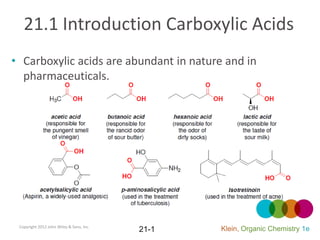
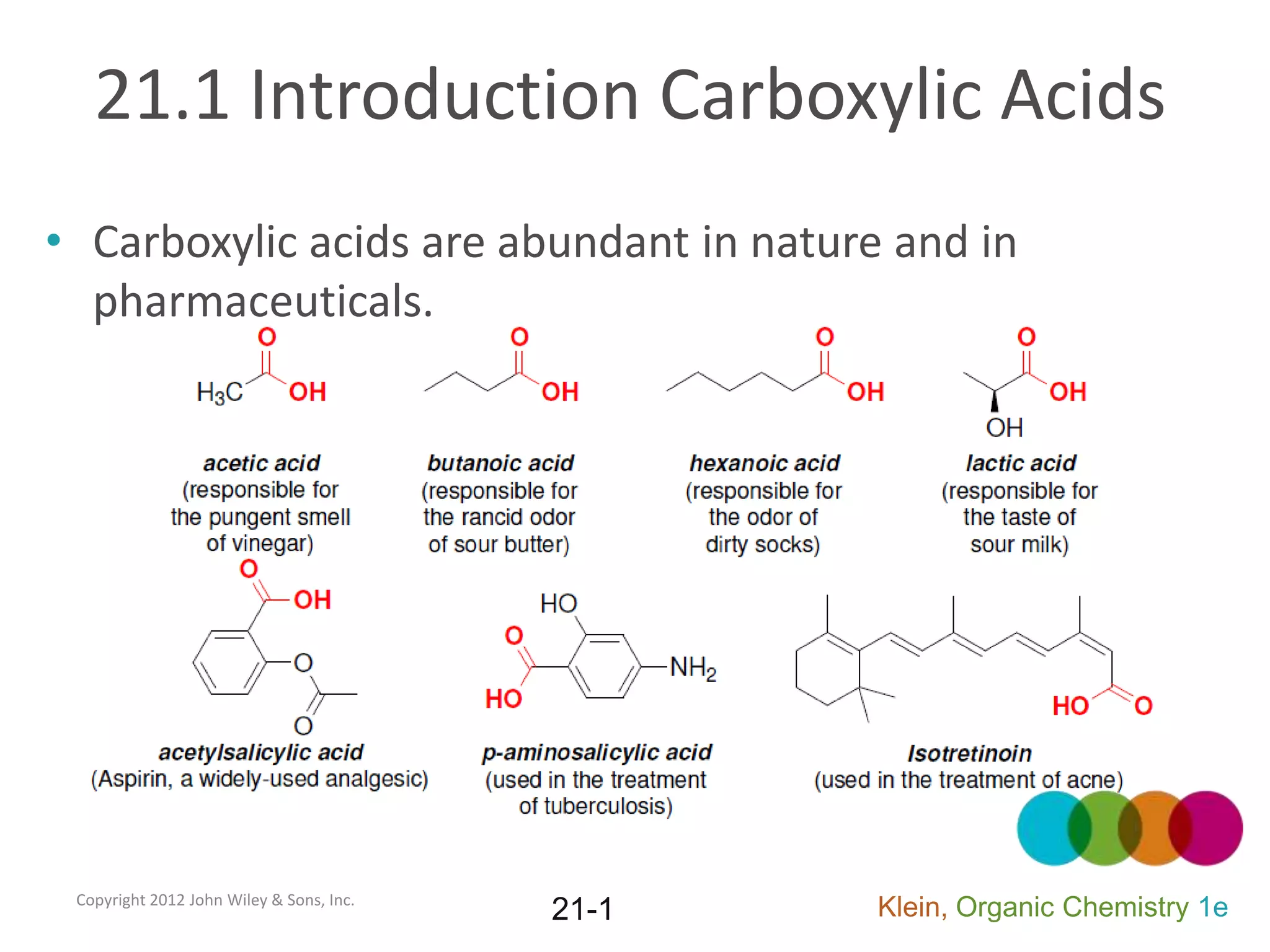
21.1 Introduction Carboxylic Acids
• Carboxylic acids are abundant in nature and in
  pharmaceuticals.


 Copyright 2012 John Wiley & Sons, Inc.
                                          21-1   Klein, Organic Chemistry 1e
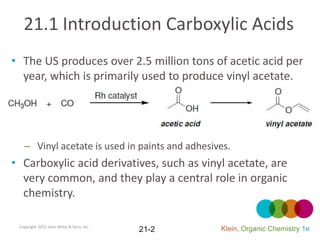
21.1 Introduction Carboxylic Acids
• The US produces over 2.5 million tons of acetic acid per
  year, which is primarily used to produce vinyl acetate.


   – Vinyl acetate is used in paints and adhesives.
• Carboxylic acid derivatives, such as vinyl acetate, are
  very common, and they play a central role in organic
  chemistry.

 Copyright 2012 John Wiley & Sons, Inc.
                                          21-2   Klein, Organic Chemistry 1e
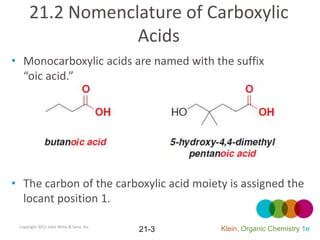
21.2 Nomenclature of Carboxylic
                  Acids
• Monocarboxylic acids are named with the suffix
  “oic acid.”


• The carbon of the carboxylic acid moiety is assigned the
  locant position 1.

 Copyright 2012 John Wiley & Sons, Inc.
                                          21-3   Klein, Organic Chemistry 1e
21.2 Nomenclature of Carboxylic
                  Acids
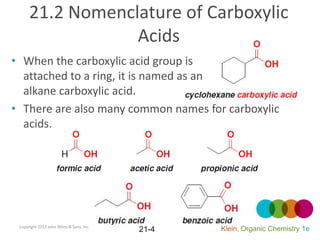
• When the carboxylic acid group is
  attached to a ring, it is named as an
  alkane carboxylic acid.
• There are also many common names for carboxylic
  acids.


 Copyright 2012 John Wiley & Sons, Inc.
                                          21-4   Klein, Organic Chemistry 1e
21.2 Nomenclature of Carboxylic
                  Acids
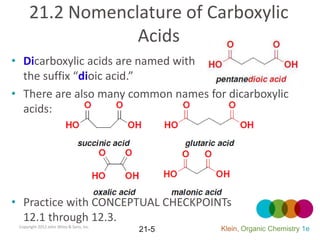
• Dicarboxylic acids are named with
  the suffix “dioic acid.”
• There are also many common names for dicarboxylic
  acids:


• Practice with CONCEPTUAL CHECKPOINTs
  12.1 through 12.3.
 Copyright 2012 John Wiley & Sons, Inc.
                                          21-5   Klein, Organic Chemistry 1e
21.3 Structure and Properties of
               Carboxylic Acids
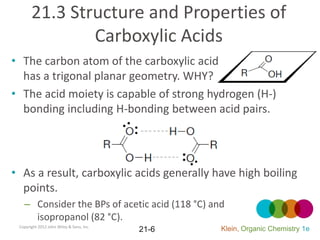
• The carbon atom of the carboxylic acid
  has a trigonal planar geometry. WHY?
• The acid moiety is capable of strong hydrogen (H-)
  bonding including H-bonding between acid pairs.


• As a result, carboxylic acids generally have high boiling
  points.
   – Consider the BPs of acetic acid (118 °C) and
     isopropanol (82 °C).
 Copyright 2012 John Wiley & Sons, Inc.
                                          21-6   Klein, Organic Chemistry 1e
21.3 Structure and Properties of
               Carboxylic Acids
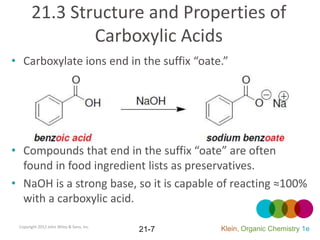
• Carboxylate ions end in the suffix “oate.”


• Compounds that end in the suffix “oate” are often
  found in food ingredient lists as preservatives.
• NaOH is a strong base, so it is capable of reacting ≈100%
  with a carboxylic acid.

 Copyright 2012 John Wiley & Sons, Inc.
                                          21-7   Klein, Organic Chemistry 1e
21.3 Structure and Properties of
               Carboxylic Acids
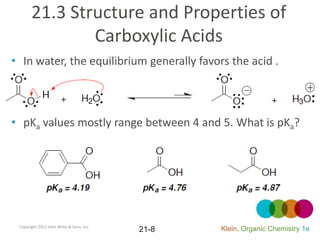
• In water, the equilibrium generally favors the acid .


• pKa values mostly range between 4 and 5. What is pKa?


 Copyright 2012 John Wiley & Sons, Inc.
                                          21-8   Klein, Organic Chemistry 1e
21.3 Structure and Properties of
               Carboxylic Acids
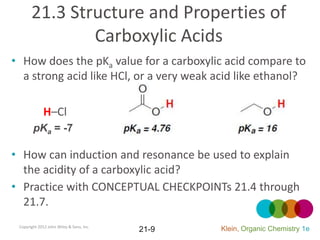
• How does the pKa value for a carboxylic acid compare to
  a strong acid like HCl, or a very weak acid like ethanol?

              H–Cl
        pKa = -7

• How can induction and resonance be used to explain
  the acidity of a carboxylic acid?
• Practice with CONCEPTUAL CHECKPOINTs 21.4 through
  21.7.
 Copyright 2012 John Wiley & Sons, Inc.
                                          21-9   Klein, Organic Chemistry 1e
21.3 Structure and Properties of
               Carboxylic Acids
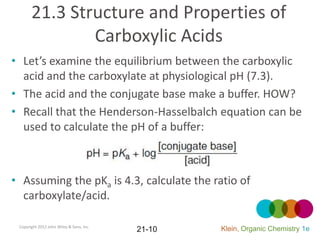
• Let’s examine the equilibrium between the carboxylic
  acid and the carboxylate at physiological pH (7.3).
• The acid and the conjugate base make a buffer. HOW?
• Recall that the Henderson-Hasselbalch equation can be
  used to calculate the pH of a buffer:


• Assuming the pKa is 4.3, calculate the ratio of
  carboxylate/acid.

 Copyright 2012 John Wiley & Sons, Inc.
                                          21-10   Klein, Organic Chemistry 1e
21.3 Structure and Properties of
               Carboxylic Acids
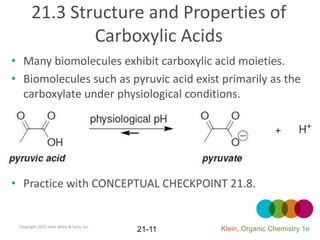
• Many biomolecules exhibit carboxylic acid moieties.
• Biomolecules such as pyruvic acid exist primarily as the
  carboxylate under physiological conditions.


• Practice with CONCEPTUAL CHECKPOINT 21.8.


 Copyright 2012 John Wiley & Sons, Inc.
                                          21-11   Klein, Organic Chemistry 1e
21.3 Structure and Properties of
               Carboxylic Acids
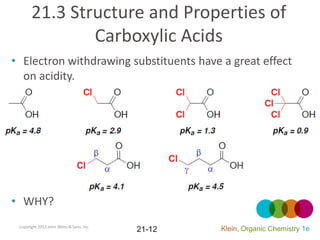
• Electron withdrawing substituents have a great effect
  on acidity.


• WHY?
 Copyright 2012 John Wiley & Sons, Inc.
                                          21-12   Klein, Organic Chemistry 1e
21.3 Structure and Properties of
               Carboxylic Acids
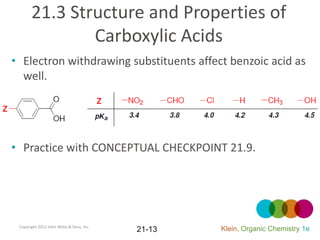
• Electron withdrawing substituents affect benzoic acid as
  well.


• Practice with CONCEPTUAL CHECKPOINT 21.9.


 Copyright 2012 John Wiley & Sons, Inc.
                                          21-13   Klein, Organic Chemistry 1e
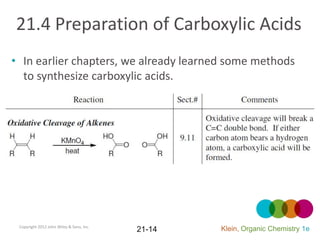
21.4 Preparation of Carboxylic Acids
• In earlier chapters, we already learned some methods
  to synthesize carboxylic acids.


 Copyright 2012 John Wiley & Sons, Inc.
                                          21-14   Klein, Organic Chemistry 1e
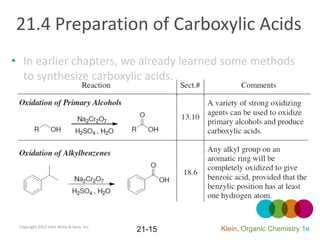
21.4 Preparation of Carboxylic Acids
• In earlier chapters, we already learned some methods
  to synthesize carboxylic acids.


 Copyright 2012 John Wiley & Sons, Inc.
                                          21-15   Klein, Organic Chemistry 1e
21.4 Preparation of Carboxylic Acids
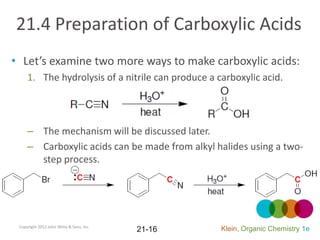
• Let’s examine two more ways to make carboxylic acids:
     1. The hydrolysis of a nitrile can produce a carboxylic acid.


     – The mechanism will be discussed later.
     – Carboxylic acids can be made from alkyl halides using a two-
       step process.


 Copyright 2012 John Wiley & Sons, Inc.
                                          21-16    Klein, Organic Chemistry 1e
21.4 Preparation of Carboxylic Acids
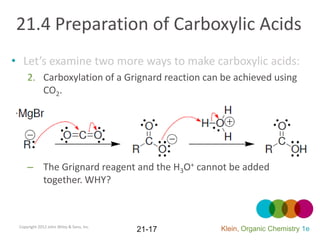
• Let’s examine two more ways to make carboxylic acids:
     2. Carboxylation of a Grignard reaction can be achieved using
        CO2.


     – The Grignard reagent and the H3O+ cannot be added
       together. WHY?


 Copyright 2012 John Wiley & Sons, Inc.
                                          21-17   Klein, Organic Chemistry 1e
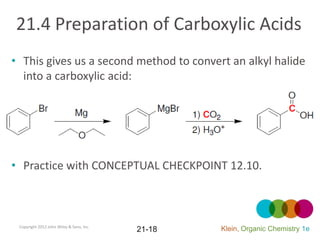
21.4 Preparation of Carboxylic Acids
• This gives us a second method to convert an alkyl halide
  into a carboxylic acid:


• Practice with CONCEPTUAL CHECKPOINT 12.10.


 Copyright 2012 John Wiley & Sons, Inc.
                                          21-18   Klein, Organic Chemistry 1e
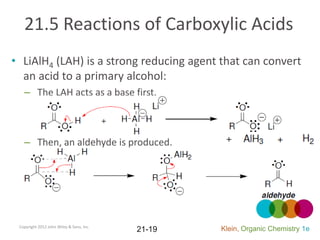
21.5 Reactions of Carboxylic Acids
• LiAlH4 (LAH) is a strong reducing agent that can convert
  an acid to a primary alcohol:
   – The LAH acts as a base first.


   – Then, an aldehyde is produced.


 Copyright 2012 John Wiley & Sons, Inc.
                                          21-19   Klein, Organic Chemistry 1e
21.5 Reactions of Carboxylic Acids
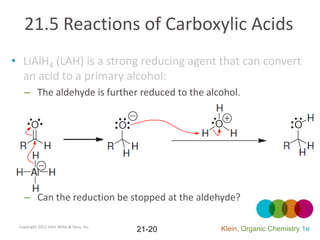
• LiAlH4 (LAH) is a strong reducing agent that can convert
  an acid to a primary alcohol:
   – The aldehyde is further reduced to the alcohol.


   – Can the reduction be stopped at the aldehyde?

 Copyright 2012 John Wiley & Sons, Inc.
                                          21-20   Klein, Organic Chemistry 1e
21.5 Reactions of Carboxylic Acids
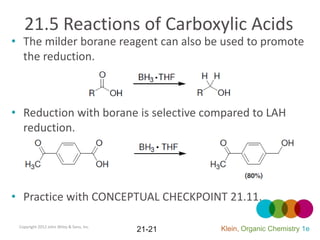
• The milder borane reagent can also be used to promote
  the reduction.


• Reduction with borane is selective compared to LAH
  reduction.


• Practice with CONCEPTUAL CHECKPOINT 21.11.

 Copyright 2012 John Wiley & Sons, Inc.
                                          21-21   Klein, Organic Chemistry 1e
21.6 Introduction to Carboxylic Acid
             Derivatives
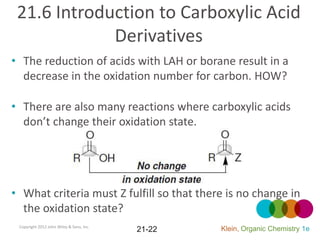
• The reduction of acids with LAH or borane result in a
  decrease in the oxidation number for carbon. HOW?

• There are also many reactions where carboxylic acids
  don’t change their oxidation state.


• What criteria must Z fulfill so that there is no change in
  the oxidation state?
 Copyright 2012 John Wiley & Sons, Inc.
                                          21-22   Klein, Organic Chemistry 1e
21.6 Introduction to Carboxylic Acid
             Derivatives
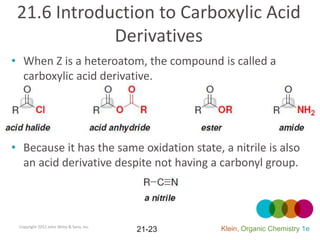
• When Z is a heteroatom, the compound is called a
  carboxylic acid derivative.


• Because it has the same oxidation state, a nitrile is also
  an acid derivative despite not having a carbonyl group.


 Copyright 2012 John Wiley & Sons, Inc.
                                          21-23   Klein, Organic Chemistry 1e
21.6 Introduction to Carboxylic Acid
             Derivatives
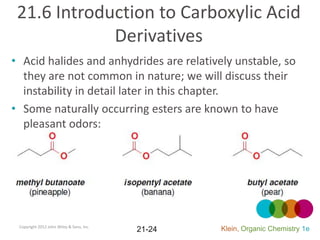
• Acid halides and anhydrides are relatively unstable, so
  they are not common in nature; we will discuss their
  instability in detail later in this chapter.
• Some naturally occurring esters are known to have
  pleasant odors:


 Copyright 2012 John Wiley & Sons, Inc.
                                          21-24   Klein, Organic Chemistry 1e
21.6 Introduction to Carboxylic Acid
             Derivatives
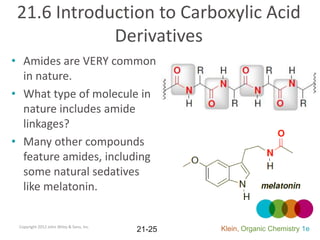
• Amides are VERY common
  in nature.
• What type of molecule in
  nature includes amide
  linkages?
• Many other compounds
  feature amides, including
  some natural sedatives
  like melatonin.


 Copyright 2012 John Wiley & Sons, Inc.
                                          21-25   Klein, Organic Chemistry 1e
21.6 Introduction to Carboxylic Acid
             Derivatives
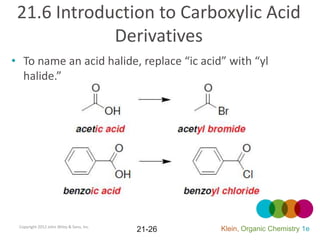
• To name an acid halide, replace “ic acid” with “yl
  halide.”


 Copyright 2012 John Wiley & Sons, Inc.
                                          21-26   Klein, Organic Chemistry 1e
21.6 Introduction to Carboxylic Acid
             Derivatives
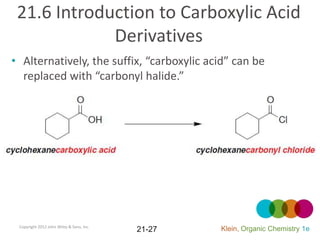
• Alternatively, the suffix, “carboxylic acid” can be
  replaced with “carbonyl halide.”


 Copyright 2012 John Wiley & Sons, Inc.
                                          21-27   Klein, Organic Chemistry 1e
21.6 Introduction to Carboxylic Acid
             Derivatives
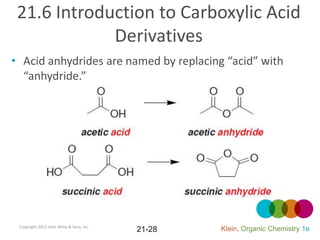
• Acid anhydrides are named by replacing “acid” with
  “anhydride.”


 Copyright 2012 John Wiley & Sons, Inc.
                                          21-28   Klein, Organic Chemistry 1e
21.6 Introduction to Carboxylic Acid
             Derivatives
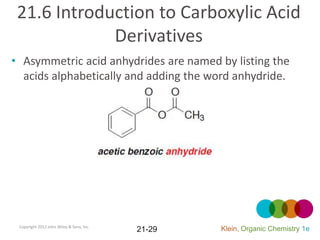
• Asymmetric acid anhydrides are named by listing the
  acids alphabetically and adding the word anhydride.


 Copyright 2012 John Wiley & Sons, Inc.
                                          21-29   Klein, Organic Chemistry 1e
21.6 Introduction to Carboxylic Acid
             Derivatives
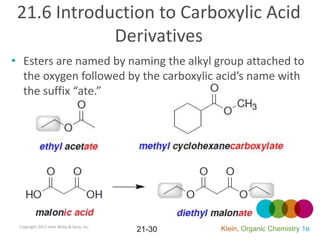
• Esters are named by naming the alkyl group attached to
  the oxygen followed by the carboxylic acid’s name with
  the suffix “ate.”


 Copyright 2012 John Wiley & Sons, Inc.
                                          21-30   Klein, Organic Chemistry 1e
21.6 Introduction to Carboxylic Acid
             Derivatives
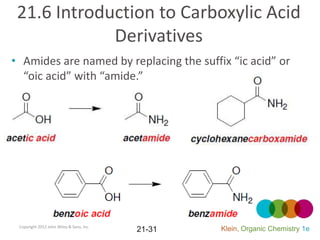
• Amides are named by replacing the suffix “ic acid” or
  “oic acid” with “amide.”


 Copyright 2012 John Wiley & Sons, Inc.
                                          21-31   Klein, Organic Chemistry 1e
21.6 Introduction to Carboxylic Acid
             Derivatives
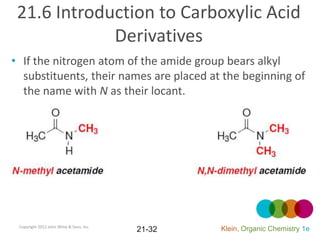
• If the nitrogen atom of the amide group bears alkyl
  substituents, their names are placed at the beginning of
  the name with N as their locant.


 Copyright 2012 John Wiley & Sons, Inc.
                                          21-32   Klein, Organic Chemistry 1e
21.6 Introduction to Carboxylic Acid
             Derivatives
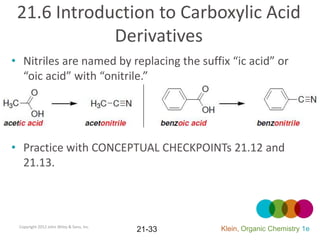
• Nitriles are named by replacing the suffix “ic acid” or
  “oic acid” with “onitrile.”


• Practice with CONCEPTUAL CHECKPOINTs 21.12 and
  21.13.


 Copyright 2012 John Wiley & Sons, Inc.
                                          21-33   Klein, Organic Chemistry 1e
21.7 Reactivity of Carboxylic Acid
                Derivatives
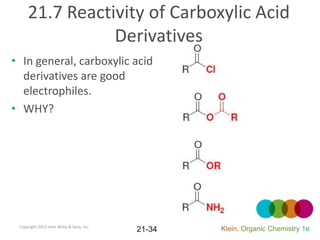
• In general, carboxylic acid
  derivatives are good
  electrophiles.
• WHY?


 Copyright 2012 John Wiley & Sons, Inc.
                                          21-34   Klein, Organic Chemistry 1e
21.7 Reactivity of Carboxylic Acid
               Derivatives
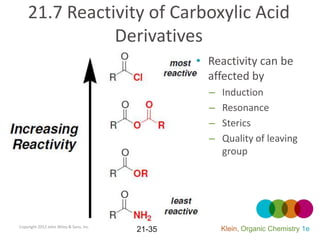
                                                 • Reactivity can be
                                                   affected by
                                                   –   Induction
                                                   –   Resonance
                                                   –   Sterics
                                                   –   Quality of leaving
                                                       group


Copyright 2012 John Wiley & Sons, Inc.
                                         21-35         Klein, Organic Chemistry 1e
21.7 Reactivity of Carboxylic Acid
                Derivatives
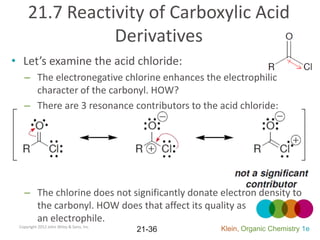
• Let’s examine the acid chloride:
   – The electronegative chlorine enhances the electrophilic
     character of the carbonyl. HOW?
   – There are 3 resonance contributors to the acid chloride:


   – The chlorine does not significantly donate electron density to
     the carbonyl. HOW does that affect its quality as
     an electrophile.
 Copyright 2012 John Wiley & Sons, Inc.
                                          21-36   Klein, Organic Chemistry 1e
21.7 Reactivity of Carboxylic Acid
                Derivatives
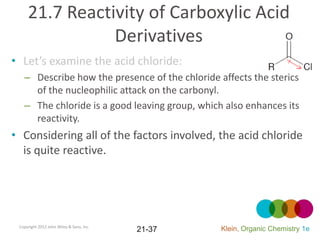
• Let’s examine the acid chloride:
   – Describe how the presence of the chloride affects the sterics
     of the nucleophilic attack on the carbonyl.
   – The chloride is a good leaving group, which also enhances its
     reactivity.
• Considering all of the factors involved, the acid chloride
  is quite reactive.


 Copyright 2012 John Wiley & Sons, Inc.
                                          21-37   Klein, Organic Chemistry 1e
21.7 Reactivity of Carboxylic Acid
                Derivatives
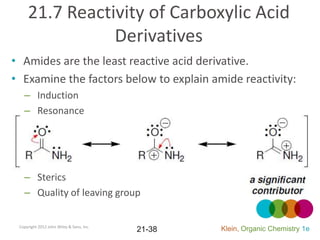
• Amides are the least reactive acid derivative.
• Examine the factors below to explain amide reactivity:
   – Induction
   – Resonance


   – Sterics
   – Quality of leaving group


 Copyright 2012 John Wiley & Sons, Inc.
                                          21-38   Klein, Organic Chemistry 1e
21.7 Reactivity of Carboxylic Acid
                Derivatives
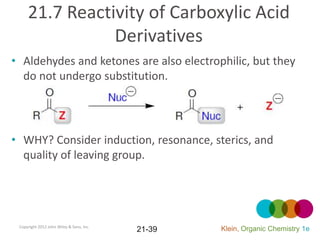
• Aldehydes and ketones are also electrophilic, but they
  do not undergo substitution.


• WHY? Consider induction, resonance, sterics, and
  quality of leaving group.


 Copyright 2012 John Wiley & Sons, Inc.
                                          21-39   Klein, Organic Chemistry 1e
21.7 Reactivity of Carboxylic Acid
                Derivatives
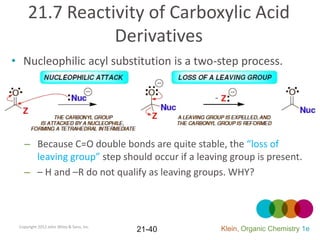
• Nucleophilic acyl substitution is a two-step process.


   – Because C=O double bonds are quite stable, the “loss of
     leaving group” step should occur if a leaving group is present.
   – – H and –R do not qualify as leaving groups. WHY?


 Copyright 2012 John Wiley & Sons, Inc.
                                          21-40   Klein, Organic Chemistry 1e
21.7 Reactivity of Carboxylic Acid
                Derivatives
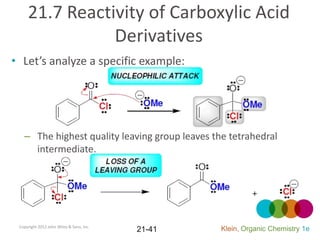
• Let’s analyze a specific example:


   – The highest quality leaving group leaves the tetrahedral
     intermediate.


 Copyright 2012 John Wiley & Sons, Inc.
                                          21-41   Klein, Organic Chemistry 1e
21.7 Reactivity of Carboxylic Acid
                Derivatives
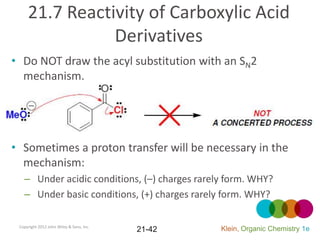
• Do NOT draw the acyl substitution with an SN2
  mechanism.


• Sometimes a proton transfer will be necessary in the
  mechanism:
   – Under acidic conditions, (–) charges rarely form. WHY?
   – Under basic conditions, (+) charges rarely form. WHY?

 Copyright 2012 John Wiley & Sons, Inc.
                                          21-42   Klein, Organic Chemistry 1e
21.7 Reactivity of Carboxylic Acid
                Derivatives
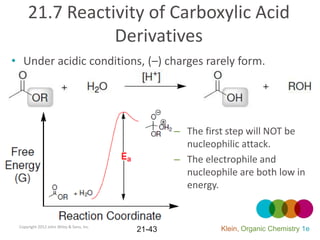
• Under acidic conditions, (–) charges rarely form.


                                                  – The first step will NOT be
                                                    nucleophilic attack.
                                                  – The electrophile and
                                                    nucleophile are both low in
                                                    energy.


 Copyright 2012 John Wiley & Sons, Inc.
                                          21-43             Klein, Organic Chemistry 1e
21.7 Reactivity of Carboxylic Acid
               Derivatives
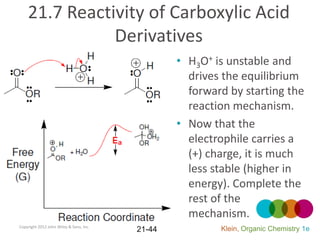
                                                 • H3O+ is unstable and
                                                   drives the equilibrium
                                                   forward by starting the
                                                   reaction mechanism.
                                                 • Now that the
                                                   electrophile carries a
                                                   (+) charge, it is much
                                                   less stable (higher in
                                                   energy). Complete the
                                                   rest of the
                                                   mechanism.
Copyright 2012 John Wiley & Sons, Inc.
                                         21-44           Klein, Organic Chemistry 1e
21.7 Reactivity of Carboxylic Acid
               Derivatives
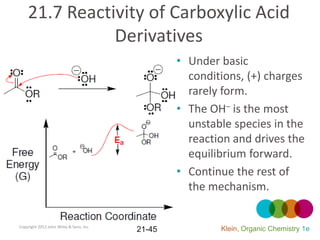
                                                 • Under basic
                                                   conditions, (+) charges
                                                   rarely form.
                                                 • The OH– is the most
                                                   unstable species in the
                                                   reaction and drives the
                                                   equilibrium forward.
                                                 • Continue the rest of
                                                   the mechanism.


Copyright 2012 John Wiley & Sons, Inc.
                                         21-45           Klein, Organic Chemistry 1e
21.7 Reactivity of Carboxylic Acid
                Derivatives
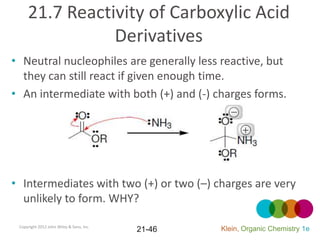
• Neutral nucleophiles are generally less reactive, but
  they can still react if given enough time.
• An intermediate with both (+) and (-) charges forms.


• Intermediates with two (+) or two (–) charges are very
  unlikely to form. WHY?

 Copyright 2012 John Wiley & Sons, Inc.
                                          21-46   Klein, Organic Chemistry 1e
21.7 Reactivity of Carboxylic Acid
                Derivatives
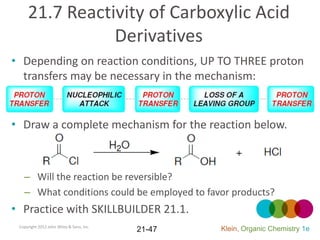
• Depending on reaction conditions, UP TO THREE proton
  transfers may be necessary in the mechanism:


• Draw a complete mechanism for the reaction below.


   – Will the reaction be reversible?
   – What conditions could be employed to favor products?
• Practice with SKILLBUILDER 21.1.
 Copyright 2012 John Wiley & Sons, Inc.
                                          21-47   Klein, Organic Chemistry 1e
21.7 Reactivity of Carboxylic Acid
                Derivatives
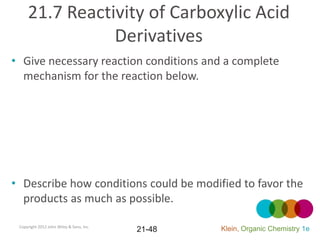
• Give necessary reaction conditions and a complete
  mechanism for the reaction below.


• Describe how conditions could be modified to favor the
  products as much as possible.

 Copyright 2012 John Wiley & Sons, Inc.
                                          21-48   Klein, Organic Chemistry 1e
21.8 Preparation and Reaction of
              Acid Chlorides
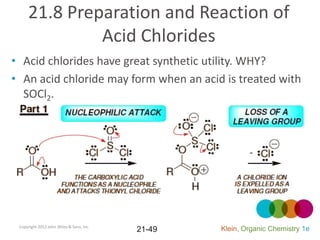
• Acid chlorides have great synthetic utility. WHY?
• An acid chloride may form when an acid is treated with
  SOCl2.


 Copyright 2012 John Wiley & Sons, Inc.
                                          21-49   Klein, Organic Chemistry 1e
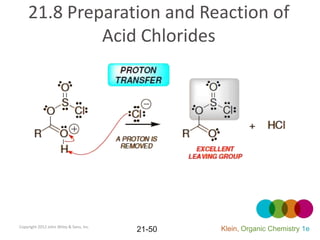
21.8 Preparation and Reaction of
             Acid Chlorides


Copyright 2012 John Wiley & Sons, Inc.
                                         21-50   Klein, Organic Chemistry 1e
21.8 Preparation and Reaction of
              Acid Chlorides


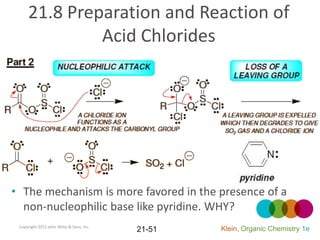
• The mechanism is more favored in the presence of a
  non-nucleophilic base like pyridine. WHY?
 Copyright 2012 John Wiley & Sons, Inc.
                                          21-51   Klein, Organic Chemistry 1e
21.8 Preparation and Reaction of
       Acid Chlorides: HYDROLYSIS
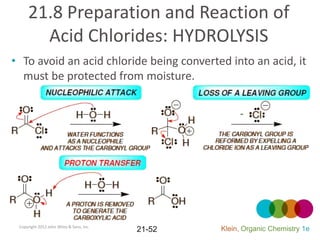
• To avoid an acid chloride being converted into an acid, it
  must be protected from moisture.


 Copyright 2012 John Wiley & Sons, Inc.
                                          21-52   Klein, Organic Chemistry 1e
21.8 Preparation and Reaction of
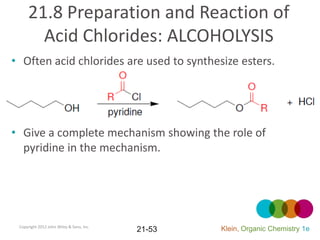
       Acid Chlorides: ALCOHOLYSIS
• Often acid chlorides are used to synthesize esters.


• Give a complete mechanism showing the role of
  pyridine in the mechanism.


 Copyright 2012 John Wiley & Sons, Inc.
                                          21-53   Klein, Organic Chemistry 1e
21.8 Preparation and Reaction of
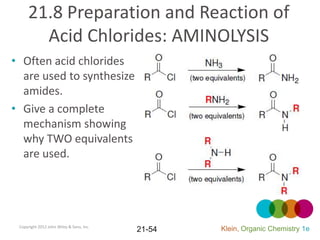
       Acid Chlorides: AMINOLYSIS
• Often acid chlorides
  are used to synthesize
  amides.
• Give a complete
  mechanism showing
  why TWO equivalents
  are used.


 Copyright 2012 John Wiley & Sons, Inc.
                                          21-54   Klein, Organic Chemistry 1e
21.8 Preparation and Reaction of
              Acid Chlorides
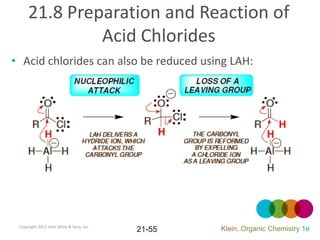
• Acid chlorides can also be reduced using LAH:


 Copyright 2012 John Wiley & Sons, Inc.
                                          21-55   Klein, Organic Chemistry 1e
21.8 Preparation and Reaction of
              Acid Chlorides
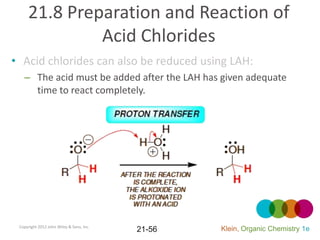
• Acid chlorides can also be reduced using LAH:
   – The acid must be added after the LAH has given adequate
     time to react completely.


 Copyright 2012 John Wiley & Sons, Inc.
                                          21-56   Klein, Organic Chemistry 1e
21.8 Preparation and Reaction of
              Acid Chlorides
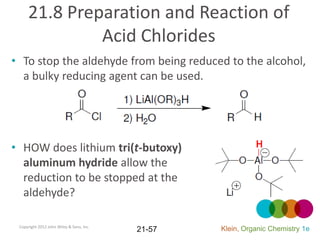
• To stop the aldehyde from being reduced to the alcohol,
  a bulky reducing agent can be used.


• HOW does lithium tri(t-butoxy)
  aluminum hydride allow the
  reduction to be stopped at the
  aldehyde?

 Copyright 2012 John Wiley & Sons, Inc.
                                          21-57   Klein, Organic Chemistry 1e
21.8 Preparation and Reaction of
              Acid Chlorides
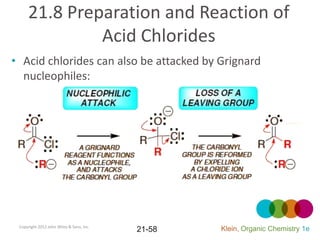
• Acid chlorides can also be attacked by Grignard
  nucleophiles:


 Copyright 2012 John Wiley & Sons, Inc.
                                          21-58   Klein, Organic Chemistry 1e
21.8 Preparation and Reaction of
              Acid Chlorides
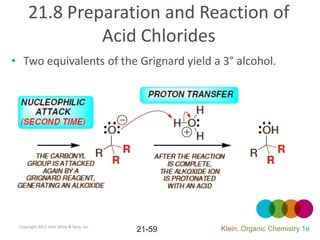
• Two equivalents of the Grignard yield a 3° alcohol.


 Copyright 2012 John Wiley & Sons, Inc.
                                          21-59   Klein, Organic Chemistry 1e
21.8 Preparation and Reaction of
              Acid Chlorides
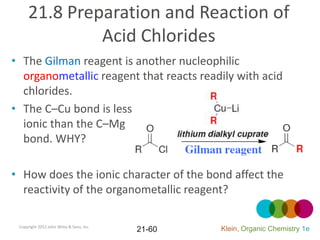
• The Gilman reagent is another nucleophilic
  organometallic reagent that reacts readily with acid
  chlorides.
• The C–Cu bond is less
  ionic than the C–Mg
  bond. WHY?

• How does the ionic character of the bond affect the
  reactivity of the organometallic reagent?

 Copyright 2012 John Wiley & Sons, Inc.
                                          21-60   Klein, Organic Chemistry 1e
21.8 Preparation and Reaction of
              Acid Chlorides
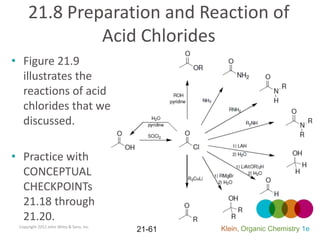
• Figure 21.9
  illustrates the
  reactions of acid
  chlorides that we
  discussed.

• Practice with
  CONCEPTUAL
  CHECKPOINTs
  21.18 through
  21.20.
 Copyright 2012 John Wiley & Sons, Inc.
                                          21-61   Klein, Organic Chemistry 1e
21.8 Preparation and Reaction of
              Acid Chlorides
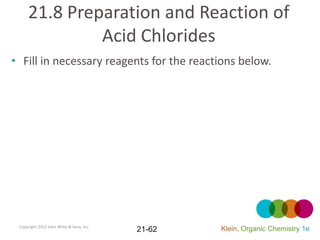
• Fill in necessary reagents for the reactions below.


 Copyright 2012 John Wiley & Sons, Inc.
                                          21-62   Klein, Organic Chemistry 1e
21.9 Preparation and Reactions of
           Acid Anhydrides
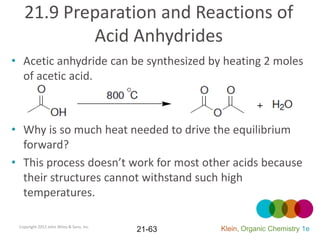
• Acetic anhydride can be synthesized by heating 2 moles
  of acetic acid.


• Why is so much heat needed to drive the equilibrium
  forward?
• This process doesn’t work for most other acids because
  their structures cannot withstand such high
  temperatures.

 Copyright 2012 John Wiley & Sons, Inc.
                                          21-63   Klein, Organic Chemistry 1e
21.9 Preparation and Reactions of
           Acid Anhydrides
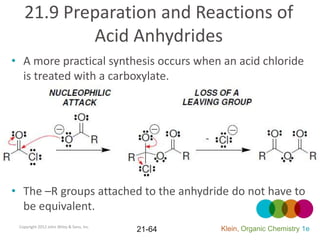
• A more practical synthesis occurs when an acid chloride
  is treated with a carboxylate.


• The –R groups attached to the anhydride do not have to
  be equivalent.
 Copyright 2012 John Wiley & Sons, Inc.
                                          21-64   Klein, Organic Chemistry 1e
21.9 Preparation and Reactions of
           Acid Anhydrides
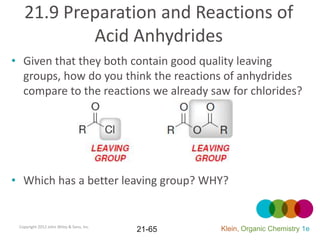
• Given that they both contain good quality leaving
  groups, how do you think the reactions of anhydrides
  compare to the reactions we already saw for chlorides?


• Which has a better leaving group? WHY?


 Copyright 2012 John Wiley & Sons, Inc.
                                          21-65   Klein, Organic Chemistry 1e
21.9 Preparation and Reactions of
           Acid Anhydrides
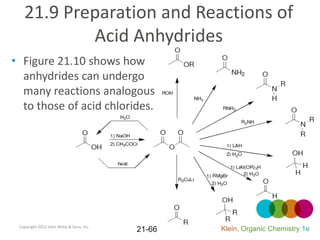
• Figure 21.10 shows how
  anhydrides can undergo
  many reactions analogous
  to those of acid chlorides.


 Copyright 2012 John Wiley & Sons, Inc.
                                          21-66   Klein, Organic Chemistry 1e
21.9 Preparation and Reactions of
           Acid Anhydrides
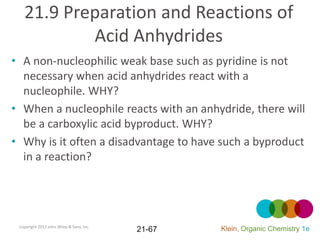
• A non-nucleophilic weak base such as pyridine is not
  necessary when acid anhydrides react with a
  nucleophile. WHY?
• When a nucleophile reacts with an anhydride, there will
  be a carboxylic acid byproduct. WHY?
• Why is it often a disadvantage to have such a byproduct
  in a reaction?


 Copyright 2012 John Wiley & Sons, Inc.
                                          21-67   Klein, Organic Chemistry 1e
21.9 Preparation and Reactions of
           Acid Anhydrides
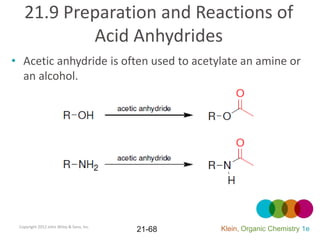
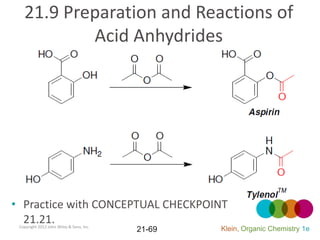
• Acetic anhydride is often used to acetylate an amine or
  an alcohol.


 Copyright 2012 John Wiley & Sons, Inc.
                                          21-68   Klein, Organic Chemistry 1e
21.9 Preparation and Reactions of
           Acid Anhydrides


• Practice with CONCEPTUAL CHECKPOINT
  21.21.
 Copyright 2012 John Wiley & Sons, Inc.
                                          21-69   Klein, Organic Chemistry 1e
21.10 Preparation of Esters
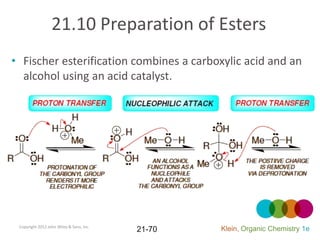
• Fischer esterification combines a carboxylic acid and an
  alcohol using an acid catalyst.


 Copyright 2012 John Wiley & Sons, Inc.
                                          21-70   Klein, Organic Chemistry 1e
21.10 Preparation of Esters
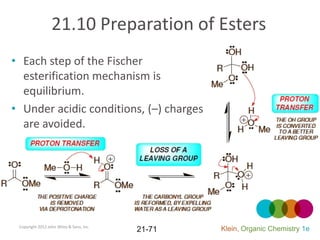
• Each step of the Fischer
  esterification mechanism is
  equilibrium.
• Under acidic conditions, (–) charges
  are avoided.


 Copyright 2012 John Wiley & Sons, Inc.
                                          21-71   Klein, Organic Chemistry 1e
21.10 Preparation of Esters
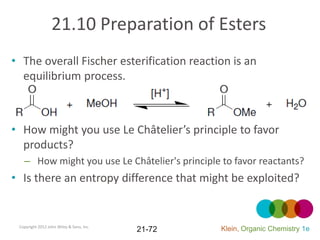
• The overall Fischer esterification reaction is an
  equilibrium process.


• How might you use Le Châtelier’s principle to favor
  products?
   – How might you use Le Châtelier's principle to favor reactants?
• Is there an entropy difference that might be exploited?


 Copyright 2012 John Wiley & Sons, Inc.
                                          21-72   Klein, Organic Chemistry 1e
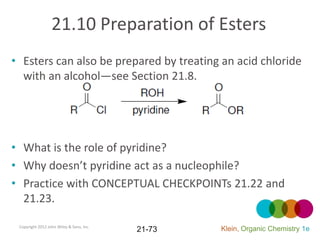
21.10 Preparation of Esters
• Esters can also be prepared by treating an acid chloride
  with an alcohol—see Section 21.8.


• What is the role of pyridine?
• Why doesn’t pyridine act as a nucleophile?
• Practice with CONCEPTUAL CHECKPOINTs 21.22 and
  21.23.

 Copyright 2012 John Wiley & Sons, Inc.
                                          21-73   Klein, Organic Chemistry 1e
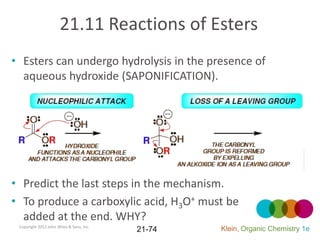
21.11 Reactions of Esters
• Esters can undergo hydrolysis in the presence of
  aqueous hydroxide (SAPONIFICATION).


• Predict the last steps in the mechanism.
• To produce a carboxylic acid, H3O+ must be
  added at the end. WHY?
 Copyright 2012 John Wiley & Sons, Inc.
                                          21-74   Klein, Organic Chemistry 1e
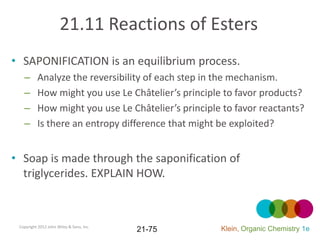
21.11 Reactions of Esters
• SAPONIFICATION is an equilibrium process.
   –      Analyze the reversibility of each step in the mechanism.
   –      How might you use Le Châtelier’s principle to favor products?
   –      How might you use Le Châtelier’s principle to favor reactants?
   –      Is there an entropy difference that might be exploited?


• Soap is made through the saponification of
  triglycerides. EXPLAIN HOW.


 Copyright 2012 John Wiley & Sons, Inc.
                                          21-75     Klein, Organic Chemistry 1e
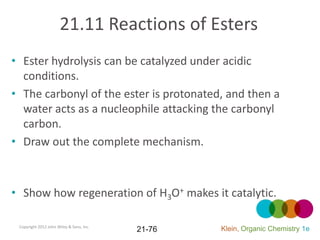
21.11 Reactions of Esters
• Ester hydrolysis can be catalyzed under acidic
  conditions.
• The carbonyl of the ester is protonated, and then a
  water acts as a nucleophile attacking the carbonyl
  carbon.
• Draw out the complete mechanism.


• Show how regeneration of H3O+ makes it catalytic.

 Copyright 2012 John Wiley & Sons, Inc.
                                          21-76   Klein, Organic Chemistry 1e
21.11 Reactions of Esters
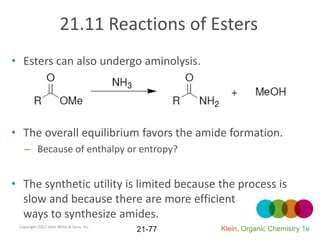
• Esters can also undergo aminolysis.


• The overall equilibrium favors the amide formation.
   – Because of enthalpy or entropy?


• The synthetic utility is limited because the process is
  slow and because there are more efficient
  ways to synthesize amides.
 Copyright 2012 John Wiley & Sons, Inc.
                                          21-77   Klein, Organic Chemistry 1e
21.11 Reactions of Esters
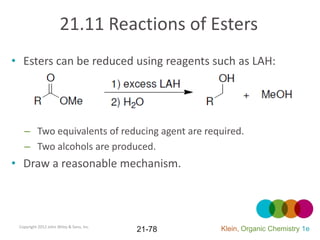
• Esters can be reduced using reagents such as LAH:


   – Two equivalents of reducing agent are required.
   – Two alcohols are produced.
• Draw a reasonable mechanism.


 Copyright 2012 John Wiley & Sons, Inc.
                                          21-78   Klein, Organic Chemistry 1e
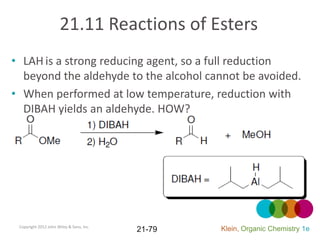
21.11 Reactions of Esters
• LAH is a strong reducing agent, so a full reduction
  beyond the aldehyde to the alcohol cannot be avoided.
• When performed at low temperature, reduction with
  DIBAH yields an aldehyde. HOW?


 Copyright 2012 John Wiley & Sons, Inc.
                                          21-79   Klein, Organic Chemistry 1e
21.11 Reactions of Esters
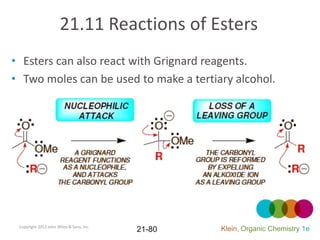
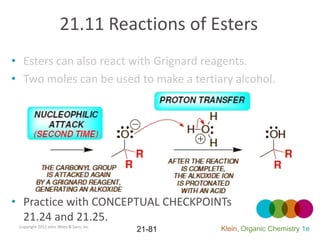
• Esters can also react with Grignard reagents.
• Two moles can be used to make a tertiary alcohol.


 Copyright 2012 John Wiley & Sons, Inc.
                                          21-80   Klein, Organic Chemistry 1e
21.11 Reactions of Esters
• Esters can also react with Grignard reagents.
• Two moles can be used to make a tertiary alcohol.


• Practice with CONCEPTUAL CHECKPOINTs
  21.24 and 21.25.
 Copyright 2012 John Wiley & Sons, Inc.
                                          21-81   Klein, Organic Chemistry 1e
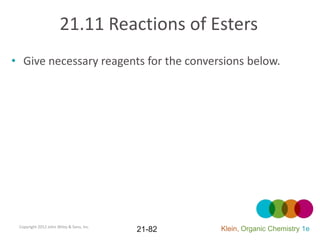
21.11 Reactions of Esters
• Give necessary reagents for the conversions below.


 Copyright 2012 John Wiley & Sons, Inc.
                                          21-82   Klein, Organic Chemistry 1e
21.12 Preparation and Reactions of
              Amides
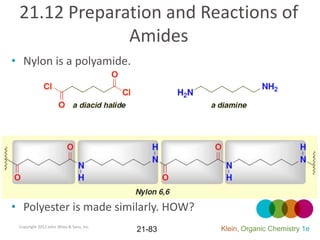
• Nylon is a polyamide.


• Polyester is made similarly. HOW?
 Copyright 2012 John Wiley & Sons, Inc.
                                          21-83   Klein, Organic Chemistry 1e
21.12 Preparation and Reactions of
              Amides
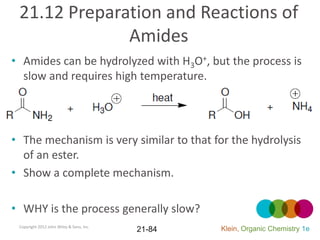
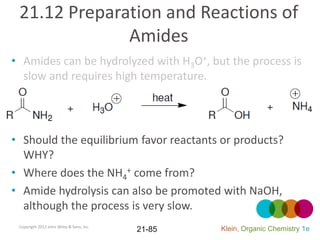
• Amides can be hydrolyzed with H3O+, but the process is
  slow and requires high temperature.


• The mechanism is very similar to that for the hydrolysis
  of an ester.
• Show a complete mechanism.

• WHY is the process generally slow?
 Copyright 2012 John Wiley & Sons, Inc.
                                          21-84   Klein, Organic Chemistry 1e
21.12 Preparation and Reactions of
              Amides
• Amides can be hydrolyzed with H3O+, but the process is
  slow and requires high temperature.


• Should the equilibrium favor reactants or products?
  WHY?
• Where does the NH4+ come from?
• Amide hydrolysis can also be promoted with NaOH,
  although the process is very slow.
 Copyright 2012 John Wiley & Sons, Inc.
                                          21-85   Klein, Organic Chemistry 1e
21.12 Preparation and Reactions of
              Amides
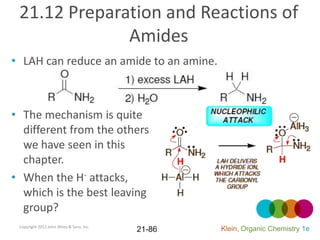
• LAH can reduce an amide to an amine.


• The mechanism is quite
  different from the others
  we have seen in this
  chapter.
• When the H- attacks,
  which is the best leaving
  group?
 Copyright 2012 John Wiley & Sons, Inc.
                                          21-86   Klein, Organic Chemistry 1e
21.12 Preparation and Reactions of
              Amides
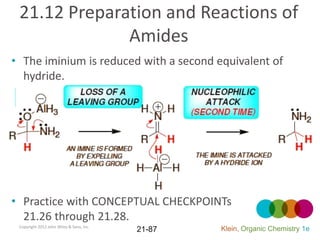
• The iminium is reduced with a second equivalent of
  hydride.


• Practice with CONCEPTUAL CHECKPOINTs
  21.26 through 21.28.
 Copyright 2012 John Wiley & Sons, Inc.
                                          21-87   Klein, Organic Chemistry 1e
21.13 Preparation and Reactions of
              Nitriles
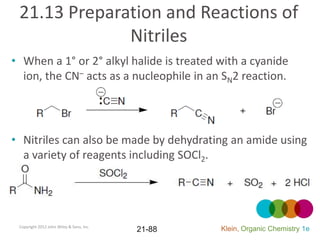
• When a 1° or 2° alkyl halide is treated with a cyanide
  ion, the CN– acts as a nucleophile in an SN2 reaction.


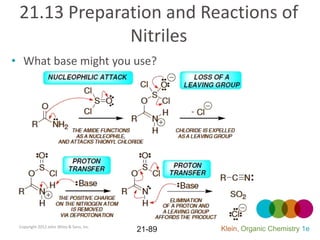
• Nitriles can also be made by dehydrating an amide using
  a variety of reagents including SOCl2.


 Copyright 2012 John Wiley & Sons, Inc.
                                          21-88   Klein, Organic Chemistry 1e
21.13 Preparation and Reactions of
              Nitriles
• What base might you use?


 Copyright 2012 John Wiley & Sons, Inc.
                                          21-89   Klein, Organic Chemistry 1e
21.13 Preparation and Reactions of
              Nitriles
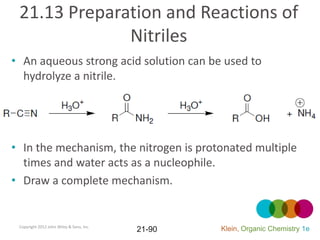
• An aqueous strong acid solution can be used to
  hydrolyze a nitrile.


• In the mechanism, the nitrogen is protonated multiple
  times and water acts as a nucleophile.
• Draw a complete mechanism.


 Copyright 2012 John Wiley & Sons, Inc.
                                          21-90   Klein, Organic Chemistry 1e
21.13 Preparation and Reactions of
              Nitriles
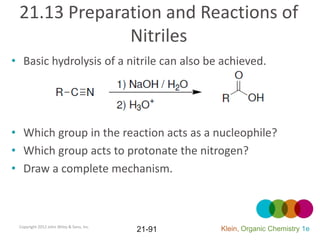
• Basic hydrolysis of a nitrile can also be achieved.


• Which group in the reaction acts as a nucleophile?
• Which group acts to protonate the nitrogen?
• Draw a complete mechanism.


 Copyright 2012 John Wiley & Sons, Inc.
                                          21-91   Klein, Organic Chemistry 1e
21.13 Preparation and Reactions of
              Nitriles
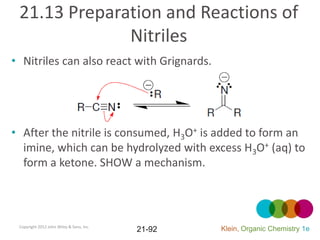
• Nitriles can also react with Grignards.


• After the nitrile is consumed, H3O+ is added to form an
  imine, which can be hydrolyzed with excess H3O+ (aq) to
  form a ketone. SHOW a mechanism.


 Copyright 2012 John Wiley & Sons, Inc.
                                          21-92   Klein, Organic Chemistry 1e
21.13 Preparation and Reactions of
              Nitriles
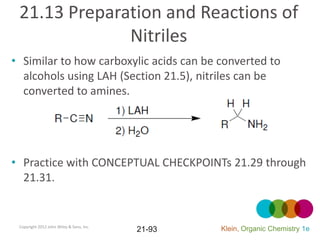
• Similar to how carboxylic acids can be converted to
  alcohols using LAH (Section 21.5), nitriles can be
  converted to amines.


• Practice with CONCEPTUAL CHECKPOINTs 21.29 through
  21.31.


 Copyright 2012 John Wiley & Sons, Inc.
                                          21-93   Klein, Organic Chemistry 1e
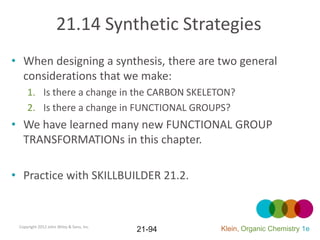
21.14 Synthetic Strategies
• When designing a synthesis, there are two general
  considerations that we make:
     1. Is there a change in the CARBON SKELETON?
     2. Is there a change in FUNCTIONAL GROUPS?
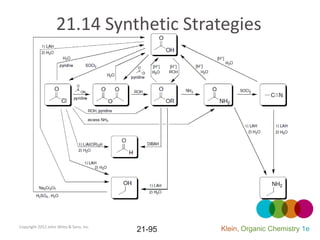
• We have learned many new FUNCTIONAL GROUP
  TRANSFORMATIONs in this chapter.

• Practice with SKILLBUILDER 21.2.


 Copyright 2012 John Wiley & Sons, Inc.
                                          21-94   Klein, Organic Chemistry 1e
21.14 Synthetic Strategies


Copyright 2012 John Wiley & Sons, Inc.
                                         21-95   Klein, Organic Chemistry 1e
21.14 Synthetic Strategies
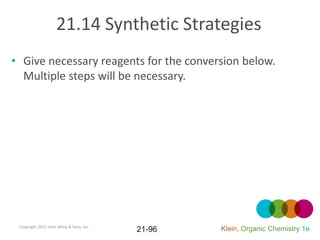
• Give necessary reagents for the conversion below.
  Multiple steps will be necessary.


 Copyright 2012 John Wiley & Sons, Inc.
                                          21-96   Klein, Organic Chemistry 1e
21.14 Synthetic Strategies
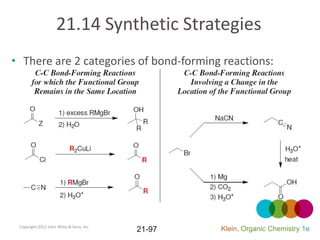
• There are 2 categories of bond-forming reactions:


 Copyright 2012 John Wiley & Sons, Inc.
                                          21-97   Klein, Organic Chemistry 1e
21.14 Synthetic Strategies
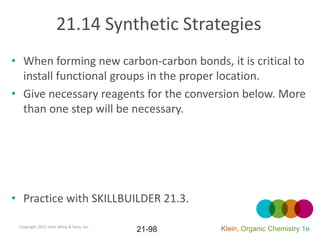
• When forming new carbon-carbon bonds, it is critical to
  install functional groups in the proper location.
• Give necessary reagents for the conversion below. More
  than one step will be necessary.


• Practice with SKILLBUILDER 21.3.

 Copyright 2012 John Wiley & Sons, Inc.
                                          21-98   Klein, Organic Chemistry 1e
21.15 Spectroscopy of Carboxylic
        Acids and Their Derivatives
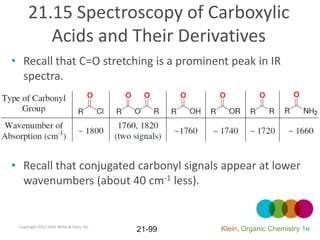
• Recall that C=O stretching is a prominent peak in IR
  spectra.


• Recall that conjugated carbonyl signals appear at lower
  wavenumbers (about 40 cm-1 less).


 Copyright 2012 John Wiley & Sons, Inc.
                                          21-99   Klein, Organic Chemistry 1e
21.15 Spectroscopy of Carboxylic
        Acids and Their Derivatives
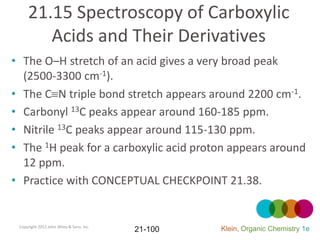
• The O–H stretch of an acid gives a very broad peak
  (2500-3300 cm-1).
• The C N triple bond stretch appears around 2200 cm-1.
• Carbonyl 13C peaks appear around 160-185 ppm.
• Nitrile 13C peaks appear around 115-130 ppm.
• The 1H peak for a carboxylic acid proton appears around
  12 ppm.
• Practice with CONCEPTUAL CHECKPOINT 21.38.


 Copyright 2012 John Wiley & Sons, Inc.
                                          21-100   Klein, Organic Chemistry 1e
21.15 Spectroscopy of Carboxylic
        Acids and Their Derivatives
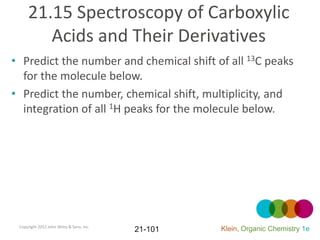
• Predict the number and chemical shift of all 13C peaks
  for the molecule below.
• Predict the number, chemical shift, multiplicity, and
  integration of all 1H peaks for the molecule below.


 Copyright 2012 John Wiley & Sons, Inc.
                                          21-101   Klein, Organic Chemistry 1e

Organic Chemistry Chapter 21 Klein

  • 1.
    21.1 Introduction CarboxylicAcids • Carboxylic acids are abundant in nature and in pharmaceuticals. Copyright 2012 John Wiley & Sons, Inc. 21-1 Klein, Organic Chemistry 1e
  • 2.
    21.1 Introduction CarboxylicAcids • The US produces over 2.5 million tons of acetic acid per year, which is primarily used to produce vinyl acetate. – Vinyl acetate is used in paints and adhesives. • Carboxylic acid derivatives, such as vinyl acetate, are very common, and they play a central role in organic chemistry. Copyright 2012 John Wiley & Sons, Inc. 21-2 Klein, Organic Chemistry 1e
  • 3.
    21.2 Nomenclature ofCarboxylic Acids • Monocarboxylic acids are named with the suffix “oic acid.” • The carbon of the carboxylic acid moiety is assigned the locant position 1. Copyright 2012 John Wiley & Sons, Inc. 21-3 Klein, Organic Chemistry 1e
  • 4.
    21.2 Nomenclature ofCarboxylic Acids • When the carboxylic acid group is attached to a ring, it is named as an alkane carboxylic acid. • There are also many common names for carboxylic acids. Copyright 2012 John Wiley & Sons, Inc. 21-4 Klein, Organic Chemistry 1e
  • 5.
    21.2 Nomenclature ofCarboxylic Acids • Dicarboxylic acids are named with the suffix “dioic acid.” • There are also many common names for dicarboxylic acids: • Practice with CONCEPTUAL CHECKPOINTs 12.1 through 12.3. Copyright 2012 John Wiley & Sons, Inc. 21-5 Klein, Organic Chemistry 1e
  • 6.
    21.3 Structure andProperties of Carboxylic Acids • The carbon atom of the carboxylic acid has a trigonal planar geometry. WHY? • The acid moiety is capable of strong hydrogen (H-) bonding including H-bonding between acid pairs. • As a result, carboxylic acids generally have high boiling points. – Consider the BPs of acetic acid (118 °C) and isopropanol (82 °C). Copyright 2012 John Wiley & Sons, Inc. 21-6 Klein, Organic Chemistry 1e
  • 7.
    21.3 Structure andProperties of Carboxylic Acids • Carboxylate ions end in the suffix “oate.” • Compounds that end in the suffix “oate” are often found in food ingredient lists as preservatives. • NaOH is a strong base, so it is capable of reacting ≈100% with a carboxylic acid. Copyright 2012 John Wiley & Sons, Inc. 21-7 Klein, Organic Chemistry 1e
  • 8.
    21.3 Structure andProperties of Carboxylic Acids • In water, the equilibrium generally favors the acid . • pKa values mostly range between 4 and 5. What is pKa? Copyright 2012 John Wiley & Sons, Inc. 21-8 Klein, Organic Chemistry 1e
  • 9.
    21.3 Structure andProperties of Carboxylic Acids • How does the pKa value for a carboxylic acid compare to a strong acid like HCl, or a very weak acid like ethanol? H–Cl pKa = -7 • How can induction and resonance be used to explain the acidity of a carboxylic acid? • Practice with CONCEPTUAL CHECKPOINTs 21.4 through 21.7. Copyright 2012 John Wiley & Sons, Inc. 21-9 Klein, Organic Chemistry 1e
  • 10.
    21.3 Structure andProperties of Carboxylic Acids • Let’s examine the equilibrium between the carboxylic acid and the carboxylate at physiological pH (7.3). • The acid and the conjugate base make a buffer. HOW? • Recall that the Henderson-Hasselbalch equation can be used to calculate the pH of a buffer: • Assuming the pKa is 4.3, calculate the ratio of carboxylate/acid. Copyright 2012 John Wiley & Sons, Inc. 21-10 Klein, Organic Chemistry 1e
  • 11.
    21.3 Structure andProperties of Carboxylic Acids • Many biomolecules exhibit carboxylic acid moieties. • Biomolecules such as pyruvic acid exist primarily as the carboxylate under physiological conditions. • Practice with CONCEPTUAL CHECKPOINT 21.8. Copyright 2012 John Wiley & Sons, Inc. 21-11 Klein, Organic Chemistry 1e
  • 12.
    21.3 Structure andProperties of Carboxylic Acids • Electron withdrawing substituents have a great effect on acidity. • WHY? Copyright 2012 John Wiley & Sons, Inc. 21-12 Klein, Organic Chemistry 1e
  • 13.
    21.3 Structure andProperties of Carboxylic Acids • Electron withdrawing substituents affect benzoic acid as well. • Practice with CONCEPTUAL CHECKPOINT 21.9. Copyright 2012 John Wiley & Sons, Inc. 21-13 Klein, Organic Chemistry 1e
  • 14.
    21.4 Preparation ofCarboxylic Acids • In earlier chapters, we already learned some methods to synthesize carboxylic acids. Copyright 2012 John Wiley & Sons, Inc. 21-14 Klein, Organic Chemistry 1e
  • 15.
    21.4 Preparation ofCarboxylic Acids • In earlier chapters, we already learned some methods to synthesize carboxylic acids. Copyright 2012 John Wiley & Sons, Inc. 21-15 Klein, Organic Chemistry 1e
  • 16.
    21.4 Preparation ofCarboxylic Acids • Let’s examine two more ways to make carboxylic acids: 1. The hydrolysis of a nitrile can produce a carboxylic acid. – The mechanism will be discussed later. – Carboxylic acids can be made from alkyl halides using a two- step process. Copyright 2012 John Wiley & Sons, Inc. 21-16 Klein, Organic Chemistry 1e
  • 17.
    21.4 Preparation ofCarboxylic Acids • Let’s examine two more ways to make carboxylic acids: 2. Carboxylation of a Grignard reaction can be achieved using CO2. – The Grignard reagent and the H3O+ cannot be added together. WHY? Copyright 2012 John Wiley & Sons, Inc. 21-17 Klein, Organic Chemistry 1e
  • 18.
    21.4 Preparation ofCarboxylic Acids • This gives us a second method to convert an alkyl halide into a carboxylic acid: • Practice with CONCEPTUAL CHECKPOINT 12.10. Copyright 2012 John Wiley & Sons, Inc. 21-18 Klein, Organic Chemistry 1e
  • 19.
    21.5 Reactions ofCarboxylic Acids • LiAlH4 (LAH) is a strong reducing agent that can convert an acid to a primary alcohol: – The LAH acts as a base first. – Then, an aldehyde is produced. Copyright 2012 John Wiley & Sons, Inc. 21-19 Klein, Organic Chemistry 1e
  • 20.
    21.5 Reactions ofCarboxylic Acids • LiAlH4 (LAH) is a strong reducing agent that can convert an acid to a primary alcohol: – The aldehyde is further reduced to the alcohol. – Can the reduction be stopped at the aldehyde? Copyright 2012 John Wiley & Sons, Inc. 21-20 Klein, Organic Chemistry 1e
  • 21.
    21.5 Reactions ofCarboxylic Acids • The milder borane reagent can also be used to promote the reduction. • Reduction with borane is selective compared to LAH reduction. • Practice with CONCEPTUAL CHECKPOINT 21.11. Copyright 2012 John Wiley & Sons, Inc. 21-21 Klein, Organic Chemistry 1e
  • 22.
    21.6 Introduction toCarboxylic Acid Derivatives • The reduction of acids with LAH or borane result in a decrease in the oxidation number for carbon. HOW? • There are also many reactions where carboxylic acids don’t change their oxidation state. • What criteria must Z fulfill so that there is no change in the oxidation state? Copyright 2012 John Wiley & Sons, Inc. 21-22 Klein, Organic Chemistry 1e
  • 23.
    21.6 Introduction toCarboxylic Acid Derivatives • When Z is a heteroatom, the compound is called a carboxylic acid derivative. • Because it has the same oxidation state, a nitrile is also an acid derivative despite not having a carbonyl group. Copyright 2012 John Wiley & Sons, Inc. 21-23 Klein, Organic Chemistry 1e
  • 24.
    21.6 Introduction toCarboxylic Acid Derivatives • Acid halides and anhydrides are relatively unstable, so they are not common in nature; we will discuss their instability in detail later in this chapter. • Some naturally occurring esters are known to have pleasant odors: Copyright 2012 John Wiley & Sons, Inc. 21-24 Klein, Organic Chemistry 1e
  • 25.
    21.6 Introduction toCarboxylic Acid Derivatives • Amides are VERY common in nature. • What type of molecule in nature includes amide linkages? • Many other compounds feature amides, including some natural sedatives like melatonin. Copyright 2012 John Wiley & Sons, Inc. 21-25 Klein, Organic Chemistry 1e
  • 26.
    21.6 Introduction toCarboxylic Acid Derivatives • To name an acid halide, replace “ic acid” with “yl halide.” Copyright 2012 John Wiley & Sons, Inc. 21-26 Klein, Organic Chemistry 1e
  • 27.
    21.6 Introduction toCarboxylic Acid Derivatives • Alternatively, the suffix, “carboxylic acid” can be replaced with “carbonyl halide.” Copyright 2012 John Wiley & Sons, Inc. 21-27 Klein, Organic Chemistry 1e
  • 28.
    21.6 Introduction toCarboxylic Acid Derivatives • Acid anhydrides are named by replacing “acid” with “anhydride.” Copyright 2012 John Wiley & Sons, Inc. 21-28 Klein, Organic Chemistry 1e
  • 29.
    21.6 Introduction toCarboxylic Acid Derivatives • Asymmetric acid anhydrides are named by listing the acids alphabetically and adding the word anhydride. Copyright 2012 John Wiley & Sons, Inc. 21-29 Klein, Organic Chemistry 1e
  • 30.
    21.6 Introduction toCarboxylic Acid Derivatives • Esters are named by naming the alkyl group attached to the oxygen followed by the carboxylic acid’s name with the suffix “ate.” Copyright 2012 John Wiley & Sons, Inc. 21-30 Klein, Organic Chemistry 1e
  • 31.
    21.6 Introduction toCarboxylic Acid Derivatives • Amides are named by replacing the suffix “ic acid” or “oic acid” with “amide.” Copyright 2012 John Wiley & Sons, Inc. 21-31 Klein, Organic Chemistry 1e
  • 32.
    21.6 Introduction toCarboxylic Acid Derivatives • If the nitrogen atom of the amide group bears alkyl substituents, their names are placed at the beginning of the name with N as their locant. Copyright 2012 John Wiley & Sons, Inc. 21-32 Klein, Organic Chemistry 1e
  • 33.
    21.6 Introduction toCarboxylic Acid Derivatives • Nitriles are named by replacing the suffix “ic acid” or “oic acid” with “onitrile.” • Practice with CONCEPTUAL CHECKPOINTs 21.12 and 21.13. Copyright 2012 John Wiley & Sons, Inc. 21-33 Klein, Organic Chemistry 1e
  • 34.
    21.7 Reactivity ofCarboxylic Acid Derivatives • In general, carboxylic acid derivatives are good electrophiles. • WHY? Copyright 2012 John Wiley & Sons, Inc. 21-34 Klein, Organic Chemistry 1e
  • 35.
    21.7 Reactivity ofCarboxylic Acid Derivatives • Reactivity can be affected by – Induction – Resonance – Sterics – Quality of leaving group Copyright 2012 John Wiley & Sons, Inc. 21-35 Klein, Organic Chemistry 1e
  • 36.
    21.7 Reactivity ofCarboxylic Acid Derivatives • Let’s examine the acid chloride: – The electronegative chlorine enhances the electrophilic character of the carbonyl. HOW? – There are 3 resonance contributors to the acid chloride: – The chlorine does not significantly donate electron density to the carbonyl. HOW does that affect its quality as an electrophile. Copyright 2012 John Wiley & Sons, Inc. 21-36 Klein, Organic Chemistry 1e
  • 37.
    21.7 Reactivity ofCarboxylic Acid Derivatives • Let’s examine the acid chloride: – Describe how the presence of the chloride affects the sterics of the nucleophilic attack on the carbonyl. – The chloride is a good leaving group, which also enhances its reactivity. • Considering all of the factors involved, the acid chloride is quite reactive. Copyright 2012 John Wiley & Sons, Inc. 21-37 Klein, Organic Chemistry 1e
  • 38.
    21.7 Reactivity ofCarboxylic Acid Derivatives • Amides are the least reactive acid derivative. • Examine the factors below to explain amide reactivity: – Induction – Resonance – Sterics – Quality of leaving group Copyright 2012 John Wiley & Sons, Inc. 21-38 Klein, Organic Chemistry 1e
  • 39.
    21.7 Reactivity ofCarboxylic Acid Derivatives • Aldehydes and ketones are also electrophilic, but they do not undergo substitution. • WHY? Consider induction, resonance, sterics, and quality of leaving group. Copyright 2012 John Wiley & Sons, Inc. 21-39 Klein, Organic Chemistry 1e
  • 40.
    21.7 Reactivity ofCarboxylic Acid Derivatives • Nucleophilic acyl substitution is a two-step process. – Because C=O double bonds are quite stable, the “loss of leaving group” step should occur if a leaving group is present. – – H and –R do not qualify as leaving groups. WHY? Copyright 2012 John Wiley & Sons, Inc. 21-40 Klein, Organic Chemistry 1e
  • 41.
    21.7 Reactivity ofCarboxylic Acid Derivatives • Let’s analyze a specific example: – The highest quality leaving group leaves the tetrahedral intermediate. Copyright 2012 John Wiley & Sons, Inc. 21-41 Klein, Organic Chemistry 1e
  • 42.
    21.7 Reactivity ofCarboxylic Acid Derivatives • Do NOT draw the acyl substitution with an SN2 mechanism. • Sometimes a proton transfer will be necessary in the mechanism: – Under acidic conditions, (–) charges rarely form. WHY? – Under basic conditions, (+) charges rarely form. WHY? Copyright 2012 John Wiley & Sons, Inc. 21-42 Klein, Organic Chemistry 1e
  • 43.
    21.7 Reactivity ofCarboxylic Acid Derivatives • Under acidic conditions, (–) charges rarely form. – The first step will NOT be nucleophilic attack. – The electrophile and nucleophile are both low in energy. Copyright 2012 John Wiley & Sons, Inc. 21-43 Klein, Organic Chemistry 1e
  • 44.
    21.7 Reactivity ofCarboxylic Acid Derivatives • H3O+ is unstable and drives the equilibrium forward by starting the reaction mechanism. • Now that the electrophile carries a (+) charge, it is much less stable (higher in energy). Complete the rest of the mechanism. Copyright 2012 John Wiley & Sons, Inc. 21-44 Klein, Organic Chemistry 1e
  • 45.
    21.7 Reactivity ofCarboxylic Acid Derivatives • Under basic conditions, (+) charges rarely form. • The OH– is the most unstable species in the reaction and drives the equilibrium forward. • Continue the rest of the mechanism. Copyright 2012 John Wiley & Sons, Inc. 21-45 Klein, Organic Chemistry 1e
  • 46.
    21.7 Reactivity ofCarboxylic Acid Derivatives • Neutral nucleophiles are generally less reactive, but they can still react if given enough time. • An intermediate with both (+) and (-) charges forms. • Intermediates with two (+) or two (–) charges are very unlikely to form. WHY? Copyright 2012 John Wiley & Sons, Inc. 21-46 Klein, Organic Chemistry 1e
  • 47.
    21.7 Reactivity ofCarboxylic Acid Derivatives • Depending on reaction conditions, UP TO THREE proton transfers may be necessary in the mechanism: • Draw a complete mechanism for the reaction below. – Will the reaction be reversible? – What conditions could be employed to favor products? • Practice with SKILLBUILDER 21.1. Copyright 2012 John Wiley & Sons, Inc. 21-47 Klein, Organic Chemistry 1e
  • 48.
    21.7 Reactivity ofCarboxylic Acid Derivatives • Give necessary reaction conditions and a complete mechanism for the reaction below. • Describe how conditions could be modified to favor the products as much as possible. Copyright 2012 John Wiley & Sons, Inc. 21-48 Klein, Organic Chemistry 1e
  • 49.
    21.8 Preparation andReaction of Acid Chlorides • Acid chlorides have great synthetic utility. WHY? • An acid chloride may form when an acid is treated with SOCl2. Copyright 2012 John Wiley & Sons, Inc. 21-49 Klein, Organic Chemistry 1e
  • 50.
    21.8 Preparation andReaction of Acid Chlorides Copyright 2012 John Wiley & Sons, Inc. 21-50 Klein, Organic Chemistry 1e
  • 51.
    21.8 Preparation andReaction of Acid Chlorides • The mechanism is more favored in the presence of a non-nucleophilic base like pyridine. WHY? Copyright 2012 John Wiley & Sons, Inc. 21-51 Klein, Organic Chemistry 1e
  • 52.
    21.8 Preparation andReaction of Acid Chlorides: HYDROLYSIS • To avoid an acid chloride being converted into an acid, it must be protected from moisture. Copyright 2012 John Wiley & Sons, Inc. 21-52 Klein, Organic Chemistry 1e
  • 53.
    21.8 Preparation andReaction of Acid Chlorides: ALCOHOLYSIS • Often acid chlorides are used to synthesize esters. • Give a complete mechanism showing the role of pyridine in the mechanism. Copyright 2012 John Wiley & Sons, Inc. 21-53 Klein, Organic Chemistry 1e
  • 54.
    21.8 Preparation andReaction of Acid Chlorides: AMINOLYSIS • Often acid chlorides are used to synthesize amides. • Give a complete mechanism showing why TWO equivalents are used. Copyright 2012 John Wiley & Sons, Inc. 21-54 Klein, Organic Chemistry 1e
  • 55.
    21.8 Preparation andReaction of Acid Chlorides • Acid chlorides can also be reduced using LAH: Copyright 2012 John Wiley & Sons, Inc. 21-55 Klein, Organic Chemistry 1e
  • 56.
    21.8 Preparation andReaction of Acid Chlorides • Acid chlorides can also be reduced using LAH: – The acid must be added after the LAH has given adequate time to react completely. Copyright 2012 John Wiley & Sons, Inc. 21-56 Klein, Organic Chemistry 1e
  • 57.
    21.8 Preparation andReaction of Acid Chlorides • To stop the aldehyde from being reduced to the alcohol, a bulky reducing agent can be used. • HOW does lithium tri(t-butoxy) aluminum hydride allow the reduction to be stopped at the aldehyde? Copyright 2012 John Wiley & Sons, Inc. 21-57 Klein, Organic Chemistry 1e
  • 58.
    21.8 Preparation andReaction of Acid Chlorides • Acid chlorides can also be attacked by Grignard nucleophiles: Copyright 2012 John Wiley & Sons, Inc. 21-58 Klein, Organic Chemistry 1e
  • 59.
    21.8 Preparation andReaction of Acid Chlorides • Two equivalents of the Grignard yield a 3° alcohol. Copyright 2012 John Wiley & Sons, Inc. 21-59 Klein, Organic Chemistry 1e
  • 60.
    21.8 Preparation andReaction of Acid Chlorides • The Gilman reagent is another nucleophilic organometallic reagent that reacts readily with acid chlorides. • The C–Cu bond is less ionic than the C–Mg bond. WHY? • How does the ionic character of the bond affect the reactivity of the organometallic reagent? Copyright 2012 John Wiley & Sons, Inc. 21-60 Klein, Organic Chemistry 1e
  • 61.
    21.8 Preparation andReaction of Acid Chlorides • Figure 21.9 illustrates the reactions of acid chlorides that we discussed. • Practice with CONCEPTUAL CHECKPOINTs 21.18 through 21.20. Copyright 2012 John Wiley & Sons, Inc. 21-61 Klein, Organic Chemistry 1e
  • 62.
    21.8 Preparation andReaction of Acid Chlorides • Fill in necessary reagents for the reactions below. Copyright 2012 John Wiley & Sons, Inc. 21-62 Klein, Organic Chemistry 1e
  • 63.
    21.9 Preparation andReactions of Acid Anhydrides • Acetic anhydride can be synthesized by heating 2 moles of acetic acid. • Why is so much heat needed to drive the equilibrium forward? • This process doesn’t work for most other acids because their structures cannot withstand such high temperatures. Copyright 2012 John Wiley & Sons, Inc. 21-63 Klein, Organic Chemistry 1e
  • 64.
    21.9 Preparation andReactions of Acid Anhydrides • A more practical synthesis occurs when an acid chloride is treated with a carboxylate. • The –R groups attached to the anhydride do not have to be equivalent. Copyright 2012 John Wiley & Sons, Inc. 21-64 Klein, Organic Chemistry 1e
  • 65.
    21.9 Preparation andReactions of Acid Anhydrides • Given that they both contain good quality leaving groups, how do you think the reactions of anhydrides compare to the reactions we already saw for chlorides? • Which has a better leaving group? WHY? Copyright 2012 John Wiley & Sons, Inc. 21-65 Klein, Organic Chemistry 1e
  • 66.
    21.9 Preparation andReactions of Acid Anhydrides • Figure 21.10 shows how anhydrides can undergo many reactions analogous to those of acid chlorides. Copyright 2012 John Wiley & Sons, Inc. 21-66 Klein, Organic Chemistry 1e
  • 67.
    21.9 Preparation andReactions of Acid Anhydrides • A non-nucleophilic weak base such as pyridine is not necessary when acid anhydrides react with a nucleophile. WHY? • When a nucleophile reacts with an anhydride, there will be a carboxylic acid byproduct. WHY? • Why is it often a disadvantage to have such a byproduct in a reaction? Copyright 2012 John Wiley & Sons, Inc. 21-67 Klein, Organic Chemistry 1e
  • 68.
    21.9 Preparation andReactions of Acid Anhydrides • Acetic anhydride is often used to acetylate an amine or an alcohol. Copyright 2012 John Wiley & Sons, Inc. 21-68 Klein, Organic Chemistry 1e
  • 69.
    21.9 Preparation andReactions of Acid Anhydrides • Practice with CONCEPTUAL CHECKPOINT 21.21. Copyright 2012 John Wiley & Sons, Inc. 21-69 Klein, Organic Chemistry 1e
  • 70.
    21.10 Preparation ofEsters • Fischer esterification combines a carboxylic acid and an alcohol using an acid catalyst. Copyright 2012 John Wiley & Sons, Inc. 21-70 Klein, Organic Chemistry 1e
  • 71.
    21.10 Preparation ofEsters • Each step of the Fischer esterification mechanism is equilibrium. • Under acidic conditions, (–) charges are avoided. Copyright 2012 John Wiley & Sons, Inc. 21-71 Klein, Organic Chemistry 1e
  • 72.
    21.10 Preparation ofEsters • The overall Fischer esterification reaction is an equilibrium process. • How might you use Le Châtelier’s principle to favor products? – How might you use Le Châtelier's principle to favor reactants? • Is there an entropy difference that might be exploited? Copyright 2012 John Wiley & Sons, Inc. 21-72 Klein, Organic Chemistry 1e
  • 73.
    21.10 Preparation ofEsters • Esters can also be prepared by treating an acid chloride with an alcohol—see Section 21.8. • What is the role of pyridine? • Why doesn’t pyridine act as a nucleophile? • Practice with CONCEPTUAL CHECKPOINTs 21.22 and 21.23. Copyright 2012 John Wiley & Sons, Inc. 21-73 Klein, Organic Chemistry 1e
  • 74.
    21.11 Reactions ofEsters • Esters can undergo hydrolysis in the presence of aqueous hydroxide (SAPONIFICATION). • Predict the last steps in the mechanism. • To produce a carboxylic acid, H3O+ must be added at the end. WHY? Copyright 2012 John Wiley & Sons, Inc. 21-74 Klein, Organic Chemistry 1e
  • 75.
    21.11 Reactions ofEsters • SAPONIFICATION is an equilibrium process. – Analyze the reversibility of each step in the mechanism. – How might you use Le Châtelier’s principle to favor products? – How might you use Le Châtelier’s principle to favor reactants? – Is there an entropy difference that might be exploited? • Soap is made through the saponification of triglycerides. EXPLAIN HOW. Copyright 2012 John Wiley & Sons, Inc. 21-75 Klein, Organic Chemistry 1e
  • 76.
    21.11 Reactions ofEsters • Ester hydrolysis can be catalyzed under acidic conditions. • The carbonyl of the ester is protonated, and then a water acts as a nucleophile attacking the carbonyl carbon. • Draw out the complete mechanism. • Show how regeneration of H3O+ makes it catalytic. Copyright 2012 John Wiley & Sons, Inc. 21-76 Klein, Organic Chemistry 1e
  • 77.
    21.11 Reactions ofEsters • Esters can also undergo aminolysis. • The overall equilibrium favors the amide formation. – Because of enthalpy or entropy? • The synthetic utility is limited because the process is slow and because there are more efficient ways to synthesize amides. Copyright 2012 John Wiley & Sons, Inc. 21-77 Klein, Organic Chemistry 1e
  • 78.
    21.11 Reactions ofEsters • Esters can be reduced using reagents such as LAH: – Two equivalents of reducing agent are required. – Two alcohols are produced. • Draw a reasonable mechanism. Copyright 2012 John Wiley & Sons, Inc. 21-78 Klein, Organic Chemistry 1e
  • 79.
    21.11 Reactions ofEsters • LAH is a strong reducing agent, so a full reduction beyond the aldehyde to the alcohol cannot be avoided. • When performed at low temperature, reduction with DIBAH yields an aldehyde. HOW? Copyright 2012 John Wiley & Sons, Inc. 21-79 Klein, Organic Chemistry 1e
  • 80.
    21.11 Reactions ofEsters • Esters can also react with Grignard reagents. • Two moles can be used to make a tertiary alcohol. Copyright 2012 John Wiley & Sons, Inc. 21-80 Klein, Organic Chemistry 1e
  • 81.
    21.11 Reactions ofEsters • Esters can also react with Grignard reagents. • Two moles can be used to make a tertiary alcohol. • Practice with CONCEPTUAL CHECKPOINTs 21.24 and 21.25. Copyright 2012 John Wiley & Sons, Inc. 21-81 Klein, Organic Chemistry 1e
  • 82.
    21.11 Reactions ofEsters • Give necessary reagents for the conversions below. Copyright 2012 John Wiley & Sons, Inc. 21-82 Klein, Organic Chemistry 1e
  • 83.
    21.12 Preparation andReactions of Amides • Nylon is a polyamide. • Polyester is made similarly. HOW? Copyright 2012 John Wiley & Sons, Inc. 21-83 Klein, Organic Chemistry 1e
  • 84.
    21.12 Preparation andReactions of Amides • Amides can be hydrolyzed with H3O+, but the process is slow and requires high temperature. • The mechanism is very similar to that for the hydrolysis of an ester. • Show a complete mechanism. • WHY is the process generally slow? Copyright 2012 John Wiley & Sons, Inc. 21-84 Klein, Organic Chemistry 1e
  • 85.
    21.12 Preparation andReactions of Amides • Amides can be hydrolyzed with H3O+, but the process is slow and requires high temperature. • Should the equilibrium favor reactants or products? WHY? • Where does the NH4+ come from? • Amide hydrolysis can also be promoted with NaOH, although the process is very slow. Copyright 2012 John Wiley & Sons, Inc. 21-85 Klein, Organic Chemistry 1e
  • 86.
    21.12 Preparation andReactions of Amides • LAH can reduce an amide to an amine. • The mechanism is quite different from the others we have seen in this chapter. • When the H- attacks, which is the best leaving group? Copyright 2012 John Wiley & Sons, Inc. 21-86 Klein, Organic Chemistry 1e
  • 87.
    21.12 Preparation andReactions of Amides • The iminium is reduced with a second equivalent of hydride. • Practice with CONCEPTUAL CHECKPOINTs 21.26 through 21.28. Copyright 2012 John Wiley & Sons, Inc. 21-87 Klein, Organic Chemistry 1e
  • 88.
    21.13 Preparation andReactions of Nitriles • When a 1° or 2° alkyl halide is treated with a cyanide ion, the CN– acts as a nucleophile in an SN2 reaction. • Nitriles can also be made by dehydrating an amide using a variety of reagents including SOCl2. Copyright 2012 John Wiley & Sons, Inc. 21-88 Klein, Organic Chemistry 1e
  • 89.
    21.13 Preparation andReactions of Nitriles • What base might you use? Copyright 2012 John Wiley & Sons, Inc. 21-89 Klein, Organic Chemistry 1e
  • 90.
    21.13 Preparation andReactions of Nitriles • An aqueous strong acid solution can be used to hydrolyze a nitrile. • In the mechanism, the nitrogen is protonated multiple times and water acts as a nucleophile. • Draw a complete mechanism. Copyright 2012 John Wiley & Sons, Inc. 21-90 Klein, Organic Chemistry 1e
  • 91.
    21.13 Preparation andReactions of Nitriles • Basic hydrolysis of a nitrile can also be achieved. • Which group in the reaction acts as a nucleophile? • Which group acts to protonate the nitrogen? • Draw a complete mechanism. Copyright 2012 John Wiley & Sons, Inc. 21-91 Klein, Organic Chemistry 1e
  • 92.
    21.13 Preparation andReactions of Nitriles • Nitriles can also react with Grignards. • After the nitrile is consumed, H3O+ is added to form an imine, which can be hydrolyzed with excess H3O+ (aq) to form a ketone. SHOW a mechanism. Copyright 2012 John Wiley & Sons, Inc. 21-92 Klein, Organic Chemistry 1e
  • 93.
    21.13 Preparation andReactions of Nitriles • Similar to how carboxylic acids can be converted to alcohols using LAH (Section 21.5), nitriles can be converted to amines. • Practice with CONCEPTUAL CHECKPOINTs 21.29 through 21.31. Copyright 2012 John Wiley & Sons, Inc. 21-93 Klein, Organic Chemistry 1e
  • 94.
    21.14 Synthetic Strategies •When designing a synthesis, there are two general considerations that we make: 1. Is there a change in the CARBON SKELETON? 2. Is there a change in FUNCTIONAL GROUPS? • We have learned many new FUNCTIONAL GROUP TRANSFORMATIONs in this chapter. • Practice with SKILLBUILDER 21.2. Copyright 2012 John Wiley & Sons, Inc. 21-94 Klein, Organic Chemistry 1e
  • 95.
    21.14 Synthetic Strategies Copyright2012 John Wiley & Sons, Inc. 21-95 Klein, Organic Chemistry 1e
  • 96.
    21.14 Synthetic Strategies •Give necessary reagents for the conversion below. Multiple steps will be necessary. Copyright 2012 John Wiley & Sons, Inc. 21-96 Klein, Organic Chemistry 1e
  • 97.
    21.14 Synthetic Strategies •There are 2 categories of bond-forming reactions: Copyright 2012 John Wiley & Sons, Inc. 21-97 Klein, Organic Chemistry 1e
  • 98.
    21.14 Synthetic Strategies •When forming new carbon-carbon bonds, it is critical to install functional groups in the proper location. • Give necessary reagents for the conversion below. More than one step will be necessary. • Practice with SKILLBUILDER 21.3. Copyright 2012 John Wiley & Sons, Inc. 21-98 Klein, Organic Chemistry 1e
  • 99.
    21.15 Spectroscopy ofCarboxylic Acids and Their Derivatives • Recall that C=O stretching is a prominent peak in IR spectra. • Recall that conjugated carbonyl signals appear at lower wavenumbers (about 40 cm-1 less). Copyright 2012 John Wiley & Sons, Inc. 21-99 Klein, Organic Chemistry 1e
  • 100.
    21.15 Spectroscopy ofCarboxylic Acids and Their Derivatives • The O–H stretch of an acid gives a very broad peak (2500-3300 cm-1). • The C N triple bond stretch appears around 2200 cm-1. • Carbonyl 13C peaks appear around 160-185 ppm. • Nitrile 13C peaks appear around 115-130 ppm. • The 1H peak for a carboxylic acid proton appears around 12 ppm. • Practice with CONCEPTUAL CHECKPOINT 21.38. Copyright 2012 John Wiley & Sons, Inc. 21-100 Klein, Organic Chemistry 1e
  • 101.
    21.15 Spectroscopy ofCarboxylic Acids and Their Derivatives • Predict the number and chemical shift of all 13C peaks for the molecule below. • Predict the number, chemical shift, multiplicity, and integration of all 1H peaks for the molecule below. Copyright 2012 John Wiley & Sons, Inc. 21-101 Klein, Organic Chemistry 1e