Unit 5
Other Databases
Prepared by-
Prof. Shital Vaibhav Ghotekar
Science & Computer Science Dept.
MAEER’S MIT Art's, Commerce & Science College ,Alandi(D),Pune
Content:
5.1 Introduction to Parallel and Distributed Databases.
5.2 Introduction to Object Based Databases.
5.3 XML Databases.
5.4 NoSQL Databases.
5.5 Multimedia Databases.
5.6 Big Data Databases.
• Introduction to Parallel Databases-
• Parallel database system improves performance of data processing using multiple resources in parallel, like
multiple CPU and disks are used parallely.
• It also performs many parallelization operations like, data loading and query processing.
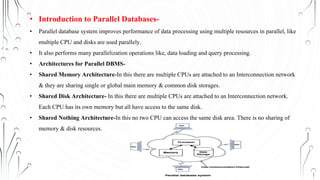
• Architectures for Parallel DBMS-
• Shared Memory Architecture-In this there are multiple CPUs are attached to an Interconnection network
& they are sharing single or global main memory & common disk storages.
• Shared Disk Architecture- In this there are multiple CPUs are attached to an Interconnection network.
Each CPU has its own memory but all have access to the same disk.
• Shared Nothing Architecture-In this no two CPU can access the same disk area. There is no sharing of
memory & disk resources.
• Advantages of Parallel Databases-
• High Availability.
• Better Performance /High Processing Speed.
• Reliability.
• Greater Flexibility.
• Serves Multiple Users.
• Disadvantages of Parallel Databases-
• Large no. of resources is required thus startup cost is high.
• Due to large no. of resources complexity is increased.
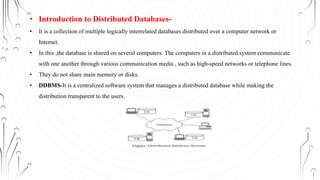
• Introduction to Distributed Databases-
• It is a collection of multiple logically interrelated databases distributed over a computer network or
Internet.
• In this ,the database is shared on several computers. The computers in a distributed system communicate
with one another through various communication media , such as high-speed networks or telephone lines.
• They do not share main memory or disks.
• DDBMS-It is a centralized software system that manages a distributed database while making the
distribution transparent to the users.
• Advantages of Distributed Databases-
• The database is easier to expand as it is already spread across multiple systems and it is not too
complicated to add a system.
• The distributed database can have the data arranged according to different levels of transparency i.e data
with different transparency levels can be stored at different locations.
• The database can be stored according to the departmental information in an organization. In that case, it
is easier for a organizational hierarchical access.
• There were a natural catastrophe such as fire or an earthquake all the data would not be destroyed it is
stored at different locations.
• It is cheaper to create a network of systems containing a part of the database. This database can also be
easily increased or decreased.
• Even if some of the data nodes go offline, the rest of the database can continue its normal functions.
• Disadvantages of Distributed Databases-
• This database is more expensive as it is complex and hence, difficult to maintain.
• It is difficult to provide security in a distributed database as the database needs to be secured at all the
locations it is stored.
• It is difficult to maintain data integrity in the distributed database because of its nature. There can also be
data redundancy in the database as it is stored at multiple locations.
• The distributed database is complicated and it is difficult to find people with the necessary experience
who can manage and maintain it.
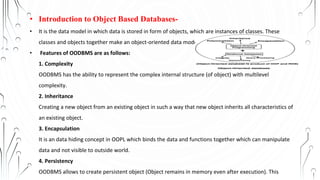
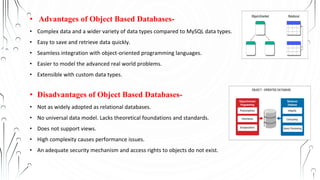
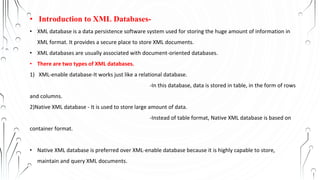
• Introduction to Object Based Databases-
• It is the data model in which data is stored in form of objects, which are instances of classes. These
classes and objects together make an object-oriented data model.
• Features of OODBMS are as follows:
1. Complexity
OODBMS has the ability to represent the complex internal structure (of object) with multilevel
complexity.
2. Inheritance
Creating a new object from an existing object in such a way that new object inherits all characteristics of
an existing object.
3. Encapsulation
It is an data hiding concept in OOPL which binds the data and functions together which can manipulate
data and not visible to outside world.
4. Persistency
OODBMS allows to create persistent object (Object remains in memory even after execution). This
• Advantages of Object Based Databases-
• Complex data and a wider variety of data types compared to MySQL data types.
• Easy to save and retrieve data quickly.
• Seamless integration with object-oriented programming languages.
• Easier to model the advanced real world problems.
• Extensible with custom data types.
• Disadvantages of Object Based Databases-
• Not as widely adopted as relational databases.
• No universal data model. Lacks theoretical foundations and standards.
• Does not support views.
• High complexity causes performance issues.
• An adequate security mechanism and access rights to objects do not exist.
• Introduction to XML Databases-
• XML database is a data persistence software system used for storing the huge amount of information in
XML format. It provides a secure place to store XML documents.
• XML databases are usually associated with document-oriented databases.
• There are two types of XML databases.
1) XML-enable database-It works just like a relational database.
-In this database, data is stored in table, in the form of rows
and columns.
2)Native XML database - It is used to store large amount of data.
-Instead of table format, Native XML database is based on
container format.
• Native XML database is preferred over XML-enable database because it is highly capable to store,
maintain and query XML documents.
• Advantages-
• Simplicity-Information coded in XML is easy to read & understand.
• Platform Independent.
• Extensibility-XML is extendable in which user can create his/her own tags.
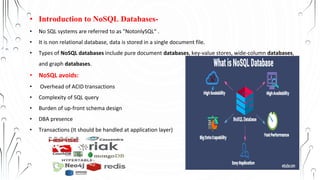
• Introduction to NoSQL Databases-
• No SQL systems are referred to as "NotonlySQL“ .
• It is non relational database, data is stored in a single document file.
• Types of NoSQL databases include pure document databases, key-value stores, wide-column databases,
and graph databases.
• NoSQL avoids:
• Overhead of ACID transactions
• Complexity of SQL query
• Burden of up-front schema design
• DBA presence
• Transactions (It should be handled at application layer)
• Provides:
• Easy and frequent changes to DB and Fast development
• Large data volumes(eg.Google)
• Schema less (A database schema is the skeleton structure that represents the logical view of the entire
database. It defines how the data is organized and how the relations among them are associated.)
• Advantages-
• Handle large volumes of data at high speed with a scale-out architecture.
• Store unstructured, semi-structured, or structured data.
• Enable easy updates to schemas and fields.
• Be developer-friendly.
• Disdvantages-
• NoSQL databases don't have the reliability functions which Relational Databases have (basically don't
support ACID).
• In order to support ACID developers will have to implement their own code, making their systems more
complex.
• NoSQL is not compatible (at all) with SQL.
• Introduction to Multimedia Databases-
• Multimedia database is the collection of interrelated multimedia data that includes text, graphics
(sketches, drawings), images, animations, video, audio and have vast amounts of multisource multimedia
data.
• Advantages-
• It support multiple formats of data(text,audio,video,images)
• It have flexibility of script language & reuse of multimedia objects.
• Disadvantages-
• It consumes lot of processing time.
• Production of multimedia is more expensive & costly than others because it is made up of more than one
medium.
• Data size of multimedia is large such as video. Multimedia data often require large storage.
• Introduction to Big Data Databases-
Big data is a collection of massive and complex data sets and data volume that include the huge quantities
of data, data management capabilities, social media analytics and real-time data.
Big data is about data volume and large data set's measured in terms of terabytes or petabytes.
This phenomenon is called Bigdata.
Examples Of Big Data-
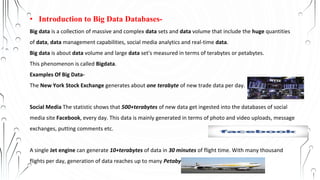
The New York Stock Exchange generates about one terabyte of new trade data per day.
Social Media The statistic shows that 500+terabytes of new data get ingested into the databases of social
media site Facebook, every day. This data is mainly generated in terms of photo and video uploads, message
exchanges, putting comments etc.
A single Jet engine can generate 10+terabytes of data in 30 minutes of flight time. With many thousand
flights per day, generation of data reaches up to many Petabytes.
• Types Of Big Data-
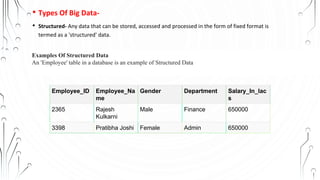
• Structured- Any data that can be stored, accessed and processed in the form of fixed format is
termed as a 'structured' data.
Employee_ID Employee_Na
me
Gender Department Salary_In_lac
s
2365 Rajesh
Kulkarni
Male Finance 650000
3398 Pratibha Joshi Female Admin 650000
Examples Of Structured Data
An 'Employee' table in a database is an example of Structured Data
• Types Of Big Data-
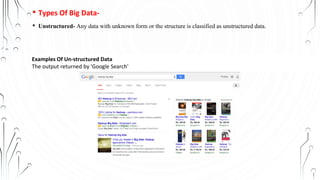
• Unstructured- Any data with unknown form or the structure is classified as unstructured data.
Examples Of Un-structured Data
The output returned by 'Google Search'
• Types Of Big Data-
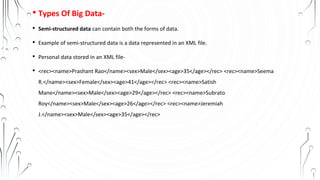
• Semi-structured data can contain both the forms of data.
• Example of semi-structured data is a data represented in an XML file.
• Personal data stored in an XML file-
• <rec><name>Prashant Rao</name><sex>Male</sex><age>35</age></rec> <rec><name>Seema
R.</name><sex>Female</sex><age>41</age></rec> <rec><name>Satish
Mane</name><sex>Male</sex><age>29</age></rec> <rec><name>Subrato
Roy</name><sex>Male</sex><age>26</age></rec> <rec><name>Jeremiah
J.</name><sex>Male</sex><age>35</age></rec>
• Advantages of Big Data:
➨Big data analysis derives innovative solutions. Big data analysis helps in understanding and
targeting customers. It helps in optimizing business processes.
➨It helps in improving science and research.
➨It improves healthcare and public health with availability of record of patients.
➨It helps in financial trading's, sports, polling, security/law enforcement etc.
➨Any one can access vast information via surveys and deliver answer of any query.
➨Every second additions are made.
➨One platform carry unlimited information.
• Disadvantages of Big Data:
➨Traditional storage can cost lot of money to store big data.
➨Lots of big data is unstructured.
➨Big data analysis violates principles of privacy.
➨It can be used for manipulation of customer records.
➨It may increase social stratification.
➨Big data analysis is not useful in short run. It needs to be analyzed for longer duration to leverage its
benefits.
➨Big data analysis results are misleading sometimes.
➨Speedy updates in big data can mismatch real figures.
Thank You.

UNIT 5- Other Databases.pdf

  • 1.
    Unit 5 Other Databases Preparedby- Prof. Shital Vaibhav Ghotekar Science & Computer Science Dept. MAEER’S MIT Art's, Commerce & Science College ,Alandi(D),Pune
  • 2.
    Content: 5.1 Introduction toParallel and Distributed Databases. 5.2 Introduction to Object Based Databases. 5.3 XML Databases. 5.4 NoSQL Databases. 5.5 Multimedia Databases. 5.6 Big Data Databases.
  • 3.
    • Introduction toParallel Databases- • Parallel database system improves performance of data processing using multiple resources in parallel, like multiple CPU and disks are used parallely. • It also performs many parallelization operations like, data loading and query processing. • Architectures for Parallel DBMS- • Shared Memory Architecture-In this there are multiple CPUs are attached to an Interconnection network & they are sharing single or global main memory & common disk storages. • Shared Disk Architecture- In this there are multiple CPUs are attached to an Interconnection network. Each CPU has its own memory but all have access to the same disk. • Shared Nothing Architecture-In this no two CPU can access the same disk area. There is no sharing of memory & disk resources.
  • 4.
    • Advantages ofParallel Databases- • High Availability. • Better Performance /High Processing Speed. • Reliability. • Greater Flexibility. • Serves Multiple Users. • Disadvantages of Parallel Databases- • Large no. of resources is required thus startup cost is high. • Due to large no. of resources complexity is increased.
  • 5.
    • Introduction toDistributed Databases- • It is a collection of multiple logically interrelated databases distributed over a computer network or Internet. • In this ,the database is shared on several computers. The computers in a distributed system communicate with one another through various communication media , such as high-speed networks or telephone lines. • They do not share main memory or disks. • DDBMS-It is a centralized software system that manages a distributed database while making the distribution transparent to the users.
  • 6.
    • Advantages ofDistributed Databases- • The database is easier to expand as it is already spread across multiple systems and it is not too complicated to add a system. • The distributed database can have the data arranged according to different levels of transparency i.e data with different transparency levels can be stored at different locations. • The database can be stored according to the departmental information in an organization. In that case, it is easier for a organizational hierarchical access. • There were a natural catastrophe such as fire or an earthquake all the data would not be destroyed it is stored at different locations. • It is cheaper to create a network of systems containing a part of the database. This database can also be easily increased or decreased. • Even if some of the data nodes go offline, the rest of the database can continue its normal functions.
  • 7.
    • Disadvantages ofDistributed Databases- • This database is more expensive as it is complex and hence, difficult to maintain. • It is difficult to provide security in a distributed database as the database needs to be secured at all the locations it is stored. • It is difficult to maintain data integrity in the distributed database because of its nature. There can also be data redundancy in the database as it is stored at multiple locations. • The distributed database is complicated and it is difficult to find people with the necessary experience who can manage and maintain it.
  • 8.
    • Introduction toObject Based Databases- • It is the data model in which data is stored in form of objects, which are instances of classes. These classes and objects together make an object-oriented data model. • Features of OODBMS are as follows: 1. Complexity OODBMS has the ability to represent the complex internal structure (of object) with multilevel complexity. 2. Inheritance Creating a new object from an existing object in such a way that new object inherits all characteristics of an existing object. 3. Encapsulation It is an data hiding concept in OOPL which binds the data and functions together which can manipulate data and not visible to outside world. 4. Persistency OODBMS allows to create persistent object (Object remains in memory even after execution). This
  • 9.
    • Advantages ofObject Based Databases- • Complex data and a wider variety of data types compared to MySQL data types. • Easy to save and retrieve data quickly. • Seamless integration with object-oriented programming languages. • Easier to model the advanced real world problems. • Extensible with custom data types. • Disadvantages of Object Based Databases- • Not as widely adopted as relational databases. • No universal data model. Lacks theoretical foundations and standards. • Does not support views. • High complexity causes performance issues. • An adequate security mechanism and access rights to objects do not exist.
  • 10.
    • Introduction toXML Databases- • XML database is a data persistence software system used for storing the huge amount of information in XML format. It provides a secure place to store XML documents. • XML databases are usually associated with document-oriented databases. • There are two types of XML databases. 1) XML-enable database-It works just like a relational database. -In this database, data is stored in table, in the form of rows and columns. 2)Native XML database - It is used to store large amount of data. -Instead of table format, Native XML database is based on container format. • Native XML database is preferred over XML-enable database because it is highly capable to store, maintain and query XML documents.
  • 11.
    • Advantages- • Simplicity-Informationcoded in XML is easy to read & understand. • Platform Independent. • Extensibility-XML is extendable in which user can create his/her own tags.
  • 12.
    • Introduction toNoSQL Databases- • No SQL systems are referred to as "NotonlySQL“ . • It is non relational database, data is stored in a single document file. • Types of NoSQL databases include pure document databases, key-value stores, wide-column databases, and graph databases. • NoSQL avoids: • Overhead of ACID transactions • Complexity of SQL query • Burden of up-front schema design • DBA presence • Transactions (It should be handled at application layer)
  • 13.
    • Provides: • Easyand frequent changes to DB and Fast development • Large data volumes(eg.Google) • Schema less (A database schema is the skeleton structure that represents the logical view of the entire database. It defines how the data is organized and how the relations among them are associated.) • Advantages- • Handle large volumes of data at high speed with a scale-out architecture. • Store unstructured, semi-structured, or structured data. • Enable easy updates to schemas and fields. • Be developer-friendly. • Disdvantages- • NoSQL databases don't have the reliability functions which Relational Databases have (basically don't support ACID). • In order to support ACID developers will have to implement their own code, making their systems more complex. • NoSQL is not compatible (at all) with SQL.
  • 14.
    • Introduction toMultimedia Databases- • Multimedia database is the collection of interrelated multimedia data that includes text, graphics (sketches, drawings), images, animations, video, audio and have vast amounts of multisource multimedia data. • Advantages- • It support multiple formats of data(text,audio,video,images) • It have flexibility of script language & reuse of multimedia objects. • Disadvantages- • It consumes lot of processing time. • Production of multimedia is more expensive & costly than others because it is made up of more than one medium. • Data size of multimedia is large such as video. Multimedia data often require large storage.
  • 15.
    • Introduction toBig Data Databases- Big data is a collection of massive and complex data sets and data volume that include the huge quantities of data, data management capabilities, social media analytics and real-time data. Big data is about data volume and large data set's measured in terms of terabytes or petabytes. This phenomenon is called Bigdata. Examples Of Big Data- The New York Stock Exchange generates about one terabyte of new trade data per day. Social Media The statistic shows that 500+terabytes of new data get ingested into the databases of social media site Facebook, every day. This data is mainly generated in terms of photo and video uploads, message exchanges, putting comments etc. A single Jet engine can generate 10+terabytes of data in 30 minutes of flight time. With many thousand flights per day, generation of data reaches up to many Petabytes.
  • 16.
    • Types OfBig Data- • Structured- Any data that can be stored, accessed and processed in the form of fixed format is termed as a 'structured' data. Employee_ID Employee_Na me Gender Department Salary_In_lac s 2365 Rajesh Kulkarni Male Finance 650000 3398 Pratibha Joshi Female Admin 650000 Examples Of Structured Data An 'Employee' table in a database is an example of Structured Data
  • 17.
    • Types OfBig Data- • Unstructured- Any data with unknown form or the structure is classified as unstructured data. Examples Of Un-structured Data The output returned by 'Google Search'
  • 18.
    • Types OfBig Data- • Semi-structured data can contain both the forms of data. • Example of semi-structured data is a data represented in an XML file. • Personal data stored in an XML file- • <rec><name>Prashant Rao</name><sex>Male</sex><age>35</age></rec> <rec><name>Seema R.</name><sex>Female</sex><age>41</age></rec> <rec><name>Satish Mane</name><sex>Male</sex><age>29</age></rec> <rec><name>Subrato Roy</name><sex>Male</sex><age>26</age></rec> <rec><name>Jeremiah J.</name><sex>Male</sex><age>35</age></rec>
  • 19.
    • Advantages ofBig Data: ➨Big data analysis derives innovative solutions. Big data analysis helps in understanding and targeting customers. It helps in optimizing business processes. ➨It helps in improving science and research. ➨It improves healthcare and public health with availability of record of patients. ➨It helps in financial trading's, sports, polling, security/law enforcement etc. ➨Any one can access vast information via surveys and deliver answer of any query. ➨Every second additions are made. ➨One platform carry unlimited information.
  • 20.
    • Disadvantages ofBig Data: ➨Traditional storage can cost lot of money to store big data. ➨Lots of big data is unstructured. ➨Big data analysis violates principles of privacy. ➨It can be used for manipulation of customer records. ➨It may increase social stratification. ➨Big data analysis is not useful in short run. It needs to be analyzed for longer duration to leverage its benefits. ➨Big data analysis results are misleading sometimes. ➨Speedy updates in big data can mismatch real figures.
  • 21.