ORCID IDS AND FUNDER
WORKFLOWS
Josh Brown
Director of Partnerships
j.brown@orcid.org
orcid.org/0000-0002-8689-4935
ORCID FOR FUNDERS WEBINAR | 8 MARCH 2017
1
WHAT IS ORCID?
• An identifier for researchers
• A registry
• A set of standard procedures for connecting
researchers to their affiliations and activities
• A committed community building connectors
• An international-scale open research effort
ORCID’s vision is a world where
all who participate in research, scholarship,
and innovation are uniquely identified
and connected to their contributions and
affiliations across time, disciplines, and
borders.
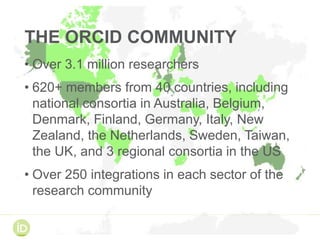
THE ORCID COMMUNITY
• Over 3.1 million researchers
• 620+ members from 40 countries, including
national consortia in Australia, Belgium,
Denmark, Finland, Germany, Italy, New
Zealand, the Netherlands, Sweden, Taiwan,
the UK, and 3 regional consortia in the US
• Over 250 integrations in each sector of the
research community
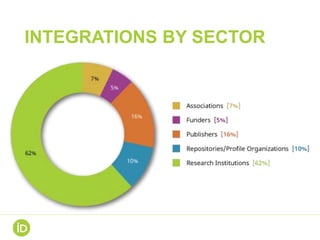
INTEGRATIONS BY SECTOR
ORCID’s vision is a world where all
who participate in research,
scholarship, and innovation are
uniquely identified and connected to
their contributions across disciplines,
borders, and time.
Publishers
equiring
ORCID iDs:
Science
EMBO
PLOS
Royal Society
ACS
eLIFE
Hindawi
IEEE
AGU
Rockefeller
Univ.Press
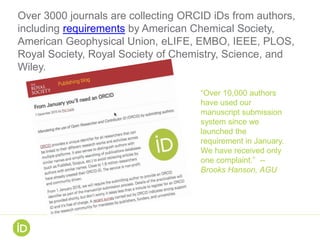
Over 3000 journals are collecting ORCID iDs from authors,
including requirements by American Chemical Society,
American Geophysical Union, eLIFE, EMBO, IEEE, PLOS,
Royal Society, Royal Society of Chemistry, Science, and
Wiley.
“Over 10,000 authors
have used our
manuscript submission
system since we
launched the
requirement in January.
We have received only
one complaint.” --
Brooks Hanson, AGU
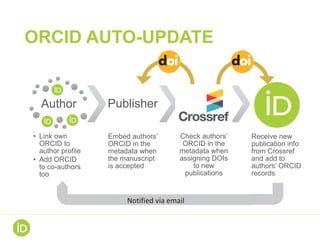
ORCID AUTO-UPDATE
Author
• Link own
ORCID to
author profile
• Add ORCID
to co-authors
too
Publisher
Embed authors’
ORCID in the
metadata when
the manuscript
is accepted
Crossref
Check authors’
ORCID in the
metadata when
assigning DOIs
to new
publications
ORCID
Receive new
publication info
from Crossref
and add to
authors’ ORCID
records
Notified via email
• Automatic update of ORCID and any
connected system (such as a funder
reporting site) means less time doing
reporting tasks and more time for research
• Accurate attribution means improved
discoverability in publication databases and
more reliable citation statistics
WHY DO FUNDERS CARE?
• Streamline application process by pulling
information from ORCID
• Ensure accurate citation of award (both
grant numbers and organization name) by
pushing award information into ORCID
record
• Enable real-time reporting by using ORCID
notification API
• Recognize your reviewers, too!
GRANT REVIEW WORKFLOW
Researcher
• Link their ORCID
to own account
• Add ORCID to
investigators too
Funder
Embed reviewer’s
ORCID in the review
and push review
acknowledgement
ORCID
Receive new review
info from funder and
add to researchers’
ORCID records
Notified via email
The ability to uniquely identify
contributors is a deceptively simple
concept which, if realised, could
enable forms of real-time
understanding of scientific research
that up to now have been extremely
costly (if not impossible).
--Jonathan Kram, Wellcome Trust
PARTICIPATING FUNDERS
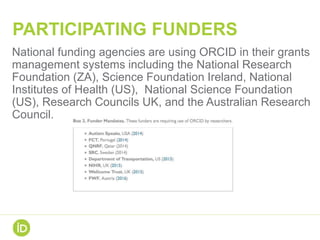
National funding agencies are using ORCID in their grants
management systems including the National Research
Foundation (ZA), Science Foundation Ireland, National
Institutes of Health (US), National Science Foundation
(US), Research Councils UK, and the Australian Research
Council.
WHAT DOES IT COST?
• Individual non-profit organizations
• Basic: $4000 (read-write-update)
• Small Premium: $8000 (notifications and more
API credentials)
• Consortia (groups of 5 or more):
Pricing depends on size of consortia. For a
group of 40+, the total cost would be
$135,000. Split evenly, this is less than
$4000 per organization for premium
membership.
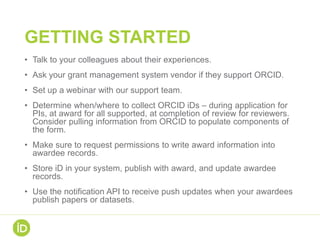
GETTING STARTED
• Talk to your colleagues about their experiences.
• Ask your grant management system vendor if they support ORCID.
• Set up a webinar with our support team.
• Determine when/where to collect ORCID iDs – during application for
PIs, at award for all supported, at completion of review for reviewers.
Consider pulling information from ORCID to populate components of
the form.
• Make sure to request permissions to write award information into
awardee records.
• Store iD in your system, publish with award, and update awardee
records.
• Use the notification API to receive push updates when your awardees
publish papers or datasets.
Integration Process
Technically, integrating ORCID involves
adding <person ID> and <source> fields to
data models, mapping to the ORCID API, and
implementing OAuth and RESTful calls.
Socially, it is critical that researchers are
engaged in the process.
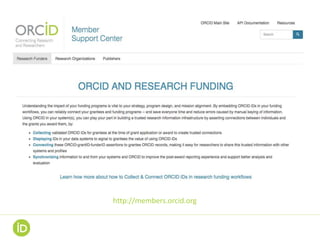
http://members.orcid.org
With hundreds of our members globally building ORCID
identifiers into their systems, as well as some funders
and publishers now requiring ORCID iDs, researchers
are increasingly likely to encounter ORCID in their day-
to-day life. We developed the Collect and Connect
program to streamline the integration process and
foster a shared user experience. This ensures
researchers and our members understand what ORCID
is and why and how to engage.
COLLECT AND CONNECT!
http://orcid.org/content/collect-connect
FUNDERS DRIVE GOOD
PRACTICE
• LEAD BY EXAMPLE
• SHARE DATA FOR RE-USE
• RE-USE DATA WHEREVER POSSIBLE
• TELL THE COMMUNITY WHAT YOU NEED
- AND LISTEN TO THEIR NEEDS

ORCID for funders - Josh Brown

  • 1.
    ORCID IDS ANDFUNDER WORKFLOWS Josh Brown Director of Partnerships j.brown@orcid.org orcid.org/0000-0002-8689-4935 ORCID FOR FUNDERS WEBINAR | 8 MARCH 2017 1
  • 2.
    WHAT IS ORCID? •An identifier for researchers • A registry • A set of standard procedures for connecting researchers to their affiliations and activities • A committed community building connectors • An international-scale open research effort
  • 3.
    ORCID’s vision isa world where all who participate in research, scholarship, and innovation are uniquely identified and connected to their contributions and affiliations across time, disciplines, and borders.
  • 4.
    THE ORCID COMMUNITY •Over 3.1 million researchers • 620+ members from 40 countries, including national consortia in Australia, Belgium, Denmark, Finland, Germany, Italy, New Zealand, the Netherlands, Sweden, Taiwan, the UK, and 3 regional consortia in the US • Over 250 integrations in each sector of the research community
  • 5.
  • 6.
    ORCID’s vision isa world where all who participate in research, scholarship, and innovation are uniquely identified and connected to their contributions across disciplines, borders, and time. Publishers equiring ORCID iDs: Science EMBO PLOS Royal Society ACS eLIFE Hindawi IEEE AGU Rockefeller Univ.Press Over 3000 journals are collecting ORCID iDs from authors, including requirements by American Chemical Society, American Geophysical Union, eLIFE, EMBO, IEEE, PLOS, Royal Society, Royal Society of Chemistry, Science, and Wiley. “Over 10,000 authors have used our manuscript submission system since we launched the requirement in January. We have received only one complaint.” -- Brooks Hanson, AGU
  • 7.
    ORCID AUTO-UPDATE Author • Linkown ORCID to author profile • Add ORCID to co-authors too Publisher Embed authors’ ORCID in the metadata when the manuscript is accepted Crossref Check authors’ ORCID in the metadata when assigning DOIs to new publications ORCID Receive new publication info from Crossref and add to authors’ ORCID records Notified via email
  • 8.
    • Automatic updateof ORCID and any connected system (such as a funder reporting site) means less time doing reporting tasks and more time for research • Accurate attribution means improved discoverability in publication databases and more reliable citation statistics
  • 9.
    WHY DO FUNDERSCARE? • Streamline application process by pulling information from ORCID • Ensure accurate citation of award (both grant numbers and organization name) by pushing award information into ORCID record • Enable real-time reporting by using ORCID notification API • Recognize your reviewers, too!
  • 10.
    GRANT REVIEW WORKFLOW Researcher •Link their ORCID to own account • Add ORCID to investigators too Funder Embed reviewer’s ORCID in the review and push review acknowledgement ORCID Receive new review info from funder and add to researchers’ ORCID records Notified via email
  • 11.
    The ability touniquely identify contributors is a deceptively simple concept which, if realised, could enable forms of real-time understanding of scientific research that up to now have been extremely costly (if not impossible). --Jonathan Kram, Wellcome Trust
  • 12.
    PARTICIPATING FUNDERS National fundingagencies are using ORCID in their grants management systems including the National Research Foundation (ZA), Science Foundation Ireland, National Institutes of Health (US), National Science Foundation (US), Research Councils UK, and the Australian Research Council.
  • 13.
    WHAT DOES ITCOST? • Individual non-profit organizations • Basic: $4000 (read-write-update) • Small Premium: $8000 (notifications and more API credentials) • Consortia (groups of 5 or more): Pricing depends on size of consortia. For a group of 40+, the total cost would be $135,000. Split evenly, this is less than $4000 per organization for premium membership.
  • 14.
    GETTING STARTED • Talkto your colleagues about their experiences. • Ask your grant management system vendor if they support ORCID. • Set up a webinar with our support team. • Determine when/where to collect ORCID iDs – during application for PIs, at award for all supported, at completion of review for reviewers. Consider pulling information from ORCID to populate components of the form. • Make sure to request permissions to write award information into awardee records. • Store iD in your system, publish with award, and update awardee records. • Use the notification API to receive push updates when your awardees publish papers or datasets.
  • 15.
    Integration Process Technically, integratingORCID involves adding <person ID> and <source> fields to data models, mapping to the ORCID API, and implementing OAuth and RESTful calls. Socially, it is critical that researchers are engaged in the process.
  • 16.
  • 17.
    With hundreds ofour members globally building ORCID identifiers into their systems, as well as some funders and publishers now requiring ORCID iDs, researchers are increasingly likely to encounter ORCID in their day- to-day life. We developed the Collect and Connect program to streamline the integration process and foster a shared user experience. This ensures researchers and our members understand what ORCID is and why and how to engage. COLLECT AND CONNECT! http://orcid.org/content/collect-connect
  • 18.
    FUNDERS DRIVE GOOD PRACTICE •LEAD BY EXAMPLE • SHARE DATA FOR RE-USE • RE-USE DATA WHEREVER POSSIBLE • TELL THE COMMUNITY WHAT YOU NEED - AND LISTEN TO THEIR NEEDS