


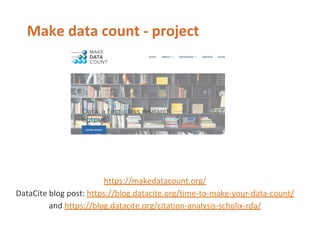
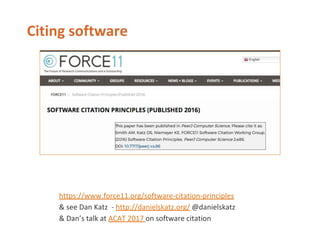
Room 400, Level 4, Building 11
…
●
●
●
●
●
●
●
…
●
●
○
○
○
○
○
●
●
…
●
●
○
○
○
○
○
●
●
1.
2.
3.
4.
●
●
●
●
●
●
●
●
●
●
●
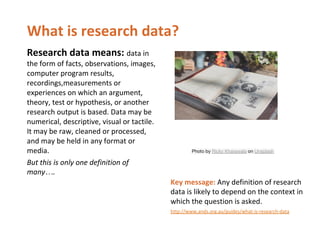
Photo by Ricky Kharawala on Unsplash
…
●
●
●
●
Photo by Andrew Worley on Unsplash
●
●
●
●
●
●
●
●
●
●
●
●
●
●
●
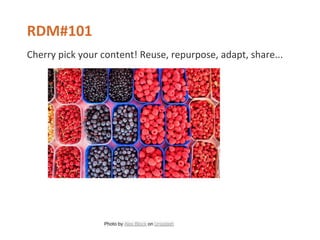
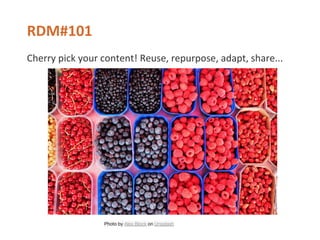
Photo by Alex Block on Unsplash
…
●
●
○
○
○
○
○
●
●
•Exploratory/Scoping
•Reuse/Secondary data analysis
•Can be starting point or ad hoc
•Peer review
•Reproduce/extend results
•Repurpose (e.g. for mashups, visualisations, simulations)
•Verify claims (e.g. report findings)
*Not in any order; not exhaustive!
•Google
•Ask a colleague
•Find link to data in a journal article
•Data journals
•Data registries e.g. re3data.org
•Open data portals e.g. data.gov
•Institutional repositories
•Data / Discipline repositories e.g. Dryad
•Project website
•Data discovery aggregators like Research Data Australia, Google Dataset
•Library catalogues, databases
*Not in any order; not exhaustive!
When creating metadata records, keep in mind that finding data is:
● Movable feast / changing beast
● No standard practice, universal standard or vocab
● Databases are non-exhaustive
● Methods for searching and terms driven by why people are
looking and how the data is stored
● Together, we’re going to build a rainbow of discipline specific data
examples!
● Working in pairs, explore re3data (or beyond!) to find data sources that
you would recommend for any specific number of disciplines.
● For each data source:
a. find some data
b. tell us how you got there - eg google or repository
c. why it’s a good example to show someone else.
Here are some scenarios to start you off:
○ Showing a researcher where they might find social science data
○ Data that may not have a disciplinary “home”
○ Incredibly niche specialised scientific data (find a rabbit hole)
○ Australian geographic and/or spatialised data
○ Internet time server data
○ Geological sample data
● re3data.org
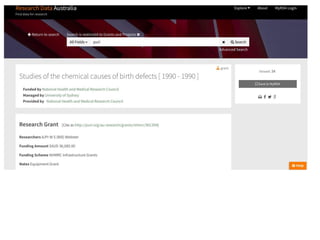
● https://researchdata.ands.org.au/
● https://www.icpsr.umich.edu/
● https://ada.edu.au/
● http://www.geosamples.org/
● https://riojournal.com/
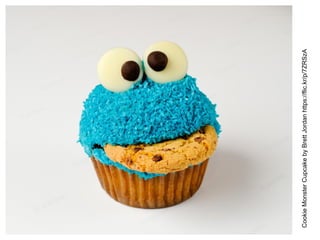
CookieMonsterCupcakebyBrettJordanhttps://flic.kr/p/7ZRSzA
…
●
●
○
○
○
○
○
●
●
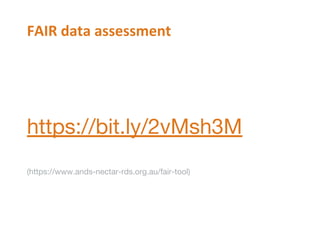
https://bit.ly/2vMsh3M
(https://www.ands-nectar-rds.org.au/fair-tool)
…
●
●
○
○
○
○
○
●
●
https://www.youtube.com/watch?v=ABF2FvSPVYE
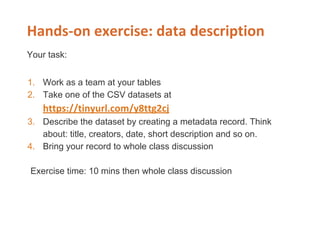
Your task:
1. Work as a team at your tables
2. Take one of the CSV datasets at
3. Describe the dataset by creating a metadata record. Think
about: title, creators, date, short description and so on.
4. Bring your record to whole class discussion
Exercise time: 10 mins then whole class discussion
•
•
•
•
• …
Your task:
1. Work as a team at your tables
2. Review the record you put together for the CSV file
3. Select a metadata schema of your choice e.g. Dublin Core,
RIF-CS, others..
4. Create a new metadata record using the schema of your choice
and the values (attributes) you listed in your original CSV file
record
Exercise time: 10 mins then whole class discussion
•
•
•
•
•
•
•
•
•
•
•
•
•
•
•
•
•
•
•
•
•
•
…
●
●
○
○
○
○
○
●
●
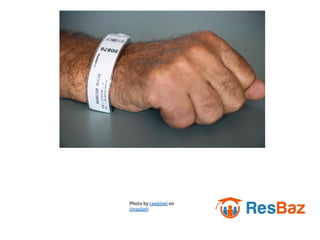
Photo by rawpixel on
Unsplash
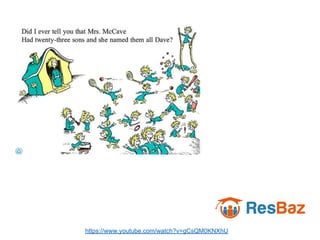
https://www.youtube.com/watch?v=gCsQM0KNXhU
Photo by John O'Nolan on
Unsplash
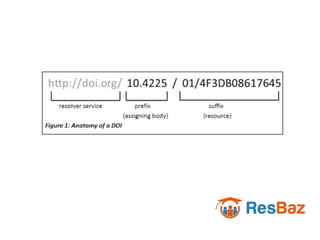
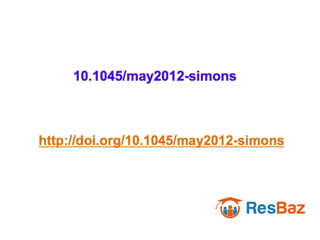
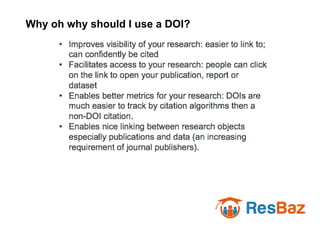
Why oh why should I use a DOI?
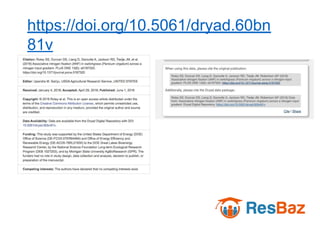
https://doi.org/10.5061/dryad.60bn
81v
Photo by Amaury Salas on Unsplash
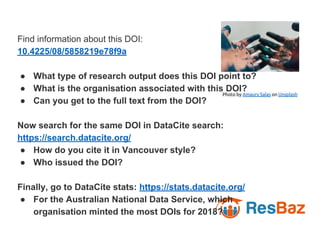
Find information about this DOI:
10.4225/08/5858219e78f9a
● What type of research output does this DOI point to?
● What is the organisation associated with this DOI?
● Can you get to the full text from the DOI?
Now search for the same DOI in DataCite search:
https://search.datacite.org/
● How do you cite it in Vancouver style?
● Who issued the DOI?
Finally, go to DataCite stats: https://stats.datacite.org/
● For the Australian National Data Service, which
organisation minted the most DOIs for 2018?
Photo by Tyler Nix on
Unsplash
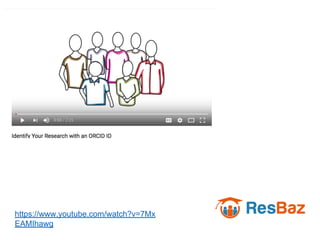
https://www.youtube.com/watch?v=7Mx
EAMIhawg
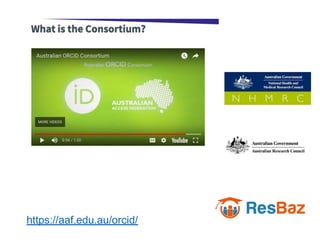
https://aaf.edu.au/orcid/
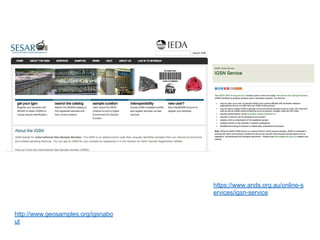
http://www.geosamples.org/igsnabo
ut
https://www.ands.org.au/online-s
ervices/igsn-service
Photo by Cristian Escobar on
Unsplash
…
●
●
○
○
○
○
○
●
●
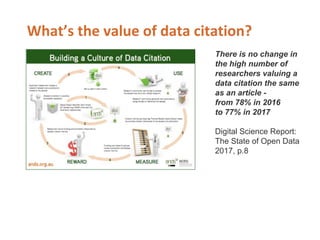
There is no change in
the high number of
researchers valuing a
data citation the same
as an article -
from 78% in 2016
to 77% in 2017
Digital Science Report:
The State of Open Data
2017, p.8
Your task:
1. Work as a team at your tables
2. Look up and read what these publishers are saying about data citation:
• Wiley’s Data Citation Policy -
https://authorservices.wiley.com/author-resources/Journal-Authors/open-
access/data-sharing-citation/index.html
• Springer Nature Research Data Policy FAQs (why and how cite data) -
https://www.springernature.com/gp/authors/research-data-policy/faqs/12
327154
3. Discuss with each other: are the policies the same? Are the citation
styles the same? Is it clear information for authors?
Exercise time: 5 mins
•
•
•
●
●
●
1.
2.
3.
4.
5.
6.
• …
•
•
…
●
●
…
●
●
○
○
○
○
○
●
●
●
●
●
●
●
●
●
●
●
●
●
●
●
●
●
Photo by Alex Block on Unsplash
●
●
●
●
●
●
●
●
●
…
●
●
●
●
●
●
●
…
●
●
●
●
●
●
●
●
●
●
●
●
●
●
●
Edusmartskills.com. (2018). [online] Available at: https://www.edusmartskills.com/webAssets/images/wso_img.jpg [Accessed 14 May 2018].
…
●
●
●
●
●
●
●
$
helena.lynn@sydney.edu.au
●
●
●
●
●
●
●
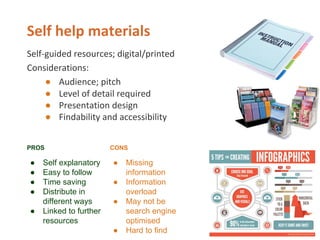
PROS CONS
● Self explanatory
● Easy to follow
● Time saving
● Distribute in
different ways
● Linked to further
resources
● Missing
information
● Information
overload
● May not be
search engine
optimised
● Hard to find
●
●
●
●
●
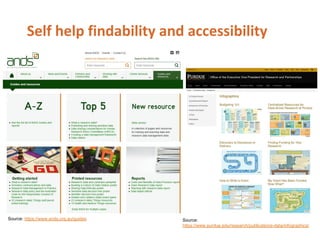
Source:
https://www.purdue.edu/research/publications-data/infographics/
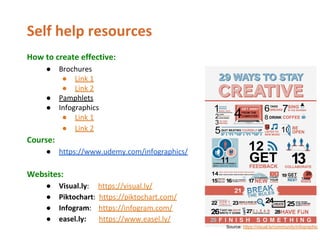
Source: https://www.ands.org.au/guides
●
●
●
●
●
●
●
●
●
●
●
●
Source: https://visual.ly/community/infographic
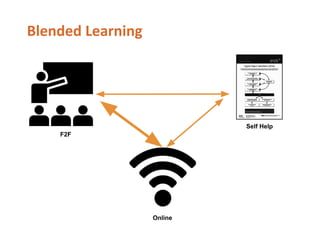
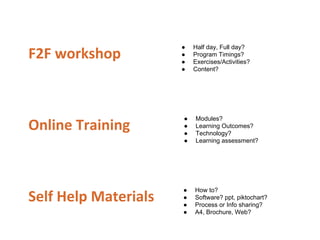
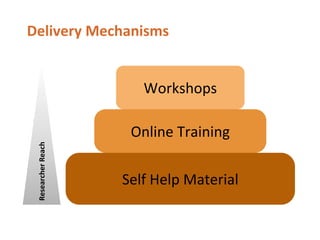
F2F
Online
Self Help
…
●
●
○
○
○
○
○
●
●
Adapted from: Fao.org. (2018). [online] Available at: http://www.fao.org/docrep/015/i2516e/i2516e.pdf [Accessed 1 May 2018].
● Half day, Full day?
● Program Timings?
● Exercises/Activities?
● Content?
● Modules?
● Learning Outcomes?
● Technology?
● Learning assessment?
● How to?
● Software? ppt, piktochart?
● Process or Info sharing?
● A4, Brochure, Web?
…
●
●
●

Skilling-up-in-research-data-management-20181128