orcid.org	

Contact Info: p. +1-301-922-9062 a. 10411 Motor City Drive, Suite 750, Bethesda, MD 20817 USA	

ORCID: Connecting Research and Researchers
Standardizing Data and Data Exchange in Scholarly Publishing
5 May 2014
Council of Science Editors
San Antonio,Texas
Rebecca Bryant, PhD
Director of Community, ORCID
r.bryant@orcid.org
@ORCID_ORG
http://orcid.org/0000-0002-2753-3881
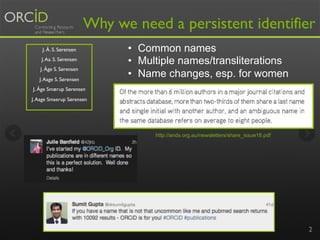
Why we need a persistent identifier
J. Å. S. Sørensen
J.Aa. S. Sørensen
J. Åge S. Sørensen
J.Aage S. Sørensen
J. Åge Smærup Sørensen
J.Aage Smaerup Sørensen
2
http://ands.org.au/newsletters/share_issue18.pdf
•  Common names
•  Multiple names/transliterations
•  Name changes, esp. for women
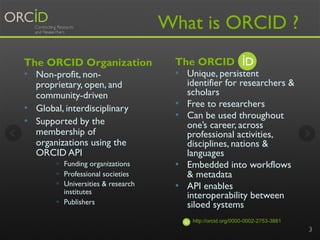
What is ORCID ?
The ORCID
•  Unique, persistent
identifier for researchers &
scholars
•  Free to researchers
•  Can be used throughout
one’s career, across
professional activities,
disciplines, nations &
languages
•  Embedded into workflows
& metadata
•  API enables
interoperability between
siloed systems
The ORCID Organization
•  Non-profit, non-
proprietary, open, and
community-driven
•  Global, interdisciplinary
•  Supported by the
membership of
organizations using the
ORCID API
§  Funding organizations
§  Professional societies
§  Universities & research
institutes
§  Publishers
3
http://orcid.org/0000-0002-2753-3881
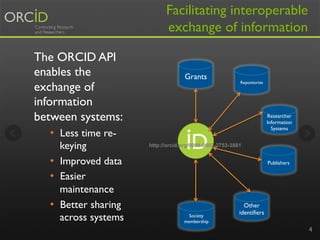
Facilitating interoperable
exchange of information
The ORCID API
enables the
exchange of
information
between systems:
•  Less time re-
keying
•  Improved data
•  Easier
maintenance
•  Better sharing
across systems
4
Grants
http://orcid.org/0000-0002-2753-3881
Repositories
Researcher
Information
Systems
Publishers
Other
identifiersSociety
membership
Adoption and Integration
5
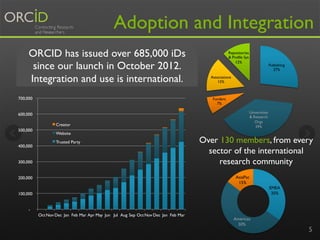
ORCID has issued over 685,000 iDs
since our launch in October 2012.
Integration and use is international.
Publishing
27%
Universities
& Research
Orgs
39%
Funders
7%
Associations
15%
Repositories
& Profile Sys
12%
EMEA
35%
Americas
50%
AsiaPac
15%
Over 130 members, from every
sector of the international
research community
-
100,000
200,000
300,000
400,000
500,000
600,000
700,000
OctNov Dec Jan Feb Mar Apr May Jun Jul Aug Sep OctNov Dec Jan Feb Mar
Creator
Website
Trusted Party
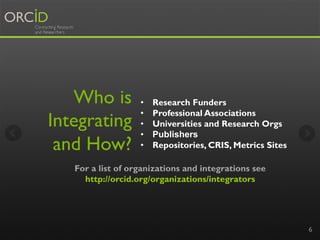
Who is
Integrating
and How?
6
•  Research Funders
•  Professional Associations
•  Universities and Research Orgs
•  Publishers
•  Repositories, CRIS, Metrics Sites
For a list of organizations and integrations see
http://orcid.org/organizations/integrators
7
“Where possible, it is also recommended that
contributors be uniquely identifiable, and data
uniquely attributable, through identifiers which
are persistent, non-proprietary, open and
interoperable (e.g. through leveraging existing
sustainable initiatives such as ORCID for
contributor identifiers and DataCite for data
identifiers).”
European Commission H2020 Grantee Guidelines
http://ec.europa.eu/research/participants/data/ref/h2020/
grants_manual/hi/oa_pilot/h2020-hi-oa-pilot-guide_en.pdf
http://biomedicalresearchworkforce.nih.gov/tracking-system.htm#d
Funders
“Greater precision and transparency of the research
outputs linked to a particular funder or grant is vital to
help us better understand the impact of our funding.”
Liz Allen, Head of Evaluation,Wellcome Trust
http://orcid.org/0000-0002-9298-3168
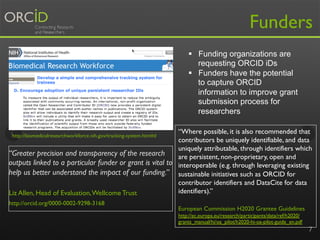
§  Funding organizations are
requesting ORCID iDs
§  Funders have the potential
to capture ORCID
information to improve grant
submission process for
researchers
8
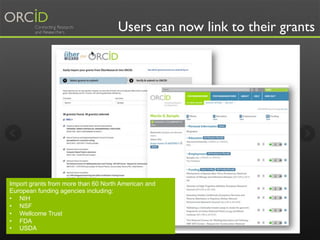
Users can now link to their grants
Import grants from more than 60 North American and
European funding agencies including:
•  NIH
•  NSF
•  Wellcome Trust
•  FDA
•  USDA
How are
Universities
Integrating?
9
For more on university integrators see
http://orcid.org/organizations/
researchorganizations
•  Get an ORCID iD and insert it in LDAP system,
CRIS, dissertation thesis, or directory
•  Get Data from an ORCID Record and
export into a CRIS or update a repository
•  Enable import
of CRIS data into
an ORCID Record
•  Link to identifiers
in your system
•  Create an iD for your faculty, staff, and students
and pre-populate with affiliation and works
information
Boston Univ, CalTech, Cambridge Univ, Chalmers
Univ Tech, Charles Darwin Univ, Chinese Academy of
Sciences Library, CERN, Cornell Univ, EMBL (EBI),
FHCRC, Glasgow Univ, Harvard Univ, IFPRI,
Karolinska Inst, KACST, KISTI, Consorcio Madroño,
Forschungszentrum Jülich, MIT, MSKCC, National
Institute of Informatics, National Taiwan Univ College
of Medicine, National Taiwan Normal Univ, NYU
Langone Medical Center, Oxford University, Penn
State, Purdue Univ, Riga Technical Univ, SUNY-
Stonybrook, Stockholm Univ,Texas A&M Univ, Univ
Bern, Univ. Cadiz, Univ Carlos III de Madrid, Univ
Oviedo, Univ Zaragoza, Univ College London, Univ
Colorado, Univ Hong Kong, Univ Kansas, Univ
Manchester, Univ Michigan, Univ Missouri, Univ
Politécnica Madrid, Univ Washington
•  Alfred P. Sloan Foundation award supports ORCID
implementation by US universities and professional associations
http://orcid.org/content/adoption-and-integration-program
•  Jisc and ARMA launching ORCID pilot program for UK Higher
Education Institutions;http://www.jisc.ac.uk/fundingopportunities/
funding_calls/2014/03/orcid.aspx
•  Use cases, workflows, and code samples will be showcased at
ORCID Outreach meeting, Chicago, IL, May 21-22. Register at:
https://orcid.org/events/Chicago2014
University Workflows
5 May 2014 10
“AGU is implementing ORCIDs in our member
records, editorial databases, and papers. Having
the ability to uniquely identify scientists helps the
society, editors, authors, and members in many
ways, from improving efficiency to providing
services and support.”
 
Brooks Hanson, Director of Publications,American Geophysical Union 
http://orcid.org/0000-0001-6230-7145
5 May 2014 orcid.org	

 11
Professional associations
Publishing community members
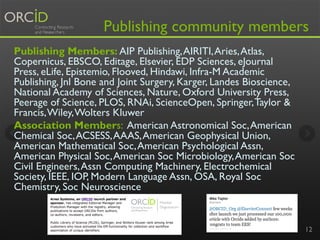
Publishing Members: AIP Publishing,AIRITI,Aries,Atlas,
Copernicus, EBSCO, Editage, Elsevier, EDP Sciences, eJournal
Press, eLife, Epistemio, Flooved, Hindawi, Infra-M Academic
Publishing, Jnl Bone and Joint Surgery, Karger, Landes Bioscience,
National Academy of Sciences, Nature, Oxford University Press,
Peerage of Science, PLOS, RNAi, ScienceOpen, Springer,Taylor &
Francis,Wiley,Wolters Kluwer
Association Members: American Astronomical Soc,American
Chemical Soc,ACSESS,AAAS,American Geophysical Union,
American Mathematical Soc,American Psychological Assn,
American Physical Soc,American Soc Microbiology,American Soc
Civil Engineers,Assn Computing Machinery, Electrochemical
Society, IEEE, IOP, Modern Language Assn, OSA, Royal Soc
Chemistry, Soc Neuroscience
12
Benefits to Publishers
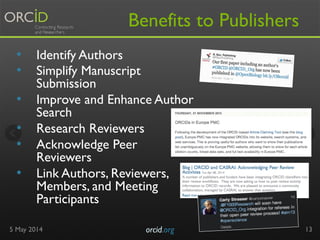
•  Identify Authors
•  Simplify Manuscript
Submission
•  Improve and Enhance Author
Search
•  Research Reviewers
•  Acknowledge Peer
Reviewers
•  Link Authors, Reviewers,
Members, and Meeting
Participants
5 May 2014 orcid.org	

 13
Learn more
14
http://orcid.org/organizations/publishers/learnmore
Suggested Practices for Collection & Display
of ORCID Identifiers
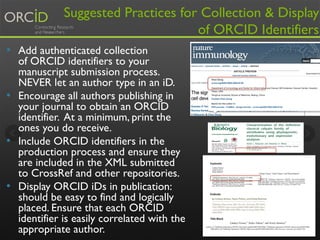
•  Add authenticated collection
of ORCID identifiers to your
manuscript submission process.
NEVER let an author type in an iD.
•  Encourage all authors publishing in
your journal to obtain an ORCID
identifier. At a minimum, print the
ones you do receive. 
•  Include ORCID identifiers in the
production process and ensure they
are included in the XML submitted
to CrossRef and other repositories.
•  Display ORCID iDs in publication:
should be easy to find and logically
placed. Ensure that each ORCID
identifier is easily correlated with the
appropriate author. 15
•  Find out more at http://orcid.org
•  More on membership at http://orcid.org/about/
membership
•  Learn about tools to embed ORCID iDs at http://
support.orcid.org/knowledgebase/
•  Attend an outreach meeting http://orcid.org/events
•  Subscribe to our blog at http://orcid.org/about/news
and follow @ORCID_Org on Twitter
•  Contact me at r.bryant@orcid.org
165 May 2014 orcid.org	

Thank you!

ORCID: status and benefits to publishers

  • 1.
    orcid.org Contact Info: p.+1-301-922-9062 a. 10411 Motor City Drive, Suite 750, Bethesda, MD 20817 USA ORCID: Connecting Research and Researchers Standardizing Data and Data Exchange in Scholarly Publishing 5 May 2014 Council of Science Editors San Antonio,Texas Rebecca Bryant, PhD Director of Community, ORCID r.bryant@orcid.org @ORCID_ORG http://orcid.org/0000-0002-2753-3881
  • 2.
    Why we needa persistent identifier J. Å. S. Sørensen J.Aa. S. Sørensen J. Åge S. Sørensen J.Aage S. Sørensen J. Åge Smærup Sørensen J.Aage Smaerup Sørensen 2 http://ands.org.au/newsletters/share_issue18.pdf •  Common names •  Multiple names/transliterations •  Name changes, esp. for women
  • 3.
    What is ORCID? The ORCID •  Unique, persistent identifier for researchers & scholars •  Free to researchers •  Can be used throughout one’s career, across professional activities, disciplines, nations & languages •  Embedded into workflows & metadata •  API enables interoperability between siloed systems The ORCID Organization •  Non-profit, non- proprietary, open, and community-driven •  Global, interdisciplinary •  Supported by the membership of organizations using the ORCID API §  Funding organizations §  Professional societies §  Universities & research institutes §  Publishers 3 http://orcid.org/0000-0002-2753-3881
  • 4.
    Facilitating interoperable exchange ofinformation The ORCID API enables the exchange of information between systems: •  Less time re- keying •  Improved data •  Easier maintenance •  Better sharing across systems 4 Grants http://orcid.org/0000-0002-2753-3881 Repositories Researcher Information Systems Publishers Other identifiersSociety membership
  • 5.
    Adoption and Integration 5 ORCIDhas issued over 685,000 iDs since our launch in October 2012. Integration and use is international. Publishing 27% Universities & Research Orgs 39% Funders 7% Associations 15% Repositories & Profile Sys 12% EMEA 35% Americas 50% AsiaPac 15% Over 130 members, from every sector of the international research community - 100,000 200,000 300,000 400,000 500,000 600,000 700,000 OctNov Dec Jan Feb Mar Apr May Jun Jul Aug Sep OctNov Dec Jan Feb Mar Creator Website Trusted Party
  • 6.
    Who is Integrating and How? 6 • Research Funders •  Professional Associations •  Universities and Research Orgs •  Publishers •  Repositories, CRIS, Metrics Sites For a list of organizations and integrations see http://orcid.org/organizations/integrators
  • 7.
    7 “Where possible, itis also recommended that contributors be uniquely identifiable, and data uniquely attributable, through identifiers which are persistent, non-proprietary, open and interoperable (e.g. through leveraging existing sustainable initiatives such as ORCID for contributor identifiers and DataCite for data identifiers).” European Commission H2020 Grantee Guidelines http://ec.europa.eu/research/participants/data/ref/h2020/ grants_manual/hi/oa_pilot/h2020-hi-oa-pilot-guide_en.pdf http://biomedicalresearchworkforce.nih.gov/tracking-system.htm#d Funders “Greater precision and transparency of the research outputs linked to a particular funder or grant is vital to help us better understand the impact of our funding.” Liz Allen, Head of Evaluation,Wellcome Trust http://orcid.org/0000-0002-9298-3168 §  Funding organizations are requesting ORCID iDs §  Funders have the potential to capture ORCID information to improve grant submission process for researchers
  • 8.
    8 Users can nowlink to their grants Import grants from more than 60 North American and European funding agencies including: •  NIH •  NSF •  Wellcome Trust •  FDA •  USDA
  • 9.
    How are Universities Integrating? 9 For moreon university integrators see http://orcid.org/organizations/ researchorganizations •  Get an ORCID iD and insert it in LDAP system, CRIS, dissertation thesis, or directory •  Get Data from an ORCID Record and export into a CRIS or update a repository •  Enable import of CRIS data into an ORCID Record •  Link to identifiers in your system •  Create an iD for your faculty, staff, and students and pre-populate with affiliation and works information Boston Univ, CalTech, Cambridge Univ, Chalmers Univ Tech, Charles Darwin Univ, Chinese Academy of Sciences Library, CERN, Cornell Univ, EMBL (EBI), FHCRC, Glasgow Univ, Harvard Univ, IFPRI, Karolinska Inst, KACST, KISTI, Consorcio Madroño, Forschungszentrum Jülich, MIT, MSKCC, National Institute of Informatics, National Taiwan Univ College of Medicine, National Taiwan Normal Univ, NYU Langone Medical Center, Oxford University, Penn State, Purdue Univ, Riga Technical Univ, SUNY- Stonybrook, Stockholm Univ,Texas A&M Univ, Univ Bern, Univ. Cadiz, Univ Carlos III de Madrid, Univ Oviedo, Univ Zaragoza, Univ College London, Univ Colorado, Univ Hong Kong, Univ Kansas, Univ Manchester, Univ Michigan, Univ Missouri, Univ Politécnica Madrid, Univ Washington
  • 10.
    •  Alfred P.Sloan Foundation award supports ORCID implementation by US universities and professional associations http://orcid.org/content/adoption-and-integration-program •  Jisc and ARMA launching ORCID pilot program for UK Higher Education Institutions;http://www.jisc.ac.uk/fundingopportunities/ funding_calls/2014/03/orcid.aspx •  Use cases, workflows, and code samples will be showcased at ORCID Outreach meeting, Chicago, IL, May 21-22. Register at: https://orcid.org/events/Chicago2014 University Workflows 5 May 2014 10
  • 11.
    “AGU is implementingORCIDs in our member records, editorial databases, and papers. Having the ability to uniquely identify scientists helps the society, editors, authors, and members in many ways, from improving efficiency to providing services and support.”   Brooks Hanson, Director of Publications,American Geophysical Union  http://orcid.org/0000-0001-6230-7145 5 May 2014 orcid.org 11 Professional associations
  • 12.
    Publishing community members PublishingMembers: AIP Publishing,AIRITI,Aries,Atlas, Copernicus, EBSCO, Editage, Elsevier, EDP Sciences, eJournal Press, eLife, Epistemio, Flooved, Hindawi, Infra-M Academic Publishing, Jnl Bone and Joint Surgery, Karger, Landes Bioscience, National Academy of Sciences, Nature, Oxford University Press, Peerage of Science, PLOS, RNAi, ScienceOpen, Springer,Taylor & Francis,Wiley,Wolters Kluwer Association Members: American Astronomical Soc,American Chemical Soc,ACSESS,AAAS,American Geophysical Union, American Mathematical Soc,American Psychological Assn, American Physical Soc,American Soc Microbiology,American Soc Civil Engineers,Assn Computing Machinery, Electrochemical Society, IEEE, IOP, Modern Language Assn, OSA, Royal Soc Chemistry, Soc Neuroscience 12
  • 13.
    Benefits to Publishers • Identify Authors •  Simplify Manuscript Submission •  Improve and Enhance Author Search •  Research Reviewers •  Acknowledge Peer Reviewers •  Link Authors, Reviewers, Members, and Meeting Participants 5 May 2014 orcid.org 13
  • 14.
  • 15.
    Suggested Practices forCollection & Display of ORCID Identifiers •  Add authenticated collection of ORCID identifiers to your manuscript submission process. NEVER let an author type in an iD. •  Encourage all authors publishing in your journal to obtain an ORCID identifier. At a minimum, print the ones you do receive.  •  Include ORCID identifiers in the production process and ensure they are included in the XML submitted to CrossRef and other repositories. •  Display ORCID iDs in publication: should be easy to find and logically placed. Ensure that each ORCID identifier is easily correlated with the appropriate author. 15
  • 16.
    •  Find outmore at http://orcid.org •  More on membership at http://orcid.org/about/ membership •  Learn about tools to embed ORCID iDs at http:// support.orcid.org/knowledgebase/ •  Attend an outreach meeting http://orcid.org/events •  Subscribe to our blog at http://orcid.org/about/news and follow @ORCID_Org on Twitter •  Contact me at r.bryant@orcid.org 165 May 2014 orcid.org Thank you!