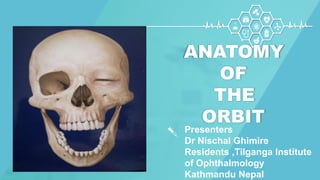
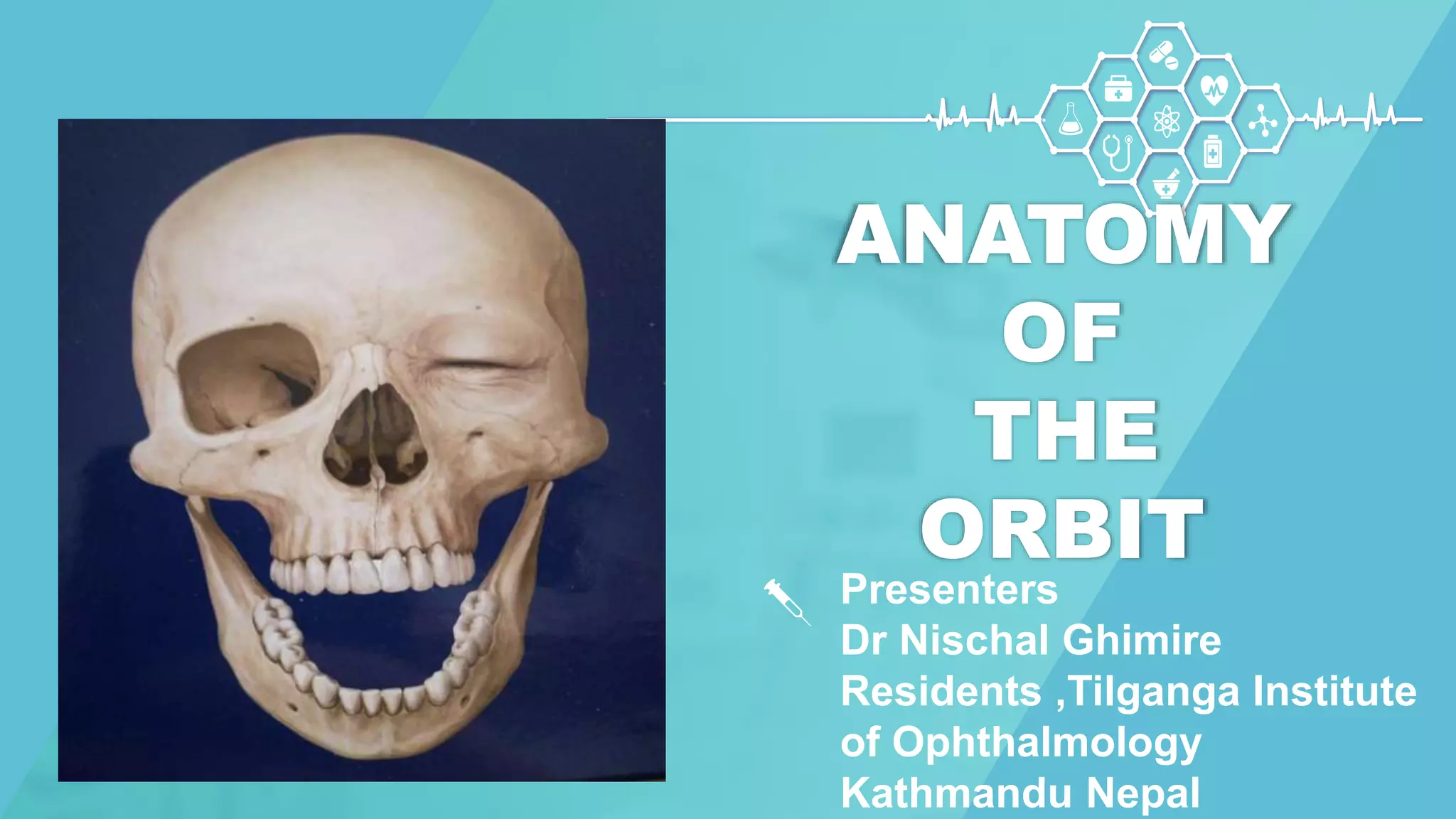
ANATOMY
OF
THE
ORBIT
Presenters
Dr Nischal Ghimire
Residents ,Tilganga Institute
of Ophthalmology
Kathmandu Nepal
Contents
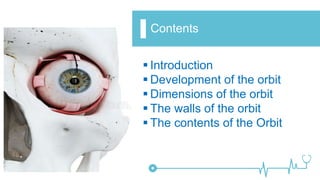
 Introduction
 Development of the orbit
 Dimensions of the orbit
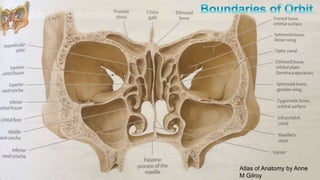
 The walls of the orbit
 The contents of the Orbit
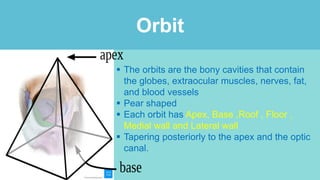
 The orbits are the bony cavities that contain
the globes, extraocular muscles, nerves, fat,
and blood vessels
 Pear shaped
 Each orbit has Apex, Base ,Roof , Floor ,
Medial wall and Lateral wall
 Tapering posteriorly to the apex and the optic
canal.
Orbit
Atlas of Anatomy by Anne
M Gilroy
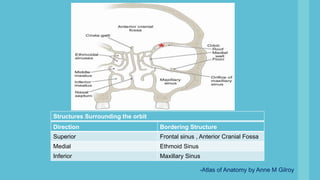
Direction Bordering Structure
Superior Frontal sinus , Anterior Cranial Fossa
Medial Ethmoid Sinus
Inferior Maxillary Sinus
Structures Surrounding the orbit
-Atlas of Anatomy by Anne M Gilroy
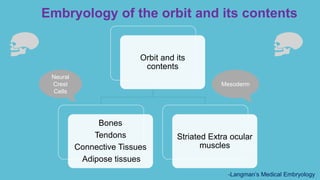
Embryology of the orbit and its contents
Orbit and its
contents
Bones
Tendons
Connective Tissues
Adipose tissues
Striated Extra ocular
muscles
Neural
Crest
Cells
Mesoderm
-Langman’s Medical Embryology
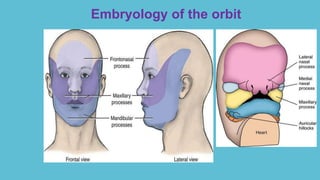
Embryology of the orbit
 Neural crest cells that expands to form :
• Fronto-nasal Process
• Maxillary Process
 Lateral nasal process and Maxillary process
Gives Inferior , Medial and Lateral orbital
walls
 Capsule of the Forebrain forms the Roof of
the orbit
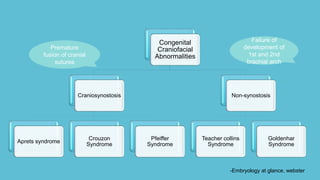
Congenital
Craniofacial
Abnormalities
Craniosynostosis
Aprets syndrome
Crouzon
Syndrome
Pfeiffer
Syndrome
Non-synostosis
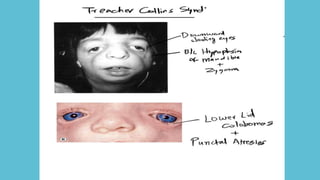
Teacher collins
Syndrome
Goldenhar
Syndrome
Premature
fusion of cranial
sutures
Failure of
development of
1st and 2nd
brachial arch
-Embryology at glance, webster
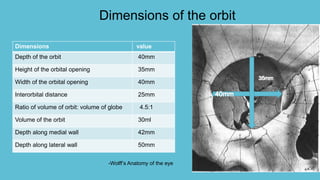
Dimensions of the orbit
Dimensions value
Depth of the orbit 40mm
Height of the orbital opening 35mm
Width of the orbital opening 40mm
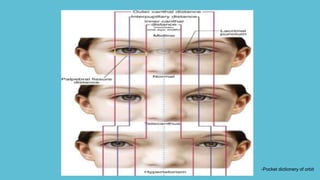
Interorbital distance 25mm
Ratio of volume of orbit: volume of globe 4.5:1
Volume of the orbit 30ml
Depth along medial wall 42mm
Depth along lateral wall 50mm
-Wolff’s Anatomy of the eye
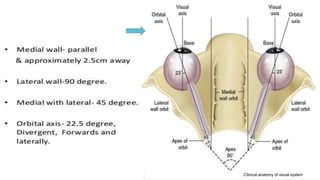
-Clinical anatomy of visual system
-Pocket dictionery of orbit
Walls of the orbit
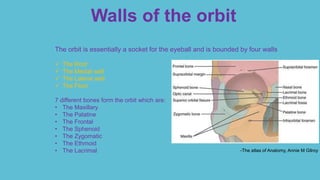
The orbit is essentially a socket for the eyeball and is bounded by four walls
 The Roof
 The Medial wall
 The Lateral wall
 The Floor
7 different bones form the orbit which are:
• The Maxillary
• The Palatine
• The Frontal
• The Sphenoid
• The Zygomatic
• The Ethmoid
• The Lacrimal -The atlas of Anatomy, Annie M Gilroy
Roof of the orbit
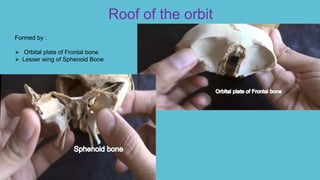
Formed by :
 Orbital plate of Frontal bone
 Lesser wing of Sphenoid Bone
Roof of the orbit
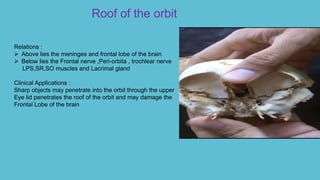
Relations :
 Above lies the meninges and frontal lobe of the brain
 Below lies the Frontal nerve ,Peri-orbita , trochlear nerve
LPS,SR,SO muscles and Lacrimal gland
Clinical Applications :
Sharp objects may penetrate into the orbit through the upper
Eye lid penetrates the roof of the orbit and may damage the
Frontal Lobe of the brain
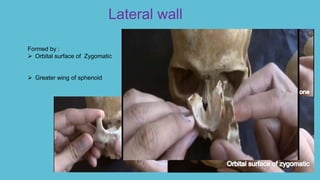
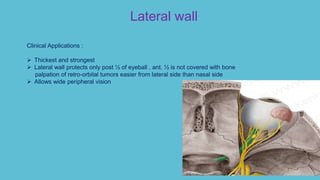
Lateral wall
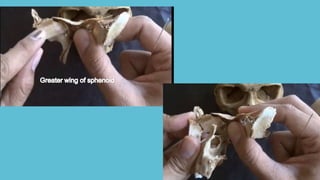
Formed by :
 Orbital surface of Zygomatic
 Greater wing of sphenoid
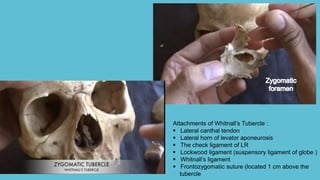
Attachments of Whitnall’s Tubercle :
 Lateral canthal tendon
 Lateral horn of levator aponeurosis
 The check ligament of LR
 Lockwood ligament (suspensory ligament of globe )
 Whitnall’s ligament
 Frontozygomatic suture (located 1 cm above the
tubercle
Clinical Applications :
 Thickest and strongest
 Lateral wall protects only post ½ of eyeball , ant. ½ is not covered with bone
palpation of retro-orbital tumors easier from lateral side than nasal side
 Allows wide peripheral vision
Lateral wall
The Floor
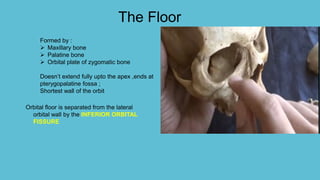
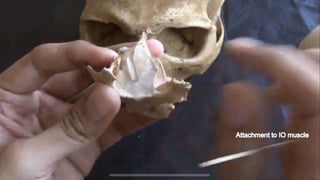
Formed by :
 Maxillary bone
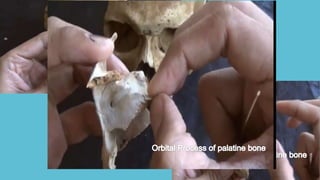
 Palatine bone
 Orbital plate of zygomatic bone
Doesn’t extend fully upto the apex ,ends at
pterygopalatine fossa ;
Shortest wall of the orbit
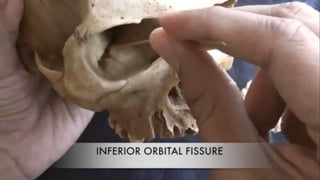
Orbital floor is separated from the lateral
orbital wall by the INFERIOR ORBITAL
FISSURE
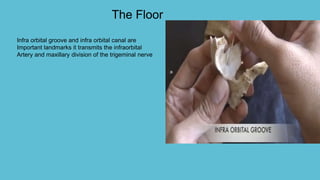
Infra orbital groove and infra orbital canal are
Important landmarks it transmits the infraorbital
Artery and maxillary division of the trigeminal nerve
The Floor
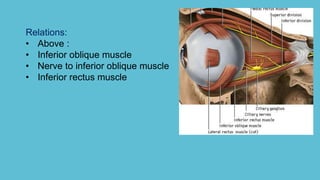
Relations:
• Above :
• Inferior oblique muscle
• Nerve to inferior oblique muscle
• Inferior rectus muscle
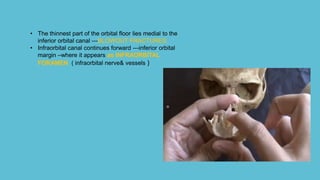
• The thinnest part of the orbital floor lies medial to the
inferior orbital canal ---BLOWOUT FRACTURES
• Infraorbital canal continues forward ---inferior orbital
margin –where it appears as INFRAORBITAL
FORAMEN ( infraorbital nerve& vessels )
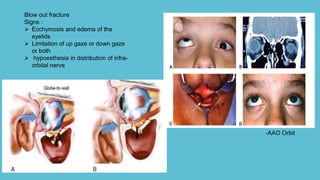
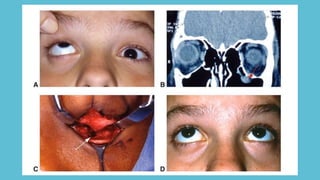
Blow out fracture
Signs :
 Ecchymosis and edema of the
eyelids
 Limitation of up gaze or down gaze
or both
 hypoesthesia in distribution of infra-
orbital nerve
-AAO Orbit
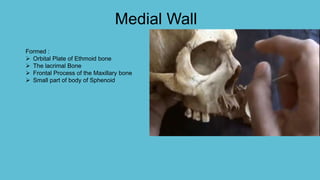
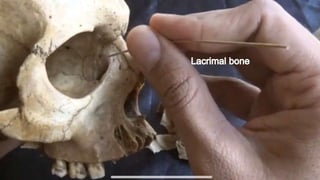
Medial Wall
Formed :
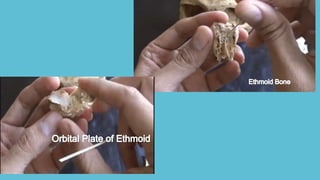
 Orbital Plate of Ethmoid bone
 The lacrimal Bone
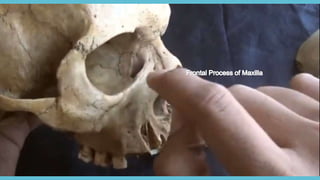
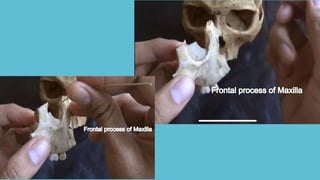
 Frontal Process of the Maxillary bone
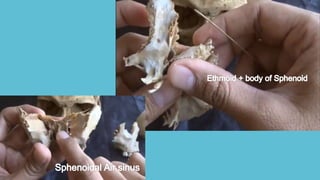
 Small part of body of Sphenoid
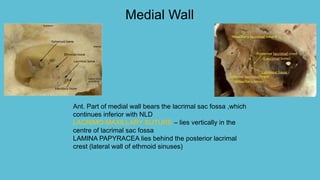
Medial Wall
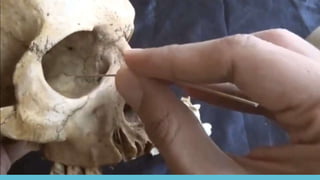
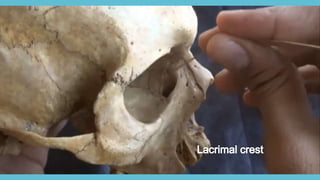
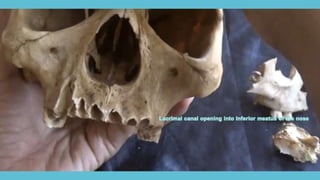
Ant. Part of medial wall bears the lacrimal sac fossa ,which
continues inferior with NLD
LACRIMO-MAXILLARY SUTURE – lies vertically in the
centre of lacrimal sac fossa
LAMINA PAPYRACEA lies behind the posterior lacrimal
crest (lateral wall of ethmoid sinuses)
Medial Wall
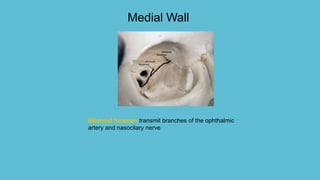
Ethmoid foramen transmit branches of the ophthalmic
artery and nasocilary nerve
-Jones phillip ferguson leatherbar
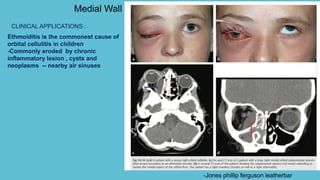
Ethmoiditis is the commonest cause of
orbital cellulitis in children
-Commonly eroded by chronic
inflammatory lesion , cysts and
neoplasms -- nearby air sinuses
Medial Wall
CLINICAL APPLICATIONS :
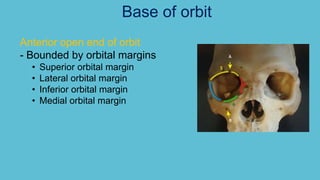
Anterior open end of orbit
- Bounded by orbital margins
• Superior orbital margin
• Lateral orbital margin
• Inferior orbital margin
• Medial orbital margin
Base of orbit
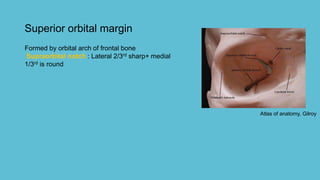
Superior orbital margin
Atlas of anatomy, Gilroy
Formed by orbital arch of frontal bone
Supraorbital notch : Lateral 2/3rd sharp+ medial
1/3rd is round
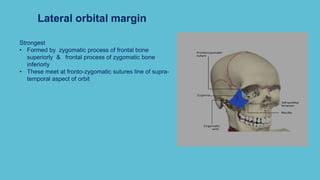
Lateral orbital margin
Strongest
• Formed by zygomatic process of frontal bone
superiorly & frontal process of zygomatic bone
inferiorly
• These meet at fronto-zygomatic sutures line of supra-
temporal aspect of orbit
Lateral orbital margin
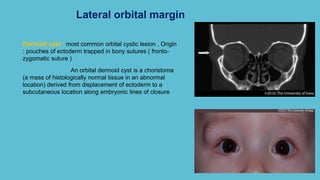
Dermoid cyst : most common orbital cystic lesion , Origin
: pouches of ectoderm trapped in bony sutures ( fronto-
zygomatic suture )
An orbital dermoid cyst is a choristoma
(a mass of histologically normal tissue in an abnormal
location) derived from displacement of ectoderm to a
subcutaneous location along embryonic lines of closure
Medial orbital margin
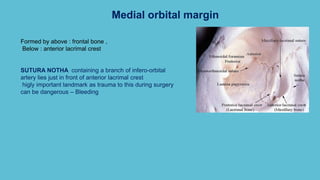
Formed by above : frontal bone ,
Below : anterior lacrimal crest
SUTURA NOTHA containing a branch of infero-orbital
artery lies just in front of anterior lacrimal crest
higly important landmark as trauma to this during surgery
can be dangerous – Bleeding
Inferior orbital margin
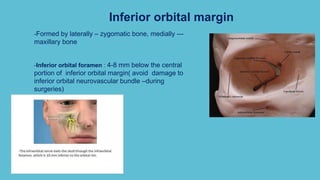
-Formed by laterally – zygomatic bone, medially ---
maxillary bone
-Inferior orbital foramen : 4-8 mm below the central
portion of inferior orbital margin( avoid damage to
inferior orbital neurovascular bundle –during
surgeries)
Apex of the orbit
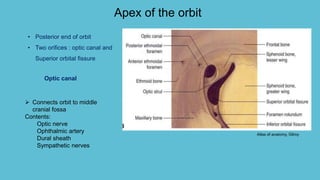
• Posterior end of orbit
• Two orifices : optic canal and
Superior orbital fissure
Optic canal
 Connects orbit to middle
cranial fossa
Contents:
Optic nerve
Ophthalmic artery
Dural sheath
Sympathetic nerves
Atlas of anatomy, Gilroy
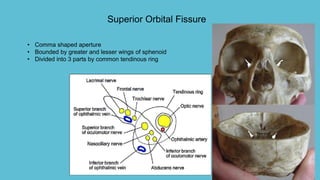
• Comma shaped aperture
• Bounded by greater and lesser wings of sphenoid
• Divided into 3 parts by common tendinous ring
Superior Orbital Fissure
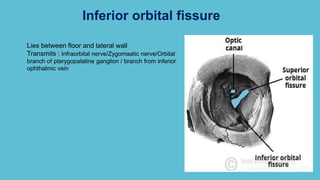
Inferior orbital fissure
Lies between floor and lateral wall
Transmits : Infraorbital nerve/Zygomaatic nerve/Orbital
branch of pterygopalatine ganglion / branch from inferior
ophthalmic vein
Orbital Apex Syndrome
Due to various etiologies involving the OA, including
trauma, neoplastic, developmental, infectious,
inflammatory as well as vascular causes
Charaterized By :
• Ophthalmoplegia
• Proptosis
• Ptosis from palsy of cranial nerves (CN) III, IV, and VI
• Hypoesthesia of the ipsilateral forehead
Atlas of Anatomy , Milroy
References

Anatomy of the Bony orbit

  • 1.
    ANATOMY OF THE ORBIT Presenters Dr Nischal Ghimire Residents,Tilganga Institute of Ophthalmology Kathmandu Nepal
  • 2.
    Contents  Introduction  Developmentof the orbit  Dimensions of the orbit  The walls of the orbit  The contents of the Orbit
  • 3.
     The orbitsare the bony cavities that contain the globes, extraocular muscles, nerves, fat, and blood vessels  Pear shaped  Each orbit has Apex, Base ,Roof , Floor , Medial wall and Lateral wall  Tapering posteriorly to the apex and the optic canal. Orbit
  • 4.
    Atlas of Anatomyby Anne M Gilroy
  • 5.
    Direction Bordering Structure SuperiorFrontal sinus , Anterior Cranial Fossa Medial Ethmoid Sinus Inferior Maxillary Sinus Structures Surrounding the orbit -Atlas of Anatomy by Anne M Gilroy
  • 6.
    Embryology of theorbit and its contents Orbit and its contents Bones Tendons Connective Tissues Adipose tissues Striated Extra ocular muscles Neural Crest Cells Mesoderm -Langman’s Medical Embryology
  • 7.
    Embryology of theorbit  Neural crest cells that expands to form : • Fronto-nasal Process • Maxillary Process  Lateral nasal process and Maxillary process Gives Inferior , Medial and Lateral orbital walls  Capsule of the Forebrain forms the Roof of the orbit
  • 8.
  • 13.
    Dimensions of theorbit Dimensions value Depth of the orbit 40mm Height of the orbital opening 35mm Width of the orbital opening 40mm Interorbital distance 25mm Ratio of volume of orbit: volume of globe 4.5:1 Volume of the orbit 30ml Depth along medial wall 42mm Depth along lateral wall 50mm -Wolff’s Anatomy of the eye
  • 14.
    -Clinical anatomy ofvisual system
  • 15.
  • 16.
    Walls of theorbit The orbit is essentially a socket for the eyeball and is bounded by four walls  The Roof  The Medial wall  The Lateral wall  The Floor 7 different bones form the orbit which are: • The Maxillary • The Palatine • The Frontal • The Sphenoid • The Zygomatic • The Ethmoid • The Lacrimal -The atlas of Anatomy, Annie M Gilroy
  • 17.
    Roof of theorbit Formed by :  Orbital plate of Frontal bone  Lesser wing of Sphenoid Bone
  • 18.
    Roof of theorbit Relations :  Above lies the meninges and frontal lobe of the brain  Below lies the Frontal nerve ,Peri-orbita , trochlear nerve LPS,SR,SO muscles and Lacrimal gland Clinical Applications : Sharp objects may penetrate into the orbit through the upper Eye lid penetrates the roof of the orbit and may damage the Frontal Lobe of the brain
  • 20.
    Lateral wall Formed by:  Orbital surface of Zygomatic  Greater wing of sphenoid
  • 21.
    Attachments of Whitnall’sTubercle :  Lateral canthal tendon  Lateral horn of levator aponeurosis  The check ligament of LR  Lockwood ligament (suspensory ligament of globe )  Whitnall’s ligament  Frontozygomatic suture (located 1 cm above the tubercle
  • 24.
    Clinical Applications : Thickest and strongest  Lateral wall protects only post ½ of eyeball , ant. ½ is not covered with bone palpation of retro-orbital tumors easier from lateral side than nasal side  Allows wide peripheral vision Lateral wall
  • 25.
    The Floor Formed by:  Maxillary bone  Palatine bone  Orbital plate of zygomatic bone Doesn’t extend fully upto the apex ,ends at pterygopalatine fossa ; Shortest wall of the orbit Orbital floor is separated from the lateral orbital wall by the INFERIOR ORBITAL FISSURE
  • 27.
    Infra orbital grooveand infra orbital canal are Important landmarks it transmits the infraorbital Artery and maxillary division of the trigeminal nerve The Floor
  • 28.
    Relations: • Above : •Inferior oblique muscle • Nerve to inferior oblique muscle • Inferior rectus muscle
  • 31.
    • The thinnestpart of the orbital floor lies medial to the inferior orbital canal ---BLOWOUT FRACTURES • Infraorbital canal continues forward ---inferior orbital margin –where it appears as INFRAORBITAL FORAMEN ( infraorbital nerve& vessels )
  • 32.
    Blow out fracture Signs:  Ecchymosis and edema of the eyelids  Limitation of up gaze or down gaze or both  hypoesthesia in distribution of infra- orbital nerve -AAO Orbit
  • 34.
    Medial Wall Formed : Orbital Plate of Ethmoid bone  The lacrimal Bone  Frontal Process of the Maxillary bone  Small part of body of Sphenoid
  • 35.
    Medial Wall Ant. Partof medial wall bears the lacrimal sac fossa ,which continues inferior with NLD LACRIMO-MAXILLARY SUTURE – lies vertically in the centre of lacrimal sac fossa LAMINA PAPYRACEA lies behind the posterior lacrimal crest (lateral wall of ethmoid sinuses)
  • 36.
    Medial Wall Ethmoid foramentransmit branches of the ophthalmic artery and nasocilary nerve
  • 45.
    -Jones phillip fergusonleatherbar Ethmoiditis is the commonest cause of orbital cellulitis in children -Commonly eroded by chronic inflammatory lesion , cysts and neoplasms -- nearby air sinuses Medial Wall CLINICAL APPLICATIONS :
  • 46.
    Anterior open endof orbit - Bounded by orbital margins • Superior orbital margin • Lateral orbital margin • Inferior orbital margin • Medial orbital margin Base of orbit
  • 47.
    Superior orbital margin Atlasof anatomy, Gilroy Formed by orbital arch of frontal bone Supraorbital notch : Lateral 2/3rd sharp+ medial 1/3rd is round
  • 48.
    Lateral orbital margin Strongest •Formed by zygomatic process of frontal bone superiorly & frontal process of zygomatic bone inferiorly • These meet at fronto-zygomatic sutures line of supra- temporal aspect of orbit
  • 49.
    Lateral orbital margin Dermoidcyst : most common orbital cystic lesion , Origin : pouches of ectoderm trapped in bony sutures ( fronto- zygomatic suture ) An orbital dermoid cyst is a choristoma (a mass of histologically normal tissue in an abnormal location) derived from displacement of ectoderm to a subcutaneous location along embryonic lines of closure
  • 50.
    Medial orbital margin Formedby above : frontal bone , Below : anterior lacrimal crest SUTURA NOTHA containing a branch of infero-orbital artery lies just in front of anterior lacrimal crest higly important landmark as trauma to this during surgery can be dangerous – Bleeding
  • 51.
    Inferior orbital margin -Formedby laterally – zygomatic bone, medially --- maxillary bone -Inferior orbital foramen : 4-8 mm below the central portion of inferior orbital margin( avoid damage to inferior orbital neurovascular bundle –during surgeries)
  • 52.
    Apex of theorbit • Posterior end of orbit • Two orifices : optic canal and Superior orbital fissure Optic canal  Connects orbit to middle cranial fossa Contents: Optic nerve Ophthalmic artery Dural sheath Sympathetic nerves Atlas of anatomy, Gilroy
  • 53.
    • Comma shapedaperture • Bounded by greater and lesser wings of sphenoid • Divided into 3 parts by common tendinous ring Superior Orbital Fissure
  • 54.
    Inferior orbital fissure Liesbetween floor and lateral wall Transmits : Infraorbital nerve/Zygomaatic nerve/Orbital branch of pterygopalatine ganglion / branch from inferior ophthalmic vein
  • 55.
    Orbital Apex Syndrome Dueto various etiologies involving the OA, including trauma, neoplastic, developmental, infectious, inflammatory as well as vascular causes Charaterized By : • Ophthalmoplegia • Proptosis • Ptosis from palsy of cranial nerves (CN) III, IV, and VI • Hypoesthesia of the ipsilateral forehead
  • 56.
  • 57.

Editor's Notes

  • #8 Ossification = 3rd month of gestation Fusion takes place on 6th month of gestation
  • #28 Continous within the maxilla to form infra orbital canal , that runs in roof of maxillary sinus continousd as infraorbital foramen
  • #30 Anterio medial to the floor there lies a depression , that provides attachment to inferio obliguq muscle
  • #31 Communicates , orbit and the infra temporal fossa , posteriorily communicates orbit to pterygopalatine fossa
  • #44 Lacrimal crest lodges lacrimal sac Naso lacrimal cana l – Nasolacrimal Duct opens inti inferior meatus of nose