Presented by: Hela Fekih
M2 Applied Linguistics
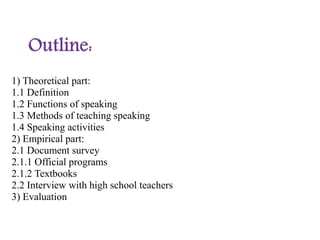
1) Theoretical part:
1.1 Definition
1.2 Functions of speaking
1.3 Methods of teaching speaking
1.4 Speaking activities
2) Empirical part:
2.1 Document survey
2.1.1 Official programs
2.1.2 Textbooks
2.2 Interview with high school teachers
3) Evaluation
Theoretical part:
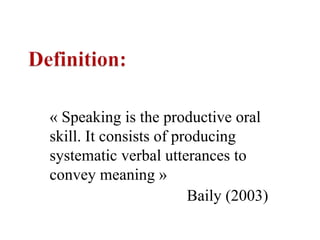
« Speaking is the productive oral
skill. It consists of producing
systematic verbal utterances to
convey meaning »
Baily (2003)
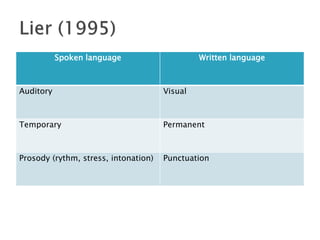
Spoken language Written language
Auditory Visual
Temporary Permanent
Prosody (rythm, stress, intonation) Punctuation
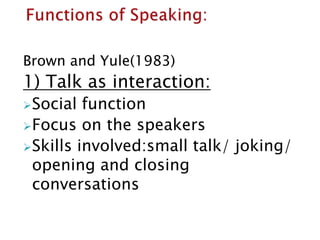
Brown and Yule(1983)
1) Talk as interaction:
Social function
Focus on the speakers
Skills involved:small talk/ joking/
opening and closing
conversations
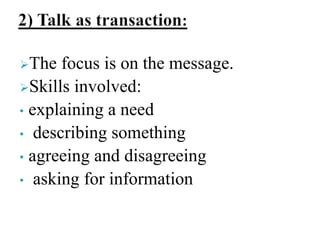
The focus is on the message.
Skills involved:
• explaining a need
• describing something
• agreeing and disagreeing
• asking for information
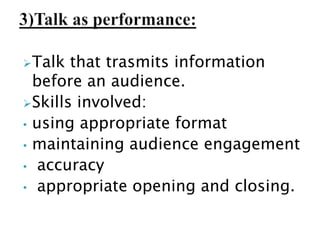
Talk that trasmits information
before an audience.
Skills involved:
• using appropriate format
• maintaining audience engagement
• accuracy
• appropriate opening and closing.
 Audiolingual method
Communicative Language
Teaching (CLT)
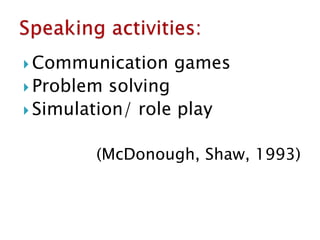
 Communication games
 Problem solving
 Simulation/ role play
(McDonough, Shaw, 1993)
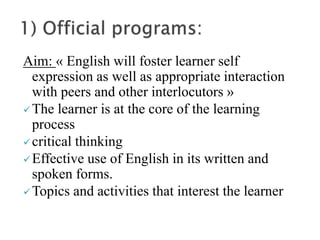
Aim: « English will foster learner self
expression as well as appropriate interaction
with peers and other interlocutors »
The learner is at the core of the learning
process
critical thinking
Effective use of English in its written and
spoken forms.
Topics and activities that interest the learner
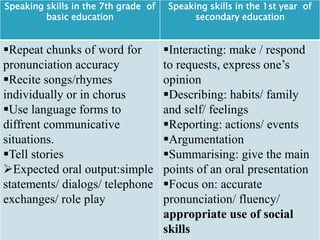
Speaking skills in the 7th grade of
basic education
Speaking skills in the 1st year of
secondary education
Repeat chunks of word for
pronunciation accuracy
Recite songs/rhymes
individually or in chorus
Use language forms to
diffrent communicative
situations.
Tell stories
Expected oral output:simple
statements/ dialogs/ telephone
exchanges/ role play
Interacting: make / respond
to requests, express one’s
opinion
Describing: habits/ family
and self/ feelings
Reporting: actions/ events
Argumentation
Summarising: give the main
points of an oral presentation
Focus on: accurate
pronunciation/ fluency/
appropriate use of social
skills
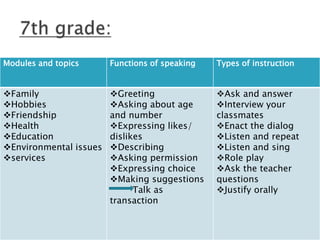
Modules and topics Functions of speaking Types of instruction
Family
Hobbies
Friendship
Health
Education
Environmental issues
services
Greeting
Asking about age
and number
Expressing likes/
dislikes
Describing
Asking permission
Expressing choice
Making suggestions
Talk as
transaction
Ask and answer
Interview your
classmates
Enact the dialog
Listen and repeat
Listen and sing
Role play
Ask the teacher
questions
Justify orally
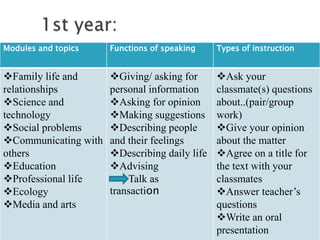
Modules and topics Functions of speaking Types of instruction
Family life and
relationships
Science and
technology
Social problems
Communicating with
others
Education
Professional life
Ecology
Media and arts
Giving/ asking for
personal information
Asking for opinion
Making suggestions
Describing people
and their feelings
Describing daily life
Advising
Talk as
transaction
Ask your
classmate(s) questions
about..(pair/group
work)
Give your opinion
about the matter
Agree on a title for
the text with your
classmates
Answer teacher’s
questions
Write an oral
presentation
Interview with two-first year
teachers of Hay-El Khadhra
high school
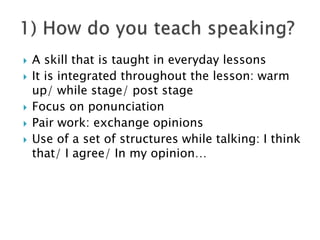
 A skill that is taught in everyday lessons
 It is integrated throughout the lesson: warm
up/ while stage/ post stage
 Focus on ponunciation
 Pair work: exchange opinions
 Use of a set of structures while talking: I think
that/ I agree/ In my opinion…
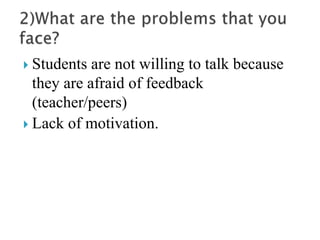
 Students are not willing to talk because
they are afraid of feedback
(teacher/peers)
 Lack of motivation.
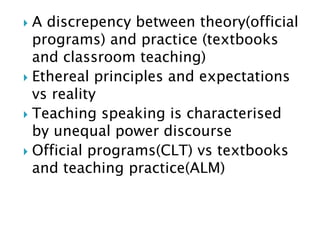
 A discrepency between theory(official
programs) and practice (textbooks
and classroom teaching)
 Ethereal principles and expectations
vs reality
 Teaching speaking is characterised
by unequal power discourse
 Official programs(CLT) vs textbooks
and teaching practice(ALM)
 Status of speaking in English classrooms in Tunisia:
undervalued and underestimated
A disregard for speaking as a main skill
 Teaching is only focused on speaking as transaction:
a disregard for interaction and performance.
 No real life concrete situations
 A problem of motivation:
 boring topics
 unclear objectives of speaking activities
 feedback
 Give students practice with both accuracy
and fluency.
 Provide opportunities for students to talk
(pair/ group work) and limit teacher talk.
 Plan speaking tasks that involve
negotiation of meaning.
 Design classroom activities that involve
practice in interactional and transactional
speaking
(Baily, 2003)
 Bailey, K.M. (2003). Speaking. In D. Nunan (Ed.),
Practical English language teaching (47-66). New
York: McGraw-Hill Contemporary.
 McDonough,J., Shaw,C. (1993). Materials and
Methods in ELT: A Teacher’s Guide. Oxford: Blackwell
Publishers.
 Richard, C.J. (2008). Teaching Listening and
Speaking: From Theory to Practice. New York:
Cambridge University Press.
 1st year Secondary school English textbook: Perform
through English
 7th grade of Basic school English textbooks: Let’s
Learn English
 Official programs for Basic and Secondary education

Speaking

  • 1.
    Presented by: HelaFekih M2 Applied Linguistics
  • 2.
    1) Theoretical part: 1.1Definition 1.2 Functions of speaking 1.3 Methods of teaching speaking 1.4 Speaking activities 2) Empirical part: 2.1 Document survey 2.1.1 Official programs 2.1.2 Textbooks 2.2 Interview with high school teachers 3) Evaluation
  • 3.
  • 4.
    « Speaking isthe productive oral skill. It consists of producing systematic verbal utterances to convey meaning » Baily (2003)
  • 5.
    Spoken language Writtenlanguage Auditory Visual Temporary Permanent Prosody (rythm, stress, intonation) Punctuation
  • 6.
    Brown and Yule(1983) 1)Talk as interaction: Social function Focus on the speakers Skills involved:small talk/ joking/ opening and closing conversations
  • 7.
    The focus ison the message. Skills involved: • explaining a need • describing something • agreeing and disagreeing • asking for information
  • 8.
    Talk that trasmitsinformation before an audience. Skills involved: • using appropriate format • maintaining audience engagement • accuracy • appropriate opening and closing.
  • 9.
  • 10.
  • 11.
     Communication games Problem solving  Simulation/ role play (McDonough, Shaw, 1993)
  • 14.
    Aim: « Englishwill foster learner self expression as well as appropriate interaction with peers and other interlocutors » The learner is at the core of the learning process critical thinking Effective use of English in its written and spoken forms. Topics and activities that interest the learner
  • 15.
    Speaking skills inthe 7th grade of basic education Speaking skills in the 1st year of secondary education Repeat chunks of word for pronunciation accuracy Recite songs/rhymes individually or in chorus Use language forms to diffrent communicative situations. Tell stories Expected oral output:simple statements/ dialogs/ telephone exchanges/ role play Interacting: make / respond to requests, express one’s opinion Describing: habits/ family and self/ feelings Reporting: actions/ events Argumentation Summarising: give the main points of an oral presentation Focus on: accurate pronunciation/ fluency/ appropriate use of social skills
  • 17.
    Modules and topicsFunctions of speaking Types of instruction Family Hobbies Friendship Health Education Environmental issues services Greeting Asking about age and number Expressing likes/ dislikes Describing Asking permission Expressing choice Making suggestions Talk as transaction Ask and answer Interview your classmates Enact the dialog Listen and repeat Listen and sing Role play Ask the teacher questions Justify orally
  • 18.
    Modules and topicsFunctions of speaking Types of instruction Family life and relationships Science and technology Social problems Communicating with others Education Professional life Ecology Media and arts Giving/ asking for personal information Asking for opinion Making suggestions Describing people and their feelings Describing daily life Advising Talk as transaction Ask your classmate(s) questions about..(pair/group work) Give your opinion about the matter Agree on a title for the text with your classmates Answer teacher’s questions Write an oral presentation
  • 19.
    Interview with two-firstyear teachers of Hay-El Khadhra high school
  • 20.
     A skillthat is taught in everyday lessons  It is integrated throughout the lesson: warm up/ while stage/ post stage  Focus on ponunciation  Pair work: exchange opinions  Use of a set of structures while talking: I think that/ I agree/ In my opinion…
  • 21.
     Students arenot willing to talk because they are afraid of feedback (teacher/peers)  Lack of motivation.
  • 23.
     A discrepencybetween theory(official programs) and practice (textbooks and classroom teaching)  Ethereal principles and expectations vs reality  Teaching speaking is characterised by unequal power discourse  Official programs(CLT) vs textbooks and teaching practice(ALM)
  • 24.
     Status ofspeaking in English classrooms in Tunisia: undervalued and underestimated A disregard for speaking as a main skill  Teaching is only focused on speaking as transaction: a disregard for interaction and performance.  No real life concrete situations  A problem of motivation:  boring topics  unclear objectives of speaking activities  feedback
  • 25.
     Give studentspractice with both accuracy and fluency.  Provide opportunities for students to talk (pair/ group work) and limit teacher talk.  Plan speaking tasks that involve negotiation of meaning.  Design classroom activities that involve practice in interactional and transactional speaking (Baily, 2003)
  • 26.
     Bailey, K.M.(2003). Speaking. In D. Nunan (Ed.), Practical English language teaching (47-66). New York: McGraw-Hill Contemporary.  McDonough,J., Shaw,C. (1993). Materials and Methods in ELT: A Teacher’s Guide. Oxford: Blackwell Publishers.  Richard, C.J. (2008). Teaching Listening and Speaking: From Theory to Practice. New York: Cambridge University Press.  1st year Secondary school English textbook: Perform through English  7th grade of Basic school English textbooks: Let’s Learn English  Official programs for Basic and Secondary education