TEACHING SPEAKING
TEACHING SPEAKING
Teaching by Principles
by H. D. Brown
by H. D. Brown
ORAL COMMUNICATION SKILLS IN
PEDAGOGICAL RESEARCH
1. Conversational discourse
• The demonstration of an ability to accomplish pragmatic goals
The demonstration of an ability to accomplish pragmatic goals
• Teaching conversation are extremely diverse, depending on the student, teacher, &
Teaching conversation are extremely diverse, depending on the student, teacher, &
overall context of the class.
2. Teaching Pronunciation
ORAL COMMUNICATION SKILLS IN
PEDAGOGICAL RESEARCH
3. Accuracy & fluency
• How shall we prioritize the two clearly important
How shall we prioritize the two clearly important
speaker goals of accuracy & fluency?
• Message oriented/ Language oriented
Message oriented/ Language oriented
4. Affective factors
Anxiety, language ego =
Anxiety, language ego = “
“you are what you speak!
you are what you speak!”
”
ORAL COMMUNICATION SKILLS IN
PEDAGOGICAL RESEARCH
5. The interaction effect
interlocutor effect
interlocutor effect
6. Questions about intelligibility
7. The growth of spoken
7. The growth of spoken copora-corpus
copora-corpus linguistics
linguistics
8. Genres of spoken language
TYPES OF SPOKEN LANGUAGE
• Interpersonal(interactional) dialogue: familiarity with context, interlocutors, and
Interpersonal(interactional) dialogue: familiarity with context, interlocutors, and
purposes of communication occurs in relationships.
• Transactional dialogue: to inform, explain, transmit particular sets of knowledge with
Transactional dialogue: to inform, explain, transmit particular sets of knowledge with
specific goals.
specific goals.
WHAT MAKES LISTENING DIFFICULT?
1.
1. Clustering
Clustering
2. Redundancy
2. Redundancy
3. Reduced forms
3. Reduced forms
4. Performance variables:
4. Performance variables: “
“thinking time
thinking time”
” “
“fillers
fillers”
”
5. Colloquial language
6. Rate of delivery
6. Rate of delivery
7. Stress, rhythm, and intonation
8. Interaction
8. Interaction
MICROSKILLS OF ORAL
MICROSKILLS OF ORAL
COMMUNICATION
COMMUNICATION
• The importance of focusing on both the forms of language & the functions of
The importance of focusing on both the forms of language & the functions of
language
language
• Micro-/macroskills of oral communication: See Table 19.1
Micro-/macroskills of oral communication: See Table 19.1
TYPES OF CLASSROOM SPEAKING
PERFORMANCE
PERFORMANCE
1. Imitative
1. Imitative
-Drills offer an opportunity to listen & to orally repeat certain strings of
language that may pose some linguistic difficulty-phonological or grammatical
See 329 for successful drills
2. Intensive
2. Intensive
3. Responsive
3. Responsive
TYPES OF CLASSROOM SPEAKING
PERFORMANCE
PERFORMANCE
4.
4. Transactional (dialogue)
Transactional (dialogue)
5. Interpersonal (dialogue)
A casual register, Colloquial language, Emotionally
A casual register, Colloquial language, Emotionally
charged language, Slang,
Ellipsis, Sarcasm, A covert
Ellipsis, Sarcasm, A covert “
“agenda
agenda”
”
6. Extensive (monologue
6. Extensive (monologue)
)
PRINCIPLES FOR DESIGNING SPEAKING
TECHNIQUES
TECHNIQUES
1. Use techniques that cover the spectrum
of learners
of learners’
’ needs, from language-based
needs, from language-based
focus on accuracy to message-based focus
on interaction, meaning, & fluency.
2. Provide intrinsically motivating techniques.
3. Encourage the use of authentic language
in meaningful contexts.
PRINCIPLES FOR DESIGNING LISTENING
TECHNIQUES
TECHNIQUES
4. Provide appropriate feedback & correction.
5. Capitalize on the natural link between speaking & listening.
6. Give students opportunities to initiate oral communications.
7. Encourage the development of speaking strategies.
TEACHING CONVERSATION
• Indirect approach
Indirect approach
• Direct approach
Direct approach
• Students acquire conversational competence, peripherally, by engaging in
Students acquire conversational competence, peripherally, by engaging in
meaningful tasks.
meaningful tasks.
• Critical of task-based instruction, which Richards labeled an indirect approach
Critical of task-based instruction, which Richards labeled an indirect approach
“
“the focus is on using language to complete a task.
the focus is on using language to complete a task.”
”
TEACHING CONVERSATION
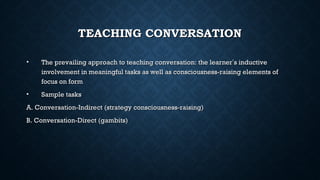
• The prevailing approach to teaching conversation: the learner
The prevailing approach to teaching conversation: the learner’
’s inductive
s inductive
involvement in meaningful tasks as well as consciousness-raising elements of
focus on form
focus on form
• Sample tasks
Sample tasks
A. Conversation-Indirect (strategy consciousness-raising)
B. Conversation-Direct (gambits)
TEACHING CONVERSATION
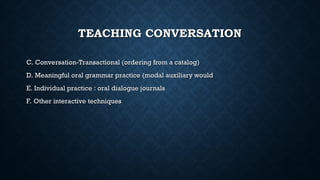
C. Conversation-Transactional (ordering from a catalog)
D. Meaningful oral grammar practice (modal auxiliary would
E. Individual practice : oral dialogue journals
F. Other interactive techniques
TEACHING PRONUNCIATION
• Affect factors
Affect factors
1. Native language
1. Native language
2. Age
2. Age
3. The quality & intensity of exposure
4. Innate phonetic ability
5. Identity & language ego
6. Motivation & concern for good pronunciation
TEACHING PRONUNCIATION
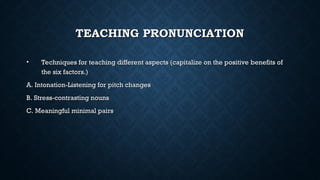
• Techniques for teaching different aspects (capitalize on the positive benefits of
Techniques for teaching different aspects (capitalize on the positive benefits of
the six factors.)
the six factors.)
A. Intonation-Listening for pitch changes
B. Stress-contrasting nouns
C. Meaningful minimal pairs
FOCUS ON FORM & ERROR TREATMENT
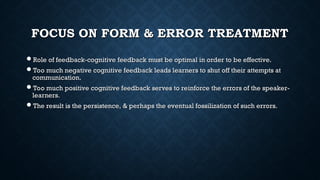
Role of feedback-cognitive feedback must be optimal in order to be effective.
Role of feedback-cognitive feedback must be optimal in order to be effective.
Too much negative cognitive feedback leads learners to shut off their attempts at
Too much negative cognitive feedback leads learners to shut off their attempts at
communication.
communication.
Too much positive cognitive feedback serves to reinforce the errors of the speaker-
Too much positive cognitive feedback serves to reinforce the errors of the speaker-
learners.
learners.
The result is the persistence, & perhaps the eventual fossilization of such errors.
The result is the persistence, & perhaps the eventual fossilization of such errors.
FOCUS ON FORM & ERROR TREATMENT
• The affective & cognitive modes of feedback are reinforcers to speakers
The affective & cognitive modes of feedback are reinforcers to speakers’
’ responses.
responses.
• Global & local errors
Global & local errors
• Students in the classroom generally want & expect errors to be corrected.
Students in the classroom generally want & expect errors to be corrected.
• Some methods recommend no direct treatment of error at all.
Some methods recommend no direct treatment of error at all.
FOCUS ON FORM & ERROR TREATMENT
• Language classroom- a happy optimum between some of the overpoliteness of the
Language classroom- a happy optimum between some of the overpoliteness of the
real world & the expectations that bring with them to the classroom
• Seven
Seven “
“basic options
basic options”
” complemented by eight
complemented by eight “
“possible features
possible features”
” within each option-
within each option-
p. 347
p. 347
• See a model for treatment of classroom speech errors (Fig 19.9-p.349).
See a model for treatment of classroom speech errors (Fig 19.9-p.349).
ASSESSING SPEAKING
ASSESSING SPEAKING
• Item types & tasks
Item types & tasks
1. Imitative tasks
1. Imitative tasks
2. Intensive tasks
2. Intensive tasks
3. Responsive tasks
3. Responsive tasks
4. Interactive tasks
5. Extensive tasks
5. Extensive tasks
• Evaluating & Scoring: pronunciation, fluency, vocabulary, grammar, discourse
Evaluating & Scoring: pronunciation, fluency, vocabulary, grammar, discourse
features, task acoomplishment
PHASES OF TEACHING SPEAKING
• Pre/Before-speaking Activity
Pre/Before-speaking Activity
• While/During-speaking Activity
While/During-speaking Activity
• Post/After-speaking Activity
Post/After-speaking Activity

Teaching Speaking - Teaching by Principles (Brown).ppt

  • 1.
    TEACHING SPEAKING TEACHING SPEAKING Teachingby Principles Teaching by Principles by H. D. Brown by H. D. Brown
  • 2.
    ORAL COMMUNICATION SKILLSIN ORAL COMMUNICATION SKILLS IN PEDAGOGICAL RESEARCH PEDAGOGICAL RESEARCH 1. Conversational discourse 1. Conversational discourse • The demonstration of an ability to accomplish pragmatic goals The demonstration of an ability to accomplish pragmatic goals • Teaching conversation are extremely diverse, depending on the student, teacher, & Teaching conversation are extremely diverse, depending on the student, teacher, & overall context of the class. overall context of the class. 2. Teaching Pronunciation 2. Teaching Pronunciation
  • 3.
    ORAL COMMUNICATION SKILLSIN ORAL COMMUNICATION SKILLS IN PEDAGOGICAL RESEARCH PEDAGOGICAL RESEARCH 3. Accuracy & fluency 3. Accuracy & fluency • How shall we prioritize the two clearly important How shall we prioritize the two clearly important speaker goals of accuracy & fluency? speaker goals of accuracy & fluency? • Message oriented/ Language oriented Message oriented/ Language oriented 4. Affective factors 4. Affective factors Anxiety, language ego = Anxiety, language ego = “ “you are what you speak! you are what you speak!” ”
  • 4.
    ORAL COMMUNICATION SKILLSIN ORAL COMMUNICATION SKILLS IN PEDAGOGICAL RESEARCH PEDAGOGICAL RESEARCH 5. The interaction effect 5. The interaction effect interlocutor effect interlocutor effect 6. Questions about intelligibility 6. Questions about intelligibility 7. The growth of spoken 7. The growth of spoken copora-corpus copora-corpus linguistics linguistics 8. Genres of spoken language 8. Genres of spoken language
  • 5.
    TYPES OF SPOKENLANGUAGE TYPES OF SPOKEN LANGUAGE • Interpersonal(interactional) dialogue: familiarity with context, interlocutors, and Interpersonal(interactional) dialogue: familiarity with context, interlocutors, and purposes of communication occurs in relationships. purposes of communication occurs in relationships. • Transactional dialogue: to inform, explain, transmit particular sets of knowledge with Transactional dialogue: to inform, explain, transmit particular sets of knowledge with specific goals. specific goals.
  • 6.
    WHAT MAKES LISTENINGDIFFICULT? WHAT MAKES LISTENING DIFFICULT? 1. 1. Clustering Clustering 2. Redundancy 2. Redundancy 3. Reduced forms 3. Reduced forms 4. Performance variables: 4. Performance variables: “ “thinking time thinking time” ” “ “fillers fillers” ” 5. Colloquial language 5. Colloquial language 6. Rate of delivery 6. Rate of delivery 7. Stress, rhythm, and intonation 7. Stress, rhythm, and intonation 8. Interaction 8. Interaction
  • 7.
    MICROSKILLS OF ORAL MICROSKILLSOF ORAL COMMUNICATION COMMUNICATION • The importance of focusing on both the forms of language & the functions of The importance of focusing on both the forms of language & the functions of language language • Micro-/macroskills of oral communication: See Table 19.1 Micro-/macroskills of oral communication: See Table 19.1
  • 8.
    TYPES OF CLASSROOMSPEAKING TYPES OF CLASSROOM SPEAKING PERFORMANCE PERFORMANCE 1. Imitative 1. Imitative -Drills offer an opportunity to listen & to orally repeat certain strings of -Drills offer an opportunity to listen & to orally repeat certain strings of language that may pose some linguistic difficulty-phonological or grammatical language that may pose some linguistic difficulty-phonological or grammatical See 329 for successful drills See 329 for successful drills 2. Intensive 2. Intensive 3. Responsive 3. Responsive
  • 9.
    TYPES OF CLASSROOMSPEAKING TYPES OF CLASSROOM SPEAKING PERFORMANCE PERFORMANCE 4. 4. Transactional (dialogue) Transactional (dialogue) 5. Interpersonal (dialogue) 5. Interpersonal (dialogue) A casual register, Colloquial language, Emotionally A casual register, Colloquial language, Emotionally charged language, Slang, charged language, Slang, Ellipsis, Sarcasm, A covert Ellipsis, Sarcasm, A covert “ “agenda agenda” ” 6. Extensive (monologue 6. Extensive (monologue) )
  • 10.
    PRINCIPLES FOR DESIGNINGSPEAKING PRINCIPLES FOR DESIGNING SPEAKING TECHNIQUES TECHNIQUES 1. Use techniques that cover the spectrum 1. Use techniques that cover the spectrum of learners of learners’ ’ needs, from language-based needs, from language-based focus on accuracy to message-based focus focus on accuracy to message-based focus on interaction, meaning, & fluency. on interaction, meaning, & fluency. 2. Provide intrinsically motivating techniques. 2. Provide intrinsically motivating techniques. 3. Encourage the use of authentic language 3. Encourage the use of authentic language in meaningful contexts. in meaningful contexts.
  • 11.
    PRINCIPLES FOR DESIGNINGLISTENING PRINCIPLES FOR DESIGNING LISTENING TECHNIQUES TECHNIQUES 4. Provide appropriate feedback & correction. 4. Provide appropriate feedback & correction. 5. Capitalize on the natural link between speaking & listening. 5. Capitalize on the natural link between speaking & listening. 6. Give students opportunities to initiate oral communications. 6. Give students opportunities to initiate oral communications. 7. Encourage the development of speaking strategies. 7. Encourage the development of speaking strategies.
  • 12.
    TEACHING CONVERSATION TEACHING CONVERSATION •Indirect approach Indirect approach • Direct approach Direct approach • Students acquire conversational competence, peripherally, by engaging in Students acquire conversational competence, peripherally, by engaging in meaningful tasks. meaningful tasks. • Critical of task-based instruction, which Richards labeled an indirect approach Critical of task-based instruction, which Richards labeled an indirect approach “ “the focus is on using language to complete a task. the focus is on using language to complete a task.” ”
  • 13.
    TEACHING CONVERSATION TEACHING CONVERSATION •The prevailing approach to teaching conversation: the learner The prevailing approach to teaching conversation: the learner’ ’s inductive s inductive involvement in meaningful tasks as well as consciousness-raising elements of involvement in meaningful tasks as well as consciousness-raising elements of focus on form focus on form • Sample tasks Sample tasks A. Conversation-Indirect (strategy consciousness-raising) A. Conversation-Indirect (strategy consciousness-raising) B. Conversation-Direct (gambits) B. Conversation-Direct (gambits)
  • 14.
    TEACHING CONVERSATION TEACHING CONVERSATION C.Conversation-Transactional (ordering from a catalog) C. Conversation-Transactional (ordering from a catalog) D. Meaningful oral grammar practice (modal auxiliary would D. Meaningful oral grammar practice (modal auxiliary would E. Individual practice : oral dialogue journals E. Individual practice : oral dialogue journals F. Other interactive techniques F. Other interactive techniques
  • 15.
    TEACHING PRONUNCIATION TEACHING PRONUNCIATION •Affect factors Affect factors 1. Native language 1. Native language 2. Age 2. Age 3. The quality & intensity of exposure 3. The quality & intensity of exposure 4. Innate phonetic ability 4. Innate phonetic ability 5. Identity & language ego 5. Identity & language ego 6. Motivation & concern for good pronunciation 6. Motivation & concern for good pronunciation
  • 16.
    TEACHING PRONUNCIATION TEACHING PRONUNCIATION •Techniques for teaching different aspects (capitalize on the positive benefits of Techniques for teaching different aspects (capitalize on the positive benefits of the six factors.) the six factors.) A. Intonation-Listening for pitch changes A. Intonation-Listening for pitch changes B. Stress-contrasting nouns B. Stress-contrasting nouns C. Meaningful minimal pairs C. Meaningful minimal pairs
  • 17.
    FOCUS ON FORM& ERROR TREATMENT FOCUS ON FORM & ERROR TREATMENT Role of feedback-cognitive feedback must be optimal in order to be effective. Role of feedback-cognitive feedback must be optimal in order to be effective. Too much negative cognitive feedback leads learners to shut off their attempts at Too much negative cognitive feedback leads learners to shut off their attempts at communication. communication. Too much positive cognitive feedback serves to reinforce the errors of the speaker- Too much positive cognitive feedback serves to reinforce the errors of the speaker- learners. learners. The result is the persistence, & perhaps the eventual fossilization of such errors. The result is the persistence, & perhaps the eventual fossilization of such errors.
  • 18.
    FOCUS ON FORM& ERROR TREATMENT FOCUS ON FORM & ERROR TREATMENT • The affective & cognitive modes of feedback are reinforcers to speakers The affective & cognitive modes of feedback are reinforcers to speakers’ ’ responses. responses. • Global & local errors Global & local errors • Students in the classroom generally want & expect errors to be corrected. Students in the classroom generally want & expect errors to be corrected. • Some methods recommend no direct treatment of error at all. Some methods recommend no direct treatment of error at all.
  • 19.
    FOCUS ON FORM& ERROR TREATMENT FOCUS ON FORM & ERROR TREATMENT • Language classroom- a happy optimum between some of the overpoliteness of the Language classroom- a happy optimum between some of the overpoliteness of the real world & the expectations that bring with them to the classroom real world & the expectations that bring with them to the classroom • Seven Seven “ “basic options basic options” ” complemented by eight complemented by eight “ “possible features possible features” ” within each option- within each option- p. 347 p. 347 • See a model for treatment of classroom speech errors (Fig 19.9-p.349). See a model for treatment of classroom speech errors (Fig 19.9-p.349).
  • 20.
    ASSESSING SPEAKING ASSESSING SPEAKING •Item types & tasks Item types & tasks 1. Imitative tasks 1. Imitative tasks 2. Intensive tasks 2. Intensive tasks 3. Responsive tasks 3. Responsive tasks 4. Interactive tasks 4. Interactive tasks 5. Extensive tasks 5. Extensive tasks • Evaluating & Scoring: pronunciation, fluency, vocabulary, grammar, discourse Evaluating & Scoring: pronunciation, fluency, vocabulary, grammar, discourse features, task acoomplishment features, task acoomplishment
  • 21.
    PHASES OF TEACHINGSPEAKING PHASES OF TEACHING SPEAKING • Pre/Before-speaking Activity Pre/Before-speaking Activity • While/During-speaking Activity While/During-speaking Activity • Post/After-speaking Activity Post/After-speaking Activity

Editor's Notes