Linguistics
LANGUAGE
“A system of communication using symbolic sounds, gestures, or marks that are put
together according to certain rules, resulting in meanings that are intelligible to all who
share that language.” – Haviland et. Al
– There was an estimated 12,000 languages when the study of language began
– There are roughly 6,000 remaining in the world today
– Although diverse, languages are fundamentally organized in similar ways
– Linguistics is the systematic study of all aspects of language
BRANCHES OF LINGUISTICS
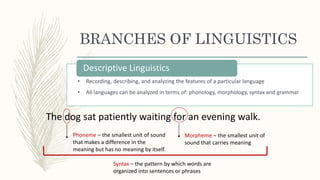
• Recording, describing, and analyzing the features of a particular language
• All languages can be analyzed in terms of: phonology, morphology, syntax and grammar
The dog sat patiently waiting for an evening walk.
Phoneme – the smallest unit of sound
that makes a difference in the
meaning but has no meaning by itself.
Morpheme – the smallest unit of
sound that carries meaning
Syntax – the pattern by which words are
organized into sentences or phrases
Descriptive Linguistics
BRANCHES OF LINGUISTICS
• Examine the interrelationships among older languages, how they have
progressed through time, and the process of change between earlier and
later forms of a language
• Depends on written records of languages
Historical Linguistics
• Many languages only exist in spoken form
• Others use symbols and visual representations for documentation
• Visual representations of language date back to 8,600 years ago
Oral Traditions
BRANCHES OF LINGUISTICS
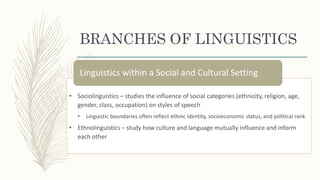
• Sociolinguistics – studies the influence of social categories (ethnicity, religion, age,
gender, class, occupation) on styles of speech
• Linguistic boundaries often reflect ethnic identity, socioeconomic status, and political rank
• Ethnolinguistics – study how culture and language mutually influence and inform
each other
Linguistics within a Social and Cultural Setting
NONVERBAL
COMMUNICTION
– Humans use body language, paralanguage, and tone of voice to
convey additional information during communication
– Grunts, groans, giggles, and sighing help to portray how the person is
feeling and what their intentions are (paralanguage)
– Pitch, tempo, and intensity contribute to ones tone and voice
– Nonverbal signals have the power to override and undercut verbal ones
– Part of nonverbal communication includes distinctive rules and
standards for social interaction
– How to greet someone, how close to stand, where to focus the gaze, etc.
ORIGINS OF
LANGUAGE
– The origin of language (how, when, and where) is still up
for debate
– Difficult to tell definitively given that vocal tissues are not
preserved in the archaeological record
– Anatomical differences responsible for human speech
indicate that the capacity for spoken language dates back
to the advent of Homo sapiens
– Anatomical changes in the position of the larynx and
epiglottis

Linguistics 101

  • 1.
  • 2.
    LANGUAGE “A system ofcommunication using symbolic sounds, gestures, or marks that are put together according to certain rules, resulting in meanings that are intelligible to all who share that language.” – Haviland et. Al – There was an estimated 12,000 languages when the study of language began – There are roughly 6,000 remaining in the world today – Although diverse, languages are fundamentally organized in similar ways – Linguistics is the systematic study of all aspects of language
  • 3.
    BRANCHES OF LINGUISTICS •Recording, describing, and analyzing the features of a particular language • All languages can be analyzed in terms of: phonology, morphology, syntax and grammar The dog sat patiently waiting for an evening walk. Phoneme – the smallest unit of sound that makes a difference in the meaning but has no meaning by itself. Morpheme – the smallest unit of sound that carries meaning Syntax – the pattern by which words are organized into sentences or phrases Descriptive Linguistics
  • 4.
    BRANCHES OF LINGUISTICS •Examine the interrelationships among older languages, how they have progressed through time, and the process of change between earlier and later forms of a language • Depends on written records of languages Historical Linguistics • Many languages only exist in spoken form • Others use symbols and visual representations for documentation • Visual representations of language date back to 8,600 years ago Oral Traditions
  • 5.
    BRANCHES OF LINGUISTICS •Sociolinguistics – studies the influence of social categories (ethnicity, religion, age, gender, class, occupation) on styles of speech • Linguistic boundaries often reflect ethnic identity, socioeconomic status, and political rank • Ethnolinguistics – study how culture and language mutually influence and inform each other Linguistics within a Social and Cultural Setting
  • 6.
    NONVERBAL COMMUNICTION – Humans usebody language, paralanguage, and tone of voice to convey additional information during communication – Grunts, groans, giggles, and sighing help to portray how the person is feeling and what their intentions are (paralanguage) – Pitch, tempo, and intensity contribute to ones tone and voice – Nonverbal signals have the power to override and undercut verbal ones – Part of nonverbal communication includes distinctive rules and standards for social interaction – How to greet someone, how close to stand, where to focus the gaze, etc.
  • 7.
    ORIGINS OF LANGUAGE – Theorigin of language (how, when, and where) is still up for debate – Difficult to tell definitively given that vocal tissues are not preserved in the archaeological record – Anatomical differences responsible for human speech indicate that the capacity for spoken language dates back to the advent of Homo sapiens – Anatomical changes in the position of the larynx and epiglottis