Corporate Social Responsibility Towards the Competition By  Raymund N. Sanchez
Agenda Overview of CSR
Unfair competition - Definition
- Antitrust laws
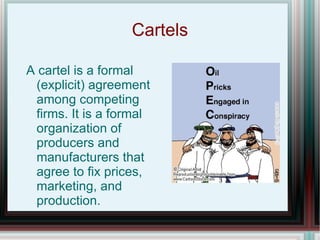
- Microsoft case Cartels
Intellectual Property Rights
Blood Diamonds
CSR Overview CSR policy functions as a built-in, self-regulating mechanism whereby business monitors and ensures its active compliance with the spirit of the law, ethical standards, and international norms.
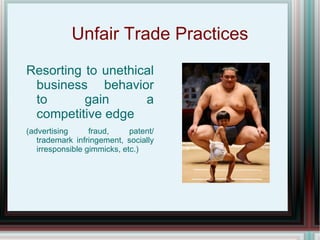
Unfair Trade Practices Resorting to unethical business behavior to gain a competitive edge  (advertising fraud, patent/ trademark infringement, socially irresponsible gimmicks, etc.)
Reasons why companies resort to Unfair Trade Practices Globalization of competition
Better informed & more discerning customers
Increasing number of competitors
Rapid advance in both soft & hard technology
Advances in scientific fields
In short, competition is getting stiffer & stiffer, Any kind of edge will count, which is why some companies resort to unethical practices.
When profit maximization becomes the sole driving force of the business that it pursues it with any means necessary. Resorting to: Fraud
Violation of human dignity
Patent/Trademark infringement
Socially irresponsible gimmicks
others When does competition become  UNFAIR ?
Anti Trust Laws Trust: or corporate monopoly was created for the purpose of eliminating competition in an area of business & of controlling the market for a product
Coverage of Anti Trust Laws Price fixing between competitors
Abuses of market power by a monopolist or dominant firm
Agreement between competitors to restrict output
Price Fixing between Competitors PRICE: often the principal way by which firms compete
Agreements on price initiatives, price ranges, price targets, collusion between competitors on floor prices are generally illegal under antitrust laws
Price Fixing between Competitors Are similarity of prices, simultaneous price changes, or high price, indications of price fixing? NO, not always Supply & Demand can cause these. Price fixing must be PROVEN. (systematic  exchanges of pricing information between competitors)
How do we determine the  “Just Price” Pricing Process: requires business to effectively calculate resources/needs, supply/demand.
Just Price: one in which both buyer & seller are given what is due them  (price a manufacturer charges its customers for G&S is total cost of investment plus normal profit)
How do we determine the  “Just Price” “ Buying & selling were instituted for the common good of both parties since each needs the product of the other... Therefore, the contract between them should rest upon equality of thing to things. The measure of a value of a thing which is exchanged should be given by its money price. Hence to sell a thing dearer or buy it cheaper than it is worth is unjust”  -St. Thomas Aquinas
How do we determine the  “Just Price” Prada
Louis Vuitton
Rolex
Rolls Royce
Q: Do these products ask for a “Just Price”?
Abusing Market Dominance Dominance: refers to a position of considerable economic power in a market held over a period of time
Abusing Market Dominance Q1: Is Being Dominant bad? Q2: Why is the law punishing companies for being too good at what they do?
Abusing Market Dominance Conduct of dominant companies that violate antitrust laws: Refusal to supply for non-objective reasons
Unfair discrimination between equivalent transactions
Non-objective refusal to grant access to essential facilities
Unfair / predatory pricing

Csr presentation