Optimal Debt-Maturity Management
Saki Bigio (UCLA)
Galo Nuño (Bank of Spain)
Juan Passadore (EIEF)
Toulouse, April 2018
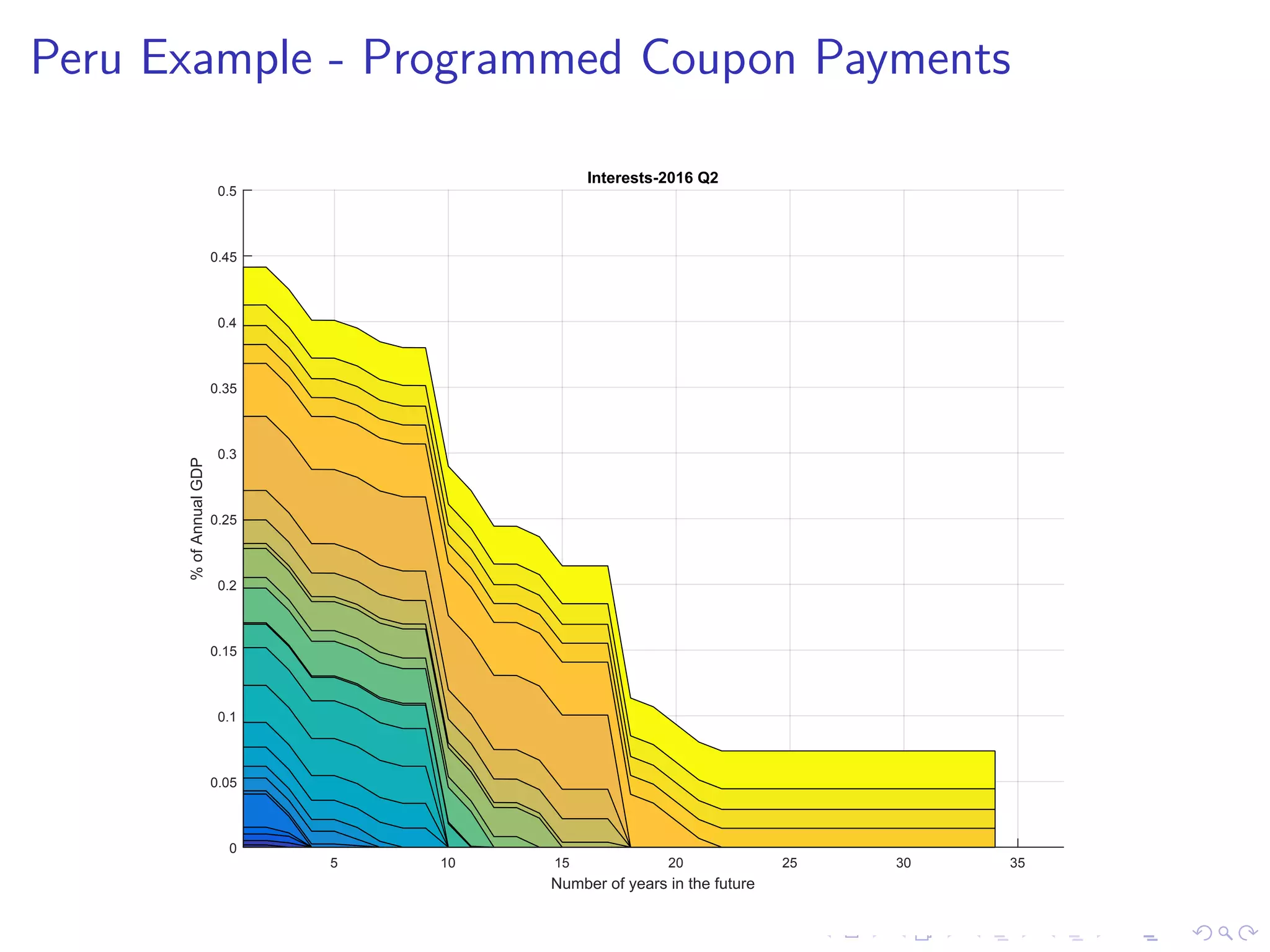
Peru Example - Programmed Coupon Payments
Number of years in the future
5 10 15 20 25 30 35
%ofAnnualGDP
0
0.05
0.1
0.15
0.2
0.25
0.3
0.35
0.4
0.45
0.5
Interests-2016 Q2
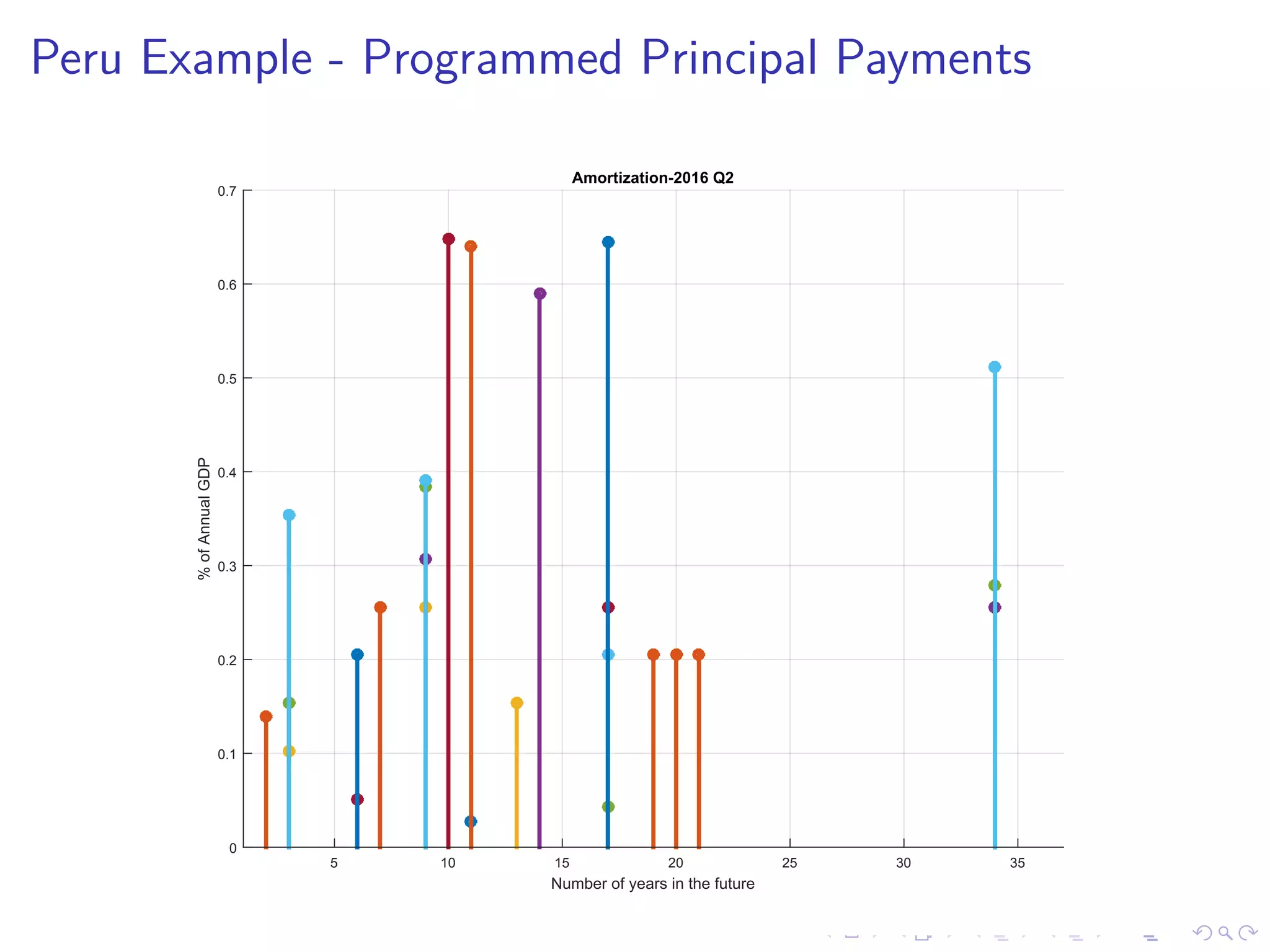
Peru Example - Programmed Principal Payments
Number of years in the future
5 10 15 20 25 30 35
%ofAnnualGDP
0
0.1
0.2
0.3
0.4
0.5
0.6
0.7
Amortization-2016 Q2
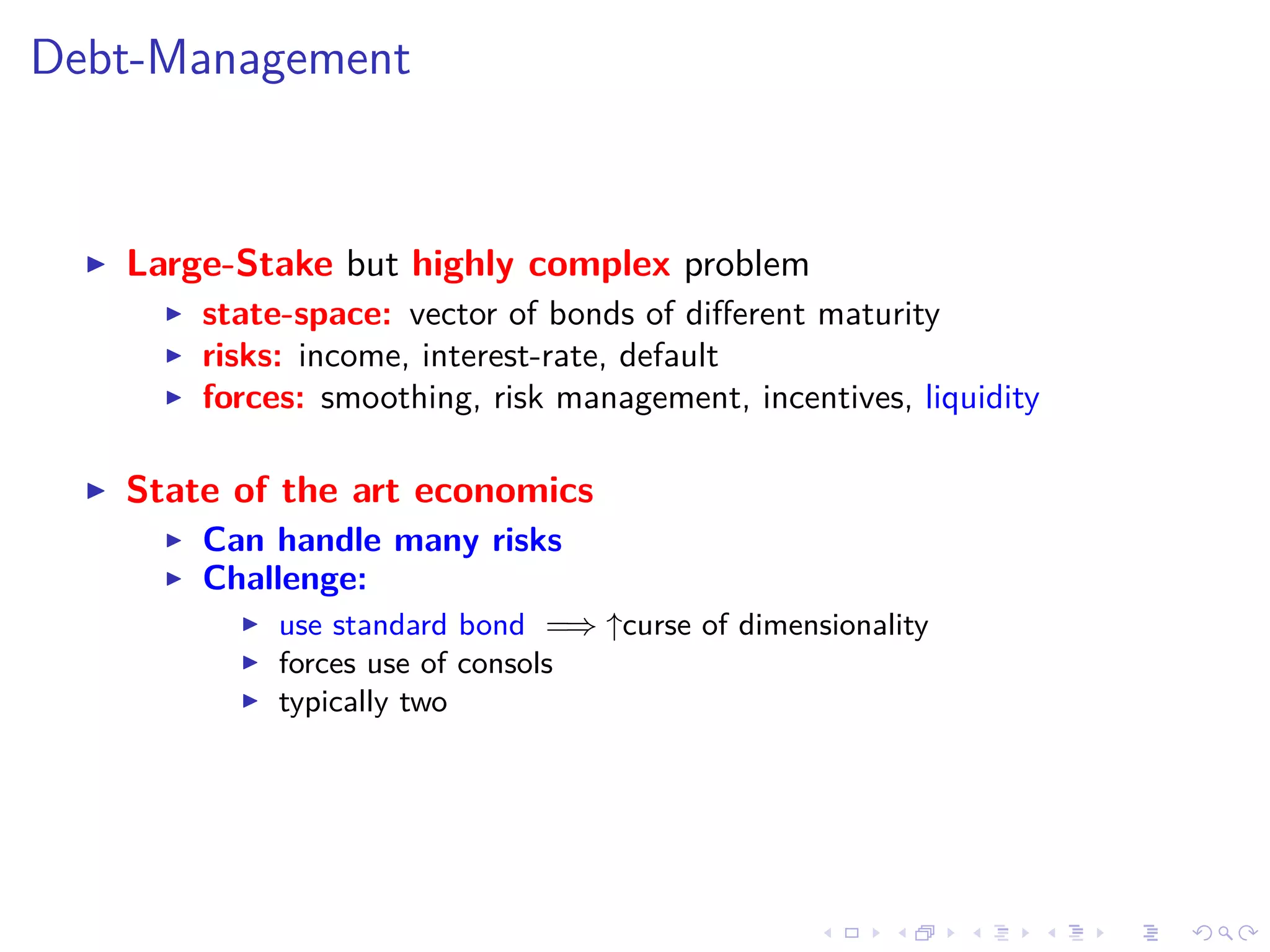
Debt-Management
Large-Stake but highly complex problem
state-space: vector of bonds of different maturity
risks: income, interest-rate, default
forces: smoothing, risk management, incentives, liquidity
State of the art economics
Can handle many risks
Challenge:
use standard bond =⇒ ↑curse of dimensionality
forces use of consols
typically two
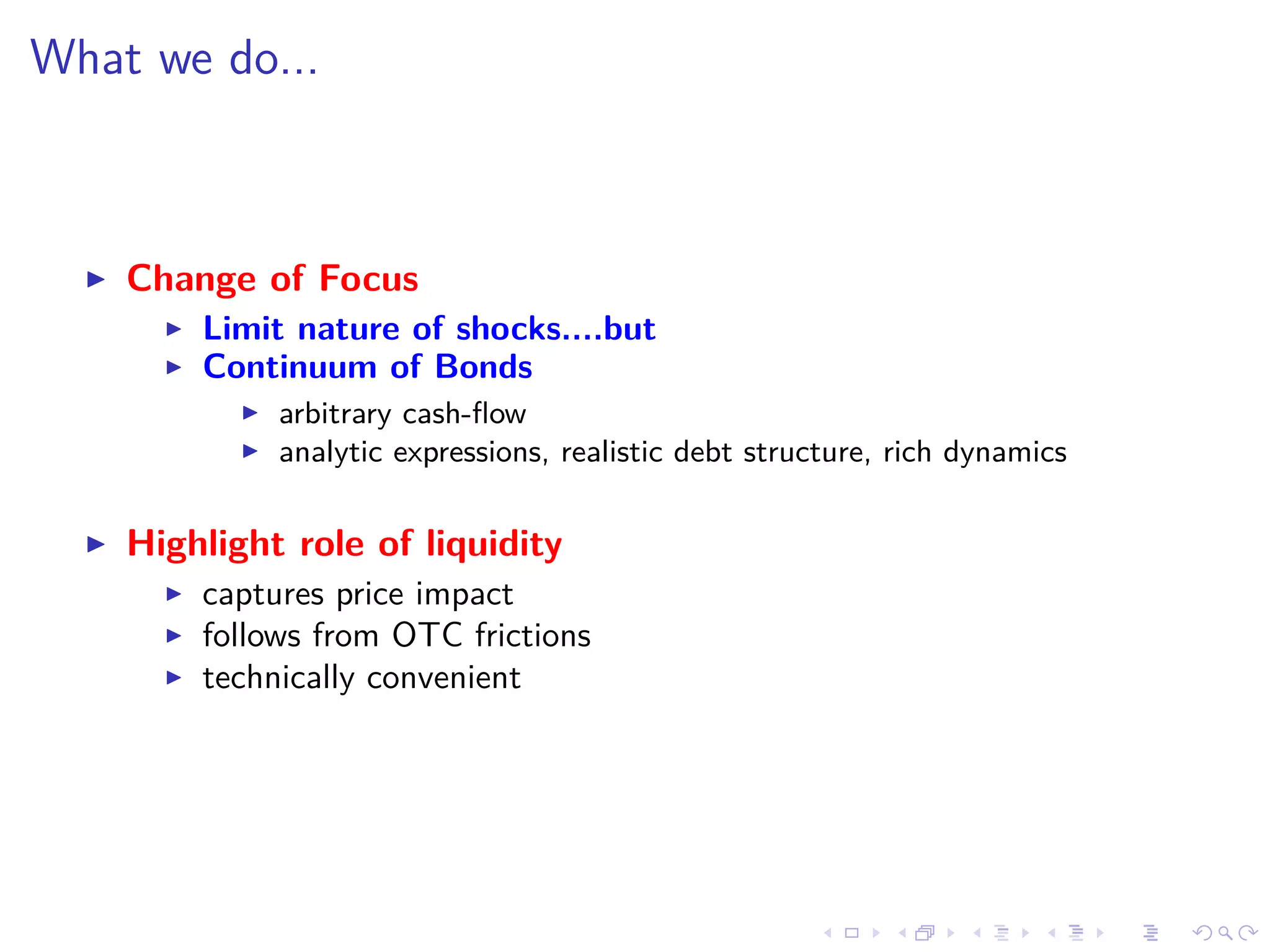
What we do...
Change of Focus
Limit nature of shocks....but
Continuum of Bonds
arbitrary cash-flow
analytic expressions, realistic debt structure, rich dynamics
Highlight role of liquidity
captures price impact
follows from OTC frictions
technically convenient
Environment
SOE, CT, incomplete markets, exogenous short rates
CT: elegance, speed and comp stats
Consumption-Savings Problem:
shocks: income, short rates, default value
liquidity cost
State Variable:
mass of debt/assets f (τ, t)
Agenda
Deterministic Transitions:
closed-form steady state
transitional dynamics
MIT shocks: output or short rate
force: liquidity smoothing vs. consumption smoothing
Risky Steady State
asymptotics when waiting for shock
one-time shocks: output, short rate
force: risk management
Default Shock
transitions: if date of decision is known
risky-steady state: if date of decision is unknown
force: incentives
Literature
Sovereign Debt: Eaton Gersovitz (1981), Bulow Rogoff (1988), Arellano
(2008), Chattarjee Eiyungor (2012), Arellano Ramayanan (2012), Bianchi
Hatchondo Martinez (2014), Debortoli, Nunes, Yared (2017), Fernández
Martin (2014), Aguiar Amador Hopenhayn Werning (2017)
Preferred Habit Models: Modigliani and Stutch (1966), Greenwood
Vayanos (2010), Vayanos and Vila (2010)
Debt Management w/ Distortionary Taxes: Lucas Stokey (1983),
Angeletos (2002), Buera Nicolini (2004), Bhandari Evans Golosov Sargent
(2017)
Continuous Time - Heterogeneous Agents: Kredler (2014), Nuno Moll
(2017), Nuno Thomas (2017),
Environment: shocks, preference and state
Random paths: income y(t), short rate ¯r(t)
later: default
Preferences:
V0 = E[
∞
0
e−ρt
u(c(t))dt] and u(x) ≡
c1−σ − 1
1 − σ
State: debt f (τ, t), expiration τ ∈ [0, T]
Environment: constraint set
Resource Constraint:
c (t) = y (t) +
T
0
q (τ, t, ι) ι (τ, t)dτ
issuance
− f (0, t)
principal
−δ
T
0
f (τ, t) dτ
coupons
.
Bond price:
q (τ, t, ι) = ψ(τ, t)
bond price
−
1
2
ψ(τ, t)λ(ι)
liquidity cost
PDE constraint: Derivation
∂f (τ, t)
∂t
= ι (τ, t) +
∂f (τ, t)
∂τ
; f (τ, 0) = f0(τ)
Environment: bond price
Bond Price ψ(τ, t):
short rate ¯r(t) path and no-arbitrage:
ψ(τ, t) = E[e
−
τ
0
¯r(t+s)ds
+ δ
τ
0
e
−
s
0
¯r(t+z)dz
ds]
In HJB form:
¯r(t)ψ(τ, t) = δ +
∂ψ
∂t
−
∂ψ
∂τ
; ψ(0, t) = 1
Environment: liquidity cost
WholesaleRetail bond market
Walrasian wholesale auction of ι (τ, t)
investment banks only
price cash-flow at ¯r (t) + η
OTC retail market
µ flow of clients match with banks
client valuation ψ(τ, t)
Auction price:
q(τ, t, ι) ψ(τ, t) −
1
2
ψ(τ, t) ¯λι
λ(ι)
,
and
¯λ ≡
η
µyss
.
General Problem
Perfect Foresight
V [f (·, 0)] = max
{ι(τ,t)}t∈[0,∞),τ∈[0,T]
Et
∞
t
e−ρ(s−t)
u(c(s))ds s.t.
c (t) = y (t) − f (0, t) +
T
0
[q (τ, t, ι) ι (τ, t) − δf (τ, t)] dτ
∂f
∂t
= ι (τ, t) +
∂f
∂τ
; f (τ, 0) = f0(τ)
Dual: Dual
Deterministic Dynamics
Theory
Deterministic Paths
no default, known paths, f0 given
Next...
derive steady-state distribution f ∗(τ)
path for transitional dynamics: f0 → f ∗(τ)
comparative statistics: f ∗(τ, X) → f ∗(τ, X )
Solving it
Step 1. Lagrangian
L (ι, f ) =
∞
0
e−ρt
u (c(t)) dt
+
∞
0
T
0
e−ρt
j (τ, t) −
∂f
∂t
+ ι (τ, t) +
∂f
∂τ
dτdt,
c(t) = y (t) − f (0, t) +
T
0
[q (t, τ, ι) ι (τ, t) − δf (τ, t)] dτ.
Step 2. First-Order Condition and Envelope
Marginal Value
u (c) q (τ, t, ι) +
∂q
∂ι
ι (τ, t) =
Marginal Cost
−j (τ, t)
ρj (τ, t) = −δu (c (t)) +
∂j
∂t
−
∂j
∂τ
, if τ ∈ (0, T]
and j (0, t) = −u (c (t)) .
Solving it
Step 1. Lagrangian
L (ι, f ) =
∞
0
e−ρt
u (c(t)) dt
+
∞
0
T
0
e−ρt
j (τ, t) −
∂f
∂t
+ ι (τ, t) +
∂f
∂τ
dτdt,
c(t) = y (t) − f (0, t) +
T
0
[q (t, τ, ι) ι (τ, t) − δf (τ, t)] dτ.
Step 2. First-Order Condition and Envelope
Marginal Value
u (c) ψ (τ, t) − ¯λψ (τ, t) ι =
Marginal Cost
−j (τ, t)
ρj (τ, t) = −δu (c (t)) +
∂j
∂t
−
∂j
∂τ
, if τ ∈ (0, T]
and j (0, t) = −u (c (t)) .
Optimal Path
Proposition:
1) v(τ, t) ≡ − j(τ,t)
u (c(t)) solves "individual trader” price-PDE:
r(t)
ρ+σ
.
c(t)/c(t)
v (τ, t) = δ +
∂v
∂t
−
∂v
∂τ
, if τ ∈ (0, T]
v (0, t) = 1
2) issuances ι(τ, t):
ψ (τ, t) − ¯λψ (τ, t) ι
marginal income
= v (τ, t)
discounted payouts
3) PDE given f0, c(t) given by BC
Optimal Path
Proposition:
1) v(τ, t) ≡ − j(τ,t)
u (c(t)) solves ‘"ndividual trader” price-PDE:
r(t)
ρ+σ
.
c(t)/c(t)
v (τ, t) = δ +
∂v
∂t
−
∂v
∂τ
, if τ ∈ (0, T]
v (0, t) = 1
2) issuances ι(τ, t):
ι =
ψ (τ, t) − v (τ, t)
¯λψ (τ, t)
3) PDE given f0, c(t) given by BC
Asymptotic Properties (t −→ ∞)
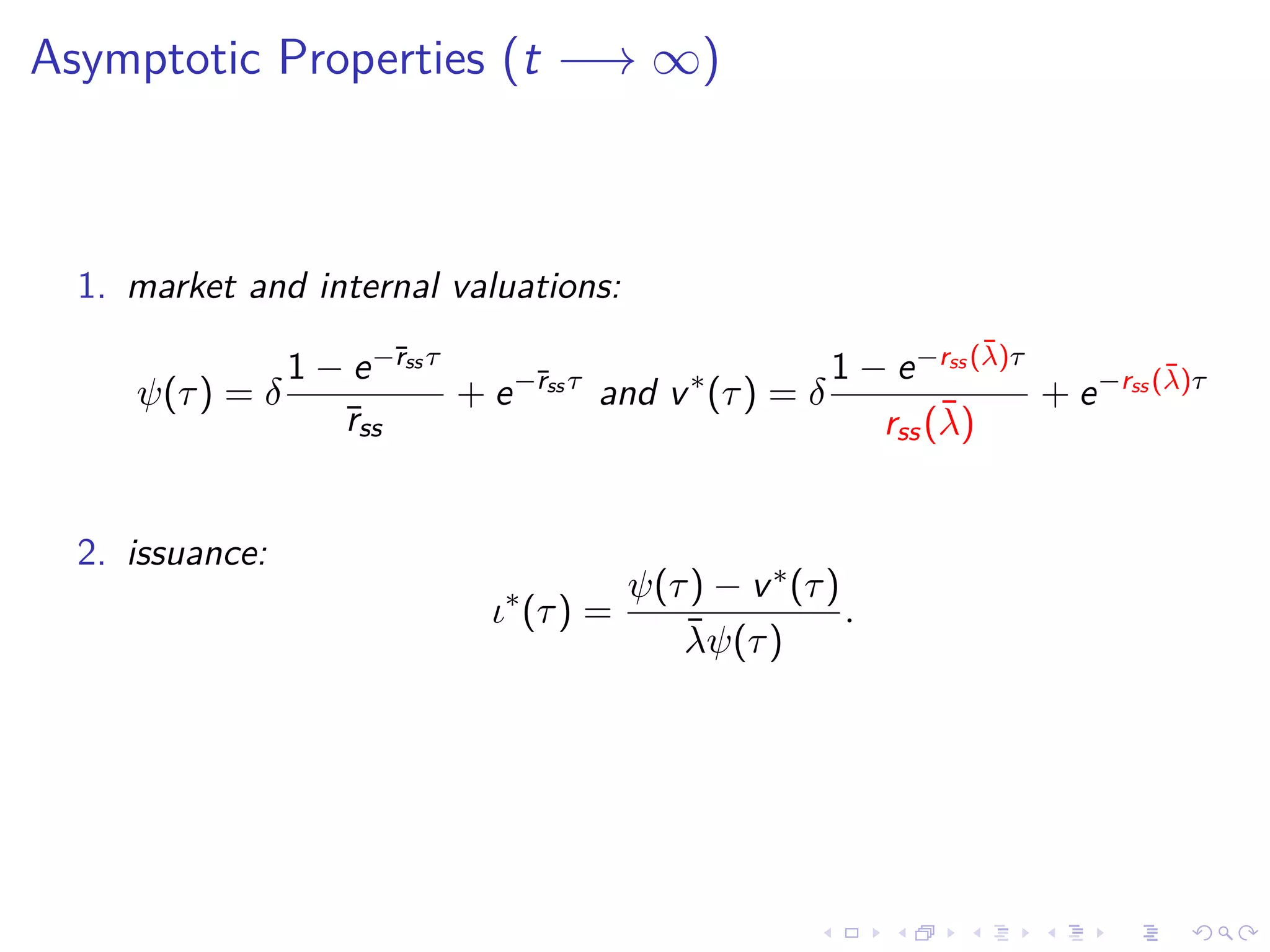
1. market and internal valuations:
ψ(τ) = δ
1 − e−¯rss τ
¯rss
+ e−¯rss τ
and v∗
(τ) = δ
1 − e−rss (¯λ)τ
rss(¯λ)
+ e−rss (¯λ)τ
2. issuance:
ι∗
(τ) =
ψ(τ) − v∗(τ)
¯λψ(τ)
.
Asymptotic Properties (t −→ ∞)
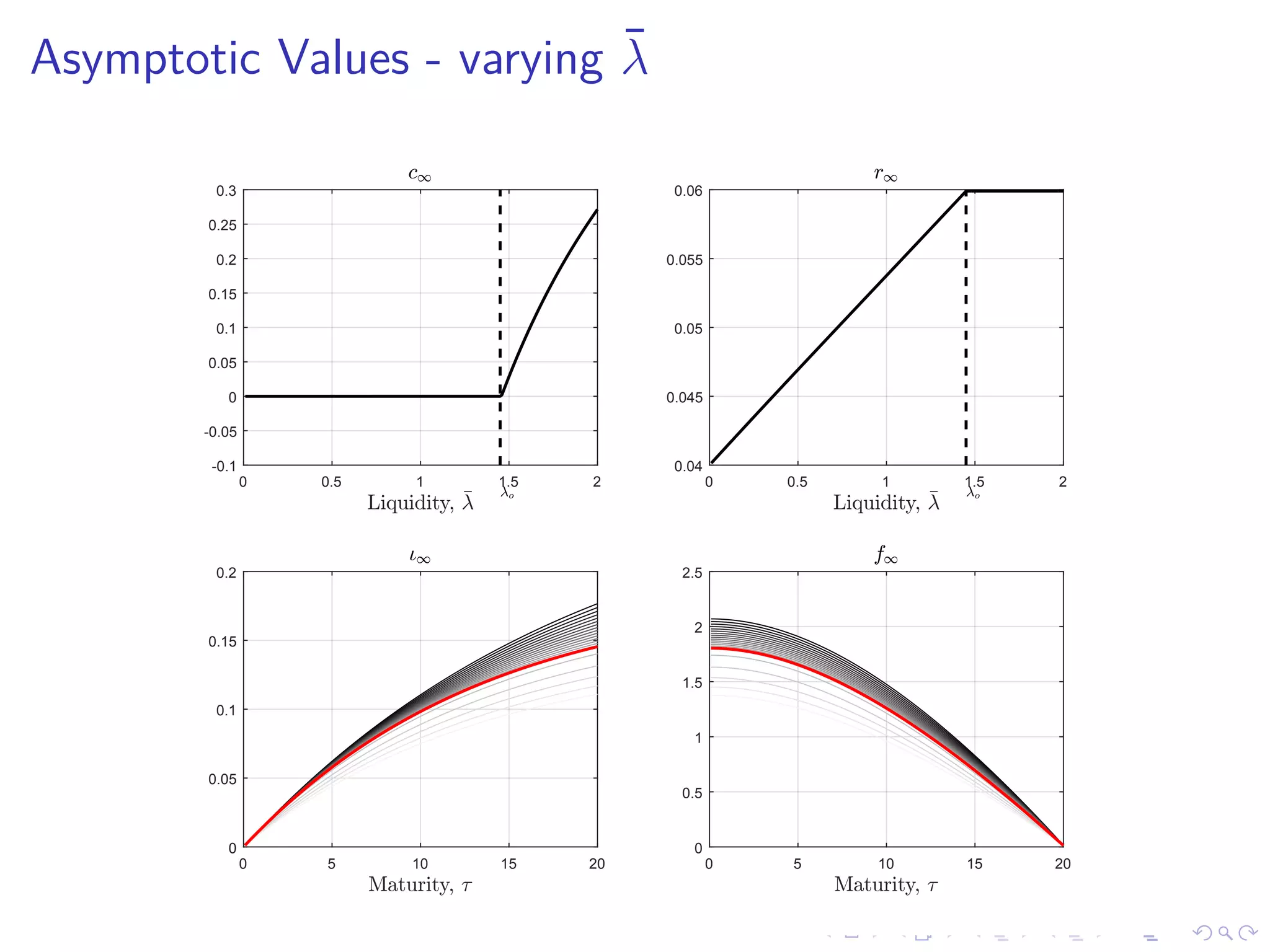
If ¯λ ≥ ¯λo
rss(λ) = ρ
Steady State c(t) = css > 0
If¯λ < ¯λo
limt→∞C(t) = 0
rss(λ) ∈ [¯rss, ρ)
Asymptotic Values - varying ¯λ
Liquidity, 76
0 0.5 1 1.5 2
-0.1
-0.05
0
0.05
0.1
0.15
0.2
0.25
0.3
6o
c1
Liquidity, 76
0 0.5 1 1.5 2
0.04
0.045
0.05
0.055
0.06
6o
r1
Maturity, =
0 5 10 15 20
0
0.05
0.1
0.15
0.2
41
Maturity, =
0 5 10 15 20
0
0.5
1
1.5
2
2.5
f1
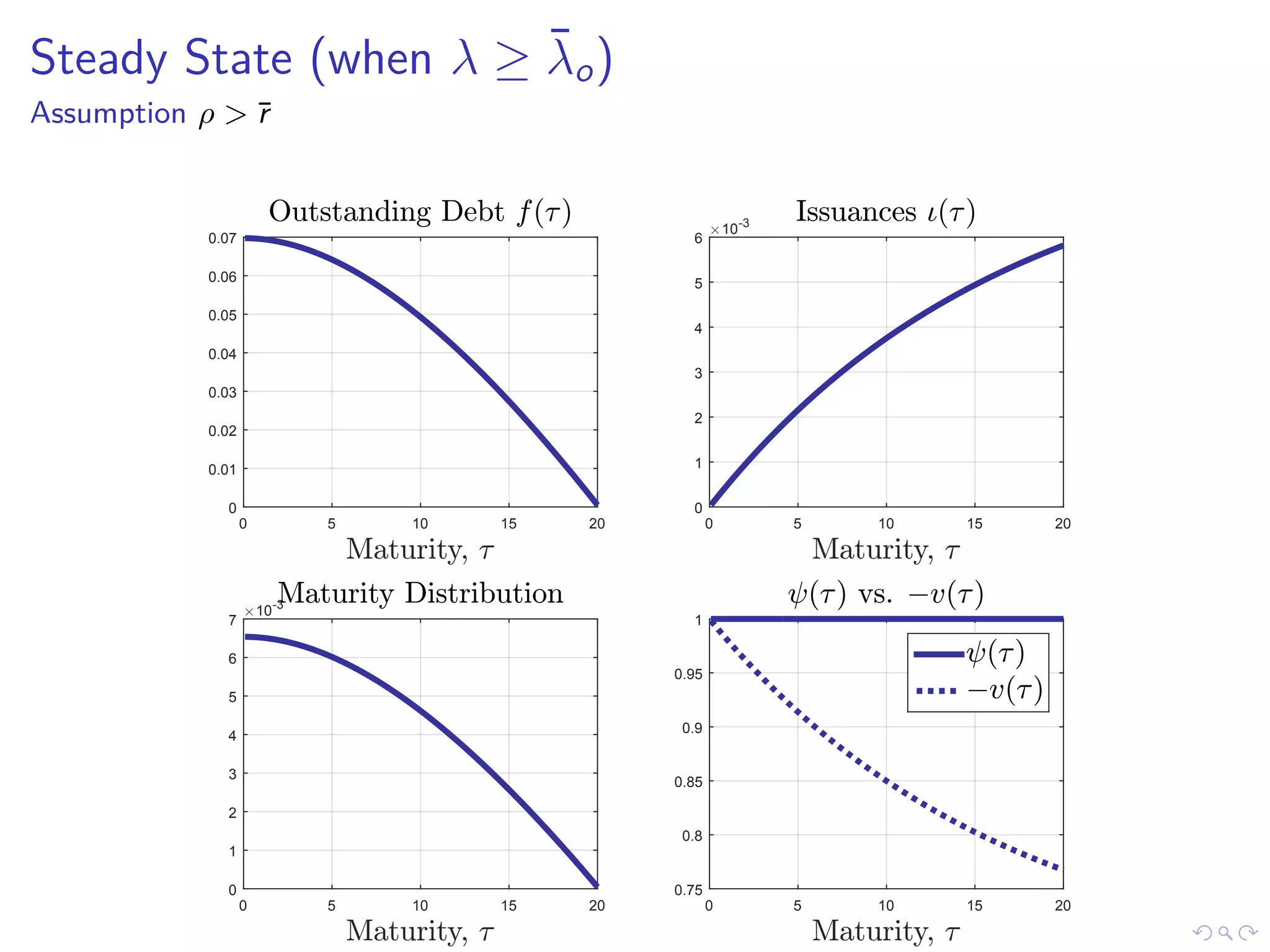
Steady State (when λ ≥ ¯λo)
Assumption ρ > ¯r
Maturity, =
0 5 10 15 20
0
0.01
0.02
0.03
0.04
0.05
0.06
0.07
Outstanding Debt f(=)
Maturity, =
0 5 10 15 20
#10-3
0
1
2
3
4
5
6
Issuances 4(=)
Maturity, =
0 5 10 15 20
#10-3
0
1
2
3
4
5
6
7
Maturity Distribution
Maturity, =
0 5 10 15 20
0.75
0.8
0.85
0.9
0.95
1
A(=) vs. !v(=)
A(=)
!v(=)
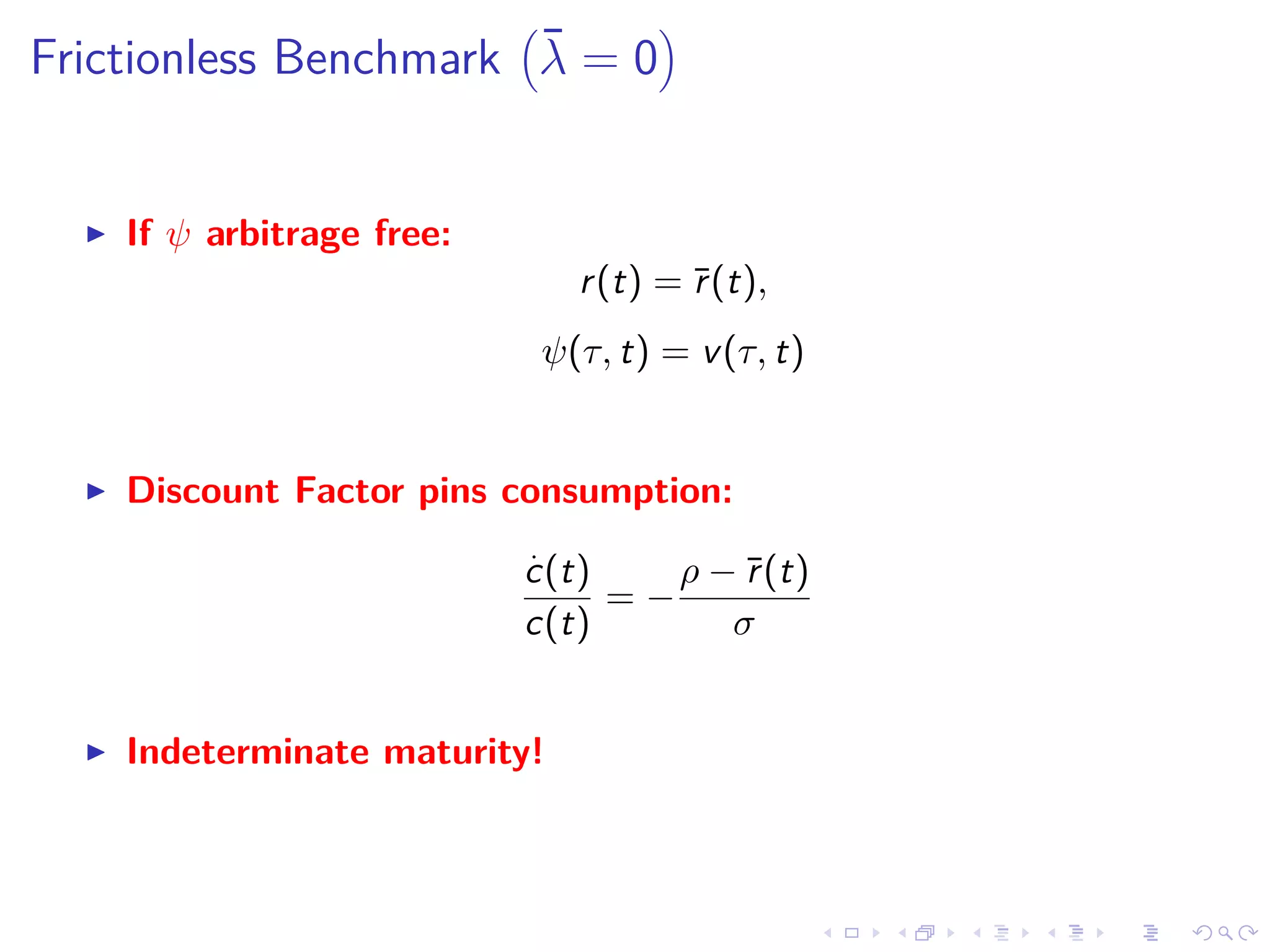
Frictionless Benchmark ¯λ = 0
If ψ arbitrage free:
r(t) = ¯r(t),
ψ(τ, t) = v(τ, t)
Discount Factor pins consumption:
.
c(t)
c(t)
= −
ρ − ¯r(t)
σ
Indeterminate maturity!
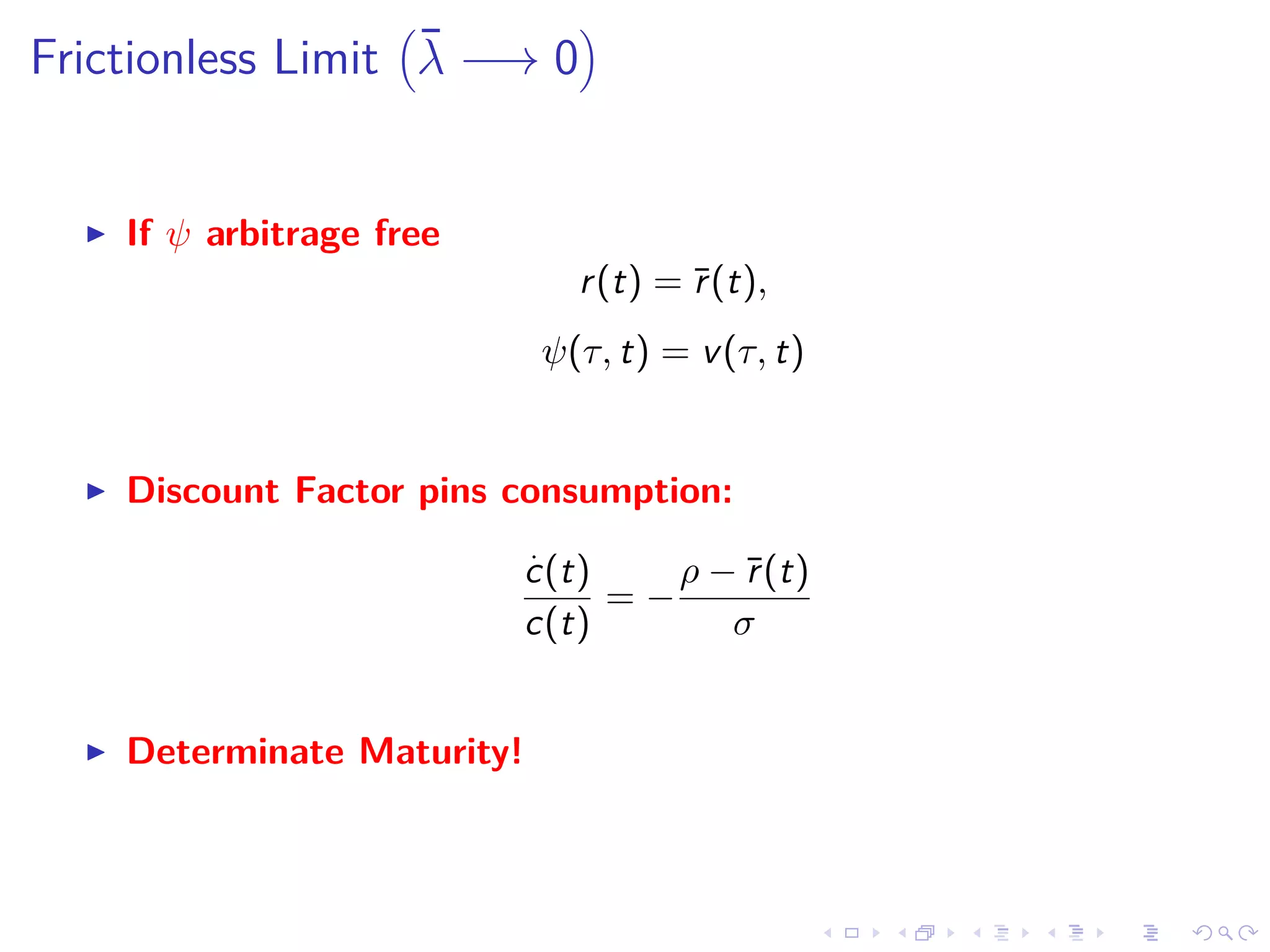
Frictionless Limit ¯λ −→ 0
If ψ arbitrage free
r(t) = ¯r(t),
ψ(τ, t) = v(τ, t)
Discount Factor pins consumption:
.
c(t)
c(t)
= −
ρ − ¯r(t)
σ
Determinate Maturity!
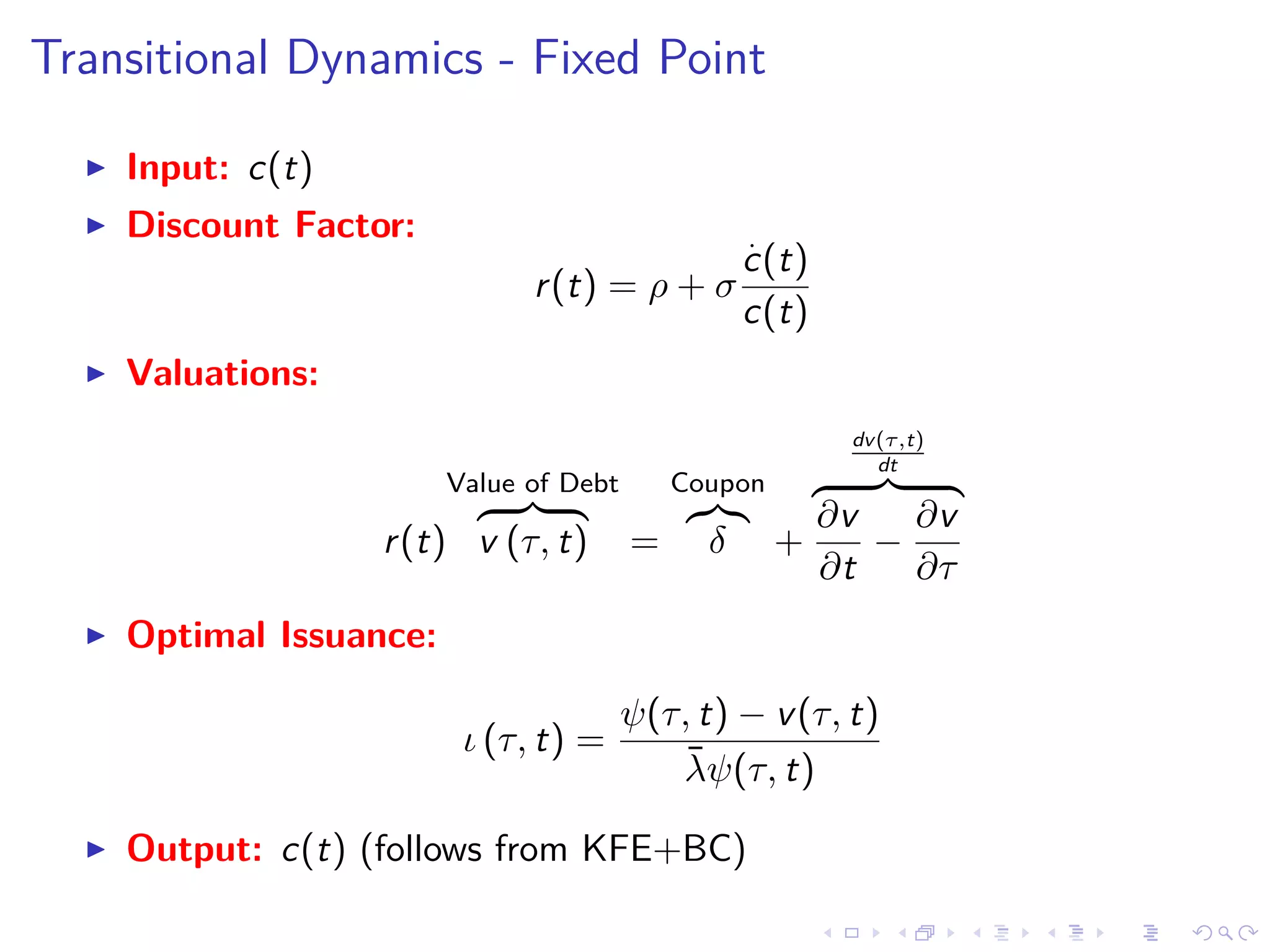
Transitional Dynamics - Fixed Point
Input: c(t)
Discount Factor:
r(t) = ρ + σ
.
c(t)
c(t)
Valuations:
r(t)
Value of Debt
v (τ, t) =
Coupon
δ +
dv(τ,t)
dt
∂v
∂t
−
∂v
∂τ
Optimal Issuance:
ι (τ, t) =
ψ(τ, t) − v(τ, t)
¯λψ(τ, t)
Output: c(t) (follows from KFE+BC)
Deterministic Dynamics
Application: Transitions
Application 1 - Transitions
Transitions reveal two novel features:
1. Income path for y(t)
liquidity cost + finite maturity produce issuance cycle
2. Path for short rate ¯r(t)
show consumption vs. liquidity smoothing
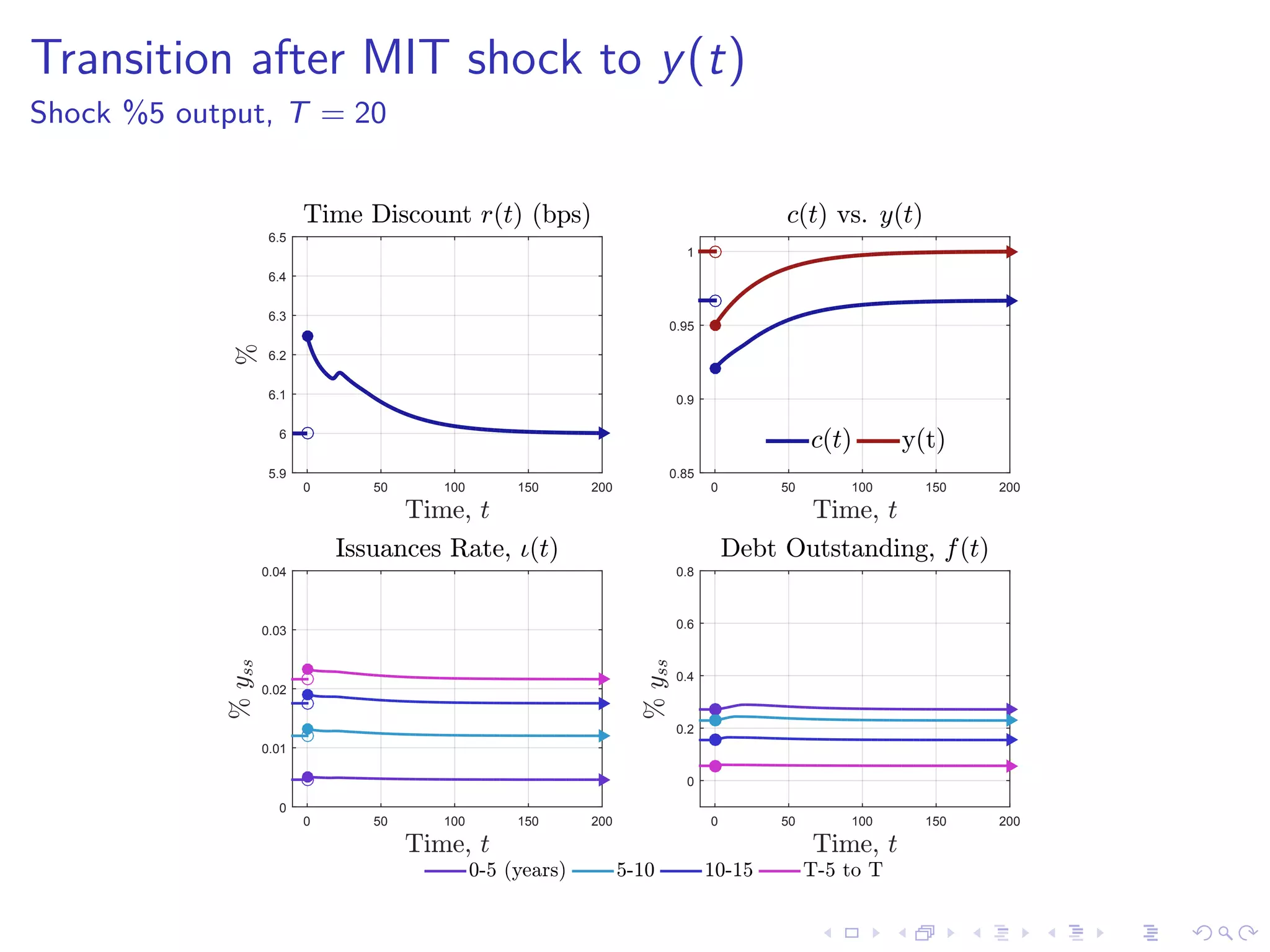
Transition after MIT shock to y(t)
Shock %5 output, T = 20
Time, t
0 50 100 150 200
%
5.9
6
6.1
6.2
6.3
6.4
6.5
Time Discount r(t) (bps)
Time, t
0 50 100 150 200
0.85
0.9
0.95
1
c(t) vs. y(t)
c(t) y(t)
Time, t
0 50 100 150 200
%yss
0
0.01
0.02
0.03
0.04
Issuances Rate, 4(t)
Time, t
0 50 100 150 200
%yss
0
0.2
0.4
0.6
0.8
Debt Outstanding, f(t)
0-5 (years) 5-10 10-15 T-5 to T
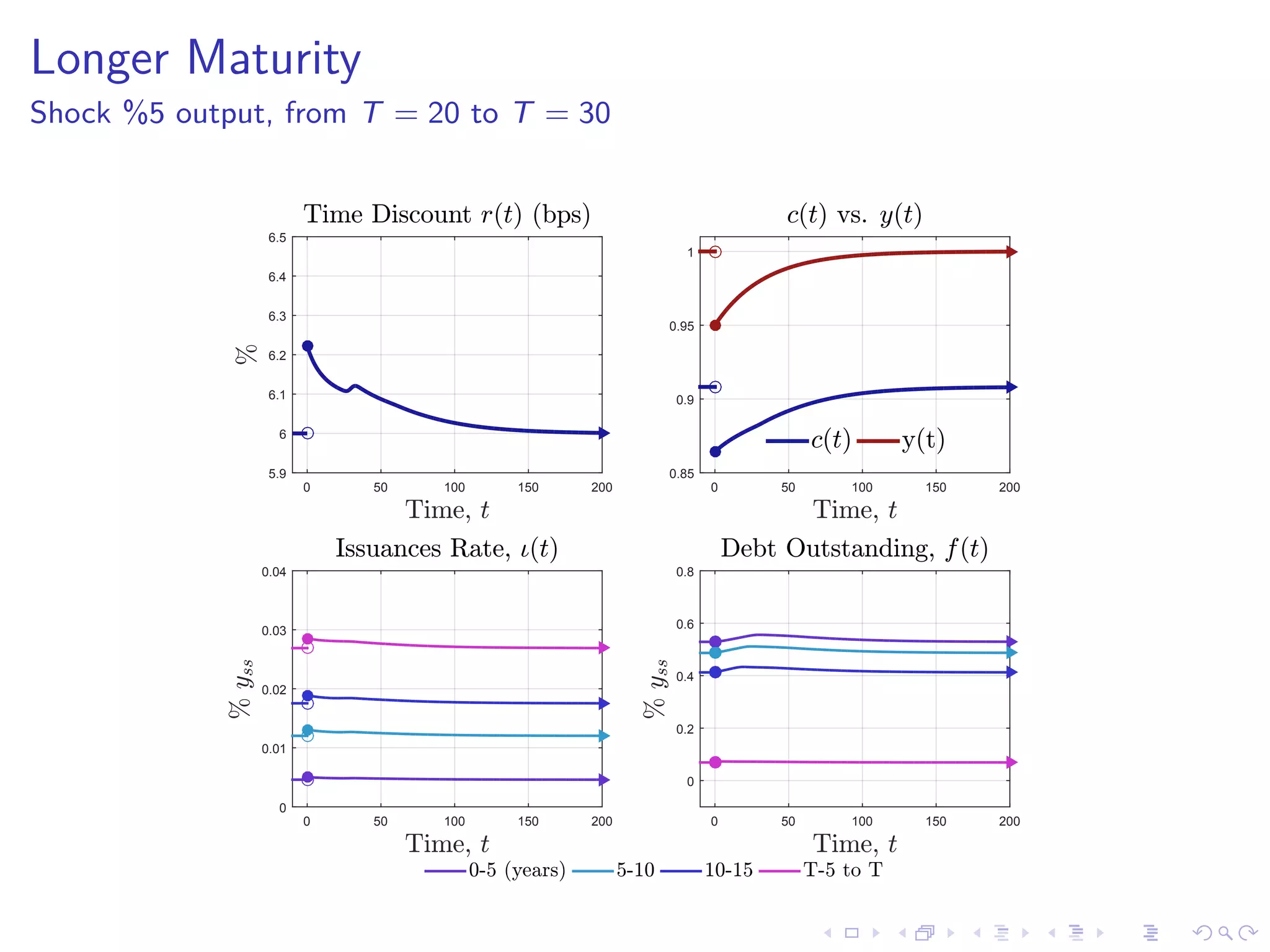
Longer Maturity
Shock %5 output, from T = 20 to T = 30
Time, t
0 50 100 150 200
%
5.9
6
6.1
6.2
6.3
6.4
6.5
Time Discount r(t) (bps)
Time, t
0 50 100 150 200
0.85
0.9
0.95
1
c(t) vs. y(t)
c(t) y(t)
Time, t
0 50 100 150 200
%yss
0
0.01
0.02
0.03
0.04
Issuances Rate, 4(t)
Time, t
0 50 100 150 200
%yss
0
0.2
0.4
0.6
0.8
Debt Outstanding, f(t)
0-5 (years) 5-10 10-15 T-5 to T
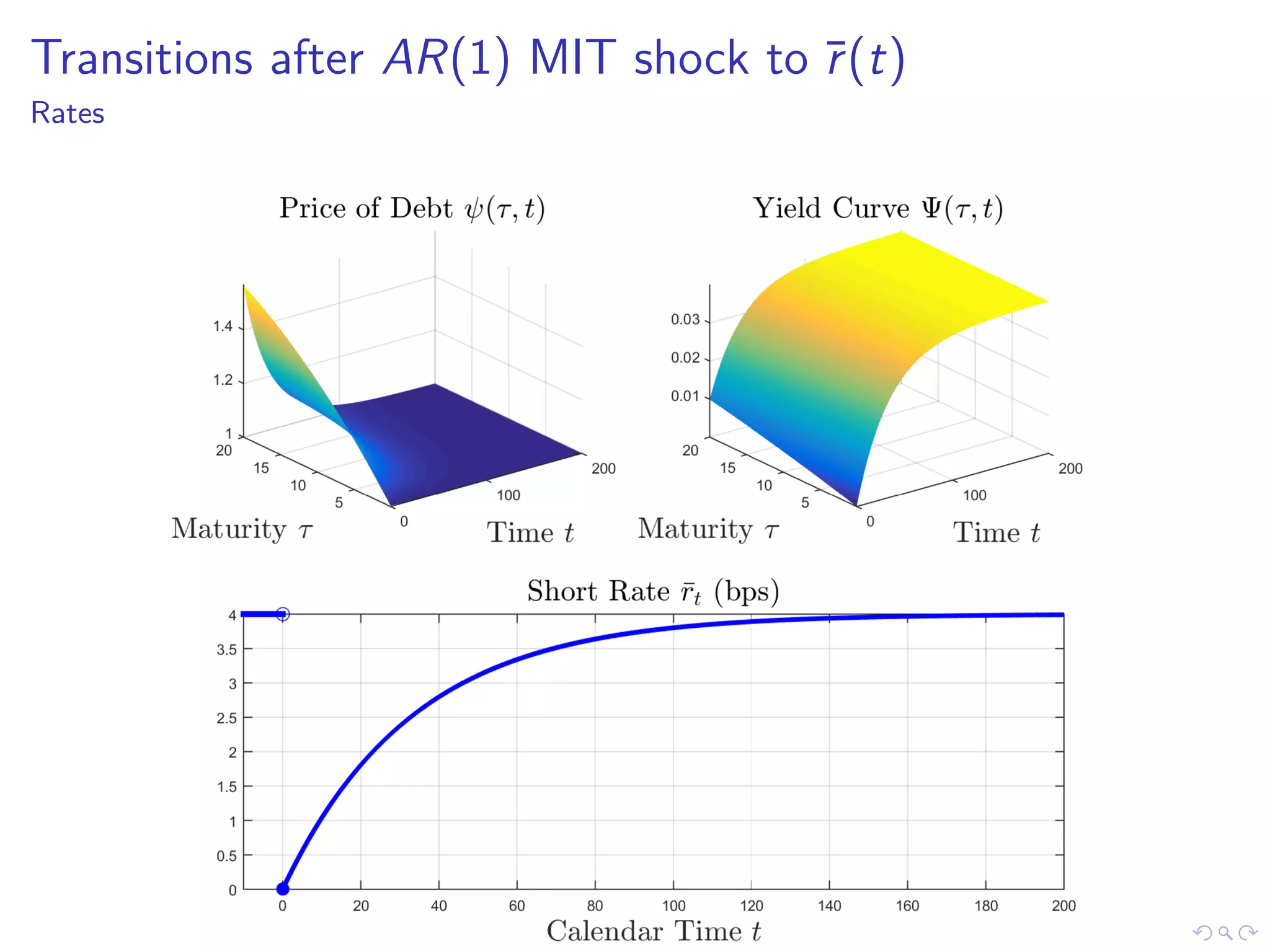
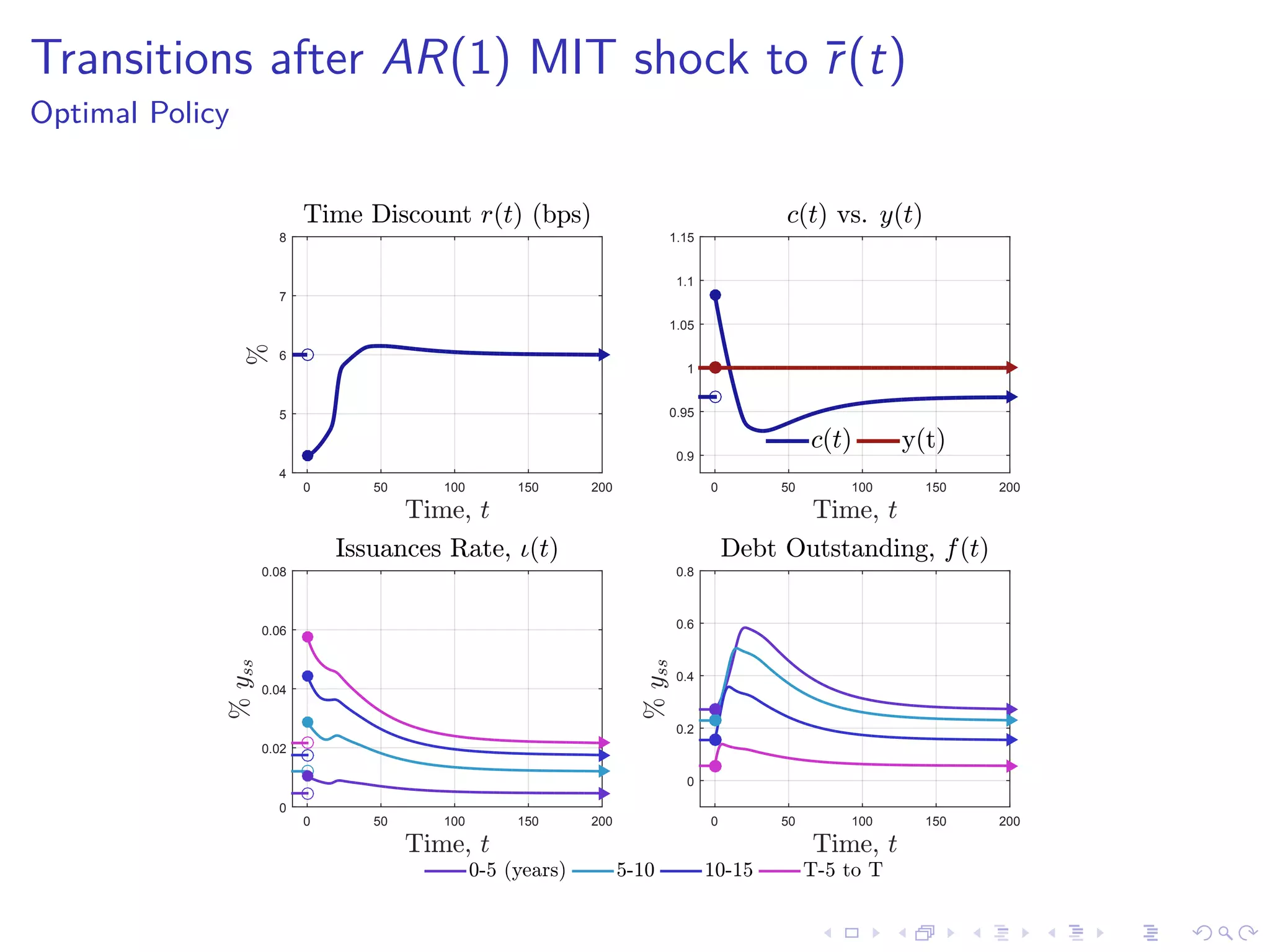
Transitions after AR(1) MIT shock to ¯r(t)
Rates
Transitions after AR(1) MIT shock to ¯r(t)
Optimal Policy
Time, t
0 50 100 150 200
%
4
5
6
7
8
Time Discount r(t) (bps)
Time, t
0 50 100 150 200
0.9
0.95
1
1.05
1.1
1.15
c(t) vs. y(t)
c(t) y(t)
Time, t
0 50 100 150 200
%yss
0
0.02
0.04
0.06
0.08
Issuances Rate, 4(t)
Time, t
0 50 100 150 200
%yss
0
0.2
0.4
0.6
0.8
Debt Outstanding, f(t)
0-5 (years) 5-10 10-15 T-5 to T
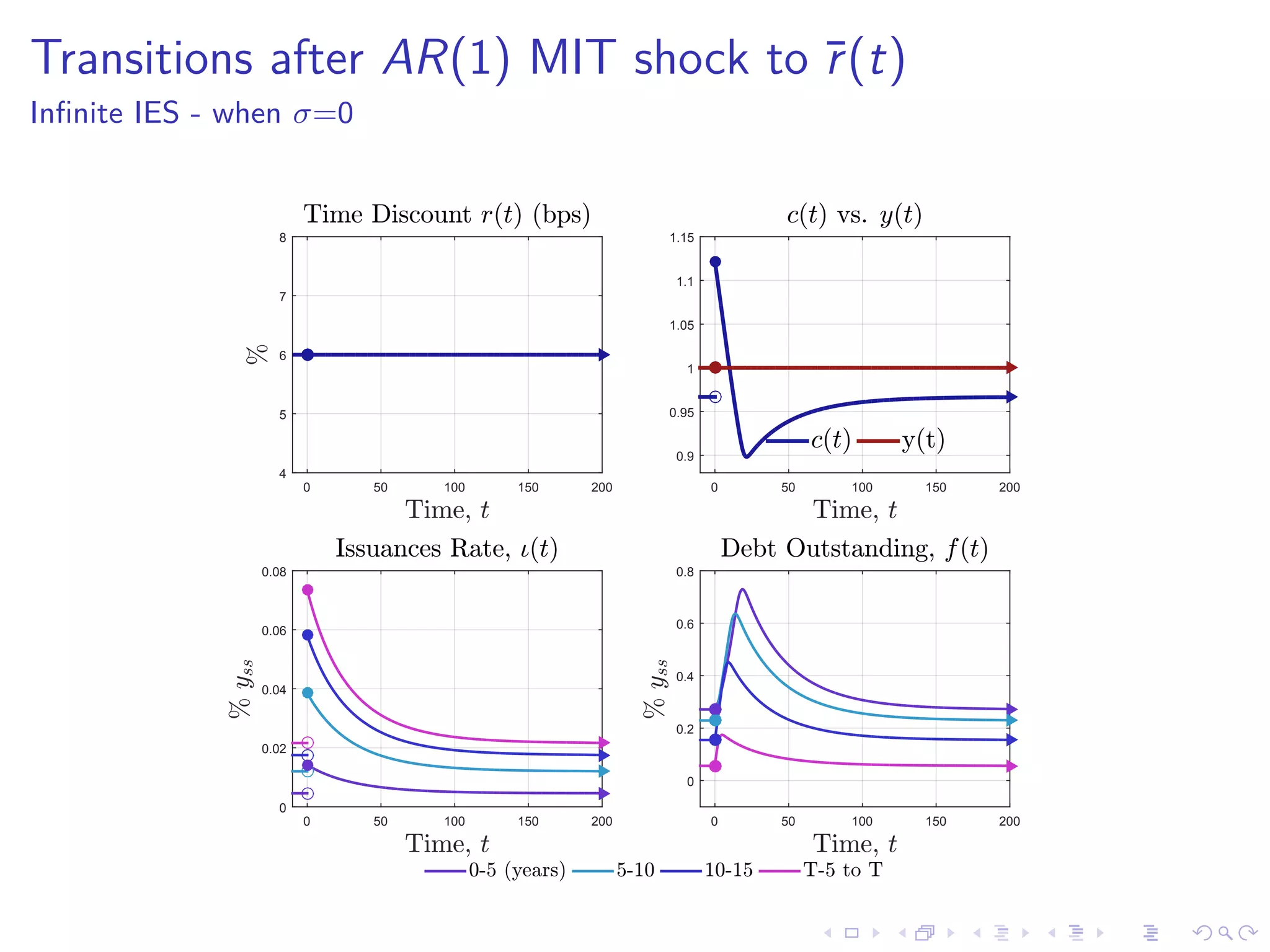
Transitions after AR(1) MIT shock to ¯r(t)
Infinite IES - when σ=0
Time, t
0 50 100 150 200
%
4
5
6
7
8
Time Discount r(t) (bps)
Time, t
0 50 100 150 200
0.9
0.95
1
1.05
1.1
1.15
c(t) vs. y(t)
c(t) y(t)
Time, t
0 50 100 150 200
%yss
0
0.02
0.04
0.06
0.08
Issuances Rate, 4(t)
Time, t
0 50 100 150 200
%yss
0
0.2
0.4
0.6
0.8
Debt Outstanding, f(t)
0-5 (years) 5-10 10-15 T-5 to T
Dynamics under Risk
Theory
Risk
What about Risk?
Complication: fixed point in sets of functions
Risky Steady State:
allows analysis with risk
Role of Uncertainty - Risky Steady State
Next...
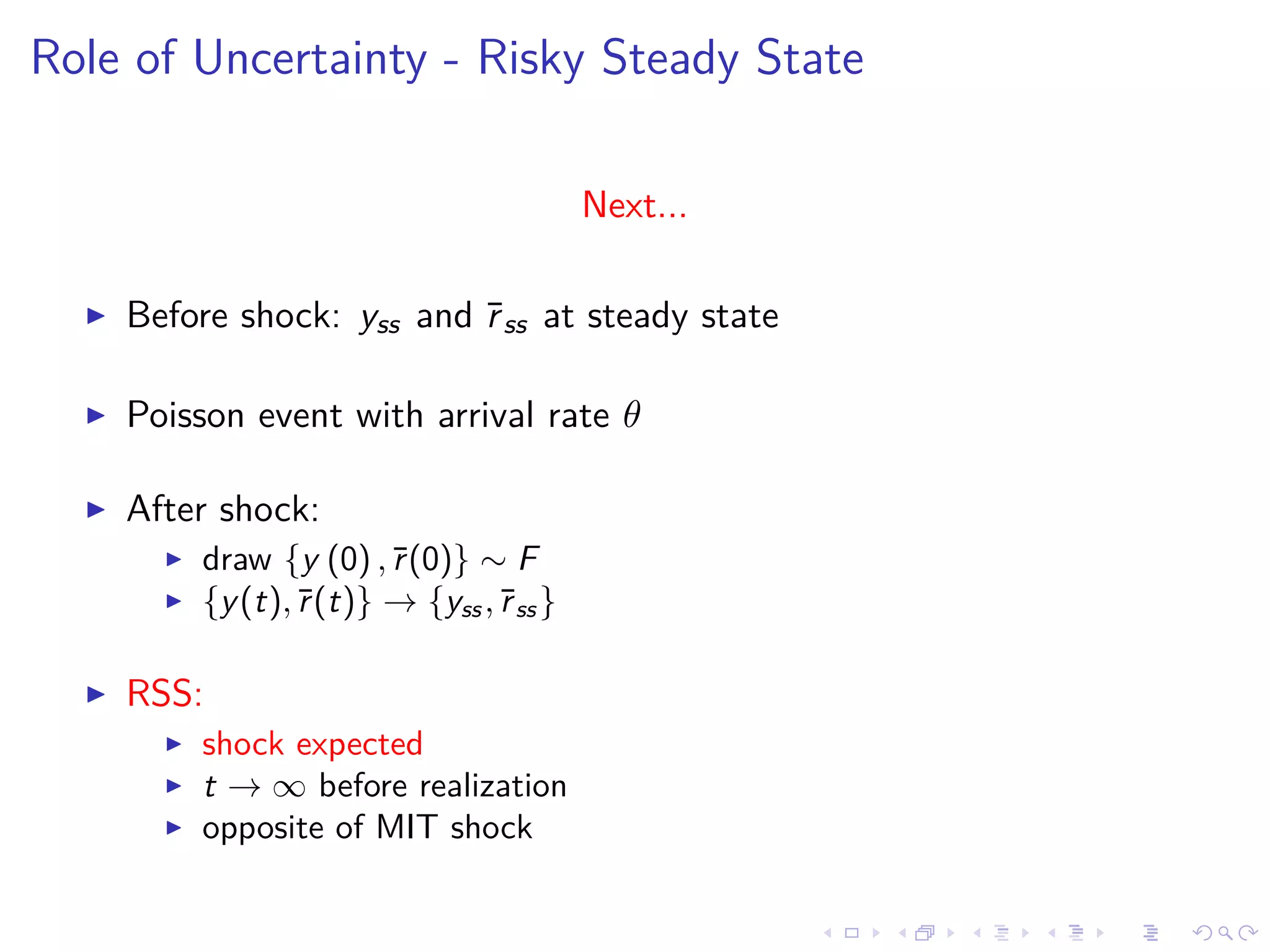
Before shock: yss and ¯rss at steady state
Poisson event with arrival rate θ
After shock:
draw {y (0) ,¯r(0)} ∼ F
{y(t),¯r(t)} → {yss,¯rss}
RSS:
shock expected
t → ∞ before realization
opposite of MIT shock
After Shocks - Risky Steady State
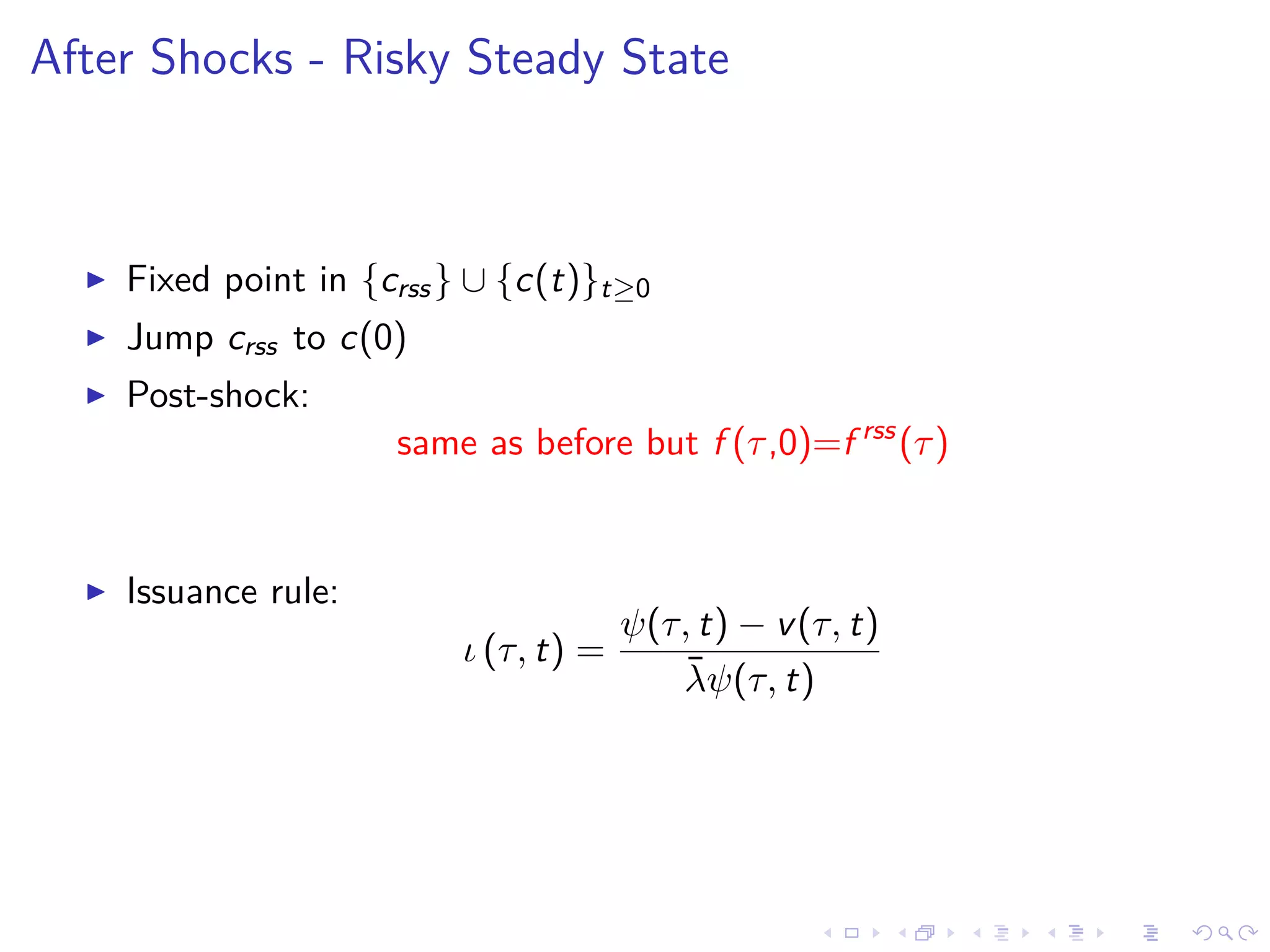
Fixed point in {crss} ∪ {c(t)}t≥0
Jump crss to c(0)
Post-shock:
same as before but f (τ,0)=f rss
(τ)
Issuance rule:
ι (τ, t) =
ψ(τ, t) − v(τ, t)
¯λψ(τ, t)
Before Shock - Risky Steady State
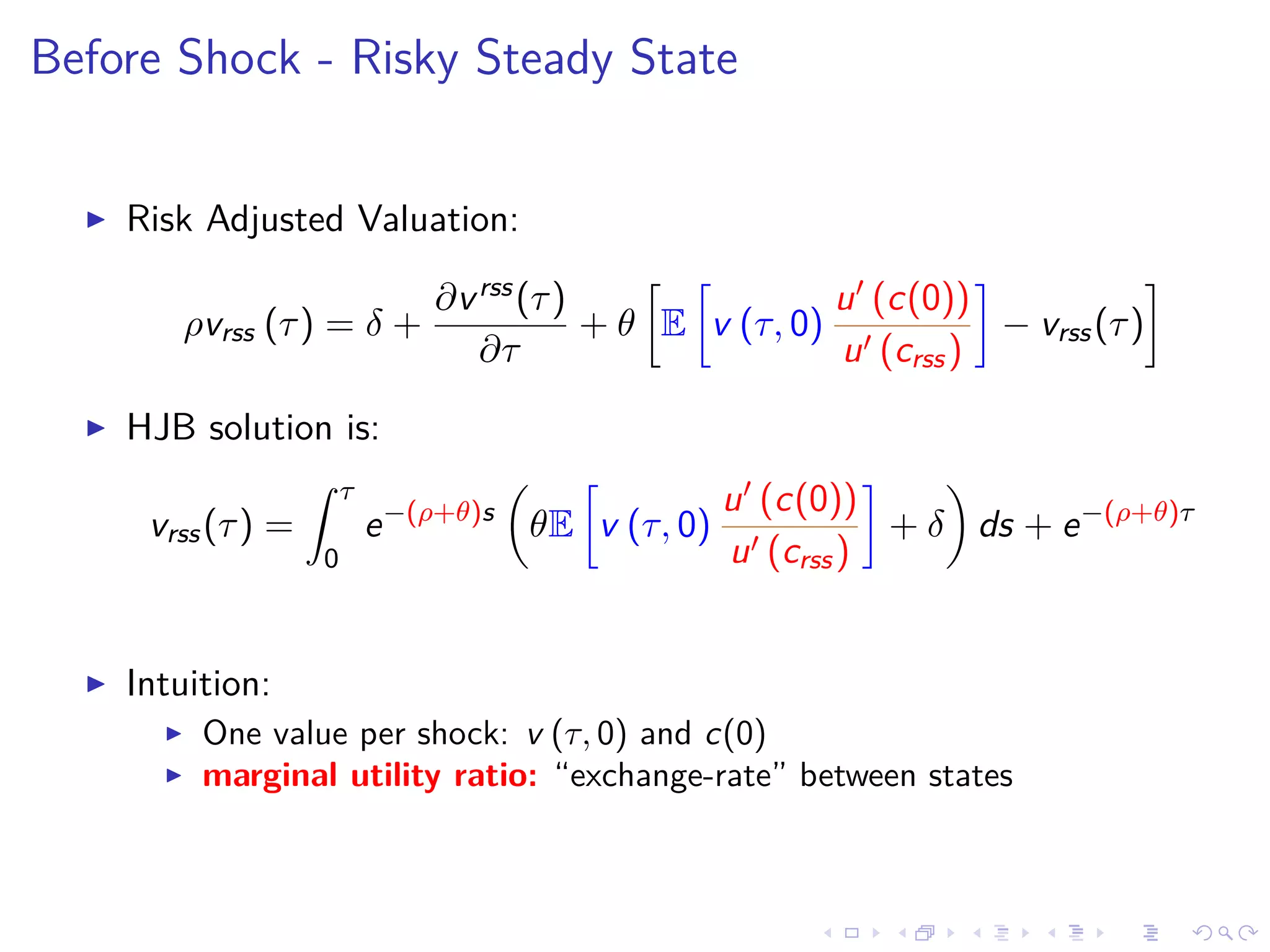
Risk Adjusted Valuation:
ρvrss (τ) = δ +
∂vrss(τ)
∂τ
+ θ E v (τ, 0)
u (c(0))
u (crss)
− vrss(τ)
HJB solution is:
vrss(τ) =
τ
0
e−(ρ+θ)s
θE v (τ, 0)
u (c(0))
u (crss)
+ δ ds + e−(ρ+θ)τ
Intuition:
One value per shock: v (τ, 0) and c(0)
marginal utility ratio: “exchange-rate” between states
Frictionless Limit - Pre-shock Transition
ˆψ (τ, t) = ˆv (τ, t)
Price Equation:
¯r (t) ˆψ (τ, t) = δ +
∂ ˆψ
∂t
−
∂ ˆψ
∂τ
+ θ E [ψ (τ, t)] − ˆψ (τ, t)
HJB and ˆψ (τ, t) = ˆv (τ, t)
r(t) ˆψ (τ, t) = δ +
∂ ˆψ
∂t
−
∂ ˆψ
∂τ
+ θ E
U (c (t))
U (ˆc (t))
ψ (τ, t) − ˆψ (τ, t)
both equations must be consistent
Frictionless Limit - Two Polar Cases
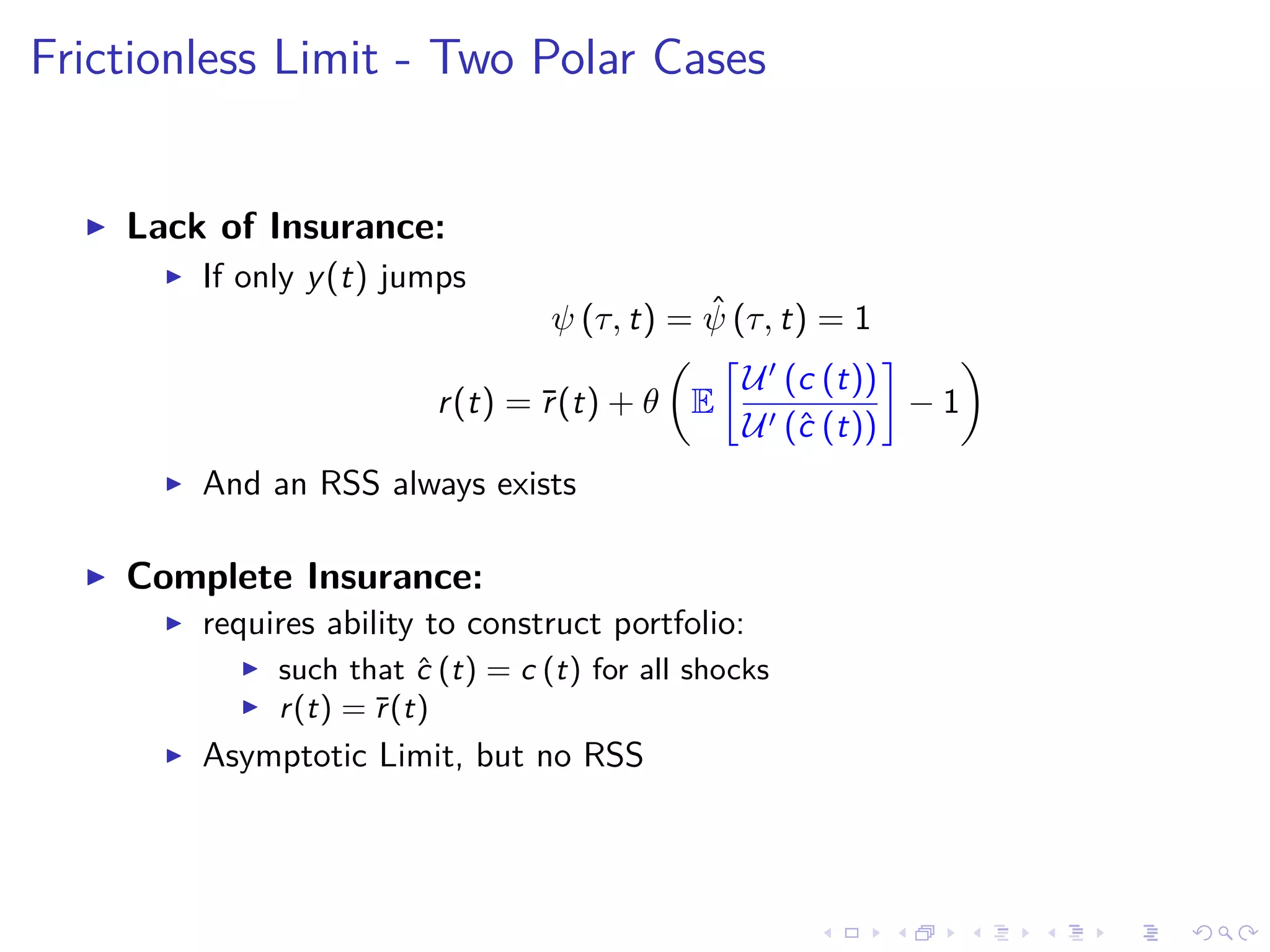
Lack of Insurance:
If only y(t) jumps
ψ (τ, t) = ˆψ (τ, t) = 1
r(t) = ¯r(t) + θ E
U (c (t))
U (ˆc (t))
− 1
And an RSS always exists
Complete Insurance:
requires ability to construct portfolio:
such that ˆc (t) = c (t) for all shocks
r(t) = ¯r(t)
Asymptotic Limit, but no RSS
Dynamics under Risk
Application 1: SS vs. RSS
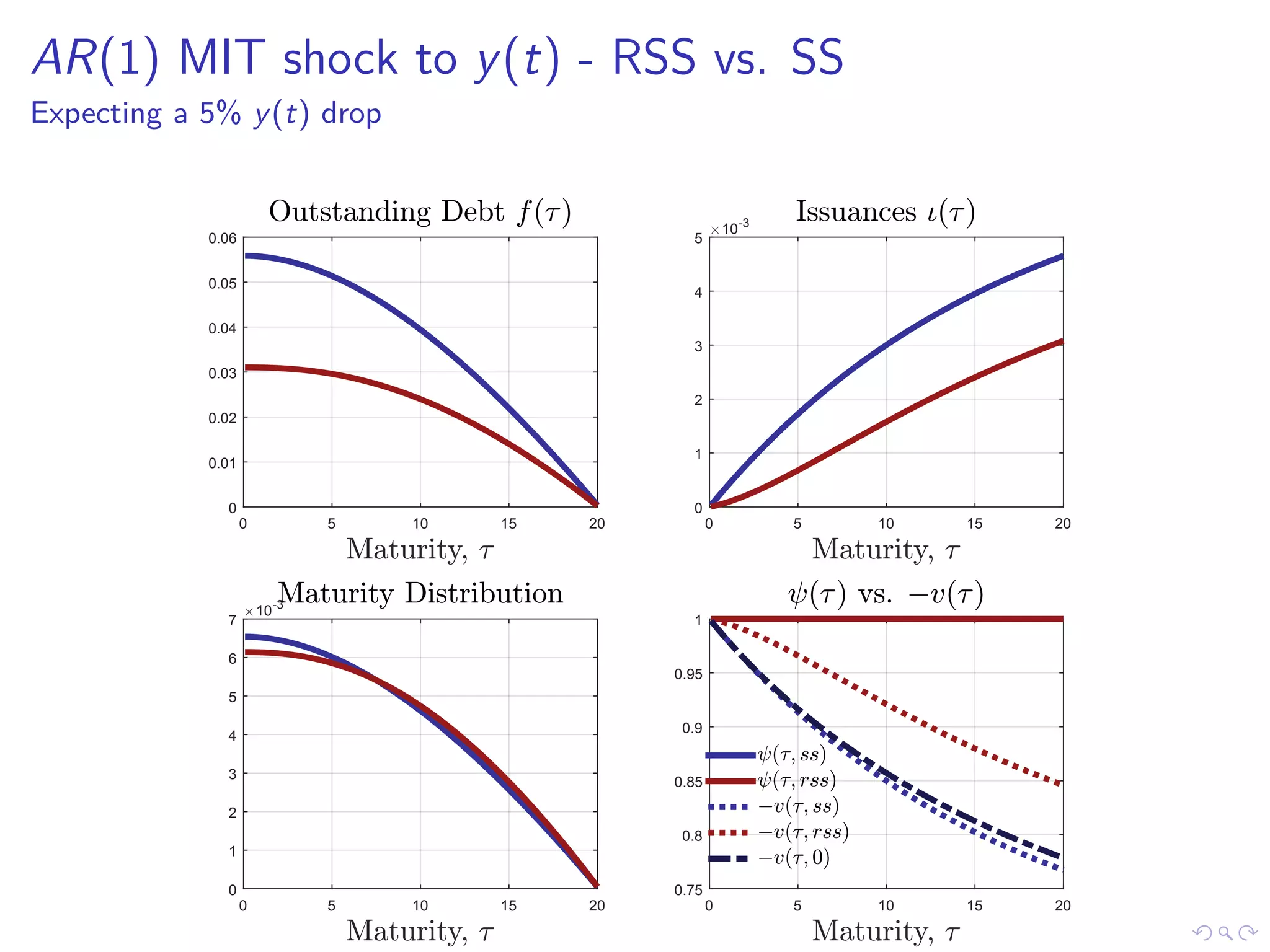
AR(1) MIT shock to y(t) - RSS vs. SS
Expecting a 5% y(t) drop
Maturity, =
0 5 10 15 20
0
0.01
0.02
0.03
0.04
0.05
0.06
Outstanding Debt f(=)
Maturity, =
0 5 10 15 20
#10-3
0
1
2
3
4
5
Issuances 4(=)
Maturity, =
0 5 10 15 20
#10-3
0
1
2
3
4
5
6
7
Maturity Distribution
Maturity, =
0 5 10 15 20
0.75
0.8
0.85
0.9
0.95
1
A(=) vs. !v(=)
A(=; ss)
A(=; rss)
!v(=; ss)
!v(=; rss)
!v(=; 0)
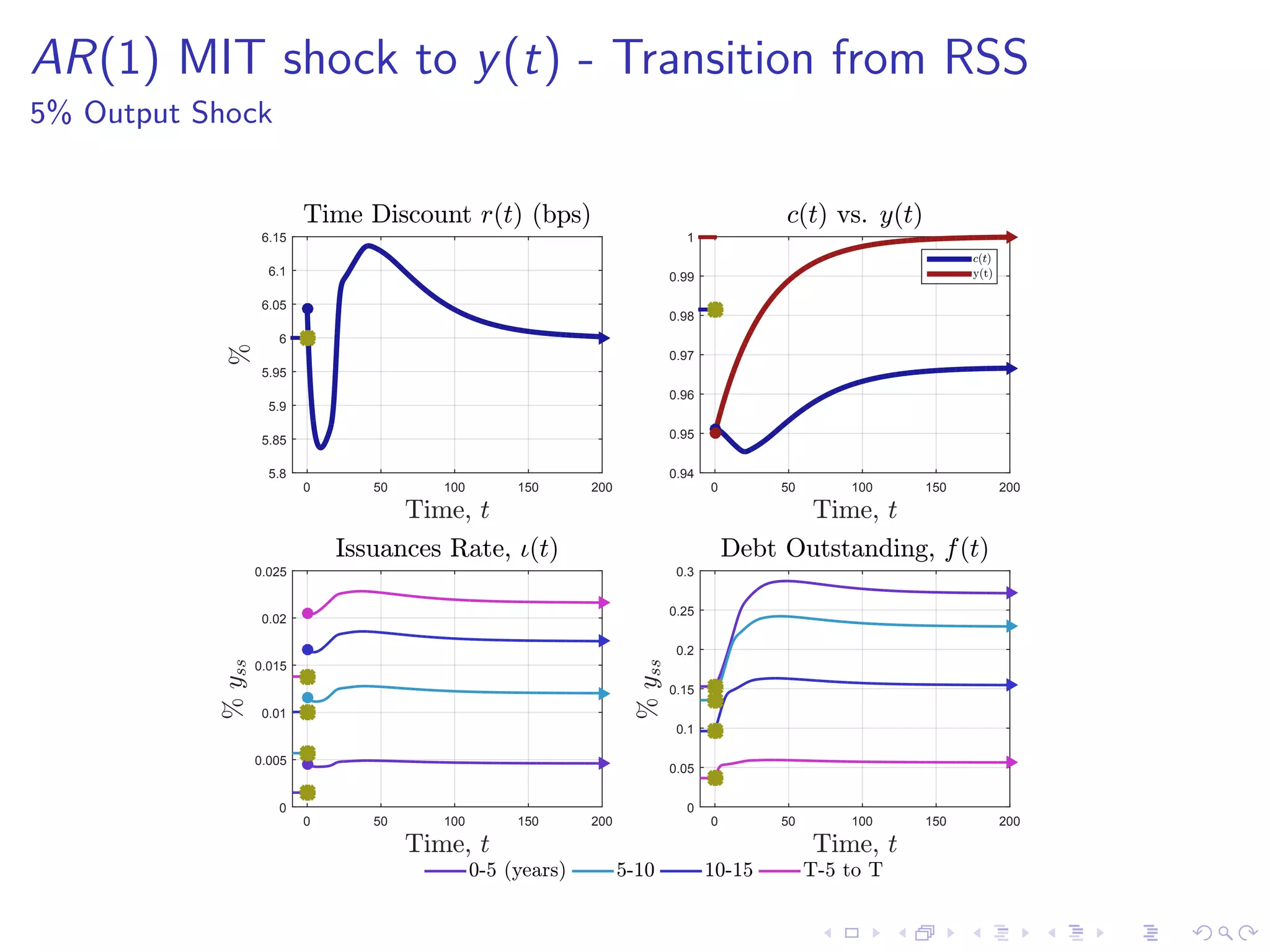
AR(1) MIT shock to y(t) - Transition from RSS
5% Output Shock
Time, t
0 50 100 150 200
%
5.8
5.85
5.9
5.95
6
6.05
6.1
6.15
Time Discount r(t) (bps)
Time, t
0 50 100 150 200
0.94
0.95
0.96
0.97
0.98
0.99
1
c(t) vs. y(t)
c(t)
y(t)
Time, t
0 50 100 150 200
%yss
0
0.005
0.01
0.015
0.02
0.025
Issuances Rate, 4(t)
Time, t
0 50 100 150 200
%yss
0
0.05
0.1
0.15
0.2
0.25
0.3
Debt Outstanding, f(t)
0-5 (years) 5-10 10-15 T-5 to T
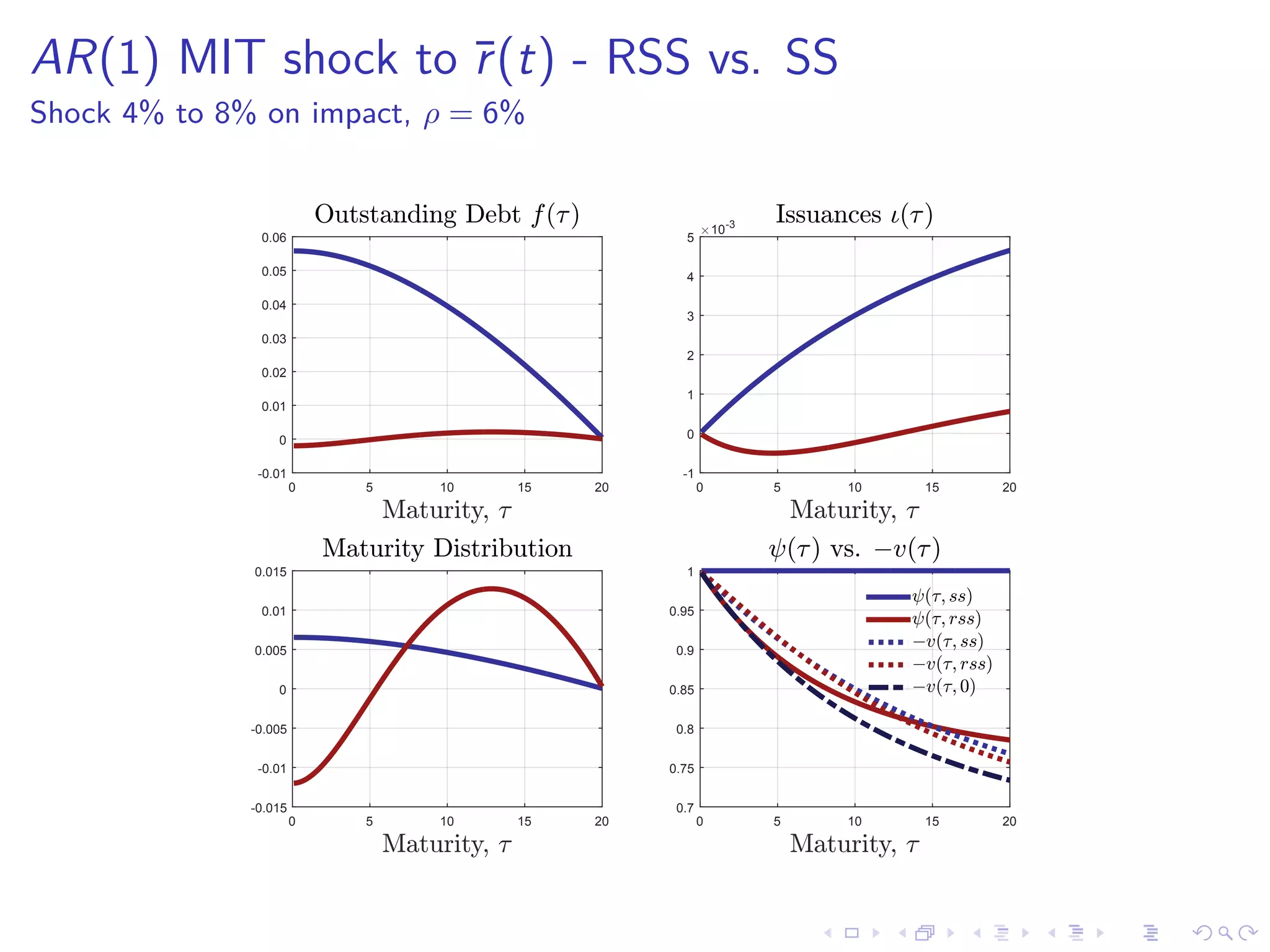
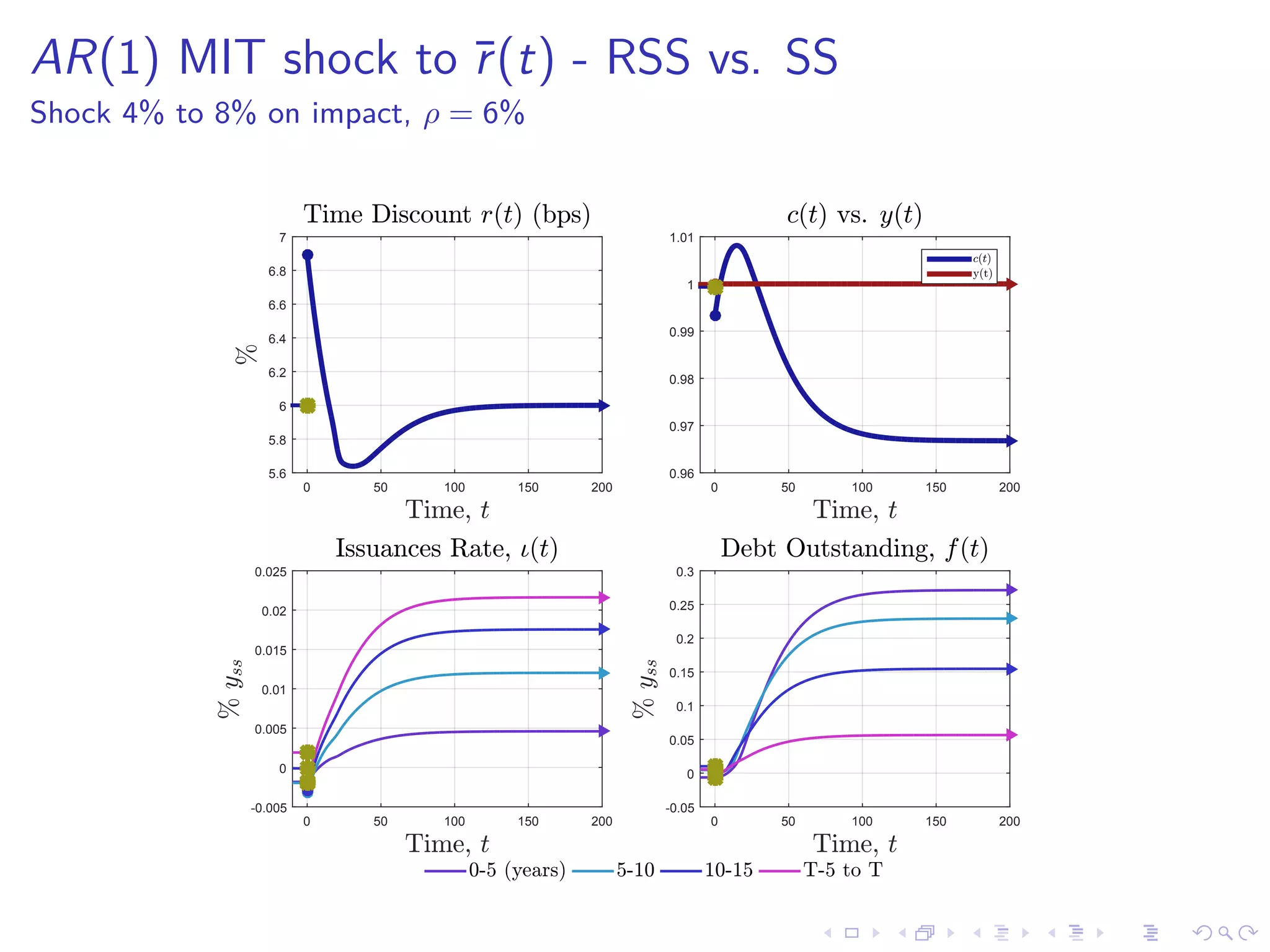
AR(1) MIT shock to ¯r(t) - RSS vs. SS
Shock 4% to 8% on impact, ρ = 6%
Maturity, =
0 5 10 15 20
-0.01
0
0.01
0.02
0.03
0.04
0.05
0.06
Outstanding Debt f(=)
Maturity, =
0 5 10 15 20
#10-3
-1
0
1
2
3
4
5
Issuances 4(=)
Maturity, =
0 5 10 15 20
-0.015
-0.01
-0.005
0
0.005
0.01
0.015
Maturity Distribution
Maturity, =
0 5 10 15 20
0.7
0.75
0.8
0.85
0.9
0.95
1
A(=) vs. !v(=)
A(=; ss)
A(=; rss)
!v(=; ss)
!v(=; rss)
!v(=; 0)
AR(1) MIT shock to ¯r(t) - RSS vs. SS
Shock 4% to 8% on impact, ρ = 6%
Time, t
0 50 100 150 200
%
5.6
5.8
6
6.2
6.4
6.6
6.8
7
Time Discount r(t) (bps)
Time, t
0 50 100 150 200
0.96
0.97
0.98
0.99
1
1.01
c(t) vs. y(t)
c(t)
y(t)
Time, t
0 50 100 150 200
%yss
-0.005
0
0.005
0.01
0.015
0.02
0.025
Issuances Rate, 4(t)
Time, t
0 50 100 150 200
%yss
-0.05
0
0.05
0.1
0.15
0.2
0.25
0.3
Debt Outstanding, f(t)
0-5 (years) 5-10 10-15 T-5 to T
Application 1: Lessons
optimal risk management
long-term debt, short-term assets
Conclusion
New approach to study maturity
liquidity
continuum of bonds of any class
Can only analyze RSS
Forces at play
liquidity cost vs. consumption smoothing
risk-aversion vs. incentives
Next: default
Future: recent developments to study aggregate shocks
Steady State - Comp Stats
Higher differentials ρ − ¯r
amplifies issuances, for higher maturity
Lower λ
scales ι(τ) and f (τ)
Role of T
dilutes adjustment cost
Dual
Given {c(t)}t≥0, then planner’s discount:
r(t) = ρ + σ
˙c(t)
c(t)
Dual Problem
D [f (·, 0)] = min
{ι(τ,t)}t=τ∈[0,∞),τ∈[0,T]
∞
0
e−
t
0
r(s)ds
ytdt s.t.
∂f
∂t
= ι (τ, t) +
∂f
∂τ
, f (T, t) = 0; f (τ, 0) = f0(τ)
y (t) = c (t) + f (0, t) −
T
0
[q (τ, t, ι) ι (τ, t) − δf (τ, t)] dτ
back
Dual (button)
Given {c(t)}t≥0, then planner’s discount:
r(t) = ρ − σ
˙c(t)
c(t)
Dual:
D [f (·, 0)] = min
{ι(τ,t)}t=τ∈[0,∞),τ∈[0,T]
∞
0
e−
t
0
r(s)ds
(f (0, t)−
T
0
(ψ(τ, t) − λ
∂f
∂t
= ι (τ, t) +
∂f
∂τ
, f (τ, 0) = f0(τ)
back
Two Definitions (button)
Yield curve Ψ(τ, t):
Implicit constant rate Ψ(τ, t) that solves:
ψ(τ, t) = e−Ψ(τ,t)τ
+ δ
τ
0
e−Ψ(τ,t)s
ds
Portfolio Weights (maturity distribution):
(τ,t) ≡
f (τ, t)
T
0 f (s, t)ds
Two Definitions (button)
Yield curve Ψ(τ, t):
Implicit constant rate Ψ(τ, t) that solves:
ψ(τ, t) = e−Ψ(τ,t)τ
+ δ
τ
0
e−Ψ(τ,t)s
ds
Portfolio Weights (maturity distribution):
(τ,t) ≡
f (τ, t)
T
0 f (s, t)ds
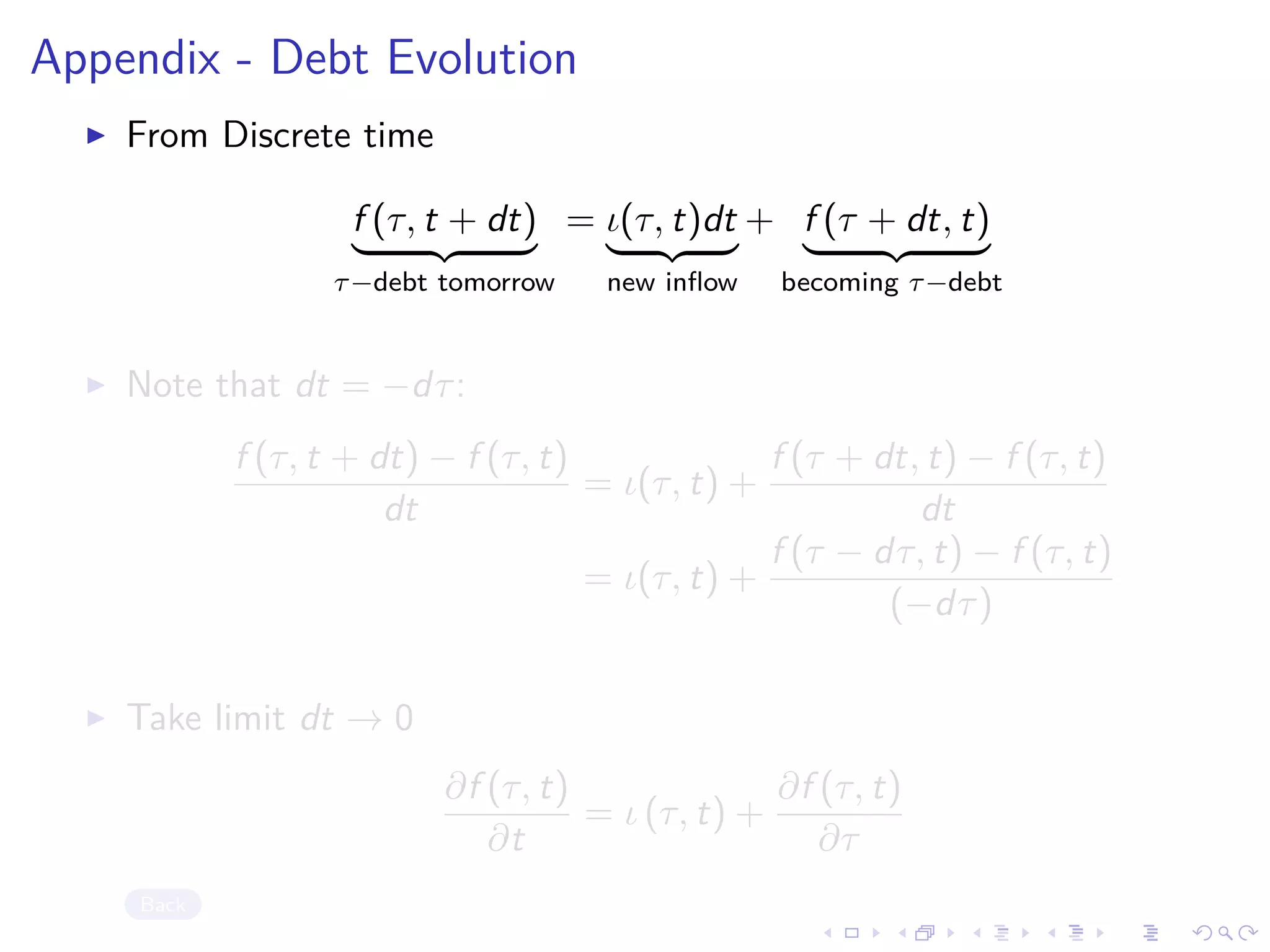
Appendix - Debt Evolution
From Discrete time
f (τ, t + dt)
τ−debt tomorrow
= ι(τ, t)dt
new inflow
+ f (τ + dt, t)
becoming τ−debt
Note that dt = −dτ:
f (τ, t + dt) − f (τ, t)
dt
= ι(τ, t) +
f (τ + dt, t) − f (τ, t)
dt
= ι(τ, t) +
f (τ − dτ, t) − f (τ, t)
(−dτ)
Take limit dt → 0
∂f (τ, t)
∂t
= ι (τ, t) +
∂f (τ, t)
∂τ
Back
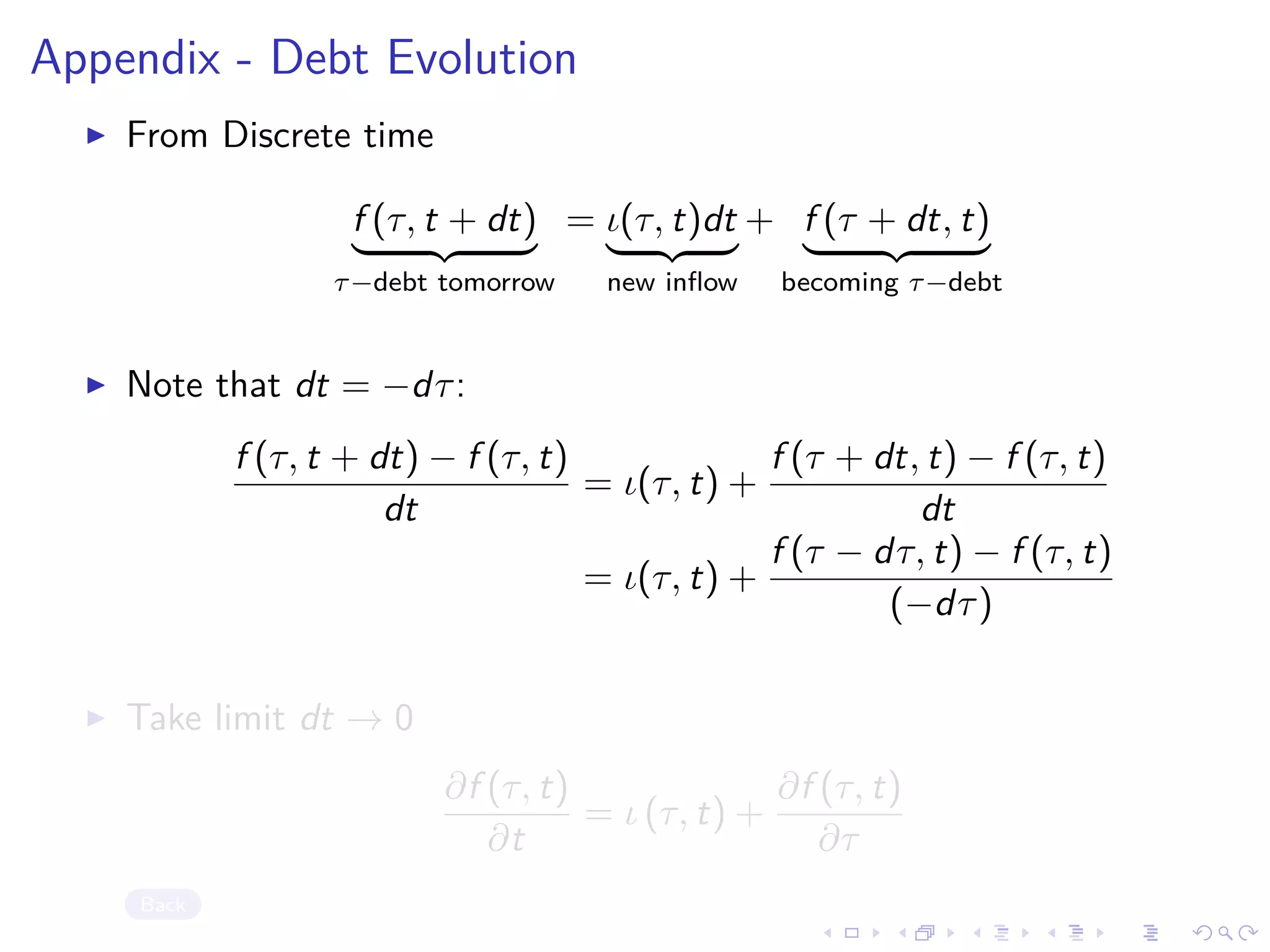
Appendix - Debt Evolution
From Discrete time
f (τ, t + dt)
τ−debt tomorrow
= ι(τ, t)dt
new inflow
+ f (τ + dt, t)
becoming τ−debt
Note that dt = −dτ:
f (τ, t + dt) − f (τ, t)
dt
= ι(τ, t) +
f (τ + dt, t) − f (τ, t)
dt
= ι(τ, t) +
f (τ − dτ, t) − f (τ, t)
(−dτ)
Take limit dt → 0
∂f (τ, t)
∂t
= ι (τ, t) +
∂f (τ, t)
∂τ
Back
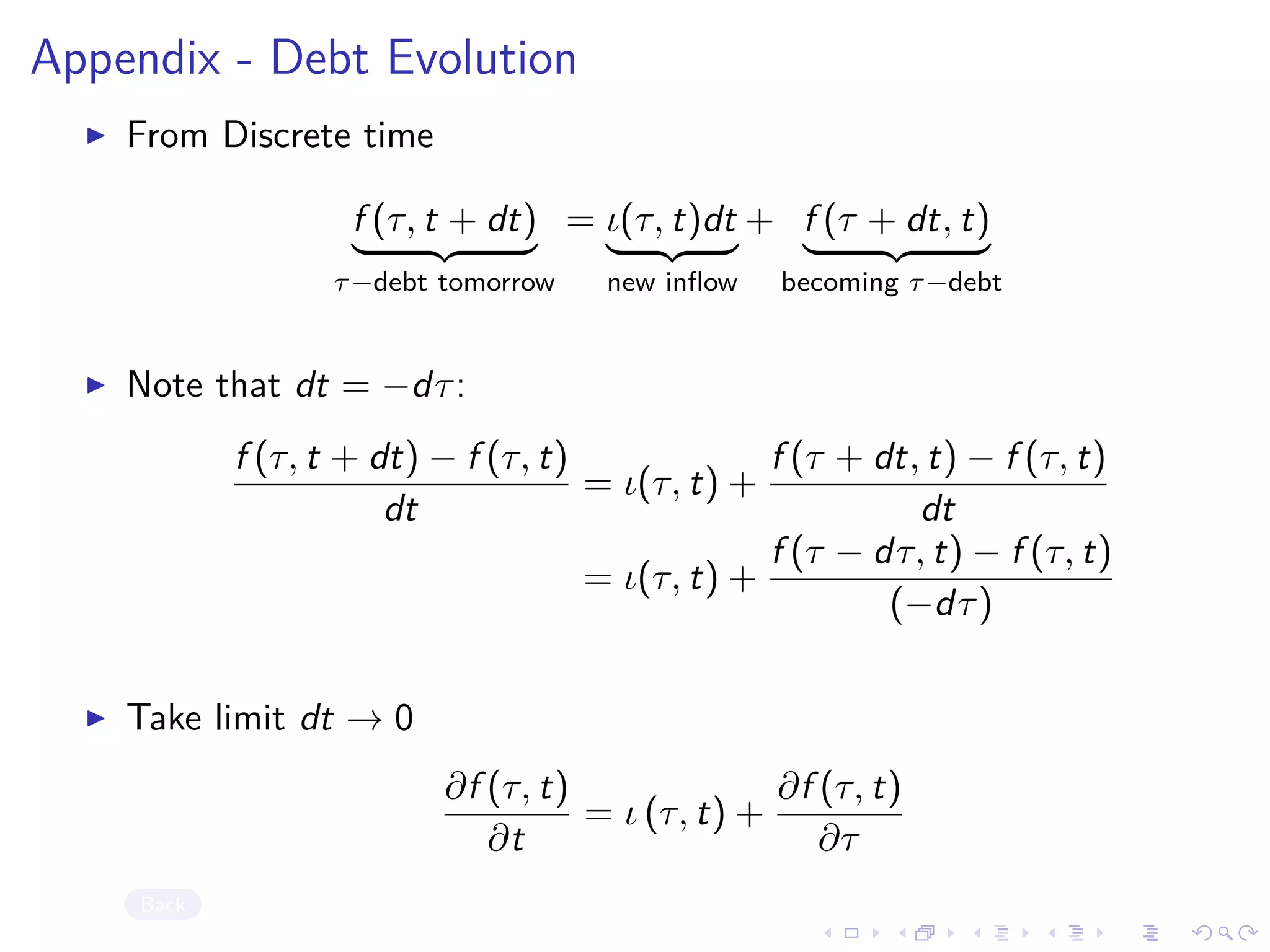
Appendix - Debt Evolution
From Discrete time
f (τ, t + dt)
τ−debt tomorrow
= ι(τ, t)dt
new inflow
+ f (τ + dt, t)
becoming τ−debt
Note that dt = −dτ:
f (τ, t + dt) − f (τ, t)
dt
= ι(τ, t) +
f (τ + dt, t) − f (τ, t)
dt
= ι(τ, t) +
f (τ − dτ, t) − f (τ, t)
(−dτ)
Take limit dt → 0
∂f (τ, t)
∂t
= ι (τ, t) +
∂f (τ, t)
∂τ
Back
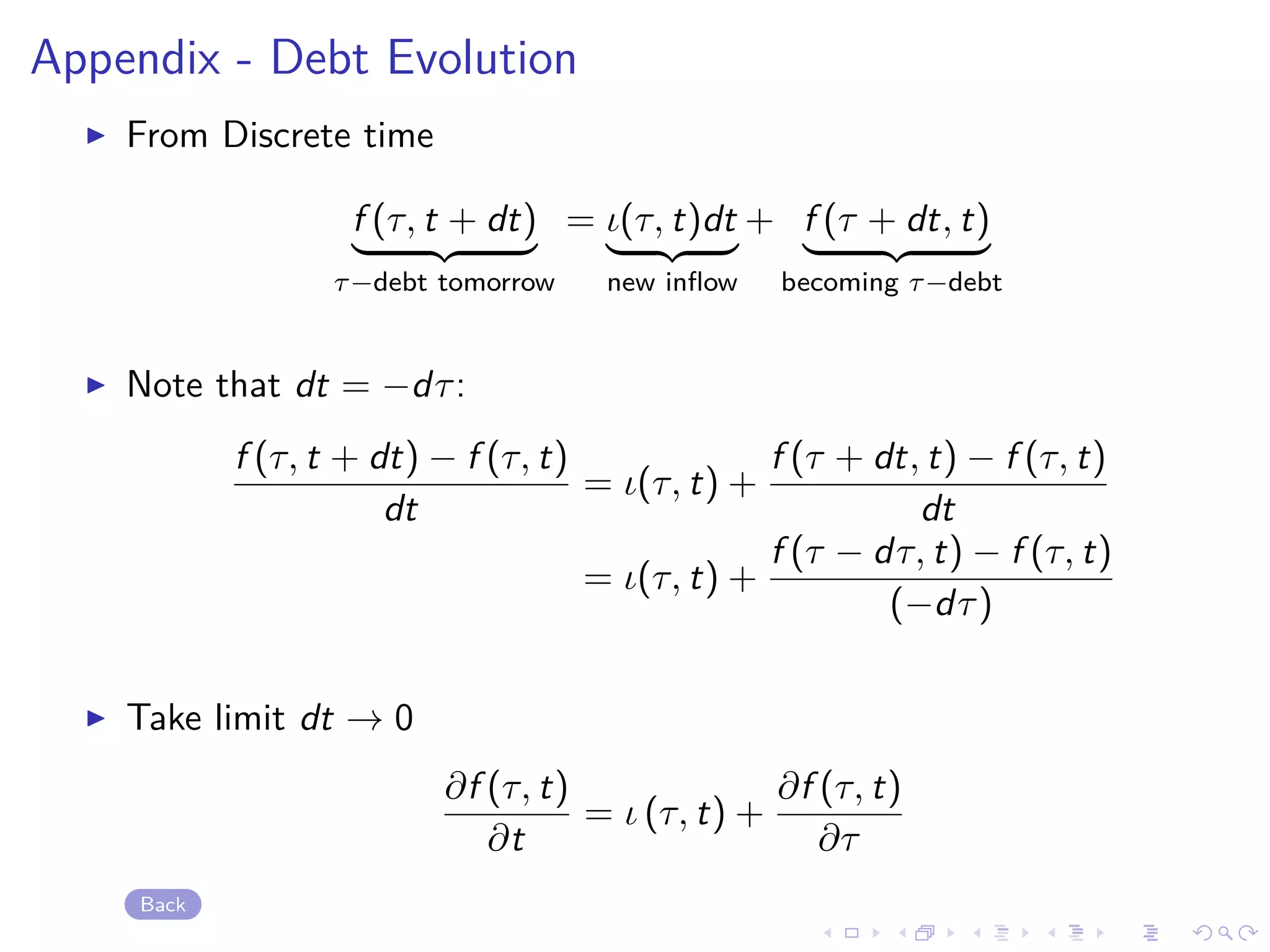
Appendix - Debt Evolution
From Discrete time
f (τ, t + dt)
τ−debt tomorrow
= ι(τ, t)dt
new inflow
+ f (τ + dt, t)
becoming τ−debt
Note that dt = −dτ:
f (τ, t + dt) − f (τ, t)
dt
= ι(τ, t) +
f (τ + dt, t) − f (τ, t)
dt
= ι(τ, t) +
f (τ − dτ, t) − f (τ, t)
(−dτ)
Take limit dt → 0
∂f (τ, t)
∂t
= ι (τ, t) +
∂f (τ, t)
∂τ
Back
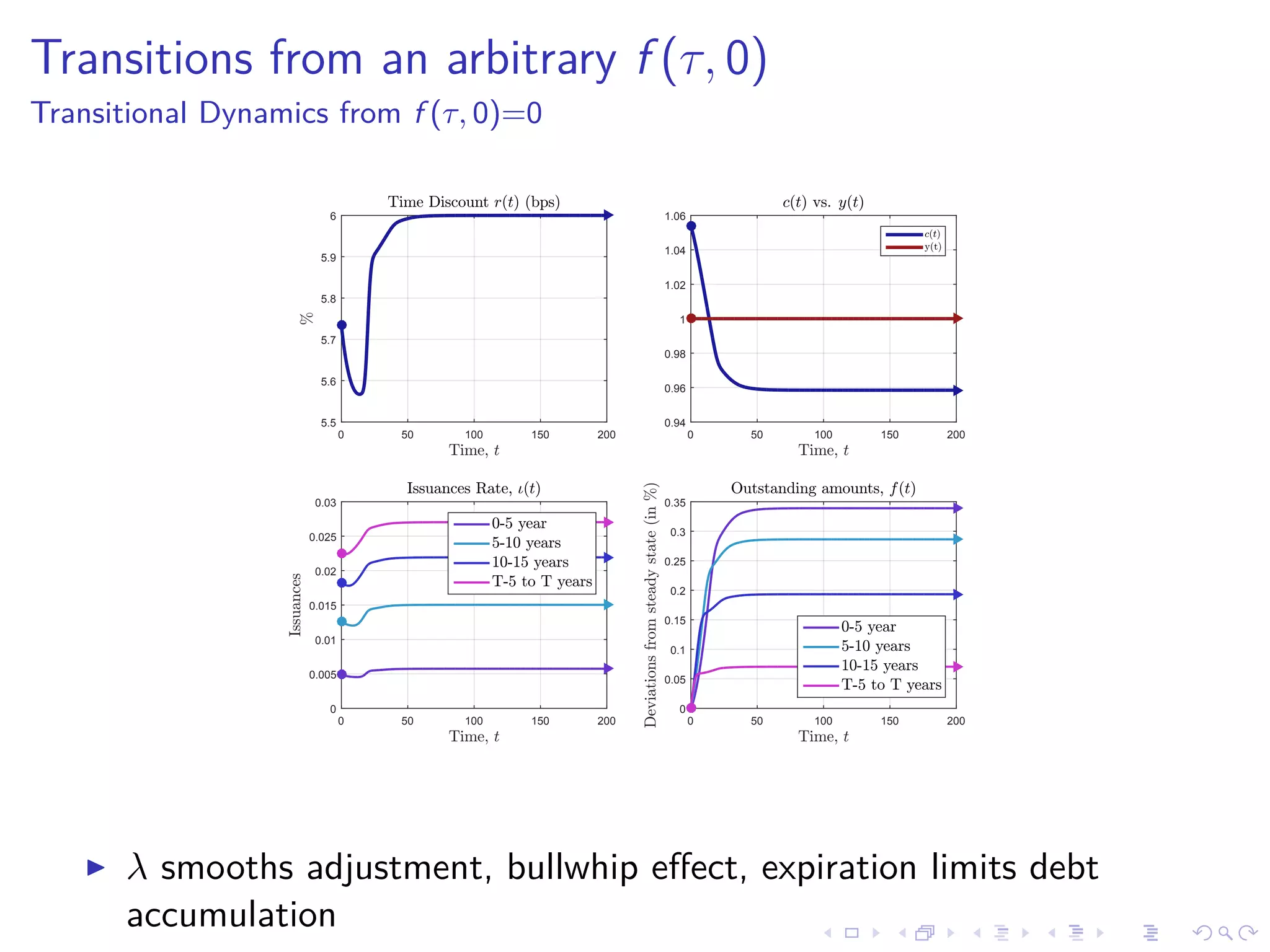
Transitions from an arbitrary f (τ, 0)
Transitional Dynamics from f (τ, 0)=0
Time, t
0 50 100 150 200
%
5.5
5.6
5.7
5.8
5.9
6
Time Discount r(t) (bps)
Time, t
0 50 100 150 200
0.94
0.96
0.98
1
1.02
1.04
1.06
c(t) vs. y(t)
c(t)
y(t)
Time, t
0 50 100 150 200
Issuances
0
0.005
0.01
0.015
0.02
0.025
0.03
Issuances Rate, 4(t)
0-5 year
5-10 years
10-15 years
T-5 to T years
Time, t
0 50 100 150 200
Deviationsfromsteadystate(in%)
0
0.05
0.1
0.15
0.2
0.25
0.3
0.35
Outstanding amounts, f(t)
0-5 year
5-10 years
10-15 years
T-5 to T years
λ smooths adjustment, bullwhip effect, expiration limits debt
accumulation
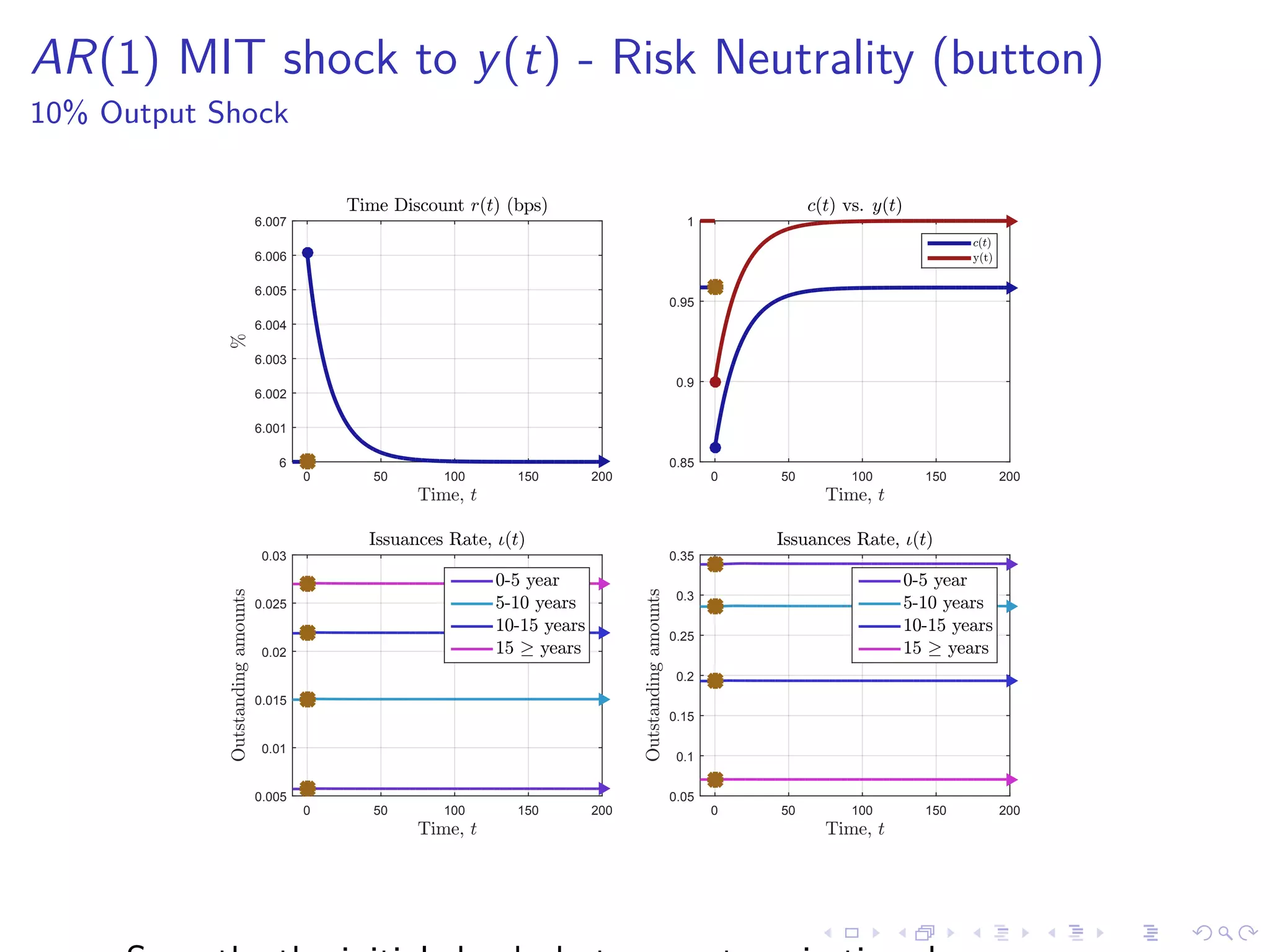
AR(1) MIT shock to y(t) - Risk Neutrality (button)
10% Output Shock
Time, t
0 50 100 150 200
%
6
6.001
6.002
6.003
6.004
6.005
6.006
6.007
Time Discount r(t) (bps)
Time, t
0 50 100 150 200
0.85
0.9
0.95
1
c(t) vs. y(t)
c(t)
y(t)
Time, t
0 50 100 150 200
Outstandingamounts
0.005
0.01
0.015
0.02
0.025
0.03
Issuances Rate, 4(t)
0-5 year
5-10 years
10-15 years
15 6 years
Time, t
0 50 100 150 200
Outstandingamounts
0.05
0.1
0.15
0.2
0.25
0.3
0.35
Issuances Rate, 4(t)
0-5 year
5-10 years
10-15 years
15 6 years
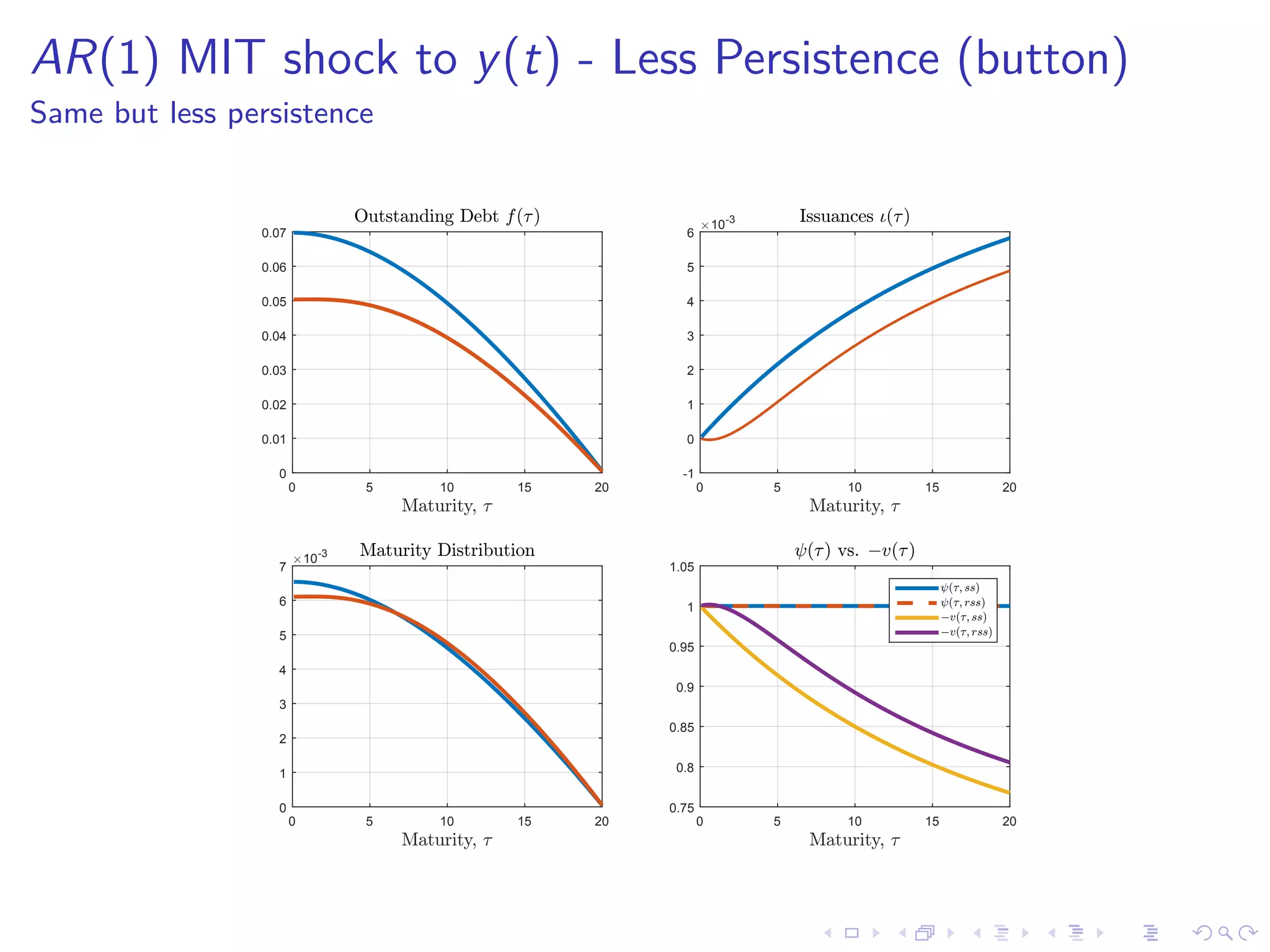
AR(1) MIT shock to y(t) - Less Persistence (button)
Same but less persistence
Maturity, =
0 5 10 15 20
0
0.01
0.02
0.03
0.04
0.05
0.06
0.07
Outstanding Debt f(=)
Maturity, =
0 5 10 15 20
#10-3
-1
0
1
2
3
4
5
6
Issuances 4(=)
Maturity, =
0 5 10 15 20
#10-3
0
1
2
3
4
5
6
7
Maturity Distribution
Maturity, =
0 5 10 15 20
0.75
0.8
0.85
0.9
0.95
1
1.05
A(=) vs. !v(=)
A(=; ss)
A(=; rss)
!v(=; ss)
!v(=; rss)
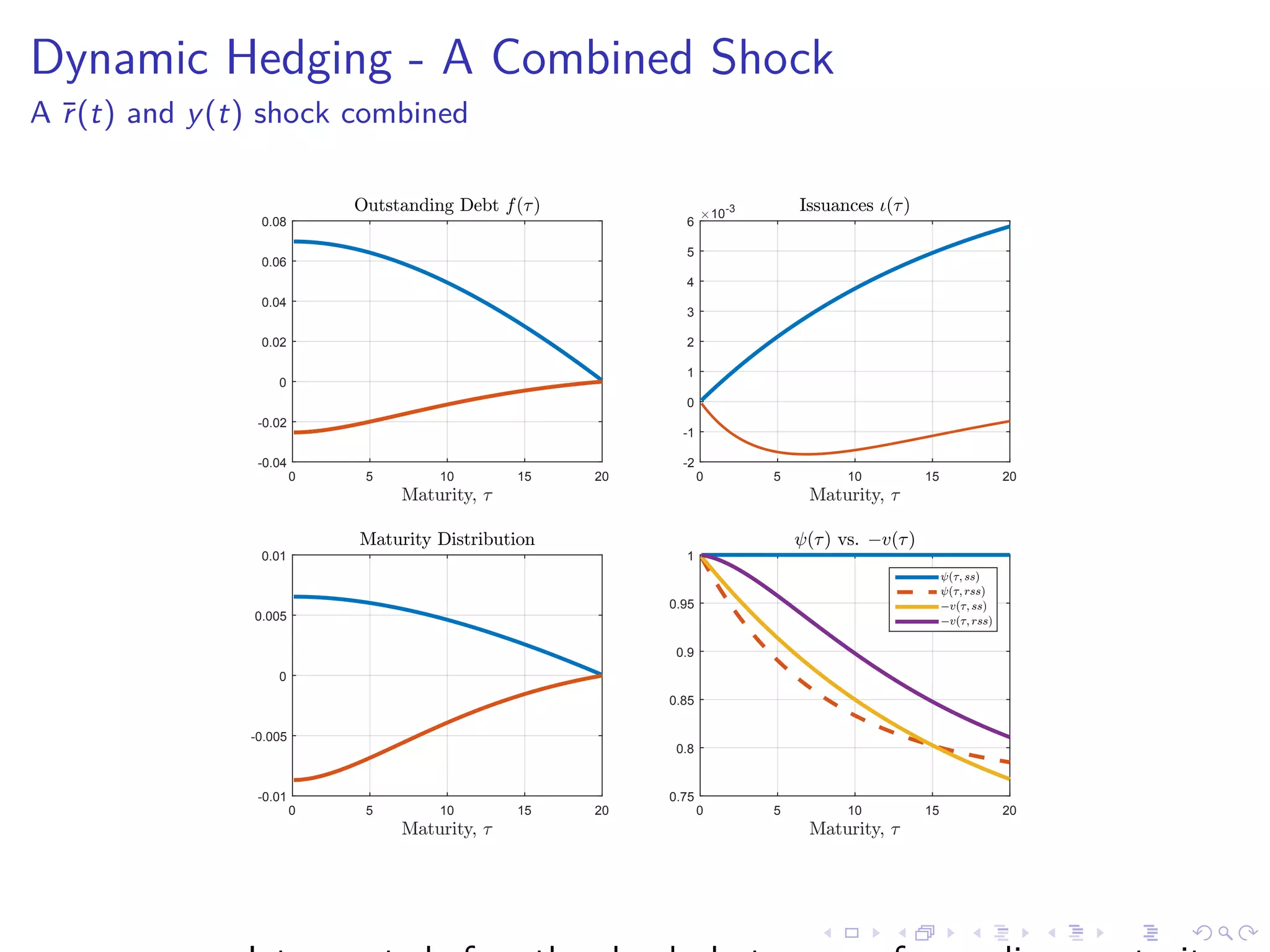
Dynamic Hedging - A Combined Shock
A ¯r(t) and y(t) shock combined
Maturity, =
0 5 10 15 20
-0.04
-0.02
0
0.02
0.04
0.06
0.08
Outstanding Debt f(=)
Maturity, =
0 5 10 15 20
#10-3
-2
-1
0
1
2
3
4
5
6
Issuances 4(=)
Maturity, =
0 5 10 15 20
-0.01
-0.005
0
0.005
0.01
Maturity Distribution
Maturity, =
0 5 10 15 20
0.75
0.8
0.85
0.9
0.95
1
A(=) vs. !v(=)
A(=; ss)
A(=; rss)
!v(=; ss)
!v(=; rss)
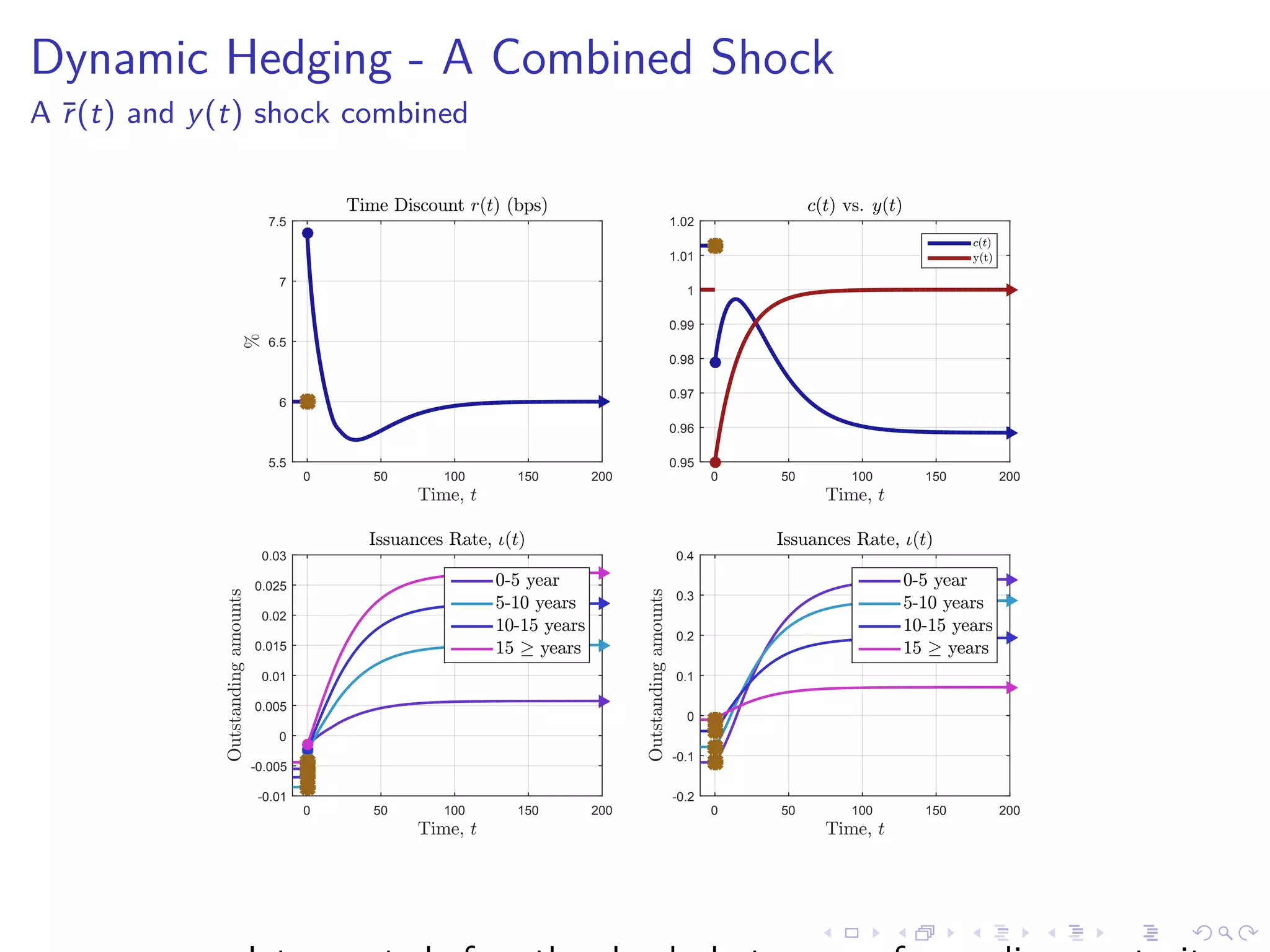
Dynamic Hedging - A Combined Shock
A ¯r(t) and y(t) shock combined
Time, t
0 50 100 150 200
%
5.5
6
6.5
7
7.5
Time Discount r(t) (bps)
Time, t
0 50 100 150 200
0.95
0.96
0.97
0.98
0.99
1
1.01
1.02
c(t) vs. y(t)
c(t)
y(t)
Time, t
0 50 100 150 200
Outstandingamounts
-0.01
-0.005
0
0.005
0.01
0.015
0.02
0.025
0.03
Issuances Rate, 4(t)
0-5 year
5-10 years
10-15 years
15 6 years
Time, t
0 50 100 150 200
Outstandingamounts
-0.2
-0.1
0
0.1
0.2
0.3
0.4
Issuances Rate, 4(t)
0-5 year
5-10 years
10-15 years
15 6 years
Transitional Dynamics - Fixed Point Algorithm in r(t)
1. Build:
r(t) = ρ − σ
˙c(t)
c(t)
2. Plug r(t) into value PDE:
r(t)v (τ, t) = −δ +
∂v
∂t
−
∂v
∂τ
3. Build issuances:
ι (τ, t) =
ψ(τ, t) + v(τ, t)
¯λ
4. Obtain f (t, τ):
f (τ, t) =
min{T,τ+t}
τ
ι(t + τ − s, s)ds + I[T > t + τ] · f (τ + t, 0)
5. c(t) given by
cout
(t) = y (t) − f (0, t) +
T
0
[q (τ, t, ι) ι (τ, t) − δf (τ, t)] dτ
Gateaux Derivative of V
dV
df
= lim
α→0
V (f + αh(τ,t)) − V (f )
α
where
h(τ,t)(˜τ,˜t) = Dirac function at (τ, t)
Back

Optimal debt maturity management

  • 1.
    Optimal Debt-Maturity Management SakiBigio (UCLA) Galo Nuño (Bank of Spain) Juan Passadore (EIEF) Toulouse, April 2018
  • 2.
    Peru Example -Programmed Coupon Payments Number of years in the future 5 10 15 20 25 30 35 %ofAnnualGDP 0 0.05 0.1 0.15 0.2 0.25 0.3 0.35 0.4 0.45 0.5 Interests-2016 Q2
  • 3.
    Peru Example -Programmed Principal Payments Number of years in the future 5 10 15 20 25 30 35 %ofAnnualGDP 0 0.1 0.2 0.3 0.4 0.5 0.6 0.7 Amortization-2016 Q2
  • 4.
    Debt-Management Large-Stake but highlycomplex problem state-space: vector of bonds of different maturity risks: income, interest-rate, default forces: smoothing, risk management, incentives, liquidity State of the art economics Can handle many risks Challenge: use standard bond =⇒ ↑curse of dimensionality forces use of consols typically two
  • 5.
    What we do... Changeof Focus Limit nature of shocks....but Continuum of Bonds arbitrary cash-flow analytic expressions, realistic debt structure, rich dynamics Highlight role of liquidity captures price impact follows from OTC frictions technically convenient
  • 6.
    Environment SOE, CT, incompletemarkets, exogenous short rates CT: elegance, speed and comp stats Consumption-Savings Problem: shocks: income, short rates, default value liquidity cost State Variable: mass of debt/assets f (τ, t)
  • 7.
    Agenda Deterministic Transitions: closed-form steadystate transitional dynamics MIT shocks: output or short rate force: liquidity smoothing vs. consumption smoothing Risky Steady State asymptotics when waiting for shock one-time shocks: output, short rate force: risk management Default Shock transitions: if date of decision is known risky-steady state: if date of decision is unknown force: incentives
  • 8.
    Literature Sovereign Debt: EatonGersovitz (1981), Bulow Rogoff (1988), Arellano (2008), Chattarjee Eiyungor (2012), Arellano Ramayanan (2012), Bianchi Hatchondo Martinez (2014), Debortoli, Nunes, Yared (2017), Fernández Martin (2014), Aguiar Amador Hopenhayn Werning (2017) Preferred Habit Models: Modigliani and Stutch (1966), Greenwood Vayanos (2010), Vayanos and Vila (2010) Debt Management w/ Distortionary Taxes: Lucas Stokey (1983), Angeletos (2002), Buera Nicolini (2004), Bhandari Evans Golosov Sargent (2017) Continuous Time - Heterogeneous Agents: Kredler (2014), Nuno Moll (2017), Nuno Thomas (2017),
  • 9.
    Environment: shocks, preferenceand state Random paths: income y(t), short rate ¯r(t) later: default Preferences: V0 = E[ ∞ 0 e−ρt u(c(t))dt] and u(x) ≡ c1−σ − 1 1 − σ State: debt f (τ, t), expiration τ ∈ [0, T]
  • 10.
    Environment: constraint set ResourceConstraint: c (t) = y (t) + T 0 q (τ, t, ι) ι (τ, t)dτ issuance − f (0, t) principal −δ T 0 f (τ, t) dτ coupons . Bond price: q (τ, t, ι) = ψ(τ, t) bond price − 1 2 ψ(τ, t)λ(ι) liquidity cost PDE constraint: Derivation ∂f (τ, t) ∂t = ι (τ, t) + ∂f (τ, t) ∂τ ; f (τ, 0) = f0(τ)
  • 11.
    Environment: bond price BondPrice ψ(τ, t): short rate ¯r(t) path and no-arbitrage: ψ(τ, t) = E[e − τ 0 ¯r(t+s)ds + δ τ 0 e − s 0 ¯r(t+z)dz ds] In HJB form: ¯r(t)ψ(τ, t) = δ + ∂ψ ∂t − ∂ψ ∂τ ; ψ(0, t) = 1
  • 12.
    Environment: liquidity cost WholesaleRetailbond market Walrasian wholesale auction of ι (τ, t) investment banks only price cash-flow at ¯r (t) + η OTC retail market µ flow of clients match with banks client valuation ψ(τ, t) Auction price: q(τ, t, ι) ψ(τ, t) − 1 2 ψ(τ, t) ¯λι λ(ι) , and ¯λ ≡ η µyss .
  • 13.
    General Problem Perfect Foresight V[f (·, 0)] = max {ι(τ,t)}t∈[0,∞),τ∈[0,T] Et ∞ t e−ρ(s−t) u(c(s))ds s.t. c (t) = y (t) − f (0, t) + T 0 [q (τ, t, ι) ι (τ, t) − δf (τ, t)] dτ ∂f ∂t = ι (τ, t) + ∂f ∂τ ; f (τ, 0) = f0(τ) Dual: Dual
  • 14.
  • 15.
    Deterministic Paths no default,known paths, f0 given Next... derive steady-state distribution f ∗(τ) path for transitional dynamics: f0 → f ∗(τ) comparative statistics: f ∗(τ, X) → f ∗(τ, X )
  • 16.
    Solving it Step 1.Lagrangian L (ι, f ) = ∞ 0 e−ρt u (c(t)) dt + ∞ 0 T 0 e−ρt j (τ, t) − ∂f ∂t + ι (τ, t) + ∂f ∂τ dτdt, c(t) = y (t) − f (0, t) + T 0 [q (t, τ, ι) ι (τ, t) − δf (τ, t)] dτ. Step 2. First-Order Condition and Envelope Marginal Value u (c) q (τ, t, ι) + ∂q ∂ι ι (τ, t) = Marginal Cost −j (τ, t) ρj (τ, t) = −δu (c (t)) + ∂j ∂t − ∂j ∂τ , if τ ∈ (0, T] and j (0, t) = −u (c (t)) .
  • 17.
    Solving it Step 1.Lagrangian L (ι, f ) = ∞ 0 e−ρt u (c(t)) dt + ∞ 0 T 0 e−ρt j (τ, t) − ∂f ∂t + ι (τ, t) + ∂f ∂τ dτdt, c(t) = y (t) − f (0, t) + T 0 [q (t, τ, ι) ι (τ, t) − δf (τ, t)] dτ. Step 2. First-Order Condition and Envelope Marginal Value u (c) ψ (τ, t) − ¯λψ (τ, t) ι = Marginal Cost −j (τ, t) ρj (τ, t) = −δu (c (t)) + ∂j ∂t − ∂j ∂τ , if τ ∈ (0, T] and j (0, t) = −u (c (t)) .
  • 18.
    Optimal Path Proposition: 1) v(τ,t) ≡ − j(τ,t) u (c(t)) solves "individual trader” price-PDE: r(t) ρ+σ . c(t)/c(t) v (τ, t) = δ + ∂v ∂t − ∂v ∂τ , if τ ∈ (0, T] v (0, t) = 1 2) issuances ι(τ, t): ψ (τ, t) − ¯λψ (τ, t) ι marginal income = v (τ, t) discounted payouts 3) PDE given f0, c(t) given by BC
  • 19.
    Optimal Path Proposition: 1) v(τ,t) ≡ − j(τ,t) u (c(t)) solves ‘"ndividual trader” price-PDE: r(t) ρ+σ . c(t)/c(t) v (τ, t) = δ + ∂v ∂t − ∂v ∂τ , if τ ∈ (0, T] v (0, t) = 1 2) issuances ι(τ, t): ι = ψ (τ, t) − v (τ, t) ¯λψ (τ, t) 3) PDE given f0, c(t) given by BC
  • 20.
    Asymptotic Properties (t−→ ∞) 1. market and internal valuations: ψ(τ) = δ 1 − e−¯rss τ ¯rss + e−¯rss τ and v∗ (τ) = δ 1 − e−rss (¯λ)τ rss(¯λ) + e−rss (¯λ)τ 2. issuance: ι∗ (τ) = ψ(τ) − v∗(τ) ¯λψ(τ) .
  • 21.
    Asymptotic Properties (t−→ ∞) If ¯λ ≥ ¯λo rss(λ) = ρ Steady State c(t) = css > 0 If¯λ < ¯λo limt→∞C(t) = 0 rss(λ) ∈ [¯rss, ρ)
  • 22.
    Asymptotic Values -varying ¯λ Liquidity, 76 0 0.5 1 1.5 2 -0.1 -0.05 0 0.05 0.1 0.15 0.2 0.25 0.3 6o c1 Liquidity, 76 0 0.5 1 1.5 2 0.04 0.045 0.05 0.055 0.06 6o r1 Maturity, = 0 5 10 15 20 0 0.05 0.1 0.15 0.2 41 Maturity, = 0 5 10 15 20 0 0.5 1 1.5 2 2.5 f1
  • 23.
    Steady State (whenλ ≥ ¯λo) Assumption ρ > ¯r Maturity, = 0 5 10 15 20 0 0.01 0.02 0.03 0.04 0.05 0.06 0.07 Outstanding Debt f(=) Maturity, = 0 5 10 15 20 #10-3 0 1 2 3 4 5 6 Issuances 4(=) Maturity, = 0 5 10 15 20 #10-3 0 1 2 3 4 5 6 7 Maturity Distribution Maturity, = 0 5 10 15 20 0.75 0.8 0.85 0.9 0.95 1 A(=) vs. !v(=) A(=) !v(=)
  • 24.
    Frictionless Benchmark ¯λ= 0 If ψ arbitrage free: r(t) = ¯r(t), ψ(τ, t) = v(τ, t) Discount Factor pins consumption: . c(t) c(t) = − ρ − ¯r(t) σ Indeterminate maturity!
  • 25.
    Frictionless Limit ¯λ−→ 0 If ψ arbitrage free r(t) = ¯r(t), ψ(τ, t) = v(τ, t) Discount Factor pins consumption: . c(t) c(t) = − ρ − ¯r(t) σ Determinate Maturity!
  • 26.
    Transitional Dynamics -Fixed Point Input: c(t) Discount Factor: r(t) = ρ + σ . c(t) c(t) Valuations: r(t) Value of Debt v (τ, t) = Coupon δ + dv(τ,t) dt ∂v ∂t − ∂v ∂τ Optimal Issuance: ι (τ, t) = ψ(τ, t) − v(τ, t) ¯λψ(τ, t) Output: c(t) (follows from KFE+BC)
  • 27.
  • 28.
    Application 1 -Transitions Transitions reveal two novel features: 1. Income path for y(t) liquidity cost + finite maturity produce issuance cycle 2. Path for short rate ¯r(t) show consumption vs. liquidity smoothing
  • 29.
    Transition after MITshock to y(t) Shock %5 output, T = 20 Time, t 0 50 100 150 200 % 5.9 6 6.1 6.2 6.3 6.4 6.5 Time Discount r(t) (bps) Time, t 0 50 100 150 200 0.85 0.9 0.95 1 c(t) vs. y(t) c(t) y(t) Time, t 0 50 100 150 200 %yss 0 0.01 0.02 0.03 0.04 Issuances Rate, 4(t) Time, t 0 50 100 150 200 %yss 0 0.2 0.4 0.6 0.8 Debt Outstanding, f(t) 0-5 (years) 5-10 10-15 T-5 to T
  • 30.
    Longer Maturity Shock %5output, from T = 20 to T = 30 Time, t 0 50 100 150 200 % 5.9 6 6.1 6.2 6.3 6.4 6.5 Time Discount r(t) (bps) Time, t 0 50 100 150 200 0.85 0.9 0.95 1 c(t) vs. y(t) c(t) y(t) Time, t 0 50 100 150 200 %yss 0 0.01 0.02 0.03 0.04 Issuances Rate, 4(t) Time, t 0 50 100 150 200 %yss 0 0.2 0.4 0.6 0.8 Debt Outstanding, f(t) 0-5 (years) 5-10 10-15 T-5 to T
  • 31.
    Transitions after AR(1)MIT shock to ¯r(t) Rates
  • 32.
    Transitions after AR(1)MIT shock to ¯r(t) Optimal Policy Time, t 0 50 100 150 200 % 4 5 6 7 8 Time Discount r(t) (bps) Time, t 0 50 100 150 200 0.9 0.95 1 1.05 1.1 1.15 c(t) vs. y(t) c(t) y(t) Time, t 0 50 100 150 200 %yss 0 0.02 0.04 0.06 0.08 Issuances Rate, 4(t) Time, t 0 50 100 150 200 %yss 0 0.2 0.4 0.6 0.8 Debt Outstanding, f(t) 0-5 (years) 5-10 10-15 T-5 to T
  • 33.
    Transitions after AR(1)MIT shock to ¯r(t) Infinite IES - when σ=0 Time, t 0 50 100 150 200 % 4 5 6 7 8 Time Discount r(t) (bps) Time, t 0 50 100 150 200 0.9 0.95 1 1.05 1.1 1.15 c(t) vs. y(t) c(t) y(t) Time, t 0 50 100 150 200 %yss 0 0.02 0.04 0.06 0.08 Issuances Rate, 4(t) Time, t 0 50 100 150 200 %yss 0 0.2 0.4 0.6 0.8 Debt Outstanding, f(t) 0-5 (years) 5-10 10-15 T-5 to T
  • 34.
  • 35.
    Risk What about Risk? Complication:fixed point in sets of functions Risky Steady State: allows analysis with risk
  • 36.
    Role of Uncertainty- Risky Steady State Next... Before shock: yss and ¯rss at steady state Poisson event with arrival rate θ After shock: draw {y (0) ,¯r(0)} ∼ F {y(t),¯r(t)} → {yss,¯rss} RSS: shock expected t → ∞ before realization opposite of MIT shock
  • 37.
    After Shocks -Risky Steady State Fixed point in {crss} ∪ {c(t)}t≥0 Jump crss to c(0) Post-shock: same as before but f (τ,0)=f rss (τ) Issuance rule: ι (τ, t) = ψ(τ, t) − v(τ, t) ¯λψ(τ, t)
  • 38.
    Before Shock -Risky Steady State Risk Adjusted Valuation: ρvrss (τ) = δ + ∂vrss(τ) ∂τ + θ E v (τ, 0) u (c(0)) u (crss) − vrss(τ) HJB solution is: vrss(τ) = τ 0 e−(ρ+θ)s θE v (τ, 0) u (c(0)) u (crss) + δ ds + e−(ρ+θ)τ Intuition: One value per shock: v (τ, 0) and c(0) marginal utility ratio: “exchange-rate” between states
  • 39.
    Frictionless Limit -Pre-shock Transition ˆψ (τ, t) = ˆv (τ, t) Price Equation: ¯r (t) ˆψ (τ, t) = δ + ∂ ˆψ ∂t − ∂ ˆψ ∂τ + θ E [ψ (τ, t)] − ˆψ (τ, t) HJB and ˆψ (τ, t) = ˆv (τ, t) r(t) ˆψ (τ, t) = δ + ∂ ˆψ ∂t − ∂ ˆψ ∂τ + θ E U (c (t)) U (ˆc (t)) ψ (τ, t) − ˆψ (τ, t) both equations must be consistent
  • 40.
    Frictionless Limit -Two Polar Cases Lack of Insurance: If only y(t) jumps ψ (τ, t) = ˆψ (τ, t) = 1 r(t) = ¯r(t) + θ E U (c (t)) U (ˆc (t)) − 1 And an RSS always exists Complete Insurance: requires ability to construct portfolio: such that ˆc (t) = c (t) for all shocks r(t) = ¯r(t) Asymptotic Limit, but no RSS
  • 41.
  • 42.
    AR(1) MIT shockto y(t) - RSS vs. SS Expecting a 5% y(t) drop Maturity, = 0 5 10 15 20 0 0.01 0.02 0.03 0.04 0.05 0.06 Outstanding Debt f(=) Maturity, = 0 5 10 15 20 #10-3 0 1 2 3 4 5 Issuances 4(=) Maturity, = 0 5 10 15 20 #10-3 0 1 2 3 4 5 6 7 Maturity Distribution Maturity, = 0 5 10 15 20 0.75 0.8 0.85 0.9 0.95 1 A(=) vs. !v(=) A(=; ss) A(=; rss) !v(=; ss) !v(=; rss) !v(=; 0)
  • 43.
    AR(1) MIT shockto y(t) - Transition from RSS 5% Output Shock Time, t 0 50 100 150 200 % 5.8 5.85 5.9 5.95 6 6.05 6.1 6.15 Time Discount r(t) (bps) Time, t 0 50 100 150 200 0.94 0.95 0.96 0.97 0.98 0.99 1 c(t) vs. y(t) c(t) y(t) Time, t 0 50 100 150 200 %yss 0 0.005 0.01 0.015 0.02 0.025 Issuances Rate, 4(t) Time, t 0 50 100 150 200 %yss 0 0.05 0.1 0.15 0.2 0.25 0.3 Debt Outstanding, f(t) 0-5 (years) 5-10 10-15 T-5 to T
  • 44.
    AR(1) MIT shockto ¯r(t) - RSS vs. SS Shock 4% to 8% on impact, ρ = 6% Maturity, = 0 5 10 15 20 -0.01 0 0.01 0.02 0.03 0.04 0.05 0.06 Outstanding Debt f(=) Maturity, = 0 5 10 15 20 #10-3 -1 0 1 2 3 4 5 Issuances 4(=) Maturity, = 0 5 10 15 20 -0.015 -0.01 -0.005 0 0.005 0.01 0.015 Maturity Distribution Maturity, = 0 5 10 15 20 0.7 0.75 0.8 0.85 0.9 0.95 1 A(=) vs. !v(=) A(=; ss) A(=; rss) !v(=; ss) !v(=; rss) !v(=; 0)
  • 45.
    AR(1) MIT shockto ¯r(t) - RSS vs. SS Shock 4% to 8% on impact, ρ = 6% Time, t 0 50 100 150 200 % 5.6 5.8 6 6.2 6.4 6.6 6.8 7 Time Discount r(t) (bps) Time, t 0 50 100 150 200 0.96 0.97 0.98 0.99 1 1.01 c(t) vs. y(t) c(t) y(t) Time, t 0 50 100 150 200 %yss -0.005 0 0.005 0.01 0.015 0.02 0.025 Issuances Rate, 4(t) Time, t 0 50 100 150 200 %yss -0.05 0 0.05 0.1 0.15 0.2 0.25 0.3 Debt Outstanding, f(t) 0-5 (years) 5-10 10-15 T-5 to T
  • 46.
    Application 1: Lessons optimalrisk management long-term debt, short-term assets
  • 47.
    Conclusion New approach tostudy maturity liquidity continuum of bonds of any class Can only analyze RSS Forces at play liquidity cost vs. consumption smoothing risk-aversion vs. incentives Next: default Future: recent developments to study aggregate shocks
  • 48.
    Steady State -Comp Stats Higher differentials ρ − ¯r amplifies issuances, for higher maturity Lower λ scales ι(τ) and f (τ) Role of T dilutes adjustment cost
  • 49.
    Dual Given {c(t)}t≥0, thenplanner’s discount: r(t) = ρ + σ ˙c(t) c(t) Dual Problem D [f (·, 0)] = min {ι(τ,t)}t=τ∈[0,∞),τ∈[0,T] ∞ 0 e− t 0 r(s)ds ytdt s.t. ∂f ∂t = ι (τ, t) + ∂f ∂τ , f (T, t) = 0; f (τ, 0) = f0(τ) y (t) = c (t) + f (0, t) − T 0 [q (τ, t, ι) ι (τ, t) − δf (τ, t)] dτ back
  • 50.
    Dual (button) Given {c(t)}t≥0,then planner’s discount: r(t) = ρ − σ ˙c(t) c(t) Dual: D [f (·, 0)] = min {ι(τ,t)}t=τ∈[0,∞),τ∈[0,T] ∞ 0 e− t 0 r(s)ds (f (0, t)− T 0 (ψ(τ, t) − λ ∂f ∂t = ι (τ, t) + ∂f ∂τ , f (τ, 0) = f0(τ) back
  • 51.
    Two Definitions (button) Yieldcurve Ψ(τ, t): Implicit constant rate Ψ(τ, t) that solves: ψ(τ, t) = e−Ψ(τ,t)τ + δ τ 0 e−Ψ(τ,t)s ds Portfolio Weights (maturity distribution): (τ,t) ≡ f (τ, t) T 0 f (s, t)ds
  • 52.
    Two Definitions (button) Yieldcurve Ψ(τ, t): Implicit constant rate Ψ(τ, t) that solves: ψ(τ, t) = e−Ψ(τ,t)τ + δ τ 0 e−Ψ(τ,t)s ds Portfolio Weights (maturity distribution): (τ,t) ≡ f (τ, t) T 0 f (s, t)ds
  • 53.
    Appendix - DebtEvolution From Discrete time f (τ, t + dt) τ−debt tomorrow = ι(τ, t)dt new inflow + f (τ + dt, t) becoming τ−debt Note that dt = −dτ: f (τ, t + dt) − f (τ, t) dt = ι(τ, t) + f (τ + dt, t) − f (τ, t) dt = ι(τ, t) + f (τ − dτ, t) − f (τ, t) (−dτ) Take limit dt → 0 ∂f (τ, t) ∂t = ι (τ, t) + ∂f (τ, t) ∂τ Back
  • 54.
    Appendix - DebtEvolution From Discrete time f (τ, t + dt) τ−debt tomorrow = ι(τ, t)dt new inflow + f (τ + dt, t) becoming τ−debt Note that dt = −dτ: f (τ, t + dt) − f (τ, t) dt = ι(τ, t) + f (τ + dt, t) − f (τ, t) dt = ι(τ, t) + f (τ − dτ, t) − f (τ, t) (−dτ) Take limit dt → 0 ∂f (τ, t) ∂t = ι (τ, t) + ∂f (τ, t) ∂τ Back
  • 55.
    Appendix - DebtEvolution From Discrete time f (τ, t + dt) τ−debt tomorrow = ι(τ, t)dt new inflow + f (τ + dt, t) becoming τ−debt Note that dt = −dτ: f (τ, t + dt) − f (τ, t) dt = ι(τ, t) + f (τ + dt, t) − f (τ, t) dt = ι(τ, t) + f (τ − dτ, t) − f (τ, t) (−dτ) Take limit dt → 0 ∂f (τ, t) ∂t = ι (τ, t) + ∂f (τ, t) ∂τ Back
  • 56.
    Appendix - DebtEvolution From Discrete time f (τ, t + dt) τ−debt tomorrow = ι(τ, t)dt new inflow + f (τ + dt, t) becoming τ−debt Note that dt = −dτ: f (τ, t + dt) − f (τ, t) dt = ι(τ, t) + f (τ + dt, t) − f (τ, t) dt = ι(τ, t) + f (τ − dτ, t) − f (τ, t) (−dτ) Take limit dt → 0 ∂f (τ, t) ∂t = ι (τ, t) + ∂f (τ, t) ∂τ Back
  • 57.
    Transitions from anarbitrary f (τ, 0) Transitional Dynamics from f (τ, 0)=0 Time, t 0 50 100 150 200 % 5.5 5.6 5.7 5.8 5.9 6 Time Discount r(t) (bps) Time, t 0 50 100 150 200 0.94 0.96 0.98 1 1.02 1.04 1.06 c(t) vs. y(t) c(t) y(t) Time, t 0 50 100 150 200 Issuances 0 0.005 0.01 0.015 0.02 0.025 0.03 Issuances Rate, 4(t) 0-5 year 5-10 years 10-15 years T-5 to T years Time, t 0 50 100 150 200 Deviationsfromsteadystate(in%) 0 0.05 0.1 0.15 0.2 0.25 0.3 0.35 Outstanding amounts, f(t) 0-5 year 5-10 years 10-15 years T-5 to T years λ smooths adjustment, bullwhip effect, expiration limits debt accumulation
  • 58.
    AR(1) MIT shockto y(t) - Risk Neutrality (button) 10% Output Shock Time, t 0 50 100 150 200 % 6 6.001 6.002 6.003 6.004 6.005 6.006 6.007 Time Discount r(t) (bps) Time, t 0 50 100 150 200 0.85 0.9 0.95 1 c(t) vs. y(t) c(t) y(t) Time, t 0 50 100 150 200 Outstandingamounts 0.005 0.01 0.015 0.02 0.025 0.03 Issuances Rate, 4(t) 0-5 year 5-10 years 10-15 years 15 6 years Time, t 0 50 100 150 200 Outstandingamounts 0.05 0.1 0.15 0.2 0.25 0.3 0.35 Issuances Rate, 4(t) 0-5 year 5-10 years 10-15 years 15 6 years
  • 59.
    AR(1) MIT shockto y(t) - Less Persistence (button) Same but less persistence Maturity, = 0 5 10 15 20 0 0.01 0.02 0.03 0.04 0.05 0.06 0.07 Outstanding Debt f(=) Maturity, = 0 5 10 15 20 #10-3 -1 0 1 2 3 4 5 6 Issuances 4(=) Maturity, = 0 5 10 15 20 #10-3 0 1 2 3 4 5 6 7 Maturity Distribution Maturity, = 0 5 10 15 20 0.75 0.8 0.85 0.9 0.95 1 1.05 A(=) vs. !v(=) A(=; ss) A(=; rss) !v(=; ss) !v(=; rss)
  • 60.
    Dynamic Hedging -A Combined Shock A ¯r(t) and y(t) shock combined Maturity, = 0 5 10 15 20 -0.04 -0.02 0 0.02 0.04 0.06 0.08 Outstanding Debt f(=) Maturity, = 0 5 10 15 20 #10-3 -2 -1 0 1 2 3 4 5 6 Issuances 4(=) Maturity, = 0 5 10 15 20 -0.01 -0.005 0 0.005 0.01 Maturity Distribution Maturity, = 0 5 10 15 20 0.75 0.8 0.85 0.9 0.95 1 A(=) vs. !v(=) A(=; ss) A(=; rss) !v(=; ss) !v(=; rss)
  • 61.
    Dynamic Hedging -A Combined Shock A ¯r(t) and y(t) shock combined Time, t 0 50 100 150 200 % 5.5 6 6.5 7 7.5 Time Discount r(t) (bps) Time, t 0 50 100 150 200 0.95 0.96 0.97 0.98 0.99 1 1.01 1.02 c(t) vs. y(t) c(t) y(t) Time, t 0 50 100 150 200 Outstandingamounts -0.01 -0.005 0 0.005 0.01 0.015 0.02 0.025 0.03 Issuances Rate, 4(t) 0-5 year 5-10 years 10-15 years 15 6 years Time, t 0 50 100 150 200 Outstandingamounts -0.2 -0.1 0 0.1 0.2 0.3 0.4 Issuances Rate, 4(t) 0-5 year 5-10 years 10-15 years 15 6 years
  • 62.
    Transitional Dynamics -Fixed Point Algorithm in r(t) 1. Build: r(t) = ρ − σ ˙c(t) c(t) 2. Plug r(t) into value PDE: r(t)v (τ, t) = −δ + ∂v ∂t − ∂v ∂τ 3. Build issuances: ι (τ, t) = ψ(τ, t) + v(τ, t) ¯λ 4. Obtain f (t, τ): f (τ, t) = min{T,τ+t} τ ι(t + τ − s, s)ds + I[T > t + τ] · f (τ + t, 0) 5. c(t) given by cout (t) = y (t) − f (0, t) + T 0 [q (τ, t, ι) ι (τ, t) − δf (τ, t)] dτ
  • 63.
    Gateaux Derivative ofV dV df = lim α→0 V (f + αh(τ,t)) − V (f ) α where h(τ,t)(˜τ,˜t) = Dirac function at (τ, t) Back