
An Option Theoretic Model for Ultimate Loss-Given-Default with Systematic Recovery Risk and Stochastic Returns on Defaulted Debt Michael Jacobs, Ph.D., CFA Senior Financial Economist Credit Risk Analysis Division Office of the Comptroller of the Currency  October, 2010 The views expressed herein are those of the author and do not necessarily represent the views of the Office of the Comptroller of the Currency or the Department of the Treasury.
Outline Background and Motivation Introduction and Conclusions Review of the Literature Theoretical Framework Comparative Statics Econometric Model & Empirical Results Implications for Downturn LGD Model Validation Summary and Future Directions
Background and Motivation Loss Given Default (LGD) – ultimate economic loss per dollar of outstanding balance at default A critical parameter in various facets of credit risk modeling – expected loss, pricing, capital (economic & regulatory) Basel II Internal Ratings Based (IRB) advanced approach to regulatory credit capital requires banks to estimate LGD May be measured either on a nominal (undiscounted) or economic (discounted) basis – we care about the latter Here we measure the market values of instruments received in settlement of default (bankruptcy or restructuring) as a proxy “ Workout” approach (discount recovery cash flows) vs. market  for distressed debt (trading or settlement prices at default or ultimate) Many extant credit risk models assume LGD to be fixed despite evidence it is stochastic and predictable with respect to other variables
Introduction and Conclusions Develop a theoretical model for ultimate loss-given default in the Merton (1974) structural credit risk model framework Derive compound option formulae to model differential seniority of instruments & an optimal foreclosure threshold Extension that allows for an independent recovery rate process representing undiversifiable recovery risk, with stochastic drift Calibrate models to observed LGDs on extensive dataset of bonds and loans from Moody’s 1987-2008 having both trading prices at default & at resolution of default Parameter estimates vary significantly across models & segments (volatilities of recovery rates and of their drifts are increasing in seniority & for bank loans as compared to bonds)  Implications for downturn LGD: declining in ELGD but uniformly higher for bonds vs. loans & greater PD-LGD correlation Validate the model in out-of-sample bootstrap exercise:  compares well to a high-dimensional regression model & a non-parametric benchmark based upon the same data
Review of the Literature Structural models: Merton (1974), Black and Cox (1976), Geske (1977), Vasicek (1984), Kim at al (1993), Hull & White (1995), Longstaff & Schwartz (1995) Reduced form models: Litterman & Iben (1991), Madan & Unal (1995), Jarrow & Turnbull (1995), Jarrow et al (1997), Lando (1998), Duffie & Singleton (1999), Duffie (1998) Credit VaR models: Creditmetrics™ (Gupton et al, 1997), Moody’s KMV™ Hybrid approaches: Frye (2000), Jarrow (2001), Bakshi et al (2001), Jokivuolle et al (2003)  Various recent academic studies have appeared on this topic Hu and Perraudin (2002) – LGD/ PD correlation Renault and Scalliet (2003) – beta kernel density estimation Acharya et al (2004) - industry distress ( “fire-sale” effect) Altman (2005) – debt market supply/demand Mason et al (2006) – option pricing & returns on defaulted debt  Carey & Gordy (2007) – estate level LGD and the role of bank debt
Theoretical Framework We propose an extension of Black and Cox (1976) with perpetual corporate debt & a continuous, positive foreclosure boundary Former assumptions removes the time dependence of the value of debt, thereby simplifying the solution and comparative statics  The latter assumption allows us to study the endogenous determination of the foreclosure boundary by the bank, as in Carey and Gordy (2007) Extend this by allowing the coupon on the loan (or drift / return on the collateral) to follow a stochastic process We assume no restriction on asset sales, so that we do not consider strategic bankruptcy, as in Leland (1994) and Leland and Toft (1996) Assume a firm financed by equity & perpetual debt divided between a single loan (class of bonds) with face value  λ  (1- λ )   Loan: senior & potentially has covenants which permit foreclosure, and entitled to a continuous coupon at a rate c which may evolve randomly Equity: receives a continuous dividend with constant & variable components  δ + ρ V t  , where V t  is the value of the firm’s assets at time t  Impose the restriction 0  ≤ ρ   ≤  r  ≤  c where r is the constant risk-free
Theoretical Framework (continued) The asset value of the firm, net of coupons  γ  and dividends  δ , follows a Geometric Brownian Motion with constant volatility, where C denotes the total fixed cash outflows per unit time:  Default occurs at time t (dividends cease) and is resolved after a fixed interval  τ  (the loan coupon continues to accrue) At emergence, loan holders receive minimum of the legal claim or the value of the firm, and the total legal claim is, respectively:  Assume firm value fluctuates through bankruptcy & as in Carey and Gordy (2007), model value of the loan at the threshold as equal to the recovery value at default time & remove the time dependency in loan value process, giving a 2 nd  order ODE debt that we solve for the  optimal foreclosure boundary   κ *  (if positive and fixed cash flows to claimants other than the bank)
Theoretical Framework (continued) Model undiversifiable recovery risk by introducing a separate process for recovery on debt R t , state of underlying collateral from default: Economic LGD on the loan is given by following expectation under physical measure with modified formulae: A well-known result (Bjerksund, 1991) is that the maturity-dependent volatility is given by::
Theoretical Framework (continued) Closed-form solution for the LGD on the bond follows well-known formula for a compound option: “outer option” is a put & “inner option” is a call with expiry dates equal.  Let R *  be the critical level of recovery such that the holder of the loan is just breaking even: The recovery to the bondholders is the expectation of the minimum of the positive part of the difference in the recovery and face value of the loan and the face value of the bond B, which is structurally identical to a compound option valuation problem (Geske, 1977):
Theoretical Framework (continued) Φ 2 (X,Y| ρ XY ): bivariate normal distribution function,  ρ  XY  =[ τ X / τ Y ] .5  for respective “expiry times” (note assumption that loan resolves before bond a matter of necessity here and seen on average in the data) Can extend this framework to arbitrary tranches: debt subordinated to the d th  degree results in a pricing formula that is a linear combination of d+1 variate Gaussian distributions  These formulae become cumbersome very quickly, so for the sake of brevity we refer the interested reader to Haug (2006) for further details
Comparative Statics LGD is montonically decreasing at increasing rate in value of the firm at default, this increases in the correlation between PD and LGD side systematic factors, & also uniformly higher for bonds than for loans LGD increases at an  increasing rate in LGD-side recovery volatility, for higher asset/recovery correlation at a faster rate, for bonds these curves lie above and increase at a faster rate
Comparative Statics (continued) LGD increases at an increasing rate in LGD volatility attributable to the PD-side systematic factor, for lower firm asset values LGD is higher but increases at a slower rate, for bonds these curves lie above & increase at a lower rate LGD decreases at a decreasing rate in recovery drift volatility, but sensitivity is not great (especially for loans), curves lie above for greater PD-LGD correlation & for bonds vs. loans
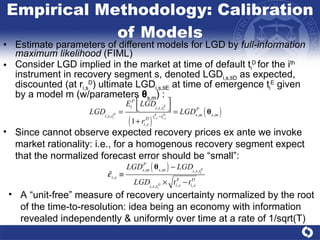
Empirical Methodology: Calibration of Models Estimate parameters of different models for LGD by  full-information maximum likelihood  (FIML)  Consider LGD implied in the market at time of default t i D  for the i th  instrument in recovery segment s, denoted LGD i,s,tiD  as expected, discounted (at r i,s D ) ultimate LGD i,s,tiE  at time of emergence t i E  given by a model m (w/parameters  θ s,m ) :  Since cannot observe expected recovery prices ex ante we invoke market rationality: i.e., for a homogenous recovery segment expect  that the normalized forecast error should be “small”:  A “unit-free” measure of recovery uncertainty normalized by the root of the time-to-resolution: idea being an economy with information revealed independently & uniformly over time at a rate of 1/sqrt(T)
Empirical Methodology: Calibration of Models (continued) Assuming that the errors are standard normal use full-information maximum likelihood: maximize the log-likelihood (LL) function:  Equivalent to minimizing the squared normalized forecast errors: Derive a measure of uncertainty of our estimate by the ML standard errors from the Hessian matrix evaluated at the optimum:
Empirical Results: Data Description Moody’s Ultimate Recovery Database™ (“MURD”) August 2009 (4050 instruments 1985-2009 for 776 obligors & 811 defaults) Debt prices on bonds and loans of  defaults  (bankruptcies & out-of-court) of U.S. large corporates (mostly rated debt & traded equity) Merged with various other information sources: Compustat, CRSP,  www.bankruptcydata.com, Edgar SEC filing, LPC DealScan Observations: instrument characteristics, complete capital structure, obligor demographics, key quantities & dates for LGD calculation  Resolution types: emergence from bankruptcy, Chapter 7 liquidation, acquisition or out-of-court settlement Recovery / LGD measures: prices of pre-petition (or received in settlement) instruments at emergence or restructuring  Sub-set: prices of traded debt at around default (30-45 day avg.) & equity prices prior to default to compute CARs
Empirical Results: Summary by Instrument & Default Event Type Overall mean LGD at default (ultimate) 54.7% (50.6%) & returns 28.6%  Loans have slightly lower LGDs default (ultimate) 52.5% (49.3%) than bonds 56.0% (51.3%) & higher returns 32.2% vs. 26.4% Bankruptcies have higher LGDs default (ultimate) 55.7% (51.6%) than restructurings 37.7% (33.8%) & lower returns 28.1% vs. 37.3%
Empirical Results: Summary by Seniority Class & Collateral Group For this data-set, rank ordering of mean LGD ( default  or ultimate) not  “intuitive” by collateral quality But rank ordering of mean LGD by seniority class in line with expectations Returns on defaulted debt generally increasing in seniority rank or collateral quality  (more  recovery risk?)
Empirical Results: FIML Estimates Overall recovery volatility increasing in seniority 16.1 to 31.1% Recovery volatility to PD -  β   (LGD -  ν ) side risk increasing in seniority class 10.0% to 18.2% (12.4% to 38.8%) But  proportion  of total variance attributable to LGD side increasing in seniority 59.4% to 20.0% Firm-value volatility  σ  increasing in seniority class 4.3% to 9.1% Mean-reversion speed in random drift of recovery κ α  humped in seniority class (3.3% sub, 5.5% sen-unsec.,4.0% for loans) Long-run mean of the random drift in the recovery α increasing in seniority 18.8% to 37.1% -> greater expected return of recovery lower ELGD paper Volatility of random drift in recovery η α  increasing in seniority 18.7% to 48.9%  -> greater volatility in expected return lower ELGD instruments
Correlation of random drift & level of recovery  ς  increasing in seniority 9.4% to 20.9% Correlation of default & recovery process ( βσ ) 1/2  increasing in seniority 6% to 12.8% Estimates statistically significant & magnitudes distinguishable across segments at conventional significance levels LR statistics indicate reject the null that all estimates are zero Model performs well-in sample & more elaborate models represent meaningful improvements over the simpler models AUROCs high by commonly accepted standards across models KS: very small p-values -> adequate separation in distributions low/high LGD MPR2 high by commonly accepted standards across models  HL: high p-values -> high accuracy to forecast cardinal LGD Empirical Results: FIML Estimates (continued)
Downturn LGD LGD mark-up declining in ELGD -> hirer recovery tail risk in lower ELGD paper Multiple higher for bonds vs. loans, higher PD-LGD correlation, collateral specific or volatility in the drift of the recovery rate drift process (differences narrow for higher ELGD
Model Validation Validate preferred 2FSM-SR&RD by out-of-sample and out-of-time rolling annual cohort analysis  Augment this by resampling on both the training and prediction samples, a non-parametric bootstrap (Efron [1979], Efron and Tibshirani [1986])  Analyze distribution of key diagnostic statistics Spearman rank-order correlation & Hoshmer-Lemeshow Chi-Squared (HLCQ) P-values Alternative #1 for predicting ultimate LGD: full-information maximum likelihood simultaneous equation regression model (FIMLE-SEM) built upon observations in URD at instrument & obligor level (Jacobs et al, 2010)  2nd alternative non-parametric estimation of a relationship with several independent variables & a bounded dependent variable Boundary bias with standard non-parametric estimators using Gaussian kernel (Hardle and Linton (1994) and Pagan and Ullah (1999)).   Chen (1999): BKDE defined on [0,1], flexible functional form, simplicity of estimation, non-negativity & finite sample optimal rate of convergence Extend (Renault and Scalliet, 2004) to GBKDE: density is a function of several independent variables (->smoothing through dependency of beta parameters)
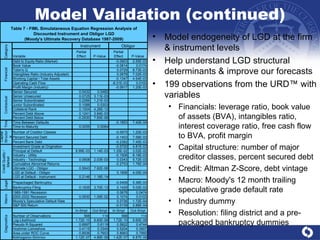
Model Validation (continued) Model endogeneity of LGD at the firm & instrument levels Help understand LGD structural determinants & improve our forecasts 199 observations from the URD™ with variables Financials: leverage ratio, book value of assets (BVA), intangibles ratio, interest coverage ratio, free cash flow to BVA, profit margin Capital structure: number of major creditor classes, percent secured debt Credit: Altman Z-Score, debt vintage Macro: Moody's 12 month trailing speculative grade default rate Industry dummy Resolution: filing district and a pre-packaged bankruptcy dummies
Model Validation (continued)
Model Validation (concluded) While all models perform decently out–of-sample in rank ordering, FIMLE-SEM performs best, GBKDE worst  & 2FSM-SR&RD in the middle (medians = 83.2, 72 & 79.1%, resp.) It is also evident from the table and figures that the better performing models are also less dispersed and exhibit less multi-modality However, the structural model is closer in performance to the regression model by the distribution of the Pearson correlation   Out-of- sample predictive accuracy is not as encouraging for any of the models (in a sizable proportion of the runs we can reject adequacy of fit) Rank ordering of HL same as Pearson: FIMLE-SEM best (median = 24.8%), GBKDE worst (median = 13.2%), 2FSM-SR&RD middle (median = 23.9%) Structural model developed herein is comparable in out-of-sample predictive accuracy to the high-dimensional regression model While all models are challenged in predicting cardinal levels of ultimate LGD out-of-sample, remarkable that a parsimonious structural model of ultimate LGD can perform so closely to a highly parameterized econometric model
Summary of Contributions and Major Findings Developed a theoretical model for ultimate LGD with many intuitive & realistic features in the structural credit risk model framework  Extension admits differential seniority, optimal foreclosure boundary, independent undiversifiable recovery risk process with stochastic drift Analysis of comparative statics: ultimate LGDs increasing in recovery volatilities, drifts on random return and PD-LGD correlation Empirical analysis: calibrated alternative models for ultimate LGD on instruments with trading prices & valkues at resolution of default using Moody’s URD™ 800 defaults are largely representative of the US large corporate loss experience with complete capital structures & recoveries on all  instruments to the time of default to the time of resolution Estimates vary significantly across models & recovery segments Estimated volatilities of the recovery rate Z& their random drift are increasing in seniority (bank loans vs. bonds) Reflects the inherently greater risk in the ultimate recovery for higher ranked instruments having lower expected loss severities
Summary of Contributions and Major Findings (continued) In an exercise relevant to advanced IRB under Basel II, analyzed quantification of a downturn LGD  Finding later to be declining for higher expected LGD & lower ranked instruments Increasing in the correlation between the process driving firm default and recovery on collateral   Validated our leading model in an out-of-sample bootstrapping exercise, comparing it to two alternatives Benchmarks: high-dimensional regression model & non-parametric, both based upon the same URD data  We found our model to compare favorably in this exercise  Conclusion: our model is worthy of consideration to risk managers & supervisors concerned with advanced IRB under the Basel II A benchmark for internally developed ultimate LGD models, as can be calibrated to LGD observed at default (either market prices or model forecasts) & ultimate workout LGD Risk managers can use our model as an input into internal credit capital models

Lgd Model Jacobs 10 10 V2[1]

  • 1.
    An Option TheoreticModel for Ultimate Loss-Given-Default with Systematic Recovery Risk and Stochastic Returns on Defaulted Debt Michael Jacobs, Ph.D., CFA Senior Financial Economist Credit Risk Analysis Division Office of the Comptroller of the Currency October, 2010 The views expressed herein are those of the author and do not necessarily represent the views of the Office of the Comptroller of the Currency or the Department of the Treasury.
  • 2.
    Outline Background andMotivation Introduction and Conclusions Review of the Literature Theoretical Framework Comparative Statics Econometric Model & Empirical Results Implications for Downturn LGD Model Validation Summary and Future Directions
  • 3.
    Background and MotivationLoss Given Default (LGD) – ultimate economic loss per dollar of outstanding balance at default A critical parameter in various facets of credit risk modeling – expected loss, pricing, capital (economic & regulatory) Basel II Internal Ratings Based (IRB) advanced approach to regulatory credit capital requires banks to estimate LGD May be measured either on a nominal (undiscounted) or economic (discounted) basis – we care about the latter Here we measure the market values of instruments received in settlement of default (bankruptcy or restructuring) as a proxy “ Workout” approach (discount recovery cash flows) vs. market for distressed debt (trading or settlement prices at default or ultimate) Many extant credit risk models assume LGD to be fixed despite evidence it is stochastic and predictable with respect to other variables
  • 4.
    Introduction and ConclusionsDevelop a theoretical model for ultimate loss-given default in the Merton (1974) structural credit risk model framework Derive compound option formulae to model differential seniority of instruments & an optimal foreclosure threshold Extension that allows for an independent recovery rate process representing undiversifiable recovery risk, with stochastic drift Calibrate models to observed LGDs on extensive dataset of bonds and loans from Moody’s 1987-2008 having both trading prices at default & at resolution of default Parameter estimates vary significantly across models & segments (volatilities of recovery rates and of their drifts are increasing in seniority & for bank loans as compared to bonds) Implications for downturn LGD: declining in ELGD but uniformly higher for bonds vs. loans & greater PD-LGD correlation Validate the model in out-of-sample bootstrap exercise: compares well to a high-dimensional regression model & a non-parametric benchmark based upon the same data
  • 5.
    Review of theLiterature Structural models: Merton (1974), Black and Cox (1976), Geske (1977), Vasicek (1984), Kim at al (1993), Hull & White (1995), Longstaff & Schwartz (1995) Reduced form models: Litterman & Iben (1991), Madan & Unal (1995), Jarrow & Turnbull (1995), Jarrow et al (1997), Lando (1998), Duffie & Singleton (1999), Duffie (1998) Credit VaR models: Creditmetrics™ (Gupton et al, 1997), Moody’s KMV™ Hybrid approaches: Frye (2000), Jarrow (2001), Bakshi et al (2001), Jokivuolle et al (2003) Various recent academic studies have appeared on this topic Hu and Perraudin (2002) – LGD/ PD correlation Renault and Scalliet (2003) – beta kernel density estimation Acharya et al (2004) - industry distress ( “fire-sale” effect) Altman (2005) – debt market supply/demand Mason et al (2006) – option pricing & returns on defaulted debt Carey & Gordy (2007) – estate level LGD and the role of bank debt
  • 6.
    Theoretical Framework Wepropose an extension of Black and Cox (1976) with perpetual corporate debt & a continuous, positive foreclosure boundary Former assumptions removes the time dependence of the value of debt, thereby simplifying the solution and comparative statics The latter assumption allows us to study the endogenous determination of the foreclosure boundary by the bank, as in Carey and Gordy (2007) Extend this by allowing the coupon on the loan (or drift / return on the collateral) to follow a stochastic process We assume no restriction on asset sales, so that we do not consider strategic bankruptcy, as in Leland (1994) and Leland and Toft (1996) Assume a firm financed by equity & perpetual debt divided between a single loan (class of bonds) with face value λ (1- λ ) Loan: senior & potentially has covenants which permit foreclosure, and entitled to a continuous coupon at a rate c which may evolve randomly Equity: receives a continuous dividend with constant & variable components δ + ρ V t , where V t is the value of the firm’s assets at time t Impose the restriction 0 ≤ ρ ≤ r ≤ c where r is the constant risk-free
  • 7.
    Theoretical Framework (continued)The asset value of the firm, net of coupons γ and dividends δ , follows a Geometric Brownian Motion with constant volatility, where C denotes the total fixed cash outflows per unit time: Default occurs at time t (dividends cease) and is resolved after a fixed interval τ (the loan coupon continues to accrue) At emergence, loan holders receive minimum of the legal claim or the value of the firm, and the total legal claim is, respectively: Assume firm value fluctuates through bankruptcy & as in Carey and Gordy (2007), model value of the loan at the threshold as equal to the recovery value at default time & remove the time dependency in loan value process, giving a 2 nd order ODE debt that we solve for the optimal foreclosure boundary κ * (if positive and fixed cash flows to claimants other than the bank)
  • 8.
    Theoretical Framework (continued)Model undiversifiable recovery risk by introducing a separate process for recovery on debt R t , state of underlying collateral from default: Economic LGD on the loan is given by following expectation under physical measure with modified formulae: A well-known result (Bjerksund, 1991) is that the maturity-dependent volatility is given by::
  • 9.
    Theoretical Framework (continued)Closed-form solution for the LGD on the bond follows well-known formula for a compound option: “outer option” is a put & “inner option” is a call with expiry dates equal. Let R * be the critical level of recovery such that the holder of the loan is just breaking even: The recovery to the bondholders is the expectation of the minimum of the positive part of the difference in the recovery and face value of the loan and the face value of the bond B, which is structurally identical to a compound option valuation problem (Geske, 1977):
  • 10.
    Theoretical Framework (continued)Φ 2 (X,Y| ρ XY ): bivariate normal distribution function, ρ XY =[ τ X / τ Y ] .5 for respective “expiry times” (note assumption that loan resolves before bond a matter of necessity here and seen on average in the data) Can extend this framework to arbitrary tranches: debt subordinated to the d th degree results in a pricing formula that is a linear combination of d+1 variate Gaussian distributions These formulae become cumbersome very quickly, so for the sake of brevity we refer the interested reader to Haug (2006) for further details
  • 11.
    Comparative Statics LGDis montonically decreasing at increasing rate in value of the firm at default, this increases in the correlation between PD and LGD side systematic factors, & also uniformly higher for bonds than for loans LGD increases at an increasing rate in LGD-side recovery volatility, for higher asset/recovery correlation at a faster rate, for bonds these curves lie above and increase at a faster rate
  • 12.
    Comparative Statics (continued)LGD increases at an increasing rate in LGD volatility attributable to the PD-side systematic factor, for lower firm asset values LGD is higher but increases at a slower rate, for bonds these curves lie above & increase at a lower rate LGD decreases at a decreasing rate in recovery drift volatility, but sensitivity is not great (especially for loans), curves lie above for greater PD-LGD correlation & for bonds vs. loans
  • 13.
    Empirical Methodology: Calibrationof Models Estimate parameters of different models for LGD by full-information maximum likelihood (FIML) Consider LGD implied in the market at time of default t i D for the i th instrument in recovery segment s, denoted LGD i,s,tiD as expected, discounted (at r i,s D ) ultimate LGD i,s,tiE at time of emergence t i E given by a model m (w/parameters θ s,m ) : Since cannot observe expected recovery prices ex ante we invoke market rationality: i.e., for a homogenous recovery segment expect that the normalized forecast error should be “small”: A “unit-free” measure of recovery uncertainty normalized by the root of the time-to-resolution: idea being an economy with information revealed independently & uniformly over time at a rate of 1/sqrt(T)
  • 14.
    Empirical Methodology: Calibrationof Models (continued) Assuming that the errors are standard normal use full-information maximum likelihood: maximize the log-likelihood (LL) function: Equivalent to minimizing the squared normalized forecast errors: Derive a measure of uncertainty of our estimate by the ML standard errors from the Hessian matrix evaluated at the optimum:
  • 15.
    Empirical Results: DataDescription Moody’s Ultimate Recovery Database™ (“MURD”) August 2009 (4050 instruments 1985-2009 for 776 obligors & 811 defaults) Debt prices on bonds and loans of defaults (bankruptcies & out-of-court) of U.S. large corporates (mostly rated debt & traded equity) Merged with various other information sources: Compustat, CRSP, www.bankruptcydata.com, Edgar SEC filing, LPC DealScan Observations: instrument characteristics, complete capital structure, obligor demographics, key quantities & dates for LGD calculation Resolution types: emergence from bankruptcy, Chapter 7 liquidation, acquisition or out-of-court settlement Recovery / LGD measures: prices of pre-petition (or received in settlement) instruments at emergence or restructuring Sub-set: prices of traded debt at around default (30-45 day avg.) & equity prices prior to default to compute CARs
  • 16.
    Empirical Results: Summaryby Instrument & Default Event Type Overall mean LGD at default (ultimate) 54.7% (50.6%) & returns 28.6% Loans have slightly lower LGDs default (ultimate) 52.5% (49.3%) than bonds 56.0% (51.3%) & higher returns 32.2% vs. 26.4% Bankruptcies have higher LGDs default (ultimate) 55.7% (51.6%) than restructurings 37.7% (33.8%) & lower returns 28.1% vs. 37.3%
  • 17.
    Empirical Results: Summaryby Seniority Class & Collateral Group For this data-set, rank ordering of mean LGD ( default or ultimate) not “intuitive” by collateral quality But rank ordering of mean LGD by seniority class in line with expectations Returns on defaulted debt generally increasing in seniority rank or collateral quality (more recovery risk?)
  • 18.
    Empirical Results: FIMLEstimates Overall recovery volatility increasing in seniority 16.1 to 31.1% Recovery volatility to PD - β (LGD - ν ) side risk increasing in seniority class 10.0% to 18.2% (12.4% to 38.8%) But proportion of total variance attributable to LGD side increasing in seniority 59.4% to 20.0% Firm-value volatility σ increasing in seniority class 4.3% to 9.1% Mean-reversion speed in random drift of recovery κ α humped in seniority class (3.3% sub, 5.5% sen-unsec.,4.0% for loans) Long-run mean of the random drift in the recovery α increasing in seniority 18.8% to 37.1% -> greater expected return of recovery lower ELGD paper Volatility of random drift in recovery η α increasing in seniority 18.7% to 48.9% -> greater volatility in expected return lower ELGD instruments
  • 19.
    Correlation of randomdrift & level of recovery ς increasing in seniority 9.4% to 20.9% Correlation of default & recovery process ( βσ ) 1/2 increasing in seniority 6% to 12.8% Estimates statistically significant & magnitudes distinguishable across segments at conventional significance levels LR statistics indicate reject the null that all estimates are zero Model performs well-in sample & more elaborate models represent meaningful improvements over the simpler models AUROCs high by commonly accepted standards across models KS: very small p-values -> adequate separation in distributions low/high LGD MPR2 high by commonly accepted standards across models HL: high p-values -> high accuracy to forecast cardinal LGD Empirical Results: FIML Estimates (continued)
  • 20.
    Downturn LGD LGDmark-up declining in ELGD -> hirer recovery tail risk in lower ELGD paper Multiple higher for bonds vs. loans, higher PD-LGD correlation, collateral specific or volatility in the drift of the recovery rate drift process (differences narrow for higher ELGD
  • 21.
    Model Validation Validatepreferred 2FSM-SR&RD by out-of-sample and out-of-time rolling annual cohort analysis Augment this by resampling on both the training and prediction samples, a non-parametric bootstrap (Efron [1979], Efron and Tibshirani [1986]) Analyze distribution of key diagnostic statistics Spearman rank-order correlation & Hoshmer-Lemeshow Chi-Squared (HLCQ) P-values Alternative #1 for predicting ultimate LGD: full-information maximum likelihood simultaneous equation regression model (FIMLE-SEM) built upon observations in URD at instrument & obligor level (Jacobs et al, 2010) 2nd alternative non-parametric estimation of a relationship with several independent variables & a bounded dependent variable Boundary bias with standard non-parametric estimators using Gaussian kernel (Hardle and Linton (1994) and Pagan and Ullah (1999)). Chen (1999): BKDE defined on [0,1], flexible functional form, simplicity of estimation, non-negativity & finite sample optimal rate of convergence Extend (Renault and Scalliet, 2004) to GBKDE: density is a function of several independent variables (->smoothing through dependency of beta parameters)
  • 22.
    Model Validation (continued)Model endogeneity of LGD at the firm & instrument levels Help understand LGD structural determinants & improve our forecasts 199 observations from the URD™ with variables Financials: leverage ratio, book value of assets (BVA), intangibles ratio, interest coverage ratio, free cash flow to BVA, profit margin Capital structure: number of major creditor classes, percent secured debt Credit: Altman Z-Score, debt vintage Macro: Moody's 12 month trailing speculative grade default rate Industry dummy Resolution: filing district and a pre-packaged bankruptcy dummies
  • 23.
  • 24.
    Model Validation (concluded)While all models perform decently out–of-sample in rank ordering, FIMLE-SEM performs best, GBKDE worst & 2FSM-SR&RD in the middle (medians = 83.2, 72 & 79.1%, resp.) It is also evident from the table and figures that the better performing models are also less dispersed and exhibit less multi-modality However, the structural model is closer in performance to the regression model by the distribution of the Pearson correlation Out-of- sample predictive accuracy is not as encouraging for any of the models (in a sizable proportion of the runs we can reject adequacy of fit) Rank ordering of HL same as Pearson: FIMLE-SEM best (median = 24.8%), GBKDE worst (median = 13.2%), 2FSM-SR&RD middle (median = 23.9%) Structural model developed herein is comparable in out-of-sample predictive accuracy to the high-dimensional regression model While all models are challenged in predicting cardinal levels of ultimate LGD out-of-sample, remarkable that a parsimonious structural model of ultimate LGD can perform so closely to a highly parameterized econometric model
  • 25.
    Summary of Contributionsand Major Findings Developed a theoretical model for ultimate LGD with many intuitive & realistic features in the structural credit risk model framework Extension admits differential seniority, optimal foreclosure boundary, independent undiversifiable recovery risk process with stochastic drift Analysis of comparative statics: ultimate LGDs increasing in recovery volatilities, drifts on random return and PD-LGD correlation Empirical analysis: calibrated alternative models for ultimate LGD on instruments with trading prices & valkues at resolution of default using Moody’s URD™ 800 defaults are largely representative of the US large corporate loss experience with complete capital structures & recoveries on all instruments to the time of default to the time of resolution Estimates vary significantly across models & recovery segments Estimated volatilities of the recovery rate Z& their random drift are increasing in seniority (bank loans vs. bonds) Reflects the inherently greater risk in the ultimate recovery for higher ranked instruments having lower expected loss severities
  • 26.
    Summary of Contributionsand Major Findings (continued) In an exercise relevant to advanced IRB under Basel II, analyzed quantification of a downturn LGD Finding later to be declining for higher expected LGD & lower ranked instruments Increasing in the correlation between the process driving firm default and recovery on collateral Validated our leading model in an out-of-sample bootstrapping exercise, comparing it to two alternatives Benchmarks: high-dimensional regression model & non-parametric, both based upon the same URD data We found our model to compare favorably in this exercise Conclusion: our model is worthy of consideration to risk managers & supervisors concerned with advanced IRB under the Basel II A benchmark for internally developed ultimate LGD models, as can be calibrated to LGD observed at default (either market prices or model forecasts) & ultimate workout LGD Risk managers can use our model as an input into internal credit capital models

Editor's Notes

  • #6 LGD @ default approach does not address the discount ate question – “implicit discounting”
  • #16 Broad definition of default (“quasi-Basel” according to Moody’s) Exceptions: trade payables & other off-balance sheet obligations debt type, seniority ranking, debt above / below, collateral type Obligor / Capital Structure: industry, proportion bank / secured debt, number of creditor classes / number instruments Defaults: amounts (EAD, AI), default type, coupon, dates / durations Recovery / LGD measures: prices of pre-petition (or received in settlement) instruments at emergence or restructuring Sub-set: prices of traded debt at around default (30-45 day avg.)
  • #17 Many OC’s had restructuring dates very near or after default trading dates