Volatility derivatives and default risk 
ARTUR SEPP 
Merrill Lynch 
Quant Congress London 
November 14-15, 2007 
1
Plan of the presentation 
1) Heston stochastic volatility model with the term-structure of ATM 
volatility and the jump-to-default: interaction between the realized 
variance and the default risk 
2) Analytical and numerical solution methods for the pricing problem 
3) Case study: application of the model to the General Motors data, 
implications 
2
References 
Theoretical and practical details for my presentation can be found in: 
1) Sepp, A. (2008) Pricing Options on Realized Variance in the He- 
ston Model with Jumps in Returns and Volatility, Journal of Compu- 
tational Finance, Vol. 11, No. 4, pp. 33-70 
http://ssrn.com/abstract=1408005 
2) Sepp, A. (2007) Ane Models in Mathematical Finance: an An- 
alytical Approach, PhD thesis, University of Tartu 
http://math.ut.ee/~spartak/papers/seppthesis.pdf 
3) Sepp, A. (2006) Extended CreditGrades Model with Stochastic 
Volatility and Jumps, Wilmott Magazine, September, 50-60 
http://ssrn.com/abstract=1412327 
3
Financial Motivation 
Volatility Products 

 Hedging against changes in the realized/implied volatility 

 Speculation and directional trading 
Credit Default Swaps 

 Hedging against the default of the issuer 

 Speculation and directional trading 
Volatility and Credit Products 

 The degree of correlation ? 

 Relative value analysis 
4
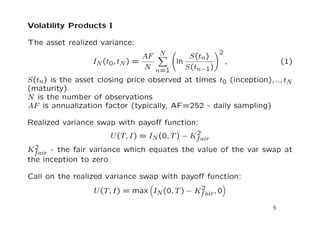
Volatility Products I 
The asset realized variance: 
IN(t0; tN) = 
AF 
N 
NX 
n=1 
  
ln 
S(tn) 
S(tn1) 
!2 
; (1) 
S(tn) is the asset closing price observed at times t0 (inception); ::; tN 
(maturity) 
N is the number of observations 
AF is annualization factor (typically, AF=252 - daily sampling) 
Realized variance swap with payo function: 
U(T; I) = IN(0; T)  K2 
fair 
K2 
fair - the fair variance which equates the value of the var swap at 
the inception to zero 
Call on the realized variance swap with payo function: 
U(T; I) = max 
 
IN(0; T)  K2 
 
fair; 0 
5
Volatility Products II 
Forward-start call: 
U(TF ; T) = max 
  
S(T) 
S(TF ) 
 K; 0 
! 
where TF - forward start time, T - maturity 
Forward-start variance swap: 
U(TF ; T) = IN(TF ; T)  K2 
fair 
Option on the future implied volatility (VIX-type option): 
U(T; T) = max 
q 
E[IN(T; T +T)]  K; 0 
 
The values of these products are sensitive to the evolution of the 
volatility surface 
6
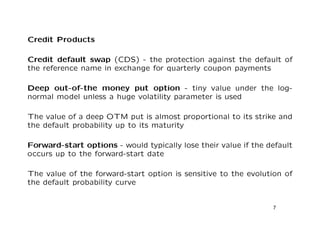
Credit Products 
Credit default swap (CDS) - the protection against the default of 
the reference name in exchange for quarterly coupon payments 
Deep out-of-the money put option - tiny value under the log- 
normal model unless a huge volatility parameter is used 
The value of a deep OTM put is almost proportional to its strike and 
the default probability up to its maturity 
Forward-start options - would typically lose their value if the default 
occurs up to the forward-start date 
The value of the forward-start option is sensitive to the evolution of 
the default probability curve 
7
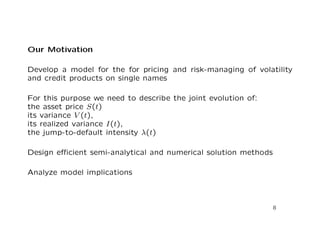
Our Motivation 
Develop a model for the for pricing and risk-managing of volatility 
and credit products on single names 
For this purpose we need to describe the joint evolution of: 
the asset price S(t) 
its variance V (t), 
its realized variance I(t), 
the jump-to-default intensity (t) 
Design ecient semi-analytical and numerical solution methods 
Analyze model implications 
8
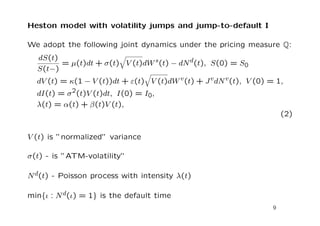
Heston model with volatility jumps and jump-to-default I 
We adopt the following joint dynamics under the pricing measure Q: 
dS(t) 
S(t) 
q 
V (t)dWs(t)  dNd(t); S(0) = S0 
= (t)dt+(t) 
q 
V (t)dWv(t)+JvdNv(t); V (0) = 1; 
dV (t) = (1  V (t))dt+(t) 
dI(t) = 2(t)V (t)dt; I(0) = I0; 
(t) = (t)+
(t)V (t); 
(2) 
V (t) is normalized variance 
(t) - is ATM-volatility 
Nd(t) - Poisson process with intensity (t) 
minf : Nd() = 1g is the default time 
9
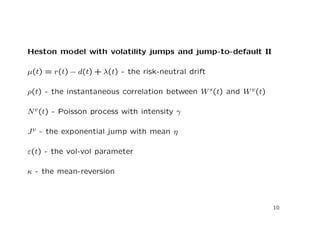
Heston model with volatility jumps and jump-to-default II 
(t) = r(t)  d(t)+(t) - the risk-neutral drift 
(t) - the instantaneous correlation between Ws(t) and Wv(t) 
Nv(t) - Poisson process with intensity 
 
Jv - the exponential jump with mean  
(t) - the vol-vol parameter 
 - the mean-reversion 
10
Model Interpretation: Asset Realized Variance 
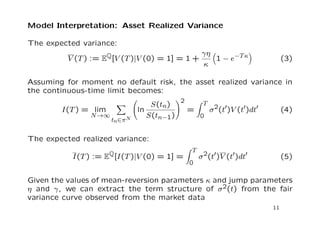
The expected variance: 
V (T) := EQ[V (T)jV (0) = 1] = 1+ 


1  eT 
 
(3) 
Assuming for moment no default risk, the asset realized variance in 
the continuous-time limit becomes: 
I(T) = lim 
N!1 
X 
tn2N 
  
ln 
S(tn) 
S(tn1) 
!2 
= 
Z T 
0 
2(t0)V (t0)dt0 (4) 
The expected realized variance: 
I(T) := EQ[I(T)jV (0) = 1] = 
Z T 
0 
2(t0)V (t0)dt0 (5) 
Given the values of mean-reversion parameters  and jump parameters 
 and 
, we can extract the term structure of 2(t) from the fair 
variance curve observed from the market data 
11
Model Interpretation: Jump-to-Default 
The probability of survival up to time T: 
Q(t; T) = EQ[  Tj  t] = EQ[e 
R T 
t (t0)dt0 
] (6) 
The probability of defaulting up to time T is connected to the inte- 
grated expected variance: 
Qc(t; T) = EQ[  Tj  t] = 1Q(t; T)  
Z T 
t 
((t0)+
(t0)V (t0))dt0 (7) 
Variation of the default intensity: 
 (t) =
2  V (t)  (8) 
Parameter
can be extracted form the time series or from non-linear 
CDS contracts 
The term structure of parameter (t), is backed-out from the survival 
probabilities implied CDS quotes 
12
Recovery Assumption I 
Should be speci
ed by the contract terms 
Can be simpli
ed by the modeling purposes 
Asset price: zero 
Call option payo: zero 
Put option payo: its strike 
Forward-start call option payo: zero 
Forward-start put option: zero if defaulted before the forward- 
start date, its strike if defaulted between the forward-start date and 
maturity 
13
Recovery Assumption II 
Realized Variance: ^I(T) - the cap level on the realized variance 
Typically, ^I(T) = 3KV (T) where KV (T) is the fair variance observed 
today for swap with maturity T 
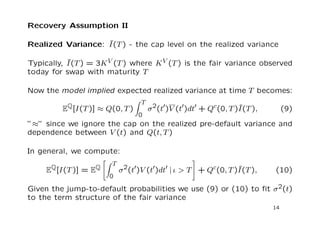
Now the model implied expected realized variance at time T becomes: 
EQ[I(T)]  Q(0; T) 
Z T 
0 
2(t0)V (t0)dt0 +Qc(0; T)^I(T); (9) 
 since we ignore the cap on the realized pre-default variance and 
dependence between V (t) and Q(t; T) 
In general, we compute: 
EQ[I(T)] = EQ 
Z T 
0 
2(t0)V (t0)dt0 j   T 
# 
+Qc(0; T)^I(T); (10) 
Given the jump-to-default probabilities we use (9) or (10) to
t 2(t) 
to the term structure of the fair variance 
14
Model Interpretation: Volatility Jumps 
Introduce the fat right tail to the density of the variance 
Explain the positive skew observed in the VIX options 
At the same time: 
Decrease the (terminal) correlation between the spot and both the 
implied variance and realized variance 
Increase the variance of the realized variance while give little impact 
on the asset (terminal) variance 
As a result, calibrating the variance jumps to the deep skews is not 
reasonable - we need to calibrate them to the volatility products 
15
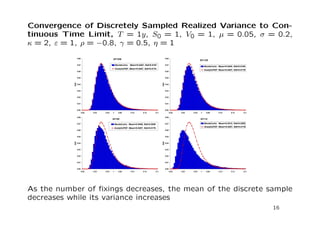
Convergence of Discretely Sampled Realized Variance to Con- 
tinuous Time Limit, T = 1y, S0 = 1, V0 = 1,  = 0:05,  = 0:2, 
 = 2,  = 1,  = 0:8, 
 = 0:5,  = 1 
As the number of
xings decreases, the mean of the discrete sample 
decreases while its variance increases 
16
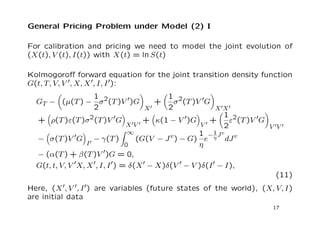
General Pricing Problem under Model (2) I 
For calibration and pricing we need to model the joint evolution of 
(X(t); V (t); I(t)) with X(t) = ln S(t) 
Kolmogoro forward equation for the joint transition density function 
G(t; T; V; V 0;X;X0; I; I0): 
GT  
 
((T)  
1 
2 
2(T)V 0)G 
 
X0 
+ 
 
1 
2 
2(T)V 0G 
 
X0X0 
+ 
 
(T)(T)2(T)V 0G 
 
X0V 0 + 
 
(1  V 0)G 
 
V 0 + 
 
1 
2 
2(T)V 0G 
 
V 0V 0 
 
 
(T)V 0G 
 
I0  
(T) 
Z 1 
0 
(G(V  Jv)  G) 
1 
 
1 
e 
Jv 
dJv 
 ((T)+
(T)V 0)G = 0; 
G(t; t; V; V 0X;X0; I; I0) = (X0  X)(V 0  V )(I0  I); 
(11) 
Here, (X0; V 0; I0) are variables (future states of the world), (X; V; I) 
are initial data 
17
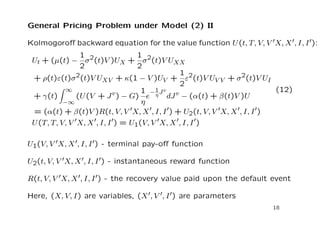
General Pricing Problem under Model (2) II 
Kolmogoro backward equation for the value function U(t; T; V; V 0X;X0; I; I0): 
Ut +((t)  
1 
2 
2(t)V )UX + 
1 
2 
2(t)V UXX 
+(t)(t)2(t)V UXV +(1  V )UV + 
1 
2 
2(t)V UV V +2(t)V UI 
+
(t) 
Z 1 
1 
(U(V +Jv)  G) 
1 
 
1 
e 
Jv 
dJv  ((t)+
(t)V )U 
= ((t)+
(t)V )R(t; V; V 0X;X0; I; I0)+U2(t; V; V 0X;X0; I; I0) 
U(T; T; V; V 0X;X0; I; I0) = U1(V; V 0X;X0; I; I0) 
(12) 
U1(V; V 0X;X0; I; I0) - terminal pay-o function 
U2(t; V; V 0X;X0; I; I0) - instantaneous reward function 
R(t; V; V 0X;X0; I; I0) - the recovery value paid upon the default event 
Here, (X; V; I) are variables, (X0; V 0; I0) are parameters 
18
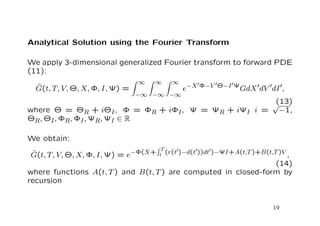
Analytical Solution using the Fourier Transform 
We apply 3-dimensional generalized Fourier transform to forward PDE 
(11): 
bG 
(t; T; V;;X;; I;	) = 
Z 1 
1 
Z 1 
1 
Z 1 
1 
eX0V 0I0	GdX0dV 0dI0; 
(13) 
where  = R + iI;  = R + iI; 	 = 	R + i	I i = 
p 
1, 
R;I;R;I;	R;	I 2 R 
We obtain: 
bG 
(t; T; V;;X;; I;	) = e(X+ 
R T 
t (r(t0)d(t0))dt0)	I+A(t;T)+B(t;T )V ; 
(14) 
where functions A(t; T) and B(t; T) are computed in closed-form by 
recursion 
19
Marginal Transition Densities and Convergence 
Asymptotic convergence rate is important to set-up the bounds for 
quadrature and FFT inversion methods 
We
rst recall that for the Black-Scholes model with constant V : 
bG 
X(t; T; V;;X)  e1 
22V02I 
; jIj ! 1 
For our model we obtain: 
bG 
X(t; T; V;;X) = bG(t; T; V; 0;X;; I; 0)  e 
((Tt)+2V0)(12) 
 jIj; jIj ! 1 
bG 
I(t; T; V;	; I) = bG 
(t; T; V; 0;X; 0; I;	)  e 
 
2(Tt)+2V0 
2 
p 
j	Ij 
; j	Ij ! 1; 
bG 
2 
2 ln jIj 
V (t; T; V;) = bG 
(t; T; V;;X; 0; I; 0)  e 
; jIj ! 1 
x = 
R T 
0 x(t0)dt0 and  stands for the leading term of the real part 
In relative terms, the convergence is fast for bG 
X, moderate for bG 
I, 
and slow for bG 
V 
20
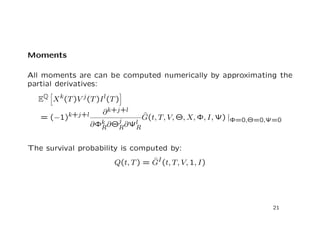
Moments 
All moments are can be computed numerically by approximating the 
partial derivatives: 
h 
i 
EQ 
Xk(T)V j(T)Il(T) 
= (1)k+j+l @k+j+l 
@k 
R@j 
R@	l 
R 
bG 
(t; T; V;;X;; I;	) j=0;=0;	=0 
The survival probability is computed by: 
Q(t; T) = bG 
I(t; T; V; 1; I) 
21
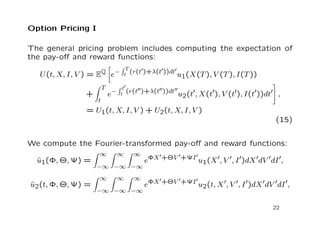
Option Pricing I 
The general pricing problem includes computing the expectation of 
the pay-o and reward functions: 
U(t;X; I; V ) = EQ 
 
e 
R T 
t (r(t0)+(t0))dt0 
u1(X(T); V (T); I(T)) 
+ 
Z T 
t 
e 
R t0 
t (r(t00)+(t00))dt00 
u2(t0;X(t0); V (t0); I(t0))dt0 
# 
; 
= U1(t;X; I; V )+U2(t;X; I; V ) 
(15) 
We compute the Fourier-transformed pay-o and reward functions: 
bu 
1(;;	) = 
Z 1 
1 
Z 1 
1 
Z 1 
1 
eX0+V 0+	I0 
u1(X0; V 0; I0)dX0dV 0dI0; 
bu 
2(t;;;	) = 
Z 1 
1 
Z 1 
1 
Z 1 
1 
eX0+V 0+	I0 
u2(t;X0; V 0; I0)dX0dV 0dI0; 
22
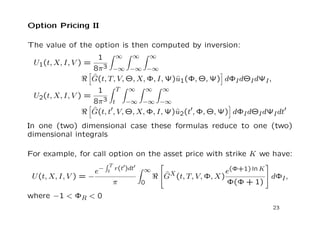
Option Pricing II 
The value of the option is then computed by inversion: 
U1(t;X; I; V ) = 
1 
83 
Z 1 
1 
Z 1 
1 
Z 1 
1 
 
h 
bG 
(t; T; V;;X;; I;	)bu 
1(;;	) 
i 
dIdId	I; 
U2(t;X; I; V ) = 
1 
83 
Z T 
t 
Z 1 
1 
Z 1 
1 
Z 1 
1 
 
h 
bG 
(t; t0; V;;X;; I;	)bu 
2(t0;;;	) 
i 
dIdId	Idt0 
In one (two) dimensional case these formulas reduce to one (two) 
dimensional integrals 
For example, for call option on the asset price with strike K we have: 
U(t;X; I; V ) =  
e 
R T 
t r(t0)dt0 
 
Z 1 
0 
 
2 
4bG 
X(t; T; V;;X) 
e(+1) lnK 
(+1) 
3 
5 dI; 
where 1  R  0 
23
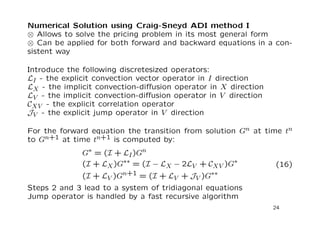
Numerical Solution using Craig-Sneyd ADI method I 

 Allows to solve the pricing problem in its most general form 

 Can be applied for both forward and backward equations in a con- 
sistent way 
Introduce the following discretesized operators: 
LI - the explicit convection vector operator in I direction 
LX - the implicit convection-diusion operator in X direction 
LV - the implicit convection-diusion operator in V direction 
CXV - the explicit correlation operator 
JV - the explicit jump operator in V direction 
For the forward equation the transition from solution Gn at time tn 
to Gn+1 at time tn+1 is computed by: 
G = (I +LI)Gn 
(I +LX)G = (I  LX  2LV +CXV )G 
(I +LV )Gn+1 = (I +LV +JV )G 
(16) 
Steps 2 and 3 lead to a system of tridiagonal equations 
Jump operator is handled by a fast recursive algorithm 
24
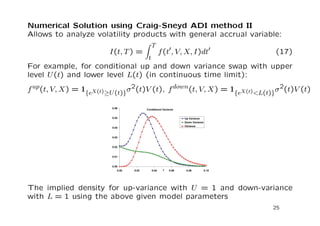
Numerical Solution using Craig-Sneyd ADI method II 
Allows to analyze volatility products with general accrual variable: 
I(t; T) = 
Z T 
t 
f(t0; V;X; I)dt0 (17) 
For example, for conditional up and down variance swap with upper 
level U(t) and lower level L(t) (in continuous time limit): 
fup(t; V;X) = 1feX(t)U(t)g2(t)V (t); fdown(t; V;X) = 1feX(t)L(t)g2(t)V (t) 
The implied density for up-variance with U = 1 and down-variance 
with L = 1 using the above given model parameters 
25
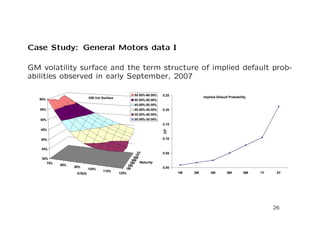
Case Study: General Motors data I 
GM volatility surface and the term structure of implied default prob- 
abilities observed in early September, 2007 
26
Case Study: General Motors data II 
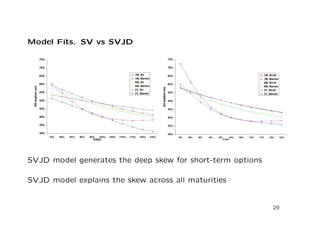
For illustration we calibrate two models: 
1) SV - the dynamics (2) without jump-to-default 
2) SVJD - the dynamics (2) with jump-to-default 
The term structure of (t) is backed-out from the ATM volatilities, 
other parameters are kept constant, no volatility jumps 
Jump-to-default intensity parameter  is inferred from the term struc- 
ture of implied probabilities for GM CDS (which is pretty 
at),
= 0 
27
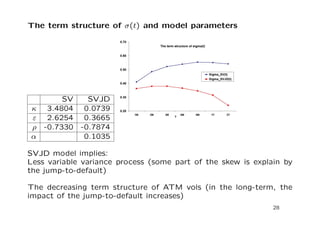
The term structure of (t) and model parameters 
SV SVJD 
 3.4804 0.0739 
 2.6254 0.3665 
 -0.7330 -0.7874 
 0.1035 
SVJD model implies: 
Less variable variance process (some part of the skew is explain by 
the jump-to-default) 
The decreasing term structure of ATM vols (in the long-term, the 
impact of the jump-to-default increases) 
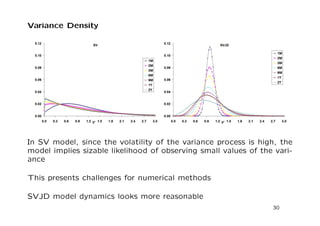
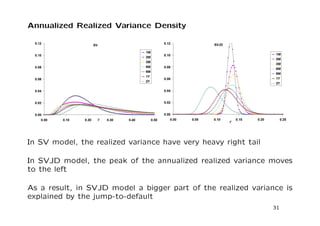
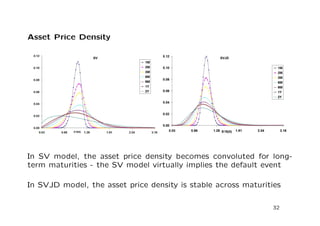
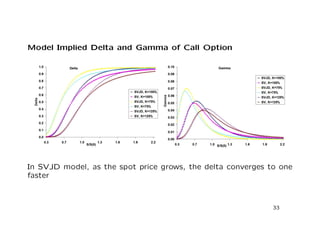
28

Volatility derivatives and default risk

  • 1.
    Volatility derivatives anddefault risk ARTUR SEPP Merrill Lynch Quant Congress London November 14-15, 2007 1
  • 2.
    Plan of thepresentation 1) Heston stochastic volatility model with the term-structure of ATM volatility and the jump-to-default: interaction between the realized variance and the default risk 2) Analytical and numerical solution methods for the pricing problem 3) Case study: application of the model to the General Motors data, implications 2
  • 3.
    References Theoretical andpractical details for my presentation can be found in: 1) Sepp, A. (2008) Pricing Options on Realized Variance in the He- ston Model with Jumps in Returns and Volatility, Journal of Compu- tational Finance, Vol. 11, No. 4, pp. 33-70 http://ssrn.com/abstract=1408005 2) Sepp, A. (2007) Ane Models in Mathematical Finance: an An- alytical Approach, PhD thesis, University of Tartu http://math.ut.ee/~spartak/papers/seppthesis.pdf 3) Sepp, A. (2006) Extended CreditGrades Model with Stochastic Volatility and Jumps, Wilmott Magazine, September, 50-60 http://ssrn.com/abstract=1412327 3
  • 4.
    Financial Motivation VolatilityProducts Hedging against changes in the realized/implied volatility Speculation and directional trading Credit Default Swaps Hedging against the default of the issuer Speculation and directional trading Volatility and Credit Products The degree of correlation ? Relative value analysis 4
  • 5.
    Volatility Products I The asset realized variance: IN(t0; tN) = AF N NX n=1 ln S(tn) S(tn1) !2 ; (1) S(tn) is the asset closing price observed at times t0 (inception); ::; tN (maturity) N is the number of observations AF is annualization factor (typically, AF=252 - daily sampling) Realized variance swap with payo function: U(T; I) = IN(0; T) K2 fair K2 fair - the fair variance which equates the value of the var swap at the inception to zero Call on the realized variance swap with payo function: U(T; I) = max IN(0; T) K2 fair; 0 5
  • 6.
    Volatility Products II Forward-start call: U(TF ; T) = max S(T) S(TF ) K; 0 ! where TF - forward start time, T - maturity Forward-start variance swap: U(TF ; T) = IN(TF ; T) K2 fair Option on the future implied volatility (VIX-type option): U(T; T) = max q E[IN(T; T +T)] K; 0 The values of these products are sensitive to the evolution of the volatility surface 6
  • 7.
    Credit Products Creditdefault swap (CDS) - the protection against the default of the reference name in exchange for quarterly coupon payments Deep out-of-the money put option - tiny value under the log- normal model unless a huge volatility parameter is used The value of a deep OTM put is almost proportional to its strike and the default probability up to its maturity Forward-start options - would typically lose their value if the default occurs up to the forward-start date The value of the forward-start option is sensitive to the evolution of the default probability curve 7
  • 8.
    Our Motivation Developa model for the for pricing and risk-managing of volatility and credit products on single names For this purpose we need to describe the joint evolution of: the asset price S(t) its variance V (t), its realized variance I(t), the jump-to-default intensity (t) Design ecient semi-analytical and numerical solution methods Analyze model implications 8
  • 9.
    Heston model withvolatility jumps and jump-to-default I We adopt the following joint dynamics under the pricing measure Q: dS(t) S(t) q V (t)dWs(t) dNd(t); S(0) = S0 = (t)dt+(t) q V (t)dWv(t)+JvdNv(t); V (0) = 1; dV (t) = (1 V (t))dt+(t) dI(t) = 2(t)V (t)dt; I(0) = I0; (t) = (t)+
  • 10.
    (t)V (t); (2) V (t) is normalized variance (t) - is ATM-volatility Nd(t) - Poisson process with intensity (t) minf : Nd() = 1g is the default time 9
  • 11.
    Heston model withvolatility jumps and jump-to-default II (t) = r(t) d(t)+(t) - the risk-neutral drift (t) - the instantaneous correlation between Ws(t) and Wv(t) Nv(t) - Poisson process with intensity Jv - the exponential jump with mean (t) - the vol-vol parameter - the mean-reversion 10
  • 12.
    Model Interpretation: AssetRealized Variance The expected variance: V (T) := EQ[V (T)jV (0) = 1] = 1+ 1 eT (3) Assuming for moment no default risk, the asset realized variance in the continuous-time limit becomes: I(T) = lim N!1 X tn2N ln S(tn) S(tn1) !2 = Z T 0 2(t0)V (t0)dt0 (4) The expected realized variance: I(T) := EQ[I(T)jV (0) = 1] = Z T 0 2(t0)V (t0)dt0 (5) Given the values of mean-reversion parameters and jump parameters and , we can extract the term structure of 2(t) from the fair variance curve observed from the market data 11
  • 13.
    Model Interpretation: Jump-to-Default The probability of survival up to time T: Q(t; T) = EQ[ Tj t] = EQ[e R T t (t0)dt0 ] (6) The probability of defaulting up to time T is connected to the inte- grated expected variance: Qc(t; T) = EQ[ Tj t] = 1Q(t; T) Z T t ((t0)+
  • 14.
    (t0)V (t0))dt0 (7) Variation of the default intensity: (t) =
  • 15.
    2 V(t) (8) Parameter
  • 16.
    can be extractedform the time series or from non-linear CDS contracts The term structure of parameter (t), is backed-out from the survival probabilities implied CDS quotes 12
  • 17.
    Recovery Assumption I Should be speci
  • 18.
    ed by thecontract terms Can be simpli
  • 19.
    ed by themodeling purposes Asset price: zero Call option payo: zero Put option payo: its strike Forward-start call option payo: zero Forward-start put option: zero if defaulted before the forward- start date, its strike if defaulted between the forward-start date and maturity 13
  • 20.
    Recovery Assumption II Realized Variance: ^I(T) - the cap level on the realized variance Typically, ^I(T) = 3KV (T) where KV (T) is the fair variance observed today for swap with maturity T Now the model implied expected realized variance at time T becomes: EQ[I(T)] Q(0; T) Z T 0 2(t0)V (t0)dt0 +Qc(0; T)^I(T); (9) since we ignore the cap on the realized pre-default variance and dependence between V (t) and Q(t; T) In general, we compute: EQ[I(T)] = EQ Z T 0 2(t0)V (t0)dt0 j T # +Qc(0; T)^I(T); (10) Given the jump-to-default probabilities we use (9) or (10) to
  • 21.
    t 2(t) tothe term structure of the fair variance 14
  • 22.
    Model Interpretation: VolatilityJumps Introduce the fat right tail to the density of the variance Explain the positive skew observed in the VIX options At the same time: Decrease the (terminal) correlation between the spot and both the implied variance and realized variance Increase the variance of the realized variance while give little impact on the asset (terminal) variance As a result, calibrating the variance jumps to the deep skews is not reasonable - we need to calibrate them to the volatility products 15
  • 23.
    Convergence of DiscretelySampled Realized Variance to Con- tinuous Time Limit, T = 1y, S0 = 1, V0 = 1, = 0:05, = 0:2, = 2, = 1, = 0:8, = 0:5, = 1 As the number of
  • 24.
    xings decreases, themean of the discrete sample decreases while its variance increases 16
  • 25.
    General Pricing Problemunder Model (2) I For calibration and pricing we need to model the joint evolution of (X(t); V (t); I(t)) with X(t) = ln S(t) Kolmogoro forward equation for the joint transition density function G(t; T; V; V 0;X;X0; I; I0): GT ((T) 1 2 2(T)V 0)G X0 + 1 2 2(T)V 0G X0X0 + (T)(T)2(T)V 0G X0V 0 + (1 V 0)G V 0 + 1 2 2(T)V 0G V 0V 0 (T)V 0G I0 (T) Z 1 0 (G(V Jv) G) 1 1 e Jv dJv ((T)+
  • 26.
    (T)V 0)G =0; G(t; t; V; V 0X;X0; I; I0) = (X0 X)(V 0 V )(I0 I); (11) Here, (X0; V 0; I0) are variables (future states of the world), (X; V; I) are initial data 17
  • 27.
    General Pricing Problemunder Model (2) II Kolmogoro backward equation for the value function U(t; T; V; V 0X;X0; I; I0): Ut +((t) 1 2 2(t)V )UX + 1 2 2(t)V UXX +(t)(t)2(t)V UXV +(1 V )UV + 1 2 2(t)V UV V +2(t)V UI + (t) Z 1 1 (U(V +Jv) G) 1 1 e Jv dJv ((t)+
  • 28.
    (t)V )U =((t)+
  • 29.
    (t)V )R(t; V;V 0X;X0; I; I0)+U2(t; V; V 0X;X0; I; I0) U(T; T; V; V 0X;X0; I; I0) = U1(V; V 0X;X0; I; I0) (12) U1(V; V 0X;X0; I; I0) - terminal pay-o function U2(t; V; V 0X;X0; I; I0) - instantaneous reward function R(t; V; V 0X;X0; I; I0) - the recovery value paid upon the default event Here, (X; V; I) are variables, (X0; V 0; I0) are parameters 18
  • 30.
    Analytical Solution usingthe Fourier Transform We apply 3-dimensional generalized Fourier transform to forward PDE (11): bG (t; T; V;;X;; I; ) = Z 1 1 Z 1 1 Z 1 1 eX0V 0I0 GdX0dV 0dI0; (13) where = R + iI; = R + iI; = R + i I i = p 1, R;I;R;I; R; I 2 R We obtain: bG (t; T; V;;X;; I; ) = e(X+ R T t (r(t0)d(t0))dt0) I+A(t;T)+B(t;T )V ; (14) where functions A(t; T) and B(t; T) are computed in closed-form by recursion 19
  • 31.
    Marginal Transition Densitiesand Convergence Asymptotic convergence rate is important to set-up the bounds for quadrature and FFT inversion methods We
  • 32.
    rst recall thatfor the Black-Scholes model with constant V : bG X(t; T; V;;X) e1 22V02I ; jIj ! 1 For our model we obtain: bG X(t; T; V;;X) = bG(t; T; V; 0;X;; I; 0) e ((Tt)+2V0)(12) jIj; jIj ! 1 bG I(t; T; V; ; I) = bG (t; T; V; 0;X; 0; I; ) e 2(Tt)+2V0 2 p j Ij ; j Ij ! 1; bG 2 2 ln jIj V (t; T; V;) = bG (t; T; V;;X; 0; I; 0) e ; jIj ! 1 x = R T 0 x(t0)dt0 and stands for the leading term of the real part In relative terms, the convergence is fast for bG X, moderate for bG I, and slow for bG V 20
  • 33.
    Moments All momentsare can be computed numerically by approximating the partial derivatives: h i EQ Xk(T)V j(T)Il(T) = (1)k+j+l @k+j+l @k R@j R@ l R bG (t; T; V;;X;; I; ) j=0;=0; =0 The survival probability is computed by: Q(t; T) = bG I(t; T; V; 1; I) 21
  • 34.
    Option Pricing I The general pricing problem includes computing the expectation of the pay-o and reward functions: U(t;X; I; V ) = EQ e R T t (r(t0)+(t0))dt0 u1(X(T); V (T); I(T)) + Z T t e R t0 t (r(t00)+(t00))dt00 u2(t0;X(t0); V (t0); I(t0))dt0 # ; = U1(t;X; I; V )+U2(t;X; I; V ) (15) We compute the Fourier-transformed pay-o and reward functions: bu 1(;; ) = Z 1 1 Z 1 1 Z 1 1 eX0+V 0+ I0 u1(X0; V 0; I0)dX0dV 0dI0; bu 2(t;;; ) = Z 1 1 Z 1 1 Z 1 1 eX0+V 0+ I0 u2(t;X0; V 0; I0)dX0dV 0dI0; 22
  • 35.
    Option Pricing II The value of the option is then computed by inversion: U1(t;X; I; V ) = 1 83 Z 1 1 Z 1 1 Z 1 1 h bG (t; T; V;;X;; I; )bu 1(;; ) i dIdId I; U2(t;X; I; V ) = 1 83 Z T t Z 1 1 Z 1 1 Z 1 1 h bG (t; t0; V;;X;; I; )bu 2(t0;;; ) i dIdId Idt0 In one (two) dimensional case these formulas reduce to one (two) dimensional integrals For example, for call option on the asset price with strike K we have: U(t;X; I; V ) = e R T t r(t0)dt0 Z 1 0 2 4bG X(t; T; V;;X) e(+1) lnK (+1) 3 5 dI; where 1 R 0 23
  • 36.
    Numerical Solution usingCraig-Sneyd ADI method I Allows to solve the pricing problem in its most general form Can be applied for both forward and backward equations in a con- sistent way Introduce the following discretesized operators: LI - the explicit convection vector operator in I direction LX - the implicit convection-diusion operator in X direction LV - the implicit convection-diusion operator in V direction CXV - the explicit correlation operator JV - the explicit jump operator in V direction For the forward equation the transition from solution Gn at time tn to Gn+1 at time tn+1 is computed by: G = (I +LI)Gn (I +LX)G = (I LX 2LV +CXV )G (I +LV )Gn+1 = (I +LV +JV )G (16) Steps 2 and 3 lead to a system of tridiagonal equations Jump operator is handled by a fast recursive algorithm 24
  • 37.
    Numerical Solution usingCraig-Sneyd ADI method II Allows to analyze volatility products with general accrual variable: I(t; T) = Z T t f(t0; V;X; I)dt0 (17) For example, for conditional up and down variance swap with upper level U(t) and lower level L(t) (in continuous time limit): fup(t; V;X) = 1feX(t)U(t)g2(t)V (t); fdown(t; V;X) = 1feX(t)L(t)g2(t)V (t) The implied density for up-variance with U = 1 and down-variance with L = 1 using the above given model parameters 25
  • 38.
    Case Study: GeneralMotors data I GM volatility surface and the term structure of implied default prob- abilities observed in early September, 2007 26
  • 39.
    Case Study: GeneralMotors data II For illustration we calibrate two models: 1) SV - the dynamics (2) without jump-to-default 2) SVJD - the dynamics (2) with jump-to-default The term structure of (t) is backed-out from the ATM volatilities, other parameters are kept constant, no volatility jumps Jump-to-default intensity parameter is inferred from the term struc- ture of implied probabilities for GM CDS (which is pretty at),
  • 40.
  • 41.
    The term structureof (t) and model parameters SV SVJD 3.4804 0.0739 2.6254 0.3665 -0.7330 -0.7874 0.1035 SVJD model implies: Less variable variance process (some part of the skew is explain by the jump-to-default) The decreasing term structure of ATM vols (in the long-term, the impact of the jump-to-default increases) 28