Sovereign Default
in a Monetary Union
Sergio de Ferra1
Federica Romei2
1
Stockholm University
2
Stockholm School of Economics and CEPR
ADEMU Conference
April 2018
1
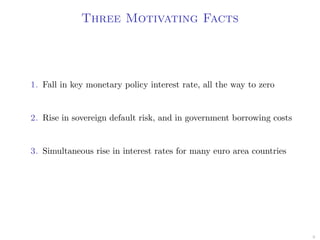
Three Motivating Facts
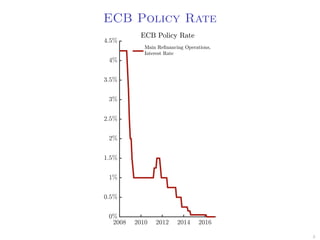
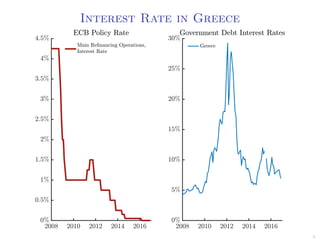
1. Fall in key monetary policy interest rate, all the way to zero
2
ECB Policy Rate
3
Three Motivating Facts
1. Fall in key monetary policy interest rate, all the way to zero
2. Rise in sovereign default risk, and in government borrowing costs
4
Interest Rate in Greece
5
Three Motivating Facts
1. Fall in key monetary policy interest rate, all the way to zero
2. Rise in sovereign default risk, and in government borrowing costs
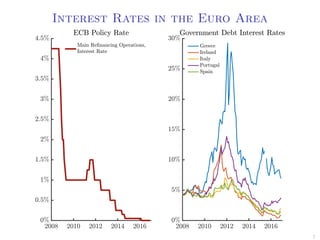
3. Simultaneous rise in interest rates for many euro area countries
6
Interest Rates in the Euro Area
7
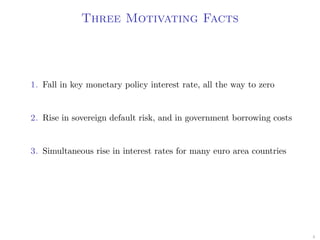
Three Motivating Facts
1. Fall in key monetary policy interest rate, all the way to zero
2. Rise in sovereign default risk, and in government borrowing costs
3. Simultaneous rise in interest rates for many euro area countries
8
Research Questions
Does monetary policy influence default?
Does default influence monetary policy?
9
Research Questions
Does monetary policy influence default?
What if many debtors are close to default at the same time?
Does default influence monetary policy?
9
Research Questions
Does monetary policy influence default?
What if many debtors are close to default at the same time?
How does the zero lower bound affect default risk?
Does default influence monetary policy?
9
Research Questions
Does monetary policy influence default?
What if many debtors are close to default at the same time?
How does the zero lower bound affect default risk?
Does default influence monetary policy?
Can default risk change preferences for monetary policy?
9
Key Results
Strong spillovers!
Monetary Policy ⇔ Default
10
Key Results
Strong spillovers!
Monetary Policy ⇔ Default
Default induces expansionary monetary policy
More default in a monetary union
10
Key Results
Strong spillovers!
Monetary Policy ⇔ Default
Default induces expansionary monetary policy
More default in a monetary union
The zero lower bound enforces debt repayment
The zlb prevents expansionary monetary policy
Default causes large, unattractive fall in demand
10
Key Results
Strong spillovers!
Monetary Policy ⇔ Default
Default induces expansionary monetary policy
More default in a monetary union
The zero lower bound enforces debt repayment
The zlb prevents expansionary monetary policy
Default causes large, unattractive fall in demand
Saving countries accept loose monetary policy
Lax monetary policy helps debtors repay
10
Literature Review
1. Sovereign default
2. Monetary unions
11
Literature Review
1. Sovereign default
Explicit consideration of lenders
Nominal effects of lender-borrower interaction in monetary union
2. Monetary unions
11
Literature Review
1. Sovereign default
Explicit consideration of lenders
Nominal effects of lender-borrower interaction in monetary union
2. Monetary unions
Does the design of a monetary union affect default incentives?
11
Literature Review
1. Sovereign default
Explicit consideration of lenders
Nominal effects of lender-borrower interaction in monetary union
Arellano (2008), Cole and Kehoe (2000), Hatchondo and Martinez
(2009), Hatchondo, Martinez and Sosa-Padilla (2014-2016),
Lorenzoni and Werning (2014), Na, Schmitt-Groh´e-Uribe, Yue
(2017) . . .
2. Monetary unions
Does the design of a monetary union affect default incentives?
Philippon and Martin (2017), Farhi and Werning (2017), Fornaro
(2015), Ayres, Navarro, Nicolini, Teles (2018), Corsetti, Kuester,
Meier, Mueller (2013) Corsetti and Dedola (2016) . . .
11
Outline
Model
Heterogeneity within the Monetary Union
Nominal Rigidities
Risky Borrowing and Default
Results
Sovereign Default
Monetary Policy
12
The Model - Environment
The economy lasts for two periods
13
The Model - Environment
The economy lasts for two periods
The world is composed of a continuum of small open economies
Two (groups of) countries: Home, Foreign
Countries share currency in a monetary union
13
The Model - Environment
The economy lasts for two periods
The world is composed of a continuum of small open economies
Two (groups of) countries: Home, Foreign
Countries share currency in a monetary union
Each country inhabited by households, firms, fiscal authority
13
The Model - Environment
The economy lasts for two periods
The world is composed of a continuum of small open economies
Two (groups of) countries: Home, Foreign
Countries share currency in a monetary union
Each country inhabited by households, firms, fiscal authority
Two types of goods, Tradable, Non-Tradable
13
The Model - Environment
The economy lasts for two periods
The world is composed of a continuum of small open economies
Two (groups of) countries: Home, Foreign
Countries share currency in a monetary union
Each country inhabited by households, firms, fiscal authority
Two types of goods, Tradable, Non-Tradable
N-good produced by firms in each country
T-good endowment has a skewed profile
13
The Model - Environment
The economy lasts for two periods
The world is composed of a continuum of small open economies
Two (groups of) countries: Home, Foreign
Countries share currency in a monetary union
Each country inhabited by households, firms, fiscal authority
Two types of goods, Tradable, Non-Tradable
N-good produced by firms in each country
T-good endowment has a skewed profile
Default risk is key source of uncertainty
13
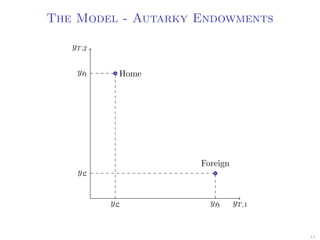
The Model - Autarky Endowments
yT,2
yT,1yL yH
yL
yH Home
Foreign
14
The Model - Households
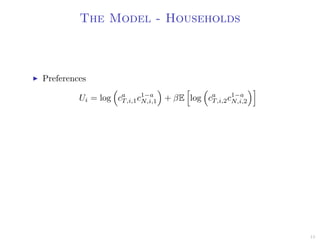
Preferences
Ui = log ca
T,i,1c1−a
N,i,1 + βE log ca
T,i,2c1−a
N,i,2
15
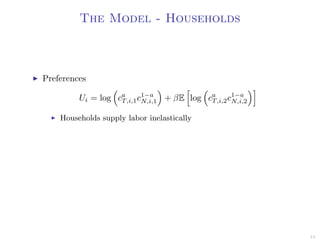
The Model - Households
Preferences
Ui = log ca
T,i,1c1−a
N,i,1 + βE log ca
T,i,2c1−a
N,i,2
Households supply labor inelastically
15
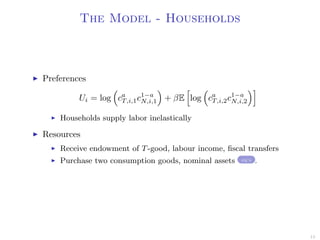
The Model - Households
Preferences
Ui = log ca
T,i,1c1−a
N,i,1 + βE log ca
T,i,2c1−a
N,i,2
Households supply labor inelastically
Resources
Receive endowment of T-good, labour income, fiscal transfers
Purchase two consumption goods, nominal assets eq’s .
15
The Model - Households
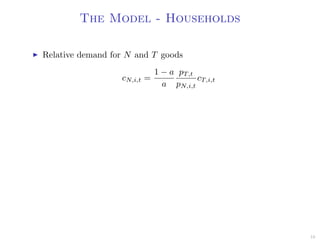
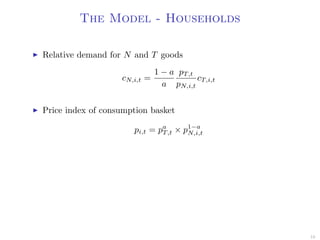
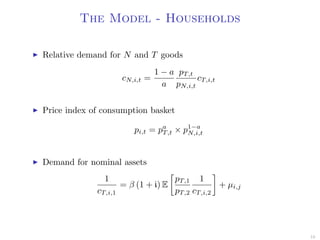
Relative demand for N and T goods
cN,i,t =
1 − a
a
pT,t
pN,i,t
cT,i,t
16
The Model - Households
Relative demand for N and T goods
cN,i,t =
1 − a
a
pT,t
pN,i,t
cT,i,t
Price index of consumption basket
pi,t = pa
T,t × p1−a
N,i,t
16
The Model - Households
Relative demand for N and T goods
cN,i,t =
1 − a
a
pT,t
pN,i,t
cT,i,t
Price index of consumption basket
pi,t = pa
T,t × p1−a
N,i,t
Demand for nominal assets
1
cT,i,1
= β (1 + i) E
pT,1
pT,2
1
cT,i,2
+ µi,j
16
Outline
Model
Heterogeneity within the Monetary Union
Nominal Rigidities
Risky Borrowing and Default
Results
Sovereign Default
Monetary Policy
17
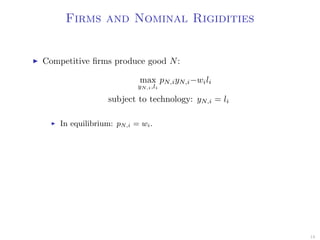
Firms and Nominal Rigidities
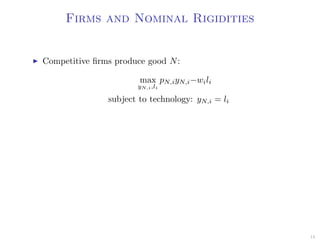
Competitive firms produce good N:
max
yN,i,li
pN,iyN,i−wili
subject to technology: yN,i = li
18
Firms and Nominal Rigidities
Competitive firms produce good N:
max
yN,i,li
pN,iyN,i−wili
subject to technology: yN,i = li
In equilibrium: pN,i = wi.
18
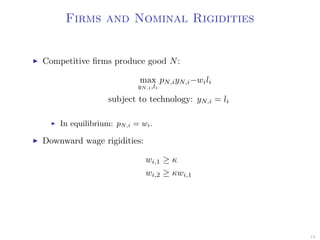
Firms and Nominal Rigidities
Competitive firms produce good N:
max
yN,i,li
pN,iyN,i−wili
subject to technology: yN,i = li
In equilibrium: pN,i = wi.
Downward wage rigidities:
wi,1 ≥ κ
wi,2 ≥ κwi,1
18
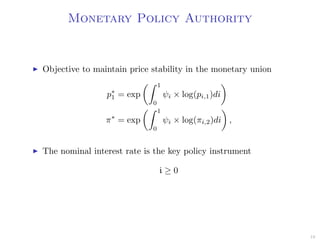
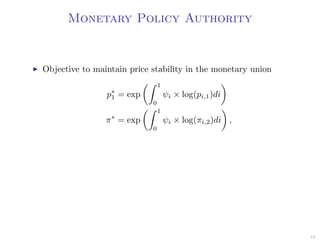
Monetary Policy Authority
Objective to maintain price stability in the monetary union
p∗
1 = exp
1
0
ψi × log(pi,1)di
π∗
= exp
1
0
ψi × log(πi,2)di ,
19
Monetary Policy Authority
Objective to maintain price stability in the monetary union
p∗
1 = exp
1
0
ψi × log(pi,1)di
π∗
= exp
1
0
ψi × log(πi,2)di ,
The nominal interest rate is the key policy instrument
i ≥ 0
19
Outline
Model
Heterogeneity within the Monetary Union
Nominal Rigidities
Risky Borrowing and Default
Results
Sovereign Default
Monetary Policy
20
Fiscal Authority
In each country, the fiscal authority takes two key decisions:
21
Fiscal Authority
In each country, the fiscal authority takes two key decisions:
1. Default
At t = 1
At t = 2
21
Fiscal Authority
In each country, the fiscal authority takes two key decisions:
1. Default
At t = 1
At t = 2
2. Borrowing and Saving
21
Fiscal Authority
In each country, the fiscal authority takes two key decisions:
1. Default
At t = 1
At t = 2
2. Borrowing and Saving
Objective to maximize household welfare
Rebates resources via fiscal transfers
21
Fiscal Authority
In each country, the fiscal authority takes two key decisions:
1. Default
At t = 1
At t = 2
2. Borrowing and Saving
Objective to maximize household welfare
Rebates resources via fiscal transfers
Will analyze fiscal authority’s decisions backwards
21
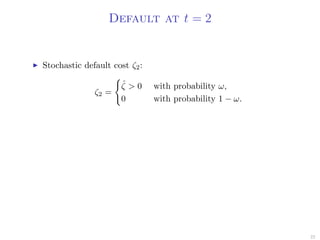
Default at t = 2
Stochastic default cost ζ2:
ζ2 =
ˆζ > 0 with probability ω,
0 with probability 1 − ω.
22
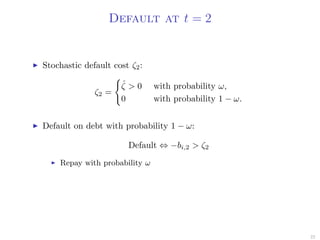
Default at t = 2
Stochastic default cost ζ2:
ζ2 =
ˆζ > 0 with probability ω,
0 with probability 1 − ω.
Default on debt with probability 1 − ω:
Default ⇔ −bi,2 > ζ2
Repay with probability ω
22
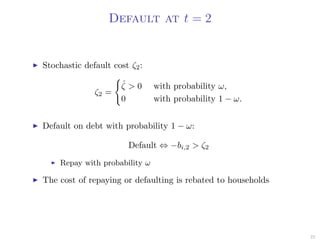
Default at t = 2
Stochastic default cost ζ2:
ζ2 =
ˆζ > 0 with probability ω,
0 with probability 1 − ω.
Default on debt with probability 1 − ω:
Default ⇔ −bi,2 > ζ2
Repay with probability ω
The cost of repaying or defaulting is rebated to households
22
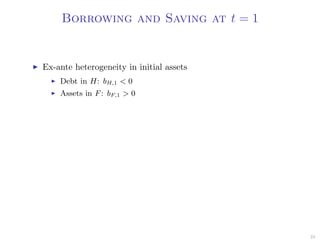
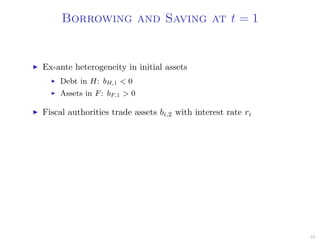
Borrowing and Saving at t = 1
Ex-ante heterogeneity in initial assets
Debt in H: bH,1 < 0
Assets in F: bF,1 > 0
23
Borrowing and Saving at t = 1
Ex-ante heterogeneity in initial assets
Debt in H: bH,1 < 0
Assets in F: bF,1 > 0
Fiscal authorities trade assets bi,2 with interest rate ri
23
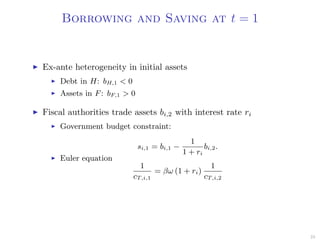
Borrowing and Saving at t = 1
Ex-ante heterogeneity in initial assets
Debt in H: bH,1 < 0
Assets in F: bF,1 > 0
Fiscal authorities trade assets bi,2 with interest rate ri
Government budget constraint:
si,1 = bi,1 −
1
1 + ri
bi,2.
Euler equation
1
cT,i,1
= βω (1 + ri)
1
cT,i,2
23
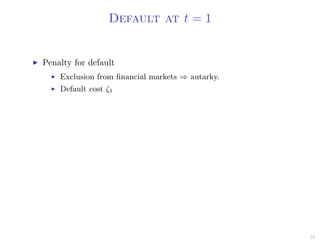
Default at t = 1
Penalty for default
Exclusion from financial markets ⇒ autarky.
Default cost ζ1
24
Default at t = 1
Penalty for default
Exclusion from financial markets ⇒ autarky.
Default cost ζ1
Benevolent default decision
Default ⇔ VD > VR (bH,1)
VR and VD are the household values upon default and repayment
24
Default at t = 1
Penalty for default
Exclusion from financial markets ⇒ autarky.
Default cost ζ1
Benevolent default decision
Default ⇔ VD > VR (bH,1)
VR and VD are the household values upon default and repayment
Default threshold
¯b ⇔ VD = VR
¯b
At ¯b, indifference between repayment and default
24
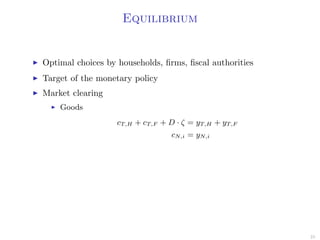
Equilibrium
Optimal choices by households, firms, fiscal authorities
25
Equilibrium
Optimal choices by households, firms, fiscal authorities
Target of the monetary policy
25
Equilibrium
Optimal choices by households, firms, fiscal authorities
Target of the monetary policy
Market clearing
Goods
cT,H + cT,F + D · ζ = yT,H + yT,F
cN,i = yN,i
25
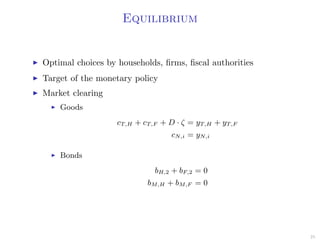
Equilibrium
Optimal choices by households, firms, fiscal authorities
Target of the monetary policy
Market clearing
Goods
cT,H + cT,F + D · ζ = yT,H + yT,F
cN,i = yN,i
Bonds
bH,2 + bF,2 = 0
bM,H + bM,F = 0
25
Outline
Model
Heterogeneity within the Monetary Union
Nominal Rigidities
Risky Borrowing and Default
Results
Sovereign Default
Monetary Policy
26
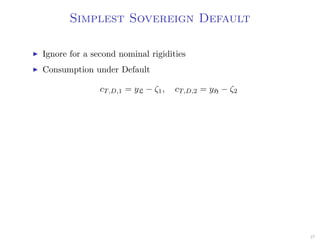
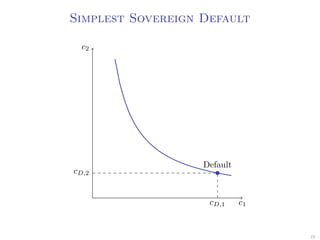
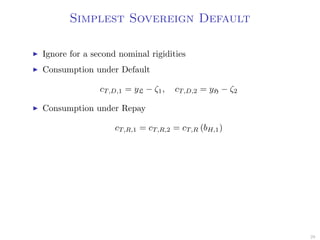
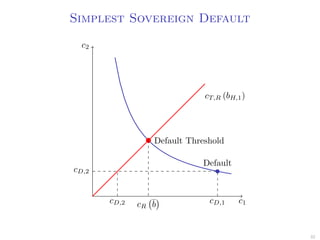
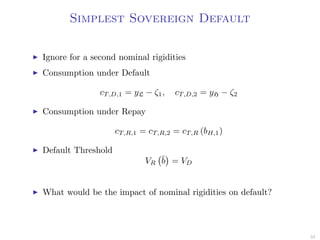
Simplest Sovereign Default
Ignore for a second nominal rigidities
Consumption under Default
cT,D,1 = yL − ζ1, cT,D,2 = yH − ζ2
27
Simplest Sovereign Default
c2
c1cD,1
cD,2
Default
28
Simplest Sovereign Default
Ignore for a second nominal rigidities
Consumption under Default
cT,D,1 = yL − ζ1, cT,D,2 = yH − ζ2
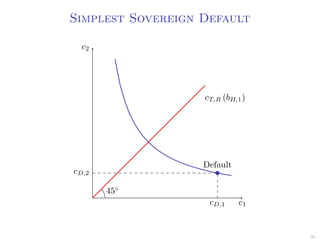
Consumption under Repay
cT,R,1 = cT,R,2 = cT,R (bH,1)
29
Simplest Sovereign Default
c2
c1cD,1
cD,2
Default
cT,R (bH,1)
45◦
30
Simplest Sovereign Default
Ignore for a second nominal rigidities
Consumption under Default
cT,D,1 = yL − ζ1, cT,D,2 = yH − ζ2
Consumption under Repay
cT,R,1 = cT,R,2 = cT,R (bH,1)
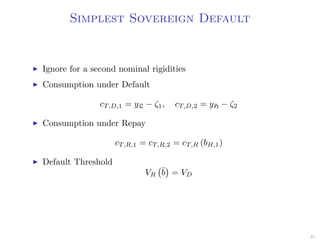
Default Threshold
VR
¯b = VD
31
Simplest Sovereign Default
c2
c1cD,1
cD,2
Default
cT,R (bH,1)
Default Threshold
cR
¯bcD,2
32
Simplest Sovereign Default
Ignore for a second nominal rigidities
Consumption under Default
cT,D,1 = yL − ζ1, cT,D,2 = yH − ζ2
Consumption under Repay
cT,R,1 = cT,R,2 = cT,R (bH,1)
Default Threshold
VR
¯b = VD
What would be the impact of nominal rigidities on default?
33
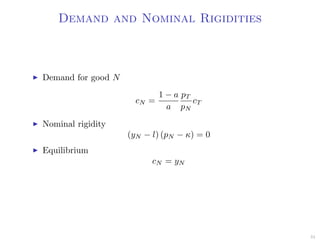
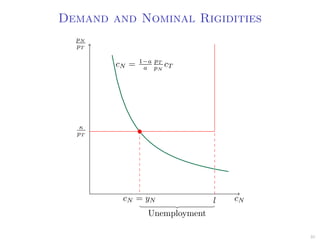
Demand and Nominal Rigidities
Demand for good N
cN =
1 − a
a
pT
pN
cT
Nominal rigidity
(yN − l) (pN − κ) = 0
Equilibrium
cN = yN
34
Demand and Nominal Rigidities
pN
pT
cN
cN = 1−a
a
pT
pN
cT
l
κ
pT
cN = yN
Unemployment
35
Nominal Rigidities and Default
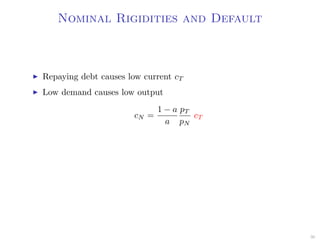
Repaying debt causes low current cT
36
Nominal Rigidities and Default
Repaying debt causes low current cT
Low demand causes low output
cN =
1 − a
a
pT
pN
cT
36
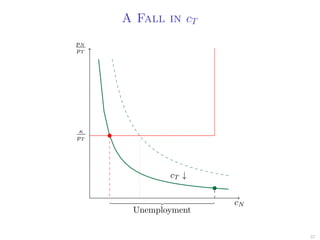
A Fall in cT
pN
pT
cN
κ
pT
cT ↓
Unemployment
37
Nominal Rigidities and Default
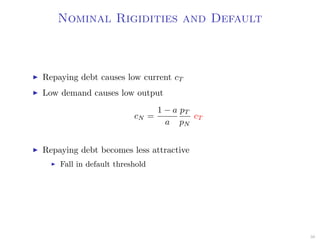
Repaying debt causes low current cT
Low demand causes low output
cN =
1 − a
a
pT
pN
cT
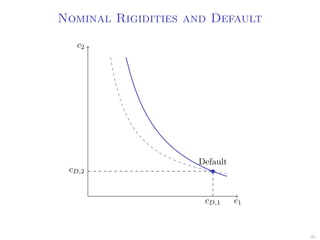
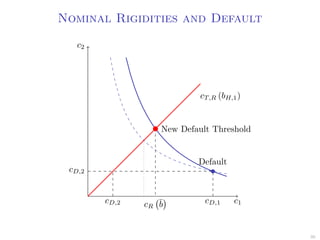
Repaying debt becomes less attractive
Fall in default threshold
38
Nominal Rigidities and Default
c2
c1cD,1
cD,2
Default
39
Nominal Rigidities and Default
c2
c1cD,1
cD,2
Default
cT,R (bH,1)
cR
¯b
New Default Threshold
cD,2
39
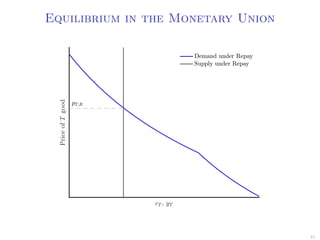
Default in the Monetary Union
What if all countries in H are close to default?
40
Default in the Monetary Union
What if all countries in H are close to default?
What implications of default for prices and monetary policy?
40
Equilibrium in the Monetary Union
41
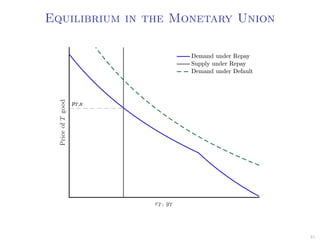
Equilibrium in the Monetary Union
41
Equilibrium in the Monetary Union
41
Default in the Monetary Union
What if all countries in H are close to default?
What implications of default for prices and monetary policy?
pT ↑, i ↓
Default causes expansionary monetary policy
42
Default in the Monetary Union
What if all countries in H are close to default?
What implications of default for prices and monetary policy?
pT ↑, i ↓
Default causes expansionary monetary policy
What implications for demand and output?
42
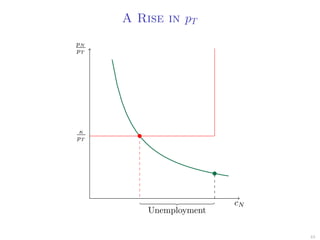
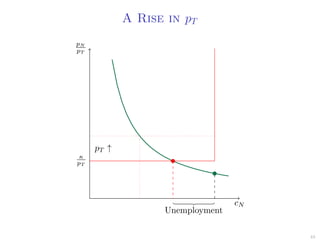
A Rise in pT
pN
pT
cN
κ
pT
Unemployment
43
A Rise in pT
pN
pT
cN
κ
pT
pT ↑
Unemployment
43
Default in the Monetary Union
What if all countries in H are close to default?
What implications of default for prices and monetary policy?
pT ↑, i ↓
Default causes expansionary monetary policy
What implications for demand and output?
cN,H ↑, yN,H ↑
44
Default in the Monetary Union
What if all countries in H are close to default?
What implications of default for prices and monetary policy?
pT ↑, i ↓
Default causes expansionary monetary policy
What implications for demand and output?
cN,H ↑, yN,H ↑
What implications for optimal default?
44
Default in the Monetary Union
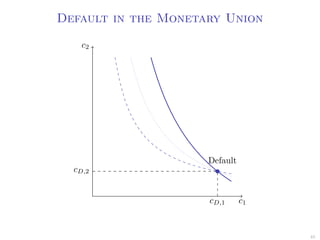
c2
c1cD,1
cD,2
Default
45
Default in the Monetary Union
c2
c1cD,1
cD,2
Default
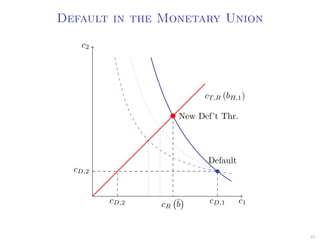
cT,R (bH,1)
cR
¯b
New Def’t Thr.
cD,2
45
Default in the Monetary Union
What if all countries in H are close to default?
What implications of default for prices and monetary policy?
pT ↑, i ↓
Default causes expansionary monetary policy
What implications for demand and output?
cN,H ↑, yN,H ↑
What implications for optimal default?
Default is more attractive
46
Default at the Zero Lower Bound
What if the ZLB prevents expansionary monetary policy?
47
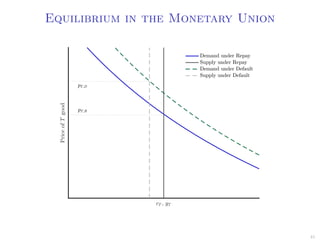
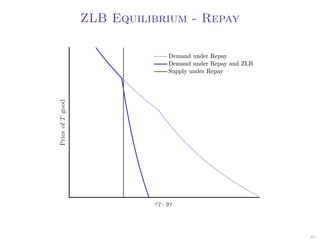
ZLB Equilibrium - Repay
48
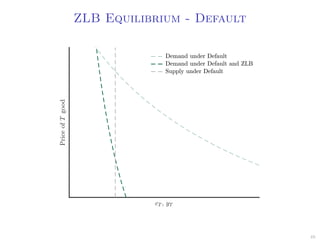
ZLB Equilibrium - Default
49
Default at the Zero Lower Bound
What if the ZLB prevents expansionary monetary policy?
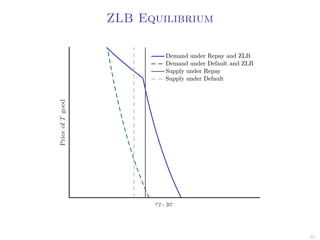
ZLB causes equilibrium pT to be lower
50
Default at the Zero Lower Bound
What if the ZLB prevents expansionary monetary policy?
ZLB causes equilibrium pT to be lower
Fall in pT may be larger upon default
50
ZLB Equilibrium
51
Default at the Zero Lower Bound
What if the ZLB prevents expansionary monetary policy?
ZLB causes equilibrium pT to be lower
Fall in pT may be larger upon default
Default causes large fall in natural interest rate
For savers, fall in asset supply and wealth
52
Default at the Zero Lower Bound
What if the ZLB prevents expansionary monetary policy?
ZLB causes equilibrium pT to be lower
Fall in pT may be larger upon default
Default causes large fall in natural interest rate
For savers, fall in asset supply and wealth
ZLB induces debtors to repay
Low pT makes default unattractive
52
Outline
Model
Heterogeneity within the Monetary Union
Nominal Rigidities
Risky Borrowing and Default
Results
Sovereign Default
Monetary Policy
53
Preferences over Monetary Policy
How would countries want Monetary Policy to be run?
54
Preferences over Monetary Policy
How would countries want Monetary Policy to be run?
54
Preferences over Monetary Policy
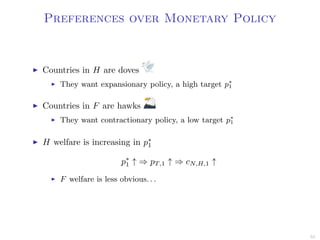
Countries in H are doves
They want expansionary policy, a high target p∗
1
55
Preferences over Monetary Policy
Countries in H are doves
They want expansionary policy, a high target p∗
1
Countries in F are hawks
They want contractionary policy, a low target p∗
1
55
Preferences over Monetary Policy
Countries in H are doves
They want expansionary policy, a high target p∗
1
Countries in F are hawks
They want contractionary policy, a low target p∗
1
H welfare is increasing in p∗
1
p∗
1 ↑ ⇒ pT,1 ↑ ⇒ cN,H,1 ↑
F welfare is less obvious. . .
55
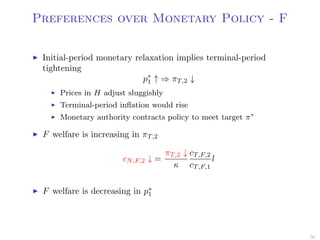
Preferences over Monetary Policy - F
Initial-period monetary relaxation implies terminal-period
tightening
p∗
1 ↑ ⇒ πT,2 ↓
56
Preferences over Monetary Policy - F
Initial-period monetary relaxation implies terminal-period
tightening
p∗
1 ↑ ⇒ πT,2 ↓
Prices in H adjust sluggishly
Terminal-period inflation would rise
Monetary authority contracts policy to meet target π∗
56
Preferences over Monetary Policy - F
Initial-period monetary relaxation implies terminal-period
tightening
p∗
1 ↑ ⇒ πT,2 ↓
Prices in H adjust sluggishly
Terminal-period inflation would rise
Monetary authority contracts policy to meet target π∗
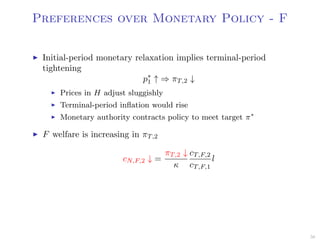
F welfare is increasing in πT,2
cN,F,2 ↓ =
πT,2 ↓
κ
cT,F,2
cT,F,1
l
56
Preferences over Monetary Policy - F
Initial-period monetary relaxation implies terminal-period
tightening
p∗
1 ↑ ⇒ πT,2 ↓
Prices in H adjust sluggishly
Terminal-period inflation would rise
Monetary authority contracts policy to meet target π∗
F welfare is increasing in πT,2
cN,F,2 ↓ =
πT,2 ↓
κ
cT,F,2
cT,F,1
l
F welfare is decreasing in p∗
1
56
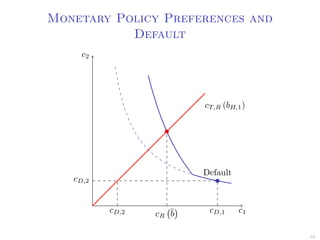
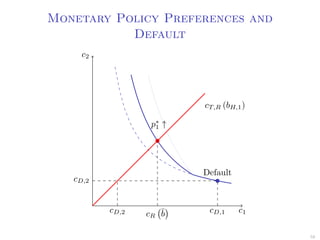
Monetary Policy Preferences and
Default
Can the threat of default milden savers’ hawkish tendencies?
57
Monetary Policy Preferences and
Default
Can the threat of default milden savers’ hawkish tendencies?
Suppose that H just about prefers to default
57
Monetary Policy Preferences and
Default
Can the threat of default milden savers’ hawkish tendencies?
Suppose that H just about prefers to default
A higher p∗
1 would induce H to repay
57
Monetary Policy Preferences and
Default
c2
c1cD,1
cD,2
Default
cT,R (bH,1)
cD,2 cR
¯b
58
Monetary Policy Preferences and
Default
c2
c1cD,1
cD,2
Default
cT,R (bH,1)
cD,2 cR
¯b
p∗
1 ↑
58
Monetary Policy Preferences and
Default
Can the threat of default milden savers’ hawkish tendencies?
Suppose that H just about prefers to default
A higher p∗
1 would induce H to repay
F agrees with H, and both support expansionary policy
59
Monetary Policy Preferences and
Default
Can the threat of default milden savers’ hawkish tendencies?
Suppose that H just about prefers to default
A higher p∗
1 would induce H to repay
F agrees with H, and both support expansionary policy
H is happy since unemployment falls
59
Monetary Policy Preferences and
Default
Can the threat of default milden savers’ hawkish tendencies?
Suppose that H just about prefers to default
A higher p∗
1 would induce H to repay
F agrees with H, and both support expansionary policy
H is happy since unemployment falls
F is happy because debt gets repaid
59
Concluding Remarks
Simple model delivers three key results. . .
Default by many countries induces expansionary monetary policy
Zero lower bound induces debtors to repay
Default broadens support for expansionary monetary policy
60
Concluding Remarks
Simple model delivers three key results. . .
Default by many countries induces expansionary monetary policy
Zero lower bound induces debtors to repay
Default broadens support for expansionary monetary policy
. . . that are close to euro-area experience
60
Concluding Remarks
Simple model delivers three key results. . .
Default by many countries induces expansionary monetary policy
Zero lower bound induces debtors to repay
Default broadens support for expansionary monetary policy
. . . that are close to euro-area experience
Use these insights to build infinite-horizon model
Dynamics of debt accumulation in a monetary union
Slow deleveraging in a debt crisis
60
Thanks!
61
Households - Appendix
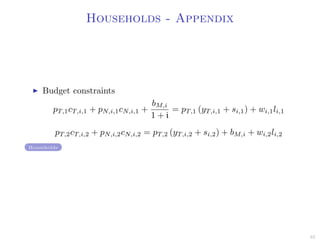
Budget constraints
pT,1cT,i,1 + pN,i,1cN,i,1 +
bM,i
1 + i
= pT,1 (yT,i,1 + si,1) + wi,1li,1
pT,2cT,i,2 + pN,i,2cN,i,2 = pT,2 (yT,i,2 + si,2) + bM,i + wi,2li,2
Households
62

Sovereign default in a monetary union

  • 1.
    Sovereign Default in aMonetary Union Sergio de Ferra1 Federica Romei2 1 Stockholm University 2 Stockholm School of Economics and CEPR ADEMU Conference April 2018 1
  • 2.
    Three Motivating Facts 1.Fall in key monetary policy interest rate, all the way to zero 2
  • 3.
  • 4.
    Three Motivating Facts 1.Fall in key monetary policy interest rate, all the way to zero 2. Rise in sovereign default risk, and in government borrowing costs 4
  • 5.
  • 6.
    Three Motivating Facts 1.Fall in key monetary policy interest rate, all the way to zero 2. Rise in sovereign default risk, and in government borrowing costs 3. Simultaneous rise in interest rates for many euro area countries 6
  • 7.
    Interest Rates inthe Euro Area 7
  • 8.
    Three Motivating Facts 1.Fall in key monetary policy interest rate, all the way to zero 2. Rise in sovereign default risk, and in government borrowing costs 3. Simultaneous rise in interest rates for many euro area countries 8
  • 9.
    Research Questions Does monetarypolicy influence default? Does default influence monetary policy? 9
  • 10.
    Research Questions Does monetarypolicy influence default? What if many debtors are close to default at the same time? Does default influence monetary policy? 9
  • 11.
    Research Questions Does monetarypolicy influence default? What if many debtors are close to default at the same time? How does the zero lower bound affect default risk? Does default influence monetary policy? 9
  • 12.
    Research Questions Does monetarypolicy influence default? What if many debtors are close to default at the same time? How does the zero lower bound affect default risk? Does default influence monetary policy? Can default risk change preferences for monetary policy? 9
  • 13.
  • 14.
    Key Results Strong spillovers! MonetaryPolicy ⇔ Default Default induces expansionary monetary policy More default in a monetary union 10
  • 15.
    Key Results Strong spillovers! MonetaryPolicy ⇔ Default Default induces expansionary monetary policy More default in a monetary union The zero lower bound enforces debt repayment The zlb prevents expansionary monetary policy Default causes large, unattractive fall in demand 10
  • 16.
    Key Results Strong spillovers! MonetaryPolicy ⇔ Default Default induces expansionary monetary policy More default in a monetary union The zero lower bound enforces debt repayment The zlb prevents expansionary monetary policy Default causes large, unattractive fall in demand Saving countries accept loose monetary policy Lax monetary policy helps debtors repay 10
  • 17.
    Literature Review 1. Sovereigndefault 2. Monetary unions 11
  • 18.
    Literature Review 1. Sovereigndefault Explicit consideration of lenders Nominal effects of lender-borrower interaction in monetary union 2. Monetary unions 11
  • 19.
    Literature Review 1. Sovereigndefault Explicit consideration of lenders Nominal effects of lender-borrower interaction in monetary union 2. Monetary unions Does the design of a monetary union affect default incentives? 11
  • 20.
    Literature Review 1. Sovereigndefault Explicit consideration of lenders Nominal effects of lender-borrower interaction in monetary union Arellano (2008), Cole and Kehoe (2000), Hatchondo and Martinez (2009), Hatchondo, Martinez and Sosa-Padilla (2014-2016), Lorenzoni and Werning (2014), Na, Schmitt-Groh´e-Uribe, Yue (2017) . . . 2. Monetary unions Does the design of a monetary union affect default incentives? Philippon and Martin (2017), Farhi and Werning (2017), Fornaro (2015), Ayres, Navarro, Nicolini, Teles (2018), Corsetti, Kuester, Meier, Mueller (2013) Corsetti and Dedola (2016) . . . 11
  • 21.
    Outline Model Heterogeneity within theMonetary Union Nominal Rigidities Risky Borrowing and Default Results Sovereign Default Monetary Policy 12
  • 22.
    The Model -Environment The economy lasts for two periods 13
  • 23.
    The Model -Environment The economy lasts for two periods The world is composed of a continuum of small open economies Two (groups of) countries: Home, Foreign Countries share currency in a monetary union 13
  • 24.
    The Model -Environment The economy lasts for two periods The world is composed of a continuum of small open economies Two (groups of) countries: Home, Foreign Countries share currency in a monetary union Each country inhabited by households, firms, fiscal authority 13
  • 25.
    The Model -Environment The economy lasts for two periods The world is composed of a continuum of small open economies Two (groups of) countries: Home, Foreign Countries share currency in a monetary union Each country inhabited by households, firms, fiscal authority Two types of goods, Tradable, Non-Tradable 13
  • 26.
    The Model -Environment The economy lasts for two periods The world is composed of a continuum of small open economies Two (groups of) countries: Home, Foreign Countries share currency in a monetary union Each country inhabited by households, firms, fiscal authority Two types of goods, Tradable, Non-Tradable N-good produced by firms in each country T-good endowment has a skewed profile 13
  • 27.
    The Model -Environment The economy lasts for two periods The world is composed of a continuum of small open economies Two (groups of) countries: Home, Foreign Countries share currency in a monetary union Each country inhabited by households, firms, fiscal authority Two types of goods, Tradable, Non-Tradable N-good produced by firms in each country T-good endowment has a skewed profile Default risk is key source of uncertainty 13
  • 28.
    The Model -Autarky Endowments yT,2 yT,1yL yH yL yH Home Foreign 14
  • 29.
    The Model -Households Preferences Ui = log ca T,i,1c1−a N,i,1 + βE log ca T,i,2c1−a N,i,2 15
  • 30.
    The Model -Households Preferences Ui = log ca T,i,1c1−a N,i,1 + βE log ca T,i,2c1−a N,i,2 Households supply labor inelastically 15
  • 31.
    The Model -Households Preferences Ui = log ca T,i,1c1−a N,i,1 + βE log ca T,i,2c1−a N,i,2 Households supply labor inelastically Resources Receive endowment of T-good, labour income, fiscal transfers Purchase two consumption goods, nominal assets eq’s . 15
  • 32.
    The Model -Households Relative demand for N and T goods cN,i,t = 1 − a a pT,t pN,i,t cT,i,t 16
  • 33.
    The Model -Households Relative demand for N and T goods cN,i,t = 1 − a a pT,t pN,i,t cT,i,t Price index of consumption basket pi,t = pa T,t × p1−a N,i,t 16
  • 34.
    The Model -Households Relative demand for N and T goods cN,i,t = 1 − a a pT,t pN,i,t cT,i,t Price index of consumption basket pi,t = pa T,t × p1−a N,i,t Demand for nominal assets 1 cT,i,1 = β (1 + i) E pT,1 pT,2 1 cT,i,2 + µi,j 16
  • 35.
    Outline Model Heterogeneity within theMonetary Union Nominal Rigidities Risky Borrowing and Default Results Sovereign Default Monetary Policy 17
  • 36.
    Firms and NominalRigidities Competitive firms produce good N: max yN,i,li pN,iyN,i−wili subject to technology: yN,i = li 18
  • 37.
    Firms and NominalRigidities Competitive firms produce good N: max yN,i,li pN,iyN,i−wili subject to technology: yN,i = li In equilibrium: pN,i = wi. 18
  • 38.
    Firms and NominalRigidities Competitive firms produce good N: max yN,i,li pN,iyN,i−wili subject to technology: yN,i = li In equilibrium: pN,i = wi. Downward wage rigidities: wi,1 ≥ κ wi,2 ≥ κwi,1 18
  • 39.
    Monetary Policy Authority Objectiveto maintain price stability in the monetary union p∗ 1 = exp 1 0 ψi × log(pi,1)di π∗ = exp 1 0 ψi × log(πi,2)di , 19
  • 40.
    Monetary Policy Authority Objectiveto maintain price stability in the monetary union p∗ 1 = exp 1 0 ψi × log(pi,1)di π∗ = exp 1 0 ψi × log(πi,2)di , The nominal interest rate is the key policy instrument i ≥ 0 19
  • 41.
    Outline Model Heterogeneity within theMonetary Union Nominal Rigidities Risky Borrowing and Default Results Sovereign Default Monetary Policy 20
  • 42.
    Fiscal Authority In eachcountry, the fiscal authority takes two key decisions: 21
  • 43.
    Fiscal Authority In eachcountry, the fiscal authority takes two key decisions: 1. Default At t = 1 At t = 2 21
  • 44.
    Fiscal Authority In eachcountry, the fiscal authority takes two key decisions: 1. Default At t = 1 At t = 2 2. Borrowing and Saving 21
  • 45.
    Fiscal Authority In eachcountry, the fiscal authority takes two key decisions: 1. Default At t = 1 At t = 2 2. Borrowing and Saving Objective to maximize household welfare Rebates resources via fiscal transfers 21
  • 46.
    Fiscal Authority In eachcountry, the fiscal authority takes two key decisions: 1. Default At t = 1 At t = 2 2. Borrowing and Saving Objective to maximize household welfare Rebates resources via fiscal transfers Will analyze fiscal authority’s decisions backwards 21
  • 47.
    Default at t= 2 Stochastic default cost ζ2: ζ2 = ˆζ > 0 with probability ω, 0 with probability 1 − ω. 22
  • 48.
    Default at t= 2 Stochastic default cost ζ2: ζ2 = ˆζ > 0 with probability ω, 0 with probability 1 − ω. Default on debt with probability 1 − ω: Default ⇔ −bi,2 > ζ2 Repay with probability ω 22
  • 49.
    Default at t= 2 Stochastic default cost ζ2: ζ2 = ˆζ > 0 with probability ω, 0 with probability 1 − ω. Default on debt with probability 1 − ω: Default ⇔ −bi,2 > ζ2 Repay with probability ω The cost of repaying or defaulting is rebated to households 22
  • 50.
    Borrowing and Savingat t = 1 Ex-ante heterogeneity in initial assets Debt in H: bH,1 < 0 Assets in F: bF,1 > 0 23
  • 51.
    Borrowing and Savingat t = 1 Ex-ante heterogeneity in initial assets Debt in H: bH,1 < 0 Assets in F: bF,1 > 0 Fiscal authorities trade assets bi,2 with interest rate ri 23
  • 52.
    Borrowing and Savingat t = 1 Ex-ante heterogeneity in initial assets Debt in H: bH,1 < 0 Assets in F: bF,1 > 0 Fiscal authorities trade assets bi,2 with interest rate ri Government budget constraint: si,1 = bi,1 − 1 1 + ri bi,2. Euler equation 1 cT,i,1 = βω (1 + ri) 1 cT,i,2 23
  • 53.
    Default at t= 1 Penalty for default Exclusion from financial markets ⇒ autarky. Default cost ζ1 24
  • 54.
    Default at t= 1 Penalty for default Exclusion from financial markets ⇒ autarky. Default cost ζ1 Benevolent default decision Default ⇔ VD > VR (bH,1) VR and VD are the household values upon default and repayment 24
  • 55.
    Default at t= 1 Penalty for default Exclusion from financial markets ⇒ autarky. Default cost ζ1 Benevolent default decision Default ⇔ VD > VR (bH,1) VR and VD are the household values upon default and repayment Default threshold ¯b ⇔ VD = VR ¯b At ¯b, indifference between repayment and default 24
  • 56.
    Equilibrium Optimal choices byhouseholds, firms, fiscal authorities 25
  • 57.
    Equilibrium Optimal choices byhouseholds, firms, fiscal authorities Target of the monetary policy 25
  • 58.
    Equilibrium Optimal choices byhouseholds, firms, fiscal authorities Target of the monetary policy Market clearing Goods cT,H + cT,F + D · ζ = yT,H + yT,F cN,i = yN,i 25
  • 59.
    Equilibrium Optimal choices byhouseholds, firms, fiscal authorities Target of the monetary policy Market clearing Goods cT,H + cT,F + D · ζ = yT,H + yT,F cN,i = yN,i Bonds bH,2 + bF,2 = 0 bM,H + bM,F = 0 25
  • 60.
    Outline Model Heterogeneity within theMonetary Union Nominal Rigidities Risky Borrowing and Default Results Sovereign Default Monetary Policy 26
  • 61.
    Simplest Sovereign Default Ignorefor a second nominal rigidities Consumption under Default cT,D,1 = yL − ζ1, cT,D,2 = yH − ζ2 27
  • 62.
  • 63.
    Simplest Sovereign Default Ignorefor a second nominal rigidities Consumption under Default cT,D,1 = yL − ζ1, cT,D,2 = yH − ζ2 Consumption under Repay cT,R,1 = cT,R,2 = cT,R (bH,1) 29
  • 64.
  • 65.
    Simplest Sovereign Default Ignorefor a second nominal rigidities Consumption under Default cT,D,1 = yL − ζ1, cT,D,2 = yH − ζ2 Consumption under Repay cT,R,1 = cT,R,2 = cT,R (bH,1) Default Threshold VR ¯b = VD 31
  • 66.
    Simplest Sovereign Default c2 c1cD,1 cD,2 Default cT,R(bH,1) Default Threshold cR ¯bcD,2 32
  • 67.
    Simplest Sovereign Default Ignorefor a second nominal rigidities Consumption under Default cT,D,1 = yL − ζ1, cT,D,2 = yH − ζ2 Consumption under Repay cT,R,1 = cT,R,2 = cT,R (bH,1) Default Threshold VR ¯b = VD What would be the impact of nominal rigidities on default? 33
  • 68.
    Demand and NominalRigidities Demand for good N cN = 1 − a a pT pN cT Nominal rigidity (yN − l) (pN − κ) = 0 Equilibrium cN = yN 34
  • 69.
    Demand and NominalRigidities pN pT cN cN = 1−a a pT pN cT l κ pT cN = yN Unemployment 35
  • 70.
    Nominal Rigidities andDefault Repaying debt causes low current cT 36
  • 71.
    Nominal Rigidities andDefault Repaying debt causes low current cT Low demand causes low output cN = 1 − a a pT pN cT 36
  • 72.
    A Fall incT pN pT cN κ pT cT ↓ Unemployment 37
  • 73.
    Nominal Rigidities andDefault Repaying debt causes low current cT Low demand causes low output cN = 1 − a a pT pN cT Repaying debt becomes less attractive Fall in default threshold 38
  • 74.
    Nominal Rigidities andDefault c2 c1cD,1 cD,2 Default 39
  • 75.
    Nominal Rigidities andDefault c2 c1cD,1 cD,2 Default cT,R (bH,1) cR ¯b New Default Threshold cD,2 39
  • 76.
    Default in theMonetary Union What if all countries in H are close to default? 40
  • 77.
    Default in theMonetary Union What if all countries in H are close to default? What implications of default for prices and monetary policy? 40
  • 78.
    Equilibrium in theMonetary Union 41
  • 79.
    Equilibrium in theMonetary Union 41
  • 80.
    Equilibrium in theMonetary Union 41
  • 81.
    Default in theMonetary Union What if all countries in H are close to default? What implications of default for prices and monetary policy? pT ↑, i ↓ Default causes expansionary monetary policy 42
  • 82.
    Default in theMonetary Union What if all countries in H are close to default? What implications of default for prices and monetary policy? pT ↑, i ↓ Default causes expansionary monetary policy What implications for demand and output? 42
  • 83.
    A Rise inpT pN pT cN κ pT Unemployment 43
  • 84.
    A Rise inpT pN pT cN κ pT pT ↑ Unemployment 43
  • 85.
    Default in theMonetary Union What if all countries in H are close to default? What implications of default for prices and monetary policy? pT ↑, i ↓ Default causes expansionary monetary policy What implications for demand and output? cN,H ↑, yN,H ↑ 44
  • 86.
    Default in theMonetary Union What if all countries in H are close to default? What implications of default for prices and monetary policy? pT ↑, i ↓ Default causes expansionary monetary policy What implications for demand and output? cN,H ↑, yN,H ↑ What implications for optimal default? 44
  • 87.
    Default in theMonetary Union c2 c1cD,1 cD,2 Default 45
  • 88.
    Default in theMonetary Union c2 c1cD,1 cD,2 Default cT,R (bH,1) cR ¯b New Def’t Thr. cD,2 45
  • 89.
    Default in theMonetary Union What if all countries in H are close to default? What implications of default for prices and monetary policy? pT ↑, i ↓ Default causes expansionary monetary policy What implications for demand and output? cN,H ↑, yN,H ↑ What implications for optimal default? Default is more attractive 46
  • 90.
    Default at theZero Lower Bound What if the ZLB prevents expansionary monetary policy? 47
  • 91.
  • 92.
  • 93.
    Default at theZero Lower Bound What if the ZLB prevents expansionary monetary policy? ZLB causes equilibrium pT to be lower 50
  • 94.
    Default at theZero Lower Bound What if the ZLB prevents expansionary monetary policy? ZLB causes equilibrium pT to be lower Fall in pT may be larger upon default 50
  • 95.
  • 96.
    Default at theZero Lower Bound What if the ZLB prevents expansionary monetary policy? ZLB causes equilibrium pT to be lower Fall in pT may be larger upon default Default causes large fall in natural interest rate For savers, fall in asset supply and wealth 52
  • 97.
    Default at theZero Lower Bound What if the ZLB prevents expansionary monetary policy? ZLB causes equilibrium pT to be lower Fall in pT may be larger upon default Default causes large fall in natural interest rate For savers, fall in asset supply and wealth ZLB induces debtors to repay Low pT makes default unattractive 52
  • 98.
    Outline Model Heterogeneity within theMonetary Union Nominal Rigidities Risky Borrowing and Default Results Sovereign Default Monetary Policy 53
  • 99.
    Preferences over MonetaryPolicy How would countries want Monetary Policy to be run? 54
  • 100.
    Preferences over MonetaryPolicy How would countries want Monetary Policy to be run? 54
  • 101.
    Preferences over MonetaryPolicy Countries in H are doves They want expansionary policy, a high target p∗ 1 55
  • 102.
    Preferences over MonetaryPolicy Countries in H are doves They want expansionary policy, a high target p∗ 1 Countries in F are hawks They want contractionary policy, a low target p∗ 1 55
  • 103.
    Preferences over MonetaryPolicy Countries in H are doves They want expansionary policy, a high target p∗ 1 Countries in F are hawks They want contractionary policy, a low target p∗ 1 H welfare is increasing in p∗ 1 p∗ 1 ↑ ⇒ pT,1 ↑ ⇒ cN,H,1 ↑ F welfare is less obvious. . . 55
  • 104.
    Preferences over MonetaryPolicy - F Initial-period monetary relaxation implies terminal-period tightening p∗ 1 ↑ ⇒ πT,2 ↓ 56
  • 105.
    Preferences over MonetaryPolicy - F Initial-period monetary relaxation implies terminal-period tightening p∗ 1 ↑ ⇒ πT,2 ↓ Prices in H adjust sluggishly Terminal-period inflation would rise Monetary authority contracts policy to meet target π∗ 56
  • 106.
    Preferences over MonetaryPolicy - F Initial-period monetary relaxation implies terminal-period tightening p∗ 1 ↑ ⇒ πT,2 ↓ Prices in H adjust sluggishly Terminal-period inflation would rise Monetary authority contracts policy to meet target π∗ F welfare is increasing in πT,2 cN,F,2 ↓ = πT,2 ↓ κ cT,F,2 cT,F,1 l 56
  • 107.
    Preferences over MonetaryPolicy - F Initial-period monetary relaxation implies terminal-period tightening p∗ 1 ↑ ⇒ πT,2 ↓ Prices in H adjust sluggishly Terminal-period inflation would rise Monetary authority contracts policy to meet target π∗ F welfare is increasing in πT,2 cN,F,2 ↓ = πT,2 ↓ κ cT,F,2 cT,F,1 l F welfare is decreasing in p∗ 1 56
  • 108.
    Monetary Policy Preferencesand Default Can the threat of default milden savers’ hawkish tendencies? 57
  • 109.
    Monetary Policy Preferencesand Default Can the threat of default milden savers’ hawkish tendencies? Suppose that H just about prefers to default 57
  • 110.
    Monetary Policy Preferencesand Default Can the threat of default milden savers’ hawkish tendencies? Suppose that H just about prefers to default A higher p∗ 1 would induce H to repay 57
  • 111.
    Monetary Policy Preferencesand Default c2 c1cD,1 cD,2 Default cT,R (bH,1) cD,2 cR ¯b 58
  • 112.
    Monetary Policy Preferencesand Default c2 c1cD,1 cD,2 Default cT,R (bH,1) cD,2 cR ¯b p∗ 1 ↑ 58
  • 113.
    Monetary Policy Preferencesand Default Can the threat of default milden savers’ hawkish tendencies? Suppose that H just about prefers to default A higher p∗ 1 would induce H to repay F agrees with H, and both support expansionary policy 59
  • 114.
    Monetary Policy Preferencesand Default Can the threat of default milden savers’ hawkish tendencies? Suppose that H just about prefers to default A higher p∗ 1 would induce H to repay F agrees with H, and both support expansionary policy H is happy since unemployment falls 59
  • 115.
    Monetary Policy Preferencesand Default Can the threat of default milden savers’ hawkish tendencies? Suppose that H just about prefers to default A higher p∗ 1 would induce H to repay F agrees with H, and both support expansionary policy H is happy since unemployment falls F is happy because debt gets repaid 59
  • 116.
    Concluding Remarks Simple modeldelivers three key results. . . Default by many countries induces expansionary monetary policy Zero lower bound induces debtors to repay Default broadens support for expansionary monetary policy 60
  • 117.
    Concluding Remarks Simple modeldelivers three key results. . . Default by many countries induces expansionary monetary policy Zero lower bound induces debtors to repay Default broadens support for expansionary monetary policy . . . that are close to euro-area experience 60
  • 118.
    Concluding Remarks Simple modeldelivers three key results. . . Default by many countries induces expansionary monetary policy Zero lower bound induces debtors to repay Default broadens support for expansionary monetary policy . . . that are close to euro-area experience Use these insights to build infinite-horizon model Dynamics of debt accumulation in a monetary union Slow deleveraging in a debt crisis 60
  • 119.
  • 120.
    Households - Appendix Budgetconstraints pT,1cT,i,1 + pN,i,1cN,i,1 + bM,i 1 + i = pT,1 (yT,i,1 + si,1) + wi,1li,1 pT,2cT,i,2 + pN,i,2cN,i,2 = pT,2 (yT,i,2 + si,2) + bM,i + wi,2li,2 Households 62