NAME :- SAHIL KUMAR
REG NO.:-12213923
Guided By: Dr. Goutam Mohanty
Assistant Professor Department of
Physics
Introduction and History
 Data Representation
Shor’s Algorithm
 Conclusion
Introduction
What is a quantum computer?
 A quantum computer is a machine
that performs calculations based on
the laws of quantum mechanics, which
is the behavior of particles at the sub-
atomic level.
Introduction
1982 - Feynman proposed the idea of creating ma “I think I
can safely say that nobody understands quantum mechanics” -
Feynman
chines based on the laws of quantum mechanics instead of
the laws of classical physics
1985 - David Deutsch developed the quantum turning
machine, showing that quantum circuits are universal.
 1994 - Peter Shor came up with a quantum algorithm to
factor very large numbers in polynomial time.
1997 - Lov Grover develops a quantum search algorithm with
O(√N) complexity
Representation of Data - Qubits
A bit of data is represented by a single atom that is in one of two states
denoted by |0> and |1>. A single bit of this form is known as a qubit
A physical implementation of a qubit could use the two energy levels of an
atom. An excited state representing |1> and a ground state representing
|0>.
Light pulse
of frequency
 for time
interval t
Excited State
Ground State Electron
State|0> State|1>
Representation of Data - Superposition
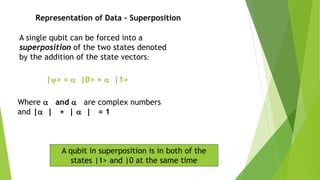
A single qubit can be forced into a
superposition of the two states denoted
by the addition of the state vectors:
|> =  |0> +  |1>
Where  and  are complex numbers
and | | + |  | = 1
A qubit in superposition is in both of the
states |1> and |0 at the same time
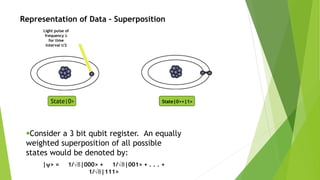
Representation of Data - Superposition
State|0> State|0>+|1>
Light pulse of
frequency 
for time
interval t/2
Consider a 3 bit qubit register. An equally
weighted superposition of all possible
states would be denoted by:
|> = 1/√8|000> + 1/√8|001> + . . . +
1/√8|111>
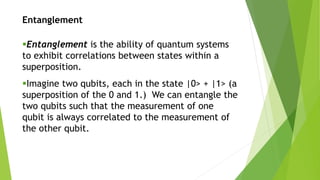
Entanglement
Entanglement is the ability of quantum systems
to exhibit correlations between states within a
superposition.
Imagine two qubits, each in the state |0> + |1> (a
superposition of the 0 and 1.) We can entangle the
two qubits such that the measurement of one
qubit is always correlated to the measurement of
the other qubit.
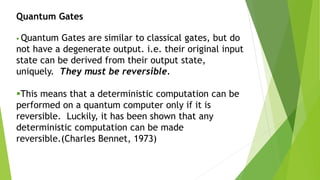
Quantum Gates
 Quantum Gates are similar to classical gates, but do
not have a degenerate output. i.e. their original input
state can be derived from their output state,
uniquely. They must be reversible.
This means that a deterministic computation can be
performed on a quantum computer only if it is
reversible. Luckily, it has been shown that any
deterministic computation can be made
reversible.(Charles Bennet, 1973)
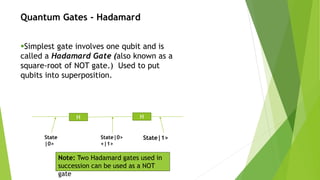
Quantum Gates - Hadamard
Simplest gate involves one qubit and is
called a Hadamard Gate (also known as a
square-root of NOT gate.) Used to put
qubits into superposition.
H H
State
|0>
State|0>
+|1>
State|1>
Note: Two Hadamard gates used in
succession can be used as a NOT
gate
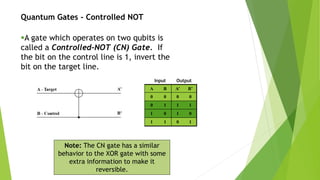
Quantum Gates - Controlled NOT
A gate which operates on two qubits is
called a Controlled-NOT (CN) Gate. If
the bit on the control line is 1, invert the
bit on the target line.
A B A’ B’
0 0 0 0
0 1 1 1
1 0 1 0
1 1 0 1
Input Output
Note: The CN gate has a similar
behavior to the XOR gate with some
extra information to make it
reversible.
Shor’s Algorithm
Shor’s algorithm shows (in principle,) that
a quantum computer is capable of
factoring very large numbers in polynomial
time.
The algorithm is dependent on
Modular Arithmetic
Quantum Parallelism
Quantum Fourier Transform
Conclusion
In 2001, a 7 qubit machine was
built and programmed to run Shor’s
algorithm to successfully factor 15.
 What algorithms will be discovered
next?
Can quantum computers solve NP
Complete problems in polynomial
time?
References
• Wikipedia
• Physics - A Textbook for
Advanced Level Students. Tom
Duncan
• The best computer in all
possible worlds.
• Cue the qubits: Quantum
computing

Quantum computing.pptx

  • 1.
    NAME :- SAHILKUMAR REG NO.:-12213923 Guided By: Dr. Goutam Mohanty Assistant Professor Department of Physics
  • 2.
    Introduction and History Data Representation Shor’s Algorithm  Conclusion
  • 3.
    Introduction What is aquantum computer?  A quantum computer is a machine that performs calculations based on the laws of quantum mechanics, which is the behavior of particles at the sub- atomic level.
  • 4.
    Introduction 1982 - Feynmanproposed the idea of creating ma “I think I can safely say that nobody understands quantum mechanics” - Feynman chines based on the laws of quantum mechanics instead of the laws of classical physics 1985 - David Deutsch developed the quantum turning machine, showing that quantum circuits are universal.  1994 - Peter Shor came up with a quantum algorithm to factor very large numbers in polynomial time. 1997 - Lov Grover develops a quantum search algorithm with O(√N) complexity
  • 5.
    Representation of Data- Qubits A bit of data is represented by a single atom that is in one of two states denoted by |0> and |1>. A single bit of this form is known as a qubit A physical implementation of a qubit could use the two energy levels of an atom. An excited state representing |1> and a ground state representing |0>. Light pulse of frequency  for time interval t Excited State Ground State Electron State|0> State|1>
  • 6.
    Representation of Data- Superposition A single qubit can be forced into a superposition of the two states denoted by the addition of the state vectors: |> =  |0> +  |1> Where  and  are complex numbers and | | + |  | = 1 A qubit in superposition is in both of the states |1> and |0 at the same time
  • 7.
    Representation of Data- Superposition State|0> State|0>+|1> Light pulse of frequency  for time interval t/2 Consider a 3 bit qubit register. An equally weighted superposition of all possible states would be denoted by: |> = 1/√8|000> + 1/√8|001> + . . . + 1/√8|111>
  • 8.
    Entanglement Entanglement is theability of quantum systems to exhibit correlations between states within a superposition. Imagine two qubits, each in the state |0> + |1> (a superposition of the 0 and 1.) We can entangle the two qubits such that the measurement of one qubit is always correlated to the measurement of the other qubit.
  • 9.
    Quantum Gates  QuantumGates are similar to classical gates, but do not have a degenerate output. i.e. their original input state can be derived from their output state, uniquely. They must be reversible. This means that a deterministic computation can be performed on a quantum computer only if it is reversible. Luckily, it has been shown that any deterministic computation can be made reversible.(Charles Bennet, 1973)
  • 10.
    Quantum Gates -Hadamard Simplest gate involves one qubit and is called a Hadamard Gate (also known as a square-root of NOT gate.) Used to put qubits into superposition. H H State |0> State|0> +|1> State|1> Note: Two Hadamard gates used in succession can be used as a NOT gate
  • 11.
    Quantum Gates -Controlled NOT A gate which operates on two qubits is called a Controlled-NOT (CN) Gate. If the bit on the control line is 1, invert the bit on the target line. A B A’ B’ 0 0 0 0 0 1 1 1 1 0 1 0 1 1 0 1 Input Output Note: The CN gate has a similar behavior to the XOR gate with some extra information to make it reversible.
  • 12.
    Shor’s Algorithm Shor’s algorithmshows (in principle,) that a quantum computer is capable of factoring very large numbers in polynomial time. The algorithm is dependent on Modular Arithmetic Quantum Parallelism Quantum Fourier Transform
  • 13.
    Conclusion In 2001, a7 qubit machine was built and programmed to run Shor’s algorithm to successfully factor 15.  What algorithms will be discovered next? Can quantum computers solve NP Complete problems in polynomial time?
  • 14.
    References • Wikipedia • Physics- A Textbook for Advanced Level Students. Tom Duncan • The best computer in all possible worlds. • Cue the qubits: Quantum computing