Circular Dichroism
Part I. Introduction
Circular Dichroism
Circular dichroism (CD) spectroscopy measures differences
in the absorption of left-handed polarized light versus right-
handed polarized light which arise due to structural asymme
try. The absence of regular structure results in zero CD inte
nsity, while an ordered structure results in a spectrum which
can contain both positive and negative signals.
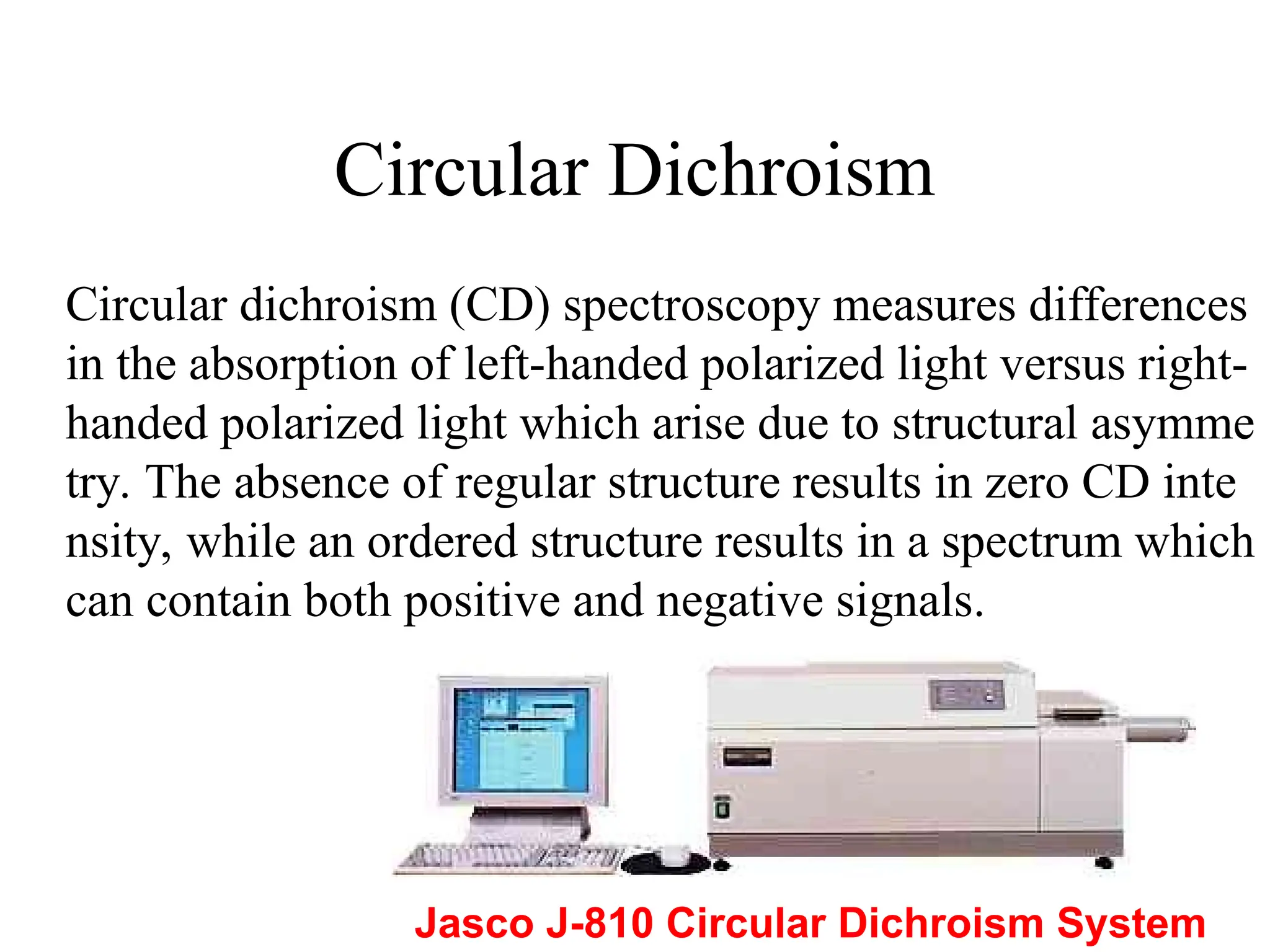
Jasco J-810 Circular Dichroism System
Chiral structure can be distinguished and charact
erized by polarized light
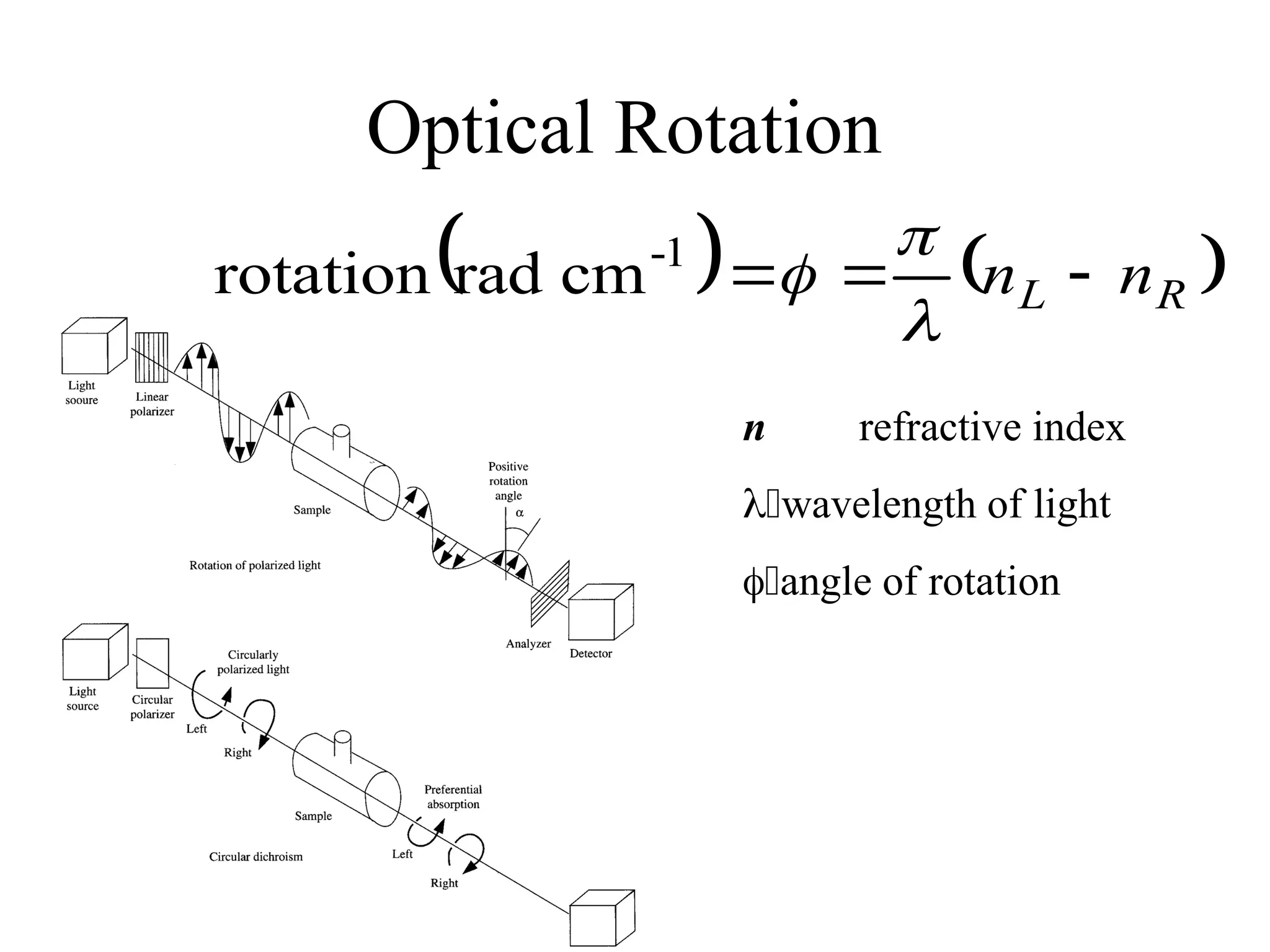
Optical rotation
Optical rotation: the rotation of linearly polarized light by t
he sample
Optical rotary dispersion
Optical rotary dispersion: the variation of optical rotatio
n as a function of wavelength. The spectrum of optical rotation.
Circular Dichroism
Circular Dichroism: the difference in absorption of left an
d right circularly light.
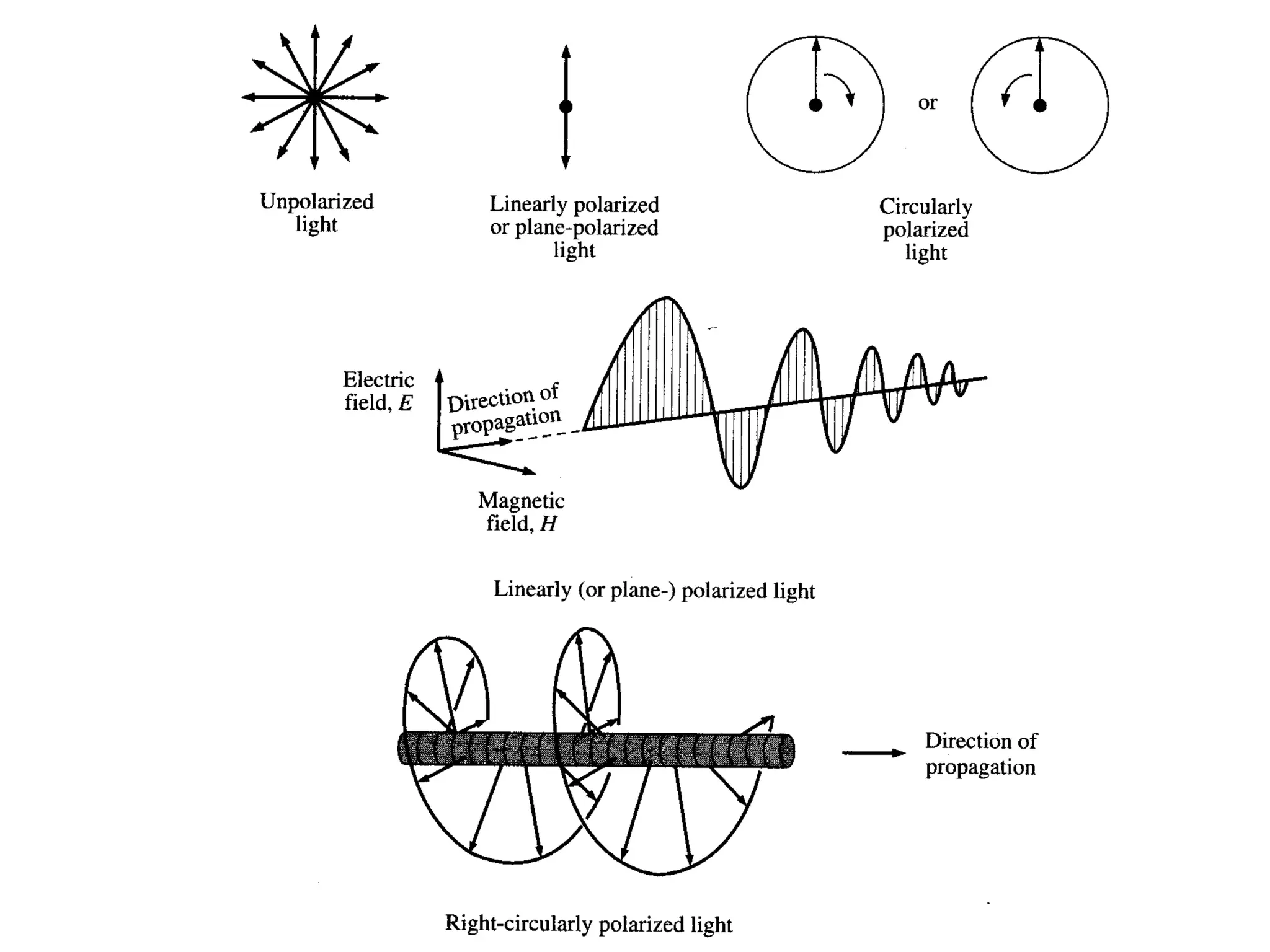
Types of polarized light
• Plane polarized light consists two circularly
polarized components of equal intensity
• Two circularly polarized components are like left-
and right-handed springs
• As observed by looking at the source, right-
handed circularly polarized light rotates clockwise
• Frequency of rotation is related to the frequency of
the light
• Can be resolved into its two circularly polarized
components
• When added together after passing through an
optically isotropic medium, plane polarized light
results
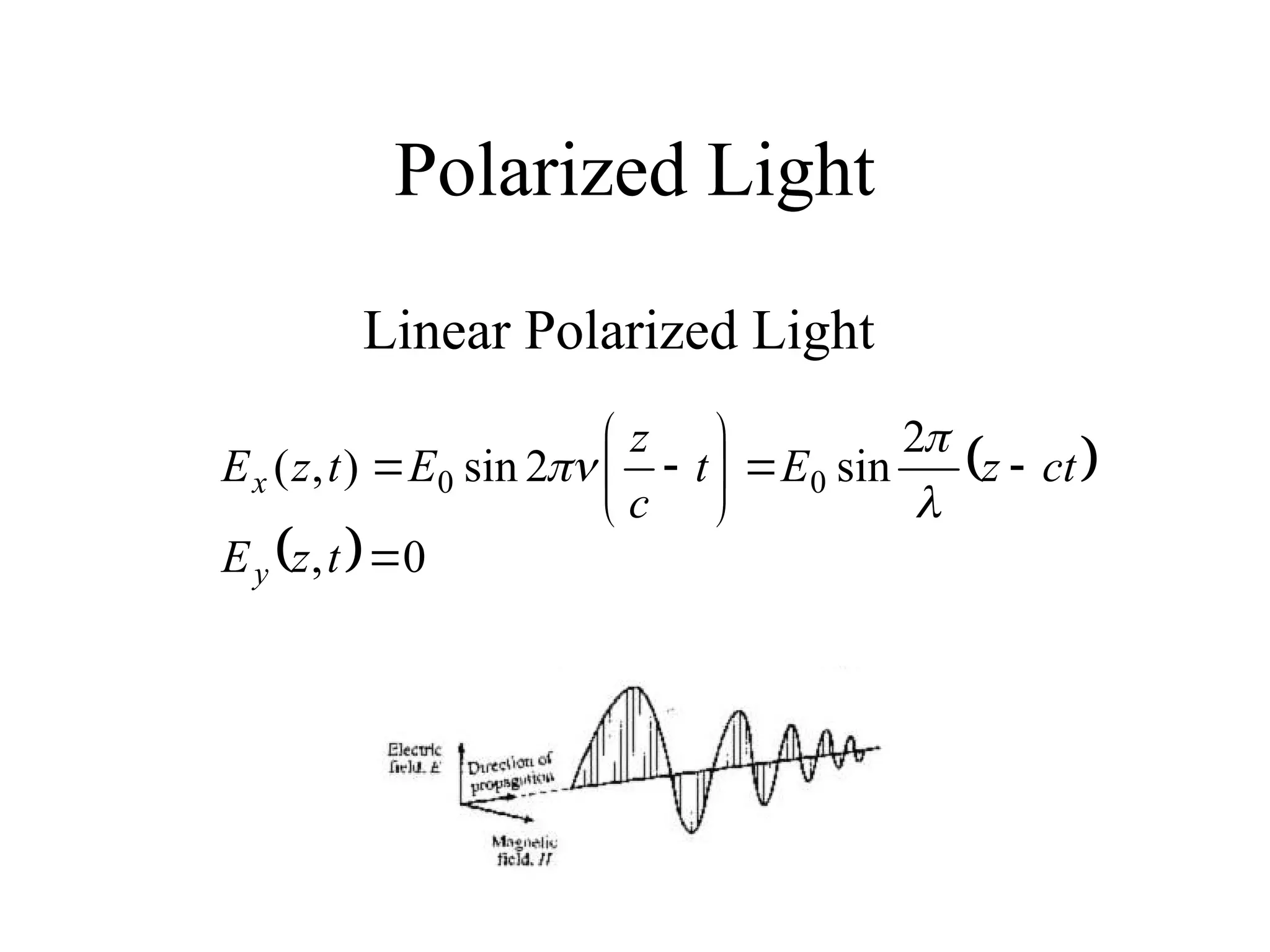
Polarized Light
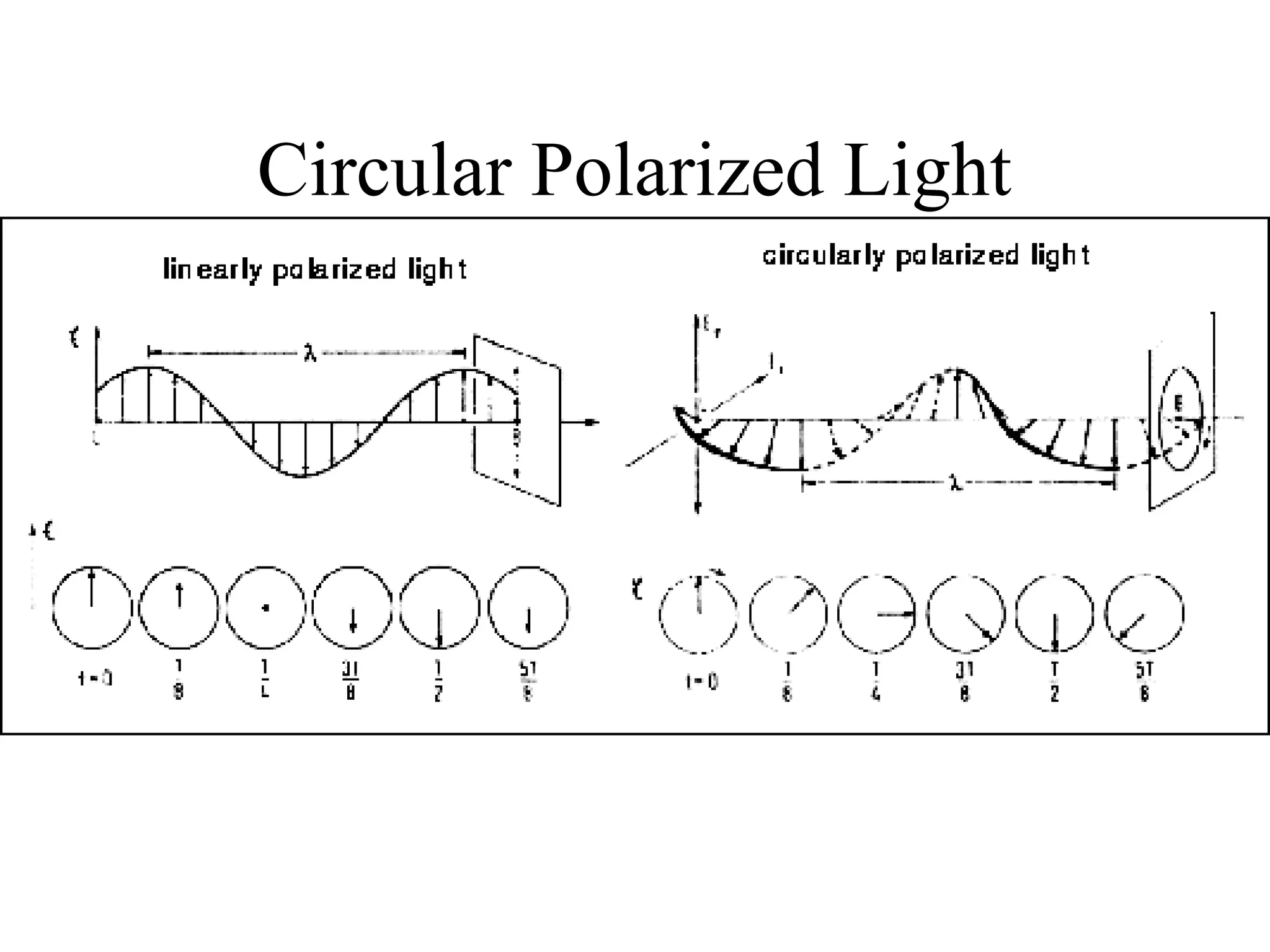
Linear Polarized Light
 
  0
,
2
sin
2
sin
)
,
( 0
0











t
z
E
ct
z
E
t
c
z
E
t
z
E
y
x



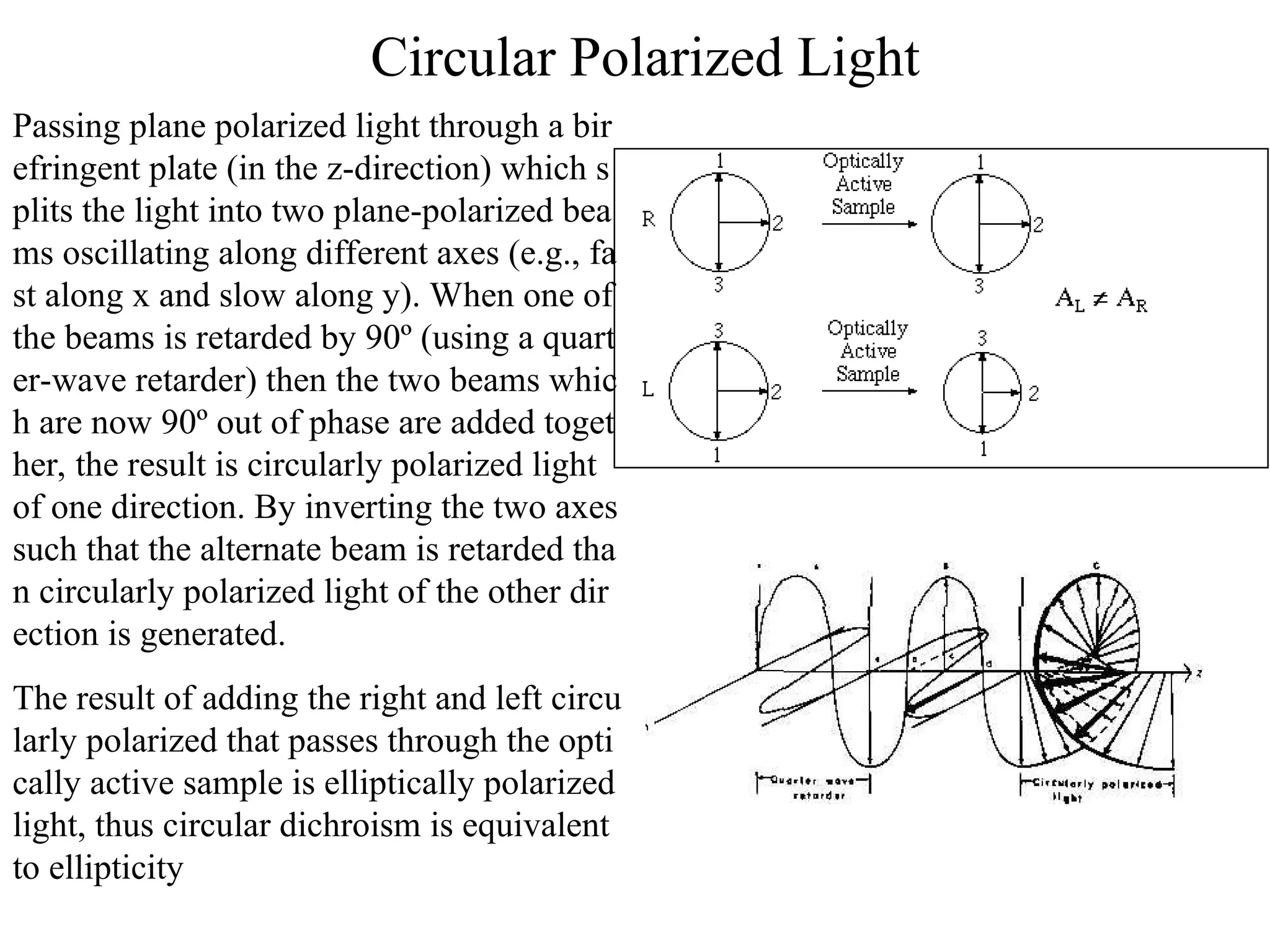
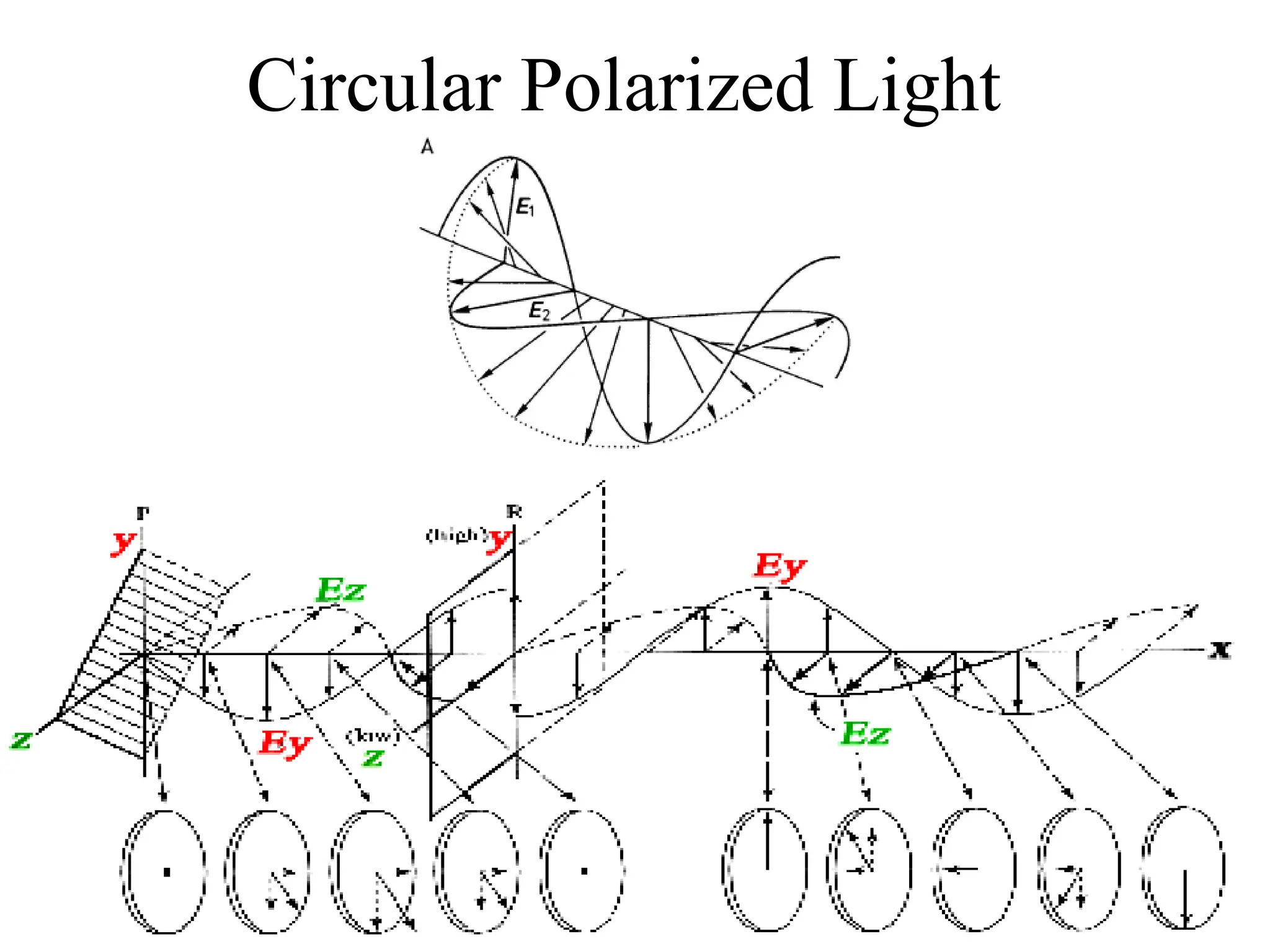
Passing plane polarized light through a bir
efringent plate (in the z-direction) which s
plits the light into two plane-polarized bea
ms oscillating along different axes (e.g., fa
st along x and slow along y). When one of
the beams is retarded by 90º (using a quart
er-wave retarder) then the two beams whic
h are now 90º out of phase are added toget
her, the result is circularly polarized light
of one direction. By inverting the two axes
such that the alternate beam is retarded tha
n circularly polarized light of the other dir
ection is generated.
The result of adding the right and left circu
larly polarized that passes through the opti
cally active sample is elliptically polarized
light, thus circular dichroism is equivalent
to ellipticity
Circular Polarized Light
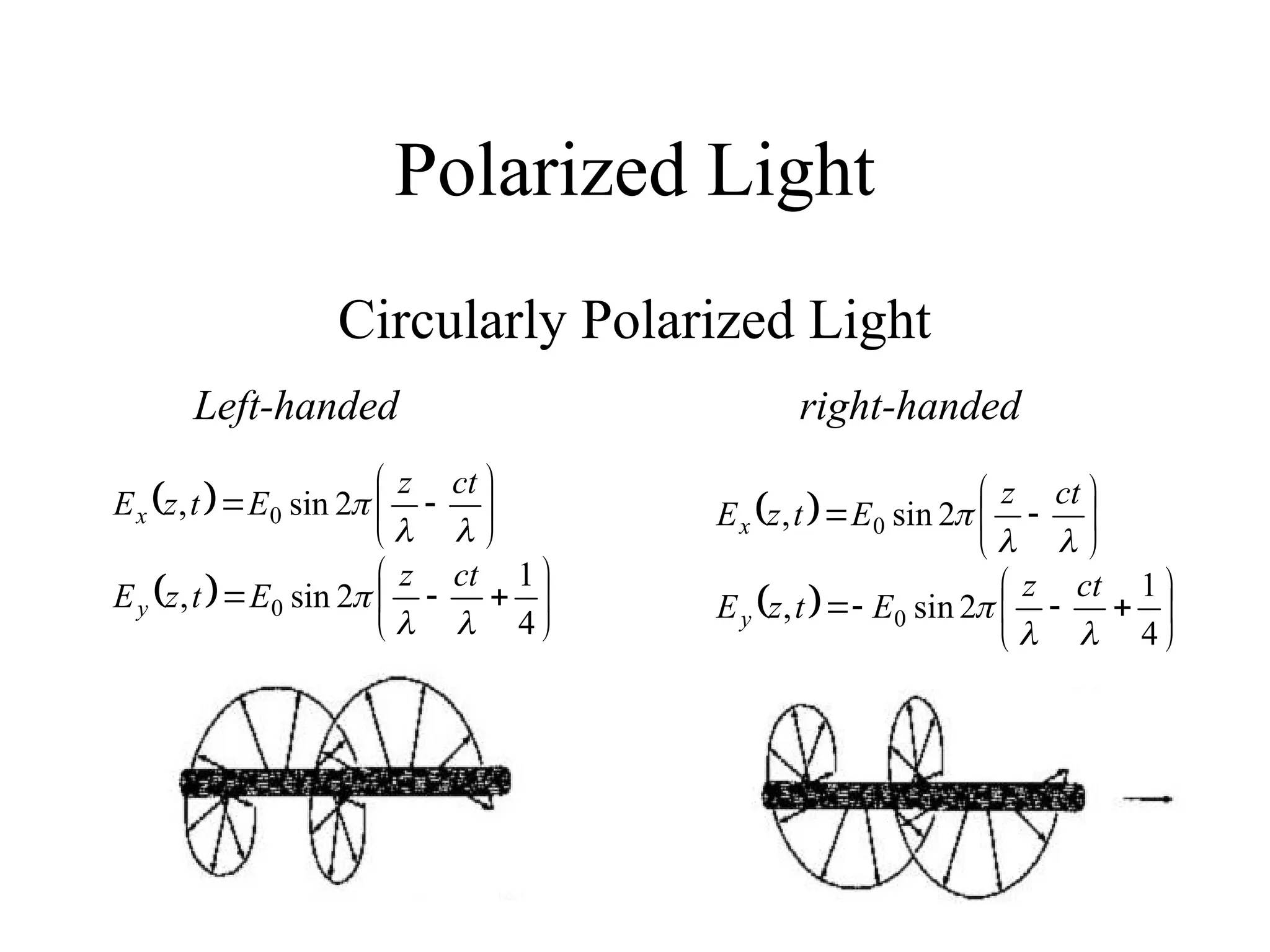
Polarized Light
Circularly Polarized Light
 
  
















4
1
2
sin
,
2
sin
,
0
0






ct
z
E
t
z
E
ct
z
E
t
z
E
y
x  
  

















4
1
2
sin
,
2
sin
,
0
0






ct
z
E
t
z
E
ct
z
E
t
z
E
y
x
Left-handed right-handed
Optical rotary dispersion
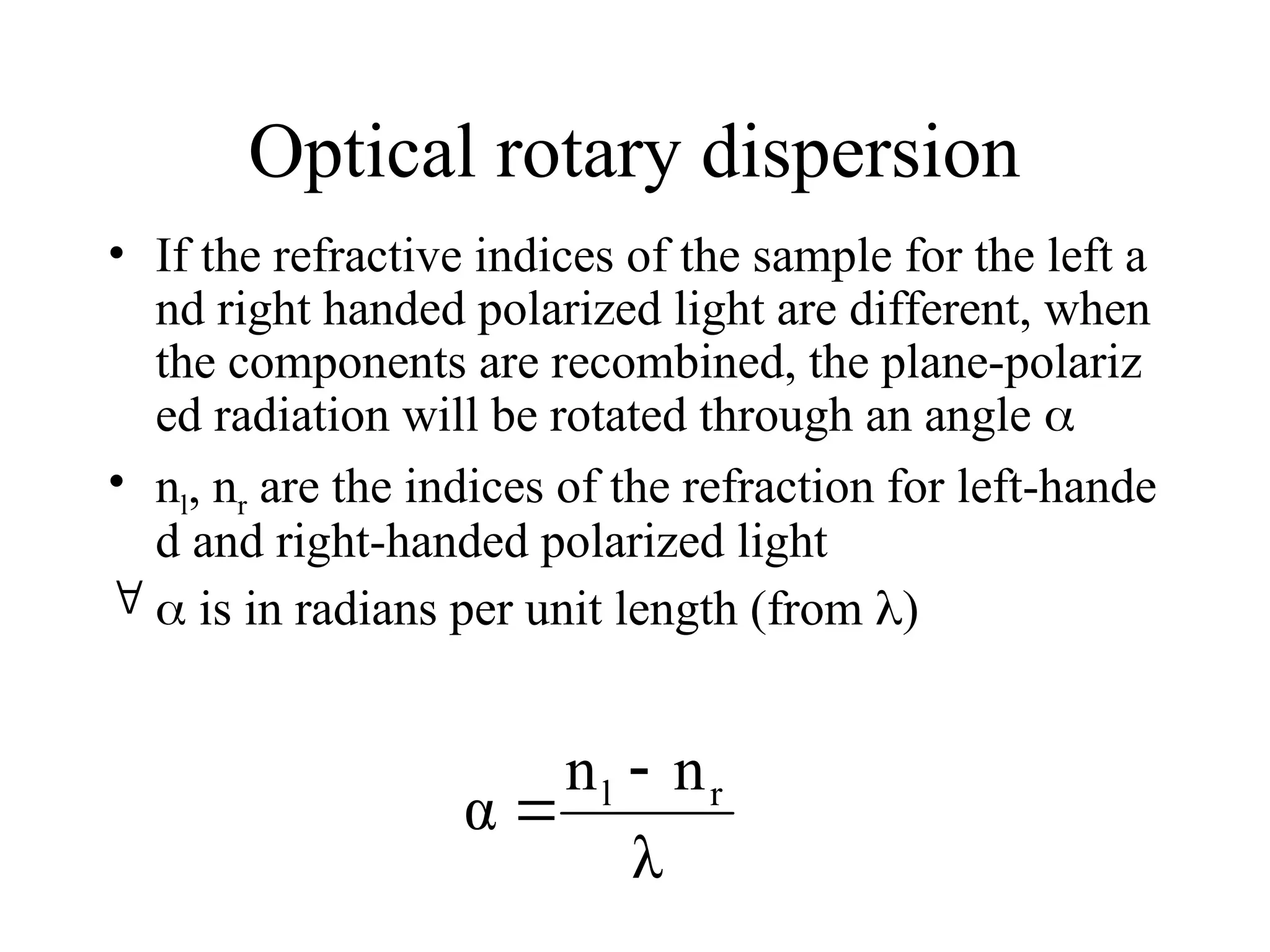
• If the refractive indices of the sample for the left a
nd right handed polarized light are different, when
the components are recombined, the plane-polariz
ed radiation will be rotated through an angle 
• nl, nr are the indices of the refraction for left-hande
d and right-handed polarized light
  is in radians per unit length (from )
λ
n
n
α r
l 

Optical Rotation
   
R
L n
n 





1
-
cm
rad
rotation
n refractive index
wavelength of light
angle of rotation
Optical Rotation
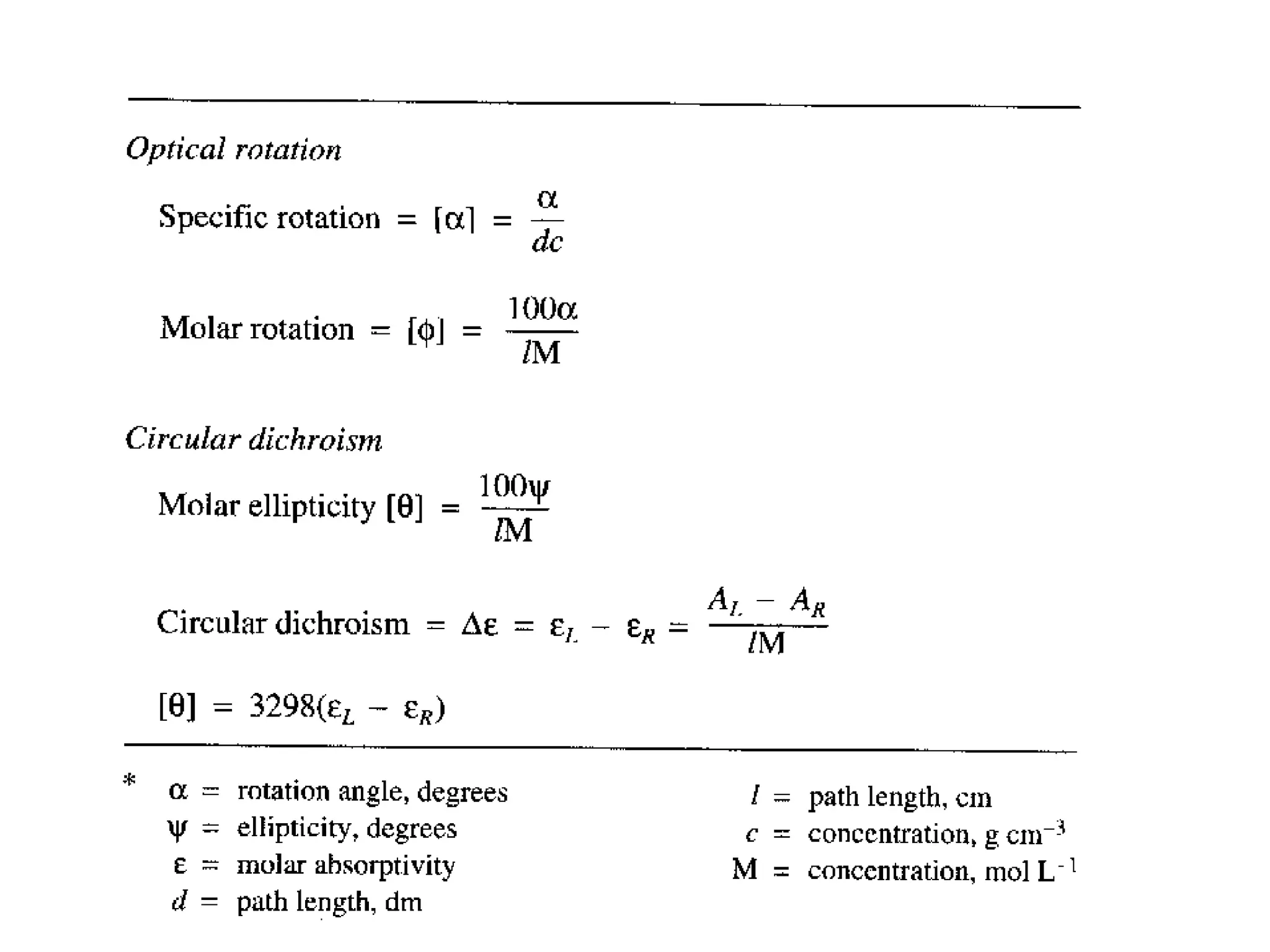
• Usually reported as a specific rotation [],
measured at a particular T, concentration and 
(normally 589; the Na D line)
• Molar rotation [] = []MW10-2
 
mL
100
g
c
decimeters
in
pathlength
lc
α
10
α
2



l
Optical rotary dispersion
 
d'
c'
α
α 
• Concentration of an optically active substance, c’, expressed in g cm-1
(as density of a pure substance)
• d’ = thickness of the sample in decimeters
   
'
'
10
α
10
α
2
2
d
c
M
M
M

 



• M = molecular weight of the optically active component
• the 10-2
factor is subject to convention and is not always included in
[M]
Optical rotary dispersion
   
'
'
10
α
10
α
2
2
d
c
M
M
M

 



• M = molecular weight of the optically
active component
• n. b. the 10-2
factor is subject to convention
and is not always included in [M]
Optical rotary dispersion
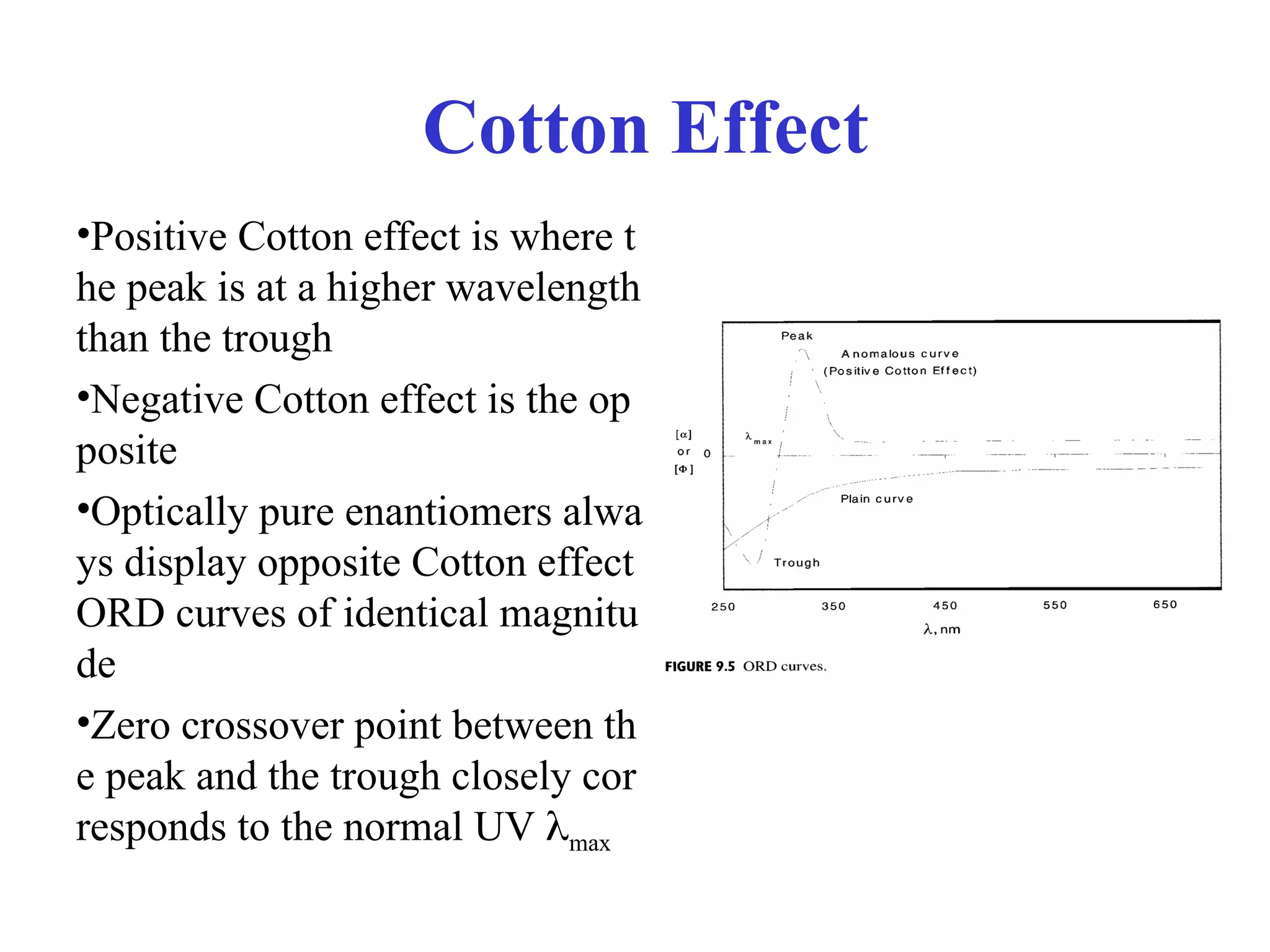
• ORD curve is a plot of molar rotation [] or [M] vs 
• Clockwise rotation is plotted positively; counterclockw
ise rotation is plotted negatively
• ORD is based solely on the index of refraction
• So-called plain curve is the ORD for a chiral compoun
d that lacks a chromophore
• Chiral compounds containing a chromophore can give
anomalous, or Cotton effect, curves
Cotton Effect
•Positive Cotton effect is where t
he peak is at a higher wavelength
than the trough
•Negative Cotton effect is the op
posite
•Optically pure enantiomers alwa
ys display opposite Cotton effect
ORD curves of identical magnitu
de
•Zero crossover point between th
e peak and the trough closely cor
responds to the normal UV max
Circular Polarized Light
Circular dichroism
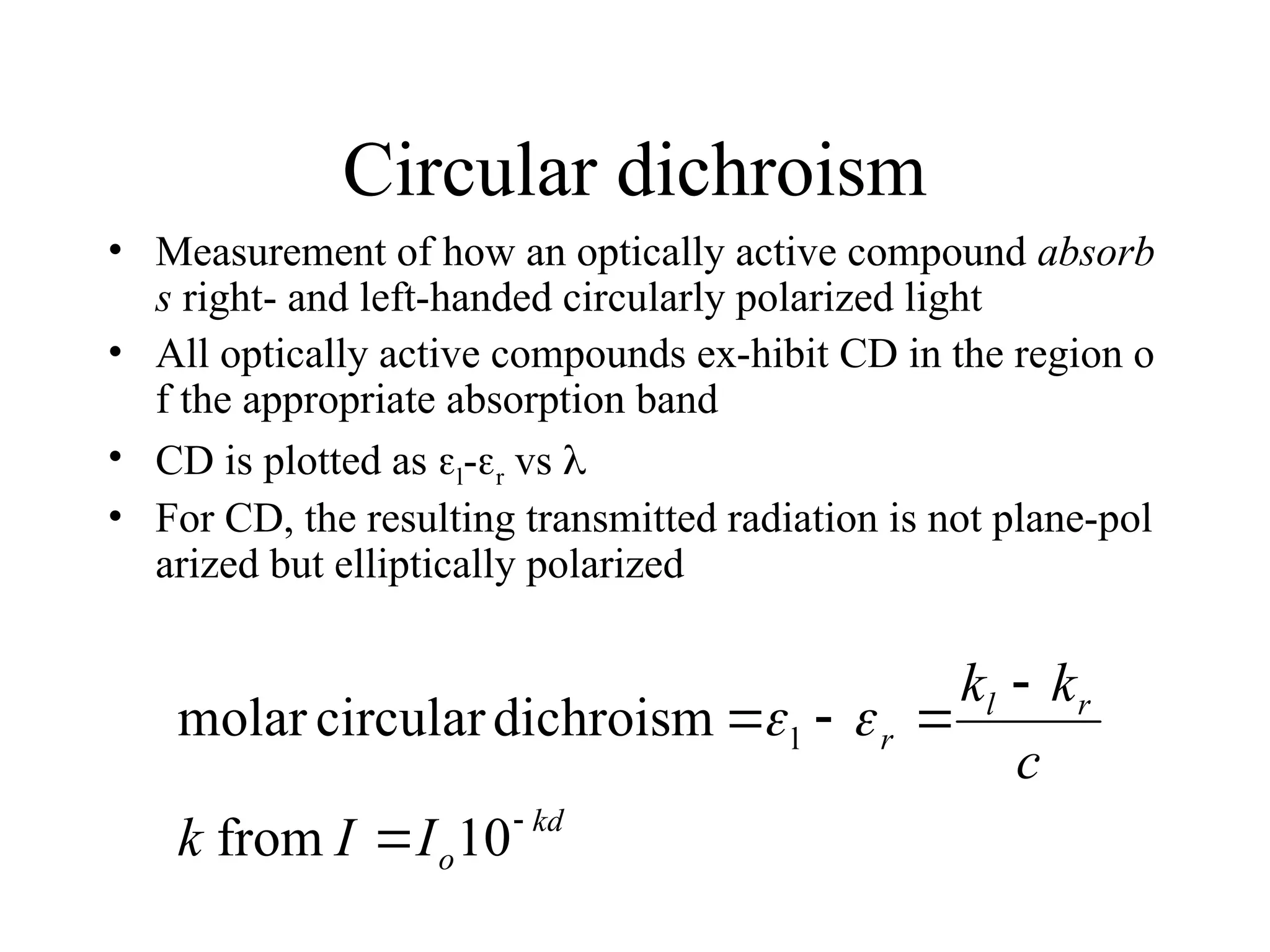
• Measurement of how an optically active compound absorb
s right- and left-handed circularly polarized light
• All optically active compounds ex-hibit CD in the region o
f the appropriate absorption band
• CD is plotted as l-r vs 
• For CD, the resulting transmitted radiation is not plane-pol
arized but elliptically polarized
kd
o
r
l
r
I
I
k
c
k
k






10
from
dichroism
circular
molar l 

   
l
A
A R
L
4
303
.
2
cm
rad 1
- 


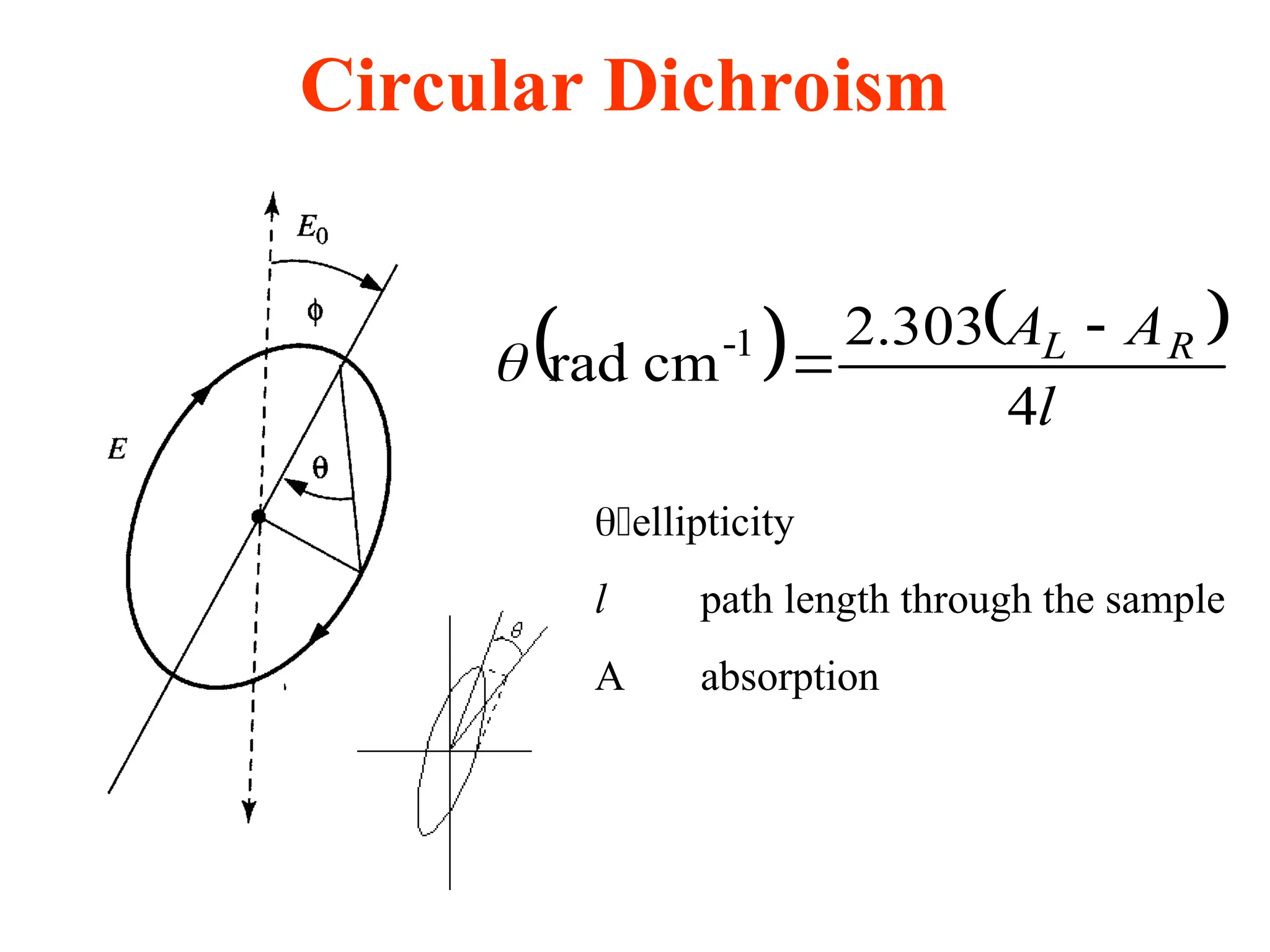
ellipticity
l path length through the sample
A absorption
Circular Dichroism
Circular dichroism
  is therefore the angle between the initial plane of polarization and th
e major axis of the ellipse of the resultant transmitted light
• A quantity  is defined such that
tan  is the ratio of the major and minor axis of the ellipse of the trans
mitted light
 ’ approximates the ellipticity
• When expressed in degrees, ’ can be converted to a specific ellipticit
y [] or a molar ellipticity []
• CD is usually plotted as []
 
   
 
θ
10
0.3032
ε
ε
10
θ
y
ellipticit
molar
d
c'
y
ellipticit
specific
3
r
l
2















M
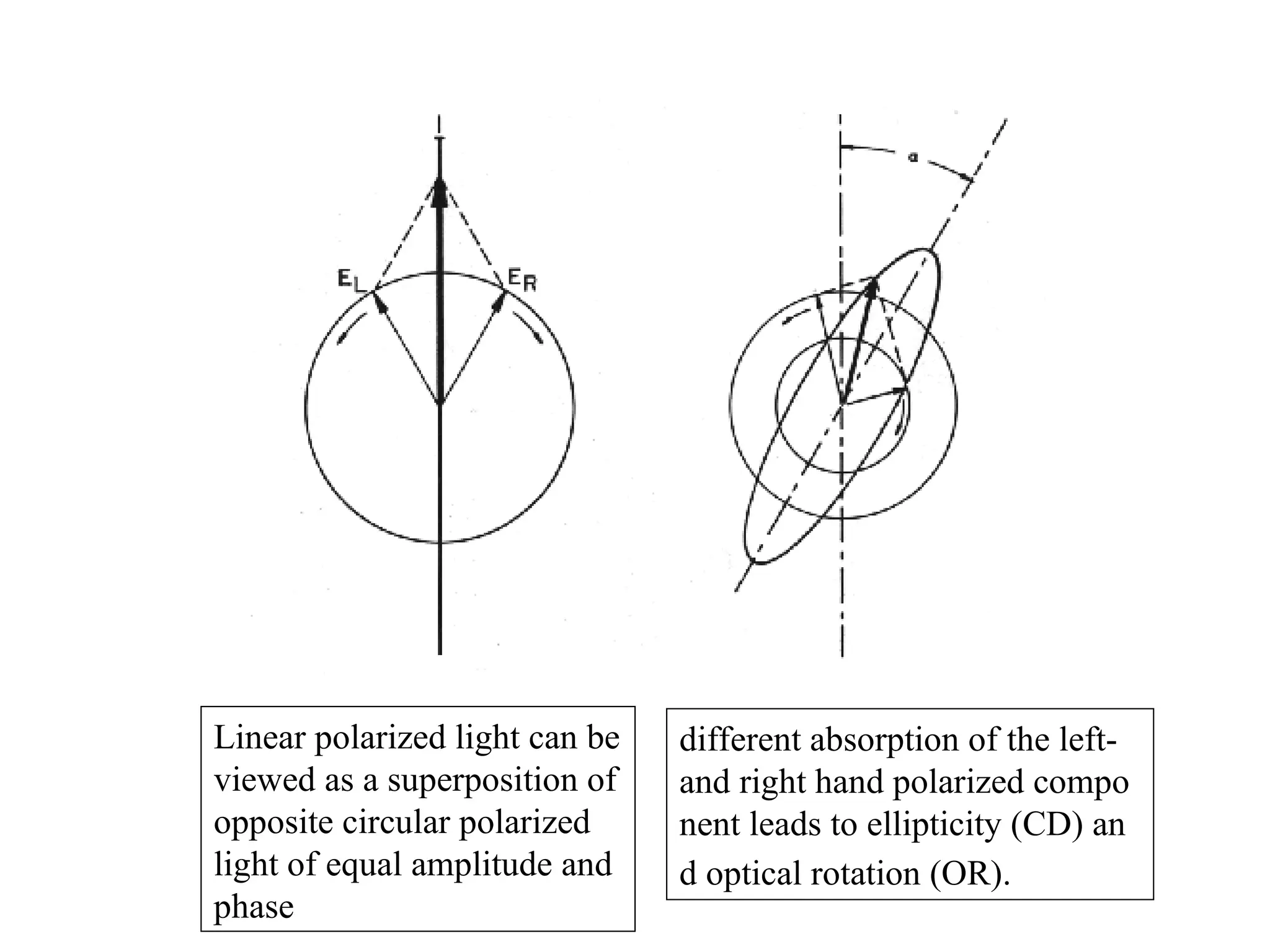
Linear polarized light can be
viewed as a superposition of
opposite circular polarized
light of equal amplitude and
phase
different absorption of the left-
and right hand polarized compo
nent leads to ellipticity (CD) an
d optical rotation (OR).
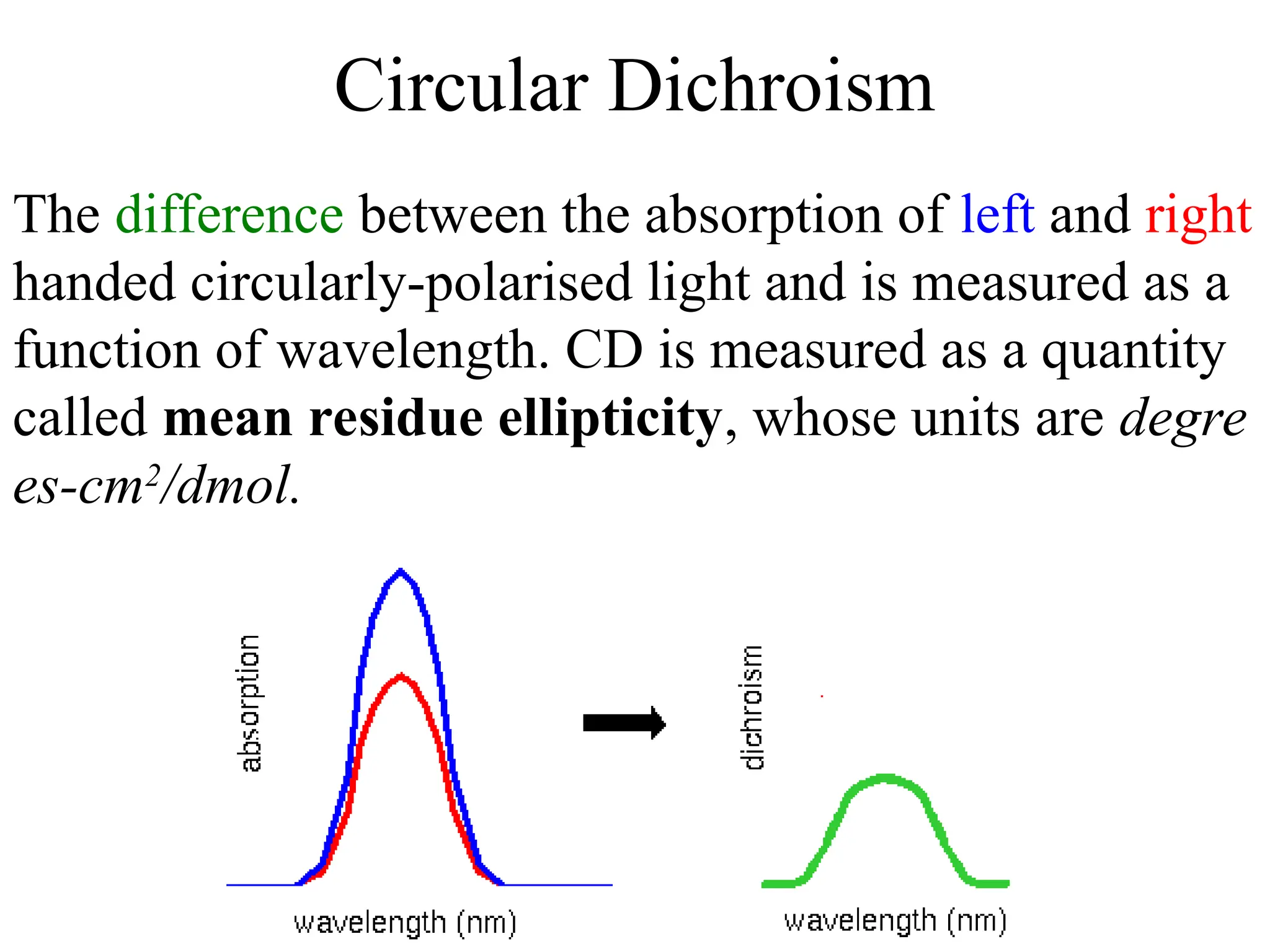
The difference between the absorption of left and right
handed circularly-polarised light and is measured as a
function of wavelength. CD is measured as a quantity
called mean residue ellipticity, whose units are degre
es-cm2
/dmol.
Circular Dichroism
ORD and CD
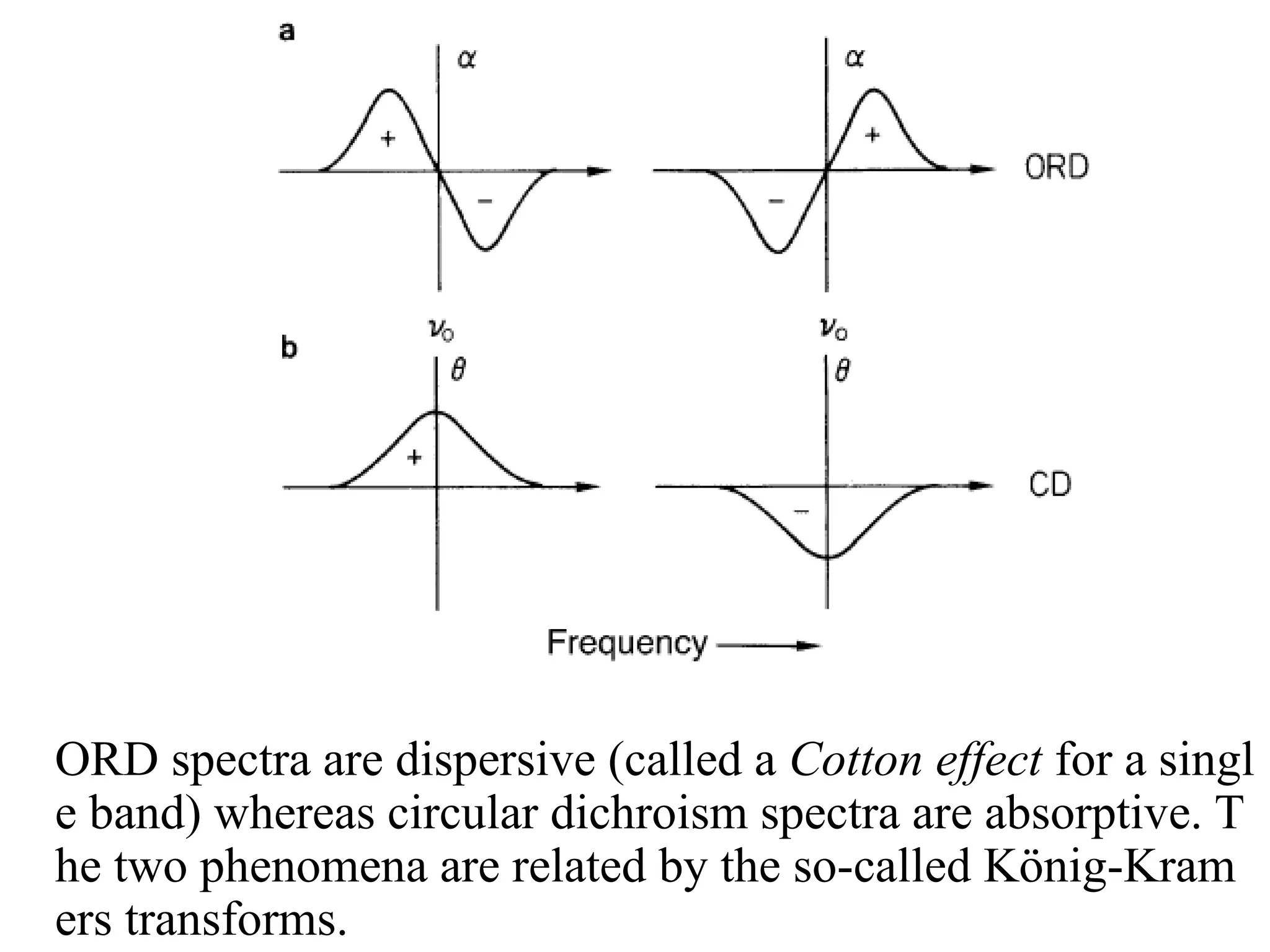
• CD plots are Gaussian rather than S-shaped.
• Positive or negative deflections depend on the sign of 
or [] and corresponds to the sign of the Cotton effect
• ORD spectra are dispersive (called a Cotton effect for a si
ngle band) whereas circular dichroism spectra are absorpt
ive. The two phenomena are related by the so-called Köni
g-Kramers transforms.
• Maximum of the CD occurs at the absorption max
• Where more than one overlapping Cotton effect, the CD
may be easier to interpret than the ORD with overlapping
S-shaped bands
ORD spectra are dispersive (called a Cotton effect for a singl
e band) whereas circular dichroism spectra are absorptive. T
he two phenomena are related by the so-called König-Kram
ers transforms.
Sample Preparation
• Additives, buffers and stabilizing compounds:
Any compound which absorbs in the region of
interest (250 - 190 nm) should be avoided.
• A buffer or detergent or other chemical should
not be used unless it can be shown that the
compound in question will not mask the protein
signal.
Sample Preparation
• Protein solution: From the above follows that the
protein solution should contain only those
chemicals necessary to maintain protein stability,
and at the lowest concentrations possible. Avoid
any chemical that is unnecessary for protein
stability/solubility. The protein itself should be as
pure as possible, any additional protein or peptide
will contribute to the CD signal.
Sample Preparation
• Contaminants: Unfolded protein, peptides, particul
ate matter (scattering particles), anything that adds
significant noise (or artifical signal contributions)
to the CD spectrum must be avoided. Filtering of t
he solutions (0.02 um syringe filters) may improve
signal to noise ratio.
• Data collection: Initial experiments are useful to e
stablish the best conditions for the "real" experime
nt. Cells of 0.5 mm path length offer a good startin
g point.
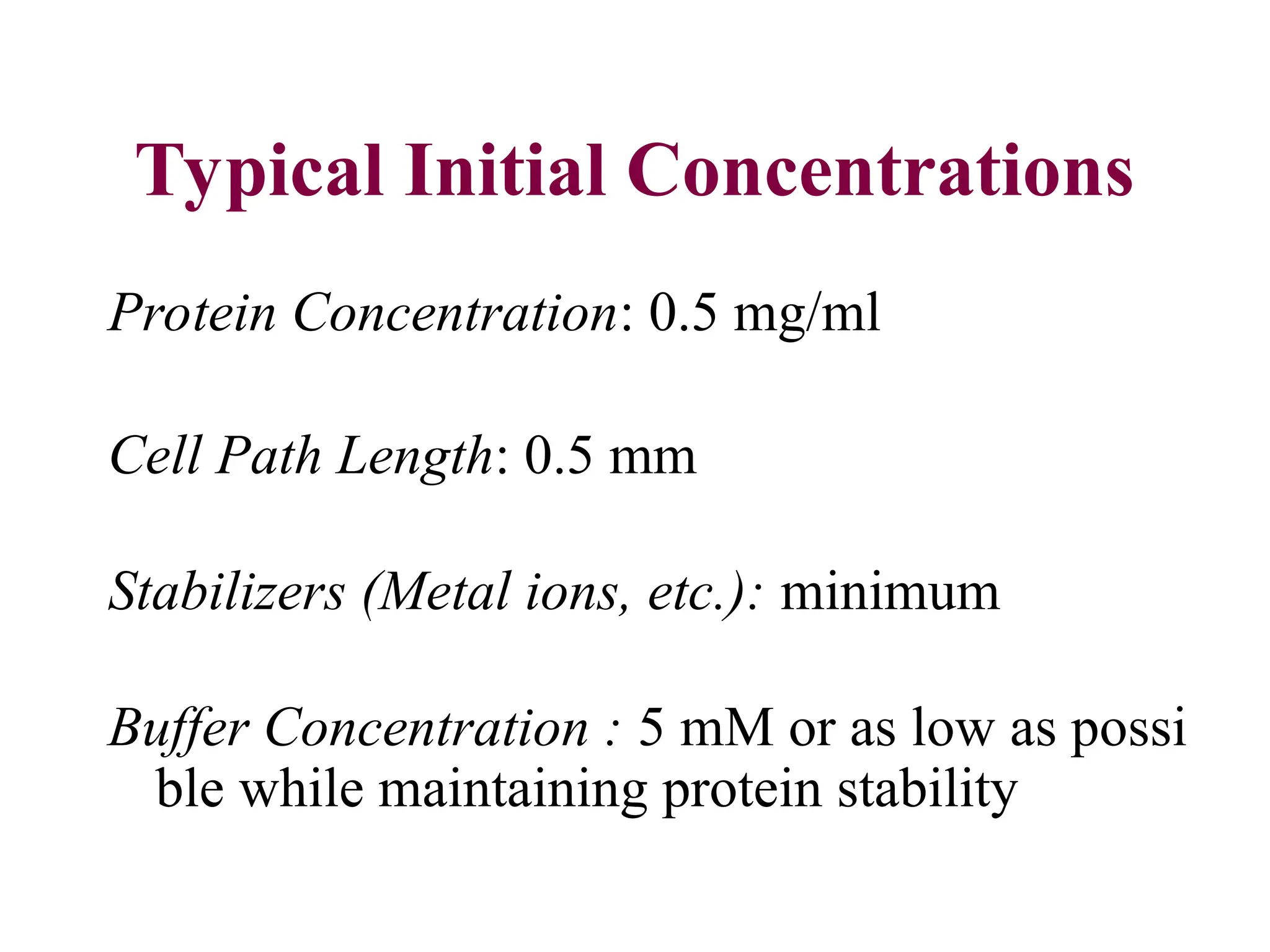
Typical Initial Concentrations
Protein Concentration: 0.5 mg/ml
Cell Path Length: 0.5 mm
Stabilizers (Metal ions, etc.): minimum
Buffer Concentration : 5 mM or as low as possi
ble while maintaining protein stability

Circular Dichroism : applications and principles

  • 1.
  • 2.
    Circular Dichroism Circular dichroism(CD) spectroscopy measures differences in the absorption of left-handed polarized light versus right- handed polarized light which arise due to structural asymme try. The absence of regular structure results in zero CD inte nsity, while an ordered structure results in a spectrum which can contain both positive and negative signals. Jasco J-810 Circular Dichroism System
  • 3.
    Chiral structure canbe distinguished and charact erized by polarized light Optical rotation Optical rotation: the rotation of linearly polarized light by t he sample Optical rotary dispersion Optical rotary dispersion: the variation of optical rotatio n as a function of wavelength. The spectrum of optical rotation. Circular Dichroism Circular Dichroism: the difference in absorption of left an d right circularly light.
  • 4.
    Types of polarizedlight • Plane polarized light consists two circularly polarized components of equal intensity • Two circularly polarized components are like left- and right-handed springs • As observed by looking at the source, right- handed circularly polarized light rotates clockwise • Frequency of rotation is related to the frequency of the light • Can be resolved into its two circularly polarized components • When added together after passing through an optically isotropic medium, plane polarized light results
  • 6.
    Polarized Light Linear PolarizedLight     0 , 2 sin 2 sin ) , ( 0 0            t z E ct z E t c z E t z E y x   
  • 7.
    Passing plane polarizedlight through a bir efringent plate (in the z-direction) which s plits the light into two plane-polarized bea ms oscillating along different axes (e.g., fa st along x and slow along y). When one of the beams is retarded by 90º (using a quart er-wave retarder) then the two beams whic h are now 90º out of phase are added toget her, the result is circularly polarized light of one direction. By inverting the two axes such that the alternate beam is retarded tha n circularly polarized light of the other dir ection is generated. The result of adding the right and left circu larly polarized that passes through the opti cally active sample is elliptically polarized light, thus circular dichroism is equivalent to ellipticity Circular Polarized Light
  • 8.
    Polarized Light Circularly PolarizedLight                      4 1 2 sin , 2 sin , 0 0       ct z E t z E ct z E t z E y x                       4 1 2 sin , 2 sin , 0 0       ct z E t z E ct z E t z E y x Left-handed right-handed
  • 9.
    Optical rotary dispersion •If the refractive indices of the sample for the left a nd right handed polarized light are different, when the components are recombined, the plane-polariz ed radiation will be rotated through an angle  • nl, nr are the indices of the refraction for left-hande d and right-handed polarized light   is in radians per unit length (from ) λ n n α r l  
  • 10.
    Optical Rotation    R L n n       1 - cm rad rotation n refractive index wavelength of light angle of rotation
  • 11.
    Optical Rotation • Usuallyreported as a specific rotation [], measured at a particular T, concentration and  (normally 589; the Na D line) • Molar rotation [] = []MW10-2   mL 100 g c decimeters in pathlength lc α 10 α 2    l
  • 12.
    Optical rotary dispersion  d' c' α α  • Concentration of an optically active substance, c’, expressed in g cm-1 (as density of a pure substance) • d’ = thickness of the sample in decimeters     ' ' 10 α 10 α 2 2 d c M M M       • M = molecular weight of the optically active component • the 10-2 factor is subject to convention and is not always included in [M]
  • 13.
    Optical rotary dispersion    ' ' 10 α 10 α 2 2 d c M M M       • M = molecular weight of the optically active component • n. b. the 10-2 factor is subject to convention and is not always included in [M]
  • 14.
    Optical rotary dispersion •ORD curve is a plot of molar rotation [] or [M] vs  • Clockwise rotation is plotted positively; counterclockw ise rotation is plotted negatively • ORD is based solely on the index of refraction • So-called plain curve is the ORD for a chiral compoun d that lacks a chromophore • Chiral compounds containing a chromophore can give anomalous, or Cotton effect, curves
  • 15.
    Cotton Effect •Positive Cottoneffect is where t he peak is at a higher wavelength than the trough •Negative Cotton effect is the op posite •Optically pure enantiomers alwa ys display opposite Cotton effect ORD curves of identical magnitu de •Zero crossover point between th e peak and the trough closely cor responds to the normal UV max
  • 16.
  • 17.
  • 18.
    Circular dichroism • Measurementof how an optically active compound absorb s right- and left-handed circularly polarized light • All optically active compounds ex-hibit CD in the region o f the appropriate absorption band • CD is plotted as l-r vs  • For CD, the resulting transmitted radiation is not plane-pol arized but elliptically polarized kd o r l r I I k c k k       10 from dichroism circular molar l  
  • 19.
       l A A R L 4 303 . 2 cm rad 1 -    ellipticity l path length through the sample A absorption Circular Dichroism
  • 20.
    Circular dichroism  is therefore the angle between the initial plane of polarization and th e major axis of the ellipse of the resultant transmitted light • A quantity  is defined such that tan  is the ratio of the major and minor axis of the ellipse of the trans mitted light  ’ approximates the ellipticity • When expressed in degrees, ’ can be converted to a specific ellipticit y [] or a molar ellipticity [] • CD is usually plotted as []         θ 10 0.3032 ε ε 10 θ y ellipticit molar d c' y ellipticit specific 3 r l 2                M
  • 21.
    Linear polarized lightcan be viewed as a superposition of opposite circular polarized light of equal amplitude and phase different absorption of the left- and right hand polarized compo nent leads to ellipticity (CD) an d optical rotation (OR).
  • 22.
    The difference betweenthe absorption of left and right handed circularly-polarised light and is measured as a function of wavelength. CD is measured as a quantity called mean residue ellipticity, whose units are degre es-cm2 /dmol. Circular Dichroism
  • 23.
    ORD and CD •CD plots are Gaussian rather than S-shaped. • Positive or negative deflections depend on the sign of  or [] and corresponds to the sign of the Cotton effect • ORD spectra are dispersive (called a Cotton effect for a si ngle band) whereas circular dichroism spectra are absorpt ive. The two phenomena are related by the so-called Köni g-Kramers transforms. • Maximum of the CD occurs at the absorption max • Where more than one overlapping Cotton effect, the CD may be easier to interpret than the ORD with overlapping S-shaped bands
  • 24.
    ORD spectra aredispersive (called a Cotton effect for a singl e band) whereas circular dichroism spectra are absorptive. T he two phenomena are related by the so-called König-Kram ers transforms.
  • 27.
    Sample Preparation • Additives,buffers and stabilizing compounds: Any compound which absorbs in the region of interest (250 - 190 nm) should be avoided. • A buffer or detergent or other chemical should not be used unless it can be shown that the compound in question will not mask the protein signal.
  • 28.
    Sample Preparation • Proteinsolution: From the above follows that the protein solution should contain only those chemicals necessary to maintain protein stability, and at the lowest concentrations possible. Avoid any chemical that is unnecessary for protein stability/solubility. The protein itself should be as pure as possible, any additional protein or peptide will contribute to the CD signal.
  • 29.
    Sample Preparation • Contaminants:Unfolded protein, peptides, particul ate matter (scattering particles), anything that adds significant noise (or artifical signal contributions) to the CD spectrum must be avoided. Filtering of t he solutions (0.02 um syringe filters) may improve signal to noise ratio. • Data collection: Initial experiments are useful to e stablish the best conditions for the "real" experime nt. Cells of 0.5 mm path length offer a good startin g point.
  • 30.
    Typical Initial Concentrations ProteinConcentration: 0.5 mg/ml Cell Path Length: 0.5 mm Stabilizers (Metal ions, etc.): minimum Buffer Concentration : 5 mM or as low as possi ble while maintaining protein stability

Editor's Notes

  • #6 C: speed of the light in vaccum; V: frequency; 