Yue Wai Sze(17226279)
Xie Xin Ying(16251172)
Tse Man Fung (17225647)
Wireless
Charging
29 November 2017
Contents
Definition History Principle Types Pros & Cons Development
Definition
• Wireless charging uses electromagnetic fields to safely transfer
power from a transmitting source to a receiving device for the
purposes of wirelessly charging a battery, without using a
physical connection.
History
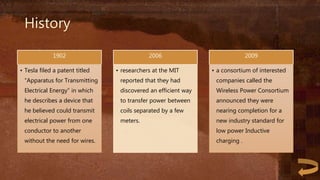
1902
• Tesla filed a patent titled
“Apparatus for Transmitting
Electrical Energy” in which
he describes a device that
he believed could transmit
electrical power from one
conductor to another
without the need for wires.
2006
• researchers at the MIT
reported that they had
discovered an efficient way
to transfer power between
coils separated by a few
meters.
2009
• a consortium of interested
companies called the
Wireless Power Consortium
announced they were
nearing completion for a
new industry standard for
low power Inductive
charging .
Principle
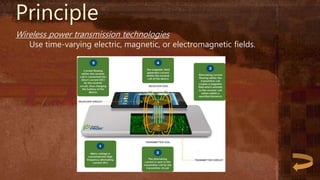
Wireless power transmission technologies
Use time-varying electric, magnetic, or electromagnetic fields.
Types
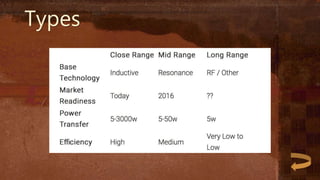
1. CLOSE RANGE
- Inductive charging technology.
- High efficiency, cost effective to deploy and easy to design and
work with.
- Supports a variety of devices, even the big ones like vehicles.
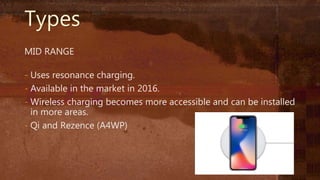
MID RANGE
- Uses resonance charging.
- Available in the market in 2016.
- Wireless charging becomes more accessible and can be installed
in more areas.
- Qi and Rezence (A4WP)
Types
Types
2. LONG RANGE (Not available now)
- Use a variety of different technologies, including radio
frequencies, infrared light, ultrasound etc.
- Long range charging is considered the holy grail of wireless
charging.
- Efficiency is questionable with long range charging as energy is
lost to the environment.
- likely only be limited to low power devices.
Types
Pros
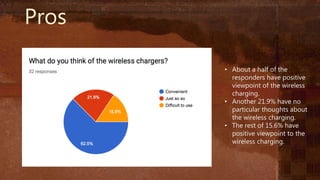
• About a half of the
responders have positive
viewpoint of the wireless
charging.
• Another 21.9% have no
particular thoughts about
the wireless charging.
• The rest of 15.6% have
positive viewpoint to the
wireless charging.
Pros
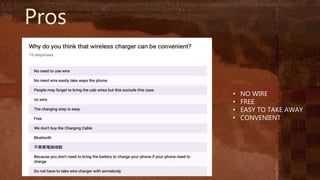
• NO WIRE
• FREE
• EASY TO TAKE AWAY
• CONVENIENT
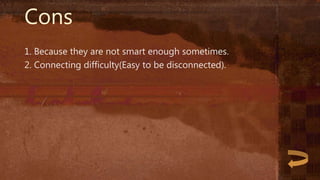
1. Because they are not smart enough sometimes.
2. Connecting difficulty(Easy to be disconnected).
Cons
Development
• As advancements continue to be made, wireless charging will
likely become more ubiquitous and convenient.
-medicine and medical care.
-be high power autonomous charging for robotics and
unmanned vehicles.
-Wearable technology is becoming increasingly integrated and
available in our daily lives.
Development
Reference
• https://www.youtube.com/watch?v=JGcgEXUgIkA
• https://powerbyproxi.com/wireless-charging/#future-of-
wireless-charging
• https://www.chargespot.com/news/state-of-wireless-charging-
the-present-and-the-future/
Wireless charging

Wireless charging

  • 1.
    Yue Wai Sze(17226279) XieXin Ying(16251172) Tse Man Fung (17225647) Wireless Charging 29 November 2017
  • 2.
    Contents Definition History PrincipleTypes Pros & Cons Development
  • 3.
    Definition • Wireless charginguses electromagnetic fields to safely transfer power from a transmitting source to a receiving device for the purposes of wirelessly charging a battery, without using a physical connection.
  • 4.
    History 1902 • Tesla fileda patent titled “Apparatus for Transmitting Electrical Energy” in which he describes a device that he believed could transmit electrical power from one conductor to another without the need for wires. 2006 • researchers at the MIT reported that they had discovered an efficient way to transfer power between coils separated by a few meters. 2009 • a consortium of interested companies called the Wireless Power Consortium announced they were nearing completion for a new industry standard for low power Inductive charging .
  • 5.
    Principle Wireless power transmissiontechnologies Use time-varying electric, magnetic, or electromagnetic fields.
  • 6.
    Types 1. CLOSE RANGE -Inductive charging technology. - High efficiency, cost effective to deploy and easy to design and work with. - Supports a variety of devices, even the big ones like vehicles.
  • 7.
    MID RANGE - Usesresonance charging. - Available in the market in 2016. - Wireless charging becomes more accessible and can be installed in more areas. - Qi and Rezence (A4WP) Types
  • 8.
    Types 2. LONG RANGE(Not available now) - Use a variety of different technologies, including radio frequencies, infrared light, ultrasound etc. - Long range charging is considered the holy grail of wireless charging. - Efficiency is questionable with long range charging as energy is lost to the environment. - likely only be limited to low power devices.
  • 9.
  • 10.
    Pros • About ahalf of the responders have positive viewpoint of the wireless charging. • Another 21.9% have no particular thoughts about the wireless charging. • The rest of 15.6% have positive viewpoint to the wireless charging.
  • 11.
    Pros • NO WIRE •FREE • EASY TO TAKE AWAY • CONVENIENT
  • 12.
    1. Because theyare not smart enough sometimes. 2. Connecting difficulty(Easy to be disconnected). Cons
  • 13.
    Development • As advancementscontinue to be made, wireless charging will likely become more ubiquitous and convenient. -medicine and medical care. -be high power autonomous charging for robotics and unmanned vehicles. -Wearable technology is becoming increasingly integrated and available in our daily lives.
  • 14.
  • 15.