KupferTek
High-Speed Data Cables
Energy-efficient, high-speed data connections
for data centers and local area networks
Kevin Krizman
KupferTek
Wayne, PA USA
KupferTek
What is “High Speed”?
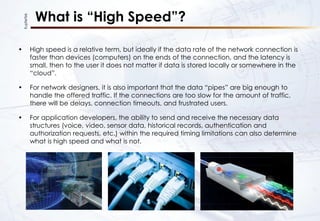
• High speed is a relative term, but ideally if the data rate of the network connection is
faster than devices (computers) on the ends of the connection, and the latency is
small, then to the user it does not matter if data is stored locally or somewhere in the
“cloud”.
• For network designers, it is also important that the data “pipes” are big enough to
handle the offered traffic. If the connections are too slow for the amount of traffic,
there will be delays, connection timeouts, and frustrated users.
• For application developers, the ability to send and receive the necessary data
structures (voice, video, sensor data, historical records, authentication and
authorization requests, etc.) within the required timing limitations can also determine
what is high speed and what is not.
KupferTek
What are data cables?
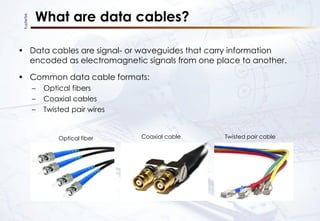
• Data cables are signal- or waveguides that carry information
encoded as electromagnetic signals from one place to another.
• Common data cable formats:
– Optical fibers
– Coaxial cables
– Twisted pair wires
Optical fiber Coaxial cable Twisted pair cable
KupferTek
Why is the choice of data cable important?
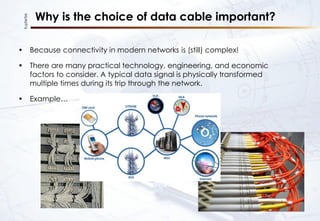
• Because connectivity in modern networks is (still) complex!
• There are many practical technology, engineering, and economic
factors to consider. A typical data signal is physically transformed
multiple times during its trip through the network.
• Example…
KupferTek
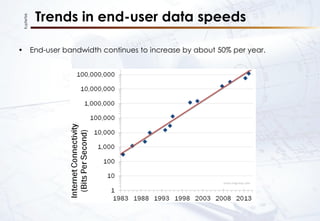
Trends in end-user data speeds
• End-user bandwidth continues to increase by about 50% per year.
KupferTek
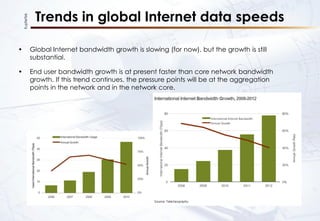
Trends in global Internet data speeds
• Global Internet bandwidth growth is slowing (for now), but the growth is still
substantial.
• End user bandwidth growth is at present faster than core network bandwidth
growth. If this trend continues, the pressure points will be at the aggregation
points in the network and in the network core.
KupferTek
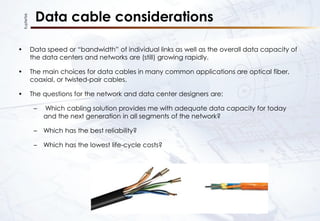
Data cable considerations
• Data speed or “bandwidth” of individual links as well as the overall data capacity of
the data centers and networks are (still) growing rapidly.
• The main choices for data cables in many common applications are optical fiber,
coaxial, or twisted-pair cables.
• The questions for the network and data center designers are:
– Which cabling solution provides me with adequate data capacity for today
and the next generation in all segments of the network?
– Which has the best reliability?
– Which has the lowest life-cycle costs?
KupferTek
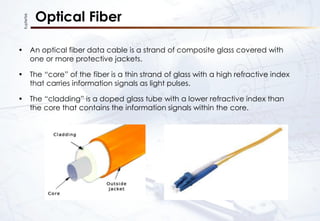
Optical Fiber
• An optical fiber data cable is a strand of composite glass covered with
one or more protective jackets.
• The “core” of the fiber is a thin strand of glass with a high refractive index
that carries information signals as light pulses.
• The “cladding” is a doped glass tube with a lower refractive index than
the core that contains the information signals within the core.
KupferTek
Types of optical fibers
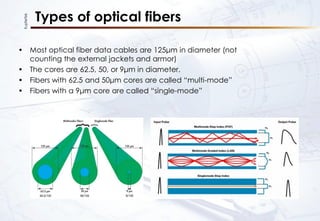
• Most optical fiber data cables are 125μm in diameter (not
counting the external jackets and armor)
• The cores are 62.5, 50, or 9μm in diameter.
• Fibers with 62.5 and 50μm cores are called “multi-mode”
• Fibers with a 9μm core are called “single-mode”
KupferTek
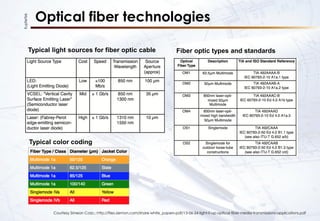
Optical fiber technologies
Courtesy Simeon Corp.: http://files.siemon.com/share-white_papers-pdf/13-06-24-light-it-up-optical-fiber-media-transmissions-applications.pdf
Typical light sources for fiber optic cable Fiber optic types and standards
Typical color coding
KupferTek
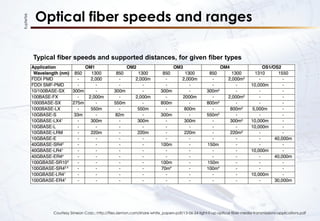
Optical fiber speeds and ranges
Typical fiber speeds and supported distances, for given fiber types
Courtesy Simeon Corp.: http://files.siemon.com/share-white_papers-pdf/13-06-24-light-it-up-optical-fiber-media-transmissions-applications.pdf
KupferTek
Important fiber characteristics
• Purity of the core glass—reduces amplitude loss and physical dispersion of the
signal.
• Surface quality/transition between core and cladding—reduces signal dispersion
promotes maximum speed transmission.
• Precision and polish of the connectors and splices—enables reliable
transmission/reception of the signal at each end of the fiber cable. Light reflections
and losses need to minimized.
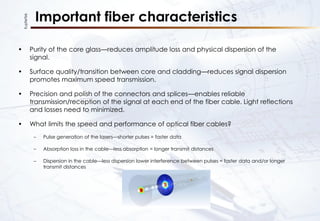
• What limits the speed and performance of optical fiber cables?
– Pulse generation of the lasers—shorter pulses = faster data
– Absorption loss in the cable—less absorption = longer transmit distances
– Dispersion in the cable—less dispersion lower interference between pulses = faster data and/or longer
transmit distances
KupferTek
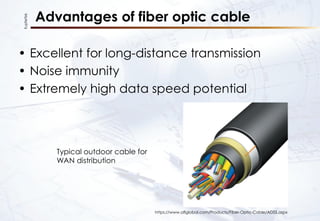
Advantages of fiber optic cable
• Excellent for long-distance transmission
• Noise immunity
• Extremely high data speed potential
https://www.aflglobal.com/Products/Fiber-Optic-Cable/ADSS.aspx
Typical outdoor cable for
WAN distribution
KupferTek
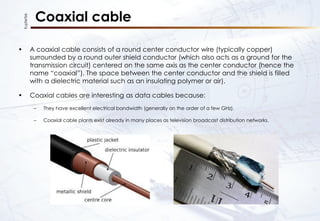
Coaxial cable
• A coaxial cable consists of a round center conductor wire (typically copper)
surrounded by a round outer shield conductor (which also acts as a ground for the
transmission circuit) centered on the same axis as the center conductor (hence the
name “coaxial”). The space between the center conductor and the shield is filled
with a dielectric material such as an insulating polymer or air).
• Coaxial cables are interesting as data cables because:
– They have excellent electrical bandwidth (generally on the order of a few GHz).
– Coaxial cable plants exist already in many places as television broadcast distribution networks.
KupferTek
Coaxial cable
• Coaxial cables are interesting as data cables because:
– They have excellent electrical bandwidth (generally on the order of a GHz or more, depending on the cable
type and the length of the cable)
– Coaxial cable plants exist already in many places as television broadcast distribution networks.
– Coaxial cables are very simple to install and terminate.
– Coaxial networks are often very convenient for signal distribution commercial and residential buildings.
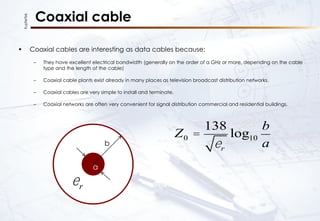
Z0 =
138
er
log10
b
ab
a
er
KupferTek
Coaxial cable properties
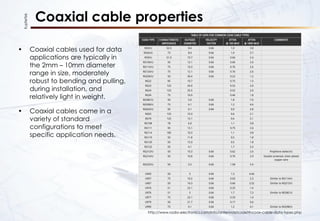
• Coaxial cables used for data
applications are typically in
the 2mm – 10mm diameter
range in size, moderately
robust to bending and pulling,
during installation, and
relatively light in weight.
• Coaxial cables come in a
variety of standard
configurations to meet
specific application needs.
http://www.radio-electronics.com/info/antennas/coax/rf-coax-cable-data-types.php
KupferTek
Coaxial cable speeds and range
Typical coaxial cable data speeds
• Coaxial cable systems generally have moderate to good data speeds for end users.
Future data speed increases are possible through aggregation of multiple RF
channels on the cable.
• With intermediate amplification, coaxial cables can carry signals a few kilometers.
Typical coaxial data channel
KupferTek
Important coaxial characteristics
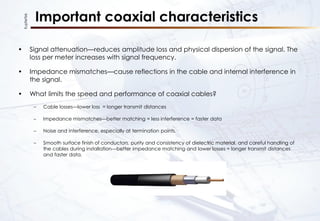
• Signal attenuation—reduces amplitude loss and physical dispersion of the signal. The
loss per meter increases with signal frequency.
• Impedance mismatches—cause reflections in the cable and internal interference in
the signal.
• What limits the speed and performance of coaxial cables?
– Cable losses—lower loss = longer transmit distances
– Impedance mismatches—better matching = less interference = faster data
– Noise and interference, especially at termination points.
– Smooth surface finish of conductors, purity and consistency of dielectric material, and careful handling of
the cables during installation—better impedance matching and lower losses = longer transmit distances
and faster data.
KupferTek
Advantages of coaxial cable
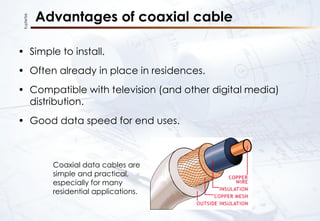
• Simple to install.
• Often already in place in residences.
• Compatible with television (and other digital media)
distribution.
• Good data speed for end uses.
Coaxial data cables are
simple and practical,
especially for many
residential applications.
KupferTek
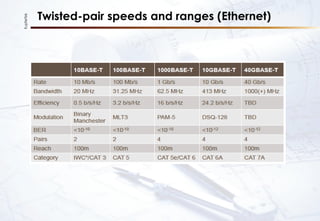
Twisted-pair data cables
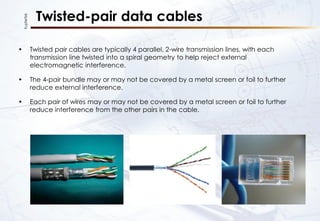
• Twisted pair cables are typically 4 parallel, 2-wire transmission lines, with each
transmission line twisted into a spiral geometry to help reject external
electromagnetic interference.
• The 4-pair bundle may or may not be covered by a metal screen or foil to further
reduce external interference.
• Each pair of wires may or may not be covered by a metal screen or foil to further
reduce interference from the other pairs in the cable.
KupferTek
Twisted-pair cables are two-wire waveguides
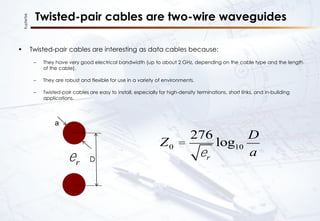
• Twisted-pair cables are interesting as data cables because:
– They have very good electrical bandwidth (up to about 2 GHz, depending on the cable type and the length
of the cable).
– They are robust and flexible for use in a variety of environments.
– Twisted-pair cables are easy to install, especially for high-density terminations, short links, and in-building
applications.
Z0 =
276
er
log10
D
aDer
a
KupferTek
Twisted-pair speeds and ranges (Ethernet)
KupferTek
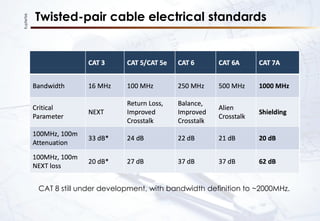
Twisted-pair cable electrical standards
CAT 8 still under development, with bandwidth definition to ~2000MHz.
KupferTek
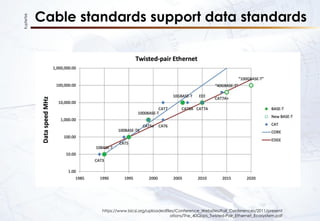
Cable standards support data standards
https://www.bicsi.org/uploadedfiles/Conference_Websites/Fall_Conferences/2011/present
ations/The_40Gbps_Twisted-Pair_Ethernet_Ecosystem.pdf
KupferTek
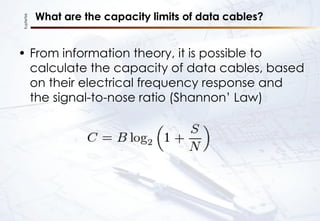
What are the capacity limits of data cables?
• From information theory, it is possible to
calculate the capacity of data cables, based
on their electrical frequency response and
the signal-to-nose ratio (Shannon’ Law)
KupferTek
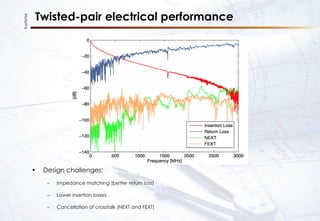
Twisted-pair electrical performance
• Design challenges:
– Impedance matching (better return loss)
– Lower insertion losses
– Cancellation of crosstalk (NEXT and FEXT)
KupferTek
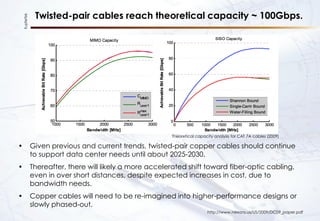
Twisted-pair cables reach theoretical capacity ~ 100Gbps.
• Given previous and current trends, twisted-pair copper cables should continue
to support data center needs until about 2025-2030.
• Thereafter, there will likely a more accelerated shift toward fiber-optic cabling,
even in over short distances, despite expected increases in cost, due to
bandwidth needs.
• Copper cables will need to be re-imagined into higher-performance designs or
slowly phased-out.
http://www.nexans.us/US/2009/DC09_paper.pdf
Theoretical capacity analysis for CAT 7A cables (2009)
KupferTek
Important twisted-pair characteristics
• Signal attenuation—reduces amplitude loss and physical dispersion of the signal. The
loss per meter increases with signal frequency.
• Impedance mismatches—cause reflections in the cable and internal interference in
the signal.
• Crosstalk between nearby twisted pairs—causes interfence in the signal
• Important considerations to minimize losses and interference
– Smooth wire surface finish.
– Consistent wire spacing, consistent twist angle,
– Pure and evenly applied dielectric materials on the wires.
KupferTek
Trends and drivers in data centers
• Most companies continue to expand their data center
infrastructure to support information-intensive business
needs and the need to global data
• The growth in so-called “Cloud Computing” and
outsourcing of network services is resulting in construction
of very large data centers. An emerging problem is the
ability to power and cool these massive installations.
• The information itself requires very little energy. It is the
storage, processing, and retrieval of the data that
consumes most of the energy.
• Energy consumers in the data center.
– Memory reading and writing
– Microprocessors
– Transmitters/Receivers (electric and optical)
– Modems and interfaces
• Virtually every watt of power that is used in a data center
needs to eventually be removed as heat using either
active or passive cooling.
KupferTek
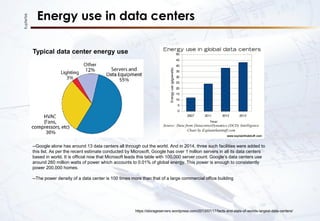
Energy use in data centers
--The power density of a data center is 100 times more than that of a large commercial office building
--Google alone has around 13 data centers all through out the world. And in 2014, three such facilities were added to
this list. As per the recent estimate conducted by Microsoft, Google has over 1 million servers in all its data centers
based in world. It is official now that Microsoft leads this table with 100,000 server count. Google’s data centers use
around 260 million watts of power which accounts to 0.01% of global energy. This power is enough to consistently
power 200,000 homes.
https://storageservers.wordpress.com/2013/07/17/facts-and-stats-of-worlds-largest-data-centers/
Typical data center energy use
KupferTek
Twisted-pair cables in data centers and LANs
• Twisted-pair data cable continues to be a viable material for data
centers and LANs, where >99% of the connections are 100m or less
in length.
• However, copper only retains its advantage as long as it can
compete with fiber optics in terms of data speed.
• The advantages listed above are only valid if the cable can support
enough data bandwidth. Data speed is essential.
• Energy consumption in networks and data centers is an emerging
issue. Electrically efficient cabling solutions, icluding twisted pair
cables, can help insure data centers are as energy efficient as
possible.
KupferTek
Twisted-pair wires remain a practical cabling solution…
• From the trends and developments in data processing and networking
speeds, copper data cables will continue to have a place for at least 10-15
years, or until about 2030 (with good installed performance for another 10
years or so).
• Copper cables represent a robust, cost-effective, and high performance
medium for connections in data centers and LANs.
• As data speeds routinely begin to exceed about 100Gbps, the use of either
fiber optics or other electrical cabling media with higher frequency
bandwidth will be required.
…for a while longer in their current form.
KupferTek
Conclusion
• In core networks and other very high traffic segments in the network, optical
fiber seems to be an interesting solution.
• At aggregation points where the connection density is very high, and the links
are short twisted pair is an interesting solution.
• For residential and small business end users, coaxial cable can also be an
interesting solution.
• The design space for cabling solutions is complex, and all three cabling
formats seem to have a place for some years into the future. As networking
technology and cabling development advance, the demand will favor high
bandwidth solutions, with the condition that they are also energy efficient and
have low-life cycle costs.
KupferTek
High-Speed Data Cables
Low-cost, energy-efficient, high-speed data connections
for data centers and local area networks

High Speed Data Cables

  • 1.
    KupferTek High-Speed Data Cables Energy-efficient,high-speed data connections for data centers and local area networks Kevin Krizman KupferTek Wayne, PA USA
  • 2.
    KupferTek What is “HighSpeed”? • High speed is a relative term, but ideally if the data rate of the network connection is faster than devices (computers) on the ends of the connection, and the latency is small, then to the user it does not matter if data is stored locally or somewhere in the “cloud”. • For network designers, it is also important that the data “pipes” are big enough to handle the offered traffic. If the connections are too slow for the amount of traffic, there will be delays, connection timeouts, and frustrated users. • For application developers, the ability to send and receive the necessary data structures (voice, video, sensor data, historical records, authentication and authorization requests, etc.) within the required timing limitations can also determine what is high speed and what is not.
  • 3.
    KupferTek What are datacables? • Data cables are signal- or waveguides that carry information encoded as electromagnetic signals from one place to another. • Common data cable formats: – Optical fibers – Coaxial cables – Twisted pair wires Optical fiber Coaxial cable Twisted pair cable
  • 4.
    KupferTek Why is thechoice of data cable important? • Because connectivity in modern networks is (still) complex! • There are many practical technology, engineering, and economic factors to consider. A typical data signal is physically transformed multiple times during its trip through the network. • Example…
  • 5.
    KupferTek Trends in end-userdata speeds • End-user bandwidth continues to increase by about 50% per year.
  • 6.
    KupferTek Trends in globalInternet data speeds • Global Internet bandwidth growth is slowing (for now), but the growth is still substantial. • End user bandwidth growth is at present faster than core network bandwidth growth. If this trend continues, the pressure points will be at the aggregation points in the network and in the network core.
  • 7.
    KupferTek Data cable considerations •Data speed or “bandwidth” of individual links as well as the overall data capacity of the data centers and networks are (still) growing rapidly. • The main choices for data cables in many common applications are optical fiber, coaxial, or twisted-pair cables. • The questions for the network and data center designers are: – Which cabling solution provides me with adequate data capacity for today and the next generation in all segments of the network? – Which has the best reliability? – Which has the lowest life-cycle costs?
  • 8.
    KupferTek Optical Fiber • Anoptical fiber data cable is a strand of composite glass covered with one or more protective jackets. • The “core” of the fiber is a thin strand of glass with a high refractive index that carries information signals as light pulses. • The “cladding” is a doped glass tube with a lower refractive index than the core that contains the information signals within the core.
  • 9.
    KupferTek Types of opticalfibers • Most optical fiber data cables are 125μm in diameter (not counting the external jackets and armor) • The cores are 62.5, 50, or 9μm in diameter. • Fibers with 62.5 and 50μm cores are called “multi-mode” • Fibers with a 9μm core are called “single-mode”
  • 10.
    KupferTek Optical fiber technologies CourtesySimeon Corp.: http://files.siemon.com/share-white_papers-pdf/13-06-24-light-it-up-optical-fiber-media-transmissions-applications.pdf Typical light sources for fiber optic cable Fiber optic types and standards Typical color coding
  • 11.
    KupferTek Optical fiber speedsand ranges Typical fiber speeds and supported distances, for given fiber types Courtesy Simeon Corp.: http://files.siemon.com/share-white_papers-pdf/13-06-24-light-it-up-optical-fiber-media-transmissions-applications.pdf
  • 12.
    KupferTek Important fiber characteristics •Purity of the core glass—reduces amplitude loss and physical dispersion of the signal. • Surface quality/transition between core and cladding—reduces signal dispersion promotes maximum speed transmission. • Precision and polish of the connectors and splices—enables reliable transmission/reception of the signal at each end of the fiber cable. Light reflections and losses need to minimized. • What limits the speed and performance of optical fiber cables? – Pulse generation of the lasers—shorter pulses = faster data – Absorption loss in the cable—less absorption = longer transmit distances – Dispersion in the cable—less dispersion lower interference between pulses = faster data and/or longer transmit distances
  • 13.
    KupferTek Advantages of fiberoptic cable • Excellent for long-distance transmission • Noise immunity • Extremely high data speed potential https://www.aflglobal.com/Products/Fiber-Optic-Cable/ADSS.aspx Typical outdoor cable for WAN distribution
  • 14.
    KupferTek Coaxial cable • Acoaxial cable consists of a round center conductor wire (typically copper) surrounded by a round outer shield conductor (which also acts as a ground for the transmission circuit) centered on the same axis as the center conductor (hence the name “coaxial”). The space between the center conductor and the shield is filled with a dielectric material such as an insulating polymer or air). • Coaxial cables are interesting as data cables because: – They have excellent electrical bandwidth (generally on the order of a few GHz). – Coaxial cable plants exist already in many places as television broadcast distribution networks.
  • 15.
    KupferTek Coaxial cable • Coaxialcables are interesting as data cables because: – They have excellent electrical bandwidth (generally on the order of a GHz or more, depending on the cable type and the length of the cable) – Coaxial cable plants exist already in many places as television broadcast distribution networks. – Coaxial cables are very simple to install and terminate. – Coaxial networks are often very convenient for signal distribution commercial and residential buildings. Z0 = 138 er log10 b ab a er
  • 16.
    KupferTek Coaxial cable properties •Coaxial cables used for data applications are typically in the 2mm – 10mm diameter range in size, moderately robust to bending and pulling, during installation, and relatively light in weight. • Coaxial cables come in a variety of standard configurations to meet specific application needs. http://www.radio-electronics.com/info/antennas/coax/rf-coax-cable-data-types.php
  • 17.
    KupferTek Coaxial cable speedsand range Typical coaxial cable data speeds • Coaxial cable systems generally have moderate to good data speeds for end users. Future data speed increases are possible through aggregation of multiple RF channels on the cable. • With intermediate amplification, coaxial cables can carry signals a few kilometers. Typical coaxial data channel
  • 18.
    KupferTek Important coaxial characteristics •Signal attenuation—reduces amplitude loss and physical dispersion of the signal. The loss per meter increases with signal frequency. • Impedance mismatches—cause reflections in the cable and internal interference in the signal. • What limits the speed and performance of coaxial cables? – Cable losses—lower loss = longer transmit distances – Impedance mismatches—better matching = less interference = faster data – Noise and interference, especially at termination points. – Smooth surface finish of conductors, purity and consistency of dielectric material, and careful handling of the cables during installation—better impedance matching and lower losses = longer transmit distances and faster data.
  • 19.
    KupferTek Advantages of coaxialcable • Simple to install. • Often already in place in residences. • Compatible with television (and other digital media) distribution. • Good data speed for end uses. Coaxial data cables are simple and practical, especially for many residential applications.
  • 20.
    KupferTek Twisted-pair data cables •Twisted pair cables are typically 4 parallel, 2-wire transmission lines, with each transmission line twisted into a spiral geometry to help reject external electromagnetic interference. • The 4-pair bundle may or may not be covered by a metal screen or foil to further reduce external interference. • Each pair of wires may or may not be covered by a metal screen or foil to further reduce interference from the other pairs in the cable.
  • 21.
    KupferTek Twisted-pair cables aretwo-wire waveguides • Twisted-pair cables are interesting as data cables because: – They have very good electrical bandwidth (up to about 2 GHz, depending on the cable type and the length of the cable). – They are robust and flexible for use in a variety of environments. – Twisted-pair cables are easy to install, especially for high-density terminations, short links, and in-building applications. Z0 = 276 er log10 D aDer a
  • 22.
  • 23.
    KupferTek Twisted-pair cable electricalstandards CAT 8 still under development, with bandwidth definition to ~2000MHz.
  • 24.
    KupferTek Cable standards supportdata standards https://www.bicsi.org/uploadedfiles/Conference_Websites/Fall_Conferences/2011/present ations/The_40Gbps_Twisted-Pair_Ethernet_Ecosystem.pdf
  • 25.
    KupferTek What are thecapacity limits of data cables? • From information theory, it is possible to calculate the capacity of data cables, based on their electrical frequency response and the signal-to-nose ratio (Shannon’ Law)
  • 26.
    KupferTek Twisted-pair electrical performance •Design challenges: – Impedance matching (better return loss) – Lower insertion losses – Cancellation of crosstalk (NEXT and FEXT)
  • 27.
    KupferTek Twisted-pair cables reachtheoretical capacity ~ 100Gbps. • Given previous and current trends, twisted-pair copper cables should continue to support data center needs until about 2025-2030. • Thereafter, there will likely a more accelerated shift toward fiber-optic cabling, even in over short distances, despite expected increases in cost, due to bandwidth needs. • Copper cables will need to be re-imagined into higher-performance designs or slowly phased-out. http://www.nexans.us/US/2009/DC09_paper.pdf Theoretical capacity analysis for CAT 7A cables (2009)
  • 28.
    KupferTek Important twisted-pair characteristics •Signal attenuation—reduces amplitude loss and physical dispersion of the signal. The loss per meter increases with signal frequency. • Impedance mismatches—cause reflections in the cable and internal interference in the signal. • Crosstalk between nearby twisted pairs—causes interfence in the signal • Important considerations to minimize losses and interference – Smooth wire surface finish. – Consistent wire spacing, consistent twist angle, – Pure and evenly applied dielectric materials on the wires.
  • 29.
    KupferTek Trends and driversin data centers • Most companies continue to expand their data center infrastructure to support information-intensive business needs and the need to global data • The growth in so-called “Cloud Computing” and outsourcing of network services is resulting in construction of very large data centers. An emerging problem is the ability to power and cool these massive installations. • The information itself requires very little energy. It is the storage, processing, and retrieval of the data that consumes most of the energy. • Energy consumers in the data center. – Memory reading and writing – Microprocessors – Transmitters/Receivers (electric and optical) – Modems and interfaces • Virtually every watt of power that is used in a data center needs to eventually be removed as heat using either active or passive cooling.
  • 30.
    KupferTek Energy use indata centers --The power density of a data center is 100 times more than that of a large commercial office building --Google alone has around 13 data centers all through out the world. And in 2014, three such facilities were added to this list. As per the recent estimate conducted by Microsoft, Google has over 1 million servers in all its data centers based in world. It is official now that Microsoft leads this table with 100,000 server count. Google’s data centers use around 260 million watts of power which accounts to 0.01% of global energy. This power is enough to consistently power 200,000 homes. https://storageservers.wordpress.com/2013/07/17/facts-and-stats-of-worlds-largest-data-centers/ Typical data center energy use
  • 31.
    KupferTek Twisted-pair cables indata centers and LANs • Twisted-pair data cable continues to be a viable material for data centers and LANs, where >99% of the connections are 100m or less in length. • However, copper only retains its advantage as long as it can compete with fiber optics in terms of data speed. • The advantages listed above are only valid if the cable can support enough data bandwidth. Data speed is essential. • Energy consumption in networks and data centers is an emerging issue. Electrically efficient cabling solutions, icluding twisted pair cables, can help insure data centers are as energy efficient as possible.
  • 32.
    KupferTek Twisted-pair wires remaina practical cabling solution… • From the trends and developments in data processing and networking speeds, copper data cables will continue to have a place for at least 10-15 years, or until about 2030 (with good installed performance for another 10 years or so). • Copper cables represent a robust, cost-effective, and high performance medium for connections in data centers and LANs. • As data speeds routinely begin to exceed about 100Gbps, the use of either fiber optics or other electrical cabling media with higher frequency bandwidth will be required. …for a while longer in their current form.
  • 33.
    KupferTek Conclusion • In corenetworks and other very high traffic segments in the network, optical fiber seems to be an interesting solution. • At aggregation points where the connection density is very high, and the links are short twisted pair is an interesting solution. • For residential and small business end users, coaxial cable can also be an interesting solution. • The design space for cabling solutions is complex, and all three cabling formats seem to have a place for some years into the future. As networking technology and cabling development advance, the demand will favor high bandwidth solutions, with the condition that they are also energy efficient and have low-life cycle costs.
  • 34.
    KupferTek High-Speed Data Cables Low-cost,energy-efficient, high-speed data connections for data centers and local area networks