OPHTHALMIC SURGICAL
INSTRUMENTS
P R E S E N T E R : D R . I D D I N D YA B AW E
M M E D O P H T H A L M O L O G Y
M A K E R E R E U N I V E R S I T Y
M AY 2 0 2 1
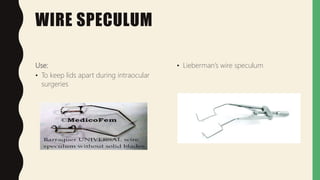
WIRE SPECULUM
Use:
• To keep lids apart during intraocular
surgeries
• Lieberman’s wire speculum
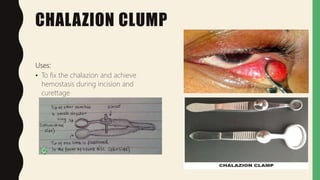
CHALAZION CLUMP
Uses:
• To fix the chalazion and achieve
hemostasis during incision and
curettage
CHALAZION SCOOP
• It has a small cup with sharp margins
attached to a narrow handle
• Uses:
• To scoop out content of chalazion
during incision and curettage
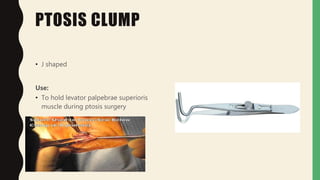
PTOSIS CLUMP
• J shaped
Use:
• To hold levator palpebrae superioris
muscle during ptosis surgery
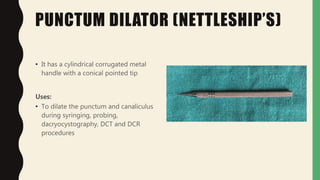
PUNCTUM DILATOR (NETTLESHIP’S)
• It has a cylindrical corrugated metal
handle with a conical pointed tip
Uses:
• To dilate the punctum and canaliculus
during syringing, probing,
dacryocystography, DCT and DCR
procedures
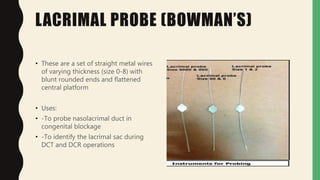
LACRIMAL PROBE (BOWMAN’S)
• These are a set of straight metal wires
of varying thickness (size 0-8) with
blunt rounded ends and flattened
central platform
• Uses:
• -To probe nasolacrimal duct in
congenital blockage
• -To identify the lacrimal sac during
DCT and DCR operations
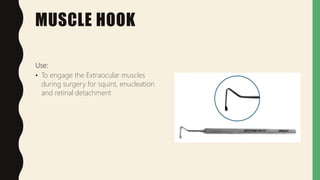
MUSCLE HOOK
Use:
• To engage the Extraocular muscles
during surgery for squint, enucleation
and retinal detachment
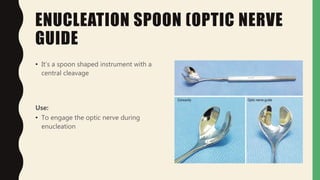
ENUCLEATION SPOON (OPTIC NERVE
GUIDE
• It’s a spoon shaped instrument with a
central cleavage
Use:
• To engage the optic nerve during
enucleation
• .
ENUCLEATION SCISSORS
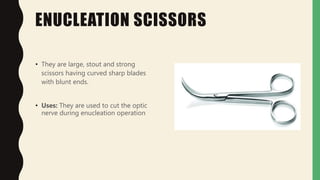
• They are large, stout and strong
scissors having curved sharp blades
with blunt ends.
• Uses: They are used to cut the optic
nerve during enucleation operation
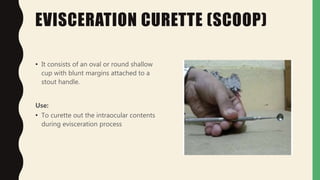
EVISCERATION CURETTE (SCOOP)
• It consists of an oval or round shallow
cup with blunt margins attached to a
stout handle.
Use:
• To curette out the intraocular contents
during evisceration process
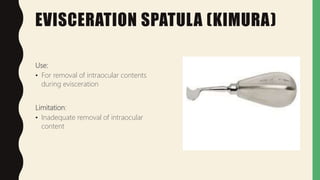
EVISCERATION SPATULA (KIMURA)
Use:
• For removal of intraocular contents
during evisceration
Limitation:
• Inadequate removal of intraocular
content
BONE PUNCH
Use:
• To enlarge the bony opening during
DCR operation by punching the bone
from margins of the opening
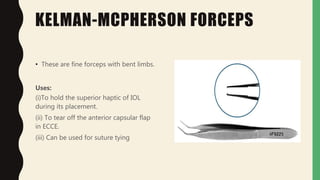
KELMAN-MCPHERSON FORCEPS
• These are fine forceps with bent limbs.
Uses:
(i)To hold the superior haptic of IOL
during its placement.
(ii) To tear off the anterior capsular flap
in ECCE.
(iii) Can be used for suture tying
SUPERIOR RECTUS HOLDING
FORCEPS
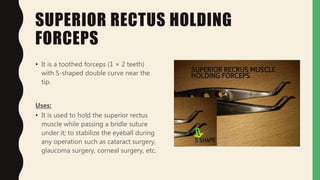
• It is a toothed forceps (1 × 2 teeth)
with S-shaped double curve near the
tip.
Uses:
• It is used to hold the superior rectus
muscle while passing a bridle suture
under it; to stabilize the eyeball during
any operation such as cataract surgery,
glaucoma surgery, corneal surgery, etc.
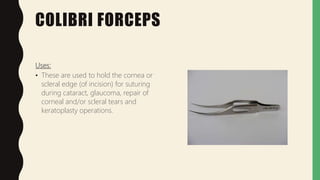
COLIBRI FORCEPS
Uses:
• These are used to hold the cornea or
scleral edge (of incision) for suturing
during cataract, glaucoma, repair of
corneal and/or scleral tears and
keratoplasty operations.
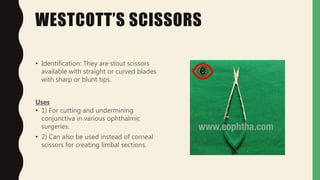
WESTCOTT’S SCISSORS
• Identification: They are stout scissors
available with straight or curved blades
with sharp or blunt tips.
Uses
• 1) For cutting and undermining
conjunctiva in various ophthalmic
surgeries.
• 2) Can also be used instead of corneal
scissors for creating limbal sections.
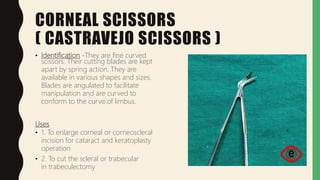
CORNEAL SCISSORS
( CASTRAVEJO SCISSORS )
• Identification -They are fine curved
scissors. Their cutting blades are kept
apart by spring action. They are
available in various shapes and sizes.
Blades are angulated to facilitate
manipulation and are curved to
conform to the curve of limbus.
Uses
• 1. To enlarge corneal or corneoscleral
incision for cataract and keratoplasty
operation
• 2. To cut the scleral or trabecular
in trabeculectomy
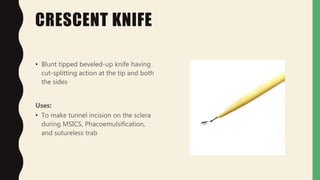
CRESCENT KNIFE
• Blunt tipped beveled-up knife having
cut-splitting action at the tip and both
the sides
Uses:
• To make tunnel incision on the sclera
during MSICS, Phacoemulsification,
and sutureless trab
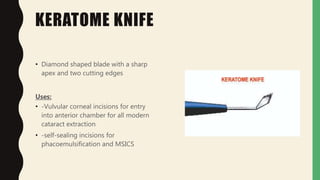
KERATOME KNIFE
• Diamond shaped blade with a sharp
apex and two cutting edges
Uses:
• -Vulvular corneal incisions for entry
into anterior chamber for all modern
cataract extraction
• -self-sealing incisions for
phacoemulsification and MSICS
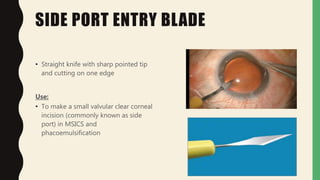
SIDE PORT ENTRY BLADE
• Straight knife with sharp pointed tip
and cutting on one edge
Use:
• To make a small valvular clear corneal
incision (commonly known as side
port) in MSICS and
phacoemulsification
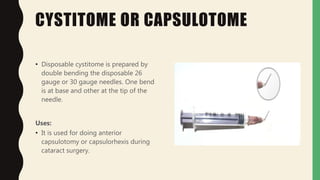
CYSTITOME OR CAPSULOTOME
• Disposable cystitome is prepared by
double bending the disposable 26
gauge or 30 gauge needles. One bend
is at base and other at the tip of the
needle.
Uses:
• It is used for doing anterior
capsulotomy or capsulorhexis during
cataract surgery.
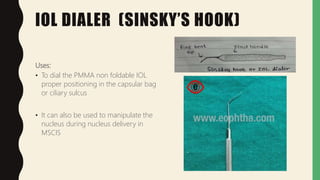
IOL DIALER (SINSKY’S HOOK)
Uses:
• To dial the PMMA non foldable IOL
proper positioning in the capsular bag
or ciliary sulcus
• It can also be used to manipulate the
nucleus during nucleus delivery in
MSCIS
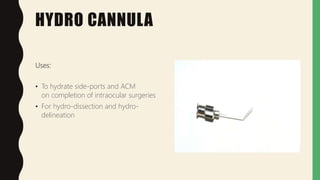
HYDRO CANNULA
Uses:
• To hydrate side-ports and ACM
on completion of intraocular surgeries
• For hydro-dissection and hydro-
delineation
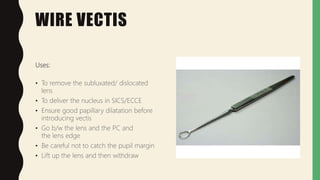
WIRE VECTIS
Uses:
• To remove the subluxated/ dislocated
lens
• To deliver the nucleus in SICS/ECCE
• Ensure good papillary dilatation before
introducing vectis
• Go b/w the lens and the PC and
the lens edge
• Be careful not to catch the pupil margin
• Lift up the lens and then withdraw
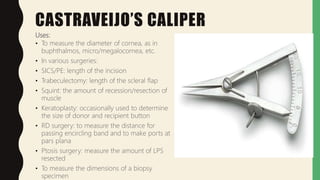
CASTRAVEIJO’S CALIPER
Uses:
• To measure the diameter of cornea, as in
buphthalmos, micro/megalocornea, etc.
• In various surgeries:
• SICS/PE: length of the incision
• Trabeculectomy: length of the scleral flap
• Squint: the amount of recession/resection of
muscle
• Keratoplasty: occasionally used to determine
the size of donor and recipient button
• RD surgery: to measure the distance for
passing encircling band and to make ports at
pars plana
• Ptosis surgery: measure the amount of LPS
resected
• To measure the dimensions of a biopsy
specimen
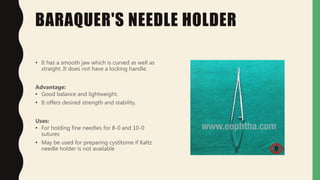
BARAQUER'S NEEDLE HOLDER
• It has a smooth jaw which is curved as well as
straight. It does not have a locking handle.
Advantage:
• Good balance and lightweight.
• It offers desired strength and stability.
Uses:
• For holding fine needles for 8-0 and 10-0
sutures
• May be used for preparing cystitome if Kaltz
needle holder is not available
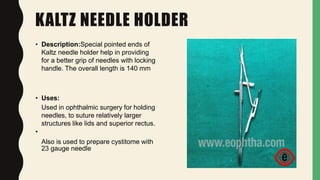
KALTZ NEEDLE HOLDER
• Description:Special pointed ends of
Kaltz needle holder help in providing
for a better grip of needles with locking
handle. The overall length is 140 mm
• Uses:
Used in ophthalmic surgery for holding
needles, to suture relatively larger
structures like lids and superior rectus.
•
Also is used to prepare cystitome with
23 gauge needle
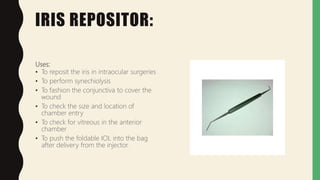
IRIS REPOSITOR:
Uses:
• To reposit the iris in intraocular surgeries
• To perform synechiolysis
• To fashion the conjunctiva to cover the
wound
• To check the size and location of
chamber entry
• To check for vitreous in the anterior
chamber
• To push the foldable IOL into the bag
after delivery from the injector.
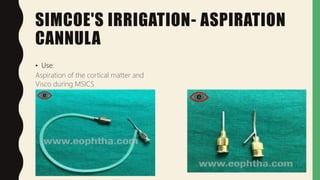
SIMCOE'S IRRIGATION- ASPIRATION
CANNULA
• Use:
Aspiration of the cortical matter and
Visco during MSICS
REFERENCES
• http://www.eophtha.com/posts/instruments-used-in-cataract-surgery-ready-reckoner-
for-the-post-graduates
• Comprehensive Ophthalmology by Khuranah
• Video on Ophthalmic Instruments by Dr. Bhatia:
https://www.youtube.com/watch?v=20zrc8JlTBU&list=PL6avnbChzuQI84JThv5GEutU-
L9Wr_1U1

Ophthalmic surgical instruments by Dr. Iddi.pptx

  • 1.
    OPHTHALMIC SURGICAL INSTRUMENTS P RE S E N T E R : D R . I D D I N D YA B AW E M M E D O P H T H A L M O L O G Y M A K E R E R E U N I V E R S I T Y M AY 2 0 2 1
  • 2.
    WIRE SPECULUM Use: • Tokeep lids apart during intraocular surgeries • Lieberman’s wire speculum
  • 3.
    CHALAZION CLUMP Uses: • Tofix the chalazion and achieve hemostasis during incision and curettage
  • 4.
    CHALAZION SCOOP • Ithas a small cup with sharp margins attached to a narrow handle • Uses: • To scoop out content of chalazion during incision and curettage
  • 5.
    PTOSIS CLUMP • Jshaped Use: • To hold levator palpebrae superioris muscle during ptosis surgery
  • 6.
    PUNCTUM DILATOR (NETTLESHIP’S) •It has a cylindrical corrugated metal handle with a conical pointed tip Uses: • To dilate the punctum and canaliculus during syringing, probing, dacryocystography, DCT and DCR procedures
  • 7.
    LACRIMAL PROBE (BOWMAN’S) •These are a set of straight metal wires of varying thickness (size 0-8) with blunt rounded ends and flattened central platform • Uses: • -To probe nasolacrimal duct in congenital blockage • -To identify the lacrimal sac during DCT and DCR operations
  • 8.
    MUSCLE HOOK Use: • Toengage the Extraocular muscles during surgery for squint, enucleation and retinal detachment
  • 9.
    ENUCLEATION SPOON (OPTICNERVE GUIDE • It’s a spoon shaped instrument with a central cleavage Use: • To engage the optic nerve during enucleation • .
  • 10.
    ENUCLEATION SCISSORS • Theyare large, stout and strong scissors having curved sharp blades with blunt ends. • Uses: They are used to cut the optic nerve during enucleation operation
  • 11.
    EVISCERATION CURETTE (SCOOP) •It consists of an oval or round shallow cup with blunt margins attached to a stout handle. Use: • To curette out the intraocular contents during evisceration process
  • 12.
    EVISCERATION SPATULA (KIMURA) Use: •For removal of intraocular contents during evisceration Limitation: • Inadequate removal of intraocular content
  • 13.
    BONE PUNCH Use: • Toenlarge the bony opening during DCR operation by punching the bone from margins of the opening
  • 14.
    KELMAN-MCPHERSON FORCEPS • Theseare fine forceps with bent limbs. Uses: (i)To hold the superior haptic of IOL during its placement. (ii) To tear off the anterior capsular flap in ECCE. (iii) Can be used for suture tying
  • 15.
    SUPERIOR RECTUS HOLDING FORCEPS •It is a toothed forceps (1 × 2 teeth) with S-shaped double curve near the tip. Uses: • It is used to hold the superior rectus muscle while passing a bridle suture under it; to stabilize the eyeball during any operation such as cataract surgery, glaucoma surgery, corneal surgery, etc.
  • 16.
    COLIBRI FORCEPS Uses: • Theseare used to hold the cornea or scleral edge (of incision) for suturing during cataract, glaucoma, repair of corneal and/or scleral tears and keratoplasty operations.
  • 17.
    WESTCOTT’S SCISSORS • Identification:They are stout scissors available with straight or curved blades with sharp or blunt tips. Uses • 1) For cutting and undermining conjunctiva in various ophthalmic surgeries. • 2) Can also be used instead of corneal scissors for creating limbal sections.
  • 18.
    CORNEAL SCISSORS ( CASTRAVEJOSCISSORS ) • Identification -They are fine curved scissors. Their cutting blades are kept apart by spring action. They are available in various shapes and sizes. Blades are angulated to facilitate manipulation and are curved to conform to the curve of limbus. Uses • 1. To enlarge corneal or corneoscleral incision for cataract and keratoplasty operation • 2. To cut the scleral or trabecular in trabeculectomy
  • 19.
    CRESCENT KNIFE • Blunttipped beveled-up knife having cut-splitting action at the tip and both the sides Uses: • To make tunnel incision on the sclera during MSICS, Phacoemulsification, and sutureless trab
  • 20.
    KERATOME KNIFE • Diamondshaped blade with a sharp apex and two cutting edges Uses: • -Vulvular corneal incisions for entry into anterior chamber for all modern cataract extraction • -self-sealing incisions for phacoemulsification and MSICS
  • 21.
    SIDE PORT ENTRYBLADE • Straight knife with sharp pointed tip and cutting on one edge Use: • To make a small valvular clear corneal incision (commonly known as side port) in MSICS and phacoemulsification
  • 22.
    CYSTITOME OR CAPSULOTOME •Disposable cystitome is prepared by double bending the disposable 26 gauge or 30 gauge needles. One bend is at base and other at the tip of the needle. Uses: • It is used for doing anterior capsulotomy or capsulorhexis during cataract surgery.
  • 23.
    IOL DIALER (SINSKY’SHOOK) Uses: • To dial the PMMA non foldable IOL proper positioning in the capsular bag or ciliary sulcus • It can also be used to manipulate the nucleus during nucleus delivery in MSCIS
  • 24.
    HYDRO CANNULA Uses: • Tohydrate side-ports and ACM on completion of intraocular surgeries • For hydro-dissection and hydro- delineation
  • 25.
    WIRE VECTIS Uses: • Toremove the subluxated/ dislocated lens • To deliver the nucleus in SICS/ECCE • Ensure good papillary dilatation before introducing vectis • Go b/w the lens and the PC and the lens edge • Be careful not to catch the pupil margin • Lift up the lens and then withdraw
  • 26.
    CASTRAVEIJO’S CALIPER Uses: • Tomeasure the diameter of cornea, as in buphthalmos, micro/megalocornea, etc. • In various surgeries: • SICS/PE: length of the incision • Trabeculectomy: length of the scleral flap • Squint: the amount of recession/resection of muscle • Keratoplasty: occasionally used to determine the size of donor and recipient button • RD surgery: to measure the distance for passing encircling band and to make ports at pars plana • Ptosis surgery: measure the amount of LPS resected • To measure the dimensions of a biopsy specimen
  • 27.
    BARAQUER'S NEEDLE HOLDER •It has a smooth jaw which is curved as well as straight. It does not have a locking handle. Advantage: • Good balance and lightweight. • It offers desired strength and stability. Uses: • For holding fine needles for 8-0 and 10-0 sutures • May be used for preparing cystitome if Kaltz needle holder is not available
  • 28.
    KALTZ NEEDLE HOLDER •Description:Special pointed ends of Kaltz needle holder help in providing for a better grip of needles with locking handle. The overall length is 140 mm • Uses: Used in ophthalmic surgery for holding needles, to suture relatively larger structures like lids and superior rectus. • Also is used to prepare cystitome with 23 gauge needle
  • 29.
    IRIS REPOSITOR: Uses: • Toreposit the iris in intraocular surgeries • To perform synechiolysis • To fashion the conjunctiva to cover the wound • To check the size and location of chamber entry • To check for vitreous in the anterior chamber • To push the foldable IOL into the bag after delivery from the injector.
  • 30.
    SIMCOE'S IRRIGATION- ASPIRATION CANNULA •Use: Aspiration of the cortical matter and Visco during MSICS
  • 31.
    REFERENCES • http://www.eophtha.com/posts/instruments-used-in-cataract-surgery-ready-reckoner- for-the-post-graduates • ComprehensiveOphthalmology by Khuranah • Video on Ophthalmic Instruments by Dr. Bhatia: https://www.youtube.com/watch?v=20zrc8JlTBU&list=PL6avnbChzuQI84JThv5GEutU- L9Wr_1U1