Parenteral’s
(Preformulation to Evaluation)
Presented By – Ms. Chitralekha G. Therkar
Asst Professor, Siddhivinayak College of Pharmacy, Warora
Index
1. Abbreviations
2. Introduction
3. Classification
4.Preformulation Factors
5. Excipients
6.Method of Preparation
7. Evaluation of Parenterals
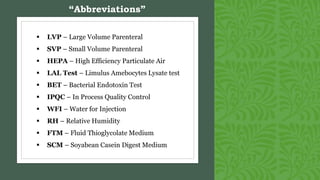
 LVP – Large Volume Parenteral
 SVP – Small Volume Parenteral
 HEPA – High Efficiency Particulate Air
 LAL Test – Limulus Amebocytes Lysate test
 BET – Bacterial Endotoxin Test
 IPQC – In Process Quality Control
 WFI – Water for Injection
 RH – Relative Humidity
 FTM – Fluid Thioglycolate Medium
 SCM – Soyabean Casein Digest Medium
“Abbreviations”
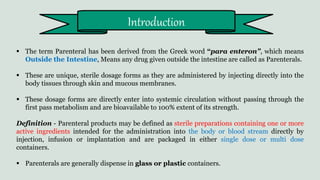
 The term Parenteral has been derived from the Greek word “para enteron”, which means
Outside the Intestine, Means any drug given outside the intestine are called as Parenterals.
 These are unique, sterile dosage forms as they are administered by injecting directly into the
body tissues through skin and mucous membranes.
 These dosage forms are directly enter into systemic circulation without passing through the
first pass metabolism and are bioavailable to 100% extent of its strength.
Definition - Parenteral products may be defined as sterile preparations containing one or more
active ingredients intended for the administration into the body or blood stream directly by
injection, infusion or implantation and are packaged in either single dose or multi dose
containers.
 Parenterals are generally dispense in glass or plastic containers.
Introduction
Advantages of Parenterals
1. Parenteral products can bypass presystemic or first pass metabolism.
2. The onset of action of parenterals is quick.
3. The drugs, which cannot be administered orally, can be administered by this route.
4. The patients who are vomiting or unconscious cannot take drug by oral route. In such cases,
the drug can be administered by this route.
5. The drug action can be prolonged by modifying the formulation.
6. This route can deliver transfusion fluids containing nutritive like glucose and electrolytes such
as sodium chloride.
Limitations of Parenterals
1. Injection causes pain at the site of injection.
2. The trained persons are required to administer the drug.
3. The administration of drug through wrong route of injection may prove to be fatal.
4. It is difficult to save a patient when overdose is given.
5. There are chances of sensitivity reaction or allergic reaction of a drug by an individual. These
reactions are sometimes fatal and lead to death.
6. An injected dose cannot be reverted.
Types of Parenterals
According to USP, the types of Parenteral products are based on the Volume and the state of product.
1. Based on Volume
 SVP – An injection that is packed in containers labelled as containing 100 ml or less.
 LVP – These are parenterals designed to provide fluid, calories and electrolytes to the body and
the volume is more than 100ml.
2. Based on States of products
 Injection - Injections contain sterile solutions and are prepared by dissolving the active
ingredient and other substances in water for injection or other suitable non-aqueous base. The
solution to be injected may show sediments which can be dispersed easily by shaking the
container. The suspension should remain stable in order to deliver a homogenous dose whenever
withdrawal is made from the container.
Classification
 Infusions - These parenteral preparations are composed of sterile aqueous solution with water
as its continuous phase. The preparations are free from bacterial endotoxins or pyrogens and are
made isotonic with blood. They do not contain any antimicrobial preservatives.
 Powder for Injection - These are sterile solid compounds that are distributed in their final
volume when the vial or container is shaken to form a clear particle-free solution.
 Concentrated Solutions for Injections - The concentrated solutions are diluted with water
for injection before they are administered through injection or through intravenous infusion.
 Implants - These solid sterile preparations are implanted in the tissue in order to release the
active ingredient for long periods. They are stored in sterile containers individually.
 Injectable Emulsion - These are liquid preparations in which the drug substances are dissolved
or dispersed in a suitable emulsion medium. These products provide essential fatty acid and
vitamins.
 Oily Injection - These are used to prepare the parenteral controlled release dosage forms
Routes of Administration
1. Intravenous Route
2. Intramuscular Route
3. Intraperitoneal Route
4. Subcutaneous Route
5. Intradermal Route
6. Intrathecal Route
7. Epidural Route
8. Intraosseous Route
9. Intra – Arterial Route
Preformulation involves the study about physical and chemical properties of drug substance prior
formulation. These studies are performed under stressed conditions of temperature, humidity, light
and oxygen so that the reactions are accelerated, and potential reaction are detected.
A few physicochemical properties that can affect a drug substance are as follows,
 Melting point - It is the temperature at which the solid and liquid phases are in equilibrium. Its
determination is a primary indication of purity.
 Solubility - This property is essential for developing solution to be injected either intravenously
or intramuscularly. It is a function of chemical structure: salts of acid or bases are the drugs that
can achieve the desired degree of water solubility.
 Molecular structure and weight - These are the basic characteristics of the drug from which
the potential properties and reactivities of functional groups can be determined.
Preformulation factors
 Particle Size and Shape - Study of particle size give information about solubility, dissolution
rate and absorption etc. These characteristics are determined by scanning electron microscope or
an optical microscope with polarizing attachments.
 Ionization constant - This property is used to determine the PH-dependent solubility of a
compound. Potentiometric PH titration or PH-solubility analysis is used for determining the PKa
value. Ionization constant of a compound also helps in determining the degree of ionization of an
acid or base. Degree of ionization depends upon the PH.
 For acidic drugs Pka ranges from 3-7.5 and for basic drugs Pka ranges from 7- 11.
 Partition Coefficient (P) - It is a ratio of equilibrium concentration of drug in aqueous and
oily phases in contact with each other at a constant temperature.
 Partition coefficient can be expressed as “P” = [Coil / Cwater],
 Where, Coil -Organic phase concentration
Cwater - Aqueous phase concentration
 The formulations of parenteral preparations need careful planning, thorough knowledge of
medicaments and additives to be used.
 The excess use of additives in parenteral products should be avoided as some of these may
interfere with the drug.
 In the preparation of parental products, the following substances are added to make a stable
preparation.
1. Vehicles
2. Additives
 Solubilizing agents
 Stabilizers
 Buffering agents
 Antibacterial agents
 Chelating agents.
 Suspending, emulsifying and wetting agents.
 Tonicity factors
EXCIPIENTS
1. Vehicles
There are two types of vehicles, which are commonly used for the preparation of injections,
A) Aqueous vehicles - water is used as vehicle for majority of injections because water is tolerated
well by the body and is safest to administer.
The aqueous vehicle used are,
1) Water for injections.
2) Water for injection free from CO2 (carbon dioxide)
3) Water for injection free from dissolved air
 Water for injection is sterile water, which is free from volatile, non- volatile impurities and from
pyrogens. Pyrogens are by-product of bacterial metabolism.
 Pyrogens are Liposaccharide, thermostable, soluble in water, unaffected by bactericide and can
pass through bacterial proof filter.
 Pyrogens can be removed from water by simple distillation process using an efficient trap which
prevents the pyrogen to enter to the condenser immediately after the preparation of water for
injection, it is filled into the final container, sealed and sterilized by autoclaving.
 Water for injection, contaminated with pyrogens may cause rise in body temperature if injected.
Hence, test for pyrogen is done to ensure that water for injection is free from pyrogens.
B) Non aqueous vehicles
 The commonly used non aqueous vehicles are oils and alcohols.
 Fixed oil, such as arachis oil, cottonseed oil, almond oil and sesame oil are used as vehicle the oily
vehicles are generally used when a depot effect of drug is required, or the medicaments are
insoluble or slightly soluble in water or the drug is soluble in oil example dimercaptol injection by
using arachis oil as vehicle.
 Ethyl alcohol is used in the preparation of hydrocortisone injection hydrocortisone is insoluble in
water, hence the solution is made in 50% alcohol.
 Alcohol causes pain and tissue damage at the site of injection.
 Therefore, it is not used commonly. Propylene glycol is used as a vehicle in the preparation of
digoxin injection. It is relatively nontoxic, but it causes pain on S/C or I/M injection.
2. Additives
These substances are added to increase the stability or quality of the product. These additives should be
used only when it is necessary to use them. While selecting the additives, care must be taken that they
should be compatible both physical and chemical with the entire formulation. They should be added in
minimum possible quantity.
The following additives are commonly used in preparing stable parental preparations.
 Solubilizing agents - These are used to increase the solubility of drugs which are slightly soluble
in water the solubility of drug is increased by using surface active agent like tweens and polysorbate
or by using co solvents.
 Stabilizers - The drugs in the form of solution are more liable to deteriorate due to oxidation and
hydrolysis. The stabilizers are added in the formulation to prevent this the oxidation can be
prevented by adding a suitable antioxidant such as, thiourea, ascorbic acid, sodium metabisulphite
or the product is sealed in an atmosphere of Nitrogen or Carbon dioxide. Hydrolysis can be
prevented by using a non aqueous vehicle or by adjusting the pH of the preparation.
 Buffering agents - The degradation of the preparation, which is due to change in pH, can be
prevented by adding a suitable buffer to maintain the desired pH.
 Antibacterial agents - These substance are added in adequate quantity to prevent the growth of
microorganism during storage. So, these substances act as preservatives. Antibacterial agents are
added in single dose containers, where parenteral products are sterilized by filtration. Some
typical preservative used in parenteral suspensions and their commonly used concentrations are
as follows,
 Benzyl alcohol (0.9% to 1.5%)
 Methylparaben (0.18% to 0.2%)
 Propylparaben (0.02%)
 Benzalkonium chloride (0.01% to 0.02%)
 Suspending, emulsifying and wetting agents - The suspending agents are used to improve
the viscosity and to suspend the particles for a long time. Methyl cellulose, carboxy-methyl
cellulose, gelatin and acacia are commonly used as suspending agents. Emulsifying agents are
used in sterile emulsions for this purpose lecithin is generally used. The wetting agents are used to
reduce the interfacial tension between the solid particles and the liquid, to prevent the
formulation of lumps.
 Chelating agent - Chelating agents such as EDTA (Ethylene diamine Tetra acetic acid) and its
salts, sodium or potassium salts of citric acid are added in the formulation, to chelate the metallic
ions present in the formulation. They form a Complex which gets dissolved in the solvent.
 Tonicity factors - Parenteral preparation should be isotonic with blood plasma or other body
fluids. The isotonicity of the solution may be adjusted by adding sodium chloride, dextrose and
boric acid etc. in suitable quantities. These substances should be compatible with other ingredients
of the formulation. Examples of tonicity adjusters are glycerin, lactose, mannitol, dextrose, NaCl,
sodium sulfate and sorbitol.
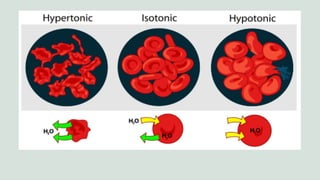
Isotonicity
Isotonic solutions are the solution having same osmotic pressure as blood. It is also refered as Iso-
Osmotic solutions. Egs, 0.9% w/v NaCl solution.
Importance of Isotonicity
 An isotonic solution is one that exhibits the same effective osmotic pressure as blood serum.
 Isotonicity is important for parenteral preparation because if the solution is isotonic with blood, the
possibility of product penetrating the RBC and causing haemolysis is reduced.
 For hypertonic solution crenation and for hypotonic solution haemolysis will occur.
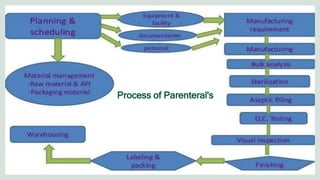
Process of Parenteral's
 The parenteral drug manufacturing (Drug Product Manufacturing) process includes compounding,
mixing, filtration, filling, terminal sterilization, lyophilization, closing, sealing, sorting, inspection,
labeling, and final packaging for distribution.
 The manufacturing process is complicated, requiring organization and control to ensure the
product meets the quality and the specifications as shown in.
 Aseptic processing requirement adds more complication but assures that all dosage forms
manufactured are free from contamination of microbial, endotoxin, and visible particulate matter.
 The manufacturing process initiates with the procurement of approved raw materials (drug,
excipients, vehicles, etc.) and primary packaging materials (containers, closures, etc) and ends with
the sterile product sealed in its dispensing package.
 The general method of preparation for the parentals is as follows,
1. Cleaning and washing of containers and closures
2. Preparation of solutions
3. Sterilization
4. Filling and sealing
5. Evaluation of parenterals
6. Packaging and labeling
Method of preparation
1. Cleaning of containers and closures
 All the containers, closures and equipment's which are required during the preparation of
parental products are thoroughly cleaned with detergent and washing is done with tap water,
followed by clean distilled water and finally rinsed with water for injection.
 Rubber closures are washed with hot solution of 0.5 % sodium pyrophosphate in water.
 The closures are then removed from the solution, washed with water followed by rinsing with
filtered water for injection on a small-scale washing is done manually but on a large-scale
automatic washing machines are used.
2. Preparation of Solution
 The various ingredients of the formulation of parentals are weighed and collected in the
preparation room.
 The raw materials required in the preparation of parenteral products should be pure. WFI free
from pyrogens and microorganisms are used in preparation of parenteral products.
 The Industrial pharmacist should decide the order of mixing and exact method of preparation to
be followed before preparing the parenteral products.
 The parenteral preparation must be prepared under strict aseptic conditions. The ingredients are
accurately weighed and dissolved in the vehicle as per method of preparation to be followed.
 The parenteral solutions so formed is passed through bacteria proof filter, such as filter candle,
Seitz filter, membrane filter. The primary objective of filtration is to clarify the solution by
removing foreign particles.
 If the parenteral preparations are required to be sterilized by means of bacteria proof filters,
filtration should be done under strict aseptic condition to avoid contamination of filtered solution,
before it is finally transferred into final container and sealed.
3. Sterilization
 The parental preparations should be immediately sterilized after sealing in its final containers. The
sterilization is done by any one of the methods of sterilization, which depends on the nature of
Medicaments present in the parenteral preparations.
 For thermostable medicament, the parenteral product are sterilized either by autoclaving at the
temperature of 115°C to 116°C for 30 minutes or 121°C for 20 minutes or in hot air oven at 160°C for
2 hours.
 The thermolabile preparations are sterilized by filtration through a suitable bacteria proof filters.
Parenteral preparations which are sterilized by filtration method may contain a suitable
bacteriostatic agent to prevent the growth of microorganisms.
 When the solutions are used for intravenous or intrathecal injection in doses exceeding 15 ml, The
bacteriostatic agent should not be used.
 The sterilized product is filled into the final containers and sealed. The process of filtration, filling
and sealing are done under aseptic conditions.
4. Filling and Sealing
 The filtered product is filled into final container such as ampoules, vials and transfusion bottles,
which are previously cleaned and dried.
 Ampoules are used for filling single dose whereas, vials are used for filling multidose. Bottles are
meant for filling transfusion fluids.
 On small scale filling is done manually by using hypodermic syringe and needle on the large scale
feeling is done by automatic filling machine.
 The sterile Powders are filled into containers by individual weighing or by using automatic or semi
automatic devices. The filling operation is carried out under strict aseptic precautions.
 During the filling of ampoules, the care should be taken that the solution should be filled below the
neck of ampoules and the solution should not touch the neck of ampoules. This will prevent the
cracking and staining of the neck of ampoules at the time of Sealing.
 Sealing should be done immediately after filling. Ampoules are sealed manually on a small scale by
rotating the neck of the ampoule in the flame of Bunsen burner but on a large scale ampoule sealing
machine is used in which tip of ampoule is used to fused to seal it.
5. Selection of containers and closures
Selection of Containers and Closures should be such that it should ensure that products must remain
its purity, potency and quality during intimate contact with the container throughout its shelf life.
 Glass
Glass is employed as the container material of choice for most SVIs. It is composed, principally of
silicon dioxide, with varying amount of other oxides such as sodium, potassium, calcium, magnesium,
aluminum, boron, and iron. Glass is preferred for clarity reasons.
Types
The USP provides a classification of glass
Type I - a borosilicate glass
Type II - a soda lime treated glass
Type III - a soda lime glass
NP - a soda lime glass not suitable for containers for parenteral.
Type I glass will be suitable for all products, although sulfur dioxide treatment is sometimes used for
even greater resistance to glass leachable. Because cost must be considered, one of the other, less
expensive types may be acceptable.
Type II glass may be suitable, for example, for a solution that is buffered, has a pH below 7, or is not
reactive with the glass.
 Type III glass is usually suitable for anhydrous liquids or dry substances.
 Types II and III glass compounds are composed of relatively high proportions of sodium oxide (14%)
and calcium oxide (8%). This makes the glass chemically less resistant.
 Both types melt at a lower temperature, are easier to mold into various shapes. Type II glass has a
lower concentration of the migratory oxides than Type III.
 In addition, Type II has been treated under controlled temperature and humidity conditions, with
sulfur dioxide or other dealkalizers to neutralize the interior surface of the container.
The glass types are determined from the results of two USP tests,
1. Powdered Glass Test
2. Water Attack Test.
 The Powdered Glass Test challenges the leaching potential of the interior structure of the glass,
whereas the Water Attack Test challenges only the intact surface of the container.
 Selecting the appropriate glass composition is a critical facet of determining the overall
specifications for each parenteral formulation.
 Glass can be the source/cause of leachable/extractable, particulates (glass deamination or glass
lamellae formation), adsorption of formulation components, especially proteins, and cracks/
scratches.
Plastic
 Plastic packaging has always been important for ophthalmic drug dosage forms and is gaining in
popularity for injectable dosage forms.
 Plastic bottles for large volume injectable (LVIs) have been used for many years.
 Plastic vials for SVIs may be a wave of the future plastic packing offers such advantages of cost
savings elimination of the problems caused by breakage of glass and increase convenience of use.
 Plastics are light weight, less fragile and easy to handle but not clear as that of glass.
Rubber
 Rubber formulations are used as rubber closures, rubber plungers and other applications.
 The most common rubber polymers used in SVIs closures are natural and butyl rubber. Silicone and
neoprene also are used but less frequently in sterile products.
 Butyl rubber has great advantages over natural rubber in that butyl rubber requires fewer additives,
has low water vapor permeation properties and has good characteristics with respect to gaseous
permeation reactivity with the active ingredient.
 Rubber permits the entry of hypodermic needle into injection vials & also provide resealing of the vial
after needle is withdrawn.
5. Evaluation of Parenterals
The finished parenteral products are subjected to the following test, in order to maintain quality control.
 Sterility test
 Clarity test
 Leakage test
 Pyrogen test
6. Packaging and labeling
After evaluation of the parenteral preparation, the ampoules, vials and transfusion bottles are properly
labelled and packed. The label should state as,
 Name of the Preparation
 Quantity of the Preparation
 Mfg. Lic. No.
 Batch No.
 Date of Manufacture
 Date of Expiry
 Storage Condition
 Retail Price
 Manufacturer’s Address
1. Formulation of injections (Solution and suspension)
Solutions
 A range of excipients may be included in parenteral solutions, including antioxidants, antimicrobial
agents, buffers, chelating agents, inert gases, and substances for adjusting tonicity.
 Antioxidants maintain product stability by being preferentially oxidized over the shelf life of the
product.
 Antimicrobial preservatives inhibit the growth of any microbes that are accidentally introduced
while doses are being withdrawn from multiple-dose bottles and act as adjuncts in aseptic
processing of products.
 It is Prepared by dissolving the drug and preservative, adjusting the pH and sterile- filtering the
resultant solution through a 0.22 μm membranes filter.
 Drug solutions that resist heat are terminally autoclave sterilized after filling; this assures product
sterility and package.
Formulation of various products
Suspension
A suspension for injection consists of insoluble solid particles dispersed in a liquid medium, with
the solid particles accounting for0.5-30% of the suspension. The vehicle may be aqueous, oil, or
both.
 Caking of injectable suspensions is minimized through the production of flocculated systems,
comprising clusters of particles (flocs) held together in a loose open structure.
 Excipients in injectable suspensions include antimicrobial preservatives, surfactants, dispersing
or suspending agents, and buffers.
 Surfactants wet the suspended powders and provide acceptable syringe ability while suspending
agents modify the viscosity of the formulation.
 General steps in manufacturing,
1. Sterilization and milling of active ingredient.
2. Sterilization of vehicle.
3. Aseptic wetting and dispersion of the active ingredient.
4. Aseptic milling of the bulk suspension.
5. Aseptic filling of the bulk suspension in suitable containers.
2. Formulation of Sterile Powders
 Due to instability in water, many drugs are formulated as drug powders to be reconstituted prior
to administration.
 Eg. Penicillin's, barbiturates, benzocaine.
 Sterile water for injection is supplied with dry powders to make “solutions/ or suspensions for
injections”. The obtained solution suspension will meet with all the requirements of
solution/suspension for parenteral.
 IV or IM route can give reconstituted solutions, however suspension is forbidden for IV
administration.
Sterile powers are prepared by following methods,
1. Sterile Re-crystallization - The drug is dissolved in a solvent and the obtained solution is
sterilized through 0.22 μm membrane filter. A sterile anti-solvent is then added to crystalize the
drug particles, which is filtered and dried aseptically.
Advantages - This method is Flexible and economic.
Disadvantage - This method represents variations from batch to batch and contamination.
2. Lyophilization - In this method, a solid substance is separated from solution by freezing the
solvent and evaporating the ice under vacuum. The obtained drug solution is sterile filtered into
sterile trays, which are aseptically loaded into a freeze dryer. The solution is then frozen at -50°C and
then dried by vacuum to separate the drug powder.
Advantage - This method involves removal of water at low temperatures.
Disadvantage - The biological molecules are damaged by the stress associated with freezing and
drying and This method is expensive and time consuming.
3. Spray drying - In this method, the solution of the drug is sprayed into a dry chamber where it
comes in contact with a hot steam of a sterile gas 80-100 °C temperature.
Advantages -
 This method is Simple, Economical, scalable and faster.
 This method involves Coating of particles during drying prolonged release.
Disadvantage -
 In this method, high processing temperatures and high shear forces can easily damage drugs.
 In this method, higher levels of drugs are lost in comparison to freeze-drying.
 This method has a limited solvent choice for a given drug.
 In this method, product cannot be prepared directly in vials or plates.
3. Formulation of Large Volume Parenterals
 Large volume injections are intended to be administered by IV Infusion Fluids and are included in
the group of sterile products and are known as large volume Parenterals.
 These consist of single dose injecting a volume of 100 ml or more than 100 ml sometimes additional
drugs are added to them by either injecting SVP to the administration sets or by piggyback method
(small volume infusion of an additional drug is added to the intravenous delivery system).
 Large volume parenteral products include,
1. Infusion fluid (Basic nutrition - Dextrose injection, Fluid replacement therapy - Normal saline)
2. Total parenterals Nutrition solution (TPN)
3. Intravenous antibiotics
4. Dialysis fluid
5. Irrigation solutions
 Large volume parenterals should be terminally heat sterilized.
 Apart from water for injection as the main component, other ingredients that should be included are
carbohydrates.
 The LVP are mostly clear solutions, except for the oil in water emulsions. The emulsions for infusion
are produced by highly specialized method as they are destabilized by heat.
 This result in many difficulties during production, thus the size of oil droplets should be controlled
during heat sterilization.
Quality Control Tests of Parenteral Products
The following are the evaluation test for the parenteral.
1. Sterility Test - It is a method carried out to detect confirm absence of any viable form of
microbes in product.
The method used for sterility tests are,
1. Direct Transfer Method - Open each sample container and withdraw the require amount of the
sample. Inject one-half of sample in a test tube containing Fluid Thioglycolate Medium (FTM).
Inject another half in the test tube containing Soyabean Casein Digest Medium (SCM). Volume of
the medium must be sufficient to promote and expedite microbial growth. Adequate mixing
between the sample inoculums and the culture medium must take place to maximize interaction
and facilitate microbial growth. If the product to be tested contains any anti-microbial agent, using
suitable reagent it should be neutralized before the test.
2. Membrane Filtration Method - This method is employed in the following cases,
1. Oil and oily preparations
2. Alcoholic preparations
3. For preparations miscible with or soluble in aqueous or oily solvents.
evaluation
The steps involved in MF sterility test method are,
1. The filter unit must be properly assembled and sterilized prior to use.
2. The contents are transferred to the filter assembly under strict aseptic conditions.
3. The membrane is removed aseptically.
4. Membrane is cut in half.
5. One half is place in suitable volume of FTM and another in an equal volume of SCM.
Interpretation of Results -
 If there is no visible evidence of microbial growth, it may be interpreted that the sample is without
intrinsic contamination and the product complies the test for sterility.
 If microbial growth is found, the product does not complies the test for sterility and the sterility test
may be repeated.
2. Clarity test (particulate matter evaluation)
 Particulate matter in parenteral solutions has been recognized as an acceptable. Since the user
could be expected to conclude that the presence of visible dirt would suggest that, the product is of
inferior quality.
 In visual method, the entire product should be inspected by human inspectors under good light
baffled against reflection into the eye and against black and white background.
 Dark background detects light particles and light background detects dark particles. Any container
with visible particle if seen is discarded.
3. Leakers Test
 Leaker test for ampoules is intended to detect incompletely sealed ampoules so that they can be
discarded in order to maintain sterile condition of the medicines.
 Open capillaries or cracks at the point of seal result in LEAKERS.
 The leaker test is performed by immersing the ampoules in a dye solution, such as 1% methylene
blue, and applying at least 25 inches of vacuum for a minimum of 15 mins.
 Detection of leaker is prominent when ampoules are immersed in a bath of dye during autoclaving
as this has advantage of accomplishing both leaker detection and sterilization in one operation.
 Another means of testing for leakers is a high frequency spark test system, which detect presence of
pinholes in ampoules.
 Bottles and vials are not subjected to such a vacuum test because of the flexibility of the rubber
closure.
4. Pyrogen Test
 Pyrogens are the metabolic products of microbes.
 Most bacteria, moulds and viruses produce Pyrogens.
 Most potent pyrogenic substance called endotoxins are produced by gram negative bacteria.
 Pyrogens when injected into a human, shows marked rise in the temperature, chills, body aches,
cutaneous vasoconstriction and increased arterial blood pressure.
 The most likely source of pyrogens are water, contaminated solutes and containers.
 The test involves measurement of the rise in body temperature of rabbits following the IV injection
of a sterile solution into ear vein of rabbit.
 The main parameters of pyrogen test are as follows,
1. Selection of animals - healthy, adult, not less than 1.5kg.
2. Equipment and material used in test - glassware, syringes, needles.
3. Retaining boxes - comfortable for rabbits as possible.
4. Thermometers - standardized position in rectum, precision of 0.1°C.
Preliminary Test (Sham Test)
If animals are used for the first time in a pyrogen test or have not been used during the 2 previous
weeks, condition them 1 to 3 days before testing the substance by injecting IV 10ml per kg pyrogen
free saline solution warmed to about 38.5°c.
Record the temperature of the animals, beginning at least 90 mins before injection and continuing for
3 hours after injection. Any animal showing a temperature variation of 0.6° or more must not be used.
Main Test
 The main test is carried out by using a group of 3 Rabbits. Dissolve the substance in, or dilute with,
pyrogen free saline solution.
 Warm the liquid to approximately 38.5° before injection.
 Inject the solution under examination slowly into the marginal veins of the ear of each rabbit over a
period not exceeding 4 mins.
 Record the temperature of each animal at half hourly intervals for 3 hours after injection. The
difference between the initial temperature and the maximum temperature which is the highest
temperature recorded for a rabbit is taken to be its response.
5. Bacterial Endotoxin Test (BET) or Limulus Amoebocyte Lysate Test (LAL Test)
 The bacterial endotoxin test (BET) is a test to detect or quantify endotoxins from gram negative
bacteria using Amoebocyte lysate from the horse shoe crab (Limulus polyphemus or
Tachypleustridentatus).
 The endotoxins of gram-negative bacteria forms a firm gel within 60 mins in the presence of lysate
of amebocytes of limulus polyphemus of horseshoe crab, when incubated at 37◦c.
 Hence, the test is only effective with gram-negative bacteria, which constitute the majority and the
most potent of the pyrogens.
 The addition of a solution containing endotoxins to a solution of a lysate produces turbidity,
precipitation or gelation of the mixture.
Production facilities and controls
The production area where the parenteral preparations are manufactured can be divided into the
following five sections,
1. Clean up area
 It is not aseptic area.
 All the parenteral products must be free from foreign particles and microorganism.
 Clean up area should be withstand moisture, dust and detergent.
 This area should be kept clean so that contaminants may not be carried out into aseptic area.
2. Preparation area
 In this area the ingredients of parenteral preparation are mixed and is made for filling
operation.
 It is not essentially to be maintained aseptic area but strict precautions are required to prevent
contamination from outside.
facilities and control
3. Aseptic area
 The parenteral preparations are filtered, filled into final container and sealed in aseptic area.
 The entry of personnel into aseptic area should be limited and through an air lock.
 Ceiling, wall and floor of that area should be sealed and painted.
 The air in the aseptic area should be free from fibers, dust and microorganism.
 The High efficiency particulate air filters (HEPA) is used for air.
 UV lamps are fitted in order to maintain sterility.
4. Quarantine area
 After filling, sealing and sterilization the parenteral product are held up in quarantine area.
 Randomly samples were kept for evaluation.
 The batch or product pass the evaluation tests are transfer in to finishing or packaging area.
5. Finishing and packaging area
 Parenteral products are properly labelled and packed.
 Properly packing is essential to provide protection against physical damage.
 The labelled container should be packed in cardboard or plastic container.
 Ampoules should be packed in partitioned boxes.
THANK YOU
THANK YOU

Parenterals from Preparation to Evaluation

  • 1.
    Parenteral’s (Preformulation to Evaluation) PresentedBy – Ms. Chitralekha G. Therkar Asst Professor, Siddhivinayak College of Pharmacy, Warora
  • 2.
    Index 1. Abbreviations 2. Introduction 3.Classification 4.Preformulation Factors 5. Excipients 6.Method of Preparation 7. Evaluation of Parenterals
  • 3.
     LVP –Large Volume Parenteral  SVP – Small Volume Parenteral  HEPA – High Efficiency Particulate Air  LAL Test – Limulus Amebocytes Lysate test  BET – Bacterial Endotoxin Test  IPQC – In Process Quality Control  WFI – Water for Injection  RH – Relative Humidity  FTM – Fluid Thioglycolate Medium  SCM – Soyabean Casein Digest Medium “Abbreviations”
  • 4.
     The termParenteral has been derived from the Greek word “para enteron”, which means Outside the Intestine, Means any drug given outside the intestine are called as Parenterals.  These are unique, sterile dosage forms as they are administered by injecting directly into the body tissues through skin and mucous membranes.  These dosage forms are directly enter into systemic circulation without passing through the first pass metabolism and are bioavailable to 100% extent of its strength. Definition - Parenteral products may be defined as sterile preparations containing one or more active ingredients intended for the administration into the body or blood stream directly by injection, infusion or implantation and are packaged in either single dose or multi dose containers.  Parenterals are generally dispense in glass or plastic containers. Introduction
  • 5.
    Advantages of Parenterals 1.Parenteral products can bypass presystemic or first pass metabolism. 2. The onset of action of parenterals is quick. 3. The drugs, which cannot be administered orally, can be administered by this route. 4. The patients who are vomiting or unconscious cannot take drug by oral route. In such cases, the drug can be administered by this route. 5. The drug action can be prolonged by modifying the formulation. 6. This route can deliver transfusion fluids containing nutritive like glucose and electrolytes such as sodium chloride. Limitations of Parenterals 1. Injection causes pain at the site of injection. 2. The trained persons are required to administer the drug. 3. The administration of drug through wrong route of injection may prove to be fatal. 4. It is difficult to save a patient when overdose is given. 5. There are chances of sensitivity reaction or allergic reaction of a drug by an individual. These reactions are sometimes fatal and lead to death. 6. An injected dose cannot be reverted.
  • 6.
    Types of Parenterals Accordingto USP, the types of Parenteral products are based on the Volume and the state of product. 1. Based on Volume  SVP – An injection that is packed in containers labelled as containing 100 ml or less.  LVP – These are parenterals designed to provide fluid, calories and electrolytes to the body and the volume is more than 100ml. 2. Based on States of products  Injection - Injections contain sterile solutions and are prepared by dissolving the active ingredient and other substances in water for injection or other suitable non-aqueous base. The solution to be injected may show sediments which can be dispersed easily by shaking the container. The suspension should remain stable in order to deliver a homogenous dose whenever withdrawal is made from the container. Classification
  • 7.
     Infusions -These parenteral preparations are composed of sterile aqueous solution with water as its continuous phase. The preparations are free from bacterial endotoxins or pyrogens and are made isotonic with blood. They do not contain any antimicrobial preservatives.  Powder for Injection - These are sterile solid compounds that are distributed in their final volume when the vial or container is shaken to form a clear particle-free solution.  Concentrated Solutions for Injections - The concentrated solutions are diluted with water for injection before they are administered through injection or through intravenous infusion.  Implants - These solid sterile preparations are implanted in the tissue in order to release the active ingredient for long periods. They are stored in sterile containers individually.  Injectable Emulsion - These are liquid preparations in which the drug substances are dissolved or dispersed in a suitable emulsion medium. These products provide essential fatty acid and vitamins.  Oily Injection - These are used to prepare the parenteral controlled release dosage forms
  • 8.
    Routes of Administration 1.Intravenous Route 2. Intramuscular Route 3. Intraperitoneal Route 4. Subcutaneous Route 5. Intradermal Route 6. Intrathecal Route 7. Epidural Route 8. Intraosseous Route 9. Intra – Arterial Route
  • 9.
    Preformulation involves thestudy about physical and chemical properties of drug substance prior formulation. These studies are performed under stressed conditions of temperature, humidity, light and oxygen so that the reactions are accelerated, and potential reaction are detected. A few physicochemical properties that can affect a drug substance are as follows,  Melting point - It is the temperature at which the solid and liquid phases are in equilibrium. Its determination is a primary indication of purity.  Solubility - This property is essential for developing solution to be injected either intravenously or intramuscularly. It is a function of chemical structure: salts of acid or bases are the drugs that can achieve the desired degree of water solubility.  Molecular structure and weight - These are the basic characteristics of the drug from which the potential properties and reactivities of functional groups can be determined. Preformulation factors
  • 10.
     Particle Sizeand Shape - Study of particle size give information about solubility, dissolution rate and absorption etc. These characteristics are determined by scanning electron microscope or an optical microscope with polarizing attachments.  Ionization constant - This property is used to determine the PH-dependent solubility of a compound. Potentiometric PH titration or PH-solubility analysis is used for determining the PKa value. Ionization constant of a compound also helps in determining the degree of ionization of an acid or base. Degree of ionization depends upon the PH.  For acidic drugs Pka ranges from 3-7.5 and for basic drugs Pka ranges from 7- 11.  Partition Coefficient (P) - It is a ratio of equilibrium concentration of drug in aqueous and oily phases in contact with each other at a constant temperature.  Partition coefficient can be expressed as “P” = [Coil / Cwater],  Where, Coil -Organic phase concentration Cwater - Aqueous phase concentration
  • 11.
     The formulationsof parenteral preparations need careful planning, thorough knowledge of medicaments and additives to be used.  The excess use of additives in parenteral products should be avoided as some of these may interfere with the drug.  In the preparation of parental products, the following substances are added to make a stable preparation. 1. Vehicles 2. Additives  Solubilizing agents  Stabilizers  Buffering agents  Antibacterial agents  Chelating agents.  Suspending, emulsifying and wetting agents.  Tonicity factors EXCIPIENTS
  • 12.
    1. Vehicles There aretwo types of vehicles, which are commonly used for the preparation of injections, A) Aqueous vehicles - water is used as vehicle for majority of injections because water is tolerated well by the body and is safest to administer. The aqueous vehicle used are, 1) Water for injections. 2) Water for injection free from CO2 (carbon dioxide) 3) Water for injection free from dissolved air  Water for injection is sterile water, which is free from volatile, non- volatile impurities and from pyrogens. Pyrogens are by-product of bacterial metabolism.  Pyrogens are Liposaccharide, thermostable, soluble in water, unaffected by bactericide and can pass through bacterial proof filter.  Pyrogens can be removed from water by simple distillation process using an efficient trap which prevents the pyrogen to enter to the condenser immediately after the preparation of water for injection, it is filled into the final container, sealed and sterilized by autoclaving.  Water for injection, contaminated with pyrogens may cause rise in body temperature if injected. Hence, test for pyrogen is done to ensure that water for injection is free from pyrogens.
  • 13.
    B) Non aqueousvehicles  The commonly used non aqueous vehicles are oils and alcohols.  Fixed oil, such as arachis oil, cottonseed oil, almond oil and sesame oil are used as vehicle the oily vehicles are generally used when a depot effect of drug is required, or the medicaments are insoluble or slightly soluble in water or the drug is soluble in oil example dimercaptol injection by using arachis oil as vehicle.  Ethyl alcohol is used in the preparation of hydrocortisone injection hydrocortisone is insoluble in water, hence the solution is made in 50% alcohol.  Alcohol causes pain and tissue damage at the site of injection.  Therefore, it is not used commonly. Propylene glycol is used as a vehicle in the preparation of digoxin injection. It is relatively nontoxic, but it causes pain on S/C or I/M injection.
  • 14.
    2. Additives These substancesare added to increase the stability or quality of the product. These additives should be used only when it is necessary to use them. While selecting the additives, care must be taken that they should be compatible both physical and chemical with the entire formulation. They should be added in minimum possible quantity. The following additives are commonly used in preparing stable parental preparations.  Solubilizing agents - These are used to increase the solubility of drugs which are slightly soluble in water the solubility of drug is increased by using surface active agent like tweens and polysorbate or by using co solvents.  Stabilizers - The drugs in the form of solution are more liable to deteriorate due to oxidation and hydrolysis. The stabilizers are added in the formulation to prevent this the oxidation can be prevented by adding a suitable antioxidant such as, thiourea, ascorbic acid, sodium metabisulphite or the product is sealed in an atmosphere of Nitrogen or Carbon dioxide. Hydrolysis can be prevented by using a non aqueous vehicle or by adjusting the pH of the preparation.
  • 15.
     Buffering agents- The degradation of the preparation, which is due to change in pH, can be prevented by adding a suitable buffer to maintain the desired pH.  Antibacterial agents - These substance are added in adequate quantity to prevent the growth of microorganism during storage. So, these substances act as preservatives. Antibacterial agents are added in single dose containers, where parenteral products are sterilized by filtration. Some typical preservative used in parenteral suspensions and their commonly used concentrations are as follows,  Benzyl alcohol (0.9% to 1.5%)  Methylparaben (0.18% to 0.2%)  Propylparaben (0.02%)  Benzalkonium chloride (0.01% to 0.02%)  Suspending, emulsifying and wetting agents - The suspending agents are used to improve the viscosity and to suspend the particles for a long time. Methyl cellulose, carboxy-methyl cellulose, gelatin and acacia are commonly used as suspending agents. Emulsifying agents are used in sterile emulsions for this purpose lecithin is generally used. The wetting agents are used to reduce the interfacial tension between the solid particles and the liquid, to prevent the formulation of lumps.
  • 16.
     Chelating agent- Chelating agents such as EDTA (Ethylene diamine Tetra acetic acid) and its salts, sodium or potassium salts of citric acid are added in the formulation, to chelate the metallic ions present in the formulation. They form a Complex which gets dissolved in the solvent.  Tonicity factors - Parenteral preparation should be isotonic with blood plasma or other body fluids. The isotonicity of the solution may be adjusted by adding sodium chloride, dextrose and boric acid etc. in suitable quantities. These substances should be compatible with other ingredients of the formulation. Examples of tonicity adjusters are glycerin, lactose, mannitol, dextrose, NaCl, sodium sulfate and sorbitol. Isotonicity Isotonic solutions are the solution having same osmotic pressure as blood. It is also refered as Iso- Osmotic solutions. Egs, 0.9% w/v NaCl solution. Importance of Isotonicity  An isotonic solution is one that exhibits the same effective osmotic pressure as blood serum.  Isotonicity is important for parenteral preparation because if the solution is isotonic with blood, the possibility of product penetrating the RBC and causing haemolysis is reduced.  For hypertonic solution crenation and for hypotonic solution haemolysis will occur.
  • 18.
  • 19.
     The parenteraldrug manufacturing (Drug Product Manufacturing) process includes compounding, mixing, filtration, filling, terminal sterilization, lyophilization, closing, sealing, sorting, inspection, labeling, and final packaging for distribution.  The manufacturing process is complicated, requiring organization and control to ensure the product meets the quality and the specifications as shown in.  Aseptic processing requirement adds more complication but assures that all dosage forms manufactured are free from contamination of microbial, endotoxin, and visible particulate matter.  The manufacturing process initiates with the procurement of approved raw materials (drug, excipients, vehicles, etc.) and primary packaging materials (containers, closures, etc) and ends with the sterile product sealed in its dispensing package.  The general method of preparation for the parentals is as follows, 1. Cleaning and washing of containers and closures 2. Preparation of solutions 3. Sterilization 4. Filling and sealing 5. Evaluation of parenterals 6. Packaging and labeling Method of preparation
  • 20.
    1. Cleaning ofcontainers and closures  All the containers, closures and equipment's which are required during the preparation of parental products are thoroughly cleaned with detergent and washing is done with tap water, followed by clean distilled water and finally rinsed with water for injection.  Rubber closures are washed with hot solution of 0.5 % sodium pyrophosphate in water.  The closures are then removed from the solution, washed with water followed by rinsing with filtered water for injection on a small-scale washing is done manually but on a large-scale automatic washing machines are used.
  • 21.
    2. Preparation ofSolution  The various ingredients of the formulation of parentals are weighed and collected in the preparation room.  The raw materials required in the preparation of parenteral products should be pure. WFI free from pyrogens and microorganisms are used in preparation of parenteral products.  The Industrial pharmacist should decide the order of mixing and exact method of preparation to be followed before preparing the parenteral products.  The parenteral preparation must be prepared under strict aseptic conditions. The ingredients are accurately weighed and dissolved in the vehicle as per method of preparation to be followed.  The parenteral solutions so formed is passed through bacteria proof filter, such as filter candle, Seitz filter, membrane filter. The primary objective of filtration is to clarify the solution by removing foreign particles.  If the parenteral preparations are required to be sterilized by means of bacteria proof filters, filtration should be done under strict aseptic condition to avoid contamination of filtered solution, before it is finally transferred into final container and sealed.
  • 22.
    3. Sterilization  Theparental preparations should be immediately sterilized after sealing in its final containers. The sterilization is done by any one of the methods of sterilization, which depends on the nature of Medicaments present in the parenteral preparations.  For thermostable medicament, the parenteral product are sterilized either by autoclaving at the temperature of 115°C to 116°C for 30 minutes or 121°C for 20 minutes or in hot air oven at 160°C for 2 hours.  The thermolabile preparations are sterilized by filtration through a suitable bacteria proof filters. Parenteral preparations which are sterilized by filtration method may contain a suitable bacteriostatic agent to prevent the growth of microorganisms.  When the solutions are used for intravenous or intrathecal injection in doses exceeding 15 ml, The bacteriostatic agent should not be used.  The sterilized product is filled into the final containers and sealed. The process of filtration, filling and sealing are done under aseptic conditions.
  • 23.
    4. Filling andSealing  The filtered product is filled into final container such as ampoules, vials and transfusion bottles, which are previously cleaned and dried.  Ampoules are used for filling single dose whereas, vials are used for filling multidose. Bottles are meant for filling transfusion fluids.  On small scale filling is done manually by using hypodermic syringe and needle on the large scale feeling is done by automatic filling machine.  The sterile Powders are filled into containers by individual weighing or by using automatic or semi automatic devices. The filling operation is carried out under strict aseptic precautions.  During the filling of ampoules, the care should be taken that the solution should be filled below the neck of ampoules and the solution should not touch the neck of ampoules. This will prevent the cracking and staining of the neck of ampoules at the time of Sealing.  Sealing should be done immediately after filling. Ampoules are sealed manually on a small scale by rotating the neck of the ampoule in the flame of Bunsen burner but on a large scale ampoule sealing machine is used in which tip of ampoule is used to fused to seal it.
  • 24.
    5. Selection ofcontainers and closures Selection of Containers and Closures should be such that it should ensure that products must remain its purity, potency and quality during intimate contact with the container throughout its shelf life.  Glass Glass is employed as the container material of choice for most SVIs. It is composed, principally of silicon dioxide, with varying amount of other oxides such as sodium, potassium, calcium, magnesium, aluminum, boron, and iron. Glass is preferred for clarity reasons. Types The USP provides a classification of glass Type I - a borosilicate glass Type II - a soda lime treated glass Type III - a soda lime glass NP - a soda lime glass not suitable for containers for parenteral. Type I glass will be suitable for all products, although sulfur dioxide treatment is sometimes used for even greater resistance to glass leachable. Because cost must be considered, one of the other, less expensive types may be acceptable. Type II glass may be suitable, for example, for a solution that is buffered, has a pH below 7, or is not reactive with the glass.
  • 25.
     Type IIIglass is usually suitable for anhydrous liquids or dry substances.  Types II and III glass compounds are composed of relatively high proportions of sodium oxide (14%) and calcium oxide (8%). This makes the glass chemically less resistant.  Both types melt at a lower temperature, are easier to mold into various shapes. Type II glass has a lower concentration of the migratory oxides than Type III.  In addition, Type II has been treated under controlled temperature and humidity conditions, with sulfur dioxide or other dealkalizers to neutralize the interior surface of the container. The glass types are determined from the results of two USP tests, 1. Powdered Glass Test 2. Water Attack Test.  The Powdered Glass Test challenges the leaching potential of the interior structure of the glass, whereas the Water Attack Test challenges only the intact surface of the container.  Selecting the appropriate glass composition is a critical facet of determining the overall specifications for each parenteral formulation.  Glass can be the source/cause of leachable/extractable, particulates (glass deamination or glass lamellae formation), adsorption of formulation components, especially proteins, and cracks/ scratches.
  • 26.
    Plastic  Plastic packaginghas always been important for ophthalmic drug dosage forms and is gaining in popularity for injectable dosage forms.  Plastic bottles for large volume injectable (LVIs) have been used for many years.  Plastic vials for SVIs may be a wave of the future plastic packing offers such advantages of cost savings elimination of the problems caused by breakage of glass and increase convenience of use.  Plastics are light weight, less fragile and easy to handle but not clear as that of glass. Rubber  Rubber formulations are used as rubber closures, rubber plungers and other applications.  The most common rubber polymers used in SVIs closures are natural and butyl rubber. Silicone and neoprene also are used but less frequently in sterile products.  Butyl rubber has great advantages over natural rubber in that butyl rubber requires fewer additives, has low water vapor permeation properties and has good characteristics with respect to gaseous permeation reactivity with the active ingredient.  Rubber permits the entry of hypodermic needle into injection vials & also provide resealing of the vial after needle is withdrawn.
  • 27.
    5. Evaluation ofParenterals The finished parenteral products are subjected to the following test, in order to maintain quality control.  Sterility test  Clarity test  Leakage test  Pyrogen test 6. Packaging and labeling After evaluation of the parenteral preparation, the ampoules, vials and transfusion bottles are properly labelled and packed. The label should state as,  Name of the Preparation  Quantity of the Preparation  Mfg. Lic. No.  Batch No.  Date of Manufacture  Date of Expiry  Storage Condition  Retail Price  Manufacturer’s Address
  • 28.
    1. Formulation ofinjections (Solution and suspension) Solutions  A range of excipients may be included in parenteral solutions, including antioxidants, antimicrobial agents, buffers, chelating agents, inert gases, and substances for adjusting tonicity.  Antioxidants maintain product stability by being preferentially oxidized over the shelf life of the product.  Antimicrobial preservatives inhibit the growth of any microbes that are accidentally introduced while doses are being withdrawn from multiple-dose bottles and act as adjuncts in aseptic processing of products.  It is Prepared by dissolving the drug and preservative, adjusting the pH and sterile- filtering the resultant solution through a 0.22 μm membranes filter.  Drug solutions that resist heat are terminally autoclave sterilized after filling; this assures product sterility and package. Formulation of various products
  • 29.
    Suspension A suspension forinjection consists of insoluble solid particles dispersed in a liquid medium, with the solid particles accounting for0.5-30% of the suspension. The vehicle may be aqueous, oil, or both.  Caking of injectable suspensions is minimized through the production of flocculated systems, comprising clusters of particles (flocs) held together in a loose open structure.  Excipients in injectable suspensions include antimicrobial preservatives, surfactants, dispersing or suspending agents, and buffers.  Surfactants wet the suspended powders and provide acceptable syringe ability while suspending agents modify the viscosity of the formulation.  General steps in manufacturing, 1. Sterilization and milling of active ingredient. 2. Sterilization of vehicle. 3. Aseptic wetting and dispersion of the active ingredient. 4. Aseptic milling of the bulk suspension. 5. Aseptic filling of the bulk suspension in suitable containers.
  • 30.
    2. Formulation ofSterile Powders  Due to instability in water, many drugs are formulated as drug powders to be reconstituted prior to administration.  Eg. Penicillin's, barbiturates, benzocaine.  Sterile water for injection is supplied with dry powders to make “solutions/ or suspensions for injections”. The obtained solution suspension will meet with all the requirements of solution/suspension for parenteral.  IV or IM route can give reconstituted solutions, however suspension is forbidden for IV administration. Sterile powers are prepared by following methods, 1. Sterile Re-crystallization - The drug is dissolved in a solvent and the obtained solution is sterilized through 0.22 μm membrane filter. A sterile anti-solvent is then added to crystalize the drug particles, which is filtered and dried aseptically. Advantages - This method is Flexible and economic. Disadvantage - This method represents variations from batch to batch and contamination.
  • 31.
    2. Lyophilization -In this method, a solid substance is separated from solution by freezing the solvent and evaporating the ice under vacuum. The obtained drug solution is sterile filtered into sterile trays, which are aseptically loaded into a freeze dryer. The solution is then frozen at -50°C and then dried by vacuum to separate the drug powder. Advantage - This method involves removal of water at low temperatures. Disadvantage - The biological molecules are damaged by the stress associated with freezing and drying and This method is expensive and time consuming. 3. Spray drying - In this method, the solution of the drug is sprayed into a dry chamber where it comes in contact with a hot steam of a sterile gas 80-100 °C temperature. Advantages -  This method is Simple, Economical, scalable and faster.  This method involves Coating of particles during drying prolonged release. Disadvantage -  In this method, high processing temperatures and high shear forces can easily damage drugs.  In this method, higher levels of drugs are lost in comparison to freeze-drying.  This method has a limited solvent choice for a given drug.  In this method, product cannot be prepared directly in vials or plates.
  • 32.
    3. Formulation ofLarge Volume Parenterals  Large volume injections are intended to be administered by IV Infusion Fluids and are included in the group of sterile products and are known as large volume Parenterals.  These consist of single dose injecting a volume of 100 ml or more than 100 ml sometimes additional drugs are added to them by either injecting SVP to the administration sets or by piggyback method (small volume infusion of an additional drug is added to the intravenous delivery system).  Large volume parenteral products include, 1. Infusion fluid (Basic nutrition - Dextrose injection, Fluid replacement therapy - Normal saline) 2. Total parenterals Nutrition solution (TPN) 3. Intravenous antibiotics 4. Dialysis fluid 5. Irrigation solutions  Large volume parenterals should be terminally heat sterilized.  Apart from water for injection as the main component, other ingredients that should be included are carbohydrates.  The LVP are mostly clear solutions, except for the oil in water emulsions. The emulsions for infusion are produced by highly specialized method as they are destabilized by heat.  This result in many difficulties during production, thus the size of oil droplets should be controlled during heat sterilization.
  • 33.
    Quality Control Testsof Parenteral Products The following are the evaluation test for the parenteral. 1. Sterility Test - It is a method carried out to detect confirm absence of any viable form of microbes in product. The method used for sterility tests are, 1. Direct Transfer Method - Open each sample container and withdraw the require amount of the sample. Inject one-half of sample in a test tube containing Fluid Thioglycolate Medium (FTM). Inject another half in the test tube containing Soyabean Casein Digest Medium (SCM). Volume of the medium must be sufficient to promote and expedite microbial growth. Adequate mixing between the sample inoculums and the culture medium must take place to maximize interaction and facilitate microbial growth. If the product to be tested contains any anti-microbial agent, using suitable reagent it should be neutralized before the test. 2. Membrane Filtration Method - This method is employed in the following cases, 1. Oil and oily preparations 2. Alcoholic preparations 3. For preparations miscible with or soluble in aqueous or oily solvents. evaluation
  • 34.
    The steps involvedin MF sterility test method are, 1. The filter unit must be properly assembled and sterilized prior to use. 2. The contents are transferred to the filter assembly under strict aseptic conditions. 3. The membrane is removed aseptically. 4. Membrane is cut in half. 5. One half is place in suitable volume of FTM and another in an equal volume of SCM. Interpretation of Results -  If there is no visible evidence of microbial growth, it may be interpreted that the sample is without intrinsic contamination and the product complies the test for sterility.  If microbial growth is found, the product does not complies the test for sterility and the sterility test may be repeated. 2. Clarity test (particulate matter evaluation)  Particulate matter in parenteral solutions has been recognized as an acceptable. Since the user could be expected to conclude that the presence of visible dirt would suggest that, the product is of inferior quality.  In visual method, the entire product should be inspected by human inspectors under good light baffled against reflection into the eye and against black and white background.  Dark background detects light particles and light background detects dark particles. Any container with visible particle if seen is discarded.
  • 35.
    3. Leakers Test Leaker test for ampoules is intended to detect incompletely sealed ampoules so that they can be discarded in order to maintain sterile condition of the medicines.  Open capillaries or cracks at the point of seal result in LEAKERS.  The leaker test is performed by immersing the ampoules in a dye solution, such as 1% methylene blue, and applying at least 25 inches of vacuum for a minimum of 15 mins.  Detection of leaker is prominent when ampoules are immersed in a bath of dye during autoclaving as this has advantage of accomplishing both leaker detection and sterilization in one operation.  Another means of testing for leakers is a high frequency spark test system, which detect presence of pinholes in ampoules.  Bottles and vials are not subjected to such a vacuum test because of the flexibility of the rubber closure.
  • 36.
    4. Pyrogen Test Pyrogens are the metabolic products of microbes.  Most bacteria, moulds and viruses produce Pyrogens.  Most potent pyrogenic substance called endotoxins are produced by gram negative bacteria.  Pyrogens when injected into a human, shows marked rise in the temperature, chills, body aches, cutaneous vasoconstriction and increased arterial blood pressure.  The most likely source of pyrogens are water, contaminated solutes and containers.  The test involves measurement of the rise in body temperature of rabbits following the IV injection of a sterile solution into ear vein of rabbit.  The main parameters of pyrogen test are as follows, 1. Selection of animals - healthy, adult, not less than 1.5kg. 2. Equipment and material used in test - glassware, syringes, needles. 3. Retaining boxes - comfortable for rabbits as possible. 4. Thermometers - standardized position in rectum, precision of 0.1°C. Preliminary Test (Sham Test) If animals are used for the first time in a pyrogen test or have not been used during the 2 previous weeks, condition them 1 to 3 days before testing the substance by injecting IV 10ml per kg pyrogen free saline solution warmed to about 38.5°c. Record the temperature of the animals, beginning at least 90 mins before injection and continuing for 3 hours after injection. Any animal showing a temperature variation of 0.6° or more must not be used.
  • 37.
    Main Test  Themain test is carried out by using a group of 3 Rabbits. Dissolve the substance in, or dilute with, pyrogen free saline solution.  Warm the liquid to approximately 38.5° before injection.  Inject the solution under examination slowly into the marginal veins of the ear of each rabbit over a period not exceeding 4 mins.  Record the temperature of each animal at half hourly intervals for 3 hours after injection. The difference between the initial temperature and the maximum temperature which is the highest temperature recorded for a rabbit is taken to be its response. 5. Bacterial Endotoxin Test (BET) or Limulus Amoebocyte Lysate Test (LAL Test)  The bacterial endotoxin test (BET) is a test to detect or quantify endotoxins from gram negative bacteria using Amoebocyte lysate from the horse shoe crab (Limulus polyphemus or Tachypleustridentatus).  The endotoxins of gram-negative bacteria forms a firm gel within 60 mins in the presence of lysate of amebocytes of limulus polyphemus of horseshoe crab, when incubated at 37◦c.  Hence, the test is only effective with gram-negative bacteria, which constitute the majority and the most potent of the pyrogens.  The addition of a solution containing endotoxins to a solution of a lysate produces turbidity, precipitation or gelation of the mixture.
  • 38.
    Production facilities andcontrols The production area where the parenteral preparations are manufactured can be divided into the following five sections, 1. Clean up area  It is not aseptic area.  All the parenteral products must be free from foreign particles and microorganism.  Clean up area should be withstand moisture, dust and detergent.  This area should be kept clean so that contaminants may not be carried out into aseptic area. 2. Preparation area  In this area the ingredients of parenteral preparation are mixed and is made for filling operation.  It is not essentially to be maintained aseptic area but strict precautions are required to prevent contamination from outside. facilities and control
  • 39.
    3. Aseptic area The parenteral preparations are filtered, filled into final container and sealed in aseptic area.  The entry of personnel into aseptic area should be limited and through an air lock.  Ceiling, wall and floor of that area should be sealed and painted.  The air in the aseptic area should be free from fibers, dust and microorganism.  The High efficiency particulate air filters (HEPA) is used for air.  UV lamps are fitted in order to maintain sterility. 4. Quarantine area  After filling, sealing and sterilization the parenteral product are held up in quarantine area.  Randomly samples were kept for evaluation.  The batch or product pass the evaluation tests are transfer in to finishing or packaging area. 5. Finishing and packaging area  Parenteral products are properly labelled and packed.  Properly packing is essential to provide protection against physical damage.  The labelled container should be packed in cardboard or plastic container.  Ampoules should be packed in partitioned boxes.
  • 40.