McGraw-Hill/Irwin Copyright © 2007 by The McGraw-Hill Companies, Inc. All rights reserved.
22
Competitiveness,
Strategy,
and Productivity
2-2
Learning ObjectivesLearning Objectives
 List and briefly discuss the primary ways
that business organizations compete.
 List five reasons for the poor
competitiveness of some companies.
 Define the term strategy and explain why
strategy is important for competitiveness.
 Contrast strategy and tactics.
2-3
Learning ObjectivesLearning Objectives
 Discuss and compare organization strategy
and operations strategy, and explain why it is
important to link the two.
 Describe and give examples of time-based
strategies.
 Define the term productivity and explain why
it is important to organizations and to
countries.
 List some of the reasons for poor productivity
and some ways of improving it.
2-4
Competitiveness:Competitiveness:
How effectively an organization meets the
wants and needs of customers relative to
others that offer similar goods or services
2-5
Businesses Compete UsingBusinesses Compete Using
MarketingMarketing
 Identifying consumer wants and needs
 Pricing
 Advertising and promotion
2-6
Businesses Compete UsingBusinesses Compete Using
OperationsOperations
 Product and service design
 Cost
 Location
 Quality
 Quick response
2-7
Businesses Compete UsingBusinesses Compete Using
OperationsOperations
 Flexibility
 Inventory management
 Supply chain management
 Service and service quality
 Managers and workers
2-8
Why Some Organizations FailWhy Some Organizations Fail
 Too much emphasis on short-term
financial performance
 Failing to take advantage of strengths
and opportunities
 Neglecting operations strategy
 Failing to recognize competitive threats
2-9
Why Some Organizations FailWhy Some Organizations Fail
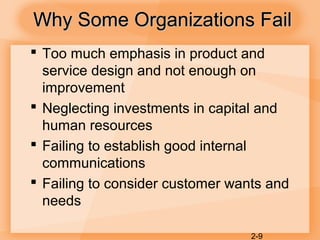
 Too much emphasis in product and
service design and not enough on
improvement
 Neglecting investments in capital and
human resources
 Failing to establish good internal
communications
 Failing to consider customer wants and
needs
2-10
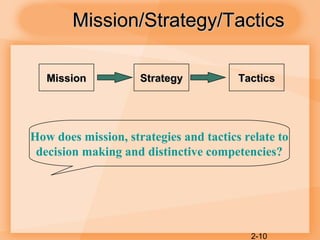
Mission/Strategy/TacticsMission/Strategy/Tactics
How does mission, strategies and tactics relate to
decision making and distinctive competencies?
StrategyStrategy TacticsTacticsMissionMission
2-11
StrategyStrategy
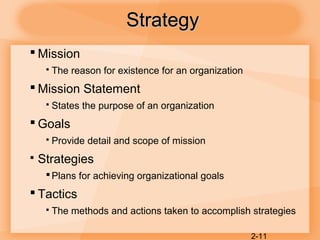
 Mission
 The reason for existence for an organization
 Mission Statement
 States the purpose of an organization
 Goals
 Provide detail and scope of mission
 Strategies
Plans for achieving organizational goals
 Tactics
 The methods and actions taken to accomplish strategies
2-12
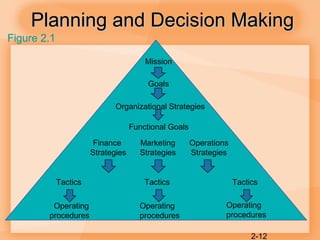
Planning and Decision MakingPlanning and Decision Making
Mission
Goals
Organizational Strategies
Functional Goals
Finance
Strategies
Marketing
Strategies
Operations
Strategies
Tactics Tactics Tactics
Operating
procedures
Operating
procedures
Operating
procedures
Figure 2.1
2-13
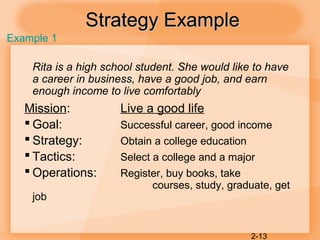
Strategy ExampleStrategy Example
Rita is a high school student. She would like to have
a career in business, have a good job, and earn
enough income to live comfortably
Mission: Live a good life
 Goal: Successful career, good income
 Strategy: Obtain a college education
 Tactics: Select a college and a major
 Operations: Register, buy books, take
courses, study, graduate, get
job
Example 1
2-14
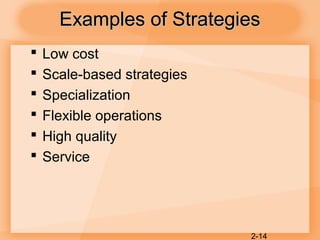
Examples of StrategiesExamples of Strategies
 Low cost
 Scale-based strategies
 Specialization
 Flexible operations
 High quality
 Service
2-15
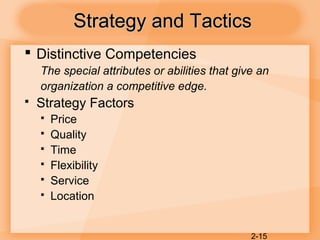
Strategy and TacticsStrategy and Tactics
 Distinctive Competencies
The special attributes or abilities that give an
organization a competitive edge.
 Strategy Factors
 Price
 Quality
 Time
 Flexibility
 Service
 Location
2-16
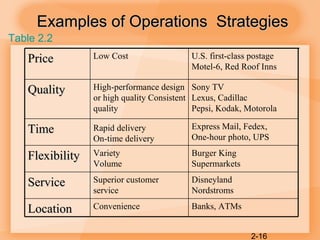
Banks, ATMsConvenienceLocationLocation
Disneyland
Nordstroms
Superior customer
service
ServiceService
Burger King
Supermarkets
Variety
Volume
FlexibilityFlexibility
Express Mail, Fedex,
One-hour photo, UPS
Rapid delivery
On-time delivery
TimeTime
Sony TV
Lexus, Cadillac
Pepsi, Kodak, Motorola
High-performance design
or high quality Consistent
quality
QualityQuality
U.S. first-class postage
Motel-6, Red Roof Inns
Low CostPricePrice
Examples of Operations StrategiesExamples of Operations Strategies
Table 2.2
2-17
Global StrategyGlobal Strategy
 Strategic decisions must be made with
respect to globalization
 What works in one country may not work in
another
 Strategies must be changed to account for
these differences
 Other issues
 Political, social, cultural, and economic
differences
2-18
Strategy FormulationStrategy Formulation
 Distinctive competencies
 Environmental scanning
 SWOT
 Order qualifiers
 Order winners
2-19
Strategy FormulationStrategy Formulation
 Order qualifiers
 Characteristics that customers perceive as
minimum standards of acceptability to be
considered as a potential purchase
 Order winners
 Characteristics of an organization’s goods or
services that cause it to be perceived as
better than the competition
2-20
 Economic conditions
 Political conditions
 Legal environment
 Technology
 Competition
 Markets
Key External FactorsKey External Factors
2-21
 Human Resources
 Facilities and equipment
 Financial resources
 Customers
 Products and services
 Technology
 Suppliers
Key Internal FactorsKey Internal Factors
2-22
Operations StrategyOperations Strategy
 Operations strategy – The approach,
consistent with organization strategy,
that is used to guide the operations
function.
2-23
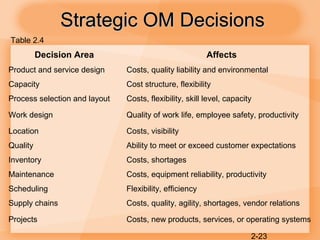
Strategic OM DecisionsStrategic OM Decisions
Decision Area Affects
Product and service design Costs, quality liability and environmental
Capacity Cost structure, flexibility
Process selection and layout Costs, flexibility, skill level, capacity
Work design Quality of work life, employee safety, productivity
Location Costs, visibility
Quality Ability to meet or exceed customer expectations
Inventory Costs, shortages
Maintenance Costs, equipment reliability, productivity
Scheduling Flexibility, efficiency
Supply chains Costs, quality, agility, shortages, vendor relations
Projects Costs, new products, services, or operating systems
Table 2.4
2-24
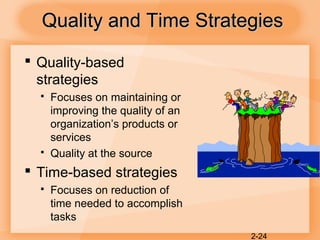
Quality and Time StrategiesQuality and Time Strategies
 Quality-based
strategies
 Focuses on maintaining or
improving the quality of an
organization’s products or
services
 Quality at the source
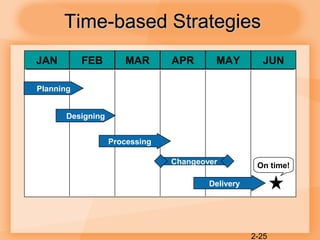
 Time-based strategies
 Focuses on reduction of
time needed to accomplish
tasks
2-25
Time-based StrategiesTime-based Strategies
JAN FEB MAR APR MAY JUN
Planning
Processing
Changeover On time!
Designing
Delivery

Ch02 p1 ppt (1)

  • 1.
    McGraw-Hill/Irwin Copyright ©2007 by The McGraw-Hill Companies, Inc. All rights reserved. 22 Competitiveness, Strategy, and Productivity
  • 2.
    2-2 Learning ObjectivesLearning Objectives List and briefly discuss the primary ways that business organizations compete.  List five reasons for the poor competitiveness of some companies.  Define the term strategy and explain why strategy is important for competitiveness.  Contrast strategy and tactics.
  • 3.
    2-3 Learning ObjectivesLearning Objectives Discuss and compare organization strategy and operations strategy, and explain why it is important to link the two.  Describe and give examples of time-based strategies.  Define the term productivity and explain why it is important to organizations and to countries.  List some of the reasons for poor productivity and some ways of improving it.
  • 4.
    2-4 Competitiveness:Competitiveness: How effectively anorganization meets the wants and needs of customers relative to others that offer similar goods or services
  • 5.
    2-5 Businesses Compete UsingBusinessesCompete Using MarketingMarketing  Identifying consumer wants and needs  Pricing  Advertising and promotion
  • 6.
    2-6 Businesses Compete UsingBusinessesCompete Using OperationsOperations  Product and service design  Cost  Location  Quality  Quick response
  • 7.
    2-7 Businesses Compete UsingBusinessesCompete Using OperationsOperations  Flexibility  Inventory management  Supply chain management  Service and service quality  Managers and workers
  • 8.
    2-8 Why Some OrganizationsFailWhy Some Organizations Fail  Too much emphasis on short-term financial performance  Failing to take advantage of strengths and opportunities  Neglecting operations strategy  Failing to recognize competitive threats
  • 9.
    2-9 Why Some OrganizationsFailWhy Some Organizations Fail  Too much emphasis in product and service design and not enough on improvement  Neglecting investments in capital and human resources  Failing to establish good internal communications  Failing to consider customer wants and needs
  • 10.
    2-10 Mission/Strategy/TacticsMission/Strategy/Tactics How does mission,strategies and tactics relate to decision making and distinctive competencies? StrategyStrategy TacticsTacticsMissionMission
  • 11.
    2-11 StrategyStrategy  Mission  Thereason for existence for an organization  Mission Statement  States the purpose of an organization  Goals  Provide detail and scope of mission  Strategies Plans for achieving organizational goals  Tactics  The methods and actions taken to accomplish strategies
  • 12.
    2-12 Planning and DecisionMakingPlanning and Decision Making Mission Goals Organizational Strategies Functional Goals Finance Strategies Marketing Strategies Operations Strategies Tactics Tactics Tactics Operating procedures Operating procedures Operating procedures Figure 2.1
  • 13.
    2-13 Strategy ExampleStrategy Example Ritais a high school student. She would like to have a career in business, have a good job, and earn enough income to live comfortably Mission: Live a good life  Goal: Successful career, good income  Strategy: Obtain a college education  Tactics: Select a college and a major  Operations: Register, buy books, take courses, study, graduate, get job Example 1
  • 14.
    2-14 Examples of StrategiesExamplesof Strategies  Low cost  Scale-based strategies  Specialization  Flexible operations  High quality  Service
  • 15.
    2-15 Strategy and TacticsStrategyand Tactics  Distinctive Competencies The special attributes or abilities that give an organization a competitive edge.  Strategy Factors  Price  Quality  Time  Flexibility  Service  Location
  • 16.
    2-16 Banks, ATMsConvenienceLocationLocation Disneyland Nordstroms Superior customer service ServiceService BurgerKing Supermarkets Variety Volume FlexibilityFlexibility Express Mail, Fedex, One-hour photo, UPS Rapid delivery On-time delivery TimeTime Sony TV Lexus, Cadillac Pepsi, Kodak, Motorola High-performance design or high quality Consistent quality QualityQuality U.S. first-class postage Motel-6, Red Roof Inns Low CostPricePrice Examples of Operations StrategiesExamples of Operations Strategies Table 2.2
  • 17.
    2-17 Global StrategyGlobal Strategy Strategic decisions must be made with respect to globalization  What works in one country may not work in another  Strategies must be changed to account for these differences  Other issues  Political, social, cultural, and economic differences
  • 18.
    2-18 Strategy FormulationStrategy Formulation Distinctive competencies  Environmental scanning  SWOT  Order qualifiers  Order winners
  • 19.
    2-19 Strategy FormulationStrategy Formulation Order qualifiers  Characteristics that customers perceive as minimum standards of acceptability to be considered as a potential purchase  Order winners  Characteristics of an organization’s goods or services that cause it to be perceived as better than the competition
  • 20.
    2-20  Economic conditions Political conditions  Legal environment  Technology  Competition  Markets Key External FactorsKey External Factors
  • 21.
    2-21  Human Resources Facilities and equipment  Financial resources  Customers  Products and services  Technology  Suppliers Key Internal FactorsKey Internal Factors
  • 22.
    2-22 Operations StrategyOperations Strategy Operations strategy – The approach, consistent with organization strategy, that is used to guide the operations function.
  • 23.
    2-23 Strategic OM DecisionsStrategicOM Decisions Decision Area Affects Product and service design Costs, quality liability and environmental Capacity Cost structure, flexibility Process selection and layout Costs, flexibility, skill level, capacity Work design Quality of work life, employee safety, productivity Location Costs, visibility Quality Ability to meet or exceed customer expectations Inventory Costs, shortages Maintenance Costs, equipment reliability, productivity Scheduling Flexibility, efficiency Supply chains Costs, quality, agility, shortages, vendor relations Projects Costs, new products, services, or operating systems Table 2.4
  • 24.
    2-24 Quality and TimeStrategiesQuality and Time Strategies  Quality-based strategies  Focuses on maintaining or improving the quality of an organization’s products or services  Quality at the source  Time-based strategies  Focuses on reduction of time needed to accomplish tasks
  • 25.
    2-25 Time-based StrategiesTime-based Strategies JANFEB MAR APR MAY JUN Planning Processing Changeover On time! Designing Delivery