© Wiley 2010 1
The Role of Operations
Strategy
 Provide a plan that makes best use of
resources which;
 Specifies the policies and plans for using
organizational resources
 Supports Business Strategy as shown on
next slide
© Wiley 2010 2
Business/Functional Strategy
© Wiley 2010 3
Importance of Operations
Strategy
 Essential differences between
operational efficiency and
strategy:
 Operational efficiency is performing tasks
well, even better than competitors
 Strategy is a plan for competing in the
marketplace
 Operations strategy ensures all tasks
performed are the right tasks
© Wiley 2010 4
To Develop a Business
Strategy
 Consider these factors and strategic
decisions:
 What business the company is in (mission)
 Analyze and understand the market
(environmental scanning)
 Identify the company strengths (core
competencies)
© Wiley 2010 5
Three Inputs to a Business Strategy
© Wiley 2010 6
Key Examples
 Mission: Dell Computer- “to be the most
successful computer company in the world”
 Environmental Scanning: political trends,
social trends, economic trends, market place
trends, global trends
 Core Competencies: strength of workers,
modern facilities, market understanding, best
technologies, financial know-how, logistics
© Wiley 2010 7
Developing an Operations
Strategy
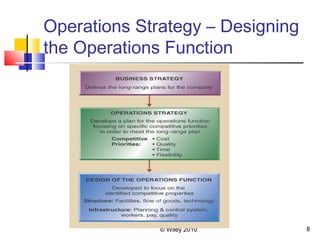
Operations Strategy: a plan for the design
and management of operations
functions
 is developed after the business strategy
 focuses on specific capabilities which give
it a competitive edge – competitive
priorities
© Wiley 2010 8
Operations Strategy – Designing
the Operations Function
© Wiley 2010 9
Competitive Priorities- The Edge
 Four Key Operations Questions:
Will you compete on –
Cost?
Quality?
Time?
Flexibility?
 All of the above? Some? Tradeoffs?
© Wiley 2010 10
Competing on Cost
 Offering product at a low price relative to competition
 Typically high volume products
 Often limit product range & offer little
customization
 May invest in automation to reduce unit costs
 Can use lower skill labor
 Probably uses product focused layouts
 Low cost does not mean low quality
© Wiley 2010 11
Competing on Quality
 Quality is often subjective
 Quality is defined differently depending on who is
defining it
 Two major quality dimensions include
 High performance design:

Superior features, high durability, & excellent customer service
 Product & service consistency:

Meets design specifications

Close tolerances

Error free delivery
 Quality needs to address
 Product design quality – product/service meets requirements
 Process quality – error free products
© Wiley 2010 12
Competing on Time
 Time/speed one of most important
competition priorities
 First that can deliver often wins the race
 Time related issues involve
 Rapid delivery:

Focused on shorter time between order placement and delivery
 On-time delivery:

Deliver product exactly when needed every time
© Wiley 2010 13
Competing on Flexibility
 Company environment changes rapidly
 Company must accommodate change by
being flexible
 Product flexibility:

Easily switch production from one item to another

Easily customize product/service to meet specific requirements
of a customer
 Volume flexibility:

Ability to ramp production up and down to match market
demands
© Wiley 2010 14
The Need for Trade-offs
 Decisions must emphasize priorities that support business
strategy
 Decisions often required trade offs
 Decisions must focus on order qualifiers and order winners
 Which priorities are “Order Qualifiers”?
Must have excellent quality since everyone expects it
 Which priorities are “Order Winners”?
Dell competes on all four priorities
Southwest Airlines competes on cost
McDonald’s competes on consistency
FedEx competes on speed
Custom tailors compete on flexibility
© Wiley 2010 15
Translating to Production Requirements
 Specific Operation requirements
include two general categories
 Structure – decisions related to the
production process, such as characteristics
of facilities used, selection of appropriate
technology, and the flow of goods and
services
 Infrastructure – decisions related to
planning and control systems of operations
© Wiley 2010 16
Translating to Production Requirements
 Dell Computer example – structure &
infrastructure

They focus on customer service, cost, and speed
 ERP system developed to allow customers to
order directly from Dell
 Product design and assembly line allow “make to
order” strategy – lowers costs, increases turns
 Suppliers ship components to a warehouse within
15 minutes of the assembly plant - VMI
 Dell set up a shipping arrangement with UPS
Strategy Formulation
 Strategy
is a broad plan developed by an organization to take it from where
it is to where it wants to be. A well-designed strategy will help an
organization reach its maximum level of effectiveness in reaching its goals
while constantly allowing it to monitor its environment to adapt the
strategy as necessary.
 Strategy Formulation
is the process of developing the strategy. And the process by which
an organization chooses the most appropriate courses of action to achieve
its defined goals. This process is essential to an organization’s success,
because it provides a framework for the actions that lead to the
anticipated results.
Strategy Formulation requires a defined set of six steps for
effective implementation.
1. Define the organization,
2. Define the strategic mission,
3. Define the strategic objectives,
4. Define the competitive strategy,
5. Implement strategies, and
6. Evaluate progress.
Step 1. Define the Organization
defining an organization is to identify the company’s
customers. Without a strong customer base, whose
needs are being filled, an organization will not be
successful. A company must identify the factors that are
valued by its customers. Is the value based on a superior
product or service relative to the competition? Are your
customers buying your products for your low prices? Do
you produce products meet image needs of your
customers?
Let’s review some of the ways in which companies can
define themselves
1. End Benefits
Organizations must remember that people are buying
benefits not features.
2. Target Market
Companies can become successful by identifying
themselves with a particular target group. This focus
should not be limited only to demographic
segmentation (i.e., age, income, education, gender,
income, family life-cycle, culture) but also by
psychographic indicators.
3. Technology
Computer companies, medical research companies, and other
companies that identify themselves with the tech world will
find that they must be able to quickly adapt to changes in the
marketplace. New products, services, and inventions are
frequently introduced, making this a very difficult and
challenging business environment in which to operate.
Step 2. Define the Strategic Mission
An organization’s strategic mission offers a long-range
perspective of what the organization strives for going
forward. A clearly stated mission will provide the
organization with a guide for carrying out its plans.
Elements of a strong strategic mission statement should
include the values that the organization holds the nature of
the business, special abilities or position the organization
holds in the marketplace, and the organization’s vision for
where it wants to be in the future.
How to write Strategic Mission?
 Ask "What do we do?"; "How do we do it?"; and "For whom
do we do it,"
 Create a draft mission statement describing how the
company uniquely answers these questions. Touch on the
organization's current operations and the industry it is in.
 Look at competitors in the industry and use their mission
statements for research. Ask yourself what works and what
does not work. Revise your mission statement as needed.
 Get feedback from other members of the organization once
the statement is drafted. 
Step 3. Define the Strategic Objectives
 This third step in the strategic formulation process requires
an organization to identify the performance targets needed to
reach clearly stated objectives.
 These objectives may include:
market position relative to the competition,
 production of goods and services,
desired market share, improved customer services,
corporation expansion, advances in technology, and sales
increases.
 Strategic objectives must be communicated with all
employees and stakeholders in order to ensure success.
All members of the organization must be made aware of
their role in the process and how their efforts contribute
to meeting the organization’s objectives. Additionally,
members of the organization should have their own set
of objectives and performance targets for their
individual roles.
Step 4. Define the Competitive
Strategy
 It requires an organization to determine where it fits into the
marketplace. This applies not only to the organization as a
whole, but to each individual unit and department
throughout the enterprise. Each area must be aware of its
role within the company and how those roles enable the
organization to maintain its competitive position.
 Three factors must be considered when
determining the overall competitive strategy:
the industry and marketplace, the company’s
position relative to the competition, and the
company’s internal strengths and weaknesses.
 The Industry
The Competition
Strengths & Weaknesses
The three factors
1. The Industry
 When evaluating the overall industry, factors to be looked at include:

size of the market,

past and potential market growth,

Competitive profitability,

new market entries, and

industry threats.
2. The Competition
An organization cannot be successful unless it has a full
understanding of the other players in marketplace. A
company must be able to identify the strengths and
weaknesses of the competition and analyze the ways in
which the competition’s products or services meet the
needs of its customer base.
3. Strengths & Weaknesses
SWOT is an acronym for Strengths,
Weaknesses, Opportunities, and Threats.
Opportunities and threats are external
factors; strengths and weaknesses are internal
factors.  
Step 5. Implement Strategies
 Developing a strategy is only effective if it is put into
place. An organization may take all the necessary steps to
understand the marketplace, define itself, and identify the
competition. However, without implementing the strategy,
the organization’s work will be of little to no value.
 The methods employed for implementing strategies are
known as tactics. These individual actions enable an
organization to build a foundation for implementation.
Companies are able to identify which of their efforts are
more successful than others and will uncover new methods
of implementation, if necessary.
Step 6. Evaluate Progress
 As in any plan, a regular evaluation of processes and results is vital to
ongoing success. An organization must keep track of the progress it is
making as defined by its strategic plan.
 An organization should consider the following questions on a continuous
basis in order to evaluate progress:
 Have market conditions changed that may require a change
in corporate direction?
 Are there new entries in the marketplace to pose a
competitive threat?
 Has the organization been successful in translating their
strategy into actionable steps?
An organization will be able to successfully implement its
strategy both now and in the future through evaluating
feedback.
© Wiley 2010 33
Strategic Role of Technology
 Technology should support competitive
priorities
 Three Applications: product technology, process
technology, and information technology
 Products - Teflon, CD’s, fiber optic cable
 Processes – flexible automation, CAD
 Information Technology – POS, EDI, ERP,
B2B
© Wiley 2010 34
Technology for Competitive
Advantage
 Technology has positive and negative
potentials
 Positive

Improve processes

Maintain up-to-date standards

Obtain competitive advantage
 Negative

Costly

Risks such as overstating benefits
© Wiley 2010 35
Technology for Competitive
Advantage
 Technology should:
 Support competitive priorities
 Can require change to strategic plans
 Can require change to operations strategy
 Technology is an important strategic
decision
© Wiley 2010 36
Measuring Productivity
 Productivity is a measure of how efficiently inputs are
converted to outputs
Productivity = output/input
 Total Productivity Measure
Total Productivity = $sales/inputs
$
 Partial Productivity Measure
Partial Productivity = cars/employee
 Multifactor Productivity Measure
Multi-factor Productivity = sales/total $costs
© Wiley 2010 37
Productivity Example - An automobile manufacturer has presented the
following data for the past three years in its annual report. As a potential
investor, you are interested in calculating yearly productivity and year to
year productivity gains as one of several factors in your investment
analysis.
2003 2002 2001
Partial Prod. Measure
Unit Car Sales/Employee 24.1 21.2
18.3
Year-to-year Improvement 13.7% 15.8%
Multifactor Prod. Measures
Total Cost Productivity 1.26 1.24 1.19
Year-to-year Improvement 1.6% 4.2%
Which is the best measurement?
2003 2002 2001
Unit car
sales
2,700,000 2,400,000 2,100,000
Employee
s
112,000 113,000 115,000
$ Sales
(billions$)
$49,000 $41,000 $38,000
Cost of
Sales
(billions)
$39,000 $33,000 $32,000
© Wiley 2010 38
Interpreting Productivity Measures
 Productivity measures must be compared to
something, i.e. another year, a different company
 Raw productivity calculations do not tell the complete
story unless there are no major structure differences.
 In the prior automobile business example, it is
obvious that some major changes were taking place
to yield 15.8% and 13.7% year-to-year
cars/employee productivity improvements. What
changes could improve car sales per employee?
Automation? Out sourcing? Major re-design?
© Wiley 2010 39
Interpreting Productivity Measures
 Other productivity measure questions:
 Is this partial productivity measurement enough to
make an investment decision?
 Is the Total Cost Productivity measure a better
reflection of year to year productivity at 4.2% and
1.6%. Why?
 Should you also look at productivity measures for
the two major competitors for comparison?
 Productivity measure provides information on
how the firm is doing relative to what is critical
to the firm
© Wiley 2010 40
Productivity, Competitiveness, and
the Service Sector
 Productivity is a scorecard
on effective resource use
 A nation’s Productivity
effects its standard of living
 US productivity growth
averaged 2.8% from
1948-1973
 Productivity growth slowed
for the next 25 years to
1.1%
 Productivity growth in
service industries has been
less than in manufacturing
© Wiley 2010 41
Productivity and the Service
Sector con’t
 Measuring service sector productivity is
a unique challenge
 Traditional measures focus on tangible
outcomes
 Service industries primarily produce
intangible outcomes
 Measuring intangibles is challenging
© Wiley 2010 42
Operations Strategy Across
the Organization
 Business strategy defines long-term
plan
 Operations strategy support the
business strategy
 Marketing strategy needs to fully
understand operations capability
 Financial plans in effect support
operations activities.

Operation strategy

  • 1.
    © Wiley 20101 The Role of Operations Strategy  Provide a plan that makes best use of resources which;  Specifies the policies and plans for using organizational resources  Supports Business Strategy as shown on next slide
  • 2.
    © Wiley 20102 Business/Functional Strategy
  • 3.
    © Wiley 20103 Importance of Operations Strategy  Essential differences between operational efficiency and strategy:  Operational efficiency is performing tasks well, even better than competitors  Strategy is a plan for competing in the marketplace  Operations strategy ensures all tasks performed are the right tasks
  • 4.
    © Wiley 20104 To Develop a Business Strategy  Consider these factors and strategic decisions:  What business the company is in (mission)  Analyze and understand the market (environmental scanning)  Identify the company strengths (core competencies)
  • 5.
    © Wiley 20105 Three Inputs to a Business Strategy
  • 6.
    © Wiley 20106 Key Examples  Mission: Dell Computer- “to be the most successful computer company in the world”  Environmental Scanning: political trends, social trends, economic trends, market place trends, global trends  Core Competencies: strength of workers, modern facilities, market understanding, best technologies, financial know-how, logistics
  • 7.
    © Wiley 20107 Developing an Operations Strategy Operations Strategy: a plan for the design and management of operations functions  is developed after the business strategy  focuses on specific capabilities which give it a competitive edge – competitive priorities
  • 8.
    © Wiley 20108 Operations Strategy – Designing the Operations Function
  • 9.
    © Wiley 20109 Competitive Priorities- The Edge  Four Key Operations Questions: Will you compete on – Cost? Quality? Time? Flexibility?  All of the above? Some? Tradeoffs?
  • 10.
    © Wiley 201010 Competing on Cost  Offering product at a low price relative to competition  Typically high volume products  Often limit product range & offer little customization  May invest in automation to reduce unit costs  Can use lower skill labor  Probably uses product focused layouts  Low cost does not mean low quality
  • 11.
    © Wiley 201011 Competing on Quality  Quality is often subjective  Quality is defined differently depending on who is defining it  Two major quality dimensions include  High performance design:  Superior features, high durability, & excellent customer service  Product & service consistency:  Meets design specifications  Close tolerances  Error free delivery  Quality needs to address  Product design quality – product/service meets requirements  Process quality – error free products
  • 12.
    © Wiley 201012 Competing on Time  Time/speed one of most important competition priorities  First that can deliver often wins the race  Time related issues involve  Rapid delivery:  Focused on shorter time between order placement and delivery  On-time delivery:  Deliver product exactly when needed every time
  • 13.
    © Wiley 201013 Competing on Flexibility  Company environment changes rapidly  Company must accommodate change by being flexible  Product flexibility:  Easily switch production from one item to another  Easily customize product/service to meet specific requirements of a customer  Volume flexibility:  Ability to ramp production up and down to match market demands
  • 14.
    © Wiley 201014 The Need for Trade-offs  Decisions must emphasize priorities that support business strategy  Decisions often required trade offs  Decisions must focus on order qualifiers and order winners  Which priorities are “Order Qualifiers”? Must have excellent quality since everyone expects it  Which priorities are “Order Winners”? Dell competes on all four priorities Southwest Airlines competes on cost McDonald’s competes on consistency FedEx competes on speed Custom tailors compete on flexibility
  • 15.
    © Wiley 201015 Translating to Production Requirements  Specific Operation requirements include two general categories  Structure – decisions related to the production process, such as characteristics of facilities used, selection of appropriate technology, and the flow of goods and services  Infrastructure – decisions related to planning and control systems of operations
  • 16.
    © Wiley 201016 Translating to Production Requirements  Dell Computer example – structure & infrastructure  They focus on customer service, cost, and speed  ERP system developed to allow customers to order directly from Dell  Product design and assembly line allow “make to order” strategy – lowers costs, increases turns  Suppliers ship components to a warehouse within 15 minutes of the assembly plant - VMI  Dell set up a shipping arrangement with UPS
  • 17.
    Strategy Formulation  Strategy isa broad plan developed by an organization to take it from where it is to where it wants to be. A well-designed strategy will help an organization reach its maximum level of effectiveness in reaching its goals while constantly allowing it to monitor its environment to adapt the strategy as necessary.  Strategy Formulation is the process of developing the strategy. And the process by which an organization chooses the most appropriate courses of action to achieve its defined goals. This process is essential to an organization’s success, because it provides a framework for the actions that lead to the anticipated results.
  • 18.
    Strategy Formulation requiresa defined set of six steps for effective implementation. 1. Define the organization, 2. Define the strategic mission, 3. Define the strategic objectives, 4. Define the competitive strategy, 5. Implement strategies, and 6. Evaluate progress.
  • 19.
    Step 1. Definethe Organization defining an organization is to identify the company’s customers. Without a strong customer base, whose needs are being filled, an organization will not be successful. A company must identify the factors that are valued by its customers. Is the value based on a superior product or service relative to the competition? Are your customers buying your products for your low prices? Do you produce products meet image needs of your customers?
  • 20.
    Let’s review someof the ways in which companies can define themselves 1. End Benefits Organizations must remember that people are buying benefits not features. 2. Target Market Companies can become successful by identifying themselves with a particular target group. This focus should not be limited only to demographic segmentation (i.e., age, income, education, gender, income, family life-cycle, culture) but also by psychographic indicators.
  • 21.
    3. Technology Computer companies,medical research companies, and other companies that identify themselves with the tech world will find that they must be able to quickly adapt to changes in the marketplace. New products, services, and inventions are frequently introduced, making this a very difficult and challenging business environment in which to operate.
  • 22.
    Step 2. Definethe Strategic Mission An organization’s strategic mission offers a long-range perspective of what the organization strives for going forward. A clearly stated mission will provide the organization with a guide for carrying out its plans. Elements of a strong strategic mission statement should include the values that the organization holds the nature of the business, special abilities or position the organization holds in the marketplace, and the organization’s vision for where it wants to be in the future.
  • 23.
    How to writeStrategic Mission?  Ask "What do we do?"; "How do we do it?"; and "For whom do we do it,"  Create a draft mission statement describing how the company uniquely answers these questions. Touch on the organization's current operations and the industry it is in.  Look at competitors in the industry and use their mission statements for research. Ask yourself what works and what does not work. Revise your mission statement as needed.  Get feedback from other members of the organization once the statement is drafted. 
  • 24.
    Step 3. Definethe Strategic Objectives  This third step in the strategic formulation process requires an organization to identify the performance targets needed to reach clearly stated objectives.  These objectives may include: market position relative to the competition,  production of goods and services, desired market share, improved customer services, corporation expansion, advances in technology, and sales increases.
  • 25.
     Strategic objectivesmust be communicated with all employees and stakeholders in order to ensure success. All members of the organization must be made aware of their role in the process and how their efforts contribute to meeting the organization’s objectives. Additionally, members of the organization should have their own set of objectives and performance targets for their individual roles.
  • 26.
    Step 4. Definethe Competitive Strategy  It requires an organization to determine where it fits into the marketplace. This applies not only to the organization as a whole, but to each individual unit and department throughout the enterprise. Each area must be aware of its role within the company and how those roles enable the organization to maintain its competitive position.
  • 27.
     Three factorsmust be considered when determining the overall competitive strategy: the industry and marketplace, the company’s position relative to the competition, and the company’s internal strengths and weaknesses.  The Industry The Competition Strengths & Weaknesses
  • 28.
    The three factors 1.The Industry  When evaluating the overall industry, factors to be looked at include:  size of the market,  past and potential market growth,  Competitive profitability,  new market entries, and  industry threats.
  • 29.
    2. The Competition Anorganization cannot be successful unless it has a full understanding of the other players in marketplace. A company must be able to identify the strengths and weaknesses of the competition and analyze the ways in which the competition’s products or services meet the needs of its customer base.
  • 30.
    3. Strengths &Weaknesses SWOT is an acronym for Strengths, Weaknesses, Opportunities, and Threats. Opportunities and threats are external factors; strengths and weaknesses are internal factors.  
  • 31.
    Step 5. ImplementStrategies  Developing a strategy is only effective if it is put into place. An organization may take all the necessary steps to understand the marketplace, define itself, and identify the competition. However, without implementing the strategy, the organization’s work will be of little to no value.  The methods employed for implementing strategies are known as tactics. These individual actions enable an organization to build a foundation for implementation. Companies are able to identify which of their efforts are more successful than others and will uncover new methods of implementation, if necessary.
  • 32.
    Step 6. EvaluateProgress  As in any plan, a regular evaluation of processes and results is vital to ongoing success. An organization must keep track of the progress it is making as defined by its strategic plan.  An organization should consider the following questions on a continuous basis in order to evaluate progress:  Have market conditions changed that may require a change in corporate direction?  Are there new entries in the marketplace to pose a competitive threat?  Has the organization been successful in translating their strategy into actionable steps? An organization will be able to successfully implement its strategy both now and in the future through evaluating feedback.
  • 33.
    © Wiley 201033 Strategic Role of Technology  Technology should support competitive priorities  Three Applications: product technology, process technology, and information technology  Products - Teflon, CD’s, fiber optic cable  Processes – flexible automation, CAD  Information Technology – POS, EDI, ERP, B2B
  • 34.
    © Wiley 201034 Technology for Competitive Advantage  Technology has positive and negative potentials  Positive  Improve processes  Maintain up-to-date standards  Obtain competitive advantage  Negative  Costly  Risks such as overstating benefits
  • 35.
    © Wiley 201035 Technology for Competitive Advantage  Technology should:  Support competitive priorities  Can require change to strategic plans  Can require change to operations strategy  Technology is an important strategic decision
  • 36.
    © Wiley 201036 Measuring Productivity  Productivity is a measure of how efficiently inputs are converted to outputs Productivity = output/input  Total Productivity Measure Total Productivity = $sales/inputs $  Partial Productivity Measure Partial Productivity = cars/employee  Multifactor Productivity Measure Multi-factor Productivity = sales/total $costs
  • 37.
    © Wiley 201037 Productivity Example - An automobile manufacturer has presented the following data for the past three years in its annual report. As a potential investor, you are interested in calculating yearly productivity and year to year productivity gains as one of several factors in your investment analysis. 2003 2002 2001 Partial Prod. Measure Unit Car Sales/Employee 24.1 21.2 18.3 Year-to-year Improvement 13.7% 15.8% Multifactor Prod. Measures Total Cost Productivity 1.26 1.24 1.19 Year-to-year Improvement 1.6% 4.2% Which is the best measurement? 2003 2002 2001 Unit car sales 2,700,000 2,400,000 2,100,000 Employee s 112,000 113,000 115,000 $ Sales (billions$) $49,000 $41,000 $38,000 Cost of Sales (billions) $39,000 $33,000 $32,000
  • 38.
    © Wiley 201038 Interpreting Productivity Measures  Productivity measures must be compared to something, i.e. another year, a different company  Raw productivity calculations do not tell the complete story unless there are no major structure differences.  In the prior automobile business example, it is obvious that some major changes were taking place to yield 15.8% and 13.7% year-to-year cars/employee productivity improvements. What changes could improve car sales per employee? Automation? Out sourcing? Major re-design?
  • 39.
    © Wiley 201039 Interpreting Productivity Measures  Other productivity measure questions:  Is this partial productivity measurement enough to make an investment decision?  Is the Total Cost Productivity measure a better reflection of year to year productivity at 4.2% and 1.6%. Why?  Should you also look at productivity measures for the two major competitors for comparison?  Productivity measure provides information on how the firm is doing relative to what is critical to the firm
  • 40.
    © Wiley 201040 Productivity, Competitiveness, and the Service Sector  Productivity is a scorecard on effective resource use  A nation’s Productivity effects its standard of living  US productivity growth averaged 2.8% from 1948-1973  Productivity growth slowed for the next 25 years to 1.1%  Productivity growth in service industries has been less than in manufacturing
  • 41.
    © Wiley 201041 Productivity and the Service Sector con’t  Measuring service sector productivity is a unique challenge  Traditional measures focus on tangible outcomes  Service industries primarily produce intangible outcomes  Measuring intangibles is challenging
  • 42.
    © Wiley 201042 Operations Strategy Across the Organization  Business strategy defines long-term plan  Operations strategy support the business strategy  Marketing strategy needs to fully understand operations capability  Financial plans in effect support operations activities.