Operations Management The direction and control of the processes that transform inputs into products and services
Process Any activity or group of activities that takes one or more input(s), transforms and adds value to them, and provides one or more output(s).  --   input(s) --  processing function --  value addition --  output(s)
Process Function i. Objective function ii. Decision variables  iii. Constraints
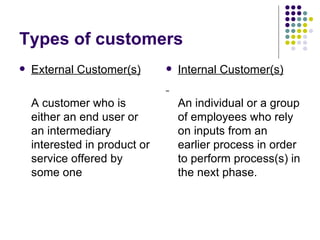
Types of customers External Customer(s) A customer who is either an end user or an intermediary interested in product or service offered by some one Internal Customer(s) An individual or a group of employees who rely on inputs from an earlier process in order to perform process(s) in the next phase.
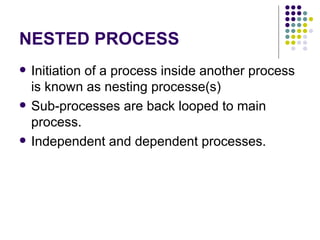
NESTED PROCESS Initiation of a process inside another process is known as nesting processe(s) Sub-processes are back looped to main process. Independent and dependent processes.
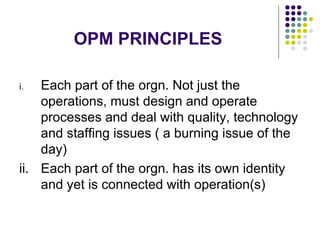
OPM PRINCIPLES Each part of the orgn. Not just the operations, must design and operate processes and deal with quality, technology and staffing issues ( a burning issue of the day) ii. Each part of the orgn. has its own identity and yet is connected with operation(s)
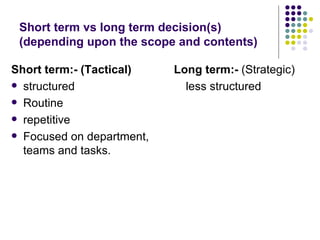
Short term vs long term decision(s) (depending upon the scope and contents)  Short term:- (Tactical) structured Routine repetitive  Focused on department, teams and tasks. Long term:-  (Strategic) less structured
Types of decisions:- Strategic choices Processes Quality Capacity, Location and Layout Operating Decisions
TYPES OF DECISIONS Strategic decision:- Affect company’s future direction. OM helps to determine the Co’s global strategies and competitive priorities. Propose the best design processes with its competitive priorities. Process:- Fundamental to all activities. How to manage process one time project(s). Technological changes to incorporate.
Quality:- It underline all processes and work activities. OMs helps to establish quality objectives and seek for improvements. TQM Capacity, Location & Layout:- Need long terms commitments. OM provides capacity, location and global operation(s).
Operating Decision(s):- Deals with operating the facility after it has been built. Internal & External Supply chain Control output and staffing level/overtimes. Synchronization process (suppliers and buyers) Just in time techniques which leads to customer satisfaction.
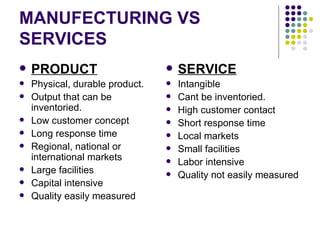
MANUFECTURING VS SERVICES  PRODUCT Physical, durable product. Output that can be inventoried. Low customer concept Long response time Regional, national or international markets Large facilities Capital intensive Quality easily measured SERVICE Intangible Cant be inventoried. High customer contact Short response time Local markets Small facilities Labor intensive Quality not easily measured
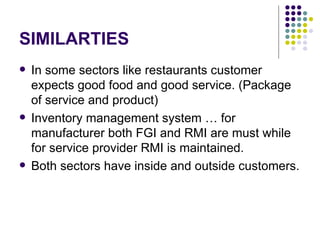
SIMILARTIES In some sectors like restaurants customer expects good food and good service. (Package of service and product) Inventory management system … for manufacturer both FGI and RMI are must while for service provider RMI is maintained. Both sectors have inside and outside customers.
Productivity It is the ratio of value of output(s) (goods or services) produced to the values of input resources ( All inputs)
Smart Operations Management    Operations Management functions: Enterprise-Control System Integration,  coordinate the resources - people, equipment, and materials -needed through all process steps to produce the end product .  It addresses industry standards and uses leading technology advancements to provide benefits which directly reduce time and cost during the documentation, implementation, testing, and verification phases of a project–delivering added value.
Integrated Information :-  Integrating plant-wide information supports collaboration and better decisions. Operations Optimization :-  Coordinate manual and automated operational activities to improve efficiency. Quality & Compliance :-  Effectively managing documentation reduces errors and supports regulatory compliance. Resource Management :-  Ensure personnel have resources and training to effectively perform their jobs.

Operations Management

  • 1.
    Operations Management Thedirection and control of the processes that transform inputs into products and services
  • 2.
    Process Any activityor group of activities that takes one or more input(s), transforms and adds value to them, and provides one or more output(s). -- input(s) -- processing function -- value addition -- output(s)
  • 3.
    Process Function i.Objective function ii. Decision variables iii. Constraints
  • 4.
    Types of customersExternal Customer(s) A customer who is either an end user or an intermediary interested in product or service offered by some one Internal Customer(s) An individual or a group of employees who rely on inputs from an earlier process in order to perform process(s) in the next phase.
  • 5.
    NESTED PROCESS Initiationof a process inside another process is known as nesting processe(s) Sub-processes are back looped to main process. Independent and dependent processes.
  • 6.
    OPM PRINCIPLES Eachpart of the orgn. Not just the operations, must design and operate processes and deal with quality, technology and staffing issues ( a burning issue of the day) ii. Each part of the orgn. has its own identity and yet is connected with operation(s)
  • 7.
    Short term vslong term decision(s) (depending upon the scope and contents) Short term:- (Tactical) structured Routine repetitive Focused on department, teams and tasks. Long term:- (Strategic) less structured
  • 8.
    Types of decisions:-Strategic choices Processes Quality Capacity, Location and Layout Operating Decisions
  • 9.
    TYPES OF DECISIONSStrategic decision:- Affect company’s future direction. OM helps to determine the Co’s global strategies and competitive priorities. Propose the best design processes with its competitive priorities. Process:- Fundamental to all activities. How to manage process one time project(s). Technological changes to incorporate.
  • 10.
    Quality:- It underlineall processes and work activities. OMs helps to establish quality objectives and seek for improvements. TQM Capacity, Location & Layout:- Need long terms commitments. OM provides capacity, location and global operation(s).
  • 11.
    Operating Decision(s):- Dealswith operating the facility after it has been built. Internal & External Supply chain Control output and staffing level/overtimes. Synchronization process (suppliers and buyers) Just in time techniques which leads to customer satisfaction.
  • 12.
    MANUFECTURING VS SERVICES PRODUCT Physical, durable product. Output that can be inventoried. Low customer concept Long response time Regional, national or international markets Large facilities Capital intensive Quality easily measured SERVICE Intangible Cant be inventoried. High customer contact Short response time Local markets Small facilities Labor intensive Quality not easily measured
  • 13.
    SIMILARTIES In somesectors like restaurants customer expects good food and good service. (Package of service and product) Inventory management system … for manufacturer both FGI and RMI are must while for service provider RMI is maintained. Both sectors have inside and outside customers.
  • 14.
    Productivity It isthe ratio of value of output(s) (goods or services) produced to the values of input resources ( All inputs)
  • 15.
    Smart Operations Management  Operations Management functions: Enterprise-Control System Integration, coordinate the resources - people, equipment, and materials -needed through all process steps to produce the end product .  It addresses industry standards and uses leading technology advancements to provide benefits which directly reduce time and cost during the documentation, implementation, testing, and verification phases of a project–delivering added value.
  • 16.
    Integrated Information :- Integrating plant-wide information supports collaboration and better decisions. Operations Optimization :- Coordinate manual and automated operational activities to improve efficiency. Quality & Compliance :- Effectively managing documentation reduces errors and supports regulatory compliance. Resource Management :- Ensure personnel have resources and training to effectively perform their jobs.