Copyright © 2014 by McGraw-Hill Education (Asia). All rights reserved.
1
Introduction to
Operations
Management
1-2
Learning Objectives
 Define the term operations management
 Identify the three major functional areas of
organizations and describe how they
interrelate
 Compare and contrast service and
manufacturing operations
 Describe the operations function and the
nature of the operations manager’s job
1-3
Learning Objectives
 Differentiate between design and operation
of production systems
 Describe the key aspects of operations
management decision making
 Briefly describe the historical evolution of
operations management
 Identify current trends that impact operations
management
1-4
Operations Management
 Operations Management is:
The management of systems or processes
that create goods and/or provide services
 Operations Management affects:
 Companies’ ability to compete
 Nation’s ability to compete internationally
1-5
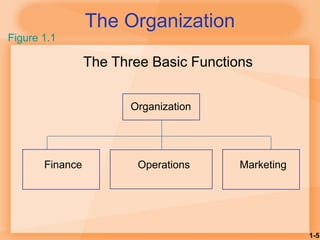
The Organization
The Three Basic Functions
Organization
Finance Operations Marketing
Figure 1.1
1-6
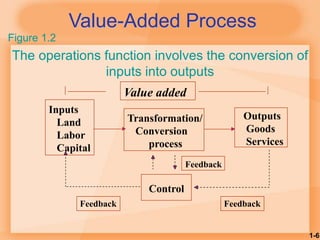
Value-Added Process
The operations function involves the conversion of
inputs into outputs
Inputs
Land
Labor
Capital
Transformation/
Conversion
process
Outputs
Goods
Services
Control
Feedback
Feedback
Feedback
Value added
Figure 1.2
1-7
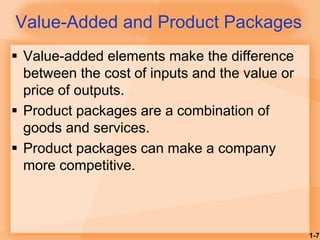
Value-Added and Product Packages
 Value-added elements make the difference
between the cost of inputs and the value or
price of outputs.
 Product packages are a combination of
goods and services.
 Product packages can make a company
more competitive.
1-8
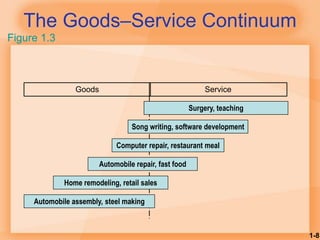
Automobile assembly, steel making
Home remodeling, retail sales
Automobile repair, fast food
The Goods–Service Continuum
Figure 1.3
Computer repair, restaurant meal
Song writing, software development
Goods Service
Surgery, teaching
1-9
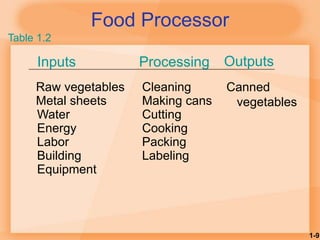
Food Processor
Inputs Processing Outputs
Raw vegetables Cleaning Canned
vegetables
Metal sheets Making cans
Water Cutting
Energy Cooking
Labor Packing
Building Labeling
Equipment
Table 1.2
1-10
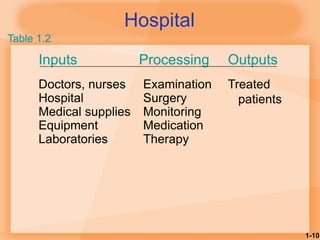
Hospital
Inputs Processing Outputs
Doctors, nurses Examination Treated
patients
Hospital Surgery
Medical supplies Monitoring
Equipment Medication
Laboratories Therapy
Table 1.2
1-11
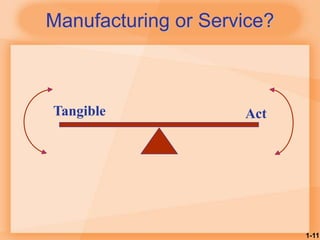
Manufacturing or Service?
Tangible Act
1-12
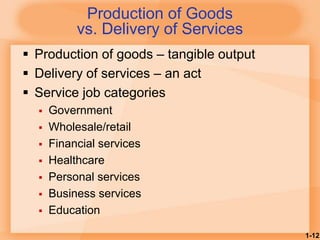
Production of Goods
vs. Delivery of Services
 Production of goods – tangible output
 Delivery of services – an act
 Service job categories
 Government
 Wholesale/retail
 Financial services
 Healthcare
 Personal services
 Business services
 Education
1-13
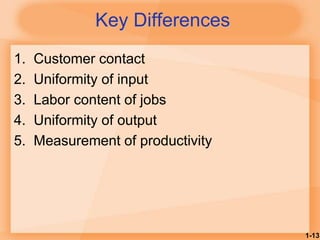
Key Differences
1. Customer contact
2. Uniformity of input
3. Labor content of jobs
4. Uniformity of output
5. Measurement of productivity
1-14
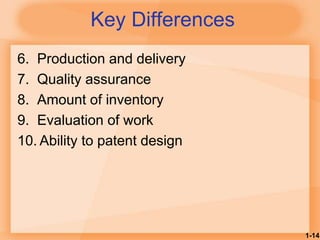
Key Differences
6. Production and delivery
7. Quality assurance
8. Amount of inventory
9. Evaluation of work
10. Ability to patent design
1-15
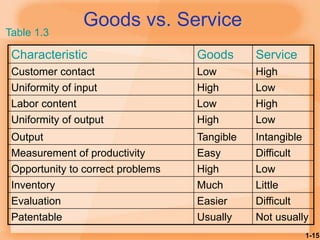
Goods vs. Service
Characteristic Goods Service
Customer contact Low High
Uniformity of input High Low
Labor content Low High
Uniformity of output High Low
Output Tangible Intangible
Measurement of productivity Easy Difficult
Opportunity to correct problems High Low
Inventory Much Little
Evaluation Easier Difficult
Patentable Usually Not usually
Table 1.3
1-16
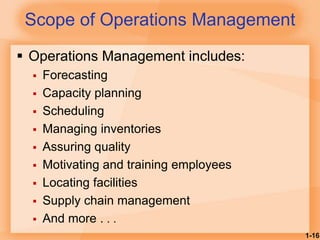
 Operations Management includes:
 Forecasting
 Capacity planning
 Scheduling
 Managing inventories
 Assuring quality
 Motivating and training employees
 Locating facilities
 Supply chain management
 And more . . .
Scope of Operations Management
1-17
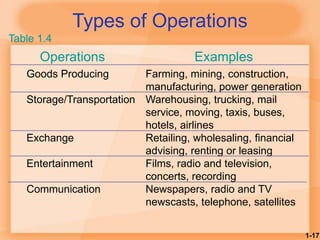
Types of Operations
Table 1.4
Operations Examples
Goods Producing Farming, mining, construction,
manufacturing, power generation
Storage/Transportation Warehousing, trucking, mail
service, moving, taxis, buses,
hotels, airlines
Exchange Retailing, wholesaling, financial
advising, renting or leasing
Entertainment Films, radio and television,
concerts, recording
Communication Newspapers, radio and TV
newscasts, telephone, satellites
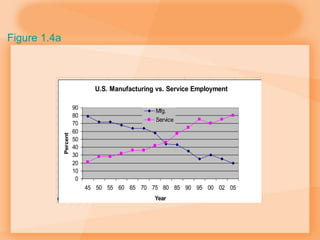
Year Mfg. Service
45 79 21
50 72 28
55 72 28
60 68 32
65 64 36
70 64 36
75 58 42
80 44 46
85 43 57
90 35 65
95 25 75
00 30 70
02 25 75
U.S. Manufacturing vs. Service Employment
0
10
20
30
40
50
60
70
80
90
45 50 55 60 65 70 75 80 85 90 95 00 02 05
Year
Percent
Mfg.
Service
Figure 1.4a
1-19
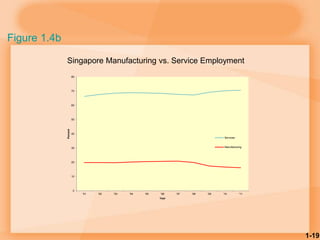
Figure 1.4b
Singapore Manufacturing vs. Service Employment
0
10
20
30
40
50
60
70
80
'01 '02 '03 '04 '05 '06 '07 '08 '09 '10 '11
Percent
Year
Services
Manufacturing
1-20
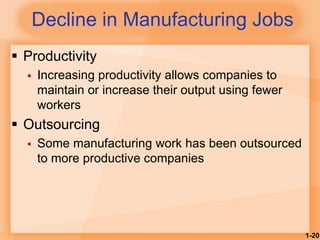
Decline in Manufacturing Jobs
 Productivity
 Increasing productivity allows companies to
maintain or increase their output using fewer
workers
 Outsourcing
 Some manufacturing work has been outsourced
to more productive companies
1-21
Challenges of Managing Services
 Service jobs are often less structured than
manufacturing jobs
 Customer contact is higher
 Worker skill levels are lower
 Services hire many low-skill, entry-level workers
 Employee turnover is higher
 Input variability is higher
 Service performance can be affected by worker’s
personal factors
1-22
Key Decisions of Operations Managers
 What
What resources/what amounts
 When
Needed/scheduled/ordered
 Where
Work to be done
 How
Designed/Resources allocated
 Who
To do the work
1-23
Operations Management Decision
Making
 Models
 Quantitative approaches
 Performance metrics
 Analysis of trade-offs
 Systems approach
 Establishing priorities
 Ethics
1-24
Decision Making
 Models
 Quantitative approaches
 Performance metrics
 Analysis of trade-offs
 Systems approach
 Establishing priorities
 Ethics
1-25
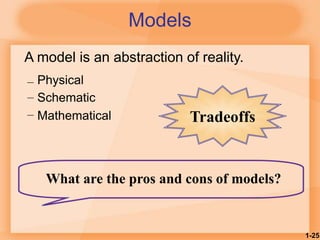
Models
A model is an abstraction of reality.
– Physical
– Schematic
– Mathematical
What are the pros and cons of models?
Tradeoffs
1-26
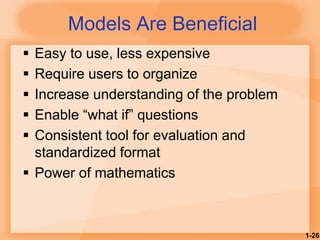
Models Are Beneficial
 Easy to use, less expensive
 Require users to organize
 Increase understanding of the problem
 Enable “what if” questions
 Consistent tool for evaluation and
standardized format
 Power of mathematics
1-27
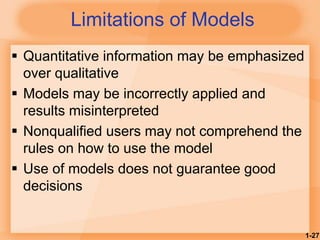
Limitations of Models
 Quantitative information may be emphasized
over qualitative
 Models may be incorrectly applied and
results misinterpreted
 Nonqualified users may not comprehend the
rules on how to use the model
 Use of models does not guarantee good
decisions
1-28
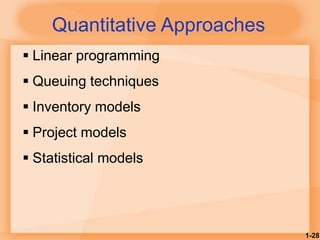
Quantitative Approaches
 Linear programming
 Queuing techniques
 Inventory models
 Project models
 Statistical models
1-29
Performance Metrics
 To control different aspects of operations
 Many: Profits
Costs
Quality
Productivity
Assets
Inventory
Schedules
Forecast accuracy
1-30
Analysis of Trade-Offs
 Decision on the amount of inventory to stock
 Increased cost of holding inventory
vs.
 Level of customer service
1-31
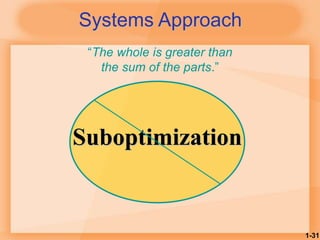
Systems Approach
“The whole is greater than
the sum of the parts.”
Suboptimization
1-32
Establishing Priorities
 Pareto phenomenon
 A few factors account for a high
percentage of the occurrence of some
event(s).
 80–20 Rule: 80% of problems are caused
by 20% of the activities.
How do we identify the vital few?
1-33
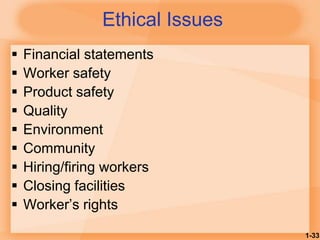
Ethical Issues
 Financial statements
 Worker safety
 Product safety
 Quality
 Environment
 Community
 Hiring/firing workers
 Closing facilities
 Worker’s rights
1-34
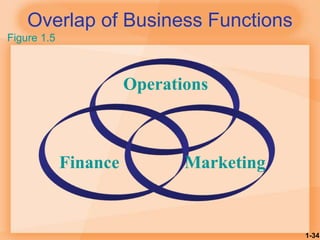
Overlap of Business Functions
Operations
Finance
Figure 1.5
Marketing
1-35
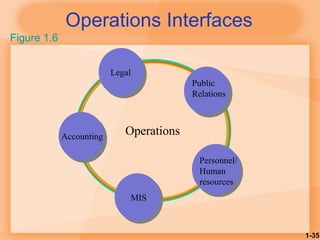
Operations Interfaces
Operations
Personnel/
Human
resources
MIS
Legal
Public
Relations
Accounting
Figure 1.6
1-36
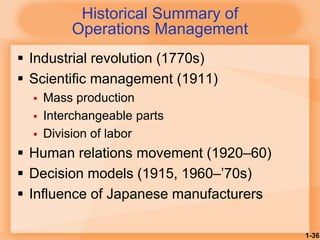
Historical Summary of
Operations Management
 Industrial revolution (1770s)
 Scientific management (1911)
 Mass production
 Interchangeable parts
 Division of labor
 Human relations movement (1920–60)
 Decision models (1915, 1960–’70s)
 Influence of Japanese manufacturers
1-37
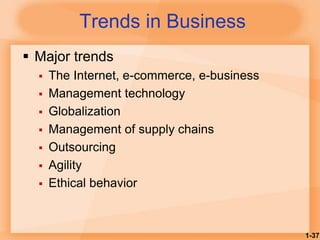
Trends in Business
 Major trends
 The Internet, e-commerce, e-business
 Management technology
 Globalization
 Management of supply chains
 Outsourcing
 Agility
 Ethical behavior
1-38
Management Technology
 Technology: The application of scientific
discoveries to the development and
improvement of goods and services
 Product and service technology
 Process technology
 Information technology
1-39
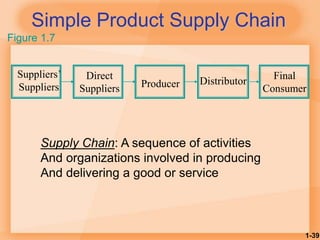
Suppliers’
Suppliers
Direct
Suppliers Producer Distributor Final
Consumer
Simple Product Supply Chain
Figure 1.7
Supply Chain: A sequence of activities
And organizations involved in producing
And delivering a good or service
1-40
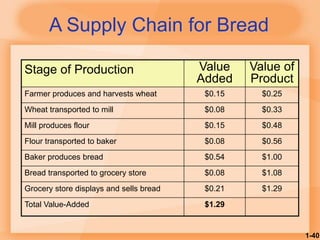
Stage of Production Value
Added
Value of
Product
Farmer produces and harvests wheat $0.15 $0.25
Wheat transported to mill $0.08 $0.33
Mill produces flour $0.15 $0.48
Flour transported to baker $0.08 $0.56
Baker produces bread $0.54 $1.00
Bread transported to grocery store $0.08 $1.08
Grocery store displays and sells bread $0.21 $1.29
Total Value-Added $1.29
A Supply Chain for Bread
1-41
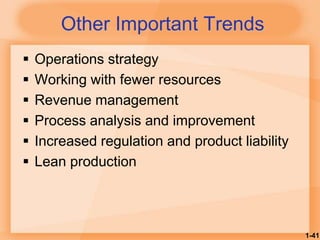
Other Important Trends
 Operations strategy
 Working with fewer resources
 Revenue management
 Process analysis and improvement
 Increased regulation and product liability
 Lean production

OM2E_Chapter01.ppt

  • 1.
    Copyright © 2014by McGraw-Hill Education (Asia). All rights reserved. 1 Introduction to Operations Management
  • 2.
    1-2 Learning Objectives  Definethe term operations management  Identify the three major functional areas of organizations and describe how they interrelate  Compare and contrast service and manufacturing operations  Describe the operations function and the nature of the operations manager’s job
  • 3.
    1-3 Learning Objectives  Differentiatebetween design and operation of production systems  Describe the key aspects of operations management decision making  Briefly describe the historical evolution of operations management  Identify current trends that impact operations management
  • 4.
    1-4 Operations Management  OperationsManagement is: The management of systems or processes that create goods and/or provide services  Operations Management affects:  Companies’ ability to compete  Nation’s ability to compete internationally
  • 5.
    1-5 The Organization The ThreeBasic Functions Organization Finance Operations Marketing Figure 1.1
  • 6.
    1-6 Value-Added Process The operationsfunction involves the conversion of inputs into outputs Inputs Land Labor Capital Transformation/ Conversion process Outputs Goods Services Control Feedback Feedback Feedback Value added Figure 1.2
  • 7.
    1-7 Value-Added and ProductPackages  Value-added elements make the difference between the cost of inputs and the value or price of outputs.  Product packages are a combination of goods and services.  Product packages can make a company more competitive.
  • 8.
    1-8 Automobile assembly, steelmaking Home remodeling, retail sales Automobile repair, fast food The Goods–Service Continuum Figure 1.3 Computer repair, restaurant meal Song writing, software development Goods Service Surgery, teaching
  • 9.
    1-9 Food Processor Inputs ProcessingOutputs Raw vegetables Cleaning Canned vegetables Metal sheets Making cans Water Cutting Energy Cooking Labor Packing Building Labeling Equipment Table 1.2
  • 10.
    1-10 Hospital Inputs Processing Outputs Doctors,nurses Examination Treated patients Hospital Surgery Medical supplies Monitoring Equipment Medication Laboratories Therapy Table 1.2
  • 11.
  • 12.
    1-12 Production of Goods vs.Delivery of Services  Production of goods – tangible output  Delivery of services – an act  Service job categories  Government  Wholesale/retail  Financial services  Healthcare  Personal services  Business services  Education
  • 13.
    1-13 Key Differences 1. Customercontact 2. Uniformity of input 3. Labor content of jobs 4. Uniformity of output 5. Measurement of productivity
  • 14.
    1-14 Key Differences 6. Productionand delivery 7. Quality assurance 8. Amount of inventory 9. Evaluation of work 10. Ability to patent design
  • 15.
    1-15 Goods vs. Service CharacteristicGoods Service Customer contact Low High Uniformity of input High Low Labor content Low High Uniformity of output High Low Output Tangible Intangible Measurement of productivity Easy Difficult Opportunity to correct problems High Low Inventory Much Little Evaluation Easier Difficult Patentable Usually Not usually Table 1.3
  • 16.
    1-16  Operations Managementincludes:  Forecasting  Capacity planning  Scheduling  Managing inventories  Assuring quality  Motivating and training employees  Locating facilities  Supply chain management  And more . . . Scope of Operations Management
  • 17.
    1-17 Types of Operations Table1.4 Operations Examples Goods Producing Farming, mining, construction, manufacturing, power generation Storage/Transportation Warehousing, trucking, mail service, moving, taxis, buses, hotels, airlines Exchange Retailing, wholesaling, financial advising, renting or leasing Entertainment Films, radio and television, concerts, recording Communication Newspapers, radio and TV newscasts, telephone, satellites
  • 18.
    Year Mfg. Service 4579 21 50 72 28 55 72 28 60 68 32 65 64 36 70 64 36 75 58 42 80 44 46 85 43 57 90 35 65 95 25 75 00 30 70 02 25 75 U.S. Manufacturing vs. Service Employment 0 10 20 30 40 50 60 70 80 90 45 50 55 60 65 70 75 80 85 90 95 00 02 05 Year Percent Mfg. Service Figure 1.4a
  • 19.
    1-19 Figure 1.4b Singapore Manufacturingvs. Service Employment 0 10 20 30 40 50 60 70 80 '01 '02 '03 '04 '05 '06 '07 '08 '09 '10 '11 Percent Year Services Manufacturing
  • 20.
    1-20 Decline in ManufacturingJobs  Productivity  Increasing productivity allows companies to maintain or increase their output using fewer workers  Outsourcing  Some manufacturing work has been outsourced to more productive companies
  • 21.
    1-21 Challenges of ManagingServices  Service jobs are often less structured than manufacturing jobs  Customer contact is higher  Worker skill levels are lower  Services hire many low-skill, entry-level workers  Employee turnover is higher  Input variability is higher  Service performance can be affected by worker’s personal factors
  • 22.
    1-22 Key Decisions ofOperations Managers  What What resources/what amounts  When Needed/scheduled/ordered  Where Work to be done  How Designed/Resources allocated  Who To do the work
  • 23.
    1-23 Operations Management Decision Making Models  Quantitative approaches  Performance metrics  Analysis of trade-offs  Systems approach  Establishing priorities  Ethics
  • 24.
    1-24 Decision Making  Models Quantitative approaches  Performance metrics  Analysis of trade-offs  Systems approach  Establishing priorities  Ethics
  • 25.
    1-25 Models A model isan abstraction of reality. – Physical – Schematic – Mathematical What are the pros and cons of models? Tradeoffs
  • 26.
    1-26 Models Are Beneficial Easy to use, less expensive  Require users to organize  Increase understanding of the problem  Enable “what if” questions  Consistent tool for evaluation and standardized format  Power of mathematics
  • 27.
    1-27 Limitations of Models Quantitative information may be emphasized over qualitative  Models may be incorrectly applied and results misinterpreted  Nonqualified users may not comprehend the rules on how to use the model  Use of models does not guarantee good decisions
  • 28.
    1-28 Quantitative Approaches  Linearprogramming  Queuing techniques  Inventory models  Project models  Statistical models
  • 29.
    1-29 Performance Metrics  Tocontrol different aspects of operations  Many: Profits Costs Quality Productivity Assets Inventory Schedules Forecast accuracy
  • 30.
    1-30 Analysis of Trade-Offs Decision on the amount of inventory to stock  Increased cost of holding inventory vs.  Level of customer service
  • 31.
    1-31 Systems Approach “The wholeis greater than the sum of the parts.” Suboptimization
  • 32.
    1-32 Establishing Priorities  Paretophenomenon  A few factors account for a high percentage of the occurrence of some event(s).  80–20 Rule: 80% of problems are caused by 20% of the activities. How do we identify the vital few?
  • 33.
    1-33 Ethical Issues  Financialstatements  Worker safety  Product safety  Quality  Environment  Community  Hiring/firing workers  Closing facilities  Worker’s rights
  • 34.
    1-34 Overlap of BusinessFunctions Operations Finance Figure 1.5 Marketing
  • 35.
  • 36.
    1-36 Historical Summary of OperationsManagement  Industrial revolution (1770s)  Scientific management (1911)  Mass production  Interchangeable parts  Division of labor  Human relations movement (1920–60)  Decision models (1915, 1960–’70s)  Influence of Japanese manufacturers
  • 37.
    1-37 Trends in Business Major trends  The Internet, e-commerce, e-business  Management technology  Globalization  Management of supply chains  Outsourcing  Agility  Ethical behavior
  • 38.
    1-38 Management Technology  Technology:The application of scientific discoveries to the development and improvement of goods and services  Product and service technology  Process technology  Information technology
  • 39.
    1-39 Suppliers’ Suppliers Direct Suppliers Producer DistributorFinal Consumer Simple Product Supply Chain Figure 1.7 Supply Chain: A sequence of activities And organizations involved in producing And delivering a good or service
  • 40.
    1-40 Stage of ProductionValue Added Value of Product Farmer produces and harvests wheat $0.15 $0.25 Wheat transported to mill $0.08 $0.33 Mill produces flour $0.15 $0.48 Flour transported to baker $0.08 $0.56 Baker produces bread $0.54 $1.00 Bread transported to grocery store $0.08 $1.08 Grocery store displays and sells bread $0.21 $1.29 Total Value-Added $1.29 A Supply Chain for Bread
  • 41.
    1-41 Other Important Trends Operations strategy  Working with fewer resources  Revenue management  Process analysis and improvement  Increased regulation and product liability  Lean production