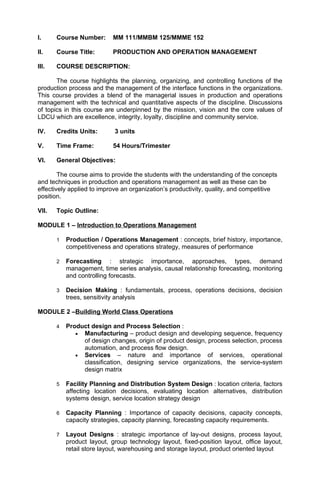
I.     Course Number:      MM 111/MMBM 125/MMME 152

II.    Course Title:       PRODUCTION AND OPERATION MANAGEMENT

III.   COURSE DESCRIPTION:

       The course highlights the planning, organizing, and controlling functions of the
production process and the management of the interface functions in the organizations.
This course provides a blend of the managerial issues in production and operations
management with the technical and quantitative aspects of the discipline. Discussions
of topics in this course are underpinned by the mission, vision and the core values of
LDCU which are excellence, integrity, loyalty, discipline and community service.

IV.    Credits Units:       3 units

V.     Time Frame:         54 Hours/Trimester

VI.    General Objectives:

        The course aims to provide the students with the understanding of the concepts
and techniques in production and operations management as well as these can be
effectively applied to improve an organization’s productivity, quality, and competitive
position.

VII.   Topic Outline:

MODULE 1 – Introduction to Operations Management

       1   Production / Operations Management : concepts, brief history, importance,
           competitiveness and operations strategy, measures of performance

       2   Forecasting : strategic importance, approaches, types, demand
           management, time series analysis, causal relationship forecasting, monitoring
           and controlling forecasts.

       3   Decision Making : fundamentals, process, operations decisions, decision
           trees, sensitivity analysis

MODULE 2 –Building World Class Operations

       4   Product design and Process Selection :
              • Manufacturing – product design and developing sequence, frequency
                of design changes, origin of product design, process selection, process
                automation, and process flow design.
              • Services – nature and importance of services, operational
                classification, designing service organizations, the service-system
                design matrix

       5   Facility Planning and Distribution System Design : location criteria, factors
           affecting location decisions, evaluating location alternatives, distribution
           systems design, service location strategy design

       6   Capacity Planning : Importance of capacity decisions, capacity concepts,
           capacity strategies, capacity planning, forecasting capacity requirements.

       7   Layout Designs : strategic importance of lay-out designs, process layout,
           product layout, group technology layout, fixed-position layout, office layout,
           retail store layout, warehousing and storage layout, product oriented layout
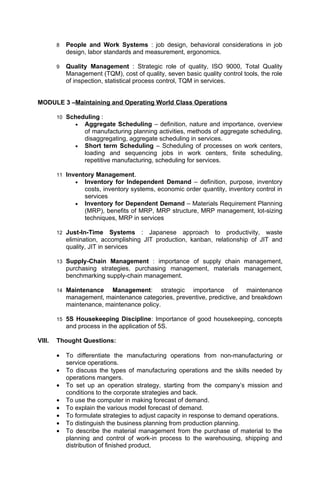
8   People and Work Systems : job design, behavioral considerations in job
            design, labor standards and measurement, ergonomics.

        9   Quality Management : Strategic role of quality, ISO 9000, Total Quality
            Management (TQM), cost of quality, seven basic quality control tools, the role
            of inspection, statistical process control, TQM in services.


MODULE 3 –Maintaining and Operating World Class Operations

        10 Scheduling :
             • Aggregate Scheduling – definition, nature and importance, overview
                   of manufacturing planning activities, methods of aggregate scheduling,
                   disaggregating, aggregate scheduling in services.
               •   Short term Scheduling – Scheduling of processes on work centers,
                   loading and sequencing jobs in work centers, finite scheduling,
                   repetitive manufacturing, scheduling for services.

        11 Inventory Management.
              • Inventory for Independent Demand – definition, purpose, inventory
                   costs, inventory systems, economic order quantity, inventory control in
                   services
               •   Inventory for Dependent Demand – Materials Requirement Planning
                   (MRP), benefits of MRP, MRP structure, MRP management, lot-sizing
                   techniques, MRP in services

        12 Just-In-Time      Systems : Japanese approach to productivity, waste
            elimination, accomplishing JIT production, kanban, relationship of JIT and
            quality, JIT in services

        13 Supply-Chain Management : importance of supply chain management,
            purchasing strategies, purchasing management, materials management,
            benchmarking supply-chain management.

        14 Maintenance     Management: strategic importance of maintenance
            management, maintenance categories, preventive, predictive, and breakdown
            maintenance, maintenance policy.

        15 5S Housekeeping Discipline: Importance of good housekeeping, concepts
            and process in the application of 5S.

VIII.   Thought Questions:

        •   To differentiate the manufacturing operations from non-manufacturing or
            service operations.
        •   To discuss the types of manufacturing operations and the skills needed by
            operations mangers.
        •   To set up an operation strategy, starting from the company’s mission and
            conditions to the corporate strategies and back.
        •   To use the computer in making forecast of demand.
        •   To explain the various model forecast of demand.
        •   To formulate strategies to adjust capacity in response to demand operations.
        •   To distinguish the business planning from production planning.
        •   To describe the material management from the purchase of material to the
            planning and control of work-in process to the warehousing, shipping and
            distribution of finished product.
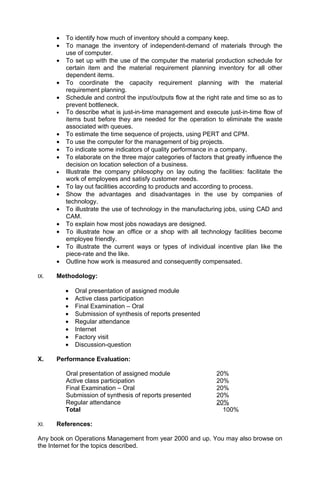
•   To identify how much of inventory should a company keep.
      •   To manage the inventory of independent-demand of materials through the
          use of computer.
      •   To set up with the use of the computer the material production schedule for
          certain item and the material requirement planning inventory for all other
          dependent items.
      •   To coordinate the capacity requirement planning with the material
          requirement planning.
      •   Schedule and control the input/outputs flow at the right rate and time so as to
          prevent bottleneck.
      •   To describe what is just-in-time management and execute just-in-time flow of
          items bust before they are needed for the operation to eliminate the waste
          associated with queues.
      •   To estimate the time sequence of projects, using PERT and CPM.
      •   To use the computer for the management of big projects.
      •   To indicate some indicators of quality performance in a company.
      •   To elaborate on the three major categories of factors that greatly influence the
          decision on location selection of a business.
      •   Illustrate the company philosophy on lay outing the facilities: facilitate the
          work of employees and satisfy customer needs.
      •   To lay out facilities according to products and according to process.
      •   Show the advantages and disadvantages in the use by companies of
          technology.
      •   To illustrate the use of technology in the manufacturing jobs, using CAD and
          CAM.
      •   To explain how most jobs nowadays are designed.
      •   To illustrate how an office or a shop with all technology facilities become
          employee friendly.
      •   To illustrate the current ways or types of individual incentive plan like the
          piece-rate and the like.
      •   Outline how work is measured and consequently compensated.

IX.   Methodology:

          •   Oral presentation of assigned module
          •   Active class participation
          •   Final Examination – Oral
          •   Submission of synthesis of reports presented
          •   Regular attendance
          •   Internet
          •   Factory visit
          •   Discussion-question

X.    Performance Evaluation:

          Oral presentation of assigned module                   20%
          Active class participation                             20%
          Final Examination – Oral                               20%
          Submission of synthesis of reports presented           20%
          Regular attendance                                     20%
          Total                                                    100%

XI.   References:

Any book on Operations Management from year 2000 and up. You may also browse on
the Internet for the topics described.

Production and operation management

  • 1.
    I. Course Number: MM 111/MMBM 125/MMME 152 II. Course Title: PRODUCTION AND OPERATION MANAGEMENT III. COURSE DESCRIPTION: The course highlights the planning, organizing, and controlling functions of the production process and the management of the interface functions in the organizations. This course provides a blend of the managerial issues in production and operations management with the technical and quantitative aspects of the discipline. Discussions of topics in this course are underpinned by the mission, vision and the core values of LDCU which are excellence, integrity, loyalty, discipline and community service. IV. Credits Units: 3 units V. Time Frame: 54 Hours/Trimester VI. General Objectives: The course aims to provide the students with the understanding of the concepts and techniques in production and operations management as well as these can be effectively applied to improve an organization’s productivity, quality, and competitive position. VII. Topic Outline: MODULE 1 – Introduction to Operations Management 1 Production / Operations Management : concepts, brief history, importance, competitiveness and operations strategy, measures of performance 2 Forecasting : strategic importance, approaches, types, demand management, time series analysis, causal relationship forecasting, monitoring and controlling forecasts. 3 Decision Making : fundamentals, process, operations decisions, decision trees, sensitivity analysis MODULE 2 –Building World Class Operations 4 Product design and Process Selection : • Manufacturing – product design and developing sequence, frequency of design changes, origin of product design, process selection, process automation, and process flow design. • Services – nature and importance of services, operational classification, designing service organizations, the service-system design matrix 5 Facility Planning and Distribution System Design : location criteria, factors affecting location decisions, evaluating location alternatives, distribution systems design, service location strategy design 6 Capacity Planning : Importance of capacity decisions, capacity concepts, capacity strategies, capacity planning, forecasting capacity requirements. 7 Layout Designs : strategic importance of lay-out designs, process layout, product layout, group technology layout, fixed-position layout, office layout, retail store layout, warehousing and storage layout, product oriented layout
  • 2.
    8 People and Work Systems : job design, behavioral considerations in job design, labor standards and measurement, ergonomics. 9 Quality Management : Strategic role of quality, ISO 9000, Total Quality Management (TQM), cost of quality, seven basic quality control tools, the role of inspection, statistical process control, TQM in services. MODULE 3 –Maintaining and Operating World Class Operations 10 Scheduling : • Aggregate Scheduling – definition, nature and importance, overview of manufacturing planning activities, methods of aggregate scheduling, disaggregating, aggregate scheduling in services. • Short term Scheduling – Scheduling of processes on work centers, loading and sequencing jobs in work centers, finite scheduling, repetitive manufacturing, scheduling for services. 11 Inventory Management. • Inventory for Independent Demand – definition, purpose, inventory costs, inventory systems, economic order quantity, inventory control in services • Inventory for Dependent Demand – Materials Requirement Planning (MRP), benefits of MRP, MRP structure, MRP management, lot-sizing techniques, MRP in services 12 Just-In-Time Systems : Japanese approach to productivity, waste elimination, accomplishing JIT production, kanban, relationship of JIT and quality, JIT in services 13 Supply-Chain Management : importance of supply chain management, purchasing strategies, purchasing management, materials management, benchmarking supply-chain management. 14 Maintenance Management: strategic importance of maintenance management, maintenance categories, preventive, predictive, and breakdown maintenance, maintenance policy. 15 5S Housekeeping Discipline: Importance of good housekeeping, concepts and process in the application of 5S. VIII. Thought Questions: • To differentiate the manufacturing operations from non-manufacturing or service operations. • To discuss the types of manufacturing operations and the skills needed by operations mangers. • To set up an operation strategy, starting from the company’s mission and conditions to the corporate strategies and back. • To use the computer in making forecast of demand. • To explain the various model forecast of demand. • To formulate strategies to adjust capacity in response to demand operations. • To distinguish the business planning from production planning. • To describe the material management from the purchase of material to the planning and control of work-in process to the warehousing, shipping and distribution of finished product.
  • 3.
    To identify how much of inventory should a company keep. • To manage the inventory of independent-demand of materials through the use of computer. • To set up with the use of the computer the material production schedule for certain item and the material requirement planning inventory for all other dependent items. • To coordinate the capacity requirement planning with the material requirement planning. • Schedule and control the input/outputs flow at the right rate and time so as to prevent bottleneck. • To describe what is just-in-time management and execute just-in-time flow of items bust before they are needed for the operation to eliminate the waste associated with queues. • To estimate the time sequence of projects, using PERT and CPM. • To use the computer for the management of big projects. • To indicate some indicators of quality performance in a company. • To elaborate on the three major categories of factors that greatly influence the decision on location selection of a business. • Illustrate the company philosophy on lay outing the facilities: facilitate the work of employees and satisfy customer needs. • To lay out facilities according to products and according to process. • Show the advantages and disadvantages in the use by companies of technology. • To illustrate the use of technology in the manufacturing jobs, using CAD and CAM. • To explain how most jobs nowadays are designed. • To illustrate how an office or a shop with all technology facilities become employee friendly. • To illustrate the current ways or types of individual incentive plan like the piece-rate and the like. • Outline how work is measured and consequently compensated. IX. Methodology: • Oral presentation of assigned module • Active class participation • Final Examination – Oral • Submission of synthesis of reports presented • Regular attendance • Internet • Factory visit • Discussion-question X. Performance Evaluation: Oral presentation of assigned module 20% Active class participation 20% Final Examination – Oral 20% Submission of synthesis of reports presented 20% Regular attendance 20% Total 100% XI. References: Any book on Operations Management from year 2000 and up. You may also browse on the Internet for the topics described.