www.tcapital.bg
Deyan Kavrakov FRICS, CIPS
COMPARATIVE ANALYSIS
Asset and Facility Management – Spot the
Difference or the Convergence
1st CEE Real Estate Management
Congress
Warsaw, Poland 2016
FAQ
What is the difference between Asset Manager and Facility
Manager?
TCM © Deyan Kavrakov
Where is the borderline between Asset Management and
Facility Management?
Integration or Convergence?
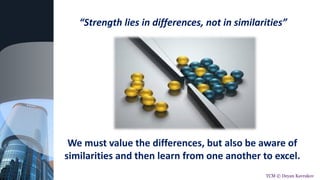
“Strength lies in differences, not in similarities”
We must value the differences, but also be aware of
similarities and then learn from one another to excel.
TCM © Deyan Kavrakov
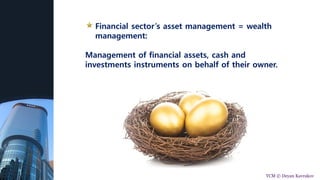
Financial sector’s asset management = wealth
management:
Management of financial assets, cash and
investments instruments on behalf of their owner.
TCM © Deyan Kavrakov
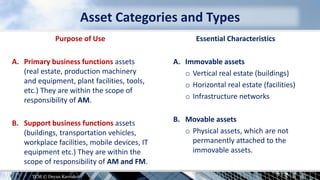
Asset Categories and Types
Purpose of Use
A. Primary business functions assets
(real estate, production machinery
and equipment, plant facilities, tools,
etc.) They are within the scope of
responsibility of AM.
B. Support business functions assets
(buildings, transportation vehicles,
workplace facilities, mobile devices, IT
equipment etc.) They are within the
scope of responsibility of AM and FM.
Essential Characteristics
A. Immovable assets
o Vertical real estate (buildings)
o Horizontal real estate (facilities)
o Infrastructure networks
B. Movable assets
o Physical assets, which are not
permanently attached to the
immovable assets.
TCM © Deyan Kavrakov
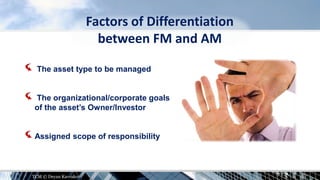
Factors of Differentiation
between FM and AM
The asset type to be managed
The organizational/corporate goals
of the asset’s Owner/Investor
Assigned scope of responsibility
TCM © Deyan Kavrakov
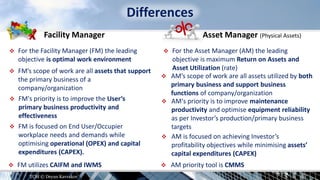
Differences
 For the Facility Manager (FM) the leading
objective is optimal work environment
Facility Manager Asset Manager (Physical Assets)
 For the Asset Manager (AM) the leading
objective is maximum Return on Assets and
Asset Utilization (rate)
TCM © Deyan Kavrakov
 FM’s scope of work are all assets that support
the primary business of a
company/organization
 FM's priority is to improve the User‘s
primary business productivity and
effectiveness
 FM is focused on End User/Occupier
workplace needs and demands while
optimising operational (OPEX) and capital
expenditures (CAPEX).
 FM utilizes CAIFM and IWMS
 AM’s scope of work are all assets utilized by both
primary business and support business
functions of company/organization
 AM's priority is to improve maintenance
productivity and optimise equipment reliability
as per Investor’s production/primary business
targets
 AM is focused on achieving Investor’s
profitability objectives while minimising assets’
capital expenditures (CAPEX)
 AM priority tool is CMMS
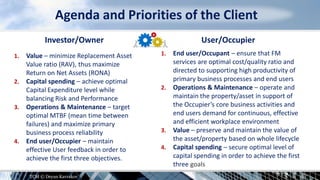
Agenda and Priorities of the Client
1. Value – minimize Replacement Asset
Value ratio (RAV), thus maximize
Return on Net Assets (RONA)
2. Capital spending – achieve optimal
Capital Expenditure level while
balancing Risk and Performance
3. Operations & Maintenance – target
optimal MTBF (mean time between
failures) and maximize primary
business process reliability
4. End user/Occupier – maintain
effective User feedback in order to
achieve the first three objectives.
User/OccupierInvestor/Owner
1. End user/Occupant – ensure that FM
services are optimal cost/quality ratio and
directed to supporting high productivity of
primary business processes and end users
2. Operations & Maintenance – operate and
maintain the property/asset in support of
the Occupier’s core business activities and
end users demand for continuous, effective
and efficient workplace environment
3. Value – preserve and maintain the value of
the asset/property based on whole lifecycle
4. Capital spending – secure optimal level of
capital spending in order to achieve the first
three goals
TCM © Deyan Kavrakov
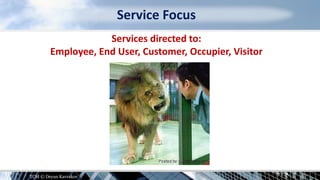
Service Focus
Services directed to:
Employee, End User, Customer, Occupier, Visitor
TCM © Deyan Kavrakov
FM Focus
Services directed to:
Employee, End User, Customer, Occupier, Visitor
TCM © Deyan Kavrakov
Operations
Asset Managers prime interest on a daily
basis is in enhancing effectiveness and
efficiency of assets performance and
production processes, by systematic
maintenance management and reliability
engineering of physical assets.
FM is dedicated to improving End
User/Occupier productivity and provide
adaptive workplace environment in order to
meet the changes in competitive marketplace
and stakeholders demands. FM’s vehicle for
accomplishing it is facilities management &
end user service management.
Hard Services Hard and Soft Services
TCM © Deyan Kavrakov
Decision Making in AM and FM
Balancing the trade-offs among Cost/Risk/Performance within
the whole asset lifecycle lies in the core of AM (And FM)
Cost-based Decision Making
Risk-based Decision Making
Performance-based Decision Making
FM adds one more decisive component to the
matrix
End User Service-based Decision Making
TCM © Deyan Kavrakov
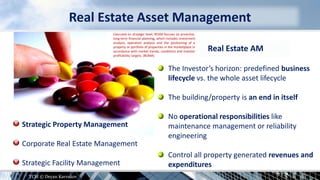
Real Estate Asset Management
Strategic Property Management
Corporate Real Estate Management
Strategic Facility Management
Real Estate AM
The Investor’s horizon: predefined business
lifecycle vs. the whole asset lifecycle
The building/property is an end in itself
No operational responsibilities like
maintenance management or reliability
engineering
Control all property generated revenues and
expenditures
TCM © Deyan Kavrakov
Executed on strategic level, REAM focuses on proactive,
long-term financial planning, which includes investment
analysis, operation analysis and the positioning of a
property or portfolio of properties in the marketplace in
accordance with market trends, conditions and investor
profitability targets. (BOMA)
www.tcapital.bg
Common fundament – the concepts of Whole Asset Lifecycle and Total
Cost of Ownership/Occupancy.
FM & AM use shared management methods like Asset Utilization Rate,
Asset Register, Asset Replacement Value, Criticality Condition Index; Asset
Inventory Management; they utilize similar analytical techniques,
procedures, IT solutions.
Operational level FM and AM scope of services in the areas of
maintenance, operations, safety, logistics, and technical infrastructure.
Corresponding management functions: strategic planning, risk
management, service management, financial planning and control,
performance management, quality management, change management,
project management, energy management, outsourcing, benchmarking etc.
Common Ground of AM and FM
TCM © Deyan Kavrakov
Trends and Perspectives of AM and FM
 Convergence or integration
 Standards
 ISO 55000 (0-2)
 CEN EN 15221 (1-7)
 Integrated Facility Management (IFM)
 Real Estate Facility Management (REFM)
 Mergers & Acquisitions
 C&W and DTZ;
 CBRE and GWS (Global Workplace
Solutions) of Johnson Controls
www.tcapital.bg
TCM © Deyan Kavrakov
__________________
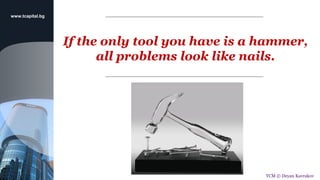
If the only tool you have is a hammer,
all problems look like nails.
__________________
www.tcapital.bg
TCM © Deyan Kavrakov
www.tcapital.bg
TCM © Deyan Kavrakov

Asset Management and Facility Management - Differences or Convergence

  • 1.
    www.tcapital.bg Deyan Kavrakov FRICS,CIPS COMPARATIVE ANALYSIS Asset and Facility Management – Spot the Difference or the Convergence 1st CEE Real Estate Management Congress Warsaw, Poland 2016
  • 2.
    FAQ What is thedifference between Asset Manager and Facility Manager? TCM © Deyan Kavrakov Where is the borderline between Asset Management and Facility Management? Integration or Convergence?
  • 3.
    “Strength lies indifferences, not in similarities” We must value the differences, but also be aware of similarities and then learn from one another to excel. TCM © Deyan Kavrakov
  • 4.
    Financial sector’s assetmanagement = wealth management: Management of financial assets, cash and investments instruments on behalf of their owner. TCM © Deyan Kavrakov
  • 5.
    Asset Categories andTypes Purpose of Use A. Primary business functions assets (real estate, production machinery and equipment, plant facilities, tools, etc.) They are within the scope of responsibility of AM. B. Support business functions assets (buildings, transportation vehicles, workplace facilities, mobile devices, IT equipment etc.) They are within the scope of responsibility of AM and FM. Essential Characteristics A. Immovable assets o Vertical real estate (buildings) o Horizontal real estate (facilities) o Infrastructure networks B. Movable assets o Physical assets, which are not permanently attached to the immovable assets. TCM © Deyan Kavrakov
  • 6.
    Factors of Differentiation betweenFM and AM The asset type to be managed The organizational/corporate goals of the asset’s Owner/Investor Assigned scope of responsibility TCM © Deyan Kavrakov
  • 7.
    Differences  For theFacility Manager (FM) the leading objective is optimal work environment Facility Manager Asset Manager (Physical Assets)  For the Asset Manager (AM) the leading objective is maximum Return on Assets and Asset Utilization (rate) TCM © Deyan Kavrakov  FM’s scope of work are all assets that support the primary business of a company/organization  FM's priority is to improve the User‘s primary business productivity and effectiveness  FM is focused on End User/Occupier workplace needs and demands while optimising operational (OPEX) and capital expenditures (CAPEX).  FM utilizes CAIFM and IWMS  AM’s scope of work are all assets utilized by both primary business and support business functions of company/organization  AM's priority is to improve maintenance productivity and optimise equipment reliability as per Investor’s production/primary business targets  AM is focused on achieving Investor’s profitability objectives while minimising assets’ capital expenditures (CAPEX)  AM priority tool is CMMS
  • 8.
    Agenda and Prioritiesof the Client 1. Value – minimize Replacement Asset Value ratio (RAV), thus maximize Return on Net Assets (RONA) 2. Capital spending – achieve optimal Capital Expenditure level while balancing Risk and Performance 3. Operations & Maintenance – target optimal MTBF (mean time between failures) and maximize primary business process reliability 4. End user/Occupier – maintain effective User feedback in order to achieve the first three objectives. User/OccupierInvestor/Owner 1. End user/Occupant – ensure that FM services are optimal cost/quality ratio and directed to supporting high productivity of primary business processes and end users 2. Operations & Maintenance – operate and maintain the property/asset in support of the Occupier’s core business activities and end users demand for continuous, effective and efficient workplace environment 3. Value – preserve and maintain the value of the asset/property based on whole lifecycle 4. Capital spending – secure optimal level of capital spending in order to achieve the first three goals TCM © Deyan Kavrakov
  • 9.
    Service Focus Services directedto: Employee, End User, Customer, Occupier, Visitor TCM © Deyan Kavrakov
  • 10.
    FM Focus Services directedto: Employee, End User, Customer, Occupier, Visitor TCM © Deyan Kavrakov
  • 11.
    Operations Asset Managers primeinterest on a daily basis is in enhancing effectiveness and efficiency of assets performance and production processes, by systematic maintenance management and reliability engineering of physical assets. FM is dedicated to improving End User/Occupier productivity and provide adaptive workplace environment in order to meet the changes in competitive marketplace and stakeholders demands. FM’s vehicle for accomplishing it is facilities management & end user service management. Hard Services Hard and Soft Services TCM © Deyan Kavrakov
  • 12.
    Decision Making inAM and FM Balancing the trade-offs among Cost/Risk/Performance within the whole asset lifecycle lies in the core of AM (And FM) Cost-based Decision Making Risk-based Decision Making Performance-based Decision Making FM adds one more decisive component to the matrix End User Service-based Decision Making TCM © Deyan Kavrakov
  • 13.
    Real Estate AssetManagement Strategic Property Management Corporate Real Estate Management Strategic Facility Management Real Estate AM The Investor’s horizon: predefined business lifecycle vs. the whole asset lifecycle The building/property is an end in itself No operational responsibilities like maintenance management or reliability engineering Control all property generated revenues and expenditures TCM © Deyan Kavrakov Executed on strategic level, REAM focuses on proactive, long-term financial planning, which includes investment analysis, operation analysis and the positioning of a property or portfolio of properties in the marketplace in accordance with market trends, conditions and investor profitability targets. (BOMA)
  • 14.
    www.tcapital.bg Common fundament –the concepts of Whole Asset Lifecycle and Total Cost of Ownership/Occupancy. FM & AM use shared management methods like Asset Utilization Rate, Asset Register, Asset Replacement Value, Criticality Condition Index; Asset Inventory Management; they utilize similar analytical techniques, procedures, IT solutions. Operational level FM and AM scope of services in the areas of maintenance, operations, safety, logistics, and technical infrastructure. Corresponding management functions: strategic planning, risk management, service management, financial planning and control, performance management, quality management, change management, project management, energy management, outsourcing, benchmarking etc. Common Ground of AM and FM TCM © Deyan Kavrakov
  • 15.
    Trends and Perspectivesof AM and FM  Convergence or integration  Standards  ISO 55000 (0-2)  CEN EN 15221 (1-7)  Integrated Facility Management (IFM)  Real Estate Facility Management (REFM)  Mergers & Acquisitions  C&W and DTZ;  CBRE and GWS (Global Workplace Solutions) of Johnson Controls www.tcapital.bg TCM © Deyan Kavrakov
  • 16.
    __________________ If the onlytool you have is a hammer, all problems look like nails. __________________ www.tcapital.bg TCM © Deyan Kavrakov
  • 17.