Risk Management
University of Economics, Kraków, 2012
              Tomasz Aleksandrowicz
operational risk management

                     credit risk definition
        credit bureau and rating agencies
                  credit risk management
operational risk
• risk of loss resulting from inadequate or failed
  internal processes, people and systems or from
  external events
• operational risk is much harder to identify than
  market and credit risk
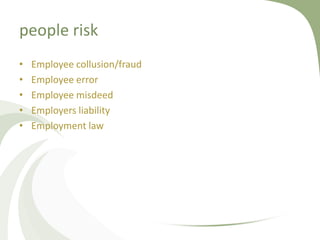
people risk
•   Employee collusion/fraud
•   Employee error
•   Employee misdeed
•   Employers liability
•   Employment law
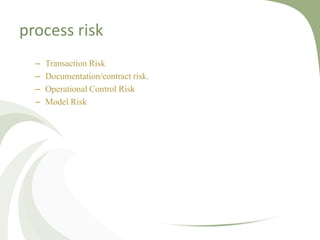
process risk
  –   Transaction Risk
  –   Documentation/contract risk.
  –   Operational Control Risk
  –   Model Risk
technology risk
external risk
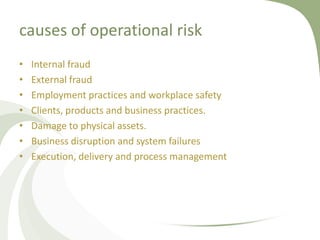
causes of operational risk
•   Internal fraud
•   External fraud
•   Employment practices and workplace safety
•   Clients, products and business practices.
•   Damage to physical assets.
•   Business disruption and system failures
•   Execution, delivery and process management
3 approaches in banking
key risk indicators
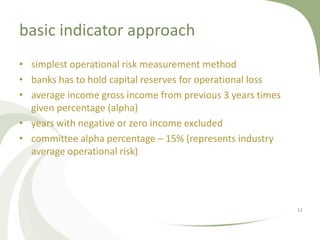
basic indicator approach
• simplest operational risk measurement method
• banks has to hold capital reserves for operational loss
• average income gross income from previous 3 years times
  given percentage (alpha)
• years with negative or zero income excluded
• committee alpha percentage – 15% (represents industry
  average operational risk)


                                                            12
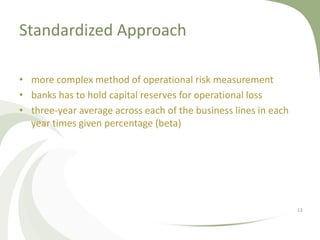
Standardized Approach

• more complex method of operational risk measurement
• banks has to hold capital reserves for operational loss
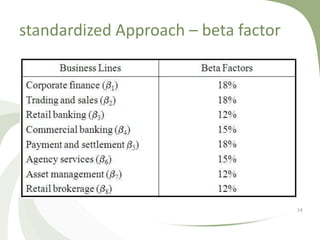
• three-year average across each of the business lines in each
  year times given percentage (beta)


                                                                 13
standardized Approach – beta factor


                                      14
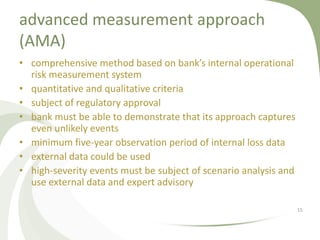
advanced measurement approach
(AMA)
• comprehensive method based on bank’s internal operational
  risk measurement system
• quantitative and qualitative criteria
• subject of regulatory approval
• bank must be able to demonstrate that its approach captures
  even unlikely events
• minimum five-year observation period of internal loss data
• external data could be used
• high-severity events must be subject of scenario analysis and
  use external data and expert advisory

                                                                  15

Rm 11

  • 1.
    Risk Management University ofEconomics, Kraków, 2012 Tomasz Aleksandrowicz
  • 2.
    operational risk management credit risk definition credit bureau and rating agencies credit risk management
  • 3.
    operational risk • riskof loss resulting from inadequate or failed internal processes, people and systems or from external events • operational risk is much harder to identify than market and credit risk
  • 5.
    people risk • Employee collusion/fraud • Employee error • Employee misdeed • Employers liability • Employment law
  • 6.
    process risk – Transaction Risk – Documentation/contract risk. – Operational Control Risk – Model Risk
  • 7.
  • 8.
  • 9.
    causes of operationalrisk • Internal fraud • External fraud • Employment practices and workplace safety • Clients, products and business practices. • Damage to physical assets. • Business disruption and system failures • Execution, delivery and process management
  • 10.
  • 11.
  • 12.
    basic indicator approach •simplest operational risk measurement method • banks has to hold capital reserves for operational loss • average income gross income from previous 3 years times given percentage (alpha) • years with negative or zero income excluded • committee alpha percentage – 15% (represents industry average operational risk) 12
  • 13.
    Standardized Approach • morecomplex method of operational risk measurement • banks has to hold capital reserves for operational loss • three-year average across each of the business lines in each year times given percentage (beta) 13
  • 14.
  • 15.
    advanced measurement approach (AMA) •comprehensive method based on bank’s internal operational risk measurement system • quantitative and qualitative criteria • subject of regulatory approval • bank must be able to demonstrate that its approach captures even unlikely events • minimum five-year observation period of internal loss data • external data could be used • high-severity events must be subject of scenario analysis and use external data and expert advisory 15