Integrating Risk Into Your Balanced
Scorecard
Prepared for:
StratexSystems Webinar Series
27 September 2012 4 October 2012
Page  2
Content
 Recapping on the Balanced Scorecard
 Recapping on Risk Management
 Integrating Risk into your Balanced Scorecard
 Use of Business Drivers to define levels of Appetite & Exposure
 Use of Risk taxonomy to identify Risks per Objective
Page  3
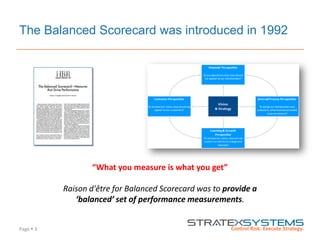
The Balanced Scorecard was introduced in 1992
“What you measure is what you get”
Raison d'être for Balanced Scorecard was to provide a
‘balanced’ set of performance measurements.
Page  4
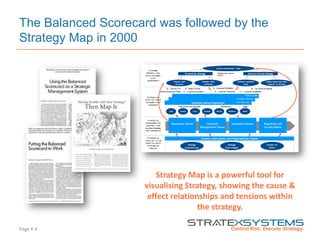
The Balanced Scorecard was followed by the
Strategy Map in 2000
Strategy Map is a powerful tool for
visualising Strategy, showing the cause &
effect relationships and tensions within
the strategy.
Page  5
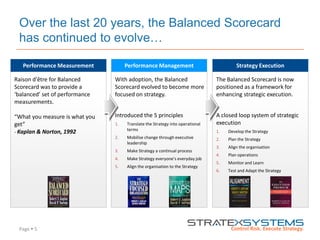
Over the last 20 years, the Balanced Scorecard
has continued to evolve…
Raison d'être for Balanced
Scorecard was to provide a
‘balanced’ set of performance
measurements.
“What you measure is what you
get”
- Kaplan & Norton, 1992
Performance Measurement
With adoption, the Balanced
Scorecard evolved to become more
focused on strategy.
Introduced the 5 principles
1. Translate the Strategy into operational
terms
2. Mobilise change through executive
leadership
3. Make Strategy a continual process
4. Make Strategy everyone’s everyday job
5. Align the organisation to the Strategy
Performance Management
The Balanced Scorecard is now
positioned as a framework for
enhancing strategic execution.
A closed loop system of strategic
execution
1. Develop the Strategy
2. Plan the Strategy
3. Align the organisation
4. Plan operations
5. Monitor and Learn
6. Test and Adapt the Strategy
Strategy Execution
Page  6
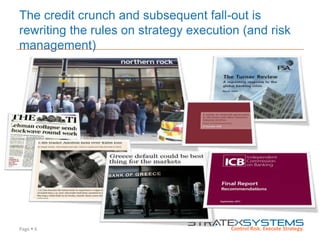
The credit crunch and subsequent fall-out is
rewriting the rules on strategy execution (and risk
management)
Page  7
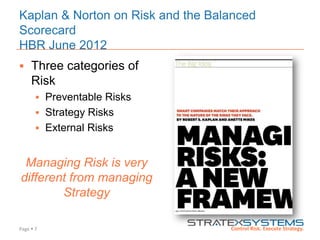
Kaplan & Norton on Risk and the Balanced
Scorecard
HBR June 2012
 Three categories of
Risk
 Preventable Risks
 Strategy Risks
 External Risks
Managing Risk is very
different from managing
Strategy
Page  8
Kaplan & Norton on Risk and the Balanced
Scorecard
- What we think…
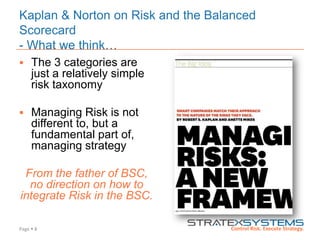
 The 3 categories are
just a relatively simple
risk taxonomy
 Managing Risk is not
different to, but a
fundamental part of,
managing strategy
From the father of BSC,
no direction on how to
integrate Risk in the BSC.
Page  9
So what do we mean when we say “Risk”?
The possibility that an event will occur
and adversely affect the achievement
of objectives. COSO Integrated Risk
Management Framework
the effect of uncertainty on objectives,
whether positive or negative.
ISO31000
The uncertainty of future events that
will impact on the achievement of
objectives, either positively
(opportunities) or negatively (threats).
Andrew Smart
The uncertainty of future events,
incorporating both lost opportunities
as well as threats materialising,
which will impact our ability to
achieve business objectives.
Client
No organisation can create value
without taking risk.
“ You have to speculate to
accumulate”
Page  10
What is Risk Management
As much about exploiting opportunities as
preventing potential problems.
Risk Management is an essential part of good management
“coordinated activities to direct and control and organization with regard to risk”
risk management framework; “set of components that provide the foundations and
organizational arrangements for designing, implementing, monitoring, reviewing and
continually improving risk management processes throughout the organization”
risk management process; “systematic application of management policies,
procedures and practices to the tasks of communication, consultation, establishing the
context, identifying, analysing, evaluating, treating, monitoring and reviewing risk”
ISO31000
Page  11
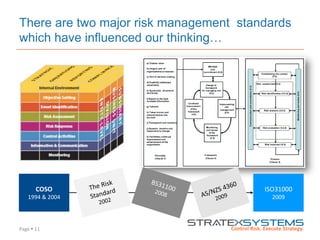
There are two major risk management standards
which have influenced our thinking…
COSO
1994 & 2004
ISO31000
2009
Page  12
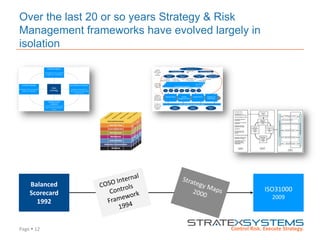
Over the last 20 or so years Strategy & Risk
Management frameworks have evolved largely in
isolation
Balanced
Scorecard
1992
ISO31000
2009
Page  13
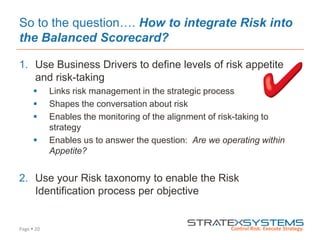
So to the question…. How to integrate Risk into
the Balanced Scorecard?
1. Use Business Drivers to define levels of risk appetite
and risk-taking
 Links risk management in the strategic process
 Shapes the conversation about risk
 Enables the monitoring of the alignment of risk-taking to
strategy
 Enables us to answer the question: Are we operating within
Appetite?
2. Use your Risk taxonomy to enable the Risk
Identification process per objective
Page  14
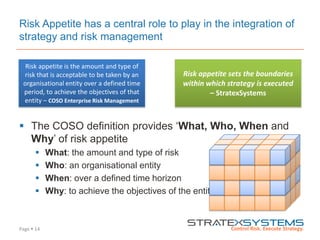
Risk Appetite has a central role to play in the integration of
strategy and risk management
 The COSO definition provides „What, Who, When and
Why‟ of risk appetite
 What: the amount and type of risk
 Who: an organisational entity
 When: over a defined time horizon
 Why: to achieve the objectives of the entity
Risk appetite is the amount and type of
risk that is acceptable to be taken by an
organisational entity over a defined time
period, to achieve the objectives of that
entity – COSO Enterprise Risk Management
Risk appetite sets the boundaries
within which strategy is executed
– StratexSystems
Page  15
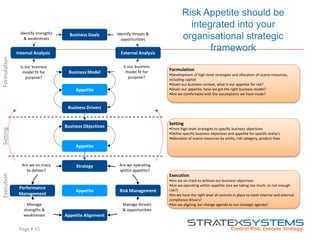
Risk Appetite should be
integrated into your
organisational strategic
framework
Business Goals
Business Model
Business Drivers
Internal Analysis External Analysis
Business Objectives
Strategy
Appetite
Appetite Alignment
Risk Management
Performance
Management
Appetite
Identify strengths
& weaknesses
Identify threats &
opportunities
Is our business
model fit for
purpose?
Is our business
model fit for
purpose?
Are we operating
within appetite?
Manage threats
& opportunities
Are we on-track
to deliver?
Manage
strengths &
weaknesses
Appetite
SettingExecutionFormulation
Setting
From high-level strategies to specific business objectives
Define specific business objectives and appetite for specific entity’s
Allocation of scarce resources by entity, risk category, product lines
Execution
Are we on-track to achieve our business objectives
Are we operating within appetite (are we taking too much, or not enough
risk?)
Do we have the right level of controls in place to meet internal and external
compliance drivers?
Are we aligning our change agenda to our strategic agenda?
Formulation
Development of high-level strategies and allocation of scarce resources,
including capital
Given our business context, what is our appetite for risk?
Given our appetite, have we got the right business model?
Are we comfortable with the assumptions we have made?
Page  16
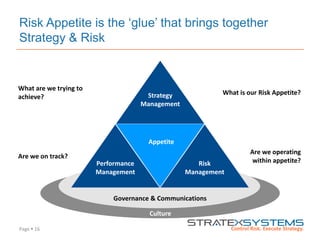
Risk Appetite is the „glue‟ that brings together
Strategy & Risk
Performance
Management
Risk
Management
Strategy
Management
Appetite
What are we trying to
achieve?
Are we on track?
What is our Risk Appetite?
Are we operating
within appetite?
Governance & Communications
Culture
Page  17
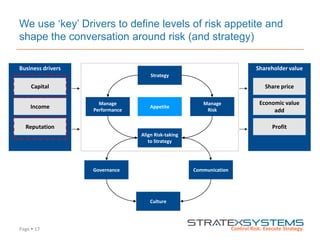
We use „key‟ Drivers to define levels of risk appetite and
shape the conversation around risk (and strategy)
Business drivers
Capital
Income
Reputation
Shareholder value
Share price
Economic value
add
Profit
Strategy
Align Risk-taking
to Strategy
Manage
Risk
Manage
Performance
Appetite
Governance Communication
Culture
Page  18
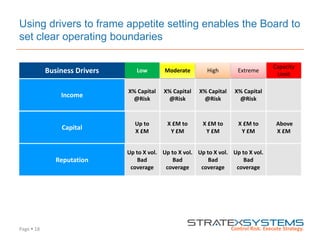
Using drivers to frame appetite setting enables the Board to
set clear operating boundaries
Business Drivers Low Moderate High Extreme
Capacity
Limit
Income
X% Capital
@Risk
X% Capital
@Risk
X% Capital
@Risk
X% Capital
@Risk
Capital
Up to
X £M
X £M to
Y £M
X £M to
Y £M
X £M to
Y £M
Above
X £M
Reputation
Up to X vol.
Bad
coverage
Up to X vol.
Bad
coverage
Up to X vol.
Bad
coverage
Up to X vol.
Bad
coverage
Page  19
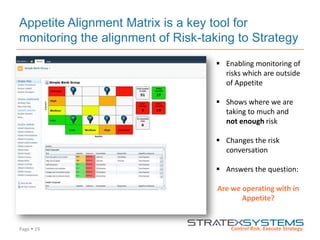
Appetite Alignment Matrix is a key tool for
monitoring the alignment of Risk-taking to Strategy
 Enabling monitoring of
risks which are outside
of Appetite
 Shows where we are
taking to much and
not enough risk
 Changes the risk
conversation
 Answers the question:
Are we operating with in
Appetite?
Page  20
So to the question…. How to integrate Risk into
the Balanced Scorecard?
1. Use Business Drivers to define levels of risk appetite
and risk-taking
 Links risk management in the strategic process
 Shapes the conversation about risk
 Enables the monitoring of the alignment of risk-taking to
strategy
 Enables us to answer the question: Are we operating within
Appetite?
2. Use your Risk taxonomy to enable the Risk
Identification process per objective
Page  21
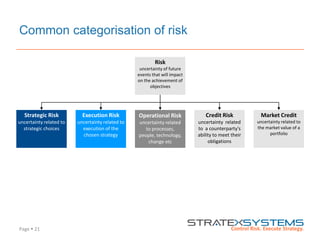
Common categorisation of risk
Strategic Risk
uncertainty related to
strategic choices
Execution Risk
uncertainty related to
execution of the
chosen strategy
Operational Risk
uncertainty related
to processes,
people, technology,
change etc
Credit Risk
uncertainty related
to a counterparty's
ability to meet their
obligations
Market Credit
uncertainty related to
the market value of a
portfolio
Risk
uncertainty of future
events that will impact
on the achievement of
objectives
Page  22
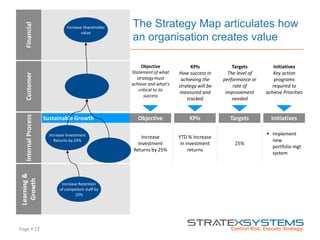
The Strategy Map articulates how
an organisation creates value
FinancialCustomerInternalProcess
Learning&
Growth
Increase Investment
Returns by 25%
Sustainable Growth
Increase Retention
of competent staff by
10%
Increase Shareholder
value
Objective KPIs InitiativesTargets
Increase
Investment
Returns by 25%
YTD % Increase
in investment
returns
25%
 Implement
new
portfolio mgt
system
Objective
Statement of what
strategy must
achieve and what’s
critical to its
success
KPIs
How success in
achieving the
strategy will be
measured and
tracked
Targets
The level of
performance or
rate of
improvement
needed
Initiatives
Key action
programs
required to
achieve Priorities
Page  23
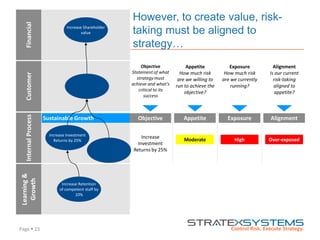
However, to create value, risk-
taking must be aligned to
strategy…
FinancialCustomerInternalProcess
Learning&
Growth
Increase Investment
Returns by 25%
Sustainable Growth
Increase Retention
of competent staff by
10%
Increase Shareholder
value
Objective Appetite AlignmentExposure
Increase
Investment
Returns by 25%
Objective
Statement of what
strategy must
achieve and what’s
critical to its
success
Appetite
How much risk
are we willing to
run to achieve the
objective?
Exposure
How much risk
are we currently
running?
Alignment
Is our current
risk-taking
aligned to
appetite?
Moderate High Over-exposed
Page  24
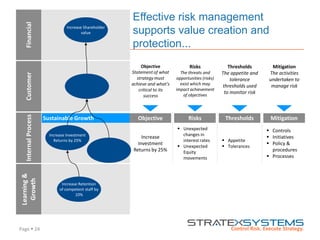
Effective risk management
supports value creation and
protection...
FinancialCustomerInternalProcess
Learning&
Growth
Increase Investment
Returns by 25%
Sustainable Growth
Increase Retention
of competent staff by
10%
Increase Shareholder
value
Objective Risks MitigationThresholds
Increase
Investment
Returns by 25%
 Unexpected
changes in
interest rates
 Unexpected
Equity
movements
 Appetite
 Tolerances
 Controls
 Initiatives
 Policy &
procedures
 Processes
Objective
Statement of what
strategy must
achieve and what’s
critical to its
success
Risks
The threats and
opportunities (risks)
exist which may
impact achievement
of objectives
Thresholds
The appetite and
tolerance
thresholds used
to monitor risk
Mitigation
The activities
undertaken to
manage risk
Page  25
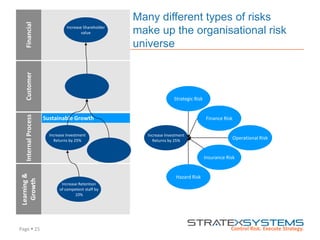
Many different types of risks
make up the organisational risk
universe
FinancialCustomerInternalProcess
Learning&
Growth
Increase Investment
Returns by 25%
Sustainable Growth
Increase Retention
of competent staff by
10%
Increase Shareholder
value
Increase Investment
Returns by 25%
Strategic Risk
Operational Risk
Insurance Risk
Finance Risk
Hazard Risk
Page  26
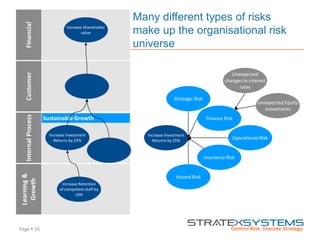
Many different types of risks
make up the organisational risk
universe
FinancialCustomerInternalProcess
Learning&
Growth
Increase Investment
Returns by 25%
Sustainable Growth
Increase Retention
of competent staff by
10%
Increase Shareholder
value
Increase Investment
Returns by 25%
Strategic Risk
Operational Risk
Insurance Risk
Finance Risk
Hazard Risk
Unexpected
changes in interest
rates
Unexpected Equity
movements
Page  27
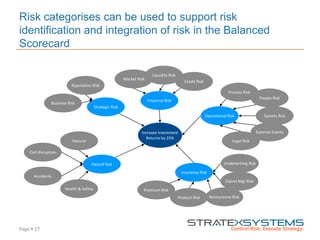
Risk categorises can be used to support risk
identification and integration of risk in the Balanced
Scorecard
Increase Investment
Returns by 25%
Insurance Risk
Underwriting Risk
Operational Risk
Strategic Risk
Hazard Risk
Financial Risk
Business Risk
Reputation Risk
Process Risk
Market Risk
Credit Risk
Liquidity Risk
People Risk
System Risk
External Events
Legal Risk
Claims Mgt Risk
Reinsurance RiskProduct Risk
Premium Risk
Civil disruption
Health & Safety
Accidents
Natural
Page  28
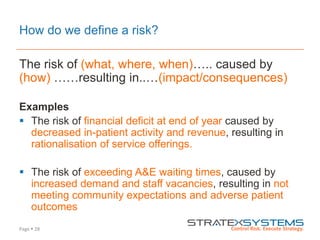
How do we define a risk?
The risk of (what, where, when)….. caused by
(how) ……resulting in..…(impact/consequences)
Examples
 The risk of financial deficit at end of year caused by
decreased in-patient activity and revenue, resulting in
rationalisation of service offerings.
 The risk of exceeding A&E waiting times, caused by
increased demand and staff vacancies, resulting in not
meeting community expectations and adverse patient
outcomes
Page  29
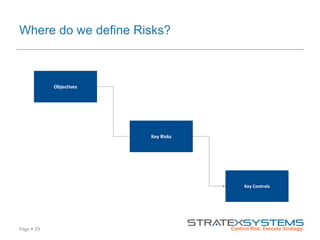
Where do we define Risks?
Objectives
Key Risks
Key Controls
Page  30
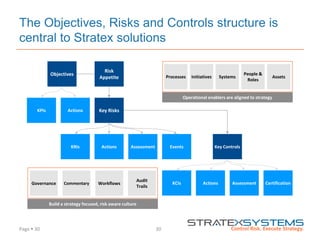
The Objectives, Risks and Controls structure is
central to Stratex solutions
30
Objectives
KPIs Actions Key Risks
KRIs Actions Assessment Key Controls
KCIs Actions Assessment
Events
Certification
Risk
Appetite Processes Initiatives Systems
People &
Roles
Assets
Operational enablers are aligned to strategy
Governance Commentary Workflows
Audit
Trails
Build a strategy focused, risk aware culture
Page  31
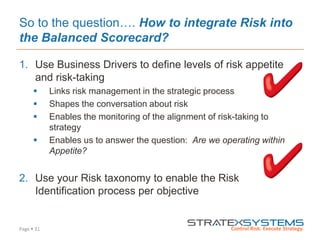
So to the question…. How to integrate Risk into
the Balanced Scorecard?
1. Use Business Drivers to define levels of risk appetite
and risk-taking
 Links risk management in the strategic process
 Shapes the conversation about risk
 Enables the monitoring of the alignment of risk-taking to
strategy
 Enables us to answer the question: Are we operating within
Appetite?
2. Use your Risk taxonomy to enable the Risk
Identification process per objective
Page  32
Q&A
Page  33
About StratexSystems
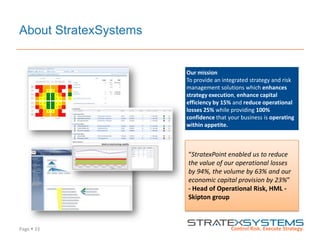
“StratexPoint enabled us to reduce
the value of our operational losses
by 94%, the volume by 63% and our
economic capital provision by 23%”
- Head of Operational Risk, HML -
Skipton group
Our mission
To provide an integrated strategy and risk
management solutions which enhances
strategy execution, enhance capital
efficiency by 15% and reduce operational
losses 25% while providing 100%
confidence that your business is operating
within appetite.
Page  34
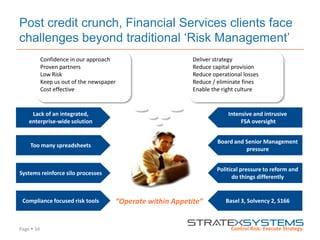
Post credit crunch, Financial Services clients face
challenges beyond traditional „Risk Management‟
Lack of an integrated,
enterprise-wide solution
Too many spreadsheets
Systems reinforce silo processes
Compliance focused risk tools
Intensive and intrusive
FSA oversight
Board and Senior Management
pressure
Political pressure to reform and
do things differently
Basel 3, Solvency 2, S166
Confidence in our approach
Proven partners
Low Risk
Keep us out of the newspaper
Cost effective
Deliver strategy
Reduce capital provision
Reduce operational losses
Reduce / eliminate fines
Enable the right culture
“Operate within Appetite”
Page  35
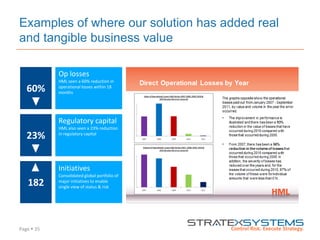
Examples of where our solution has added real
and tangible business value
60%
23%
182
Op losses
HML seen a 60% reduction in
operational losses within 18
months
Regulatory capital
HML also seen a 23% reduction
in regulatory capital
Initiatives
Consolidated global portfolio of
major initiatives to enable
single view of status & risk
Page  36
Demonstration
Page  37
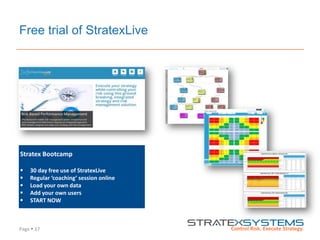
Free trial of StratexLive
Stratex Bootcamp
 30 day free use of StratexLive
 Regular ‘coaching’ session online
 Load your own data
 Add your own users
 START NOW

Integrating Risk into your Balanced Scorecard

  • 1.
    Integrating Risk IntoYour Balanced Scorecard Prepared for: StratexSystems Webinar Series 27 September 2012 4 October 2012
  • 2.
    Page  2 Content Recapping on the Balanced Scorecard  Recapping on Risk Management  Integrating Risk into your Balanced Scorecard  Use of Business Drivers to define levels of Appetite & Exposure  Use of Risk taxonomy to identify Risks per Objective
  • 3.
    Page  3 TheBalanced Scorecard was introduced in 1992 “What you measure is what you get” Raison d'être for Balanced Scorecard was to provide a ‘balanced’ set of performance measurements.
  • 4.
    Page  4 TheBalanced Scorecard was followed by the Strategy Map in 2000 Strategy Map is a powerful tool for visualising Strategy, showing the cause & effect relationships and tensions within the strategy.
  • 5.
    Page  5 Overthe last 20 years, the Balanced Scorecard has continued to evolve… Raison d'être for Balanced Scorecard was to provide a ‘balanced’ set of performance measurements. “What you measure is what you get” - Kaplan & Norton, 1992 Performance Measurement With adoption, the Balanced Scorecard evolved to become more focused on strategy. Introduced the 5 principles 1. Translate the Strategy into operational terms 2. Mobilise change through executive leadership 3. Make Strategy a continual process 4. Make Strategy everyone’s everyday job 5. Align the organisation to the Strategy Performance Management The Balanced Scorecard is now positioned as a framework for enhancing strategic execution. A closed loop system of strategic execution 1. Develop the Strategy 2. Plan the Strategy 3. Align the organisation 4. Plan operations 5. Monitor and Learn 6. Test and Adapt the Strategy Strategy Execution
  • 6.
    Page  6 Thecredit crunch and subsequent fall-out is rewriting the rules on strategy execution (and risk management)
  • 7.
    Page  7 Kaplan& Norton on Risk and the Balanced Scorecard HBR June 2012  Three categories of Risk  Preventable Risks  Strategy Risks  External Risks Managing Risk is very different from managing Strategy
  • 8.
    Page  8 Kaplan& Norton on Risk and the Balanced Scorecard - What we think…  The 3 categories are just a relatively simple risk taxonomy  Managing Risk is not different to, but a fundamental part of, managing strategy From the father of BSC, no direction on how to integrate Risk in the BSC.
  • 9.
    Page  9 Sowhat do we mean when we say “Risk”? The possibility that an event will occur and adversely affect the achievement of objectives. COSO Integrated Risk Management Framework the effect of uncertainty on objectives, whether positive or negative. ISO31000 The uncertainty of future events that will impact on the achievement of objectives, either positively (opportunities) or negatively (threats). Andrew Smart The uncertainty of future events, incorporating both lost opportunities as well as threats materialising, which will impact our ability to achieve business objectives. Client No organisation can create value without taking risk. “ You have to speculate to accumulate”
  • 10.
    Page  10 Whatis Risk Management As much about exploiting opportunities as preventing potential problems. Risk Management is an essential part of good management “coordinated activities to direct and control and organization with regard to risk” risk management framework; “set of components that provide the foundations and organizational arrangements for designing, implementing, monitoring, reviewing and continually improving risk management processes throughout the organization” risk management process; “systematic application of management policies, procedures and practices to the tasks of communication, consultation, establishing the context, identifying, analysing, evaluating, treating, monitoring and reviewing risk” ISO31000
  • 11.
    Page  11 Thereare two major risk management standards which have influenced our thinking… COSO 1994 & 2004 ISO31000 2009
  • 12.
    Page  12 Overthe last 20 or so years Strategy & Risk Management frameworks have evolved largely in isolation Balanced Scorecard 1992 ISO31000 2009
  • 13.
    Page  13 Soto the question…. How to integrate Risk into the Balanced Scorecard? 1. Use Business Drivers to define levels of risk appetite and risk-taking  Links risk management in the strategic process  Shapes the conversation about risk  Enables the monitoring of the alignment of risk-taking to strategy  Enables us to answer the question: Are we operating within Appetite? 2. Use your Risk taxonomy to enable the Risk Identification process per objective
  • 14.
    Page  14 RiskAppetite has a central role to play in the integration of strategy and risk management  The COSO definition provides „What, Who, When and Why‟ of risk appetite  What: the amount and type of risk  Who: an organisational entity  When: over a defined time horizon  Why: to achieve the objectives of the entity Risk appetite is the amount and type of risk that is acceptable to be taken by an organisational entity over a defined time period, to achieve the objectives of that entity – COSO Enterprise Risk Management Risk appetite sets the boundaries within which strategy is executed – StratexSystems
  • 15.
    Page  15 RiskAppetite should be integrated into your organisational strategic framework Business Goals Business Model Business Drivers Internal Analysis External Analysis Business Objectives Strategy Appetite Appetite Alignment Risk Management Performance Management Appetite Identify strengths & weaknesses Identify threats & opportunities Is our business model fit for purpose? Is our business model fit for purpose? Are we operating within appetite? Manage threats & opportunities Are we on-track to deliver? Manage strengths & weaknesses Appetite SettingExecutionFormulation Setting From high-level strategies to specific business objectives Define specific business objectives and appetite for specific entity’s Allocation of scarce resources by entity, risk category, product lines Execution Are we on-track to achieve our business objectives Are we operating within appetite (are we taking too much, or not enough risk?) Do we have the right level of controls in place to meet internal and external compliance drivers? Are we aligning our change agenda to our strategic agenda? Formulation Development of high-level strategies and allocation of scarce resources, including capital Given our business context, what is our appetite for risk? Given our appetite, have we got the right business model? Are we comfortable with the assumptions we have made?
  • 16.
    Page  16 RiskAppetite is the „glue‟ that brings together Strategy & Risk Performance Management Risk Management Strategy Management Appetite What are we trying to achieve? Are we on track? What is our Risk Appetite? Are we operating within appetite? Governance & Communications Culture
  • 17.
    Page  17 Weuse „key‟ Drivers to define levels of risk appetite and shape the conversation around risk (and strategy) Business drivers Capital Income Reputation Shareholder value Share price Economic value add Profit Strategy Align Risk-taking to Strategy Manage Risk Manage Performance Appetite Governance Communication Culture
  • 18.
    Page  18 Usingdrivers to frame appetite setting enables the Board to set clear operating boundaries Business Drivers Low Moderate High Extreme Capacity Limit Income X% Capital @Risk X% Capital @Risk X% Capital @Risk X% Capital @Risk Capital Up to X £M X £M to Y £M X £M to Y £M X £M to Y £M Above X £M Reputation Up to X vol. Bad coverage Up to X vol. Bad coverage Up to X vol. Bad coverage Up to X vol. Bad coverage
  • 19.
    Page  19 AppetiteAlignment Matrix is a key tool for monitoring the alignment of Risk-taking to Strategy  Enabling monitoring of risks which are outside of Appetite  Shows where we are taking to much and not enough risk  Changes the risk conversation  Answers the question: Are we operating with in Appetite?
  • 20.
    Page  20 Soto the question…. How to integrate Risk into the Balanced Scorecard? 1. Use Business Drivers to define levels of risk appetite and risk-taking  Links risk management in the strategic process  Shapes the conversation about risk  Enables the monitoring of the alignment of risk-taking to strategy  Enables us to answer the question: Are we operating within Appetite? 2. Use your Risk taxonomy to enable the Risk Identification process per objective
  • 21.
    Page  21 Commoncategorisation of risk Strategic Risk uncertainty related to strategic choices Execution Risk uncertainty related to execution of the chosen strategy Operational Risk uncertainty related to processes, people, technology, change etc Credit Risk uncertainty related to a counterparty's ability to meet their obligations Market Credit uncertainty related to the market value of a portfolio Risk uncertainty of future events that will impact on the achievement of objectives
  • 22.
    Page  22 TheStrategy Map articulates how an organisation creates value FinancialCustomerInternalProcess Learning& Growth Increase Investment Returns by 25% Sustainable Growth Increase Retention of competent staff by 10% Increase Shareholder value Objective KPIs InitiativesTargets Increase Investment Returns by 25% YTD % Increase in investment returns 25%  Implement new portfolio mgt system Objective Statement of what strategy must achieve and what’s critical to its success KPIs How success in achieving the strategy will be measured and tracked Targets The level of performance or rate of improvement needed Initiatives Key action programs required to achieve Priorities
  • 23.
    Page  23 However,to create value, risk- taking must be aligned to strategy… FinancialCustomerInternalProcess Learning& Growth Increase Investment Returns by 25% Sustainable Growth Increase Retention of competent staff by 10% Increase Shareholder value Objective Appetite AlignmentExposure Increase Investment Returns by 25% Objective Statement of what strategy must achieve and what’s critical to its success Appetite How much risk are we willing to run to achieve the objective? Exposure How much risk are we currently running? Alignment Is our current risk-taking aligned to appetite? Moderate High Over-exposed
  • 24.
    Page  24 Effectiverisk management supports value creation and protection... FinancialCustomerInternalProcess Learning& Growth Increase Investment Returns by 25% Sustainable Growth Increase Retention of competent staff by 10% Increase Shareholder value Objective Risks MitigationThresholds Increase Investment Returns by 25%  Unexpected changes in interest rates  Unexpected Equity movements  Appetite  Tolerances  Controls  Initiatives  Policy & procedures  Processes Objective Statement of what strategy must achieve and what’s critical to its success Risks The threats and opportunities (risks) exist which may impact achievement of objectives Thresholds The appetite and tolerance thresholds used to monitor risk Mitigation The activities undertaken to manage risk
  • 25.
    Page  25 Manydifferent types of risks make up the organisational risk universe FinancialCustomerInternalProcess Learning& Growth Increase Investment Returns by 25% Sustainable Growth Increase Retention of competent staff by 10% Increase Shareholder value Increase Investment Returns by 25% Strategic Risk Operational Risk Insurance Risk Finance Risk Hazard Risk
  • 26.
    Page  26 Manydifferent types of risks make up the organisational risk universe FinancialCustomerInternalProcess Learning& Growth Increase Investment Returns by 25% Sustainable Growth Increase Retention of competent staff by 10% Increase Shareholder value Increase Investment Returns by 25% Strategic Risk Operational Risk Insurance Risk Finance Risk Hazard Risk Unexpected changes in interest rates Unexpected Equity movements
  • 27.
    Page  27 Riskcategorises can be used to support risk identification and integration of risk in the Balanced Scorecard Increase Investment Returns by 25% Insurance Risk Underwriting Risk Operational Risk Strategic Risk Hazard Risk Financial Risk Business Risk Reputation Risk Process Risk Market Risk Credit Risk Liquidity Risk People Risk System Risk External Events Legal Risk Claims Mgt Risk Reinsurance RiskProduct Risk Premium Risk Civil disruption Health & Safety Accidents Natural
  • 28.
    Page  28 Howdo we define a risk? The risk of (what, where, when)….. caused by (how) ……resulting in..…(impact/consequences) Examples  The risk of financial deficit at end of year caused by decreased in-patient activity and revenue, resulting in rationalisation of service offerings.  The risk of exceeding A&E waiting times, caused by increased demand and staff vacancies, resulting in not meeting community expectations and adverse patient outcomes
  • 29.
    Page  29 Wheredo we define Risks? Objectives Key Risks Key Controls
  • 30.
    Page  30 TheObjectives, Risks and Controls structure is central to Stratex solutions 30 Objectives KPIs Actions Key Risks KRIs Actions Assessment Key Controls KCIs Actions Assessment Events Certification Risk Appetite Processes Initiatives Systems People & Roles Assets Operational enablers are aligned to strategy Governance Commentary Workflows Audit Trails Build a strategy focused, risk aware culture
  • 31.
    Page  31 Soto the question…. How to integrate Risk into the Balanced Scorecard? 1. Use Business Drivers to define levels of risk appetite and risk-taking  Links risk management in the strategic process  Shapes the conversation about risk  Enables the monitoring of the alignment of risk-taking to strategy  Enables us to answer the question: Are we operating within Appetite? 2. Use your Risk taxonomy to enable the Risk Identification process per objective
  • 32.
  • 33.
    Page  33 AboutStratexSystems “StratexPoint enabled us to reduce the value of our operational losses by 94%, the volume by 63% and our economic capital provision by 23%” - Head of Operational Risk, HML - Skipton group Our mission To provide an integrated strategy and risk management solutions which enhances strategy execution, enhance capital efficiency by 15% and reduce operational losses 25% while providing 100% confidence that your business is operating within appetite.
  • 34.
    Page  34 Postcredit crunch, Financial Services clients face challenges beyond traditional „Risk Management‟ Lack of an integrated, enterprise-wide solution Too many spreadsheets Systems reinforce silo processes Compliance focused risk tools Intensive and intrusive FSA oversight Board and Senior Management pressure Political pressure to reform and do things differently Basel 3, Solvency 2, S166 Confidence in our approach Proven partners Low Risk Keep us out of the newspaper Cost effective Deliver strategy Reduce capital provision Reduce operational losses Reduce / eliminate fines Enable the right culture “Operate within Appetite”
  • 35.
    Page  35 Examplesof where our solution has added real and tangible business value 60% 23% 182 Op losses HML seen a 60% reduction in operational losses within 18 months Regulatory capital HML also seen a 23% reduction in regulatory capital Initiatives Consolidated global portfolio of major initiatives to enable single view of status & risk
  • 36.
  • 37.
    Page  37 Freetrial of StratexLive Stratex Bootcamp  30 day free use of StratexLive  Regular ‘coaching’ session online  Load your own data  Add your own users  START NOW

Editor's Notes

  • #4 Introduced in 1992 at a time of transition in how business created value, from creating value out of tangible assets to creating it out of intangible assetsDesigned as a performance management tool Answered the question – How are we performing?
  • #5 Strategy Map introduced in the HBR article: Having trouble with your strategy, then Map it, in the year 2000Powerful tool which enabled a strategy to be expressed on a single page, showing the cause & effect relationship between objectives and tensions within the Map
  • #6 BSC has evolved from Performance Management to Strategy Execution frameworkWhat about risk?
  • #7 Credit Crunch and subsequent fall-out forcing organisations to re-think how they execute strategyRe-writing the rules with a greater emphasis on Risk and specifically Risk AppetiteBoards & Regulators more active stakeholders