IBM X-Force® 2010
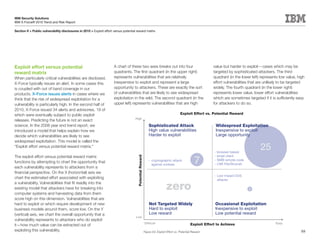
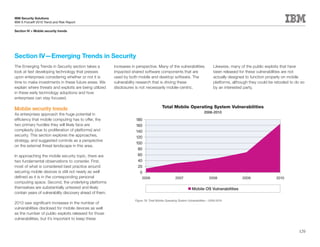
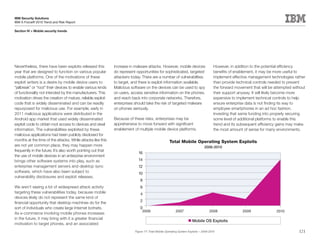
Trend and Risk Report
March 2011
IBM Security Solutions
IBM X-Force® 2010 Trend and Risk Report

Dedication


Dedication
The IBM X-Force® 2010 Trend and Risk Report is dedicated in memory of our friend and colleague Bryan
Williams who passed away during this effort. His knowledge and focus on the changing threat landscape of
virtualization is documented in this report. Bryan was a highly valued member of the IBM X-Force team
since the early days and his contribution to the team, security and IBM are too numerous to list. He will be
greatly missed.


IBM Confidential and Internal only—2011                                                                        2
IBM Security Solutions
IBM X-Force® 2010 Trend and Risk Report

Contributors


Contributors
Producing the X-Force Trend and Risk Report is a dedication in collaboration across all of IBM. We would             About X-Force
like to thank the following individuals for their rapt attention and dedication to the publication of this report.   The IBM X-Force® research and development teams
                                                                                                                     study and monitor the latest threat trends including
Contributor                                 Title
                                                                                                                     vulnerabilities, exploits and active attacks, viruses
Amrit Williams                              Director, Emerging Security Technology                                   and other malware, spam, phishing, and malicious
Bryan Williams                              X-Force Research and Development, Protection Technologies                web content. In addition to advising customers and
Carsten Hagemann                            X-Force Software Engineer, Content Security                              the general public about emerging and critical
Colin Bell                                  Principle Consultant, AppScan OnDemand Services                          threats, X-Force also delivers security content to help
David Merrill                               STSM, IBM Chief Information Security Office, CISA                        protect IBM customers from these threats.
Dr. Jens Thamm                              Database Management Content Security
Harold Moss                                 Emerging Tech & Cloud Computing Technical Architect
Jay Radcliffe                               Senior Threat Analyst, MSS
Jeffrey Palatt                              Manager, Emergency Response Services
John Kuhn                                   Senior Threat Analyst, MSS
Jon Larimer                                 X-Force Advanced Research, Malware
Leslie Horacek                              X-Force Threat Response Manager
Lisa Washburn                               Global Product Mgr, IBM Security Services—Threat/Cloud
Marc Noske                                  Database Administration, Content Security
Mark E. Wallis                              Senior Information Developer for IBM Security Solutions
Matthew Ward                                Senior Product Manager—Tivoli Security
Michelle Alvarez                            Team Lead, MSS Intelligence Center(aka Eagle Eyes)
Mike Warfield                               Senior Wizard, X-Force
Ory Segal                                   Security Products Architect, AppScan Product Manager
Patrick Vandenberg                          Manager, Rational Security & Compliance Marketing
Ralf Iffert                                 Manager X-Force Content Security
Ryan McNulty                                IBM Managed Security Services & SQL Querier Extraordinaire
Scott Moore                                 X-Force Software Developer and X-Force Database Team Lead
Shane Garrett                               X-Force Advanced Research
Steven Bade                                 STSM Security Architect and Strategist
Tom Cross                                   Manager—X-Force Strategy and Threat Intelligence
Wangui McKelvey                             X-Force Marketing Manager                                                                                                     3
IBM Security Solutions
IBM X-Force® 2010 Trend and Risk Report

Contents > Section I


Contents
Section I
Dedication                                              2    Trending in the dark—what does malicious traffic look like?   24   Phishing                                   57

Contributors                                            3      Spoofed Denial of Service attacks                           24     Phishing volume                          57

About X-Force                                           3      Targets of Denial of Service attacks                        26     Are phishers becoming skimmers?          58

Navigating the report                                   6    Worms of yesteryear: Where are they now?                      27     Phishing—country of origin               59

Section I—Threats                                       7    Web content trends                                            31     Phishing—country of origin trends        60

Executive overview                                      7      Analysis methodology                                        31     Phishing URLs—country of origin          61

2010 Highlights                                         8      Percentage of unwanted Internet content                     32     Phishing URLs—country of origin trends   62

  Threats                                               8      Malicious websites                                          37     Phishing—most popular subject lines      63

  Operating Secure Infrastructure                       8    Spammers focus on content rather than volume                  42     Phishing targets                         64

  Developing Secure Software                            9      Major content trends in spam for 2010                       42

  Emerging Trends in Security                          10      Spam volume                                                 45

  IBM Security collaboration                           10      Conclusions about spam volume and content                   45

IBM Managed Security Services—A global threat landscape 11     Spammers on holiday at the end of the year                  46

  Trojan Bot networks                                  11      Regional spam volume per day of the week                    47

  SQL injection                                        13      Common domains in URL spam                                  48

  Obfuscation                                          15      Common top-level domains in URL spam                        51

  PDF exploitation                                     16      Internationalized country code top-level domains:
                                                               First occurrences in spam                                   51
  Cross-site scripting                                 17
                                                               Spam—country of origin                                      52
  Industry trends                                      18
                                                               Spam—country of origin trends                               54
Top high-volume signatures—IBM MSS                     21
                                                               Spam URLs—country of origin trends                          55
  Targeting SMB Servers                                22
  SQL injection—high volume                            23
  PsExec                                               23
  Brute force attacks & scans                          23
  JScript & UNIX                                       23


                                                                                                                                                                            4
IBM Security Solutions
IBM X-Force® 2010 Trend and Risk Report

Contents > Section II, III and IV


Contents
Section II, III and IV
Section II—Operating Secure Infrastructure                   68   Virtualization—risks and recommendations           90   Section III—Developing Secure Software                      101
Advanced persistent threat (APT) and targeted attacks        68     Virtualization system components                 90   Further analysis on web application trends                  101
  Background and definitions                                 68     Vulnerability distribution                       92     Conclusions from real-world web application assessments 101
  Response and research                                      68     Attacks unique to virtualization systems         93     Hybrid analysis sheds light on vulnerability blind spot   111
  Conclusions and recommendations                            70     Public exploits                                  94   Web application hack-ability and efficient defense          114
Stuxnet and SCADA                                            72     Summary of security concerns                     94     Avoid the Net cast by automation                          119
  Who is behind Stuxnet?                                     72     Operating Secure Virtual Infrastructure          94     Fix vulnerabilities efficiently                           119
  Works cited                                                74   Endpoint security and systems management           96     The best defense against the elite                        119
Public vulnerability disclosures in 2010                     74     A well-managed device is a more secure device    96   Section IV—Emerging Trends in Security                      120
  2010—A record setting year                                 75   The State of Affairs in DNSSEC                     98   Mobile security trends                                      120
  Public exploit disclosure                                  78     Introduction                                     98     Effective controls to manage mobile devices               122
  Vendor supplied patches                                    79     2010 The year in review                          98     Encryption                                                123
  Toward more reliable public vulnerability reporting        80     Software deployment and components               98     Remote Access Service                                     124
  Shift from local to remotely exploitable vulnerabilities   81     DNSSEC challenges and stumbling blocks           99     Future security vision                                    125
  Web application vulnerabilities                            82     What’s ahead now                                100   The evolving state of security in the cloud                 126
  Web application platforms vs. plug-ins                     84     Conclusion                                      100     Design elements for security in the cloud                 128
  Client-side vulnerabilities and exploits                   85
  Exploit effort versus potential reward matrix              88
  Key Recommendations                                        89


                                                                                                                                                                                        5
IBM Security Solutions
IBM X-Force® 2010 Trend and Risk Report

Navigating the report


Navigating the report
Welcome. This year we have made some helpful            We start by talking about the threats that our
improvements to the format and content of the           systems and networks are facing, because we have
Trend Report. These improvements are aimed at           to begin by understanding the problem we are all
enabling readers to take the findings a step further.   working to solve. Once a threat is understood, we
We understand that computer and network security        can work towards realistic technology controls and
is about focusing on awareness of the threat and        educational awareness to help secure our enterprise
helping to protect the systems and networks from        and systems. In both the Operating Secure
these threats. But then what? As an organization        Infrastructure and Developing Secure Software
matures in its stance on computer security and          sections we not only discuss threats but provide
known threats, how can they begin to develop a          logical advice on how to help improve or detect
deeper focus towards improvement?                       those threats in your environment. In the Emerging
                                                        Trends in Security section, we take a forward look
We asked ourselves that question and determined         into emerging technologies that are pressing into
the answer was to provide to our readers a deeper       discussions as future business concerns.
understanding of what we experience and have
learned from the breadth of capabilities that is IBM    We believe this new layout better organizes the
Security Solutions.                                     material we want to present and helps you the
                                                        reader focus on what is most important to your
For this report we have divided the content into four   organization.
sections.

•	 Threats
•	 Operating Secure Infrastructure
•	 Developing Secure Software
•	 Emerging Trends in Security


                                                                                                              6
IBM Security Solutions
IBM X-Force® 2010 Trend and Risk Report

Section I > Executive overview


Section I–Threats
In this section we explore topics that comprise          generally, we have seen a rise in hactivism across      In our advanced persistent threat article, we look
“Threats” and describe the attacks aimed at the          the globe, where attackers are no longer motivated      at some of the most sophisticated adversaries our
enterprise that security specialists face. We address    simply by self-recognition or financial gain, but by    networks have ever faced. These types of low and
the malicious activity observed across the spectrum      political change and protest.                           slow coordinated attacks are often an indicator of
by IBM and how we go about helping protect                                                                       highly cohesive and organized groups of attackers
networks from those threats. In addition, an update      The second half of 2010 also marked a highly            who use a variety of sophisticated attack
on the latest attack trends as identified by IBM.        visible precedent in the industrial and manufacturing   techniques to inch their way into the enterprise.
                                                         space. The multi-faceted and highly customized
Executive overview                                       Stuxnet worm shook up the SCADA world by                Not only are attacks changing but so is the very
The second decade of the twenty first century is         proving how security vulnerabilities can cripple a      technology that we utilize to carry this traffic. We
underway and technology continues to permeate            factory or production site. No longer is just           take a quick look at how networks are scrambling
every aspect of our work and personal lives. At IBM      e-commerce, personal, or corporate data at risk,        to keep up with technology changes. At the mid-
we call this the Smarter Planet and we are               but the very infrastructure that powers our factories   year point, we discussed a shift from IPv4 into IPv6
continuously helping our customers to take               and energy sector can be exposed for exploitation.      requirements and in this report, we discuss the
advantage of a world that’s more interconnected,                                                                 oncoming advent of DNSSEC.
intelligent, and instrumented. As much as these          On a smaller scale, mobile devices continue to
innovations can increase our efficiency and ability to   multiply in the workplace, helping increase the         2010 was a pivotal year on many counts and has
instantly connect on a global scale, so too can the      magnitude and complexity of risk in protecting the      shown that understanding the trends of the security
risks and dangers of a connected world become            enterprise. In the emerging trends in security          landscape is more critical than ever. IBM continues
more sophisticated and difficult to contain.             section, we look at several mobile vulnerabilities      its dedicated effort to educate, inform, and discuss
                                                         that may be an indicator of more to come. In the        security topics and emerging trends with the
To prove the point, the confluence of this innovation    enterprise, and at home, web vulnerabilities            community at large. Preparing organizations to not
recently showed its face in several authoritarian        targeting the browser continue to dominate the          only understand the emerging threat landscape, but
countries, where technology and political activism       majority of weaknesses, demonstrating the               also to better understand the weaknesses of an
have united to empower people in sharing a voice         importance of patch compliance and host                 organization’s infrastructure.
and making change on a global scale. More                protection. We discuss an interesting case study of
                                                         how large complex organizations can benefit from
                                                         centralized patch management.


                                                                                                                                                                    7
IBM Security Solutions
IBM X-Force® 2010 Trend and Risk Report

Section I > 2010 Highlights > Threats > Operating Secure Infrastructure


2010 Highlights                                                     •	 Obfuscation, whereby attackers attempt to hide         •	 There were a few months with ups and downs in
Threats                                                                their activities and disguise their programming,          the volume of spam seen over the year, however,
Malware and the Malicious web                                          continued to increase over 2010 and shows no              the overall trends stayed flat and we have seen
•	 IBM Managed Security Services (MSS) saw an                          signs of waning.                                          even less volume at the end of the year in
   upward trend in Trojan botnet activity during                    •	 Compromise through PDF exploitation continues             comparison to the beginning of 2010.
   2010. This growth is significant because despite                    to be a favorite among attackers. In late April, a     •	 At 15.5 percent, India was the top country for
   increasing coordinated efforts to shut down botnet                  particular spam campaign contained an Adobe               phishing email origination in 2010, followed by
   activity (as seen with the Mariposa, Bredolab and                   Acrobat PDF that used the Launch command to               Russia at 10.4 percent.
   Waledec botnets), this threat appears to be                         deliver malware. At the peak of the attacks, IBM       •	 In 2010, financial institutions continue to climb as
   gaining momentum.                                                   Managed Security Services (MSS) received more             the number one target for phishing attempts,
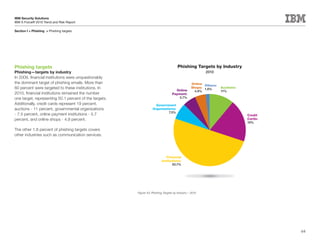
•	 IBM’s data illustrates the dramatic impact of a                     than 85,000 alerts in a single day.                       representing 50 percent of the targeted industries
   successful effort in early 2010 to shutdown the                  •	 The SQL Slammer worm first surfaced in January            up from the mid-year report when it was 49 percent.
   Waledac botnet, which resulted in an instantaneous                  2003 and became known as one of the most               •	 In 2010, more than three out of four financial phishing
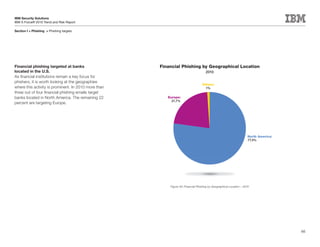
   drop off in observed command and control traffic.                   devastating Internet threats of the past decade.          emails targeted banks located in North America.
•	 Zeus (also known as Zbot and Kneber), continues                     This worm continued to generate a great deal of           The remaining 22 percent targeted Europe.
   to evolve through intrinsic and plugin advances.                    traffic on the Internet in 2010.
   The Zeus/Zbot family of botnets has been around                                                                            Operating Secure Infrastructure
   for many years now and due to its extreme                        Web content, spam, and phishing                           Vulnerabilities and Exploitation
   popularity with attackers, there are hundreds, or                •	 IBM Content security team identified that in the       •	 According to the X-Force database tracking, 2010
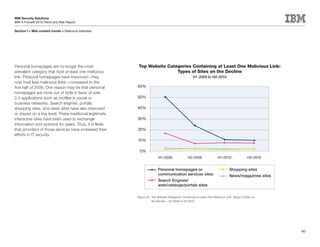
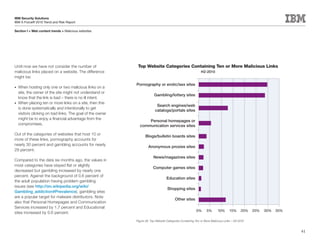
   even thousands, of separate Zeus botnets active                     past three years, anonymous proxies have steadily         had the largest number of vulnerability disclosures
   at any given time. The Zeus botnet malware is                       increased, more than quintupling in number.               in history—8,562. This is a 27 percent increase
   commonly used by attackers to steal banking                         Anonymous proxies are a critical type of website          over 2009, and this increase has had a significant
   information from infected computers.                                to track, because they allow people to hide               operational impact for anyone managing large IT
•	 SQL injection is one of the leading attack vectors                  potentially malicious intent.                             infrastructures. More vulnerability disclosures can
   because of its simplicity to execute and its                     •	 USA, India, Brazil, Vietnam, and Russia are the top       mean more time patching and remediating
   scalability to compromise large amounts of web                      five countries for spam origination in 2010.              vulnerable systems.
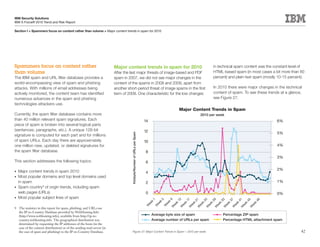
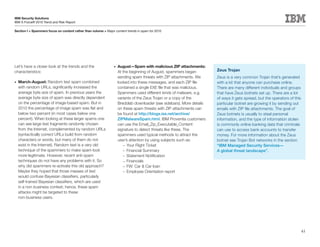
   servers across the Internet. There also appears to               •	 In 2010, spammers focused on content over
   be a seasonal pattern: during each of the past                      volume. At the beginning of August, spammers
   three years, there has been a globally scaled SQL                   began sending spam threats with ZIP attachments
   injection attack some time during the months of                     that contained a single EXE file that was malicious.
   May through August.                                                 By September, spammers began shifting to HTML
                                                                       spam to once again trick the end-user.
                                                                                                                                                                                      8
IBM Security Solutions
IBM X-Force® 2010 Trend and Risk Report

Section I > 2010 Highlights > Developing Secure Software


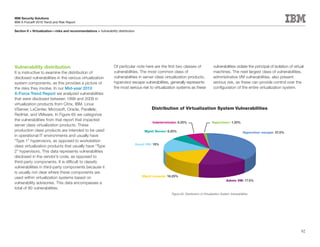
•	 49 percent of the vulnerabilities disclosed in 2010       Virtualization                                             •	 ASP.NET applications were clearly more
   were web application vulnerabilities. The majority of     •	 IBM X-Force notes that virtualization systems              susceptible to SQL injection than Java or PHP.
   these were cross site scripting and SQL injection            added 373 new vulnerabilities to the network               The likely reason is that applications would typically
   issues. However, as IBM X-Force has been saying              infrastructure in the period between 1999                  use SQL Server as a backend database. SQL
   for years, these vulnerabilities represent just the tip      and 2009.                                                  injection is better documented and easier to detect
   of the iceberg since many organizations develop           •	 A number of public exploits exist that                     in this technology.
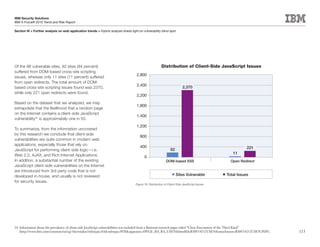
   third-party applications in-house that are never             demonstrate the risk from virtualization                •	 As Web 2.0, AJAX applications, and Rich Internet
   even reported publically and are not included in             system vulnerabilities is real.                            Applications (RIAs) become more common,
   this count.                                               •	 Hypervisor escape vulnerabilities are the most             client-side JavaScript vulnerabilities may become
•	 Although vendors have been diligent in providing             common type of vulnerability that has been                 more relevant, with a potential rise in the amount of
   patches, at least 44 percent of all vulnerabilities in       disclosed in server class virtualization systems.          such issues being exploited by malicious attackers.
   2010 still had no corresponding patch by the end                                                                     •	 A recent IBM research study discovered that about
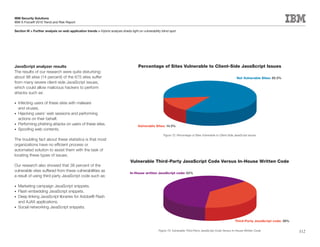
   of the year.                                              Developing Secure Software                                    14 percent of the Fortune 500 sites suffer from
•	 In early 2010, the term Advanced Persistent Threat        Web Application Vulnerabilities                               many severe client-side JavaScript issues, which
   (APT) became part of the everyday information             •	 From the IBM® Rational® AppScan® OnDemand                  could allow malicious attackers to perform attacks
   security lexicon as a result of certain public               Premium Service we observed web application                such as
   disclosures and acknowledgement of a targeted                vulnerabilities comprising 49 percent of the total             – Infecting users of these sites with malware
   series of attacks known as Operation Aurora.                 vulnerabilities reported in 2010, it is no surprise               and viruses.
   There has been much debate over this term and                that developing secure software is harder                      – Hijacking users’ web sessions and performing
   the underlying concepts within the information               than ever.                                                        actions on their behalf.
   security community.                                       •	 In 2010 for the first time we now find that Cross-             – Performing phishing attacks on users of
•	 During certain public disclosures in early 2010, and         Site Request Forgery (CSRF) is more likely to be                  these sites.
   after attacks associated with Operation Aurora, the          found in our testing than Cross-Site Scripting                 – Spoofing web contents.
   term APT began to take on a different meaning. In            (XSS). This change is attributed to better detection
                                                                                                                        •	   Based on the dataset that we analyzed, we may
   essence, APT became associated with any                      techniques for CSRF and also a greater awareness
                                                                                                                             extrapolate that the likelihood that a random page
   targeted, sophisticated, or complex attack                   of the risk. We find that organizations will tolerate
                                                                                                                             on the Internet contains a client-side JavaScript
   regardless of the attacker, motive, origin, or               having some outstanding issues with CSRF if the
                                                                                                                             vulnerability is approximately one in 55.
   method of operation.                                         risk of exploitation is minimized. This is not the
                                                                case with XSS and these issues are often
                                                                quickly resolved.


                                                                                                                                                                                  9
IBM Security Solutions
IBM X-Force® 2010 Trend and Risk Report

Section I > 2010 Highlights > Emerging Trends in Security > IBM Security collaboration


Emerging Trends in Security
                                                                    IBM Security collaboration
Mobile
•	 Mobile devices represent opportunities for                       IBM Security represents several brands that provide a broad spectrum of security competency.
   sophisticated, targeted attackers. There are a                   •	   IBM X-Force® research and development teams discover, analyze, monitor, and record a broad range of
   number of vulnerabilities to target, and there is                     computer security threats and vulnerabilities
   exploit information available.
•	 However, it is important to keep the vulnerability               •	   IBM Managed Security Services (MSS) is responsible for monitoring exploits related to endpoints, servers
   increases in perspective -- these do represent                        (including web servers), and general network infrastructure. MSS tracks exploits delivered over the web as
   shared software components used by both mobile                        well as other vectors such as email and instant messaging.
   and desktop software. The vulnerability research
                                                                    •	   Professional Security Services (PSS) delivers comprehensive, enterprise-wide security assessment, design,
   that is driving these disclosures is not necessarily                  and deployment services to help build effective information security solutions.
   mobile-centric.
•	 Still, we aren’t seeing widespread attack activity               •	   Our Content security team independently scours and categorizes the web through crawling, independent
   targeting mobile vulnerabilities today, because                       discoveries, and through the feeds provided by MSS. In addition, the team actively monitors millions of email
   mobile devices do not represent the same kind of                      addresses to receive mass amounts of spam and phishing emails. This work provides optimal spam
   financial opportunity that desktop machines do for                    protection accompanied by the latest trends in spam and phishing emails.
   the sort of individuals who appear to create large               •	   IBM has collated real-world vulnerability data from security tests conducted over the past three years from the
   Internet botnets.                                                     IBM® Rational® AppScan® OnDemand Premium Service. This service combines application security
                                                                         assessment results obtained from IBM Rational AppScan with manual security testing and verification.
Cloud security
•	 While security is still considered one of the major              •	   IBM Cloud Security Services allows clients to consume security software features through a hosted
   inhibitors to cloud adoption, organizations are                       subscription model that helps reduce costs, improve service delivery, and improve security.
   increasingly adopting cloud-based technologies to
                                                                    •	   Identity and access management solutions provide identity management, access management, and user
   address competitive market needs.
                                                                         compliance auditing. These solutions centralize and automate the management of users, authentication,
•	 Extending existing security policies and standards,
                                                                         access, audit policy, and the provisioning of user services.
   leveraging sound physical security protections
   already in place, and assessing systems and                      •	   IBM Endpoint Management Solutions combine endpoint and security management into a single offering that
   applications for security weaknesses are examples                     enables customers to see and manage physical and virtual endpoints—servers, desktops, roaming laptops,
   of security design elements that should be included                   and specialized equipment such as point-of-sale devices, ATMs and self-service kiosks.
   when establishing a secure cloud environment.


                                                                                                                                                                                       10
IBM Security Solutions
IBM X-Force® 2010 Trend and Risk Report

Section I > IBM Managed Security Services—A global threat landscape > Trojan Bot networks


IBM Managed Security Services—                                      availability of bot exploit toolkits such as WARBOT.                   Trojan Bot networks also continued to evolve in
A global threat landscape                                           This allows less than tech-savvy individuals to take                   2010. One of them, Zeus (also known as Zbot and
IBM Managed Security Services (MSS) monitors                        advantage of the lucrative business of selling                         Kneber), continues to evolve through intrinsic and
several billion events in more than 130 countries, 24               sensitive information on the black market.                             plugin advances. The Zeus/Zbot family of botnets
hours a day, 365 days a year. The global presence of
IBM MSS provides a first-hand view of current threats.                                                                            Trojan Botnet Activity
IBM analysts use this wealth of data to deliver a                                                    250,000
unique understanding of the cyber threat landscape.
This section focuses on Trojan botnet activity, SQL
injection, obfuscation, PDF exploitation, and                                                        200,000
cross-site scripting activity—threats that are
discussed throughout this report. The trend of
these threats is vital to determining what direction                                                 150,000


                                                                                       Event Count
the threat is taking and to understanding the
significance of the threat to our networks.
                                                                                                     100,000
Trojan Bot networks
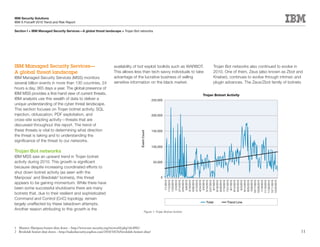
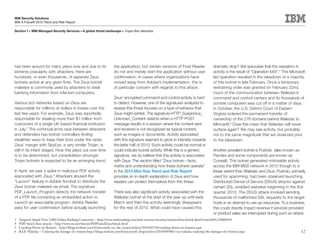
IBM MSS saw an upward trend in Trojan botnet
activity during 2010. This growth is significant                                                      50,000
because despite increasing coordinated efforts to
shut down botnet activity (as seen with the
Mariposa1 and Bredolab2 botnets), this threat                                                                0
                                                                                                                   1/1/2010
                                                                                                                  1/12/2010
                                                                                                                  1/23/2010
                                                                                                                   2/3/2010
                                                                                                                  2/14/2010
                                                                                                                  2/25/2010
                                                                                                                   3/8/2010
                                                                                                                  3/19/2010
                                                                                                                  3/30/2010
                                                                                                                  4/13/2010
                                                                                                                  4/24/2010
                                                                                                                   5/5/2010
                                                                                                                  5/16/2010
                                                                                                                  5/27/2010
                                                                                                                   6/7/2010
                                                                                                                  6/18/2010
                                                                                                                  6/29/2010
                                                                                                                  7/10/2010
                                                                                                                  7/21/2010
                                                                                                                   8/1/2010
                                                                                                                  8/12/2010
                                                                                                                  8/23/2010
                                                                                                                   9/3/2010
                                                                                                                  9/14/2010
                                                                                                                  9/25/2010
                                                                                                                  10/6/2010
                                                                                                                 10/17/2010
                                                                                                                 10/28/2010
                                                                                                                  11/8/2010
                                                                                                                 11/19/2010
                                                                                                                 11/30/2010
                                                                                                                 12/11/2010
                                                                                                                 12/22/2010
appears to be gaining momentum. While there have
been some successful shutdowns there are many
botnets that, due to their resilient and sophisticated
Command and Control (CnC) topology, remain
                                                                                                                                   Total          Trend Line
largely unaffected by these takedown attempts.
Another reason attributing to this growth is the
                                                                                               Figure 1: Trojan Botnet Activity


1 Massive Mariposa botnet shut down – http://www.net-security.org/secworld.php?id=8962
2 Bredolab botnet shut down – http://nakedsecurity.sophos.com/2010/10/26/bredolab-botnet-shut/                                                                                              11
IBM Security Solutions
IBM X-Force® 2010 Trend and Risk Report

Section I > IBM Managed Security Services—A global threat landscape > Trojan Bot networks


has been around for many years now and due to its                     the application, but certain versions of Foxit Reader                 dramatic drop? We speculate that the cessation in
extreme popularity with attackers, there are                          do not and merely start the application without user                  activity is the result of “Operation b49”.5 This Microsoft
hundreds, or even thousands, of separate Zeus                         confirmation. In cases where organizations have                       led operation resulted in the takedown of a majority
botnets active at any given time. The Zeus botnet                     moved away from Adobe’s implementation, this is                       of this botnet in late February. Once a temporary
malware is commonly used by attackers to steal                        of particular concern with regards to this attack.                    restraining order was granted on February 22nd,
banking information from infected computers.                                                                                                much of the communication between Waledac’s
                                                                      Zeus’ encrypted command and control activity is hard                  command and control centers and its thousands of
Various bot networks based on Zeus are                                to detect. However, one of the signatures analyzed to                 zombie computers was cut off in a matter of days.
responsible for millions of dollars in losses over the                assess this threat focuses on a type of behavior that                 In October, the U.S. District Court of Eastern
last few years. For example, Zeus was reportedly                      Zeus might exhibit. The signature HTTP_Suspicious_                    Virginia ordered the permanent transfer of
responsible for stealing more than $1 million from                    Unknown_Content detects when a HTTP POST                              ownership of the 276 domains behind Waledac to
customers of a single UK-based financial institution                  message results in a session where the content sent                   Microsoft.6 Does this mean that Waledac will never
in July.3 The continual arms race between attackers                   and received is not recognized as typical content,                    surface again? We may see activity, but probably
and defenders has botnet controllers finding                          such as images or documents. Activity associated                      not to the same magnitude that we observed prior
stealthier ways to keep their bots under the radar.                   with this signature seemed to grow in intensity towards               to the takedown.
Zeus’ merger with SpyEye, a very similar Trojan, is                   the latter half of 2010. Such activity could be normal or
still in its infant stages. How this plays out over time              could indicate botnet activity. While this is a generic               Another prevalent botnet is Pushdo (also known as
is to be determined, but consolidation amongst                        signature, we do believe that this activity is associated             Pandex and some components are known as
Trojan botnets is expected to be an emerging trend.                   with Zeus. The section titled “Zeus botnet—facts,                     Cutwail). This botnet generated noticeable activity
                                                                      myths and understanding how these botnets operate”                    across the IBM MSS network in 2010 though to a
In April, we saw a spike in malicious PDF activity                    in the 2010 Mid-Year Trend and Risk Report                            lesser extent than Waledac and Zeus. Pushdo, primarily
associated with Zeus.4 Attackers abused the                           provides an in-depth explanation of Zeus and how                      used for spamming, had been observed launching
“Launch” feature in Adobe Acrobat to distribute the                   readers can protect themselves from this threat.                      Distributed Denial of Service (DDoS) attacks against
Zeus botnet malware via email. The signature                                                                                                certain SSL-enabled websites beginning in the first
PDF_Launch_Program detects the network transfer                       There was also significant activity associated with the               quarter 2010. The DDoS attack involved sending
of a PDF file containing an embedded action to                        Waledac botnet at the start of the year up until early                thousands of malformed SSL requests to the target
Launch an executable program. Adobe Reader                            March and then the activity seemingly disappears                      hosts in an attempt to use up resources. To a business,
asks for user confirmation before actually launching                  for the rest of 2010. What could have caused this                     this could directly impact revenue if services provided
                                                                                                                                            or product sales are interrupted during such an attack.
3   Targeted Attack Nets 3,000 Online Banking Customers – http://www.darkreading.com/smb-security/security/attacks/showArticle.jhtml?articleID=226600381
4   PDF-based Zeus attacks – http://www.iss.net/threats/PDFbasedZeusAttack.html
5   Cracking Down on Botnets – http://blogs.technet.com/b/microsoft_on_the_issues/archive/2010/02/24/cracking-down-on-botnets.aspx
6   R.I.P. Waledac – Undoing the damage of a botnet http://blogs.technet.com/b/microsoft_blog/archive/2010/09/08/r-i-p-waledac-undoing-the-damage-of-a-botnet.aspx                                 12
IBM Security Solutions
IBM X-Force® 2010 Trend and Risk Report

Section I > IBM Managed Security Services—A global threat landscape > SQL injection


SQL injection                                                                                                SQL Injection Attacks Monitored by
SQL injection is one of the leading attack vectors                                                            IBM Managed Security Services
seen because of its simplicity to execute and its                                      45,000
scalability to compromise large amounts of web
servers across the Internet. A review of past
                                                                                       35,000
X-Force Trend and Risk Reports reveals an
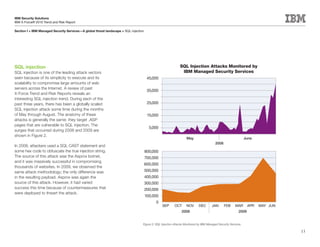
interesting SQL injection trend. During each of the
past three years, there has been a globally scaled                                     25,000
SQL injection attack some time during the months
of May through August. The anatomy of these                                            15,000
attacks is generally the same: they target .ASP
pages that are vulnerable to SQL injection. The
                                                                                        5,000
surges that occurred during 2008 and 2009 are
shown in Figure 2.
                                                                                                                  May                                          June
                                                                                                                                        2008
In 2008, attackers used a SQL CAST statement and
some hex code to obfuscate the true injection string.                                 800,000
The source of this attack was the Asprox botnet,                                      700,000
and it was massively successful in compromising
                                                                                      600,000
thousands of websites. In 2009, we observed the
same attack methodology; the only difference was                                      500,000
in the resulting payload. Asprox was again the                                        400,000
source of this attack. However, it had varied                                         300,000
success this time because of countermeasures that                                     200,000
were deployed to thwart the attack.
                                                                                      100,000
                                                                                           0
                                                                                                SEP      OCT      NOV       DEC       JAN      FEB     MAR       APR   MAY JUN
                                                                                                               2008                                       2009


                                                                                  Figure 2: SQL Injection Attacks Monitored by IBM Managed Security Services

                                                                                                                                                                                 13
IBM Security Solutions
IBM X-Force® 2010 Trend and Risk Report

Section I > IBM Managed Security Services—A global threat landscape > SQL injection


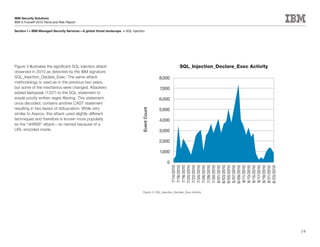
Figure 3 illustrates the significant SQL injection attack                                                     SQL_Injection_Declare_Exec Activity
observed in 2010 as detected by the IBM signature
SQL_Injection_Declare_Exec. The same attack                                                    8,000
methodology is used as in the previous two years,
but some of the mechanics were changed. Attackers                                              7,000
added leetspeak (1337) to the SQL statement to
evade poorly written regex filtering. This statement,                                          6,000
once decoded, contains another CAST statement
resulting in two layers of obfuscation. While very                                             5,000


                                                                                 Event Count
similar to Asprox, this attack used slightly different
techniques and therefore is known more popularly                                               4,000
as the “dnf666” attack—so named because of a
URL encoded inside.                                                                            3,000

                                                                                               2,000

                                                                                               1,000

                                                                                                    0

                                                                                                        7/14/2010
                                                                                                        7/16/2010
                                                                                                        7/18/2010
                                                                                                        7/20/2010
                                                                                                        7/22/2010
                                                                                                        7/24/2010
                                                                                                        7/26/2010
                                                                                                        7/28/2010
                                                                                                        7/30/2010
                                                                                                        8/01/2010
                                                                                                        8/03/2010
                                                                                                        8/05/2010
                                                                                                        8/07/2010
                                                                                                        8/09/2010
                                                                                                        8/11/2010
                                                                                                        8/13/2010
                                                                                                        8/15/2010
                                                                                                        8/17/2010
                                                                                                        8/19/2010
                                                                                                        8/21/2010
                                                                                                        8/23/2010
                                                                                  Figure 3: SQL_Injection_Declare_Exec Activity


                                                                                                                                                    14
IBM Security Solutions
IBM X-Force® 2010 Trend and Risk Report

Section I > IBM Managed Security Services—A global threat landscape > Obfuscation


Obfuscation                                                                                              Obfuscation Activity
IBM MSS continues to track trends in obfuscation                                      400,000
techniques used by attackers and toolkits.
Obfuscation is a technique to hide or mask the                                        350,000
code used to develop applications. New                                                300,000
obfuscation methods are constantly evolving in an


                                                                        Event Count
attempt to evade intrusion prevention systems (IPS)                                   250,000
and anti-virus which often can’t decode the web
                                                                                      200,000
page or file to find the hidden attack. Through
special detection algorithms incorporated into IBM                                    150,000
Security Network IPS, we watch how patterns of
                                                                                      100,000
use change by monitoring hits on these algorithms
in our world-wide MSS deployments.                                                     50,000

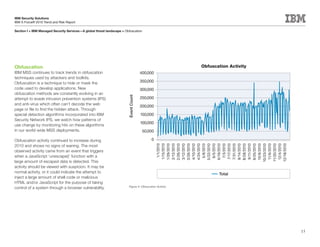
Obfuscation activity continued to increase during                                          0
2010 and shows no signs of waning. The most


                                                                                                  1/1/2010
                                                                                                 1/15/2010
                                                                                                 1/29/2010
                                                                                                 2/12/2010
                                                                                                 2/26/2010
                                                                                                 3/12/2010
                                                                                                 3/26/2010
                                                                                                 4/10/2010
                                                                                                 4/24/2010
                                                                                                  5/8/2010
                                                                                                 5/22/2010
                                                                                                  6/5/2010
                                                                                                 6/19/2010
                                                                                                  7/3/2010
                                                                                                 7/17/2010
                                                                                                 7/31/2010
                                                                                                 8/14/2010
                                                                                                 8/28/2010
                                                                                                 9/11/2010
                                                                                                 9/25/2010
                                                                                                 10/9/2010
                                                                                                10/23/2010
                                                                                                 11/6/2010
                                                                                                11/20/2010
                                                                                                 12/4/2010
                                                                                                12/18/2010
observed activity came from an event that triggers
when a JavaScript ‘unescape()’ function with a
large amount of escaped data is detected. This
activity should be viewed with suspicion. It may be
normal activity, or it could indicate the attempt to                                                            Total
inject a large amount of shell code or malicious
HTML and/or JavaScript for the purpose of taking
                                                                        Figure 4: Obfuscation Activity
control of a system through a browser vulnerability.


                                                                                                                                15
IBM Security Solutions
IBM X-Force® 2010 Trend and Risk Report

Section I > IBM Managed Security Services—A global threat landscape > PDF exploitation


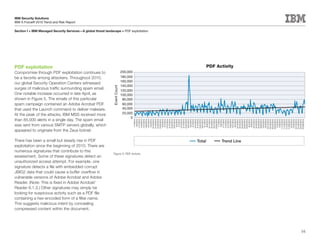
PDF exploitation                                                                                  PDF Activity
Compromise through PDF exploitation continues to                             200,000
be a favorite among attackers. Throughout 2010,                              180,000
                                                                             160,000
our global Security Operation Centers witnessed
                                                                             140,000


                                                               Event Count
surges of malicious traffic surrounding spam email.
                                                                             120,000
One notable increase occurred in late April, as                              100,000
shown in Figure 5. The emails of this particular                              80,000
spam campaign contained an Adobe Acrobat PDF                                  60,000
that used the Launch command to deliver malware.                              40,000
At the peak of the attacks, IBM MSS received more                             20,000
                                                                                   0
than 85,000 alerts in a single day. The spam email


                                                                                        7/31/2010
                                                                                         8/5/2010
                                                                                        7/11/2010
                                                                                        7/16/2010
                                                                                        7/21/2010
                                                                                        7/26/2010
                                                                                         6/6/2010
                                                                                        6/11/2010
                                                                                        6/16/2010
                                                                                        6/21/2010
                                                                                        6/26/2010
                                                                                         7/1/2010
                                                                                         7/6/2010
                                                                                        4/27/2010
                                                                                         5/2/2010
                                                                                         5/7/2010
                                                                                        5/12/2010
                                                                                        5/17/2010
                                                                                        5/22/2010
                                                                                        5/27/2010
                                                                                         6/1/2010
                                                                                        3/22/2010
                                                                                        3/27/2010
                                                                                         4/2/2010
                                                                                         4/7/2010
                                                                                        4/12/2010
                                                                                        4/17/2010
                                                                                        4/22/2010


                                                                                       10/14/2010
                                                                                       10/19/2010
                                                                                       10/24/2010
                                                                                       10/29/2010
                                                                                        11/3/2010
                                                                                        11/8/2010
                                                                                       11/13/2010
                                                                                       11/18/2010
                                                                                       11/23/2010
                                                                                       11/28/2010
                                                                                        12/3/2010
                                                                                        12/8/2010
                                                                                       12/13/2010
                                                                                       12/18/2010
                                                                                       12/23/2010
                                                                                       12/28/2010
                                                                                        2/10/2010
                                                                                        2/15/2010
                                                                                        2/20/2010
                                                                                        2/25/2010
                                                                                         3/2/2010
                                                                                         3/7/2010
                                                                                        3/12/2010
                                                                                        3/17/2010


                                                                                        9/24/2010
                                                                                        9/29/2010
                                                                                        10/4/2010
                                                                                        10/9/2010
                                                                                         1/1/2010
                                                                                         1/6/2010
                                                                                        1/11/2010
                                                                                        1/16/2010
                                                                                        1/21/2010
                                                                                        1/26/2010
                                                                                        1/31/2010
                                                                                         2/5/2010


                                                                                        8/10/2010
                                                                                        8/15/2010
                                                                                        8/20/2010
                                                                                        8/25/2010
                                                                                        8/30/2010
                                                                                         9/4/2010
                                                                                         9/9/2010
                                                                                        9/14/2010
                                                                                        9/19/2010
was sent from various SMTP servers globally, which
appeared to originate from the Zeus botnet.

There has been a small but steady rise in PDF                                             Total         Trend Line
exploitation since the beginning of 2010. There are
numerous signatures that contribute to this
                                                               Figure 5: PDF Activity
assessment. Some of these signatures detect an
unauthorized access attempt. For example, one
signature detects a file with embedded corrupt
JBIG2 data that could cause a buffer overflow in
vulnerable versions of Adobe Acrobat and Adobe
Reader. (Note: This is fixed in Adobe Acrobat/
Reader 8.1.3.) Other signatures may simply be
looking for suspicious activity such as a PDF file
containing a hex-encoded form of a filter name.
This suggests malicious intent by concealing
compressed content within the document.


                                                                                                                     16
IBM Security Solutions
IBM X-Force® 2010 Trend and Risk Report

Section I > IBM Managed Security Services—A global threat landscape > Cross-site scripting


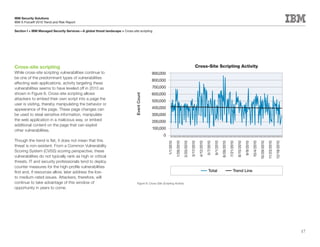
Cross-site scripting                                                                                                                                 Cross-Site Scripting Activity
While cross-site scripting vulnerabilities continue to                                       900,000
be one of the predominant types of vulnerabilities
                                                                                             800,000
affecting web applications, activity targeting these
vulnerabilities seems to have leveled off in 2010 as                                         700,000
shown in Figure 6. Cross-site scripting allows                                               600,000


                                                                               Event Count
attackers to embed their own script into a page the
                                                                                             500,000
user is visiting, thereby manipulating the behavior or
appearance of the page. These page changes can                                               400,000
be used to steal sensitive information, manipulate                                           300,000
the web application in a malicious way, or embed                                             200,000
additional content on the page that can exploit
other vulnerabilities.                                                                       100,000
                                                                                                       0
Though the trend is flat, it does not mean that this


                                                                                                           1/1/2010

                                                                                                                      1/26/2010

                                                                                                                                  2/20/2010

                                                                                                                                              3/17/2010

                                                                                                                                                          4/12/2010

                                                                                                                                                                      5/7/2010

                                                                                                                                                                                 6/1/2010

                                                                                                                                                                                            6/26/2010

                                                                                                                                                                                                        7/21/2010

                                                                                                                                                                                                                    8/15/2010

                                                                                                                                                                                                                                9/9/2010


                                                                                                                                                                                                                                                                    11/23/2010
                                                                                                                                                                                                                                           10/4/2010

                                                                                                                                                                                                                                                       10/29/2010


                                                                                                                                                                                                                                                                                 12/18/2010
threat is non-existent. From a Common Vulnerability
Scoring System (CVSS) scoring perspective, these
vulnerabilities do not typically rank as high or critical
threats. IT and security professionals tend to deploy
counter measures for the high-profile vulnerabilities
first and, if resources allow, later address the low-                                                                                                                    Total                                Trend Line
to medium-rated issues. Attackers, therefore, will
continue to take advantage of this window of                                     Figure 6: Cross-Site Scripting Activity
opportunity in years to come.


                                                                                                                                                                                                                                                                                              17
IBM Security Solutions
IBM X-Force® 2010 Trend and Risk Report

Section I > IBM Managed Security Services—A global threat landscape > Industry trends


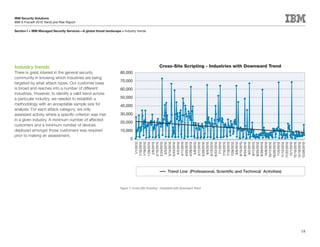
Industry trends                                                                                   Cross-Site Scripting - Industries with Downward Trend
There is great interest in the general security                     80,000
community in knowing which industries are being
                                                                    70,000
targeted by what attack types. Our customer base
is broad and reaches into a number of different                     60,000
industries. However, to identify a valid trend across
a particular industry, we needed to establish a                     50,000
methodology with an acceptable sample size for                      40,000
analysis. For each attack category, we only
assessed activity where a specific criterion was met                30,000
in a given industry. A minimum number of affected
                                                                    20,000
customers and a minimum number of devices
deployed amongst those customers was required                       10,000
prior to making an assessment.
                                                                           0
                                                                                 1/1/2010
                                                                                1/10/2010
                                                                                1/19/2010
                                                                                1/28/2010
                                                                                 2/6/2010
                                                                                2/15/2010
                                                                                2/24/2010
                                                                                 3/5/2010
                                                                                3/14/2010
                                                                                3/23/2010
                                                                                 4/2/2010
                                                                                4/11/2010
                                                                                4/20/2010
                                                                                4/29/2010
                                                                                 5/8/2010
                                                                                5/17/2010
                                                                                5/26/2010
                                                                                 6/4/2010
                                                                                6/13/2010
                                                                                6/22/2010
                                                                                 7/1/2010
                                                                                7/10/2010
                                                                                7/19/2010
                                                                                7/28/2010
                                                                                 8/6/2010
                                                                                8/15/2010
                                                                                8/24/2010
                                                                                 9/2/2010
                                                                                9/11/2010
                                                                                9/20/2010
                                                                                9/29/2010
                                                                                10/8/2010
                                                                               10/17/2010
                                                                               10/26/2010
                                                                                11/4/2010
                                                                               11/13/2010
                                                                               11/22/2010
                                                                                12/1/2010
                                                                               12/10/2010
                                                                               12/19/2010
                                                                               12/28/2010
                                                                                                         Trend Line (Professional, Scientific and Technical Activities)


                                                                    Figure 7: Cross-Site Scripting – Industries with Downward Trend


                                                                                                                                                                          18
IBM Security Solutions
IBM X-Force® 2010 Trend and Risk Report

Section I > IBM Managed Security Services—A global threat landscape > Industry trends


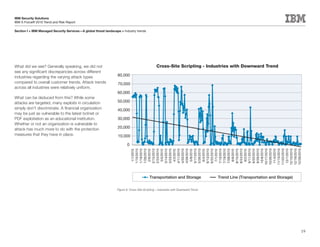
What did we see? Generally speaking, we did not                                                 Cross-Site Scripting - Industries with Downward Trend
see any significant discrepancies across different
industries regarding the varying attack types                     80,000
compared to overall customer trends. Attack trends                70,000
across all industries were relatively uniform.
                                                                  60,000
What can be deduced from this? While some
attacks are targeted, many exploits in circulation                50,000
simply don’t discriminate. A financial organization               40,000
may be just as vulnerable to the latest botnet or
PDF exploitation as an educational institution.                   30,000
Whether or not an organization is vulnerable to
attack has much more to do with the protection                    20,000
measures that they have in place.                                 10,000

                                                                         0


                                                                             10/17/2010
                                                                             10/26/2010

                                                                             11/13/2010
                                                                             11/22/2010

                                                                             12/10/2010
                                                                             12/19/2010
                                                                             12/28/2010
                                                                              1/10/2010
                                                                              1/19/2010
                                                                              1/28/2010

                                                                              2/15/2010
                                                                              2/24/2010

                                                                              3/14/2010
                                                                              3/23/2010

                                                                              4/11/2010
                                                                              4/20/2010
                                                                              4/29/2010

                                                                              5/17/2010
                                                                              5/26/2010

                                                                              6/13/2010
                                                                              6/22/2010

                                                                              7/10/2010
                                                                              7/19/2010
                                                                              7/28/2010

                                                                              8/15/2010
                                                                              8/24/2010

                                                                              9/11/2010
                                                                              9/20/2010
                                                                              9/29/2010
                                                                              10/8/2010


                                                                              11/4/2010


                                                                              12/1/2010
                                                                               1/1/2010


                                                                               2/6/2010


                                                                               3/5/2010


                                                                               4/2/2010


                                                                               5/8/2010


                                                                               6/4/2010


                                                                               7/1/2010


                                                                               8/6/2010


                                                                               9/2/2010
                                                                                           Transportation and Storage               Trend Line (Transportation and Storage)


                                                                  Figure 8: Cross-Site Scripting – Industries with Downward Trend


                                                                                                                                                                              19
IBM Security Solutions
IBM X-Force® 2010 Trend and Risk Report

Section I > IBM Managed Security Services—A global threat landscape > Industry trends


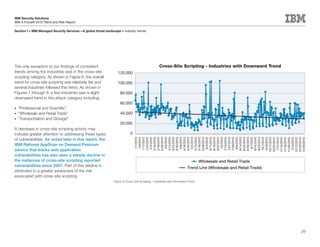
The only exception to our findings of consistent                                                   Cross-Site Scripting - Industries with Downward Trend
trends among the industries was in the cross-site                  120,000
scripting category. As shown in Figure 6, the overall
trend for cross-site scripting was relatively flat and             100,000
several industries followed this trend. As shown in
Figures 7 through 9, a few industries saw a slight                  80,000
downward trend in this attack category including:
                                                                    60,000
•	 “Professional and Scientific”
•	 “Wholesale and Retail Trade”                                     40,000
•	 “Transportation and Storage”
                                                                    20,000
A decrease in cross-site scripting activity may
indicate greater attention to addressing these types                        0
of vulnerabilities. As noted later in this report, the
                                                                                  1/1/2010
                                                                                  1/9/2010
                                                                                 1/17/2010
                                                                                 1/25/2010
                                                                                  2/2/2010
                                                                                 2/10/2010
                                                                                 2/18/2010
                                                                                 2/26/2010
                                                                                  3/6/2010
                                                                                 3/14/2010
                                                                                 3/22/2010
                                                                                 3/30/2010
                                                                                  4/8/2010
                                                                                 4/16/2010
                                                                                 4/24/2010
                                                                                  5/2/2010
                                                                                 5/10/2010
                                                                                 5/18/2010
                                                                                 5/26/2010
                                                                                  6/3/2010
                                                                                 6/11/2010
                                                                                 6/19/2010
                                                                                 6/27/2010
                                                                                  7/5/2010
                                                                                 7/13/2010
                                                                                 7/21/2010
                                                                                 7/29/2010
                                                                                  8/6/2010
                                                                                 8/14/2010
                                                                                 8/22/2010
                                                                                 8/30/2010
                                                                                  9/7/2010
                                                                                 9/15/2010
                                                                                 9/23/2010
                                                                                 10/1/2010
                                                                                 10/9/2010
                                                                                10/17/2010
                                                                                10/25/2010
                                                                                 11/2/2010
                                                                                11/10/2010
                                                                                11/18/2010
                                                                                11/26/2010
                                                                                 12/4/2010
                                                                                12/12/2010
                                                                                12/20/2010
                                                                                12/28/2010
IBM Rational AppScan on Demand Premium
service that tracks web application
vulnerabilities has also seen a steady decline in
the instances of cross-site scripting reported                                                                                    Wholesale and Retail Trade
vulnerabilities since 2007. Part of this decline is
                                                                                                                         Trend Line (Wholesale and Retail Trade)
attributed to a greater awareness of the risk
associated with cross-site scripting.
                                                                Figure 9: Cross-Site Scripting – Industries with Downward Trend


                                                                                                                                                                   20
IBM Security Solutions
IBM X-Force® 2010 Trend and Risk Report

Section I > Top high-volume signatures—IBM MSS


Top high-volume signatures—                                                             Rank                                       Event Name     Trend Line
IBM MSS
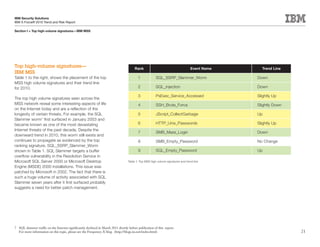
Table 1 to the right, shows the placement of the top                                      1             SQL_SSRP_Slammer_Worm                   Down
MSS high volume signatures and their trend line
for 2010.                                                                                 2             SQL_injection                           Down

                                                                                          3             PsExec_Service_Accessed                 Slightly Up
The top high volume signatures seen across the
MSS network reveal some interesting aspects of life                                       4             SSH_Brute_Force                         Slightly Down
on the Internet today and are a reflection of the
longevity of certain threats. For example, the SQL                                        5             JScript_CollectGarbage                  Up
Slammer worm7 first surfaced in January 2003 and
became known as one of the most devastating                                               6             HTTP_Unix_Passwords                     Slightly Up
Internet threats of the past decade. Despite the
                                                                                          7             SMB_Mass_Login                          Down
downward trend in 2010, this worm still exists and
continues to propagate as evidenced by the top                                            8             SMB_Empty_Password                      No Change
ranking signature, SQL_SSRP_Slammer_Worm
shown in Table 1. SQL Slammer targets a buffer                                            9             SQL_Empty_Password                      Up
overflow vulnerability in the Resolution Service in
Microsoft SQL Server 2000 or Microsoft Desktop                                     Table 1: Top MSS high volume signatures and trend line
Engine (MSDE) 2000 installations. This issue was
patched by Microsoft in 2002. The fact that there is
such a huge volume of activity associated with SQL
Slammer seven years after it first surfaced probably
suggests a need for better patch management.


7 SQL slammer traffic on the Internet significantly declined in March 2011 shortly before publication of this report.
  For more information on this topic, please see the Frequency-X blog. (http://blogs.iss.net/index.html)                                                        21
IBM Security Solutions
IBM X-Force® 2010 Trend and Risk Report

Section I > Top high-volume signatures—IBM MSS > Targeting SMB Servers


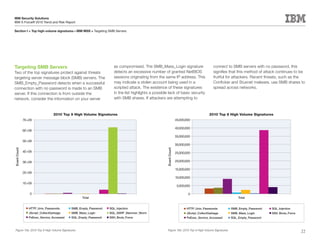
Targeting SMB Servers                                              as compromised. The SMB_Mass_Login signature                            connect to SMB servers with no password, this
Two of the top signatures protect against threats                  detects an excessive number of granted NetBIOS                          signifies that this method of attack continues to be
targeting server message block (SMB) servers. The                  sessions originating from the same IP address. This                     fruitful for attackers. Recent threats, such as the
SMB_Empty_Password detects when a successful                       may indicate a stolen account being used in a                           Conficker and Stuxnet malware, use SMB shares to
connection with no password is made to an SMB                      scripted attack. The existence of these signatures                      spread across networks.
server. If this connection is from outside the                     in the list highlights a possible lack of basic security
network, consider the information on your server                   with SMB shares. If attackers are attempting to


                                  2010 Top 9 High Volume Signatures                                                                     2010 Top 8 High Volume Signatures
              7E+09                                                                                               45,000,000

                                                                                                                  40,000,000
              6E+09
                                                                                                                  35,000,000
              5E+09
                                                                                                                  30,000,000
Event Count


                                                                                                    Event Count
              4E+09                                                                                               25,000,000

              3E+09                                                                                               20,000,000

                                                                                                                  15,000,000
              2E+09
                                                                                                                  10,000,000
              1E+09
                                                                                                                   5,000,000

                  0                                                                                                       0
                                                 Total                                                                                                   Total


                 HTTP_Unix_Passwords       SMB_Empty_Password   SQL_Injection                                            HTTP_Unix_Passwords         SMB_Empty_Password     SQL_Injection
                 JScript_CollectGarbage    SMB_Mass_Login       SQL_SSRP_Slammer_Worm                                    JScript_CollectGarbage      SMB_Mass_Login         SSH_Brute_Force
                 PsExec_Service_Accessed   SQL_Empty_Password   SSH_Brute_Force                                          PsExec_Service_Accessed     SQL_Empty_Password


Figure 10a: 2010 Top 9 High Volume Signatures                                                        Figure 10b: 2010 Top 8 High Volume Signatures
                                                                                                                                                                                              22
IBM Security Solutions
IBM X-Force® 2010 Trend and Risk Report

Section I > Top high-volume signatures—IBM MSS > SQL injection—high volume > PsExec—A remote administration tool > Brute force attacks & scans > JScript & UNIX


SQL injection—high volume                                       Brute force attacks & scans                                      The Darknet data in that mid-year report shows that
Our heuristic SQL signature had the second highest              SSH_Brute_Force is another interesting signature in              the level of SSH brute force scanning is steadily
volume seen in 2010. This is not surprising because             this list. A brute force attack involves an attacker             increasing while the MSS data shows that the level of
SQL injection attacks against web applications are              trying to gain unauthorized access to a system by                brute force attacks against active SSH servers is high.
very common. IBM MSS has observed a seasonal                    trying a large number of password possibilities. This
surge in SQL injection attacks during the months of             signature detects an excessive number of SSH                     JScript & UNIX
May through August for the past three years as                  Server Identifications from an SSH server within a               JScript_CollectGarbage detects the transfer of a
discussed in the section IBM Managed Security                   specified timeframe. Through this type of attack, a              JScript file containing a call to the function
Services—A global threat landscape. The other                   malicious individual may be able to view, copy, or               CollectGarbage(). CollectGarbage() is part of the
SQL signature noted in Table 1, SQL_Empty_                      delete important files on the accessed server or                 .NET framework but, according to Microsoft, “is not
Password, detects when a successful connection                  execute malicious code. Organizations can help                   intended to be used directly from your code.” This
with no password is made to an SQL server. As                   mitigate brute-force attacks by disabling direct                 function has been used by attackers and can be
with the SMB_Empty_Password signature, these                    access to root accounts and using strong                         indicative of malicious intent. However, it can also
types of connections should be considered                       usernames and passwords.                                         be used for legitimate purposes.
suspicious if made from outside the network.
                                                                We provided an in-depth view on this topic in the                Finally, the HTTP_Unix_Passwords signature
PsExec—A remote administration tool                             2010 Mid-Year Trend and Risk Report where we                     detects attempts to access the /etc/passwd file on
The signature in the third spot, PsExec_Service_                explain the nature of a Darknet. A Darknet is a                  UNIX systems via a web (HTTP) server. While this
Accessed, is notable in that PsExec is a legitimate             black-hole network whose addresses are not                       activity is sometimes authorized, it can sometimes
application. It is a command line based remote                  allocated to any active legitimate device or service on          be suspicious. This is a very old attack, but is still
administration tool. However, worms and advanced                the Internet. When an attacker attempts a brute-                 successful today.
threats also take advantage of PsExec. The “Here                force attack on a particular address in the Darknet
you have” worm, for instance, includes a PsExec                 they never connect to an SSH server because one
tool that allows it to copy itself onto other                   does not exist. Therefore, they stop after one
computers over the network. If this application is              attempt. Conversely, a successful SSH connection
used in your organization, you should ensure that               may result in thousands of brute force attempts
best security practices are employed.                           which explains the large volume of activity
                                                                associated with SSH_Brute_Force.


                                                                                                                                                                                     23
IBM Security Solutions
IBM X-Force® 2010 Trend and Risk Report

Section	I	>	Trending	in	the	dark—what	does	malicious	traffic	look	like?	>	Spoofed Denial of Service attacks


Trending in the dark—what does                                     addresses, the attacker makes it difficult for the                                                known as backscatter. If an attacker randomly
malicious traffic look like?                                       victim’s system to distinguish between the spoofed                                                selects an IP address in our darknet range, and the
As we discussed in the previous section, one of the                packets and legitimate packets from real users. The                                               victim responds, we’ll collect that response. By
many data resources that IBM security analysts use                 victim system will respond to a certain percentage                                                studying these responses we can learn things
to determine trending is the darknet, also known as                of these spoofed packets. These responses are                                                     about Denial of Service activity on the Internet.
a black-hole network. A darknet is a large range of
IP addresses on the Internet that have never had
                                                                                                                                                               Backscatter
any services running on them. Our darknet has an
aperture of 25,600 addresses. Generally speaking,                    50,000,000
there is no legitimate reason why computers on the                   45,000,000
Internet would send packets to addresses in this
range, but in fact they do. Often, traffic into this                 40,000,000
network is associated with malicious activity. This
                                                                     35,000,000
space is continuously monitored and all incoming
traffic is captured in its entirety and stored for                   30,000,000
analysis and long-term archiving.
                                                                     25,000,000
Spoofed Denial of Service attacks
                                                                     20,000,000
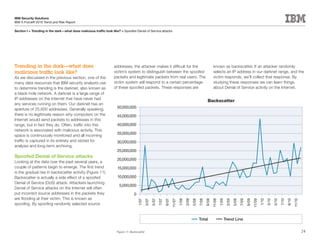
Looking at the data over the past several years, a
couple of patterns begin to emerge. The first trend                  15,000,000
is the gradual rise in backscatter activity (Figure 11).
Backscatter is actually a side effect of a spoofed                   10,000,000
Denial of Service (DoS) attack. Attackers launching
                                                                       5,000,000
Denial of Service attacks on the Internet will often
put incorrect source addresses in the packets they                                0
are flooding at their victim. This is known as


                                                                                                                                                                                                          9/09
                                                                                                                                                                                                                 11/09
                                                                                                                                                                                                                         1/10
                                                                                                                                                                                                                                3/10
                                                                                                                                                                                                                                       5/10
                                                                                                                                                                                                                                              7/10
                                                                                                                                                                                                                                                     9/10
                                                                                                                                                                                                                                                            11/10
                                                                                                                                                              9/08
                                                                                                                                                                     11/08
                                                                                                                                                                             1/09
                                                                                                                                                                                     3/09


                                                                                                                                                                                                   7/09
                                                                                      1/07
                                                                                              3/07
                                                                                                     5/07


                                                                                                                          11/07
                                                                                                                                  1/08
                                                                                                                                         3/08


                                                                                                                                                       7/08
                                                                                                            7/07
                                                                                                                   9/07


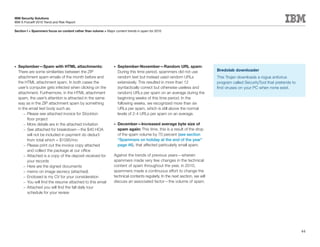
                                                                                                                                                                                            5/09
                                                                                                                                                5/08

spoofing. By spoofing randomly selected source


                                                                                                                                                       Total                        Trend Line


                                                                     Figure 11: Backscatter                                                                                                                                                                         24
IBM Security Solutions
IBM X-Force® 2010 Trend and Risk Report

Section	I	>	Trending	in	the	dark—what	does	malicious	traffic	look	like?	>	Spoofed Denial of Service attacks


In the X-Force darknet, each SYN-ACK backscatter                   since 2007. However, backscatter is subject to a       another group. This “shelling match” between
packet received is an indicator that an attacker sent              high degree of variability due to the nature of what   warring camps can result in a sudden increase in
a spoofed packet to a well-known service port on                   is being collected and what is occurring. Some         backscatter traffic and backscatter source
the machine under attack spoofed from one of                       intense periods of backscatter are the result of       addresses. It generally ceases as suddenly as it
X-Force darknet addresses. While there has been a                  internecine warfare within and between various         began. This type of activity most likely contributed
gradual increase in backscatter activity since 2007,               attacker camps. During this warfare, one group         to the dramatic spikes in February 2007 and
there was a large jump year-over-year between                      attempts to block or take over the resources of        December 2009 as shown in Figure 11 on page 24.
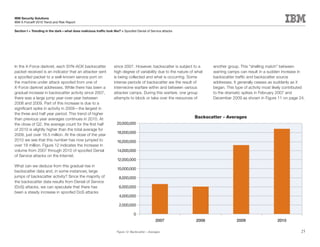
2008 and 2009. Part of this increase is due to a
significant spike in activity in 2009—the largest in
the three and half year period. This trend of higher
than previous year averages continues in 2010. At                                                                 Backscatter - Averages
the close of Q2, the average count for the first half                20,000,000
of 2010 is slightly higher than the total average for
                                                                     18,000,000
2009, just over 16.5 million. At the close of the year
2010 we see that this number has now jumped to                       16,000,000
over 18 million. Figure 12 indicates the increase in
volume from 2007 through 2010 of spoofed Denial                      14,000,000
of Service attacks on the Internet.
                                                                     12,000,000
What can we deduce from this gradual rise in
                                                                     10,000,000
backscatter data and, in some instances, large
jumps of backscatter activity? Since the majority of                  8,000,000
the backscatter data results from Denial of Service
(DoS) attacks, we can speculate that there has                        6,000,000
been a steady increase in spoofed DoS attacks
                                                                      4,000,000

                                                                      2,000,000

                                                                                 0
                                                                                                  2007             2008                2009                   2010

                                                                     Figure 12: Backscatter – Averages                                                                     25
IBM Security Solutions
IBM X-Force® 2010 Trend and Risk Report

Section	I	>	Trending	in	the	dark—what	does	malicious	traffic	look	like?	>	Targets of Denial of Service attacks


Targets of Denial of Service attacks                                                                                 Top Backscatter Generating Countries
The nature of a spoofed Denial of Service attack                              35,000,000
makes it difficult to determine the attacker. The
attacker fabricates origins for the connections to the                        30,000,000
victim’s IP address. These fabricated connections                             25,000,000
can in turn come from a multitude of different
machines. When looking at backscatter in the                                  20,000,000
X-Force darknet, it is clear that the origins of the
                                                                              15,000,000
attack are spoofed, but the target of the attack is
known. Examining the sources of the backscatter                               10,000,000
provides information on the targets of spoofed
                                                                               5,000,000
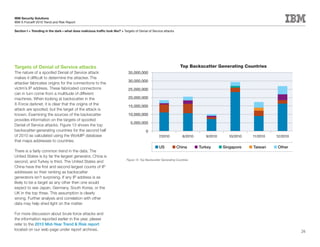
Denial of Service attacks. Figure 13 shows the top
backscatter-generating countries for the second half                                       0
of 2010 as calculated using the WorldIP database                                                     7/2010            8/2010      9/2010     10/2010   11/2010   12/2010
that maps addresses to countries.
                                                                                                     US            China        Turkey      Singapore   Taiwan    Other
There is a fairly common trend in the data. The
United States is by far the largest generator, China is
                                                                             Figure 13: Top Backscatter Generating Countries
second, and Turkey is third. The United States and
China have the first and second largest counts of IP
addresses so their ranking as backscatter
generators isn’t surprising. If any IP address is as
likely to be a target as any other then one would
expect to see Japan, Germany, South Korea, or the
UK in the top three. This assumption is clearly
wrong. Further analysis and correlation with other
data may help shed light on the matter.

For more discussion about brute force attacks and
the information reported earlier in the year, please
refer to the 2010 Mid-Year Trend & Risk report
located on our web page under report archives.                                                                                                                              26
IBM Security Solutions
IBM X-Force® 2010 Trend and Risk Report

Section	I	>	Worms	of	yesteryear:	Where	are	they	now?


Worms of yesteryear:                                     IBM’s Managed Security Service tracks the              Blaster appeared in August of 2003 and rapidly
Where are they now?                                      malicious activity seen on its customer’s networks     spread. This worm propagated by exploiting a
The ongoing war against the threat of computer           and thus affords a window into the activity of these   buffer overflow in the Remote Procedure Call (RPC)
worms is cyclic. A new invader appears, after the        worms of yesteryear. The following list gives an       interface and the Distributed Component Object
battles to contain the infection and the initial         overview of five of the most recent worms that         Model (DCOM) interface that had been patched a
outbreak appears won, it falls off the collective        spread entirely or partly by exploiting operating      month earlier. The worm payload would install an
radar as years pass and the next invaders appear.        system vulnerabilities. All of these worms targeted    auto-starting executable that would continue trying
                                                         software, usually operating systems, by Microsoft.     to propagate and trigger a Denial of Service against
Worms propagate by a number of methods such as                                                                  Microsoft’s update site at a specific time.
malicious email attachments, open or weakly              SQL Slammer first appeared in late January of
protected shares and network accessible software         2003, generating such a deluge of traffic that it      Sasser appeared at the end of August in 2004.
vulnerabilities. A number of prominent worms have        brought down numerous critical resources and           It propagated by exploiting a vulnerability in the
appeared over the last seven years but those that        noticeably slowed the Internet. Its single UDP         Local Security Authority Subsystem Service
spread via exploitation of network accessible            packet payload targeted a vulnerability in Microsoft   (LSASS), which is a process in Microsoft Windows
vulnerabilities tend to be the most virulent. They can   SQL Server that had been patched previously in         operating systems that is responsible for enforcing
spread across networks from machine to machine           July. The compromised host would then loop,            the security policy on the system. LSASS patched a
without a user interceding to view an email or open      spamming copies of itself to random IP addresses,      few weeks previously. Once infected, a machine
a file. The autonomous spreading of these worms          DoSing (Denial of Service) itself and sending out a    would download and install an auto-starting
can lead to high infection rates and frequently,         large amount of traffic.                               executable which would scan and attempt to infect
disastrous side effects occur of machines crashing                                                              other machines. The worm itself wasn’t malicious
from unreliable exploitation and potentially crippling                                                          but a side effect of its scanning caused crashes
network utilization for virulent worms.                                                                         and reboots in servers and desktops which had
                                                                                                                severe consequences for many companies.


                                                                                                                                                                  27
IBM Security Solutions
IBM X-Force® 2010 Trend and Risk Report

Section	I	>	Worms	of	yesteryear:	Where	are	they	now?


The Zotob worm appeared in mid-August of 2005.
It propagated by exploiting a buffer overflow in the            Year              Worm        Vulnerability        IBM Signature        MS Bulletin
Microsoft Plug and Play service that was patched
earlier in the month. A side effect of this propagation
was crashing and reboots of machines due to the                 2003         SQL Slammer     CVE-2002-0649       SQL_SSRP_StackBo       MS02-039
exploit. Infected machines would download and
install an executable to continue propagation and
                                                                2003              Blaster    CVE-2003-0352    MSRPC_RemoteActivate_Bo   MS03-026
install a backdoor to phone back to an Internet Relay
Chat (IRC) channel for further instructions.
                                                                2004              Sasser     CVE-2003-0533       MSRPC_LSASS_Bo         MS04-011
Conficker was detected in early November of 2008.
Propagation was via a vulnerability in the server service
of all supported Microsft operating systems at the              2005               Zotob     CVE-2005-1983        PlugAndPlay_BO        MS05-039
time. Later variants added additional vectors such as
weak SMB passwords and infection of USB devices.
Once compromised, the infected machine would                    2008            Conficker    CVE-2008-4250     MSRPC_Srvsvc_Path_Bo     MS08-067
attach itself to a botnet awaiting further commands.
Most variants of this worm also performed controlled
                                                            Table 2: Top Worms 2003 - 2008
scanning and infection of further hosts.


                                                                                                                                                      28
IBM Security Solutions
IBM X-Force® 2010 Trend and Risk Report

Section	I	>	Worms	of	yesteryear:	Where	are	they	now?


Figure 14 breaks down the alert activity by worm.                                                                         Worm Exploitation Averages 2010
For clarity, the alert associated with the worm                                            2,500,000
activity has been renamed for the worm. In most
cases this network activity is based on detected
exploitation by the worms but this is a tricky                                             2,000,000
endeavor for a number of reasons. For one, the
alert is not necessarily an indication of an attempted                                      1,500,000
propagation by a worm, alerts can be due to a
security audit or an exploitation attempt by
something else entirely. Another issue is that worms                                        1,000,000
have different propagation rates. Conficker
regulates its propagation in an attempt to avoid                                             500,000
overt detection while SQL Slammer can spam
hundreds of exploitation attempts a second. Due to
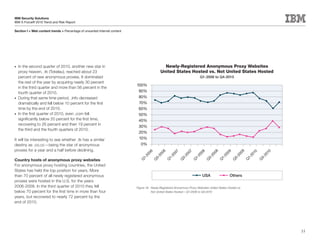
                                                                                                      0
the number of ways that Conficker variants can


                                                                                                             Jan

                                                                                                                    Feb

                                                                                                                           Mar

                                                                                                                                  April

                                                                                                                                          May

                                                                                                                                                June

                                                                                                                                                       July

                                                                                                                                                              Aug


                                                                                                                                                                            Oct

                                                                                                                                                                                  Nov

                                                                                                                                                                                         Dec
                                                                                                                                                                     Sept
spread, counts of peer to peer activity were used.

SQL Slammer8 has by far the largest number of
exploitation attempts. Even though seven years
have passed in which time to remediate the worm,                                                              SQL Slammer                   Conficker               Blaster             Sasser
it remains extremely noisy. The large dip in activity
between July and August is due to remediation in a
                                                                                           Figure 14: Worm Exploitation Averages 2010
single network. Ever afterwards, Slammer counts
overshadow all others.


8 SQL slammer traffic on the Internet significantly declined in March 2011 shortly before publication of this report.
  For more information on this topic, please see the Frequency-X blog. (http://blogs.iss.net/index.html)                                                                                         29
IBM Security Solutions
IBM X-Force® 2010 Trend and Risk Report

Section	I	>	Worms	of	yesteryear:	Where	are	they	now?


Figure 15 shows the same monthly averages with                                                 Non-Slammer Averages 2010
SQL Slammer removed. Conficker traffic is the next         200,000
highest. This is not surprising as it is the most
                                                           180,000
recent of the studied worms and also known to be
extremely widespread. There is a noticeable decline        160,000
in activity over the year, likely attributed to infected   140,000
nodes being cleaned or brought offline. Blaster and        120,000
Sasser are still showing activity while Zotob’s counts     100,000
were so low that it was removed from the figure. This
                                                            80,000
discrepancy may be due to the fact that Blaster and
Sasser would affect both Windows 2000 and XP                60,000
and they came at an earlier time while Zotob only           40,000
affected Windows 2000 and came out in 2005.                  20,000
                                                                   0
It is interesting to note, that the worms exploiting


                                                                           Jan

                                                                                  Feb

                                                                                         Mar

                                                                                                  April

                                                                                                          May

                                                                                                                June

                                                                                                                        July

                                                                                                                               Aug


                                                                                                                                            Oct

                                                                                                                                                  Nov

                                                                                                                                                        Dec
                                                                                                                                     Sept
vulnerabilities patched over seven years ago still
show noticeable activity. The activity for all the
worms is unlikely to grow significantly as any new
machine brought online should not be vulnerable to
the exploits they spread by. It seems inevitable that                                          Conficker               Blaster          Sasser
the activity from these worms will eventually die out
as old infected machines are replaced but they do          Figure 15: Non-Slammer Averages 2010
show a remarkable tenacity.

New worms will always be on the horizon. As the
latest invader is brought under control and gradually
driven out, it will likely never be fully ousted. There
will almost certainly be a few survivors holding out
in the dark corners of our networks.


                                                                                                                                                              30
IBM Security Solutions
IBM X-Force® 2010 Trend and Risk Report

Section I > Web content trends > Analysis methodology


Web content trends                                                     Table 3 below lists the IBM web filter categories that   Analysis methodology
This section summarizes the amount and distribution                    correspond with these types of sites.                    X-Force captures information about the distribution
of “bad” web content that is typically unwanted by                                                                              of content on the Internet by counting the hosts
businesses based on social principles and corporate                    This section provides analysis for:                      categorized in the IBM Security Solutions web filter
policy. Unwanted or “bad” Internet content is                          •	 Percent and distribution of web content that is       database. Counting hosts is a method for determining
associated with three types of websites: adult, social                    considered bad, unwanted, or undesirable              content distribution and generally provides a realistic
deviance, and criminal.                                                •	 Increase in the amount of anonymous proxies           assessment. Results may differ when using other
                                                                       •	 Malware URLs: Hosting countries and linkage           methodologies such as counting web pages and
The web filter categories are defined in detail at:                                                                             sub-pages.
http://www-935.ibm.com/services/us/index.
wss/detail/iss/a1029077?cntxt=a1027244                                                                                          The IBM Content data center constantly reviews and
                                                                                                                                analyzes new web content data. The IBM Content
                                                                                                                                data center analyzes 150 million new web pages and
    Website Type                                                Description & Web Filter Category                               images each month and has analyzed 14 billion web
 Adult                            Pornography                                                                                   pages and images since 1999!
                                  Erotic / Sex
 Social Deviance                  Political Extreme / Hate / Discrimination                                                     The IBM Web Filter Database has 68 filter categories
                                  Sects                                                                                         and 67 million entries with 150,000 new or updated
 Criminal                         Anonymous Proxies                                                                             entries added each day.
                                  Computer Crime / Hacking
                                  Illegal Activities
                                  Illegal Drugs
                                  Malware
                                  Violence / Extreme
                                  Warez / Software Piracy

Table 3: Web filter categories associated with unwanted web content


                                                                                                                                                                                    31
IBM Security Solutions
IBM X-Force® 2010 Trend and Risk Report

Section I > Web content trends > Percentage of unwanted Internet content


Percentage of unwanted Internet content                                                         Content Distribution of the Internet
Approximately seven percent of the Internet                                                                                   2010
currently contains unwanted content such as
pornographic or criminal websites.

Increase of anonymous proxies
As the Internet becomes a more integrated part of our
lives—not only at home, but at work and at school—
                                                                                                                                     Adult:   Criminal
organizations responsible for maintaining acceptable                                                                                          0.245%
                                                                                                                                     6.635%
environments increasingly find the need to control
where people can browse in these public settings.                            Other:
                                                                                                                                     0.248%
                                                                           93.117%

One such control is a content filtering system that
prevents access to unacceptable or inappropriate
websites. Some individuals attempt to use an
anonymous proxy (also known as web proxies) to
circumvent web filtering technologies.                                                                                                        Social
                                                                                                                                              Deviance
                                                                                                                                              0.003%


                                                                           Figure 16: Content Distribution of the Internet – 2010


                                                                                                                                                         32
IBM Security Solutions
IBM X-Force® 2010 Trend and Risk Report

Section I > Web content trends > Percentage of unwanted Internet content


Web proxies allow users to enter a URL on a web                                                      Volume Increases of Anonymous Proxy Websites
form instead of directly visiting the target website.                                                                            H2-2007 to H2-2010
Using the proxy hides the target URL from a web                      600%
filter. If the web filter is not set up to monitor or block
anonymous proxies, then this activity (which would                   500%
have normally been stopped) can bypass the filter
and allow the user to reach the disallowed website.                  400%

The growth in volume of anonymous proxy websites                     300%
reflects this trend.
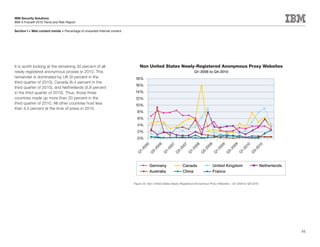
                                                                     200%
In the past three years, anonymous proxies have
                                                                     100%
steadily increased, more than quintupling in number.
Anonymous proxies are a critical type of website to
                                                                           0%
track, because of the ease at which proxies allow                                H2-2007            H1-2008           H2-2008           H1-2009       H2-2009   H1-2010   H2-2010
people to hide potentially malicious intent.
                                                                    Figure 17: Volume Increases of Anonymous Proxy Websites – H2-2007 to H2-2010


                                                                                                                                                                                    33
IBM Security Solutions
IBM X-Force® 2010 Trend and Risk Report

Section I > Web content trends > Percentage of unwanted Internet content


Top Level Domains of Anonymous Proxies                                          Top Level Domains of Newly-Registered Anonymous Proxy Websites
Figure 18 illustrates the Top Level Domains (TLDs)                                                                         Q1-2006 to Q4-2010
of the newly-registered anonymous proxies.
                                                                           70%

In 2006, more than 60 percent of all newly-                                60%
registered anonymous proxies were .com domains,
but since the middle of 2007, .info has been at the                        50%
top until the beginning of 2010 (while .com was
                                                                           40%
runner-up most of the time).
                                                                           30%
But why is .info no longer in the prime position? It
seemed to be a proven TLD for anonymous proxies                            20%
for years. A reason could be that .info, similar to .com,
                                                                            10%
is running out of names. Additionally, the question
arises why anonymous proxies are now provided on                             0%
.cc and .tk top level domains. These are the Domains


                                                                                             6


                                                                                                                                                               9
                                                                                                                                     8
                                                                                                                 07
of Cocos (Keeling) Islands (.cc), an Australian territory,
                                                                                 06


                                                                                                                                              09
                                                                                                                          08


                                                                                                                                                                                10
                                                                                                      07


                                                                                                                                                              10
                                                                                                                                     0


                                                                                                                                                         0
                                                                                             0


                                                                                                                                                                              20
                                                                                                              20


                                                                                                                                  20


                                                                                                                                                      20
                                                                                          20


                                                                                                                                                            20
                                                                                                    20


                                                                                                                         20


                                                                                                                                            20
                                                                               20


and Tokelau (.tk), a territory of New Zealand. Nearly all
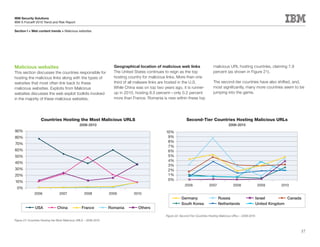


                                                                                                                                                                            3-
                                                                                                            3-


                                                                                                                                                          1-
                                                                                                                                3-


                                                                                                                                                    3-
                                                                                        3-


                                                                                                  1-


                                                                                                                       1-


                                                                                                                                          1-
                                                                             1-


                                                                                                                                                         Q
                                                                                                 Q


                                                                                                                                                                       Q
                                                                                                                      Q


                                                                                                                                         Q
                                                                            Q


                                                                                                           Q


                                                                                                                               Q


                                                                                                                                                   Q
                                                                                      Q


.cc anonymous proxy websites are registered on the
domain co.cc. It is free of charge to register a domain
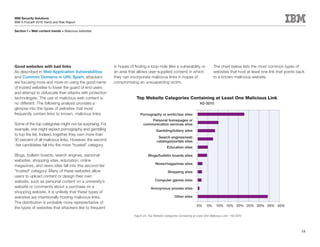
anything.co.cc (see http://www.co.cc/?lang=en).                                                   info                com                cn                net                 org
The same is true for .tk. (see http://www.dot.tk/).                                               li                  ch                 cc                tk
Thus, it is both cheap and attractive to install new
anonymous proxies on .co.cc or .tk.                                        Figure 18: Top Level Domains of Newly-Registered Anonymous Proxy Websites – Q1-2006 to Q4-2010


Additional trends:

•	   At the end of 2009, .cc (Cocos (Keeling) Islands)
     started to increase significantly and even reached
     the number one position in the second quarter of
     2010. Nevertheless .cc went out of vogue by the
     end of 2010.
                                                                                                                                                                                     34
IBM Security Solutions
IBM X-Force® 2010 Trend and Risk Report

Section I > Web content trends > Percentage of unwanted Internet content


•	 In the second quarter of 2010, another new star in                                         Newly-Registered Anonymous Proxy Websites
   proxy heaven, .tk (Tokelau), reached about 23                                            United States Hosted vs. Not United States Hosted
   percent of new anonymous proxies. It dominated                                                                        Q1-2006 to Q4-2010
   the rest of the year by acquiring nearly 30 percent
                                                                           100%
   in the third quarter and more than 56 percent in the
   fourth quarter of 2010.                                                  90%
•	 During that same time period, .info decreased                            80%
   dramatically and fell below 10 percent for the first                     70%
   time by the end of 2010.                                                 60%
•	 In the first quarter of 2010, even .com fell                             50%
   significantly below 20 percent for the first time,                       40%
   recovering to 26 percent and then 19 percent in
                                                                            30%
   the third and the fourth quarters of 2010.
                                                                            20%
It will be interesting to see whether .tk has a similar                     10%
destiny as .co.cc—being the star of anonymous                                0%
proxies for a year and a half before declining.


                                                                                            6


                                                                                                                   08


                                                                                                                   09
                                                                                                                   07
                                                                                  06


                                                                                                                  09
                                                                                                                  08


                                                                                                                   10
                                                                                                     07


                                                                                                                  10
                                                                                            0


                                                                                                                20
                                                                                                                20


                                                                                                                20


                                                                                                                20
                                                                                         20


                                                                                                                20
                                                                                                   20


                                                                                                               20


                                                                                                               20
                                                                                20


                                                                                                             3-
                                                                                                             3-


                                                                                                             1-
                                                                                                             3-


                                                                                                             3-
                                                                                       3-


                                                                                                 1-


                                                                                                             1-


                                                                                                             1-
                                                                              1-


Country hosts of anonymous proxy websites


                                                                                                           Q
                                                                                                Q


                                                                                                           Q
                                                                                                           Q


                                                                                                           Q
                                                                             Q


                                                                                                          Q


                                                                                                           Q


                                                                                                           Q
                                                                                      Q


For anonymous proxy hosting countries, the United
States has held the top position for years. More
than 70 percent of all newly registered anonymous                                                                          USA                 Others
proxies were hosted in the U.S. for the years
2006-2009. In the third quarter of 2010 they fell                          Figure 19: Newly-Registered Anonymous Proxy Websites United States Hosted vs.
below 70 percent for the first time in more than four                                 Not United States Hosted – Q1-2006 to Q4-2010
years, but recovered to nearly 72 percent by the
end of 2010.


                                                                                                                                                           35
IBM Security Solutions
IBM X-Force® 2010 Trend and Risk Report

Section I > Web content trends > Percentage of unwanted Internet content


It is worth looking at the remaining 30 percent of all                         Non United States Newly-Registered Anonymous Proxy Websites
newly registered anonymous proxies in 2010. This                                                                       Q1-2006 to Q4-2010
remainder is dominated by UK (9 percent in the                              18%
third quarter of 2010), Canada (6.4 percent in the
                                                                            16%
third quarter of 2010), and Netherlands (5.8 percent
in the third quarter of 2010). Thus, those three                            14%
countries made up more than 20 percent in the                               12%
third quarter of 2010. All other countries host less                        10%
than 4.5 percent at the time of press in 2010.
                                                                             8%
                                                                             6%
                                                                             4%
                                                                             2%
                                                                             0%


                                                                                            6


                                                                                                                 09
                                                                                                                 08
                                                                                                                 07
                                                                                 06


                                                                                                                09
                                                                                                                08


                                                                                                                 10
                                                                                                    07


                                                                                                                10
                                                                                            0


                                                                                                              20
                                                                                                              20


                                                                                                              20


                                                                                                              20
                                                                                         20


                                                                                                              20
                                                                                                   20


                                                                                                             20


                                                                                                             20
                                                                               20


                                                                                                           3-
                                                                                                           3-


                                                                                                           1-
                                                                                                           3-


                                                                                                           3-
                                                                                       3-


                                                                                                 1-


                                                                                                           1-


                                                                                                           1-
                                                                             1-


                                                                                                         Q
                                                                                                Q


                                                                                                         Q
                                                                                                         Q


                                                                                                         Q
                                                                            Q


                                                                                                        Q


                                                                                                         Q


                                                                                                         Q
                                                                                     Q


                                                                                      Germany                 Canada                United Kingdom                       Netherlands
                                                                                      Australia               China                 France

                                                                           Figure 20: Non United States Newly-Registered Anonymous Proxy Websites – Q1-2006 to Q4-2010


                                                                                                                                                                                       36
IBM Security Solutions
IBM X-Force® 2010 Trend and Risk Report

Section I > Web content trends > Malicious websites


Malicious websites                                                   Geographical location of malicious web links                    malicious URL hosting countries, claiming 7.9
This section discusses the countries responsible for                 The United States continues to reign as the top                 percent (as shown in Figure 21).
hosting the malicious links along with the types of                  hosting country for malicious links. More than one
websites that most often link back to these                          third of all malware links are hosted in the U.S.               The second-tier countries have also shifted, and,
malicious websites. Exploits from Malicious                          While China was on top two years ago, it is runner-             most significantly, many more countries seem to be
websites discusses the web exploit toolkits involved                 up in 2010, hosting 8.5 percent—only 0.2 percent                jumping into the game.
in the majority of these malicious websites.                         more than France. Romania is new within these top


                   Countries Hosting the Most Malicious URLS                                                     Second-Tier Countries Hosting Malicious URLs
                                                2006-2010                                                                                        2006-2010
90%                                                                                               10%
80%                                                                                                9%
                                                                                                   8%
70%
                                                                                                   7%
60%                                                                                                6%
50%                                                                                                5%
                                                                                                   4%
40%
                                                                                                   3%
30%                                                                                                2%
20%                                                                                                1%
                                                                                                   0%
10%
                                                                                                                2006              2007              2008                2009       2010
 0%
               2006              2007               2008           2009         2010
                                                                                                             Germany                     Russia                         Israel         Canada
                                                                                                             South Korea                 Netherlands                    United Kingdom
               USA              China             France           Romania        Others

                                                                                                  Figure 22: Second-Tier Countries Hosting Malicious URLs – 2006-2010
Figure 21: Countries Hosting the Most Malicious URLS – 2006-2010


                                                                                                                                                                                            37
IBM Security Solutions
IBM X-Force® 2010 Trend and Risk Report

Section I > Web content trends > Malicious websites


Good websites with bad links                              in hopes of finding a loop-hole (like a vulnerability or                The chart below lists the most common types of
As described in Web Application Vulnerabilities           an area that allows user-supplied content) in which                     websites that host at least one link that points back
and Common Domains in URL Spam, attackers                 they can incorporate malicious links in hopes of                        to a known malicious website.
are focusing more and more on using the good name         compromising an unsuspecting victim.
of trusted websites to lower the guard of end users
and attempt to obfuscate their attacks with protection
technologies. The use of malicious web content is                      Top Website Categories Containing at Least One Malicious Link
no different. The following analysis provides a                                                                         H2-2010
glimpse into the types of websites that most
frequently contain links to known, malicious links.                       Pornography or erotic/sex sites
                                                                                Personal homepages or
Some of the top categories might not be surprising. For                     communication services sites
example, one might expect pornography and gambling                                    Gambling/lottery sites
to top the list. Indeed, together they own more than
                                                                                        Search engines/web
30 percent of all malicious links. However, the second                                 catalogs/portals sites
-tier candidates fall into the more “trusted” category.
                                                                                              Education sites

Blogs, bulletin boards, search engines, personal                                Blogs/bulletin boards sites
websites, shopping sites, education, online
                                                                                      News/magazines sites
magazines, and news sites fall into this second-tier
“trusted” category. Many of these websites allow                                               Shopping sites
users to upload content or design their own
website, such as personal content on a university’s                                  Computer games sites
website or comments about a purchase on a                                         Anonymous proxies sites
shopping website. It is unlikely that these types of
websites are intentionally hosting malicious links.                                                 Other sites
The distribution is probably more representative of
                                                                                                                     0%      5%     10% 15% 20% 25% 30% 35% 40%
the types of websites that attackers like to frequent
                                                                      Figure 23: Top Website Categories Containing at Least One Malicious Link – H2-2010


                                                                                                                                                                                     38
IBM Security Solutions
IBM X-Force® 2010 Trend and Risk Report

Section I > Web content trends > Malicious websites


When comparing this data with the data of the            Top Website Categories Containing at Least One Malicious Link:
previous years, interesting trends appear.                               Types of Sites on the Incline
Particularly in the first half of 2010, professional                                               H1-2009 to H2-2010
“bad” websites like pornography or gambling
                                                        35%
websites have increased their links to malware,
making it appear more likely that “professionals” are   30%
improving their efforts to systematically distribute    25%
their malware. However, in the second term of 2010
they declined again, but both end in a percentage       20%
above the levels of 2009.                               15%

Educational sites such as university websites have      10%
also seen increases in malware links since 2009.          5%
The same is true for Blogs and bulletin boards until
mid-2010. Then they significantly decreased and fell      0%
below 5 percent for the first time in more than a                       H1-2009                H2-2009                H1-2010                H2-2010
year. Moreover, we noticed increases for computer
games and anonymous proxy sites, but on a                               Pornography or                                     Computer games sites
lesser level.                                                           erotic/sex sites                                   Anonymous proxies sites
                                                                        Blogs/bulletin boards sites                        Education sites
The only major category that did not decrease
                                                                        Gambling/lottery sites
significantly in the second half of 2010 was
gambling sites.
                                                        Figure 24: Top Website Categories Containing at Least One Malicious Link: Types of Sites on
                                                                   the Incline – H1-2009 to H2-2010


                                                                                                                                                       39
IBM Security Solutions
IBM X-Force® 2010 Trend and Risk Report

Section I > Web content trends > Malicious websites


Personal homepages are no longer the most                 Top Website Categories Containing at Least One Malicious Link:
prevalent category that host at least one malicious                       Types of Sites on the Decline
link. Personal homepages have improved—they                                                         H1-2009 to H2-2010
now host less malicious links—compared to the
first half of 2009. One reason may be that personal      60%
homepages are more out of style in favor of web
2.0 applications such as profiles in social or           50%
business networks. Search engines, portals,
shopping sites, and news sites have also improved        40%
or stayed on a low level. These traditional legitimate
interactive sites have been used to exchange             30%
information and opinions for years. Thus, it is likely
that providers of those services have increased their    20%
efforts in IT security.
                                                         10%

                                                           0%
                                                                         H1-2009                H2-2009                H1-2010                H2-2010


                                                                         Personal homepages or                                  Shopping sites
                                                                         communication services sites                           News/magazines sites
                                                                         Search Engines/
                                                                         web/catalogs/portals sites

                                                         Figure 25: Top Website Categories Containing at Least One Malicious Link: Types of Sites on
                                                                    the Decline – H1-2009 to H2-2010


                                                                                                                                                        40
IBM Security Solutions
IBM X-Force® 2010 Trend and Risk Report

Section I > Web content trends > Malicious websites


Until now we have not consider the number of                Top Website Categories Containing Ten or More Malicious Links
malicious links placed on a website. The difference                                                         H2-2010
might be:
                                                           Pornography or erotic/sex sites
•	 When hosting only one or two malicious links on a
   site, the owner of the site might not understand or
                                                                        Gambling/lottery sites
   know that the link is bad – there is no ill intent.
•	 When placing ten or more links on a site, then this
                                                                          Search engines/web
   is done systematically and intentionally to get
                                                                         catalogs/portals sites
   visitors clicking on bad links. The goal of the owner
   might be to enjoy a financial advantage from the
                                                                 Personal homepages or
   compromises.                                              communication services sites

Out of the categories of websites that host 10 or
                                                                 Blogs/bulletin boards sites
more of these links, pornography accounts for
nearly 30 percent and gambling accounts for nearly
                                                                    Anonymous proxies sites
29 percent.
                                                                        News/magazines sites
Compared to the data six months ago, the values in
most categories have stayed flat or slightly
                                                                       Computer games sites
decreased but gambling increased by nearly one
percent. Against the background of 0.6 percent of
                                                                                 Education sites
the adult population having problem gambling
issues (see http://en.wikipedia.org/wiki/
                                                                                  Shopping sites
Gambling_addiction#Prevalence), gambling sites
are a popular target for malware distributors. Note
                                                                                        Other sites
also that Personal Homepages and Communication
Services increased by 1.7 percent and Educational
                                                                                                        0%      5%      10%      15%      20%   25%   30%   35%
sites increased by 0.6 percent.
                                                           Figure 26: Top Website Categories Containing Ten or More Malicious Links – H2-2010


                                                                                                                                                                  41
IBM Security Solutions
IBM X-Force® 2010 Trend and Risk Report

Section I > Spammers focus on content rather than volume > Major content trends in spam for 2010


Spammers focus on content rather                                        Major content trends in spam for 2010                                                in technical spam content was the constant level of
than volume                                                             After the last major threats of image-based and PDF                                  HTML-based spam (in most cases a bit more than 80
The IBM spam and URL filter database provides a                         spam in 2007, we did not see major changes in the                                    percent) and plain-text spam (mostly 10-15 percent).
world-encompassing view of spam and phishing                            content of the spams in 2008 and 2009, apart from
attacks. With millions of email addresses being                         another short-period threat of image spams in the first                              In 2010 there were major changes in the technical
actively monitored, the content team has identified                     term of 2009. One characteristic for the low changes                                 content of spam. To see these trends at a glance,
numerous advances in the spam and phishing                                                                                                                   see Figure 27.
technologies attackers use.
                                                                                                                                           Major Content Trends in Spam
Currently, the spam filter database contains more                                                                                                    2010 per week
than 40 million relevant spam signatures. Each                                                                        14                                                                         6%
piece of spam is broken into several logical parts
(sentences, paragraphs, etc.). A unique 128-bit                                                                       12
                                                                                   Kilobyte/Number of URLs per Spam                                                                              5%
signature is computed for each part and for millions
of spam URLs. Each day there are approximately                                                                        10
one million new, updated, or deleted signatures for                                                                                                                                              4%
the spam filter database.                                                                                             8
                                                                                                                                                                                                 3%
This section addresses the following topics:                                                                          6

•	 Major content trends in spam 2010                                                                                                                                                             2%
                                                                                                                      4
•	 Most popular domains and top level domains used
   in spam                                                                                                            2                                                                          1%
•	 Spam country9 of origin trends, including spam
   web pages (URLs)                                                                                                   0                                                                          0%
•	 Most popular subject lines of spam


                                                                                                                                             49
                                                                                                                                             29
                                                                                                                           1


                                                                                                                                               9


                                                                                                                                             33


                                                                                                                                             45
                                                                                                                                 5


                                                                                                                                              13

                                                                                                                                              17

                                                                                                                                             21


                                                                                                                                             37

                                                                                                                                              41
                                                                                                                                             25
                                                                                                                           k

                                                                                                                                k

                                                                                                                                             k


                                                                                                                                           k


                                                                                                                                           k
                                                                                                                                           k
                                                                                                                       ee

                                                                                                                                ee

                                                                                                                                      ee


                                                                                                                                           k


                                                                                                                                           k
                                                                                                                                           k

                                                                                                                                          k


                                                                                                                                          k
                                                                                                                                          k
                                                                                                                                          k
                                                                                                                                        ee


                                                                                                                                        ee
                                                                                                                                        ee


                                                                                                                                        ee


                                                                                                                                        ee
                                                                                                                                        ee

                                                                                                                                       ee


                                                                                                                                       ee
                                                                                                                                       ee


                                                                                                                                       ee
                                                                                                                      W

                                                                                                                               W

                                                                                                                                     W


                                                                                                                                      W


                                                                                                                                      W
                                                                                                                                      W


                                                                                                                                      W


                                                                                                                                      W
                                                                                                                                      W

                                                                                                                                      W


                                                                                                                                      W
                                                                                                                                      W


                                                                                                                                      W
9 The statistics in this report for spam, phishing, and URLs use
  the IP-to-Country Database provided by WebHosting.Info
  (http://www.webhosting.info), available from http://ip-to-                                                               Average byte size of spam              Percentage ZIP spam
  country.webhosting.info. The geographical distribution was                                                               Average number of URLs per spam        Percentage HTML attachment spam
  determined by requesting the IP addresses of the hosts (in the
  case of the content distribution) or of the sending mail server (in
  the case of spam and phishing) to the IP-to-Country Database.                      Figure 27: Major Content Trends in Spam – 2010 per week                                                                   42
IBM Security Solutions
IBM X-Force® 2010 Trend and Risk Report

Section I > Spammers focus on content rather than volume > Major content trends in spam for 2010


Let’s have a closer look at the trends and the                   •	   August—Spam with malicious ZIP attachments:
characteristics:                                                      At the beginning of August, spammers began         Zeus Trojan
                                                                      sending spam threats with ZIP attachments. We      Zeus is a very common Trojan that’s generated
•	   March-August: Random text spam combined                          looked into these messages, and each ZIP file      with a kit that anyone can purchase online.
     with random URLs, significantly increased the                    contained a single EXE file that was malicious.    There are many different individuals and groups
     average byte size of spam. In previous years the                 Spammers used different kinds of malware, e.g.     that have Zeus botnets set up. There are a lot
     average byte size of spam was directly dependent                 variants of the Zeus Trojan or a copy of the       of ways it gets spread, but the operators of this
     on the percentage of image-based spam. But in                    Bredolab downloader (see sidebars). More details   particular botnet are growing it by sending out
     2010 the percentage of image spam was flat and                   on these spam threats with ZIP attachments can     emails with ZIP file attachments. The goal of
     below two percent (in most cases below one                       be found at http://blogs.iss.net/archive/          Zeus botnets is usually to steal personal
     percent). When looking at these larger spams one                 ZIPMalwareSpam.html. IBM Proventia customers       information, and the type of information stolen
     can see large text fragments randomly chosen                     can use the Email_Zip_Executable_Content           is commonly online banking data that criminals
     from the Internet, complemented by random URLs                   signature to detect threats like these. The        can use to access bank accounts to transfer
     (syntactically correct URLs build from random                    spammers used typical methods to attract the       money. For more information about the Zeus
     characters or words, but many of them do not                     user’s attention by using subjects such as:        botnet see Trojan Bot networks in the section
     exist in the Internet). Random text is a very old                   – Your Flight Ticket                            “IBM Managed Security Services—
     technique of the spammers to make spam look                         – Financial Summary                             A global threat landscape”.
     more legitimate. However, recent anti-spam                          – Statement Notification
     techniques do not have any problems with it. So                     – Financials
     why did spammers re-activate this old approach?                     – FW: Car & Car loan
     Maybe they hoped that those masses of text                          – Employee Orientation report
     would confuse Bayesian classifiers, particularly
     self-trained Bayesian classifiers, which are used
     in a non-business context; hence, these spam
     attacks might be targeted to these
     non-business users.


                                                                                                                                                                             43
IBM Security Solutions
IBM X-Force® 2010 Trend and Risk Report

Section I > Spammers focus on content rather than volume > Major content trends in spam for 2010


•	   September—Spam with HTML attachments:                       •	   September-November—Random URL spam:
     There are some similarities between the ZIP                      During this time period, spammers did not use           Bredolab downloader
     attachment spam emails of the month before and                   random text but instead used random URLs                This Trojan downloads a rogue antivirus
     the HTML attachment spam. In both cases the                      extensively. This resulted in more than 12              program called SecurityTool that pretends to
     user’s computer gets infected when clicking on the               (syntactically correct but otherwise useless and        find viruses on your PC when none exist.
     attachment. Furthermore, in the HTML attachment                  random) URLs per spam on an average during the
     spam, the user’s attention is attracted in the same              beginning weeks of this time period. In the
     way as in the ZIP attachment spam by something                   following weeks, we recognized more than six
     in the email text body such as:                                  URLs per spam, which is still above the normal
         – Please see attached invoice for Stockton                   levels of 2-4 URLs per spam on an average.
           floor project
         – More details are in the attached invitation           •	   December—Increased average byte size of
         – See attached for breakdown—the $40 HOA                     spam again: This time, this is a result of the drop
           will not be included in payment do deduct                  of the spam volume by 70 percent (see section
           from total which = $1095/mo                                “Spammers on holiday at the end of the year”
         – Please print out the invoice copy attached                 page 46), that affected particularly small spam.
           and collect the package at our office
         – Attached is a copy of the deposit received for        Against the trends of previous years—wherein
           your records                                          spammers made very few changes in the technical
         – Here are the signed documents                         content of spam throughout the year, in 2010,
         – memo on image secrecy (attached)                      spammers made a continuous effort to change the
         – Enclosed is my CV for your consideration              technical contents regularly. In the next section, we will
         – You will find the resume attached to this email       discuss an associated factor—the volume of spam.
         – Attached you will find the fall daily tour
           schedule for your review


                                                                                                                                                                             44
IBM Security Solutions
IBM X-Force® 2010 Trend and Risk Report

Section I > Spammers focus on content rather than volume > Spam volume > Conclusions about spam volume and content


Spam volume                                                          – the growth of Backscatter Activity in 2010 -                                 •	 Are the new operating systems more secure and
While we recognized significant increases of the spam                  see section “Spoofed Denial of                                                  prevent a further increase of the levels?
volume year over year until 2009, in 2010 there were a                 Service attacks”                                                             •	 Do even “spamming companies” suffer from the war

few months with ups and downs in the volume of                       – the rise of the Vulnerability Disclosures in                                    for talent, hence, they have recruitment problems?
spam seen over the year. However, the overall trends                   2010 - see section “2010 - A record
stayed flat, and we saw less volume at the end of the                  setting year”                                                                It is very unlikely that the spam business has become
year in comparison to the beginning of 2010.                  •	 Is the increase of spam messages only achieved                                     unprofitable. One scenario could be that spam volume
                                                                 within internal social network messaging systems                                   stays flat but the kinds of spam change more
Conclusions about spam                                           and other Web 2.0 applications?                                                    frequently to circumvent spam filters with new types of
                                                              •	 Are spammers cautious in efforts with increasing the                               spam that are more difficult to detect.
volume and content
Why are spammers making an effort to change the                  levels too much because the more similar spam
                                                                 messages they produce, the easier they can be                                      Maybe there will be more experiments with other
technical content of spam more often than in previous
                                                                 detected and blocked by perfected spam filters?                                    attachment types? We tallied the most popular file
years but are no longer focusing on increasing the
                                                                 That would mean, they assume that they have                                        types, and there is one file type becoming more and
overall volume of spam? Here we ponder a few
                                                                 reached an optimum concerning the spam volume.                                     more popular – Open Office documents. When do
presumptions about these possible trends. Some
                                                                                                                                                    spammers use those attachments?
trends might be more plausible than others.

•	 Perhaps in recent years there was a linear connection                                                                       Changes in Spam Volume
   between the number of spam messages and the                                                                                   April 2008 to December 2010

   profit reached by spam. Is this connection lost?                               250%
•	 Is the spam market saturated? Will we even see a
                                                                                  200%
   decrease of spam volume in the upcoming years?
•	 Since there is only one single point to combat
                                                                                  150%
   current spam - when receiving them - for the
   companies (or the users), did the bad guys change                              100%
   their focus to other - more distributed - areas that
   are more complicated to take countermeasures?                                   50%
   This assumption is strengthened by:
                                                                                    0%
       – the increase of Botnet Trojan Activity in 2010 -
          see section “Trojan Bot networks”
                                                                                        8

                                                                                              8

                                                                                                     8

                                                                                                             8

                                                                                                                    8

                                                                                                                          9

                                                                                                                                 9

                                                                                                                                        9

                                                                                                                                               9

                                                                                                                                                         9

                                                                                                                                                                       9

                                                                                                                                                                      10

                                                                                                                                                                      10

                                                                                                                                                                      10


                                                                                                                                                                10 0

                                                                                                                                                                12 0

                                                                                                                                                                       0
                                                                                                                                                                      1

                                                                                                                                                                     01

                                                                                                                                                                     01
                                                                                        0

                                                                                               0

                                                                                                      0

                                                                                                             0

                                                                                                                    0

                                                                                                                           0

                                                                                                                                  0

                                                                                                                                         0

                                                                                                                                                0

                                                                                                                                                       0

                                                                                                                                                                0
                                                                                                                                                                    20

                                                                                                                                                                    20

                                                                                                                                                                    20

                                                                                                                                                                    20
                                                                                     20

                                                                                            20

                                                                                                   20

                                                                                                          20

                                                                                                                 20

                                                                                                                        20

                                                                                                                               20

                                                                                                                                      20

                                                                                                                                             20

                                                                                                                                                    20

                                                                                                                                                             20


                                                                                                                                                                  /2

                                                                                                                                                                  /2
                                                                                                                                                                2/

                                                                                                                                                                 4/

                                                                                                                                                                 6/

                                                                                                                                                                 8/
                                                                                   4/

                                                                                         6/

                                                                                               8/


                                                                                                         /

                                                                                                                /

                                                                                                                    2/

                                                                                                                           4/

                                                                                                                                  6/

                                                                                                                                         8/

                                                                                                                                                  /

                                                                                                                                                            /
       – the surge of Obfuscation Activity in 2010 -
                                                                                                             12


                                                                                                                                                         12
                                                                                                      10


                                                                                                                                               10


          see section “Obfuscation”                                                Figure 28: Changes in Spam Volume – April 2008 to December 2010                                                        45
IBM Security Solutions
IBM X-Force® 2010 Trend and Risk Report

Section I > Spammers focus on content rather than volume > Spammers on holiday at the end of the year


Spammers on holiday at                                                                                                   Spam Volume per Day
the end of the year                                                                                             December 9th, 2010 until January 11th, 2011
One week before year’s end, spammers surprised us                        160%
by sending out 70 percent less spam than the weeks
                                                                         140%
before; this period lasted about two and a half weeks.
After the Christmas holiday season, spam levels                           120%
returned to the same level as before Christmas.                          100%

When looking at the reductions of the spam volume                          80%
per country there were some countries, such the                            60%
U.S., Canada, and UK, with a decline of more than
90 percent. More about the declines per country                            40%
and some more details can be found on http://                              20%
blogs.iss.net/archive/2011spambotdecline.html.
                                                                            0%        10

                                                                                       0

                                                                                      10

                                                                                      10

                                                                                       0

                                                                              /2 10

                                                                                       0

                                                                              /2 10

                                                                                       0

                                                                              /2 10

                                                                                       0

                                                                              1/ 10

                                                                              1/ 11

                                                                              1/ 11

                                                                              1/ 11

                                                                            1/ 011

                                                                                       1
                                                                                     01
                                                                           12 201


                                                                           12 201


                                                                           12 201


                                                                           12 201


                                                                           12 201


                                                                                    20

                                                                                    20

                                                                                    20
                                                                                    20


                                                                                    20

                                                                                    20


                                                                                    20


                                                                                    20


                                                                                    20


                                                                                    20


                                                                                    2

                                                                                   /2
                                                                                 2/

                                                                                 4/

                                                                                 6/

                                                                                 8/
                                                                                 1/

                                                                                 3/

                                                                                 5/

                                                                                 7/

                                                                                 9/

                                                                                 1/

                                                                                 3/

                                                                                 5/

                                                                                 7/

                                                                                 9/

                                                                                 1/
                                                                                 9/


                                                                                10
                                                                               /1


                                                                               /1


                                                                              /3
                                                                              /2
                                                                              /1
                                                                              /1


                                                                              /1


                                                                              /2
                                                                            /
                                                                         12

                                                                           12


                                                                           12
                                                                           12


                                                                           12


                                                                           12


                                                                           12
                                                                         Figure 29: Spam Volume per Day – December 9th, 2010 until January 11th, 2011


                                                                                                                                                              46
IBM Security Solutions
IBM X-Force® 2010 Trend and Risk Report

Section I > Spammers focus on content rather than volume > Regional spam volume per day of the week


Regional spam volume                                           days; on Saturday and Sunday, they only send out                        Assuming that spammers prefer not to work
per day of the week                                            about five percent each day. Their strongest days are                   weekends, it appears that spam in the English,
Another approach for looking at the spam volume is             Tuesday, Wednesday, and Thursday, when they                             French, and Spanish languages is sent out
checking the spam volume per day of the week. If               process about 20 percent of their weekly amount                         completely automatically, retaining its typical volume
we received equal volumes each day, then we                    each day. The patterns are similar for Portuguese                       on weekends. Contrarily, Russian and Portuguese
would receive 14.3 percent of the weekly spam                  spam. Their strongest days are Tuesday to Thursday,                     spam requires more manual work, resulting in a
volume per day. When looking at spam written in                and their weakest days are Saturday and Sunday.                         significant drop at the weekends.
English, French, or Spanish, this appears more or
less the case.
                                                                                   English, French, Spanish, Russian, and Portuguese Spam Volume
English spam is distributed very consistently over                                                                       2010 per Day of the Week
the week days. The days with the least amount of                            25%
spam are Wednesday (14.0 percent) and Sunday
(13.7 percent); the days of the week with the most
spam are Tuesday (14.7 percent) and Friday (14.8                            20%
percent). The most French spam is received on
Thursday (15.7 percent) and Friday (15.8 percent).
The greatest spam day of the week for Spanish                               15%
spam is Monday, when they process 18 percent of
the weekly amount of their spam. However, the
                                                                            10%
difference between the other week day amounts for
French and Spanish is rather low.
                                                                             5%
The situation is different for Russian and Portuguese
spam. On weekends, we receive much less spam
written in these two languages. Almost 90 percent of                         0%
spam in the Russian language is sent out on week                                      Monday         Tuesday      Wednesday Thursday                Friday       Saturday        Sunday


                                                                                           English            French             Spanish             Russian             Portuguese


                                                                           Figure 30: English, French, Spanish, Russian, and Portuguese Spam Volume – 2010 per Day of the Week            47
IBM Security Solutions
IBM X-Force® 2010 Trend and Risk Report

Section I > Spammers focus on content rather than volume > Common domains in URL spam


Common domains in URL spam                                   •	 Internet service providers (blue): Used by              •	 Official	websites	of	Pfizer	and	Rolex	(yellow):
The vast majority of spam, more than 90 percent, is             spammers in recent years to make look their                From September 2010 on, spammers used the
still classified as URL spam—spam messages that                 spams appear trustworthy.                                  official websites of Pfizer (pfizer.com,
include URLs that a person clicks to view the spam           •	 Image-hosting websites (green): Also used by               pfizerhelpfulanswers.com, viagra.com) and Rolex
contents. It is worthwhile to take a closer look at             spammers for several years. Spammers like to vary          (rolex.com). Obviously, spammers include in their
the most frequently used domain names in URL                    between well known image-hosters like flickr.com           strategies that most spam filters do not use simple
spam. The table on the following page shows the                 and imageshack.us and many other small and                 keyword search anymore and even assume that
top 10 domains per month throughout 2010, with                  medium-sized image-hosting websites.                       URLs from pfizer.com or rolex.com make their
some key domains highlighted.                                •	 Random word domains (orange): From July to                 messages looking more legitimate.
                                                                September 2010 spammers used random words               •	 URL shortening services (purple): From
The majority of those domain names are well-known               to “build” URLs. This was done in such a massive           September 2010 on, some of these services
and trusted (highlighted in color in the table on page          way that the very common words “the”, “of”,                made it to the top 10.
49). Not only do these legitimate websites provide a            “and”, “in”, “a” even made it to the top ten with the
recognizable (and trustworthy) web link to the end user,        “.com” extension. Since then, we have seen              The table of domains on the next page became
but spam messages using them may also successfully              random domains built from random characters and         more multicolored in the second half of 2010. That
evade some anti-spam technology because they                    now it appears we see random domains built from         means that spammers used multiple methods to
only use legitimate links in their spam emails. There           random words.                                           present their offers via URLs. This is another
are different types of well-known domains:                                                                              illustration of the move of spammers from volume to
                                                                                                                        “content quality,” as mentioned above.


                                                                                                                                                                            48
IBM Security Solutions
IBM X-Force® 2010 Trend and Risk Report

Section I > Spammers focus on content rather than volume > Common domains in URL spam


  Rank            January 2010                   February 2010            March 2010                April 2010             May 2010               June 2010
    1.                flickr.com                    radikal.ru           livefilestore.com        livefilestore.com      imageshack.us          imageshack.us
    2.            imageshack.us                  imageshack.us           imageboo.com             imageshack.us          imageshost.ru          imageshost.ru
    3.                radikal.ru                 livefilestore.com          radikal.ru            imageshost.ru            myimg.de               pikucha.ru
    4.            livefilestore.com                 flickr.com           imageshack.us              imgur.com                xs.to                imgur.com
    5.              webmd.com                        live.com           googlegroups.com             myimg.de              imgur.com             mytasvir.com
    6.              picsochka.ru                 imageboo.com                live.com                  xs.to              tinypic.com          mojoimage.com
    7.                live.com                     capalola.biz          akamaitech.net            icontact.com         livefilestore.com         myimg.de
    8.           superbshore.com                   feetorder.ru          gonestory.com              tinypic.com           icontact.com            twimg.com
    9.               tumblr.com                   laughexcite.ru          bestanswer.ru               live.com         googlegroups.com          icontact.com
    10.            fairgreat.com                   hismouth.ru             wrotelike.ru             binkyou.net       images-amazon.com           twitter.com

  Rank               July 2010                    August 2010           September 2010            October 2010          November 2010          December 2010
    1.            imageshack.us                    yahoo.com                 the.com            businessinsider.com        rolex.com              pfizer.com
    2.             icontact.com                      the.com                 of.com                  migre.me              msn.com                viagra.com
    3.                the.com                     icontact.com              msn.com             4freeimagehost.com            bit.ly              msn.com
    4.               myimg.de                     feetspicy.com      pfizerhelpfulanswers.com           bit.ly             pfizer.com             rolex.com
    5.                 of.com                        of.com                 and.com               postimage.org              co.cc                   bit.ly
    6.               imgur.com                   ratherwent.com                bit.ly               imgur.com            royalfoote.com        product45h.com
    7.                   by.ru                      and.com                  in.com                  pfizer.com          royalbelie.com      newpfizermed5k.com
    8.                and.com                    facebook.com              yahoo.com                viagra.com        royalreleasable.com        xmages.net
    9.                 in.com                        in.com                   a.com              uploadgeek.com       luxurystorewatch.com      cordfork.com
    10.          tastymighty.com                      a.com                x-misc.com             vipplayerq.com         basincook.com       onlinepfizersoft2.com

Table 4: Most common domains in URL spam, 2010

                                                                                                                                                                     49
IBM Security Solutions
IBM X-Force® 2010 Trend and Risk Report

Section I > Spammers focus on content rather than volume > Common domains in URL spam


It was the trend of recent years to use well-known                                                      Top Ten Domains Used in Spam
and trusted domains in spam. In the second half of                                                    Spam Domains vs. Trusted Domains
2010 this trend stopped increasing for the first time                                                                  H1-2008 to H2-2010
in more than two years but stayed at a high level.
                                                                               100%
The following chart shows the percentage of trusted
domains versus spam domains within the monthly                                  90%
top 10 domains of the last three years. Not until the                           80%
second half of 2010 was there no further increase of
                                                                                 70%
the usage of trusted domains in spam. At this point,
the percentage slightly decreased to 77 percent.                                60%
                                                                                50%
                                                                                40%
                                                                                30%
                                                                                20%
                                                                                 10%
                                                                                  0%
                                                                                           H1-2008       H2-2008       H1-2009       H2-2009        H1-2010       H2-2010


                                                                                                            Spam Domains                   Trusted Domains


                                                                               Figure 31: Top Ten Domains Used in Spam: Spam Domains vs. Trusted Domains – H1-2008 to H2-2010


                                                                                                                                                                                50
IBM Security Solutions
IBM X-Force® 2010 Trend and Risk Report

Section I > Spammers focus on content rather than volume > Common top-level domains in URL spam > Internationalized country code top-level domains: First occurrences in spam


Common top-level domains                                         Internationalized country code top-level
                                                                                                                                           Internationalized country code
in URL spam                                                      domains: First occurrences in spam
                                                                                                                                           top-level domains
Table 5 shows the five most frequently used Top                  When looking at the midfield of the top level
Level Domains used in spam by month. In this                     domains used in URL spam in November and                                  Since the beginning of 2010 it is possible to
table we only consider URLs that really host                     December, we recognized the first occurrences of                          register internationalized country code top-level
spam content.                                                    internationalized country code TLDs. This TLD                             domains. Therefore URLs can be displayed
                                                                 reached rank 46 in November and rank 28 in                                without using any ASCII letters. The first domains
2010 was completely dominated by .ru spam                        December.” The spam that used these URLs                                  were registered in the Arabic and Cyrillic
URLs. In January .ru reached rank 4, and in nearly               was rather unspectacular, just normal Russian                             alphabet. More details on internationalized
all months that followed .ru won the race (only in               language spam.”                                                           domains can be found on
April it was runner-up). In December 2010, there                                                                                           http://en.wikipedia.org/wiki/Internationalized_
was an interesting newcomer to the top 5; .ec, the                                                                                         country_code_top-level_domain
top level domain of Ecuador, entered this table for
                                                                                                                                           http://en.wikipedia.org/wiki/List_of_Internet_
the first time. This entrance was caused by the
                                                                                                                                           top-level_domains
massive abuse of the URL shortening service redir.
ec, another manifestation of the intensified usage of                                                                                      http://en.wikipedia.org/wiki/Internationalized_
these services.                                                                                                                            domain_name

Perhaps the most surprising question is: What                    Top 5 TLDs used to host Spam Content
happened to China (.cn)? After ranking 2 in January,
                                                                   Rank       January 2010          February 2010           March 2010        April 2010        May 2010          June 2010
its rank decreased from month to month. Since                       1.              com               ru (Russia)            ru (Russia)          com           ru (Russia)       ru (Russia)
May 2010, China no longer belongs to the most                       2.          cn (China)                com                    com          ru (Russia)           com               com
common top level domains used in spam. In the                       3.               net                   net                    net              net         de (Germany)      de (Germany)
IBM X-Force 2010 Mid-Year Trend and Risk                            4.          ru (Russia)           cn (China)             cn (China)      de (Germany)            net               net
Report in section “Spammers’ domains move                           5.              info                  info                    biz         cn (China)            org               org
from .cn to .ru” there is detailed information about               Rank         July 2010            August 2010         September 2010      October 2010    November 2010      December 2010
this change and its reasons.                                        1.          ru (Russia)           ru (Russia)           ru (Russia)       ru (Russia)       ru (Russia)       ru (Russia)
                                                                    2.              com                   com                   com               com               com               com
                                                                    3.         de (Germany)                net                   net               net               net         ec (Ecuador)
                                                                    4.               net             de (Germany)               info           in (India)        in (India)           info
                                                                    5.              org               fr (France)            in (India)      de (Germany)      tk (Tokelau)        in (India)
10 ‘рф’ are the letters rf in the Cyrillic language
   and mean ‘Russian Federation’.                                Table 5: Most common top level domains with real spam content, 2010                                                            51
IBM Security Solutions
IBM X-Force® 2010 Trend and Risk Report

Section I > Spammers focus on content rather than volume > Spam—country of origin


Spam—country of origin                                                                                       Geographical Distribution of Spam Senders
The following map shows the origination point11 for
                                                                                                                                              2010
spam globally in 2010. As in the previous year, the
U.S., India, Brazil, and Vietnam were the top four
spam-sending countries, accounting for nearly one
third of worldwide spam. However, the countries
changed their positions, and the U.S. re-conquered
the top position for the first time since 2007. UK,
Germany, Ukraine, and Romania are newcomers to
the top 10 while Poland, Turkey, China, and
Colombia left the top ten spam senders in 2010
compared with 2009.


                                                                              Figure 32: Geographical Distribution of Spam Senders – 2010


                                                                                      Country                         % of Spam                                 Country    % of Spam
                                                                                       USA                               10.9%                            United Kingdom     4.4%
                                                                                       India                             8.2%                                Germany         3.7%
                                                                                      Brazil                             8.1%                              South Korea       3.3%
                                                                                     Vietnam                             5.4%                                 Ukraine        3.0%
                                                                                      Russia                             5.2%                                 Romania        2.9%

                                                                              Table 6: Geographical Distribution of Spam Senders – 2010


11 The country of origin indicates the location of the server that sent the spam email. X-Force believes that most spam email is sent by bot networks. Since bots can
   be controlled from anywhere, the nationality of the actual attackers behind a spam email may not be the same as the country from which the spam originated.                         52
IBM Security Solutions
IBM X-Force® 2010 Trend and Risk Report

Section I > Spammers focus on content rather than volume > Spam—country of origin


When looking at shorter time frames and including                                                                Spam Origins per Quarter
the previous year, some more trends become                                                                              Q1-2009 to Q4-2010
visible, particularly the decrease of Brazil in                                     16%
comparison to 2009 and the continued incline of
India from spring 2009 to autumn 2010.                                              14%
                                                                                    12%
                                                                                    10%
                                                                                    8%
                                                                                    6%
                                                                                    4%
                                                                                    2%
                                                                                    0%


                                                                                                                   9


                                                                                                                             9
                                                                                                         9
                                                                                             09


                                                                                                                                                            10


                                                                                                                                                                     10
                                                                                                                                                   10
                                                                                                                                       10
                                                                                                                   0


                                                                                                                             0
                                                                                                         0


                                                                                                                                                          20


                                                                                                                                                                   20
                                                                                                                                                 20
                                                                                                                20


                                                                                                                          20


                                                                                                                                     20
                                                                                                      20
                                                                                           20


                                                                                                                                                        3-


                                                                                                                                                                 4-
                                                                                                                                               2-
                                                                                                                                   1-
                                                                                                              3-


                                                                                                                        4-
                                                                                                    2-
                                                                                         1-


                                                                                                                                  Q


                                                                                                                                               Q


                                                                                                                                                                 Q
                                                                                                                                                        Q
                                                                                        Q


                                                                                                  Q


                                                                                                                       Q
                                                                                                             Q
                                                                                              Brazil                                Germany                          India
                                                                                              Russia                                South Korea                      Turkey
                                                                                              United Kingdom                        USA                              Vietnam


                                                                                    Figure 33: Spam Origins per Quarter – Q1-2009 to Q4-2010


                                                                                                                                                                               53
IBM Security Solutions
IBM X-Force® 2010 Trend and Risk Report

Section I > Spammers focus on content rather than volume > Spam—country of origin trends


Spam—country of origin trends                                                                                     Spam Origins Over Time
When looking at the last five years some long-term                                                                        2006-2010
trends become visible:                                                    16%

•	 India is the only country having a continuous growth                   14%
•	 After two years of significant increases, Brazil and
                                                                          12%
   Vietnam declined for the first time
•	 After two years as runner-up the United States
                                                                          10%
   recaptured the top position in 2010
•	 Spain and France lost their dominating role                             8%
   beginning in 2007
•	 Russia lost its dominating role beginning in 2009                       6%
•	 South Korea fell below four percent for the first time
                                                                           4%

                                                                           2%

                                                                           0%
                                                                                           2006                2007         2008        2009       2010


                                                                                           Brazil           France         India      Russia    South Korea
                                                                                           Spain             Turkey        USA        Vietnam


                                                                          Figure 34: Spam Origins Over Time – 2006-2010


                                                                                                                                                              54
IBM Security Solutions
IBM X-Force® 2010 Trend and Risk Report

Section I > Spammers focus on content rather than volume > Spam URLs—country of origin trends


Spam URLs—country of origin trends                                                                         Spam URL Hosts Over Time
From 2007 until end of 2009, spam URLs hosted                                                                             2006-2010
on servers in China dramatically increased. All other                          50%
countries have stagnated or declined, particularly
the United States. In 2010, the trend towards China                           45%
has slowed, and China actually declined for the first
                                                                               40%
time in the last two years. China still holds the
number one position, hosting more than 30 percent                             35%
of all spam URLs. Some other countries increased,
particularly the U.S., now hosting nearly 27 percent                           30%
of all spam URLs and South Korea, hosting more
than 8 percent of all spam URLs. A newcomer to                                 25%
the top ten is Moldova, which hosts 5.4 percent of
                                                                               20%
all spam URLs.
                                                                               15%

                                                                               10%

                                                                                5%

                                                                                0%
                                                                                           2006              2007              2008        2009            2010


                                                                                      China              Hungary                Romania           Russia          USA
                                                                                      France              South Korea                 Moldova         Hong Kong


                                                                             Figure 35: Spam URL Hosts Over Time – 2006-2010


                                                                                                                                                                        55
IBM Security Solutions
IBM X-Force® 2010 Trend and Risk Report

Section I > Spammers focus on content rather than volume > Spam URLs—country of origin trends


The top ten subject lines in 2010 made up about                The following table shows the most popular spam
2.4 percent of all spam subject lines; this is less            subject lines in 2010:
than 2009 (2.6 percent), 2008 (3 percent), and
significantly down from the 20 percent figure                                     Subject Line                  %
recorded in 2007.
                                                                Inna (status-online) invites you for chat.     0.45%
While the subjects on rank 1, 2, 3, and 8 are dating            You have got new messages(dating)              0.40%
related (marked in orange in the following table),              Marina 21y.o, I am on-line now, let’s chat?    0.26%
there are also subjects related to Web 2.0 and social
networks (rank 5, 9, and 10, marked green). As                  Pfizer -80% now!                               0.25%
expected, the “classical” topics about replica                  You have a new personal message                0.22%
watches or medical products are still visible (rank 4,
                                                                Replica Watches                                0.20%
6, and 7, marked in yellow). Particularly medical
products of Pfizer enjoy great popularity when                  RE: SALE 70% 0FF on Pfizer                     0.18%
mentioned in spam subjects. Here spammers do it                 I am on-line now, let's chat?                  0.16%
in their traditional way and play with upper and lower
                                                                News on myspace                                0.15%
case, replace “o” by “0” (zero), use different percent
numbers and so on. Obviously 70 and 80 percent                  Please read                                    0.13%
seem to be their favorite percentage rates, as these
two are the only ones which reached the top 10.                Table 7: most popular spam subject lines 2010


                                                                                                                       56
IBM Security Solutions
IBM X-Force® 2010 Trend and Risk Report

Section I > Phishing > Phishing volume


Phishing                                                                                                      Phishing Volume Over Time
This section covers the following topics:                                                                           April 2008 to December 2010
                                                        250%
•	 Phishing as a percentage of spam
•	 Phishing country of origin trends, including
   phishing web pages (URLs)
                                                        200%
•	 Most popular subject lines and targets of phishing
•	 Phishing targets (by industry and by geography)

                                                        150%
Phishing volume
In 2010, Phishing emails slowed and the complete
year volume did not reach the levels at the end of
                                                        100%
2009. In 2010, after a drop in January and February
we saw an increase in the phishing volume in March
and April. In May there was another drop. This
                                                         50%
might be in relation to the apprehension of a
Romanian phishing gang at the beginning of May
(see http://www.h-online.com/security/news/
item/Police-apprehend-Romanian-phishing-                   0%
gang-997151.html). In June, the levels of March
                                                                8

                                                                         8


                                                                                  8

                                                                                         8

                                                                                                 8

                                                                                                         9

                                                                                                                 9


                                                                                                                         9

                                                                                                                                  9


                                                                                                                                           9

                                                                                                                                                  9

                                                                                                                                                        10


                                                                                                                                                               10

                                                                                                                                                                      10


                                                                                                                                                                             10

                                                                                                                                                                                    10


                                                                                                                                                                                           10
                                                                0

                                                                       0


                                                                                0

                                                                                         0

                                                                                                0

                                                                                                        0

                                                                                                                0


                                                                                                                        0

                                                                                                                                0


                                                                                                                                         0

                                                                                                                                                  0
and April were reached again, but still far away from


                                                                                                                                                      20


                                                                                                                                                             20

                                                                                                                                                                    20


                                                                                                                                                                           20

                                                                                                                                                                                  20


                                                                                                                                                                                         20
                                                             20

                                                                    20


                                                                             20

                                                                                      20

                                                                                             20

                                                                                                     20

                                                                                                             20


                                                                                                                     20

                                                                                                                             20


                                                                                                                                      20

                                                                                                                                               20

                                                                                                                                                      2/


                                                                                                                                                             4/

                                                                                                                                                                  6/


                                                                                                                                                                           8/


                                                                                                                                                                                   /


                                                                                                                                                                                          /
                                                           4/

                                                                    6/


                                                                             8/


                                                                                     /

                                                                                             /

                                                                                                    2/

                                                                                                            4/

                                                                                                                    6/

                                                                                                                             8/


                                                                                                                                       /

                                                                                                                                              /


                                                                                                                                                                                       12
                                                                                                                                                                                10
                                                                                          12


                                                                                                                                           12
                                                                                  10


                                                                                                                                    10
the volumes of summer of 2009. Phishing slowed
down in the following months with a very slight
increase in October and November.                       Figure 36: Phishing Volume Over Time – April 2008 to December 2010


                                                                                                                                                                                              57
IBM Security Solutions
IBM X-Force® 2010 Trend and Risk Report

Section I > Phishing > Are phishers becoming skimmers?


Are	phishers	becoming	skimmers?                                                                                       Phishing Emails as a Percentage of Spam
When comparing the phishing email volume by                                                                                                2008-2010, quarterly
quarter, we saw significant increases of phishing                                      0.80%
emails in summer and fall of 2008 and 2009.12 In
2010, this seasonal phishing surge did not occur                                       0.70%
(see bars of Q3 in Figure 37).                                                         0.60%

Another lucrative phishing approach in the area of                                     0.50%
banks is ATM skimming. This could be an obvious
resumption of the former email phishing “business”                                     0.40%
because:
                                                                                       0.30%

•	   Most people are unfamiliar with ATM skimming                                      0.20%
•	   ATM skimming occurred five times more in 2010
     than in 2009 (see http://www.cuna.org/                                            0.10%
     newsnow/10/system121510-7.html)—maybe
                                                                                       0.00%
     even more unfamiliar than they are with spam and                                                         Q1                        Q2                          Q3             Q4
     phishing emails.
                                                                                                                                      2008            2009           2010
ATM skimming occurred five times more in 2010
than in 2009 (see http://www.cuna.org/
                                                                                        Figure 37: Phishing Emails as a Percentage of Spam – 2008-2010, quarterly
newsnow/10/system121510-7.html again).
However, phishers do use other approaches, see
the sidebar “Zeus Trojan” on page 43 for example.
                                                                             ATM skimming

                                                                             ATM skimmers put a device over the card slot of an ATM that reads the magnetic strip when the
                                                                             unsuspecting users pass their card through it. More information about this topic can be found on
                                                                             http://en.wikipedia.org/wiki/Credit_card_fraud#Skimming.


12 The country of origin indicates the location of the server that sent the phishing email. X-Force believes that most phishing email is sent by bot networks. Since bots can be
   controlled from anywhere, the nationality of the actual attackers behind a phishing email may not be the same as the country from which the phishing email originated.               58
IBM Security Solutions
IBM X-Force® 2010 Trend and Risk Report

Section I > Phishing > Phishing—country of origin


Phishing—country of origin                                                          Geographical Distribution of Phishing Senders
The top country of origin of phishing emails is now
                                                                                                                        2010
originating from India and the runner-up is Russia.
The top phishing email country of origin of 2009,
Brazil, reached rank three during 2010. Position
four is owned by USA. Hence, the members of the
top four are still the same as in 2009, only their
positions have changed.

Newcomers in the top 10 are Ukraine, Taiwan, and
Vietnam, while Argentina, Turkey, and Chile
disappeared from this list.

The following map highlights the major countries of
origin for phishing emails in 2010.


                                                      Figure 38: Geographical Distribution of Phishing Senders – 2010


                                                             Country                         % of Phishing                       Country     % of Phishing
                                                              India                               15.5%                        South Korea       4.7%
                                                             Russia                               10.4%                         Colombia         3.0%
                                                              Brazil                               7.6%                          Taiwan          2.2%
                                                              USA                                  7.5%                          Vietnam         2.2%
                                                             Ukraine                               6.3%                          Poland          1.8%

                                                      Table 8: Geographical Distribution of Phishing Senders – 2010


                                                                                                                                                             59
IBM Security Solutions
IBM X-Force® 2010 Trend and Risk Report

Section I > Phishing > Phishing—country of origin trends


Phishing—country of origin trends                                          The new leading phishing senders are now
Many of the leading phishing senders of 2006, 2007,                        originating from India, Russia, Brazil, with India
and 2008, have declined significantly in 2009 and                          holding the top position.
2010. In particular, Spain and Italy have lost their
position, but South Korea is still ranked six in 2010.


        Phishing Origins Over Time: Previous Major Contributors Decline                                                       Phishing Origins Over Time: Long Term Gainers
                                                  2006-2010                                                                                               2006-2010
18%                                                                                                       30%

16%
                                                                                                          25%
14%

12%                                                                                                       20%

10%
                                                                                                          15%
 8%

 6%                                                                                                       10%

 4%
                                                                                                           5%
 2%
                                                                                                           0%
 0%
             2006                2007                2008               2009                   2010                   2006                2007                 2008              2009     2010


                      France               Germany                    Israel              Italy                                Argentina              Brazil              Colombia      India
                      Poland               South Korea                Spain                                                    Russia                 Ukraine             USA


      Figure 39: Phishing Origins Over Time: Previous Major Contributors Decline – 2006-2010                    Figure 40: Phishing Origins Over Time: Long Term Gainers – 2006-2010


                                                                                                                                                                                                 60
IBM Security Solutions
IBM X-Force® 2010 Trend and Risk Report

Section I > Phishing > Phishing URLs—country of origin


Phishing URLs—country of origin                                                          Geographical Distribution of Phishing URLs
The following map shows where the phishing URLs
                                                                                                                        2010
are hosted. The top ten countries have not changed
in comparison to 2009, and even their place has
changed only a little. Russia fell from rank eight to
10, while Spain and Poland each gained one rank.


                                                         Figure 41: Geographical Distribution of Phishing URLs – 2010


                                                                Country                     % of Phishing URLs                 Country   % of Phishing URLs
                                                              Romania                                18.8%                     Canada          4.7%
                                                                USA                                  14.6%                      Japan          4.3%
                                                               China                                 11.3%                      Spain          3.2%
                                                           South Korea                                9.8%                     Poland          3.0%
                                                          United Kingdom                              7.2%                     Russia          2.9%

                                                         Table 9: Geographical Distribution of Phishing URLs – 2010


                                                                                                                                                              61
IBM Security Solutions
IBM X-Force® 2010 Trend and Risk Report

Section I > Phishing > Phishing URLs—country of origin trends


Phishing URLs—                                                                                          Phishing URL Hoster Over Time
country of origin trends                                                                                               2006-2010
Over the last five years, there have been many                              60%
changes in the major phishing URL hosting
countries. At one time, the U.S. hosted more than
50 percent of all phishing sites in 2006. In 2009 and                       50%
2010, less than one-sixth of all phishing URLs were
located in the U.S. Romania hosted the most
phishing sites in 2009. In 2010, the number of
                                                                            40%
phishing sites in Romania increased and constitutes
about 19 percent of all phishing URLs. Besides the
United Kingdom, Romania is the only country with a
significant increase compared to 2009.                                      30%


                                                                            20%


                                                                             10%


                                                                              0%
                                                                                            2006              2007       2008       2009      2010


                                                                          Canada                   China                 Japan        Romania          Russia
                                                                          Singapore                South Korea           Thailand     United Kingdom   USA


                                                                Figure 42: Phishing URL Hoster Over Time – 2006-2010


                                                                                                                                                                62
IBM Security Solutions
IBM X-Force® 2010 Trend and Risk Report

Section I > Phishing > Phishing—most popular subject lines


Phishing—most popular subject lines                          lines. All of them contain an urgent request for the
Over time popular subject lines continue to drop in          user to do something—in most cases to log-in to
importance. By 2010, the top 10 most popular                 their bank accounts by following the link in the
subject lines only represented about 26 percent of           email to a fraudulent website. On rank two, three,
all phishing emails in comparison to earlier years           and four, we see subject lines targeted to special
where it represented as high as 40 percent. By far           organizations or companies, and rank 10 is related
most popular subject line of the phishers is                 to a U.S. tax website. Rank five is funny; a small
“Security Alert—Verification of Your Current Details”.       typo makes the phishing email look like an
Nearly nine percent of all phishing emails use this          advertisement for a bakery.
subject. This text is very common and can be used
for all phishing targets. Within the top 10 there are        The following table shows the most popular
some further commonalities amongst the subject               phishing subject lines in 2010:


   Subject Line                                                                                        %
   Security Alert—Verification of Your Current Details                                               8.62%
   American Express Online Form                                                                      3.41%
   Rejected ACH transaction, please review the transaction report                                    3.05%
   Amazon.com: Please verify your new email address                                                  2.92%
   Welcome to Very Best Baking!                                                                      2.86%
   For the security of your account we require a profile update.                                     1.50%
   important notification                                                                            1.11%
   Official information                                                                              1.10%
   Your Account Has Been Limited                                                                     0.95%
   Notice of Underreported Income                                                                    0.93%

Table 10: Most popular phishing subject lines, 2010


                                                                                                                    63
IBM Security Solutions
IBM X-Force® 2010 Trend and Risk Report

Section I > Phishing > Phishing targets


Phishing targets                                                                       Phishing Targets by Industry
Phishing—targets by industry                                                                             2010
In 2009, financial institutions were unquestionably
the dominant target of phishing emails. More than                                                 Online Others:
60 percent were targeted to these institutions. In                                                Shops: 1.8%      Auctions:
                                                                                     Online         4.9%           11%
2010, financial institutions remained the number                                   Payment:
one target, representing 50.1 percent of the targets.                                  5.7%
Additionally, credit cards represent 19 percent,                     Government
auctions - 11 percent, governmental organizations                  Organizations:
                                                                             7.5%
- 7.5 percent, online payment institutions - 5.7                                                                               Credit
percent, and online shops - 4.9 percent.                                                                                       Cards:
                                                                                                                               19%

The other 1.8 percent of phishing targets covers
other industries such as communication services.


                                                                             Financial
                                                                                utions:
                                                                          Institutions:
                                                                                 50.1%


                                                        Figure 43: Phishing Targets by Industry – 2010


                                                                                                                                        64
IBM Security Solutions
IBM X-Force® 2010 Trend and Risk Report

Section I > Phishing > Phishing targets


Until the middle of 2010, financial institutions were       seemed to try another business model by targeting                     are shopping online. Phishers returned to their
the predominant industry targeted by phishing               online shops. This could be associated with the                       traditional business to target banks in the fourth
emails. In the first half of 2009, online payment was       recovery of the global economy since more people                      quarter of 2010.
a significant target of phishing emails. However, in
the second half of 2009, we saw many more emails
targeting government institutions (predominantly a                                                            Phishing Targets by Industry
U.S. tax-related website), credit cards, and                                                                             Q1-2009 to Q4-2010
auctions. At the same time, the percentage of                       100%
phishing targeting online payment organizations                      90%
declined. In the first quarter of 2010 financial
                                                                     80%
institutions—still the dominant target of phishers—
and credit cards declined again while auctions                       70%
increased. But in the second quarter, all other                      60%
industries declined, and phishers focused on
                                                                     50%
financial institutions and credit cards. In the third
quarter, financial institutions lost its top position for            40%
the first time, outpaced by online shops. Second                     30%
runner-up in fall 2010 was online payment. But at                    20%
the end of the year, the financial institutions re-
conquered the top spot, and auctions became                          10%
runner-up while all other industries declined.                        0%
                                                                                 09


                                                                                                 9


                                                                                                               9


                                                                                                                             9


                                                                                                                                        10


                                                                                                                                                   10


                                                                                                                                                               10


                                                                                                                                                                        10
                                                                                                 0


                                                                                                               0


                                                                                                                             0
Why did phishers stop targeting government


                                                                                                                                      20


                                                                                                                                                 20


                                                                                                                                                             20


                                                                                                                                                                      20
                                                                               20


                                                                                              20


                                                                                                            20


                                                                                                                          20


                                                                                                                                    1-


                                                                                                                                               2-


                                                                                                                                                           3-


                                                                                                                                                                    4-
                                                                             1-


                                                                                            2-


                                                                                                          3-


                                                                                                                        4-
institutions (in this case, a U.S. tax-related website)


                                                                                                                                   Q


                                                                                                                                              Q


                                                                                                                                                                    Q
                                                                                                                                                          Q
                                                                            Q


                                                                                          Q


                                                                                                                       Q
                                                                                                        Q


in spring 2010? One reason may be that after three
quarters of targeting this tax-related website the
profit was declining, and phishers were focusing on                                            Auctions                                                 Online Payment
their traditional and proven business to target banks                                          Credit Cards                                             Online Shops
and credit cards. However, in the third quarter they                                           Financial Institutions                                   Other
                                                                                               Government Organizations


                                                                   Figure 44: Phishing Targets by Industry – Q1-2009 to Q4-2010                                                        65
IBM Security Solutions
IBM X-Force® 2010 Trend and Risk Report

Section I > Phishing > Phishing targets


Financial phishing targeted at banks                  Financial Phishing by Geographical Location
located in the U.S.                                                                  2010
As financial institutions remain a key focus for
phishers, it is worth looking at the geographies
                                                                                  Others:
where this activity is prominent. In 2010 more than                                 1%
three out of four financial phishing emails target
banks located in North America. The remaining 22         Europe:
                                                           21.7%
percent are targeting Europe.


                                                                                                                      North America:
                                                                                                                      77.3%


                                                          Figure 45: Financial Phishing by Geographical Location – 2010


                                                                                                                                       66
IBM Security Solutions
IBM X-Force® 2010 Trend and Risk Report

Section I > Phishing > Phishing targets


However, after taking a closer look using shorter                   Financial Phishing by Geographical Location
time frames, changes become apparent. The                                                     Q1-2009 to Q4-2010
following chart shows the shift in geographical           100%
location that happened over the course of 2009
                                                           90%
and 2010. While the last three quarters of 2009
                                                           80%
were dominated by financial phishing that targeted
U.S. banks (more than 95 percent), in the first            70%
quarter of 2010, nearly 45 percent of financial            60%
phishing targeted Europe. In the second quarter            50%
Europe began to decline to 24 percent, by the third        40%
quarter it was 9 percent, and by the end of the year
                                                           30%
is was nearly zero.
                                                           20%
So why did financial phishers turn towards Europe in       10%
the first quarter of 2010 and then back towards the          0%
U.S.? A reason might be that, in the first quarter, the


                                                                                          9


                                                                                                             9
                                                                                 9
                                                                      09


                                                                                                            10


                                                                                                            10
                                                                                                           10
                                                                                                           10
                                                                                          0


                                                                                                   0
                                                                                 0


                                                                                                         20


                                                                                                         20
                                                                                                         20
                                                                                       20


                                                                                                20


                                                                                                        20
                                                                              20
                                                                    20
recovery from the financial crisis in Europe became


                                                                                                      3-


                                                                                                      4-
                                                                                                      2-
                                                                                                      1-
                                                                                     3-


                                                                                              4-
                                                                            2-
                                                                  1-


                                                                                                    Q


                                                                                                    Q


                                                                                                    Q
                                                                                                    Q
                                                                 Q


                                                                          Q


                                                                                              Q
                                                                                     Q
noticeable while, in the second quarter, the
budgetary crisis in Greece led to the crisis in Europe.
In the second half of 2010 the budgetary crisis
continued in Ireland. Furthermore, the countries of                            Europe               North America                   Other
the Iberian Peninsula are under close examination
concerning their national finances.                       Figure 46: Financial Phishing by Geographical Location – Q1-2009 to Q4-2010


                                                                                                                                            67
IBM Security Solutions
IBM X-Force® 2010 Trend and Risk Report

Section II > Advanced persistent threat (APT) and targeted attacks > Background and definitions > Response and research


Section II—Operating Secure Infrastructure
In this section of the Trend Report we explore those             Advanced persistent threat (APT)                          During certain public disclosures in early 2010, the
topics surrounding the weaknesses in process,                    and targeted attacks                                      term APT was used when describing the attacks
software, and infrastructure targeted by today’s                 In early 2010, the term Advanced Persistent Threat        associated with Operation Aurora. At this point, the
threats. We discuss security compliance best                     (APT) became part of the everyday information             term began to take on a different meaning. In
practices, operating cost reduction ideas,                       security lexicon as a result of certain public            essence, APT became associated with any targeted,
automation, lowered cost of ownership, and the                   disclosures and acknowledgement of a targeted             sophisticated, or complex attack regardless of the
consolidation of tasks, products, and roles. We also             series of attacks known as Operation Aurora.              attacker, motive, origin, or method of operation.
present data tracked across IBM during the                       There has been much debate over this term and
process of managing or mitigating these problems.                the underlying concepts within the information            The attention given to APT raised awareness and
                                                                 security community. As such, it is a topic that           also sparked debate in 2010. This resulted in
                                                                 deserves attention and this section describes the         confusion and conflicting views. In fact, some views
                                                                 background including historical meaning and broad         suggest that APT was a manufactured term for
                                                                 interpretations, provides information based on actual     purposes of marketing security services while other
                                                                 response and research, and discusses how to               views point out the specific nuances that define
                                                                 reduce the risks associated with this type of threat.     APT for them. While multiple viewpoints exist, it is
                                                                                                                           important to note that this type of threat is a
                                                                 Background	and	definitions                                legitimate issue for certain organizations.
                                                                 Prior to 2010, the term APT was generally used to
                                                                 describe a campaign or series of campaigns                Response and research
                                                                 designed to systematically compromise systems             The IBM Emergency Response Services (ERS)
                                                                 and networks. This was based on observations by           practice has been responding to computer security
                                                                 those responsible for defending certain networks          emergencies for over 10 years. Over the course of
                                                                 and systems from attacks. Essentially, similarities       these incidents, there have been multiple constants:
                                                                 across attacks were recognized, leading to the            new vulnerabilities exploited, new attack vectors,
                                                                 ability to classify attacks into a particular category.   new tools, and new techniques that are used by the
                                                                 The term APT was given to this category and was           adversaries we face. IBM X-Force often refers to
                                                                 associated with a specific adversary that was             this concept as the evolving threat.
                                                                 believed to have a mission for the exploitation of
                                                                 cyber-defense systems for the purposes of
                                                                 economic, political, or military gain.

                                                                                                                                                                            68
IBM Security Solutions
IBM X-Force® 2010 Trend and Risk Report

Section II > Advanced persistent threat (APT) and targeted attacks > Response and research


In recent response efforts involving incidents of this           The single most common threat vector used over           With this type of threat, it becomes increasingly
type, we have noticed a sharp increase in the                    the past few years as observed by ERS is spear           imperative to understand the type of data that an
convergence of attack vectors and techniques. This               phishing where an object contains a link to a web        adversary is interested in rather than focusing too
is the single largest reason that attacks of this type           page that contains malware. The delivery of this         heavily on a specific attack vector, malware, or
are referred to as complex or sophisticated. In fact,            type of message to victims can occur through             weakness. This is partly because there is evidence
many of the tactics used by adversaries with                     email, instant messaging, and social network sites.      to suggest that this type of adversary has resources
capabilities in this category are not individually               The type of malware and method of initial                to study and understand the weaknesses of a
unique or advanced. It is only when the procedures               compromise can differ as well. In many cases,            targeted organization. Of course, it is still important
and tools are combined that the complexity begins                different malware is used within the same attack         to understand the specific weaknesses that exist
to increase exponentially.                                       wave to compromise different systems throughout          because it is a good idea to close security gaps
                                                                 the organization. While this is not always zero-day      wherever possible depending on the overall cost
As an example of complexity, in many cases the                   malware, there have been many instances where            and complexity of the solution required.
attackers perform reconnaissance that goes beyond                the malware used is not observed in the wild. This
the simple ability to understand how to compromise               makes detection challenging, but there are               Another aspect with respect to the complexity of a
the initial victim. In fact, the initial system is often         generally accepted response procedures that can          targeted attack is that the attacker has an objective
not the ultimate target. Once the initial compromise             help identify compromised systems based on               and a desire to achieve that objective. As such, a
occurs, the attackers may use various tactics to                 common indications and characteristics shared            motivated attacker of this type is invested in the
perform additional reconnaissance or may                         between compromised systems.                             success of the mission and will expend resources
compromise the next host. These tactics can                                                                               to maintain unauthorized access. This includes
include things like privilege escalation, which                  Often a high-value target is an end-user system          observing remedial actions taken by a victim
might take place when the attacker has                           such as one that belongs to person who has               organization and using tools and tactics as activity
compromised a system at the user level and                       access to sensitive data. This might be an executive     is discovered and access is removed. Sometimes
then subsequently runs a local exploit to gain                   user, someone involved in strategic negotiations, or     these tools and tactics are different and more
administrative privileges providing an ability to use            simply an engineer. Alternatively, a high-value target   sophisticated, but the key is that the attacker is
that system for lateral movement within the network              could be an actual server that contains sensitive        dedicated to maintaining a persistent capability to
to access another system.                                        data. While these are not novel concepts for             extract data.
                                                                 information security professionals, understanding
                                                                 the progression of an attack and the motive of an
                                                                 attacker is essential.


                                                                                                                                                                              69
IBM Security Solutions
IBM X-Force® 2010 Trend and Risk Report

Section II > Advanced persistent threat (APT) and targeted attacks > Conclusions and recommendations


Finally, it is important to understand data exfiltration        experience from previous engagements, as well as        examination of current controls can help reveal
methods used to get sensitive data out of the target            proper tools and sound scientific methods, to           gaps in capabilities. Analysis should be based on
environment. While there are numerous ways to                   determine if there is a known issue.                    current instrumentation, with a focus on answering
exfiltrate data, ERS has observed that attackers in                                                                     the questions that need answering to combat this
this category often attempt to use some form of                 These recommendations are not exhaustive but            type of threat. Enhancements can include the
encryption and/or obfuscation to exfiltrate the data.           rather are listed here to show what has been            entire gamut of potential products but here are a
This could be as simple as creating an encrypted                successful based on previous engagements. They          few significant recommendations:
compressed archive of files, or a bit more                      are considered best practices for mature                   – Use threat feeds and reputation services to
complicated such as the use of an encrypted                     organizations that want to have a comprehensive               help identify if an internal system is
tunnel. Regardless of the exfiltration method                   and superior security posture. In every case that             communicating with an external system that
chosen, the common denominator seems to                         ERS has been involved with, recommendations are               is known to be associated with malicious
indicate that the attacker attempts to use legitimate           made based on the use of current instrumentation              activity.
protocols and masquerade as a legitimate user                   that can be leveraged within a specific organization       – Use DNS and DHCP logging to understand
whenever possible. This is another reason to                    to augment the ability to get better situational              internal hosts that may be compromised
classify this type of threat as sophisticated.                  awareness. If there is a particular concern, we               based on a known bad IP address.
                                                                recommend additional discussions to validate the           – Use network forensic tools to help detect
Conclusions and recommendations                                 listed recommendations and to discuss the current             anomalies such as malformed packets.
In summary, this is a dynamic and challenging                   implementation and use of tools.                           – Investigate nefarious activity based on
problem; however, it is our strong belief that significant                                                                    information obtained from various data
steps can be taken to understand and combat this                •	 Use information risk management principles.                points.
type of threat through better situational awareness.               Consider the type of industry your organization is      – Use host-based enterprise forensic tools that
                                                                   within, the type of information handled, and the           aid in the detection of compromised systems
First and foremost, the decisions made with respect                perceived value from the adversarial perspective.          based on shared characteristics and memory
to the recommendations in this section should be                   Determine high value targets, the location of              analysis for malicious characteristics.
made using a risk-based approach. That is, if your                 sensitive data, and the overall data flow with
organization has been subjected to attacks of this                 respect to sensitive data. Implement a tier-based    Note that while network-based tools may seem like
nature, then these recommendations may be more                     control framework to ensure proper protection.       a more economical approach, the use of host-based
likely to apply. If you are unsure or concerned about           •	 Enhance information security controls.               tools is highly recommended in conjunction with
this type of threat, we suggest that you perform a                 Traditional controls are absolutely necessary but    network tools to be most effective.
specific threat assessment. This type of assessment                compliance should not be the only driver for
should be performed by an organization familiar with               information security if an organization intends to
this type of threat that can use knowledge and                     have a robust and advanced security posture. An
                                                                                                                                                                        70
IBM Security Solutions
IBM X-Force® 2010 Trend and Risk Report

Section II > Advanced persistent threat (APT) and targeted attacks > Conclusions and recommendations


                                                                                                                       Situational
                                                                                                                       Awareness
•	 Validate the incident response process.
   Specifically, this means ensuring that the incident
   response process aligns step by step with enterprise
   tools and mapping the flow of the investigative
   process to the technology. Aspects of leveraging
                                                                                                                Predictive Analytics
   tools for detection, using advanced response
                                                                                                               Use of expert systems to analyze
   techniques, and proper remediation timing should                                                        massive volumes of heterogeneous data
   be taken into consideration. Use of an applicable                                                    providing contextual results that can be used to
                                                                                                       focus finite resouces and enable real-time action
   process framework such as ITIL can be helpful.
•	 Build a comprehensive data breach program.
   This should include a Data Breach Program
   Manager that has the responsibility for coordinating                                          Proactive Tools, Techniques, & Practices
   all aspects of response efforts beyond the technical                                       Provides the ability to track threats over time and allows for quicker
                                                                                             detection of the unknown using incident response methodology and
   components. Specifically, this type of program                                       indicators of compromise to close the gap between compromise and detection
   should effectively establish a framework to ensure
   proper communications and information flow during
   a large-scale complex data breach. The areas to                                                              Traditional Controls
   include would be the appropriate business leaders,
                                                                                   While unable to fully defend against complex targeted attacks, can be used to detect and
   data owners, information technology operations,                              even prevent components of these attacks; traditional controls are required for compliance and
   legal counsel, public relations, security operations,                                            to build foundation for Proactive and Predective Security
   etc. One of the goals should be to privately share
   information with external entities including law
   enforcement and industry groups.                                team should attempt to focus efforts on proactive                volumes of heterogeneous streaming data in real-
•	 Establish a dedicated response team. While                      assessments if the tools are available to do so.                 time can be extremely valuable. This type of capability
   many organizations have an incident response                 •	 Consider a next generation predictive solution.                  can learn from the past based on models, evaluate
   team, they are often overwhelmed trying to                      While security has begun to evolve from a reactive               new information against previous information as it
   determine what is significant, in part due to the               stance to a proactive stance, the methodologies                  arrives, determine if the data is relevant, and even use
   sheer volume of malware that can be found in any                used are still quite resource intensive in that they             new observations to reverse earlier assertions. This
   given organization. Many successful organizations               require human analysis. Sometimes, this analysis can             can tell us where to focus, and possibly recommend
   have built a dedicated advanced incident response               lead to wasted productivity and significant cost. Use            what to do or even take action for us when there is
   team that can take advantage of the tools                       of an expert predictive system to model massive                  extremely high confidence (99.9%).
   designed to assist with advanced threats. This
                                                                                                                                                                                         71
IBM Security Solutions
IBM X-Force® 2010 Trend and Risk Report

Section II > Stuxnet and SCADA > Who is behind Stuxnet?


Stuxnet and SCADA
Midway through 2010 a new piece of malware was
discovered that caused those outside the computer
security field to take notice, and those inside the
field to be exceptionally concerned. This new worm
caused (and continues to cause) an immense
amount of speculation regarding its origin, purpose,
and targets. Named Stuxnet for some keywords
found inside the program, this worm looks for a
very specific environment before enabling its
payload. Over the latter part of 2010, many media
organizations speculated that this piece of malware
was sponsored by a nation state or that this
malware was created for a specific target.

These questions remain unanswered, but many
facts have come to light about how Stuxnet
transmits itself and what actions the payload takes
once its intended environment is found. One of the
                                                          (PLC) which allows the manipulation of sensitive         rather clear: this likely was not something created
factors that made those in the computer security
                                                          equipment. In this article, we take a look at what is    by a single individual. According to one published
field initially take notice is the complexity of this
                                                          true and what is speculation. We also point out          report (Madrigal, 2010), this could have been
program and the quantity of zero day exploits used
                                                          what customers who do not have SCADA                     created by a team of as many as 30 individuals.
in this worm. Zero day exploits are those that have
                                                          (Supervisory Control and Data Acquisition)               This indicates a level of organization and funding
no work around or patch. This has not been seen in
                                                          equipment should look for and be concerned about         that probably has not been seen before in the
any other malware packages to date. Another
                                                          with regards to Stuxnet.                                 security field. What was Stuxnet designed to do?
unique aspect of Stuxnet is that it contained
                                                                                                                   While we do not have any direct evidence to
components that were digitally signed with stolen
certificates. Further analysis by computer security
                                                          Who	is	behind	Stuxnet?                                   support the intent of the author(s), the programming
                                                          There are no solid facts regarding who is                code suggests that Stuxnet looks for a setup that is
researchers caused yet more concern as a root kit
                                                          responsible for writing or funding Stuxnet. Some in      used in processing facilities that handle uranium
was found for the programmable logic controller
                                                          the media speculate that Israel may be involved,         used in nuclear devices.
                                                          but there is little evidence for that. One thing seems
                                                                                                                                                                    72
IBM Security Solutions
IBM X-Force® 2010 Trend and Risk Report

Section II > Stuxnet and SCADA > Who is behind Stuxnet?


After several months of analysis, discoveries suggest     WinCC software’s database server as well as infect       (Shachtman, 2010). Also, customers might not be
that Stuxnet alters the frequency at which processing     Siemens Step7 project files. There are rootkit           directly impacted by Stuxnet, but it will not likely
centrifuges spin, which can cause permanent               components that have been signed with stolen             take long for other malware writers to copy aspects
damage to those devices and their contents.               certificates which make it difficult to fully clean an   of Stuxnet for their own uses. Taking actions to help
Additional evidence suggested that the code also          infected system. The certificates used have since        protect against aspects of Stuxnet will help protect
contained an element that falsely reported that the       been revoked, but it is still possible for Stuxnet to    against future threats that have yet to be discovered.
equipment was functioning normally (Broad,                infect a system.
Markoff, & Sanger, 2011). This would have made it                                                                  New information continues to come to light on
harder to detect its presence as well as harder to        One question asked by many of our customers is           details of Stuxnet and we expect more to come.
detect the damage it was doing to equipment. The          “We do not have SCADA systems in our facilities,         This is the first big example of a cyber-weapon
question of where Stuxnet was targeting is one of         why should we care about Stuxnet?” While                 being discovered and publicly analyzed. Not
the few areas for which we have some evidence.            Stuxnet’s payload might not apply to those that do       surprisingly, the media have been covering the
Many reports show that nearly 60% of the initial          not have SCADA equipment or the particular               event heavily. These types of media reports on
infection was centered on Iranian systems                 SCADA equipment that Stuxnet targets, the                computer security are going to become more
(Thakur, 2010).                                           infection itself does impact affected computers.         consistently seen going forward. Reports like this
                                                          Stuxnet contains many components—including               often are geared towards the general public, not
The Stuxnet malware itself contained many different       kernel-mode drivers—that can affect the reliability      computer security specialists.
components and took advantage of four then-               and performance of a PC. Stuxnet’s installation of a
unpatched vulnerabilities in Windows systems.             peer-to-peer communication component opens
Two of the vulnerabilities were used to spread            infected machines to unauthorized remote access.
Stuxnet—the LNK vulnerability (CVE-2010-2568)             A Stuxnet infection can also indicate the presence of
and the Printer Spooler vulnerability (CVE-2010-          unpatched vulnerabilities on networked computers.
2729). The other two vulnerabilities were used to
elevate privileges on already infected machines—          One of Stuxnet’s infection vectors is through
the Win32k.sys keyboard layout vulnerability              portable USB drives and the use of the LNK
(CVE-2010-2743) and the Task Scheduler                    vulnerability (CVE-2010-2568). From a policy
vulnerability (CVE-2010-3888). (Since the detection       perspective, one should review the use of USB
of Stuxnet, each of these vulnerabilities has been        drives. Many institutions including the United States
patched by the vendor.) Stuxnet can take                  military have opted to ban the use of these drives to
advantage of a default password in the Siemens            limit threats that target that transmission method


                                                                                                                                                                        73
IBM Security Solutions
IBM X-Force® 2010 Trend and Risk Report

Section II > Stuxnet and SCADA > Works cited > Public vulnerability disclosures in 2010


Works cited                                                       Public vulnerability                                     The X-Force database is an invaluable operational
Broad, W., Markoff, J., & Sanger, D. (2011, January               disclosures in 2010                                      tool for us in X-Force. If a vulnerability is being
15). New York Times. Retrieved January 21, 2011,                  The fundamental challenge posed by computer              discussed somewhere on the Internet, we need to
from New York Times: http://www.nytimes.                          security is the asymmetric nature of the threat.         be aware of it, so that we can assess it and to help
com/2011/01/16/world/middleeast/16stuxnet.html                    Security professionals should identify and mitigate      ensure our customers are protected from attacks
                                                                  every single vulnerability in complex infrastructures,   that target it. The development of the security
Fanelli, J., Sisk, R., & Siemaszko. (2010, September              but an attacker need only find one to be successful.     content for the vulnerability assessment and intrusion
23). New York Daily Times. Retrieved January 20,                  X-Force Research was founded in 1997 with the            prevention products that we make is driven by
2011, from New York Daily Times: http://www.                      mission of understanding everything there is to          vulnerability disclosures and the X-Force database.
nydailynews.com/news/                                             know about security vulnerabilities. One of the first
politics/2010/09/23/2010-09-23_mahmoud_                           things that we did was create the X-Force                We think our customers should be aware of these
ahmadinejads_un_speech_discussing_911_                            Database—which tracks every single public security       vulnerability disclosures too, so that they can
prompts_us_delegation_to_walk_out.html                            vulnerability disclosure, whether it comes from a        respond by patching or through other means. Every
                                                                  software vendor or a third party.                        vulnerability that we catalog can be viewed and
Madrigal, A. (2010, November 4). The Atlantic.                                                                             searched on our website. The purpose is to provide
Retrieved January 20, 2011, from The Atlantic:                    At the end of 2010, there were 54,604 vulnerabilities    a central resource where people can investigate
http://www.theatlantic.com/technology/                            in the X-Force Database, covering 24,607 distinct        security issues and find the latest information
archive/2010/11/the-stuxnet-worm-more-than-                       software products from 12,562 vendors. These go          available from IBM. We also make vulnerability
30-people-built-it/66156/                                         all the way back to a CERT advisory about FTPd           information available to customers directly via daily
                                                                  published in 1988. All of this vulnerability data was    emails from our customizable X-Force Threat
Thakur, V. (2010, July 22). Symantec. Retrieved                   entered by our database team, who search through         Analysis Service.
January 20, 2011, from Symantec: http://www.                      security mailing lists, vendor security bulletins, bug
symantec.com/connect/blogs/w32stuxnet-                            tracking systems, and exploit sites in order to
network-information                                               catalog every public vulnerability disclosure, along
                                                                  with the release of patches and exploits for those
Shachtman, N. (2010, December 9). Retrieved                       vulnerabilities. These disclosures live in our
February 18, 2011, from Wired: http://www.wired.                  database, unless they are publicly refuted by the
com/dangerroom/2010/12/military-bans-disks-                       vendor or another reputable source.
threatens-courts-martials-to-stop-new-leaks/


                                                                                                                                                                              74
IBM Security Solutions
IBM X-Force® 2010 Trend and Risk Report

Section II > Public vulnerability disclosures in 2010 > 2010—A record setting year


                                                                                                     Cumulative Vulnerability Disclosures                                                                                           Vulnerability Disclosures Growth by Year
2010—A record setting year                                                                                                1996-2010                                                                                                                               1996-2010

From our perspective, 2010 had the largest number                   60,000                                                                                                                        10,000

of vulnerability disclosures in history—8,562. This is              50,000
                                                                                                                                                                                                   8,000
a 27 percent increase over 2009, and this increase
                                                                    40,000
has had a significant operational impact for anyone                                                                                                                                                6,000

managing large IT infrastructures. More vulnerability               30,000

disclosures mean more time patching and remediating                 20,000
                                                                                                                                                                                                   4,000

vulnerable systems.                                                                                                                                                                                2,000
                                                                    10,000


The relative mix of vulnerability severities has not                    0                                                                                                                                0

changed substantially for the past three years.
                                                                             1996

                                                                                    1997


                                                                                           1998

                                                                                                  1999

                                                                                                         2000


                                                                                                                2001

                                                                                                                       2002

                                                                                                                                2003

                                                                                                                                         2004

                                                                                                                                                2005

                                                                                                                                                       2006


                                                                                                                                                              2007

                                                                                                                                                                     2008

                                                                                                                                                                             2009

                                                                                                                                                                                      2010


                                                                                                                                                                                                                                                                                  2005


                                                                                                                                                                                                                                                                                                2007
                                                                                                                                                                                                               1996

                                                                                                                                                                                                                      1997

                                                                                                                                                                                                                             1998

                                                                                                                                                                                                                                     1999

                                                                                                                                                                                                                                            2000

                                                                                                                                                                                                                                                   2001

                                                                                                                                                                                                                                                           2002

                                                                                                                                                                                                                                                                    2003

                                                                                                                                                                                                                                                                           2004


                                                                                                                                                                                                                                                                                         2006


                                                                                                                                                                                                                                                                                                       2008

                                                                                                                                                                                                                                                                                                              2009

                                                                                                                                                                                                                                                                                                                     2010
X-Force ranks vulnerabilities in our database as
Critical, High, Medium, or Low based on the                         Figure 47: Cumulative Vulnerability Disclosures – 1996-2010                                                                   Figure 48: Vulnerability Disclosures Growth by Year – 1996-2010
industry standard Common Vulnerability Scoring
System (CVSS) scores. Vulnerabilities with a CVSS
base score of 10 are counted as critical; 7 to 9 are                                                                                                                 Vulnerability Disclosures by Severity
                                                                                                                                                                                             2007-2010
counted as high; 4 to 6 are counted as medium;                                                                                70%
anything else is counted as low. The vast majority of
                                                                                                                              60%
vulnerability disclosures are rated medium (60
percent) or high (33 percent) severity based on this                                                                          50%


CVSS methodology.                                                                                                             40%

                                                                                                                              30%

                                                                                                                              20%

                                                                                                                              10%

                                                                                                                              0%
                                                                                                                                       2007                                 2008                                      2009                                2010


                                                                                                                                                       Medium                       High                     Low                     Critical


                                                                                                                              Figure 49: FVulnerability Disclosures by Severity – 2007-2010


                                                                                                                                                                                                                                                                                                                     75
IBM Security Solutions
IBM X-Force® 2010 Trend and Risk Report

Section II > Public vulnerability disclosures in 2010 > 2010—A record setting year


              CVSS Base Score 2008                                                   CVSS Base Score 2009                             CVSS Base Score 2010
                      Low:    Critical:                                                    Low:    Critical:                                    Low:    Critical:
                       8%     1%                                                            7%     1%                                            6%     1%


                                                   High:                                                                High:                                                High:
                                                   37%                                                                  29%                                                  33%


      Medium
      Medium:
            m:                                                             Medium
                                                                           Medium:
                                                                                 m:                                             Medium
                                                                                                                                Medium:
                                                                                                                                      m:
         54%
         544%                                                                 63
                                                                              63%
                                                                                3%                                                 60
                                                                                                                                   60%
                                                                                                                                     0%


                 Figure 50: CVSS Base Score 2008                                      Figure 51: CVSS Base Score 2009                      Figure 52: CVSS Base Score 2010


                                                                                                                                                                                     76
IBM Security Solutions
IBM X-Force® 2010 Trend and Risk Report

Section II > Public vulnerability disclosures in 2010 > 2010—A record setting year


Were there really more vulnerability                                CVE’s were issued for the year). Often, CVEs are         However, when X-Force digs beneath the surface of
disclosures	in	2010?                                                not issued for vulnerabilities impacting software        the total number of vulnerability disclosures that we
It’s worth noting that X-Force is not the only                      made by small, independent software developers.          witnessed this year, we see increases in important
organization that tracks and counts vulnerability                                                                            areas that support our hypothesis that 2010 was a
disclosures. Every organization that does this has a                The second factor that impacts the number of             particularly busy year for those of us who work with
slightly different perspective on the total number of               vulnerability disclosures is the number of individual    security vulnerabilities. When we look at the ten
vulnerabilities disclosed in a given year and how                   vulnerabilities counted in a particular vulnerability    enterprise software vendors with the most total
large the fluctuations are, year over year. We believe              report. In some cases, a single vulnerability            vulnerability disclosures (excluding open source
that there are two factors that influence these                     appearing in a single vulnerability disclosure report    web content management platforms), the average
differences in perspective. The first and most                      might appear in multiple places or be exploitable        increase was 66%, with eight of the ten vendors
important factor is the number of sources of                        through multiple vectors within an application. This     seeing more vulnerability disclosure in 2010
vulnerability disclosure that an organization is                    is particularly common with web applications which       versus 2009.
tracking. X-Force strives to be as comprehensive as                 may be bundled with a large number of scripts that
possible, but many organizations choose not to                      all share the same vulnerability due to shared code      There is a complex set of dynamics that impacts
count everything. For example, Common                               or a single shared library. Such a vulnerability might   the volume of vulnerability disclosures coming from
Vulnerabilities and Exposures (CVE) is the industry                 be counted multiple times or a single time,              a particular vendor, including the total number of
standard naming scheme for vulnerabilities.                         depending on the standards set by a particular           products a vendor supports and the complexity of
However, only 4,128 CVEs have been made public                      vulnerability tracking organization.                     those products, the maturity of their internal efforts
for 2010 at this time (when actually over 10,000                                                                             to find and fix security issues, the amount of
                                                                                                                             external vulnerability research targeting that vendor,
                                                                                                                             mergers and acquisitions, etc. However, we think
                                                                                                                             that such a significant increase across the board
                                                                                                                             signifies efforts that are going on throughout the
                                                                                                                             software industry to improve software quality and
                                                                                                                             identify and patch vulnerabilities. The ensuing
                                                                                                                             increase in vulnerability disclosures is keeping a lot
                                                                                                                             of us busy tracking and patching these issues on
                                                                                                                             our networks. Hopefully, all of this work is moving
                                                                                                                             us toward a future in which much of the software
                                                                                                                             that we are using is much safer than it is today.


                                                                                                                                                                                 77
IBM Security Solutions
IBM X-Force® 2010 Trend and Risk Report

Section II > Public vulnerability disclosures in 2010 > Public exploit disclosure


Public exploit disclosure                                                  The vast majority of public exploits are released the              attackers has diminished. This happens slowly over
Public exploit disclosure was also up 21 percent in                        same day or in conjunction with public disclosure of               time as more and more vulnerable hosts are
2010 on a real basis versus 2009, although not on                          the vulnerability. Many are released within one week               patched or upgraded. Thus, the long tail of exploit
a percentage basis. Approximately 14.9 percent of                          of disclosure. However, we still see a small number                releases is a window into some of the real world
the vulnerabilities disclosed in 2010 had public                           of exploits surfacing tens or hundreds of days after               attack activity that networks are facing in the time
exploits, which is down slightly from the 15.7                             initial public disclosure. In many of these cases,                 period between patch releases and patch
percent last year, but because so many more                                attackers may have had private access to these                     installation. Keeping this window as short as
vulnerabilities were disclosed this year, the total                        exploits shortly after (or even prior to) public                   possible is an important element of running a
number of exploits increased.                                              disclosure of the vulnerability. The exploit code only             secure network.
                                                                           emerges publicly after its usefulness to the

                                        Public Exploit Disclosures                                                               Public Exploit Disclosure Timing by Weeks
                                                       2006-2010                                                                                                2010
             1,300                                                                                                 900
             1,200                                                                                                 800
             1,100                                                                                                 700
             1,000                                                                                                 600
              900                                                                                                  500
              800                                                                                                  400
              700                                                                                                  300
              600                                                                                                  200
              500                                                                                                  100
              400                                                                                                    0
                           2006            2007          2008          2009          2010                                      0 Days          1 Week         2 Weeks           3 Weeks      4 Weeks

                                           Exploits             Power (Exploits)

           Figure 53: Public Exploit Disclosures – 2006-2010                                                      Figure 54: Public Exploit Disclosure Timing by Weeks – 2010


                                     2006             2007         2008            2009     2010              Exploit Timing               0 Days         1 Week        2 Weeks           3 Weeks      4 Weeks
   True Exploits                      504           1078            1025        1059         1280
                                                                                                           0 Days                            854            270             18              9            9
   Percentage of Total               7.3%          16.5%           13.4%       15.7%        14.9%
Table 11: Public exploit disclosures 2006 – 2010                                                        Table 12: Public Exploit Disclosure Timing by Weeks – 2010
                                                                                                                                                                                                             78
IBM Security Solutions
IBM X-Force® 2010 Trend and Risk Report

Section II > Public vulnerability disclosures in 2010 > Vendor supplied patches


Vendor supplied patches                                             public disclosure of vulnerabilities that have not         sufficient to protect a network from known threats,
Approximately 44.1 percent of the vulnerabilities that              been fixed in order to protect their customers,            not to mention the risk of zero-day attacks of which
were disclosed during 2010 currently have no vendor                 however disclosure is not always under the vendor’s        vendors are not aware.
supplied patch information in our database. How                     control. Unfortunately in many cases where security
                                                                    vulnerabilities are disclosed without vendor                  Patch Timeline                     All   Top Vendors
quickly do patches become available for publicly
                                                                    coordination, some exploitation details are also              Same Day                      3400          1814
disclosed issues? This is an important question for
                                                                    publicly released. Some vulnerabilities are trivial to        Week 1                        192            34
network operators. Table 13 provides some insight
                                                                    fix, but even in the best case, time is required to           Week 2                         55            11
into this question. The first column shows how
                                                                    verify the vulnerability report, fix the bug, verify the      Week 3                         57            12
many weeks after public disclosure patches
                                                                                                                                  Week 4                         33             7
became available for vulnerabilities in our database.               fix, and test update packages before they are
                                                                                                                                  Week 5                         27             7
Fortunately, most patches become available for                      released to customers. In more complicated cases,
                                                                                                                                  Week 6                         22             4
most vulnerabilities at the same time that they are                 a single vulnerability might need to be fixed in a
                                                                                                                                  Week 7                         17             3
publicly disclosed, however that isn’t always the                   wide array of different supported versions and
                                                                                                                                  Week 8                         16             8
case. Some vulnerabilities are publicly disclosed for               packages of a particular product, all of which need
many weeks before patches are released. We are                      to be updated and tested. Changes to a piece of            Table 13: Patch release timing 2010

only showing the first eight weeks of data in this                  software may also require other changes to
chart but these numbers trail off over time with the                additional software components that it relies upon.
odd vulnerability being fixed hundreds of days after                In the most complicated cases we’ve seen, a fix to
initial public disclosure.                                          a single security vulnerability requires coordination
                                                                    with an ecosystem of different vendors who make
In order to maximize the relevance of this data, we                 software that incorporates or relies upon the
looked specifically at a list of vendors that X-Force               component that is being changed. This sort of
considers the most important because they make                      multi-vendor coordination can be extremely
the most popular enterprise software. The third                     complicated and, frankly, slow.
column limits our inquiry to these important vendors.
Even in this case, there are often many weeks                       What this means for network administrators is that
between vulnerability disclosure and patch release.                 there are going to be publicly disclosed exposures in
The worst example in our dataset was 313 days.                      our networks no matter how much pressure is put
                                                                    on vendors to improve their patch responsiveness.
Why do these gaps exist and why can they be so                      It is important to recognize this reality and plan
long? The situation faced by a vendor varies on a                   effectively—although patch management is an
case by case basis. Obviously, vendors try to avoid                 important part of running a secure network, it is not
                                                                                                                                                                                         79
IBM Security Solutions
IBM X-Force® 2010 Trend and Risk Report

Section II > Public vulnerability disclosures in 2010 > Toward more reliable public vulnerability reporting


Toward more reliable public                                            a forum through which the IT industry addresses          vulnerability is disclosed, endpoint management
vulnerability reporting                                                multi-product security challenges. The first draft       systems could automatically deploy temporary
Keeping track of public vulnerability disclosures and                  of this standard has yet to be published as of this      workaround measures or temporarily disable the
remedy information across thousands of vendors is                      writing, but it should include a mechanism that          vulnerable component. Later, when a patch
a challenging task. No one should have a better                        allows vendors to clearly indicate the status of a       becomes available, it could be automatically
understanding of the true status of security issues                    vulnerability remediation effort, including cases        deployed and the workaround reverted. This
impacting a particular vendor’s products than the                      where they dispute a public vulnerability report.        approach would result in more consistent security
vendor itself. However, that perspective is not                        We think that as CVRF matures and is adopted,            posture with less concern about missing an
always perfectly reflected in public information                       it should help to eliminate questions and concerns       important detail that might be leveraged by
resources about security vulnerabilities. Every                        about inconsistent information and differences of        an attacker.
software vendor takes a different approach in how                      perspective regarding the remediation status of
they respond to public vulnerability reports. Some                     a vulnerability.
vendors do not respond to every public report.
Some only respond privately in forums accessible                       It may take a long time before we get to a point
to paying customers. Some responses are not                            where most major software vendors are publishing
clearly tied to the public vulnerability reports that                  remediation information in a standard format for
they are intended to address. As a consequence,                        every public disclosure, but the benefits should be
while it is relatively easy to pick up on public                       enormous. Every IT operation is tasked with running
security vulnerability reports and catalog those,                      a complex array of different types of products in a
tracking down remediation information can                              production environment. It can be difficult to keep
be challenging.                                                        on top of the myriad of different vulnerabilities that
                                                                       may affect those products while also making sure
We think that better standardization of vulnerability                  that remedies are installed promptly. The more
reporting would help improve the consistency of                        reliable and comprehensive public vulnerability
this sort of information. Currently an effort is                       information resources are, the easier these tasks
underway to develop an XML standard for                                will be.
publishing security advisories and remedy
information called the Common Vulnerability                            With standardized vulnerability reporting coupled
Reporting Format (CVRF). This standard is being                        with advanced endpoint management technology
developed through a multi-vendor effort under the                      one could also imagine a high level of automation,
auspices of the Industry Consortium for                                wherein network managers could monitor
Advancement of Security on the Internet (ICASI)—                       exposures across the entire enterprise. When a
                                                                                                                                                                                80
IBM Security Solutions
IBM X-Force® 2010 Trend and Risk Report

Section II > Public vulnerability disclosures in 2010 > Shift from local to remotely exploitable vulnerabilities


Shift from local to remotely                                            We are presently starting to enter a third era, where                          Although relatively rare, our study on virtualization
exploitable vulnerabilities                                             individual computer systems have become so                                     vulnerabilities published in the 2010 Mid-Year
The most obvious question that one may ask about                        powerful that it is usually inefficient to use them for just                   X-Force Trend Report showed that these
the various vulnerabilities disclosed in 2010 is what                   one function. Enter virtualization, where the one                              vulnerabilities are the most common type disclosed
kind of exposure do they represent? By and large,                       system, one function principal is maintained by                                in virtualization software. It will be interesting to see
they are remote code execution vulnerabilities—this                     running a number of different virtual systems on a                             if their numbers increase as we continue to shift
is as opposed to local privilege escalation issues.                     single hardware platform. Here, local privilege                                into the virtualization era. Fortunately, we have
Twenty years ago, individual computer systems,                          escalation issues generally are still only marginally                          learned a lot about designing secure software in the
particularly with Internet access, could be relatively                  valuable. However, a new vulnerability class has                               past 20 years and we are bringing those lessons
expensive. Many had to be shared among multiple                         arisen—hypervisor escape vulnerabilities that allow an                         into this new environment. You can read more
users. In this environment, privilege escalation                        attacker with control over one system to control the                           about our findings in the area of virtualization later in
vulnerabilities were valuable to an attacker who                        other systems running on the same physical machine.                            this report on page 90.
might obtain access to an individual user account
on a multiuser system and seek to gain full control
over the system.                                                                                          Percentage of Remotely Exploitable Vulnerabilities
                                                                                                                                               2000-2010
As computers became less expensive we gradually
                                                                           100%
entered an era where one computer system,
generally speaking, served one function—one has a                           90%
separate mail server, web server, database server,                          80%
and so on. These machines usually do not have a                             70%
lot of individual user accounts—they are generally                          60%
accessed by the individual who administrates the                            50%
system. Therefore, in this environment, privilege
                                                                            40%
escalation vulnerabilities typically do not have as
                                                                            30%
much value. Over time we have seen a
corresponding shift in vulnerability disclosure from                        20%
local to remote issues.                                                     10%
                                                                             0%
                                                                                  2000        2001          2002         2003         2004         2005        2006       2007      2008      2009       2010

                                                                           Figure 55: Percentage of Remotely Exploitable Vulnerabilities – 2000-2010                                                         81
IBM Security Solutions
IBM X-Force® 2010 Trend and Risk Report

Section II > Public vulnerability disclosures in 2010 > Web application vulnerabilities


Web application vulnerabilities                                       are custom—they are developed by in-house or                          Therefore, the total number of web application
What kind of software do these vulnerabilities                        outsourced development teams to meet a very                           vulnerabilities is likely much larger than the quantity
impact and how do they relate to the attack                           specific need. These custom web apps are not                          of public reports that we track in our database.
methodologies employed by the bad guys? We                            usually subject to public vulnerability disclosure                    Web application vulnerabilities may vastly exceed
think that the real threat today revolves around the                  because there is no reason to notify the public                       the quantity of other kinds of security issues on
web. The web is the primary platform on which                         about a vulnerability in a private web app.                           the Internet.
network applications are developed. A great deal of
functionality has been pushed into the protocols
both on the client and the server side. The                                                                  Web Application Vulnerabilities
complexity of these systems has produced a wealth                                                           as a Percentage of All Disclosures in 2010
of vulnerability disclosures and attack activity.

Let’s start on the server side with web application                                                          Web Applications:                    Others:
                                                                                                             49%                                  51%
vulnerabilities. Forty-nine percent of the
vulnerabilities disclosed in 2010 were web
application vulnerabilities. The majority of these
were cross-site scripting and SQL injection issues.
However, as we have been saying for years, these
vulnerabilities represent just the tip of the iceberg. In
the X-Force database, we track public vulnerability
disclosures. When it comes to web applications,
this means vulnerabilities in web apps that are
maintained for use by third parties, such as
commercial web application frameworks or open
source projects. The majority of web applications


                                                                                               Figure 56: Web Application Vulnerabilities as a Percentage of All Disclosures in 2010

                                                                                                                                                                                                 82
IBM Security Solutions
IBM X-Force® 2010 Trend and Risk Report

Section II > Public vulnerability disclosures in 2010 > Web application vulnerabilities


            Cumulative Count of Web Application Vulnerability Disclosures                                                 Web Application Vulnerabilities by Attack Technique
                                                     1998-2010                                                                                                2004-2010

25,000                                                                                                      50%

                                                                                                            45%

20,000                                                                                                      40%

                                                                                                            35%

15,000                                                                                                      30%

                                                                                                            25%

10,000                                                                                                      20%

                                                                                                            15%

                                                                                                            10%
 5,000
                                                                                                            5%

                                                                                                            0%
      0
                                                                                                                  2004           2005            2006            2007             2008          2009           2010
          8


                9


                        0

                                 01


                                         2


                                                 3


                                                          4


                                                                  5


                                                                          6

                                                                                  07


                                                                                         8


                                                                                                9

                                                                                                       10
                                         0
        9


                                                          0


                                                                  0
                 9


                                                 0


                                                                                          0


                                                                                                 0
                                                                          0
                        0


                                                                                                     20
                              20


                                                                               20
     19


              19


                                      20


                                                       20


                                                               20
                                              20


                                                                                       20


                                                                                              20
                                                                       20
                     20


                                                                                                                         Cross-Site Scripting              SQL Injection            Other       File Include


Figure 57: Cumulative Count of Web Application Vulnerability Disclosures – 1998-2010                               Figure 58: Web Application Vulnerabilities by Attack Technique – 2004-2010


                                                                                                                                                                                                                83
IBM Security Solutions
IBM X-Force® 2010 Trend and Risk Report

Section II > Public vulnerability disclosures in 2010 > Web application platforms vs. plug-ins


Web application platforms vs. plug-ins                                                                   Disclosed Vulnerabilities in Web Application
One important web application category is open                                                                      Platforms vs. Plug-Ins
source content management systems. These tools                                                                                                2010
often find their way onto both internal and external                           10%
corporate websites because they simplify the task                                9%
of setting up a complex site, and there is a wide
                                                                                 8%
array of different plugins available for these
platforms that can add all kinds of useful                                       7%
functionality. However, it is important for                                      6%
organizations that are running these platforms to
                                                                                 5%
be aware that the plugins typically have different
developers who may not be as prompt at providing                                 4%
patches for security issues as the maintainers of                                3%
the core platform itself.                                                        2%

Looking specifically at Drupal, Joomla!, Typo3, and                              1%
Wordpress, there were six times the number of                                    0%
vulnerabilities disclosed in the plugins for these                                                               Platform                                               Plug-ins
platforms than in the core platforms themselves
during 2010. Only 41 percent of the vulnerabilities                             Figure 59: Disclosed Vulnerabilities in Web Application Platforms vs. Plug-Ins – 2010
disclosed for these plugins had patches available.
Patch promptness may vary widely from one plugin
developer to the next, so it is important that users
of these CMS systems examine vulnerability
disclosure and patch promptness associated with
the specific plugins that they intend to use.


                                                                                                                                                                                   84
IBM Security Solutions
IBM X-Force® 2010 Trend and Risk Report

Section II > Public vulnerability disclosures in 2010 > Client-side vulnerabilities and exploits


Client-side vulnerabilities and exploits                               particularly due to a substantial decrease in the                                          a future in which substantially fewer client
The bad guys know that web application                                 volume of vulnerable ActiveX controls that were                                            vulnerabilities remained for attackers to target.
vulnerabilities are plentiful and our managed security                 being discovered. We interpreted this trend                                                Unfortunately, this trend seems to have reversed in
services reports large volumes of attack activity                      positively, as it seemed that some of the low                                              2010, meaning that the promise of a future with few
targeting them. SQL Injection is a particularly                        hanging fruit client side vulnerabilities had been                                         client side vulnerability disclosures is further out
significant risk as these attacks are sometimes                        plucked and we seemed to be progressing toward                                             than we originally hoped.
launched in order to gain a foot hold within corporate
networks from the Internet. SQL Injection
vulnerabilities in external web applications can                                                                                                   Top Client Categories
sometimes be exploited to gain code execution                                                                                 Changes in Critical and High Client Software Vulnerabilities
privileges on a database server in the Demilitarized
Zone (DMZ). Once an attacker has hopped onto this                                                 300
lily pad, access to the internal network may be just
another exploit away, often facilitated by data                                                   250
                                                                          Number of Disclosures


replication between DMZ databases and databases
on the inside.                                                                                    200

SQL Injection vulnerabilities can also used to                                                    150
manipulate the content of websites. Attackers take
advantage of this capability to insert code into                                                  100
legitimate websites, redirecting visitors to malicious
sites. These malicious sites usually host exploits                                                 50
that target the victim’s web browser and the
browser environment, often using automated exploit                                                 0
toolkits that obfuscate their attack payloads.                                                      2005                    2006                      2007                      2008          2009             2010

The browser and the browser environment have
been primary targets for attack activity for several
                                                                                                                  Browsers                 Operating Systems                       Document     Multimedia
years. In previous trend reports, X-Force observed
a decrease over time in the total number of high
and critical vulnerabilities in this client environment,                                Figure 60: Top Client Categories – Changes in Critical and High Client Software Vulnerabilities

                                                                                                                                                                                                                   85
IBM Security Solutions
IBM X-Force® 2010 Trend and Risk Report

Section II > Public vulnerability disclosures in 2010 > Client-side vulnerabilities and exploits


The total number of high and critical browser                                                                      Vulnerability Disclosures Related to Critical and High
vulnerability disclosures has leveled off since 2009,                                                                             Document Format Issues
but 2010 saw an increase in the volume of                                                                                                                  2005-2010
disclosures in document readers and editors as well
                                                                                                  80
as multimedia players (particularly Flash) and Java.
Many of these vulnerabilities have been subjected to                                              70
attack activity in the wild. X-Force believes that these


                                                                          Number of Disclosures
formats are targeted in part because the browser                                                  60
market has become more competitive. A vulnerability                                               50
in a particular browser may only successfully exploit
a percentage of the potential victims who visit a                                                 40
malicious website. Popular document and
                                                                                                  30
multimedia viewers have more universal market
penetration and malicious code can reach them                                                     20
regardless of what browser is being used by the
victim. Furthermore, document readers can also be                                                 10
targeted over email. Malicious email attachments                                                  0
were exploited in 2010 through mass spam attacks,                                                  2005                 2006                     2007                      2008               2009   2010
as well as in cases of sophisticated, targeted spear
phishing, sometimes with zero-day vulnerabilities.
                                                                                                                          Office Formats                  Portable Document Formats (PDF)


                                                                                       Figure 61: Vulnerability Disclosures Related to Critical and High Document Format Issues – 2005-2010


                                                                                                                                                                                                        86
IBM Security Solutions
IBM X-Force® 2010 Trend and Risk Report

Section II > Public vulnerability disclosures in 2010 > Client-side vulnerabilities and exploits


                                                                                   Critical and High Vulnerability Disclosures
                                                                                         Affecting Multimedia Software
                                                                                                             2005-2010

                                                               50
                                       Number of Disclosures


                                                               40

                                                               30

                                                               20

                                                               10

                                                                0
                                                                2005           2006                 2007                      2008                 2009          2010


                                                                       QuickTime      RealPlayer®            Flash Player                  Windows Media   VLC


                                        Figure 62: Critical and High Vulnerability Disclosures Affecting Multimedia Software – 2005-2010


                                                                                                                                                                        87
IBM Security Solutions
IBM X-Force® 2010 Trend and Risk Report

Section II > Public vulnerability disclosures in 2010 > Exploit effort versus potential reward matrix


Exploit effort versus potential                                        A chart of these two axes breaks out into four                                        value but harder to exploit—cases which may be
reward matrix                                                          quadrants. The first quadrant (in the upper right)                                    targeted by sophisticated attackers. The third
When particularly critical vulnerabilities are disclosed,              represents vulnerabilities that are relatively                                        quadrant (in the lower left) represents low value, high
X-Force typically issues an alert. In some cases this                  inexpensive to exploit and represent a large                                          effort vulnerabilities that are unlikely to be targeted
is coupled with out of band coverage in our                            opportunity to attackers. These are exactly the sort                                  widely. The fourth quadrant (in the lower right)
products. X-Force issues alerts in cases where we                      of vulnerabilities that are likely to see widespread                                  represents lower value, lower effort vulnerabilities
think that the risk of widespread exploitation for a                   exploitation in the wild. The second quadrant (in the                                 which are sometimes targeted if it is sufficiently easy
vulnerability is particularly high. In the second half of              upper left) represents vulnerabilities that are high                                  for attackers to do so.
2010, X-Force issued 34 alerts and advisories, 19 of
which were eventually subject to public exploit                                                                                          Exploit Effort vs. Potential Reward
                                                                                      High
releases. Predicting the future is not an exact
science. In the 2008 year end trend report, we                                                                 Sophisticated Attack                            Widespread Exploitation
introduced a model that helps explain how we                                                                   High value vulnerabilities                      Inexpensive to exploit
decide which vulnerabilities are likely to see                                                                 Harder to exploit                               Large opportunity
widespread exploitation. This model is called the
“Exploit effort versus potential reward matrix.”
                                                                                                                                                              - browser based
                                                                                                                                                                                         25
                                                                                                                                                    7
The exploit effort versus potential reward matrix                                                                                                             - email client
                                                                                        Potential Reward


                                                                                                               - cryptographic attack                         - SMB remote code
functions by attempting to chart the opportunity that                                                                                                         - LNK File/Stuxnet
                                                                                                                 against cookies
each vulnerability represents to attackers from a
financial perspective. On the X (horizontal) axis we
                                                                                                                                                              - Low impact DoS
chart the estimated effort associated with exploiting                                                                                                           attacks
a vulnerability. Vulnerabilities that fit readily into the
existing model that attackers have for breaking into
computer systems and harvesting data from them
                                                                                                                             zero                                                  2

score high on this dimension. Vulnerabilities that are
hard to exploit or which require development of new                                                            Not Targeted Widely                             Occasional Exploitation
business models around them, score low. On the Y                                                               Hard to exploit                                 Inexpensive to exploit
(vertical) axis, we chart the overall opportunity that a                                                       Low reward                                      Low potential reward
                                                                                       Low
vulnerability represents to attackers who do exploit
                                                                                                           Difficult                             Exploit Effort to Achieve                        Easy
it—how much value can be extracted out of
exploiting this vulnerability.                                                                             Figure 63: Exploit Effort vs. Potential Reward                                                         88
IBM Security Solutions
IBM X-Force® 2010 Trend and Risk Report

Section II > Public vulnerability disclosures in 2010 > Exploit effort versus potential reward matrix


In the previous chart (page 88),we show in which of                    developed processes for taking those kinds of                        going to be there. It takes time for a new attack
the four quadrants we categorize the 34                                vulnerabilities and turning them into cash. But this                 methodology to take hold and become popular.
vulnerabilities that X-Force released alerts and                       vulnerability represents a new kind of attack vector.                Hopefully most people will have patched this
advisories for in the second half of 2010. For                         Cryptographic attacks against cookie values do not                   particular vulnerability long before then.
obvious reasons most of these fall into the first                      surface frequently. Basically, the challenge for the
quadrant. All but one of the 25 vulnerabilities in the                 bad guys is that they would have to think outside of                 The two vulnerabilities (CVE-2010-3229 and
first quadrant are vulnerabilities in the browser, the                 the box in order to adopt and use this vulnerability.                CVE-2010-2742) classified as low value, low cost
browser environment, or in email clients. As we                        Although we believe that this vulnerability is being                 are both remote Denial of Service issues. Neither
have discussed before, this software area is a                         exploited maliciously, the volume of activity that we                was subject to public exploit disclosure.
popular target for exploitation. In some of these                      associate with more mainstream issues is likely not
cases, exploits emerged before patches were
available from the vendors. The only vulnerability in
                                                                         Key Recommendations
this category that is not a browser or email client
side issue is the LNK file vulnerability (CVE-2010-                      Looking at all of this vulnerability disclosure data holistically, three key recommendations for network administrators stand out:
2568) that the Stuxnet worm used to exploit                              1. Web Application vulnerabilities represent a significant risk to the modern enterprise
computers via malicious USB keys.                                           Large quantities of web application vulnerabilities are being disclosed and attackers are actively targeting these
                                                                            vulnerabilities wherever they can be found. IBM believes in a total lifecycle approach to managing web application
Most of the seven vulnerabilities classified as high                        security, from design, to development, to testing, to operational deployment. An array of tools and processes
                                                                            should be employed, from vulnerability assessment at development time to protection in production with web
value, but hard to exploit, can only be targeted by
                                                                            application firewalling or intrusion prevention. Pay close attention, in particular, to third party web applications that
attackers with some special knowledge or access,
                                                                            may be running in your environment, such as open source content management systems and their associated
or were hard to exploit for technical reasons. One                          plugins. It is also important that vulnerabilities in these systems are patched.
interesting exception was a cryptographic attack
                                                                         2. Client side vulnerabilities are a favorite target for attackers
against ASP.NET (CVE-2010-3332) that could be
                                                                            It is important that software on client machines stays patched up to date—particularly browser and browser
used to predict cookie values and gain access to                            related software such as multimedia players, and document viewers and editors. The bulk of malicious activity
web applications without permission. We think this                          on the Internet targets this kind of software.
is a very serious vulnerability and tools have been
                                                                         3. Patching is not enough
publicly disseminated that can be used to exploit it.                       Some vulnerabilities are disclosed and are exploited before a patch is available. Although we want the window
So why do we place it in the second quadrant? The                           between disclosure and patch to be as short as possible, it will always exist. Sometimes long time frames are
reason is that it represents an unusual kind of                             unavoidable. This means that other mitigation strategies are needed, including network IPS, as well as the ability
vulnerability. Attackers are used to the regular                            to automatically deploy workarounds and mitigations during the window of time that a fix is unavailable.
disclosure of client side vulnerabilities that they can
plug into their exploit tool kits. They have highly
                                                                                                                                                                                                          89
IBM Security Solutions
IBM X-Force® 2010 Trend and Risk Report

Section II > Virtualization—risks and recommendations > Virtualization system components


Virtualization—risks and                                         Virtualization system components                                     associated with each of them. Figure 64 shows the
recommendations                                                  To understand how to secure virtualization systems,                  components of a typical virtualization system. Each
Virtualization systems have been growing in                      it is necessary to understand their components,                      of these components has been subject to computer
importance. Their increasing deployment across                   and vulnerabilities and configuration issues                         security vulnerability disclosures.
network infrastructures makes it important to
understand the security concerns surrounding
them, as there is danger in deploying any new                                                       Virtualization System Components
technology before its security issues are well
understood. In the IBM X-Force 2010 Mid-Year
Trend and Risk Report we investigated different
                                                                                                                                                                                 5
security vulnerabilities that had been disclosed in
Virtualization technology. This section continues the
discussion by looking at the different security issues
these vulnerabilities relate to and providing                                                                                                            Guest VM
                                                                                                                                                           Users
recommendations for managing them.

We begin by describing the various components of                                   System                            Virtualization
virtualization systems and the security issues                                   Administrators                          Server                      Virtualization System
surrounding them. Next, we describe some new types
                                                                                                                                                             Virtual
of attacks that are unique to virtualization systems.                                                                                            6
                                                                                                                                                            Network
We then provide a description of public exploits that
have been published for virtualization systems,
illustrating that the risk against these systems is real.
                                                                                                                                             Admin       Guest               Guest
Finally, we summarize virtualization system security                                                                                          VM          VM                  VM
concerns and provide recommendations for                                  1                                      2
operating virtualization securely.                                                                                                                         Hypervisor
                                                                                                                                                           Hardware
                                                                                  Management                         Management
                                                                                   Console                             Server
                                                                                                                                             3       4


                                                                           Figure 64: Virtualization System Components
                                                                                                                                                                                      90
IBM Security Solutions
IBM X-Force® 2010 Trend and Risk Report

Section II > Virtualization—risks and recommendations > Virtualization system components


1. Management console                                            and implements the configuration by communicating        physical servers, they are configured by installing
The management console is the application used by                with other elements of the virtualization system.        operating systems and applications on them. The
system administrators to configure the virtualization                                                                     hypervisor isolates virtual machines from one
system. It may be either a web browser using a web               Administrative VM vulnerabilities                        another so they can communicate only through the
application, or a custom console.                                A number of different types of vulnerabilities have      virtual network.
                                                                 been disclosed in administrative VMs. Some allow a
Management console vulnerabilities                               Denial of Service either by halting the system or        Guest VM vulnerabilities
Some vulnerabilities disclosed in management                     crashing the administrative VM. Others allow attackers   One type of vulnerability disclosed in guest
consoles can divulge password information or allow               to obtain passwords stored in the administrative VM.     machines allows an attacker who is logged into the
attackers to gain access to the management server                Still others allow an attacker to exploit the network    machine to gain elevated privileges. Others allow an
without logging in. Others allow an attacker to                  services exposed by the administrative VM to cause       attacker to crash the virtual machine or truncate
execute code within the context of the web browser               buffer overflows that allow arbitrary code to be         arbitrary files on the guest VM. A final class of
or to redirect configuration requests to other                   executed, to gain elevated privileges, or to bypass      vulnerability allows an attacker to remotely exploit
management servers.                                              authentication altogether.                               buffer overflow vulnerabilities to execute arbitrary
                                                                                                                          code on the guest VM.
2. Management server                                             4. Hypervisor
The management server is the component that                      The hypervisor is the operating system of the            6. Virtual network
stores configuration information. It is configured via           virtualization system. It runs directly on the           The virtual network is the network implemented
the management console and interacts with the                    hardware and provides the substrate on top of            within the virtualization server through which guest
virtualization system to provide configuration                   which the virtual machines run.                          VMs communicate with one another without going
information.                                                                                                              across a physical network The topology of a virtual
                                                                 Hypervisor vulnerabilities                               network is defined through virtual switches that are
Management server vulnerabilities                                Disclosed hypervisor vulnerabilities either allow an     established through the configuration of the
Vulnerabilities have been disclosed in management                attacker to cause a Denial of Service by crashing        virtualization system and through virtual firewalls
servers that allow local users logged into the                   the hypervisor or to violate the isolation of guest      that are installed as special-purpose VMs.
management server to gain elevated privileges or to              VMs by allowing one guest VM to access another
execute arbitrary code on the management server.                 without communicating across the virtual network.        Virtual network vulnerabilities
                                                                 This latter type of vulnerability is known as            Vulnerabilities have been disclosed in workstation
3. Administrative VM                                             hypervisor escape vulnerability.                         virtualization products that impact virtual network
The administrative VM is a special virtual machine that                                                                   infrastructure components such as DHCP servers
exposes network services to the management server                5. Guest VMs                                             that run within the virtual network.
for configuring the virtualization system. It receives           Guest virtual machines provide the operating
configuration information from the management server             environment within which virtual servers run. Like                                                         91
IBM Security Solutions
IBM X-Force® 2010 Trend and Risk Report

Section II > Virtualization—risks and recommendations > Vulnerability distribution


Vulnerability distribution                                         Of particular note here are the first two classes of                     vulnerabilities violate the principal of isolation of virtual
It is instructive to examine the distribution of                   vulnerabilities. The most common class of                                machines. The next largest class of vulnerabilities,
disclosed vulnerabilities in the various virtualization            vulnerabilities in server class virtualization products,                 administrative VM vulnerabilities, also present
system components, as this provides a picture of                   hypervisor escape vulnerabilities, generally represents                  serious risk, as these can provide control over the
the risks they involve. In our Mid-year 2010                       the most serious risk to virtualization systems as these                 configuration of the entire virtualization system.
X-Force Trend Report we analyzed vulnerabilities
that were disclosed between 1999 and 2009 in
virtualization products from Citrix, IBM, Linux
VServer, LxCenter, Microsoft, Oracle, Parallels,                                              Distribution of Virtualization System Vulnerabilities
RedHat, and VMware. In Figure 65 we categorize
the vulnerabilities from that report that impacted
                                                                                              Indeterminate: 6.25%                         Hypervisor: 1.25%
server class virtualization products. These
production class products are intended to be used                                         Mgmt Server: 6.25%                                                        Hypervisor escape: 37.5%
in operational IT environments and usually have
“Type 1” hypervisors, as opposed to workstation
                                                                                     Guest VM: 15%
class virtualization products that usually have “Type
2” hypervisors. This data represents vulnerabilities
disclosed in the vendor’s code, as opposed to
third-party components. It is difficult to classify
vulnerabilities in third-party components because it
is usually not clear where these components are
used within virtualization systems based on                                             Mgmt console: 16.25%
                                                                                                                                                      Admin VM: 17.5%
vulnerability advisories. This data encompasses a
total of 80 vulnerabilities.
                                                                                                         Figure 65: Distribution of Virtualization System Vulnerabilities


                                                                                                                                                                                                       92
IBM Security Solutions
IBM X-Force® 2010 Trend and Risk Report

Section II > Virtualization—risks and recommendations > Attacks unique to virtualization systems


Attacks unique to virtualization systems                           To affect this attack, the attacker must first insert a            over a dedicated network that is hard to
A number of attacks are unique to virtualization                   process under his control in the communication                     compromise, but unfortunately real world systems
systems, and so represent new types of risk to                     path between the two virtualization servers. This                  are not always deployed in an ideal way. Once
network infrastructure. One such attack is VM                      could be done by compromising a router, or by                      established the attacker’s process can observe
jumping or guest hopping, which allows one virtual                 changing the configuration of an intervening switch                VMs being migrated from one virtualization system
server to access another without going across the                  to insert a machine under the attacker’s control.                  to another, and modify the state of a migrating VM
virtual network by exploiting hypervisor escape                    If best practices are followed, VM migration occurs                via the process under his control.
vulnerabilities. Other types of attacks affect virtual
machine images. They can be modified during
deployment and duplication, can be deleted to
effect a Denial of Service attack, and can be                                                  VM migration man-in-the-middle attack
modified on disk to inject code or files into the
virtual file structure.

A third type of attack affects VM migration, a
feature that allows a running guest VM to be                               VM Instance                                                                                     VM Instance
transferred from one virtualization server to another                                                 Host A                   Network
with very little downtime (on the order of a few                                                   migrates VM
seconds). There are several virtualization products                                                 to Host B
                                                                                                                          Man-in-the-middle
that implement this feature, whose purpose is to                           Host VMM A                                                                                      Host VMM B
                                                                                                                               Mallory
provide high availability and load balancing.

John Oberheide at the University of Michigan has
                                                                                                                         Can modify arbitrary VM
demonstrated that if the communication channel                                                                            OS/application state
between virtualization servers is not encrypted, it is
possible to execute a man-in-the-middle attack that
enables an attacker to change arbitrary state (in                                   From “Exploiting Live Virtual Machine Migration”, Black Hat DC 2008 briefings, John Oberheide.
files or processes) in a VM when it is migrated. The
operation of this attack is illustrated in Figure 66.
                                                                      Figure 66: VM migration man-in-the-middle attack


                                                                                                                                                                                         93
IBM Security Solutions
IBM X-Force® 2010 Trend and Risk Report

Section II > Virtualization—risks and recommendations > Public exploits > Summary of security concerns > Operating Secure Virtual Infrastructure


Public exploits                                                       the vulnerability could allow an attacker to execute             Operating Secure Virtual Infrastructure
Not all vulnerabilities have been shown to be                         arbitrary code on the system. The attack involves                Keeping in mind all of the aforementioned security
vulnerable to attack, so it is significant when                       sending multiple ciphers to the OpenSSL service                  concerns, of course it is important to acknowledge
exploits have been published that demonstrate                         to exploit a bug in the cipher processing code. A                that the value of virtualization can far outweigh the
attacks against specific vulnerabilities. Thirty-six                  Neophasis post explains how this vulnerability                   new risks that it introduces in most cases. However,
such exploits are known for virtualization system                     might be exploited.                                              we should approach the deployment of
vulnerabilities. Most of these attacks are against                                                                                     virtualization with an understanding that smart
third-party software that is used by vendors in                    Summary of security concerns                                        practices in terms of the configuration and
implementing their systems, rather than in vendor-                 The forgoing discussion raises a number of security                 management of these systems can help reduce the
developed code. A few examples are given below.                    concerns related to virtualization systems.                         security risks. To that end we include a discussion
                                                                                                                                       of our configuration recommendations for each
•	 CVE-2009-2267. This vulnerability allows a guest                1. Virtualization systems added 373 new                             component of the virtual infrastructure.
   OS user to gain elevated privileges on a guest OS                  vulnerabilities to the network infrastructure in
   by exploiting a bug in the handling of page faults. It             the period between 1999 and 2009.                                Management server
   affects ESX server 4 and other VMware products.                 2. A number of public exploits exist that                           Management servers should be treated like
   A binary executable for exploiting this vulnerability              demonstrate the risk from virtualization system                  application servers; they should be segregated from
   has been posted at lists.grok.org.uk.                              vulnerabilities is real.                                         operational networks by appropriately configured
•	 CVE-2009-3760. This vulnerability allows a remote               3. Contrary to the perception of some, virtualization               firewalls and routers. To help protect management
   attacker to write PHP code (the scripting code                     systems don’t add any inherent security,                         system databases, you should restrict their access
   used to implement web server functionality) into a                 because the same connectivity is needed as                       to the management server, a database
   web server configuration script and then to take                   between servers on physical networks.                            administrator, and backup software. You should
   advantage of this change to execute commands                    4. The addition of new components to the network                    limit access to remote management tools and use
   with the privilege of the server. This vulnerability               infrastructure provides new targets of attack.                   accounts with limited privileges. Finally, all
   affects the XenCenter web server. It is exploited by            5. Some entirely new types of attacks are                           communications with the management server
   sending specially crafted URLs to the server, which                introduced due to the nature of virtualization                   should be authenticated and encrypted, and use
   has been published in a Neophasis post.                            systems.                                                         logging to track the operations performed on the
•	 CVE-2007-5135. This is an OpenSSL buffer                        6. Migration of VMs for load balancing can make                     management server.
   overflow that enables an attacker to crash a                       them more difficult to secure, because they move
   service on VMWare ESX server 3.5, presumably in                    from one execution environment to another.
   the administrative VM. This is a good example of a              7. The ease of addition of new VMs to the
   vulnerability in a third party component. Although                 infrastructure can increase the likelihood that
   this has not been demonstrated, it is possible that                insecure systems will go online.
                                                                                                                                                                                         94
IBM Security Solutions
IBM X-Force® 2010 Trend and Risk Report

Section II > Virtualization—risks and recommendations > Operating Secure Virtual Infrastructure


Administrative VM                                                  disable virtual devices that are unused and use
Avoid installing third-party software on                           hardened server images as the basis for new VMs.
administrative VMs, as this can violate the vendors’               For example, VMware supports the definition of
hardening of their systems and introduces                          templates that can be used for the creation of new
unnecessary risk. You should scan your systems to                  VM images.
discover all exposed network services and disable
or reduce access to those you don’t need. To aid in                Virtual network
log analysis, synchronize clocks on virtualization                 There are a number of measures you should take to
servers and management servers and manage log                      protect your virtual networks. If possible, you
size to avoid filling partitions. It’s also a good idea to         should install VMs with different security profiles on
implement file integrity checking and password                     different physical virtualization servers. This is
policies, disable root logins, and only allow server               advised because of the existence of hypervisor
administrators to manage administrative VMs.                       escape vulnerabilities that enable one virtual server
                                                                   to affect other virtual servers running on the same
Hypervisor                                                         virtualization server without communicating over the
The measures available to help protect the                         virtual network. Failing this measure, you should at
hypervisor are limited—install hypervisor updates                  least use virtual firewalls between groups of
and patches as soon as they are available.                         machines with different security postures. You
                                                                   should also isolate VM traffic by defining VLAN port
Guest VMs                                                          groups in virtual switches and associating each VM
Virtual servers running in guest VMs should be                     virtual adapter with the appropriate port group. If
hardened just like physical servers. You should                    supported, you should configure port groups to
update and patch their operating systems. Use                      prevent virtual adapters from entering promiscuous
single-role servers and disable unnecessary                        mode and to prevent virtual NICs from changing
services. You should use a local firewall to insure                their MAC addresses.
limited host control and use limited scope
administrative accounts with strong passwords.
You should also protect files on your virtual
servers—use access control lists, use encryption if
possible, and audit file operations such as access,
creation, and deletion. Finally, there are a couple of
measures that are unique to virtual servers. You can
                                                                                                                            95
IBM Security Solutions
IBM X-Force® 2010 Trend and Risk Report

Section II > Endpoint security and systems management > A well-managed device is a more secure device


Endpoint security and systems                                                                                          A well-managed device is a
management                                                                                                             more secure device
In 2010 there was no slowdown in the frequency or                                                                      The same methods and controls we have known
velocity of conditions that can lead to compromised                                                                    about and have been available for decades are the
systems. In the first half of 2010, reported                                                                           same methods most organizations struggle with
vulnerabilities were at an all-time high at 4,396, of                                                                  effectively implementing. Basic device management
which 94 percent were remotely exploitable. The full                                                                   hygiene is elusive for most, but it is still one of the
year total of reported vulnerabilities for 2010                                                                        most effective methods for maintaining resiliency in
reached 8,562.                                                                                                         your computing environment.

Although vendors typically have been diligent in                                                                       Basic device management hygiene should include
providing patches, at least 44 percent of all
vulnerabilities in 2010 had no corresponding patch.                                                                    1. Real-time asset inventory and configuration
Compounding the problem is that alternative                                                                               information for all devices, regardless of location.
methods of mitigating an exposure, such as                                                                             2. Installed, running, and up-to-date anti-virus, and
                                                                insidious was its targeting of physical Supervisory
disabling certain services or modifying the system                                                                        other endpoint security technologies.
                                                                Control and Data Acquisition (SCADA) systems.
registry, can often be a time-consuming and                                                                            3. Patching early and often.
error-prone task across today’s highly complex and                                                                     4. Defining and enforcing security configuration
                                                                Stuxnet is an especially troubling incident because
distributed computing environments.                                                                                       policies including:
                                                                it is a proof of concept for what a well-organized
                                                                                                                          a. OS, application, data, and user settings
                                                                group can accomplish in a fairly short amount of
Malware has become more sophisticated as well,                                                                            b. Removable media access
                                                                time to compromise command and control systems
using blended techniques, stealth, evasion, and                                                                           c. Firewall configuration
                                                                and modify programmable logic controllers used in
polymorphism to impact the ability to detect and                                                                          d. File and print sharing
                                                                many industrial processes, including nuclear plants.
prevent compromise, in many cases including                                                                               e. Asset and configuration inventories
targeted techniques to counter traditional endpoint                                                                    5. Educating and empowering users on corporate
                                                                Even though we are experiencing an increase in
security solutions.                                                                                                       use policies and changes in the threat
                                                                highly sophisticated and stealthy malware, in the
                                                                                                                          environment.
                                                                majority of cases, including Stuxnet, the
In June of 2010 Stuxnet appeared and was called                                                                        6. The ability to monitor the computing
                                                                mechanisms used to initially compromise a device
the most sophisticated malware ever discovered.                                                                           environment and quickly identify any deviations
                                                                still tend to exploit misconfigured, poorly
Not only did it employ close to a dozen individual                                                                        from normal operating state, system
                                                                administered, and unpatched systems.
executables, it exercised almost as many different                                                                        compromise, or failure.
propagation methods. What made Stuxnet so
                                                                                                                                                                           96
IBM Security Solutions
IBM X-Force® 2010 Trend and Risk Report

Section II > Endpoint security and systems management > A well-managed device is a more secure device


Although we are seeing increasingly sophisticated               They chose a control group, which included devices     During the incident response process, it became
attacks, the reality is that most attackers take                from all geographies, and implemented the security     clear that infected systems all shared a common
advantage of our inability to practice basic device             configuration technology and tracked the malware       characteristic. Using this information and their
management hygiene. The attackers may be getting                outbreaks over the course of 3 quarters. The control   existing systems management tools they were able
smarter, but it doesn’t take a genius to take the               group showed an 80 percent reduction in malware        to identify infected machines with real-time
path of least resistance.                                       outbreaks compared to other groups, even though        configuration data across their 5,000 endpoints in
                                                                many of these systems were located in regions that     less than five minutes. They forced these machines
Case study one: large technology company                        historically been quite susceptible to attack.         to auto-quarantine themselves from the network,
Environment: Tens of thousands of end-user                                                                             which allowed them additional time to determine if
computing devices located across three major                    Summary: Eliminating the most common attack            the devices needed to be completely reimaged or if
geographies in North America, Asia Pacific, and                 vectors—many common configuration and                  there was a method to clean the infection without
Europe, but managed centrally from the Eastern                  administrative errors—in end-user computing            further data loss.
United States.                                                  devices was an effective approach in limiting
                                                                successful compromise.                                 Summary: Situational awareness into the state of
Problem: Malware outbreaks had been increasing                                                                         all computing assets was able to dramatically limit
significantly, especially in geographies with less IT           Case study two: public sector                          the impact of a compromise when one does occur.
control. Clean-up, technical support, and                       Environment: 5,000 end-user computing devices
administrative costs were increasing and the                    located throughout North America.                      There is no silver bullet and the goal of security
situation was becoming untenable.                                                                                      professionals isn’t to guarantee 100% security
                                                                Problem: In April of 2008 several dozen computers      against attack. Rather, the focus should be on
Approach: Forensic analysis suggested that the                  were exhibiting strange behavior, including running    eliminating attack vectors and limiting the impact
majority of these malware outbreaks were initially              port scans against the network and periodically        when a compromise does occur. That goal requires
compromising the systems through fairly standard                rebooting. It was determined that they had been        coordination and a common language between the
methods of exploiting misconfigured or poorly                   infected with a new polymorphic virus, which was       security and operational teams to manage and
administered systems, including unpatched systems.              rapidly spreading to other computers. There were       secure the computing environment.
                                                                no AV signatures available.
The company had a defined security configuration
policy, but was struggling to ensure compliance                 Approach: As there were no signatures available
across their global deployment. They decided to                 and it wasn’t clear all the propagation methods the
deploy a security configuration technology to                   virus would use, the organization made a decision to
implement the operational controls needed to                    quarantine the devices. The problem was that they
enforce configuration compliance.                               were not sure which machines had been infected.
                                                                                                                                                                        97
IBM Security Solutions
IBM X-Force® 2010 Trend and Risk Report

Section II > The State of Affairs in DNSSEC > Introduction > 2010 The year in review > Software deployment and components


The State of Affairs in DNSSEC                                        returned by the DNS. Improvements in server                          Software deployment and components
Introduction                                                          software have made spoofing attacks more difficult,                  Most modern DNS implementations already support
DNSSEC11 is the set of security extensions to the                     but have never completely eliminated the threat.                     DNSSEC out of the box. Some older deployments of
Domain Naming System (DNS) to perform verification                    This is what DNSSEC was designed to thwart.                          name servers certainly remain but, since the root has
and validation of received responses to DNS queries.                                                                                       been signed and is serving up signatures, all servers
When someone references a site such as xyzzy.test.                    DNSSEC has been under design by the Internet                         actively on the net and handling DNS requests have
com, they expect to get answers back regarding the                    Engineering Task Force, IETF, for the last 15 years.                 proven at least compatible with DNSSEC and the
Internet address where the servers are located on                     The IETF itself only turned 25 in January of 2011.                   kinks have been worked out at that level.
the Internet. In the past, we’ve simply relied on them                These extensions have been a long time in coming,
and trusted them to be true. DNS is a highly distributed              and are finally beginning to arrive.                                 Bind version 9 has supported DNSSEC for many
cloud (some would say fog) of servers relaying requests                                                                                    years and introduced the concept of a “Domain
and responses back and forth and is a fundamental                     2010 The year in review                                              Look-aside Validation”, DLV, service.15 This service
core protocol on which the Internet itself is highly                  2010 opened with a whole new promise in DNSSEC.13                    was intended to be a third party trust anchor to
dependent. Outside of certain limited, predefined                     Agreements had finally been reached for the signing of               serve in the interim until the root was signed. Now
transactions, the servers themselves have had no                      the root zone “.” and initial testing was begun. The .gov            that the root is signed, the DLVs still serve a need
real trust mechanism between them, depending on                       global top level domain (gTLD) had been signed with a                by providing a mechanism for domain owners to
a hierarchical tree of recursive queries and                          mandate that all the domains within .gov would also be               register their keys and have their zones validated
redirections to discover other servers with answers.                  signed by the beginning of 2010. Many, if not most,                  until all the registries and registrars are fully up to
                                                                      were. A number of the country code top level domains                 speed and supporting DNSSEC.
That trust in the relationships between servers and                   (ccTLDs) had also been signed.14 The Public Interest
the integrity of the responses has proven to be ill                   Registry (PIR) began 2010 by testing signing the .org                Some popular caching forwarder servers for DNS,
founded at times. Over the last several years, name                   gTLD which they finalized and signed in mid-2010.                    such as DNSmasq, still do not support DNSSEC and
servers have come under attack through spoofing,                                                                                           depend on the downstream servers for validation at
where false information is deliberately fed into the                  During the course of the year, the months of testing                 this time. These servers can still handle DNSSEC
stream of DNS responses. Once in the stream,                          signatures of the root zone came to a successful                     requests and can also pass them upstream to
these responses have been trusted as if they came                     conclusion and the root zone was formally signed in                  requesters for validation. These cachers may not do
from true authoritative sources. There has been no                    June with all 13 root name servers supporting the                    validation themselves, but they do not interfere with
way to verify, end to end, the validity of the data                   signed zone.                                                         the proper functioning of DNSSEC.

13   DNSSEC: DNS Security Extensions – http://www.dnssec.net/
14   DNSSEC Deployment – https://www.dnssec-deployment.org/
15   A Handy Table Showing the Status of TLD DNSSEC Deployment – https://www.dnssec-deployment.org/index.php/deployment-case-studies/a-handy-table-showing-the-status-of-tld-dnssec-deployment/
16   DNSSEC Look-aside Validation Registry – https://dlv.isc.org/about/using                                                                                                                      98
IBM Security Solutions
IBM X-Force® 2010 Trend and Risk Report

Section II > The State of Affairs in DNSSEC > DNSSEC challenges and stumbling blocks


Several packages—both commercial software and                        One overt problem on the provider side is in regards                 Key management itself is going to add some
Open Source freeware—are on the market now for                       to the registrars. These organizations accept                        burden on IT staff and operational procedures
the domain holders to conveniently support DNSSEC.                   domain registrations for the registries, along with                  should be put into place.20 Zones should be re-
OpenDNSSEC17 is one such Open Source package.                        providing other value-add services within their                      signed and verified periodically. The idea of
This package allows near drop-in support of                          business model. Domain registrations are                             updating a zone every few weeks, whether it has
DNSSEC using a “bump on the wire” technique.                         inexpensive on a domain by domain basis, and very                    changed or not, just to freshen up the signatures
Zone signings are handled automatically on a                         competitive. The registrars are depending on large                   may not sit well with some IT departments.
dedicated machine situated between an isolated                       volumes of domains with little manual work and                       Packages such as OpenDNSSEC can alleviate this
primary authoritative name server and the slaves                     highly automated processes. Throwing the issue of                    to some extent by separating out the zone signing
that service the requests from the outside Internet.                 DNSSEC key registration into the mix threatens to                    from the actual zone management. The zones
This allows the basic DNS management to continue                     complicate the registration process and drive up                     records are signed by zone signing keys (zsks) and
on with little change, but can require rearchitecting                their cost of doing business. Even once they have                    that can be largely automated. But the zone signing
of some deployments that may not have conformed                      the process automated, the chances are this may                      keys are signed by key signing keys (ksks). It is
to best common practices in the past.                                still drive up their support costs with little if any                these keys, the ksks, which are registered with the
                                                                     increase in revenues. It should come as little                       registrars or a DLV and should be rotated or
DNSSEC challenges and                                                surprise that very few registrars have announced                     updated on a yearly basis. This is difficult to
stumbling blocks                                                     support for DNSSEC.18 Even some which are said                       automate on the domain holder’s side and likely to
DNSSEC has now overcome some of the perceived                        to be furthest along in their support plan are saying                be a source of support problems on the registrar’s
major challenges—agreements over signing the                         that they are still studying it and have no immediate                side, even if they manage to automate the process.
root zone, getting the registries to sign their                      plans for deployment.19 In this environment, the only
supported zones, and getting software available                      choices for the domain holder who wishes to sign                     In spite of the momentum in favor of DNSSEC,
and deployed. However, in the upcoming years                         his zone and support DNSSEC may be to change                         there is still some dispute and disagreement. Some
there will still be challenges that threaten to hold                 to one of the very few registrars supporting                         services, such as OpenDNS (a large and popular
back the utilization and realization of the full benefit             DNSSEC or to continue to participate in a DLV                        DNS service provider) have indicated they have no
of DNSSEC. Most of the challenges now being                          service such as that at the Internet Software                        intention of participating in DNSSEC, preferring
faced are less apparent than the ones that have                      Consortium (ISC).                                                    instead to deploy DNSCurve, a competing protocol.21
already been handled.

17   OpenDNSSEC – http://www.opendnssec.org/
18   Public Interest Registry (.org) listing of Registrars and DNSSEC – http://www.pir.org/get/registrars
19   Domain registrars lagging behind over DNSSEC security – http://news.techworld.com/security/3218219/domain-registrars-lagging-behind-over-dnssec-security
20   Five Strategies for Flawless DNSSEC Key Management and Rollover – http://www.securityweek.com/five-strategies-flawless-dnssec-key-management-and-rollover
21   OpenDNS adopts DNSCurve – http://blog.opendns.com/2010/02/23/opendns-dnscurve/                                                                                                       99
IBM Security Solutions
IBM X-Force® 2010 Trend and Risk Report

Section II > The State of Affairs in DNSSEC > What’s ahead now > Conclusion


They argue that their DNS resolvers already support              know if it is not checked and he does get trapped           authenticity and reliability that sites are what they
DNSCurve and use it whenever possible. But, they                 by some attack. This transparency problem has the           say they are. There have also been proposals and
then go on with the caveat that, “Of course,                     associated problem of creating a lack of demand             discussions for IPsec keys and information to be
authoritative servers need to be upgraded to                     for a feature that really should be just there. Lacking     overloaded into the DNS and authenticated by
support DNSCurve as well...” which is something                  some mandate from the registry authorities to the           DNSSEC to facilitate opportunistic encryption and
that has not happened. But the debate continues to               ISPs, this may be difficult to overcome.                    VPNs. These are desirable features that make
hold back deployment.                                                                                                        DNSSEC more valuable but must wait for DNSSEC-
                                                                 This applies equally, if not more so, to change-            aware applications.
There are also vexing problems on the consumer or                adverse IT departments in corporations that are
client side of the DNSSEC issue. Some ISPs have                  unwilling to make changes even if it is “doing the          It’s important to keep in mind that DNSSEC was
indicated that they will not be providing DNSSEC                 right thing.” The risk, no matter how minuscule, of         designed to deal with one particular threat, that of
validation because they have seen no demand for                  causing something to break due to a change which            DNS spoofing and falsified DNS data. It is not the be
it.22 This is hardly surprising, since the attacks have          isn’t going to provide them with some overt,                all and end all of DNS security. But it has a valuable
been few and DNSSEC is designed to be largely                    observable, benefit can create reluctance in a              role to play. And, as we can learn from some of the
transparent to the end consumer. There doesn’t                   corporate environment.                                      proposed uses for DNSSEC, there may yet be other
seem to be a pain point on the consumer side to                                                                              uses to which DNS with DNSSEC may be applied.
help push adoption. This should be a simple thing                What’s ahead now
to provide. It’s just a matter of enabling an option in          Now that the root zone has been signed and more             Conclusion
the caching name servers, which most installations               and more of the TLD zones are being signed, we              2010 was a watershed year for DNSSEC with many
should now support.                                              can expect to see more progress in the coming               important milestones passed. Some would argue
                                                                 years and some new and fresh ideas for taking               that DNSSEC has finally reached a critical mass
For zones that are not signed, this situation results            advantage of DNSSEC. Already, proposals have                and momentum is building behind it. But, in spite of
in no increase in server load and has no impact at               been put forth to add e-commerce certificate                all the good press, DNSSEC still has a long way to
all. If a domain is signed, those signatures can be              hashes in DNS to firmly tie a certificate to the            go in achieving true end-to-end validation of the
checked and the failing records dropped. The end                 domain holder through the use of DNSSEC to sign             Domain Naming System.
consumer may not even see that something has                     those records.23 While this is certainly no substitute
happened to help protect him. He might not even                  for a Certifying Authority, it helps build trust in the


22 DNSSEC Deployment Among ISPs – The Why, How, and What – http://www.circleid.com/posts/20100629_dnssec_deployment_among_isps_the_why_how_and_what/
23 Dan Kaminsky’s “The DNSSEC Diaries” – http://dankaminsky.com/2010/12/13/dnssec-ch1/                                                                                         100
IBM Security Solutions
IBM X-Force® 2010 Trend and Risk Report

Section III > Further analysis on web application trends > Conclusions from real-world web application assessments


Section III—Developing Secure Software
In Developing Secure Software, we present data                     Conclusions from real-world web                       For each of these categories, two core metrics
surrounding proven processes and techniques for                    application assessments                               were calculated:
developing secure software. We discuss how                         Methodology
enterprises can find existing vulnerabilities and help             IBM has collated real-world vulnerability data from   1. The percent chance of finding at least one
prevent new ones from being introduced. If you use                 hundreds of security tests conducted in 2010 from        vulnerability in that category.
networked or web applications to collect or                        the IBM® Rational® AppScan® OnDemand                  2. The average number of vulnerabilities that are
exchange sensitive data, your job as a security                    Premium Service. This service combines application       likely to be found in that category.
professional is harder now than ever before. We                    security assessment results obtained from IBM®
take a look at both the static and dynamic security                Rational® AppScan® with manual security testing       Having collated similar data since 2007, it was also
testing done by the Rational® AppScan® group in                    and verification. In all cases, identified false      possible to trend this data over the past four years.
all stages of application development and share                    positives were removed from the results and the       In 2010 additional metrics were also captured for
insights on what was discovered.                                   remaining vulnerabilities were categorized into the   each test data point to gain deeper analysis of the
                                                                   following key security categories:                    data. This included the following areas.
Further analysis on web
                                                                                                                         Business Segment where test data was
application trends                                                 •	 Cross-site request forgery
                                                                                                                         attributed to belong to one of the following:
IBM Rational Security and Compliance provides                      •	 Cross-site scripting
                                                                                                                         •	 Financials
further analysis on web Application Security trends                •	 Error message information leak
                                                                                                                         •	 Industrials
in this year’s report in two different ways.                       •	 Improper access control
                                                                                                                         •	 Information technology
Continuing from its 2009 research, IBM® Rational®                  •	 Improper application deployment
                                                                                                                         •	 Logistics
AppScan® onDemand Premium Service derives                          •	 Improper use of SSL
                                                                                                                         •	 Retail
trends on web application vulnerabilities from 2010                •	 Inadequate or poor input control
                                                                                                                         •	 Other
assessment data. Additionally for this year’s report,              •	 Information disclosure
new automated technologies in the IBM®                             •	 Insufficient web server configuration
                                                                                                                         Application Security Test Cycle depicting the
Rational® AppScan® portfolio are able to provide                   •	 Non-standard encryption
                                                                                                                         type of test the application was involved in:
visibility to an organizational blind spot regarding               •	 SQL injection
                                                                                                                         •	 One-time assessment—Applications tested for the
web Application vulnerabilities.                                                                                            first time
                                                                                                                         •	 Quarterly assessment—Applications tested in a
                                                                                                                            regular, ongoing basis
                                                                                                                         •	 Retest—Follow-up test to confirm the findings
                                                                                                                            (typically from the one-time assessment)

                                                                                                                                                                           101
IBM Security Solutions
IBM X-Force® 2010 Trend and Risk Report

Section III > Further analysis on web application trends > Conclusions from real-world web application assessments


Application Technology depicting the main                                             Cross-Site Request Forgery vs. Cross-Site Scripting Vulnerabilities
technology used to develop the application:                                                 IBM® Rational® AppScan® OnDemand Premium Service
•	 ASP.NET application                                                                                                                  2007-2010
•	 Java-based applications (including JSP)
                                                                           90%
•	 PHP-based applications
                                                                           80%
2007—2010 Application vulnerability trends
Several conclusions can be derived from our                                70%
application assessment data, many of which
                                                                           60%
indicate trends in the susceptibility of websites to
these vulnerabilities. Since we started recording                          50%
application security statistics in 2007 we have seen
a steady decline in the instances of cross-site                            40%
scripting (XSS) while, at the same time, cross-site                        30%
request forgery (CSRF) has increased. In 2010, for
the first time, we now find that CSRF is more likely                       20%
to be found in our testing than XSS.
                                                                           10%
This change is attributed to better detection                               0%
techniques for CSRF and also a greater awareness                                               2007                         2008                          2009                      2010
of the risk. We find that some organizations tolerate
having some outstanding issues with CSRF if the
risk of exploitation is minimized. This is generally                                                     Cross-Site Request Forgery                            Cross-Site Scripting
not the case with XSS and these issues are often
quickly resolved.                                                          Figure 67: Cross-Site Request Forgery vs. Cross-Site Scripting Vulnerabilities IBM® Rational® AppScan®
                                                                                      OnDemand Premium Service – 2007-2010


                                                                                                                                                                                           102
IBM Security Solutions
IBM X-Force® 2010 Trend and Risk Report

Section III > Further analysis on web application trends > Conclusions from real-world web application assessments


The true risk from CSRF is dependent on the                                                     Annual Trends for Web Application Vulnerability Types
specific application transaction that is vulnerable.                                            IBM® Rational® AppScan® OnDemand Premium Service
It can be a simple search page or a more volatile                                                                                      2007-2010
money transfer transaction. As a consequence, we                           90%
find that each instance of CSRF should be fully
investigated. In the cases where it is a search page,                      80%
the business may choose to accept this or put it on
                                                                           70%
a slower track for mitigation.
                                                                           60%
XSS and SQL injection are both attributed directly
to a lack of input control in code. Although we are                        50%
seeing that instances relating to input control are on
                                                                           40%
the decline, it is not as steady as XSS. We still find
it present in our testing in excess of 60 percent of                       30%
the time. SQL injection instances increased slightly
in 2010, but are still down considerably from the                          20%
numbers we had in 2007. Our data suggests that                             10%
better database controls and methods appear to be
the main reason for the decline, rather than any                            0%
specific improvement in the lack of input control.                                             2007                         2008                         2009          2010


                                                                                          Cross-Site Scripting                  Inadequate/Poor Input Control         SQL Injection


                                                                           Figure 68: Annual Trends for Web Application Vulnerability Types IBM® Rational® AppScan®
                                                                                      OnDemand Premium Service – 2007-2010


                                                                                                                                                                                      103
IBM Security Solutions
IBM X-Force® 2010 Trend and Risk Report

Section III > Further analysis on web application trends > Conclusions from real-world web application assessments


                                                                                                ANNUAL TRENDS

                                                                        2007                                    2008                              2009                              2010

  Vulnerability Type                                         Avg.                % one               Avg.                % one            Avg.             % one            Avg.             % one
                                                         vulnerability        vulnerability      vulnerability        vulnerability   vulnerability     vulnerability   vulnerability     vulnerability
                                                           per test         likely to occur        per test         likely to occur     per test      likely to occur     per test      likely to occur

  Cross-Site Request Forgery                                  1.9                 22%                  1.8                20%             7.9             59%               3.8             53%

  Cross-Site Scripting                                        12.7                83%                 17.9                79%            40.8             64%               5.8             49%

  Error Message Information Leak                              46.9                83%                 22.6                74%            23.5             68%              15.3             56%

  Improper Access Control                                     3.9                 56%                  2.4                67%             0.8             30%               0.9             31%

  Improper Application Deployment                             2.6                 50%                  3.2                54%             3.0             51%               1.9             33%

  Improper Use of SSL                                         28.9                50%                 23.8                74%             38.8            51%               26.4            60%

  Inadequate / Poor Input Control                             14.4                78%                 28.1                77%             44.4            69%               10.5            61%

  Information Disclosure                                      6.6                 61%                  8.7                63%             12.9            64%               16.6            84%

  Insufficient Web Server Configuration                       16.5                72%                  5.4                46%             1.4             31%               4.4             44%

  Non Standard Encryption                                     7.3                 28%                  2.4                17%             2.5             35%               1.6             22%

  SQL injection                                               1.3                 33%                  5.3                19%             1.7              18%              2.3              23%


Table 14: Annual trends for Web application vulnerability types, 2007 – 2010, IBM® Rational® AppScan® OnDemand Premium Service


                                                                                                                                                                                                    104
IBM Security Solutions
IBM X-Force® 2010 Trend and Risk Report

Section III > Further analysis on web application trends > Conclusions from real-world web application assessments


Business segments                                                                                                  Web Application Security Improvements
As in 2009 we were able to split out our 2010                                                                 IBM Rational® AppScan® OnDemand Premium Service
                                                                                                                    ®

statistics by business segments. Where the number                                                                                         2007-2010
of data points would allow, we were able to split out                                            80%
data for five business segments.
                                                                                                 70%
In 2010, financial applications were again the best


                                                                     % Finding Likely to Occur
performing segment. Financial applications were                                                  60%
found to not only have lower percentages attributed
to the likelihood of finding each of the vulnerabilities                                         50%
covered, but they also have very low numbers for
the instances of each finding found for a given test.                                            40%
So while XSS and SQL injection might be found in
                                                                                                 30%
some financial applications, it would typically be an
isolated occurrence and not a flaw seen throughout                                               20%
the application. The same is not true for
applications for industrial and IT organizations.                                                10%

                                                                                                 0%
                                                                                                       Financials       Industrials    I.T.        Logistics            Retail         Other


                                                                                                                    Cross-Site Request Forgery               Cross-Site Scripting
                                                                                                                    Improper Access Control                  SQL Injection


                                                                       Figure 69: Web Application Security Improvements IBM® Rational® AppScan® OnDemand Premium Service – 2007-2010


                                                                                                                                                                                               105
IBM Security Solutions
IBM X-Force® 2010 Trend and Risk Report

Section III > Further analysis on web application trends > Conclusions from real-world web application assessments


                                                                                             BUSINESS SEGMENT

                                                             Financials                Industrials            Information Tech.          Logistics                  Retail                  Other
                                                                      % one                      % one                    % one                  % one                   % one                  % one
  Vulnerability Type                                      Avg.                      Avg.                       Avg.                    Avg.                   Avg.                    Avg.
                                                                        vuln                       vuln                     vuln                   vuln                    vuln                   vuln
                                                        vuln per                  vuln per                   vuln per                vuln per               vuln per                vuln per
                                                                     likely to                  likely to                likely to              likely to               likely to              likely to
                                                          test                      test                       test                    test                   test                    test
                                                                       occur                      occur                    occur                  occur                   occur                  occur

  Cross-Site Request Forgery                               6.3         75%           2.6         55%            4.2       50%          9.2       57%          0.5            27%      2.4           56%

  Cross-Site Scripting                                     0.4         30%           7.6         52%            6.4       41%          1.7       57%          2.6            64%     11.0           48%

  Error Message Information Leak                          10.9         80%          23.2         58%           14.6       47%          0.7       33%         17.8            59%     11.2           60%

  Improper Access Control                                 0.4          30%           1.2         40%            0.7       32%          0.1       10%          2.2            32%      0.4           28%

  Improper Application Deployment                         2.4          55%           1.3         32%            2.1       24%          1.6       24%          0.4        27%          3.9           44%

  Improper Use of SSL                                     32.1         90%          15.6         33%           19.4       50%         45.7       81%         20.0        73%         46.6           88%

  Inadequate / Poor Input Control                         3.5          40%          11.8         63%           13.8       65%          1.6       48%         11.3        82%         15.1           60%

  Information Disclosure                                  10.9         75%          22.5         92%           17.4       82%         13.4       90%          7.8        82%         16.2           76%

  Insufficient Web Server Configuration                   1.0          50%           8.1         58%            4.4       44%          0.5       24%          2.3        27%          3.4           36%

  Non Standard Encryption                                 2.1          10%           1.7         23%            0.7       24%          0.3       10%          4.6        41%          0.4           20%

  SQL injection                                           0.1           5%           1.4         28%            5.0       21%          0.0        5%          7.0        59%          0.3       16%


Table 15: Most Prevalent Web Application Vulnerabilities by Industry, IBM® Rational® AppScan® OnDemand Premium Service


                                                                                                                                                                                                      106
IBM Security Solutions
IBM X-Force® 2010 Trend and Risk Report

Section III > Further analysis on web application trends > Conclusions from real-world web application assessments


Application security test cycle                                                                                     Improvement Between Testing Cycles
For the first time we collated data relating to the                                                           IBM Rational® AppScan® OnDemand Premium Service
                                                                                                                   ®

actual test cycle that was being conducted. This                                                                                                 2010
allowed us to see the correlation between the initial                                             70%
test of an application and the follow-up retest. In a
pleasing way, the trend between these two                                                         60%
statistics is that there is a significant decline in the


                                                                      % Finding Likely to Occur
likelihood of finding vulnerabilities in the retest. In
                                                                                                  50%
many cases this reduction is more than half that of
the original. This demonstrates the importance not
                                                                                                  40%
only of testing applications, but also that follow up
and mitigation are equally important.
                                                                                                  30%

                                                                                                  20%

                                                                                                  10%

                                                                                                  0%
                                                                                                          Cross-Site      Cross-Site Scripting          Improper Access         SQL Injection
                                                                                                        Request Forgery                                     Control

                                                                                                                             One Time Assessment                 Retest


                                                                        Figure 70: Improvement Between Testing Cycles IBM® Rational® AppScan® OnDemand Premium Service – 2010


                                                                                                                                                                                                107
IBM Security Solutions
IBM X-Force® 2010 Trend and Risk Report

Section III > Further analysis on web application trends > Conclusions from real-world web application assessments


                                                                                            SECURITY TEST CYCLE

                                                                   One Time Assessment                                Quarterly Assessment                               Retest

  Vulnerability Type
                                                         Avg. vulnerability        % one vulnerability        Avg. vulnerability   % one vulnerability   Avg. vulnerability   % one vulnerability
                                                             per test                likely to occur              per test           likely to occur         per test           likely to occur

  Cross-Site Request Forgery                                      3.2                       58%                      7.8                  58%                   0.6                  27%

  Cross-Site Scripting                                            8.8                       58%                      1.0                  35%                   0.8                  30%

  Error Message Information Leak                                 22.5                       63%                      3.4                  43%                   4.5                  43%

  Improper Access Control                                         1.2                       37%                      0.4                  25%                   0.3                  17%

  Improper Application Deployment                                 2.4                       35%                      1.5                  28%                   0.4                  30%

  Improper Use of SSL                                            27.2                       54%                     35.5                  83%                  11.3                  53%

  Inadequate / Poor Input Control                                15.8                       74%                      1.6                  43%                   2.3                  33%

  Information Disclosure                                         21.3                       86%                     10.3                  78%                   7.1                  83%

  Insufficient Web Server Configuration                           6.0                       48%                      1.3                  33%                   2.7                  40%

  Non Standard Encryption                                         1.5                       25%                      1.3                  13%                   2.2                  23%

  SQL injection                                                   3.3                       28%                      0.1                  8%                    1.4                  27%


Table 16: Security test cycles by vulnerability type, IBM® Rational® AppScan® OnDemand Premium Service 2010


                                                                                                                                                                                              108
IBM Security Solutions
IBM X-Force® 2010 Trend and Risk Report

Section III > Further analysis on web application trends > Conclusions from real-world web application assessments


Application technology                                                                                     Comparison of Application Technology by Vulnerability Type
Another new statistic for us in 2010 was taken from                                                          IBM® Rational® AppScan® OnDemand Premium Service
looking at the technology of the application. We                                                                                               2010
were only able to split this across three types but                                               70%
this still showed some interesting results. ASP.NET
applications were clearly more susceptible to SQL                                                 60%
injection than Java or PHP. The likely reason is that


                                                                      % Finding Likely to Occur
ASP.NET applications would typically use SQL
                                                                                                  50%
Server as a backend database. SQL injection is better
documented and easier to detect in this technology.
                                                                                                  40%
PHP overall performed best of the three technologies.
However, it is worth highlighting that our data is taken                                          30%
entirely from commercial applications.
                                                                                                  20%

                                                                                                  10%

                                                                                                  0%
                                                                                                          Cross-Site      Cross-Site Scripting        Improper Access     SQL Injection
                                                                                                        Request Forgery                                   Control

                                                                                                                             ASP.NET               Java             PHP

                                                                        Figure 71: Comparison of Application Technology by Vulnerability Type IBM® Rational® AppScan®
                                                                                   OnDemand Premium Service – 2010


                                                                                                                                                                                          109
IBM Security Solutions
IBM X-Force® 2010 Trend and Risk Report

Section III > Further analysis on web application trends > Conclusions from real-world web application assessments


                                                                                        APPLICATION TECHNOLOGY

                                                                           ASP.NET                                             Java                                       PHP

  Vulnerability Type
                                                         Avg. vulnerability       % one vulnerability         Avg. vulnerability   % one vulnerability   Avg. vulnerability   % one vulnerability
                                                             per test               likely to occur               per test           likely to occur         per test           likely to occur

  Cross-Site Request Forgery                                     2.8                       61%                        4.4                 51%                   3.4                  44%

  Cross-Site Scripting                                           4.9                       48%                        7.2                 53%                   1.9                  32%

  Error Message Information Leak                                23.6                       71%                        13.7                51%                   3.4                  40%

  Improper Access Control                                        1.1                       29%                        0.8                 32%                   0.8                  36%

  Improper Application Deployment                                2.5                       48%                        1.5                 26%                   2.0                  28%

  Improper Use of SSL                                           28.2                       64%                        28.8                55%                  12.4                  72%

  Inadequate / Poor Input Control                               10.6                       66%                        12.1                59%                   3.7                  56%

  Information Disclosure                                        24.7                       84%                        14.5                88%                   6.6                  72%

  Insufficient Web Server Configuration                          3.0                       50%                         5.7                41%                   2.3                  44%

  Non Standard Encryption                                        2.7                       30%                         1.1                17%                   0.7                  24%

  SQL injection                                                  3.3                       38%                         2.3                18%                   0.2                  16%


Table 17: Comparison of application technology by vulnerability type, IBM® Rational® AppScan® OnDemand Premium Service 2010


                                                                                                                                                                                              110
IBM Security Solutions
IBM X-Force® 2010 Trend and Risk Report

Section III > Further analysis on web application trends > Hybrid analysis sheds light on vulnerability blind spot


Hybrid analysis sheds light on                                        This summary presents the results of research
vulnerability blind spot                                              performed by the IBM Rational application security
Background and methodology                                            group into the prevalence of client-side JavaScript
In the past ten years, many whitepapers, research                     vulnerabilities, using a new IBM technology called
articles, and Blog posts have been published on the                   JavaScript Security Analyzer (JSA). JSA performs
subject of server-side web application vulnerabilities                hybrid analysis by applying static taint analysis on
such as SQL injection, cross-site scripting, and                      JavaScript code collected from web pages and
HTTP response splitting. In addition, several                         extracted by an automated deep web-crawl
projects such as the WASC web hacking incident                        process. From our perspective, this kind of analysis
database or the WASC statistics projects have tried                   is superior to—and more accurate than—regular
to estimate the incidence of such issues in the                       static taint analysis of JavaScript code because it
real world.                                                           includes the entire JavaScript codebase in its
                                                                      natural environment: fully rendered HTML pages
On the other hand, there is a dearth of information                   and the browser’s Document Object Model (DOM).
and statistics on the incidence of client-side
JavaScript™ vulnerabilities in web applications,                      The research used a sample group of approximately
even though these vulnerabilities can be just as                      675 websites, consisting of all the Fortune 500
severe as their server-side counterparts. We                          companies and another 175 handpicked websites,
suspect that the main reason for this lack of                         including IT, web application security vendors, and
information is that client-side vulnerabilities may be                social networking sites. In order to avoid damage to
harder to locate, and require deep knowledge of                       the sites or interference with their regular behavior,
JavaScript and the ability to perform code review                     we used a non-intrusive web crawler, similar to that
of HTML pages and JavaScript files.                                   of a web search engine, which retrieved
                                                                      approximately 200 web pages and JavaScript files
As Web 2.0, AJAX applications, and Rich Internet                      per site into a repository. We then used the
Applications (RIAs) become more common, client-                       JavaScript Security Analyzer to analyze these
side JavaScript vulnerabilities may become more                       pages offline for client-side JavaScript
relevant, with a potential rise in the amount of such                 vulnerabilities. We concentrated on two main types
issues being exploited by malicious hackers.                          of issues: DOM-based cross-site scripting, and
                                                                      open redirects.


                                                                                                                               111
IBM Security Solutions
IBM X-Force® 2010 Trend and Risk Report

Section III > Further analysis on web application trends > Hybrid analysis sheds light on vulnerability blind spot


JavaScript analyzer results                                                            Percentage of Sites Vulnerable to Client-Side JavaScript Issues
The results of our research were quite disturbing:
about 98 sites (14 percent) of the 675 sites suffer                                                                                                                Not Vulnerable Sites: 85.5%
from many severe client-side JavaScript issues,
which could allow malicious hackers to perform
attacks such as:

•	 Infecting users of these sites with malware
   and viruses.
•	 Hijacking users’ web sessions and performing
   actions on their behalf.
•	 Performing phishing attacks on users of these sites.
                                                                                       Vulnerable Sites: 14.5%
•	 Spoofing web contents.
                                                                                                         Figure 72: Percentage of Sites Vulnerable to Client-Side JavaScript Issues
The troubling fact about these statistics is that most
organizations have no efficient process or
automated solution to assist them with the task of
locating these types of issues.
                                                                                 Vulnerable Third-Party JavaScript Code Versus In-House Written Code
Our research also showed that 38 percent of the
vulnerable sites suffered from these vulnerabilities as
                                                                                 In-House written JavaScript code: 62%
a result of using third party JavaScript code such as:

•	 Marketing campaign JavaScript snippets.
•	 Flash embedding JavaScript snippets.
•	 Deep linking JavaScript libraries for Adobe® Flash
   and AJAX applications.
•	 Social networking JavaScript snippets.


                                                                                                                                                                  Third-Party JavaScript code: 38%

                                                                                                     Figure 73: Vulnerable Third-Party JavaScript Code Versus In-House Written Code                  112
IBM Security Solutions
IBM X-Force® 2010 Trend and Risk Report

Section III > Further analysis on web application trends > Hybrid analysis sheds light on vulnerability blind spot


Of the 98 vulnerable sites, 92 sites (94 percent)                                                         Distribution of Client-Side JavaScript Issues
suffered from DOM-based cross-site scripting
                                                                                      2,800
issues, whereas only 11 sites (11 percent) suffered
from open redirects. The total amount of DOM-
                                                                                      2,400
based cross-site scripting issues found was 2370,                                                                          2,370
while only 221 open redirects were found.
                                                                                      2,200
Based on the dataset that we analyzed, we may
                                                                                      1,800
extrapolate that the likelihood that a random page
on the Internet contains a client-side JavaScript
                                                                                      1,400
vulnerability24 is approximately one in 55.
                                                                                      1,200
To summarize, from the information uncovered
by this research we conclude that client-side
                                                                                        800
vulnerabilities are quite common in modern web
applications, especially those that rely on
                                                                                        400                                                                221
JavaScript for performing client-side logic—i.e.                                                                 92
Web 2.0, AJAX, and Rich Internet Applications.                                                                                                     11
                                                                                            0
In addition, a substantial number of the existing                                                            DOM-based XSS                        Open Redirect
JavaScript client-side vulnerabilities on the Internet
are introduced from 3rd party code that is not
developed in-house, and usually is not reviewed                                                                       Sites Vulnerable          Total Issues
for security issues.
                                                                                     Figure 74: Distribution of Client-Side JavaScript Issues


24 Information about the prevalence of client-side JavaScript vulnerabilities was included from a Rational research paper titled “Close Encounters of the Third Kind”
   (http://www.ibm.com/common/ssi/cgi-bin/ssialias?infotype=SA&subtype=WH&appname=SWGE_RA_RA_USEN&htmlfid=RAW14252USEN&attachment=RAW14252USEN.PDF).                    113
IBM Security Solutions
IBM X-Force® 2010 Trend and Risk Report

Section	III	>	Web	application	hack-ability	and	efficient	defense


Web application hack-ability                                                            Web Vulnerabilities by Frequency of Occurence
and efficient defense
                                                                           700%
IBM Security provides both scanning products and
services. The value of this combination is that, in
                                                                           600%
aggregate, IBM can show how effective companies
are in securing their web applications. While these
                                                                           500%
numbers do not have direct bearing on your
business, which has its own risk picture, they do
provide a comparative view which is useful.                                400%


The following Web Application Vulnerability                                300%
scanning is from IBM Professional services, and
these vulnerability numbers represent vulnerabilities                      200%
found by both Rational® AppScan® as well as
manual site analysis by a professional                                     100%
penetration tester.
                                                                              0%
                                                                                             2007                  2008       2009         2010
Figure 75 to the right shows the likelihood that each
vulnerability will occur within a web application. One
thing to understand is that some of these scans are                      SQL Injection                                        Improper Application Deployment
repeat scans, so some of the decline shown is due                        Non-Standard Encryption                              Improper Access Control
to fixed vulnerabilities over time.                                      Insufficient Web Server Configuration                Error Message Information Leak
                                                                         Information Disclosure                               Cross-Site Scripting
                                                                         Inadequate/Poor Input Control                        Cross-Site Request Forgery
                                                                         Improper Use of SSL


                                                                   Figure 75: Web Vulnerabilities by Frequency of Occurence


                                                                                                                                                                114
IBM Security Solutions
IBM X-Force® 2010 Trend and Risk Report

Section	III	>	Web	application	hack-ability	and	efficient	defense


If you want to compare your web vulnerability levels with other companies in your business segment, the chart
below shows the average number of instances of a given vulnerability type across industries.


                                                                                                BUSINESS SEGMENT

                                                                             Financials                                            Industrials                               Information Tech.

  Vulnerability Type
                                                          Avg. vulnerability         % one vulnerability         Avg. vulnerability       % one vulnerability   Avg. vulnerability    % one vulnerability
                                                              per test                 likely to occur               per test               likely to occur         per test            likely to occur

  Cross-Site Request Forgery                                       6.3                        75%                         2.6                    55%                   4.2                   50%

  Cross-Site Scripting                                             0.4                        30%                         7.6                    52%                   6.4                   41%

  Error Message Information Leak                                  10.9                        80%                        23.2                    58%                  14.6                   47%

  Improper Access Control                                          0.4                        30%                         1.2                    40%                   0.7                   32%

  Improper Application Deployment                                  2.4                        55%                         1.3                    32%                   2.1                   24%

  Improper Use of SSL                                             32.1                        90%                        15.6                    33%                  19.4                   50%

  Inadequate / Poor Input Control                                  3.5                        40%                        11.8                    63%                  13.8                   65%

  Information Disclosure                                          10.9                        75%                        22.5                    92%                  17.4                   82%

  Insufficient Web Server Configuration                            1.0                        50%                         8.1                    58%                   4.4                   44%

  Non Standard Encryption                                          2.1                        10%                         1.7                    23%                   0.7                   24%

  SQL injection                                                    0.1                         5%                         1.4                    28%                   5.0                   21%


Table 18: Vulnerability type for Financials, Industrials, Information Technology, IBM® Rational® AppScan® OnDemand Premium Service 2010


                                                                                                                                                                                                      115
IBM Security Solutions
IBM X-Force® 2010 Trend and Risk Report

Section	III	>	Web	application	hack-ability	and	efficient	defense


                                                                                               BUSINESS SEGMENT

                                                                             Logistics                                              Retail                                     Other

  Vulnerability Type
                                                          Avg. vulnerability        % one vulnerability            Avg. vulnerability   % one vulnerability   Avg. vulnerability   % one vulnerability
                                                              per test                likely to occur                  per test           likely to occur         per test           likely to occur

  Cross-Site Request Forgery                                       9.2                       57%                          0.5                  27%                   2.4                  56%

  Cross-Site Scripting                                             1.7                       57%                          2.6                  64%                  11.0                  48%

  Error Message Information Leak                                   0.7                       33%                         17.8                  59%                  11.2                  60%

  Improper Access Control                                          0.1                       10%                          2.2                  32%                   0.4                  28%

  Improper Application Deployment                                  1.6                       24%                          0.4                  27%                   3.9                  44%

  Improper Use of SSL                                             45.7                       81%                         20.0                  73%                  46.6                  88%

  Inadequate / Poor Input Control                                  1.6                       48%                         11.3                  82%                  15.1                  60%

  Information Disclosure                                          13.4                       90%                          7.8                  82%                  16.2                  76%

  Insufficient Web Server Configuration                            0.5                       24%                          2.3                  27%                   3.4                  36%

  Non Standard Encryption                                          0.3                       10%                          4.6                  41%                   0.4                  20%

  SQL injection                                                    0.0                        5%                          7.0                  59%                   0.3                  16%


Table 19: Vulnerability type for Logistics, Retail, Other, IBM® Rational® AppScan® OnDemand Premium Service 2010


                                                                                                                                                                                                   116
IBM Security Solutions
IBM X-Force® 2010 Trend and Risk Report

Section	III	>	Web	application	hack-ability	and	efficient	defense


If you are considering what technology to use for your next web application, these numbers may help you
focus your research.


                                                                           ASP.NET                                            Java                                       PHP

  Vulnerability Type
                                                        Avg. vulnerability        % one vulnerability        Avg. vulnerability   % one vulnerability   Avg. vulnerability   % one vulnerability
                                                            per test                likely to occur              per test           likely to occur         per test           likely to occur

  Cross-Site Request Forgery                                     2.8                      61%                         4.4                51%                   3.4                  44%

  Cross-Site Scripting                                           4.9                      48%                         7.2                53%                   1.9                  32%

  Error Message Information Leak                                23.6                      71%                        13.7                51%                   3.4                  40%

  Improper Access Control                                        1.1                      29%                         0.8                32%                   0.8                  36%

  Improper Application Deployment                                2.5                      48%                         1.5                26%                   2.0                  28%

  Improper Use of SSL                                           28.2                      64%                        28.8                55%                  12.4                  72%

  Inadequate / Poor Input Control                               10.6                      66%                        12.1                59%                   3.7                  56%

  Information Disclosure                                        24.7                      84%                        14.5                88%                   6.6                  72%

  Insufficient Web Server Configuration                          3.0                      50%                         5.7                41%                   2.3                  44%

  Non Standard Encryption                                        2.7                      30%                         1.1                17%                   0.7                  24%

  SQL injection                                                  3.3                      38%                         2.3                18%                   0.2                  16%


Table 20: Vulnerability type by web application (ASP.NET, Java, PHP), IBM® Rational® AppScan® OnDemand Premium Service 2010


                                                                                                                                                                                             117
IBM Security Solutions
IBM X-Force® 2010 Trend and Risk Report

Section	III	>	Web	application	hack-ability	and	efficient	defense


At first review, these numbers may seem to be of                   Understanding that hacking is mainly about             Faraday cage) can shift to becoming a relatively
limited use. While every security fanatic holds the                efficiency, we can prioritize and strategize our web   inefficient target so that it takes more effort to
theoretical concept of zero vulnerability as a laudable            application defense to be as efficient as possible.    compromise your company rather than another.
but perhaps impossible goal, there is value in looking             Our unobtainable goal of zero vulnerability            You can use numbers in the previous chart to have
at a comparative vulnerability. Understanding this                 (unplugged, powered off, and placed inside a           an idea of how attractive your business servers may
stems from understanding the nature of your                                                                               be to attackers.
adversary, the attacker. Some may claim attackers
as being lazy, but it is demonstrated that attackers
range from disciplined ascetics focused only on the
acquisition of hacking skills to the lazy buyers of
hacking products. One thing is certain, attackers
pursue efficiency as the following examples illustrate.

•	 Attackers use scanning tools and automated
   propagation tools which are designed to use any and
   all vectors to fulfill one simple intent: Give control of
   as many computers as possible to a master.
•	 They use cached pages on search sites to assess
   your vulnerability so that they can “probe the ghost
   of your defenses” without probing you directly.
   Your cached page can tell them what to attack
   without directly examining your live web pages.
•	 Attack business sites rank targets, building search
   engines for hacking targets. So the most
   vulnerable targets are attacked the most. This is
   where the comparative view starts to make sense,
   in that a less vulnerable website will be ranked
   lower and therefore hacked less.
•	 There is a self-sustaining cycle where vulnerable
   websites allow the propagation of bots, which then
   generate more fake sites with malware, etc. This
   cycle is self-reinforcing.
                                                                                                                                                                          118
IBM Security Solutions
IBM X-Force® 2010 Trend and Risk Report

Section	III	>	Web	application	hack-ability	and	efficient	defense	>	Avoid the Net cast by automation > Fix vulnerabilities efficiently > The best defense against the elite


Avoid the Net cast by automation                                       The most efficient threat-mitigation systems block                     Clearly, those vulnerabilities which are blocked by
Automated systems sweep the net for easily                             whole classes of threats with a few detection                          Intrusion Prevention and access control are less
exploited websites. Typically, these automated                         algorithms. Part of the value of assessing accuracy                    important to fix, especially if the fix is difficult, but it
attacks are mitigated most effectively by a separate                   as a historical track record is taking into account                    is always a good idea to fix broken applications, if
web access control system and Intrusion                                the background and motivations of the researchers.                     for no other reason than to help your application
Prevention System (IPS) with web application                                                                                                  developers avoid the same mistakes in the future.
protection capabilities.                                               These tools rapidly can close down vulnerabilities,
                                                                       giving you more time to fix your vulnerabilities                       The best defense against the elite
For web applications, a good choice is to separate                     efficiently.                                                           If you avoid the net cast by automation, you should
your authentication solution from your web                                                                                                    fix the vulnerabilities you can, and make your
application. This can provide you with vulnerability                   Fix	vulnerabilities	efficiently                                        remaining vulnerabilities difficult to access; and you
mitigation for several types of web application                        Vulnerability prioritization is a balance between the                  hopefully will be left exposed only to the hacker
vulnerabilities at once. Separate authentication also                  difficulty of the fix versus the ease of the attack.                   elite. From here you can continuously work toward
makes access control itself more efficient for                         This is where professional penetration testing and                     the unobtainable “Zero Vulnerability” posture with
administrators to manage than from within the web                      vulnerability assessment services provide additional                   relative safety.
application code.                                                      value because they identify relationships that help
                                                                       you prioritize. Vulnerabilities in web applications are
When it comes to intrusion prevention, efficiency                      often related, one hard-to-fix vulnerability may be
should be measured in actions taken over                               mitigated by fixing several easy-to-fix vulnerabilities.
vulnerabilities blocked. The perfect Intrusion                         For example, request forgery is often difficult to fix,
Detection System has an efficiency ratio                               but to be more effective, it is often combined with
approaching 0, where turning it on results in perfect                  link injection as a vehicle for delivering malicious
protection. This of course is driven by the accuracy                   content. In addition to identifying complex
of detection. Threat prevention accuracy is driven in                  relationships, the professional penetration tester
turn by security research, so accuracy should be                       can find vulnerabilities that are recognized only by
viewed as a “historical trend” of pre-emptiveness.                     intelligent human probing.


                                                                                                                                                                                                       119
IBM Security Solutions
IBM X-Force® 2010 Trend and Risk Report

Section IV > Mobile security trends


Section IV—Emerging Trends in Security
The Emerging Trends in Security section takes a           increases in perspective. Many of the vulnerabilities                    Likewise, many of the public exploits that have
look at fast developing technology that presses           impacted shared software components that are                             been released for these vulnerabilities are not
upon enterprises considering whether or not it is         used by both mobile and desktop software. The                            actually designed to function properly on mobile
time to make investments in these future areas. We        vulnerability research that is driving these                             platforms, although they could be retooled to do so
explain where threats and exploits are being utilized     disclosures is not necessarily mobile-centric.                           by an interested party.
in these early technology adoptions and how
enterprises can stay focused.

Mobile security trends                                                                     Total Mobile Operating System Vulnerabilities
                                                                                                                            2006-2010
As enterprises approach the huge potential in
efficiency that mobile computing has to offer, the                    180
two primary hurdles they will likely face are                         160
complexity (due to proliferation of platforms) and                    140
security. This section explores the approaches,                       120
strategy, and suggested controls as a perspective
                                                                      100
on the external threat landscape in this area.
                                                                       80
In approaching the mobile security topic, there are                    60
two fundamental observations to consider. First,                       40
most of what is considered best practice around                        20
securing mobile devices is still not nearly as well                     0
defined as it is in the corresponding personal                             2006                      2007                      2008                2009               2010
computing space. Second, the underlying platforms
themselves are substantially untested and likely                                                                  Mobile OS Vulnerabilities
contain years of vulnerability discovery ahead of them.
                                                                      Figure 76: Total Mobile Operating System Vulnerabilities – 2006-2010
2010 saw significant increases in the number of
vulnerabilities disclosed for mobile devices as well
as the number of public exploits released for those
vulnerabilities, but it’s important to keep these


                                                                                                                                                                                   120
IBM Security Solutions
IBM X-Force® 2010 Trend and Risk Report

Section IV > Mobile security trends


Nevertheless, there have been exploits released this          increase in malware attacks. However, mobile devices                    However, in addition to the potential efficiency
year that are designed to function on various popular         do represent opportunities for sophisticated, targeted                  benefits of enablement, it may be more useful to
mobile platforms. One of the motivations of these             attackers today. There are a number of vulnerabilities                  implement effective management technologies rather
exploit writers is a desire by mobile device users to         to target, and there is exploit information available.                  than provide technical controls needed to prevent
“jailbreak” or “root” their devices to enable various kinds   Malicious software on the devices can be used to spy                    the forward movement that will be attempted without
of functionality not intended by the manufacturers. This      on users, access sensitive information on the phones,                   their support anyway. It will likely become more
motivation drives the creation of mature, reliable exploit    and reach back into corporate networks. Therefore,                      expensive to implement technical controls to help
code that is widely disseminated and can be readily           enterprises should take the risk of targeted malware                    ensure enterprise data is not finding its way to
repurposed for malicious use. For example, early in           on phones seriously.                                                    employee smartphones in an ad hoc fashion.
2011 malicious applications were distributed in the                                                                                   Investing that same funding into properly securing
Android app market that used widely disseminated              Because of these risks, enterprises may be                              some level of additional platforms to enable this
exploit code to obtain root access to devices and steal       apprehensive to move forward with significant                           trend and its subsequent efficiency gains may make
information. The vulnerabilities exploited by these           enablement of multiple mobile device platforms.                         the most amount of sense for many environments.
malicious applications had been publicly disclosed for
months at the time of the attacks. While attacks like this                                          Total Mobile Operating System Exploits
are not yet common place, they may happen more                                                                                 2006-2010
frequently in the future. It’s also worth pointing out that
                                                                            16
the use of mobile devices in an enterprise environment
brings other software systems into play, such as                            14
enterprise management servers and desktop sync                              12
software, which have also been subject to                                   10
vulnerability disclosures and exploit releases.
                                                                             8
We aren’t seeing a lot of widespread attack activity                         6
targeting these vulnerabilities today, because mobile                        4
devices likely do not represent the same kind of
financial opportunity that desktop machines do for the                       2
sort of individuals who create large Internet botnets.                       0
                                                                               2006                      2007                      2008               2009                    2010
As e-commerce involving mobile phones increases
in the future, it may bring with it a greater financial
                                                                                                                     Mobile OS Exploits
motivation to target phones, and an associated
                                                                                                                                                             Source: IBM X-Force®
                                                                          Figure 77: Total Mobile Operating System Exploits – 2006-2010                                              121
IBM Security Solutions
IBM X-Force® 2010 Trend and Risk Report

Section IV > Mobile security trends > Effective controls to manage mobile devices


Effective controls to manage                                       For example, here is a typical set of controls.                  discourage the practice of making internal services
mobile devices                                                                                                                      available externally. Doing so simply increases
Existing enterprise security standards serve to help               •	 A device password of adequate strength to protect             attack surface area.
protect the integrity of our data and its                             the data classifications expected to reside on the         •	 Configure Bluetooth so that it is not discoverable

corresponding IT infrastructure. Therefore, it should                 device.                                                       and it will connect only with paired devices on all
be relatively straightforward for the enterprise to                •	 A timeout and lockout feature controlled by the               handheld devices supporting these features.
identify the required controls for a given data                       device password and set for a period of minimal
classification. The data-focused approach should                      time. This is typically anywhere from five to 30           If devices cannot meet these minimum requirements,
provide the foundation of the appropriate security                    minutes; the shorter the better from a security            they should not be suitable for enterprise use. Ideally,
standards to adequately protect this same data on                     perspective.                                               technology should be implemented to properly
mobile devices while taking into account the unique                •	 Device configuration such that any data stored on          configure devices for employees as part of the
aspects of mobile technology. This enterprise data                    the device is removed after “X” failed login attempts,     boarding process. This establishes a trusted
is of no less value because it now resides on the                     or the device is managed by a remote service with          relationship at the completion of the boarding process.
latest, shiny new smartphone rather than on                           this ability. If both controls are possible, they should
existing personal computers or servers.                               both be used. This data removal should include             As you review these defined controls, notice that
                                                                      data stored on memory media (i.e., flash memory)           there are some controls unique to smartphones.
As enterprises arrive at the specific controls they                   used by the device if possible.                            The requirement to either remotely or locally remove
need to enforce, it is vital to establish correct                  •	 Password prompt on the device should pause for             information is a compensatory control to address
assumptions on the various classifications of data                    an incremental time after each unsuccessful login          the unique nature of smartphones. Because of their
that will end up residing on their devices. This can                  attempt to protect against brute-force login               size and common use cases, enterprises should
be approached in different ways including                             attempts if possible.                                      expect that loss and theft will be higher than they’ve
identifying classification based on employee roles or              •	 Install and run an anti-malware program on any             typically witnessed in laptop programs. The reality is
services that are expected for device support.                        device that has access to the enterprise                   that even the most conscientious employee can use
Regardless of the approach, it is paramount that                      infrastructure or has access to enterprise data.           their smartphone in an airport, cab, hotel, or
this classification is established in order to clearly             •	 Install and run a firewall program on the device if        anywhere they go because that is the nature and
define the resulting controls that are required.                      possible. Limiting access into the enterprise is an        benefit of the technology.
                                                                      effective means of decreasing risk.
This statement ideally results in a fairly small set of            •	 Remote access for synchronization of data or
controls required to host, transmit, and process this                 access to enterprise infrastructure should always
data so the controls can be clearly defined in                        go through an approved Remote Access Service
employee security standards as well as                                (RAS) gateway using adequate access credentials.
implemented and enforced via technology.                              It is a sound security practice to minimize or
                                                                                                                                                                                     122
IBM Security Solutions
IBM X-Force® 2010 Trend and Risk Report

Section IV > Mobile security trends > Encryption


In reviewing the myriad of platforms that have            exposed to attack. One way to combat this                crucial to thoroughly understand the implementation
become available in the last couple of years, the         problem is to develop a mechanism for regularly          you’ve selected to help ensure that it meets the
primary observation from a security perspective is        reminding corporate mobile device end users that         specific encryption requirements defined in your
that platform vendors have designed their products        installing updates is an important part of keeping       security policy.
to appeal to consumers with the enterprise being a        their device and their corporate data secure.
secondary concern. Most smartphone platforms                                                                       Note that nearly all data encryption approaches for
did not lend themselves to immediate enterprise           It is very likely that at least initially, as software   smartphones have been software-based and do not
use in their initial versions. Nor did they support the   updates become more important and more frequent          provide an ideal architecture for the typical
typical controls that an enterprise would expect. In      to fix exploited vulnerabilities that enterprises may    smartphone. It is hard to determine if this is simply
fairness, nearly all vendors have recognized this         only be able to rely on their MDM (Mobile Device         a point in time in the development of mobile devices
and have begun to embrace that their customers            Management) solutions to simply limit                    and more will eventually include hardware-based
desire to use their devices across both their work        synchronization to updated versions. Currently, the      encryption capabilities. This concern may also be
and personal lives. As a result, typically as platforms   platform vendor/hardware vendor/carrier ecosystem        mitigated as processor capacity continues to
hit version two or three, they include most or all of     has not embraced the notion of frequent updates          increase in smartphones and we see both faster
the minimum enterprise requirements. It is                that can be distributed by third parties, like           and multiple processors in these devices.
particularly important that enterprises consider          enterprises, in order for them to more closely
patch management of these devices as a part of            manage vulnerabilities on their enterprise devices.      Until the summer of 2010, some felt smartphone
their overall strategy for managing them. As              Obviously, as this moves forward, it may vary from       malware was an urban legend but as a result of
discussed above, the desire to “jailbreak” or “root”      platform to platform, adding an additional challenge     multiple security research disclosures that summer,
the devices has been one of the drivers for the           of inconsistency for the enterprise.                     there is now more recognition that this is both
public dissemination of reliable exploit code for                                                                  possible and likely common moving forward.
mobile devices, and this sort of exploit code has         Encryption                                               Enterprises should not discount this threat because
been used in malicious attacks.                           While encryption of data at rest is not required for     it is not as pervasive as the existing personal
                                                          some types of information in some industries, it         computer threat landscape.
Although it is the responsibility of the ecosystem of     should be used for a subset of specific types of
mobile device makers and telecom companies to             data in nearly every enterprise. This is driven by       It is valuable to maintain an information-based
make sure that updates are available that fix these       legislation as well as by customer expectation so        objective approach as we look at the current threat
vulnerabilities, those updates may have to be             we’ll continue to see this apply to at least a portion   landscape in this arena. While the threat of mobile
manually installed by end users. Experience shows         of employees for every enterprise. Whether               malware has existed as long as the devices have
that manual end user update processes are                 enterprises leverage native encryption capabilities      been available, it remains far less prevalent than
inconsistently complied with and users who aren’t         that may exist in some platforms or seek some of         malware attacks against many other devices. In fact,
keeping up with updates may have devices that are         the third party encryption solutions that exist, it is
                                                                                                                                                                    123
IBM Security Solutions
IBM X-Force® 2010 Trend and Risk Report

Section IV > Mobile security trends > Remote Access Service


most of the activity that drives the most malware             of available applications skyrockets. This will also      Remote Access Service
today remains focused on targeting Windows XP                 challenge the end user because of the nature of           Since smartphones in their essence exist as mobile
computing devices. This should not be a surprise—             smartphone application stores.                            devices and are typically outside of both the
they exist in the hundreds of millions and are typically                                                                enterprise infrastructure and premise, a secure
manned by a wide range of user expertise. We                  Unlike personal computers where this approach             remote access service is a fundamental enabler of
should expect this target to exist as it does today           isn’t prevalent, users likely will perceive the           enterprise mobile computing.
until the prevalence of XP devices begins to                  application store as a trusted source of software for
decrease as the 2014 Windows XP end-of-life                   their device. This couldn’t be farther from the truth,    In an ideal circumstance, a Remote Access Service
support date arrives. Until then, XP will remain a            with no existing application store providing secure       (RAS) would only allow access to those devices it
primary target, especially with common malware                code reviews. In fact, most do not provide any code       could demonstrate as trustworthy, rejecting all others.
development kits available.                                   review whatsoever, simply providing a place for           In addition, given the specific defined use cases for
                                                              developers who complete the registration process          mobile devices, risk can be lowered by limiting this
One of the reasons Windows XP grew to the primary             (which may include a minimal fee) to sell or give         access to those destinations and services needed by
attack target is simple pervasiveness. Windows XP             away their work. While it is undoubtedly possible to      the device and restricting those that are not required.
market share drove this attractiveness. The discovery         remotely compromise a smartphone device by                RAS is another area where the desire for platform
of numerous vulnerabilities allowed it to grow and            socially engineering a user into clicking a link or       diversity becomes a challenge. Ideally, the enterprise
the existence of malware development kits allowed             visiting a URL, these attacks require remote code         would desire adoption of common, industry-standard
it to flourish. If you apply this same logic to the           execution vulnerabilities, unlike the application store   secure access solutions that are commonly supported
current smartphone landscape, you would note that             approach. It is likely that malicious behaviors in        in many or most platforms.
at present, there is no single dominant platform. As          what appear to be trustworthy applications may
there become clear winners in this space, we should           provide an easy vector.                                   Enterprise selection of RAS service should also
expect them to be targeted.                                                                                             focus on the technology selection that is best
                                                              We should also expect that many of the same               suited to smartphone devices. Typically, most
In discussing smartphone malware, we may see a                malware components we see in desktop malware              personal computer RAS services use IPsec (Internet
slightly different attack approach than we’ve seen in         will exist in their mobile counterparts. Components       Protocol Security) as a means to establish an
the personal computing space. Specifically, we may            like keystroke loggers and proxies that redirect          authenticated, secure tunnel across the Internet
see malware introduced voluntarily by the device              traffic and steal information have already been           between the personal computer and the enterprise
owner by using “vetted” application hosting in one of         observed in smartphone malware. Multiple types of         gateway. This approach has supported the needed,
the many platform-specific application stores. This           Premium SMS toll fraud malware exist; these are           secure algorithms to help provide confidence that
approach is already evidenced in existing malware             unique to smartphones and represent an easy way           data in transit was well protected between the two
and should be expected to increase as the number              of generating quick revenue for the attacker.
                                                                                                                                                                           124
IBM Security Solutions
IBM X-Force® 2010 Trend and Risk Report

Section IV > Mobile security trends > Future security vision


points. The obvious approach would be to transport             that do provide security functions which allow for the       container, the user would be free to decide what kind
that same approach to smartphone devices. Many                 discovery of a trusted device (hence preferable from a       of controls the device itself should contain and what
smartphone platforms include IPsec VPN clients                 security perspective) while still maintaining the battery-   applications they were comfortable with without
natively and work with most industry standard                  friendly, user-friendly approach observed with an            regard to any impact on enterprise data,
gateways. The benefit of this approach is that                 on-demand secure access service.                             applications, and access.
existing infrastructure can be leveraged, using the
same level of security required.                               Future security vision                                       The need for this approach and separation is
                                                               Nirvana, as it applies to future of smartphone               necessary as we look at the future enterprise use of
The downside to this approach, when used with                  security and enterprise use, is likely the ability for       smartphones. Certainly, while starting with the need
smartphones, is a real issue with device battery life          smartphone devices and associated platforms to               for malware prevention, we shouldn’t expect that
and usability. Maintaining a constant tunnel between           support dual personas on a single device. Since              enterprise protection ends there. It is only a matter
device and gateway, which is needed to synchronize             much of the smartphone growth within the enterprise          of time before things like intrusion prevention and
data, quickly saps battery life. The alternative               likely will be comprised of employee-owned devices,          data leakage prevention are requirements on
approach is to manage the use of this tunnel, leaving          the ability for enterprise data and controls to              smartphones as they’ve become on personal
it connected only long enough to synchronize or                peacefully co-exist on a personal smartphone is the          computers. Given the likely relatively limited nature
access data, and then turning it off. Unfortunately, this      most desired state. In today’s environment,                  of computing resources present on smartphones,
loses many of the benefits gained by mobile efficiency.        enterprises should ensure control of their data              the most viable approach to these needs is to push
                                                               regardless of where it is and this includes employee-        the execution of them into the enterprise remote
An alternate approach is the use of Secure Sockets             owned smartphones. As a result, enterprise                   access connection in a way that helps ensure that
Layer (SSL) as a tunneling protocol within the remote          requirements should be applied to all smartphones            all connection to and from the device is forced
access solution. While SSL is able to support similar          enabled to access or store this data, regardless of          through a common service that performs this
encryption algorithms as IPsec (in terms of bit                owner liability. The ideal future state would allow the      inspection before allowing the traffic to its ultimate
strength), it exists natively in http (s). SSL can provide     enterprise to properly secure access to its data and         destination. To some degree, this inspection can be
an on-demand secure connection into the enterprise             infrastructure to the degree required while allowing         exacerbated by finite segregation between
that does not require the mobile device to maintain a          the individual to decide the security controls for their     enterprise data and applications, access, and
constant secure tunnel; it is only needed for actual           data and access to personally-subscribed services.           personal use but ultimately, even if only the
data exchange. The primary concern with the use of             For the enterprise, this would mean that all enterprise      enterprise portion needs this level of inspection, the
SSL in a remote access service is in terms of the              data, applications, and network access to and from           most favorable approach will be to push a lot of this
gateway. In most cases, this function is simply a              the enterprise would be secured in their prescribed          into the cloud or, in more likely terms, into the
reverse-proxy SSL-based exchange that is easily                manner but would be enforced to only that                    remote access enterprise connection.
compromised and provides little security isolation.            “container” where those applications, associated
That said, there are SSL-based gateways available              data, and connectivity existed. Outside of the                                                                 125
IBM Security Solutions
IBM X-Force® 2010 Trend and Risk Report

Section IV > The evolving state of security in the cloud


The evolving state of security                                        the part of some organizations to aggressively adopt
in the cloud                                                          the cloud. In fact, many organizations are looking at
While security is still considered one of the major                   a private cloud implementation as their initial foray
inhibitors to cloud adoption, organizations are                       into cloud computing in order to maintain control
increasingly adopting cloud-based technologies to                     over data processing and security. Although
address competitive market needs. This                                perceptions about cloud computing in general may
contradiction highlights the fact that many of the                    be changing, the fact remains that an organization’s
perceived challenges associated with cloud                            willingness to utilize the public cloud for mission-
computing have been of less concern for a large                       critical work usually depends on their understanding
subset of the market that have already adopted the                    of potential risks and their assessment of whether
cloud. We are seeing a shift in perception as cloud                   their data can be adequately safeguarded. They also
adoption evolves and knowledge increases. A                           may rely on their experience with and knowledge of
recent study from Appirio focused on the state of                     specific cloud-based solutions. In fact, we see
the public cloud from the perspective of                              greater adoption of cloud technologies with which
corporations that are using the public cloud for one                  the market has become more familiar. For example,
or more service. Of the 155 medium-to-large                           although email is clearly a business critical
companies responding to their survey, 28 percent                      application and can contain confidential data, many
agreed that security is the number one                                organizations have already leveraged some form of
misconception about cloud computing and 39                            web-based email as part of a collaboration solution.
percent said that cloud computing would be a                          The question for organizations is not whether the
pivotal enabler of an overall business transformation                 cloud as a whole is secure, but whether the
for their organization.25                                             organization is comfortable placing their workload on
                                                                      the cloud. As shown in Figure 78, the relevant
Unlike other emerging technologies, the interest in                   component of the adoption curve is that most
security as it relates to cloud computing began close                 workloads can be suitable for cloud-based
to its inception, and concerns about cloud security                   technologies. Whether that technology is adopted
have received considerable attention in the                           depends on the business benefits of the organization
marketplace. This has translated into hesitancy on                    and their perception of the risks.


25 “State of the Public Cloud: The Cloud Adopters’ Perspective” published October 2010, Appirio.                              126
IBM Security Solutions
IBM X-Force® 2010 Trend and Risk Report

Section IV > The evolving state of security in the cloud


As with many outsourcing technologies, public                                                                    Cloud Maturity Model
cloud computing requires that the subscriber trust
the provider to manipulate and handle their data
with appropriate security measures. This trust                                                                                                                           Development
                                                                                                                                                                                        Collaboration


                                                                          Low
relationship is paramount in cloud computing given                                                                                                                          & Test
                                                                                                                                                            Analytics
that many providers are unable, or in some cases,
unwilling to share their security controls or the                                                                                               Desktop
details of the environment for the very purpose of                                                                                                                                                      Public Clouds

maintaining security. Security best practices                                                                                  Infrastructure
                                                                                                                                 & Storage
guidelines specific to cloud computing have begun
                                                                                                                      Disaster                                                            Medical
to emerge from organizations such as the Cloud                                                                        Recovery                                                            Imaging


                                                                          Concern
Security Alliance (CSA), which has a stated focus of
                                                                                                              Business
providing security and privacy guidance for


                                                                                                                                ds
                                                                                                              Processes                                                          Government


                                                                                                                           oa
subscribers of cloud computing. This helps                                                       Regulatory
                                                                                                                                                                                  Services


                                                                                                                          kl
organizations evaluate their risk tolerance for using                                             Sensitive


                                                                                                                          or
                                                                                                                                                                      Energy
                                                                                                    Data


                                                                                                                     W
                                                                                                                                                                    Management
the cloud. With the increasing challenge of                                          Sensitive
                                                                                                                                                      s
compliance that subscribers are facing, organizations
                                                                                       Data
                                                                                                                                           us   tr ie
                                                                                                                                     Ind
                                                                                                                                                          Finance
should leverage industry recognized best practices
                                                                          High


                                                                                                                                     Collaborative
while establishing their strategy around security and                                                                                    Care
their use of cloud-based technology.
                                                                                    Low                                             Cloud Maturity                                             High


                                                              Private Clouds


                                                           Figure 78: Cloud Maturity Model


                                                                                                                                                                                                                    127
IBM Security Solutions
IBM X-Force® 2010 Trend and Risk Report

Section IV > The evolving state of security in the cloud > Design elements for security in the cloud


Design elements for                                                  cloud solution dedicated to workplace collaboration,
                                                                                                                                      Security in the cloud is a product of ongoing due
security in the cloud                                                anti-spam is certainly an appropriate and needed
                                                                                                                                      diligence rather than a point in time statement.
Secure by design                                                     control. However, in a cloud designed for
                                                                                                                                      Organizations should plan on engaging in security
Cloud computing is largely driven by financial and                   development, anti-spam probably is not a control
                                                                                                                                      over the life cycle of their cloud activities with the
operational efficiency motivators. As a result,                      necessary to reduce risk associated with the workload.
                                                                                                                                      same level of diligence they execute within their
organizations should build security into the fabric of               This approach allows the cloud provider to address the
                                                                                                                                      enterprise environments.
their cloud activities to achieve the expected returns.              specific security needs of each cloud solution and
Retroactive attempts to apply security later in the cloud            control costs, which should translate into cost savings
                                                                                                                                    by actually moving security as a workload into the
life cycle often result in diffusing the value of cloud              for their subscribers. The delivery and deployment
                                                                                                                                    cloud. Cloud-based security services not only can offer
computing. For example, if an organization wants to                  models (SaaS, IaaS, PaaS, etc.) can also determine
                                                                                                                                    customers cost savings over performing that function
use the cloud, public or private, as a platform for                  the types of security controls that are appropriate
                                                                                                                                    in house, but may allow some organizations to take on
delivering cloud-based application services, but has                 based on differences in attributes such as data flow,
                                                                                                                                    new security controls that they otherwise would not
not ensured that the targeted application has been                   integration points, and user access scenarios.
                                                                                                                                    have added to their security management program,
securely designed and implemented, then regardless                                                                                  such as ongoing vulnerability scanning.
of the controls their provider has put into place, the               Improving security via the cloud
application vulnerabilities could leave the solution open            Although a vast amount of public attention has been
                                                                                                                                    Cloud providers who understand security threats and
to unintended data loss or compromise. Extending                     given to the security risks of cloud computing, it is
                                                                                                                                    are able to adapt as threats evolve, are best equipped
existing security policies and standards, leveraging                 likely that for many organizations the cloud could be
                                                                                                                                    to help subscribers strengthen their security posture
sound physical security protections already in place,                considered more secure than their traditional legacy
                                                                                                                                    via the cloud. Ongoing gap assessments against best
and assessing systems and applications for security                  environment. Cloud providers may contribute security
                                                                                                                                    practices for secure cloud computing and testing for
weaknesses are examples of security design elements                  capabilities and skills that subscribers do not or cannot
                                                                                                                                    weaknesses against external attack via penetration
that should be included when establishing a secure                   support within their own organizations. Cloud adoption
                                                                                                                                    testing are ways that cloud providers can assess and
cloud environment.                                                   is typically aligned with specific initiatives, and as such,
                                                                                                                                    maintain their security posture.
                                                                     the security requirements are narrowly focused and
Purpose-built security                                               thus can be more deliberate. As such, security can be
                                                                                                                                    Organizations should understand the implications of
IBM believes that there is no “one-size-fits-all”                    applied more appropriately and effectively to that
                                                                                                                                    their cloud initiative in terms of security and privacy.
approach to security within clouds. Rather there are                 workload or task than was applied as part of the
                                                                                                                                    Organizations new to the cloud should look towards
common sets of foundational security controls which                  organization’s enterprise-wide security program.
                                                                                                                                    seasoned experts to help them consume cloud-based
apply to all types of clouds. On top of these                                                                                       technologies and security vendors, like IBM, can help
foundational controls, organizations should implement                Cloud computing can also allow organizations to apply
                                                                                                                                    these organizations plot out their security requirements
workload-specific controls that align with the work                  layers of security that they previously were not able to
                                                                                                                                    and help ensure that their security strategy for cloud
being done in that particular cloud. For example, in a               implement due to lack of skilled resources or budget
                                                                                                                                    computing is sound.                                      128
IBM Security Solutions
IBM X-Force® 2010 Trend and Risk Report

Section IV > The evolving state of security in the cloud > Design elements for security in the cloud


Cloud computing opportunities                                        Summary
As acceptance of cloud computing advances, we                        As cloud adoption continues to grow, and cloud
expect to see the cloud being used in new ways that                  providers apply controls appropriate to the function
can serve to advance security. For example, IBM is                   and purpose of their cloud solution, acceptance of the
exploring the use of advanced analytics to help                      cloud, even the public cloud, as a platform for
organizations identify threats to their environments                 handling increasingly sensitive and mission critical
and respond to those threats without impacting                       workloads is expected to grow. Building security into
business value. These advanced analytics capabilities                the foundation of each cloud initiative should be the
are being developed to allow the processing of                       joint responsibility of the cloud subscriber and their
millions of events per second to identify the key                    providers. This requires a deep understanding of the
threats or the needle in a haystack which an                         security requirements surrounding that initiative, and a
organization should focus on from a security                         commitment to meet those requirements without
perspective. IBM is also leveraging social network                   applying security controls that are unnecessary or
concepts such as crowd sourcing to evaluate the                      ineffective. If vendors and subscribers are able to do
impacts of collective group experiences and                          this, then the efficiencies and cost savings that cloud
knowledge to identify and address vulnerabilities.                   computing affords can be better realized.
Finally, IBM is evaluating emerging endpoints such
as mobile technologies to provide protection from                    As security concerns quell regarding cloud
new avenues of attack against cloud subscribers.                     computing, more organizations may take advantage
                                                                     of the security benefits that can be gained from
                                                                     cloud computing either as a beneficiary of the
                                                                     security controls the provider offers for their specific
                                                                     security initiative or as a consumer of cloud-based
                                                                     security services. In the meantime, organizations
                                                                     should continue to seek guidance from security
                                                                     vendors like IBM for help in evaluating and
                                                                     developing their cloud security strategy, assessing
                                                                     the controls around their cloud initiatives, and
                                                                     providing them with secure solutions for enabling
                                                                     cloud computing within their organization.


                                                                                                                                129
IBM Security Solutions
IBM X-Force® 2010 Trend and Risk Report


© Copyright IBM Corporation 2011

IBM Corporation
Software Group
Route 100
Somers, NY 10589 U.S.A.

Produced in the United States of America
March 2011
All Rights Reserved

IBM, the IBM logo, ibm.com and X-Force are trademarks or registered trademarks of International Business Machines Corporation in the United States, other countries, or both. If these and other IBM trademarked
terms are marked on their first occurrence in this information with a trademark symbol (® or ™), these symbols indicate U.S. registered or common law trademarks owned by IBM at the time this information was
published. Such trademarks may also be registered or common law trademarks in other countries. A current list of IBM trademarks is available on the web at “Copyright and trademark information” at ibm.com/legal/
copytrade.shtml

Adobe is a registered trademark of Adobe Systems Incorporated in the United States, and/or other countries.

Linux is a registered trademark of Linus Torvalds in the United States, other countries, or both.

Microsoft and Windows are trademarks of Microsoft Corporation in the United States, other countries, or both.

UNIX is a registered trademark of The Open Group in the United States and other countries.

Java and all Java-based trademarks and logos are trademarks or registered trademarks of Oracle and/or its affiliates.

Other company, product or service names may be trademarks or service marks of others.

Information in this document concerning non-IBM products was obtained from the suppliers of these products, published announcement material or other publicly available sources. Questions on the capabilities of
non-IBM products should be addressed to the suppliers of those products.

All performance data contained in this publication was obtained in the specific operating environment and under the conditions described above and is presented as an illustration. Performance obtained in other
operating environments may vary and customers should conduct their own testing.

The use of third-party data, studies and/or quoted material does not represent an endorsement by IBM of the publishing organization, nor does it necessarily represent the viewpoint of IBM.

The customer is responsible for ensuring compliance with legal requirements. It is the customer’s sole responsibility to obtain advice of competent legal counsel as to the identification and interpretation of any
relevant laws and regulatory requirements that may affect the customer’s business and any actions the customer may need to take to comply with such laws. IBM does not provide legal advice or represent or warrant
that its services or products will ensure that the customer is in compliance with any law or regulation.


          Please Recycle


    WGL03007-USEN-00
                                                                                                                                                                                                                    130

MCR X Force 2011 Trend And Risk Report

  • 1.
    IBM X-Force® 2010 Trendand Risk Report March 2011
  • 2.
    IBM Security Solutions IBMX-Force® 2010 Trend and Risk Report Dedication Dedication The IBM X-Force® 2010 Trend and Risk Report is dedicated in memory of our friend and colleague Bryan Williams who passed away during this effort. His knowledge and focus on the changing threat landscape of virtualization is documented in this report. Bryan was a highly valued member of the IBM X-Force team since the early days and his contribution to the team, security and IBM are too numerous to list. He will be greatly missed. IBM Confidential and Internal only—2011 2
  • 3.
    IBM Security Solutions IBMX-Force® 2010 Trend and Risk Report Contributors Contributors Producing the X-Force Trend and Risk Report is a dedication in collaboration across all of IBM. We would About X-Force like to thank the following individuals for their rapt attention and dedication to the publication of this report. The IBM X-Force® research and development teams study and monitor the latest threat trends including Contributor Title vulnerabilities, exploits and active attacks, viruses Amrit Williams Director, Emerging Security Technology and other malware, spam, phishing, and malicious Bryan Williams X-Force Research and Development, Protection Technologies web content. In addition to advising customers and Carsten Hagemann X-Force Software Engineer, Content Security the general public about emerging and critical Colin Bell Principle Consultant, AppScan OnDemand Services threats, X-Force also delivers security content to help David Merrill STSM, IBM Chief Information Security Office, CISA protect IBM customers from these threats. Dr. Jens Thamm Database Management Content Security Harold Moss Emerging Tech & Cloud Computing Technical Architect Jay Radcliffe Senior Threat Analyst, MSS Jeffrey Palatt Manager, Emergency Response Services John Kuhn Senior Threat Analyst, MSS Jon Larimer X-Force Advanced Research, Malware Leslie Horacek X-Force Threat Response Manager Lisa Washburn Global Product Mgr, IBM Security Services—Threat/Cloud Marc Noske Database Administration, Content Security Mark E. Wallis Senior Information Developer for IBM Security Solutions Matthew Ward Senior Product Manager—Tivoli Security Michelle Alvarez Team Lead, MSS Intelligence Center(aka Eagle Eyes) Mike Warfield Senior Wizard, X-Force Ory Segal Security Products Architect, AppScan Product Manager Patrick Vandenberg Manager, Rational Security & Compliance Marketing Ralf Iffert Manager X-Force Content Security Ryan McNulty IBM Managed Security Services & SQL Querier Extraordinaire Scott Moore X-Force Software Developer and X-Force Database Team Lead Shane Garrett X-Force Advanced Research Steven Bade STSM Security Architect and Strategist Tom Cross Manager—X-Force Strategy and Threat Intelligence Wangui McKelvey X-Force Marketing Manager 3
  • 4.
    IBM Security Solutions IBMX-Force® 2010 Trend and Risk Report Contents > Section I Contents Section I Dedication 2 Trending in the dark—what does malicious traffic look like? 24 Phishing 57 Contributors 3 Spoofed Denial of Service attacks 24 Phishing volume 57 About X-Force 3 Targets of Denial of Service attacks 26 Are phishers becoming skimmers? 58 Navigating the report 6 Worms of yesteryear: Where are they now? 27 Phishing—country of origin 59 Section I—Threats 7 Web content trends 31 Phishing—country of origin trends 60 Executive overview 7 Analysis methodology 31 Phishing URLs—country of origin 61 2010 Highlights 8 Percentage of unwanted Internet content 32 Phishing URLs—country of origin trends 62 Threats 8 Malicious websites 37 Phishing—most popular subject lines 63 Operating Secure Infrastructure 8 Spammers focus on content rather than volume 42 Phishing targets 64 Developing Secure Software 9 Major content trends in spam for 2010 42 Emerging Trends in Security 10 Spam volume 45 IBM Security collaboration 10 Conclusions about spam volume and content 45 IBM Managed Security Services—A global threat landscape 11 Spammers on holiday at the end of the year 46 Trojan Bot networks 11 Regional spam volume per day of the week 47 SQL injection 13 Common domains in URL spam 48 Obfuscation 15 Common top-level domains in URL spam 51 PDF exploitation 16 Internationalized country code top-level domains: First occurrences in spam 51 Cross-site scripting 17 Spam—country of origin 52 Industry trends 18 Spam—country of origin trends 54 Top high-volume signatures—IBM MSS 21 Spam URLs—country of origin trends 55 Targeting SMB Servers 22 SQL injection—high volume 23 PsExec 23 Brute force attacks & scans 23 JScript & UNIX 23 4
  • 5.
    IBM Security Solutions IBMX-Force® 2010 Trend and Risk Report Contents > Section II, III and IV Contents Section II, III and IV Section II—Operating Secure Infrastructure 68 Virtualization—risks and recommendations 90 Section III—Developing Secure Software 101 Advanced persistent threat (APT) and targeted attacks 68 Virtualization system components 90 Further analysis on web application trends 101 Background and definitions 68 Vulnerability distribution 92 Conclusions from real-world web application assessments 101 Response and research 68 Attacks unique to virtualization systems 93 Hybrid analysis sheds light on vulnerability blind spot 111 Conclusions and recommendations 70 Public exploits 94 Web application hack-ability and efficient defense 114 Stuxnet and SCADA 72 Summary of security concerns 94 Avoid the Net cast by automation 119 Who is behind Stuxnet? 72 Operating Secure Virtual Infrastructure 94 Fix vulnerabilities efficiently 119 Works cited 74 Endpoint security and systems management 96 The best defense against the elite 119 Public vulnerability disclosures in 2010 74 A well-managed device is a more secure device 96 Section IV—Emerging Trends in Security 120 2010—A record setting year 75 The State of Affairs in DNSSEC 98 Mobile security trends 120 Public exploit disclosure 78 Introduction 98 Effective controls to manage mobile devices 122 Vendor supplied patches 79 2010 The year in review 98 Encryption 123 Toward more reliable public vulnerability reporting 80 Software deployment and components 98 Remote Access Service 124 Shift from local to remotely exploitable vulnerabilities 81 DNSSEC challenges and stumbling blocks 99 Future security vision 125 Web application vulnerabilities 82 What’s ahead now 100 The evolving state of security in the cloud 126 Web application platforms vs. plug-ins 84 Conclusion 100 Design elements for security in the cloud 128 Client-side vulnerabilities and exploits 85 Exploit effort versus potential reward matrix 88 Key Recommendations 89 5
  • 6.
    IBM Security Solutions IBMX-Force® 2010 Trend and Risk Report Navigating the report Navigating the report Welcome. This year we have made some helpful We start by talking about the threats that our improvements to the format and content of the systems and networks are facing, because we have Trend Report. These improvements are aimed at to begin by understanding the problem we are all enabling readers to take the findings a step further. working to solve. Once a threat is understood, we We understand that computer and network security can work towards realistic technology controls and is about focusing on awareness of the threat and educational awareness to help secure our enterprise helping to protect the systems and networks from and systems. In both the Operating Secure these threats. But then what? As an organization Infrastructure and Developing Secure Software matures in its stance on computer security and sections we not only discuss threats but provide known threats, how can they begin to develop a logical advice on how to help improve or detect deeper focus towards improvement? those threats in your environment. In the Emerging Trends in Security section, we take a forward look We asked ourselves that question and determined into emerging technologies that are pressing into the answer was to provide to our readers a deeper discussions as future business concerns. understanding of what we experience and have learned from the breadth of capabilities that is IBM We believe this new layout better organizes the Security Solutions. material we want to present and helps you the reader focus on what is most important to your For this report we have divided the content into four organization. sections. • Threats • Operating Secure Infrastructure • Developing Secure Software • Emerging Trends in Security 6
  • 7.
    IBM Security Solutions IBMX-Force® 2010 Trend and Risk Report Section I > Executive overview Section I–Threats In this section we explore topics that comprise generally, we have seen a rise in hactivism across In our advanced persistent threat article, we look “Threats” and describe the attacks aimed at the the globe, where attackers are no longer motivated at some of the most sophisticated adversaries our enterprise that security specialists face. We address simply by self-recognition or financial gain, but by networks have ever faced. These types of low and the malicious activity observed across the spectrum political change and protest. slow coordinated attacks are often an indicator of by IBM and how we go about helping protect highly cohesive and organized groups of attackers networks from those threats. In addition, an update The second half of 2010 also marked a highly who use a variety of sophisticated attack on the latest attack trends as identified by IBM. visible precedent in the industrial and manufacturing techniques to inch their way into the enterprise. space. The multi-faceted and highly customized Executive overview Stuxnet worm shook up the SCADA world by Not only are attacks changing but so is the very The second decade of the twenty first century is proving how security vulnerabilities can cripple a technology that we utilize to carry this traffic. We underway and technology continues to permeate factory or production site. No longer is just take a quick look at how networks are scrambling every aspect of our work and personal lives. At IBM e-commerce, personal, or corporate data at risk, to keep up with technology changes. At the mid- we call this the Smarter Planet and we are but the very infrastructure that powers our factories year point, we discussed a shift from IPv4 into IPv6 continuously helping our customers to take and energy sector can be exposed for exploitation. requirements and in this report, we discuss the advantage of a world that’s more interconnected, oncoming advent of DNSSEC. intelligent, and instrumented. As much as these On a smaller scale, mobile devices continue to innovations can increase our efficiency and ability to multiply in the workplace, helping increase the 2010 was a pivotal year on many counts and has instantly connect on a global scale, so too can the magnitude and complexity of risk in protecting the shown that understanding the trends of the security risks and dangers of a connected world become enterprise. In the emerging trends in security landscape is more critical than ever. IBM continues more sophisticated and difficult to contain. section, we look at several mobile vulnerabilities its dedicated effort to educate, inform, and discuss that may be an indicator of more to come. In the security topics and emerging trends with the To prove the point, the confluence of this innovation enterprise, and at home, web vulnerabilities community at large. Preparing organizations to not recently showed its face in several authoritarian targeting the browser continue to dominate the only understand the emerging threat landscape, but countries, where technology and political activism majority of weaknesses, demonstrating the also to better understand the weaknesses of an have united to empower people in sharing a voice importance of patch compliance and host organization’s infrastructure. and making change on a global scale. More protection. We discuss an interesting case study of how large complex organizations can benefit from centralized patch management. 7
  • 8.
    IBM Security Solutions IBMX-Force® 2010 Trend and Risk Report Section I > 2010 Highlights > Threats > Operating Secure Infrastructure 2010 Highlights • Obfuscation, whereby attackers attempt to hide • There were a few months with ups and downs in Threats their activities and disguise their programming, the volume of spam seen over the year, however, Malware and the Malicious web continued to increase over 2010 and shows no the overall trends stayed flat and we have seen • IBM Managed Security Services (MSS) saw an signs of waning. even less volume at the end of the year in upward trend in Trojan botnet activity during • Compromise through PDF exploitation continues comparison to the beginning of 2010. 2010. This growth is significant because despite to be a favorite among attackers. In late April, a • At 15.5 percent, India was the top country for increasing coordinated efforts to shut down botnet particular spam campaign contained an Adobe phishing email origination in 2010, followed by activity (as seen with the Mariposa, Bredolab and Acrobat PDF that used the Launch command to Russia at 10.4 percent. Waledec botnets), this threat appears to be deliver malware. At the peak of the attacks, IBM • In 2010, financial institutions continue to climb as gaining momentum. Managed Security Services (MSS) received more the number one target for phishing attempts, • IBM’s data illustrates the dramatic impact of a than 85,000 alerts in a single day. representing 50 percent of the targeted industries successful effort in early 2010 to shutdown the • The SQL Slammer worm first surfaced in January up from the mid-year report when it was 49 percent. Waledac botnet, which resulted in an instantaneous 2003 and became known as one of the most • In 2010, more than three out of four financial phishing drop off in observed command and control traffic. devastating Internet threats of the past decade. emails targeted banks located in North America. • Zeus (also known as Zbot and Kneber), continues This worm continued to generate a great deal of The remaining 22 percent targeted Europe. to evolve through intrinsic and plugin advances. traffic on the Internet in 2010. The Zeus/Zbot family of botnets has been around Operating Secure Infrastructure for many years now and due to its extreme Web content, spam, and phishing Vulnerabilities and Exploitation popularity with attackers, there are hundreds, or • IBM Content security team identified that in the • According to the X-Force database tracking, 2010 even thousands, of separate Zeus botnets active past three years, anonymous proxies have steadily had the largest number of vulnerability disclosures at any given time. The Zeus botnet malware is increased, more than quintupling in number. in history—8,562. This is a 27 percent increase commonly used by attackers to steal banking Anonymous proxies are a critical type of website over 2009, and this increase has had a significant information from infected computers. to track, because they allow people to hide operational impact for anyone managing large IT • SQL injection is one of the leading attack vectors potentially malicious intent. infrastructures. More vulnerability disclosures can because of its simplicity to execute and its • USA, India, Brazil, Vietnam, and Russia are the top mean more time patching and remediating scalability to compromise large amounts of web five countries for spam origination in 2010. vulnerable systems. servers across the Internet. There also appears to • In 2010, spammers focused on content over be a seasonal pattern: during each of the past volume. At the beginning of August, spammers three years, there has been a globally scaled SQL began sending spam threats with ZIP attachments injection attack some time during the months of that contained a single EXE file that was malicious. May through August. By September, spammers began shifting to HTML spam to once again trick the end-user. 8
  • 9.
    IBM Security Solutions IBMX-Force® 2010 Trend and Risk Report Section I > 2010 Highlights > Developing Secure Software • 49 percent of the vulnerabilities disclosed in 2010 Virtualization • ASP.NET applications were clearly more were web application vulnerabilities. The majority of • IBM X-Force notes that virtualization systems susceptible to SQL injection than Java or PHP. these were cross site scripting and SQL injection added 373 new vulnerabilities to the network The likely reason is that applications would typically issues. However, as IBM X-Force has been saying infrastructure in the period between 1999 use SQL Server as a backend database. SQL for years, these vulnerabilities represent just the tip and 2009. injection is better documented and easier to detect of the iceberg since many organizations develop • A number of public exploits exist that in this technology. third-party applications in-house that are never demonstrate the risk from virtualization • As Web 2.0, AJAX applications, and Rich Internet even reported publically and are not included in system vulnerabilities is real. Applications (RIAs) become more common, this count. • Hypervisor escape vulnerabilities are the most client-side JavaScript vulnerabilities may become • Although vendors have been diligent in providing common type of vulnerability that has been more relevant, with a potential rise in the amount of patches, at least 44 percent of all vulnerabilities in disclosed in server class virtualization systems. such issues being exploited by malicious attackers. 2010 still had no corresponding patch by the end • A recent IBM research study discovered that about of the year. Developing Secure Software 14 percent of the Fortune 500 sites suffer from • In early 2010, the term Advanced Persistent Threat Web Application Vulnerabilities many severe client-side JavaScript issues, which (APT) became part of the everyday information • From the IBM® Rational® AppScan® OnDemand could allow malicious attackers to perform attacks security lexicon as a result of certain public Premium Service we observed web application such as disclosures and acknowledgement of a targeted vulnerabilities comprising 49 percent of the total – Infecting users of these sites with malware series of attacks known as Operation Aurora. vulnerabilities reported in 2010, it is no surprise and viruses. There has been much debate over this term and that developing secure software is harder – Hijacking users’ web sessions and performing the underlying concepts within the information than ever. actions on their behalf. security community. • In 2010 for the first time we now find that Cross- – Performing phishing attacks on users of • During certain public disclosures in early 2010, and Site Request Forgery (CSRF) is more likely to be these sites. after attacks associated with Operation Aurora, the found in our testing than Cross-Site Scripting – Spoofing web contents. term APT began to take on a different meaning. In (XSS). This change is attributed to better detection • Based on the dataset that we analyzed, we may essence, APT became associated with any techniques for CSRF and also a greater awareness extrapolate that the likelihood that a random page targeted, sophisticated, or complex attack of the risk. We find that organizations will tolerate on the Internet contains a client-side JavaScript regardless of the attacker, motive, origin, or having some outstanding issues with CSRF if the vulnerability is approximately one in 55. method of operation. risk of exploitation is minimized. This is not the case with XSS and these issues are often quickly resolved. 9
  • 10.
    IBM Security Solutions IBMX-Force® 2010 Trend and Risk Report Section I > 2010 Highlights > Emerging Trends in Security > IBM Security collaboration Emerging Trends in Security IBM Security collaboration Mobile • Mobile devices represent opportunities for IBM Security represents several brands that provide a broad spectrum of security competency. sophisticated, targeted attackers. There are a • IBM X-Force® research and development teams discover, analyze, monitor, and record a broad range of number of vulnerabilities to target, and there is computer security threats and vulnerabilities exploit information available. • However, it is important to keep the vulnerability • IBM Managed Security Services (MSS) is responsible for monitoring exploits related to endpoints, servers increases in perspective -- these do represent (including web servers), and general network infrastructure. MSS tracks exploits delivered over the web as shared software components used by both mobile well as other vectors such as email and instant messaging. and desktop software. The vulnerability research • Professional Security Services (PSS) delivers comprehensive, enterprise-wide security assessment, design, that is driving these disclosures is not necessarily and deployment services to help build effective information security solutions. mobile-centric. • Still, we aren’t seeing widespread attack activity • Our Content security team independently scours and categorizes the web through crawling, independent targeting mobile vulnerabilities today, because discoveries, and through the feeds provided by MSS. In addition, the team actively monitors millions of email mobile devices do not represent the same kind of addresses to receive mass amounts of spam and phishing emails. This work provides optimal spam financial opportunity that desktop machines do for protection accompanied by the latest trends in spam and phishing emails. the sort of individuals who appear to create large • IBM has collated real-world vulnerability data from security tests conducted over the past three years from the Internet botnets. IBM® Rational® AppScan® OnDemand Premium Service. This service combines application security assessment results obtained from IBM Rational AppScan with manual security testing and verification. Cloud security • While security is still considered one of the major • IBM Cloud Security Services allows clients to consume security software features through a hosted inhibitors to cloud adoption, organizations are subscription model that helps reduce costs, improve service delivery, and improve security. increasingly adopting cloud-based technologies to • Identity and access management solutions provide identity management, access management, and user address competitive market needs. compliance auditing. These solutions centralize and automate the management of users, authentication, • Extending existing security policies and standards, access, audit policy, and the provisioning of user services. leveraging sound physical security protections already in place, and assessing systems and • IBM Endpoint Management Solutions combine endpoint and security management into a single offering that applications for security weaknesses are examples enables customers to see and manage physical and virtual endpoints—servers, desktops, roaming laptops, of security design elements that should be included and specialized equipment such as point-of-sale devices, ATMs and self-service kiosks. when establishing a secure cloud environment. 10
  • 11.
    IBM Security Solutions IBMX-Force® 2010 Trend and Risk Report Section I > IBM Managed Security Services—A global threat landscape > Trojan Bot networks IBM Managed Security Services— availability of bot exploit toolkits such as WARBOT. Trojan Bot networks also continued to evolve in A global threat landscape This allows less than tech-savvy individuals to take 2010. One of them, Zeus (also known as Zbot and IBM Managed Security Services (MSS) monitors advantage of the lucrative business of selling Kneber), continues to evolve through intrinsic and several billion events in more than 130 countries, 24 sensitive information on the black market. plugin advances. The Zeus/Zbot family of botnets hours a day, 365 days a year. The global presence of IBM MSS provides a first-hand view of current threats. Trojan Botnet Activity IBM analysts use this wealth of data to deliver a 250,000 unique understanding of the cyber threat landscape. This section focuses on Trojan botnet activity, SQL injection, obfuscation, PDF exploitation, and 200,000 cross-site scripting activity—threats that are discussed throughout this report. The trend of these threats is vital to determining what direction 150,000 Event Count the threat is taking and to understanding the significance of the threat to our networks. 100,000 Trojan Bot networks IBM MSS saw an upward trend in Trojan botnet activity during 2010. This growth is significant 50,000 because despite increasing coordinated efforts to shut down botnet activity (as seen with the Mariposa1 and Bredolab2 botnets), this threat 0 1/1/2010 1/12/2010 1/23/2010 2/3/2010 2/14/2010 2/25/2010 3/8/2010 3/19/2010 3/30/2010 4/13/2010 4/24/2010 5/5/2010 5/16/2010 5/27/2010 6/7/2010 6/18/2010 6/29/2010 7/10/2010 7/21/2010 8/1/2010 8/12/2010 8/23/2010 9/3/2010 9/14/2010 9/25/2010 10/6/2010 10/17/2010 10/28/2010 11/8/2010 11/19/2010 11/30/2010 12/11/2010 12/22/2010 appears to be gaining momentum. While there have been some successful shutdowns there are many botnets that, due to their resilient and sophisticated Command and Control (CnC) topology, remain Total Trend Line largely unaffected by these takedown attempts. Another reason attributing to this growth is the Figure 1: Trojan Botnet Activity 1 Massive Mariposa botnet shut down – http://www.net-security.org/secworld.php?id=8962 2 Bredolab botnet shut down – http://nakedsecurity.sophos.com/2010/10/26/bredolab-botnet-shut/ 11
  • 12.
    IBM Security Solutions IBMX-Force® 2010 Trend and Risk Report Section I > IBM Managed Security Services—A global threat landscape > Trojan Bot networks has been around for many years now and due to its the application, but certain versions of Foxit Reader dramatic drop? We speculate that the cessation in extreme popularity with attackers, there are do not and merely start the application without user activity is the result of “Operation b49”.5 This Microsoft hundreds, or even thousands, of separate Zeus confirmation. In cases where organizations have led operation resulted in the takedown of a majority botnets active at any given time. The Zeus botnet moved away from Adobe’s implementation, this is of this botnet in late February. Once a temporary malware is commonly used by attackers to steal of particular concern with regards to this attack. restraining order was granted on February 22nd, banking information from infected computers. much of the communication between Waledac’s Zeus’ encrypted command and control activity is hard command and control centers and its thousands of Various bot networks based on Zeus are to detect. However, one of the signatures analyzed to zombie computers was cut off in a matter of days. responsible for millions of dollars in losses over the assess this threat focuses on a type of behavior that In October, the U.S. District Court of Eastern last few years. For example, Zeus was reportedly Zeus might exhibit. The signature HTTP_Suspicious_ Virginia ordered the permanent transfer of responsible for stealing more than $1 million from Unknown_Content detects when a HTTP POST ownership of the 276 domains behind Waledac to customers of a single UK-based financial institution message results in a session where the content sent Microsoft.6 Does this mean that Waledac will never in July.3 The continual arms race between attackers and received is not recognized as typical content, surface again? We may see activity, but probably and defenders has botnet controllers finding such as images or documents. Activity associated not to the same magnitude that we observed prior stealthier ways to keep their bots under the radar. with this signature seemed to grow in intensity towards to the takedown. Zeus’ merger with SpyEye, a very similar Trojan, is the latter half of 2010. Such activity could be normal or still in its infant stages. How this plays out over time could indicate botnet activity. While this is a generic Another prevalent botnet is Pushdo (also known as is to be determined, but consolidation amongst signature, we do believe that this activity is associated Pandex and some components are known as Trojan botnets is expected to be an emerging trend. with Zeus. The section titled “Zeus botnet—facts, Cutwail). This botnet generated noticeable activity myths and understanding how these botnets operate” across the IBM MSS network in 2010 though to a In April, we saw a spike in malicious PDF activity in the 2010 Mid-Year Trend and Risk Report lesser extent than Waledac and Zeus. Pushdo, primarily associated with Zeus.4 Attackers abused the provides an in-depth explanation of Zeus and how used for spamming, had been observed launching “Launch” feature in Adobe Acrobat to distribute the readers can protect themselves from this threat. Distributed Denial of Service (DDoS) attacks against Zeus botnet malware via email. The signature certain SSL-enabled websites beginning in the first PDF_Launch_Program detects the network transfer There was also significant activity associated with the quarter 2010. The DDoS attack involved sending of a PDF file containing an embedded action to Waledac botnet at the start of the year up until early thousands of malformed SSL requests to the target Launch an executable program. Adobe Reader March and then the activity seemingly disappears hosts in an attempt to use up resources. To a business, asks for user confirmation before actually launching for the rest of 2010. What could have caused this this could directly impact revenue if services provided or product sales are interrupted during such an attack. 3 Targeted Attack Nets 3,000 Online Banking Customers – http://www.darkreading.com/smb-security/security/attacks/showArticle.jhtml?articleID=226600381 4 PDF-based Zeus attacks – http://www.iss.net/threats/PDFbasedZeusAttack.html 5 Cracking Down on Botnets – http://blogs.technet.com/b/microsoft_on_the_issues/archive/2010/02/24/cracking-down-on-botnets.aspx 6 R.I.P. Waledac – Undoing the damage of a botnet http://blogs.technet.com/b/microsoft_blog/archive/2010/09/08/r-i-p-waledac-undoing-the-damage-of-a-botnet.aspx 12
  • 13.
    IBM Security Solutions IBMX-Force® 2010 Trend and Risk Report Section I > IBM Managed Security Services—A global threat landscape > SQL injection SQL injection SQL Injection Attacks Monitored by SQL injection is one of the leading attack vectors IBM Managed Security Services seen because of its simplicity to execute and its 45,000 scalability to compromise large amounts of web servers across the Internet. A review of past 35,000 X-Force Trend and Risk Reports reveals an interesting SQL injection trend. During each of the past three years, there has been a globally scaled 25,000 SQL injection attack some time during the months of May through August. The anatomy of these 15,000 attacks is generally the same: they target .ASP pages that are vulnerable to SQL injection. The 5,000 surges that occurred during 2008 and 2009 are shown in Figure 2. May June 2008 In 2008, attackers used a SQL CAST statement and some hex code to obfuscate the true injection string. 800,000 The source of this attack was the Asprox botnet, 700,000 and it was massively successful in compromising 600,000 thousands of websites. In 2009, we observed the same attack methodology; the only difference was 500,000 in the resulting payload. Asprox was again the 400,000 source of this attack. However, it had varied 300,000 success this time because of countermeasures that 200,000 were deployed to thwart the attack. 100,000 0 SEP OCT NOV DEC JAN FEB MAR APR MAY JUN 2008 2009 Figure 2: SQL Injection Attacks Monitored by IBM Managed Security Services 13
  • 14.
    IBM Security Solutions IBMX-Force® 2010 Trend and Risk Report Section I > IBM Managed Security Services—A global threat landscape > SQL injection Figure 3 illustrates the significant SQL injection attack SQL_Injection_Declare_Exec Activity observed in 2010 as detected by the IBM signature SQL_Injection_Declare_Exec. The same attack 8,000 methodology is used as in the previous two years, but some of the mechanics were changed. Attackers 7,000 added leetspeak (1337) to the SQL statement to evade poorly written regex filtering. This statement, 6,000 once decoded, contains another CAST statement resulting in two layers of obfuscation. While very 5,000 Event Count similar to Asprox, this attack used slightly different techniques and therefore is known more popularly 4,000 as the “dnf666” attack—so named because of a URL encoded inside. 3,000 2,000 1,000 0 7/14/2010 7/16/2010 7/18/2010 7/20/2010 7/22/2010 7/24/2010 7/26/2010 7/28/2010 7/30/2010 8/01/2010 8/03/2010 8/05/2010 8/07/2010 8/09/2010 8/11/2010 8/13/2010 8/15/2010 8/17/2010 8/19/2010 8/21/2010 8/23/2010 Figure 3: SQL_Injection_Declare_Exec Activity 14
  • 15.
    IBM Security Solutions IBMX-Force® 2010 Trend and Risk Report Section I > IBM Managed Security Services—A global threat landscape > Obfuscation Obfuscation Obfuscation Activity IBM MSS continues to track trends in obfuscation 400,000 techniques used by attackers and toolkits. Obfuscation is a technique to hide or mask the 350,000 code used to develop applications. New 300,000 obfuscation methods are constantly evolving in an Event Count attempt to evade intrusion prevention systems (IPS) 250,000 and anti-virus which often can’t decode the web 200,000 page or file to find the hidden attack. Through special detection algorithms incorporated into IBM 150,000 Security Network IPS, we watch how patterns of 100,000 use change by monitoring hits on these algorithms in our world-wide MSS deployments. 50,000 Obfuscation activity continued to increase during 0 2010 and shows no signs of waning. The most 1/1/2010 1/15/2010 1/29/2010 2/12/2010 2/26/2010 3/12/2010 3/26/2010 4/10/2010 4/24/2010 5/8/2010 5/22/2010 6/5/2010 6/19/2010 7/3/2010 7/17/2010 7/31/2010 8/14/2010 8/28/2010 9/11/2010 9/25/2010 10/9/2010 10/23/2010 11/6/2010 11/20/2010 12/4/2010 12/18/2010 observed activity came from an event that triggers when a JavaScript ‘unescape()’ function with a large amount of escaped data is detected. This activity should be viewed with suspicion. It may be normal activity, or it could indicate the attempt to Total inject a large amount of shell code or malicious HTML and/or JavaScript for the purpose of taking Figure 4: Obfuscation Activity control of a system through a browser vulnerability. 15
  • 16.
    IBM Security Solutions IBMX-Force® 2010 Trend and Risk Report Section I > IBM Managed Security Services—A global threat landscape > PDF exploitation PDF exploitation PDF Activity Compromise through PDF exploitation continues to 200,000 be a favorite among attackers. Throughout 2010, 180,000 160,000 our global Security Operation Centers witnessed 140,000 Event Count surges of malicious traffic surrounding spam email. 120,000 One notable increase occurred in late April, as 100,000 shown in Figure 5. The emails of this particular 80,000 spam campaign contained an Adobe Acrobat PDF 60,000 that used the Launch command to deliver malware. 40,000 At the peak of the attacks, IBM MSS received more 20,000 0 than 85,000 alerts in a single day. The spam email 7/31/2010 8/5/2010 7/11/2010 7/16/2010 7/21/2010 7/26/2010 6/6/2010 6/11/2010 6/16/2010 6/21/2010 6/26/2010 7/1/2010 7/6/2010 4/27/2010 5/2/2010 5/7/2010 5/12/2010 5/17/2010 5/22/2010 5/27/2010 6/1/2010 3/22/2010 3/27/2010 4/2/2010 4/7/2010 4/12/2010 4/17/2010 4/22/2010 10/14/2010 10/19/2010 10/24/2010 10/29/2010 11/3/2010 11/8/2010 11/13/2010 11/18/2010 11/23/2010 11/28/2010 12/3/2010 12/8/2010 12/13/2010 12/18/2010 12/23/2010 12/28/2010 2/10/2010 2/15/2010 2/20/2010 2/25/2010 3/2/2010 3/7/2010 3/12/2010 3/17/2010 9/24/2010 9/29/2010 10/4/2010 10/9/2010 1/1/2010 1/6/2010 1/11/2010 1/16/2010 1/21/2010 1/26/2010 1/31/2010 2/5/2010 8/10/2010 8/15/2010 8/20/2010 8/25/2010 8/30/2010 9/4/2010 9/9/2010 9/14/2010 9/19/2010 was sent from various SMTP servers globally, which appeared to originate from the Zeus botnet. There has been a small but steady rise in PDF Total Trend Line exploitation since the beginning of 2010. There are numerous signatures that contribute to this Figure 5: PDF Activity assessment. Some of these signatures detect an unauthorized access attempt. For example, one signature detects a file with embedded corrupt JBIG2 data that could cause a buffer overflow in vulnerable versions of Adobe Acrobat and Adobe Reader. (Note: This is fixed in Adobe Acrobat/ Reader 8.1.3.) Other signatures may simply be looking for suspicious activity such as a PDF file containing a hex-encoded form of a filter name. This suggests malicious intent by concealing compressed content within the document. 16
  • 17.
    IBM Security Solutions IBMX-Force® 2010 Trend and Risk Report Section I > IBM Managed Security Services—A global threat landscape > Cross-site scripting Cross-site scripting Cross-Site Scripting Activity While cross-site scripting vulnerabilities continue to 900,000 be one of the predominant types of vulnerabilities 800,000 affecting web applications, activity targeting these vulnerabilities seems to have leveled off in 2010 as 700,000 shown in Figure 6. Cross-site scripting allows 600,000 Event Count attackers to embed their own script into a page the 500,000 user is visiting, thereby manipulating the behavior or appearance of the page. These page changes can 400,000 be used to steal sensitive information, manipulate 300,000 the web application in a malicious way, or embed 200,000 additional content on the page that can exploit other vulnerabilities. 100,000 0 Though the trend is flat, it does not mean that this 1/1/2010 1/26/2010 2/20/2010 3/17/2010 4/12/2010 5/7/2010 6/1/2010 6/26/2010 7/21/2010 8/15/2010 9/9/2010 11/23/2010 10/4/2010 10/29/2010 12/18/2010 threat is non-existent. From a Common Vulnerability Scoring System (CVSS) scoring perspective, these vulnerabilities do not typically rank as high or critical threats. IT and security professionals tend to deploy counter measures for the high-profile vulnerabilities first and, if resources allow, later address the low- Total Trend Line to medium-rated issues. Attackers, therefore, will continue to take advantage of this window of Figure 6: Cross-Site Scripting Activity opportunity in years to come. 17
  • 18.
    IBM Security Solutions IBMX-Force® 2010 Trend and Risk Report Section I > IBM Managed Security Services—A global threat landscape > Industry trends Industry trends Cross-Site Scripting - Industries with Downward Trend There is great interest in the general security 80,000 community in knowing which industries are being 70,000 targeted by what attack types. Our customer base is broad and reaches into a number of different 60,000 industries. However, to identify a valid trend across a particular industry, we needed to establish a 50,000 methodology with an acceptable sample size for 40,000 analysis. For each attack category, we only assessed activity where a specific criterion was met 30,000 in a given industry. A minimum number of affected 20,000 customers and a minimum number of devices deployed amongst those customers was required 10,000 prior to making an assessment. 0 1/1/2010 1/10/2010 1/19/2010 1/28/2010 2/6/2010 2/15/2010 2/24/2010 3/5/2010 3/14/2010 3/23/2010 4/2/2010 4/11/2010 4/20/2010 4/29/2010 5/8/2010 5/17/2010 5/26/2010 6/4/2010 6/13/2010 6/22/2010 7/1/2010 7/10/2010 7/19/2010 7/28/2010 8/6/2010 8/15/2010 8/24/2010 9/2/2010 9/11/2010 9/20/2010 9/29/2010 10/8/2010 10/17/2010 10/26/2010 11/4/2010 11/13/2010 11/22/2010 12/1/2010 12/10/2010 12/19/2010 12/28/2010 Trend Line (Professional, Scientific and Technical Activities) Figure 7: Cross-Site Scripting – Industries with Downward Trend 18
  • 19.
    IBM Security Solutions IBMX-Force® 2010 Trend and Risk Report Section I > IBM Managed Security Services—A global threat landscape > Industry trends What did we see? Generally speaking, we did not Cross-Site Scripting - Industries with Downward Trend see any significant discrepancies across different industries regarding the varying attack types 80,000 compared to overall customer trends. Attack trends 70,000 across all industries were relatively uniform. 60,000 What can be deduced from this? While some attacks are targeted, many exploits in circulation 50,000 simply don’t discriminate. A financial organization 40,000 may be just as vulnerable to the latest botnet or PDF exploitation as an educational institution. 30,000 Whether or not an organization is vulnerable to attack has much more to do with the protection 20,000 measures that they have in place. 10,000 0 10/17/2010 10/26/2010 11/13/2010 11/22/2010 12/10/2010 12/19/2010 12/28/2010 1/10/2010 1/19/2010 1/28/2010 2/15/2010 2/24/2010 3/14/2010 3/23/2010 4/11/2010 4/20/2010 4/29/2010 5/17/2010 5/26/2010 6/13/2010 6/22/2010 7/10/2010 7/19/2010 7/28/2010 8/15/2010 8/24/2010 9/11/2010 9/20/2010 9/29/2010 10/8/2010 11/4/2010 12/1/2010 1/1/2010 2/6/2010 3/5/2010 4/2/2010 5/8/2010 6/4/2010 7/1/2010 8/6/2010 9/2/2010 Transportation and Storage Trend Line (Transportation and Storage) Figure 8: Cross-Site Scripting – Industries with Downward Trend 19
  • 20.
    IBM Security Solutions IBMX-Force® 2010 Trend and Risk Report Section I > IBM Managed Security Services—A global threat landscape > Industry trends The only exception to our findings of consistent Cross-Site Scripting - Industries with Downward Trend trends among the industries was in the cross-site 120,000 scripting category. As shown in Figure 6, the overall trend for cross-site scripting was relatively flat and 100,000 several industries followed this trend. As shown in Figures 7 through 9, a few industries saw a slight 80,000 downward trend in this attack category including: 60,000 • “Professional and Scientific” • “Wholesale and Retail Trade” 40,000 • “Transportation and Storage” 20,000 A decrease in cross-site scripting activity may indicate greater attention to addressing these types 0 of vulnerabilities. As noted later in this report, the 1/1/2010 1/9/2010 1/17/2010 1/25/2010 2/2/2010 2/10/2010 2/18/2010 2/26/2010 3/6/2010 3/14/2010 3/22/2010 3/30/2010 4/8/2010 4/16/2010 4/24/2010 5/2/2010 5/10/2010 5/18/2010 5/26/2010 6/3/2010 6/11/2010 6/19/2010 6/27/2010 7/5/2010 7/13/2010 7/21/2010 7/29/2010 8/6/2010 8/14/2010 8/22/2010 8/30/2010 9/7/2010 9/15/2010 9/23/2010 10/1/2010 10/9/2010 10/17/2010 10/25/2010 11/2/2010 11/10/2010 11/18/2010 11/26/2010 12/4/2010 12/12/2010 12/20/2010 12/28/2010 IBM Rational AppScan on Demand Premium service that tracks web application vulnerabilities has also seen a steady decline in the instances of cross-site scripting reported Wholesale and Retail Trade vulnerabilities since 2007. Part of this decline is Trend Line (Wholesale and Retail Trade) attributed to a greater awareness of the risk associated with cross-site scripting. Figure 9: Cross-Site Scripting – Industries with Downward Trend 20
  • 21.
    IBM Security Solutions IBMX-Force® 2010 Trend and Risk Report Section I > Top high-volume signatures—IBM MSS Top high-volume signatures— Rank Event Name Trend Line IBM MSS Table 1 to the right, shows the placement of the top 1 SQL_SSRP_Slammer_Worm Down MSS high volume signatures and their trend line for 2010. 2 SQL_injection Down 3 PsExec_Service_Accessed Slightly Up The top high volume signatures seen across the MSS network reveal some interesting aspects of life 4 SSH_Brute_Force Slightly Down on the Internet today and are a reflection of the longevity of certain threats. For example, the SQL 5 JScript_CollectGarbage Up Slammer worm7 first surfaced in January 2003 and became known as one of the most devastating 6 HTTP_Unix_Passwords Slightly Up Internet threats of the past decade. Despite the 7 SMB_Mass_Login Down downward trend in 2010, this worm still exists and continues to propagate as evidenced by the top 8 SMB_Empty_Password No Change ranking signature, SQL_SSRP_Slammer_Worm shown in Table 1. SQL Slammer targets a buffer 9 SQL_Empty_Password Up overflow vulnerability in the Resolution Service in Microsoft SQL Server 2000 or Microsoft Desktop Table 1: Top MSS high volume signatures and trend line Engine (MSDE) 2000 installations. This issue was patched by Microsoft in 2002. The fact that there is such a huge volume of activity associated with SQL Slammer seven years after it first surfaced probably suggests a need for better patch management. 7 SQL slammer traffic on the Internet significantly declined in March 2011 shortly before publication of this report. For more information on this topic, please see the Frequency-X blog. (http://blogs.iss.net/index.html) 21
  • 22.
    IBM Security Solutions IBMX-Force® 2010 Trend and Risk Report Section I > Top high-volume signatures—IBM MSS > Targeting SMB Servers Targeting SMB Servers as compromised. The SMB_Mass_Login signature connect to SMB servers with no password, this Two of the top signatures protect against threats detects an excessive number of granted NetBIOS signifies that this method of attack continues to be targeting server message block (SMB) servers. The sessions originating from the same IP address. This fruitful for attackers. Recent threats, such as the SMB_Empty_Password detects when a successful may indicate a stolen account being used in a Conficker and Stuxnet malware, use SMB shares to connection with no password is made to an SMB scripted attack. The existence of these signatures spread across networks. server. If this connection is from outside the in the list highlights a possible lack of basic security network, consider the information on your server with SMB shares. If attackers are attempting to 2010 Top 9 High Volume Signatures 2010 Top 8 High Volume Signatures 7E+09 45,000,000 40,000,000 6E+09 35,000,000 5E+09 30,000,000 Event Count Event Count 4E+09 25,000,000 3E+09 20,000,000 15,000,000 2E+09 10,000,000 1E+09 5,000,000 0 0 Total Total HTTP_Unix_Passwords SMB_Empty_Password SQL_Injection HTTP_Unix_Passwords SMB_Empty_Password SQL_Injection JScript_CollectGarbage SMB_Mass_Login SQL_SSRP_Slammer_Worm JScript_CollectGarbage SMB_Mass_Login SSH_Brute_Force PsExec_Service_Accessed SQL_Empty_Password SSH_Brute_Force PsExec_Service_Accessed SQL_Empty_Password Figure 10a: 2010 Top 9 High Volume Signatures Figure 10b: 2010 Top 8 High Volume Signatures 22
  • 23.
    IBM Security Solutions IBMX-Force® 2010 Trend and Risk Report Section I > Top high-volume signatures—IBM MSS > SQL injection—high volume > PsExec—A remote administration tool > Brute force attacks & scans > JScript & UNIX SQL injection—high volume Brute force attacks & scans The Darknet data in that mid-year report shows that Our heuristic SQL signature had the second highest SSH_Brute_Force is another interesting signature in the level of SSH brute force scanning is steadily volume seen in 2010. This is not surprising because this list. A brute force attack involves an attacker increasing while the MSS data shows that the level of SQL injection attacks against web applications are trying to gain unauthorized access to a system by brute force attacks against active SSH servers is high. very common. IBM MSS has observed a seasonal trying a large number of password possibilities. This surge in SQL injection attacks during the months of signature detects an excessive number of SSH JScript & UNIX May through August for the past three years as Server Identifications from an SSH server within a JScript_CollectGarbage detects the transfer of a discussed in the section IBM Managed Security specified timeframe. Through this type of attack, a JScript file containing a call to the function Services—A global threat landscape. The other malicious individual may be able to view, copy, or CollectGarbage(). CollectGarbage() is part of the SQL signature noted in Table 1, SQL_Empty_ delete important files on the accessed server or .NET framework but, according to Microsoft, “is not Password, detects when a successful connection execute malicious code. Organizations can help intended to be used directly from your code.” This with no password is made to an SQL server. As mitigate brute-force attacks by disabling direct function has been used by attackers and can be with the SMB_Empty_Password signature, these access to root accounts and using strong indicative of malicious intent. However, it can also types of connections should be considered usernames and passwords. be used for legitimate purposes. suspicious if made from outside the network. We provided an in-depth view on this topic in the Finally, the HTTP_Unix_Passwords signature PsExec—A remote administration tool 2010 Mid-Year Trend and Risk Report where we detects attempts to access the /etc/passwd file on The signature in the third spot, PsExec_Service_ explain the nature of a Darknet. A Darknet is a UNIX systems via a web (HTTP) server. While this Accessed, is notable in that PsExec is a legitimate black-hole network whose addresses are not activity is sometimes authorized, it can sometimes application. It is a command line based remote allocated to any active legitimate device or service on be suspicious. This is a very old attack, but is still administration tool. However, worms and advanced the Internet. When an attacker attempts a brute- successful today. threats also take advantage of PsExec. The “Here force attack on a particular address in the Darknet you have” worm, for instance, includes a PsExec they never connect to an SSH server because one tool that allows it to copy itself onto other does not exist. Therefore, they stop after one computers over the network. If this application is attempt. Conversely, a successful SSH connection used in your organization, you should ensure that may result in thousands of brute force attempts best security practices are employed. which explains the large volume of activity associated with SSH_Brute_Force. 23
  • 24.
    IBM Security Solutions IBMX-Force® 2010 Trend and Risk Report Section I > Trending in the dark—what does malicious traffic look like? > Spoofed Denial of Service attacks Trending in the dark—what does addresses, the attacker makes it difficult for the known as backscatter. If an attacker randomly malicious traffic look like? victim’s system to distinguish between the spoofed selects an IP address in our darknet range, and the As we discussed in the previous section, one of the packets and legitimate packets from real users. The victim responds, we’ll collect that response. By many data resources that IBM security analysts use victim system will respond to a certain percentage studying these responses we can learn things to determine trending is the darknet, also known as of these spoofed packets. These responses are about Denial of Service activity on the Internet. a black-hole network. A darknet is a large range of IP addresses on the Internet that have never had Backscatter any services running on them. Our darknet has an aperture of 25,600 addresses. Generally speaking, 50,000,000 there is no legitimate reason why computers on the 45,000,000 Internet would send packets to addresses in this range, but in fact they do. Often, traffic into this 40,000,000 network is associated with malicious activity. This 35,000,000 space is continuously monitored and all incoming traffic is captured in its entirety and stored for 30,000,000 analysis and long-term archiving. 25,000,000 Spoofed Denial of Service attacks 20,000,000 Looking at the data over the past several years, a couple of patterns begin to emerge. The first trend 15,000,000 is the gradual rise in backscatter activity (Figure 11). Backscatter is actually a side effect of a spoofed 10,000,000 Denial of Service (DoS) attack. Attackers launching 5,000,000 Denial of Service attacks on the Internet will often put incorrect source addresses in the packets they 0 are flooding at their victim. This is known as 9/09 11/09 1/10 3/10 5/10 7/10 9/10 11/10 9/08 11/08 1/09 3/09 7/09 1/07 3/07 5/07 11/07 1/08 3/08 7/08 7/07 9/07 5/09 5/08 spoofing. By spoofing randomly selected source Total Trend Line Figure 11: Backscatter 24
  • 25.
    IBM Security Solutions IBMX-Force® 2010 Trend and Risk Report Section I > Trending in the dark—what does malicious traffic look like? > Spoofed Denial of Service attacks In the X-Force darknet, each SYN-ACK backscatter since 2007. However, backscatter is subject to a another group. This “shelling match” between packet received is an indicator that an attacker sent high degree of variability due to the nature of what warring camps can result in a sudden increase in a spoofed packet to a well-known service port on is being collected and what is occurring. Some backscatter traffic and backscatter source the machine under attack spoofed from one of intense periods of backscatter are the result of addresses. It generally ceases as suddenly as it X-Force darknet addresses. While there has been a internecine warfare within and between various began. This type of activity most likely contributed gradual increase in backscatter activity since 2007, attacker camps. During this warfare, one group to the dramatic spikes in February 2007 and there was a large jump year-over-year between attempts to block or take over the resources of December 2009 as shown in Figure 11 on page 24. 2008 and 2009. Part of this increase is due to a significant spike in activity in 2009—the largest in the three and half year period. This trend of higher than previous year averages continues in 2010. At Backscatter - Averages the close of Q2, the average count for the first half 20,000,000 of 2010 is slightly higher than the total average for 18,000,000 2009, just over 16.5 million. At the close of the year 2010 we see that this number has now jumped to 16,000,000 over 18 million. Figure 12 indicates the increase in volume from 2007 through 2010 of spoofed Denial 14,000,000 of Service attacks on the Internet. 12,000,000 What can we deduce from this gradual rise in 10,000,000 backscatter data and, in some instances, large jumps of backscatter activity? Since the majority of 8,000,000 the backscatter data results from Denial of Service (DoS) attacks, we can speculate that there has 6,000,000 been a steady increase in spoofed DoS attacks 4,000,000 2,000,000 0 2007 2008 2009 2010 Figure 12: Backscatter – Averages 25
  • 26.
    IBM Security Solutions IBMX-Force® 2010 Trend and Risk Report Section I > Trending in the dark—what does malicious traffic look like? > Targets of Denial of Service attacks Targets of Denial of Service attacks Top Backscatter Generating Countries The nature of a spoofed Denial of Service attack 35,000,000 makes it difficult to determine the attacker. The attacker fabricates origins for the connections to the 30,000,000 victim’s IP address. These fabricated connections 25,000,000 can in turn come from a multitude of different machines. When looking at backscatter in the 20,000,000 X-Force darknet, it is clear that the origins of the 15,000,000 attack are spoofed, but the target of the attack is known. Examining the sources of the backscatter 10,000,000 provides information on the targets of spoofed 5,000,000 Denial of Service attacks. Figure 13 shows the top backscatter-generating countries for the second half 0 of 2010 as calculated using the WorldIP database 7/2010 8/2010 9/2010 10/2010 11/2010 12/2010 that maps addresses to countries. US China Turkey Singapore Taiwan Other There is a fairly common trend in the data. The United States is by far the largest generator, China is Figure 13: Top Backscatter Generating Countries second, and Turkey is third. The United States and China have the first and second largest counts of IP addresses so their ranking as backscatter generators isn’t surprising. If any IP address is as likely to be a target as any other then one would expect to see Japan, Germany, South Korea, or the UK in the top three. This assumption is clearly wrong. Further analysis and correlation with other data may help shed light on the matter. For more discussion about brute force attacks and the information reported earlier in the year, please refer to the 2010 Mid-Year Trend & Risk report located on our web page under report archives. 26
  • 27.
    IBM Security Solutions IBMX-Force® 2010 Trend and Risk Report Section I > Worms of yesteryear: Where are they now? Worms of yesteryear: IBM’s Managed Security Service tracks the Blaster appeared in August of 2003 and rapidly Where are they now? malicious activity seen on its customer’s networks spread. This worm propagated by exploiting a The ongoing war against the threat of computer and thus affords a window into the activity of these buffer overflow in the Remote Procedure Call (RPC) worms is cyclic. A new invader appears, after the worms of yesteryear. The following list gives an interface and the Distributed Component Object battles to contain the infection and the initial overview of five of the most recent worms that Model (DCOM) interface that had been patched a outbreak appears won, it falls off the collective spread entirely or partly by exploiting operating month earlier. The worm payload would install an radar as years pass and the next invaders appear. system vulnerabilities. All of these worms targeted auto-starting executable that would continue trying software, usually operating systems, by Microsoft. to propagate and trigger a Denial of Service against Worms propagate by a number of methods such as Microsoft’s update site at a specific time. malicious email attachments, open or weakly SQL Slammer first appeared in late January of protected shares and network accessible software 2003, generating such a deluge of traffic that it Sasser appeared at the end of August in 2004. vulnerabilities. A number of prominent worms have brought down numerous critical resources and It propagated by exploiting a vulnerability in the appeared over the last seven years but those that noticeably slowed the Internet. Its single UDP Local Security Authority Subsystem Service spread via exploitation of network accessible packet payload targeted a vulnerability in Microsoft (LSASS), which is a process in Microsoft Windows vulnerabilities tend to be the most virulent. They can SQL Server that had been patched previously in operating systems that is responsible for enforcing spread across networks from machine to machine July. The compromised host would then loop, the security policy on the system. LSASS patched a without a user interceding to view an email or open spamming copies of itself to random IP addresses, few weeks previously. Once infected, a machine a file. The autonomous spreading of these worms DoSing (Denial of Service) itself and sending out a would download and install an auto-starting can lead to high infection rates and frequently, large amount of traffic. executable which would scan and attempt to infect disastrous side effects occur of machines crashing other machines. The worm itself wasn’t malicious from unreliable exploitation and potentially crippling but a side effect of its scanning caused crashes network utilization for virulent worms. and reboots in servers and desktops which had severe consequences for many companies. 27
  • 28.
    IBM Security Solutions IBMX-Force® 2010 Trend and Risk Report Section I > Worms of yesteryear: Where are they now? The Zotob worm appeared in mid-August of 2005. It propagated by exploiting a buffer overflow in the Year Worm Vulnerability IBM Signature MS Bulletin Microsoft Plug and Play service that was patched earlier in the month. A side effect of this propagation was crashing and reboots of machines due to the 2003 SQL Slammer CVE-2002-0649 SQL_SSRP_StackBo MS02-039 exploit. Infected machines would download and install an executable to continue propagation and 2003 Blaster CVE-2003-0352 MSRPC_RemoteActivate_Bo MS03-026 install a backdoor to phone back to an Internet Relay Chat (IRC) channel for further instructions. 2004 Sasser CVE-2003-0533 MSRPC_LSASS_Bo MS04-011 Conficker was detected in early November of 2008. Propagation was via a vulnerability in the server service of all supported Microsft operating systems at the 2005 Zotob CVE-2005-1983 PlugAndPlay_BO MS05-039 time. Later variants added additional vectors such as weak SMB passwords and infection of USB devices. Once compromised, the infected machine would 2008 Conficker CVE-2008-4250 MSRPC_Srvsvc_Path_Bo MS08-067 attach itself to a botnet awaiting further commands. Most variants of this worm also performed controlled Table 2: Top Worms 2003 - 2008 scanning and infection of further hosts. 28
  • 29.
    IBM Security Solutions IBMX-Force® 2010 Trend and Risk Report Section I > Worms of yesteryear: Where are they now? Figure 14 breaks down the alert activity by worm. Worm Exploitation Averages 2010 For clarity, the alert associated with the worm 2,500,000 activity has been renamed for the worm. In most cases this network activity is based on detected exploitation by the worms but this is a tricky 2,000,000 endeavor for a number of reasons. For one, the alert is not necessarily an indication of an attempted 1,500,000 propagation by a worm, alerts can be due to a security audit or an exploitation attempt by something else entirely. Another issue is that worms 1,000,000 have different propagation rates. Conficker regulates its propagation in an attempt to avoid 500,000 overt detection while SQL Slammer can spam hundreds of exploitation attempts a second. Due to 0 the number of ways that Conficker variants can Jan Feb Mar April May June July Aug Oct Nov Dec Sept spread, counts of peer to peer activity were used. SQL Slammer8 has by far the largest number of exploitation attempts. Even though seven years have passed in which time to remediate the worm, SQL Slammer Conficker Blaster Sasser it remains extremely noisy. The large dip in activity between July and August is due to remediation in a Figure 14: Worm Exploitation Averages 2010 single network. Ever afterwards, Slammer counts overshadow all others. 8 SQL slammer traffic on the Internet significantly declined in March 2011 shortly before publication of this report. For more information on this topic, please see the Frequency-X blog. (http://blogs.iss.net/index.html) 29
  • 30.
    IBM Security Solutions IBMX-Force® 2010 Trend and Risk Report Section I > Worms of yesteryear: Where are they now? Figure 15 shows the same monthly averages with Non-Slammer Averages 2010 SQL Slammer removed. Conficker traffic is the next 200,000 highest. This is not surprising as it is the most 180,000 recent of the studied worms and also known to be extremely widespread. There is a noticeable decline 160,000 in activity over the year, likely attributed to infected 140,000 nodes being cleaned or brought offline. Blaster and 120,000 Sasser are still showing activity while Zotob’s counts 100,000 were so low that it was removed from the figure. This 80,000 discrepancy may be due to the fact that Blaster and Sasser would affect both Windows 2000 and XP 60,000 and they came at an earlier time while Zotob only 40,000 affected Windows 2000 and came out in 2005. 20,000 0 It is interesting to note, that the worms exploiting Jan Feb Mar April May June July Aug Oct Nov Dec Sept vulnerabilities patched over seven years ago still show noticeable activity. The activity for all the worms is unlikely to grow significantly as any new machine brought online should not be vulnerable to the exploits they spread by. It seems inevitable that Conficker Blaster Sasser the activity from these worms will eventually die out as old infected machines are replaced but they do Figure 15: Non-Slammer Averages 2010 show a remarkable tenacity. New worms will always be on the horizon. As the latest invader is brought under control and gradually driven out, it will likely never be fully ousted. There will almost certainly be a few survivors holding out in the dark corners of our networks. 30
  • 31.
    IBM Security Solutions IBMX-Force® 2010 Trend and Risk Report Section I > Web content trends > Analysis methodology Web content trends Table 3 below lists the IBM web filter categories that Analysis methodology This section summarizes the amount and distribution correspond with these types of sites. X-Force captures information about the distribution of “bad” web content that is typically unwanted by of content on the Internet by counting the hosts businesses based on social principles and corporate This section provides analysis for: categorized in the IBM Security Solutions web filter policy. Unwanted or “bad” Internet content is • Percent and distribution of web content that is database. Counting hosts is a method for determining associated with three types of websites: adult, social considered bad, unwanted, or undesirable content distribution and generally provides a realistic deviance, and criminal. • Increase in the amount of anonymous proxies assessment. Results may differ when using other • Malware URLs: Hosting countries and linkage methodologies such as counting web pages and The web filter categories are defined in detail at: sub-pages. http://www-935.ibm.com/services/us/index. wss/detail/iss/a1029077?cntxt=a1027244 The IBM Content data center constantly reviews and analyzes new web content data. The IBM Content data center analyzes 150 million new web pages and Website Type Description & Web Filter Category images each month and has analyzed 14 billion web Adult Pornography pages and images since 1999! Erotic / Sex Social Deviance Political Extreme / Hate / Discrimination The IBM Web Filter Database has 68 filter categories Sects and 67 million entries with 150,000 new or updated Criminal Anonymous Proxies entries added each day. Computer Crime / Hacking Illegal Activities Illegal Drugs Malware Violence / Extreme Warez / Software Piracy Table 3: Web filter categories associated with unwanted web content 31
  • 32.
    IBM Security Solutions IBMX-Force® 2010 Trend and Risk Report Section I > Web content trends > Percentage of unwanted Internet content Percentage of unwanted Internet content Content Distribution of the Internet Approximately seven percent of the Internet 2010 currently contains unwanted content such as pornographic or criminal websites. Increase of anonymous proxies As the Internet becomes a more integrated part of our lives—not only at home, but at work and at school— Adult: Criminal organizations responsible for maintaining acceptable 0.245% 6.635% environments increasingly find the need to control where people can browse in these public settings. Other: 0.248% 93.117% One such control is a content filtering system that prevents access to unacceptable or inappropriate websites. Some individuals attempt to use an anonymous proxy (also known as web proxies) to circumvent web filtering technologies. Social Deviance 0.003% Figure 16: Content Distribution of the Internet – 2010 32
  • 33.
    IBM Security Solutions IBMX-Force® 2010 Trend and Risk Report Section I > Web content trends > Percentage of unwanted Internet content Web proxies allow users to enter a URL on a web Volume Increases of Anonymous Proxy Websites form instead of directly visiting the target website. H2-2007 to H2-2010 Using the proxy hides the target URL from a web 600% filter. If the web filter is not set up to monitor or block anonymous proxies, then this activity (which would 500% have normally been stopped) can bypass the filter and allow the user to reach the disallowed website. 400% The growth in volume of anonymous proxy websites 300% reflects this trend. 200% In the past three years, anonymous proxies have 100% steadily increased, more than quintupling in number. Anonymous proxies are a critical type of website to 0% track, because of the ease at which proxies allow H2-2007 H1-2008 H2-2008 H1-2009 H2-2009 H1-2010 H2-2010 people to hide potentially malicious intent. Figure 17: Volume Increases of Anonymous Proxy Websites – H2-2007 to H2-2010 33
  • 34.
    IBM Security Solutions IBMX-Force® 2010 Trend and Risk Report Section I > Web content trends > Percentage of unwanted Internet content Top Level Domains of Anonymous Proxies Top Level Domains of Newly-Registered Anonymous Proxy Websites Figure 18 illustrates the Top Level Domains (TLDs) Q1-2006 to Q4-2010 of the newly-registered anonymous proxies. 70% In 2006, more than 60 percent of all newly- 60% registered anonymous proxies were .com domains, but since the middle of 2007, .info has been at the 50% top until the beginning of 2010 (while .com was 40% runner-up most of the time). 30% But why is .info no longer in the prime position? It seemed to be a proven TLD for anonymous proxies 20% for years. A reason could be that .info, similar to .com, 10% is running out of names. Additionally, the question arises why anonymous proxies are now provided on 0% .cc and .tk top level domains. These are the Domains 6 9 8 07 of Cocos (Keeling) Islands (.cc), an Australian territory, 06 09 08 10 07 10 0 0 0 20 20 20 20 20 20 20 20 20 20 and Tokelau (.tk), a territory of New Zealand. Nearly all 3- 3- 1- 3- 3- 3- 1- 1- 1- 1- Q Q Q Q Q Q Q Q Q Q .cc anonymous proxy websites are registered on the domain co.cc. It is free of charge to register a domain anything.co.cc (see http://www.co.cc/?lang=en). info com cn net org The same is true for .tk. (see http://www.dot.tk/). li ch cc tk Thus, it is both cheap and attractive to install new anonymous proxies on .co.cc or .tk. Figure 18: Top Level Domains of Newly-Registered Anonymous Proxy Websites – Q1-2006 to Q4-2010 Additional trends: • At the end of 2009, .cc (Cocos (Keeling) Islands) started to increase significantly and even reached the number one position in the second quarter of 2010. Nevertheless .cc went out of vogue by the end of 2010. 34
  • 35.
    IBM Security Solutions IBMX-Force® 2010 Trend and Risk Report Section I > Web content trends > Percentage of unwanted Internet content • In the second quarter of 2010, another new star in Newly-Registered Anonymous Proxy Websites proxy heaven, .tk (Tokelau), reached about 23 United States Hosted vs. Not United States Hosted percent of new anonymous proxies. It dominated Q1-2006 to Q4-2010 the rest of the year by acquiring nearly 30 percent 100% in the third quarter and more than 56 percent in the fourth quarter of 2010. 90% • During that same time period, .info decreased 80% dramatically and fell below 10 percent for the first 70% time by the end of 2010. 60% • In the first quarter of 2010, even .com fell 50% significantly below 20 percent for the first time, 40% recovering to 26 percent and then 19 percent in 30% the third and the fourth quarters of 2010. 20% It will be interesting to see whether .tk has a similar 10% destiny as .co.cc—being the star of anonymous 0% proxies for a year and a half before declining. 6 08 09 07 06 09 08 10 07 10 0 20 20 20 20 20 20 20 20 20 20 3- 3- 1- 3- 3- 3- 1- 1- 1- 1- Country hosts of anonymous proxy websites Q Q Q Q Q Q Q Q Q Q For anonymous proxy hosting countries, the United States has held the top position for years. More than 70 percent of all newly registered anonymous USA Others proxies were hosted in the U.S. for the years 2006-2009. In the third quarter of 2010 they fell Figure 19: Newly-Registered Anonymous Proxy Websites United States Hosted vs. below 70 percent for the first time in more than four Not United States Hosted – Q1-2006 to Q4-2010 years, but recovered to nearly 72 percent by the end of 2010. 35
  • 36.
    IBM Security Solutions IBMX-Force® 2010 Trend and Risk Report Section I > Web content trends > Percentage of unwanted Internet content It is worth looking at the remaining 30 percent of all Non United States Newly-Registered Anonymous Proxy Websites newly registered anonymous proxies in 2010. This Q1-2006 to Q4-2010 remainder is dominated by UK (9 percent in the 18% third quarter of 2010), Canada (6.4 percent in the 16% third quarter of 2010), and Netherlands (5.8 percent in the third quarter of 2010). Thus, those three 14% countries made up more than 20 percent in the 12% third quarter of 2010. All other countries host less 10% than 4.5 percent at the time of press in 2010. 8% 6% 4% 2% 0% 6 09 08 07 06 09 08 10 07 10 0 20 20 20 20 20 20 20 20 20 20 3- 3- 1- 3- 3- 3- 1- 1- 1- 1- Q Q Q Q Q Q Q Q Q Q Germany Canada United Kingdom Netherlands Australia China France Figure 20: Non United States Newly-Registered Anonymous Proxy Websites – Q1-2006 to Q4-2010 36
  • 37.
    IBM Security Solutions IBMX-Force® 2010 Trend and Risk Report Section I > Web content trends > Malicious websites Malicious websites Geographical location of malicious web links malicious URL hosting countries, claiming 7.9 This section discusses the countries responsible for The United States continues to reign as the top percent (as shown in Figure 21). hosting the malicious links along with the types of hosting country for malicious links. More than one websites that most often link back to these third of all malware links are hosted in the U.S. The second-tier countries have also shifted, and, malicious websites. Exploits from Malicious While China was on top two years ago, it is runner- most significantly, many more countries seem to be websites discusses the web exploit toolkits involved up in 2010, hosting 8.5 percent—only 0.2 percent jumping into the game. in the majority of these malicious websites. more than France. Romania is new within these top Countries Hosting the Most Malicious URLS Second-Tier Countries Hosting Malicious URLs 2006-2010 2006-2010 90% 10% 80% 9% 8% 70% 7% 60% 6% 50% 5% 4% 40% 3% 30% 2% 20% 1% 0% 10% 2006 2007 2008 2009 2010 0% 2006 2007 2008 2009 2010 Germany Russia Israel Canada South Korea Netherlands United Kingdom USA China France Romania Others Figure 22: Second-Tier Countries Hosting Malicious URLs – 2006-2010 Figure 21: Countries Hosting the Most Malicious URLS – 2006-2010 37
  • 38.
    IBM Security Solutions IBMX-Force® 2010 Trend and Risk Report Section I > Web content trends > Malicious websites Good websites with bad links in hopes of finding a loop-hole (like a vulnerability or The chart below lists the most common types of As described in Web Application Vulnerabilities an area that allows user-supplied content) in which websites that host at least one link that points back and Common Domains in URL Spam, attackers they can incorporate malicious links in hopes of to a known malicious website. are focusing more and more on using the good name compromising an unsuspecting victim. of trusted websites to lower the guard of end users and attempt to obfuscate their attacks with protection technologies. The use of malicious web content is Top Website Categories Containing at Least One Malicious Link no different. The following analysis provides a H2-2010 glimpse into the types of websites that most frequently contain links to known, malicious links. Pornography or erotic/sex sites Personal homepages or Some of the top categories might not be surprising. For communication services sites example, one might expect pornography and gambling Gambling/lottery sites to top the list. Indeed, together they own more than Search engines/web 30 percent of all malicious links. However, the second catalogs/portals sites -tier candidates fall into the more “trusted” category. Education sites Blogs, bulletin boards, search engines, personal Blogs/bulletin boards sites websites, shopping sites, education, online News/magazines sites magazines, and news sites fall into this second-tier “trusted” category. Many of these websites allow Shopping sites users to upload content or design their own website, such as personal content on a university’s Computer games sites website or comments about a purchase on a Anonymous proxies sites shopping website. It is unlikely that these types of websites are intentionally hosting malicious links. Other sites The distribution is probably more representative of 0% 5% 10% 15% 20% 25% 30% 35% 40% the types of websites that attackers like to frequent Figure 23: Top Website Categories Containing at Least One Malicious Link – H2-2010 38
  • 39.
    IBM Security Solutions IBMX-Force® 2010 Trend and Risk Report Section I > Web content trends > Malicious websites When comparing this data with the data of the Top Website Categories Containing at Least One Malicious Link: previous years, interesting trends appear. Types of Sites on the Incline Particularly in the first half of 2010, professional H1-2009 to H2-2010 “bad” websites like pornography or gambling 35% websites have increased their links to malware, making it appear more likely that “professionals” are 30% improving their efforts to systematically distribute 25% their malware. However, in the second term of 2010 they declined again, but both end in a percentage 20% above the levels of 2009. 15% Educational sites such as university websites have 10% also seen increases in malware links since 2009. 5% The same is true for Blogs and bulletin boards until mid-2010. Then they significantly decreased and fell 0% below 5 percent for the first time in more than a H1-2009 H2-2009 H1-2010 H2-2010 year. Moreover, we noticed increases for computer games and anonymous proxy sites, but on a Pornography or Computer games sites lesser level. erotic/sex sites Anonymous proxies sites Blogs/bulletin boards sites Education sites The only major category that did not decrease Gambling/lottery sites significantly in the second half of 2010 was gambling sites. Figure 24: Top Website Categories Containing at Least One Malicious Link: Types of Sites on the Incline – H1-2009 to H2-2010 39
  • 40.
    IBM Security Solutions IBMX-Force® 2010 Trend and Risk Report Section I > Web content trends > Malicious websites Personal homepages are no longer the most Top Website Categories Containing at Least One Malicious Link: prevalent category that host at least one malicious Types of Sites on the Decline link. Personal homepages have improved—they H1-2009 to H2-2010 now host less malicious links—compared to the first half of 2009. One reason may be that personal 60% homepages are more out of style in favor of web 2.0 applications such as profiles in social or 50% business networks. Search engines, portals, shopping sites, and news sites have also improved 40% or stayed on a low level. These traditional legitimate interactive sites have been used to exchange 30% information and opinions for years. Thus, it is likely that providers of those services have increased their 20% efforts in IT security. 10% 0% H1-2009 H2-2009 H1-2010 H2-2010 Personal homepages or Shopping sites communication services sites News/magazines sites Search Engines/ web/catalogs/portals sites Figure 25: Top Website Categories Containing at Least One Malicious Link: Types of Sites on the Decline – H1-2009 to H2-2010 40
  • 41.
    IBM Security Solutions IBMX-Force® 2010 Trend and Risk Report Section I > Web content trends > Malicious websites Until now we have not consider the number of Top Website Categories Containing Ten or More Malicious Links malicious links placed on a website. The difference H2-2010 might be: Pornography or erotic/sex sites • When hosting only one or two malicious links on a site, the owner of the site might not understand or Gambling/lottery sites know that the link is bad – there is no ill intent. • When placing ten or more links on a site, then this Search engines/web is done systematically and intentionally to get catalogs/portals sites visitors clicking on bad links. The goal of the owner might be to enjoy a financial advantage from the Personal homepages or compromises. communication services sites Out of the categories of websites that host 10 or Blogs/bulletin boards sites more of these links, pornography accounts for nearly 30 percent and gambling accounts for nearly Anonymous proxies sites 29 percent. News/magazines sites Compared to the data six months ago, the values in most categories have stayed flat or slightly Computer games sites decreased but gambling increased by nearly one percent. Against the background of 0.6 percent of Education sites the adult population having problem gambling issues (see http://en.wikipedia.org/wiki/ Shopping sites Gambling_addiction#Prevalence), gambling sites are a popular target for malware distributors. Note Other sites also that Personal Homepages and Communication Services increased by 1.7 percent and Educational 0% 5% 10% 15% 20% 25% 30% 35% sites increased by 0.6 percent. Figure 26: Top Website Categories Containing Ten or More Malicious Links – H2-2010 41
  • 42.
    IBM Security Solutions IBMX-Force® 2010 Trend and Risk Report Section I > Spammers focus on content rather than volume > Major content trends in spam for 2010 Spammers focus on content rather Major content trends in spam for 2010 in technical spam content was the constant level of than volume After the last major threats of image-based and PDF HTML-based spam (in most cases a bit more than 80 The IBM spam and URL filter database provides a spam in 2007, we did not see major changes in the percent) and plain-text spam (mostly 10-15 percent). world-encompassing view of spam and phishing content of the spams in 2008 and 2009, apart from attacks. With millions of email addresses being another short-period threat of image spams in the first In 2010 there were major changes in the technical actively monitored, the content team has identified term of 2009. One characteristic for the low changes content of spam. To see these trends at a glance, numerous advances in the spam and phishing see Figure 27. technologies attackers use. Major Content Trends in Spam Currently, the spam filter database contains more 2010 per week than 40 million relevant spam signatures. Each 14 6% piece of spam is broken into several logical parts (sentences, paragraphs, etc.). A unique 128-bit 12 Kilobyte/Number of URLs per Spam 5% signature is computed for each part and for millions of spam URLs. Each day there are approximately 10 one million new, updated, or deleted signatures for 4% the spam filter database. 8 3% This section addresses the following topics: 6 • Major content trends in spam 2010 2% 4 • Most popular domains and top level domains used in spam 2 1% • Spam country9 of origin trends, including spam web pages (URLs) 0 0% • Most popular subject lines of spam 49 29 1 9 33 45 5 13 17 21 37 41 25 k k k k k k ee ee ee k k k k k k k ee ee ee ee ee ee ee ee ee ee W W W W W W W W W W W W W 9 The statistics in this report for spam, phishing, and URLs use the IP-to-Country Database provided by WebHosting.Info (http://www.webhosting.info), available from http://ip-to- Average byte size of spam Percentage ZIP spam country.webhosting.info. The geographical distribution was Average number of URLs per spam Percentage HTML attachment spam determined by requesting the IP addresses of the hosts (in the case of the content distribution) or of the sending mail server (in the case of spam and phishing) to the IP-to-Country Database. Figure 27: Major Content Trends in Spam – 2010 per week 42
  • 43.
    IBM Security Solutions IBMX-Force® 2010 Trend and Risk Report Section I > Spammers focus on content rather than volume > Major content trends in spam for 2010 Let’s have a closer look at the trends and the • August—Spam with malicious ZIP attachments: characteristics: At the beginning of August, spammers began Zeus Trojan sending spam threats with ZIP attachments. We Zeus is a very common Trojan that’s generated • March-August: Random text spam combined looked into these messages, and each ZIP file with a kit that anyone can purchase online. with random URLs, significantly increased the contained a single EXE file that was malicious. There are many different individuals and groups average byte size of spam. In previous years the Spammers used different kinds of malware, e.g. that have Zeus botnets set up. There are a lot average byte size of spam was directly dependent variants of the Zeus Trojan or a copy of the of ways it gets spread, but the operators of this on the percentage of image-based spam. But in Bredolab downloader (see sidebars). More details particular botnet are growing it by sending out 2010 the percentage of image spam was flat and on these spam threats with ZIP attachments can emails with ZIP file attachments. The goal of below two percent (in most cases below one be found at http://blogs.iss.net/archive/ Zeus botnets is usually to steal personal percent). When looking at these larger spams one ZIPMalwareSpam.html. IBM Proventia customers information, and the type of information stolen can see large text fragments randomly chosen can use the Email_Zip_Executable_Content is commonly online banking data that criminals from the Internet, complemented by random URLs signature to detect threats like these. The can use to access bank accounts to transfer (syntactically correct URLs build from random spammers used typical methods to attract the money. For more information about the Zeus characters or words, but many of them do not user’s attention by using subjects such as: botnet see Trojan Bot networks in the section exist in the Internet). Random text is a very old – Your Flight Ticket “IBM Managed Security Services— technique of the spammers to make spam look – Financial Summary A global threat landscape”. more legitimate. However, recent anti-spam – Statement Notification techniques do not have any problems with it. So – Financials why did spammers re-activate this old approach? – FW: Car & Car loan Maybe they hoped that those masses of text – Employee Orientation report would confuse Bayesian classifiers, particularly self-trained Bayesian classifiers, which are used in a non-business context; hence, these spam attacks might be targeted to these non-business users. 43
  • 44.
    IBM Security Solutions IBMX-Force® 2010 Trend and Risk Report Section I > Spammers focus on content rather than volume > Major content trends in spam for 2010 • September—Spam with HTML attachments: • September-November—Random URL spam: There are some similarities between the ZIP During this time period, spammers did not use Bredolab downloader attachment spam emails of the month before and random text but instead used random URLs This Trojan downloads a rogue antivirus the HTML attachment spam. In both cases the extensively. This resulted in more than 12 program called SecurityTool that pretends to user’s computer gets infected when clicking on the (syntactically correct but otherwise useless and find viruses on your PC when none exist. attachment. Furthermore, in the HTML attachment random) URLs per spam on an average during the spam, the user’s attention is attracted in the same beginning weeks of this time period. In the way as in the ZIP attachment spam by something following weeks, we recognized more than six in the email text body such as: URLs per spam, which is still above the normal – Please see attached invoice for Stockton levels of 2-4 URLs per spam on an average. floor project – More details are in the attached invitation • December—Increased average byte size of – See attached for breakdown—the $40 HOA spam again: This time, this is a result of the drop will not be included in payment do deduct of the spam volume by 70 percent (see section from total which = $1095/mo “Spammers on holiday at the end of the year” – Please print out the invoice copy attached page 46), that affected particularly small spam. and collect the package at our office – Attached is a copy of the deposit received for Against the trends of previous years—wherein your records spammers made very few changes in the technical – Here are the signed documents content of spam throughout the year, in 2010, – memo on image secrecy (attached) spammers made a continuous effort to change the – Enclosed is my CV for your consideration technical contents regularly. In the next section, we will – You will find the resume attached to this email discuss an associated factor—the volume of spam. – Attached you will find the fall daily tour schedule for your review 44
  • 45.
    IBM Security Solutions IBMX-Force® 2010 Trend and Risk Report Section I > Spammers focus on content rather than volume > Spam volume > Conclusions about spam volume and content Spam volume – the growth of Backscatter Activity in 2010 - • Are the new operating systems more secure and While we recognized significant increases of the spam see section “Spoofed Denial of prevent a further increase of the levels? volume year over year until 2009, in 2010 there were a Service attacks” • Do even “spamming companies” suffer from the war few months with ups and downs in the volume of – the rise of the Vulnerability Disclosures in for talent, hence, they have recruitment problems? spam seen over the year. However, the overall trends 2010 - see section “2010 - A record stayed flat, and we saw less volume at the end of the setting year” It is very unlikely that the spam business has become year in comparison to the beginning of 2010. • Is the increase of spam messages only achieved unprofitable. One scenario could be that spam volume within internal social network messaging systems stays flat but the kinds of spam change more Conclusions about spam and other Web 2.0 applications? frequently to circumvent spam filters with new types of • Are spammers cautious in efforts with increasing the spam that are more difficult to detect. volume and content Why are spammers making an effort to change the levels too much because the more similar spam messages they produce, the easier they can be Maybe there will be more experiments with other technical content of spam more often than in previous detected and blocked by perfected spam filters? attachment types? We tallied the most popular file years but are no longer focusing on increasing the That would mean, they assume that they have types, and there is one file type becoming more and overall volume of spam? Here we ponder a few reached an optimum concerning the spam volume. more popular – Open Office documents. When do presumptions about these possible trends. Some spammers use those attachments? trends might be more plausible than others. • Perhaps in recent years there was a linear connection Changes in Spam Volume between the number of spam messages and the April 2008 to December 2010 profit reached by spam. Is this connection lost? 250% • Is the spam market saturated? Will we even see a 200% decrease of spam volume in the upcoming years? • Since there is only one single point to combat 150% current spam - when receiving them - for the companies (or the users), did the bad guys change 100% their focus to other - more distributed - areas that are more complicated to take countermeasures? 50% This assumption is strengthened by: 0% – the increase of Botnet Trojan Activity in 2010 - see section “Trojan Bot networks” 8 8 8 8 8 9 9 9 9 9 9 10 10 10 10 0 12 0 0 1 01 01 0 0 0 0 0 0 0 0 0 0 0 20 20 20 20 20 20 20 20 20 20 20 20 20 20 20 /2 /2 2/ 4/ 6/ 8/ 4/ 6/ 8/ / / 2/ 4/ 6/ 8/ / / – the surge of Obfuscation Activity in 2010 - 12 12 10 10 see section “Obfuscation” Figure 28: Changes in Spam Volume – April 2008 to December 2010 45
  • 46.
    IBM Security Solutions IBMX-Force® 2010 Trend and Risk Report Section I > Spammers focus on content rather than volume > Spammers on holiday at the end of the year Spammers on holiday at Spam Volume per Day the end of the year December 9th, 2010 until January 11th, 2011 One week before year’s end, spammers surprised us 160% by sending out 70 percent less spam than the weeks 140% before; this period lasted about two and a half weeks. After the Christmas holiday season, spam levels 120% returned to the same level as before Christmas. 100% When looking at the reductions of the spam volume 80% per country there were some countries, such the 60% U.S., Canada, and UK, with a decline of more than 90 percent. More about the declines per country 40% and some more details can be found on http:// 20% blogs.iss.net/archive/2011spambotdecline.html. 0% 10 0 10 10 0 /2 10 0 /2 10 0 /2 10 0 1/ 10 1/ 11 1/ 11 1/ 11 1/ 011 1 01 12 201 12 201 12 201 12 201 12 201 20 20 20 20 20 20 20 20 20 20 2 /2 2/ 4/ 6/ 8/ 1/ 3/ 5/ 7/ 9/ 1/ 3/ 5/ 7/ 9/ 1/ 9/ 10 /1 /1 /3 /2 /1 /1 /1 /2 / 12 12 12 12 12 12 12 Figure 29: Spam Volume per Day – December 9th, 2010 until January 11th, 2011 46
  • 47.
    IBM Security Solutions IBMX-Force® 2010 Trend and Risk Report Section I > Spammers focus on content rather than volume > Regional spam volume per day of the week Regional spam volume days; on Saturday and Sunday, they only send out Assuming that spammers prefer not to work per day of the week about five percent each day. Their strongest days are weekends, it appears that spam in the English, Another approach for looking at the spam volume is Tuesday, Wednesday, and Thursday, when they French, and Spanish languages is sent out checking the spam volume per day of the week. If process about 20 percent of their weekly amount completely automatically, retaining its typical volume we received equal volumes each day, then we each day. The patterns are similar for Portuguese on weekends. Contrarily, Russian and Portuguese would receive 14.3 percent of the weekly spam spam. Their strongest days are Tuesday to Thursday, spam requires more manual work, resulting in a volume per day. When looking at spam written in and their weakest days are Saturday and Sunday. significant drop at the weekends. English, French, or Spanish, this appears more or less the case. English, French, Spanish, Russian, and Portuguese Spam Volume English spam is distributed very consistently over 2010 per Day of the Week the week days. The days with the least amount of 25% spam are Wednesday (14.0 percent) and Sunday (13.7 percent); the days of the week with the most spam are Tuesday (14.7 percent) and Friday (14.8 20% percent). The most French spam is received on Thursday (15.7 percent) and Friday (15.8 percent). The greatest spam day of the week for Spanish 15% spam is Monday, when they process 18 percent of the weekly amount of their spam. However, the 10% difference between the other week day amounts for French and Spanish is rather low. 5% The situation is different for Russian and Portuguese spam. On weekends, we receive much less spam written in these two languages. Almost 90 percent of 0% spam in the Russian language is sent out on week Monday Tuesday Wednesday Thursday Friday Saturday Sunday English French Spanish Russian Portuguese Figure 30: English, French, Spanish, Russian, and Portuguese Spam Volume – 2010 per Day of the Week 47
  • 48.
    IBM Security Solutions IBMX-Force® 2010 Trend and Risk Report Section I > Spammers focus on content rather than volume > Common domains in URL spam Common domains in URL spam • Internet service providers (blue): Used by • Official websites of Pfizer and Rolex (yellow): The vast majority of spam, more than 90 percent, is spammers in recent years to make look their From September 2010 on, spammers used the still classified as URL spam—spam messages that spams appear trustworthy. official websites of Pfizer (pfizer.com, include URLs that a person clicks to view the spam • Image-hosting websites (green): Also used by pfizerhelpfulanswers.com, viagra.com) and Rolex contents. It is worthwhile to take a closer look at spammers for several years. Spammers like to vary (rolex.com). Obviously, spammers include in their the most frequently used domain names in URL between well known image-hosters like flickr.com strategies that most spam filters do not use simple spam. The table on the following page shows the and imageshack.us and many other small and keyword search anymore and even assume that top 10 domains per month throughout 2010, with medium-sized image-hosting websites. URLs from pfizer.com or rolex.com make their some key domains highlighted. • Random word domains (orange): From July to messages looking more legitimate. September 2010 spammers used random words • URL shortening services (purple): From The majority of those domain names are well-known to “build” URLs. This was done in such a massive September 2010 on, some of these services and trusted (highlighted in color in the table on page way that the very common words “the”, “of”, made it to the top 10. 49). Not only do these legitimate websites provide a “and”, “in”, “a” even made it to the top ten with the recognizable (and trustworthy) web link to the end user, “.com” extension. Since then, we have seen The table of domains on the next page became but spam messages using them may also successfully random domains built from random characters and more multicolored in the second half of 2010. That evade some anti-spam technology because they now it appears we see random domains built from means that spammers used multiple methods to only use legitimate links in their spam emails. There random words. present their offers via URLs. This is another are different types of well-known domains: illustration of the move of spammers from volume to “content quality,” as mentioned above. 48
  • 49.
    IBM Security Solutions IBMX-Force® 2010 Trend and Risk Report Section I > Spammers focus on content rather than volume > Common domains in URL spam Rank January 2010 February 2010 March 2010 April 2010 May 2010 June 2010 1. flickr.com radikal.ru livefilestore.com livefilestore.com imageshack.us imageshack.us 2. imageshack.us imageshack.us imageboo.com imageshack.us imageshost.ru imageshost.ru 3. radikal.ru livefilestore.com radikal.ru imageshost.ru myimg.de pikucha.ru 4. livefilestore.com flickr.com imageshack.us imgur.com xs.to imgur.com 5. webmd.com live.com googlegroups.com myimg.de imgur.com mytasvir.com 6. picsochka.ru imageboo.com live.com xs.to tinypic.com mojoimage.com 7. live.com capalola.biz akamaitech.net icontact.com livefilestore.com myimg.de 8. superbshore.com feetorder.ru gonestory.com tinypic.com icontact.com twimg.com 9. tumblr.com laughexcite.ru bestanswer.ru live.com googlegroups.com icontact.com 10. fairgreat.com hismouth.ru wrotelike.ru binkyou.net images-amazon.com twitter.com Rank July 2010 August 2010 September 2010 October 2010 November 2010 December 2010 1. imageshack.us yahoo.com the.com businessinsider.com rolex.com pfizer.com 2. icontact.com the.com of.com migre.me msn.com viagra.com 3. the.com icontact.com msn.com 4freeimagehost.com bit.ly msn.com 4. myimg.de feetspicy.com pfizerhelpfulanswers.com bit.ly pfizer.com rolex.com 5. of.com of.com and.com postimage.org co.cc bit.ly 6. imgur.com ratherwent.com bit.ly imgur.com royalfoote.com product45h.com 7. by.ru and.com in.com pfizer.com royalbelie.com newpfizermed5k.com 8. and.com facebook.com yahoo.com viagra.com royalreleasable.com xmages.net 9. in.com in.com a.com uploadgeek.com luxurystorewatch.com cordfork.com 10. tastymighty.com a.com x-misc.com vipplayerq.com basincook.com onlinepfizersoft2.com Table 4: Most common domains in URL spam, 2010 49
  • 50.
    IBM Security Solutions IBMX-Force® 2010 Trend and Risk Report Section I > Spammers focus on content rather than volume > Common domains in URL spam It was the trend of recent years to use well-known Top Ten Domains Used in Spam and trusted domains in spam. In the second half of Spam Domains vs. Trusted Domains 2010 this trend stopped increasing for the first time H1-2008 to H2-2010 in more than two years but stayed at a high level. 100% The following chart shows the percentage of trusted domains versus spam domains within the monthly 90% top 10 domains of the last three years. Not until the 80% second half of 2010 was there no further increase of 70% the usage of trusted domains in spam. At this point, the percentage slightly decreased to 77 percent. 60% 50% 40% 30% 20% 10% 0% H1-2008 H2-2008 H1-2009 H2-2009 H1-2010 H2-2010 Spam Domains Trusted Domains Figure 31: Top Ten Domains Used in Spam: Spam Domains vs. Trusted Domains – H1-2008 to H2-2010 50
  • 51.
    IBM Security Solutions IBMX-Force® 2010 Trend and Risk Report Section I > Spammers focus on content rather than volume > Common top-level domains in URL spam > Internationalized country code top-level domains: First occurrences in spam Common top-level domains Internationalized country code top-level Internationalized country code in URL spam domains: First occurrences in spam top-level domains Table 5 shows the five most frequently used Top When looking at the midfield of the top level Level Domains used in spam by month. In this domains used in URL spam in November and Since the beginning of 2010 it is possible to table we only consider URLs that really host December, we recognized the first occurrences of register internationalized country code top-level spam content. internationalized country code TLDs. This TLD domains. Therefore URLs can be displayed reached rank 46 in November and rank 28 in without using any ASCII letters. The first domains 2010 was completely dominated by .ru spam December.” The spam that used these URLs were registered in the Arabic and Cyrillic URLs. In January .ru reached rank 4, and in nearly was rather unspectacular, just normal Russian alphabet. More details on internationalized all months that followed .ru won the race (only in language spam.” domains can be found on April it was runner-up). In December 2010, there http://en.wikipedia.org/wiki/Internationalized_ was an interesting newcomer to the top 5; .ec, the country_code_top-level_domain top level domain of Ecuador, entered this table for http://en.wikipedia.org/wiki/List_of_Internet_ the first time. This entrance was caused by the top-level_domains massive abuse of the URL shortening service redir. ec, another manifestation of the intensified usage of http://en.wikipedia.org/wiki/Internationalized_ these services. domain_name Perhaps the most surprising question is: What Top 5 TLDs used to host Spam Content happened to China (.cn)? After ranking 2 in January, Rank January 2010 February 2010 March 2010 April 2010 May 2010 June 2010 its rank decreased from month to month. Since 1. com ru (Russia) ru (Russia) com ru (Russia) ru (Russia) May 2010, China no longer belongs to the most 2. cn (China) com com ru (Russia) com com common top level domains used in spam. In the 3. net net net net de (Germany) de (Germany) IBM X-Force 2010 Mid-Year Trend and Risk 4. ru (Russia) cn (China) cn (China) de (Germany) net net Report in section “Spammers’ domains move 5. info info biz cn (China) org org from .cn to .ru” there is detailed information about Rank July 2010 August 2010 September 2010 October 2010 November 2010 December 2010 this change and its reasons. 1. ru (Russia) ru (Russia) ru (Russia) ru (Russia) ru (Russia) ru (Russia) 2. com com com com com com 3. de (Germany) net net net net ec (Ecuador) 4. net de (Germany) info in (India) in (India) info 5. org fr (France) in (India) de (Germany) tk (Tokelau) in (India) 10 ‘рф’ are the letters rf in the Cyrillic language and mean ‘Russian Federation’. Table 5: Most common top level domains with real spam content, 2010 51
  • 52.
    IBM Security Solutions IBMX-Force® 2010 Trend and Risk Report Section I > Spammers focus on content rather than volume > Spam—country of origin Spam—country of origin Geographical Distribution of Spam Senders The following map shows the origination point11 for 2010 spam globally in 2010. As in the previous year, the U.S., India, Brazil, and Vietnam were the top four spam-sending countries, accounting for nearly one third of worldwide spam. However, the countries changed their positions, and the U.S. re-conquered the top position for the first time since 2007. UK, Germany, Ukraine, and Romania are newcomers to the top 10 while Poland, Turkey, China, and Colombia left the top ten spam senders in 2010 compared with 2009. Figure 32: Geographical Distribution of Spam Senders – 2010 Country % of Spam Country % of Spam USA 10.9% United Kingdom 4.4% India 8.2% Germany 3.7% Brazil 8.1% South Korea 3.3% Vietnam 5.4% Ukraine 3.0% Russia 5.2% Romania 2.9% Table 6: Geographical Distribution of Spam Senders – 2010 11 The country of origin indicates the location of the server that sent the spam email. X-Force believes that most spam email is sent by bot networks. Since bots can be controlled from anywhere, the nationality of the actual attackers behind a spam email may not be the same as the country from which the spam originated. 52
  • 53.
    IBM Security Solutions IBMX-Force® 2010 Trend and Risk Report Section I > Spammers focus on content rather than volume > Spam—country of origin When looking at shorter time frames and including Spam Origins per Quarter the previous year, some more trends become Q1-2009 to Q4-2010 visible, particularly the decrease of Brazil in 16% comparison to 2009 and the continued incline of India from spring 2009 to autumn 2010. 14% 12% 10% 8% 6% 4% 2% 0% 9 9 9 09 10 10 10 10 0 0 0 20 20 20 20 20 20 20 20 3- 4- 2- 1- 3- 4- 2- 1- Q Q Q Q Q Q Q Q Brazil Germany India Russia South Korea Turkey United Kingdom USA Vietnam Figure 33: Spam Origins per Quarter – Q1-2009 to Q4-2010 53
  • 54.
    IBM Security Solutions IBMX-Force® 2010 Trend and Risk Report Section I > Spammers focus on content rather than volume > Spam—country of origin trends Spam—country of origin trends Spam Origins Over Time When looking at the last five years some long-term 2006-2010 trends become visible: 16% • India is the only country having a continuous growth 14% • After two years of significant increases, Brazil and 12% Vietnam declined for the first time • After two years as runner-up the United States 10% recaptured the top position in 2010 • Spain and France lost their dominating role 8% beginning in 2007 • Russia lost its dominating role beginning in 2009 6% • South Korea fell below four percent for the first time 4% 2% 0% 2006 2007 2008 2009 2010 Brazil France India Russia South Korea Spain Turkey USA Vietnam Figure 34: Spam Origins Over Time – 2006-2010 54
  • 55.
    IBM Security Solutions IBMX-Force® 2010 Trend and Risk Report Section I > Spammers focus on content rather than volume > Spam URLs—country of origin trends Spam URLs—country of origin trends Spam URL Hosts Over Time From 2007 until end of 2009, spam URLs hosted 2006-2010 on servers in China dramatically increased. All other 50% countries have stagnated or declined, particularly the United States. In 2010, the trend towards China 45% has slowed, and China actually declined for the first 40% time in the last two years. China still holds the number one position, hosting more than 30 percent 35% of all spam URLs. Some other countries increased, particularly the U.S., now hosting nearly 27 percent 30% of all spam URLs and South Korea, hosting more than 8 percent of all spam URLs. A newcomer to 25% the top ten is Moldova, which hosts 5.4 percent of 20% all spam URLs. 15% 10% 5% 0% 2006 2007 2008 2009 2010 China Hungary Romania Russia USA France South Korea Moldova Hong Kong Figure 35: Spam URL Hosts Over Time – 2006-2010 55
  • 56.
    IBM Security Solutions IBMX-Force® 2010 Trend and Risk Report Section I > Spammers focus on content rather than volume > Spam URLs—country of origin trends The top ten subject lines in 2010 made up about The following table shows the most popular spam 2.4 percent of all spam subject lines; this is less subject lines in 2010: than 2009 (2.6 percent), 2008 (3 percent), and significantly down from the 20 percent figure Subject Line % recorded in 2007. Inna (status-online) invites you for chat. 0.45% While the subjects on rank 1, 2, 3, and 8 are dating You have got new messages(dating) 0.40% related (marked in orange in the following table), Marina 21y.o, I am on-line now, let’s chat? 0.26% there are also subjects related to Web 2.0 and social networks (rank 5, 9, and 10, marked green). As Pfizer -80% now! 0.25% expected, the “classical” topics about replica You have a new personal message 0.22% watches or medical products are still visible (rank 4, Replica Watches 0.20% 6, and 7, marked in yellow). Particularly medical products of Pfizer enjoy great popularity when RE: SALE 70% 0FF on Pfizer 0.18% mentioned in spam subjects. Here spammers do it I am on-line now, let's chat? 0.16% in their traditional way and play with upper and lower News on myspace 0.15% case, replace “o” by “0” (zero), use different percent numbers and so on. Obviously 70 and 80 percent Please read 0.13% seem to be their favorite percentage rates, as these two are the only ones which reached the top 10. Table 7: most popular spam subject lines 2010 56
  • 57.
    IBM Security Solutions IBMX-Force® 2010 Trend and Risk Report Section I > Phishing > Phishing volume Phishing Phishing Volume Over Time This section covers the following topics: April 2008 to December 2010 250% • Phishing as a percentage of spam • Phishing country of origin trends, including phishing web pages (URLs) 200% • Most popular subject lines and targets of phishing • Phishing targets (by industry and by geography) 150% Phishing volume In 2010, Phishing emails slowed and the complete year volume did not reach the levels at the end of 100% 2009. In 2010, after a drop in January and February we saw an increase in the phishing volume in March and April. In May there was another drop. This 50% might be in relation to the apprehension of a Romanian phishing gang at the beginning of May (see http://www.h-online.com/security/news/ item/Police-apprehend-Romanian-phishing- 0% gang-997151.html). In June, the levels of March 8 8 8 8 8 9 9 9 9 9 9 10 10 10 10 10 10 0 0 0 0 0 0 0 0 0 0 0 and April were reached again, but still far away from 20 20 20 20 20 20 20 20 20 20 20 20 20 20 20 20 20 2/ 4/ 6/ 8/ / / 4/ 6/ 8/ / / 2/ 4/ 6/ 8/ / / 12 10 12 12 10 10 the volumes of summer of 2009. Phishing slowed down in the following months with a very slight increase in October and November. Figure 36: Phishing Volume Over Time – April 2008 to December 2010 57
  • 58.
    IBM Security Solutions IBMX-Force® 2010 Trend and Risk Report Section I > Phishing > Are phishers becoming skimmers? Are phishers becoming skimmers? Phishing Emails as a Percentage of Spam When comparing the phishing email volume by 2008-2010, quarterly quarter, we saw significant increases of phishing 0.80% emails in summer and fall of 2008 and 2009.12 In 2010, this seasonal phishing surge did not occur 0.70% (see bars of Q3 in Figure 37). 0.60% Another lucrative phishing approach in the area of 0.50% banks is ATM skimming. This could be an obvious resumption of the former email phishing “business” 0.40% because: 0.30% • Most people are unfamiliar with ATM skimming 0.20% • ATM skimming occurred five times more in 2010 than in 2009 (see http://www.cuna.org/ 0.10% newsnow/10/system121510-7.html)—maybe 0.00% even more unfamiliar than they are with spam and Q1 Q2 Q3 Q4 phishing emails. 2008 2009 2010 ATM skimming occurred five times more in 2010 than in 2009 (see http://www.cuna.org/ Figure 37: Phishing Emails as a Percentage of Spam – 2008-2010, quarterly newsnow/10/system121510-7.html again). However, phishers do use other approaches, see the sidebar “Zeus Trojan” on page 43 for example. ATM skimming ATM skimmers put a device over the card slot of an ATM that reads the magnetic strip when the unsuspecting users pass their card through it. More information about this topic can be found on http://en.wikipedia.org/wiki/Credit_card_fraud#Skimming. 12 The country of origin indicates the location of the server that sent the phishing email. X-Force believes that most phishing email is sent by bot networks. Since bots can be controlled from anywhere, the nationality of the actual attackers behind a phishing email may not be the same as the country from which the phishing email originated. 58
  • 59.
    IBM Security Solutions IBMX-Force® 2010 Trend and Risk Report Section I > Phishing > Phishing—country of origin Phishing—country of origin Geographical Distribution of Phishing Senders The top country of origin of phishing emails is now 2010 originating from India and the runner-up is Russia. The top phishing email country of origin of 2009, Brazil, reached rank three during 2010. Position four is owned by USA. Hence, the members of the top four are still the same as in 2009, only their positions have changed. Newcomers in the top 10 are Ukraine, Taiwan, and Vietnam, while Argentina, Turkey, and Chile disappeared from this list. The following map highlights the major countries of origin for phishing emails in 2010. Figure 38: Geographical Distribution of Phishing Senders – 2010 Country % of Phishing Country % of Phishing India 15.5% South Korea 4.7% Russia 10.4% Colombia 3.0% Brazil 7.6% Taiwan 2.2% USA 7.5% Vietnam 2.2% Ukraine 6.3% Poland 1.8% Table 8: Geographical Distribution of Phishing Senders – 2010 59
  • 60.
    IBM Security Solutions IBMX-Force® 2010 Trend and Risk Report Section I > Phishing > Phishing—country of origin trends Phishing—country of origin trends The new leading phishing senders are now Many of the leading phishing senders of 2006, 2007, originating from India, Russia, Brazil, with India and 2008, have declined significantly in 2009 and holding the top position. 2010. In particular, Spain and Italy have lost their position, but South Korea is still ranked six in 2010. Phishing Origins Over Time: Previous Major Contributors Decline Phishing Origins Over Time: Long Term Gainers 2006-2010 2006-2010 18% 30% 16% 25% 14% 12% 20% 10% 15% 8% 6% 10% 4% 5% 2% 0% 0% 2006 2007 2008 2009 2010 2006 2007 2008 2009 2010 France Germany Israel Italy Argentina Brazil Colombia India Poland South Korea Spain Russia Ukraine USA Figure 39: Phishing Origins Over Time: Previous Major Contributors Decline – 2006-2010 Figure 40: Phishing Origins Over Time: Long Term Gainers – 2006-2010 60
  • 61.
    IBM Security Solutions IBMX-Force® 2010 Trend and Risk Report Section I > Phishing > Phishing URLs—country of origin Phishing URLs—country of origin Geographical Distribution of Phishing URLs The following map shows where the phishing URLs 2010 are hosted. The top ten countries have not changed in comparison to 2009, and even their place has changed only a little. Russia fell from rank eight to 10, while Spain and Poland each gained one rank. Figure 41: Geographical Distribution of Phishing URLs – 2010 Country % of Phishing URLs Country % of Phishing URLs Romania 18.8% Canada 4.7% USA 14.6% Japan 4.3% China 11.3% Spain 3.2% South Korea 9.8% Poland 3.0% United Kingdom 7.2% Russia 2.9% Table 9: Geographical Distribution of Phishing URLs – 2010 61
  • 62.
    IBM Security Solutions IBMX-Force® 2010 Trend and Risk Report Section I > Phishing > Phishing URLs—country of origin trends Phishing URLs— Phishing URL Hoster Over Time country of origin trends 2006-2010 Over the last five years, there have been many 60% changes in the major phishing URL hosting countries. At one time, the U.S. hosted more than 50 percent of all phishing sites in 2006. In 2009 and 50% 2010, less than one-sixth of all phishing URLs were located in the U.S. Romania hosted the most phishing sites in 2009. In 2010, the number of 40% phishing sites in Romania increased and constitutes about 19 percent of all phishing URLs. Besides the United Kingdom, Romania is the only country with a significant increase compared to 2009. 30% 20% 10% 0% 2006 2007 2008 2009 2010 Canada China Japan Romania Russia Singapore South Korea Thailand United Kingdom USA Figure 42: Phishing URL Hoster Over Time – 2006-2010 62
  • 63.
    IBM Security Solutions IBMX-Force® 2010 Trend and Risk Report Section I > Phishing > Phishing—most popular subject lines Phishing—most popular subject lines lines. All of them contain an urgent request for the Over time popular subject lines continue to drop in user to do something—in most cases to log-in to importance. By 2010, the top 10 most popular their bank accounts by following the link in the subject lines only represented about 26 percent of email to a fraudulent website. On rank two, three, all phishing emails in comparison to earlier years and four, we see subject lines targeted to special where it represented as high as 40 percent. By far organizations or companies, and rank 10 is related most popular subject line of the phishers is to a U.S. tax website. Rank five is funny; a small “Security Alert—Verification of Your Current Details”. typo makes the phishing email look like an Nearly nine percent of all phishing emails use this advertisement for a bakery. subject. This text is very common and can be used for all phishing targets. Within the top 10 there are The following table shows the most popular some further commonalities amongst the subject phishing subject lines in 2010: Subject Line % Security Alert—Verification of Your Current Details 8.62% American Express Online Form 3.41% Rejected ACH transaction, please review the transaction report 3.05% Amazon.com: Please verify your new email address 2.92% Welcome to Very Best Baking! 2.86% For the security of your account we require a profile update. 1.50% important notification 1.11% Official information 1.10% Your Account Has Been Limited 0.95% Notice of Underreported Income 0.93% Table 10: Most popular phishing subject lines, 2010 63
  • 64.
    IBM Security Solutions IBMX-Force® 2010 Trend and Risk Report Section I > Phishing > Phishing targets Phishing targets Phishing Targets by Industry Phishing—targets by industry 2010 In 2009, financial institutions were unquestionably the dominant target of phishing emails. More than Online Others: 60 percent were targeted to these institutions. In Shops: 1.8% Auctions: Online 4.9% 11% 2010, financial institutions remained the number Payment: one target, representing 50.1 percent of the targets. 5.7% Additionally, credit cards represent 19 percent, Government auctions - 11 percent, governmental organizations Organizations: 7.5% - 7.5 percent, online payment institutions - 5.7 Credit percent, and online shops - 4.9 percent. Cards: 19% The other 1.8 percent of phishing targets covers other industries such as communication services. Financial utions: Institutions: 50.1% Figure 43: Phishing Targets by Industry – 2010 64
  • 65.
    IBM Security Solutions IBMX-Force® 2010 Trend and Risk Report Section I > Phishing > Phishing targets Until the middle of 2010, financial institutions were seemed to try another business model by targeting are shopping online. Phishers returned to their the predominant industry targeted by phishing online shops. This could be associated with the traditional business to target banks in the fourth emails. In the first half of 2009, online payment was recovery of the global economy since more people quarter of 2010. a significant target of phishing emails. However, in the second half of 2009, we saw many more emails targeting government institutions (predominantly a Phishing Targets by Industry U.S. tax-related website), credit cards, and Q1-2009 to Q4-2010 auctions. At the same time, the percentage of 100% phishing targeting online payment organizations 90% declined. In the first quarter of 2010 financial 80% institutions—still the dominant target of phishers— and credit cards declined again while auctions 70% increased. But in the second quarter, all other 60% industries declined, and phishers focused on 50% financial institutions and credit cards. In the third quarter, financial institutions lost its top position for 40% the first time, outpaced by online shops. Second 30% runner-up in fall 2010 was online payment. But at 20% the end of the year, the financial institutions re- conquered the top spot, and auctions became 10% runner-up while all other industries declined. 0% 09 9 9 9 10 10 10 10 0 0 0 Why did phishers stop targeting government 20 20 20 20 20 20 20 20 1- 2- 3- 4- 1- 2- 3- 4- institutions (in this case, a U.S. tax-related website) Q Q Q Q Q Q Q Q in spring 2010? One reason may be that after three quarters of targeting this tax-related website the profit was declining, and phishers were focusing on Auctions Online Payment their traditional and proven business to target banks Credit Cards Online Shops and credit cards. However, in the third quarter they Financial Institutions Other Government Organizations Figure 44: Phishing Targets by Industry – Q1-2009 to Q4-2010 65
  • 66.
    IBM Security Solutions IBMX-Force® 2010 Trend and Risk Report Section I > Phishing > Phishing targets Financial phishing targeted at banks Financial Phishing by Geographical Location located in the U.S. 2010 As financial institutions remain a key focus for phishers, it is worth looking at the geographies Others: where this activity is prominent. In 2010 more than 1% three out of four financial phishing emails target banks located in North America. The remaining 22 Europe: 21.7% percent are targeting Europe. North America: 77.3% Figure 45: Financial Phishing by Geographical Location – 2010 66
  • 67.
    IBM Security Solutions IBMX-Force® 2010 Trend and Risk Report Section I > Phishing > Phishing targets However, after taking a closer look using shorter Financial Phishing by Geographical Location time frames, changes become apparent. The Q1-2009 to Q4-2010 following chart shows the shift in geographical 100% location that happened over the course of 2009 90% and 2010. While the last three quarters of 2009 80% were dominated by financial phishing that targeted U.S. banks (more than 95 percent), in the first 70% quarter of 2010, nearly 45 percent of financial 60% phishing targeted Europe. In the second quarter 50% Europe began to decline to 24 percent, by the third 40% quarter it was 9 percent, and by the end of the year 30% is was nearly zero. 20% So why did financial phishers turn towards Europe in 10% the first quarter of 2010 and then back towards the 0% U.S.? A reason might be that, in the first quarter, the 9 9 9 09 10 10 10 10 0 0 0 20 20 20 20 20 20 20 20 recovery from the financial crisis in Europe became 3- 4- 2- 1- 3- 4- 2- 1- Q Q Q Q Q Q Q Q noticeable while, in the second quarter, the budgetary crisis in Greece led to the crisis in Europe. In the second half of 2010 the budgetary crisis continued in Ireland. Furthermore, the countries of Europe North America Other the Iberian Peninsula are under close examination concerning their national finances. Figure 46: Financial Phishing by Geographical Location – Q1-2009 to Q4-2010 67
  • 68.
    IBM Security Solutions IBMX-Force® 2010 Trend and Risk Report Section II > Advanced persistent threat (APT) and targeted attacks > Background and definitions > Response and research Section II—Operating Secure Infrastructure In this section of the Trend Report we explore those Advanced persistent threat (APT) During certain public disclosures in early 2010, the topics surrounding the weaknesses in process, and targeted attacks term APT was used when describing the attacks software, and infrastructure targeted by today’s In early 2010, the term Advanced Persistent Threat associated with Operation Aurora. At this point, the threats. We discuss security compliance best (APT) became part of the everyday information term began to take on a different meaning. In practices, operating cost reduction ideas, security lexicon as a result of certain public essence, APT became associated with any targeted, automation, lowered cost of ownership, and the disclosures and acknowledgement of a targeted sophisticated, or complex attack regardless of the consolidation of tasks, products, and roles. We also series of attacks known as Operation Aurora. attacker, motive, origin, or method of operation. present data tracked across IBM during the There has been much debate over this term and process of managing or mitigating these problems. the underlying concepts within the information The attention given to APT raised awareness and security community. As such, it is a topic that also sparked debate in 2010. This resulted in deserves attention and this section describes the confusion and conflicting views. In fact, some views background including historical meaning and broad suggest that APT was a manufactured term for interpretations, provides information based on actual purposes of marketing security services while other response and research, and discusses how to views point out the specific nuances that define reduce the risks associated with this type of threat. APT for them. While multiple viewpoints exist, it is important to note that this type of threat is a Background and definitions legitimate issue for certain organizations. Prior to 2010, the term APT was generally used to describe a campaign or series of campaigns Response and research designed to systematically compromise systems The IBM Emergency Response Services (ERS) and networks. This was based on observations by practice has been responding to computer security those responsible for defending certain networks emergencies for over 10 years. Over the course of and systems from attacks. Essentially, similarities these incidents, there have been multiple constants: across attacks were recognized, leading to the new vulnerabilities exploited, new attack vectors, ability to classify attacks into a particular category. new tools, and new techniques that are used by the The term APT was given to this category and was adversaries we face. IBM X-Force often refers to associated with a specific adversary that was this concept as the evolving threat. believed to have a mission for the exploitation of cyber-defense systems for the purposes of economic, political, or military gain. 68
  • 69.
    IBM Security Solutions IBMX-Force® 2010 Trend and Risk Report Section II > Advanced persistent threat (APT) and targeted attacks > Response and research In recent response efforts involving incidents of this The single most common threat vector used over With this type of threat, it becomes increasingly type, we have noticed a sharp increase in the the past few years as observed by ERS is spear imperative to understand the type of data that an convergence of attack vectors and techniques. This phishing where an object contains a link to a web adversary is interested in rather than focusing too is the single largest reason that attacks of this type page that contains malware. The delivery of this heavily on a specific attack vector, malware, or are referred to as complex or sophisticated. In fact, type of message to victims can occur through weakness. This is partly because there is evidence many of the tactics used by adversaries with email, instant messaging, and social network sites. to suggest that this type of adversary has resources capabilities in this category are not individually The type of malware and method of initial to study and understand the weaknesses of a unique or advanced. It is only when the procedures compromise can differ as well. In many cases, targeted organization. Of course, it is still important and tools are combined that the complexity begins different malware is used within the same attack to understand the specific weaknesses that exist to increase exponentially. wave to compromise different systems throughout because it is a good idea to close security gaps the organization. While this is not always zero-day wherever possible depending on the overall cost As an example of complexity, in many cases the malware, there have been many instances where and complexity of the solution required. attackers perform reconnaissance that goes beyond the malware used is not observed in the wild. This the simple ability to understand how to compromise makes detection challenging, but there are Another aspect with respect to the complexity of a the initial victim. In fact, the initial system is often generally accepted response procedures that can targeted attack is that the attacker has an objective not the ultimate target. Once the initial compromise help identify compromised systems based on and a desire to achieve that objective. As such, a occurs, the attackers may use various tactics to common indications and characteristics shared motivated attacker of this type is invested in the perform additional reconnaissance or may between compromised systems. success of the mission and will expend resources compromise the next host. These tactics can to maintain unauthorized access. This includes include things like privilege escalation, which Often a high-value target is an end-user system observing remedial actions taken by a victim might take place when the attacker has such as one that belongs to person who has organization and using tools and tactics as activity compromised a system at the user level and access to sensitive data. This might be an executive is discovered and access is removed. Sometimes then subsequently runs a local exploit to gain user, someone involved in strategic negotiations, or these tools and tactics are different and more administrative privileges providing an ability to use simply an engineer. Alternatively, a high-value target sophisticated, but the key is that the attacker is that system for lateral movement within the network could be an actual server that contains sensitive dedicated to maintaining a persistent capability to to access another system. data. While these are not novel concepts for extract data. information security professionals, understanding the progression of an attack and the motive of an attacker is essential. 69
  • 70.
    IBM Security Solutions IBMX-Force® 2010 Trend and Risk Report Section II > Advanced persistent threat (APT) and targeted attacks > Conclusions and recommendations Finally, it is important to understand data exfiltration experience from previous engagements, as well as examination of current controls can help reveal methods used to get sensitive data out of the target proper tools and sound scientific methods, to gaps in capabilities. Analysis should be based on environment. While there are numerous ways to determine if there is a known issue. current instrumentation, with a focus on answering exfiltrate data, ERS has observed that attackers in the questions that need answering to combat this this category often attempt to use some form of These recommendations are not exhaustive but type of threat. Enhancements can include the encryption and/or obfuscation to exfiltrate the data. rather are listed here to show what has been entire gamut of potential products but here are a This could be as simple as creating an encrypted successful based on previous engagements. They few significant recommendations: compressed archive of files, or a bit more are considered best practices for mature – Use threat feeds and reputation services to complicated such as the use of an encrypted organizations that want to have a comprehensive help identify if an internal system is tunnel. Regardless of the exfiltration method and superior security posture. In every case that communicating with an external system that chosen, the common denominator seems to ERS has been involved with, recommendations are is known to be associated with malicious indicate that the attacker attempts to use legitimate made based on the use of current instrumentation activity. protocols and masquerade as a legitimate user that can be leveraged within a specific organization – Use DNS and DHCP logging to understand whenever possible. This is another reason to to augment the ability to get better situational internal hosts that may be compromised classify this type of threat as sophisticated. awareness. If there is a particular concern, we based on a known bad IP address. recommend additional discussions to validate the – Use network forensic tools to help detect Conclusions and recommendations listed recommendations and to discuss the current anomalies such as malformed packets. In summary, this is a dynamic and challenging implementation and use of tools. – Investigate nefarious activity based on problem; however, it is our strong belief that significant information obtained from various data steps can be taken to understand and combat this • Use information risk management principles. points. type of threat through better situational awareness. Consider the type of industry your organization is – Use host-based enterprise forensic tools that within, the type of information handled, and the aid in the detection of compromised systems First and foremost, the decisions made with respect perceived value from the adversarial perspective. based on shared characteristics and memory to the recommendations in this section should be Determine high value targets, the location of analysis for malicious characteristics. made using a risk-based approach. That is, if your sensitive data, and the overall data flow with organization has been subjected to attacks of this respect to sensitive data. Implement a tier-based Note that while network-based tools may seem like nature, then these recommendations may be more control framework to ensure proper protection. a more economical approach, the use of host-based likely to apply. If you are unsure or concerned about • Enhance information security controls. tools is highly recommended in conjunction with this type of threat, we suggest that you perform a Traditional controls are absolutely necessary but network tools to be most effective. specific threat assessment. This type of assessment compliance should not be the only driver for should be performed by an organization familiar with information security if an organization intends to this type of threat that can use knowledge and have a robust and advanced security posture. An 70
  • 71.
    IBM Security Solutions IBMX-Force® 2010 Trend and Risk Report Section II > Advanced persistent threat (APT) and targeted attacks > Conclusions and recommendations Situational Awareness • Validate the incident response process. Specifically, this means ensuring that the incident response process aligns step by step with enterprise tools and mapping the flow of the investigative process to the technology. Aspects of leveraging Predictive Analytics tools for detection, using advanced response Use of expert systems to analyze techniques, and proper remediation timing should massive volumes of heterogeneous data be taken into consideration. Use of an applicable providing contextual results that can be used to focus finite resouces and enable real-time action process framework such as ITIL can be helpful. • Build a comprehensive data breach program. This should include a Data Breach Program Manager that has the responsibility for coordinating Proactive Tools, Techniques, & Practices all aspects of response efforts beyond the technical Provides the ability to track threats over time and allows for quicker detection of the unknown using incident response methodology and components. Specifically, this type of program indicators of compromise to close the gap between compromise and detection should effectively establish a framework to ensure proper communications and information flow during a large-scale complex data breach. The areas to Traditional Controls include would be the appropriate business leaders, While unable to fully defend against complex targeted attacks, can be used to detect and data owners, information technology operations, even prevent components of these attacks; traditional controls are required for compliance and legal counsel, public relations, security operations, to build foundation for Proactive and Predective Security etc. One of the goals should be to privately share information with external entities including law enforcement and industry groups. team should attempt to focus efforts on proactive volumes of heterogeneous streaming data in real- • Establish a dedicated response team. While assessments if the tools are available to do so. time can be extremely valuable. This type of capability many organizations have an incident response • Consider a next generation predictive solution. can learn from the past based on models, evaluate team, they are often overwhelmed trying to While security has begun to evolve from a reactive new information against previous information as it determine what is significant, in part due to the stance to a proactive stance, the methodologies arrives, determine if the data is relevant, and even use sheer volume of malware that can be found in any used are still quite resource intensive in that they new observations to reverse earlier assertions. This given organization. Many successful organizations require human analysis. Sometimes, this analysis can can tell us where to focus, and possibly recommend have built a dedicated advanced incident response lead to wasted productivity and significant cost. Use what to do or even take action for us when there is team that can take advantage of the tools of an expert predictive system to model massive extremely high confidence (99.9%). designed to assist with advanced threats. This 71
  • 72.
    IBM Security Solutions IBMX-Force® 2010 Trend and Risk Report Section II > Stuxnet and SCADA > Who is behind Stuxnet? Stuxnet and SCADA Midway through 2010 a new piece of malware was discovered that caused those outside the computer security field to take notice, and those inside the field to be exceptionally concerned. This new worm caused (and continues to cause) an immense amount of speculation regarding its origin, purpose, and targets. Named Stuxnet for some keywords found inside the program, this worm looks for a very specific environment before enabling its payload. Over the latter part of 2010, many media organizations speculated that this piece of malware was sponsored by a nation state or that this malware was created for a specific target. These questions remain unanswered, but many facts have come to light about how Stuxnet transmits itself and what actions the payload takes once its intended environment is found. One of the (PLC) which allows the manipulation of sensitive rather clear: this likely was not something created factors that made those in the computer security equipment. In this article, we take a look at what is by a single individual. According to one published field initially take notice is the complexity of this true and what is speculation. We also point out report (Madrigal, 2010), this could have been program and the quantity of zero day exploits used what customers who do not have SCADA created by a team of as many as 30 individuals. in this worm. Zero day exploits are those that have (Supervisory Control and Data Acquisition) This indicates a level of organization and funding no work around or patch. This has not been seen in equipment should look for and be concerned about that probably has not been seen before in the any other malware packages to date. Another with regards to Stuxnet. security field. What was Stuxnet designed to do? unique aspect of Stuxnet is that it contained While we do not have any direct evidence to components that were digitally signed with stolen certificates. Further analysis by computer security Who is behind Stuxnet? support the intent of the author(s), the programming There are no solid facts regarding who is code suggests that Stuxnet looks for a setup that is researchers caused yet more concern as a root kit responsible for writing or funding Stuxnet. Some in used in processing facilities that handle uranium was found for the programmable logic controller the media speculate that Israel may be involved, used in nuclear devices. but there is little evidence for that. One thing seems 72
  • 73.
    IBM Security Solutions IBMX-Force® 2010 Trend and Risk Report Section II > Stuxnet and SCADA > Who is behind Stuxnet? After several months of analysis, discoveries suggest WinCC software’s database server as well as infect (Shachtman, 2010). Also, customers might not be that Stuxnet alters the frequency at which processing Siemens Step7 project files. There are rootkit directly impacted by Stuxnet, but it will not likely centrifuges spin, which can cause permanent components that have been signed with stolen take long for other malware writers to copy aspects damage to those devices and their contents. certificates which make it difficult to fully clean an of Stuxnet for their own uses. Taking actions to help Additional evidence suggested that the code also infected system. The certificates used have since protect against aspects of Stuxnet will help protect contained an element that falsely reported that the been revoked, but it is still possible for Stuxnet to against future threats that have yet to be discovered. equipment was functioning normally (Broad, infect a system. Markoff, & Sanger, 2011). This would have made it New information continues to come to light on harder to detect its presence as well as harder to One question asked by many of our customers is details of Stuxnet and we expect more to come. detect the damage it was doing to equipment. The “We do not have SCADA systems in our facilities, This is the first big example of a cyber-weapon question of where Stuxnet was targeting is one of why should we care about Stuxnet?” While being discovered and publicly analyzed. Not the few areas for which we have some evidence. Stuxnet’s payload might not apply to those that do surprisingly, the media have been covering the Many reports show that nearly 60% of the initial not have SCADA equipment or the particular event heavily. These types of media reports on infection was centered on Iranian systems SCADA equipment that Stuxnet targets, the computer security are going to become more (Thakur, 2010). infection itself does impact affected computers. consistently seen going forward. Reports like this Stuxnet contains many components—including often are geared towards the general public, not The Stuxnet malware itself contained many different kernel-mode drivers—that can affect the reliability computer security specialists. components and took advantage of four then- and performance of a PC. Stuxnet’s installation of a unpatched vulnerabilities in Windows systems. peer-to-peer communication component opens Two of the vulnerabilities were used to spread infected machines to unauthorized remote access. Stuxnet—the LNK vulnerability (CVE-2010-2568) A Stuxnet infection can also indicate the presence of and the Printer Spooler vulnerability (CVE-2010- unpatched vulnerabilities on networked computers. 2729). The other two vulnerabilities were used to elevate privileges on already infected machines— One of Stuxnet’s infection vectors is through the Win32k.sys keyboard layout vulnerability portable USB drives and the use of the LNK (CVE-2010-2743) and the Task Scheduler vulnerability (CVE-2010-2568). From a policy vulnerability (CVE-2010-3888). (Since the detection perspective, one should review the use of USB of Stuxnet, each of these vulnerabilities has been drives. Many institutions including the United States patched by the vendor.) Stuxnet can take military have opted to ban the use of these drives to advantage of a default password in the Siemens limit threats that target that transmission method 73
  • 74.
    IBM Security Solutions IBMX-Force® 2010 Trend and Risk Report Section II > Stuxnet and SCADA > Works cited > Public vulnerability disclosures in 2010 Works cited Public vulnerability The X-Force database is an invaluable operational Broad, W., Markoff, J., & Sanger, D. (2011, January disclosures in 2010 tool for us in X-Force. If a vulnerability is being 15). New York Times. Retrieved January 21, 2011, The fundamental challenge posed by computer discussed somewhere on the Internet, we need to from New York Times: http://www.nytimes. security is the asymmetric nature of the threat. be aware of it, so that we can assess it and to help com/2011/01/16/world/middleeast/16stuxnet.html Security professionals should identify and mitigate ensure our customers are protected from attacks every single vulnerability in complex infrastructures, that target it. The development of the security Fanelli, J., Sisk, R., & Siemaszko. (2010, September but an attacker need only find one to be successful. content for the vulnerability assessment and intrusion 23). New York Daily Times. Retrieved January 20, X-Force Research was founded in 1997 with the prevention products that we make is driven by 2011, from New York Daily Times: http://www. mission of understanding everything there is to vulnerability disclosures and the X-Force database. nydailynews.com/news/ know about security vulnerabilities. One of the first politics/2010/09/23/2010-09-23_mahmoud_ things that we did was create the X-Force We think our customers should be aware of these ahmadinejads_un_speech_discussing_911_ Database—which tracks every single public security vulnerability disclosures too, so that they can prompts_us_delegation_to_walk_out.html vulnerability disclosure, whether it comes from a respond by patching or through other means. Every software vendor or a third party. vulnerability that we catalog can be viewed and Madrigal, A. (2010, November 4). The Atlantic. searched on our website. The purpose is to provide Retrieved January 20, 2011, from The Atlantic: At the end of 2010, there were 54,604 vulnerabilities a central resource where people can investigate http://www.theatlantic.com/technology/ in the X-Force Database, covering 24,607 distinct security issues and find the latest information archive/2010/11/the-stuxnet-worm-more-than- software products from 12,562 vendors. These go available from IBM. We also make vulnerability 30-people-built-it/66156/ all the way back to a CERT advisory about FTPd information available to customers directly via daily published in 1988. All of this vulnerability data was emails from our customizable X-Force Threat Thakur, V. (2010, July 22). Symantec. Retrieved entered by our database team, who search through Analysis Service. January 20, 2011, from Symantec: http://www. security mailing lists, vendor security bulletins, bug symantec.com/connect/blogs/w32stuxnet- tracking systems, and exploit sites in order to network-information catalog every public vulnerability disclosure, along with the release of patches and exploits for those Shachtman, N. (2010, December 9). Retrieved vulnerabilities. These disclosures live in our February 18, 2011, from Wired: http://www.wired. database, unless they are publicly refuted by the com/dangerroom/2010/12/military-bans-disks- vendor or another reputable source. threatens-courts-martials-to-stop-new-leaks/ 74
  • 75.
    IBM Security Solutions IBMX-Force® 2010 Trend and Risk Report Section II > Public vulnerability disclosures in 2010 > 2010—A record setting year Cumulative Vulnerability Disclosures Vulnerability Disclosures Growth by Year 2010—A record setting year 1996-2010 1996-2010 From our perspective, 2010 had the largest number 60,000 10,000 of vulnerability disclosures in history—8,562. This is 50,000 8,000 a 27 percent increase over 2009, and this increase 40,000 has had a significant operational impact for anyone 6,000 managing large IT infrastructures. More vulnerability 30,000 disclosures mean more time patching and remediating 20,000 4,000 vulnerable systems. 2,000 10,000 The relative mix of vulnerability severities has not 0 0 changed substantially for the past three years. 1996 1997 1998 1999 2000 2001 2002 2003 2004 2005 2006 2007 2008 2009 2010 2005 2007 1996 1997 1998 1999 2000 2001 2002 2003 2004 2006 2008 2009 2010 X-Force ranks vulnerabilities in our database as Critical, High, Medium, or Low based on the Figure 47: Cumulative Vulnerability Disclosures – 1996-2010 Figure 48: Vulnerability Disclosures Growth by Year – 1996-2010 industry standard Common Vulnerability Scoring System (CVSS) scores. Vulnerabilities with a CVSS base score of 10 are counted as critical; 7 to 9 are Vulnerability Disclosures by Severity 2007-2010 counted as high; 4 to 6 are counted as medium; 70% anything else is counted as low. The vast majority of 60% vulnerability disclosures are rated medium (60 percent) or high (33 percent) severity based on this 50% CVSS methodology. 40% 30% 20% 10% 0% 2007 2008 2009 2010 Medium High Low Critical Figure 49: FVulnerability Disclosures by Severity – 2007-2010 75
  • 76.
    IBM Security Solutions IBMX-Force® 2010 Trend and Risk Report Section II > Public vulnerability disclosures in 2010 > 2010—A record setting year CVSS Base Score 2008 CVSS Base Score 2009 CVSS Base Score 2010 Low: Critical: Low: Critical: Low: Critical: 8% 1% 7% 1% 6% 1% High: High: High: 37% 29% 33% Medium Medium: m: Medium Medium: m: Medium Medium: m: 54% 544% 63 63% 3% 60 60% 0% Figure 50: CVSS Base Score 2008 Figure 51: CVSS Base Score 2009 Figure 52: CVSS Base Score 2010 76
  • 77.
    IBM Security Solutions IBMX-Force® 2010 Trend and Risk Report Section II > Public vulnerability disclosures in 2010 > 2010—A record setting year Were there really more vulnerability CVE’s were issued for the year). Often, CVEs are However, when X-Force digs beneath the surface of disclosures in 2010? not issued for vulnerabilities impacting software the total number of vulnerability disclosures that we It’s worth noting that X-Force is not the only made by small, independent software developers. witnessed this year, we see increases in important organization that tracks and counts vulnerability areas that support our hypothesis that 2010 was a disclosures. Every organization that does this has a The second factor that impacts the number of particularly busy year for those of us who work with slightly different perspective on the total number of vulnerability disclosures is the number of individual security vulnerabilities. When we look at the ten vulnerabilities disclosed in a given year and how vulnerabilities counted in a particular vulnerability enterprise software vendors with the most total large the fluctuations are, year over year. We believe report. In some cases, a single vulnerability vulnerability disclosures (excluding open source that there are two factors that influence these appearing in a single vulnerability disclosure report web content management platforms), the average differences in perspective. The first and most might appear in multiple places or be exploitable increase was 66%, with eight of the ten vendors important factor is the number of sources of through multiple vectors within an application. This seeing more vulnerability disclosure in 2010 vulnerability disclosure that an organization is is particularly common with web applications which versus 2009. tracking. X-Force strives to be as comprehensive as may be bundled with a large number of scripts that possible, but many organizations choose not to all share the same vulnerability due to shared code There is a complex set of dynamics that impacts count everything. For example, Common or a single shared library. Such a vulnerability might the volume of vulnerability disclosures coming from Vulnerabilities and Exposures (CVE) is the industry be counted multiple times or a single time, a particular vendor, including the total number of standard naming scheme for vulnerabilities. depending on the standards set by a particular products a vendor supports and the complexity of However, only 4,128 CVEs have been made public vulnerability tracking organization. those products, the maturity of their internal efforts for 2010 at this time (when actually over 10,000 to find and fix security issues, the amount of external vulnerability research targeting that vendor, mergers and acquisitions, etc. However, we think that such a significant increase across the board signifies efforts that are going on throughout the software industry to improve software quality and identify and patch vulnerabilities. The ensuing increase in vulnerability disclosures is keeping a lot of us busy tracking and patching these issues on our networks. Hopefully, all of this work is moving us toward a future in which much of the software that we are using is much safer than it is today. 77
  • 78.
    IBM Security Solutions IBMX-Force® 2010 Trend and Risk Report Section II > Public vulnerability disclosures in 2010 > Public exploit disclosure Public exploit disclosure The vast majority of public exploits are released the attackers has diminished. This happens slowly over Public exploit disclosure was also up 21 percent in same day or in conjunction with public disclosure of time as more and more vulnerable hosts are 2010 on a real basis versus 2009, although not on the vulnerability. Many are released within one week patched or upgraded. Thus, the long tail of exploit a percentage basis. Approximately 14.9 percent of of disclosure. However, we still see a small number releases is a window into some of the real world the vulnerabilities disclosed in 2010 had public of exploits surfacing tens or hundreds of days after attack activity that networks are facing in the time exploits, which is down slightly from the 15.7 initial public disclosure. In many of these cases, period between patch releases and patch percent last year, but because so many more attackers may have had private access to these installation. Keeping this window as short as vulnerabilities were disclosed this year, the total exploits shortly after (or even prior to) public possible is an important element of running a number of exploits increased. disclosure of the vulnerability. The exploit code only secure network. emerges publicly after its usefulness to the Public Exploit Disclosures Public Exploit Disclosure Timing by Weeks 2006-2010 2010 1,300 900 1,200 800 1,100 700 1,000 600 900 500 800 400 700 300 600 200 500 100 400 0 2006 2007 2008 2009 2010 0 Days 1 Week 2 Weeks 3 Weeks 4 Weeks Exploits Power (Exploits) Figure 53: Public Exploit Disclosures – 2006-2010 Figure 54: Public Exploit Disclosure Timing by Weeks – 2010 2006 2007 2008 2009 2010 Exploit Timing 0 Days 1 Week 2 Weeks 3 Weeks 4 Weeks True Exploits 504 1078 1025 1059 1280 0 Days 854 270 18 9 9 Percentage of Total 7.3% 16.5% 13.4% 15.7% 14.9% Table 11: Public exploit disclosures 2006 – 2010 Table 12: Public Exploit Disclosure Timing by Weeks – 2010 78
  • 79.
    IBM Security Solutions IBMX-Force® 2010 Trend and Risk Report Section II > Public vulnerability disclosures in 2010 > Vendor supplied patches Vendor supplied patches public disclosure of vulnerabilities that have not sufficient to protect a network from known threats, Approximately 44.1 percent of the vulnerabilities that been fixed in order to protect their customers, not to mention the risk of zero-day attacks of which were disclosed during 2010 currently have no vendor however disclosure is not always under the vendor’s vendors are not aware. supplied patch information in our database. How control. Unfortunately in many cases where security vulnerabilities are disclosed without vendor Patch Timeline All Top Vendors quickly do patches become available for publicly coordination, some exploitation details are also Same Day 3400 1814 disclosed issues? This is an important question for publicly released. Some vulnerabilities are trivial to Week 1 192 34 network operators. Table 13 provides some insight fix, but even in the best case, time is required to Week 2 55 11 into this question. The first column shows how verify the vulnerability report, fix the bug, verify the Week 3 57 12 many weeks after public disclosure patches Week 4 33 7 became available for vulnerabilities in our database. fix, and test update packages before they are Week 5 27 7 Fortunately, most patches become available for released to customers. In more complicated cases, Week 6 22 4 most vulnerabilities at the same time that they are a single vulnerability might need to be fixed in a Week 7 17 3 publicly disclosed, however that isn’t always the wide array of different supported versions and Week 8 16 8 case. Some vulnerabilities are publicly disclosed for packages of a particular product, all of which need many weeks before patches are released. We are to be updated and tested. Changes to a piece of Table 13: Patch release timing 2010 only showing the first eight weeks of data in this software may also require other changes to chart but these numbers trail off over time with the additional software components that it relies upon. odd vulnerability being fixed hundreds of days after In the most complicated cases we’ve seen, a fix to initial public disclosure. a single security vulnerability requires coordination with an ecosystem of different vendors who make In order to maximize the relevance of this data, we software that incorporates or relies upon the looked specifically at a list of vendors that X-Force component that is being changed. This sort of considers the most important because they make multi-vendor coordination can be extremely the most popular enterprise software. The third complicated and, frankly, slow. column limits our inquiry to these important vendors. Even in this case, there are often many weeks What this means for network administrators is that between vulnerability disclosure and patch release. there are going to be publicly disclosed exposures in The worst example in our dataset was 313 days. our networks no matter how much pressure is put on vendors to improve their patch responsiveness. Why do these gaps exist and why can they be so It is important to recognize this reality and plan long? The situation faced by a vendor varies on a effectively—although patch management is an case by case basis. Obviously, vendors try to avoid important part of running a secure network, it is not 79
  • 80.
    IBM Security Solutions IBMX-Force® 2010 Trend and Risk Report Section II > Public vulnerability disclosures in 2010 > Toward more reliable public vulnerability reporting Toward more reliable public a forum through which the IT industry addresses vulnerability is disclosed, endpoint management vulnerability reporting multi-product security challenges. The first draft systems could automatically deploy temporary Keeping track of public vulnerability disclosures and of this standard has yet to be published as of this workaround measures or temporarily disable the remedy information across thousands of vendors is writing, but it should include a mechanism that vulnerable component. Later, when a patch a challenging task. No one should have a better allows vendors to clearly indicate the status of a becomes available, it could be automatically understanding of the true status of security issues vulnerability remediation effort, including cases deployed and the workaround reverted. This impacting a particular vendor’s products than the where they dispute a public vulnerability report. approach would result in more consistent security vendor itself. However, that perspective is not We think that as CVRF matures and is adopted, posture with less concern about missing an always perfectly reflected in public information it should help to eliminate questions and concerns important detail that might be leveraged by resources about security vulnerabilities. Every about inconsistent information and differences of an attacker. software vendor takes a different approach in how perspective regarding the remediation status of they respond to public vulnerability reports. Some a vulnerability. vendors do not respond to every public report. Some only respond privately in forums accessible It may take a long time before we get to a point to paying customers. Some responses are not where most major software vendors are publishing clearly tied to the public vulnerability reports that remediation information in a standard format for they are intended to address. As a consequence, every public disclosure, but the benefits should be while it is relatively easy to pick up on public enormous. Every IT operation is tasked with running security vulnerability reports and catalog those, a complex array of different types of products in a tracking down remediation information can production environment. It can be difficult to keep be challenging. on top of the myriad of different vulnerabilities that may affect those products while also making sure We think that better standardization of vulnerability that remedies are installed promptly. The more reporting would help improve the consistency of reliable and comprehensive public vulnerability this sort of information. Currently an effort is information resources are, the easier these tasks underway to develop an XML standard for will be. publishing security advisories and remedy information called the Common Vulnerability With standardized vulnerability reporting coupled Reporting Format (CVRF). This standard is being with advanced endpoint management technology developed through a multi-vendor effort under the one could also imagine a high level of automation, auspices of the Industry Consortium for wherein network managers could monitor Advancement of Security on the Internet (ICASI)— exposures across the entire enterprise. When a 80
  • 81.
    IBM Security Solutions IBMX-Force® 2010 Trend and Risk Report Section II > Public vulnerability disclosures in 2010 > Shift from local to remotely exploitable vulnerabilities Shift from local to remotely We are presently starting to enter a third era, where Although relatively rare, our study on virtualization exploitable vulnerabilities individual computer systems have become so vulnerabilities published in the 2010 Mid-Year The most obvious question that one may ask about powerful that it is usually inefficient to use them for just X-Force Trend Report showed that these the various vulnerabilities disclosed in 2010 is what one function. Enter virtualization, where the one vulnerabilities are the most common type disclosed kind of exposure do they represent? By and large, system, one function principal is maintained by in virtualization software. It will be interesting to see they are remote code execution vulnerabilities—this running a number of different virtual systems on a if their numbers increase as we continue to shift is as opposed to local privilege escalation issues. single hardware platform. Here, local privilege into the virtualization era. Fortunately, we have Twenty years ago, individual computer systems, escalation issues generally are still only marginally learned a lot about designing secure software in the particularly with Internet access, could be relatively valuable. However, a new vulnerability class has past 20 years and we are bringing those lessons expensive. Many had to be shared among multiple arisen—hypervisor escape vulnerabilities that allow an into this new environment. You can read more users. In this environment, privilege escalation attacker with control over one system to control the about our findings in the area of virtualization later in vulnerabilities were valuable to an attacker who other systems running on the same physical machine. this report on page 90. might obtain access to an individual user account on a multiuser system and seek to gain full control over the system. Percentage of Remotely Exploitable Vulnerabilities 2000-2010 As computers became less expensive we gradually 100% entered an era where one computer system, generally speaking, served one function—one has a 90% separate mail server, web server, database server, 80% and so on. These machines usually do not have a 70% lot of individual user accounts—they are generally 60% accessed by the individual who administrates the 50% system. Therefore, in this environment, privilege 40% escalation vulnerabilities typically do not have as 30% much value. Over time we have seen a corresponding shift in vulnerability disclosure from 20% local to remote issues. 10% 0% 2000 2001 2002 2003 2004 2005 2006 2007 2008 2009 2010 Figure 55: Percentage of Remotely Exploitable Vulnerabilities – 2000-2010 81
  • 82.
    IBM Security Solutions IBMX-Force® 2010 Trend and Risk Report Section II > Public vulnerability disclosures in 2010 > Web application vulnerabilities Web application vulnerabilities are custom—they are developed by in-house or Therefore, the total number of web application What kind of software do these vulnerabilities outsourced development teams to meet a very vulnerabilities is likely much larger than the quantity impact and how do they relate to the attack specific need. These custom web apps are not of public reports that we track in our database. methodologies employed by the bad guys? We usually subject to public vulnerability disclosure Web application vulnerabilities may vastly exceed think that the real threat today revolves around the because there is no reason to notify the public the quantity of other kinds of security issues on web. The web is the primary platform on which about a vulnerability in a private web app. the Internet. network applications are developed. A great deal of functionality has been pushed into the protocols both on the client and the server side. The Web Application Vulnerabilities complexity of these systems has produced a wealth as a Percentage of All Disclosures in 2010 of vulnerability disclosures and attack activity. Let’s start on the server side with web application Web Applications: Others: 49% 51% vulnerabilities. Forty-nine percent of the vulnerabilities disclosed in 2010 were web application vulnerabilities. The majority of these were cross-site scripting and SQL injection issues. However, as we have been saying for years, these vulnerabilities represent just the tip of the iceberg. In the X-Force database, we track public vulnerability disclosures. When it comes to web applications, this means vulnerabilities in web apps that are maintained for use by third parties, such as commercial web application frameworks or open source projects. The majority of web applications Figure 56: Web Application Vulnerabilities as a Percentage of All Disclosures in 2010 82
  • 83.
    IBM Security Solutions IBMX-Force® 2010 Trend and Risk Report Section II > Public vulnerability disclosures in 2010 > Web application vulnerabilities Cumulative Count of Web Application Vulnerability Disclosures Web Application Vulnerabilities by Attack Technique 1998-2010 2004-2010 25,000 50% 45% 20,000 40% 35% 15,000 30% 25% 10,000 20% 15% 10% 5,000 5% 0% 0 2004 2005 2006 2007 2008 2009 2010 8 9 0 01 2 3 4 5 6 07 8 9 10 0 9 0 0 9 0 0 0 0 0 20 20 20 19 19 20 20 20 20 20 20 20 20 Cross-Site Scripting SQL Injection Other File Include Figure 57: Cumulative Count of Web Application Vulnerability Disclosures – 1998-2010 Figure 58: Web Application Vulnerabilities by Attack Technique – 2004-2010 83
  • 84.
    IBM Security Solutions IBMX-Force® 2010 Trend and Risk Report Section II > Public vulnerability disclosures in 2010 > Web application platforms vs. plug-ins Web application platforms vs. plug-ins Disclosed Vulnerabilities in Web Application One important web application category is open Platforms vs. Plug-Ins source content management systems. These tools 2010 often find their way onto both internal and external 10% corporate websites because they simplify the task 9% of setting up a complex site, and there is a wide 8% array of different plugins available for these platforms that can add all kinds of useful 7% functionality. However, it is important for 6% organizations that are running these platforms to 5% be aware that the plugins typically have different developers who may not be as prompt at providing 4% patches for security issues as the maintainers of 3% the core platform itself. 2% Looking specifically at Drupal, Joomla!, Typo3, and 1% Wordpress, there were six times the number of 0% vulnerabilities disclosed in the plugins for these Platform Plug-ins platforms than in the core platforms themselves during 2010. Only 41 percent of the vulnerabilities Figure 59: Disclosed Vulnerabilities in Web Application Platforms vs. Plug-Ins – 2010 disclosed for these plugins had patches available. Patch promptness may vary widely from one plugin developer to the next, so it is important that users of these CMS systems examine vulnerability disclosure and patch promptness associated with the specific plugins that they intend to use. 84
  • 85.
    IBM Security Solutions IBMX-Force® 2010 Trend and Risk Report Section II > Public vulnerability disclosures in 2010 > Client-side vulnerabilities and exploits Client-side vulnerabilities and exploits particularly due to a substantial decrease in the a future in which substantially fewer client The bad guys know that web application volume of vulnerable ActiveX controls that were vulnerabilities remained for attackers to target. vulnerabilities are plentiful and our managed security being discovered. We interpreted this trend Unfortunately, this trend seems to have reversed in services reports large volumes of attack activity positively, as it seemed that some of the low 2010, meaning that the promise of a future with few targeting them. SQL Injection is a particularly hanging fruit client side vulnerabilities had been client side vulnerability disclosures is further out significant risk as these attacks are sometimes plucked and we seemed to be progressing toward than we originally hoped. launched in order to gain a foot hold within corporate networks from the Internet. SQL Injection vulnerabilities in external web applications can Top Client Categories sometimes be exploited to gain code execution Changes in Critical and High Client Software Vulnerabilities privileges on a database server in the Demilitarized Zone (DMZ). Once an attacker has hopped onto this 300 lily pad, access to the internal network may be just another exploit away, often facilitated by data 250 Number of Disclosures replication between DMZ databases and databases on the inside. 200 SQL Injection vulnerabilities can also used to 150 manipulate the content of websites. Attackers take advantage of this capability to insert code into 100 legitimate websites, redirecting visitors to malicious sites. These malicious sites usually host exploits 50 that target the victim’s web browser and the browser environment, often using automated exploit 0 toolkits that obfuscate their attack payloads. 2005 2006 2007 2008 2009 2010 The browser and the browser environment have been primary targets for attack activity for several Browsers Operating Systems Document Multimedia years. In previous trend reports, X-Force observed a decrease over time in the total number of high and critical vulnerabilities in this client environment, Figure 60: Top Client Categories – Changes in Critical and High Client Software Vulnerabilities 85
  • 86.
    IBM Security Solutions IBMX-Force® 2010 Trend and Risk Report Section II > Public vulnerability disclosures in 2010 > Client-side vulnerabilities and exploits The total number of high and critical browser Vulnerability Disclosures Related to Critical and High vulnerability disclosures has leveled off since 2009, Document Format Issues but 2010 saw an increase in the volume of 2005-2010 disclosures in document readers and editors as well 80 as multimedia players (particularly Flash) and Java. Many of these vulnerabilities have been subjected to 70 attack activity in the wild. X-Force believes that these Number of Disclosures formats are targeted in part because the browser 60 market has become more competitive. A vulnerability 50 in a particular browser may only successfully exploit a percentage of the potential victims who visit a 40 malicious website. Popular document and 30 multimedia viewers have more universal market penetration and malicious code can reach them 20 regardless of what browser is being used by the victim. Furthermore, document readers can also be 10 targeted over email. Malicious email attachments 0 were exploited in 2010 through mass spam attacks, 2005 2006 2007 2008 2009 2010 as well as in cases of sophisticated, targeted spear phishing, sometimes with zero-day vulnerabilities. Office Formats Portable Document Formats (PDF) Figure 61: Vulnerability Disclosures Related to Critical and High Document Format Issues – 2005-2010 86
  • 87.
    IBM Security Solutions IBMX-Force® 2010 Trend and Risk Report Section II > Public vulnerability disclosures in 2010 > Client-side vulnerabilities and exploits Critical and High Vulnerability Disclosures Affecting Multimedia Software 2005-2010 50 Number of Disclosures 40 30 20 10 0 2005 2006 2007 2008 2009 2010 QuickTime RealPlayer® Flash Player Windows Media VLC Figure 62: Critical and High Vulnerability Disclosures Affecting Multimedia Software – 2005-2010 87
  • 88.
    IBM Security Solutions IBMX-Force® 2010 Trend and Risk Report Section II > Public vulnerability disclosures in 2010 > Exploit effort versus potential reward matrix Exploit effort versus potential A chart of these two axes breaks out into four value but harder to exploit—cases which may be reward matrix quadrants. The first quadrant (in the upper right) targeted by sophisticated attackers. The third When particularly critical vulnerabilities are disclosed, represents vulnerabilities that are relatively quadrant (in the lower left) represents low value, high X-Force typically issues an alert. In some cases this inexpensive to exploit and represent a large effort vulnerabilities that are unlikely to be targeted is coupled with out of band coverage in our opportunity to attackers. These are exactly the sort widely. The fourth quadrant (in the lower right) products. X-Force issues alerts in cases where we of vulnerabilities that are likely to see widespread represents lower value, lower effort vulnerabilities think that the risk of widespread exploitation for a exploitation in the wild. The second quadrant (in the which are sometimes targeted if it is sufficiently easy vulnerability is particularly high. In the second half of upper left) represents vulnerabilities that are high for attackers to do so. 2010, X-Force issued 34 alerts and advisories, 19 of which were eventually subject to public exploit Exploit Effort vs. Potential Reward High releases. Predicting the future is not an exact science. In the 2008 year end trend report, we Sophisticated Attack Widespread Exploitation introduced a model that helps explain how we High value vulnerabilities Inexpensive to exploit decide which vulnerabilities are likely to see Harder to exploit Large opportunity widespread exploitation. This model is called the “Exploit effort versus potential reward matrix.” - browser based 25 7 The exploit effort versus potential reward matrix - email client Potential Reward - cryptographic attack - SMB remote code functions by attempting to chart the opportunity that - LNK File/Stuxnet against cookies each vulnerability represents to attackers from a financial perspective. On the X (horizontal) axis we - Low impact DoS chart the estimated effort associated with exploiting attacks a vulnerability. Vulnerabilities that fit readily into the existing model that attackers have for breaking into computer systems and harvesting data from them zero 2 score high on this dimension. Vulnerabilities that are hard to exploit or which require development of new Not Targeted Widely Occasional Exploitation business models around them, score low. On the Y Hard to exploit Inexpensive to exploit (vertical) axis, we chart the overall opportunity that a Low reward Low potential reward Low vulnerability represents to attackers who do exploit Difficult Exploit Effort to Achieve Easy it—how much value can be extracted out of exploiting this vulnerability. Figure 63: Exploit Effort vs. Potential Reward 88
  • 89.
    IBM Security Solutions IBMX-Force® 2010 Trend and Risk Report Section II > Public vulnerability disclosures in 2010 > Exploit effort versus potential reward matrix In the previous chart (page 88),we show in which of developed processes for taking those kinds of going to be there. It takes time for a new attack the four quadrants we categorize the 34 vulnerabilities and turning them into cash. But this methodology to take hold and become popular. vulnerabilities that X-Force released alerts and vulnerability represents a new kind of attack vector. Hopefully most people will have patched this advisories for in the second half of 2010. For Cryptographic attacks against cookie values do not particular vulnerability long before then. obvious reasons most of these fall into the first surface frequently. Basically, the challenge for the quadrant. All but one of the 25 vulnerabilities in the bad guys is that they would have to think outside of The two vulnerabilities (CVE-2010-3229 and first quadrant are vulnerabilities in the browser, the the box in order to adopt and use this vulnerability. CVE-2010-2742) classified as low value, low cost browser environment, or in email clients. As we Although we believe that this vulnerability is being are both remote Denial of Service issues. Neither have discussed before, this software area is a exploited maliciously, the volume of activity that we was subject to public exploit disclosure. popular target for exploitation. In some of these associate with more mainstream issues is likely not cases, exploits emerged before patches were available from the vendors. The only vulnerability in Key Recommendations this category that is not a browser or email client side issue is the LNK file vulnerability (CVE-2010- Looking at all of this vulnerability disclosure data holistically, three key recommendations for network administrators stand out: 2568) that the Stuxnet worm used to exploit 1. Web Application vulnerabilities represent a significant risk to the modern enterprise computers via malicious USB keys. Large quantities of web application vulnerabilities are being disclosed and attackers are actively targeting these vulnerabilities wherever they can be found. IBM believes in a total lifecycle approach to managing web application Most of the seven vulnerabilities classified as high security, from design, to development, to testing, to operational deployment. An array of tools and processes should be employed, from vulnerability assessment at development time to protection in production with web value, but hard to exploit, can only be targeted by application firewalling or intrusion prevention. Pay close attention, in particular, to third party web applications that attackers with some special knowledge or access, may be running in your environment, such as open source content management systems and their associated or were hard to exploit for technical reasons. One plugins. It is also important that vulnerabilities in these systems are patched. interesting exception was a cryptographic attack 2. Client side vulnerabilities are a favorite target for attackers against ASP.NET (CVE-2010-3332) that could be It is important that software on client machines stays patched up to date—particularly browser and browser used to predict cookie values and gain access to related software such as multimedia players, and document viewers and editors. The bulk of malicious activity web applications without permission. We think this on the Internet targets this kind of software. is a very serious vulnerability and tools have been 3. Patching is not enough publicly disseminated that can be used to exploit it. Some vulnerabilities are disclosed and are exploited before a patch is available. Although we want the window So why do we place it in the second quadrant? The between disclosure and patch to be as short as possible, it will always exist. Sometimes long time frames are reason is that it represents an unusual kind of unavoidable. This means that other mitigation strategies are needed, including network IPS, as well as the ability vulnerability. Attackers are used to the regular to automatically deploy workarounds and mitigations during the window of time that a fix is unavailable. disclosure of client side vulnerabilities that they can plug into their exploit tool kits. They have highly 89
  • 90.
    IBM Security Solutions IBMX-Force® 2010 Trend and Risk Report Section II > Virtualization—risks and recommendations > Virtualization system components Virtualization—risks and Virtualization system components associated with each of them. Figure 64 shows the recommendations To understand how to secure virtualization systems, components of a typical virtualization system. Each Virtualization systems have been growing in it is necessary to understand their components, of these components has been subject to computer importance. Their increasing deployment across and vulnerabilities and configuration issues security vulnerability disclosures. network infrastructures makes it important to understand the security concerns surrounding them, as there is danger in deploying any new Virtualization System Components technology before its security issues are well understood. In the IBM X-Force 2010 Mid-Year Trend and Risk Report we investigated different 5 security vulnerabilities that had been disclosed in Virtualization technology. This section continues the discussion by looking at the different security issues these vulnerabilities relate to and providing Guest VM Users recommendations for managing them. We begin by describing the various components of System Virtualization virtualization systems and the security issues Administrators Server Virtualization System surrounding them. Next, we describe some new types Virtual of attacks that are unique to virtualization systems. 6 Network We then provide a description of public exploits that have been published for virtualization systems, illustrating that the risk against these systems is real. Admin Guest Guest Finally, we summarize virtualization system security VM VM VM concerns and provide recommendations for 1 2 operating virtualization securely. Hypervisor Hardware Management Management Console Server 3 4 Figure 64: Virtualization System Components 90
  • 91.
    IBM Security Solutions IBMX-Force® 2010 Trend and Risk Report Section II > Virtualization—risks and recommendations > Virtualization system components 1. Management console and implements the configuration by communicating physical servers, they are configured by installing The management console is the application used by with other elements of the virtualization system. operating systems and applications on them. The system administrators to configure the virtualization hypervisor isolates virtual machines from one system. It may be either a web browser using a web Administrative VM vulnerabilities another so they can communicate only through the application, or a custom console. A number of different types of vulnerabilities have virtual network. been disclosed in administrative VMs. Some allow a Management console vulnerabilities Denial of Service either by halting the system or Guest VM vulnerabilities Some vulnerabilities disclosed in management crashing the administrative VM. Others allow attackers One type of vulnerability disclosed in guest consoles can divulge password information or allow to obtain passwords stored in the administrative VM. machines allows an attacker who is logged into the attackers to gain access to the management server Still others allow an attacker to exploit the network machine to gain elevated privileges. Others allow an without logging in. Others allow an attacker to services exposed by the administrative VM to cause attacker to crash the virtual machine or truncate execute code within the context of the web browser buffer overflows that allow arbitrary code to be arbitrary files on the guest VM. A final class of or to redirect configuration requests to other executed, to gain elevated privileges, or to bypass vulnerability allows an attacker to remotely exploit management servers. authentication altogether. buffer overflow vulnerabilities to execute arbitrary code on the guest VM. 2. Management server 4. Hypervisor The management server is the component that The hypervisor is the operating system of the 6. Virtual network stores configuration information. It is configured via virtualization system. It runs directly on the The virtual network is the network implemented the management console and interacts with the hardware and provides the substrate on top of within the virtualization server through which guest virtualization system to provide configuration which the virtual machines run. VMs communicate with one another without going information. across a physical network The topology of a virtual Hypervisor vulnerabilities network is defined through virtual switches that are Management server vulnerabilities Disclosed hypervisor vulnerabilities either allow an established through the configuration of the Vulnerabilities have been disclosed in management attacker to cause a Denial of Service by crashing virtualization system and through virtual firewalls servers that allow local users logged into the the hypervisor or to violate the isolation of guest that are installed as special-purpose VMs. management server to gain elevated privileges or to VMs by allowing one guest VM to access another execute arbitrary code on the management server. without communicating across the virtual network. Virtual network vulnerabilities This latter type of vulnerability is known as Vulnerabilities have been disclosed in workstation 3. Administrative VM hypervisor escape vulnerability. virtualization products that impact virtual network The administrative VM is a special virtual machine that infrastructure components such as DHCP servers exposes network services to the management server 5. Guest VMs that run within the virtual network. for configuring the virtualization system. It receives Guest virtual machines provide the operating configuration information from the management server environment within which virtual servers run. Like 91
  • 92.
    IBM Security Solutions IBMX-Force® 2010 Trend and Risk Report Section II > Virtualization—risks and recommendations > Vulnerability distribution Vulnerability distribution Of particular note here are the first two classes of vulnerabilities violate the principal of isolation of virtual It is instructive to examine the distribution of vulnerabilities. The most common class of machines. The next largest class of vulnerabilities, disclosed vulnerabilities in the various virtualization vulnerabilities in server class virtualization products, administrative VM vulnerabilities, also present system components, as this provides a picture of hypervisor escape vulnerabilities, generally represents serious risk, as these can provide control over the the risks they involve. In our Mid-year 2010 the most serious risk to virtualization systems as these configuration of the entire virtualization system. X-Force Trend Report we analyzed vulnerabilities that were disclosed between 1999 and 2009 in virtualization products from Citrix, IBM, Linux VServer, LxCenter, Microsoft, Oracle, Parallels, Distribution of Virtualization System Vulnerabilities RedHat, and VMware. In Figure 65 we categorize the vulnerabilities from that report that impacted Indeterminate: 6.25% Hypervisor: 1.25% server class virtualization products. These production class products are intended to be used Mgmt Server: 6.25% Hypervisor escape: 37.5% in operational IT environments and usually have “Type 1” hypervisors, as opposed to workstation Guest VM: 15% class virtualization products that usually have “Type 2” hypervisors. This data represents vulnerabilities disclosed in the vendor’s code, as opposed to third-party components. It is difficult to classify vulnerabilities in third-party components because it is usually not clear where these components are used within virtualization systems based on Mgmt console: 16.25% Admin VM: 17.5% vulnerability advisories. This data encompasses a total of 80 vulnerabilities. Figure 65: Distribution of Virtualization System Vulnerabilities 92
  • 93.
    IBM Security Solutions IBMX-Force® 2010 Trend and Risk Report Section II > Virtualization—risks and recommendations > Attacks unique to virtualization systems Attacks unique to virtualization systems To affect this attack, the attacker must first insert a over a dedicated network that is hard to A number of attacks are unique to virtualization process under his control in the communication compromise, but unfortunately real world systems systems, and so represent new types of risk to path between the two virtualization servers. This are not always deployed in an ideal way. Once network infrastructure. One such attack is VM could be done by compromising a router, or by established the attacker’s process can observe jumping or guest hopping, which allows one virtual changing the configuration of an intervening switch VMs being migrated from one virtualization system server to access another without going across the to insert a machine under the attacker’s control. to another, and modify the state of a migrating VM virtual network by exploiting hypervisor escape If best practices are followed, VM migration occurs via the process under his control. vulnerabilities. Other types of attacks affect virtual machine images. They can be modified during deployment and duplication, can be deleted to effect a Denial of Service attack, and can be VM migration man-in-the-middle attack modified on disk to inject code or files into the virtual file structure. A third type of attack affects VM migration, a feature that allows a running guest VM to be VM Instance VM Instance transferred from one virtualization server to another Host A Network with very little downtime (on the order of a few migrates VM seconds). There are several virtualization products to Host B Man-in-the-middle that implement this feature, whose purpose is to Host VMM A Host VMM B Mallory provide high availability and load balancing. John Oberheide at the University of Michigan has Can modify arbitrary VM demonstrated that if the communication channel OS/application state between virtualization servers is not encrypted, it is possible to execute a man-in-the-middle attack that enables an attacker to change arbitrary state (in From “Exploiting Live Virtual Machine Migration”, Black Hat DC 2008 briefings, John Oberheide. files or processes) in a VM when it is migrated. The operation of this attack is illustrated in Figure 66. Figure 66: VM migration man-in-the-middle attack 93
  • 94.
    IBM Security Solutions IBMX-Force® 2010 Trend and Risk Report Section II > Virtualization—risks and recommendations > Public exploits > Summary of security concerns > Operating Secure Virtual Infrastructure Public exploits the vulnerability could allow an attacker to execute Operating Secure Virtual Infrastructure Not all vulnerabilities have been shown to be arbitrary code on the system. The attack involves Keeping in mind all of the aforementioned security vulnerable to attack, so it is significant when sending multiple ciphers to the OpenSSL service concerns, of course it is important to acknowledge exploits have been published that demonstrate to exploit a bug in the cipher processing code. A that the value of virtualization can far outweigh the attacks against specific vulnerabilities. Thirty-six Neophasis post explains how this vulnerability new risks that it introduces in most cases. However, such exploits are known for virtualization system might be exploited. we should approach the deployment of vulnerabilities. Most of these attacks are against virtualization with an understanding that smart third-party software that is used by vendors in Summary of security concerns practices in terms of the configuration and implementing their systems, rather than in vendor- The forgoing discussion raises a number of security management of these systems can help reduce the developed code. A few examples are given below. concerns related to virtualization systems. security risks. To that end we include a discussion of our configuration recommendations for each • CVE-2009-2267. This vulnerability allows a guest 1. Virtualization systems added 373 new component of the virtual infrastructure. OS user to gain elevated privileges on a guest OS vulnerabilities to the network infrastructure in by exploiting a bug in the handling of page faults. It the period between 1999 and 2009. Management server affects ESX server 4 and other VMware products. 2. A number of public exploits exist that Management servers should be treated like A binary executable for exploiting this vulnerability demonstrate the risk from virtualization system application servers; they should be segregated from has been posted at lists.grok.org.uk. vulnerabilities is real. operational networks by appropriately configured • CVE-2009-3760. This vulnerability allows a remote 3. Contrary to the perception of some, virtualization firewalls and routers. To help protect management attacker to write PHP code (the scripting code systems don’t add any inherent security, system databases, you should restrict their access used to implement web server functionality) into a because the same connectivity is needed as to the management server, a database web server configuration script and then to take between servers on physical networks. administrator, and backup software. You should advantage of this change to execute commands 4. The addition of new components to the network limit access to remote management tools and use with the privilege of the server. This vulnerability infrastructure provides new targets of attack. accounts with limited privileges. Finally, all affects the XenCenter web server. It is exploited by 5. Some entirely new types of attacks are communications with the management server sending specially crafted URLs to the server, which introduced due to the nature of virtualization should be authenticated and encrypted, and use has been published in a Neophasis post. systems. logging to track the operations performed on the • CVE-2007-5135. This is an OpenSSL buffer 6. Migration of VMs for load balancing can make management server. overflow that enables an attacker to crash a them more difficult to secure, because they move service on VMWare ESX server 3.5, presumably in from one execution environment to another. the administrative VM. This is a good example of a 7. The ease of addition of new VMs to the vulnerability in a third party component. Although infrastructure can increase the likelihood that this has not been demonstrated, it is possible that insecure systems will go online. 94
  • 95.
    IBM Security Solutions IBMX-Force® 2010 Trend and Risk Report Section II > Virtualization—risks and recommendations > Operating Secure Virtual Infrastructure Administrative VM disable virtual devices that are unused and use Avoid installing third-party software on hardened server images as the basis for new VMs. administrative VMs, as this can violate the vendors’ For example, VMware supports the definition of hardening of their systems and introduces templates that can be used for the creation of new unnecessary risk. You should scan your systems to VM images. discover all exposed network services and disable or reduce access to those you don’t need. To aid in Virtual network log analysis, synchronize clocks on virtualization There are a number of measures you should take to servers and management servers and manage log protect your virtual networks. If possible, you size to avoid filling partitions. It’s also a good idea to should install VMs with different security profiles on implement file integrity checking and password different physical virtualization servers. This is policies, disable root logins, and only allow server advised because of the existence of hypervisor administrators to manage administrative VMs. escape vulnerabilities that enable one virtual server to affect other virtual servers running on the same Hypervisor virtualization server without communicating over the The measures available to help protect the virtual network. Failing this measure, you should at hypervisor are limited—install hypervisor updates least use virtual firewalls between groups of and patches as soon as they are available. machines with different security postures. You should also isolate VM traffic by defining VLAN port Guest VMs groups in virtual switches and associating each VM Virtual servers running in guest VMs should be virtual adapter with the appropriate port group. If hardened just like physical servers. You should supported, you should configure port groups to update and patch their operating systems. Use prevent virtual adapters from entering promiscuous single-role servers and disable unnecessary mode and to prevent virtual NICs from changing services. You should use a local firewall to insure their MAC addresses. limited host control and use limited scope administrative accounts with strong passwords. You should also protect files on your virtual servers—use access control lists, use encryption if possible, and audit file operations such as access, creation, and deletion. Finally, there are a couple of measures that are unique to virtual servers. You can 95
  • 96.
    IBM Security Solutions IBMX-Force® 2010 Trend and Risk Report Section II > Endpoint security and systems management > A well-managed device is a more secure device Endpoint security and systems A well-managed device is a management more secure device In 2010 there was no slowdown in the frequency or The same methods and controls we have known velocity of conditions that can lead to compromised about and have been available for decades are the systems. In the first half of 2010, reported same methods most organizations struggle with vulnerabilities were at an all-time high at 4,396, of effectively implementing. Basic device management which 94 percent were remotely exploitable. The full hygiene is elusive for most, but it is still one of the year total of reported vulnerabilities for 2010 most effective methods for maintaining resiliency in reached 8,562. your computing environment. Although vendors typically have been diligent in Basic device management hygiene should include providing patches, at least 44 percent of all vulnerabilities in 2010 had no corresponding patch. 1. Real-time asset inventory and configuration Compounding the problem is that alternative information for all devices, regardless of location. methods of mitigating an exposure, such as 2. Installed, running, and up-to-date anti-virus, and insidious was its targeting of physical Supervisory disabling certain services or modifying the system other endpoint security technologies. Control and Data Acquisition (SCADA) systems. registry, can often be a time-consuming and 3. Patching early and often. error-prone task across today’s highly complex and 4. Defining and enforcing security configuration Stuxnet is an especially troubling incident because distributed computing environments. policies including: it is a proof of concept for what a well-organized a. OS, application, data, and user settings group can accomplish in a fairly short amount of Malware has become more sophisticated as well, b. Removable media access time to compromise command and control systems using blended techniques, stealth, evasion, and c. Firewall configuration and modify programmable logic controllers used in polymorphism to impact the ability to detect and d. File and print sharing many industrial processes, including nuclear plants. prevent compromise, in many cases including e. Asset and configuration inventories targeted techniques to counter traditional endpoint 5. Educating and empowering users on corporate Even though we are experiencing an increase in security solutions. use policies and changes in the threat highly sophisticated and stealthy malware, in the environment. majority of cases, including Stuxnet, the In June of 2010 Stuxnet appeared and was called 6. The ability to monitor the computing mechanisms used to initially compromise a device the most sophisticated malware ever discovered. environment and quickly identify any deviations still tend to exploit misconfigured, poorly Not only did it employ close to a dozen individual from normal operating state, system administered, and unpatched systems. executables, it exercised almost as many different compromise, or failure. propagation methods. What made Stuxnet so 96
  • 97.
    IBM Security Solutions IBMX-Force® 2010 Trend and Risk Report Section II > Endpoint security and systems management > A well-managed device is a more secure device Although we are seeing increasingly sophisticated They chose a control group, which included devices During the incident response process, it became attacks, the reality is that most attackers take from all geographies, and implemented the security clear that infected systems all shared a common advantage of our inability to practice basic device configuration technology and tracked the malware characteristic. Using this information and their management hygiene. The attackers may be getting outbreaks over the course of 3 quarters. The control existing systems management tools they were able smarter, but it doesn’t take a genius to take the group showed an 80 percent reduction in malware to identify infected machines with real-time path of least resistance. outbreaks compared to other groups, even though configuration data across their 5,000 endpoints in many of these systems were located in regions that less than five minutes. They forced these machines Case study one: large technology company historically been quite susceptible to attack. to auto-quarantine themselves from the network, Environment: Tens of thousands of end-user which allowed them additional time to determine if computing devices located across three major Summary: Eliminating the most common attack the devices needed to be completely reimaged or if geographies in North America, Asia Pacific, and vectors—many common configuration and there was a method to clean the infection without Europe, but managed centrally from the Eastern administrative errors—in end-user computing further data loss. United States. devices was an effective approach in limiting successful compromise. Summary: Situational awareness into the state of Problem: Malware outbreaks had been increasing all computing assets was able to dramatically limit significantly, especially in geographies with less IT Case study two: public sector the impact of a compromise when one does occur. control. Clean-up, technical support, and Environment: 5,000 end-user computing devices administrative costs were increasing and the located throughout North America. There is no silver bullet and the goal of security situation was becoming untenable. professionals isn’t to guarantee 100% security Problem: In April of 2008 several dozen computers against attack. Rather, the focus should be on Approach: Forensic analysis suggested that the were exhibiting strange behavior, including running eliminating attack vectors and limiting the impact majority of these malware outbreaks were initially port scans against the network and periodically when a compromise does occur. That goal requires compromising the systems through fairly standard rebooting. It was determined that they had been coordination and a common language between the methods of exploiting misconfigured or poorly infected with a new polymorphic virus, which was security and operational teams to manage and administered systems, including unpatched systems. rapidly spreading to other computers. There were secure the computing environment. no AV signatures available. The company had a defined security configuration policy, but was struggling to ensure compliance Approach: As there were no signatures available across their global deployment. They decided to and it wasn’t clear all the propagation methods the deploy a security configuration technology to virus would use, the organization made a decision to implement the operational controls needed to quarantine the devices. The problem was that they enforce configuration compliance. were not sure which machines had been infected. 97
  • 98.
    IBM Security Solutions IBMX-Force® 2010 Trend and Risk Report Section II > The State of Affairs in DNSSEC > Introduction > 2010 The year in review > Software deployment and components The State of Affairs in DNSSEC returned by the DNS. Improvements in server Software deployment and components Introduction software have made spoofing attacks more difficult, Most modern DNS implementations already support DNSSEC11 is the set of security extensions to the but have never completely eliminated the threat. DNSSEC out of the box. Some older deployments of Domain Naming System (DNS) to perform verification This is what DNSSEC was designed to thwart. name servers certainly remain but, since the root has and validation of received responses to DNS queries. been signed and is serving up signatures, all servers When someone references a site such as xyzzy.test. DNSSEC has been under design by the Internet actively on the net and handling DNS requests have com, they expect to get answers back regarding the Engineering Task Force, IETF, for the last 15 years. proven at least compatible with DNSSEC and the Internet address where the servers are located on The IETF itself only turned 25 in January of 2011. kinks have been worked out at that level. the Internet. In the past, we’ve simply relied on them These extensions have been a long time in coming, and trusted them to be true. DNS is a highly distributed and are finally beginning to arrive. Bind version 9 has supported DNSSEC for many cloud (some would say fog) of servers relaying requests years and introduced the concept of a “Domain and responses back and forth and is a fundamental 2010 The year in review Look-aside Validation”, DLV, service.15 This service core protocol on which the Internet itself is highly 2010 opened with a whole new promise in DNSSEC.13 was intended to be a third party trust anchor to dependent. Outside of certain limited, predefined Agreements had finally been reached for the signing of serve in the interim until the root was signed. Now transactions, the servers themselves have had no the root zone “.” and initial testing was begun. The .gov that the root is signed, the DLVs still serve a need real trust mechanism between them, depending on global top level domain (gTLD) had been signed with a by providing a mechanism for domain owners to a hierarchical tree of recursive queries and mandate that all the domains within .gov would also be register their keys and have their zones validated redirections to discover other servers with answers. signed by the beginning of 2010. Many, if not most, until all the registries and registrars are fully up to were. A number of the country code top level domains speed and supporting DNSSEC. That trust in the relationships between servers and (ccTLDs) had also been signed.14 The Public Interest the integrity of the responses has proven to be ill Registry (PIR) began 2010 by testing signing the .org Some popular caching forwarder servers for DNS, founded at times. Over the last several years, name gTLD which they finalized and signed in mid-2010. such as DNSmasq, still do not support DNSSEC and servers have come under attack through spoofing, depend on the downstream servers for validation at where false information is deliberately fed into the During the course of the year, the months of testing this time. These servers can still handle DNSSEC stream of DNS responses. Once in the stream, signatures of the root zone came to a successful requests and can also pass them upstream to these responses have been trusted as if they came conclusion and the root zone was formally signed in requesters for validation. These cachers may not do from true authoritative sources. There has been no June with all 13 root name servers supporting the validation themselves, but they do not interfere with way to verify, end to end, the validity of the data signed zone. the proper functioning of DNSSEC. 13 DNSSEC: DNS Security Extensions – http://www.dnssec.net/ 14 DNSSEC Deployment – https://www.dnssec-deployment.org/ 15 A Handy Table Showing the Status of TLD DNSSEC Deployment – https://www.dnssec-deployment.org/index.php/deployment-case-studies/a-handy-table-showing-the-status-of-tld-dnssec-deployment/ 16 DNSSEC Look-aside Validation Registry – https://dlv.isc.org/about/using 98
  • 99.
    IBM Security Solutions IBMX-Force® 2010 Trend and Risk Report Section II > The State of Affairs in DNSSEC > DNSSEC challenges and stumbling blocks Several packages—both commercial software and One overt problem on the provider side is in regards Key management itself is going to add some Open Source freeware—are on the market now for to the registrars. These organizations accept burden on IT staff and operational procedures the domain holders to conveniently support DNSSEC. domain registrations for the registries, along with should be put into place.20 Zones should be re- OpenDNSSEC17 is one such Open Source package. providing other value-add services within their signed and verified periodically. The idea of This package allows near drop-in support of business model. Domain registrations are updating a zone every few weeks, whether it has DNSSEC using a “bump on the wire” technique. inexpensive on a domain by domain basis, and very changed or not, just to freshen up the signatures Zone signings are handled automatically on a competitive. The registrars are depending on large may not sit well with some IT departments. dedicated machine situated between an isolated volumes of domains with little manual work and Packages such as OpenDNSSEC can alleviate this primary authoritative name server and the slaves highly automated processes. Throwing the issue of to some extent by separating out the zone signing that service the requests from the outside Internet. DNSSEC key registration into the mix threatens to from the actual zone management. The zones This allows the basic DNS management to continue complicate the registration process and drive up records are signed by zone signing keys (zsks) and on with little change, but can require rearchitecting their cost of doing business. Even once they have that can be largely automated. But the zone signing of some deployments that may not have conformed the process automated, the chances are this may keys are signed by key signing keys (ksks). It is to best common practices in the past. still drive up their support costs with little if any these keys, the ksks, which are registered with the increase in revenues. It should come as little registrars or a DLV and should be rotated or DNSSEC challenges and surprise that very few registrars have announced updated on a yearly basis. This is difficult to stumbling blocks support for DNSSEC.18 Even some which are said automate on the domain holder’s side and likely to DNSSEC has now overcome some of the perceived to be furthest along in their support plan are saying be a source of support problems on the registrar’s major challenges—agreements over signing the that they are still studying it and have no immediate side, even if they manage to automate the process. root zone, getting the registries to sign their plans for deployment.19 In this environment, the only supported zones, and getting software available choices for the domain holder who wishes to sign In spite of the momentum in favor of DNSSEC, and deployed. However, in the upcoming years his zone and support DNSSEC may be to change there is still some dispute and disagreement. Some there will still be challenges that threaten to hold to one of the very few registrars supporting services, such as OpenDNS (a large and popular back the utilization and realization of the full benefit DNSSEC or to continue to participate in a DLV DNS service provider) have indicated they have no of DNSSEC. Most of the challenges now being service such as that at the Internet Software intention of participating in DNSSEC, preferring faced are less apparent than the ones that have Consortium (ISC). instead to deploy DNSCurve, a competing protocol.21 already been handled. 17 OpenDNSSEC – http://www.opendnssec.org/ 18 Public Interest Registry (.org) listing of Registrars and DNSSEC – http://www.pir.org/get/registrars 19 Domain registrars lagging behind over DNSSEC security – http://news.techworld.com/security/3218219/domain-registrars-lagging-behind-over-dnssec-security 20 Five Strategies for Flawless DNSSEC Key Management and Rollover – http://www.securityweek.com/five-strategies-flawless-dnssec-key-management-and-rollover 21 OpenDNS adopts DNSCurve – http://blog.opendns.com/2010/02/23/opendns-dnscurve/ 99
  • 100.
    IBM Security Solutions IBMX-Force® 2010 Trend and Risk Report Section II > The State of Affairs in DNSSEC > What’s ahead now > Conclusion They argue that their DNS resolvers already support know if it is not checked and he does get trapped authenticity and reliability that sites are what they DNSCurve and use it whenever possible. But, they by some attack. This transparency problem has the say they are. There have also been proposals and then go on with the caveat that, “Of course, associated problem of creating a lack of demand discussions for IPsec keys and information to be authoritative servers need to be upgraded to for a feature that really should be just there. Lacking overloaded into the DNS and authenticated by support DNSCurve as well...” which is something some mandate from the registry authorities to the DNSSEC to facilitate opportunistic encryption and that has not happened. But the debate continues to ISPs, this may be difficult to overcome. VPNs. These are desirable features that make hold back deployment. DNSSEC more valuable but must wait for DNSSEC- This applies equally, if not more so, to change- aware applications. There are also vexing problems on the consumer or adverse IT departments in corporations that are client side of the DNSSEC issue. Some ISPs have unwilling to make changes even if it is “doing the It’s important to keep in mind that DNSSEC was indicated that they will not be providing DNSSEC right thing.” The risk, no matter how minuscule, of designed to deal with one particular threat, that of validation because they have seen no demand for causing something to break due to a change which DNS spoofing and falsified DNS data. It is not the be it.22 This is hardly surprising, since the attacks have isn’t going to provide them with some overt, all and end all of DNS security. But it has a valuable been few and DNSSEC is designed to be largely observable, benefit can create reluctance in a role to play. And, as we can learn from some of the transparent to the end consumer. There doesn’t corporate environment. proposed uses for DNSSEC, there may yet be other seem to be a pain point on the consumer side to uses to which DNS with DNSSEC may be applied. help push adoption. This should be a simple thing What’s ahead now to provide. It’s just a matter of enabling an option in Now that the root zone has been signed and more Conclusion the caching name servers, which most installations and more of the TLD zones are being signed, we 2010 was a watershed year for DNSSEC with many should now support. can expect to see more progress in the coming important milestones passed. Some would argue years and some new and fresh ideas for taking that DNSSEC has finally reached a critical mass For zones that are not signed, this situation results advantage of DNSSEC. Already, proposals have and momentum is building behind it. But, in spite of in no increase in server load and has no impact at been put forth to add e-commerce certificate all the good press, DNSSEC still has a long way to all. If a domain is signed, those signatures can be hashes in DNS to firmly tie a certificate to the go in achieving true end-to-end validation of the checked and the failing records dropped. The end domain holder through the use of DNSSEC to sign Domain Naming System. consumer may not even see that something has those records.23 While this is certainly no substitute happened to help protect him. He might not even for a Certifying Authority, it helps build trust in the 22 DNSSEC Deployment Among ISPs – The Why, How, and What – http://www.circleid.com/posts/20100629_dnssec_deployment_among_isps_the_why_how_and_what/ 23 Dan Kaminsky’s “The DNSSEC Diaries” – http://dankaminsky.com/2010/12/13/dnssec-ch1/ 100
  • 101.
    IBM Security Solutions IBMX-Force® 2010 Trend and Risk Report Section III > Further analysis on web application trends > Conclusions from real-world web application assessments Section III—Developing Secure Software In Developing Secure Software, we present data Conclusions from real-world web For each of these categories, two core metrics surrounding proven processes and techniques for application assessments were calculated: developing secure software. We discuss how Methodology enterprises can find existing vulnerabilities and help IBM has collated real-world vulnerability data from 1. The percent chance of finding at least one prevent new ones from being introduced. If you use hundreds of security tests conducted in 2010 from vulnerability in that category. networked or web applications to collect or the IBM® Rational® AppScan® OnDemand 2. The average number of vulnerabilities that are exchange sensitive data, your job as a security Premium Service. This service combines application likely to be found in that category. professional is harder now than ever before. We security assessment results obtained from IBM® take a look at both the static and dynamic security Rational® AppScan® with manual security testing Having collated similar data since 2007, it was also testing done by the Rational® AppScan® group in and verification. In all cases, identified false possible to trend this data over the past four years. all stages of application development and share positives were removed from the results and the In 2010 additional metrics were also captured for insights on what was discovered. remaining vulnerabilities were categorized into the each test data point to gain deeper analysis of the following key security categories: data. This included the following areas. Further analysis on web Business Segment where test data was application trends • Cross-site request forgery attributed to belong to one of the following: IBM Rational Security and Compliance provides • Cross-site scripting • Financials further analysis on web Application Security trends • Error message information leak • Industrials in this year’s report in two different ways. • Improper access control • Information technology Continuing from its 2009 research, IBM® Rational® • Improper application deployment • Logistics AppScan® onDemand Premium Service derives • Improper use of SSL • Retail trends on web application vulnerabilities from 2010 • Inadequate or poor input control • Other assessment data. Additionally for this year’s report, • Information disclosure new automated technologies in the IBM® • Insufficient web server configuration Application Security Test Cycle depicting the Rational® AppScan® portfolio are able to provide • Non-standard encryption type of test the application was involved in: visibility to an organizational blind spot regarding • SQL injection • One-time assessment—Applications tested for the web Application vulnerabilities. first time • Quarterly assessment—Applications tested in a regular, ongoing basis • Retest—Follow-up test to confirm the findings (typically from the one-time assessment) 101
  • 102.
    IBM Security Solutions IBMX-Force® 2010 Trend and Risk Report Section III > Further analysis on web application trends > Conclusions from real-world web application assessments Application Technology depicting the main Cross-Site Request Forgery vs. Cross-Site Scripting Vulnerabilities technology used to develop the application: IBM® Rational® AppScan® OnDemand Premium Service • ASP.NET application 2007-2010 • Java-based applications (including JSP) 90% • PHP-based applications 80% 2007—2010 Application vulnerability trends Several conclusions can be derived from our 70% application assessment data, many of which 60% indicate trends in the susceptibility of websites to these vulnerabilities. Since we started recording 50% application security statistics in 2007 we have seen a steady decline in the instances of cross-site 40% scripting (XSS) while, at the same time, cross-site 30% request forgery (CSRF) has increased. In 2010, for the first time, we now find that CSRF is more likely 20% to be found in our testing than XSS. 10% This change is attributed to better detection 0% techniques for CSRF and also a greater awareness 2007 2008 2009 2010 of the risk. We find that some organizations tolerate having some outstanding issues with CSRF if the risk of exploitation is minimized. This is generally Cross-Site Request Forgery Cross-Site Scripting not the case with XSS and these issues are often quickly resolved. Figure 67: Cross-Site Request Forgery vs. Cross-Site Scripting Vulnerabilities IBM® Rational® AppScan® OnDemand Premium Service – 2007-2010 102
  • 103.
    IBM Security Solutions IBMX-Force® 2010 Trend and Risk Report Section III > Further analysis on web application trends > Conclusions from real-world web application assessments The true risk from CSRF is dependent on the Annual Trends for Web Application Vulnerability Types specific application transaction that is vulnerable. IBM® Rational® AppScan® OnDemand Premium Service It can be a simple search page or a more volatile 2007-2010 money transfer transaction. As a consequence, we 90% find that each instance of CSRF should be fully investigated. In the cases where it is a search page, 80% the business may choose to accept this or put it on 70% a slower track for mitigation. 60% XSS and SQL injection are both attributed directly to a lack of input control in code. Although we are 50% seeing that instances relating to input control are on 40% the decline, it is not as steady as XSS. We still find it present in our testing in excess of 60 percent of 30% the time. SQL injection instances increased slightly in 2010, but are still down considerably from the 20% numbers we had in 2007. Our data suggests that 10% better database controls and methods appear to be the main reason for the decline, rather than any 0% specific improvement in the lack of input control. 2007 2008 2009 2010 Cross-Site Scripting Inadequate/Poor Input Control SQL Injection Figure 68: Annual Trends for Web Application Vulnerability Types IBM® Rational® AppScan® OnDemand Premium Service – 2007-2010 103
  • 104.
    IBM Security Solutions IBMX-Force® 2010 Trend and Risk Report Section III > Further analysis on web application trends > Conclusions from real-world web application assessments ANNUAL TRENDS 2007 2008 2009 2010 Vulnerability Type Avg. % one Avg. % one Avg. % one Avg. % one vulnerability vulnerability vulnerability vulnerability vulnerability vulnerability vulnerability vulnerability per test likely to occur per test likely to occur per test likely to occur per test likely to occur Cross-Site Request Forgery 1.9 22% 1.8 20% 7.9 59% 3.8 53% Cross-Site Scripting 12.7 83% 17.9 79% 40.8 64% 5.8 49% Error Message Information Leak 46.9 83% 22.6 74% 23.5 68% 15.3 56% Improper Access Control 3.9 56% 2.4 67% 0.8 30% 0.9 31% Improper Application Deployment 2.6 50% 3.2 54% 3.0 51% 1.9 33% Improper Use of SSL 28.9 50% 23.8 74% 38.8 51% 26.4 60% Inadequate / Poor Input Control 14.4 78% 28.1 77% 44.4 69% 10.5 61% Information Disclosure 6.6 61% 8.7 63% 12.9 64% 16.6 84% Insufficient Web Server Configuration 16.5 72% 5.4 46% 1.4 31% 4.4 44% Non Standard Encryption 7.3 28% 2.4 17% 2.5 35% 1.6 22% SQL injection 1.3 33% 5.3 19% 1.7 18% 2.3 23% Table 14: Annual trends for Web application vulnerability types, 2007 – 2010, IBM® Rational® AppScan® OnDemand Premium Service 104
  • 105.
    IBM Security Solutions IBMX-Force® 2010 Trend and Risk Report Section III > Further analysis on web application trends > Conclusions from real-world web application assessments Business segments Web Application Security Improvements As in 2009 we were able to split out our 2010 IBM Rational® AppScan® OnDemand Premium Service ® statistics by business segments. Where the number 2007-2010 of data points would allow, we were able to split out 80% data for five business segments. 70% In 2010, financial applications were again the best % Finding Likely to Occur performing segment. Financial applications were 60% found to not only have lower percentages attributed to the likelihood of finding each of the vulnerabilities 50% covered, but they also have very low numbers for the instances of each finding found for a given test. 40% So while XSS and SQL injection might be found in 30% some financial applications, it would typically be an isolated occurrence and not a flaw seen throughout 20% the application. The same is not true for applications for industrial and IT organizations. 10% 0% Financials Industrials I.T. Logistics Retail Other Cross-Site Request Forgery Cross-Site Scripting Improper Access Control SQL Injection Figure 69: Web Application Security Improvements IBM® Rational® AppScan® OnDemand Premium Service – 2007-2010 105
  • 106.
    IBM Security Solutions IBMX-Force® 2010 Trend and Risk Report Section III > Further analysis on web application trends > Conclusions from real-world web application assessments BUSINESS SEGMENT Financials Industrials Information Tech. Logistics Retail Other % one % one % one % one % one % one Vulnerability Type Avg. Avg. Avg. Avg. Avg. Avg. vuln vuln vuln vuln vuln vuln vuln per vuln per vuln per vuln per vuln per vuln per likely to likely to likely to likely to likely to likely to test test test test test test occur occur occur occur occur occur Cross-Site Request Forgery 6.3 75% 2.6 55% 4.2 50% 9.2 57% 0.5 27% 2.4 56% Cross-Site Scripting 0.4 30% 7.6 52% 6.4 41% 1.7 57% 2.6 64% 11.0 48% Error Message Information Leak 10.9 80% 23.2 58% 14.6 47% 0.7 33% 17.8 59% 11.2 60% Improper Access Control 0.4 30% 1.2 40% 0.7 32% 0.1 10% 2.2 32% 0.4 28% Improper Application Deployment 2.4 55% 1.3 32% 2.1 24% 1.6 24% 0.4 27% 3.9 44% Improper Use of SSL 32.1 90% 15.6 33% 19.4 50% 45.7 81% 20.0 73% 46.6 88% Inadequate / Poor Input Control 3.5 40% 11.8 63% 13.8 65% 1.6 48% 11.3 82% 15.1 60% Information Disclosure 10.9 75% 22.5 92% 17.4 82% 13.4 90% 7.8 82% 16.2 76% Insufficient Web Server Configuration 1.0 50% 8.1 58% 4.4 44% 0.5 24% 2.3 27% 3.4 36% Non Standard Encryption 2.1 10% 1.7 23% 0.7 24% 0.3 10% 4.6 41% 0.4 20% SQL injection 0.1 5% 1.4 28% 5.0 21% 0.0 5% 7.0 59% 0.3 16% Table 15: Most Prevalent Web Application Vulnerabilities by Industry, IBM® Rational® AppScan® OnDemand Premium Service 106
  • 107.
    IBM Security Solutions IBMX-Force® 2010 Trend and Risk Report Section III > Further analysis on web application trends > Conclusions from real-world web application assessments Application security test cycle Improvement Between Testing Cycles For the first time we collated data relating to the IBM Rational® AppScan® OnDemand Premium Service ® actual test cycle that was being conducted. This 2010 allowed us to see the correlation between the initial 70% test of an application and the follow-up retest. In a pleasing way, the trend between these two 60% statistics is that there is a significant decline in the % Finding Likely to Occur likelihood of finding vulnerabilities in the retest. In 50% many cases this reduction is more than half that of the original. This demonstrates the importance not 40% only of testing applications, but also that follow up and mitigation are equally important. 30% 20% 10% 0% Cross-Site Cross-Site Scripting Improper Access SQL Injection Request Forgery Control One Time Assessment Retest Figure 70: Improvement Between Testing Cycles IBM® Rational® AppScan® OnDemand Premium Service – 2010 107
  • 108.
    IBM Security Solutions IBMX-Force® 2010 Trend and Risk Report Section III > Further analysis on web application trends > Conclusions from real-world web application assessments SECURITY TEST CYCLE One Time Assessment Quarterly Assessment Retest Vulnerability Type Avg. vulnerability % one vulnerability Avg. vulnerability % one vulnerability Avg. vulnerability % one vulnerability per test likely to occur per test likely to occur per test likely to occur Cross-Site Request Forgery 3.2 58% 7.8 58% 0.6 27% Cross-Site Scripting 8.8 58% 1.0 35% 0.8 30% Error Message Information Leak 22.5 63% 3.4 43% 4.5 43% Improper Access Control 1.2 37% 0.4 25% 0.3 17% Improper Application Deployment 2.4 35% 1.5 28% 0.4 30% Improper Use of SSL 27.2 54% 35.5 83% 11.3 53% Inadequate / Poor Input Control 15.8 74% 1.6 43% 2.3 33% Information Disclosure 21.3 86% 10.3 78% 7.1 83% Insufficient Web Server Configuration 6.0 48% 1.3 33% 2.7 40% Non Standard Encryption 1.5 25% 1.3 13% 2.2 23% SQL injection 3.3 28% 0.1 8% 1.4 27% Table 16: Security test cycles by vulnerability type, IBM® Rational® AppScan® OnDemand Premium Service 2010 108
  • 109.
    IBM Security Solutions IBMX-Force® 2010 Trend and Risk Report Section III > Further analysis on web application trends > Conclusions from real-world web application assessments Application technology Comparison of Application Technology by Vulnerability Type Another new statistic for us in 2010 was taken from IBM® Rational® AppScan® OnDemand Premium Service looking at the technology of the application. We 2010 were only able to split this across three types but 70% this still showed some interesting results. ASP.NET applications were clearly more susceptible to SQL 60% injection than Java or PHP. The likely reason is that % Finding Likely to Occur ASP.NET applications would typically use SQL 50% Server as a backend database. SQL injection is better documented and easier to detect in this technology. 40% PHP overall performed best of the three technologies. However, it is worth highlighting that our data is taken 30% entirely from commercial applications. 20% 10% 0% Cross-Site Cross-Site Scripting Improper Access SQL Injection Request Forgery Control ASP.NET Java PHP Figure 71: Comparison of Application Technology by Vulnerability Type IBM® Rational® AppScan® OnDemand Premium Service – 2010 109
  • 110.
    IBM Security Solutions IBMX-Force® 2010 Trend and Risk Report Section III > Further analysis on web application trends > Conclusions from real-world web application assessments APPLICATION TECHNOLOGY ASP.NET Java PHP Vulnerability Type Avg. vulnerability % one vulnerability Avg. vulnerability % one vulnerability Avg. vulnerability % one vulnerability per test likely to occur per test likely to occur per test likely to occur Cross-Site Request Forgery 2.8 61% 4.4 51% 3.4 44% Cross-Site Scripting 4.9 48% 7.2 53% 1.9 32% Error Message Information Leak 23.6 71% 13.7 51% 3.4 40% Improper Access Control 1.1 29% 0.8 32% 0.8 36% Improper Application Deployment 2.5 48% 1.5 26% 2.0 28% Improper Use of SSL 28.2 64% 28.8 55% 12.4 72% Inadequate / Poor Input Control 10.6 66% 12.1 59% 3.7 56% Information Disclosure 24.7 84% 14.5 88% 6.6 72% Insufficient Web Server Configuration 3.0 50% 5.7 41% 2.3 44% Non Standard Encryption 2.7 30% 1.1 17% 0.7 24% SQL injection 3.3 38% 2.3 18% 0.2 16% Table 17: Comparison of application technology by vulnerability type, IBM® Rational® AppScan® OnDemand Premium Service 2010 110
  • 111.
    IBM Security Solutions IBMX-Force® 2010 Trend and Risk Report Section III > Further analysis on web application trends > Hybrid analysis sheds light on vulnerability blind spot Hybrid analysis sheds light on This summary presents the results of research vulnerability blind spot performed by the IBM Rational application security Background and methodology group into the prevalence of client-side JavaScript In the past ten years, many whitepapers, research vulnerabilities, using a new IBM technology called articles, and Blog posts have been published on the JavaScript Security Analyzer (JSA). JSA performs subject of server-side web application vulnerabilities hybrid analysis by applying static taint analysis on such as SQL injection, cross-site scripting, and JavaScript code collected from web pages and HTTP response splitting. In addition, several extracted by an automated deep web-crawl projects such as the WASC web hacking incident process. From our perspective, this kind of analysis database or the WASC statistics projects have tried is superior to—and more accurate than—regular to estimate the incidence of such issues in the static taint analysis of JavaScript code because it real world. includes the entire JavaScript codebase in its natural environment: fully rendered HTML pages On the other hand, there is a dearth of information and the browser’s Document Object Model (DOM). and statistics on the incidence of client-side JavaScript™ vulnerabilities in web applications, The research used a sample group of approximately even though these vulnerabilities can be just as 675 websites, consisting of all the Fortune 500 severe as their server-side counterparts. We companies and another 175 handpicked websites, suspect that the main reason for this lack of including IT, web application security vendors, and information is that client-side vulnerabilities may be social networking sites. In order to avoid damage to harder to locate, and require deep knowledge of the sites or interference with their regular behavior, JavaScript and the ability to perform code review we used a non-intrusive web crawler, similar to that of HTML pages and JavaScript files. of a web search engine, which retrieved approximately 200 web pages and JavaScript files As Web 2.0, AJAX applications, and Rich Internet per site into a repository. We then used the Applications (RIAs) become more common, client- JavaScript Security Analyzer to analyze these side JavaScript vulnerabilities may become more pages offline for client-side JavaScript relevant, with a potential rise in the amount of such vulnerabilities. We concentrated on two main types issues being exploited by malicious hackers. of issues: DOM-based cross-site scripting, and open redirects. 111
  • 112.
    IBM Security Solutions IBMX-Force® 2010 Trend and Risk Report Section III > Further analysis on web application trends > Hybrid analysis sheds light on vulnerability blind spot JavaScript analyzer results Percentage of Sites Vulnerable to Client-Side JavaScript Issues The results of our research were quite disturbing: about 98 sites (14 percent) of the 675 sites suffer Not Vulnerable Sites: 85.5% from many severe client-side JavaScript issues, which could allow malicious hackers to perform attacks such as: • Infecting users of these sites with malware and viruses. • Hijacking users’ web sessions and performing actions on their behalf. • Performing phishing attacks on users of these sites. Vulnerable Sites: 14.5% • Spoofing web contents. Figure 72: Percentage of Sites Vulnerable to Client-Side JavaScript Issues The troubling fact about these statistics is that most organizations have no efficient process or automated solution to assist them with the task of locating these types of issues. Vulnerable Third-Party JavaScript Code Versus In-House Written Code Our research also showed that 38 percent of the vulnerable sites suffered from these vulnerabilities as In-House written JavaScript code: 62% a result of using third party JavaScript code such as: • Marketing campaign JavaScript snippets. • Flash embedding JavaScript snippets. • Deep linking JavaScript libraries for Adobe® Flash and AJAX applications. • Social networking JavaScript snippets. Third-Party JavaScript code: 38% Figure 73: Vulnerable Third-Party JavaScript Code Versus In-House Written Code 112
  • 113.
    IBM Security Solutions IBMX-Force® 2010 Trend and Risk Report Section III > Further analysis on web application trends > Hybrid analysis sheds light on vulnerability blind spot Of the 98 vulnerable sites, 92 sites (94 percent) Distribution of Client-Side JavaScript Issues suffered from DOM-based cross-site scripting 2,800 issues, whereas only 11 sites (11 percent) suffered from open redirects. The total amount of DOM- 2,400 based cross-site scripting issues found was 2370, 2,370 while only 221 open redirects were found. 2,200 Based on the dataset that we analyzed, we may 1,800 extrapolate that the likelihood that a random page on the Internet contains a client-side JavaScript 1,400 vulnerability24 is approximately one in 55. 1,200 To summarize, from the information uncovered by this research we conclude that client-side 800 vulnerabilities are quite common in modern web applications, especially those that rely on 400 221 JavaScript for performing client-side logic—i.e. 92 Web 2.0, AJAX, and Rich Internet Applications. 11 0 In addition, a substantial number of the existing DOM-based XSS Open Redirect JavaScript client-side vulnerabilities on the Internet are introduced from 3rd party code that is not developed in-house, and usually is not reviewed Sites Vulnerable Total Issues for security issues. Figure 74: Distribution of Client-Side JavaScript Issues 24 Information about the prevalence of client-side JavaScript vulnerabilities was included from a Rational research paper titled “Close Encounters of the Third Kind” (http://www.ibm.com/common/ssi/cgi-bin/ssialias?infotype=SA&subtype=WH&appname=SWGE_RA_RA_USEN&htmlfid=RAW14252USEN&attachment=RAW14252USEN.PDF). 113
  • 114.
    IBM Security Solutions IBMX-Force® 2010 Trend and Risk Report Section III > Web application hack-ability and efficient defense Web application hack-ability Web Vulnerabilities by Frequency of Occurence and efficient defense 700% IBM Security provides both scanning products and services. The value of this combination is that, in 600% aggregate, IBM can show how effective companies are in securing their web applications. While these 500% numbers do not have direct bearing on your business, which has its own risk picture, they do provide a comparative view which is useful. 400% The following Web Application Vulnerability 300% scanning is from IBM Professional services, and these vulnerability numbers represent vulnerabilities 200% found by both Rational® AppScan® as well as manual site analysis by a professional 100% penetration tester. 0% 2007 2008 2009 2010 Figure 75 to the right shows the likelihood that each vulnerability will occur within a web application. One thing to understand is that some of these scans are SQL Injection Improper Application Deployment repeat scans, so some of the decline shown is due Non-Standard Encryption Improper Access Control to fixed vulnerabilities over time. Insufficient Web Server Configuration Error Message Information Leak Information Disclosure Cross-Site Scripting Inadequate/Poor Input Control Cross-Site Request Forgery Improper Use of SSL Figure 75: Web Vulnerabilities by Frequency of Occurence 114
  • 115.
    IBM Security Solutions IBMX-Force® 2010 Trend and Risk Report Section III > Web application hack-ability and efficient defense If you want to compare your web vulnerability levels with other companies in your business segment, the chart below shows the average number of instances of a given vulnerability type across industries. BUSINESS SEGMENT Financials Industrials Information Tech. Vulnerability Type Avg. vulnerability % one vulnerability Avg. vulnerability % one vulnerability Avg. vulnerability % one vulnerability per test likely to occur per test likely to occur per test likely to occur Cross-Site Request Forgery 6.3 75% 2.6 55% 4.2 50% Cross-Site Scripting 0.4 30% 7.6 52% 6.4 41% Error Message Information Leak 10.9 80% 23.2 58% 14.6 47% Improper Access Control 0.4 30% 1.2 40% 0.7 32% Improper Application Deployment 2.4 55% 1.3 32% 2.1 24% Improper Use of SSL 32.1 90% 15.6 33% 19.4 50% Inadequate / Poor Input Control 3.5 40% 11.8 63% 13.8 65% Information Disclosure 10.9 75% 22.5 92% 17.4 82% Insufficient Web Server Configuration 1.0 50% 8.1 58% 4.4 44% Non Standard Encryption 2.1 10% 1.7 23% 0.7 24% SQL injection 0.1 5% 1.4 28% 5.0 21% Table 18: Vulnerability type for Financials, Industrials, Information Technology, IBM® Rational® AppScan® OnDemand Premium Service 2010 115
  • 116.
    IBM Security Solutions IBMX-Force® 2010 Trend and Risk Report Section III > Web application hack-ability and efficient defense BUSINESS SEGMENT Logistics Retail Other Vulnerability Type Avg. vulnerability % one vulnerability Avg. vulnerability % one vulnerability Avg. vulnerability % one vulnerability per test likely to occur per test likely to occur per test likely to occur Cross-Site Request Forgery 9.2 57% 0.5 27% 2.4 56% Cross-Site Scripting 1.7 57% 2.6 64% 11.0 48% Error Message Information Leak 0.7 33% 17.8 59% 11.2 60% Improper Access Control 0.1 10% 2.2 32% 0.4 28% Improper Application Deployment 1.6 24% 0.4 27% 3.9 44% Improper Use of SSL 45.7 81% 20.0 73% 46.6 88% Inadequate / Poor Input Control 1.6 48% 11.3 82% 15.1 60% Information Disclosure 13.4 90% 7.8 82% 16.2 76% Insufficient Web Server Configuration 0.5 24% 2.3 27% 3.4 36% Non Standard Encryption 0.3 10% 4.6 41% 0.4 20% SQL injection 0.0 5% 7.0 59% 0.3 16% Table 19: Vulnerability type for Logistics, Retail, Other, IBM® Rational® AppScan® OnDemand Premium Service 2010 116
  • 117.
    IBM Security Solutions IBMX-Force® 2010 Trend and Risk Report Section III > Web application hack-ability and efficient defense If you are considering what technology to use for your next web application, these numbers may help you focus your research. ASP.NET Java PHP Vulnerability Type Avg. vulnerability % one vulnerability Avg. vulnerability % one vulnerability Avg. vulnerability % one vulnerability per test likely to occur per test likely to occur per test likely to occur Cross-Site Request Forgery 2.8 61% 4.4 51% 3.4 44% Cross-Site Scripting 4.9 48% 7.2 53% 1.9 32% Error Message Information Leak 23.6 71% 13.7 51% 3.4 40% Improper Access Control 1.1 29% 0.8 32% 0.8 36% Improper Application Deployment 2.5 48% 1.5 26% 2.0 28% Improper Use of SSL 28.2 64% 28.8 55% 12.4 72% Inadequate / Poor Input Control 10.6 66% 12.1 59% 3.7 56% Information Disclosure 24.7 84% 14.5 88% 6.6 72% Insufficient Web Server Configuration 3.0 50% 5.7 41% 2.3 44% Non Standard Encryption 2.7 30% 1.1 17% 0.7 24% SQL injection 3.3 38% 2.3 18% 0.2 16% Table 20: Vulnerability type by web application (ASP.NET, Java, PHP), IBM® Rational® AppScan® OnDemand Premium Service 2010 117
  • 118.
    IBM Security Solutions IBMX-Force® 2010 Trend and Risk Report Section III > Web application hack-ability and efficient defense At first review, these numbers may seem to be of Understanding that hacking is mainly about Faraday cage) can shift to becoming a relatively limited use. While every security fanatic holds the efficiency, we can prioritize and strategize our web inefficient target so that it takes more effort to theoretical concept of zero vulnerability as a laudable application defense to be as efficient as possible. compromise your company rather than another. but perhaps impossible goal, there is value in looking Our unobtainable goal of zero vulnerability You can use numbers in the previous chart to have at a comparative vulnerability. Understanding this (unplugged, powered off, and placed inside a an idea of how attractive your business servers may stems from understanding the nature of your be to attackers. adversary, the attacker. Some may claim attackers as being lazy, but it is demonstrated that attackers range from disciplined ascetics focused only on the acquisition of hacking skills to the lazy buyers of hacking products. One thing is certain, attackers pursue efficiency as the following examples illustrate. • Attackers use scanning tools and automated propagation tools which are designed to use any and all vectors to fulfill one simple intent: Give control of as many computers as possible to a master. • They use cached pages on search sites to assess your vulnerability so that they can “probe the ghost of your defenses” without probing you directly. Your cached page can tell them what to attack without directly examining your live web pages. • Attack business sites rank targets, building search engines for hacking targets. So the most vulnerable targets are attacked the most. This is where the comparative view starts to make sense, in that a less vulnerable website will be ranked lower and therefore hacked less. • There is a self-sustaining cycle where vulnerable websites allow the propagation of bots, which then generate more fake sites with malware, etc. This cycle is self-reinforcing. 118
  • 119.
    IBM Security Solutions IBMX-Force® 2010 Trend and Risk Report Section III > Web application hack-ability and efficient defense > Avoid the Net cast by automation > Fix vulnerabilities efficiently > The best defense against the elite Avoid the Net cast by automation The most efficient threat-mitigation systems block Clearly, those vulnerabilities which are blocked by Automated systems sweep the net for easily whole classes of threats with a few detection Intrusion Prevention and access control are less exploited websites. Typically, these automated algorithms. Part of the value of assessing accuracy important to fix, especially if the fix is difficult, but it attacks are mitigated most effectively by a separate as a historical track record is taking into account is always a good idea to fix broken applications, if web access control system and Intrusion the background and motivations of the researchers. for no other reason than to help your application Prevention System (IPS) with web application developers avoid the same mistakes in the future. protection capabilities. These tools rapidly can close down vulnerabilities, giving you more time to fix your vulnerabilities The best defense against the elite For web applications, a good choice is to separate efficiently. If you avoid the net cast by automation, you should your authentication solution from your web fix the vulnerabilities you can, and make your application. This can provide you with vulnerability Fix vulnerabilities efficiently remaining vulnerabilities difficult to access; and you mitigation for several types of web application Vulnerability prioritization is a balance between the hopefully will be left exposed only to the hacker vulnerabilities at once. Separate authentication also difficulty of the fix versus the ease of the attack. elite. From here you can continuously work toward makes access control itself more efficient for This is where professional penetration testing and the unobtainable “Zero Vulnerability” posture with administrators to manage than from within the web vulnerability assessment services provide additional relative safety. application code. value because they identify relationships that help you prioritize. Vulnerabilities in web applications are When it comes to intrusion prevention, efficiency often related, one hard-to-fix vulnerability may be should be measured in actions taken over mitigated by fixing several easy-to-fix vulnerabilities. vulnerabilities blocked. The perfect Intrusion For example, request forgery is often difficult to fix, Detection System has an efficiency ratio but to be more effective, it is often combined with approaching 0, where turning it on results in perfect link injection as a vehicle for delivering malicious protection. This of course is driven by the accuracy content. In addition to identifying complex of detection. Threat prevention accuracy is driven in relationships, the professional penetration tester turn by security research, so accuracy should be can find vulnerabilities that are recognized only by viewed as a “historical trend” of pre-emptiveness. intelligent human probing. 119
  • 120.
    IBM Security Solutions IBMX-Force® 2010 Trend and Risk Report Section IV > Mobile security trends Section IV—Emerging Trends in Security The Emerging Trends in Security section takes a increases in perspective. Many of the vulnerabilities Likewise, many of the public exploits that have look at fast developing technology that presses impacted shared software components that are been released for these vulnerabilities are not upon enterprises considering whether or not it is used by both mobile and desktop software. The actually designed to function properly on mobile time to make investments in these future areas. We vulnerability research that is driving these platforms, although they could be retooled to do so explain where threats and exploits are being utilized disclosures is not necessarily mobile-centric. by an interested party. in these early technology adoptions and how enterprises can stay focused. Mobile security trends Total Mobile Operating System Vulnerabilities 2006-2010 As enterprises approach the huge potential in efficiency that mobile computing has to offer, the 180 two primary hurdles they will likely face are 160 complexity (due to proliferation of platforms) and 140 security. This section explores the approaches, 120 strategy, and suggested controls as a perspective 100 on the external threat landscape in this area. 80 In approaching the mobile security topic, there are 60 two fundamental observations to consider. First, 40 most of what is considered best practice around 20 securing mobile devices is still not nearly as well 0 defined as it is in the corresponding personal 2006 2007 2008 2009 2010 computing space. Second, the underlying platforms themselves are substantially untested and likely Mobile OS Vulnerabilities contain years of vulnerability discovery ahead of them. Figure 76: Total Mobile Operating System Vulnerabilities – 2006-2010 2010 saw significant increases in the number of vulnerabilities disclosed for mobile devices as well as the number of public exploits released for those vulnerabilities, but it’s important to keep these 120
  • 121.
    IBM Security Solutions IBMX-Force® 2010 Trend and Risk Report Section IV > Mobile security trends Nevertheless, there have been exploits released this increase in malware attacks. However, mobile devices However, in addition to the potential efficiency year that are designed to function on various popular do represent opportunities for sophisticated, targeted benefits of enablement, it may be more useful to mobile platforms. One of the motivations of these attackers today. There are a number of vulnerabilities implement effective management technologies rather exploit writers is a desire by mobile device users to to target, and there is exploit information available. than provide technical controls needed to prevent “jailbreak” or “root” their devices to enable various kinds Malicious software on the devices can be used to spy the forward movement that will be attempted without of functionality not intended by the manufacturers. This on users, access sensitive information on the phones, their support anyway. It will likely become more motivation drives the creation of mature, reliable exploit and reach back into corporate networks. Therefore, expensive to implement technical controls to help code that is widely disseminated and can be readily enterprises should take the risk of targeted malware ensure enterprise data is not finding its way to repurposed for malicious use. For example, early in on phones seriously. employee smartphones in an ad hoc fashion. 2011 malicious applications were distributed in the Investing that same funding into properly securing Android app market that used widely disseminated Because of these risks, enterprises may be some level of additional platforms to enable this exploit code to obtain root access to devices and steal apprehensive to move forward with significant trend and its subsequent efficiency gains may make information. The vulnerabilities exploited by these enablement of multiple mobile device platforms. the most amount of sense for many environments. malicious applications had been publicly disclosed for months at the time of the attacks. While attacks like this Total Mobile Operating System Exploits are not yet common place, they may happen more 2006-2010 frequently in the future. It’s also worth pointing out that 16 the use of mobile devices in an enterprise environment brings other software systems into play, such as 14 enterprise management servers and desktop sync 12 software, which have also been subject to 10 vulnerability disclosures and exploit releases. 8 We aren’t seeing a lot of widespread attack activity 6 targeting these vulnerabilities today, because mobile 4 devices likely do not represent the same kind of financial opportunity that desktop machines do for the 2 sort of individuals who create large Internet botnets. 0 2006 2007 2008 2009 2010 As e-commerce involving mobile phones increases in the future, it may bring with it a greater financial Mobile OS Exploits motivation to target phones, and an associated Source: IBM X-Force® Figure 77: Total Mobile Operating System Exploits – 2006-2010 121
  • 122.
    IBM Security Solutions IBMX-Force® 2010 Trend and Risk Report Section IV > Mobile security trends > Effective controls to manage mobile devices Effective controls to manage For example, here is a typical set of controls. discourage the practice of making internal services mobile devices available externally. Doing so simply increases Existing enterprise security standards serve to help • A device password of adequate strength to protect attack surface area. protect the integrity of our data and its the data classifications expected to reside on the • Configure Bluetooth so that it is not discoverable corresponding IT infrastructure. Therefore, it should device. and it will connect only with paired devices on all be relatively straightforward for the enterprise to • A timeout and lockout feature controlled by the handheld devices supporting these features. identify the required controls for a given data device password and set for a period of minimal classification. The data-focused approach should time. This is typically anywhere from five to 30 If devices cannot meet these minimum requirements, provide the foundation of the appropriate security minutes; the shorter the better from a security they should not be suitable for enterprise use. Ideally, standards to adequately protect this same data on perspective. technology should be implemented to properly mobile devices while taking into account the unique • Device configuration such that any data stored on configure devices for employees as part of the aspects of mobile technology. This enterprise data the device is removed after “X” failed login attempts, boarding process. This establishes a trusted is of no less value because it now resides on the or the device is managed by a remote service with relationship at the completion of the boarding process. latest, shiny new smartphone rather than on this ability. If both controls are possible, they should existing personal computers or servers. both be used. This data removal should include As you review these defined controls, notice that data stored on memory media (i.e., flash memory) there are some controls unique to smartphones. As enterprises arrive at the specific controls they used by the device if possible. The requirement to either remotely or locally remove need to enforce, it is vital to establish correct • Password prompt on the device should pause for information is a compensatory control to address assumptions on the various classifications of data an incremental time after each unsuccessful login the unique nature of smartphones. Because of their that will end up residing on their devices. This can attempt to protect against brute-force login size and common use cases, enterprises should be approached in different ways including attempts if possible. expect that loss and theft will be higher than they’ve identifying classification based on employee roles or • Install and run an anti-malware program on any typically witnessed in laptop programs. The reality is services that are expected for device support. device that has access to the enterprise that even the most conscientious employee can use Regardless of the approach, it is paramount that infrastructure or has access to enterprise data. their smartphone in an airport, cab, hotel, or this classification is established in order to clearly • Install and run a firewall program on the device if anywhere they go because that is the nature and define the resulting controls that are required. possible. Limiting access into the enterprise is an benefit of the technology. effective means of decreasing risk. This statement ideally results in a fairly small set of • Remote access for synchronization of data or controls required to host, transmit, and process this access to enterprise infrastructure should always data so the controls can be clearly defined in go through an approved Remote Access Service employee security standards as well as (RAS) gateway using adequate access credentials. implemented and enforced via technology. It is a sound security practice to minimize or 122
  • 123.
    IBM Security Solutions IBMX-Force® 2010 Trend and Risk Report Section IV > Mobile security trends > Encryption In reviewing the myriad of platforms that have exposed to attack. One way to combat this crucial to thoroughly understand the implementation become available in the last couple of years, the problem is to develop a mechanism for regularly you’ve selected to help ensure that it meets the primary observation from a security perspective is reminding corporate mobile device end users that specific encryption requirements defined in your that platform vendors have designed their products installing updates is an important part of keeping security policy. to appeal to consumers with the enterprise being a their device and their corporate data secure. secondary concern. Most smartphone platforms Note that nearly all data encryption approaches for did not lend themselves to immediate enterprise It is very likely that at least initially, as software smartphones have been software-based and do not use in their initial versions. Nor did they support the updates become more important and more frequent provide an ideal architecture for the typical typical controls that an enterprise would expect. In to fix exploited vulnerabilities that enterprises may smartphone. It is hard to determine if this is simply fairness, nearly all vendors have recognized this only be able to rely on their MDM (Mobile Device a point in time in the development of mobile devices and have begun to embrace that their customers Management) solutions to simply limit and more will eventually include hardware-based desire to use their devices across both their work synchronization to updated versions. Currently, the encryption capabilities. This concern may also be and personal lives. As a result, typically as platforms platform vendor/hardware vendor/carrier ecosystem mitigated as processor capacity continues to hit version two or three, they include most or all of has not embraced the notion of frequent updates increase in smartphones and we see both faster the minimum enterprise requirements. It is that can be distributed by third parties, like and multiple processors in these devices. particularly important that enterprises consider enterprises, in order for them to more closely patch management of these devices as a part of manage vulnerabilities on their enterprise devices. Until the summer of 2010, some felt smartphone their overall strategy for managing them. As Obviously, as this moves forward, it may vary from malware was an urban legend but as a result of discussed above, the desire to “jailbreak” or “root” platform to platform, adding an additional challenge multiple security research disclosures that summer, the devices has been one of the drivers for the of inconsistency for the enterprise. there is now more recognition that this is both public dissemination of reliable exploit code for possible and likely common moving forward. mobile devices, and this sort of exploit code has Encryption Enterprises should not discount this threat because been used in malicious attacks. While encryption of data at rest is not required for it is not as pervasive as the existing personal some types of information in some industries, it computer threat landscape. Although it is the responsibility of the ecosystem of should be used for a subset of specific types of mobile device makers and telecom companies to data in nearly every enterprise. This is driven by It is valuable to maintain an information-based make sure that updates are available that fix these legislation as well as by customer expectation so objective approach as we look at the current threat vulnerabilities, those updates may have to be we’ll continue to see this apply to at least a portion landscape in this arena. While the threat of mobile manually installed by end users. Experience shows of employees for every enterprise. Whether malware has existed as long as the devices have that manual end user update processes are enterprises leverage native encryption capabilities been available, it remains far less prevalent than inconsistently complied with and users who aren’t that may exist in some platforms or seek some of malware attacks against many other devices. In fact, keeping up with updates may have devices that are the third party encryption solutions that exist, it is 123
  • 124.
    IBM Security Solutions IBMX-Force® 2010 Trend and Risk Report Section IV > Mobile security trends > Remote Access Service most of the activity that drives the most malware of available applications skyrockets. This will also Remote Access Service today remains focused on targeting Windows XP challenge the end user because of the nature of Since smartphones in their essence exist as mobile computing devices. This should not be a surprise— smartphone application stores. devices and are typically outside of both the they exist in the hundreds of millions and are typically enterprise infrastructure and premise, a secure manned by a wide range of user expertise. We Unlike personal computers where this approach remote access service is a fundamental enabler of should expect this target to exist as it does today isn’t prevalent, users likely will perceive the enterprise mobile computing. until the prevalence of XP devices begins to application store as a trusted source of software for decrease as the 2014 Windows XP end-of-life their device. This couldn’t be farther from the truth, In an ideal circumstance, a Remote Access Service support date arrives. Until then, XP will remain a with no existing application store providing secure (RAS) would only allow access to those devices it primary target, especially with common malware code reviews. In fact, most do not provide any code could demonstrate as trustworthy, rejecting all others. development kits available. review whatsoever, simply providing a place for In addition, given the specific defined use cases for developers who complete the registration process mobile devices, risk can be lowered by limiting this One of the reasons Windows XP grew to the primary (which may include a minimal fee) to sell or give access to those destinations and services needed by attack target is simple pervasiveness. Windows XP away their work. While it is undoubtedly possible to the device and restricting those that are not required. market share drove this attractiveness. The discovery remotely compromise a smartphone device by RAS is another area where the desire for platform of numerous vulnerabilities allowed it to grow and socially engineering a user into clicking a link or diversity becomes a challenge. Ideally, the enterprise the existence of malware development kits allowed visiting a URL, these attacks require remote code would desire adoption of common, industry-standard it to flourish. If you apply this same logic to the execution vulnerabilities, unlike the application store secure access solutions that are commonly supported current smartphone landscape, you would note that approach. It is likely that malicious behaviors in in many or most platforms. at present, there is no single dominant platform. As what appear to be trustworthy applications may there become clear winners in this space, we should provide an easy vector. Enterprise selection of RAS service should also expect them to be targeted. focus on the technology selection that is best We should also expect that many of the same suited to smartphone devices. Typically, most In discussing smartphone malware, we may see a malware components we see in desktop malware personal computer RAS services use IPsec (Internet slightly different attack approach than we’ve seen in will exist in their mobile counterparts. Components Protocol Security) as a means to establish an the personal computing space. Specifically, we may like keystroke loggers and proxies that redirect authenticated, secure tunnel across the Internet see malware introduced voluntarily by the device traffic and steal information have already been between the personal computer and the enterprise owner by using “vetted” application hosting in one of observed in smartphone malware. Multiple types of gateway. This approach has supported the needed, the many platform-specific application stores. This Premium SMS toll fraud malware exist; these are secure algorithms to help provide confidence that approach is already evidenced in existing malware unique to smartphones and represent an easy way data in transit was well protected between the two and should be expected to increase as the number of generating quick revenue for the attacker. 124
  • 125.
    IBM Security Solutions IBMX-Force® 2010 Trend and Risk Report Section IV > Mobile security trends > Future security vision points. The obvious approach would be to transport that do provide security functions which allow for the container, the user would be free to decide what kind that same approach to smartphone devices. Many discovery of a trusted device (hence preferable from a of controls the device itself should contain and what smartphone platforms include IPsec VPN clients security perspective) while still maintaining the battery- applications they were comfortable with without natively and work with most industry standard friendly, user-friendly approach observed with an regard to any impact on enterprise data, gateways. The benefit of this approach is that on-demand secure access service. applications, and access. existing infrastructure can be leveraged, using the same level of security required. Future security vision The need for this approach and separation is Nirvana, as it applies to future of smartphone necessary as we look at the future enterprise use of The downside to this approach, when used with security and enterprise use, is likely the ability for smartphones. Certainly, while starting with the need smartphones, is a real issue with device battery life smartphone devices and associated platforms to for malware prevention, we shouldn’t expect that and usability. Maintaining a constant tunnel between support dual personas on a single device. Since enterprise protection ends there. It is only a matter device and gateway, which is needed to synchronize much of the smartphone growth within the enterprise of time before things like intrusion prevention and data, quickly saps battery life. The alternative likely will be comprised of employee-owned devices, data leakage prevention are requirements on approach is to manage the use of this tunnel, leaving the ability for enterprise data and controls to smartphones as they’ve become on personal it connected only long enough to synchronize or peacefully co-exist on a personal smartphone is the computers. Given the likely relatively limited nature access data, and then turning it off. Unfortunately, this most desired state. In today’s environment, of computing resources present on smartphones, loses many of the benefits gained by mobile efficiency. enterprises should ensure control of their data the most viable approach to these needs is to push regardless of where it is and this includes employee- the execution of them into the enterprise remote An alternate approach is the use of Secure Sockets owned smartphones. As a result, enterprise access connection in a way that helps ensure that Layer (SSL) as a tunneling protocol within the remote requirements should be applied to all smartphones all connection to and from the device is forced access solution. While SSL is able to support similar enabled to access or store this data, regardless of through a common service that performs this encryption algorithms as IPsec (in terms of bit owner liability. The ideal future state would allow the inspection before allowing the traffic to its ultimate strength), it exists natively in http (s). SSL can provide enterprise to properly secure access to its data and destination. To some degree, this inspection can be an on-demand secure connection into the enterprise infrastructure to the degree required while allowing exacerbated by finite segregation between that does not require the mobile device to maintain a the individual to decide the security controls for their enterprise data and applications, access, and constant secure tunnel; it is only needed for actual data and access to personally-subscribed services. personal use but ultimately, even if only the data exchange. The primary concern with the use of For the enterprise, this would mean that all enterprise enterprise portion needs this level of inspection, the SSL in a remote access service is in terms of the data, applications, and network access to and from most favorable approach will be to push a lot of this gateway. In most cases, this function is simply a the enterprise would be secured in their prescribed into the cloud or, in more likely terms, into the reverse-proxy SSL-based exchange that is easily manner but would be enforced to only that remote access enterprise connection. compromised and provides little security isolation. “container” where those applications, associated That said, there are SSL-based gateways available data, and connectivity existed. Outside of the 125
  • 126.
    IBM Security Solutions IBMX-Force® 2010 Trend and Risk Report Section IV > The evolving state of security in the cloud The evolving state of security the part of some organizations to aggressively adopt in the cloud the cloud. In fact, many organizations are looking at While security is still considered one of the major a private cloud implementation as their initial foray inhibitors to cloud adoption, organizations are into cloud computing in order to maintain control increasingly adopting cloud-based technologies to over data processing and security. Although address competitive market needs. This perceptions about cloud computing in general may contradiction highlights the fact that many of the be changing, the fact remains that an organization’s perceived challenges associated with cloud willingness to utilize the public cloud for mission- computing have been of less concern for a large critical work usually depends on their understanding subset of the market that have already adopted the of potential risks and their assessment of whether cloud. We are seeing a shift in perception as cloud their data can be adequately safeguarded. They also adoption evolves and knowledge increases. A may rely on their experience with and knowledge of recent study from Appirio focused on the state of specific cloud-based solutions. In fact, we see the public cloud from the perspective of greater adoption of cloud technologies with which corporations that are using the public cloud for one the market has become more familiar. For example, or more service. Of the 155 medium-to-large although email is clearly a business critical companies responding to their survey, 28 percent application and can contain confidential data, many agreed that security is the number one organizations have already leveraged some form of misconception about cloud computing and 39 web-based email as part of a collaboration solution. percent said that cloud computing would be a The question for organizations is not whether the pivotal enabler of an overall business transformation cloud as a whole is secure, but whether the for their organization.25 organization is comfortable placing their workload on the cloud. As shown in Figure 78, the relevant Unlike other emerging technologies, the interest in component of the adoption curve is that most security as it relates to cloud computing began close workloads can be suitable for cloud-based to its inception, and concerns about cloud security technologies. Whether that technology is adopted have received considerable attention in the depends on the business benefits of the organization marketplace. This has translated into hesitancy on and their perception of the risks. 25 “State of the Public Cloud: The Cloud Adopters’ Perspective” published October 2010, Appirio. 126
  • 127.
    IBM Security Solutions IBMX-Force® 2010 Trend and Risk Report Section IV > The evolving state of security in the cloud As with many outsourcing technologies, public Cloud Maturity Model cloud computing requires that the subscriber trust the provider to manipulate and handle their data with appropriate security measures. This trust Development Collaboration Low relationship is paramount in cloud computing given & Test Analytics that many providers are unable, or in some cases, unwilling to share their security controls or the Desktop details of the environment for the very purpose of Public Clouds maintaining security. Security best practices Infrastructure & Storage guidelines specific to cloud computing have begun Disaster Medical to emerge from organizations such as the Cloud Recovery Imaging Concern Security Alliance (CSA), which has a stated focus of Business providing security and privacy guidance for ds Processes Government oa subscribers of cloud computing. This helps Regulatory Services kl organizations evaluate their risk tolerance for using Sensitive or Energy Data W Management the cloud. With the increasing challenge of Sensitive s compliance that subscribers are facing, organizations Data us tr ie Ind Finance should leverage industry recognized best practices High Collaborative while establishing their strategy around security and Care their use of cloud-based technology. Low Cloud Maturity High Private Clouds Figure 78: Cloud Maturity Model 127
  • 128.
    IBM Security Solutions IBMX-Force® 2010 Trend and Risk Report Section IV > The evolving state of security in the cloud > Design elements for security in the cloud Design elements for cloud solution dedicated to workplace collaboration, Security in the cloud is a product of ongoing due security in the cloud anti-spam is certainly an appropriate and needed diligence rather than a point in time statement. Secure by design control. However, in a cloud designed for Organizations should plan on engaging in security Cloud computing is largely driven by financial and development, anti-spam probably is not a control over the life cycle of their cloud activities with the operational efficiency motivators. As a result, necessary to reduce risk associated with the workload. same level of diligence they execute within their organizations should build security into the fabric of This approach allows the cloud provider to address the enterprise environments. their cloud activities to achieve the expected returns. specific security needs of each cloud solution and Retroactive attempts to apply security later in the cloud control costs, which should translate into cost savings by actually moving security as a workload into the life cycle often result in diffusing the value of cloud for their subscribers. The delivery and deployment cloud. Cloud-based security services not only can offer computing. For example, if an organization wants to models (SaaS, IaaS, PaaS, etc.) can also determine customers cost savings over performing that function use the cloud, public or private, as a platform for the types of security controls that are appropriate in house, but may allow some organizations to take on delivering cloud-based application services, but has based on differences in attributes such as data flow, new security controls that they otherwise would not not ensured that the targeted application has been integration points, and user access scenarios. have added to their security management program, securely designed and implemented, then regardless such as ongoing vulnerability scanning. of the controls their provider has put into place, the Improving security via the cloud application vulnerabilities could leave the solution open Although a vast amount of public attention has been Cloud providers who understand security threats and to unintended data loss or compromise. Extending given to the security risks of cloud computing, it is are able to adapt as threats evolve, are best equipped existing security policies and standards, leveraging likely that for many organizations the cloud could be to help subscribers strengthen their security posture sound physical security protections already in place, considered more secure than their traditional legacy via the cloud. Ongoing gap assessments against best and assessing systems and applications for security environment. Cloud providers may contribute security practices for secure cloud computing and testing for weaknesses are examples of security design elements capabilities and skills that subscribers do not or cannot weaknesses against external attack via penetration that should be included when establishing a secure support within their own organizations. Cloud adoption testing are ways that cloud providers can assess and cloud environment. is typically aligned with specific initiatives, and as such, maintain their security posture. the security requirements are narrowly focused and Purpose-built security thus can be more deliberate. As such, security can be Organizations should understand the implications of IBM believes that there is no “one-size-fits-all” applied more appropriately and effectively to that their cloud initiative in terms of security and privacy. approach to security within clouds. Rather there are workload or task than was applied as part of the Organizations new to the cloud should look towards common sets of foundational security controls which organization’s enterprise-wide security program. seasoned experts to help them consume cloud-based apply to all types of clouds. On top of these technologies and security vendors, like IBM, can help foundational controls, organizations should implement Cloud computing can also allow organizations to apply these organizations plot out their security requirements workload-specific controls that align with the work layers of security that they previously were not able to and help ensure that their security strategy for cloud being done in that particular cloud. For example, in a implement due to lack of skilled resources or budget computing is sound. 128
  • 129.
    IBM Security Solutions IBMX-Force® 2010 Trend and Risk Report Section IV > The evolving state of security in the cloud > Design elements for security in the cloud Cloud computing opportunities Summary As acceptance of cloud computing advances, we As cloud adoption continues to grow, and cloud expect to see the cloud being used in new ways that providers apply controls appropriate to the function can serve to advance security. For example, IBM is and purpose of their cloud solution, acceptance of the exploring the use of advanced analytics to help cloud, even the public cloud, as a platform for organizations identify threats to their environments handling increasingly sensitive and mission critical and respond to those threats without impacting workloads is expected to grow. Building security into business value. These advanced analytics capabilities the foundation of each cloud initiative should be the are being developed to allow the processing of joint responsibility of the cloud subscriber and their millions of events per second to identify the key providers. This requires a deep understanding of the threats or the needle in a haystack which an security requirements surrounding that initiative, and a organization should focus on from a security commitment to meet those requirements without perspective. IBM is also leveraging social network applying security controls that are unnecessary or concepts such as crowd sourcing to evaluate the ineffective. If vendors and subscribers are able to do impacts of collective group experiences and this, then the efficiencies and cost savings that cloud knowledge to identify and address vulnerabilities. computing affords can be better realized. Finally, IBM is evaluating emerging endpoints such as mobile technologies to provide protection from As security concerns quell regarding cloud new avenues of attack against cloud subscribers. computing, more organizations may take advantage of the security benefits that can be gained from cloud computing either as a beneficiary of the security controls the provider offers for their specific security initiative or as a consumer of cloud-based security services. In the meantime, organizations should continue to seek guidance from security vendors like IBM for help in evaluating and developing their cloud security strategy, assessing the controls around their cloud initiatives, and providing them with secure solutions for enabling cloud computing within their organization. 129
  • 130.
    IBM Security Solutions IBMX-Force® 2010 Trend and Risk Report © Copyright IBM Corporation 2011 IBM Corporation Software Group Route 100 Somers, NY 10589 U.S.A. Produced in the United States of America March 2011 All Rights Reserved IBM, the IBM logo, ibm.com and X-Force are trademarks or registered trademarks of International Business Machines Corporation in the United States, other countries, or both. If these and other IBM trademarked terms are marked on their first occurrence in this information with a trademark symbol (® or ™), these symbols indicate U.S. registered or common law trademarks owned by IBM at the time this information was published. Such trademarks may also be registered or common law trademarks in other countries. A current list of IBM trademarks is available on the web at “Copyright and trademark information” at ibm.com/legal/ copytrade.shtml Adobe is a registered trademark of Adobe Systems Incorporated in the United States, and/or other countries. Linux is a registered trademark of Linus Torvalds in the United States, other countries, or both. Microsoft and Windows are trademarks of Microsoft Corporation in the United States, other countries, or both. UNIX is a registered trademark of The Open Group in the United States and other countries. Java and all Java-based trademarks and logos are trademarks or registered trademarks of Oracle and/or its affiliates. Other company, product or service names may be trademarks or service marks of others. Information in this document concerning non-IBM products was obtained from the suppliers of these products, published announcement material or other publicly available sources. Questions on the capabilities of non-IBM products should be addressed to the suppliers of those products. All performance data contained in this publication was obtained in the specific operating environment and under the conditions described above and is presented as an illustration. Performance obtained in other operating environments may vary and customers should conduct their own testing. The use of third-party data, studies and/or quoted material does not represent an endorsement by IBM of the publishing organization, nor does it necessarily represent the viewpoint of IBM. The customer is responsible for ensuring compliance with legal requirements. It is the customer’s sole responsibility to obtain advice of competent legal counsel as to the identification and interpretation of any relevant laws and regulatory requirements that may affect the customer’s business and any actions the customer may need to take to comply with such laws. IBM does not provide legal advice or represent or warrant that its services or products will ensure that the customer is in compliance with any law or regulation. Please Recycle WGL03007-USEN-00 130