Unilever in India
 Hindustan Lever’s Project ‘Shakti’ –
Marketing FMCG to the Rural Consumer
Emerging Markets
• Huge opportunity, competition, no brand
  awareness, people don’t understand the need

• Instead of pushing the marketing from top-down,
  how do you shift the attention to bottom-up
  strategy
• How does a company succeed
  • Understand the Customer / Segments
  • Provide the Value /Educate
  • Cultural Aspects, Values, Needs => Win-Win
Definitions and Names
• Project Shakti = ‘Shakti’ means strength and
  empowerment. Also name of a Hindu Goddess

• FMCG = Fast Moving Consumer Goods
• iShakti= information ‘kiosk’ operated & hosted by the
  Shakti Entrepreneur

• Vani = Means Voice; reminds of a women name
• SHG = Self-Help Groups
• HLL = Hindustan Lever Limited
The Origin
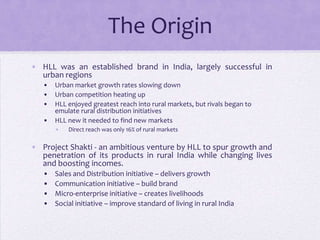
• HLL was an established brand in India, largely successful in
  urban regions
   •   Urban market growth rates slowing down
   •   Urban competition heating up
   •   HLL enjoyed greatest reach into rural markets, but rivals began to
       emulate rural distribution initiatives
   •   HLL new it needed to find new markets
       •   Direct reach was only 16% of rural markets

• Project Shakti - an ambitious venture by HLL to spur growth and
  penetration of its products in rural India while changing lives
  and boosting incomes.
   •   Sales and Distribution initiative – delivers growth
   •   Communication initiative – build brand
   •   Micro-enterprise initiative – creates livelihoods
   •   Social initiative – improve standard of living in rural India
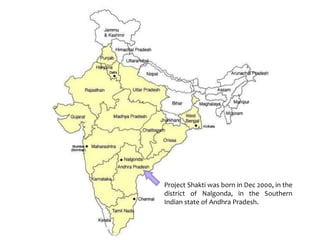
Project Shakti was born in Dec 2000, in the
district of Nalgonda, in the Southern
Indian state of Andhra Pradesh.
Project Shakti: The Objectives

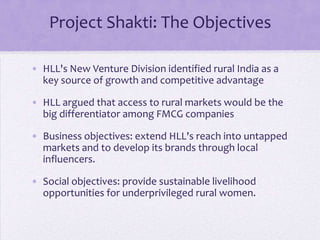
• HLL's New Venture Division identified rural India as a
  key source of growth and competitive advantage

• HLL argued that access to rural markets would be the
  big differentiator among FMCG companies

• Business objectives: extend HLL's reach into untapped
  markets and to develop its brands through local
  influencers.

• Social objectives: provide sustainable livelihood
  opportunities for underprivileged rural women.
Strategy
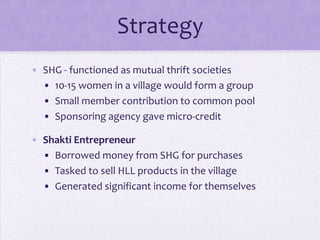
• SHG - functioned as mutual thrift societies
  • 10-15 women in a village would form a group
  • Small member contribution to common pool
  • Sponsoring agency gave micro-credit

• Shakti Entrepreneur
  • Borrowed money from SHG for purchases
  • Tasked to sell HLL products in the village
  • Generated significant income for themselves
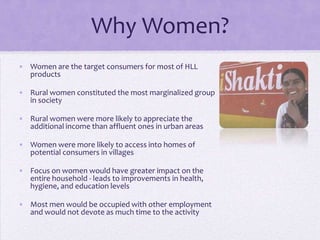
Why Women?
• Women are the target consumers for most of HLL
  products

• Rural women constituted the most marginalized group
  in society

• Rural women were more likely to appreciate the
  additional income than affluent ones in urban areas

• Women were more likely to access into homes of
  potential consumers in villages

• Focus on women would have greater impact on the
  entire household - leads to improvements in health,
  hygiene, and education levels

• Most men would be occupied with other employment
  and would not devote as much time to the activity
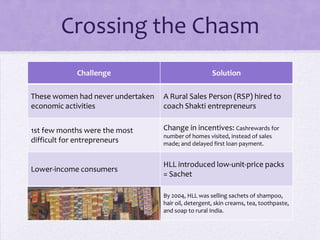
Crossing the Chasm
            Challenge                                 Solution

These women had never undertaken   A Rural Sales Person (RSP) hired to
economic activities                coach Shakti entrepreneurs


1st few months were the most       Change in incentives: Cashrewards for
                                   number of homes visited, instead of sales
difficult for entrepreneurs        made; and delayed first loan payment.


                                   HLL introduced low-unit-price packs
Lower-income consumers
                                   = Sachet

                                   By 2004, HLL was selling sachets of shampoo,
                                   hair oil, detergent, skin creams, tea, toothpaste,
                                   and soap to rural India.
Shakti Vani: The Communicator

• A branded social communication program
  targeted at the rural community
  • A local women was appointed as a ‘Vani’,
    trained and positioned as an expert on matters
    relating to personal and community health and
    hygiene
  • A ‘Vani’ covered a cluster of villages
iShakti – The Portal
• The iShakti information ‘kiosk’ is operated and
  hosted by the Shakti Entrepreneur.

• Access to information on education,
  employment, agriculture, health, personal
  care, legal procedures, e-governance and
  entertainment.

• Users can post queries on these subjects to
  local experts who respond within 48 hours.
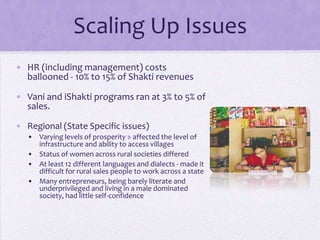
Scaling Up Issues
• HR (including management) costs
  ballooned - 10% to 15% of Shakti revenues

• Vani and iShakti programs ran at 3% to 5% of
  sales.

• Regional (State Specific issues)
   • Varying levels of prosperity > affected the level of
     infrastructure and ability to access villages
   • Status of women across rural societies differed
   • At least 12 different languages and dialects - made it
     difficult for rural sales people to work across a state
   • Many entrepreneurs, being barely literate and
     underprivileged and living in a male dominated
     society, had little self-confidence
Targets & Performance

• Target:
  • Original: To reach 250 million additional consumers
    through 100k entrepreneurs by 2010
  • Revised: To increase the number of Shakti entrepreneurs
    that we recruit, train and employ from 45,000 in 2010 to
    75,000 in 2015.

• Performance:
  • In 2004, PS grew to >15% of HLL's rural turnover
  • By 2011, 45,000 entrepreneurs (‘Shakti ammas’) were
    selling products to over 3 million households in 100,000
    Indian villages.

  Source: http://www.hul.co.in/sustainable-living/casestudies/Casecategory/Project-Shakti.aspx
Q. & A.
• A win-win for both sides – HUL makes money and also
  spreads good. Comments?
• Any ethical issue with Project Shakti?
  • Educating to create demand, increase consumption
  • Pollution from packaging

• How could they tackle regional issues?
  • Education differences
  • Status of Women in Rural society

• Is this an effective Marketing strategy for emerging
  Markets?

Project Shakti - Unilever India

  • 1.
    Unilever in India Hindustan Lever’s Project ‘Shakti’ – Marketing FMCG to the Rural Consumer
  • 2.
    Emerging Markets • Hugeopportunity, competition, no brand awareness, people don’t understand the need • Instead of pushing the marketing from top-down, how do you shift the attention to bottom-up strategy • How does a company succeed • Understand the Customer / Segments • Provide the Value /Educate • Cultural Aspects, Values, Needs => Win-Win
  • 3.
    Definitions and Names •Project Shakti = ‘Shakti’ means strength and empowerment. Also name of a Hindu Goddess • FMCG = Fast Moving Consumer Goods • iShakti= information ‘kiosk’ operated & hosted by the Shakti Entrepreneur • Vani = Means Voice; reminds of a women name • SHG = Self-Help Groups • HLL = Hindustan Lever Limited
  • 4.
    The Origin • HLLwas an established brand in India, largely successful in urban regions • Urban market growth rates slowing down • Urban competition heating up • HLL enjoyed greatest reach into rural markets, but rivals began to emulate rural distribution initiatives • HLL new it needed to find new markets • Direct reach was only 16% of rural markets • Project Shakti - an ambitious venture by HLL to spur growth and penetration of its products in rural India while changing lives and boosting incomes. • Sales and Distribution initiative – delivers growth • Communication initiative – build brand • Micro-enterprise initiative – creates livelihoods • Social initiative – improve standard of living in rural India
  • 5.
    Project Shakti wasborn in Dec 2000, in the district of Nalgonda, in the Southern Indian state of Andhra Pradesh.
  • 6.
    Project Shakti: TheObjectives • HLL's New Venture Division identified rural India as a key source of growth and competitive advantage • HLL argued that access to rural markets would be the big differentiator among FMCG companies • Business objectives: extend HLL's reach into untapped markets and to develop its brands through local influencers. • Social objectives: provide sustainable livelihood opportunities for underprivileged rural women.
  • 7.
    Strategy • SHG -functioned as mutual thrift societies • 10-15 women in a village would form a group • Small member contribution to common pool • Sponsoring agency gave micro-credit • Shakti Entrepreneur • Borrowed money from SHG for purchases • Tasked to sell HLL products in the village • Generated significant income for themselves
  • 8.
    Why Women? • Womenare the target consumers for most of HLL products • Rural women constituted the most marginalized group in society • Rural women were more likely to appreciate the additional income than affluent ones in urban areas • Women were more likely to access into homes of potential consumers in villages • Focus on women would have greater impact on the entire household - leads to improvements in health, hygiene, and education levels • Most men would be occupied with other employment and would not devote as much time to the activity
  • 9.
    Crossing the Chasm Challenge Solution These women had never undertaken A Rural Sales Person (RSP) hired to economic activities coach Shakti entrepreneurs 1st few months were the most Change in incentives: Cashrewards for number of homes visited, instead of sales difficult for entrepreneurs made; and delayed first loan payment. HLL introduced low-unit-price packs Lower-income consumers = Sachet By 2004, HLL was selling sachets of shampoo, hair oil, detergent, skin creams, tea, toothpaste, and soap to rural India.
  • 10.
    Shakti Vani: TheCommunicator • A branded social communication program targeted at the rural community • A local women was appointed as a ‘Vani’, trained and positioned as an expert on matters relating to personal and community health and hygiene • A ‘Vani’ covered a cluster of villages
  • 11.
    iShakti – ThePortal • The iShakti information ‘kiosk’ is operated and hosted by the Shakti Entrepreneur. • Access to information on education, employment, agriculture, health, personal care, legal procedures, e-governance and entertainment. • Users can post queries on these subjects to local experts who respond within 48 hours.
  • 12.
    Scaling Up Issues •HR (including management) costs ballooned - 10% to 15% of Shakti revenues • Vani and iShakti programs ran at 3% to 5% of sales. • Regional (State Specific issues) • Varying levels of prosperity > affected the level of infrastructure and ability to access villages • Status of women across rural societies differed • At least 12 different languages and dialects - made it difficult for rural sales people to work across a state • Many entrepreneurs, being barely literate and underprivileged and living in a male dominated society, had little self-confidence
  • 13.
    Targets & Performance •Target: • Original: To reach 250 million additional consumers through 100k entrepreneurs by 2010 • Revised: To increase the number of Shakti entrepreneurs that we recruit, train and employ from 45,000 in 2010 to 75,000 in 2015. • Performance: • In 2004, PS grew to >15% of HLL's rural turnover • By 2011, 45,000 entrepreneurs (‘Shakti ammas’) were selling products to over 3 million households in 100,000 Indian villages. Source: http://www.hul.co.in/sustainable-living/casestudies/Casecategory/Project-Shakti.aspx
  • 14.
    Q. & A. •A win-win for both sides – HUL makes money and also spreads good. Comments? • Any ethical issue with Project Shakti? • Educating to create demand, increase consumption • Pollution from packaging • How could they tackle regional issues? • Education differences • Status of Women in Rural society • Is this an effective Marketing strategy for emerging Markets?

Editor's Notes

  • #2 http://www.hul.co.in/sustainable-living/casestudies/Casecategory/Project-Shakti.aspx
  • #4 Shakti means strength and empowerment - name was chosen to symbolize the role that women would play in HLL's new enterprise.SharatDhalI, head of the project, and his boss, DalipSehgal, executive director of New Ventures and a member of Hindustan Lever's board.
  • #7 HLL's New Venture Division identified rural India as a key source of growth and competitive advantageHLL argued that access to rural markets would be the big differentiator among FMCG companiesHistorically, HLL enjoyed greatest reach into rural markets, butrivals began to emulate rural distribution initiativesit's direct reach was only 16% of rural markets.
  • #8 HLL partnered with SHGs to extend its reach in rural markets. Sponsoring agencies included - NGOs, multilateral agencies, government bodies, and public-sector banksShakti Entrepreneur: Empowerment of WomenA member of a SHG in eau of the 50 chosen villages was appointed as Shakti entrepreneur.entrepreneurs borrowed money from their respective SHGs and purchased HLL productsentrepreneur's job was to sell these products in their villages > this generated significant income for the individual entrepreneurs sold to outlets and direct to consumers.
  • #9 HLL new that to be a success, it had to make a significant difference to the lives of the entrepreneurs ave. household monthly income among women who became Shakti entrepreneurs was less than Rs 1,000SHakti to impact the entrepreneurs family it had to yield a monthly income of at least 500 rupees
  • #10 They took on large inventory – need to payback the loan. A Rural Sales Person (RSP) was hired to coach Shakti entrepreneurs and help them create and grow viable business. 
  • #11 Vani was given communication aids such as pictorial literature that could be understood by illiterate people interactive games that would interest her audience while driving home the message
  • #12 Q: Exploitation in any way? Hand in Glove about the education part about hygiene.
  • #13 Had to figure out how to double number of entrepreneurs without significantly increasing the number of people managing themCurrently had about 500 RSPs managing 12,000 entrepreneurs. Plans to hire 500 more RSPs in next 2 yearsWomen in Andhra Pradesh are more independent than women in northern statesIn some districts it would be almost impossible for a women to venture out and sell products to other homes or to mail retailers in the village.