System Development Life Cycle
(SDLC)
By:
Amandeep Singh
Rochna Dhatwalia
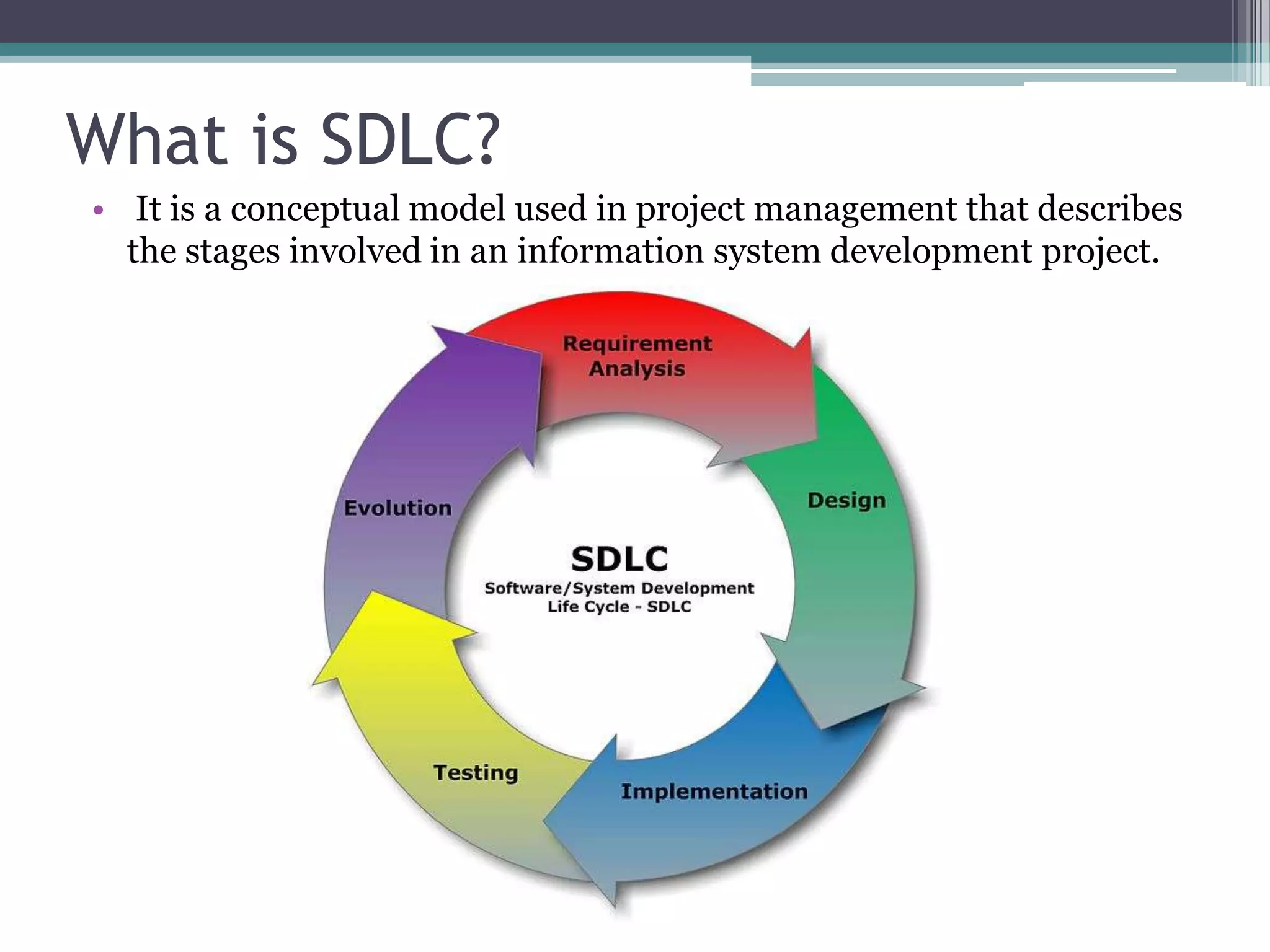
What is SDLC?
• It is a conceptual model used in project management that describes
  the stages involved in an information system development project.
Recognition of Need
• It can be environmental based or organizational
  based.
• Ideas are generated to advance technology.
• User originated ideas prompt initial
  investigation.
Feasibility Study
• Economic: Cost benefit analysis.
• Technical: We need to check whether existing
  computer can support the system.
• Behavioral: An estimate should be made of how
  strong a reaction the user staff is likely to have
  toward the development of a computerized
  system.
Feasibility Study (Steps)
• Form a project team and appoint a leader.
• Prepare System flowcharts.
• Enumerate potential candidate system.
• Describe and identify characteristics of
  candidate system.
• Evaluate performance.
• Select best candidate system.
Analysis
• In the Analysis stage an in-depth analysis is
  performed to obtain a detailed understanding of
  the business needs.
• Tools Used: DFD’s, interviews, on-site
  observation, questionnaire etc.
• Training, experience and common sense are
  required for collecting information to do
  anlaysis.
Design
• It is the most creative and challenging phase of
  SDLC.
• It defines the final system and refers to the
  technical specifications.
• DFDs are used to show the flow of system.
• Two phases: 1. Logical Design and Physical
  Design
• Logical Design: Specifies user needs.
• Physical Design: Tells the programmer what the
  candidate system must do.
Implementation
• Less creative then designing phase.
• It is of 3 types:
1. Implementation of a computer system to
    replace a manual system.
2. Implementation of a new computer system to
    replace an existing one.
3. Implementation of a modified application to
    replace existing one on same computer.
• Parallel Runs: In this new system runs with old
  system which provides assurance, and even
  helps user staff gain experience.
Post Implementation
• The Post-Implementation Review is used to
  evaluate the effectiveness of the system.
• The objectives are to determine if the system
  does what it is designed to do
• Does it support the user as required in an
  effective and efficient manner
• The review should assess how successful the
  system is in terms of
  functionality, performance, and cost versus
  benefits.
Maintenance
• The emphasis during this phase is to ensure that
  needs continue to be met and that the system
  continues to perform according to specifications.
• Routine hardware and software maintenance
  and upgrades are performed to ensure effective
  system operations.
• User training continues during this phase, as
  needed, to acquaint new users to the system or
  to introduce new features to current users.
SDLC with Prototyping
Why do we use prototyping approach?
• It is used because of failures that occurred in the
  final version of the software application
  developed using the other SDLC approach.
• There were various limitations with the other
  approach of SDLC and to overcome these
  limitations, the concept of prototyping was
  introduced.
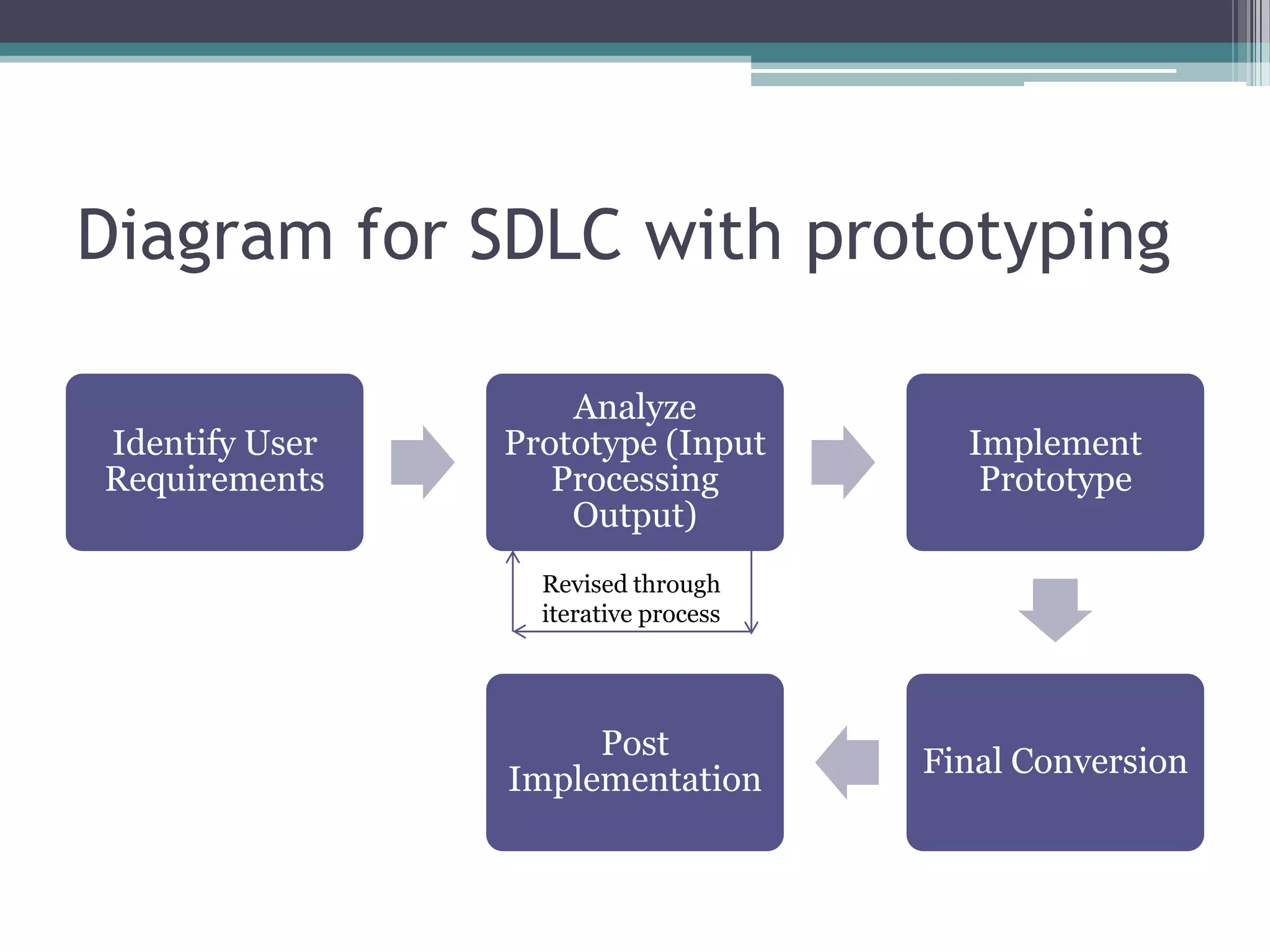
Diagram for SDLC with prototyping

                    Analyze
Identify User   Prototype (Input        Implement
Requirements       Processing            Prototype
                    Output)
                  Revised through
                  iterative process


                     Post
                                      Final Conversion
                Implementation
What is Prototyping?
• It is an advanced technology which recognizes
  problem and uses advanced computer
  technology.
• The system is built through trial and error and
  refined using iterative process.
• It is of two types: Throwaway or Rapid
  Prototype and evolutionary prototype.
Throwaway or Rapid Prototype
• It is also called closed ended prototype.
• In this we create a model that will eventually be
  discarded instead of becoming part of final
  system.
• After preliminary analysis, a simple working
  model of the system is constructed so that the
  user has an idea what the final system may look
  like.
• Speed is crucial in rapid prototype.
• Since with a limited budget and time, little can
  be expected from a system that will eventually be
  discarded.
Evolutionary Prototyping
• It is different from Rapid prototyping as its main
  goal is to build a robust prototype in every
  manner and constantly refine it.
• This technique allows the development team to
  add features that couldn’t be added in
  requirement and design phase.
• In this, developers will focus and develop only
  those parts of the system which they understand
  perfectly.
Evolutionary Prototyping
• The developer will not implement a poorly
  understood feature to help minimize risk.
• Once the partial system is done, it is sent to
  customer sites so that they can detect
  opportunities for new featured.
• These new features are then implemented by the
  developers.
• Software design is updated and code is retested.
Thank You
 Amandeep Singh
 Rochna Dhatwalia

System development life cycle (sdlc)

  • 1.
    System Development LifeCycle (SDLC) By: Amandeep Singh Rochna Dhatwalia
  • 2.
    What is SDLC? •It is a conceptual model used in project management that describes the stages involved in an information system development project.
  • 3.
    Recognition of Need •It can be environmental based or organizational based. • Ideas are generated to advance technology. • User originated ideas prompt initial investigation.
  • 4.
    Feasibility Study • Economic:Cost benefit analysis. • Technical: We need to check whether existing computer can support the system. • Behavioral: An estimate should be made of how strong a reaction the user staff is likely to have toward the development of a computerized system.
  • 5.
    Feasibility Study (Steps) •Form a project team and appoint a leader. • Prepare System flowcharts. • Enumerate potential candidate system. • Describe and identify characteristics of candidate system. • Evaluate performance. • Select best candidate system.
  • 6.
    Analysis • In theAnalysis stage an in-depth analysis is performed to obtain a detailed understanding of the business needs. • Tools Used: DFD’s, interviews, on-site observation, questionnaire etc. • Training, experience and common sense are required for collecting information to do anlaysis.
  • 7.
    Design • It isthe most creative and challenging phase of SDLC. • It defines the final system and refers to the technical specifications. • DFDs are used to show the flow of system. • Two phases: 1. Logical Design and Physical Design • Logical Design: Specifies user needs. • Physical Design: Tells the programmer what the candidate system must do.
  • 8.
    Implementation • Less creativethen designing phase. • It is of 3 types: 1. Implementation of a computer system to replace a manual system. 2. Implementation of a new computer system to replace an existing one. 3. Implementation of a modified application to replace existing one on same computer. • Parallel Runs: In this new system runs with old system which provides assurance, and even helps user staff gain experience.
  • 9.
    Post Implementation • ThePost-Implementation Review is used to evaluate the effectiveness of the system. • The objectives are to determine if the system does what it is designed to do • Does it support the user as required in an effective and efficient manner • The review should assess how successful the system is in terms of functionality, performance, and cost versus benefits.
  • 10.
    Maintenance • The emphasisduring this phase is to ensure that needs continue to be met and that the system continues to perform according to specifications. • Routine hardware and software maintenance and upgrades are performed to ensure effective system operations. • User training continues during this phase, as needed, to acquaint new users to the system or to introduce new features to current users.
  • 11.
  • 12.
    Why do weuse prototyping approach? • It is used because of failures that occurred in the final version of the software application developed using the other SDLC approach. • There were various limitations with the other approach of SDLC and to overcome these limitations, the concept of prototyping was introduced.
  • 13.
    Diagram for SDLCwith prototyping Analyze Identify User Prototype (Input Implement Requirements Processing Prototype Output) Revised through iterative process Post Final Conversion Implementation
  • 14.
    What is Prototyping? •It is an advanced technology which recognizes problem and uses advanced computer technology. • The system is built through trial and error and refined using iterative process. • It is of two types: Throwaway or Rapid Prototype and evolutionary prototype.
  • 15.
    Throwaway or RapidPrototype • It is also called closed ended prototype. • In this we create a model that will eventually be discarded instead of becoming part of final system. • After preliminary analysis, a simple working model of the system is constructed so that the user has an idea what the final system may look like. • Speed is crucial in rapid prototype. • Since with a limited budget and time, little can be expected from a system that will eventually be discarded.
  • 16.
    Evolutionary Prototyping • Itis different from Rapid prototyping as its main goal is to build a robust prototype in every manner and constantly refine it. • This technique allows the development team to add features that couldn’t be added in requirement and design phase. • In this, developers will focus and develop only those parts of the system which they understand perfectly.
  • 17.
    Evolutionary Prototyping • Thedeveloper will not implement a poorly understood feature to help minimize risk. • Once the partial system is done, it is sent to customer sites so that they can detect opportunities for new featured. • These new features are then implemented by the developers. • Software design is updated and code is retested.
  • 18.
    Thank You AmandeepSingh Rochna Dhatwalia