Understanding Operating Systems
Flynn & McHoes
Part I: Operating Systems Theory
1. Overview
2. Memory Management, Early Systems
3. Memory Management, Recent Systems
4. Processor Management
5. Process Management
6. Concurrent Processes
7. Device Management
8. File Management
9. Network Organization Concepts
10. Management of Network Functions
11. System Management
Understanding Operating Systems 2
Understanding Operating Systems
Part II: Operating Systems in Practice
12. MS-DOS Operating System
13. Windows 2000
14. UNIX/Linux Operating System
15. OpenVMS Alpha Operating System
16. IBM OS/390 Operating System
Understanding Operating Systems 3
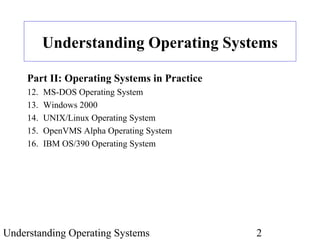
Chapter 1: Overview
• Introduction
• Operating System
Components
• Machine Hardware
• Types of Operating
Systems
• Brief History of Operating
Systems Development
• Conclusion
Software
Components
Developed
Hardware
Components
Developed
Operating Systems
Developed
Understanding Operating Systems 4
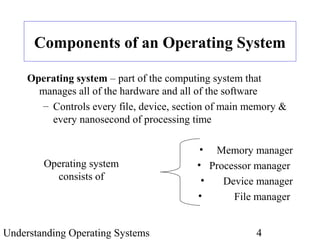
Components of an Operating System
Operating system – part of the computing system that
manages all of the hardware and all of the software
– Controls every file, device, section of main memory &
every nanosecond of processing time
• Memory manager
• Processor manager
• Device manager
• File manager
Operating system
consists of
Understanding Operating Systems 5
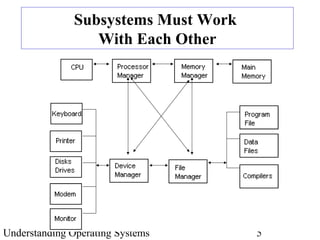
Subsystems Must Work
With Each Other
Understanding Operating Systems 6
Tasks Performed by Each Subsystem
• Monitor its resources continuously
• Enforce the policies that determine who gets what, when
and how much
• Allocate the resource when appropriate
• Deallocate the resource (reclaim it) when appropriate
Understanding Operating Systems 7
Machine Hardware
• Memory chips
• Input/output devices (monitor, keyboard, printer)
• Storage devices (disks, magnetic tape, card readers, drums)
• Central Processing Unit (Arithmetic Logic Unit, registers,
internal control, bus control)
Understanding Operating Systems 8
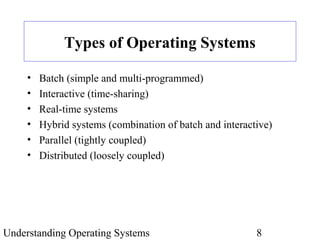
Types of Operating Systems
• Batch (simple and multi-programmed)
• Interactive (time-sharing)
• Real-time systems
• Hybrid systems (combination of batch and interactive)
• Parallel (tightly coupled)
• Distributed (loosely coupled)
Understanding Operating Systems 9
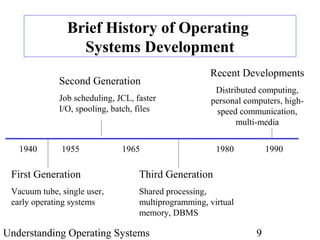
Brief History of Operating
Systems Development
1940 1955 1965 1980 1990
First Generation
Vacuum tube, single user,
early operating systems
Second Generation
Job scheduling, JCL, faster
I/O, spooling, batch, files
Third Generation
Shared processing,
multiprogramming, virtual
memory, DBMS
Recent Developments
Distributed computing,
personal computers, high-
speed communication,
multi-media
Understanding Operating Systems 10
Key Terms
• batch system
• central processing unit
• device manager
• file manager
• firmware
• hardware
• hybrid system
• interactive system
• main memory
• mainframe
• memory manager
• microcomputer
• minicomputer
• multiprocessing
• networking
• operating system
• processor manager
• real-time system
• software
• supercomputer
• workstation

Operating system lec#1

  • 1.
    Understanding Operating Systems Flynn& McHoes Part I: Operating Systems Theory 1. Overview 2. Memory Management, Early Systems 3. Memory Management, Recent Systems 4. Processor Management 5. Process Management 6. Concurrent Processes 7. Device Management 8. File Management 9. Network Organization Concepts 10. Management of Network Functions 11. System Management
  • 2.
    Understanding Operating Systems2 Understanding Operating Systems Part II: Operating Systems in Practice 12. MS-DOS Operating System 13. Windows 2000 14. UNIX/Linux Operating System 15. OpenVMS Alpha Operating System 16. IBM OS/390 Operating System
  • 3.
    Understanding Operating Systems3 Chapter 1: Overview • Introduction • Operating System Components • Machine Hardware • Types of Operating Systems • Brief History of Operating Systems Development • Conclusion Software Components Developed Hardware Components Developed Operating Systems Developed
  • 4.
    Understanding Operating Systems4 Components of an Operating System Operating system – part of the computing system that manages all of the hardware and all of the software – Controls every file, device, section of main memory & every nanosecond of processing time • Memory manager • Processor manager • Device manager • File manager Operating system consists of
  • 5.
    Understanding Operating Systems5 Subsystems Must Work With Each Other
  • 6.
    Understanding Operating Systems6 Tasks Performed by Each Subsystem • Monitor its resources continuously • Enforce the policies that determine who gets what, when and how much • Allocate the resource when appropriate • Deallocate the resource (reclaim it) when appropriate
  • 7.
    Understanding Operating Systems7 Machine Hardware • Memory chips • Input/output devices (monitor, keyboard, printer) • Storage devices (disks, magnetic tape, card readers, drums) • Central Processing Unit (Arithmetic Logic Unit, registers, internal control, bus control)
  • 8.
    Understanding Operating Systems8 Types of Operating Systems • Batch (simple and multi-programmed) • Interactive (time-sharing) • Real-time systems • Hybrid systems (combination of batch and interactive) • Parallel (tightly coupled) • Distributed (loosely coupled)
  • 9.
    Understanding Operating Systems9 Brief History of Operating Systems Development 1940 1955 1965 1980 1990 First Generation Vacuum tube, single user, early operating systems Second Generation Job scheduling, JCL, faster I/O, spooling, batch, files Third Generation Shared processing, multiprogramming, virtual memory, DBMS Recent Developments Distributed computing, personal computers, high- speed communication, multi-media
  • 10.
    Understanding Operating Systems10 Key Terms • batch system • central processing unit • device manager • file manager • firmware • hardware • hybrid system • interactive system • main memory • mainframe • memory manager • microcomputer • minicomputer • multiprocessing • networking • operating system • processor manager • real-time system • software • supercomputer • workstation