UNIPROCESS SCHEDULING
Chapter 6 2
CPU Scheduling
Chapter 6
3
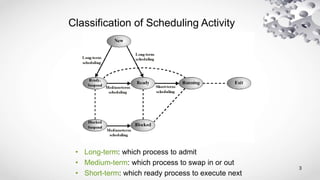
Classification of Scheduling Activity
• Long-term: which process to admit
• Medium-term: which process to swap in or out
• Short-term: which ready process to execute next
4
Long-Term Scheduling
• Determines which programs are
admitted to the system for processing
• Controls the degree of
multiprogramming
• If more processes are admitted
– less likely that all processes will be blocked
– better CPU usage
– each process has smaller fraction of the
CPU
• The long term scheduler may attempt to
5
Medium-Term Scheduling
• Swapping decisions based on the need to manage
multiprogramming
– Allows the long-term scheduler to admit more processes than
actually fit in memory
– but too many processes can increase disk activity (paging), so
there is some “optimum” level of multiprogramming.
• Done by memory management software (chapter 8)
6
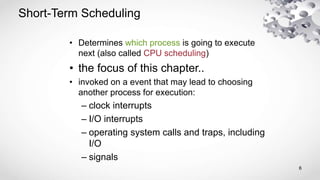
Short-Term Scheduling
• Determines which process is going to execute
next (also called CPU scheduling)
• the focus of this chapter..
• invoked on a event that may lead to choosing
another process for execution:
– clock interrupts
– I/O interrupts
– operating system calls and traps, including
I/O
– signals
7
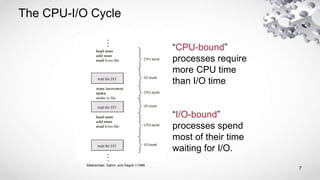
The CPU-I/O Cycle
Silberschatz, Galvin, and Gagne 1999
“CPU-bound”
processes require
more CPU time
than I/O time
“I/O-bound”
processes spend
most of their time
waiting for I/O.
8
Histogram of CPU-burst Times
Silberschatz, Galvin, and Gagne 1999
9
Our focus
• Uniprocessor Scheduling: scheduling a
single CPU among all the processes in
the system
• Key Criteria:
– Maximize CPU utilization
– Maximize throughput
– Minimize waiting times
– Minimize response time
– Minimize turnaround time
10
Criteria
• Maximize CPU utilization
– Efficiency
– Need to keep the CPU busy
• Minimize waiting times
– Time spent waiting in READY queue
– Each process should get a fair share of the
CPU
11
Criteria
• Maximize throughput
– Process completions per time unit
• Minimize response time
– From a user request to the first response
– I/O bound processes
• Minimize turnaround time
– CPU-bound process equivalent of response
time
– Elapsed time to complete a process
12
User vs. System Scheduling Criteria
User-oriented
• Turnaround Time (batch systems): Elapsed time from
the submission of a process to its completion
• Response Time (interactive systems): Elapsed time
from the submission of a request to the first response
System-oriented
• CPU utilization
• fairness
• throughput: processes completed per unit time
13
Two Components of Scheduling Policies
Selection function
• which process in the ready queue is selected next for
execution?
Decision mode
• at what times is the selection function exercised?
– Nonpreemptive
• A process in the running state runs until it blocks or
ends
– Preemptive
• Currently running process may be interrupted and
moved to the Ready state by the OS
• Prevents any one process from monopolizing the
CPU
14
Policy vs. Mechanism
• Important in scheduling and resource
allocation algorithms
• Policy
– What is to be done
• Mechanism
– How to do it
• Policy: All users equal access
• Mechanism: round robin scheduling
• Policy: Paid jobs get higher priority
• Mechanism: Preemptive scheduling
15
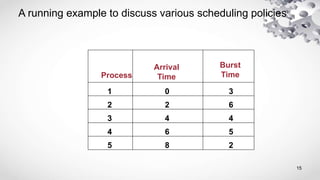
A running example to discuss various scheduling policies
Process
Arrival
Time
Burst
Time
1
2
3
4
5
0
2
4
6
8
3
6
4
5
2
16
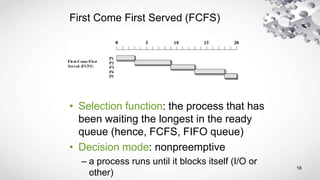
First Come First Served (FCFS)
• Selection function: the process that has
been waiting the longest in the ready
queue (hence, FCFS, FIFO queue)
• Decision mode: nonpreemptive
– a process runs until it blocks itself (I/O or
other)
17
FCFS Drawbacks
• Favors CPU-bound processes
– A process that does not perform any I/O will
monopolize the processor!
– I/O-bound processes have to wait until
CPU-bound process completes
– They may have to wait even when their I/Os
have completed
• poor device utilization
– We could reduce the average wait time by
giving more priority to I/O bound processes
18
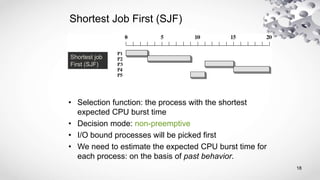
Shortest Job First (SJF)
• Selection function: the process with the shortest
expected CPU burst time
• Decision mode: non-preemptive
• I/O bound processes will be picked first
• We need to estimate the expected CPU burst time for
each process: on the basis of past behavior.
Shortest job
First (SJF)
19
Estimating the Required CPU Burst
• Can average all past history equally
• But recent history of a process is more likely to
reflect future behavior
• A common technique for that is to use exponential
averaging
– S[n+1] = a T[n] + (1-a) S[n] ; 0 < a < 1
– Puts more weight on recent instances
whenever a > 1/n
20
Exponentially Decreasing Coefficients
21
Exponential Averaging
• Set S[1] = 0 to give new processes high priority.
• Exponential averaging tracks changes in process
behavior much faster than simple averaging.
22
Shortest Job First: Critique
• SJF implicitly incorporates priorities: shortest jobs
are given preference.
– Typically these are I/O bound jobs
• Longer processes can starve if there is a steady
supply of shorter processes
• Lack of preemption not suitable in a time sharing
environment
– CPU bound process gets lower priority
– But a process doing no I/O at all could
monopolize the CPU if it is the first one in the
system
23
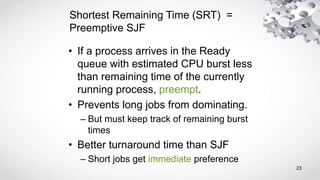
Shortest Remaining Time (SRT) =
Preemptive SJF
• If a process arrives in the Ready
queue with estimated CPU burst less
than remaining time of the currently
running process, preempt.
• Prevents long jobs from dominating.
– But must keep track of remaining burst
times
• Better turnaround time than SJF
– Short jobs get immediate preference
24
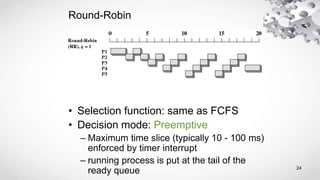
• Selection function: same as FCFS
• Decision mode: Preemptive
– Maximum time slice (typically 10 - 100 ms)
enforced by timer interrupt
– running process is put at the tail of the
ready queue
Round-Robin
25
Time Quantum for Round Robin
• must be substantially larger than process switch time
• should be larger than the typical CPU burst
• If too large, degenerates to FCFS
• Too small, excessive context switches (overhead)
26
Fairness vs. Efficiency
• Each context switch has the OS using the
CPU instead of the user process
– give up CPU, save all info, reload w/ status of
incoming process
– Say 20 ms quantum length, 5 ms context
switch
– Waste of resources
• 20% of CPU time (5/20) for context switch
– If 500 ms quantum, better use of resources
• 1% of CPU time (5/500) for context switch
• Bad if lots of users in system – interactive users
waiting for CPU
27
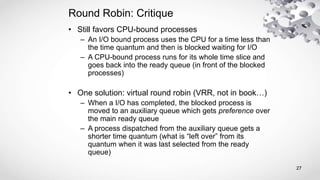
Round Robin: Critique
• Still favors CPU-bound processes
– An I/O bound process uses the CPU for a time less than
the time quantum and then is blocked waiting for I/O
– A CPU-bound process runs for its whole time slice and
goes back into the ready queue (in front of the blocked
processes)
• One solution: virtual round robin (VRR, not in book…)
– When a I/O has completed, the blocked process is
moved to an auxiliary queue which gets preference over
the main ready queue
– A process dispatched from the auxiliary queue gets a
shorter time quantum (what is “left over” from its
quantum when it was last selected from the ready
queue)
FIRST COME FIRST SERVE (FCFS)
• Characteristics of FCFS CPU Process Scheduling
1. Implementation is simple.
2. Does not cause any causalities while using
3. It adopts a non pre emptive and pre emptive strategy.
4. It runs each procedure in the order that they are received.
5. Arrival time is used as a selection criterion for procedures.
• Advantages of FCFS CPU Process Scheduling
• The advantages of FCFS CPU Process Scheduling are:
• In order to allocate processes, it uses the First In First Out queue.
• The FCFS CPU Scheduling Process is straight forward and easy to
implement.
• In the FCFS situation pre emptive scheduling, there is no chance of
process starving.
The disadvantages of FCFS CPU Process Scheduling are:
1. FCFS CPU Scheduling Algorithm has Long Waiting Time
2. FCFS CPU Scheduling favors CPU over Input or Output operations
3. In FCFS there is a chance of occurrence of Convoy Effect
4. Because FCFS is so straight forward, it often isn't very effective.
Extended waiting periods go hand in hand with this. All other orders
are left idle if the CPU is busy processing one time-consuming order.
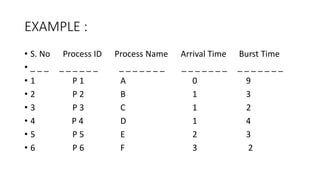
EXAMPLE :
• S. No Process ID Process Name Arrival Time Burst Time
• _ _ _ _ _ _ _ _ _ _ _ _ _ _ _ _ _ _ _ _ _ _ _ _ _ _ _ _ _ _
• 1 P 1 A 0 9
• 2 P 2 B 1 3
• 3 P 3 C 1 2
• 4 P 4 D 1 4
• 5 P 5 E 2 3
• 6 P 6 F 3 2
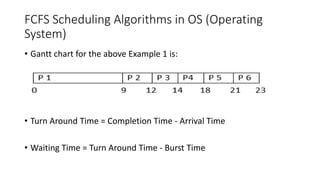
FCFS Scheduling Algorithms in OS (Operating
System)
• Gantt chart for the above Example 1 is:
• Turn Around Time = Completion Time - Arrival Time
• Waiting Time = Turn Around Time - Burst Time
• Solution”:
• S. No P ID Arrival Time Burst Time Completion Time Turn Around Time Waiting Time
• 1 P 1 0 9 9 9 0
• 2 P 2 1 3 12 11 8
• 3 P 3 1 2 14 13 11
• 4 P 4 1 4 18 17 13
• 5 P 5 2 3 21 19 16
• 6 P 6 3 2 23 20 18
Turn Around Time = Completion Time - Arrival Time
Waiting Time = Turn Around Time - Burst Time ( TAT= WT + BT )

UNIPROCESS SCHEDULING.pptx

  • 1.
  • 2.
    Chapter 6 2 CPUScheduling Chapter 6
  • 3.
    3 Classification of SchedulingActivity • Long-term: which process to admit • Medium-term: which process to swap in or out • Short-term: which ready process to execute next
  • 4.
    4 Long-Term Scheduling • Determineswhich programs are admitted to the system for processing • Controls the degree of multiprogramming • If more processes are admitted – less likely that all processes will be blocked – better CPU usage – each process has smaller fraction of the CPU • The long term scheduler may attempt to
  • 5.
    5 Medium-Term Scheduling • Swappingdecisions based on the need to manage multiprogramming – Allows the long-term scheduler to admit more processes than actually fit in memory – but too many processes can increase disk activity (paging), so there is some “optimum” level of multiprogramming. • Done by memory management software (chapter 8)
  • 6.
    6 Short-Term Scheduling • Determineswhich process is going to execute next (also called CPU scheduling) • the focus of this chapter.. • invoked on a event that may lead to choosing another process for execution: – clock interrupts – I/O interrupts – operating system calls and traps, including I/O – signals
  • 7.
    7 The CPU-I/O Cycle Silberschatz,Galvin, and Gagne 1999 “CPU-bound” processes require more CPU time than I/O time “I/O-bound” processes spend most of their time waiting for I/O.
  • 8.
    8 Histogram of CPU-burstTimes Silberschatz, Galvin, and Gagne 1999
  • 9.
    9 Our focus • UniprocessorScheduling: scheduling a single CPU among all the processes in the system • Key Criteria: – Maximize CPU utilization – Maximize throughput – Minimize waiting times – Minimize response time – Minimize turnaround time
  • 10.
    10 Criteria • Maximize CPUutilization – Efficiency – Need to keep the CPU busy • Minimize waiting times – Time spent waiting in READY queue – Each process should get a fair share of the CPU
  • 11.
    11 Criteria • Maximize throughput –Process completions per time unit • Minimize response time – From a user request to the first response – I/O bound processes • Minimize turnaround time – CPU-bound process equivalent of response time – Elapsed time to complete a process
  • 12.
    12 User vs. SystemScheduling Criteria User-oriented • Turnaround Time (batch systems): Elapsed time from the submission of a process to its completion • Response Time (interactive systems): Elapsed time from the submission of a request to the first response System-oriented • CPU utilization • fairness • throughput: processes completed per unit time
  • 13.
    13 Two Components ofScheduling Policies Selection function • which process in the ready queue is selected next for execution? Decision mode • at what times is the selection function exercised? – Nonpreemptive • A process in the running state runs until it blocks or ends – Preemptive • Currently running process may be interrupted and moved to the Ready state by the OS • Prevents any one process from monopolizing the CPU
  • 14.
    14 Policy vs. Mechanism •Important in scheduling and resource allocation algorithms • Policy – What is to be done • Mechanism – How to do it • Policy: All users equal access • Mechanism: round robin scheduling • Policy: Paid jobs get higher priority • Mechanism: Preemptive scheduling
  • 15.
    15 A running exampleto discuss various scheduling policies Process Arrival Time Burst Time 1 2 3 4 5 0 2 4 6 8 3 6 4 5 2
  • 16.
    16 First Come FirstServed (FCFS) • Selection function: the process that has been waiting the longest in the ready queue (hence, FCFS, FIFO queue) • Decision mode: nonpreemptive – a process runs until it blocks itself (I/O or other)
  • 17.
    17 FCFS Drawbacks • FavorsCPU-bound processes – A process that does not perform any I/O will monopolize the processor! – I/O-bound processes have to wait until CPU-bound process completes – They may have to wait even when their I/Os have completed • poor device utilization – We could reduce the average wait time by giving more priority to I/O bound processes
  • 18.
    18 Shortest Job First(SJF) • Selection function: the process with the shortest expected CPU burst time • Decision mode: non-preemptive • I/O bound processes will be picked first • We need to estimate the expected CPU burst time for each process: on the basis of past behavior. Shortest job First (SJF)
  • 19.
    19 Estimating the RequiredCPU Burst • Can average all past history equally • But recent history of a process is more likely to reflect future behavior • A common technique for that is to use exponential averaging – S[n+1] = a T[n] + (1-a) S[n] ; 0 < a < 1 – Puts more weight on recent instances whenever a > 1/n
  • 20.
  • 21.
    21 Exponential Averaging • SetS[1] = 0 to give new processes high priority. • Exponential averaging tracks changes in process behavior much faster than simple averaging.
  • 22.
    22 Shortest Job First:Critique • SJF implicitly incorporates priorities: shortest jobs are given preference. – Typically these are I/O bound jobs • Longer processes can starve if there is a steady supply of shorter processes • Lack of preemption not suitable in a time sharing environment – CPU bound process gets lower priority – But a process doing no I/O at all could monopolize the CPU if it is the first one in the system
  • 23.
    23 Shortest Remaining Time(SRT) = Preemptive SJF • If a process arrives in the Ready queue with estimated CPU burst less than remaining time of the currently running process, preempt. • Prevents long jobs from dominating. – But must keep track of remaining burst times • Better turnaround time than SJF – Short jobs get immediate preference
  • 24.
    24 • Selection function:same as FCFS • Decision mode: Preemptive – Maximum time slice (typically 10 - 100 ms) enforced by timer interrupt – running process is put at the tail of the ready queue Round-Robin
  • 25.
    25 Time Quantum forRound Robin • must be substantially larger than process switch time • should be larger than the typical CPU burst • If too large, degenerates to FCFS • Too small, excessive context switches (overhead)
  • 26.
    26 Fairness vs. Efficiency •Each context switch has the OS using the CPU instead of the user process – give up CPU, save all info, reload w/ status of incoming process – Say 20 ms quantum length, 5 ms context switch – Waste of resources • 20% of CPU time (5/20) for context switch – If 500 ms quantum, better use of resources • 1% of CPU time (5/500) for context switch • Bad if lots of users in system – interactive users waiting for CPU
  • 27.
    27 Round Robin: Critique •Still favors CPU-bound processes – An I/O bound process uses the CPU for a time less than the time quantum and then is blocked waiting for I/O – A CPU-bound process runs for its whole time slice and goes back into the ready queue (in front of the blocked processes) • One solution: virtual round robin (VRR, not in book…) – When a I/O has completed, the blocked process is moved to an auxiliary queue which gets preference over the main ready queue – A process dispatched from the auxiliary queue gets a shorter time quantum (what is “left over” from its quantum when it was last selected from the ready queue)
  • 28.
    FIRST COME FIRSTSERVE (FCFS) • Characteristics of FCFS CPU Process Scheduling 1. Implementation is simple. 2. Does not cause any causalities while using 3. It adopts a non pre emptive and pre emptive strategy. 4. It runs each procedure in the order that they are received. 5. Arrival time is used as a selection criterion for procedures.
  • 29.
    • Advantages ofFCFS CPU Process Scheduling • The advantages of FCFS CPU Process Scheduling are: • In order to allocate processes, it uses the First In First Out queue. • The FCFS CPU Scheduling Process is straight forward and easy to implement. • In the FCFS situation pre emptive scheduling, there is no chance of process starving.
  • 30.
    The disadvantages ofFCFS CPU Process Scheduling are: 1. FCFS CPU Scheduling Algorithm has Long Waiting Time 2. FCFS CPU Scheduling favors CPU over Input or Output operations 3. In FCFS there is a chance of occurrence of Convoy Effect 4. Because FCFS is so straight forward, it often isn't very effective. Extended waiting periods go hand in hand with this. All other orders are left idle if the CPU is busy processing one time-consuming order.
  • 31.
    EXAMPLE : • S.No Process ID Process Name Arrival Time Burst Time • _ _ _ _ _ _ _ _ _ _ _ _ _ _ _ _ _ _ _ _ _ _ _ _ _ _ _ _ _ _ • 1 P 1 A 0 9 • 2 P 2 B 1 3 • 3 P 3 C 1 2 • 4 P 4 D 1 4 • 5 P 5 E 2 3 • 6 P 6 F 3 2
  • 32.
    FCFS Scheduling Algorithmsin OS (Operating System) • Gantt chart for the above Example 1 is: • Turn Around Time = Completion Time - Arrival Time • Waiting Time = Turn Around Time - Burst Time
  • 33.
    • Solution”: • S.No P ID Arrival Time Burst Time Completion Time Turn Around Time Waiting Time • 1 P 1 0 9 9 9 0 • 2 P 2 1 3 12 11 8 • 3 P 3 1 2 14 13 11 • 4 P 4 1 4 18 17 13 • 5 P 5 2 3 21 19 16 • 6 P 6 3 2 23 20 18 Turn Around Time = Completion Time - Arrival Time Waiting Time = Turn Around Time - Burst Time ( TAT= WT + BT )