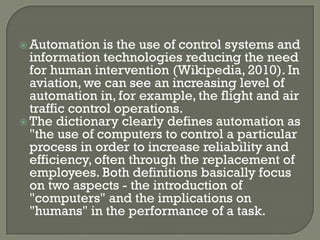
 Automation    is the use of control systems and
  information technologies reducing the need
  for human intervention (Wikipedia, 2010). In
  aviation, we can see an increasing level of
  automation in, for example, the flight and air
  traffic control operations.
 The dictionary clearly defines automation as
  "the use of computers to control a particular
  process in order to increase reliability and
  efficiency, often through the replacement of
  employees. Both definitions basically focus
  on two aspects - the introduction of
  "computers" and the implications on
  "humans" in the performance of a task.
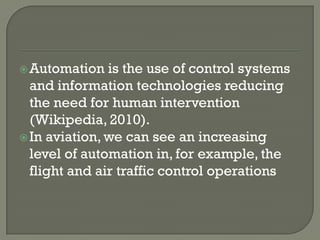
 Automation   is the use of control systems
  and information technologies reducing
  the need for human intervention
  (Wikipedia, 2010).
 In aviation, we can see an increasing
  level of automation in, for example, the
  flight and air traffic control operations
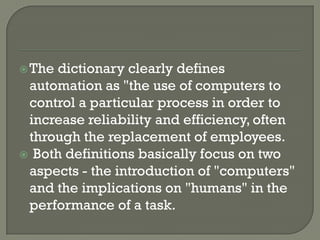
 Thedictionary clearly defines
 automation as "the use of computers to
 control a particular process in order to
 increase reliability and efficiency, often
 through the replacement of employees.
 Both definitions basically focus on two
 aspects - the introduction of "computers"
 and the implications on "humans" in the
 performance of a task.
 With the advent of modern technology, the use of
  computers becomes inevitable in the completion
  and performance of a particular task.
 While automation proves to improve the
  completion of a job, it drastically affects the
  "operator" whose task shifts from being the
  "performer" to being the "onlooker".
 This is where the issue of "complacency" sets in.
 With this major revolution, one may ask if the
  introduction of automation is indeed an
  advantage or disadvantage.
   With the advent of modern technology, the use of computers
    becomes inevitable in the completion and performance of a
    particular task. While automation proves to improve the
    completion of a job, it drastically affects the "operator" whose task
    shifts from being the "performer" to being the "onlooker". This is
    where the issue of "complacency" sets in. With this major
    revolution, one may ask if the introduction of automation is indeed
    an advantage or disadvantage.
   Since the evolution of this major global trend, automation has
    widely enveloped the aviation field. Industry-wide, it has become
    a by-name and is considered an indispensable or integral addition
    to this highly complex, dynamic, and competitive business with
    the objective of improving and controlling flight management
    efficiency. Nowadays, we can see a widespread use and increasing
    level of automation in aviation particularly in flight and air traffic
    control operations. However, it has also given rise to issues and
    concerns pertaining to human intervention, accidents and
    incidents; and issues on human factors, specifically complacency.
Since the evolution of this major global trend,
 automation has widely enveloped the aviation
 field. Industry-wide, it has become a by-name
 and is considered an indispensable or integral
 addition to this highly complex, dynamic, and
 competitive business with the objective of
 improving and controlling flight management
 efficiency.
 Nowadays, we can see a widespread use and
 increasing level of automation in aviation
 particularly in flight and air traffic control
 operations.
 However, it has also given rise to issues and
 concerns pertaining to human intervention,
 accidents and incidents; and issues on human
 factors, specifically complacency.
 Automation   in flight operations:
 HF and automation
 Pilot / computer interface
 Autopilot
 Autothrottle
 Flight management system
 Automation in ATC operations:
 ADS-B
 SWIM
 NextGen
 NNEW
   Advantages
   1) Greater Situational Awareness
   With reduced direct operational involvement, flight crew members are
    able to allocate their concentration towards maintaining awareness with
    their environment as well as interpersonal communication with their
    colleagues. Automation are thus able to relieve pilots of their workloads
    by assuring the availability of essential flight information at all times.
    Flight safety is enhanced when pilots are able to react more quickly and
    effectively to situations due to greater attention to their surroundings.
   2) Operating Cost Reduction
   With computer management, the heading, altitude and airspeed whereby
    the aircraft can travel at the most ideal efficiency, can be retrieved. With
    efficient flight performance, fuel usage can be reduced to achieve a lower
    operating cost. This is especially critical for commercial airlines, which
    aim to cut cost for greater profits. As flight information is managed by the
    flight management computers automatically, the requirement of having a
    third flight crew (flight engineer) to oversee the performance of
    secondary airplane systems and fuel consumption is lifted. A reduced
    number of flight crew members required helps to cut costs for airlines.
   1) Greater Situational Awareness
   With reduced direct operational involvement,
    flight crew members are able to allocate their
    concentration towards maintaining awareness
    with their environment as well as interpersonal
    communication with their colleagues.
    Automation are thus able to relieve pilots of their
    workloads by assuring the availability of
    essential flight information at all times. Flight
    safety is enhanced when pilots are able to react
    more quickly and effectively to situations due to
    greater attention to their surroundings
 2) Operating Cost Reduction
 With computer management, the       heading,
  altitude and airspeed whereby the aircraft can
  travel at the most ideal efficiency, can be
  retrieved. With efficient flight performance, fuel
  usage can be reduced to achieve a lower
  operating cost.
 This is especially critical for commercial airlines,
  which aim to cut cost for greater profits.
 As flight information is managed by the flight
  management computers automatically, the
  requirement of having a third flight crew (flight
  engineer) to oversee the performance of
  secondary airplane systems and fuel
  consumption is lifted.
 A reduced number of flight crew members
  required helps to cut costs for airlines.
   Disadvantages
   1) Overdependence on Automation (Complacency)
   With increased reliance on automated technologies, flight crew may rely excessively on the glass
    cockpits. This could lead to the negligence of the necessity of their participation during crucial
    periods of a flight, such as the landing and takeoff phases.
   For instance, in 1974, Eastern Air Lines Flight 212 crashed short of the runway while executing a
    precise instrumental approach in poor visibility conditions into Charlotte/Douglas International
    Airport. Out of the 82 people aboard the flight, only ten survived. The accident investigation concluded
    that the mishap occurred due to the pilot distraction.
   After the observation of several accidents that were due to pilot distraction when flight crew engages
    in unnecessary activities during crucial flight phases, the Sterile Cockpit Rule was instilled by the
    Federal Aviation Administration (FAA) in 1981. This regulation prohibits flight crew from engaging in
    unnecessary activities during important flight phases, usually below the flight altitude of 10,000 feet.
   The introduction of the Crew Resource Management (CRM) training in 1979 also strives to enhance
    pilot decision-making skills by highlighting the importance of situational awareness, leadership
    capabilities and interpersonal communication skills even during the presence of automation and
    convenience.
   Both the CRM training and Sterile Cockpit Rule aim to emphasize the role of the automation only as an
    additional supporting assistance tool. Even with the introduction of the automation, flight crew are still
    educated to direct as much attention to piloting the flight as before the debut of the technology.
   With this, the Times quotes engineering Professor William B. Rouse of Georgia Institute of Technology
    and IEEE Fellow as saying, "Complacency is an issue, but designing the interaction between human
    and technical so the human has the right level of judgment when you need them is a design task in
    itself… When the person has no role in the task, there’s a much greater risk of complacency." Also, a
    captain at Continental Airlines, once said, "No light comes on to tell you that you're being complacent
 With increased reliance on automated technologies,
  flight crew may rely excessively on the glass
  cockpits. This could lead to the negligence of the
  necessity of their participation during crucial
  periods of a flight, such as the landing and takeoff
  phases.
 For instance, in 1974, Eastern Air Lines Flight 212
  crashed short of the runway while executing a
  precise instrumental approach in poor visibility
  conditions into Charlotte/Douglas International
  Airport.
 Out of the 82 people aboard the flight, only ten
  survived. The accident investigation concluded that
  the mishap occurred due to the pilot distraction.
 Continue……
 After the observation   of several accidents that
  were due to pilot distraction when flight crew
  engages in unnecessary activities during crucial
  flight phases, the Sterile Cockpit Rule was
  instilled by the Federal Aviation Administration
  (FAA) in 1981. This regulation prohibits flight
  crew from engaging in unnecessary activities
  during important flight phases, usually below the
  flight altitude of 10,000 feet.
 The introduction of the Crew Resource
  Management (CRM) training in 1979 also strives
  to enhance pilot decision-making skills by
  highlighting the importance of situational
  awareness, leadership capabilities and
  interpersonal communication skills even during
  the presence of automation and convenience.
 Both the CRM training and Sterile Cockpit Rule aim to
  emphasize the role of the automation only as an
  additional supporting assistance tool.
 Even with the introduction of the automation, flight
  crew are still educated to direct as much attention to
  piloting the flight as before the debut of the
  technology.
 With this, the Times quotes engineering Professor
  William B. Rouse of Georgia Institute of Technology
  and IEEE Fellow as saying, "Complacency is an issue,
  but designing the interaction between human and
  technical so the human has the right level of judgment
  when you need them is a design task in itself… When
  the person has no role in the task, there’s a much
  greater risk of complacency." Also, a captain at
  Continental Airlines, once said, "No light comes on to
  tell you that you're being complacent
 Spencer   and Ebbage (20031) defined
  airmanship as the following: “A personal state
  that enables aircrew to exercise sound
  judgement, display uncompromising flight
  discipline and demonstrate skilful control of
  an aircraft and a situation.
 It is maintained by continuous self-
  improvement and a desire to perform
  optimally at all times.”
 Flight crew aircraft piloting skill development
  may be adversely affected by their excessive
  dependence on the electronic instruments.
 For instance, pilots can rely totally on the
  autopilot function to maintain a particular
  altitude and airspeed of the aircraft.
 The importance of airmanship is highlighted when
  airlines doubt pilot training effectiveness through
  the new Multi-Pilot Crew License (MPL) medium.
 The MPL allows pilots to bypass the acquisition of
  Private Pilot License (PPL) as well as Commercial
  Pilot License (CPL) to achieve a frozen Air
  Transport Pilot License (ATPL).
 With greater focus on flight simulator training,
  airline pilots trained through the MPL method will
  not spend as many hours as pilots trained via the
  traditional method.
 As the automation features become more common
  on many aircraft types, flight crew will inevitably
  increase their reliance on these functions.
 This causes pilots to reduce their application of
  airmanship. The ability to fly an aircraft manually
  despite regular exposure to automation and
  convenient information access is important,
  especially during emergencies.
 In 2008, United Airlines Flight 731 lost half of its
  display panels, radios, transponders and TCAS.
  Fortunately, the pilots were able to maintain
  manual flight control to land back at their
  departure aerodrome. The necessity to maintain
  airmanship is thus highlighted even during this
  age of automation.
 While 90% of the flight crew members surveyed
  in a National Aeronautics and Space
  Administration (NASA) questionnaire indicated
  that they do practise manual flying to uphold
  their skills, it ultimately depends on how much
  the industry emphasizes the importance of
  airmanship over the safety and efficiency of
  flight operations.
   Automation has indeed proven itself to be revolutionary
    technological advancement which reliably enhances flight
    operational safety and efficiency.
    Pilots can allocate resources and concentration efficiently to
    piloting the plane safety with convenient access to the required
    flight information.
    With reduced number of flight crew and fuel consumption,
    operation expenditure is lower.
    Despite economic and operational advantages, over-reliance on
    automation may deteriorate pilots’ airmanship.
    Excessive dependence on automation may result in flight crew’s
    complacency to assure their participation during the flight,
    especially during critical phases.
    The introduction of training and implementation of rule assures that
    pilots dedicate their attention to situational awareness, even as the
    aircraft is controlled by the computers.
    Only with the emphasis of cognitive skills to eliminate human
    errors, such technological advances can then enhance flight safety.
 The benefits of automation may be highly regarded but
  this should not prevent the "operator" to exercise his
  "human touch" or intervention in the fulfillment of a task.
  Its drawbacks have high and costly returns that need to
  be taken into consideration.
 Whether or not automation is boon or bane is no longer
  a question, with it being embraced by the industry, it is
  undoubtedly that this system will be eliminated. So, in
  order to fully maximize and utilize its benefits, the
  drawbacks must be addressed and the development of
  "operator" through proper training should be a prime
  concern.
 Automation is here to stay and there is no stopping it. It
  has proven to be a major technological advancement in
  the industry, and with proper handling and use, plus the
  full knowledge and commitment to job completion of
  individuals using and maintaining it, the human +
  computer tandem will equate to reliability, safety and
  efficiency beyond par.

Automation in airline

  • 2.
     Automation is the use of control systems and information technologies reducing the need for human intervention (Wikipedia, 2010). In aviation, we can see an increasing level of automation in, for example, the flight and air traffic control operations.  The dictionary clearly defines automation as "the use of computers to control a particular process in order to increase reliability and efficiency, often through the replacement of employees. Both definitions basically focus on two aspects - the introduction of "computers" and the implications on "humans" in the performance of a task.
  • 3.
     Automation is the use of control systems and information technologies reducing the need for human intervention (Wikipedia, 2010).  In aviation, we can see an increasing level of automation in, for example, the flight and air traffic control operations
  • 4.
     Thedictionary clearlydefines automation as "the use of computers to control a particular process in order to increase reliability and efficiency, often through the replacement of employees.  Both definitions basically focus on two aspects - the introduction of "computers" and the implications on "humans" in the performance of a task.
  • 5.
     With theadvent of modern technology, the use of computers becomes inevitable in the completion and performance of a particular task.  While automation proves to improve the completion of a job, it drastically affects the "operator" whose task shifts from being the "performer" to being the "onlooker".  This is where the issue of "complacency" sets in.  With this major revolution, one may ask if the introduction of automation is indeed an advantage or disadvantage.
  • 6.
    With the advent of modern technology, the use of computers becomes inevitable in the completion and performance of a particular task. While automation proves to improve the completion of a job, it drastically affects the "operator" whose task shifts from being the "performer" to being the "onlooker". This is where the issue of "complacency" sets in. With this major revolution, one may ask if the introduction of automation is indeed an advantage or disadvantage.  Since the evolution of this major global trend, automation has widely enveloped the aviation field. Industry-wide, it has become a by-name and is considered an indispensable or integral addition to this highly complex, dynamic, and competitive business with the objective of improving and controlling flight management efficiency. Nowadays, we can see a widespread use and increasing level of automation in aviation particularly in flight and air traffic control operations. However, it has also given rise to issues and concerns pertaining to human intervention, accidents and incidents; and issues on human factors, specifically complacency.
  • 7.
    Since the evolutionof this major global trend, automation has widely enveloped the aviation field. Industry-wide, it has become a by-name and is considered an indispensable or integral addition to this highly complex, dynamic, and competitive business with the objective of improving and controlling flight management efficiency.  Nowadays, we can see a widespread use and increasing level of automation in aviation particularly in flight and air traffic control operations.  However, it has also given rise to issues and concerns pertaining to human intervention, accidents and incidents; and issues on human factors, specifically complacency.
  • 8.
     Automation in flight operations:  HF and automation  Pilot / computer interface  Autopilot  Autothrottle  Flight management system  Automation in ATC operations:  ADS-B  SWIM  NextGen  NNEW
  • 9.
    Advantages  1) Greater Situational Awareness  With reduced direct operational involvement, flight crew members are able to allocate their concentration towards maintaining awareness with their environment as well as interpersonal communication with their colleagues. Automation are thus able to relieve pilots of their workloads by assuring the availability of essential flight information at all times. Flight safety is enhanced when pilots are able to react more quickly and effectively to situations due to greater attention to their surroundings.  2) Operating Cost Reduction  With computer management, the heading, altitude and airspeed whereby the aircraft can travel at the most ideal efficiency, can be retrieved. With efficient flight performance, fuel usage can be reduced to achieve a lower operating cost. This is especially critical for commercial airlines, which aim to cut cost for greater profits. As flight information is managed by the flight management computers automatically, the requirement of having a third flight crew (flight engineer) to oversee the performance of secondary airplane systems and fuel consumption is lifted. A reduced number of flight crew members required helps to cut costs for airlines.
  • 10.
    1) Greater Situational Awareness  With reduced direct operational involvement, flight crew members are able to allocate their concentration towards maintaining awareness with their environment as well as interpersonal communication with their colleagues. Automation are thus able to relieve pilots of their workloads by assuring the availability of essential flight information at all times. Flight safety is enhanced when pilots are able to react more quickly and effectively to situations due to greater attention to their surroundings
  • 11.
     2) OperatingCost Reduction  With computer management, the heading, altitude and airspeed whereby the aircraft can travel at the most ideal efficiency, can be retrieved. With efficient flight performance, fuel usage can be reduced to achieve a lower operating cost.  This is especially critical for commercial airlines, which aim to cut cost for greater profits.  As flight information is managed by the flight management computers automatically, the requirement of having a third flight crew (flight engineer) to oversee the performance of secondary airplane systems and fuel consumption is lifted.  A reduced number of flight crew members required helps to cut costs for airlines.
  • 12.
    Disadvantages  1) Overdependence on Automation (Complacency)  With increased reliance on automated technologies, flight crew may rely excessively on the glass cockpits. This could lead to the negligence of the necessity of their participation during crucial periods of a flight, such as the landing and takeoff phases.  For instance, in 1974, Eastern Air Lines Flight 212 crashed short of the runway while executing a precise instrumental approach in poor visibility conditions into Charlotte/Douglas International Airport. Out of the 82 people aboard the flight, only ten survived. The accident investigation concluded that the mishap occurred due to the pilot distraction.  After the observation of several accidents that were due to pilot distraction when flight crew engages in unnecessary activities during crucial flight phases, the Sterile Cockpit Rule was instilled by the Federal Aviation Administration (FAA) in 1981. This regulation prohibits flight crew from engaging in unnecessary activities during important flight phases, usually below the flight altitude of 10,000 feet.  The introduction of the Crew Resource Management (CRM) training in 1979 also strives to enhance pilot decision-making skills by highlighting the importance of situational awareness, leadership capabilities and interpersonal communication skills even during the presence of automation and convenience.  Both the CRM training and Sterile Cockpit Rule aim to emphasize the role of the automation only as an additional supporting assistance tool. Even with the introduction of the automation, flight crew are still educated to direct as much attention to piloting the flight as before the debut of the technology.  With this, the Times quotes engineering Professor William B. Rouse of Georgia Institute of Technology and IEEE Fellow as saying, "Complacency is an issue, but designing the interaction between human and technical so the human has the right level of judgment when you need them is a design task in itself… When the person has no role in the task, there’s a much greater risk of complacency." Also, a captain at Continental Airlines, once said, "No light comes on to tell you that you're being complacent
  • 13.
     With increasedreliance on automated technologies, flight crew may rely excessively on the glass cockpits. This could lead to the negligence of the necessity of their participation during crucial periods of a flight, such as the landing and takeoff phases.  For instance, in 1974, Eastern Air Lines Flight 212 crashed short of the runway while executing a precise instrumental approach in poor visibility conditions into Charlotte/Douglas International Airport.  Out of the 82 people aboard the flight, only ten survived. The accident investigation concluded that the mishap occurred due to the pilot distraction.
  • 14.
     Continue……  Afterthe observation of several accidents that were due to pilot distraction when flight crew engages in unnecessary activities during crucial flight phases, the Sterile Cockpit Rule was instilled by the Federal Aviation Administration (FAA) in 1981. This regulation prohibits flight crew from engaging in unnecessary activities during important flight phases, usually below the flight altitude of 10,000 feet.  The introduction of the Crew Resource Management (CRM) training in 1979 also strives to enhance pilot decision-making skills by highlighting the importance of situational awareness, leadership capabilities and interpersonal communication skills even during the presence of automation and convenience.
  • 15.
     Both theCRM training and Sterile Cockpit Rule aim to emphasize the role of the automation only as an additional supporting assistance tool.  Even with the introduction of the automation, flight crew are still educated to direct as much attention to piloting the flight as before the debut of the technology.  With this, the Times quotes engineering Professor William B. Rouse of Georgia Institute of Technology and IEEE Fellow as saying, "Complacency is an issue, but designing the interaction between human and technical so the human has the right level of judgment when you need them is a design task in itself… When the person has no role in the task, there’s a much greater risk of complacency." Also, a captain at Continental Airlines, once said, "No light comes on to tell you that you're being complacent
  • 16.
     Spencer and Ebbage (20031) defined airmanship as the following: “A personal state that enables aircrew to exercise sound judgement, display uncompromising flight discipline and demonstrate skilful control of an aircraft and a situation.  It is maintained by continuous self- improvement and a desire to perform optimally at all times.”  Flight crew aircraft piloting skill development may be adversely affected by their excessive dependence on the electronic instruments.  For instance, pilots can rely totally on the autopilot function to maintain a particular altitude and airspeed of the aircraft.
  • 17.
     The importanceof airmanship is highlighted when airlines doubt pilot training effectiveness through the new Multi-Pilot Crew License (MPL) medium.  The MPL allows pilots to bypass the acquisition of Private Pilot License (PPL) as well as Commercial Pilot License (CPL) to achieve a frozen Air Transport Pilot License (ATPL).  With greater focus on flight simulator training, airline pilots trained through the MPL method will not spend as many hours as pilots trained via the traditional method.  As the automation features become more common on many aircraft types, flight crew will inevitably increase their reliance on these functions.  This causes pilots to reduce their application of airmanship. The ability to fly an aircraft manually despite regular exposure to automation and convenient information access is important, especially during emergencies.
  • 18.
     In 2008,United Airlines Flight 731 lost half of its display panels, radios, transponders and TCAS. Fortunately, the pilots were able to maintain manual flight control to land back at their departure aerodrome. The necessity to maintain airmanship is thus highlighted even during this age of automation.  While 90% of the flight crew members surveyed in a National Aeronautics and Space Administration (NASA) questionnaire indicated that they do practise manual flying to uphold their skills, it ultimately depends on how much the industry emphasizes the importance of airmanship over the safety and efficiency of flight operations.
  • 19.
    Automation has indeed proven itself to be revolutionary technological advancement which reliably enhances flight operational safety and efficiency. Pilots can allocate resources and concentration efficiently to piloting the plane safety with convenient access to the required flight information. With reduced number of flight crew and fuel consumption, operation expenditure is lower. Despite economic and operational advantages, over-reliance on automation may deteriorate pilots’ airmanship. Excessive dependence on automation may result in flight crew’s complacency to assure their participation during the flight, especially during critical phases. The introduction of training and implementation of rule assures that pilots dedicate their attention to situational awareness, even as the aircraft is controlled by the computers. Only with the emphasis of cognitive skills to eliminate human errors, such technological advances can then enhance flight safety.
  • 20.
     The benefitsof automation may be highly regarded but this should not prevent the "operator" to exercise his "human touch" or intervention in the fulfillment of a task. Its drawbacks have high and costly returns that need to be taken into consideration.  Whether or not automation is boon or bane is no longer a question, with it being embraced by the industry, it is undoubtedly that this system will be eliminated. So, in order to fully maximize and utilize its benefits, the drawbacks must be addressed and the development of "operator" through proper training should be a prime concern.  Automation is here to stay and there is no stopping it. It has proven to be a major technological advancement in the industry, and with proper handling and use, plus the full knowledge and commitment to job completion of individuals using and maintaining it, the human + computer tandem will equate to reliability, safety and efficiency beyond par.