16-1 
CChhaapptteerr 1166 
OOppeerraattiinngg aanndd 
FFiinnaanncciiaall LLeevveerraaggee
16-2 
OOppeerraattiinngg aanndd 
FFiinnaanncciiaall LLeevveerraaggee 
 Operating Leverage 
 Financial Leverage 
 Total Leverage 
 Cash-Flow Ability to Service Debt 
 Other Methods of Analysis 
 Combination of Methods
16-3 
OOppeerraattiinngg LLeevveerraaggee 
OOppeerraattiinngg LLeevveerraaggee ---- TThhee uussee ooff 
ffiixxeedd ooppeerraattiinngg ccoossttss bbyy tthhee ffiirrmm.. 
 One potential “effect” caused by the 
presence of operating leverage is 
that a change in the volume of sales 
results in a “more than proportional” 
change in operating profit (or loss).
16-4 
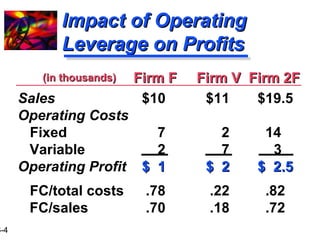
IImmppaacctt ooff OOppeerraattiinngg 
LLeevveerraaggee oonn PPrrooffiittss 
FFiirrmm FF FFiirrmm VV FFiirrmm 22FF 
((iinn tthhoouussaannddss)) 
Sales $10 $11 $19.5 
Operating Costs 
Fixed 7 2 14 
Variable 2 7 3 
Operating Profit $$ 11 $$ 22 $$ 22..55 
FC/total costs .78 .22 .82 
FC/sales .70 .18 .72
16-5 
IImmppaacctt ooff OOppeerraattiinngg 
LLeevveerraaggee oonn PPrrooffiittss 
 Now, subject each firm to a 5500%% 
iinnccrreeaassee iinn ssaalleess for next year. 
 Which firm do you think will be more 
““sseennssiittiivvee”” to the change in sales (i.e., 
show the largest percentage change in 
operating profit, EBIT)? 
[ ] FFiirrmm FF; [ ] FFiirrmm VV; [ ] FFiirrmm 22FF.
16-6 
IImmppaacctt ooff OOppeerraattiinngg 
LLeevveerraaggee oonn PPrrooffiittss 
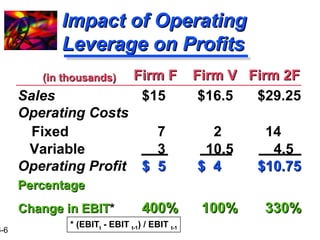
FFiirrmm FF FFiirrmm VV FFiirrmm 22FF 
((iinn tthhoouussaannddss)) 
Sales $15 $16.5 $29.25 
Operating Costs 
Fixed 7 2 14 
Variable 3 10.5 4.5 
Operating Profit $$ 55 $$ 44 $$1100..7755 
PPeerrcceennttaaggee 
CChhaannggee iinn EEBBIITT* 440000%% 110000%% 333300%% 
* (EBITt - EBIT t-1) / EBIT t-1
16-7 
IImmppaacctt ooff OOppeerraattiinngg 
LLeevveerraaggee oonn PPrrooffiittss 
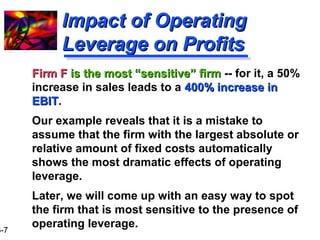
 FFiirrmm FF iiss tthhee mmoosstt ““sseennssiittiivvee”” ffiirrmm -- for it, a 50% 
increase in sales leads to a 440000%% iinnccrreeaassee iinn 
EEBBIITT. 
 Our example reveals that it is a mistake to 
assume that the firm with the largest absolute or 
relative amount of fixed costs automatically 
shows the most dramatic effects of operating 
leverage. 
 Later, we will come up with an easy way to spot 
the firm that is most sensitive to the presence of 
operating leverage.
16-8 
BBrreeaakk--EEvveenn AAnnaallyyssiiss 
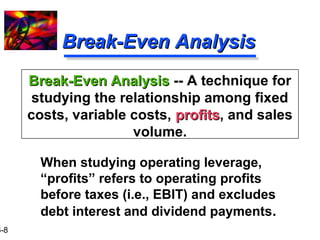
BBrreeaakk--EEvveenn AAnnaallyyssiiss -- A technique for 
studying the relationship among fixed 
costs, variable costs, pprrooffiittss, and sales 
volume. 
 When studying operating leverage, 
“profits” refers to operating profits 
before taxes (i.e., EBIT) and excludes 
debt interest and dividend payments.
16-9 
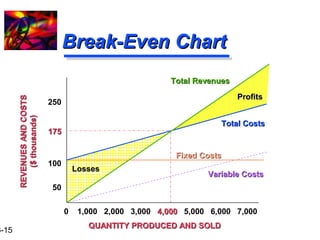
BBrreeaakk--EEvveenn CChhaarrtt 
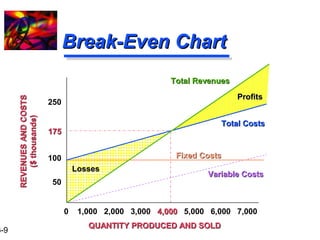
TToottaall RReevveennuueess 
0 1,000 2,000 3,000 44,,000000 5,000 6,000 7,000 
QQUUAANNTTIITTYY PPRROODDUUCCEEDD AANNDD SSOOLLDD 
PPrrooffiittss 
FFiixxeedd CCoossttss 
LLoosssseess VVaarriiaabbllee CCoossttss 
RREEVVEENNUUEESS AANNDD CCOOSSTTSS 
(($$ tthhoouussaannddss)) 
250 
117755 
100 
50 
TToottaall CCoossttss
16-10 
BBrreeaakk--EEvveenn 
((QQuuaannttiittyy)) PPooiinntt 
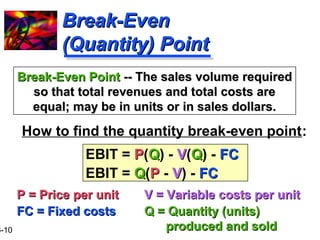
BBrreeaakk--EEvveenn PPooiinntt ---- TThhee ssaalleess vvoolluummee rreeqquuiirreedd 
ssoo tthhaatt ttoottaall rreevveennuueess aanndd ttoottaall ccoossttss aarree 
eeqquuaall;; mmaayy bbee iinn uunniittss oorr iinn ssaalleess ddoollllaarrss.. 
How to find the quantity break-even point: 
EBIT = PP(QQ) - VV(QQ) - FFCC 
EBIT = QQ(PP - VV) - FFCC 
PP == PPrriiccee ppeerr uunniitt VV == VVaarriiaabbllee ccoossttss ppeerr uunniitt 
FFCC == FFiixxeedd ccoossttss QQ == QQuuaannttiittyy ((uunniittss)) 
pprroodduucceedd aanndd ssoolldd
16-11 
BBrreeaakk--EEvveenn 
((QQuuaannttiittyy)) PPooiinntt 
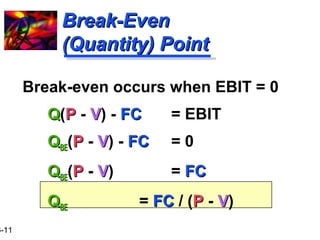
Break-even occurs when EBIT = 0 
QQ(PP - VV) - FFCC = EBIT 
QQBBEE(PP - VV) - FFCC = 0 
QQBBEE(PP - VV) = FFCC 
QQBBEE = FFCC / (PP - VV)
16-12 
BBrreeaakk--EEvveenn ((SSaalleess)) PPooiinntt 
How to find the sales break-even point: 
SSBBEE = FFCC + (VVCCBBEE) 
SSBBEE = FFCC + (QQBBEE )(VV) 
or 
SSBBEE 
** = FFCC / [1 - (VVCC / S) ] 
* Refer to text for derivation of the formula
16-13 
BBrreeaakk--EEvveenn PPooiinntt 
EExxaammppllee 
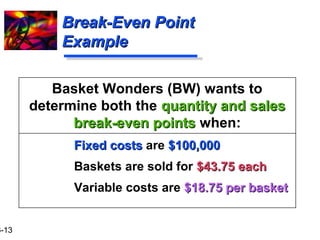
Basket Wonders (BW) wants to 
determine both the qquuaannttiittyy aanndd ssaalleess 
bbrreeaakk--eevveenn ppooiinnttss when: 
 FFiixxeedd ccoossttss are $$110000,,000000 
 Baskets are sold for $$4433..7755 eeaacchh 
 Variable costs are $$1188..7755 ppeerr bbaasskkeett
16-14 
BBrreeaakk--EEvveenn PPooiinntt ((ss)) 
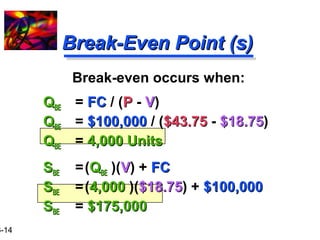
Break-even occurs when: 
QQBBEE = FFCC / (PP - VV) 
QQBBEE = $$110000,,000000 / ($$4433..7755 - $$1188..7755) 
QQBBEE = 44,,000000 UUnniittss 
SSBBEE = (QQBBEE )(VV) + FFCC 
SSBBEE = (44,,000000 )($$1188..7755) + $$110000,,000000 
SSBBEE = $$117755,,000000
16-15 
BBrreeaakk--EEvveenn CChhaarrtt 
TToottaall RReevveennuueess 
0 1,000 2,000 3,000 44,,000000 5,000 6,000 7,000 
QQUUAANNTTIITTYY PPRROODDUUCCEEDD AANNDD SSOOLLDD 
PPrrooffiittss 
FFiixxeedd CCoossttss 
LLoosssseess VVaarriiaabbllee CCoossttss 
RREEVVEENNUUEESS AANNDD CCOOSSTTSS 
(($$ tthhoouussaannddss)) 
250 
117755 
100 
50 
TToottaall CCoossttss
16-16 
DDeeggrreeee ooff OOppeerraattiinngg 
LLeevveerraaggee ((DDOOLL)) 
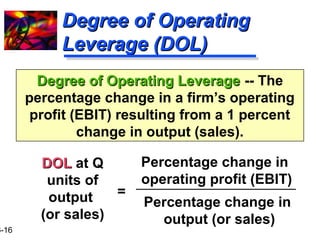
DDeeggrreeee ooff OOppeerraattiinngg LLeevveerraaggee -- The 
percentage change in a firm’s operating 
profit (EBIT) resulting from a 1 percent 
change in output (sales). 
DDOOLL at Q 
units of 
output 
(or sales) 
= 
Percentage change in 
operating profit (EBIT) 
Percentage change in 
output (or sales)
16-17 
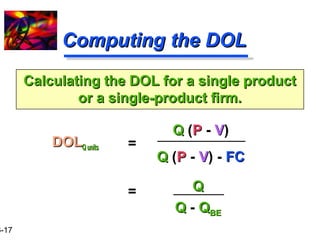
CCoommppuuttiinngg tthhee DDOOLL 
CCaallccuullaattiinngg tthhee DDOOLL ffoorr aa ssiinnggllee pprroodduucctt 
oorr aa ssiinnggllee--pprroodduucctt ffiirrmm.. 
DDOOLLQQ uunniittss 
= 
QQ (PP - VV) 
QQ (PP - VV) - FFCC 
= QQ 
QQ - QQBBEE
16-18 
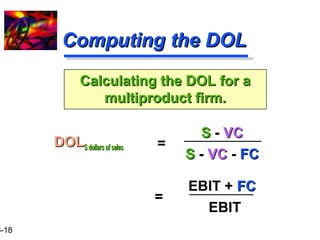
CCoommppuuttiinngg tthhee DDOOLL 
CCaallccuullaattiinngg tthhee DDOOLL ffoorr aa 
mmuullttiipprroodduucctt ffiirrmm.. 
DDOOLLSS ddoollllaarrss ooff ssaalleess 
= SS - VC 
SS - VVCC - FFCC 
= 
EBIT + FFCC 
EBIT
16-19 
BBrreeaakk--EEvveenn 
PPooiinntt EExxaammppllee 
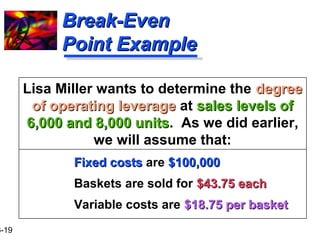
Lisa Miller wants to determine the ddeeggrreeee 
ooff ooppeerraattiinngg lleevveerraaggee at ssaalleess lleevveellss ooff 
66,000000 aanndd 88,000000 uunniittss. As we did earlier, 
we will assume that: 
FFiixxeedd ccoossttss are $$110000,000000 
Baskets are sold for $$433..7755 eeaacchh 
Variable costs are $$1188..7755 ppeerr bbaasskkeett
16-20 
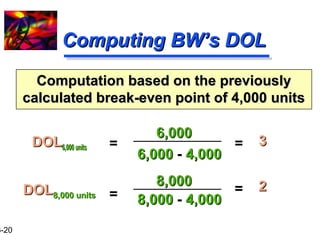
CCoommppuuttiinngg BBWW’’ss DDOOLL 
CCoommppuuttaattiioonn bbaasseedd oonn tthhee pprreevviioouussllyy 
ccaallccuullaatteedd bbrreeaakk--eevveenn ppooiinntt ooff 4,000000 uunniittss 
DDOOLL66,000000 uunniittss 
= 6,000 
66,000000 - 4,000000 
= 
= 33 
DDOOLL88,000000 uunniittss 
88,000000 
88,000000 - 4,000000 
= 22
16-21 
IInntteerrpprreettaattiioonn ooff tthhee DDOOLL 
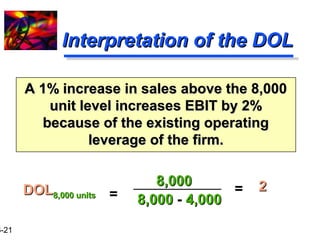
AA 11%% iinnccrreeaassee iinn ssaalleess aabboovvee tthhee 88,000000 
uunniitt lleevveell iinnccrreeaasseess EEBBIITT bbyy 22%% 
bbeeccaauussee ooff tthhee eexxiissttiinngg ooppeerraattiinngg 
lleevveerraaggee ooff tthhee ffiirrmm.. 
DDOOLL = 88,000000 uunniittss 
88,000000 
88,000000 - 4,000000 
= 22
16-22 
IInntteerrpprreettaattiioonn ooff tthhee DDOOLL 
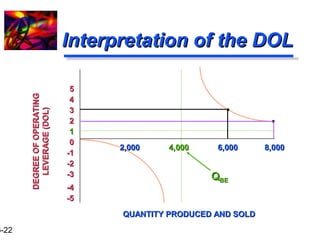
22,000000 4,000000 66,000000 88,000000 
55 
4 
33 
22 
11 
QQUUAANNTTIITTYY PPRROODDUUCCEEDD AANNDD SSOOLLDD 
00 
--11 
--22 
--33 
--4 
-5 DEGREE OF OPERATING 
LLEEVVEERRAAGGEE ((DDOOLL)) 
QQBBEE
16-23 
IInntteerrpprreettaattiioonn ooff tthhee DDOOLL 
KKeeyy CCoonncclluussiioonnss ttoo bbee DDrraawwnn ffrroomm sslliiddee 
1166--2222 aanndd oouurr DDiissccuussssiioonn ooff DDOOLL 
DOL is a quantitative measure of the “sensitivity” 
of a firm’s operating profit to a change in the 
firm’s sales. 
The closer that a firm operates to its break-even 
point, the higher is the absolute value of its DOL. 
When comparing firms, the firm with the highest 
DOL is the firm that will be most “sensitive” to a 
change in sales.
16-24 
DDOOLL aanndd BBuussiinneessss RRiisskk 
BBuussiinneessss RRiisskk ---- TThhee iinnhheerreenntt uunncceerrttaaiinnttyy 
iinn tthhee pphhyyssiiccaall ooppeerraattiioonnss ooff tthhee ffiirrmm.. IIttss 
iimmppaacctt iiss sshhoowwnn iinn tthhee vvaarriiaabbiilliittyy ooff tthhee 
ffiirrmm’’ss ooppeerraattiinngg iinnccoommee ((EEBBIITT)).. 
DOL is only oonnee ccoommppoonneenntt of business risk 
and becomes “active” oonnllyy iinn tthhee pprreesseennccee 
ooff ssaalleess aanndd pprroodduuccttiioonn ccoosstt vvaarriiaabbiilliittyy. 
DOL mmaaggnniiffiieess the variability of operating 
profits and, hence, business risk.
16-25 
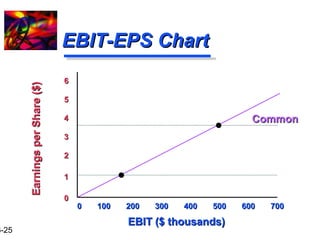
EEBBIITT--EEPPSS CChhaarrtt 
00 110000 220000 330000 40000 550000 660000 770000 
EEBBIITT (($$ tthhoouussaannddss)) 
66 
Earnings per Share ($) 00 
55 
4 
33 
22 
11 
CCoommmmoonn
16-26 
FFiinnaanncciiaall LLeevveerraaggee 
FFiinnaanncciiaall LLeevveerraaggee ---- TThhee uussee ooff 
ffiixxeedd ffiinnaanncciinngg ccoossttss bbyy tthhee ffiirrmm.. 
TThhee BBrriittiisshh eexxpprreessssiioonn iiss ggeeaarriinngg.. 
Financial leverage is acquired by 
choice. 
Used as a means of increasing the 
return to common shareholders.
16-27 
EEBBIITT--EEPPSS BBrreeaakk--EEvveenn,, 
oorr IInnddiiffffeerreennccee,, AAnnaallyyssiiss 
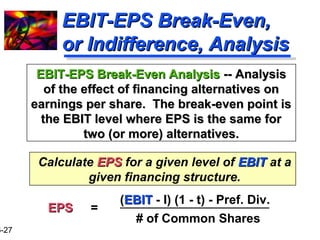
EEBBIITT--EEPPSS BBrreeaakk--EEvveenn AAnnaallyyssiiss ---- AAnnaallyyssiiss 
ooff tthhee eeffffeecctt ooff ffiinnaanncciinngg aalltteerrnnaattiivveess oonn 
eeaarrnniinnggss ppeerr sshhaarree.. TThhee bbrreeaakk--eevveenn ppooiinntt iiss 
tthhee EEBBIITT lleevveell wwhheerree EEPPSS iiss tthhee ssaammee ffoorr 
ttwwoo ((oorr mmoorree)) aalltteerrnnaattiivveess.. 
Calculate EEPPSS for a given level of EEBBIITT at a 
given financing structure. 
(EEBBIITT - I) (1 - t) - Pref. Div. 
# of Common Shares 
EEPPSS =
16-28 
EEBBIITT--EEPPSS CChhaarrtt 
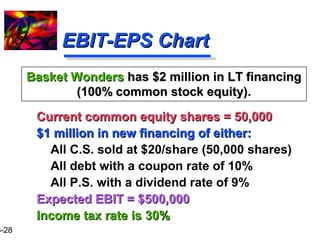
BBaasskkeett WWoonnddeerrss hhaass $$22 mmiilllliioonn iinn LLTT ffiinnaanncciinngg 
((110000%% ccoommmmoonn ssttoocckk eeqquuiittyy)).. 
CCuurrrreenntt ccoommmmoonn eeqquuiittyy sshhaarreess == 5500,000000 
$$11 mmiilllliioonn iinn nneeww ffiinnaanncciinngg ooff eeiitthheerr:: 
All C.S. sold at $20/share (50,000 shares) 
All debt with a coupon rate of 10% 
All P.S. with a dividend rate of 9% 
EExxppeecctteedd EEBBIITT == $$550000,000000 
IInnccoommee ttaaxx rraattee iiss 3300%%
16-29 
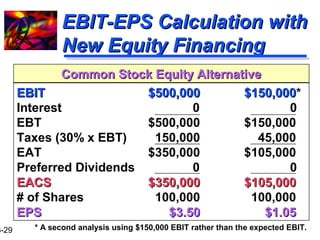
EEBBIITT--EEPPSS CCaallccuullaattiioonn wwiitthh 
NNeeww EEqquuiittyy FFiinnaanncciinngg 
CCoommmmoonn SSttoocckk EEqquuiittyy AAlltteerrnnaattiivvee 
EEBBIITT $$550000,000000 $$115500,000000* 
Interest 0 0 
EBT $500,000 $150,000 
Taxes (30% x EBT) 150,000 45,000 
EAT $350,000 $105,000 
Preferred Dividends 0 0 
EEAACCSS $$335500,000000 $$110055,000000 
# of Shares 100,000 100,000 
EEPPSS $$33..5500 $$11..0055 
* A second analysis using $150,000 EBIT rather than the expected EBIT.
16-30 
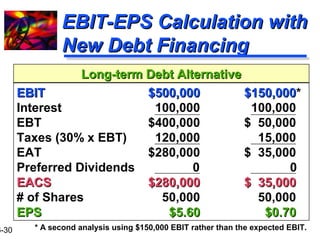
EEBBIITT--EEPPSS CCaallccuullaattiioonn wwiitthh 
NNeeww DDeebbtt FFiinnaanncciinngg 
LLoonngg--tteerrmm DDeebbtt AAlltteerrnnaattiivvee 
EEBBIITT $$550000,000000 $$115500,000000* 
Interest 100,000 100,000 
EBT $400,000 $ 50,000 
Taxes (30% x EBT) 120,000 15,000 
EAT $280,000 $ 35,000 
Preferred Dividends 0 0 
EEAACCSS $$228800,000000 $$ 3355,000000 
# of Shares 50,000 50,000 
EEPPSS $$55..6600 $$00..7700 
* A second analysis using $150,000 EBIT rather than the expected EBIT.
16-31 
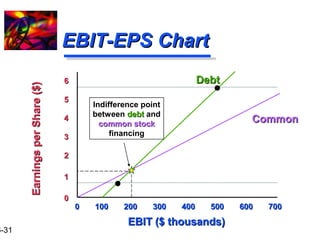
EEBBIITT--EEPPSS CChhaarrtt 
00 110000 220000 330000 440000 550000 660000 770000 
EEBBIITT (($$ tthhoouussaannddss)) 
66 
Earnings per Share ($) 00 
55 
44 
33 
22 
11 
CCoommmmoonn 
DDeebbtt 
Indifference point 
between ddeebbtt and 
ccoommmmoonn ssttoocckk 
financing
16-32 
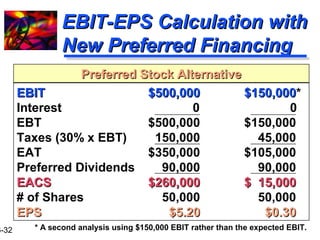
EEBBIITT--EEPPSS CCaallccuullaattiioonn wwiitthh 
NNeeww PPrreeffeerrrreedd FFiinnaanncciinngg 
PPrreeffeerrrreedd SSttoocckk AAlltteerrnnaattiivvee 
EEBBIITT $$550000,,000000 $$115500,,000000* 
Interest 0 0 
EBT $500,000 $150,000 
Taxes (30% x EBT) 150,000 45,000 
EAT $350,000 $105,000 
Preferred Dividends 90,000 90,000 
EEAACCSS $$226600,,000000 $$ 1155,,000000 
# of Shares 50,000 50,000 
EEPPSS $$55..2200 $$00..3300 
* A second analysis using $150,000 EBIT rather than the expected EBIT.
16-33 
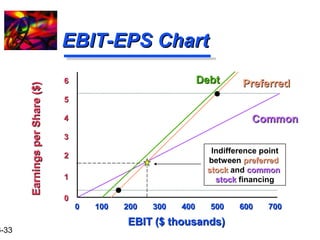
EEBBIITT--EEPPSS CChhaarrtt 
PPrreeffeerrrreedd 
0 100 200 330000 440000 550000 660000 770000 
EEBBIITT (($$ tthhoouussaannddss)) 
66 
Earnings per Share ($) 00 
55 
44 
33 
22 
11 
CCoommmmoonn 
DDeebbtt 
Indifference point 
between pprreeffeerrrreedd 
ssttoocckk and ccoommmmoonn 
ssttoocckk financing
16-34 
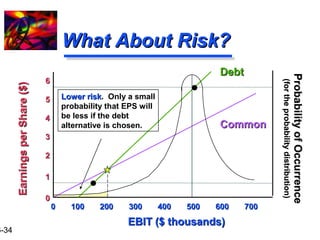
WWhhaatt AAbboouutt RRiisskk?? 
66 
DDeebbtt 
EBIT ($ thousands) Earnings per Share ($) 
00 110000 220000 330000 440000 550000 660000 770000 
55 
44 
33 
22 
11 
00 
CCoommmmoonn 
LLoowweerr rriisskk. Only a small 
probability that EPS will 
be less if the debt 
alternative is chosen. 
Probability of Occurrence 
((for the probability distribution)
16-35 
WWhhaatt AAbboouutt RRiisskk?? 
66 
DDeebbtt 
EBIT ($ thousands) Earnings per Share ($) 
00 110000 220000 330000 440000 550000 660000 770000 
55 
44 
33 
22 
11 
00 
CCoommmmoonn 
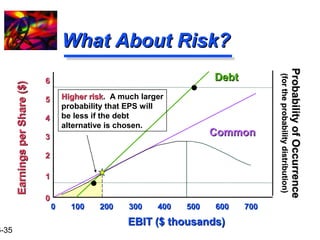
HHiigghheerr rriisskk. A much larger 
probability that EPS will 
be less if the debt 
alternative is chosen. 
Probability of Occurrence 
((for the probability distribution)
16-36 
DDeeggrreeee ooff FFiinnaanncciiaall 
LLeevveerraaggee ((DDFFLL)) 
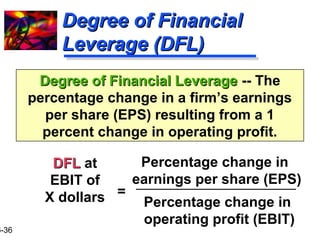
DDeeggrreeee ooff FFiinnaanncciiaall LLeevveerraaggee -- The 
percentage change in a firm’s earnings 
per share (EPS) resulting from a 1 
percent change in operating profit. 
DDFFLL at 
EBIT of 
X dollars 
= 
Percentage change in 
earnings per share (EPS) 
Percentage change in 
operating profit (EBIT)
16-37 
CCoommppuuttiinngg tthhee DDFFLL 
DDFFLL EBIT of $X 
CCaallccuullaattiinngg tthhee DDFFLL 
= EBIT 
EEBBIITT - II - [ PPDD / (1 - tt) ] 
EEBBIITT == EEaarrnniinnggss bbeeffoorree iinntteerreesstt aanndd ttaaxxeess 
II == IInntteerreesstt 
PPDD == PPrreeffeerrrreedd ddiivviiddeennddss 
tt == CCoorrppoorraattee ttaaxx rraattee
16-38 
WWhhaatt iiss tthhee DDFFLL ffoorr EEaacchh 
ooff tthhee FFiinnaanncciinngg CChhooiicceess?? 
CCaallccuullaattiinngg tthhee DDFFLL ffoorr NNEEWW eeqquuiittyy* aalltteerrnnaattiivvee 
DDFFLL $$550000,,000000 
= $500,000 
$$550000,,000000 - 00 - [00 / (1 - 00)] 
= 11..0000 
* The calculation is based on the expected EBIT
16-39 
WWhhaatt iiss tthhee DDFFLL ffoorr EEaacchh 
ooff tthhee FFiinnaanncciinngg CChhooiicceess?? 
CCaallccuullaattiinngg tthhee DDFFLL ffoorr NNEEWW ddeebbtt * aalltteerrnnaattiivvee 
DDFFLL $$550000,,000000 
= $500,000 
{{ $$550000,,000000 - 110000,,000000 
- [00 / (1 - 00)] } 
= $$550000,,000000 / $400,000 
= 11..2255 
* The calculation is based on the expected EBIT
CCaallccuullaattiinngg tthhee DDFFLL ffoorr NNEEWW pprreeffeerrrreedd * aalltteerrnnaattiivvee 
16-40 
WWhhaatt iiss tthhee DDFFLL ffoorr EEaacchh 
ooff tthhee FFiinnaanncciinngg CChhooiicceess?? 
DDFFLL $$550000,,000000 
= $500,000 
{{ $$550000,,000000 - 00 
- [9900,,000000 / (1 - ..3300)] } 
= $$550000,,000000 / $400,000 
= 11..3355 
* The calculation is based on the expected EBIT
16-41 
VVaarriiaabbiilliittyy ooff EEPPSS 
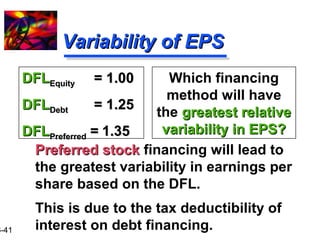
DDFFLLEEqquuiittyy == 11..0000 
DDFFLLDDeebbtt == 11..2255 
DDFFLLPPrreeffeerrrreedd == 11..3355 
Which financing 
method will have 
the ggrreeaatteesstt rreellaattiivvee 
vvaarriiaabbiilliittyy iinn EEPPSS?? 
PPrreeffeerrrreedd ssttoocckk financing will lead to 
the greatest variability in earnings per 
share based on the DFL. 
 This is due to the tax deductibility of 
interest on debt financing.
16-42 
FFiinnaanncciiaall RRiisskk 
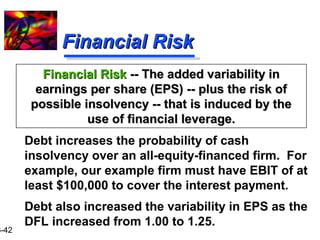
FFiinnaanncciiaall RRiisskk ---- TThhee aaddddeedd vvaarriiaabbiilliittyy iinn 
eeaarrnniinnggss ppeerr sshhaarree ((EEPPSS)) ---- pplluuss tthhee rriisskk ooff 
ppoossssiibbllee iinnssoollvveennccyy ---- tthhaatt iiss iinndduucceedd bbyy tthhee 
uussee ooff ffiinnaanncciiaall lleevveerraaggee.. 
 Debt increases the probability of cash 
insolvency over an all-equity-financed firm. For 
example, our example firm must have EBIT of at 
least $100,000 to cover the interest payment. 
 Debt also increased the variability in EPS as the 
DFL increased from 1.00 to 1.25.
16-43 
TToottaall FFiirrmm RRiisskk 
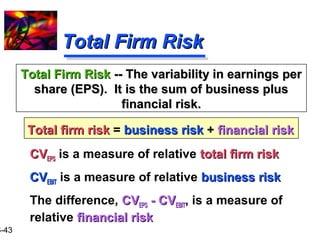
TToottaall FFiirrmm RRiisskk ---- TThhee vvaarriiaabbiilliittyy iinn eeaarrnniinnggss ppeerr 
sshhaarree ((EEPPSS)).. IItt iiss tthhee ssuumm ooff bbuussiinneessss pplluuss 
ffiinnaanncciiaall rriisskk.. 
TToottaall ffiirrmm rriisskk = bbuussiinneessss rriisskk + ffiinnaanncciiaall rriisskk 
CCVVEEPPSS is a measure of relative ttoottaall ffiirrmm rriisskk 
CCVVEEBBIITT is a measure of relative bbuussiinneessss rriisskk 
The difference, CCVVEEPPSS -- CCVVEEBBIITT, is a measure of 
relative ffiinnaanncciiaall rriisskk
16-44 
DDeeggrreeee ooff TToottaall 
LLeevveerraaggee ((DDTTLL)) 
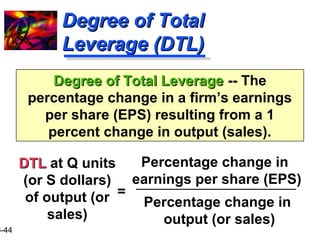
DDeeggrreeee ooff TToottaall LLeevveerraaggee -- The 
percentage change in a firm’s earnings 
per share (EPS) resulting from a 1 
percent change in output (sales). 
DDTTLL at Q units 
(or S dollars) 
of output (or 
sales) 
= 
Percentage change in 
earnings per share (EPS) 
Percentage change in 
output (or sales)
16-45 
CCoommppuuttiinngg tthhee DDTTLL 
DDTTLL QQ uunniittss ((oorr SS ddoollllaarrss)) = ( DDOOLL QQ uunniittss ((oorr SS ddoollllaarrss)) ) 
DDTTLL S dollars 
of sales 
x ( DDFFLL EEBBIITT ooff XX ddoollllaarrss ) 
= EBIT + FC 
EEBBIITT - II - [ PPDD / (1 - tt) ] 
DDTTLL Q units 
QQ (PP -- VV) 
QQ (PP -- VV) - FC - II - [ PPDD / (1 - tt) ] 
=
16-46 
DDTTLL EExxaammppllee 
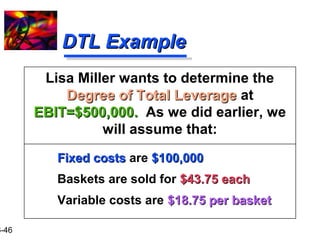
Lisa Miller wants to determine the 
DDeeggrreeee ooff TToottaall LLeevveerraaggee at 
EEBBIITT==$$550000,,000000.. As we did earlier, we 
will assume that: 
FFiixxeedd ccoossttss are $$110000,,000000 
Baskets are sold for $$4433..7755 eeaacchh 
Variable costs are $$1188..7755 ppeerr bbaasskkeett
16-47 
CCoommppuuttiinngg tthhee DDTTLL 
ffoorr AAllll--EEqquuiittyy FFiinnaanncciinngg 
DDTTLLSS ddoollllaarrss = (DDOOLL SS ddoollllaarrss) x (DDFFLLEEBBIITT ooff $$SS ) 
DDTTLLSS ddoollllaarrss = (11..22 ) x ( 11..00* ) = 11..2200 
DDTTLL S dollars 
of sales 
= 
$$550000,,000000 + $100,000 
$$550000,,000000 - 00 - [ 00 / (1 - ..33) ] 
= 11..2200 
*Note: No financial leverage.
16-48 
CCoommppuuttiinngg tthhee DDTTLL 
ffoorr DDeebbtt FFiinnaanncciinngg 
DDTTLLSS ddoollllaarrss = (DDOOLL SS ddoollllaarrss) x (DDFFLLEEBBIITT ooff $$SS ) 
DDTTLLSS ddoollllaarrss = (11..22 ) x ( 11..2255* ) = 11..5500 
DDTTLL S dollars 
of sales 
= 
$$550000,,000000 + $100,000 
{ $$550000,,000000 - $$110000,,000000 
- [ 00 / (1 - ..33) ] } 
= 11..5500 
*Note: Calculated on Slide 39.
16-49 
RRiisskk vveerrssuuss RReettuurrnn 
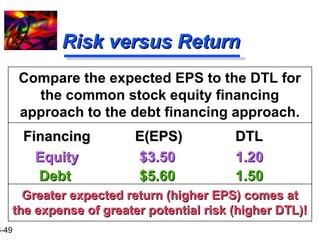
Compare the expected EPS to the DTL for 
the common stock equity financing 
approach to the debt financing approach. 
FFiinnaanncciinngg EE((EEPPSS)) DDTTLL 
EEqquuiittyy $$33..5500 11..2200 
DDeebbtt $$55..6600 11..5500 
GGrreeaatteerr eexxppeecctteedd rreettuurrnn ((hhiigghheerr EEPPSS)) ccoommeess aatt 
tthhee eexxppeennssee ooff ggrreeaatteerr ppootteennttiiaall rriisskk ((hhiigghheerr DDTTLL))!!
16-50 
WWhhaatt iiss aann AApppprroopprriiaattee 
AAmmoouunntt ooff FFiinnaanncciiaall LLeevveerraaggee?? 
DDeebbtt CCaappaacciittyy ---- TThhee mmaaxxiimmuumm aammoouunntt ooff ddeebbtt 
((aanndd ootthheerr ffiixxeedd--cchhaarrggee ffiinnaanncciinngg)) tthhaatt aa ffiirrmm 
ccaann aaddeeqquuaatteellyy sseerrvviiccee.. 
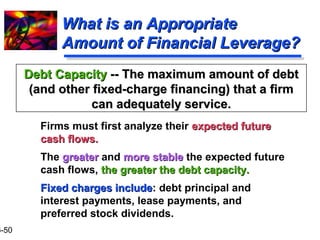
Firms must first analyze their eexxppeecctteedd ffuuttuurree 
ccaasshh fflloowwss.. 
The ggrreeaatteerr and mmoorree ssttaabbllee the expected future 
cash flows, tthhee ggrreeaatteerr tthhee ddeebbtt ccaappaacciittyy.. 
FFiixxeedd cchhaarrggeess iinncclluuddee: debt principal and 
interest payments, lease payments, and 
preferred stock dividends.
16-51 
CCoovveerraaggee RRaattiiooss 
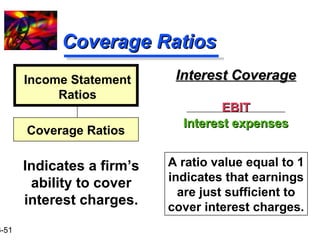
IInntteerreesstt CCoovveerraaggee 
EEBBIITT 
IInntteerreesstt eexxppeennsseess 
Income Statement 
Ratios 
Coverage Ratios 
Indicates a firm’s 
ability to cover 
interest charges. 
A ratio value equal to 1 
indicates that earnings 
are just sufficient to 
cover interest charges.
16-52 
CCoovveerraaggee RRaattiiooss 
DDeebbtt--sseerrvviiccee CCoovveerraaggee 
EEBBIITT 
{ IInntteerreesstt eexxppeennsseess + 
[PPrriinncciippaall ppaayymmeennttss // ((11--tt)) ] } 
Income Statement 
Ratios 
Coverage Ratios 
Indicates a firm’s 
ability to cover 
interest expenses and 
principal payments. 
Allows us to examine the 
ability of the firm to meet 
all of its debt payments. 
Failure to make principal 
payments is also default.
16-53 
CCoovveerraaggee EExxaammppllee 
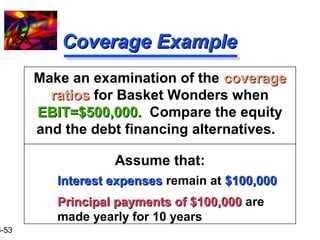
Make an examination of the ccoovveerraaggee 
rraattiiooss for Basket Wonders when 
EEBBIITT==$$550000,,000000.. Compare the equity 
and the debt financing alternatives. 
Assume that: 
IInntteerreesstt eexxppeennsseess remain at $$110000,,000000 
PPrriinncciippaall ppaayymmeennttss ooff $$110000,,000000 are 
made yearly for 10 years
16-54 
CCoovveerraaggee EExxaammppllee 
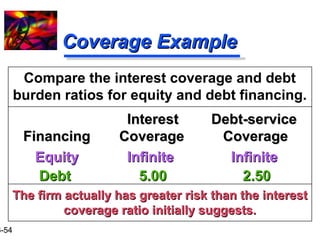
Compare the interest coverage and debt 
burden ratios for equity and debt financing. 
IInntteerreesstt DDeebbtt--sseerrvviiccee 
FFiinnaanncciinngg CCoovveerraaggee CCoovveerraaggee 
EEqquuiittyy IInnffiinniittee IInnffiinniittee 
DDeebbtt 55..0000 22..5500 
TThhee ffiirrmm aaccttuuaallllyy hhaass ggrreeaatteerr rriisskk tthhaann tthhee iinntteerreesstt 
ccoovveerraaggee rraattiioo iinniittiiaallllyy ssuuggggeessttss..
16-55 
SSuummmmaarryy ooff tthhee CCoovveerraaggee 
RRaattiioo DDiissccuussssiioonn 
 The debt-service coverage ratio accounts 
for required annual principal payments. 
 A single ratio value cannot be interpreted 
identically for all firms as some firms have 
greater debt capacity. 
 Annual financial lease payments should be 
added to both the numerator and 
denominator of the debt-service coverage 
ratio as financial leases are similar to debt.
16-56 
OOtthheerr MMeetthhooddss ooff AAnnaallyyssiiss 
CCaappiittaall SSttrruuccttuurree ---- TThhee mmiixx ((oorr pprrooppoorrttiioonn)) ooff aa 
ffiirrmm’’ss ppeerrmmaanneenntt lloonngg--tteerrmm ffiinnaanncciinngg 
rreepprreesseenntteedd bbyy ddeebbtt,, pprreeffeerrrreedd ssttoocckk,, aanndd 
ccoommmmoonn ssttoocckk eeqquuiittyy.. 
 Often, firms are compared to peer institutions in the 
same industry. 
 Large deviations from norms must be justified. 
 For example, an industry’s median debt-to-net-worth 
ratio might be used as a benchmark for financial 
leverage comparisons.
16-57 
OOtthheerr MMeetthhooddss ooff AAnnaallyyssiiss 
SSuurrvveeyyiinngg IInnvveessttmmeenntt AAnnaallyyssttss aanndd LLeennddeerrss 
 Firms may gain insight into the financial 
markets’ evaluation of their firm by 
talking with: 
 Investment bankers 
 Institutional investors 
 Investment analysts 
 Lenders
16-58 
OOtthheerr MMeetthhooddss ooff AAnnaallyyssiiss 
SSeeccuurriittyy RRaattiinnggss 
 Firms must consider the impact 
of any financing decision on the 
firm’s security rating (s).

Operating and Financial Leverage

  • 1.
    16-1 CChhaapptteerr 1166 OOppeerraattiinngg aanndd FFiinnaanncciiaall LLeevveerraaggee
  • 2.
    16-2 OOppeerraattiinngg aanndd FFiinnaanncciiaall LLeevveerraaggee Operating Leverage Financial Leverage Total Leverage Cash-Flow Ability to Service Debt Other Methods of Analysis Combination of Methods
  • 3.
    16-3 OOppeerraattiinngg LLeevveerraaggee OOppeerraattiinngg LLeevveerraaggee ---- TThhee uussee ooff ffiixxeedd ooppeerraattiinngg ccoossttss bbyy tthhee ffiirrmm.. One potential “effect” caused by the presence of operating leverage is that a change in the volume of sales results in a “more than proportional” change in operating profit (or loss).
  • 4.
    16-4 IImmppaacctt ooffOOppeerraattiinngg LLeevveerraaggee oonn PPrrooffiittss FFiirrmm FF FFiirrmm VV FFiirrmm 22FF ((iinn tthhoouussaannddss)) Sales $10 $11 $19.5 Operating Costs Fixed 7 2 14 Variable 2 7 3 Operating Profit $$ 11 $$ 22 $$ 22..55 FC/total costs .78 .22 .82 FC/sales .70 .18 .72
  • 5.
    16-5 IImmppaacctt ooffOOppeerraattiinngg LLeevveerraaggee oonn PPrrooffiittss Now, subject each firm to a 5500%% iinnccrreeaassee iinn ssaalleess for next year. Which firm do you think will be more ““sseennssiittiivvee”” to the change in sales (i.e., show the largest percentage change in operating profit, EBIT)? [ ] FFiirrmm FF; [ ] FFiirrmm VV; [ ] FFiirrmm 22FF.
  • 6.
    16-6 IImmppaacctt ooffOOppeerraattiinngg LLeevveerraaggee oonn PPrrooffiittss FFiirrmm FF FFiirrmm VV FFiirrmm 22FF ((iinn tthhoouussaannddss)) Sales $15 $16.5 $29.25 Operating Costs Fixed 7 2 14 Variable 3 10.5 4.5 Operating Profit $$ 55 $$ 44 $$1100..7755 PPeerrcceennttaaggee CChhaannggee iinn EEBBIITT* 440000%% 110000%% 333300%% * (EBITt - EBIT t-1) / EBIT t-1
  • 7.
    16-7 IImmppaacctt ooffOOppeerraattiinngg LLeevveerraaggee oonn PPrrooffiittss FFiirrmm FF iiss tthhee mmoosstt ““sseennssiittiivvee”” ffiirrmm -- for it, a 50% increase in sales leads to a 440000%% iinnccrreeaassee iinn EEBBIITT. Our example reveals that it is a mistake to assume that the firm with the largest absolute or relative amount of fixed costs automatically shows the most dramatic effects of operating leverage. Later, we will come up with an easy way to spot the firm that is most sensitive to the presence of operating leverage.
  • 8.
    16-8 BBrreeaakk--EEvveenn AAnnaallyyssiiss BBrreeaakk--EEvveenn AAnnaallyyssiiss -- A technique for studying the relationship among fixed costs, variable costs, pprrooffiittss, and sales volume. When studying operating leverage, “profits” refers to operating profits before taxes (i.e., EBIT) and excludes debt interest and dividend payments.
  • 9.
    16-9 BBrreeaakk--EEvveenn CChhaarrtt TToottaall RReevveennuueess 0 1,000 2,000 3,000 44,,000000 5,000 6,000 7,000 QQUUAANNTTIITTYY PPRROODDUUCCEEDD AANNDD SSOOLLDD PPrrooffiittss FFiixxeedd CCoossttss LLoosssseess VVaarriiaabbllee CCoossttss RREEVVEENNUUEESS AANNDD CCOOSSTTSS (($$ tthhoouussaannddss)) 250 117755 100 50 TToottaall CCoossttss
  • 10.
    16-10 BBrreeaakk--EEvveenn ((QQuuaannttiittyy))PPooiinntt BBrreeaakk--EEvveenn PPooiinntt ---- TThhee ssaalleess vvoolluummee rreeqquuiirreedd ssoo tthhaatt ttoottaall rreevveennuueess aanndd ttoottaall ccoossttss aarree eeqquuaall;; mmaayy bbee iinn uunniittss oorr iinn ssaalleess ddoollllaarrss.. How to find the quantity break-even point: EBIT = PP(QQ) - VV(QQ) - FFCC EBIT = QQ(PP - VV) - FFCC PP == PPrriiccee ppeerr uunniitt VV == VVaarriiaabbllee ccoossttss ppeerr uunniitt FFCC == FFiixxeedd ccoossttss QQ == QQuuaannttiittyy ((uunniittss)) pprroodduucceedd aanndd ssoolldd
  • 11.
    16-11 BBrreeaakk--EEvveenn ((QQuuaannttiittyy))PPooiinntt Break-even occurs when EBIT = 0 QQ(PP - VV) - FFCC = EBIT QQBBEE(PP - VV) - FFCC = 0 QQBBEE(PP - VV) = FFCC QQBBEE = FFCC / (PP - VV)
  • 12.
    16-12 BBrreeaakk--EEvveenn ((SSaalleess))PPooiinntt How to find the sales break-even point: SSBBEE = FFCC + (VVCCBBEE) SSBBEE = FFCC + (QQBBEE )(VV) or SSBBEE ** = FFCC / [1 - (VVCC / S) ] * Refer to text for derivation of the formula
  • 13.
    16-13 BBrreeaakk--EEvveenn PPooiinntt EExxaammppllee Basket Wonders (BW) wants to determine both the qquuaannttiittyy aanndd ssaalleess bbrreeaakk--eevveenn ppooiinnttss when: FFiixxeedd ccoossttss are $$110000,,000000 Baskets are sold for $$4433..7755 eeaacchh Variable costs are $$1188..7755 ppeerr bbaasskkeett
  • 14.
    16-14 BBrreeaakk--EEvveenn PPooiinntt((ss)) Break-even occurs when: QQBBEE = FFCC / (PP - VV) QQBBEE = $$110000,,000000 / ($$4433..7755 - $$1188..7755) QQBBEE = 44,,000000 UUnniittss SSBBEE = (QQBBEE )(VV) + FFCC SSBBEE = (44,,000000 )($$1188..7755) + $$110000,,000000 SSBBEE = $$117755,,000000
  • 15.
    16-15 BBrreeaakk--EEvveenn CChhaarrtt TToottaall RReevveennuueess 0 1,000 2,000 3,000 44,,000000 5,000 6,000 7,000 QQUUAANNTTIITTYY PPRROODDUUCCEEDD AANNDD SSOOLLDD PPrrooffiittss FFiixxeedd CCoossttss LLoosssseess VVaarriiaabbllee CCoossttss RREEVVEENNUUEESS AANNDD CCOOSSTTSS (($$ tthhoouussaannddss)) 250 117755 100 50 TToottaall CCoossttss
  • 16.
    16-16 DDeeggrreeee ooffOOppeerraattiinngg LLeevveerraaggee ((DDOOLL)) DDeeggrreeee ooff OOppeerraattiinngg LLeevveerraaggee -- The percentage change in a firm’s operating profit (EBIT) resulting from a 1 percent change in output (sales). DDOOLL at Q units of output (or sales) = Percentage change in operating profit (EBIT) Percentage change in output (or sales)
  • 17.
    16-17 CCoommppuuttiinngg tthheeDDOOLL CCaallccuullaattiinngg tthhee DDOOLL ffoorr aa ssiinnggllee pprroodduucctt oorr aa ssiinnggllee--pprroodduucctt ffiirrmm.. DDOOLLQQ uunniittss = QQ (PP - VV) QQ (PP - VV) - FFCC = QQ QQ - QQBBEE
  • 18.
    16-18 CCoommppuuttiinngg tthheeDDOOLL CCaallccuullaattiinngg tthhee DDOOLL ffoorr aa mmuullttiipprroodduucctt ffiirrmm.. DDOOLLSS ddoollllaarrss ooff ssaalleess = SS - VC SS - VVCC - FFCC = EBIT + FFCC EBIT
  • 19.
    16-19 BBrreeaakk--EEvveenn PPooiinnttEExxaammppllee Lisa Miller wants to determine the ddeeggrreeee ooff ooppeerraattiinngg lleevveerraaggee at ssaalleess lleevveellss ooff 66,000000 aanndd 88,000000 uunniittss. As we did earlier, we will assume that: FFiixxeedd ccoossttss are $$110000,000000 Baskets are sold for $$433..7755 eeaacchh Variable costs are $$1188..7755 ppeerr bbaasskkeett
  • 20.
    16-20 CCoommppuuttiinngg BBWW’’ssDDOOLL CCoommppuuttaattiioonn bbaasseedd oonn tthhee pprreevviioouussllyy ccaallccuullaatteedd bbrreeaakk--eevveenn ppooiinntt ooff 4,000000 uunniittss DDOOLL66,000000 uunniittss = 6,000 66,000000 - 4,000000 = = 33 DDOOLL88,000000 uunniittss 88,000000 88,000000 - 4,000000 = 22
  • 21.
    16-21 IInntteerrpprreettaattiioonn oofftthhee DDOOLL AA 11%% iinnccrreeaassee iinn ssaalleess aabboovvee tthhee 88,000000 uunniitt lleevveell iinnccrreeaasseess EEBBIITT bbyy 22%% bbeeccaauussee ooff tthhee eexxiissttiinngg ooppeerraattiinngg lleevveerraaggee ooff tthhee ffiirrmm.. DDOOLL = 88,000000 uunniittss 88,000000 88,000000 - 4,000000 = 22
  • 22.
    16-22 IInntteerrpprreettaattiioonn oofftthhee DDOOLL 22,000000 4,000000 66,000000 88,000000 55 4 33 22 11 QQUUAANNTTIITTYY PPRROODDUUCCEEDD AANNDD SSOOLLDD 00 --11 --22 --33 --4 -5 DEGREE OF OPERATING LLEEVVEERRAAGGEE ((DDOOLL)) QQBBEE
  • 23.
    16-23 IInntteerrpprreettaattiioonn oofftthhee DDOOLL KKeeyy CCoonncclluussiioonnss ttoo bbee DDrraawwnn ffrroomm sslliiddee 1166--2222 aanndd oouurr DDiissccuussssiioonn ooff DDOOLL DOL is a quantitative measure of the “sensitivity” of a firm’s operating profit to a change in the firm’s sales. The closer that a firm operates to its break-even point, the higher is the absolute value of its DOL. When comparing firms, the firm with the highest DOL is the firm that will be most “sensitive” to a change in sales.
  • 24.
    16-24 DDOOLL aannddBBuussiinneessss RRiisskk BBuussiinneessss RRiisskk ---- TThhee iinnhheerreenntt uunncceerrttaaiinnttyy iinn tthhee pphhyyssiiccaall ooppeerraattiioonnss ooff tthhee ffiirrmm.. IIttss iimmppaacctt iiss sshhoowwnn iinn tthhee vvaarriiaabbiilliittyy ooff tthhee ffiirrmm’’ss ooppeerraattiinngg iinnccoommee ((EEBBIITT)).. DOL is only oonnee ccoommppoonneenntt of business risk and becomes “active” oonnllyy iinn tthhee pprreesseennccee ooff ssaalleess aanndd pprroodduuccttiioonn ccoosstt vvaarriiaabbiilliittyy. DOL mmaaggnniiffiieess the variability of operating profits and, hence, business risk.
  • 25.
    16-25 EEBBIITT--EEPPSS CChhaarrtt 00 110000 220000 330000 40000 550000 660000 770000 EEBBIITT (($$ tthhoouussaannddss)) 66 Earnings per Share ($) 00 55 4 33 22 11 CCoommmmoonn
  • 26.
    16-26 FFiinnaanncciiaall LLeevveerraaggee FFiinnaanncciiaall LLeevveerraaggee ---- TThhee uussee ooff ffiixxeedd ffiinnaanncciinngg ccoossttss bbyy tthhee ffiirrmm.. TThhee BBrriittiisshh eexxpprreessssiioonn iiss ggeeaarriinngg.. Financial leverage is acquired by choice. Used as a means of increasing the return to common shareholders.
  • 27.
    16-27 EEBBIITT--EEPPSS BBrreeaakk--EEvveenn,, oorr IInnddiiffffeerreennccee,, AAnnaallyyssiiss EEBBIITT--EEPPSS BBrreeaakk--EEvveenn AAnnaallyyssiiss ---- AAnnaallyyssiiss ooff tthhee eeffffeecctt ooff ffiinnaanncciinngg aalltteerrnnaattiivveess oonn eeaarrnniinnggss ppeerr sshhaarree.. TThhee bbrreeaakk--eevveenn ppooiinntt iiss tthhee EEBBIITT lleevveell wwhheerree EEPPSS iiss tthhee ssaammee ffoorr ttwwoo ((oorr mmoorree)) aalltteerrnnaattiivveess.. Calculate EEPPSS for a given level of EEBBIITT at a given financing structure. (EEBBIITT - I) (1 - t) - Pref. Div. # of Common Shares EEPPSS =
  • 28.
    16-28 EEBBIITT--EEPPSS CChhaarrtt BBaasskkeett WWoonnddeerrss hhaass $$22 mmiilllliioonn iinn LLTT ffiinnaanncciinngg ((110000%% ccoommmmoonn ssttoocckk eeqquuiittyy)).. CCuurrrreenntt ccoommmmoonn eeqquuiittyy sshhaarreess == 5500,000000 $$11 mmiilllliioonn iinn nneeww ffiinnaanncciinngg ooff eeiitthheerr:: All C.S. sold at $20/share (50,000 shares) All debt with a coupon rate of 10% All P.S. with a dividend rate of 9% EExxppeecctteedd EEBBIITT == $$550000,000000 IInnccoommee ttaaxx rraattee iiss 3300%%
  • 29.
    16-29 EEBBIITT--EEPPSS CCaallccuullaattiioonnwwiitthh NNeeww EEqquuiittyy FFiinnaanncciinngg CCoommmmoonn SSttoocckk EEqquuiittyy AAlltteerrnnaattiivvee EEBBIITT $$550000,000000 $$115500,000000* Interest 0 0 EBT $500,000 $150,000 Taxes (30% x EBT) 150,000 45,000 EAT $350,000 $105,000 Preferred Dividends 0 0 EEAACCSS $$335500,000000 $$110055,000000 # of Shares 100,000 100,000 EEPPSS $$33..5500 $$11..0055 * A second analysis using $150,000 EBIT rather than the expected EBIT.
  • 30.
    16-30 EEBBIITT--EEPPSS CCaallccuullaattiioonnwwiitthh NNeeww DDeebbtt FFiinnaanncciinngg LLoonngg--tteerrmm DDeebbtt AAlltteerrnnaattiivvee EEBBIITT $$550000,000000 $$115500,000000* Interest 100,000 100,000 EBT $400,000 $ 50,000 Taxes (30% x EBT) 120,000 15,000 EAT $280,000 $ 35,000 Preferred Dividends 0 0 EEAACCSS $$228800,000000 $$ 3355,000000 # of Shares 50,000 50,000 EEPPSS $$55..6600 $$00..7700 * A second analysis using $150,000 EBIT rather than the expected EBIT.
  • 31.
    16-31 EEBBIITT--EEPPSS CChhaarrtt 00 110000 220000 330000 440000 550000 660000 770000 EEBBIITT (($$ tthhoouussaannddss)) 66 Earnings per Share ($) 00 55 44 33 22 11 CCoommmmoonn DDeebbtt Indifference point between ddeebbtt and ccoommmmoonn ssttoocckk financing
  • 32.
    16-32 EEBBIITT--EEPPSS CCaallccuullaattiioonnwwiitthh NNeeww PPrreeffeerrrreedd FFiinnaanncciinngg PPrreeffeerrrreedd SSttoocckk AAlltteerrnnaattiivvee EEBBIITT $$550000,,000000 $$115500,,000000* Interest 0 0 EBT $500,000 $150,000 Taxes (30% x EBT) 150,000 45,000 EAT $350,000 $105,000 Preferred Dividends 90,000 90,000 EEAACCSS $$226600,,000000 $$ 1155,,000000 # of Shares 50,000 50,000 EEPPSS $$55..2200 $$00..3300 * A second analysis using $150,000 EBIT rather than the expected EBIT.
  • 33.
    16-33 EEBBIITT--EEPPSS CChhaarrtt PPrreeffeerrrreedd 0 100 200 330000 440000 550000 660000 770000 EEBBIITT (($$ tthhoouussaannddss)) 66 Earnings per Share ($) 00 55 44 33 22 11 CCoommmmoonn DDeebbtt Indifference point between pprreeffeerrrreedd ssttoocckk and ccoommmmoonn ssttoocckk financing
  • 34.
    16-34 WWhhaatt AAbboouuttRRiisskk?? 66 DDeebbtt EBIT ($ thousands) Earnings per Share ($) 00 110000 220000 330000 440000 550000 660000 770000 55 44 33 22 11 00 CCoommmmoonn LLoowweerr rriisskk. Only a small probability that EPS will be less if the debt alternative is chosen. Probability of Occurrence ((for the probability distribution)
  • 35.
    16-35 WWhhaatt AAbboouuttRRiisskk?? 66 DDeebbtt EBIT ($ thousands) Earnings per Share ($) 00 110000 220000 330000 440000 550000 660000 770000 55 44 33 22 11 00 CCoommmmoonn HHiigghheerr rriisskk. A much larger probability that EPS will be less if the debt alternative is chosen. Probability of Occurrence ((for the probability distribution)
  • 36.
    16-36 DDeeggrreeee ooffFFiinnaanncciiaall LLeevveerraaggee ((DDFFLL)) DDeeggrreeee ooff FFiinnaanncciiaall LLeevveerraaggee -- The percentage change in a firm’s earnings per share (EPS) resulting from a 1 percent change in operating profit. DDFFLL at EBIT of X dollars = Percentage change in earnings per share (EPS) Percentage change in operating profit (EBIT)
  • 37.
    16-37 CCoommppuuttiinngg tthheeDDFFLL DDFFLL EBIT of $X CCaallccuullaattiinngg tthhee DDFFLL = EBIT EEBBIITT - II - [ PPDD / (1 - tt) ] EEBBIITT == EEaarrnniinnggss bbeeffoorree iinntteerreesstt aanndd ttaaxxeess II == IInntteerreesstt PPDD == PPrreeffeerrrreedd ddiivviiddeennddss tt == CCoorrppoorraattee ttaaxx rraattee
  • 38.
    16-38 WWhhaatt iisstthhee DDFFLL ffoorr EEaacchh ooff tthhee FFiinnaanncciinngg CChhooiicceess?? CCaallccuullaattiinngg tthhee DDFFLL ffoorr NNEEWW eeqquuiittyy* aalltteerrnnaattiivvee DDFFLL $$550000,,000000 = $500,000 $$550000,,000000 - 00 - [00 / (1 - 00)] = 11..0000 * The calculation is based on the expected EBIT
  • 39.
    16-39 WWhhaatt iisstthhee DDFFLL ffoorr EEaacchh ooff tthhee FFiinnaanncciinngg CChhooiicceess?? CCaallccuullaattiinngg tthhee DDFFLL ffoorr NNEEWW ddeebbtt * aalltteerrnnaattiivvee DDFFLL $$550000,,000000 = $500,000 {{ $$550000,,000000 - 110000,,000000 - [00 / (1 - 00)] } = $$550000,,000000 / $400,000 = 11..2255 * The calculation is based on the expected EBIT
  • 40.
    CCaallccuullaattiinngg tthhee DDFFLLffoorr NNEEWW pprreeffeerrrreedd * aalltteerrnnaattiivvee 16-40 WWhhaatt iiss tthhee DDFFLL ffoorr EEaacchh ooff tthhee FFiinnaanncciinngg CChhooiicceess?? DDFFLL $$550000,,000000 = $500,000 {{ $$550000,,000000 - 00 - [9900,,000000 / (1 - ..3300)] } = $$550000,,000000 / $400,000 = 11..3355 * The calculation is based on the expected EBIT
  • 41.
    16-41 VVaarriiaabbiilliittyy ooffEEPPSS DDFFLLEEqquuiittyy == 11..0000 DDFFLLDDeebbtt == 11..2255 DDFFLLPPrreeffeerrrreedd == 11..3355 Which financing method will have the ggrreeaatteesstt rreellaattiivvee vvaarriiaabbiilliittyy iinn EEPPSS?? PPrreeffeerrrreedd ssttoocckk financing will lead to the greatest variability in earnings per share based on the DFL. This is due to the tax deductibility of interest on debt financing.
  • 42.
    16-42 FFiinnaanncciiaall RRiisskk FFiinnaanncciiaall RRiisskk ---- TThhee aaddddeedd vvaarriiaabbiilliittyy iinn eeaarrnniinnggss ppeerr sshhaarree ((EEPPSS)) ---- pplluuss tthhee rriisskk ooff ppoossssiibbllee iinnssoollvveennccyy ---- tthhaatt iiss iinndduucceedd bbyy tthhee uussee ooff ffiinnaanncciiaall lleevveerraaggee.. Debt increases the probability of cash insolvency over an all-equity-financed firm. For example, our example firm must have EBIT of at least $100,000 to cover the interest payment. Debt also increased the variability in EPS as the DFL increased from 1.00 to 1.25.
  • 43.
    16-43 TToottaall FFiirrmmRRiisskk TToottaall FFiirrmm RRiisskk ---- TThhee vvaarriiaabbiilliittyy iinn eeaarrnniinnggss ppeerr sshhaarree ((EEPPSS)).. IItt iiss tthhee ssuumm ooff bbuussiinneessss pplluuss ffiinnaanncciiaall rriisskk.. TToottaall ffiirrmm rriisskk = bbuussiinneessss rriisskk + ffiinnaanncciiaall rriisskk CCVVEEPPSS is a measure of relative ttoottaall ffiirrmm rriisskk CCVVEEBBIITT is a measure of relative bbuussiinneessss rriisskk The difference, CCVVEEPPSS -- CCVVEEBBIITT, is a measure of relative ffiinnaanncciiaall rriisskk
  • 44.
    16-44 DDeeggrreeee ooffTToottaall LLeevveerraaggee ((DDTTLL)) DDeeggrreeee ooff TToottaall LLeevveerraaggee -- The percentage change in a firm’s earnings per share (EPS) resulting from a 1 percent change in output (sales). DDTTLL at Q units (or S dollars) of output (or sales) = Percentage change in earnings per share (EPS) Percentage change in output (or sales)
  • 45.
    16-45 CCoommppuuttiinngg tthheeDDTTLL DDTTLL QQ uunniittss ((oorr SS ddoollllaarrss)) = ( DDOOLL QQ uunniittss ((oorr SS ddoollllaarrss)) ) DDTTLL S dollars of sales x ( DDFFLL EEBBIITT ooff XX ddoollllaarrss ) = EBIT + FC EEBBIITT - II - [ PPDD / (1 - tt) ] DDTTLL Q units QQ (PP -- VV) QQ (PP -- VV) - FC - II - [ PPDD / (1 - tt) ] =
  • 46.
    16-46 DDTTLL EExxaammppllee Lisa Miller wants to determine the DDeeggrreeee ooff TToottaall LLeevveerraaggee at EEBBIITT==$$550000,,000000.. As we did earlier, we will assume that: FFiixxeedd ccoossttss are $$110000,,000000 Baskets are sold for $$4433..7755 eeaacchh Variable costs are $$1188..7755 ppeerr bbaasskkeett
  • 47.
    16-47 CCoommppuuttiinngg tthheeDDTTLL ffoorr AAllll--EEqquuiittyy FFiinnaanncciinngg DDTTLLSS ddoollllaarrss = (DDOOLL SS ddoollllaarrss) x (DDFFLLEEBBIITT ooff $$SS ) DDTTLLSS ddoollllaarrss = (11..22 ) x ( 11..00* ) = 11..2200 DDTTLL S dollars of sales = $$550000,,000000 + $100,000 $$550000,,000000 - 00 - [ 00 / (1 - ..33) ] = 11..2200 *Note: No financial leverage.
  • 48.
    16-48 CCoommppuuttiinngg tthheeDDTTLL ffoorr DDeebbtt FFiinnaanncciinngg DDTTLLSS ddoollllaarrss = (DDOOLL SS ddoollllaarrss) x (DDFFLLEEBBIITT ooff $$SS ) DDTTLLSS ddoollllaarrss = (11..22 ) x ( 11..2255* ) = 11..5500 DDTTLL S dollars of sales = $$550000,,000000 + $100,000 { $$550000,,000000 - $$110000,,000000 - [ 00 / (1 - ..33) ] } = 11..5500 *Note: Calculated on Slide 39.
  • 49.
    16-49 RRiisskk vveerrssuussRReettuurrnn Compare the expected EPS to the DTL for the common stock equity financing approach to the debt financing approach. FFiinnaanncciinngg EE((EEPPSS)) DDTTLL EEqquuiittyy $$33..5500 11..2200 DDeebbtt $$55..6600 11..5500 GGrreeaatteerr eexxppeecctteedd rreettuurrnn ((hhiigghheerr EEPPSS)) ccoommeess aatt tthhee eexxppeennssee ooff ggrreeaatteerr ppootteennttiiaall rriisskk ((hhiigghheerr DDTTLL))!!
  • 50.
    16-50 WWhhaatt iissaann AApppprroopprriiaattee AAmmoouunntt ooff FFiinnaanncciiaall LLeevveerraaggee?? DDeebbtt CCaappaacciittyy ---- TThhee mmaaxxiimmuumm aammoouunntt ooff ddeebbtt ((aanndd ootthheerr ffiixxeedd--cchhaarrggee ffiinnaanncciinngg)) tthhaatt aa ffiirrmm ccaann aaddeeqquuaatteellyy sseerrvviiccee.. Firms must first analyze their eexxppeecctteedd ffuuttuurree ccaasshh fflloowwss.. The ggrreeaatteerr and mmoorree ssttaabbllee the expected future cash flows, tthhee ggrreeaatteerr tthhee ddeebbtt ccaappaacciittyy.. FFiixxeedd cchhaarrggeess iinncclluuddee: debt principal and interest payments, lease payments, and preferred stock dividends.
  • 51.
    16-51 CCoovveerraaggee RRaattiiooss IInntteerreesstt CCoovveerraaggee EEBBIITT IInntteerreesstt eexxppeennsseess Income Statement Ratios Coverage Ratios Indicates a firm’s ability to cover interest charges. A ratio value equal to 1 indicates that earnings are just sufficient to cover interest charges.
  • 52.
    16-52 CCoovveerraaggee RRaattiiooss DDeebbtt--sseerrvviiccee CCoovveerraaggee EEBBIITT { IInntteerreesstt eexxppeennsseess + [PPrriinncciippaall ppaayymmeennttss // ((11--tt)) ] } Income Statement Ratios Coverage Ratios Indicates a firm’s ability to cover interest expenses and principal payments. Allows us to examine the ability of the firm to meet all of its debt payments. Failure to make principal payments is also default.
  • 53.
    16-53 CCoovveerraaggee EExxaammppllee Make an examination of the ccoovveerraaggee rraattiiooss for Basket Wonders when EEBBIITT==$$550000,,000000.. Compare the equity and the debt financing alternatives. Assume that: IInntteerreesstt eexxppeennsseess remain at $$110000,,000000 PPrriinncciippaall ppaayymmeennttss ooff $$110000,,000000 are made yearly for 10 years
  • 54.
    16-54 CCoovveerraaggee EExxaammppllee Compare the interest coverage and debt burden ratios for equity and debt financing. IInntteerreesstt DDeebbtt--sseerrvviiccee FFiinnaanncciinngg CCoovveerraaggee CCoovveerraaggee EEqquuiittyy IInnffiinniittee IInnffiinniittee DDeebbtt 55..0000 22..5500 TThhee ffiirrmm aaccttuuaallllyy hhaass ggrreeaatteerr rriisskk tthhaann tthhee iinntteerreesstt ccoovveerraaggee rraattiioo iinniittiiaallllyy ssuuggggeessttss..
  • 55.
    16-55 SSuummmmaarryy oofftthhee CCoovveerraaggee RRaattiioo DDiissccuussssiioonn The debt-service coverage ratio accounts for required annual principal payments. A single ratio value cannot be interpreted identically for all firms as some firms have greater debt capacity. Annual financial lease payments should be added to both the numerator and denominator of the debt-service coverage ratio as financial leases are similar to debt.
  • 56.
    16-56 OOtthheerr MMeetthhooddssooff AAnnaallyyssiiss CCaappiittaall SSttrruuccttuurree ---- TThhee mmiixx ((oorr pprrooppoorrttiioonn)) ooff aa ffiirrmm’’ss ppeerrmmaanneenntt lloonngg--tteerrmm ffiinnaanncciinngg rreepprreesseenntteedd bbyy ddeebbtt,, pprreeffeerrrreedd ssttoocckk,, aanndd ccoommmmoonn ssttoocckk eeqquuiittyy.. Often, firms are compared to peer institutions in the same industry. Large deviations from norms must be justified. For example, an industry’s median debt-to-net-worth ratio might be used as a benchmark for financial leverage comparisons.
  • 57.
    16-57 OOtthheerr MMeetthhooddssooff AAnnaallyyssiiss SSuurrvveeyyiinngg IInnvveessttmmeenntt AAnnaallyyssttss aanndd LLeennddeerrss Firms may gain insight into the financial markets’ evaluation of their firm by talking with: Investment bankers Institutional investors Investment analysts Lenders
  • 58.
    16-58 OOtthheerr MMeetthhooddssooff AAnnaallyyssiiss SSeeccuurriittyy RRaattiinnggss Firms must consider the impact of any financing decision on the firm’s security rating (s).