Open source Approach to Design
and Deployment of Microservices
based VNF
PREM SANKAR G, ERICSSON
HTTPS://TWITTER.COM/PREMSANKAR
Agenda
 Microservices overview
 VNF Characteristics
 Opensource Ecosystem
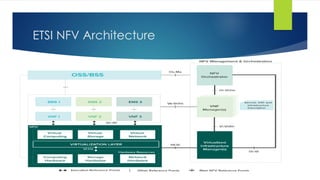
 Mapping to ETSI NFV architecture
 Design Patterns
 VNF Deployments
 ONAP
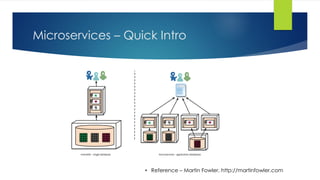
Microservices – Quick Intro
• Reference – Martin Fowler, http://martinfowler.com
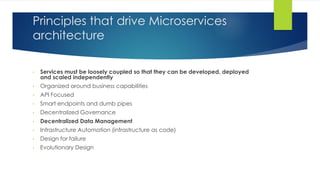
Principles that drive Microservices
architecture
• Services must be loosely coupled so that they can be developed, deployed
and scaled independently
• Organized around business capabilities
• API Focused
• Smart endpoints and dumb pipes
• Decentralized Governance
• Decentralized Data Management
• Infrastructure Automation (infrastructure as code)
• Design for failure
• Evolutionary Design
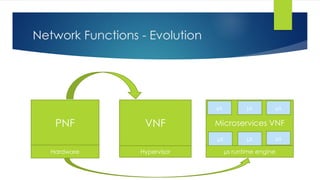
Network Functions - Evolution
PNF VNF
Hypervisor
Microservices VNF
Hardware
µs µs µs
µs µs µs
µs runtime engine
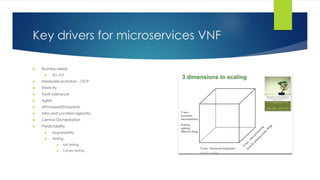
Key drivers for microservices VNF
 Business needs
 5G, IOT
 Hardware evolution – OCP
 Elasticity
 Fault Tolerance
 Agility
 API-based/End points
 Infra and Location agnostic
 Central Orchestration
 Predictability
 Upgradability
 Testing
 A/B Testing
 Canary testing
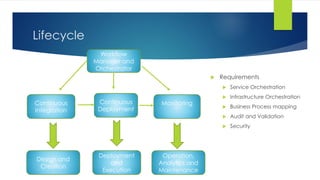
Lifecycle
Workflow
Manager and
Orchestrator
Continuous
Integration
Continuous
Deployment
Monitoring
Design and
Creation
Deployment
and
Execution
Operation,
Analytics and
Maintenance
 Requirements
 Service Orchestration
 Infrastructure Orchestration
 Business Process mapping
 Audit and Validation
 Security
ETSI NFV Architecture
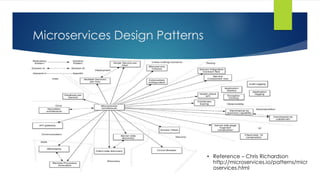
Microservices Design Patterns
• Reference – Chris Richardson
http://microservices.io/patterns/micr
oservices.html
Microservices Design Patterns for VNF
 Decomposition Pattern
 Subdomain context
 Service discovery Pattern
 Database per service Pattern
 Keep each microservice’s persistent data private to that service and accessible only via its API
 RDBMS design approaches
 Private-tables-per-service – each service owns a set of tables that must only be accessed by that service
 Schema-per-service – each service has a database schema that’s private to that service
 Database-server-per-service – each service has it’s own database server.
 Circuit Breaker
 API Gateway Pattern
Opensource Ecosystem
• Workflow Manager and Orchestrator
• ONAP , ARIA, OSM
• Design and Deployment
• CI/CD Pipelines
• Jenkins
• Fabric8 (Jenkins, Kubernetes and Docker)
• Other options – goCD, concourse.ci
• Ansible/Puppet/Chef
• Execution/NFVi
• Kubernetes with ODL/CANAL/Weave, OPNFV
• Service Mesh - Istio
• Monitoring
• Prometheus and other alternatives (https://prometheus.io/docs/introduction/comparison/)
• Tracing
• Zipkin
• Logging
• ELK stack
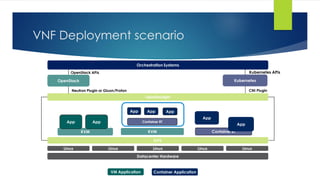
VNF Deployment scenario
Neutron Plugin or Gluon/Proton
Linux Linux Linux Linux
Kubernetes
Datacenter Hardware
Linux
OpenStack
OVS
App
Orchestration Systems
OpenStack APIs
OpenDaylight
Kubernetes APIs
CNI Plugin
KVM KVM ContainerRT
Container RT
App App App
VM Application Container Application
App
App App
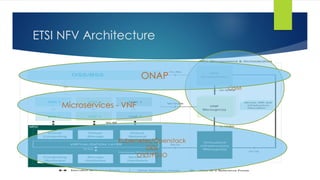
ETSI NFV Architecture
OSM
ONAP
Kubernetes/Openstack
ODL
OVS/FD.IO
Microservices - VNF
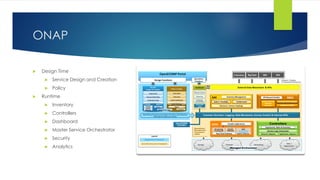
ONAP
 Design Time
 Service Design and Creation
 Policy
 Runtime
 Inventory
 Controllers
 Dashboard
 Master Service Orchestrator
 Security
 Analytics
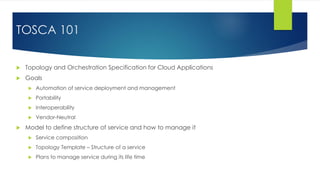
 Topology and Orchestration Specification for Cloud Applications
 Goals
 Automation of service deployment and management
 Portability
 Interoperability
 Vendor-Neutral
 Model to define structure of service and how to manage it
 Service composition
 Topology Template – Structure of a service
 Plans to manage service during its life time
TOSCA 101
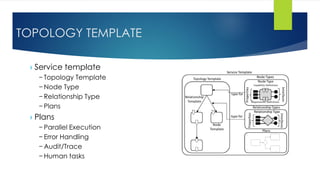
TOPOLOGY TEMPLATE
› Service template
– Topology Template
– Node Type
– Relationship Type
– Plans
› Plans
– Parallel Execution
– Error Handling
– Audit/Trace
– Human tasks
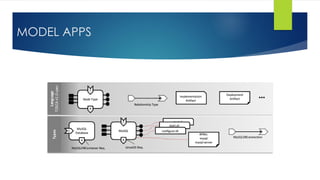
MODEL APPS
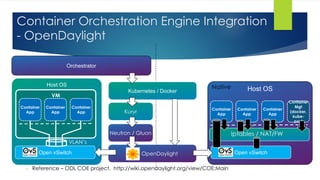
Container Orchestration Engine Integration
- OpenDaylight
Host OS
Open vSwitch
Host OS
Open vSwitch
VM
Container
App
Container
App
Container
App
VLAN’s
Orchestrator
OpenDaylight
Kubernetes / Docker
Kuryr
Neutron / Gluon
Container
App
Container
App
Container
App
Container
Mgt
(docker,
kube-
pxy)
Iptables / NAT/FW
Native
• Reference – ODL COE project, http://wiki.opendaylight.org/view/COE:Main
Q&A
Any organization that designs a system
(defined broadly) will produce a design
whose structure is a copy of the
organization's communication structure.
-- Melvyn Conway, 1967

Opensource approach to design and deployment of Microservices based VNF

  • 1.
    Open source Approachto Design and Deployment of Microservices based VNF PREM SANKAR G, ERICSSON HTTPS://TWITTER.COM/PREMSANKAR
  • 2.
    Agenda  Microservices overview VNF Characteristics  Opensource Ecosystem  Mapping to ETSI NFV architecture  Design Patterns  VNF Deployments  ONAP
  • 3.
    Microservices – QuickIntro • Reference – Martin Fowler, http://martinfowler.com
  • 4.
    Principles that driveMicroservices architecture • Services must be loosely coupled so that they can be developed, deployed and scaled independently • Organized around business capabilities • API Focused • Smart endpoints and dumb pipes • Decentralized Governance • Decentralized Data Management • Infrastructure Automation (infrastructure as code) • Design for failure • Evolutionary Design
  • 5.
    Network Functions -Evolution PNF VNF Hypervisor Microservices VNF Hardware µs µs µs µs µs µs µs runtime engine
  • 6.
    Key drivers formicroservices VNF  Business needs  5G, IOT  Hardware evolution – OCP  Elasticity  Fault Tolerance  Agility  API-based/End points  Infra and Location agnostic  Central Orchestration  Predictability  Upgradability  Testing  A/B Testing  Canary testing
  • 7.
    Lifecycle Workflow Manager and Orchestrator Continuous Integration Continuous Deployment Monitoring Design and Creation Deployment and Execution Operation, Analyticsand Maintenance  Requirements  Service Orchestration  Infrastructure Orchestration  Business Process mapping  Audit and Validation  Security
  • 8.
  • 9.
    Microservices Design Patterns •Reference – Chris Richardson http://microservices.io/patterns/micr oservices.html
  • 10.
    Microservices Design Patternsfor VNF  Decomposition Pattern  Subdomain context  Service discovery Pattern  Database per service Pattern  Keep each microservice’s persistent data private to that service and accessible only via its API  RDBMS design approaches  Private-tables-per-service – each service owns a set of tables that must only be accessed by that service  Schema-per-service – each service has a database schema that’s private to that service  Database-server-per-service – each service has it’s own database server.  Circuit Breaker  API Gateway Pattern
  • 11.
    Opensource Ecosystem • WorkflowManager and Orchestrator • ONAP , ARIA, OSM • Design and Deployment • CI/CD Pipelines • Jenkins • Fabric8 (Jenkins, Kubernetes and Docker) • Other options – goCD, concourse.ci • Ansible/Puppet/Chef • Execution/NFVi • Kubernetes with ODL/CANAL/Weave, OPNFV • Service Mesh - Istio • Monitoring • Prometheus and other alternatives (https://prometheus.io/docs/introduction/comparison/) • Tracing • Zipkin • Logging • ELK stack
  • 12.
    VNF Deployment scenario NeutronPlugin or Gluon/Proton Linux Linux Linux Linux Kubernetes Datacenter Hardware Linux OpenStack OVS App Orchestration Systems OpenStack APIs OpenDaylight Kubernetes APIs CNI Plugin KVM KVM ContainerRT Container RT App App App VM Application Container Application App App App
  • 13.
  • 14.
    ONAP  Design Time Service Design and Creation  Policy  Runtime  Inventory  Controllers  Dashboard  Master Service Orchestrator  Security  Analytics
  • 15.
     Topology andOrchestration Specification for Cloud Applications  Goals  Automation of service deployment and management  Portability  Interoperability  Vendor-Neutral  Model to define structure of service and how to manage it  Service composition  Topology Template – Structure of a service  Plans to manage service during its life time TOSCA 101
  • 16.
    TOPOLOGY TEMPLATE › Servicetemplate – Topology Template – Node Type – Relationship Type – Plans › Plans – Parallel Execution – Error Handling – Audit/Trace – Human tasks
  • 17.
  • 18.
    Container Orchestration EngineIntegration - OpenDaylight Host OS Open vSwitch Host OS Open vSwitch VM Container App Container App Container App VLAN’s Orchestrator OpenDaylight Kubernetes / Docker Kuryr Neutron / Gluon Container App Container App Container App Container Mgt (docker, kube- pxy) Iptables / NAT/FW Native • Reference – ODL COE project, http://wiki.opendaylight.org/view/COE:Main
  • 19.
    Q&A Any organization thatdesigns a system (defined broadly) will produce a design whose structure is a copy of the organization's communication structure. -- Melvyn Conway, 1967