Microservices:Microservices:
Notes From The FieldNotes From The Field
Josh Ellithorpe - 2015
@zquestz
Shoulders of GiantsShoulders of Giants
Adrian Cockcroft -
Martin Fowler -
Fred George -
Sam Newman -
The 12 Factor App -
250+ Startups, web scale and Fortune 500 teams that were kind enough to
share their experiences.
The amazing open source community.
https://twitter.com/adrianco
https://twitter.com/martinfowler
https://twitter.com/fgeorge52
https://twitter.com/samnewman
http://12factor.net
Why Microservices?Why Microservices?
Nexus of business and technology forces including:
Mobile / Big Data / Social / Cloud / IOT
Organizational change to a DevOps workflow.
Leverage technology enablers in the open source space.
Containers make microservices easy to setup and deploy.
What is a Microservice?What is a Microservice?
​Culture
Development team structure and process must mirror the service design.
DevOps teams, tools, and processes must be in place.
Characteristics
An app deployed as a set of independent components each running in its
own process.
Can be updated and deployed independently in an automated fashion.
Uses lightweight, async, and simple communication channel like REST.
Immutable. Externalizes data persistence and configuration.
Follow DDD (Domain-Driven Design) bounded context, avoid cross service
transactions.
BenefitsBenefits
Small independent teams deliver faster.
Can easily scale out by adding service instances.
Clear ownership – reduces risk and enables innovation.
Forces declarative dependency tracking.
Less dependencies an individual developer must track.
Automated testing and rollback increases resiliency.
Technology diversity – each team is free to use any language or platform.
RisksRisks
Are my DevOps processes and tools mature enough to handle constant
change?
Who will manage all the new dependencies – KV Store, Registration,
Discovery, Registry, etc.
How do I secure and patch all these services?
How do I manage isolation and tenancy for thousands of service instances?
How do I track resource allocation and prevent zombies?
Eventual consistency is really hard.
Breaking down the monolith is risky and costly.
Does TDD impact developer productivity?
How do I manage service dependencies?
How to deal with persistence and database schema updates?
Debugging and monitoring is much more complex.
Best PracticesBest Practices
Each microservice must be owned by one and only one team.
Team structure should mirror system design.
Team size of 4 to 8 members.
Write tests, then code, then check-in and deploy.
Use feature toggles.
Abstract cross service calls through a standard library – focus on
functionality.
Smart endpoints, stupid pipes.
Use circuit breaker, canary deploys and automated rollback.
Independent persistence layer for each service.
Be incremental and start with the Web tier.
Excellent logging, stats collection, and monitoring.
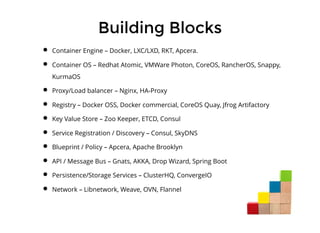
Building BlocksBuilding Blocks
Container Engine – Docker, LXC/LXD, RKT, Apcera.
Container OS – Redhat Atomic, VMWare Photon, CoreOS, RancherOS, Snappy,
KurmaOS
Proxy/Load balancer – Nginx, HA-Proxy
Registry – Docker OSS, Docker commercial, CoreOS Quay, Jfrog Artifactory
Key Value Store – Zoo Keeper, ETCD, Consul
Service Registration / Discovery – Consul, SkyDNS
Blueprint / Policy – Apcera, Apache Brooklyn
API / Message Bus – Gnats, AKKA, Drop Wizard, Spring Boot
Persistence/Storage Services – ClusterHQ, ConvergeIO
Network – Libnetwork, Weave, OVN, Flannel
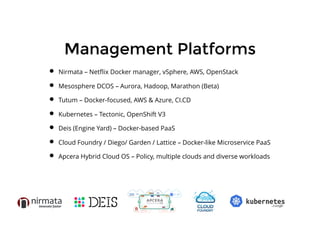
Management PlatformsManagement Platforms
Nirmata – Netflix Docker manager, vSphere, AWS, OpenStack
Mesosphere DCOS – Aurora, Hadoop, Marathon (Beta)
Tutum – Docker-focused, AWS & Azure, CI.CD
Kubernetes – Tectonic, OpenShift V3
Deis (Engine Yard) – Docker-based PaaS
Cloud Foundry / Diego/ Garden / Lattice – Docker-like Microservice PaaS
Apcera Hybrid Cloud OS – Policy, multiple clouds and diverse workloads
We're Hiring!We're Hiring!
Think microservices and containers are the future?
Interested in helping shape the future of enterprise IT?
Contact us at jobs@apcera.com

Microservices: Notes From The Field

  • 1.
    Microservices:Microservices: Notes From TheFieldNotes From The Field Josh Ellithorpe - 2015 @zquestz
  • 2.
    Shoulders of GiantsShouldersof Giants Adrian Cockcroft - Martin Fowler - Fred George - Sam Newman - The 12 Factor App - 250+ Startups, web scale and Fortune 500 teams that were kind enough to share their experiences. The amazing open source community. https://twitter.com/adrianco https://twitter.com/martinfowler https://twitter.com/fgeorge52 https://twitter.com/samnewman http://12factor.net
  • 3.
    Why Microservices?Why Microservices? Nexusof business and technology forces including: Mobile / Big Data / Social / Cloud / IOT Organizational change to a DevOps workflow. Leverage technology enablers in the open source space. Containers make microservices easy to setup and deploy.
  • 4.
    What is aMicroservice?What is a Microservice? ​Culture Development team structure and process must mirror the service design. DevOps teams, tools, and processes must be in place. Characteristics An app deployed as a set of independent components each running in its own process. Can be updated and deployed independently in an automated fashion. Uses lightweight, async, and simple communication channel like REST. Immutable. Externalizes data persistence and configuration. Follow DDD (Domain-Driven Design) bounded context, avoid cross service transactions.
  • 5.
    BenefitsBenefits Small independent teamsdeliver faster. Can easily scale out by adding service instances. Clear ownership – reduces risk and enables innovation. Forces declarative dependency tracking. Less dependencies an individual developer must track. Automated testing and rollback increases resiliency. Technology diversity – each team is free to use any language or platform.
  • 6.
    RisksRisks Are my DevOpsprocesses and tools mature enough to handle constant change? Who will manage all the new dependencies – KV Store, Registration, Discovery, Registry, etc. How do I secure and patch all these services? How do I manage isolation and tenancy for thousands of service instances? How do I track resource allocation and prevent zombies? Eventual consistency is really hard. Breaking down the monolith is risky and costly. Does TDD impact developer productivity? How do I manage service dependencies? How to deal with persistence and database schema updates? Debugging and monitoring is much more complex.
  • 7.
    Best PracticesBest Practices Eachmicroservice must be owned by one and only one team. Team structure should mirror system design. Team size of 4 to 8 members. Write tests, then code, then check-in and deploy. Use feature toggles. Abstract cross service calls through a standard library – focus on functionality. Smart endpoints, stupid pipes. Use circuit breaker, canary deploys and automated rollback. Independent persistence layer for each service. Be incremental and start with the Web tier. Excellent logging, stats collection, and monitoring.
  • 8.
    Building BlocksBuilding Blocks ContainerEngine – Docker, LXC/LXD, RKT, Apcera. Container OS – Redhat Atomic, VMWare Photon, CoreOS, RancherOS, Snappy, KurmaOS Proxy/Load balancer – Nginx, HA-Proxy Registry – Docker OSS, Docker commercial, CoreOS Quay, Jfrog Artifactory Key Value Store – Zoo Keeper, ETCD, Consul Service Registration / Discovery – Consul, SkyDNS Blueprint / Policy – Apcera, Apache Brooklyn API / Message Bus – Gnats, AKKA, Drop Wizard, Spring Boot Persistence/Storage Services – ClusterHQ, ConvergeIO Network – Libnetwork, Weave, OVN, Flannel
  • 9.
    Management PlatformsManagement Platforms Nirmata– Netflix Docker manager, vSphere, AWS, OpenStack Mesosphere DCOS – Aurora, Hadoop, Marathon (Beta) Tutum – Docker-focused, AWS & Azure, CI.CD Kubernetes – Tectonic, OpenShift V3 Deis (Engine Yard) – Docker-based PaaS Cloud Foundry / Diego/ Garden / Lattice – Docker-like Microservice PaaS Apcera Hybrid Cloud OS – Policy, multiple clouds and diverse workloads
  • 10.
    We're Hiring!We're Hiring! Thinkmicroservices and containers are the future? Interested in helping shape the future of enterprise IT? Contact us at jobs@apcera.com