Organizer	

!
Margaret Walker

CohesiveFT	

!
!
Tweet: @MargieWalker

#AWSChicago	

Sponsored by
Hosted by
#AWSChicago
!
AWS Chicago Meetup	

!
July?
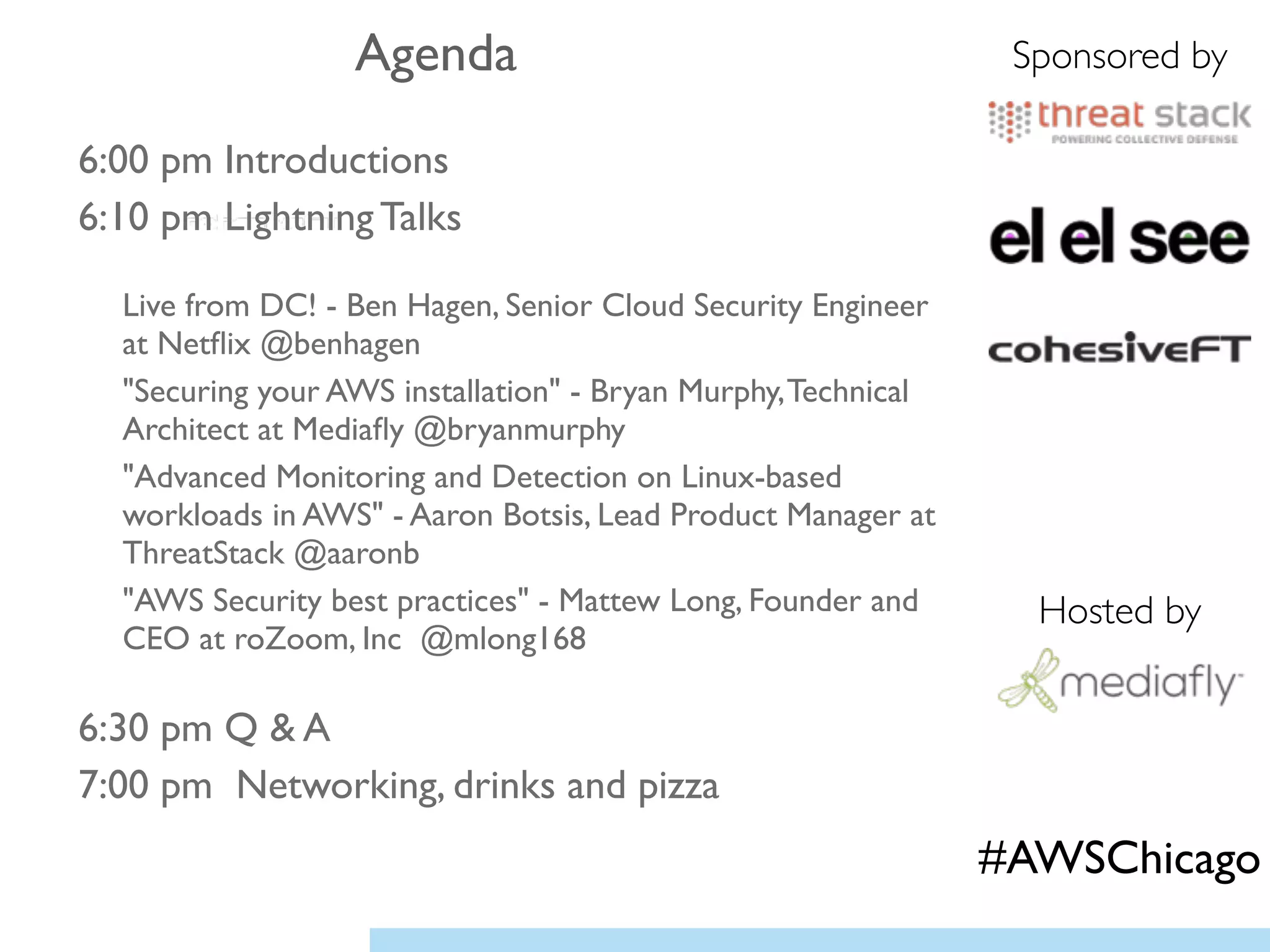
6:00 pm Introductions	

6:10 pm Lightning Talks	

!
Live from DC! - Ben Hagen, Senior Cloud Security Engineer
at Netflix @benhagen	

"Securing your AWS installation" - Bryan Murphy,Technical
Architect at Mediafly @bryanmurphy	

"Advanced Monitoring and Detection on Linux-based
workloads in AWS" - Aaron Botsis, Lead Product Manager at
ThreatStack @aaronb 	

"AWS Security best practices" - Mattew Long, Founder and
CEO at roZoom, Inc @mlong168	

!
6:30 pm Q & A 	

7:00 pm Networking, drinks and pizza
Agenda Sponsored by
Hosted by
#AWSChicago
“Live from DC!”	

!
Ben Hagen	

Senior Cloud Security Engineer at Netflix	

!
Tweet: @benhagen

#AWSChicago	

!
Sponsored by
Hosted by
#AWSChicago
“Securing your AWS installation”	

!
Bryan Murphy	

Technical Architect at Mediafly	

!
Tweet: @bryanmurphy

#AWSChicago	

!
Sponsored by
Hosted by
#AWSChicago
Safe Harbor Statement: Our discussions may include predictions, estimates or other information that might be considered
forward-looking. While these forward-looking statements represent our current judgment on what the future holds, they
are subject to risks and uncertainties that could cause actual results to differ materially. You are cautioned not to place
undue reliance on these forward-looking statements, which reflect our opinions only as of the date of this presentation.
Please keep in mind that we are not obligating ourselves to revise or publicly release the results of any revision to these
forward- looking statements in light of new information or future events. Throughout today’s discussion, we will attempt to
convey some important factors relating to our business that may affect our predictions. © 2006-2014 Mediafly, Inc. | Confidential
Infrastructure Security Best Practices
On Amazon Web Services
Bryan Murphy
© 2006-2014 Mediafly, Inc. | Confidential
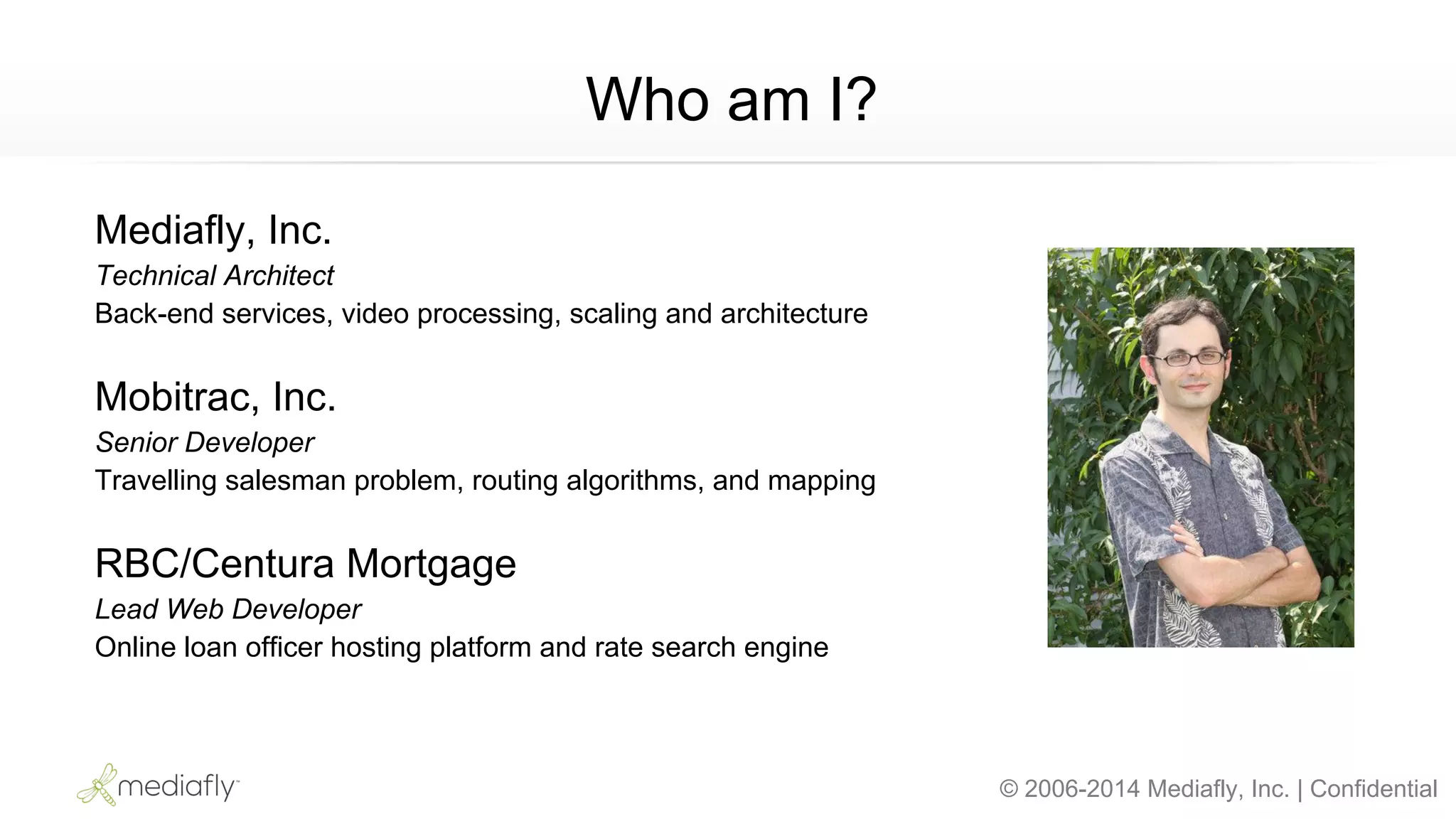
Mediafly, Inc.
Technical Architect
Back-end services, video processing, scaling and architecture
Mobitrac, Inc.
Senior Developer
Travelling salesman problem, routing algorithms, and mapping
RBC/Centura Mortgage
Lead Web Developer
Online loan officer hosting platform and rate search engine
Who am I?
© 2006-2014 Mediafly, Inc. | Confidential
Who are we?
“The Content Mobility Cloud”
We process and store highly sensitive content for Fortune 500 customers, and
deliver that content to white-labeled mobile apps and the web
• Sales presentations and selling collateral
• Pre-release/pre-air video
Customers include:
• Global banks
• Leading consumer-packaged goods companies
• TV and theatrical studios
Small, passionate, growing team
• We are hiring! Search mediafly careers
© 2006-2014 Mediafly, Inc. | Confidential
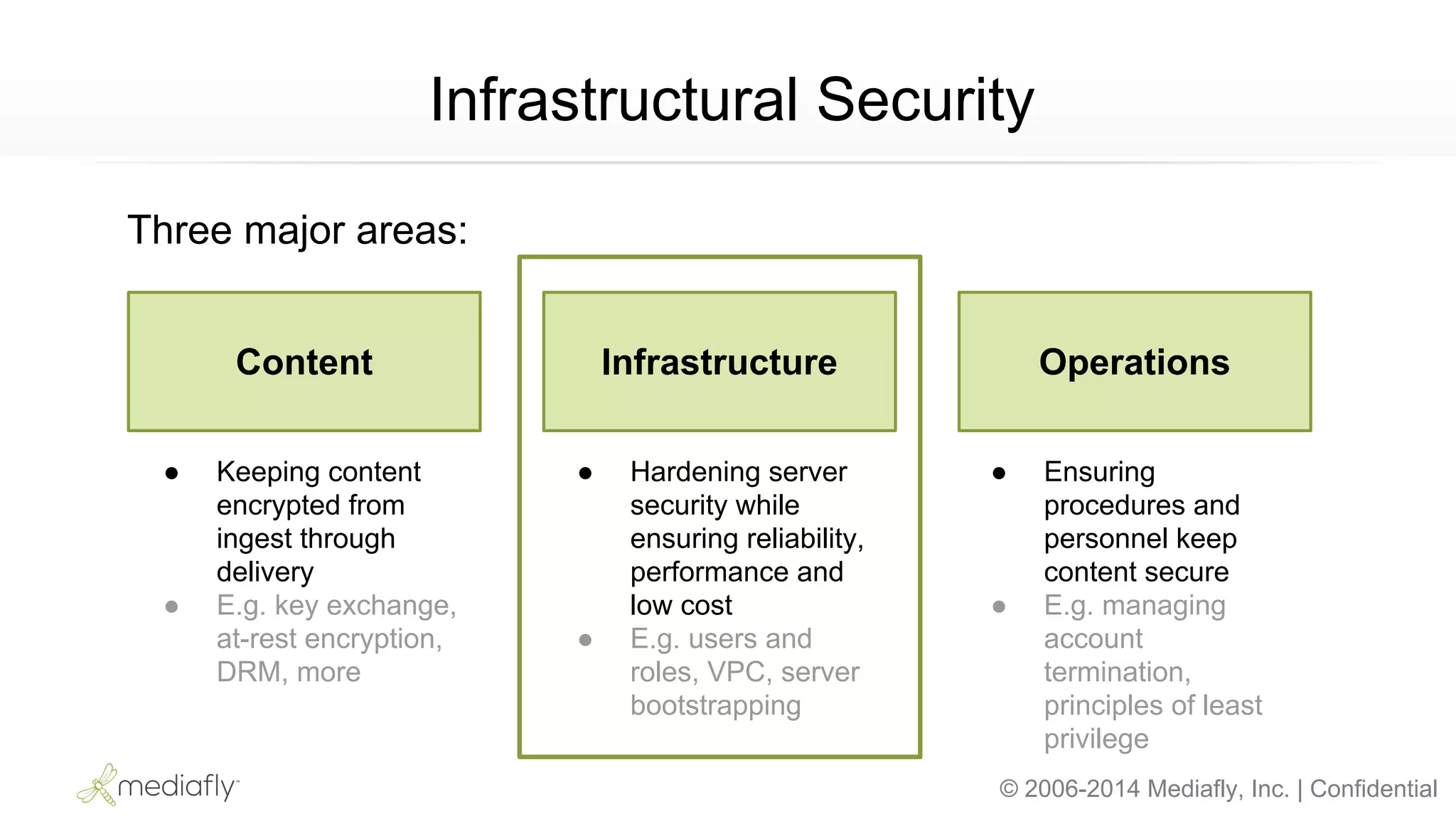
Infrastructural Security
Three major areas:
Content Infrastructure Operations
● Keeping content
encrypted from
ingest through
delivery
● E.g. key exchange,
at-rest encryption,
DRM, more
● Hardening server
security while
ensuring reliability,
performance and
low cost
● E.g. users and
roles, VPC, server
bootstrapping
● Ensuring
procedures and
personnel keep
content secure
● E.g. managing
account
termination,
principles of least
privilege
© 2006-2014 Mediafly, Inc. | Confidential
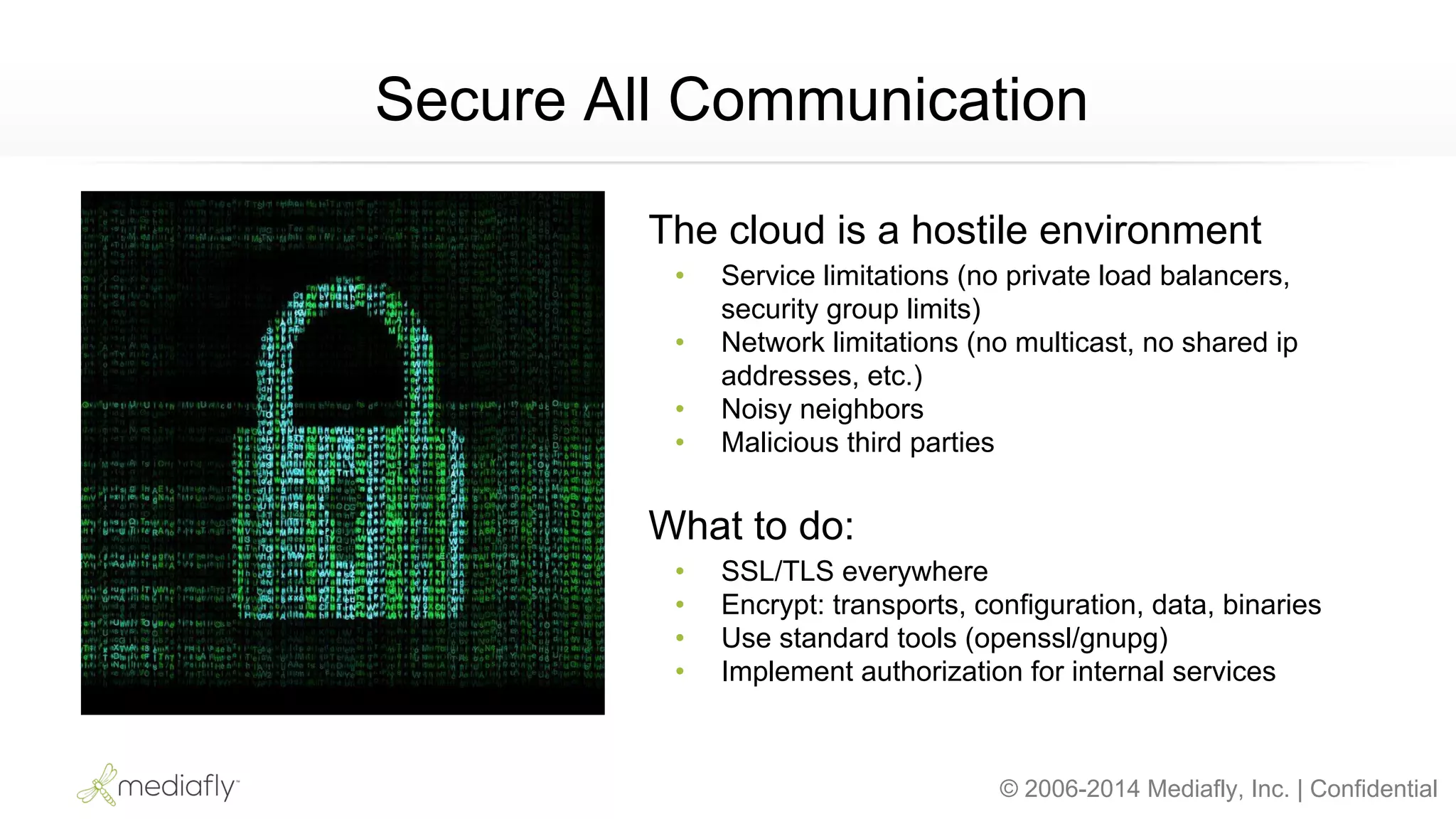
Secure All Communication
The cloud is a hostile environment
• Service limitations (no private load balancers,
security group limits)
• Network limitations (no multicast, no shared ip
addresses, etc.)
• Noisy neighbors
• Malicious third parties
What to do:
• SSL/TLS everywhere
• Encrypt: transports, configuration, data, binaries
• Use standard tools (openssl/gnupg)
• Implement authorization for internal services
© 2006-2014 Mediafly, Inc. | Confidential
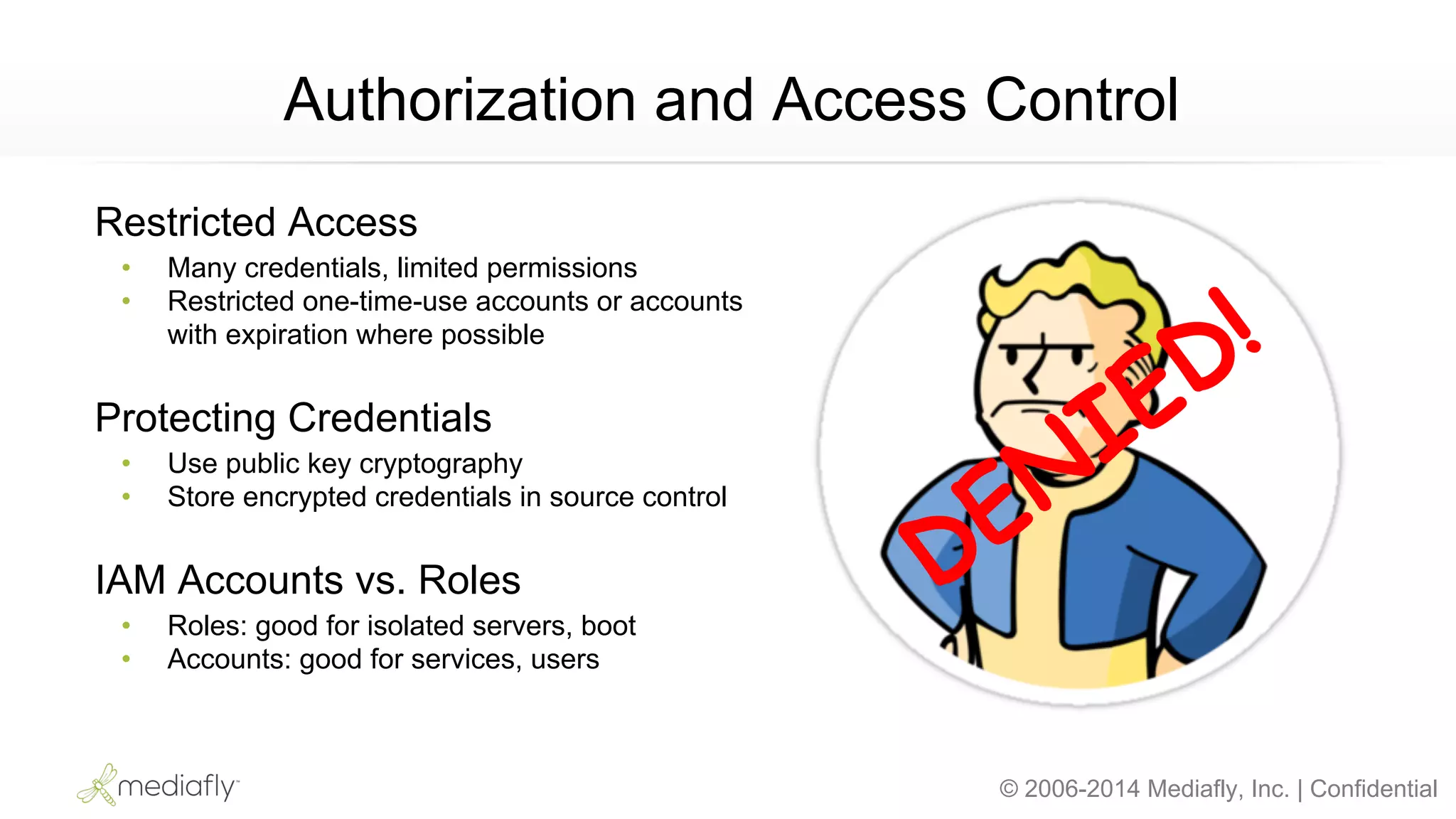
Authorization and Access Control
Restricted Access
• Many credentials, limited permissions
• Restricted one-time-use accounts or accounts
with expiration where possible
Protecting Credentials
• Use public key cryptography
• Store encrypted credentials in source control
IAM Accounts vs. Roles
• Roles: good for isolated servers, boot
• Accounts: good for services, users
DENIED!
© 2006-2014 Mediafly, Inc. | Confidential
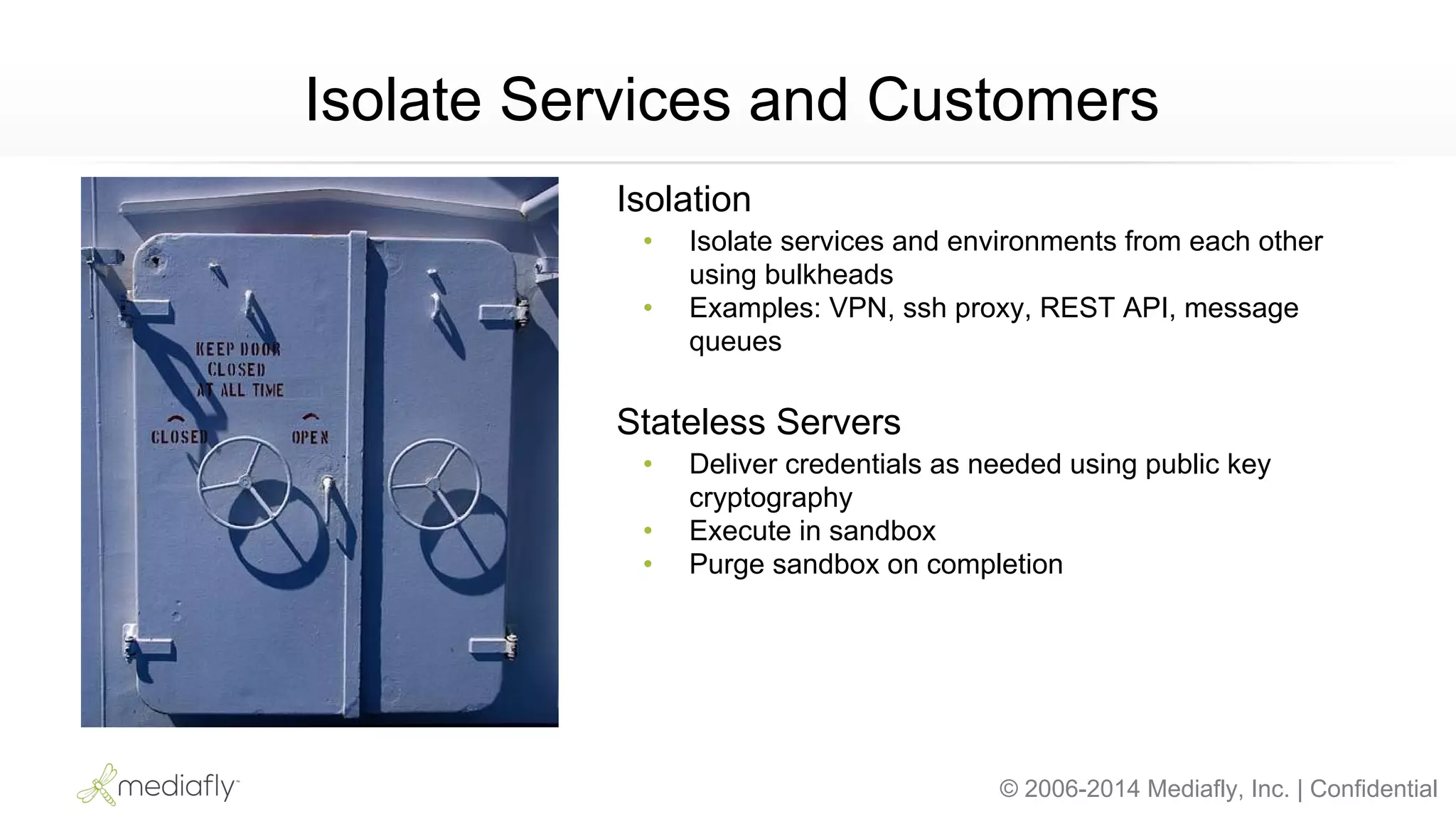
Isolate Services and Customers
Isolation
• Isolate services and environments from each other
using bulkheads
• Examples: VPN, ssh proxy, REST API, message
queues
Stateless Servers
• Deliver credentials as needed using public key
cryptography
• Execute in sandbox
• Purge sandbox on completion
© 2006-2014 Mediafly, Inc. | Confidential
Verification
Automated Security Testing
Regular Audits
• Manual internal audits
• Third party automated testing
• Third party security audits
Logging
Monitoring
© 2006-2014 Mediafly, Inc. | Confidential
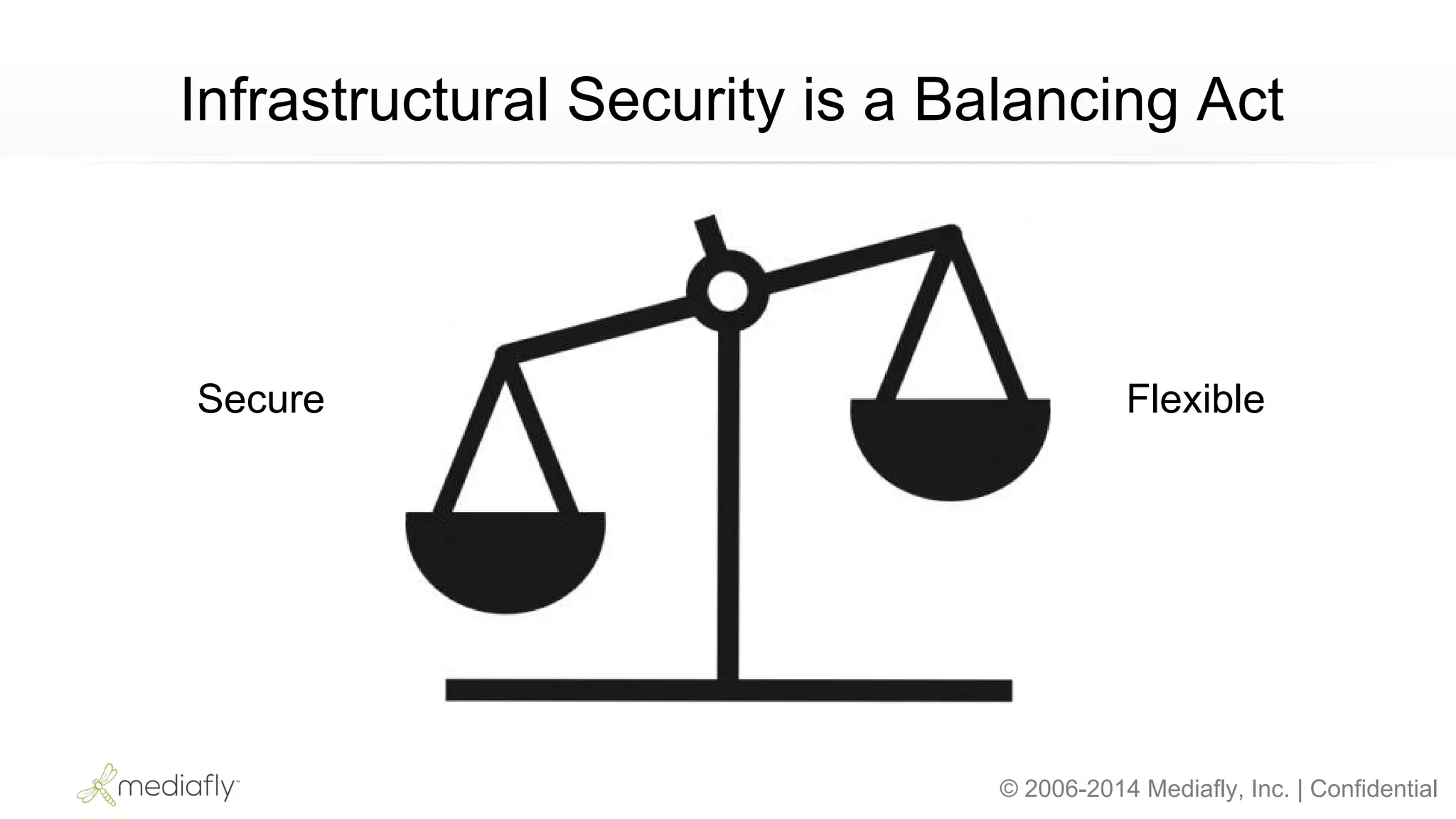
Infrastructural Security is a Balancing Act
Secure Flexible
© 2006-2014 Mediafly, Inc. | Confidential
Thank you!
Bryan Murphy
twitter.com/bryanmurphy
twitter.com/mediafly
“Advanced Monitoring and
Detection on Linux-based
workloads in AWS”	

!
Aaron Botsis	

Lead Product Manager at ThreatStack 	

!
Tweet: @aaronb

#AWSChicago	

!
Sponsored by
Hosted by
#AWSChicago
ADVANCED SECURITY
MONITORING FOR
THE CLOUD
Aaron Botsis
@aaronb, @threatstack
who is logging into my (machines|applications|SaaS accounts)
!
what are they are running
!
of running apps, what are making network activity, and where
!
every kernel module loaded
every library
every file created/modified/removed
everything!!!!
but why stop there?
but aaron, why?
!
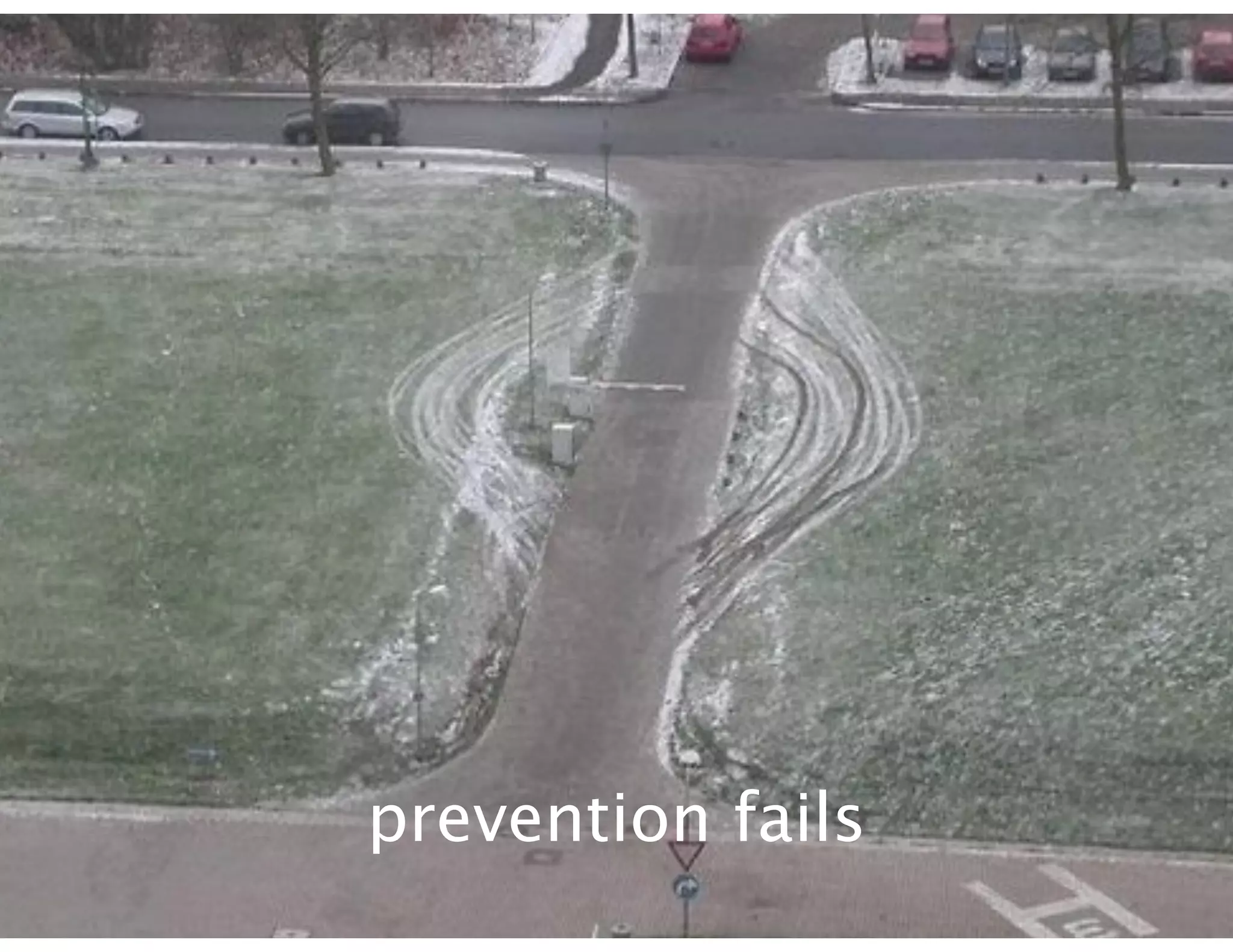
prevention fails
thanks, aaron
step 1:
audit all of the things
logins
processes
network activity
file access
kernel modules
shared libraries
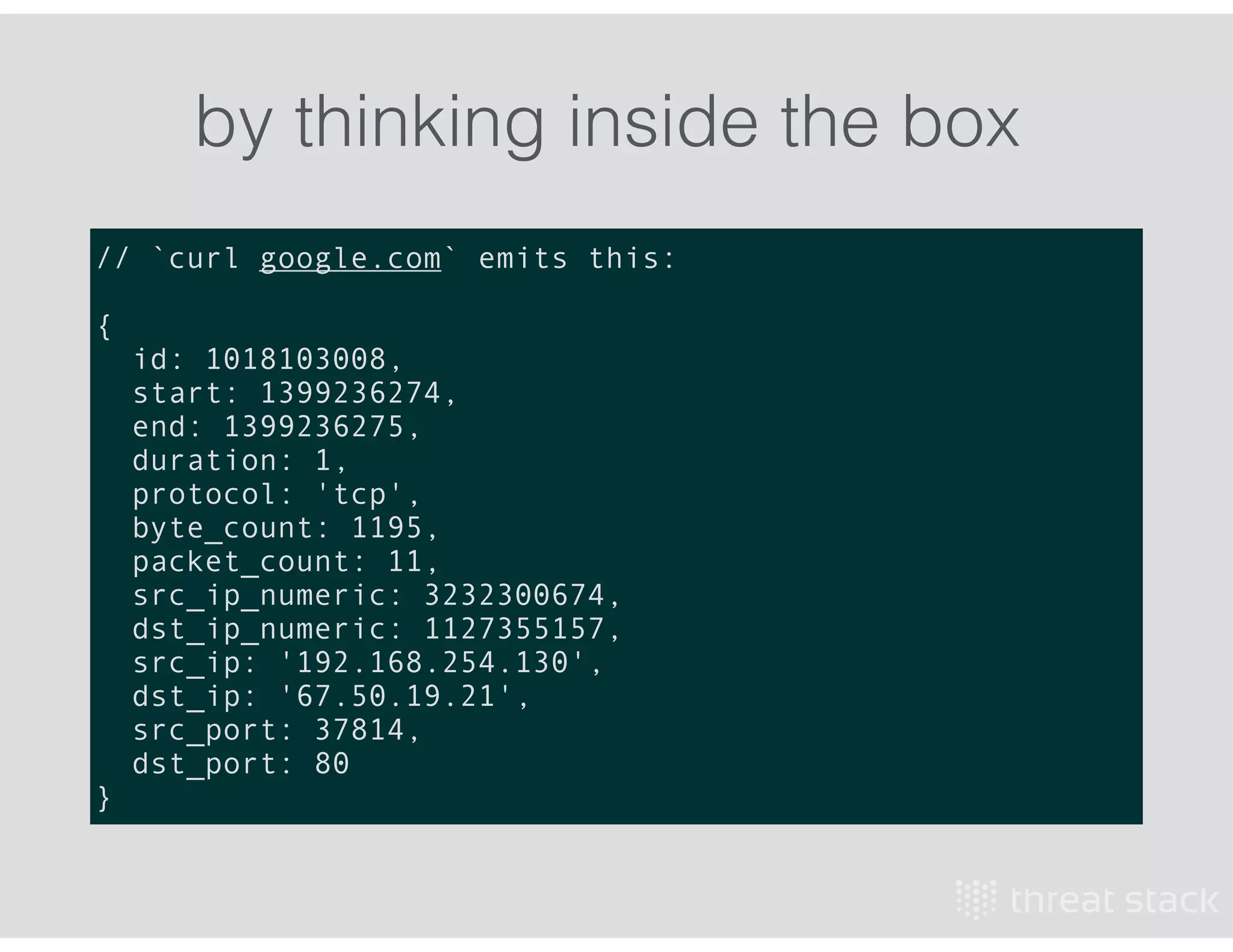
// `curl google.com` emits this:
!
{
id: 1018103008,
start: 1399236274,
end: 1399236275,
duration: 1,
protocol: 'tcp',
byte_count: 1195,
packet_count: 11,
src_ip_numeric: 3232300674,
dst_ip_numeric: 1127355157,
src_ip: '192.168.254.130',
dst_ip: '67.50.19.21',
src_port: 37814,
dst_port: 80
}
by thinking inside the box
step 2:
build behavior
profiles
does apache always spawn a shell?
does that shell always switch privs to root?
does root always make network connections to China?
..by thinking outside
the box
step 3:
anomalies help
prevent
devs know app best
behavior deviations help identify attack new vectors
create rules to looks for known misbehavior
disable behavioral detection programmatically
Why DevOps.!
(…a tangent)
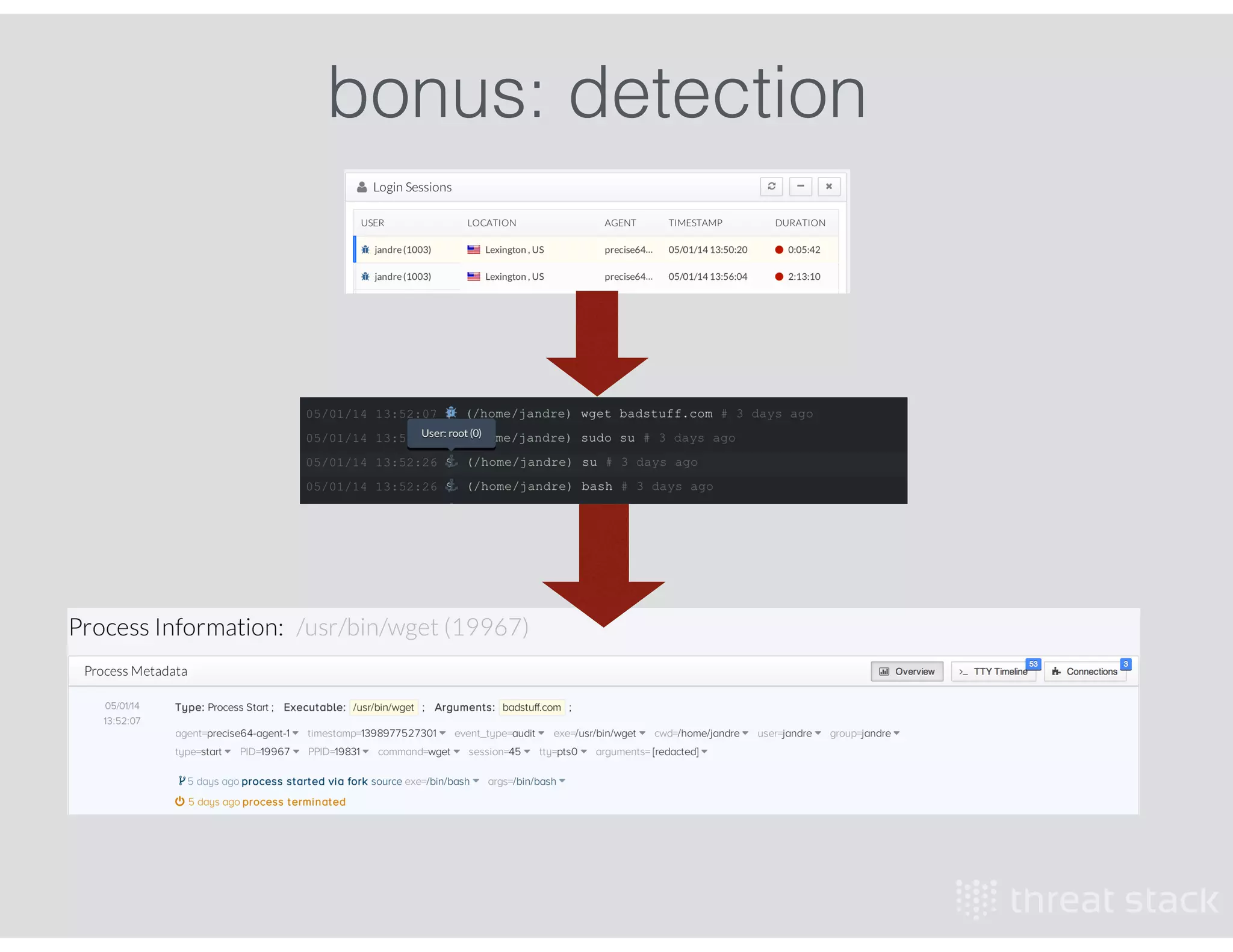
bonus: detection
thank you.
“AWS Security best practices”	

!
Mattew Long	

Founder and CEO at roZoom, Inc 	

!
Tweet: @mlong168

#AWSChicago	

!
Sponsored by
Hosted by
#AWSChicago
About Me
President & CEO @roZoom
Twitter @mlong168
Linkedin: http://linkd.in/T90u7l
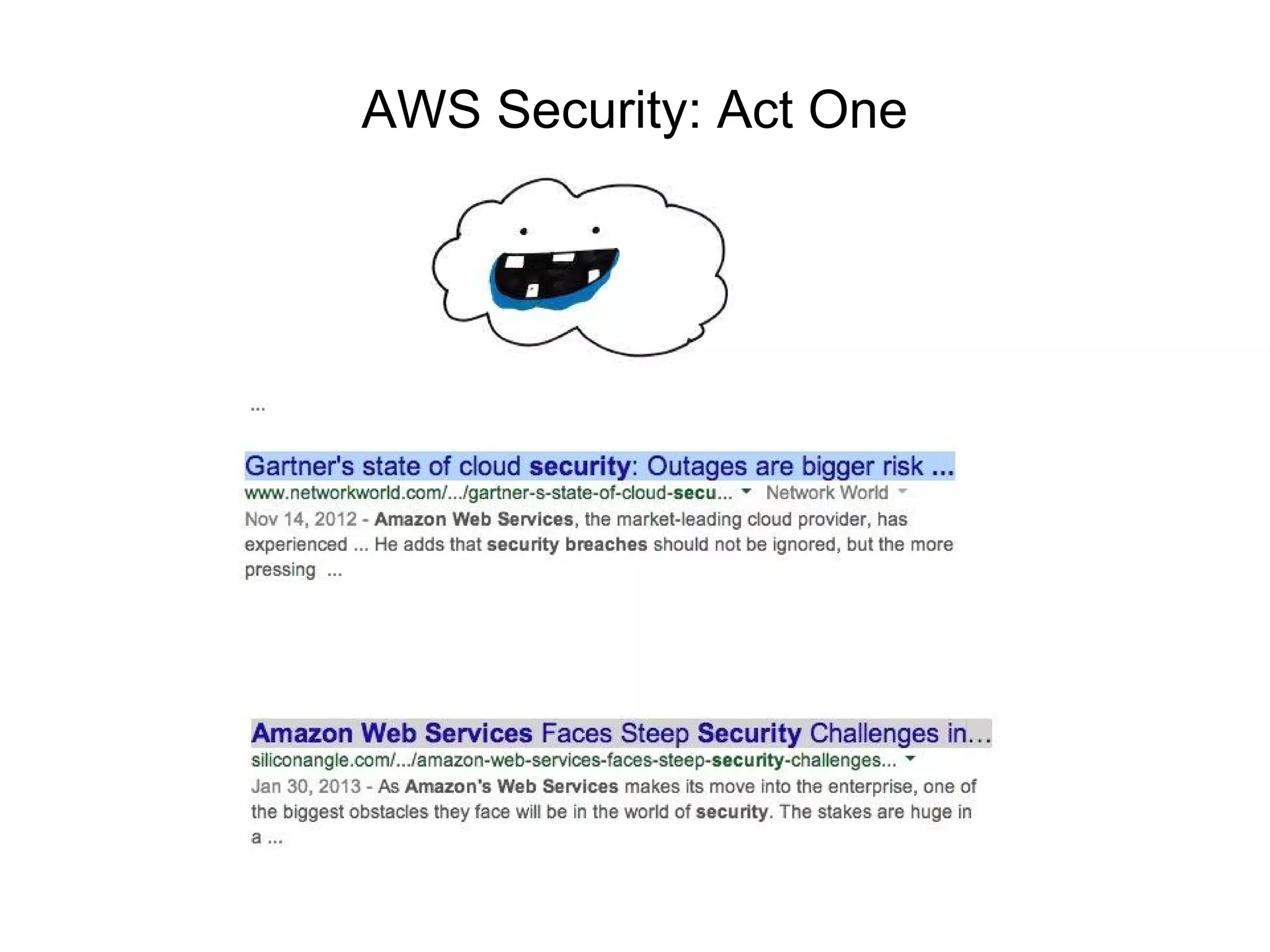
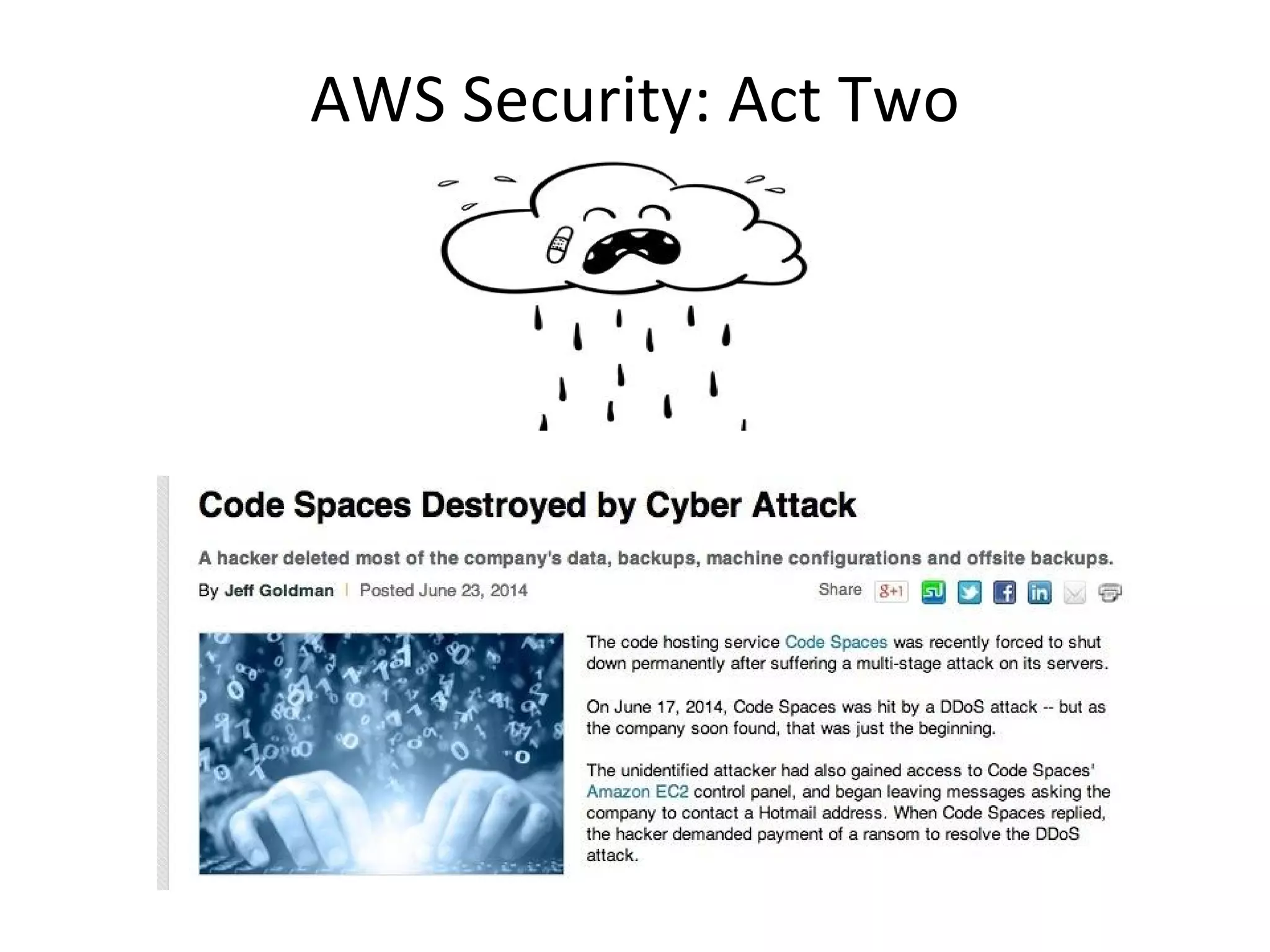
AWS Security: Act One
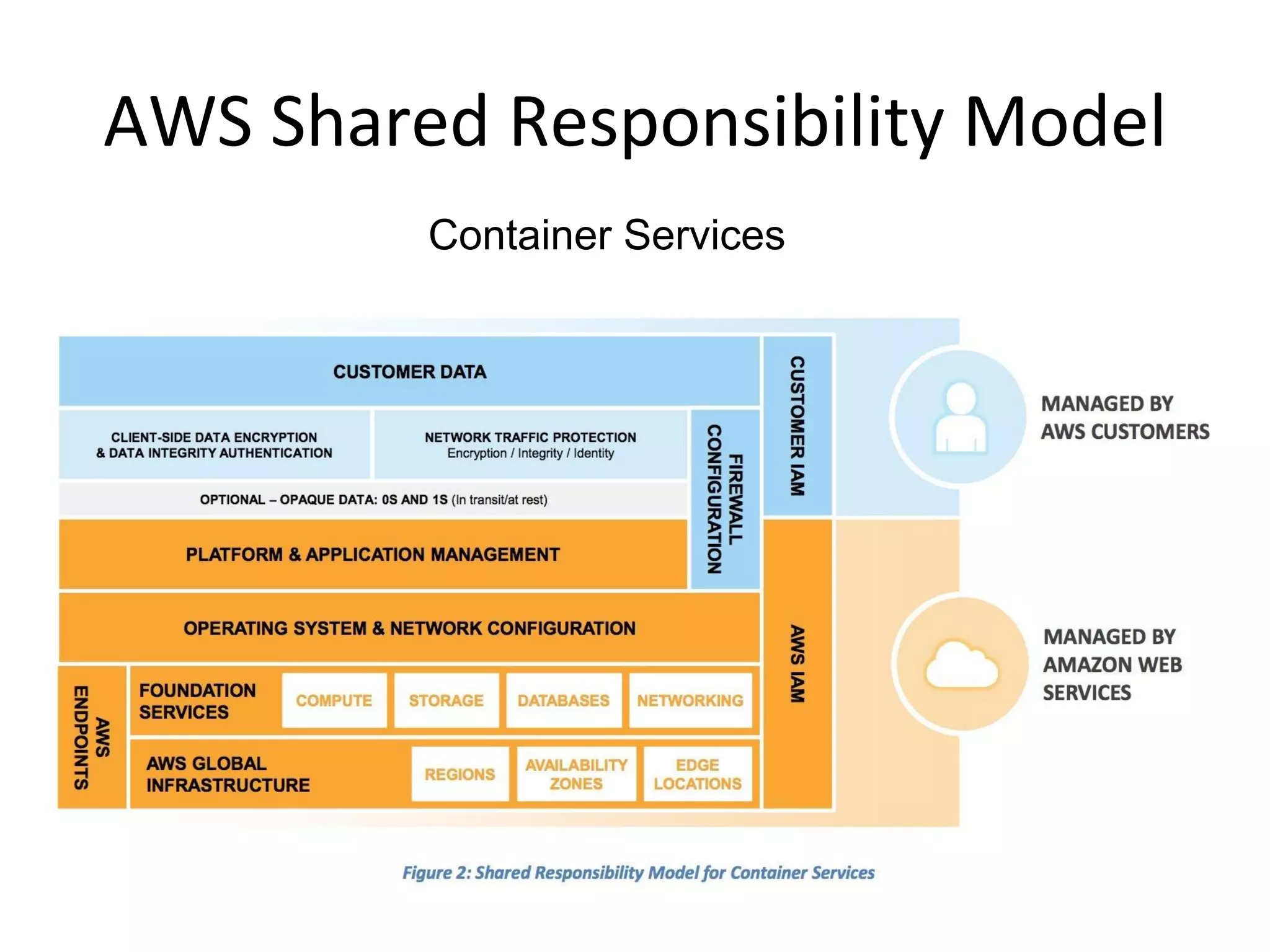
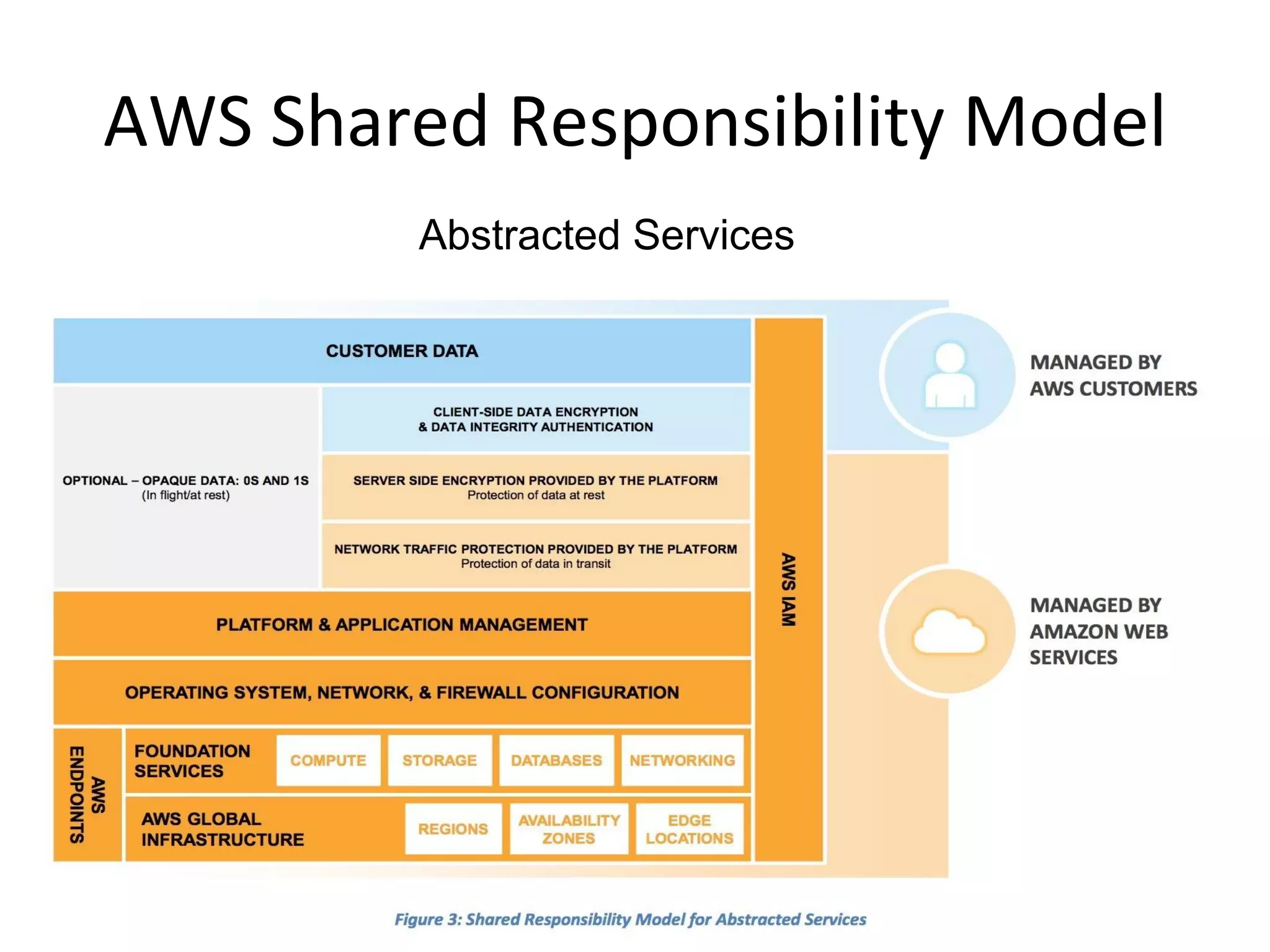
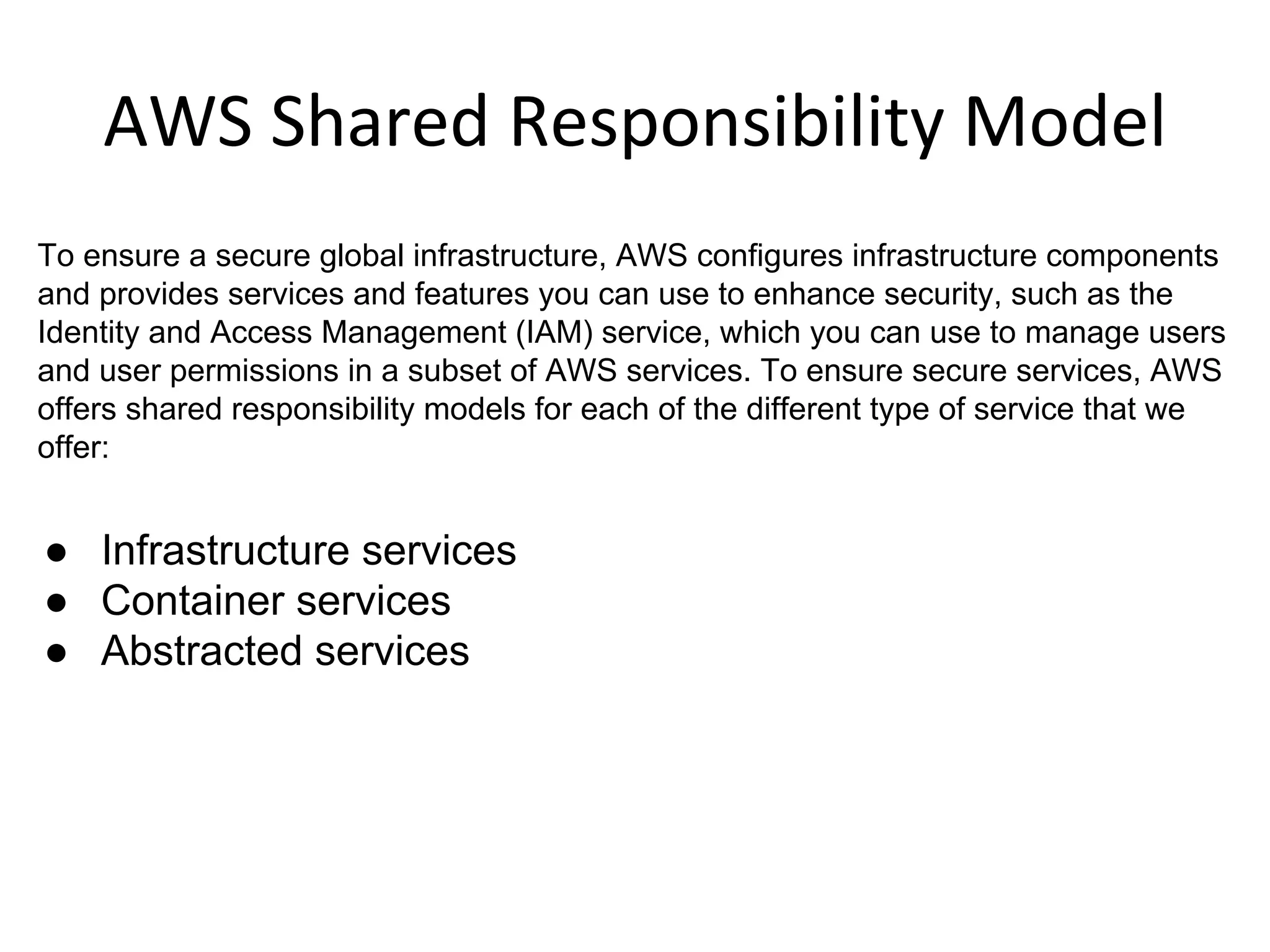
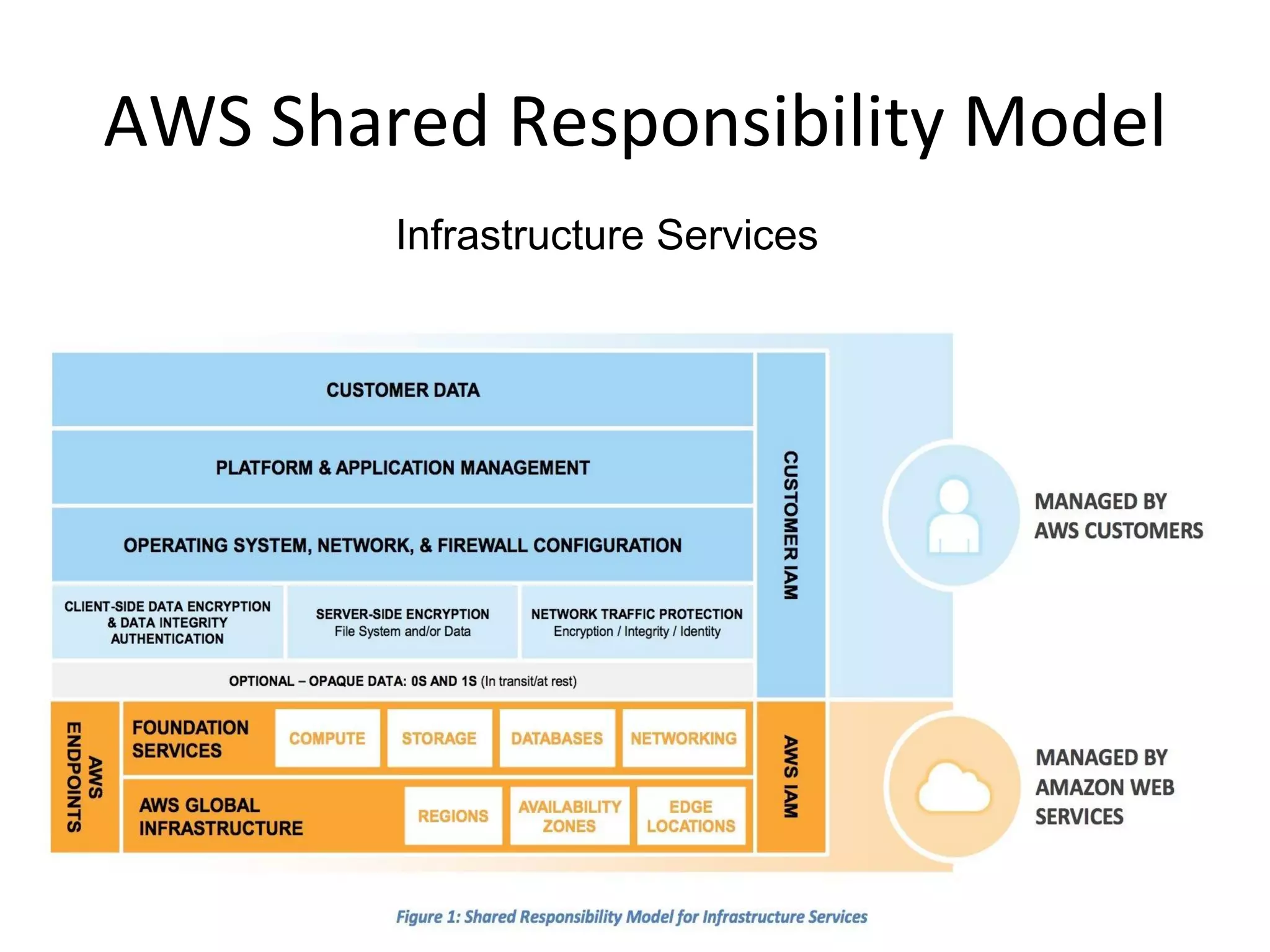
To ensure a secure global infrastructure, AWS configures infrastructure components
and provides services and features you can use to enhance security, such as the
Identity and Access Management (IAM) service, which you can use to manage users
and user permissions in a subset of AWS services. To ensure secure services, AWS
offers shared responsibility models for each of the different type of service that we
offer:
● Infrastructure services
● Container services
● Abstracted services
Infrastructure Services
Container Services
Abstracted Services
Security Best Practices
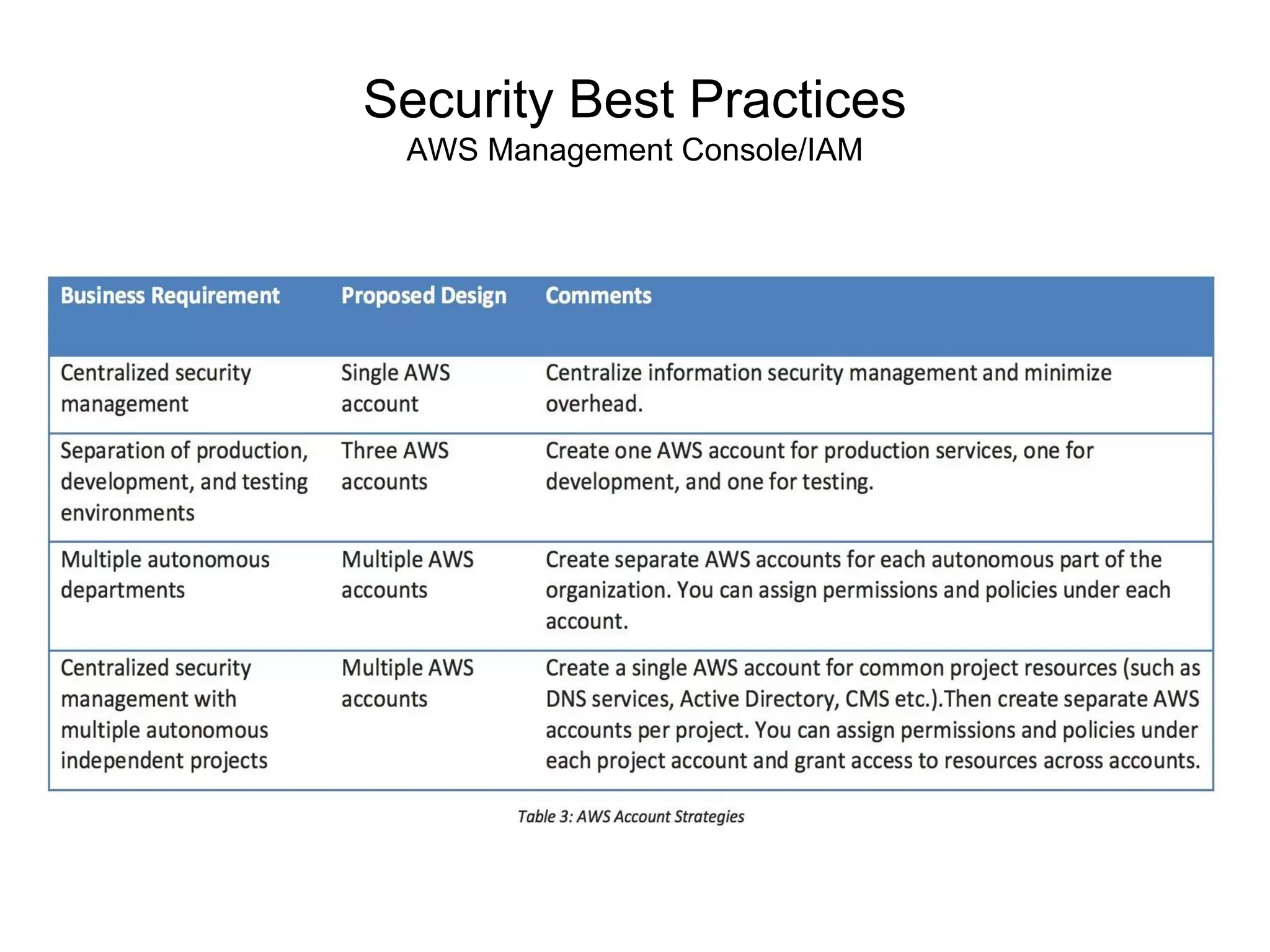
AWS Management Console/IAM
Security Best Practices
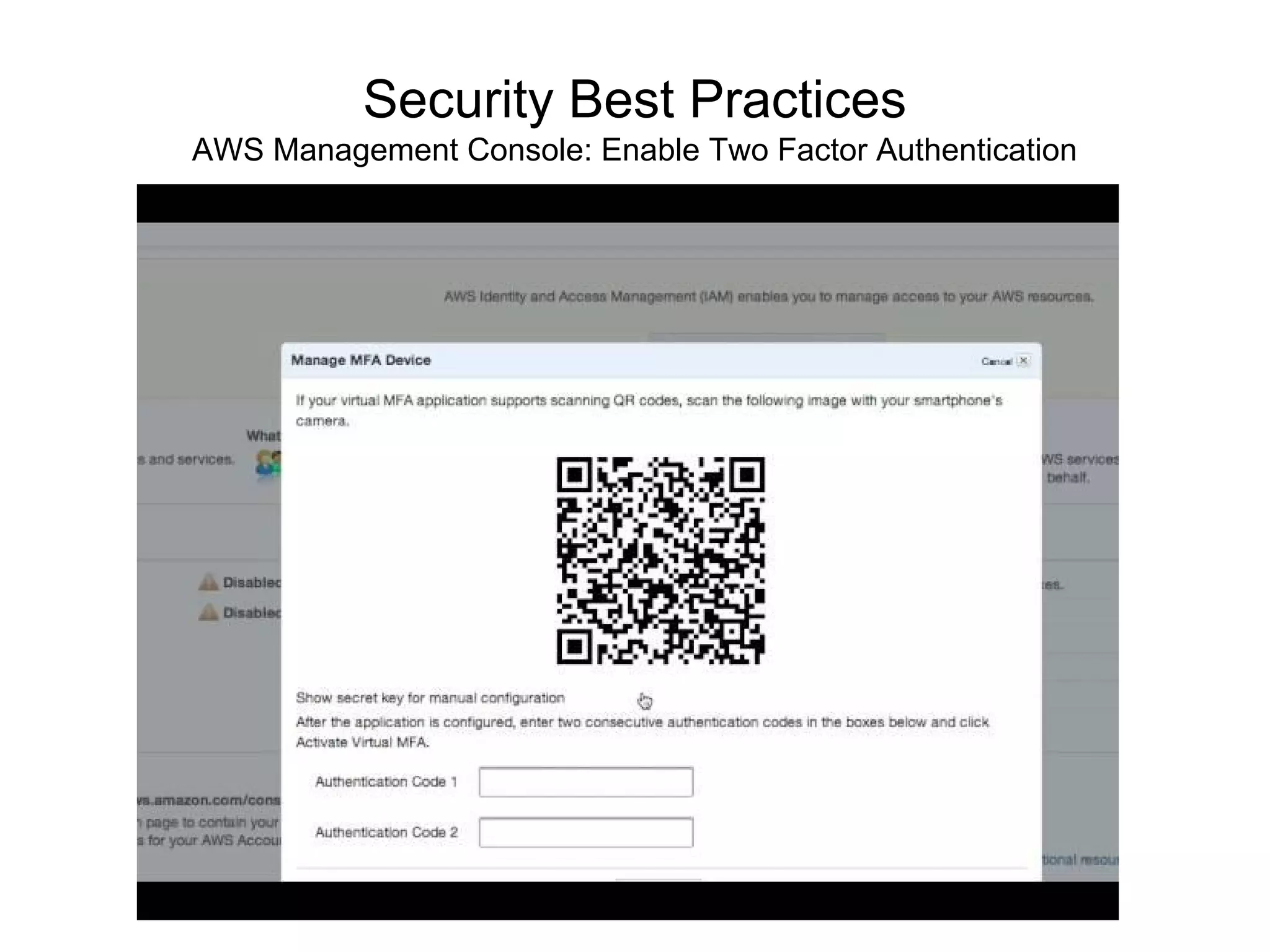
AWS Management Console: Enable Two Factor Authentication
Security Best Practices
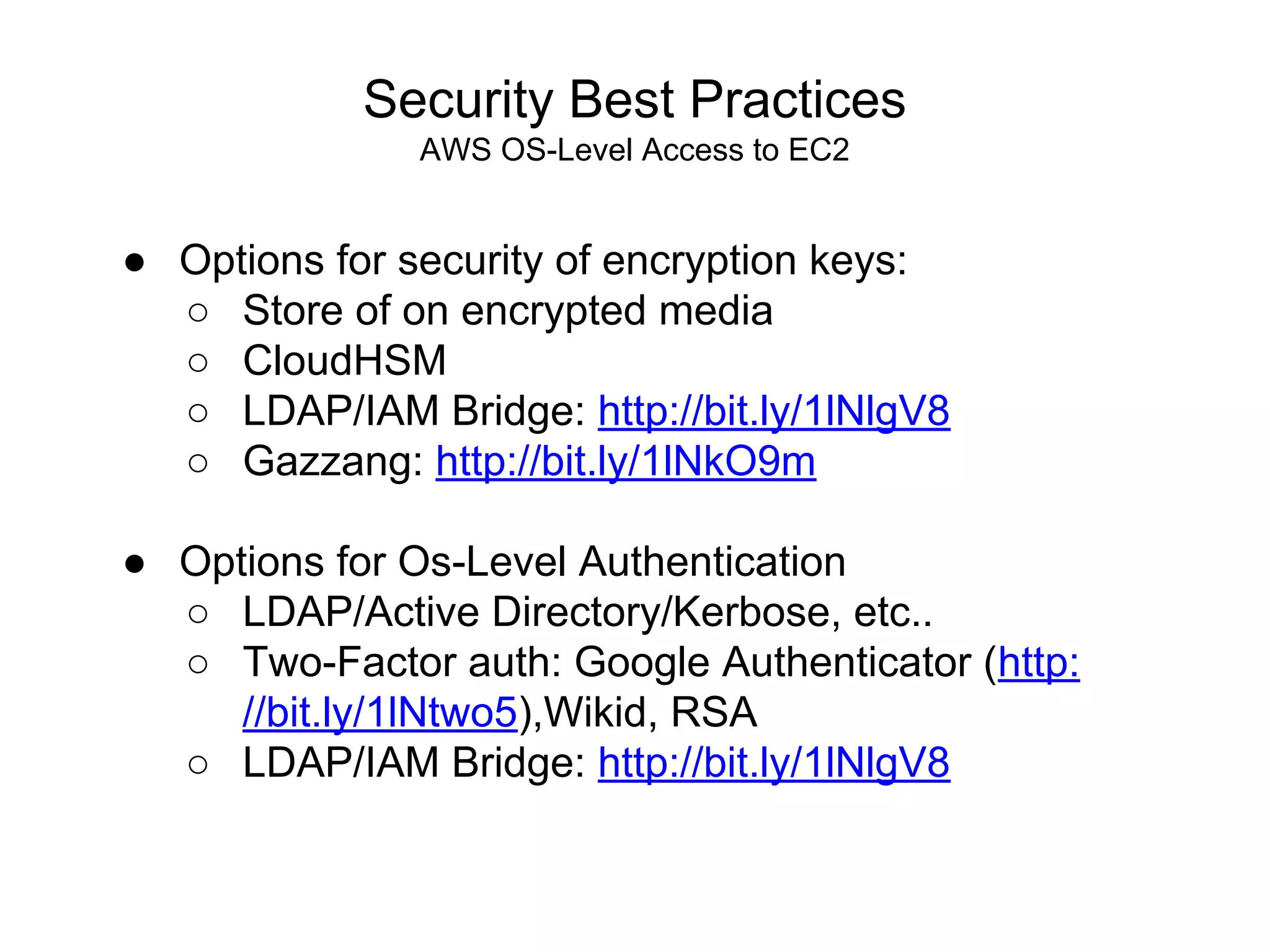
AWS OS-Level Access to EC2
● Options for security of encryption keys:
○ Store of on encrypted media
○ CloudHSM
○ LDAP/IAM Bridge: http://bit.ly/1lNlgV8
○ Gazzang: http://bit.ly/1lNkO9m
● Options for Os-Level Authentication
○ LDAP/Active Directory/Kerbose, etc..
○ Two-Factor auth: Google Authenticator (http:
//bit.ly/1lNtwo5),Wikid, RSA
○ LDAP/IAM Bridge: http://bit.ly/1lNlgV8
Security Best Practices
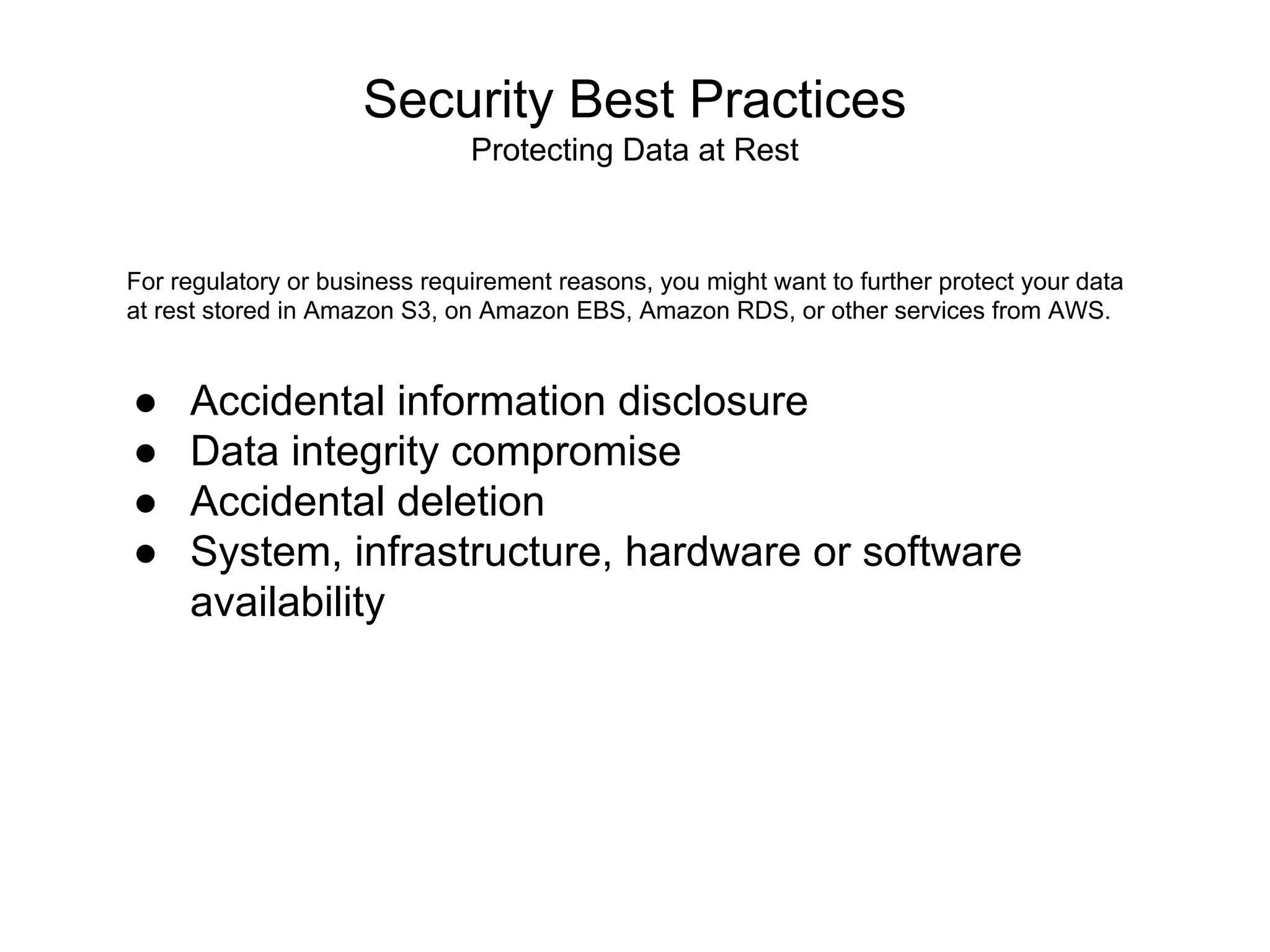
Protecting Data at Rest
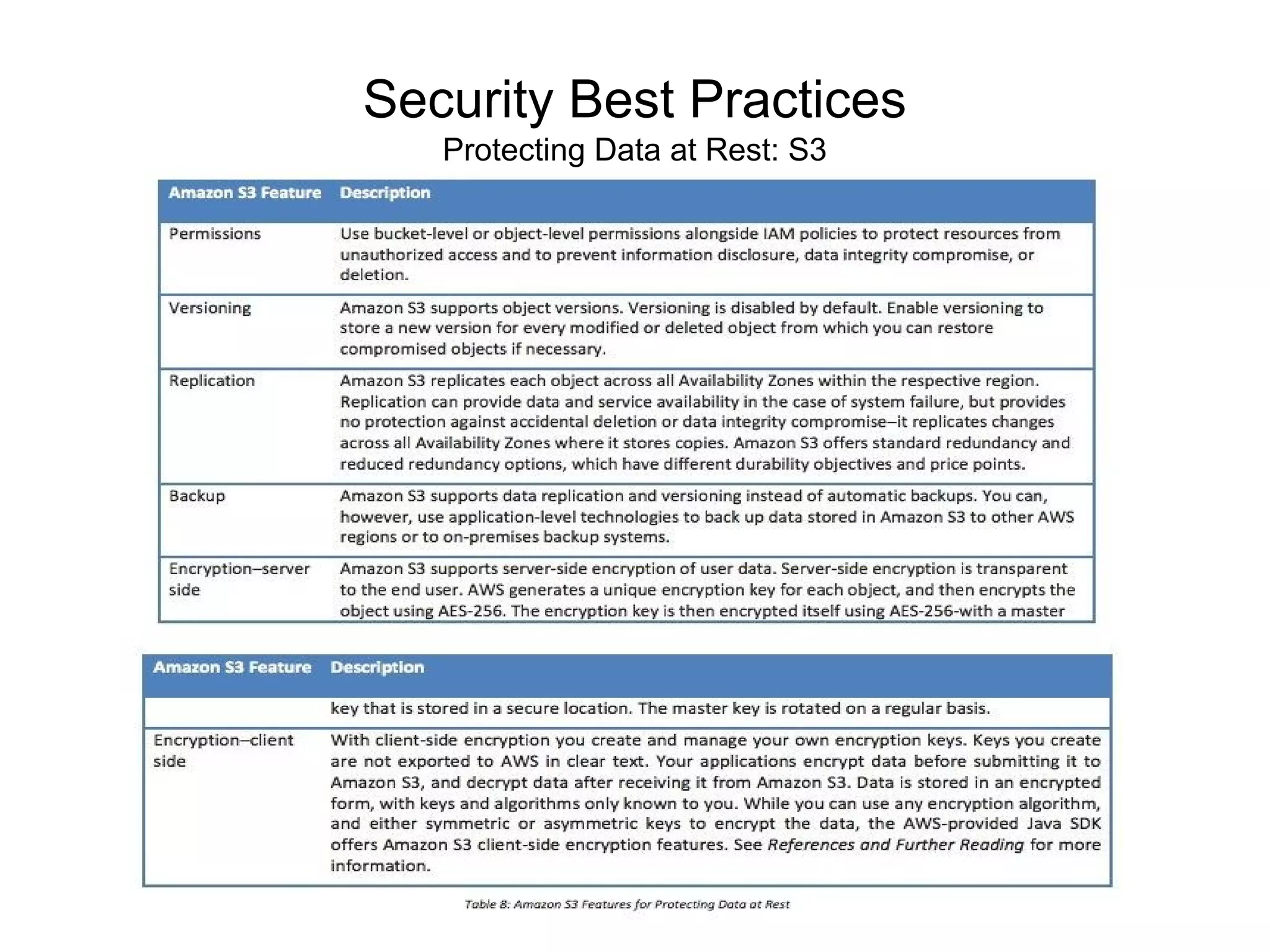
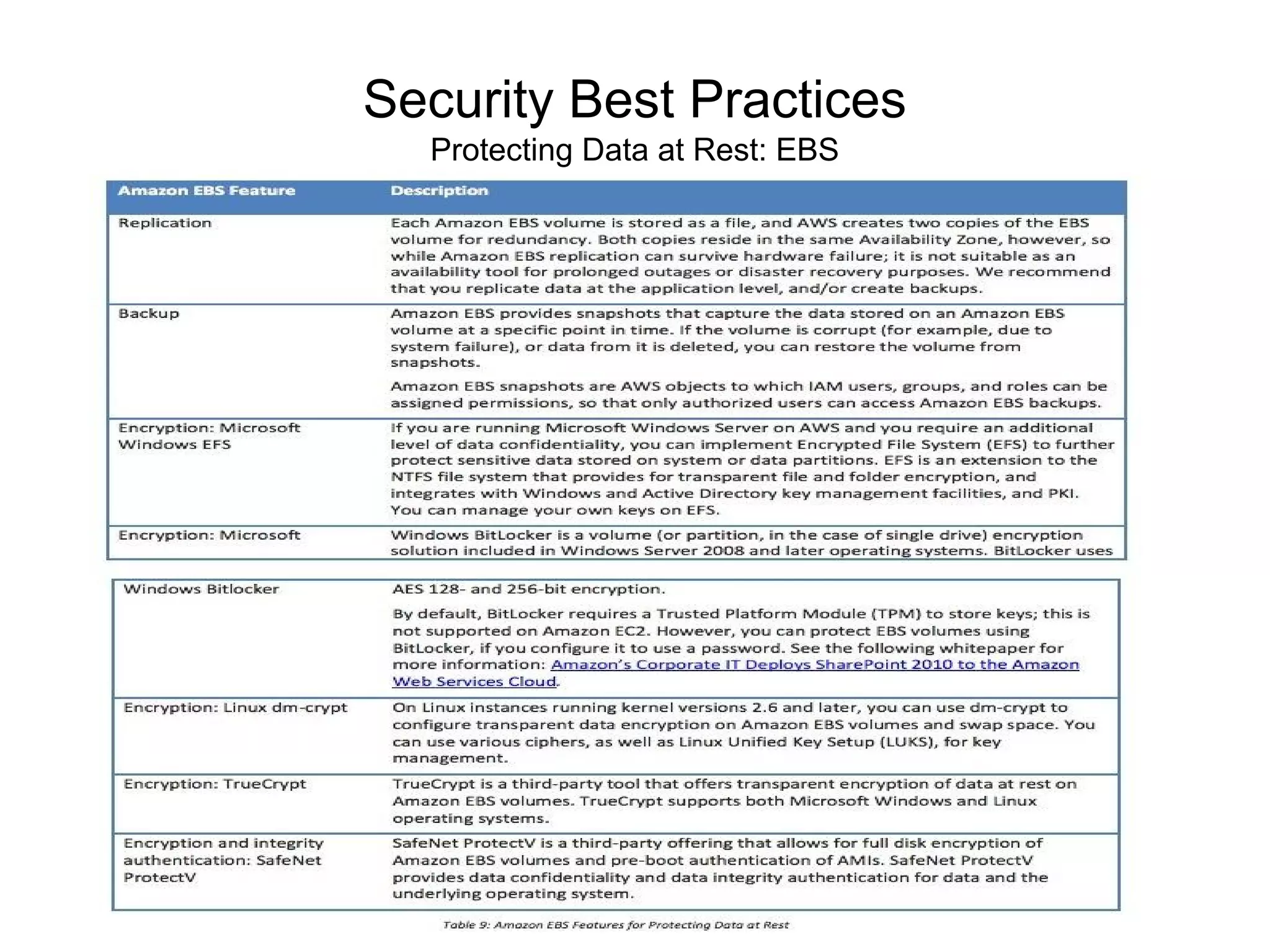
For regulatory or business requirement reasons, you might want to further protect your data
at rest stored in Amazon S3, on Amazon EBS, Amazon RDS, or other services from AWS.
● Accidental information disclosure
● Data integrity compromise
● Accidental deletion
● System, infrastructure, hardware or software
availability
Security Best Practices
Protecting Data at Rest: S3
Security Best Practices
Protecting Data at Rest: EBS
Security Best Practices
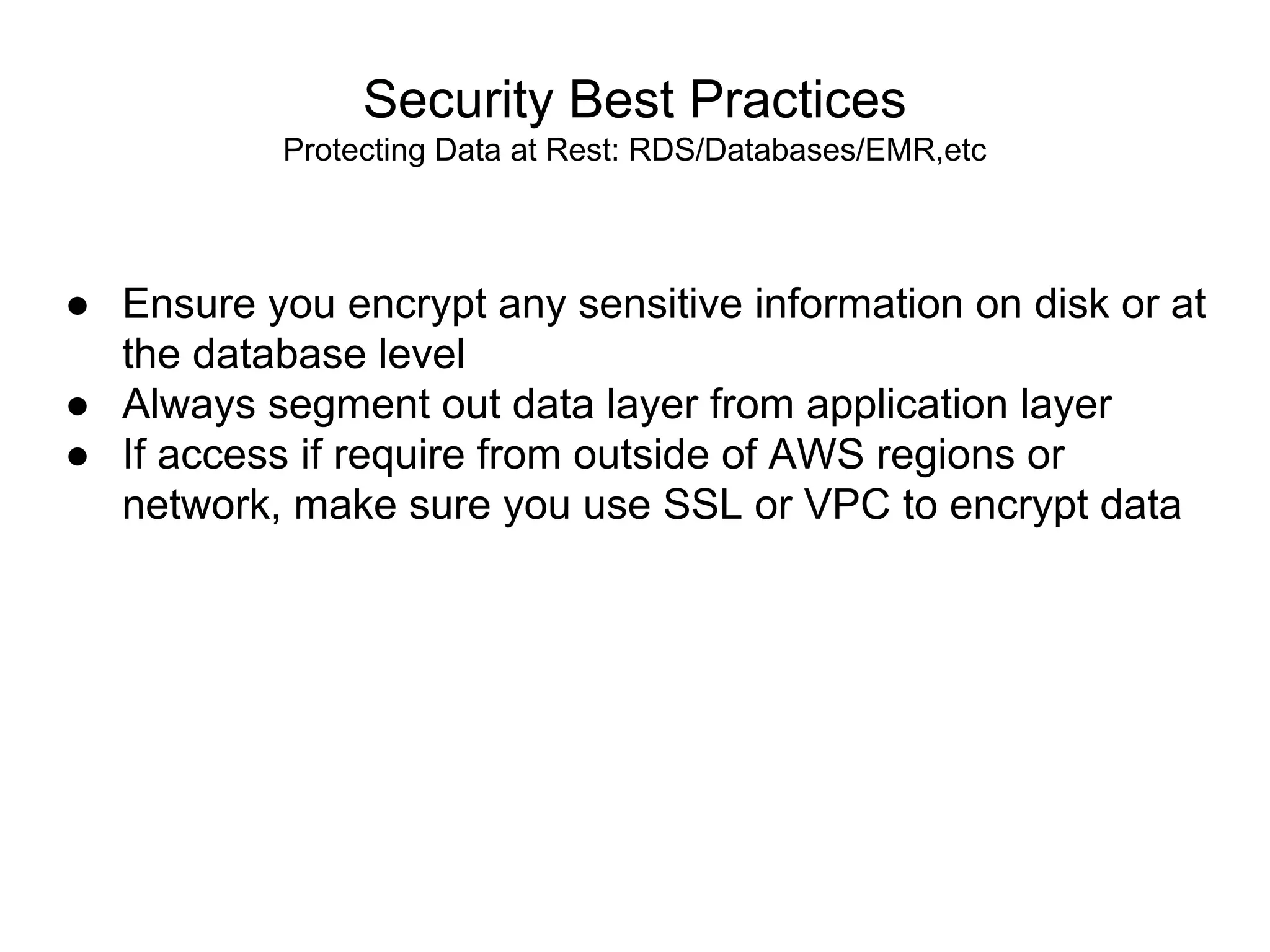
Protecting Data at Rest: RDS/Databases/EMR,etc
● Ensure you encrypt any sensitive information on disk or at
the database level
● Always segment out data layer from application layer
● If access if require from outside of AWS regions or
network, make sure you use SSL or VPC to encrypt data
Security Best Practices
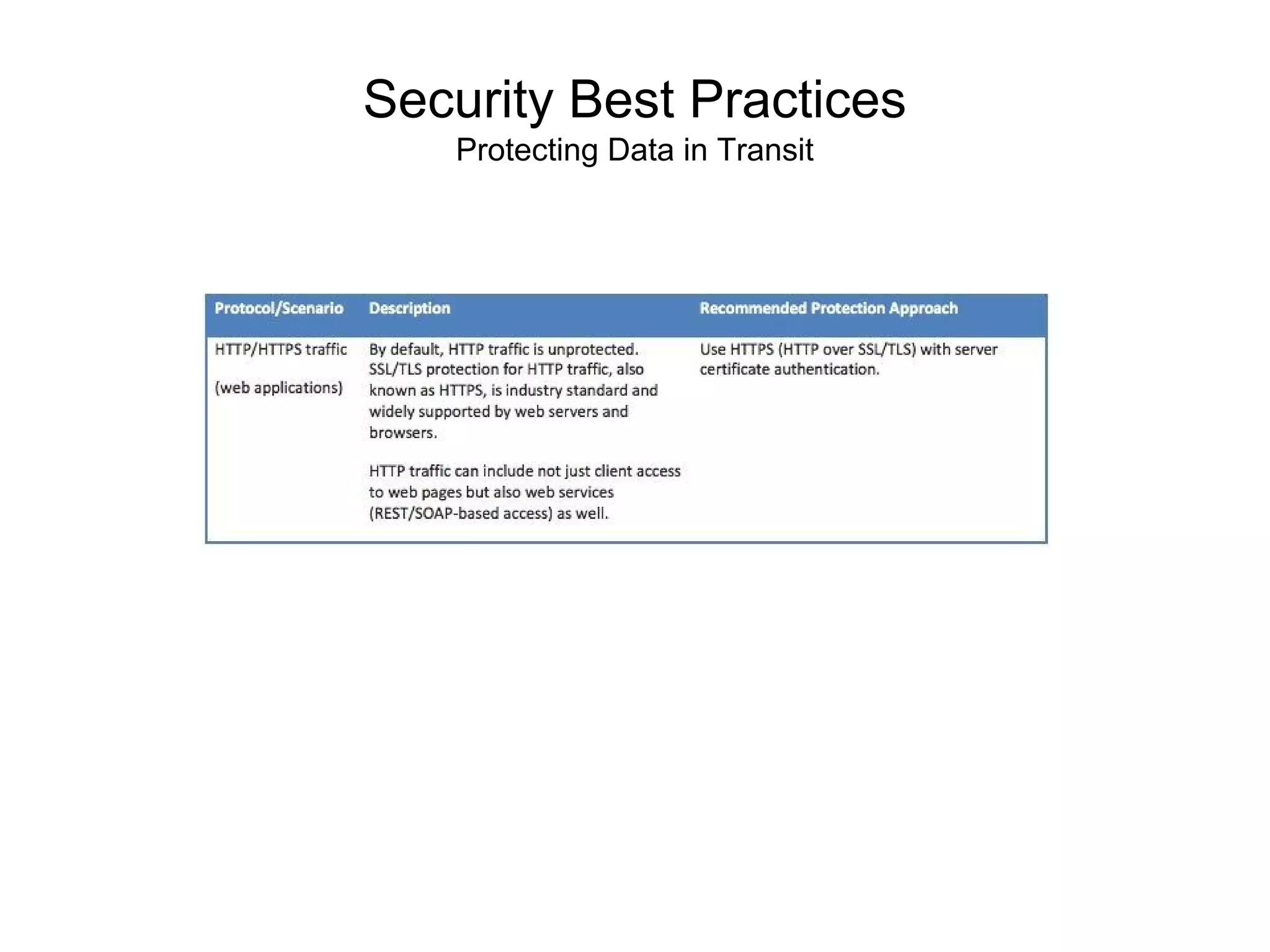
Protecting Data in Transit
Security Best Practices
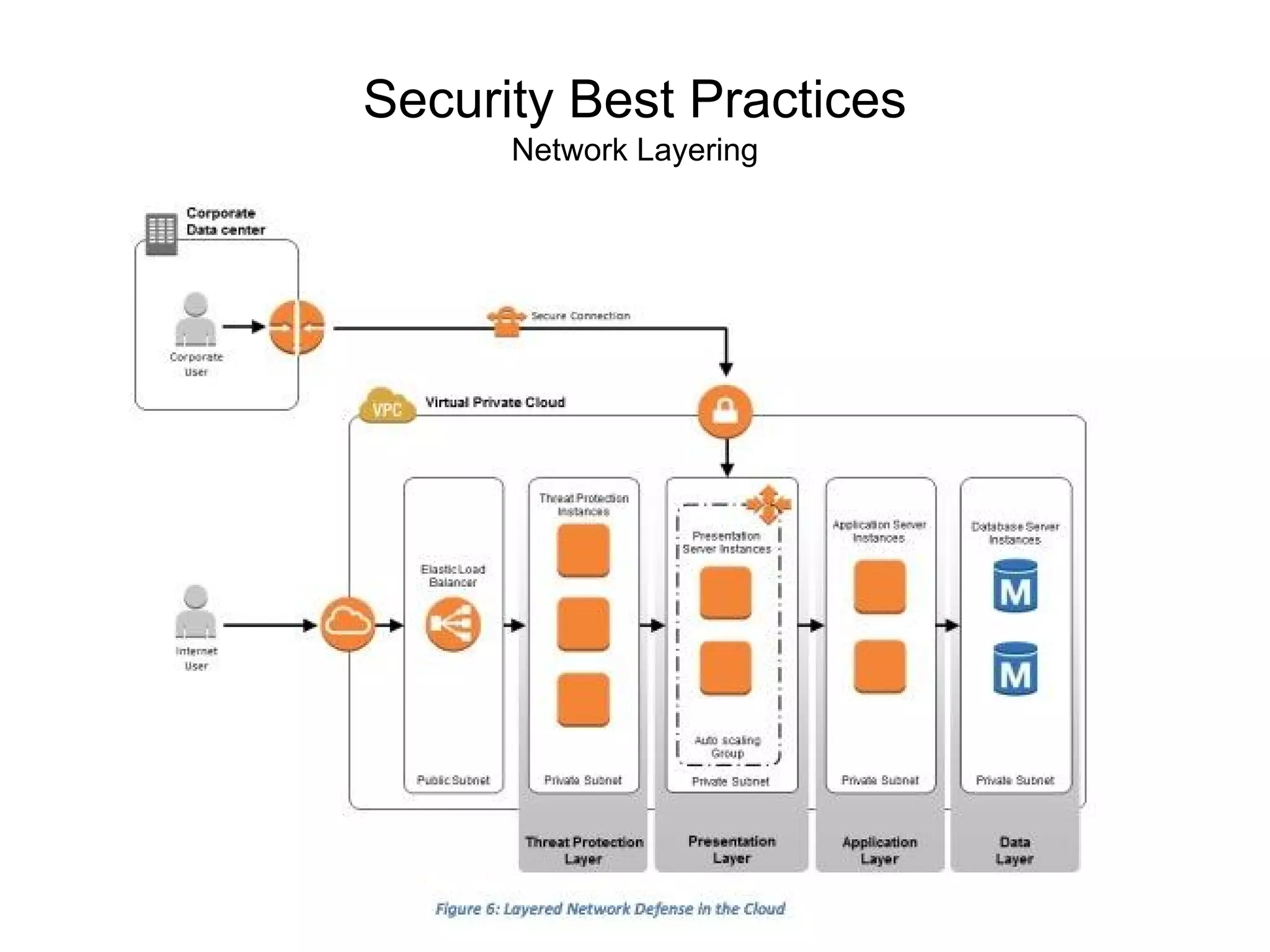
Network Layering
Security Best Practices
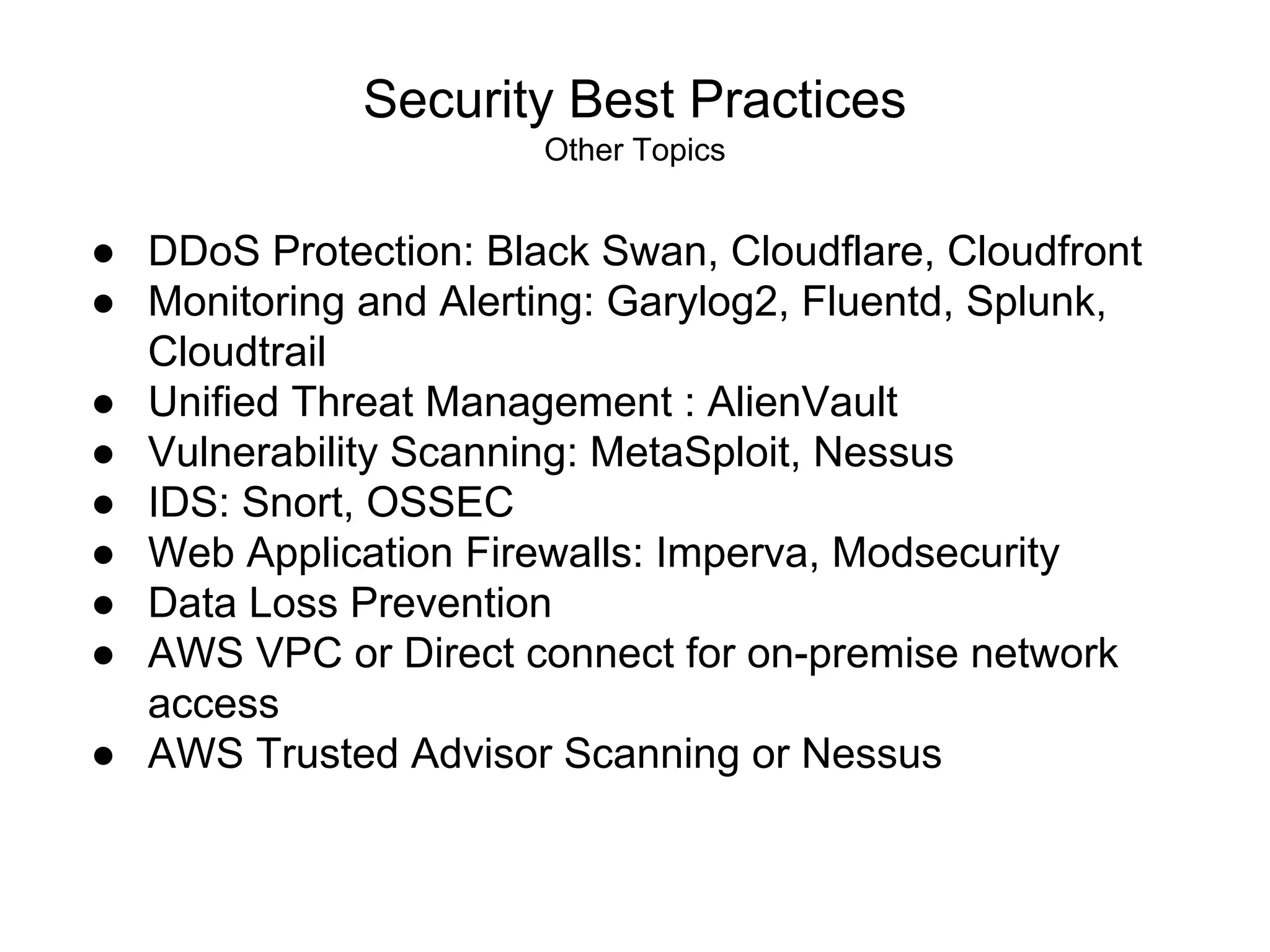
Other Topics
● DDoS Protection: Black Swan, Cloudflare, Cloudfront
● Monitoring and Alerting: Garylog2, Fluentd, Splunk,
Cloudtrail
● Unified Threat Management : AlienVault
● Vulnerability Scanning: MetaSploit, Nessus
● IDS: Snort, OSSEC
● Web Application Firewalls: Imperva, Modsecurity
● Data Loss Prevention
● AWS VPC or Direct connect for on-premise network
access
● AWS Trusted Advisor Scanning or Nessus
Credits
Credits go to the following:
AWS Security Best Practices: http://bit.
ly/T97y3I
Q & A 	

!
!
Pizza’s almost here!	

!
!
Sponsored by
Hosted by
#AWSChicago

AWS Chicago user group meetup on June 24, 2014

  • 1.
  • 2.
  • 3.
    6:00 pm Introductions 6:10pm Lightning Talks ! Live from DC! - Ben Hagen, Senior Cloud Security Engineer at Netflix @benhagen "Securing your AWS installation" - Bryan Murphy,Technical Architect at Mediafly @bryanmurphy "Advanced Monitoring and Detection on Linux-based workloads in AWS" - Aaron Botsis, Lead Product Manager at ThreatStack @aaronb "AWS Security best practices" - Mattew Long, Founder and CEO at roZoom, Inc @mlong168 ! 6:30 pm Q & A 7:00 pm Networking, drinks and pizza Agenda Sponsored by Hosted by #AWSChicago
  • 4.
    “Live from DC!” ! BenHagen Senior Cloud Security Engineer at Netflix ! Tweet: @benhagen
 #AWSChicago ! Sponsored by Hosted by #AWSChicago
  • 5.
    “Securing your AWSinstallation” ! Bryan Murphy Technical Architect at Mediafly ! Tweet: @bryanmurphy
 #AWSChicago ! Sponsored by Hosted by #AWSChicago
  • 6.
    Safe Harbor Statement:Our discussions may include predictions, estimates or other information that might be considered forward-looking. While these forward-looking statements represent our current judgment on what the future holds, they are subject to risks and uncertainties that could cause actual results to differ materially. You are cautioned not to place undue reliance on these forward-looking statements, which reflect our opinions only as of the date of this presentation. Please keep in mind that we are not obligating ourselves to revise or publicly release the results of any revision to these forward- looking statements in light of new information or future events. Throughout today’s discussion, we will attempt to convey some important factors relating to our business that may affect our predictions. © 2006-2014 Mediafly, Inc. | Confidential Infrastructure Security Best Practices On Amazon Web Services Bryan Murphy
  • 7.
    © 2006-2014 Mediafly,Inc. | Confidential Mediafly, Inc. Technical Architect Back-end services, video processing, scaling and architecture Mobitrac, Inc. Senior Developer Travelling salesman problem, routing algorithms, and mapping RBC/Centura Mortgage Lead Web Developer Online loan officer hosting platform and rate search engine Who am I?
  • 8.
    © 2006-2014 Mediafly,Inc. | Confidential Who are we? “The Content Mobility Cloud” We process and store highly sensitive content for Fortune 500 customers, and deliver that content to white-labeled mobile apps and the web • Sales presentations and selling collateral • Pre-release/pre-air video Customers include: • Global banks • Leading consumer-packaged goods companies • TV and theatrical studios Small, passionate, growing team • We are hiring! Search mediafly careers
  • 9.
    © 2006-2014 Mediafly,Inc. | Confidential Infrastructural Security Three major areas: Content Infrastructure Operations ● Keeping content encrypted from ingest through delivery ● E.g. key exchange, at-rest encryption, DRM, more ● Hardening server security while ensuring reliability, performance and low cost ● E.g. users and roles, VPC, server bootstrapping ● Ensuring procedures and personnel keep content secure ● E.g. managing account termination, principles of least privilege
  • 10.
    © 2006-2014 Mediafly,Inc. | Confidential Secure All Communication The cloud is a hostile environment • Service limitations (no private load balancers, security group limits) • Network limitations (no multicast, no shared ip addresses, etc.) • Noisy neighbors • Malicious third parties What to do: • SSL/TLS everywhere • Encrypt: transports, configuration, data, binaries • Use standard tools (openssl/gnupg) • Implement authorization for internal services
  • 11.
    © 2006-2014 Mediafly,Inc. | Confidential Authorization and Access Control Restricted Access • Many credentials, limited permissions • Restricted one-time-use accounts or accounts with expiration where possible Protecting Credentials • Use public key cryptography • Store encrypted credentials in source control IAM Accounts vs. Roles • Roles: good for isolated servers, boot • Accounts: good for services, users DENIED!
  • 12.
    © 2006-2014 Mediafly,Inc. | Confidential Isolate Services and Customers Isolation • Isolate services and environments from each other using bulkheads • Examples: VPN, ssh proxy, REST API, message queues Stateless Servers • Deliver credentials as needed using public key cryptography • Execute in sandbox • Purge sandbox on completion
  • 13.
    © 2006-2014 Mediafly,Inc. | Confidential Verification Automated Security Testing Regular Audits • Manual internal audits • Third party automated testing • Third party security audits Logging Monitoring
  • 14.
    © 2006-2014 Mediafly,Inc. | Confidential Infrastructural Security is a Balancing Act Secure Flexible
  • 15.
    © 2006-2014 Mediafly,Inc. | Confidential Thank you! Bryan Murphy twitter.com/bryanmurphy twitter.com/mediafly
  • 16.
    “Advanced Monitoring and Detectionon Linux-based workloads in AWS” ! Aaron Botsis Lead Product Manager at ThreatStack ! Tweet: @aaronb
 #AWSChicago ! Sponsored by Hosted by #AWSChicago
  • 17.
    ADVANCED SECURITY MONITORING FOR THECLOUD Aaron Botsis @aaronb, @threatstack
  • 19.
    who is logginginto my (machines|applications|SaaS accounts) ! what are they are running ! of running apps, what are making network activity, and where ! every kernel module loaded every library every file created/modified/removed everything!!!! but why stop there?
  • 20.
  • 22.
  • 23.
  • 24.
    step 1: audit allof the things logins processes network activity file access kernel modules shared libraries
  • 25.
    // `curl google.com`emits this: ! { id: 1018103008, start: 1399236274, end: 1399236275, duration: 1, protocol: 'tcp', byte_count: 1195, packet_count: 11, src_ip_numeric: 3232300674, dst_ip_numeric: 1127355157, src_ip: '192.168.254.130', dst_ip: '67.50.19.21', src_port: 37814, dst_port: 80 } by thinking inside the box
  • 26.
    step 2: build behavior profiles doesapache always spawn a shell? does that shell always switch privs to root? does root always make network connections to China?
  • 27.
  • 28.
    step 3: anomalies help prevent devsknow app best behavior deviations help identify attack new vectors create rules to looks for known misbehavior disable behavioral detection programmatically
  • 29.
  • 30.
  • 31.
  • 32.
    “AWS Security bestpractices” ! Mattew Long Founder and CEO at roZoom, Inc ! Tweet: @mlong168
 #AWSChicago ! Sponsored by Hosted by #AWSChicago
  • 34.
    About Me President &CEO @roZoom Twitter @mlong168 Linkedin: http://linkd.in/T90u7l
  • 35.
  • 38.
    To ensure asecure global infrastructure, AWS configures infrastructure components and provides services and features you can use to enhance security, such as the Identity and Access Management (IAM) service, which you can use to manage users and user permissions in a subset of AWS services. To ensure secure services, AWS offers shared responsibility models for each of the different type of service that we offer: ● Infrastructure services ● Container services ● Abstracted services
  • 39.
  • 40.
  • 41.
  • 42.
    Security Best Practices AWSManagement Console/IAM
  • 43.
    Security Best Practices AWSManagement Console: Enable Two Factor Authentication
  • 44.
    Security Best Practices AWSOS-Level Access to EC2 ● Options for security of encryption keys: ○ Store of on encrypted media ○ CloudHSM ○ LDAP/IAM Bridge: http://bit.ly/1lNlgV8 ○ Gazzang: http://bit.ly/1lNkO9m ● Options for Os-Level Authentication ○ LDAP/Active Directory/Kerbose, etc.. ○ Two-Factor auth: Google Authenticator (http: //bit.ly/1lNtwo5),Wikid, RSA ○ LDAP/IAM Bridge: http://bit.ly/1lNlgV8
  • 45.
    Security Best Practices ProtectingData at Rest For regulatory or business requirement reasons, you might want to further protect your data at rest stored in Amazon S3, on Amazon EBS, Amazon RDS, or other services from AWS. ● Accidental information disclosure ● Data integrity compromise ● Accidental deletion ● System, infrastructure, hardware or software availability
  • 46.
  • 47.
  • 48.
    Security Best Practices ProtectingData at Rest: RDS/Databases/EMR,etc ● Ensure you encrypt any sensitive information on disk or at the database level ● Always segment out data layer from application layer ● If access if require from outside of AWS regions or network, make sure you use SSL or VPC to encrypt data
  • 49.
  • 50.
  • 51.
    Security Best Practices OtherTopics ● DDoS Protection: Black Swan, Cloudflare, Cloudfront ● Monitoring and Alerting: Garylog2, Fluentd, Splunk, Cloudtrail ● Unified Threat Management : AlienVault ● Vulnerability Scanning: MetaSploit, Nessus ● IDS: Snort, OSSEC ● Web Application Firewalls: Imperva, Modsecurity ● Data Loss Prevention ● AWS VPC or Direct connect for on-premise network access ● AWS Trusted Advisor Scanning or Nessus
  • 53.
    Credits Credits go tothe following: AWS Security Best Practices: http://bit. ly/T97y3I
  • 54.
    Q & A ! ! Pizza’s almost here! ! ! Sponsored by Hosted by #AWSChicago