Unikernelized Linux
Tiejun Chen <tiejunc@vmware.com>
VMware China R&D Advanced Technology Center
This is our own exploration of unikernels.
This is not a roadmap or commitment from VMware.
Warning 
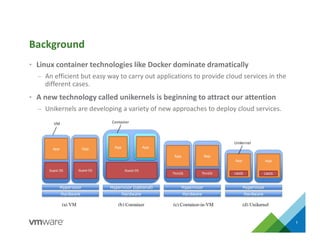
• Linux container technologies like Docker dominate dramatically
– An efficient but easy way to carry out applications to provide cloud services in the
different cases.
• A new technology called unikernels is beginning to attract our attention
– Unikernels are developing a variety of new approaches to deploy cloud services.
Background
1
• Unikernels projects
– MirageOS, ClickOS, Clive, HaLVM, LING, Rump Kernels, OSv, Unik, Solo5 Unikernel,
Drawbridge
• Unikernels solutions
– Docker
• Hyperkit/VPNkit
• Moby/Linuxkit
– Mikelangelo
• Improving Responsiveness and Agility of HPC Cloud Infrastructure
– NFV
• Unikernels based NFV architecture
Major Existing Unikernels
2
• Definition
– Unikernels are specialised, single address space machine images constructed by
using library operating systems. --Wiki
• Types
– General purpose unikernels
• A library that derives from a generally designed OS kernel
• Works for apps that follow some mature speculations (e.g. POSIX, or glibc)
• Example: Rumprun, OSv, ClickOS and Drawbridge
– Language specific unikernels
• A library of a programming language that includes all OS functionalities
• Works for apps written in specific languages only
• Example: MirageOS (OCaml), Clive (Golang), HalVM (Haskell), IncludeOS (C++), Ling (Erlang)
and Runtime.js (Javascript)
3
Unikernel Definition and Types
• The biggest characteristics
– Single address space: Zero-copy and huge page
– Single running mode: Perform the efficient function call
– One process with multiple threads: No heavy context switch and TLB flush
• Compared to a traditional OS, unikernels provide many benefits
– Improved security
• Unikernels reduce the amount of code deployed, which reduces the attack surface.
– Small footprints
• Unikernels images are often orders of magnitude smaller than traditional OS deployments.
– Highly optimized
• Unikernels enables whole-system optimization across device drivers and application logic.
Especially it’s mostly paravirtualized under virtualization environment.
– Fast Boot
• Unikernels can boot extremely quickly, with boot times measured in milliseconds.
4
Unikernel Essentials
• OSv
– For unmodified network-intensive applications, we demonstrate up to 25%
increase in throughput and 47% decrease in latency. By using non-POSIX network
APIs, we can further improve performance and demonstrate a 290% increase in
Memcached throughput.
– http://www.cs.utah.edu/~peterm/prelim-osv-performance.pdf
• IncludeOS
– As a test case a bootable disk image consisting of a simple DNS server with OS
included is shown to require only 158 kb of disk space and to require 5-20% less
CPU-time, depending on hardware, compared to the same binary running on
Linux.
• ClickOS
– ClickOS virtual machines are small (5MB), boot quickly (about 30 milliseconds), add
little delay (45 microseconds) and over one hundred of them can be concurrently
run while saturating a 10Gb pipe on a commodity server.
Unikernel Experiments: Public Claims
5
• Challenges - why existing unikernels have yet to gain large popularity
– Lack of compelling use cases
– Compatibility with existing applications
– Lack of production support (e.g. monitoring, debugging, logging)
6
Unikernel Challenges
• Serverless
Most public cloud vendors are embracing this promising model with container.
– Pros
• Quick OS boot & improved security & smaller size and footprint
• Mature VM management
• Potentially multiple languages support
– Cons
• Unikernels is a little heavy to carry out just one function.
• Debug issue can worsen serverless development.
• Time of creating VM has a significant impact on function invocation.
– Conclusion
• In terms of different QOS unikernels are beneficial and useful complement to serverless
mode. Furthermore, what if we can unikernelize linux, and further optimize it accordingly.
Use Cases for Unikernels 1/3
7
• IoT
IoT is a big markets as well.
– Pros
• The feature of smaller size & footprint are good for those resource-strained IoT platforms.
• Such a lightweight VM instance can address security issue.
– Cons
• Oftentimes unikernels need virtualization technology.
• Unikernels are not designed to address those IoT characters like power consumption.
• Unikernels don’t support versatile architectures.
– Conclusion
• Unikernels can value IoT when virtualization probably thrives at the edge. More
importantly, IoT closely ties with the embedded system where Linux always plays a very
import role, so it’s worth fitting unikernlized Linux into IoT.
Use Cases for Unikernels 2/3
8
• IO intensive applications
IO Performance always captures people’s attention.
– Pros
• Oftentimes unikernels have the simple IO flow framework
– Cons
• Only a subset of I/O intensive apps are good for unikernels: the latency-sensitive apps. The
other subset of I/O intensive apps like the bandwidth-intensive apps need more
considerations and explorations.
– Conclusion
• Unikernels can contribute IO case at large. NFV is really a potential chance to make
unikernels succeed with any targeted acceleration to Linux.
Use Cases for Unikernels 3/3
9
• Summary
– Unikernels still yield comparable performance.
• The different unikernels have different focuses.
• User has to put more or less effort to develop an application based on unikernels.
– Nothing more specifically is done to embrace unikernels from hypervisor’s view.
– Linux could be a good candidate of unikernels
• Linux itself could help eliminate those challenges of unikernels
• All optimizations and acceleration aimed to Linux can benefit unikernels
• Unikernelized Linux can catch more eye by means of Linux community 
Exploration Conclusions
10
Our target is to explore what is the best platform for running unikernels case
We will achieve this by
• Research existing unikernels
– Integrate and support those major existing unikernels well
• Build new unikernel
– Convert Linux kernel
• Explore optimizations
– Integrate virtIO model into ESXi as an example
– Provide monitoring, logging and remote debugging
– Supporting a short lived unikernels instance
– Resources are consumed by live unikernels
11
What Could We Do?
• Convert Linux to unikernels
– The fundamental philosophy of Linux is aiming to multiple processes and two
modes.
– Most components are coupled tightly.
– How to further improve performance
• Reduce time of creating VM
– Snapshort
– VM Fork
• A good paravirtualized API for common unikernels
– Some pv ops might already be a good start
• New scheduler
• Manage the lifecycle and identities of the provisioned unikernels
12
What Are The Key Challenges?
• Support major existing unikernels
– Integrate virtIO framework into ESXi
– Port vmxnet3 and pvscsi into them
• Define a standard API which can paravirtualize unikernels
– Based on common hypercall
– Configure/control guest OS
– Setup Inter-VM Communication
– Allocate/destroy memory directly
• Add a new scheduler
– Address short lived VM
– Schedule a group of unikernels instances
How Could We Possibly Achieve This? Hypervisor basics
13
• Convert Linux
– Single running mode
• Ring 0
– __USER32_CS | __USER_DS | __USER_CS
– Check with ‘cmpq $__USER_CS, CS(%rsp)’
• Stack
– Switch stacks manually
• Interrupt Stack Table (IST)
– set_intr_gate_ist(X86_TRAP_PF, &page_fault, PF_STACK)
– Interrupt and exception
– Single address space
• Single process
• No fork()/exec()
How Could We Possibly Achieve This? Linux basics 1/2
14
• Convert Linux
– Optimization
• Smaller size and footprint
• Zero-copy
– {get,put}_user
– copy_{from,to}_user
– Other unnecessary copy and check
• Scheduler
– scheduling classes & policies
• fair vs rt vs deadline
• New?
• Lightweight TCP/IP Stack
– LWIP
– Fastsocket
– Seastar
– A variety of Linux variants
• Multiple Unikernelized Linux profiles
How Could We Possibly Achieve This? Linux basics 2/2
15
• Support existing applications
– Different code circumstances
• Source code
– New standard library
• glibc
– Function Call
• Binary
– –shared –pic
• LD_PRELOAD
– Others
• BT
– Multiple processes
• One fork = one unikernelized Linux instance
– IPC = Inter-VM Communication
• PCID – Process-context identifiers
– Limited bits
– Linux’s own debug/monitor/log tools and utilities
16
How Could We Possibly Achieve This? Compatibility
• Debug unikernels
– Log info
• virtual serial port
• Dynamic buffer memory allocation
– Linux’s own utilizes
• ssh/gdb/ftrace/perf/kprobe/kdump/…
• PCID & the balloon driver
• Monitor unikernels
– A mini-httpd as a stub connecting those Linux utilities
• Inspired by OSv
• Log unikernels
– rsyslog
– vRealize Log Insight
17
How Could We Possibly Achieve This?
Debugging, monitoring and logging
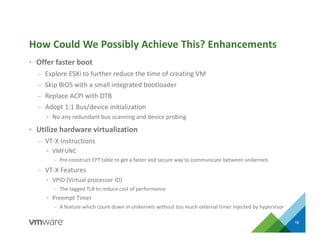
• Offer faster boot
– Explore ESXi to further reduce the time of creating VM
– Skip BIOS with a small integrated bootloader
– Replace ACPI with DTB
– Adopt 1:1 Bus/device initialization
• No any redundant bus scanning and device probing
• Utilize hardware virtualization
– VT-X Instructions
• VMFUNC
– Pre-construct EPT table to get a faster and secure way to communicate between unikernels
– VT-X Features
• VPID (Virtual processor ID)
– The tagged TLB to reduce cost of performance
• Preempt Timer
– A feature which count down in unikernels without too much external timer injected by hypervisor
How Could We Possibly Achieve This? Enhancements
18
• Construct an efficient toolchain
– Build and deploy unikernels like Docker
– Customized components management
• Configuration
• Kernel image
• User App
• Dependencies
• Support orchestration
– Docker Swarm Mode, Kubernetes, Mesos and Cloud Foundry
– Unik
• Integrate Source Code Analyzer tool
– This can help us enhance security from code level
19
How Could We Possibly Achieve This? Others
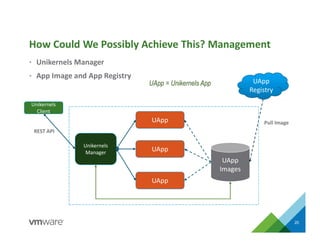
• Unikernels Manager
• App Image and App Registry
20
How Could We Possibly Achieve This? Management
Unikernels
Client
Unikernels
Client
Unikernels
Manager
UApp
UApp
UApp
UApp
Images
UApp
Registry
Pull Image
REST API
UApp = Unikernels App
• http://unikernel.org/projects/
• https://wiki.xen.org/images/3/34/XenProject_Unikernel_Whitepaper_2015_
FINAL.pdf
• https://www.linux.com/news/7-unikernel-projects-take-docker-2015
• https://www.usenix.org/node/184012
• https://www.deepdyve.com/lp/institute-of-electrical-and-electronics-
engineers/includeos-a-minimal-resource-efficient-unikernel-for-cloud-
services-J43NrzQ7fn
• https://www.usenix.org/system/files/conference/nsdi14/nsdi14-paper-
martins.pdf
References
Thank You!
tiejunc@vmware.com

Unikernelized Linux

  • 1.
    Unikernelized Linux Tiejun Chen<tiejunc@vmware.com> VMware China R&D Advanced Technology Center
  • 2.
    This is ourown exploration of unikernels. This is not a roadmap or commitment from VMware. Warning 
  • 3.
    • Linux containertechnologies like Docker dominate dramatically – An efficient but easy way to carry out applications to provide cloud services in the different cases. • A new technology called unikernels is beginning to attract our attention – Unikernels are developing a variety of new approaches to deploy cloud services. Background 1
  • 4.
    • Unikernels projects –MirageOS, ClickOS, Clive, HaLVM, LING, Rump Kernels, OSv, Unik, Solo5 Unikernel, Drawbridge • Unikernels solutions – Docker • Hyperkit/VPNkit • Moby/Linuxkit – Mikelangelo • Improving Responsiveness and Agility of HPC Cloud Infrastructure – NFV • Unikernels based NFV architecture Major Existing Unikernels 2
  • 5.
    • Definition – Unikernelsare specialised, single address space machine images constructed by using library operating systems. --Wiki • Types – General purpose unikernels • A library that derives from a generally designed OS kernel • Works for apps that follow some mature speculations (e.g. POSIX, or glibc) • Example: Rumprun, OSv, ClickOS and Drawbridge – Language specific unikernels • A library of a programming language that includes all OS functionalities • Works for apps written in specific languages only • Example: MirageOS (OCaml), Clive (Golang), HalVM (Haskell), IncludeOS (C++), Ling (Erlang) and Runtime.js (Javascript) 3 Unikernel Definition and Types
  • 6.
    • The biggestcharacteristics – Single address space: Zero-copy and huge page – Single running mode: Perform the efficient function call – One process with multiple threads: No heavy context switch and TLB flush • Compared to a traditional OS, unikernels provide many benefits – Improved security • Unikernels reduce the amount of code deployed, which reduces the attack surface. – Small footprints • Unikernels images are often orders of magnitude smaller than traditional OS deployments. – Highly optimized • Unikernels enables whole-system optimization across device drivers and application logic. Especially it’s mostly paravirtualized under virtualization environment. – Fast Boot • Unikernels can boot extremely quickly, with boot times measured in milliseconds. 4 Unikernel Essentials
  • 7.
    • OSv – Forunmodified network-intensive applications, we demonstrate up to 25% increase in throughput and 47% decrease in latency. By using non-POSIX network APIs, we can further improve performance and demonstrate a 290% increase in Memcached throughput. – http://www.cs.utah.edu/~peterm/prelim-osv-performance.pdf • IncludeOS – As a test case a bootable disk image consisting of a simple DNS server with OS included is shown to require only 158 kb of disk space and to require 5-20% less CPU-time, depending on hardware, compared to the same binary running on Linux. • ClickOS – ClickOS virtual machines are small (5MB), boot quickly (about 30 milliseconds), add little delay (45 microseconds) and over one hundred of them can be concurrently run while saturating a 10Gb pipe on a commodity server. Unikernel Experiments: Public Claims 5
  • 8.
    • Challenges -why existing unikernels have yet to gain large popularity – Lack of compelling use cases – Compatibility with existing applications – Lack of production support (e.g. monitoring, debugging, logging) 6 Unikernel Challenges
  • 9.
    • Serverless Most publiccloud vendors are embracing this promising model with container. – Pros • Quick OS boot & improved security & smaller size and footprint • Mature VM management • Potentially multiple languages support – Cons • Unikernels is a little heavy to carry out just one function. • Debug issue can worsen serverless development. • Time of creating VM has a significant impact on function invocation. – Conclusion • In terms of different QOS unikernels are beneficial and useful complement to serverless mode. Furthermore, what if we can unikernelize linux, and further optimize it accordingly. Use Cases for Unikernels 1/3 7
  • 10.
    • IoT IoT isa big markets as well. – Pros • The feature of smaller size & footprint are good for those resource-strained IoT platforms. • Such a lightweight VM instance can address security issue. – Cons • Oftentimes unikernels need virtualization technology. • Unikernels are not designed to address those IoT characters like power consumption. • Unikernels don’t support versatile architectures. – Conclusion • Unikernels can value IoT when virtualization probably thrives at the edge. More importantly, IoT closely ties with the embedded system where Linux always plays a very import role, so it’s worth fitting unikernlized Linux into IoT. Use Cases for Unikernels 2/3 8
  • 11.
    • IO intensiveapplications IO Performance always captures people’s attention. – Pros • Oftentimes unikernels have the simple IO flow framework – Cons • Only a subset of I/O intensive apps are good for unikernels: the latency-sensitive apps. The other subset of I/O intensive apps like the bandwidth-intensive apps need more considerations and explorations. – Conclusion • Unikernels can contribute IO case at large. NFV is really a potential chance to make unikernels succeed with any targeted acceleration to Linux. Use Cases for Unikernels 3/3 9
  • 12.
    • Summary – Unikernelsstill yield comparable performance. • The different unikernels have different focuses. • User has to put more or less effort to develop an application based on unikernels. – Nothing more specifically is done to embrace unikernels from hypervisor’s view. – Linux could be a good candidate of unikernels • Linux itself could help eliminate those challenges of unikernels • All optimizations and acceleration aimed to Linux can benefit unikernels • Unikernelized Linux can catch more eye by means of Linux community  Exploration Conclusions 10
  • 13.
    Our target isto explore what is the best platform for running unikernels case We will achieve this by • Research existing unikernels – Integrate and support those major existing unikernels well • Build new unikernel – Convert Linux kernel • Explore optimizations – Integrate virtIO model into ESXi as an example – Provide monitoring, logging and remote debugging – Supporting a short lived unikernels instance – Resources are consumed by live unikernels 11 What Could We Do?
  • 14.
    • Convert Linuxto unikernels – The fundamental philosophy of Linux is aiming to multiple processes and two modes. – Most components are coupled tightly. – How to further improve performance • Reduce time of creating VM – Snapshort – VM Fork • A good paravirtualized API for common unikernels – Some pv ops might already be a good start • New scheduler • Manage the lifecycle and identities of the provisioned unikernels 12 What Are The Key Challenges?
  • 15.
    • Support majorexisting unikernels – Integrate virtIO framework into ESXi – Port vmxnet3 and pvscsi into them • Define a standard API which can paravirtualize unikernels – Based on common hypercall – Configure/control guest OS – Setup Inter-VM Communication – Allocate/destroy memory directly • Add a new scheduler – Address short lived VM – Schedule a group of unikernels instances How Could We Possibly Achieve This? Hypervisor basics 13
  • 16.
    • Convert Linux –Single running mode • Ring 0 – __USER32_CS | __USER_DS | __USER_CS – Check with ‘cmpq $__USER_CS, CS(%rsp)’ • Stack – Switch stacks manually • Interrupt Stack Table (IST) – set_intr_gate_ist(X86_TRAP_PF, &page_fault, PF_STACK) – Interrupt and exception – Single address space • Single process • No fork()/exec() How Could We Possibly Achieve This? Linux basics 1/2 14
  • 17.
    • Convert Linux –Optimization • Smaller size and footprint • Zero-copy – {get,put}_user – copy_{from,to}_user – Other unnecessary copy and check • Scheduler – scheduling classes & policies • fair vs rt vs deadline • New? • Lightweight TCP/IP Stack – LWIP – Fastsocket – Seastar – A variety of Linux variants • Multiple Unikernelized Linux profiles How Could We Possibly Achieve This? Linux basics 2/2 15
  • 18.
    • Support existingapplications – Different code circumstances • Source code – New standard library • glibc – Function Call • Binary – –shared –pic • LD_PRELOAD – Others • BT – Multiple processes • One fork = one unikernelized Linux instance – IPC = Inter-VM Communication • PCID – Process-context identifiers – Limited bits – Linux’s own debug/monitor/log tools and utilities 16 How Could We Possibly Achieve This? Compatibility
  • 19.
    • Debug unikernels –Log info • virtual serial port • Dynamic buffer memory allocation – Linux’s own utilizes • ssh/gdb/ftrace/perf/kprobe/kdump/… • PCID & the balloon driver • Monitor unikernels – A mini-httpd as a stub connecting those Linux utilities • Inspired by OSv • Log unikernels – rsyslog – vRealize Log Insight 17 How Could We Possibly Achieve This? Debugging, monitoring and logging
  • 20.
    • Offer fasterboot – Explore ESXi to further reduce the time of creating VM – Skip BIOS with a small integrated bootloader – Replace ACPI with DTB – Adopt 1:1 Bus/device initialization • No any redundant bus scanning and device probing • Utilize hardware virtualization – VT-X Instructions • VMFUNC – Pre-construct EPT table to get a faster and secure way to communicate between unikernels – VT-X Features • VPID (Virtual processor ID) – The tagged TLB to reduce cost of performance • Preempt Timer – A feature which count down in unikernels without too much external timer injected by hypervisor How Could We Possibly Achieve This? Enhancements 18
  • 21.
    • Construct anefficient toolchain – Build and deploy unikernels like Docker – Customized components management • Configuration • Kernel image • User App • Dependencies • Support orchestration – Docker Swarm Mode, Kubernetes, Mesos and Cloud Foundry – Unik • Integrate Source Code Analyzer tool – This can help us enhance security from code level 19 How Could We Possibly Achieve This? Others
  • 22.
    • Unikernels Manager •App Image and App Registry 20 How Could We Possibly Achieve This? Management Unikernels Client Unikernels Client Unikernels Manager UApp UApp UApp UApp Images UApp Registry Pull Image REST API UApp = Unikernels App
  • 23.
    • http://unikernel.org/projects/ • https://wiki.xen.org/images/3/34/XenProject_Unikernel_Whitepaper_2015_ FINAL.pdf •https://www.linux.com/news/7-unikernel-projects-take-docker-2015 • https://www.usenix.org/node/184012 • https://www.deepdyve.com/lp/institute-of-electrical-and-electronics- engineers/includeos-a-minimal-resource-efficient-unikernel-for-cloud- services-J43NrzQ7fn • https://www.usenix.org/system/files/conference/nsdi14/nsdi14-paper- martins.pdf References
  • 24.