Spring Cloud Microservices
A journey inside a financial entity
Jordi Gil @jordigilnieto
Toni Jara @tonijar
Preface
Team
Spring I/O
2016
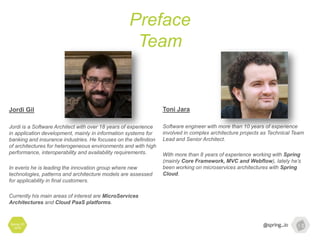
Toni Jara
Software engineer with more than 10 years of experience
involved in complex architecture projects as Technical Team
Lead and Senior Architect.
With more than 8 years of experience working with Spring
(mainly Core Framework, MVC and Webflow), lately he’s
been working on microservices architectures with Spring
Cloud.
Jordi Gil
Jordi is a Software Architect with over 18 years of experience
in application development, mainly in information systems for
banking and insurance industries. He focuses on the definition
of architectures for heterogeneous environments and with high
performance, interoperability and availability requirements.
In everis he is leading the innovation group where new
technologies, patterns and architecture models are assessed
for applicability in final customers.
Currently his main areas of interest are MicroServices
Architectures and Cloud PaaS platforms.
Index
1. Introduction
2. Development
3. Deployment
4. Operations
5. Demo
6. Conclusions
7. Questions
Spring I/O
2016
Spring I/O
2016
INTRODUCTION
Introduction
Objectives
Spring I/O
2016
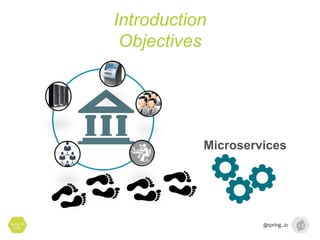
Microservices
Introduction
Monolithic applications
Spring I/O
2016
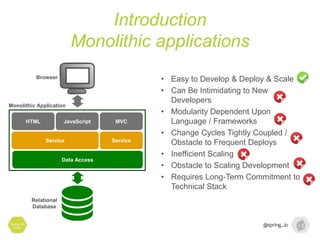
• Easy to Develop & Deploy & Scale
• Can Be Intimidating to New
Developers
• Modularity Dependent Upon
Language / Frameworks
• Change Cycles Tightly Coupled /
Obstacle to Frequent Deploys
• Inefficient Scaling
• Obstacle to Scaling Development
• Requires Long-Term Commitment to
Technical Stack
HTML JavaScript MVC
Service Service
Data Access
Browser
Relational
Database
Monolithic Application
Introduction
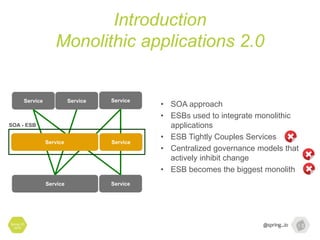
Monolithic applications 2.0
Spring I/O
2016
• SOA approach
• ESBs used to integrate monolithic
applications
• ESB Tightly Couples Services
• Centralized governance models that
actively inhibit change
• ESB becomes the biggest monolith
Service Service
SOA - ESB
Service Service Service
Service Service
Introduction
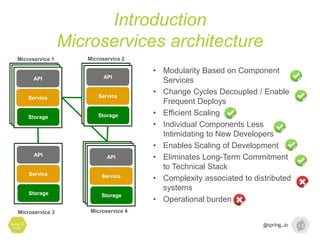
Microservices architecture
Spring I/O
2016
• Modularity Based on Component
Services
• Change Cycles Decoupled / Enable
Frequent Deploys
• Efficient Scaling
• Individual Components Less
Intimidating to New Developers
• Enables Scaling of Development
• Eliminates Long-Term Commitment
to Technical Stack
• Complexity associated to distributed
systems
• Operational burden
API
Service
Storage
Microservice 1
API
Service
Storage
Microservice 2
API
Service
Storage
Microservice 3
API
Service
Storage
Microservice 4
Introduction
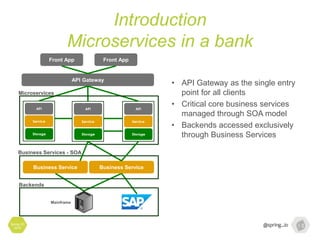
Microservices in a bank
Spring I/O
2016
• API Gateway as the single entry
point for all clients
• Critical core business services
managed through SOA model
• Backends accessed exclusively
through Business Services
API Gateway
Front App Front App
Mainframe
Business Service Business Service
Backends
Business Services - SOA
Microservices
Introduction
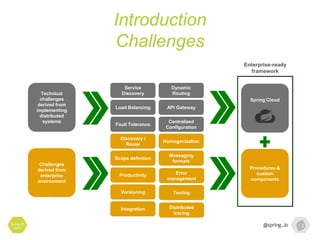
Challenges
Spring I/O
2016
Discovery /
Reuse
Scope definition
Productivity
Homogenization
Versioning
Integration
Messaging
formats
Error
management
Testing
Distributed
tracing
Service
Discovery
Load Balancing
Fault Tolerance
Centralized
Configuration
Dynamic
Routing
API Gateway
Technical
challenges
derived from
implementing
distributed
systems
Challenges
derived from
enterprise
environment
Spring Cloud
Procedures &
custom
components
Enterprise-ready
framework
Introduction
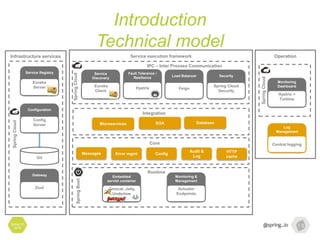
Technical model
Spring I/O
2016
Operation
SpringCloud
Infrastructure services
SpringCloud
Service Registry
Eureka
Server
Configuration
Config
Server
Git
Service execution framework
SpringCloud
SpringBoot
Service
Discovery
Eureka
Client
Fault Tolerance /
Resilience
Hyxtrix
Load Balancer
Feign
Security
Spring Cloud
Security
Embedded
servlet container
Tomcat, Jetty,
Undertow
Monitoring &
Management
Actuator
Endpoints
IPC – Inter Process Communication
Runtime
Gateway
Zuul
Monitoring
Dashboard
Hystrix +
Turbine
Log
Management
Central logging
Microservices SOA
Integration
Database
Core
Messages Error mgmt Config
Audit &
Log
HTTP
cache
Introduction
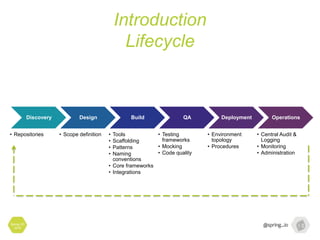
Lifecycle
Spring I/O
2016
Discovery
• Repositories
Design
• Scope definition
Build
• Tools
• Scaffolding
• Patterns
• Naming
conventions
• Core frameworks
• Integrations
QA
• Testing
frameworks
• Mocking
• Code quality
Deployment
• Environment
topology
• Procedures
Operations
• Central Audit &
Logging
• Monitoring
• Administration
Spring I/O
2016
DEVELOPMENT
Development
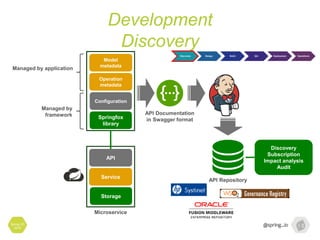
Discovery
Spring I/O
2016
API
Service
Storage
Microservice
API Documentation
in Swagger format
Model
metadata
Operation
metadata
Configuration
Springfox
library
Managed by application
Managed by
framework
API Repository
Discovery
Subscription
Impact analysis
Audit
Discovery Design Build QA Deployment Operations
Development
Design
Spring I/O
2016
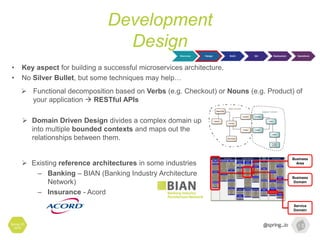
• Key aspect for building a successful microservices architecture.
• No Silver Bullet, but some techniques may help…
Business
Area
Business
Domain
Service
Domain
 Existing reference architectures in some industries
– Banking – BIAN (Banking Industry Architecture
Network)
– Insurance - Acord
 Functional decomposition based on Verbs (e.g. Checkout) or Nouns (e.g. Product) of
your application  RESTful APIs
 Domain Driven Design divides a complex domain up
into multiple bounded contexts and maps out the
relationships between them.
Discovery Design Build QA Deployment Operations
Development
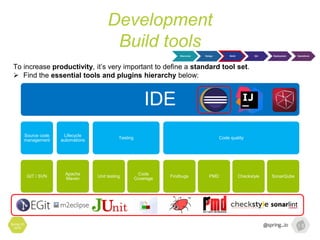
Build tools
Spring I/O
2016
IDE
Source code
management
GIT / SVN
Lifecycle
automations
Apache
Maven
Testing
Unit testing
Code
Coverage
Code quality
Findbugs PMD Checkstyle SonarQube
To increase productivity, it’s very important to define a standard tool set.
 Find the essential tools and plugins hierarchy below:
Discovery Design Build QA Deployment Operations
Development
Source code management tools
Spring I/O
2016
Discovery Design Build QA Deployment Operations
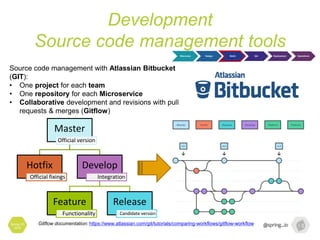
Source code management with Atlassian Bitbucket
(GIT):
• One project for each team
• One repository for each Microservice
• Collaborative development and revisions with pull
requests & merges (Gitflow)
Master
Official version
Hotfix
Official fixings
Develop
Integration
Feature
Functionality
Release
Candidate version
Gitflow documentation: https://www.atlassian.com/git/tutorials/comparing-workflows/gitflow-workflow
Development
Maven archetype
Spring I/O
2016
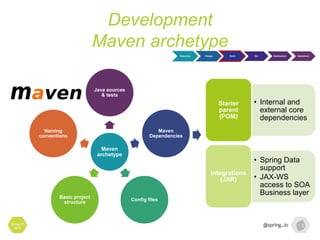
Maven
archetype
Java sources
& tests
Maven
Dependencies
Config files
Basic project
structure
Naming
conventions
• Internal and
external core
dependencies
Starter
parent
(POM)
• Spring Data
support
• JAX-WS
access to SOA
Business layer
Integrations
(JAR)
Discovery Design Build QA Deployment Operations
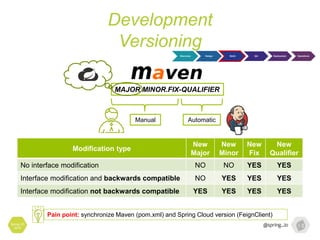
Development
Versioning
Spring I/O
2016
Modification type
New
Major
New
Minor
New
Fix
New
Qualifier
No interface modification NO NO YES YES
Interface modification and backwards compatible NO YES YES YES
Interface modification not backwards compatible YES YES YES YES
Pain point: synchronize Maven (pom.xml) and Spring Cloud version (FeignClient)
Manual Automatic
MAJOR.MINOR.FIX-QUALIFIER
Discovery Design Build QA Deployment Operations
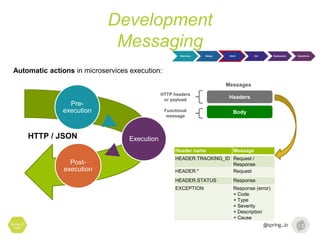
Development
Messaging
Spring I/O
2016
HTTP / JSON
Automatic actions in microservices execution:
Pre-
execution
Execution
Post-
execution
Headers
Body
Messages
HTTP headers
or payload
Functional
message
Header name Message
HEADER.TRACKING_ID Request /
Response
HEADER.* Request
HEADER.STATUS Response
EXCEPTION Response (error)
+ Code
+ Type
+ Severity
+ Description
+ Cause
Discovery Design Build QA Deployment Operations
Development
Integrations
Spring I/O
2016
Discovery Design Build QA Deployment Operations
Development:
1. [MS/SOA] Client JAR (Feign/JAX-WS)
uploaded to Artifactory
2. Consumer adds Maven
dependencies:
• [MS/SOA] Client JAR
• [DB] JDBC driver
3. [DB] Implement Spring Data domain
and repository classes
4. Implement integration logic
• [MS/SOA] @Autowire client
class
• [DB] @Autowire Spring Data
repository
[MS/SOA] Execution:
1. On-the-fly configurations
2. Propagate architecture headers
Client JAR
upload
Add Maven
dependencies
Data model
Integration
logic
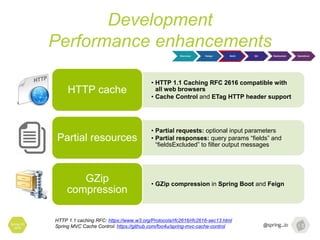
Development
Performance enhancements
Spring I/O
2016
Discovery Design Build QA Deployment Operations
HTTP 1.1 caching RFC: https://www.w3.org/Protocols/rfc2616/rfc2616-sec13.html
Spring MVC Cache Control: https://github.com/foo4u/spring-mvc-cache-control
• HTTP 1.1 Caching RFC 2616 compatible with
all web browsers
• Cache Control and ETag HTTP header support
HTTP cache
• Partial requests: optional input parameters
• Partial responses: query params “fields” and
“fieldsExcluded” to filter output messages
Partial resources
• GZip compression in Spring Boot and Feign
GZip
compression
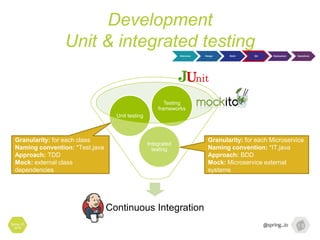
Development
Unit & integrated testing
Spring I/O
2016
Discovery Design Build QA Deployment Operations
Continuous Integration
Integrated
testing
Unit testing
Testing
frameworks
Granularity: for each class
Naming convention: *Test.java
Approach: TDD
Mock: external class
dependencies
Granularity: for each Microservice
Naming convention: *IT.java
Approach: BDD
Mock: Microservice external
systems
Development
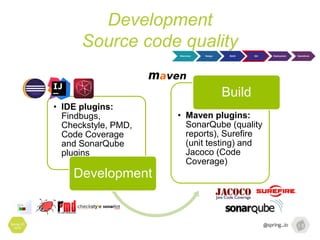
Source code quality
Spring I/O
2016
Discovery Design Build QA Deployment Operations
• IDE plugins:
Findbugs,
Checkstyle, PMD,
Code Coverage
and SonarQube
plugins
Development
• Maven plugins:
SonarQube (quality
reports), Surefire
(unit testing) and
Jacoco (Code
Coverage)
Build
Spring I/O
2016
DEPLOYMENT
Deployment
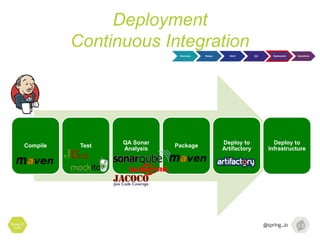
Continuous Integration
Spring I/O
2016
Discovery Design Build QA Deployment Operations
Compile Test
QA Sonar
Analysis
Package
Deploy to
Artifactory
Deploy to
Infrastructure
Deployment
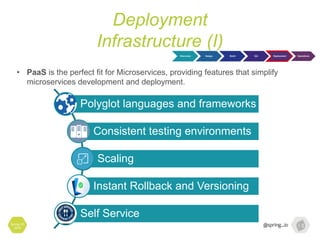
Infrastructure (I)
Spring I/O
2016
Discovery Design Build QA Deployment Operations
• PaaS is the perfect fit for Microservices, providing features that simplify
microservices development and deployment.
Polyglot languages and frameworks
Consistent testing environments
Scaling
Instant Rollback and Versioning
Self Service
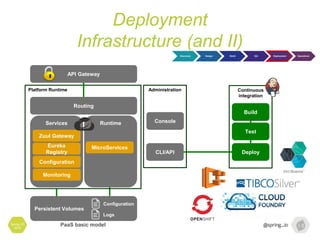
Deployment
Infrastructure (and II)
Spring I/O
2016
Discovery Design Build QA Deployment Operations
API Gateway
Routing
Services Runtime
Persistent Volumes
Platform Runtime Administration
Console
CLI/API
PaaS basic model
Continuous
integration
Build
Test
Deploy
Zuul Gateway
Eureka
Registry
Configuration
Monitoring
MicroServices
Configuration
Logs
Spring I/O
2016
OPERATION
Operation
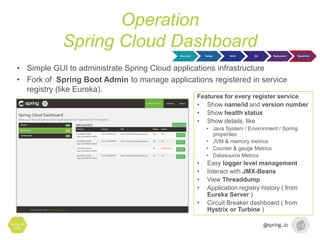
Spring Cloud Dashboard
Spring I/O
2016
Discovery Design Build QA Deployment Operations
• Simple GUI to administrate Spring Cloud applications infrastructure
• Fork of Spring Boot Admin to manage applications registered in service
registry (like Eureka).
Features for every register service
• Show name/id and version number
• Show health status
• Show details, like
• Java System / Environment / Spring
properties
• JVM & memory metrics
• Counter & gauge Metrics
• Datasource Metrics
• Easy logger level management
• Interact with JMX-Beans
• View Threaddump
• Application registry history ( from
Eureka Server )
• Circuit Breaker dashboard ( from
Hystrix or Turbine )
Operation
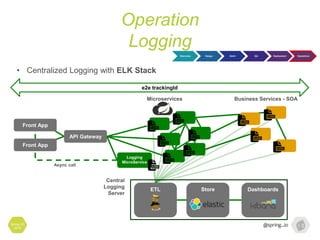
Logging
Discovery Design Build QA Deployment Operations
• Centralized Logging with ELK Stack
Front App
Front App
API Gateway
Business Services - SOAMicroservices
Central
Logging
Server
ETL Store Dashboards
Logging
MicroService
Async call
e2e trackingId
Spring I/O
2016
Operation
Audit
Discovery Design Build QA Deployment Operations
Spring I/O
2016
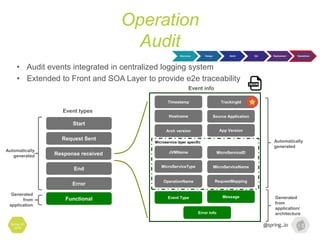
• Audit events integrated in centralized logging system
• Extended to Front and SOA Layer to provide e2e traceability
Start
Request Sent
Response received
End
Error
Functional
Automatically
generated
Generated
from
application
Event types
Event info
Timestamp
Event Type
Hostname
TrackingId
Source Application
Arch version
Error info
App Version
Message
JVMName
MicroServiceType
MicroServiceID
MIcroServiceName
OperationName RequestMapping
Automatically
generated
Generated
from
application/
architecture
Microservice layer specific
Spring I/O
2016
DEMO
Spring I/O
2016
CONCLUSIONS
Conclusions
Final thoughts
Spring I/O
2016
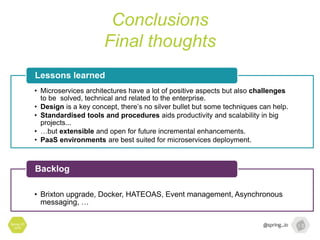
• Microservices architectures have a lot of positive aspects but also challenges
to be solved, technical and related to the enterprise.
• Design is a key concept, there’s no silver bullet but some techniques can help.
• Standardised tools and procedures aids productivity and scalability in big
projects...
• …but extensible and open for future incremental enhancements.
• PaaS environments are best suited for microservices deployment.
Lessons learned
• Brixton upgrade, Docker, HATEOAS, Event management, Asynchronous
messaging, …
Backlog
Spring I/O
2016
QUESTIONS
Spring I/O
2016
everis.com
Consulting, IT & Outsourcing Professional Services

SpringIO 2016 - Spring Cloud MicroServices, a journey inside a financial entity

  • 1.
    Spring Cloud Microservices Ajourney inside a financial entity Jordi Gil @jordigilnieto Toni Jara @tonijar
  • 2.
    Preface Team Spring I/O 2016 Toni Jara Softwareengineer with more than 10 years of experience involved in complex architecture projects as Technical Team Lead and Senior Architect. With more than 8 years of experience working with Spring (mainly Core Framework, MVC and Webflow), lately he’s been working on microservices architectures with Spring Cloud. Jordi Gil Jordi is a Software Architect with over 18 years of experience in application development, mainly in information systems for banking and insurance industries. He focuses on the definition of architectures for heterogeneous environments and with high performance, interoperability and availability requirements. In everis he is leading the innovation group where new technologies, patterns and architecture models are assessed for applicability in final customers. Currently his main areas of interest are MicroServices Architectures and Cloud PaaS platforms.
  • 3.
    Index 1. Introduction 2. Development 3.Deployment 4. Operations 5. Demo 6. Conclusions 7. Questions Spring I/O 2016
  • 4.
  • 5.
  • 6.
    Introduction Monolithic applications Spring I/O 2016 •Easy to Develop & Deploy & Scale • Can Be Intimidating to New Developers • Modularity Dependent Upon Language / Frameworks • Change Cycles Tightly Coupled / Obstacle to Frequent Deploys • Inefficient Scaling • Obstacle to Scaling Development • Requires Long-Term Commitment to Technical Stack HTML JavaScript MVC Service Service Data Access Browser Relational Database Monolithic Application
  • 7.
    Introduction Monolithic applications 2.0 SpringI/O 2016 • SOA approach • ESBs used to integrate monolithic applications • ESB Tightly Couples Services • Centralized governance models that actively inhibit change • ESB becomes the biggest monolith Service Service SOA - ESB Service Service Service Service Service
  • 8.
    Introduction Microservices architecture Spring I/O 2016 •Modularity Based on Component Services • Change Cycles Decoupled / Enable Frequent Deploys • Efficient Scaling • Individual Components Less Intimidating to New Developers • Enables Scaling of Development • Eliminates Long-Term Commitment to Technical Stack • Complexity associated to distributed systems • Operational burden API Service Storage Microservice 1 API Service Storage Microservice 2 API Service Storage Microservice 3 API Service Storage Microservice 4
  • 9.
    Introduction Microservices in abank Spring I/O 2016 • API Gateway as the single entry point for all clients • Critical core business services managed through SOA model • Backends accessed exclusively through Business Services API Gateway Front App Front App Mainframe Business Service Business Service Backends Business Services - SOA Microservices
  • 10.
    Introduction Challenges Spring I/O 2016 Discovery / Reuse Scopedefinition Productivity Homogenization Versioning Integration Messaging formats Error management Testing Distributed tracing Service Discovery Load Balancing Fault Tolerance Centralized Configuration Dynamic Routing API Gateway Technical challenges derived from implementing distributed systems Challenges derived from enterprise environment Spring Cloud Procedures & custom components Enterprise-ready framework
  • 11.
    Introduction Technical model Spring I/O 2016 Operation SpringCloud Infrastructureservices SpringCloud Service Registry Eureka Server Configuration Config Server Git Service execution framework SpringCloud SpringBoot Service Discovery Eureka Client Fault Tolerance / Resilience Hyxtrix Load Balancer Feign Security Spring Cloud Security Embedded servlet container Tomcat, Jetty, Undertow Monitoring & Management Actuator Endpoints IPC – Inter Process Communication Runtime Gateway Zuul Monitoring Dashboard Hystrix + Turbine Log Management Central logging Microservices SOA Integration Database Core Messages Error mgmt Config Audit & Log HTTP cache
  • 12.
    Introduction Lifecycle Spring I/O 2016 Discovery • Repositories Design •Scope definition Build • Tools • Scaffolding • Patterns • Naming conventions • Core frameworks • Integrations QA • Testing frameworks • Mocking • Code quality Deployment • Environment topology • Procedures Operations • Central Audit & Logging • Monitoring • Administration
  • 13.
  • 14.
    Development Discovery Spring I/O 2016 API Service Storage Microservice API Documentation inSwagger format Model metadata Operation metadata Configuration Springfox library Managed by application Managed by framework API Repository Discovery Subscription Impact analysis Audit Discovery Design Build QA Deployment Operations
  • 15.
    Development Design Spring I/O 2016 • Keyaspect for building a successful microservices architecture. • No Silver Bullet, but some techniques may help… Business Area Business Domain Service Domain  Existing reference architectures in some industries – Banking – BIAN (Banking Industry Architecture Network) – Insurance - Acord  Functional decomposition based on Verbs (e.g. Checkout) or Nouns (e.g. Product) of your application  RESTful APIs  Domain Driven Design divides a complex domain up into multiple bounded contexts and maps out the relationships between them. Discovery Design Build QA Deployment Operations
  • 16.
    Development Build tools Spring I/O 2016 IDE Sourcecode management GIT / SVN Lifecycle automations Apache Maven Testing Unit testing Code Coverage Code quality Findbugs PMD Checkstyle SonarQube To increase productivity, it’s very important to define a standard tool set.  Find the essential tools and plugins hierarchy below: Discovery Design Build QA Deployment Operations
  • 17.
    Development Source code managementtools Spring I/O 2016 Discovery Design Build QA Deployment Operations Source code management with Atlassian Bitbucket (GIT): • One project for each team • One repository for each Microservice • Collaborative development and revisions with pull requests & merges (Gitflow) Master Official version Hotfix Official fixings Develop Integration Feature Functionality Release Candidate version Gitflow documentation: https://www.atlassian.com/git/tutorials/comparing-workflows/gitflow-workflow
  • 18.
    Development Maven archetype Spring I/O 2016 Maven archetype Javasources & tests Maven Dependencies Config files Basic project structure Naming conventions • Internal and external core dependencies Starter parent (POM) • Spring Data support • JAX-WS access to SOA Business layer Integrations (JAR) Discovery Design Build QA Deployment Operations
  • 19.
    Development Versioning Spring I/O 2016 Modification type New Major New Minor New Fix New Qualifier Nointerface modification NO NO YES YES Interface modification and backwards compatible NO YES YES YES Interface modification not backwards compatible YES YES YES YES Pain point: synchronize Maven (pom.xml) and Spring Cloud version (FeignClient) Manual Automatic MAJOR.MINOR.FIX-QUALIFIER Discovery Design Build QA Deployment Operations
  • 20.
    Development Messaging Spring I/O 2016 HTTP /JSON Automatic actions in microservices execution: Pre- execution Execution Post- execution Headers Body Messages HTTP headers or payload Functional message Header name Message HEADER.TRACKING_ID Request / Response HEADER.* Request HEADER.STATUS Response EXCEPTION Response (error) + Code + Type + Severity + Description + Cause Discovery Design Build QA Deployment Operations
  • 21.
    Development Integrations Spring I/O 2016 Discovery DesignBuild QA Deployment Operations Development: 1. [MS/SOA] Client JAR (Feign/JAX-WS) uploaded to Artifactory 2. Consumer adds Maven dependencies: • [MS/SOA] Client JAR • [DB] JDBC driver 3. [DB] Implement Spring Data domain and repository classes 4. Implement integration logic • [MS/SOA] @Autowire client class • [DB] @Autowire Spring Data repository [MS/SOA] Execution: 1. On-the-fly configurations 2. Propagate architecture headers Client JAR upload Add Maven dependencies Data model Integration logic
  • 22.
    Development Performance enhancements Spring I/O 2016 DiscoveryDesign Build QA Deployment Operations HTTP 1.1 caching RFC: https://www.w3.org/Protocols/rfc2616/rfc2616-sec13.html Spring MVC Cache Control: https://github.com/foo4u/spring-mvc-cache-control • HTTP 1.1 Caching RFC 2616 compatible with all web browsers • Cache Control and ETag HTTP header support HTTP cache • Partial requests: optional input parameters • Partial responses: query params “fields” and “fieldsExcluded” to filter output messages Partial resources • GZip compression in Spring Boot and Feign GZip compression
  • 23.
    Development Unit & integratedtesting Spring I/O 2016 Discovery Design Build QA Deployment Operations Continuous Integration Integrated testing Unit testing Testing frameworks Granularity: for each class Naming convention: *Test.java Approach: TDD Mock: external class dependencies Granularity: for each Microservice Naming convention: *IT.java Approach: BDD Mock: Microservice external systems
  • 24.
    Development Source code quality SpringI/O 2016 Discovery Design Build QA Deployment Operations • IDE plugins: Findbugs, Checkstyle, PMD, Code Coverage and SonarQube plugins Development • Maven plugins: SonarQube (quality reports), Surefire (unit testing) and Jacoco (Code Coverage) Build
  • 25.
  • 26.
    Deployment Continuous Integration Spring I/O 2016 DiscoveryDesign Build QA Deployment Operations Compile Test QA Sonar Analysis Package Deploy to Artifactory Deploy to Infrastructure
  • 27.
    Deployment Infrastructure (I) Spring I/O 2016 DiscoveryDesign Build QA Deployment Operations • PaaS is the perfect fit for Microservices, providing features that simplify microservices development and deployment. Polyglot languages and frameworks Consistent testing environments Scaling Instant Rollback and Versioning Self Service
  • 28.
    Deployment Infrastructure (and II) SpringI/O 2016 Discovery Design Build QA Deployment Operations API Gateway Routing Services Runtime Persistent Volumes Platform Runtime Administration Console CLI/API PaaS basic model Continuous integration Build Test Deploy Zuul Gateway Eureka Registry Configuration Monitoring MicroServices Configuration Logs
  • 29.
  • 30.
    Operation Spring Cloud Dashboard SpringI/O 2016 Discovery Design Build QA Deployment Operations • Simple GUI to administrate Spring Cloud applications infrastructure • Fork of Spring Boot Admin to manage applications registered in service registry (like Eureka). Features for every register service • Show name/id and version number • Show health status • Show details, like • Java System / Environment / Spring properties • JVM & memory metrics • Counter & gauge Metrics • Datasource Metrics • Easy logger level management • Interact with JMX-Beans • View Threaddump • Application registry history ( from Eureka Server ) • Circuit Breaker dashboard ( from Hystrix or Turbine )
  • 31.
    Operation Logging Discovery Design BuildQA Deployment Operations • Centralized Logging with ELK Stack Front App Front App API Gateway Business Services - SOAMicroservices Central Logging Server ETL Store Dashboards Logging MicroService Async call e2e trackingId Spring I/O 2016
  • 32.
    Operation Audit Discovery Design BuildQA Deployment Operations Spring I/O 2016 • Audit events integrated in centralized logging system • Extended to Front and SOA Layer to provide e2e traceability Start Request Sent Response received End Error Functional Automatically generated Generated from application Event types Event info Timestamp Event Type Hostname TrackingId Source Application Arch version Error info App Version Message JVMName MicroServiceType MicroServiceID MIcroServiceName OperationName RequestMapping Automatically generated Generated from application/ architecture Microservice layer specific
  • 33.
  • 34.
  • 35.
    Conclusions Final thoughts Spring I/O 2016 •Microservices architectures have a lot of positive aspects but also challenges to be solved, technical and related to the enterprise. • Design is a key concept, there’s no silver bullet but some techniques can help. • Standardised tools and procedures aids productivity and scalability in big projects... • …but extensible and open for future incremental enhancements. • PaaS environments are best suited for microservices deployment. Lessons learned • Brixton upgrade, Docker, HATEOAS, Event management, Asynchronous messaging, … Backlog
  • 36.
  • 37.
    Spring I/O 2016 everis.com Consulting, IT& Outsourcing Professional Services