OPEN
URETEROLITHOTOMY
Eko Indra P
Indication
• Stones with a low likelihood of treatment success using
ESWL & URS
• Secondary treatment for treatment failure after less
invasive techniques
• Developing countries without access to URS or lithotripsy
equipment
Open Ureterolithotomy
• Depends on the location of the stone.
• For all locations, an extraperitoneal approach can be
performed.
• If undergoing a concomitant intraperitoneal surgery for
another indication, a transperitoneal approach can be
used
APPROACH
o Proximal ureter (crossing the illac vessels)
• Supracostal, subcostal provide optimal exposure.
• Midline extraperitoneal or intraperitoneal
o Distal ureter
• Extraperitoneal via a low midline
• Pfannenstiel incision
• Gibson incision
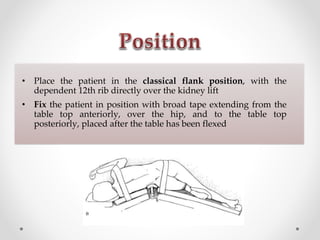
• Place the patient in the classical flank position, with the
dependent 12th rib directly over the kidney lift
• Fix the patient in position with broad tape extending from the
table top anteriorly, over the hip, and to the table top
posteriorly, placed after the table has been flexed
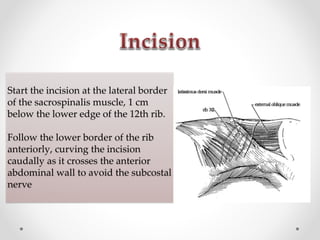
Start the incision at the lateral border
of the sacrospinalis muscle, 1 cm
below the lower edge of the 12th rib.
Follow the lower border of the rib
anteriorly, curving the incision
caudally as it crosses the anterior
abdominal wall to avoid the subcostal
nerve
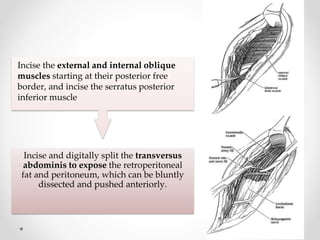
Incise and digitally split the transversus
abdominis to expose the retroperitoneal
fat and peritoneum, which can be bluntly
dissected and pushed anteriorly.
Incise the external and internal oblique
muscles starting at their posterior free
border, and incise the serratus posterior
inferior muscle
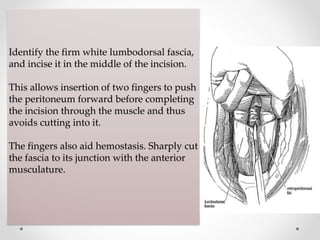
Identify the firm white lumbodorsal fascia,
and incise it in the middle of the incision.
This allows insertion of two fingers to push
the peritoneum forward before completing
the incision through the muscle and thus
avoids cutting into it.
The fingers also aid hemostasis. Sharply cut
the fascia to its junction with the anterior
musculature.
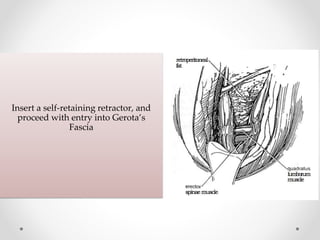
Insert a self-retaining retractor, and
proceed with entry into Gerota’s
Fascia
• The stone can be located by:
o Visualizing a bulge within the ureter
o Gentle palpation
• Carefully dissection of the ureter to :
o Preserve as much periureteral tissue as possible
o Minimize stone migration
o Ureteral devascularization.
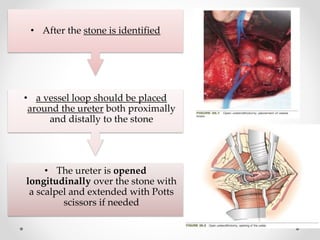
• The ureter is opened
longitudinally over the stone with
a scalpel and extended with Potts
scissors if needed
• a vessel loop should be placed
around the ureter both proximally
and distally to the stone
• After the stone is identified
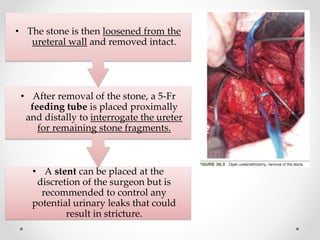
• A stent can be placed at the
discretion of the surgeon but is
recommended to control any
potential urinary leaks that could
result in stricture.
• After removal of the stone, a 5-Fr
feeding tube is placed proximally
and distally to interrogate the ureter
for remaining stone fragments.
• The stone is then loosened from the
ureteral wall and removed intact.
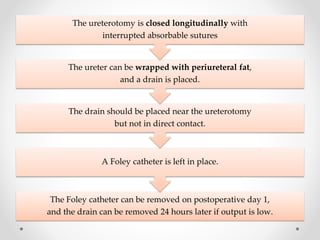
The Foley catheter can be removed on postoperative day 1,
and the drain can be removed 24 hours later if output is low.
A Foley catheter is left in place.
The drain should be placed near the ureterotomy
but not in direct contact.
The ureter can be wrapped with periureteral fat,
and a drain is placed.
The ureterotomy is closed longitudinally with
interrupted absorbable sutures
Thank You
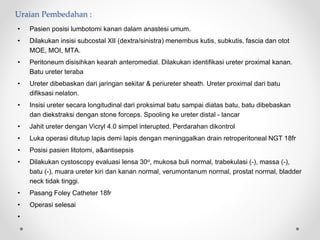
Uraian Pembedahan :
• Pasien posisi lumbotomi kanan dalam anastesi umum.
• Dilakukan insisi subcostal XII (dextra/sinistra) menembus kutis, subkutis, fascia dan otot
MOE, MOI, MTA.
• Peritoneum disisihkan kearah anteromedial. Dilakukan identifikasi ureter proximal kanan.
Batu ureter teraba
• Ureter dibebaskan dari jaringan sekitar & periureter sheath. Ureter proximal dari batu
difiksasi nelaton.
• Insisi ureter secara longitudinal dari proksimal batu sampai diatas batu, batu dibebaskan
dan diekstraksi dengan stone forceps. Spooling ke ureter distal - lancar
• Jahit ureter dengan Vicryl 4.0 simpel interupted. Perdarahan dikontrol
• Luka operasi ditutup lapis demi lapis dengan meninggalkan drain retroperitoneal NGT 18fr
• Posisi pasien litotomi, a&antisepsis
• Dilakukan cystoscopy evaluasi lensa 30o, mukosa buli normal, trabekulasi (-), massa (-),
batu (-), muara ureter kiri dan kanan normal, verumontanum normal, prostat normal, bladder
neck tidak tinggi.
• Pasang Foley Catheter 18fr
• Operasi selesai
•
Post Op :
• Vital Sign, localized state, UOP & drain
• Diet
• Antibiotik
• Analgetik
• Inj Ranitidin
• Cek DPL post op

Open Ureterolithotomy

  • 1.
  • 2.
    Indication • Stones witha low likelihood of treatment success using ESWL & URS • Secondary treatment for treatment failure after less invasive techniques • Developing countries without access to URS or lithotripsy equipment
  • 3.
    Open Ureterolithotomy • Dependson the location of the stone. • For all locations, an extraperitoneal approach can be performed. • If undergoing a concomitant intraperitoneal surgery for another indication, a transperitoneal approach can be used
  • 4.
    APPROACH o Proximal ureter(crossing the illac vessels) • Supracostal, subcostal provide optimal exposure. • Midline extraperitoneal or intraperitoneal o Distal ureter • Extraperitoneal via a low midline • Pfannenstiel incision • Gibson incision
  • 5.
    • Place thepatient in the classical flank position, with the dependent 12th rib directly over the kidney lift • Fix the patient in position with broad tape extending from the table top anteriorly, over the hip, and to the table top posteriorly, placed after the table has been flexed
  • 6.
    Start the incisionat the lateral border of the sacrospinalis muscle, 1 cm below the lower edge of the 12th rib. Follow the lower border of the rib anteriorly, curving the incision caudally as it crosses the anterior abdominal wall to avoid the subcostal nerve
  • 7.
    Incise and digitallysplit the transversus abdominis to expose the retroperitoneal fat and peritoneum, which can be bluntly dissected and pushed anteriorly. Incise the external and internal oblique muscles starting at their posterior free border, and incise the serratus posterior inferior muscle
  • 8.
    Identify the firmwhite lumbodorsal fascia, and incise it in the middle of the incision. This allows insertion of two fingers to push the peritoneum forward before completing the incision through the muscle and thus avoids cutting into it. The fingers also aid hemostasis. Sharply cut the fascia to its junction with the anterior musculature.
  • 9.
    Insert a self-retainingretractor, and proceed with entry into Gerota’s Fascia
  • 10.
    • The stonecan be located by: o Visualizing a bulge within the ureter o Gentle palpation • Carefully dissection of the ureter to : o Preserve as much periureteral tissue as possible o Minimize stone migration o Ureteral devascularization.
  • 11.
    • The ureteris opened longitudinally over the stone with a scalpel and extended with Potts scissors if needed • a vessel loop should be placed around the ureter both proximally and distally to the stone • After the stone is identified
  • 12.
    • A stentcan be placed at the discretion of the surgeon but is recommended to control any potential urinary leaks that could result in stricture. • After removal of the stone, a 5-Fr feeding tube is placed proximally and distally to interrogate the ureter for remaining stone fragments. • The stone is then loosened from the ureteral wall and removed intact.
  • 13.
    The Foley cathetercan be removed on postoperative day 1, and the drain can be removed 24 hours later if output is low. A Foley catheter is left in place. The drain should be placed near the ureterotomy but not in direct contact. The ureter can be wrapped with periureteral fat, and a drain is placed. The ureterotomy is closed longitudinally with interrupted absorbable sutures
  • 14.
  • 17.
    Uraian Pembedahan : •Pasien posisi lumbotomi kanan dalam anastesi umum. • Dilakukan insisi subcostal XII (dextra/sinistra) menembus kutis, subkutis, fascia dan otot MOE, MOI, MTA. • Peritoneum disisihkan kearah anteromedial. Dilakukan identifikasi ureter proximal kanan. Batu ureter teraba • Ureter dibebaskan dari jaringan sekitar & periureter sheath. Ureter proximal dari batu difiksasi nelaton. • Insisi ureter secara longitudinal dari proksimal batu sampai diatas batu, batu dibebaskan dan diekstraksi dengan stone forceps. Spooling ke ureter distal - lancar • Jahit ureter dengan Vicryl 4.0 simpel interupted. Perdarahan dikontrol • Luka operasi ditutup lapis demi lapis dengan meninggalkan drain retroperitoneal NGT 18fr • Posisi pasien litotomi, a&antisepsis • Dilakukan cystoscopy evaluasi lensa 30o, mukosa buli normal, trabekulasi (-), massa (-), batu (-), muara ureter kiri dan kanan normal, verumontanum normal, prostat normal, bladder neck tidak tinggi. • Pasang Foley Catheter 18fr • Operasi selesai •
  • 18.
    Post Op : •Vital Sign, localized state, UOP & drain • Diet • Antibiotik • Analgetik • Inj Ranitidin • Cek DPL post op