HYPOGONADOTROPIC
HYPOGONADISM
Eko Indra
Pradono
OVERVIEW OF
HYPOGONADISM
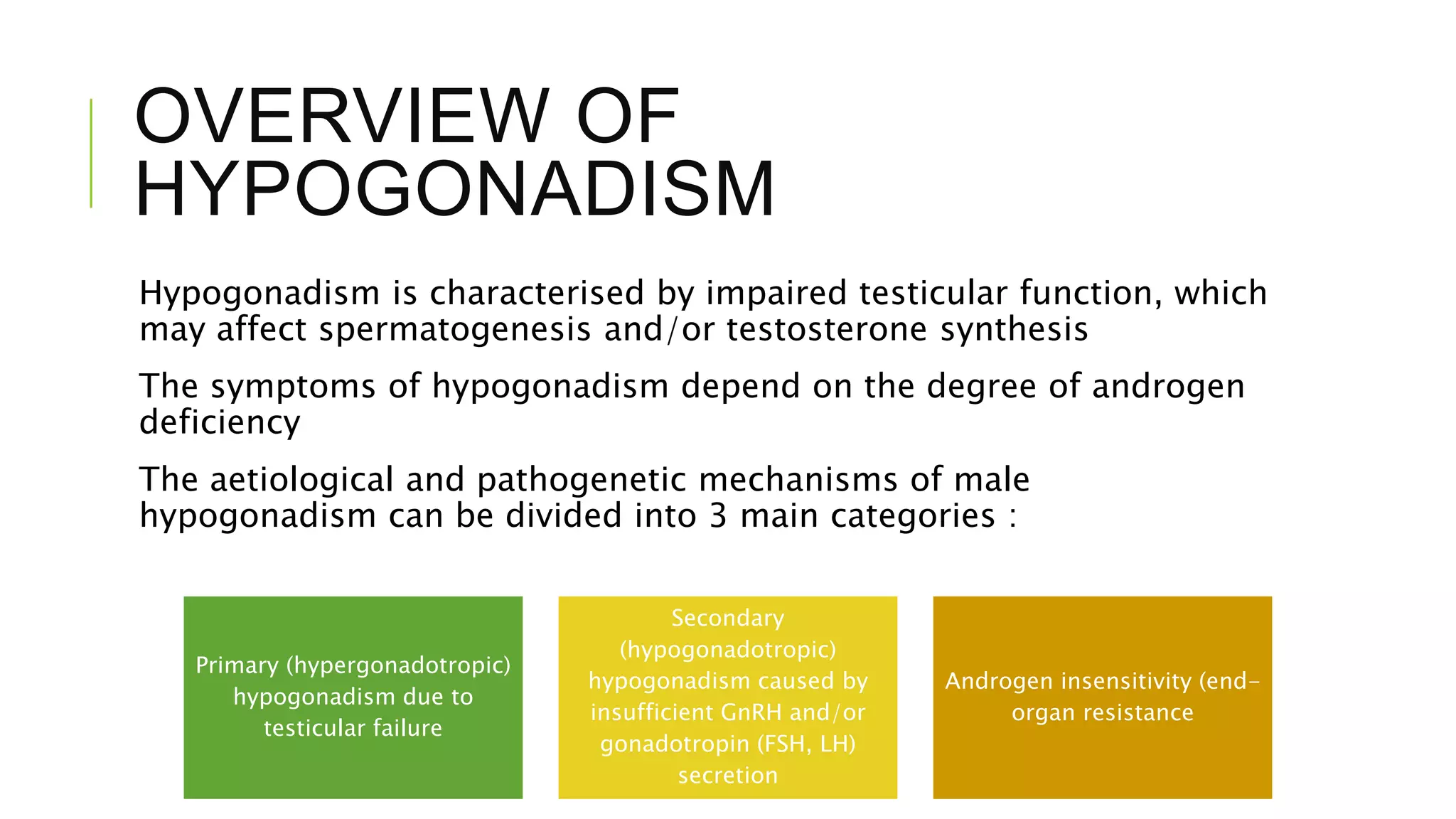
Hypogonadism is characterised by impaired testicular function, which
may affect spermatogenesis and/or testosterone synthesis
The symptoms of hypogonadism depend on the degree of androgen
deficiency
The aetiological and pathogenetic mechanisms of male
hypogonadism can be divided into 3 main categories :
Primary (hypergonadotropic)
hypogonadism due to
testicular failure
Secondary
(hypogonadotropic)
hypogonadism caused by
insufficient GnRH and/or
gonadotropin (FSH, LH)
secretion
Androgen insensitivity (end-
organ resistance
OVERVIEW
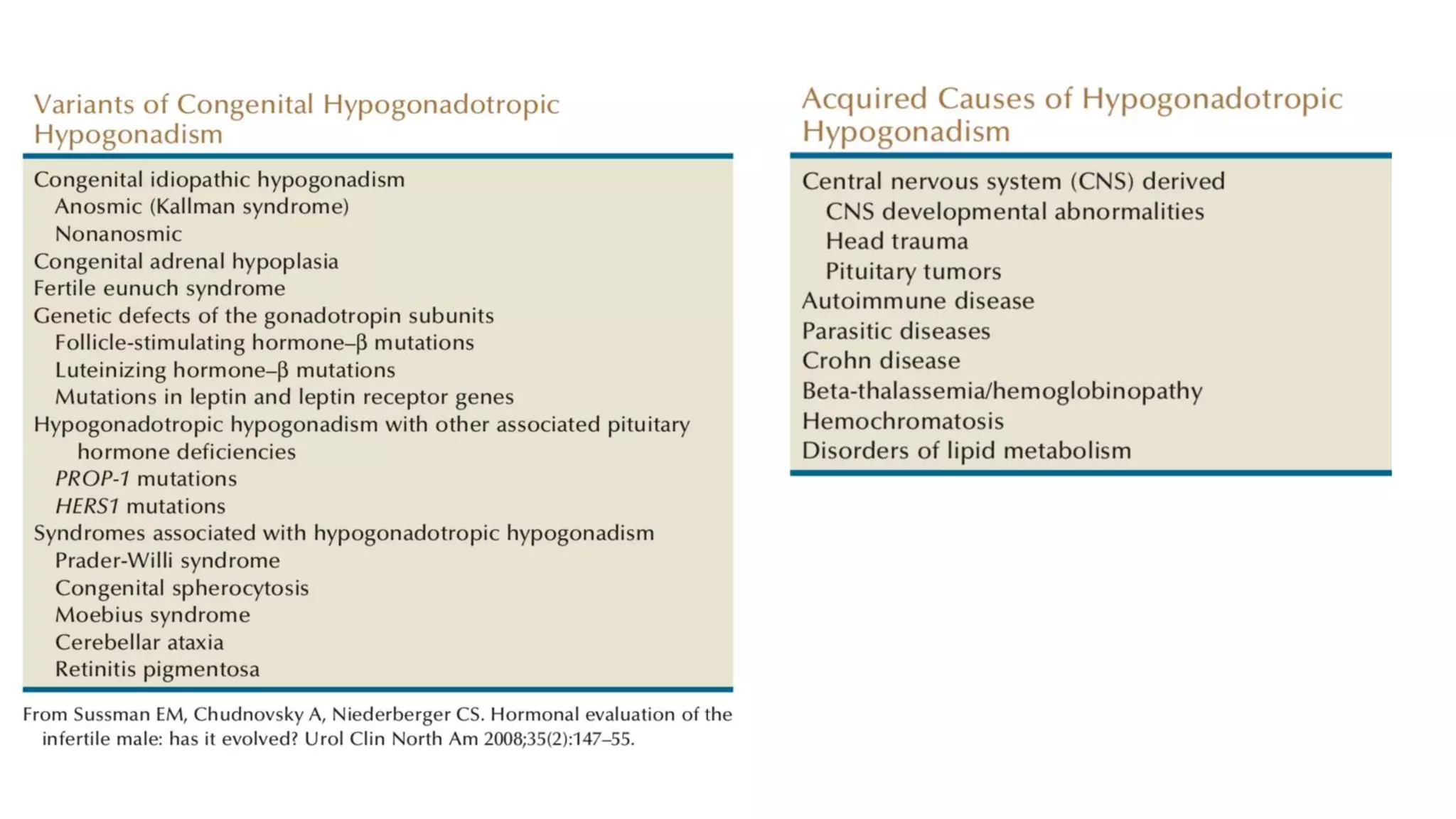
Isolated gonadotropin deficiency or hypogonadotropic hypogonadism (HH)
•Rare cause of subfertility (1% of male infertility cases)
•Congenital or acquired
Acquired causes :
Pituitary disease (prior surgery, infarction, tumors, infection, metabolic
conditions)
Most common  anosmic form or Kallman syndrome (1:10,000 and
1:60,000 births)
KALLMAN SYNDROME (1)
Results from failure to secrete GnRH by the
hypothalamus  low gonadotropin levels  failure to
transition prepubertal testis to postpubertal level of
function
GnRH deficiency  result of failed embryonic migration
of neuroendocrine GnRH cells from olfactory epithelium
to forebrain
 Absence or hypoplasia of olfactory bulbs  concurrent
anosmia
Kallman syndrome represents genetically diverse group
of diseases with:
 Both X-chromosome linked inheritance via mutation in
KAL1 gene
 Autosomal dominant inheritance via mutations in
Fibroblast Growt Factor Reseptor 1 (FGFR1), FGFR8,
KALLMAN SYNDROME (2)
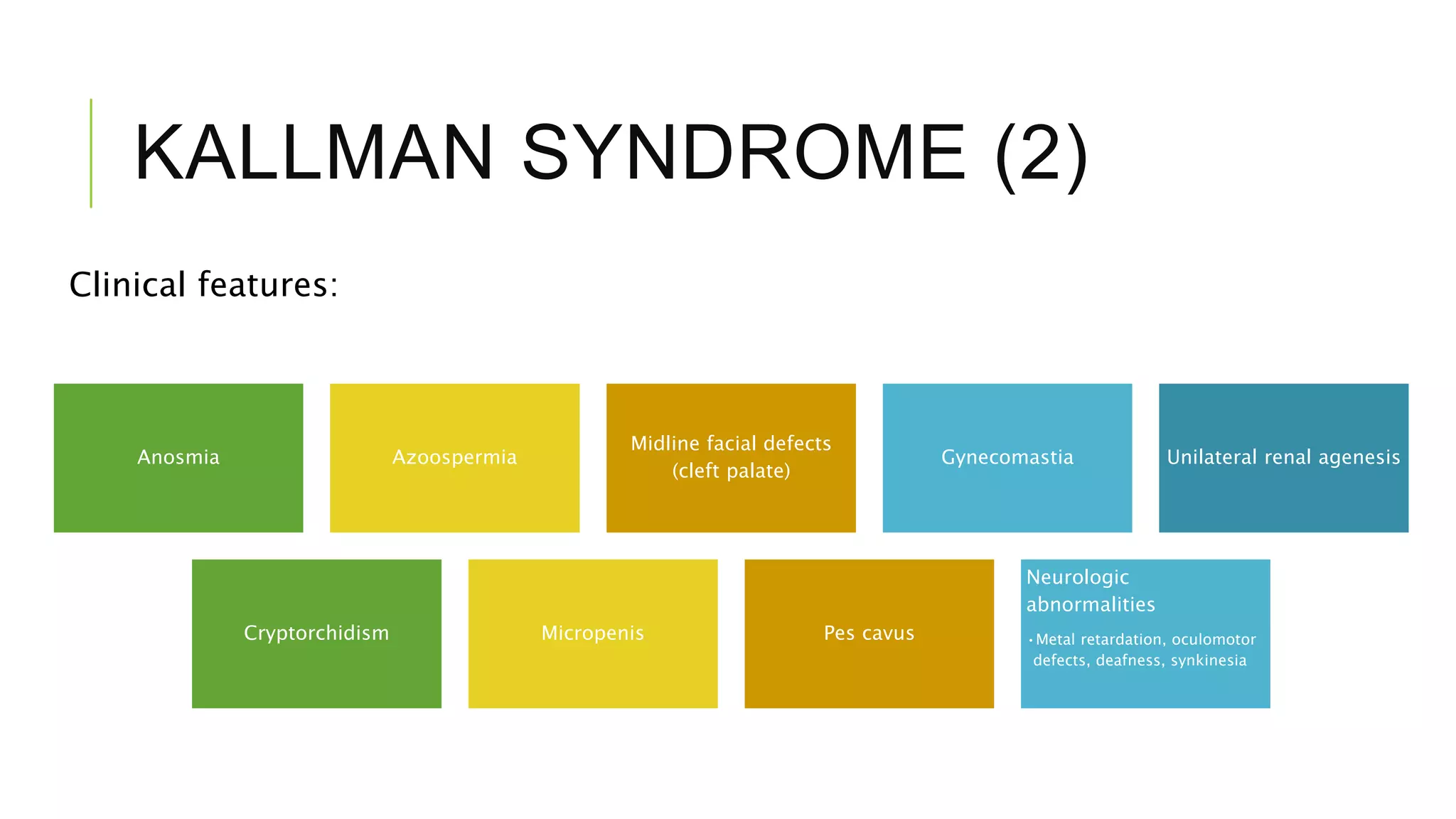
Clinical features:
Anosmia Azoospermia
Midline facial defects
(cleft palate)
Gynecomastia Unilateral renal agenesis
Cryptorchidism Micropenis Pes cavus
Neurologic
abnormalities
•Metal retardation, oculomotor
defects, deafness, synkinesia
KALLMAN SYNDROME (3)
PRADER-WILLI SYNDROME (1)
• Caused by microdeletions or mutations on the paternal chromosome 15 at the
q11 or 13 location
• Because of concurrent medical problems in these patients, most do not seek
treatment for infertility
• Clinical features :
Infantile
hypotonia
Obesity Cryptorchidism Short stature
Mental
retardation
PRADER-WILLI SYNDROME
(2)
DIAGNOSTIC OF HH (1)
HH usually presents in the late teenage years when the patient fails to undergo the
usual pubertal changes with secondary virilization
Important to distinguish HH from constitutional delay of growth and puberty (CGDP)
because they share many clinical and hormonal features and yet require markedly
different treatments
HH
• Require lifelong androgen replacement
for maintenance of virilization and
episodes of exogenous gonadotropin
treatment off androgen therapy for
fertility induction
CGDP
• Attain spontaneous puberty by age 18
• May require transient androgen
replacement for puberty induction but
then will progress through normal
development and fertility
DIAGNOSTIC OF HH (2)
Number of physiologic and stimulatory tests to discriminate :
 Serial serum LH measurements
 Prolactin response to THR and GnRH
 HCG stimulation tests
HH
• Have minimal variability in LH
levels
• Do not demonstrate significant
increases in gonadotropins levels
with administration of GnRH
CGDP
• Often demonstrate LH pulses with
serial overnight blood draws
• Gonadotropin surge in response
to GnRH stimulation
DIAGNOSTIC OF HH (3)
A suspected tumour requires imaging [computed tomography (CT) or
magnetic resonance imaging (MRI)] of the sella region and a complete
endocrine work-up
Normal androgen levels and subsequent development of secondary
sex characteristics (in cases of onset of hypogonadism before
puberty) and a eugonadal state can be achieved by androgen
replacement alone
GOALS OF HH TREATMENT
Induction of normal serum androgen levels to allow
appropriate virilization and bone growth
induction of spermatogenesis and fertility
TREATMENTS OF HH (1)
Various effective methods of testosterone replacement therapy
Intramuscular
testosterone
enanthate or
cypionate
(200mg every 2
weeks)
Transdermal
patches (5-
10mg/day)
Testosterone
gel
Buccal tablets
Adequacy of replacement can be assessed by:
 Serum testosterone levels (within midrange of normal)
 Observation of desired phenotypic response to therapy
EAU RECOMMENDATIONS
Recommendations Strength rating
Provide testosterone replacement therapy for symptomatic patients with primary and secondary
hypogonadism who are not considering parenthood.
Strong
In men with hypogonadotropic hypogonadism, induce spermatogenesis by an effective drug
therapy (human chorionic gonadotropin, human menopausal gonadotropins, recombinant
follicle-stimulating hormone, highly purified FSH).
Strong
Do not use testosterone replacement for the treatment of male infertility. Strong
TREATMENTS OF HH (1)
 human Chorionic Gonadotropin (hCG) as First-line therapy :
subcutaneously at a dose of 1500 to 2000 IU two to three times
per week, for 4 to 6 months.
 Without significant further improvement, FSH stimulation is added
to the treatment regimen to induce spermatogenesis
TREATMENTS OF HH (2)
FSH (administed as human menopausal gonadotropin/hMG)
 Contains both FSH & LH in equal dose or with recombinant human FSH
formulation
 at a dose of 75 IU, 2-3x/week and recombinant FSH at a dose of 37.5-75 IU, 2-
3x/weeks
 continued until attainment of sperm concentrations of at least 5 million per mL in
the ejaculate or pregnancy
Clomiphene (antiestrogen) or tamoxifen or with aromatase inhibitors such as
anastrozole or letrozole
restore testosterone levels and possibly improve spermatogenesis in selected
patients with HH presenting after puberty with intact pituitary function
 initial dose 25 mg every day or 50 mg every other day and is increased by
TREATMENTS OF HH (3)
In some studies, the titration target is restoration of normal
androgen levels; in others, it is elevated at 600 to 800 ng/dL
The typical dose of anastrozole is 1 mg daily
TREATMENT OUTCOME &
CONSIDERATIONS
 The vast majority of patients will be able to conceive after
gonadotropin therapy, although 71% of the patients with
subsequent fertility have sperm concentrations considerably lower
than normal, suggesting that these patients are often able to
conceive with low counts
 10% of patients may maintain normal serum testosterone levels
after cessation of all endocrine therapy, implying that HH may be
reversible in some patients
 In patients who have developed hypogonadism before puberty and
have not been treated with gonadotropins or GnRH  may be need
one to two years of therapy to achieve sperm production
HH MEDICATIONS
Menopur : Menotropin/human Menopausal Gonadotropin (hMG) 225
IU FSH & 225 IU LH
@75 IU, SC 2-3x/week, until attainment of sperm concentration (at
least 5 million/ml) or pegnancy is obtained
 Roburantia Starfer/Torrex :
Zink, Folic Acid, Ascorbic acid, cyanocobalamin, sodium selenium,
fructose, arginine, carnitine, Vit E
REFERENCES
Jungwirth A, Diemer T, Kopa Z, Krausz C, Minhas S, Tournaye H. Male
infertility. EAU Guidelines 2019.
Niederberger CS. Chapter 24: Male infertility. In: Kavoussi LR, Partin
AW, Peters CA. Campbell-walsh Urology. 11th ed. Philadelphia:
Elsevier, Inc.;2016.
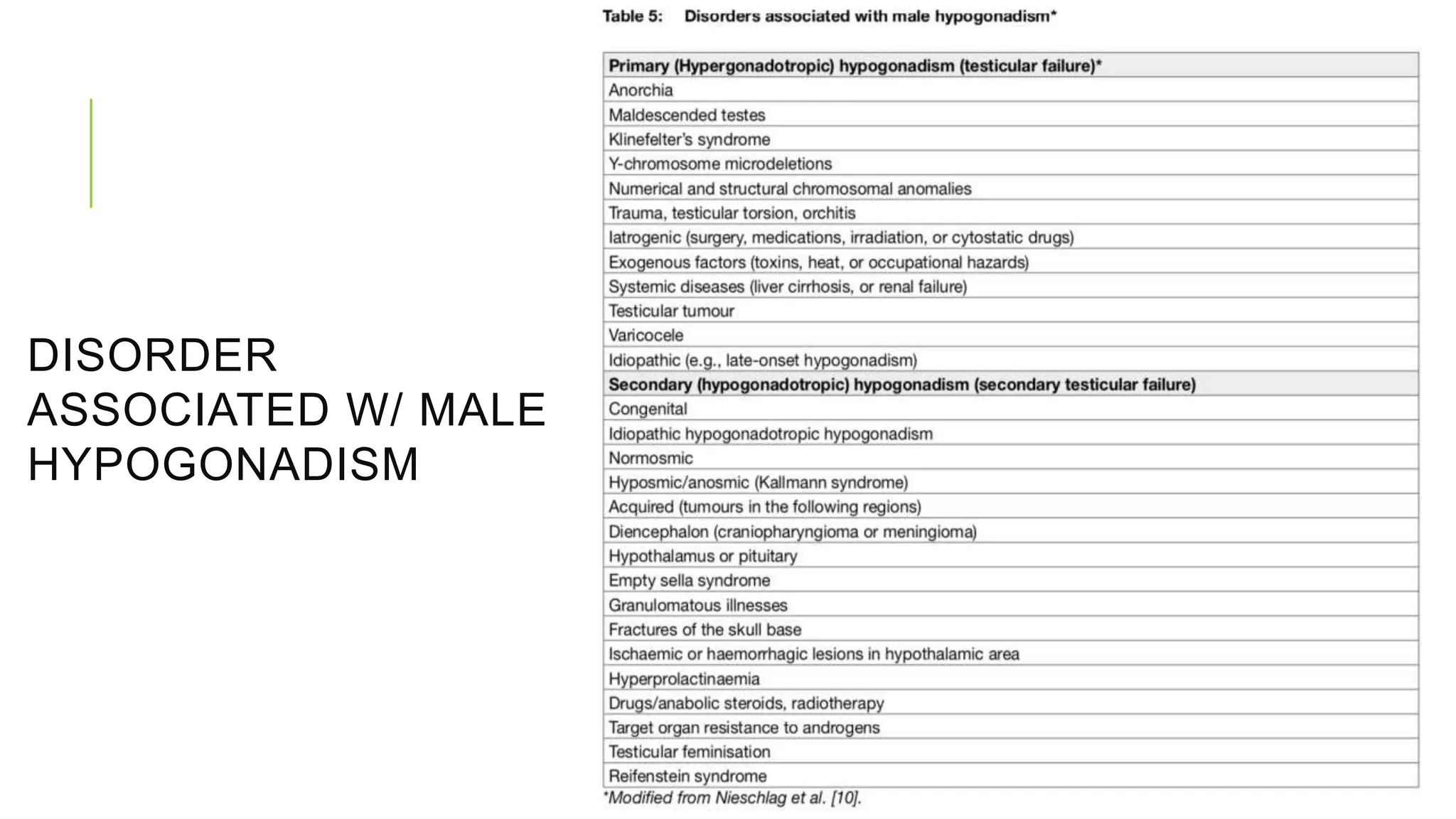
DISORDER
ASSOCIATED W/ MALE
HYPOGONADISM

Hypogonadotropic Hypogonadism

  • 1.
  • 2.
    OVERVIEW OF HYPOGONADISM Hypogonadism ischaracterised by impaired testicular function, which may affect spermatogenesis and/or testosterone synthesis The symptoms of hypogonadism depend on the degree of androgen deficiency The aetiological and pathogenetic mechanisms of male hypogonadism can be divided into 3 main categories : Primary (hypergonadotropic) hypogonadism due to testicular failure Secondary (hypogonadotropic) hypogonadism caused by insufficient GnRH and/or gonadotropin (FSH, LH) secretion Androgen insensitivity (end- organ resistance
  • 3.
    OVERVIEW Isolated gonadotropin deficiencyor hypogonadotropic hypogonadism (HH) •Rare cause of subfertility (1% of male infertility cases) •Congenital or acquired Acquired causes : Pituitary disease (prior surgery, infarction, tumors, infection, metabolic conditions) Most common  anosmic form or Kallman syndrome (1:10,000 and 1:60,000 births)
  • 5.
    KALLMAN SYNDROME (1) Resultsfrom failure to secrete GnRH by the hypothalamus  low gonadotropin levels  failure to transition prepubertal testis to postpubertal level of function GnRH deficiency  result of failed embryonic migration of neuroendocrine GnRH cells from olfactory epithelium to forebrain  Absence or hypoplasia of olfactory bulbs  concurrent anosmia Kallman syndrome represents genetically diverse group of diseases with:  Both X-chromosome linked inheritance via mutation in KAL1 gene  Autosomal dominant inheritance via mutations in Fibroblast Growt Factor Reseptor 1 (FGFR1), FGFR8,
  • 6.
    KALLMAN SYNDROME (2) Clinicalfeatures: Anosmia Azoospermia Midline facial defects (cleft palate) Gynecomastia Unilateral renal agenesis Cryptorchidism Micropenis Pes cavus Neurologic abnormalities •Metal retardation, oculomotor defects, deafness, synkinesia
  • 7.
  • 8.
    PRADER-WILLI SYNDROME (1) •Caused by microdeletions or mutations on the paternal chromosome 15 at the q11 or 13 location • Because of concurrent medical problems in these patients, most do not seek treatment for infertility • Clinical features : Infantile hypotonia Obesity Cryptorchidism Short stature Mental retardation
  • 9.
  • 10.
    DIAGNOSTIC OF HH(1) HH usually presents in the late teenage years when the patient fails to undergo the usual pubertal changes with secondary virilization Important to distinguish HH from constitutional delay of growth and puberty (CGDP) because they share many clinical and hormonal features and yet require markedly different treatments HH • Require lifelong androgen replacement for maintenance of virilization and episodes of exogenous gonadotropin treatment off androgen therapy for fertility induction CGDP • Attain spontaneous puberty by age 18 • May require transient androgen replacement for puberty induction but then will progress through normal development and fertility
  • 11.
    DIAGNOSTIC OF HH(2) Number of physiologic and stimulatory tests to discriminate :  Serial serum LH measurements  Prolactin response to THR and GnRH  HCG stimulation tests HH • Have minimal variability in LH levels • Do not demonstrate significant increases in gonadotropins levels with administration of GnRH CGDP • Often demonstrate LH pulses with serial overnight blood draws • Gonadotropin surge in response to GnRH stimulation
  • 12.
    DIAGNOSTIC OF HH(3) A suspected tumour requires imaging [computed tomography (CT) or magnetic resonance imaging (MRI)] of the sella region and a complete endocrine work-up Normal androgen levels and subsequent development of secondary sex characteristics (in cases of onset of hypogonadism before puberty) and a eugonadal state can be achieved by androgen replacement alone
  • 13.
    GOALS OF HHTREATMENT Induction of normal serum androgen levels to allow appropriate virilization and bone growth induction of spermatogenesis and fertility
  • 14.
    TREATMENTS OF HH(1) Various effective methods of testosterone replacement therapy Intramuscular testosterone enanthate or cypionate (200mg every 2 weeks) Transdermal patches (5- 10mg/day) Testosterone gel Buccal tablets Adequacy of replacement can be assessed by:  Serum testosterone levels (within midrange of normal)  Observation of desired phenotypic response to therapy
  • 15.
    EAU RECOMMENDATIONS Recommendations Strengthrating Provide testosterone replacement therapy for symptomatic patients with primary and secondary hypogonadism who are not considering parenthood. Strong In men with hypogonadotropic hypogonadism, induce spermatogenesis by an effective drug therapy (human chorionic gonadotropin, human menopausal gonadotropins, recombinant follicle-stimulating hormone, highly purified FSH). Strong Do not use testosterone replacement for the treatment of male infertility. Strong
  • 16.
    TREATMENTS OF HH(1)  human Chorionic Gonadotropin (hCG) as First-line therapy : subcutaneously at a dose of 1500 to 2000 IU two to three times per week, for 4 to 6 months.  Without significant further improvement, FSH stimulation is added to the treatment regimen to induce spermatogenesis
  • 17.
    TREATMENTS OF HH(2) FSH (administed as human menopausal gonadotropin/hMG)  Contains both FSH & LH in equal dose or with recombinant human FSH formulation  at a dose of 75 IU, 2-3x/week and recombinant FSH at a dose of 37.5-75 IU, 2- 3x/weeks  continued until attainment of sperm concentrations of at least 5 million per mL in the ejaculate or pregnancy Clomiphene (antiestrogen) or tamoxifen or with aromatase inhibitors such as anastrozole or letrozole restore testosterone levels and possibly improve spermatogenesis in selected patients with HH presenting after puberty with intact pituitary function  initial dose 25 mg every day or 50 mg every other day and is increased by
  • 18.
    TREATMENTS OF HH(3) In some studies, the titration target is restoration of normal androgen levels; in others, it is elevated at 600 to 800 ng/dL The typical dose of anastrozole is 1 mg daily
  • 19.
    TREATMENT OUTCOME & CONSIDERATIONS The vast majority of patients will be able to conceive after gonadotropin therapy, although 71% of the patients with subsequent fertility have sperm concentrations considerably lower than normal, suggesting that these patients are often able to conceive with low counts  10% of patients may maintain normal serum testosterone levels after cessation of all endocrine therapy, implying that HH may be reversible in some patients  In patients who have developed hypogonadism before puberty and have not been treated with gonadotropins or GnRH  may be need one to two years of therapy to achieve sperm production
  • 20.
    HH MEDICATIONS Menopur :Menotropin/human Menopausal Gonadotropin (hMG) 225 IU FSH & 225 IU LH @75 IU, SC 2-3x/week, until attainment of sperm concentration (at least 5 million/ml) or pegnancy is obtained  Roburantia Starfer/Torrex : Zink, Folic Acid, Ascorbic acid, cyanocobalamin, sodium selenium, fructose, arginine, carnitine, Vit E
  • 21.
    REFERENCES Jungwirth A, DiemerT, Kopa Z, Krausz C, Minhas S, Tournaye H. Male infertility. EAU Guidelines 2019. Niederberger CS. Chapter 24: Male infertility. In: Kavoussi LR, Partin AW, Peters CA. Campbell-walsh Urology. 11th ed. Philadelphia: Elsevier, Inc.;2016.
  • 24.