Open Educational Resources
A potential game changer for education?
Oslo, 10 December 2015
Gard Titlestad, Secretary General
International Council for Open and Distance Education
Look – now it is moving!
ICDE
An international organisation
addressing global and regional
challenges
• To be the leading global network for making quality learning
accessible throughout the world using online, open, distance
and flexible education.
• To connect institutions, organisations and professionals from
across the globe so that they can share ideas, resources and best
practices, partner on major projects and advocate together.
• To be the official partner of UNESCO, that shares that agency’s
key aim – the attainment of quality education for all
• ICDE believes that in pursuing education as a universal right, the
needs of the learner must be central.
• To organize members in all regions of the world
25 Years Support
From Norway
Why is ICDE here?
Partner with
UNESCO
50 years
http://www.universityworldne
ws.com/specialreports/index.p
hp?action=view&report=82
More from the 26th
ICDE World
Conference!
ICDE Operational
Network Representatives
Open Educational
Resources
“... are digital learning resources offered online freely and
openly to teachers, educators, students and independent
learners in order to be used, shared, combined, adapted,
and expanded in teaching, learning and research.”
(OECD 2011)
“... are teaching, learning and research materials in any
medium that reside in the public domain and have been
released under an open licence that permits access, use,
repurposing, reuse and redistribution by others with no
or limited restrictions.”
(UNESCO 2011)
From the UNESCO OER
Declaration
• Foster awareness and use of OER
• Encourage the development and adaptation of
OER in a variety of languages and cultural
contexts
• Encourage the open licensing of educational
materials produced with public funds.
ICDE work shouder to shoulder with UNESCO and
other stakeholders to have this implementet
OER matters
https://www.youtube.com/watch?v=Yfl1B6Qmp5g
Whatch the video!
OER and Online, Open and
Flexible Learning can
increase the impact of
investments in knowledge
OER &
OOF
Open Access – open science
Research based OER
Research based teaching
Innovation in education – open innovation
Innovate the learning system – flip the classroom
Knowledge supply for innovation
High quality education
Research based education
Resource based education
Open education
3 recommendations
12 languages
http://langoer.eun.org/
Check the Project!
9 – 11 JUNE 2015, UNESCO HEADQUARTERS, PARIS, FRANCE.
BE PART OF A DIFFERENT FUTURE FOR HIGHER
EDUCATION.
GLOBAL HIGH LEVEL POLICY FORUM:
ONLINE, OPEN AND FLEXIBLE HIGHER
EDUCATION
FOR THE FUTURE WE WANT
FROM STATEMENTS TO ACTION: EQUITY, ACCESS, AND QUALITY
LEARNING OUTCOMES
Online, Open, and Flexible Higher Education
for the Future We Want: Policy Challenges
A Background Report Prepared by the
International Council of Open and Distance
Education (ICDE) for the United Nations
Educational, Scientific and Cultural
Organization (UNESCO)
June 2015
Check the report!
SURVEY RESULTS
What We Heard – Perspectives and
Experiences from 105 Educational
Leaders from 53 Countries
The findings verify the policy
recommendations!
E-Learning in Higher Education in Latin
America
Rec. 1: For
Governments to Adopt
national policies in
support of Open
Educational Resources
in less used languages.
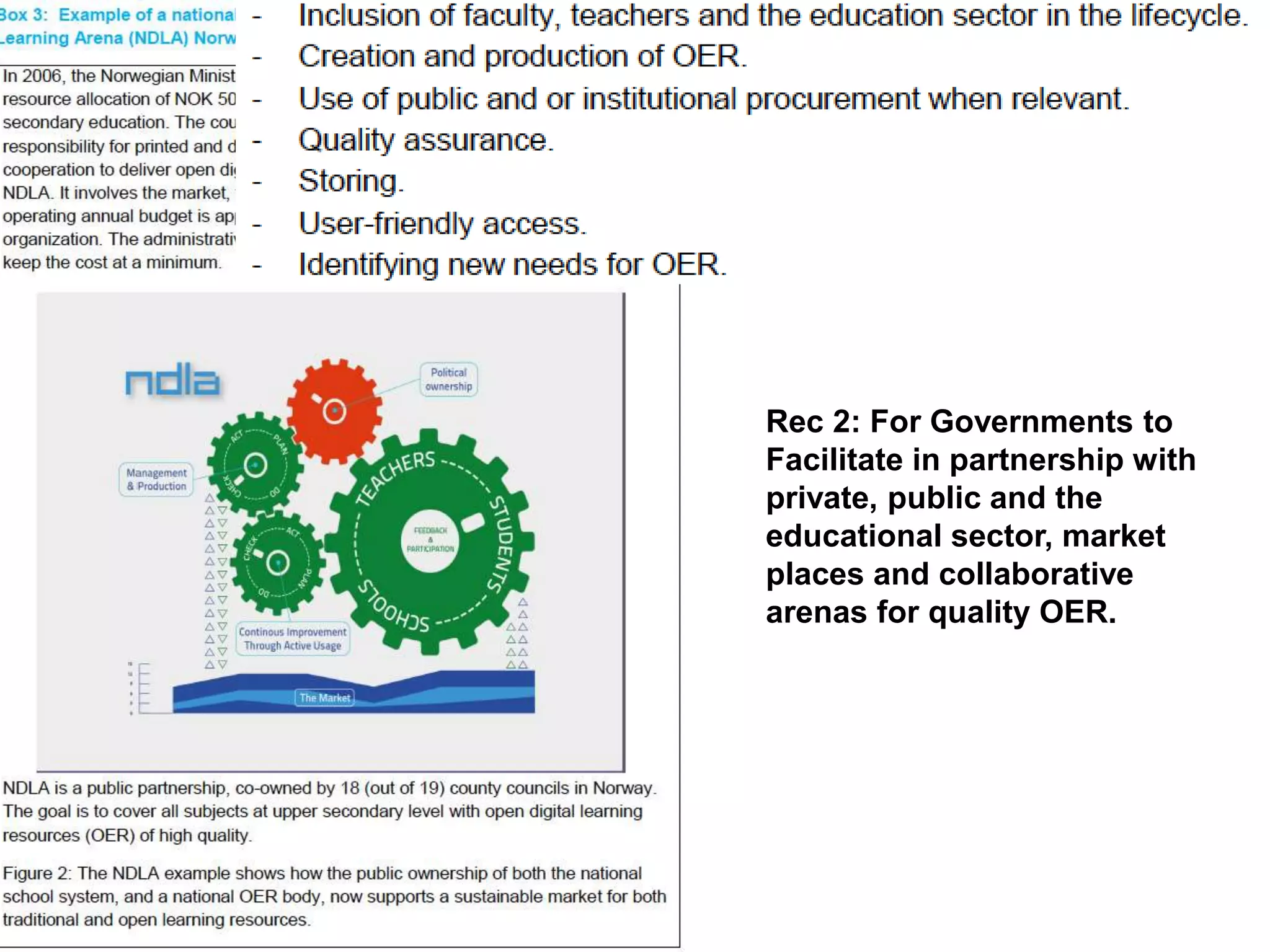
Rec 2: For Governments to
Facilitate in partnership with
private, public and the
educational sector, market
places and collaborative
arenas for quality OER.
• The USAID led
initiative works on
the same as policy
recommendation
no 3:
– Frameworks and
standards
Rec 3: For Governments to
Take the leadership in
facilitating the development
of open frameworks and
standards to ease the ability
of OER repositories and
systems to work together
(provide and accept
educational content,
compatible applications and
contextualised services).
Change is happen now!
A Norwegian example
http://ndla.no/en
Sessions Users Page views
Rec 2: For Governments to
Facilitate in partnership with
private, public and the
educational sector, market
places and collaborative
arenas for quality OER.
Contact North, Canada
Host for the next ICDE World Conference 2017
944 online certificate, diploma, undergraduate and
graduate programs
20,088 online courses
7,637 literacy and basic skills and training courses
From Ontario’s 24 Public Colleges, 22 Public
Universities and 250 Literacy and Basic Skills and
Training Providers
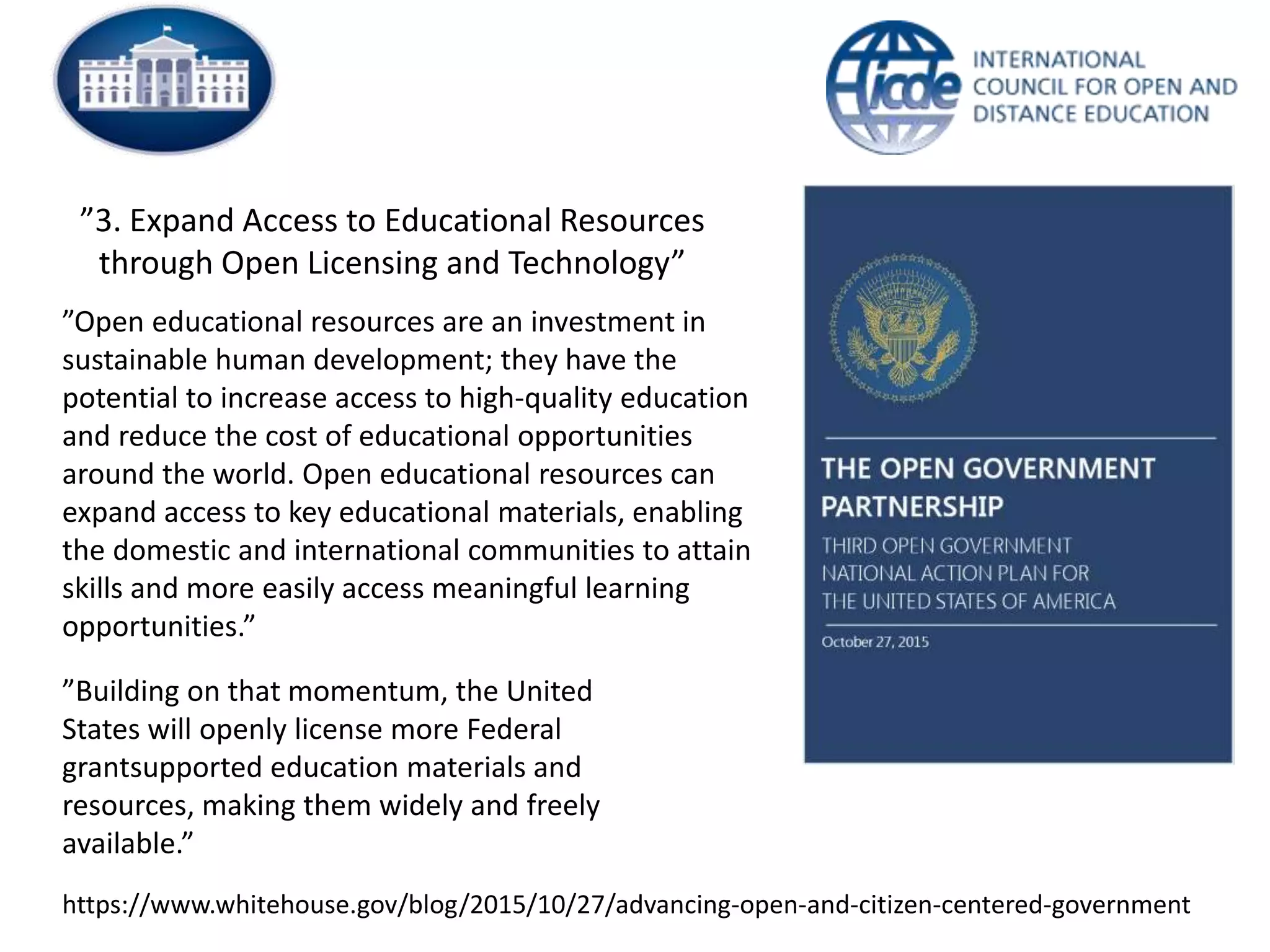
”3. Expand Access to Educational Resources
through Open Licensing and Technology”
”Open educational resources are an investment in
sustainable human development; they have the
potential to increase access to high-quality education
and reduce the cost of educational opportunities
around the world. Open educational resources can
expand access to key educational materials, enabling
the domestic and international communities to attain
skills and more easily access meaningful learning
opportunities.”
”Building on that momentum, the United
States will openly license more Federal
grantsupported education materials and
resources, making them widely and freely
available.”
https://www.whitehouse.gov/blog/2015/10/27/advancing-open-and-citizen-centered-government
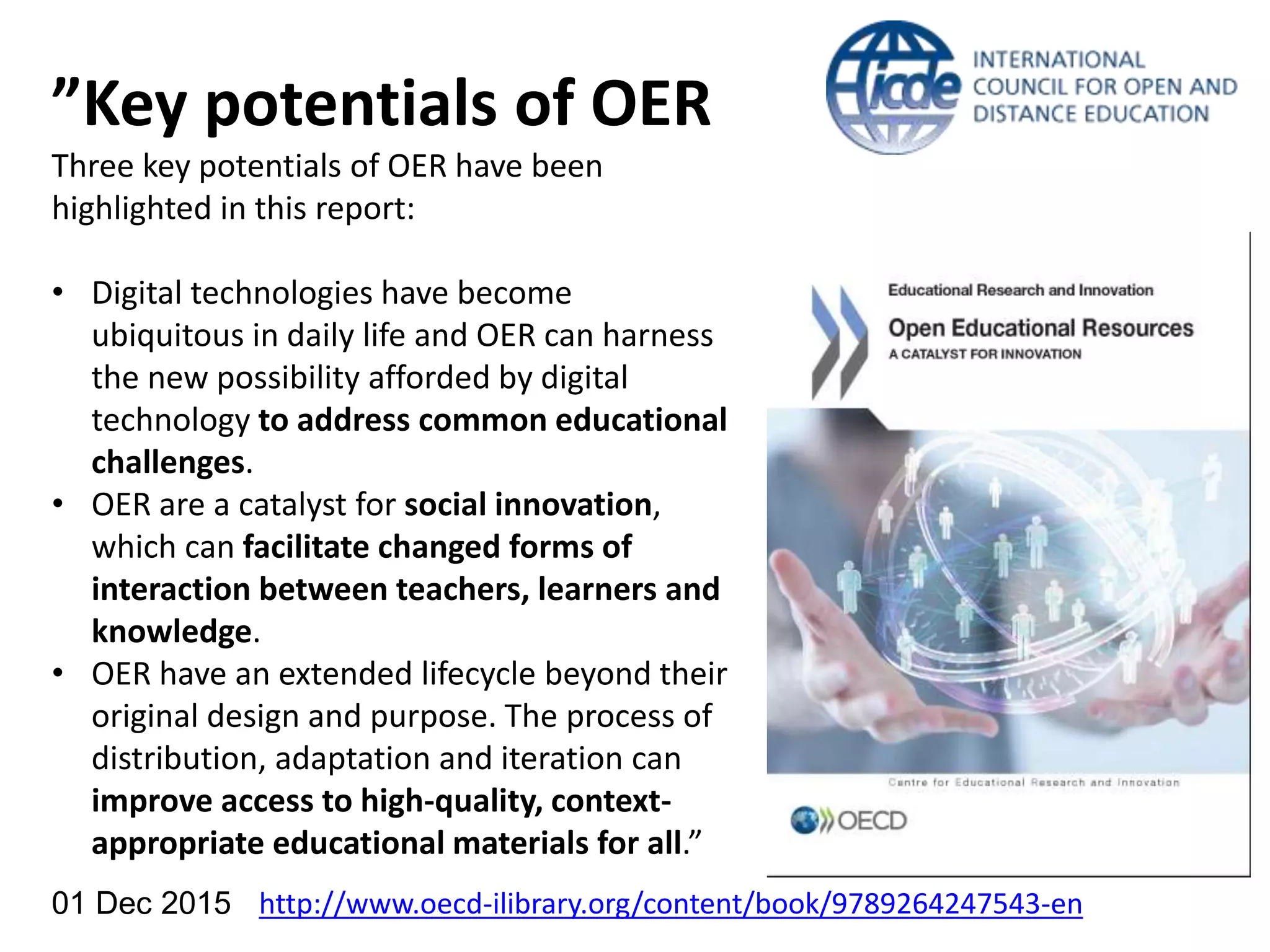
”Key potentials of OER
Three key potentials of OER have been
highlighted in this report:
• Digital technologies have become
ubiquitous in daily life and OER can harness
the new possibility afforded by digital
technology to address common educational
challenges.
• OER are a catalyst for social innovation,
which can facilitate changed forms of
interaction between teachers, learners and
knowledge.
• OER have an extended lifecycle beyond their
original design and purpose. The process of
distribution, adaptation and iteration can
improve access to high-quality, context-
appropriate educational materials for all.”
http://www.oecd-ilibrary.org/content/book/9789264247543-en01 Dec 2015
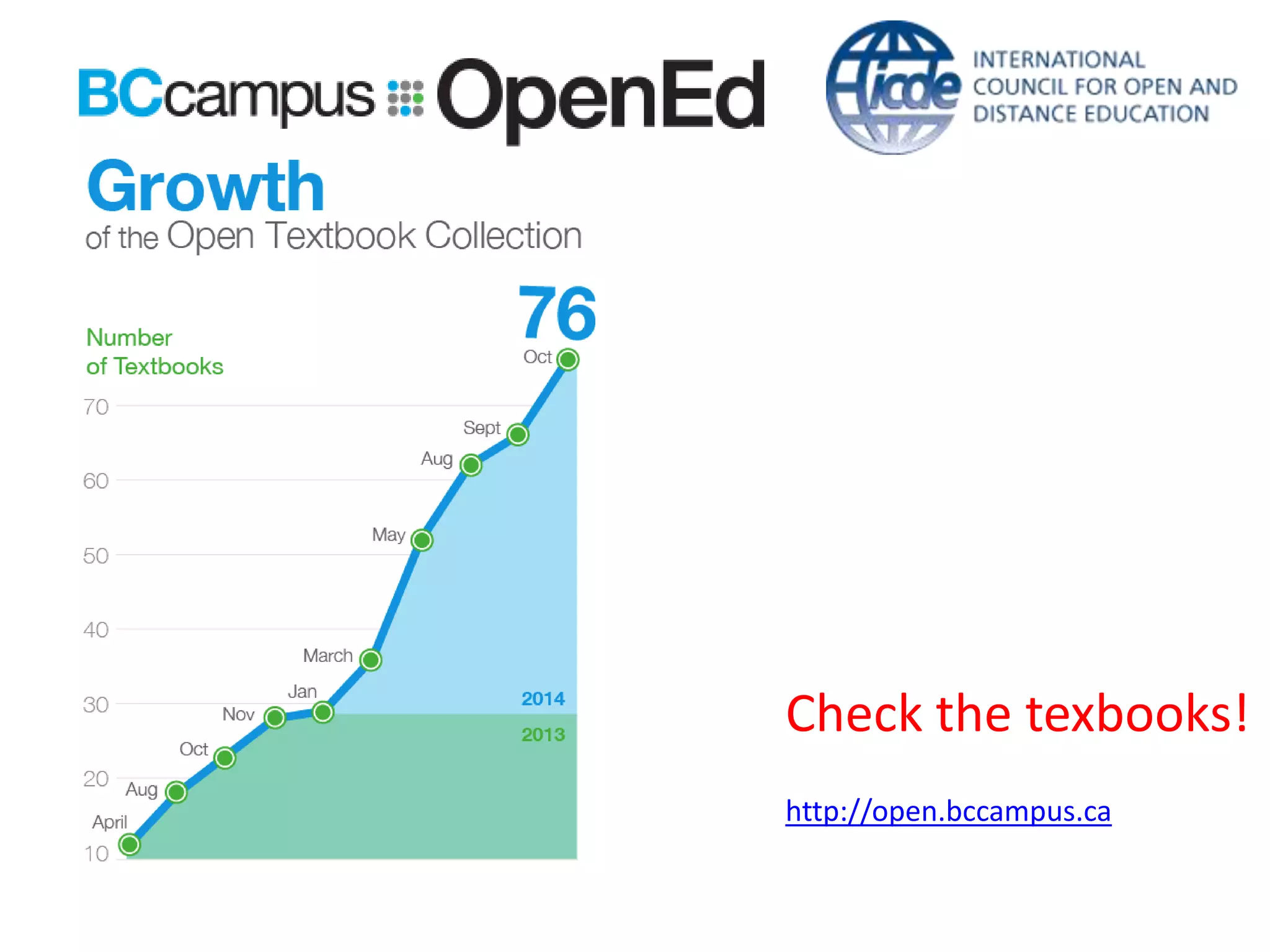
http://open.bccampus.ca
Check the texbooks!
More BC Open Textbook
Stats
As of December 4, 2015
General Stats
Student Savings $985,700- 1,214,092
Number of participating institutions 24 (19 Public, 5
Private)
Number of students affected 9,857
Number of textbooks on open 137
http://open.bccampus.ca/2015/09/10/more-bc-open-textbook-stats/
http://open.bccampus.ca/about-2/
http://open.bccampus.ca
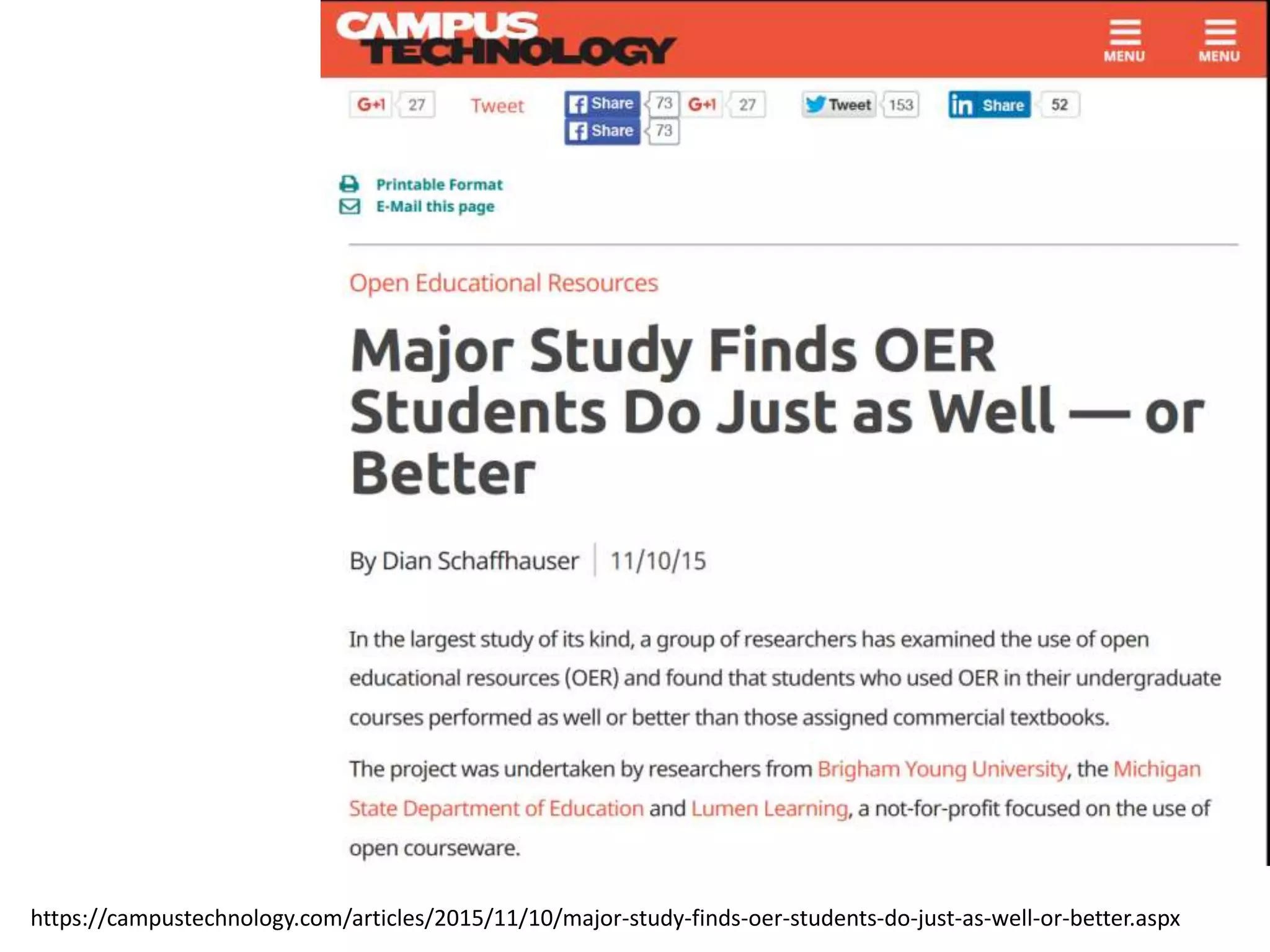
https://campustechnology.com/articles/2015/11/10/major-study-finds-oer-students-do-just-as-well-or-better.aspx
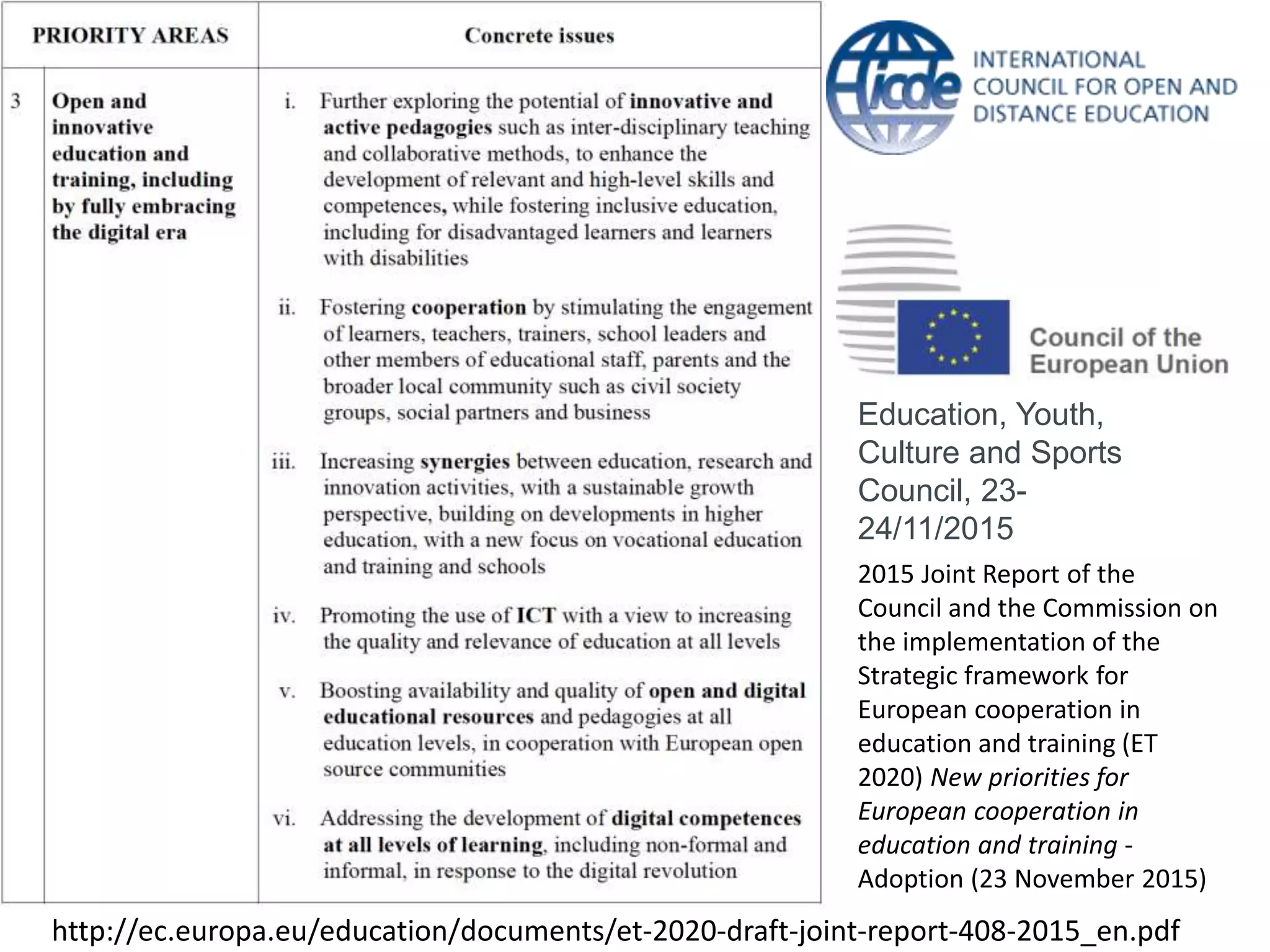
Education, Youth,
Culture and Sports
Council, 23-
24/11/2015
2015 Joint Report of the
Council and the Commission on
the implementation of the
Strategic framework for
European cooperation in
education and training (ET
2020) New priorities for
European cooperation in
education and training -
Adoption (23 November 2015)
http://ec.europa.eu/education/documents/et-2020-draft-joint-report-408-2015_en.pdf
”TOWARDS INCLUSIVE AND EQUITABLE
QUALITY EDUCATION AND LIFELONG
LEARNING FOR ALL”
Sustainable Development Goal 4 Education 2030
Target 3, point 43.:
A well-established, properly-regulated
tertiary education system supported by
technology, Open Educational Resources
(OERs) and distance education modalities
can increase access, equity, quality and
relevance, and narrow the gap between
what is taught at tertiary education
institutions and what economies and
societies demand. The provision of tertiary
education should be progressively free, in
line with existing international agreements.
Framework for Action
Education 2030:
http://www.unesco.org/new/en/education/resources/online-materials/single-
view/news/the_global_education_community_adopts_and_launches_education_2030_framework_for_action/#.VmYS9OPqhBc
Adopted 4 November 2015.
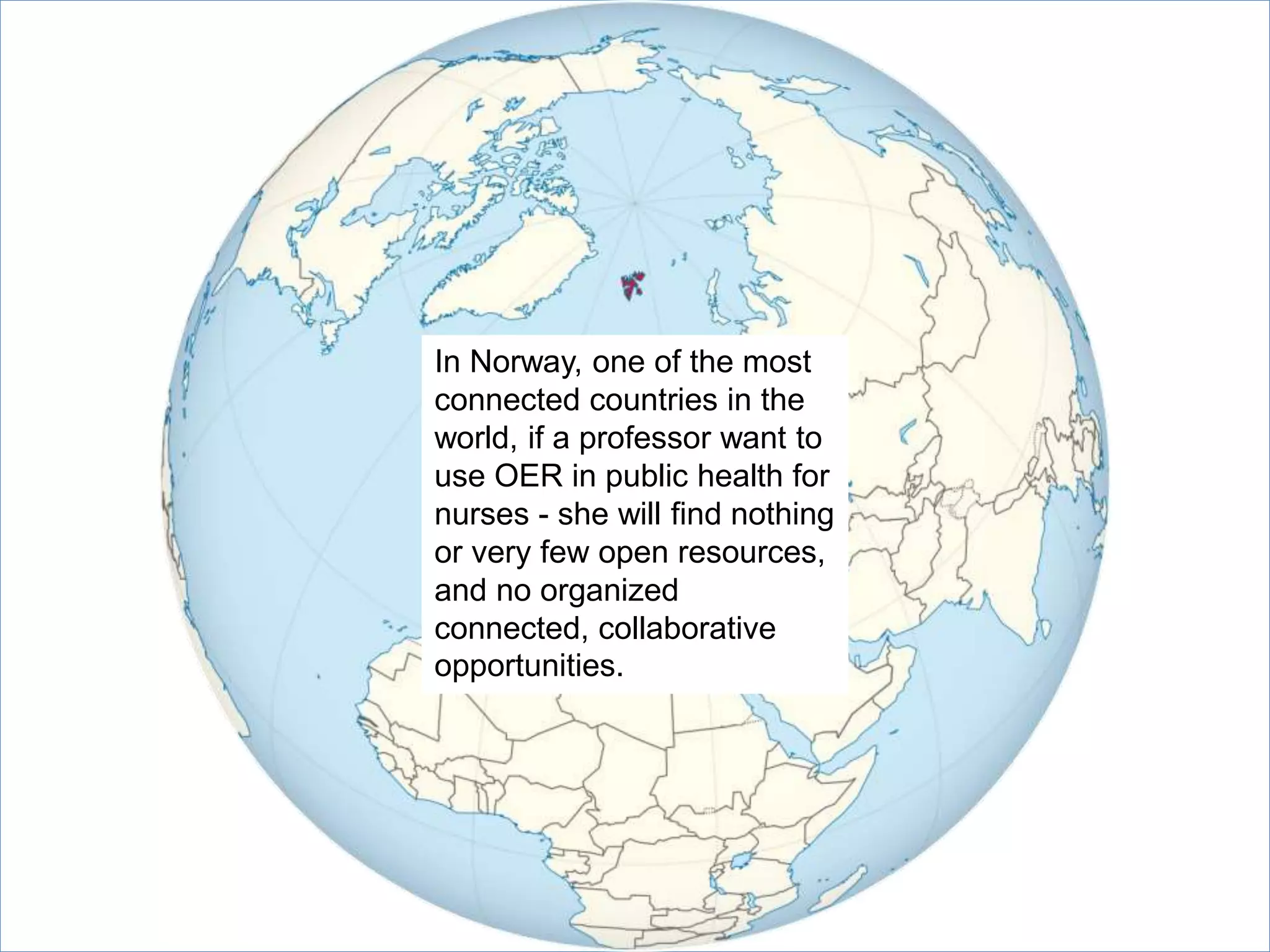
In Norway, one of the most
connected countries in the
world, if a professor want to
use OER in public health for
nurses - she will find nothing
or very few open resources,
and no organized
connected, collaborative
opportunities.
If the same professor in France engaged, she
would find more than 200 licensed education
resources regarding public health for nurses,
all linked to the higher education curricula. In
fact, a student in France can use collaborative
free quality assured educational material for
her grades, e.g. bachelor and master within
the equational system, all made possible and
digitalized by collaborative thematic
universities in a connected French
educational system.
”TOWARDS INCLUSIVE AND EQUITABLE
QUALITY EDUCATION AND LIFELONG
LEARNING FOR ALL”
Sustainable Development Goal 4: Education 2030
THANK YOU
titlestad@icde.org
www.icde.org
Open Education Resources - a game changer!

Open Education Resources - a game changer!

  • 1.
    Open Educational Resources Apotential game changer for education? Oslo, 10 December 2015 Gard Titlestad, Secretary General International Council for Open and Distance Education Look – now it is moving!
  • 2.
    ICDE An international organisation addressingglobal and regional challenges
  • 3.
    • To bethe leading global network for making quality learning accessible throughout the world using online, open, distance and flexible education. • To connect institutions, organisations and professionals from across the globe so that they can share ideas, resources and best practices, partner on major projects and advocate together. • To be the official partner of UNESCO, that shares that agency’s key aim – the attainment of quality education for all • ICDE believes that in pursuing education as a universal right, the needs of the learner must be central. • To organize members in all regions of the world 25 Years Support From Norway Why is ICDE here? Partner with UNESCO 50 years
  • 4.
  • 5.
  • 6.
    Open Educational Resources “... aredigital learning resources offered online freely and openly to teachers, educators, students and independent learners in order to be used, shared, combined, adapted, and expanded in teaching, learning and research.” (OECD 2011) “... are teaching, learning and research materials in any medium that reside in the public domain and have been released under an open licence that permits access, use, repurposing, reuse and redistribution by others with no or limited restrictions.” (UNESCO 2011)
  • 7.
    From the UNESCOOER Declaration • Foster awareness and use of OER • Encourage the development and adaptation of OER in a variety of languages and cultural contexts • Encourage the open licensing of educational materials produced with public funds. ICDE work shouder to shoulder with UNESCO and other stakeholders to have this implementet
  • 8.
  • 9.
    OER and Online,Open and Flexible Learning can increase the impact of investments in knowledge OER & OOF Open Access – open science Research based OER Research based teaching Innovation in education – open innovation Innovate the learning system – flip the classroom Knowledge supply for innovation High quality education Research based education Resource based education Open education
  • 10.
  • 11.
  • 13.
    9 – 11JUNE 2015, UNESCO HEADQUARTERS, PARIS, FRANCE. BE PART OF A DIFFERENT FUTURE FOR HIGHER EDUCATION. GLOBAL HIGH LEVEL POLICY FORUM: ONLINE, OPEN AND FLEXIBLE HIGHER EDUCATION FOR THE FUTURE WE WANT FROM STATEMENTS TO ACTION: EQUITY, ACCESS, AND QUALITY LEARNING OUTCOMES
  • 14.
    Online, Open, andFlexible Higher Education for the Future We Want: Policy Challenges A Background Report Prepared by the International Council of Open and Distance Education (ICDE) for the United Nations Educational, Scientific and Cultural Organization (UNESCO) June 2015 Check the report!
  • 15.
    SURVEY RESULTS What WeHeard – Perspectives and Experiences from 105 Educational Leaders from 53 Countries The findings verify the policy recommendations!
  • 17.
    E-Learning in HigherEducation in Latin America Rec. 1: For Governments to Adopt national policies in support of Open Educational Resources in less used languages.
  • 19.
    Rec 2: ForGovernments to Facilitate in partnership with private, public and the educational sector, market places and collaborative arenas for quality OER.
  • 20.
    • The USAIDled initiative works on the same as policy recommendation no 3: – Frameworks and standards
  • 21.
    Rec 3: ForGovernments to Take the leadership in facilitating the development of open frameworks and standards to ease the ability of OER repositories and systems to work together (provide and accept educational content, compatible applications and contextualised services).
  • 22.
  • 23.
  • 24.
    Rec 2: ForGovernments to Facilitate in partnership with private, public and the educational sector, market places and collaborative arenas for quality OER.
  • 25.
    Contact North, Canada Hostfor the next ICDE World Conference 2017 944 online certificate, diploma, undergraduate and graduate programs 20,088 online courses 7,637 literacy and basic skills and training courses From Ontario’s 24 Public Colleges, 22 Public Universities and 250 Literacy and Basic Skills and Training Providers
  • 26.
    ”3. Expand Accessto Educational Resources through Open Licensing and Technology” ”Open educational resources are an investment in sustainable human development; they have the potential to increase access to high-quality education and reduce the cost of educational opportunities around the world. Open educational resources can expand access to key educational materials, enabling the domestic and international communities to attain skills and more easily access meaningful learning opportunities.” ”Building on that momentum, the United States will openly license more Federal grantsupported education materials and resources, making them widely and freely available.” https://www.whitehouse.gov/blog/2015/10/27/advancing-open-and-citizen-centered-government
  • 27.
    ”Key potentials ofOER Three key potentials of OER have been highlighted in this report: • Digital technologies have become ubiquitous in daily life and OER can harness the new possibility afforded by digital technology to address common educational challenges. • OER are a catalyst for social innovation, which can facilitate changed forms of interaction between teachers, learners and knowledge. • OER have an extended lifecycle beyond their original design and purpose. The process of distribution, adaptation and iteration can improve access to high-quality, context- appropriate educational materials for all.” http://www.oecd-ilibrary.org/content/book/9789264247543-en01 Dec 2015
  • 29.
  • 30.
    More BC OpenTextbook Stats As of December 4, 2015 General Stats Student Savings $985,700- 1,214,092 Number of participating institutions 24 (19 Public, 5 Private) Number of students affected 9,857 Number of textbooks on open 137 http://open.bccampus.ca/2015/09/10/more-bc-open-textbook-stats/ http://open.bccampus.ca/about-2/ http://open.bccampus.ca
  • 31.
  • 32.
    Education, Youth, Culture andSports Council, 23- 24/11/2015 2015 Joint Report of the Council and the Commission on the implementation of the Strategic framework for European cooperation in education and training (ET 2020) New priorities for European cooperation in education and training - Adoption (23 November 2015) http://ec.europa.eu/education/documents/et-2020-draft-joint-report-408-2015_en.pdf
  • 33.
    ”TOWARDS INCLUSIVE ANDEQUITABLE QUALITY EDUCATION AND LIFELONG LEARNING FOR ALL” Sustainable Development Goal 4 Education 2030
  • 34.
    Target 3, point43.: A well-established, properly-regulated tertiary education system supported by technology, Open Educational Resources (OERs) and distance education modalities can increase access, equity, quality and relevance, and narrow the gap between what is taught at tertiary education institutions and what economies and societies demand. The provision of tertiary education should be progressively free, in line with existing international agreements. Framework for Action Education 2030: http://www.unesco.org/new/en/education/resources/online-materials/single- view/news/the_global_education_community_adopts_and_launches_education_2030_framework_for_action/#.VmYS9OPqhBc Adopted 4 November 2015.
  • 35.
    In Norway, oneof the most connected countries in the world, if a professor want to use OER in public health for nurses - she will find nothing or very few open resources, and no organized connected, collaborative opportunities.
  • 36.
    If the sameprofessor in France engaged, she would find more than 200 licensed education resources regarding public health for nurses, all linked to the higher education curricula. In fact, a student in France can use collaborative free quality assured educational material for her grades, e.g. bachelor and master within the equational system, all made possible and digitalized by collaborative thematic universities in a connected French educational system.
  • 37.
    ”TOWARDS INCLUSIVE ANDEQUITABLE QUALITY EDUCATION AND LIFELONG LEARNING FOR ALL” Sustainable Development Goal 4: Education 2030 THANK YOU titlestad@icde.org www.icde.org