2
ontario
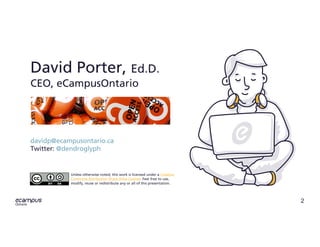
David Porter, Ed.D.
CEO, eCampusOntario
davidp@ecampusontario.ca
Twitter: @dendroglyph
Unless otherwise noted, this work is licensed under a Creative
Commons Attribution Share Alike License. Feel free to use,
modify, reuse or redistribute any or all of this presentation.
3
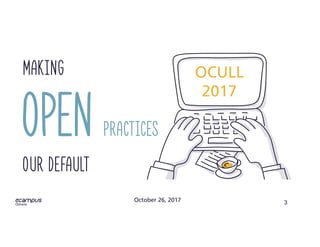
Making
Open practices
our default
October 26, 2017
OCULL
2017
OUR NORMAL
WORKING
CONTEXT IS
CHANGING
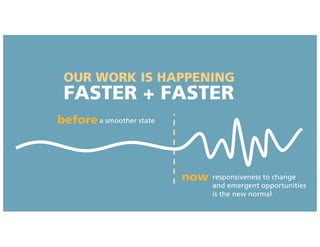
FASTER + FASTER
OUR WORK IS HAPPENING
beforea smoother state
now responsiveness to change
and emergent opportunities
is the new normal
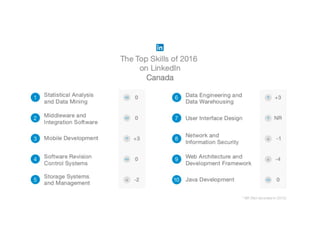
Technology	skills	are	in	demand,	but	they	change	fast!
slideshare.net/linkedin
Slide	from:	Don	Presant – CanCred.ca
8
ontario
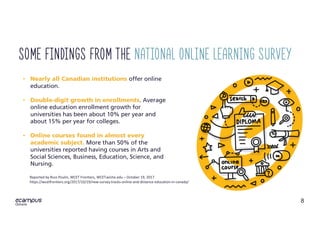
• Nearly all Canadian institutions offer online
education.
• Double-digit growth in enrollments. Average
online education enrollment growth for
universities has been about 10% per year and
about 15% per year for colleges.
• Online courses found in almost every
academic subject. More than 50% of the
universities reported having courses in Arts and
Social Sciences, Business, Education, Science, and
Nursing.
Some findings from the national Online Learning survey
Reported	by	Russ	Poulin,	WCET	Frontiers,	WCET.wiche.edu – October	19,	2017
https://wcetfrontiers.org/2017/10/19/new-survey-tracks-online-and-distance-education-in-canada/
9
ontario
• Online learning is a strategic asset. More than 2/3
rated online learning as important for the institution,
long-term. Less than half (14%) have implemented or
are implementing (26%) a strategic plan for online
learning, while about a third (32%) are developing a
plan.
• Blended learning is common. Nearly three-fourths
(72%) of reporting institutions offer blended/hybrid
courses. About 12% of institutions report that more
than 30% of their courses are offered in this mode of
instruction.
• Less use of MOOCs and OER than expected. British
Columbia and Ontario have been world-wide leaders in
promoting open content. 5% of responding institutions
use OER extensively and 35% report moderate OER use.
Some findings from the national Online Learning survey
11
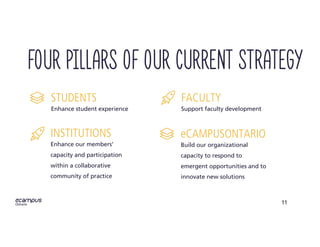
Enhance student experience
STUDENTS
Support faculty development
FACULTY
Enhance our members’
capacity and participation
within a collaborative
community of practice
INSTITUTIONS
Build our organizational
capacity to respond to
emergent opportunities and to
innovate new solutions
eCAMPUSONTARIO
Four Pillars of OUR Current Strategy
12
Upskilling
is a guiding principle
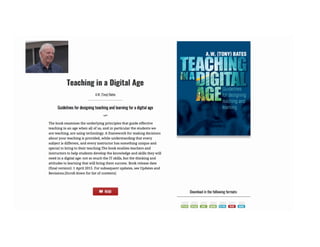
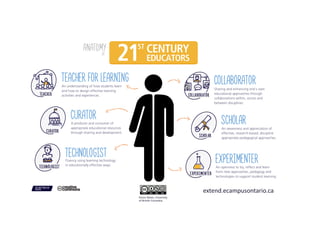
Simon Bates, University
of British Columbia.
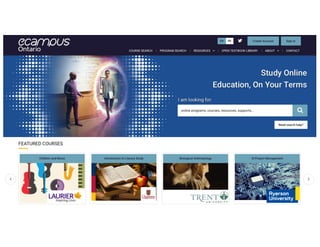
extend.ecampusontario.ca
15
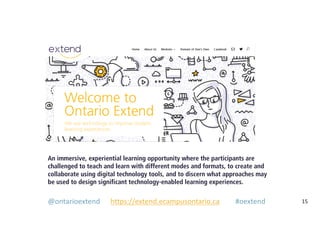
An immersive, experiential learning opportunity where the participants are
challenged to teach and learn with different modes and formats, to create and
collaborate using digital technology tools, and to discern what approaches may
be used to design significant technology-enabled learning experiences.
@ontarioextend https://extend.ecampusontario.ca #oextend
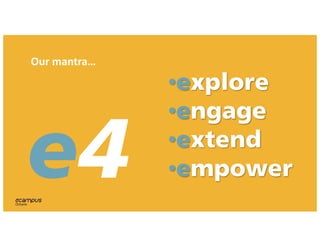
e4
•explore
•engage
•extend
•empower
Our	mantra…
enlightenment
18
Rethinking
Needs to be at the core of our practice
19
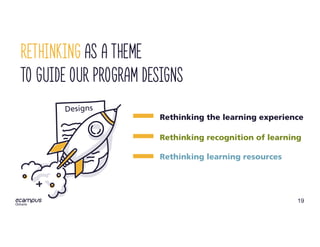
Rethinking AS a Theme
to guide our program designs
Rethinking learning resources
Rethinking the learning experience
Rethinking recognition of learning
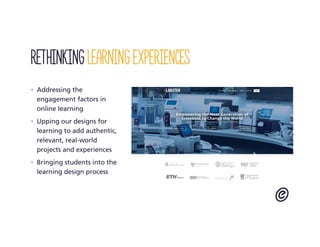
Rethinking learning experiences
• Addressing the
engagement factors in
online learning
• Upping our designs for
learning to add authentic,
relevant, real-world
projects and experiences
• Bringing students into the
learning design process
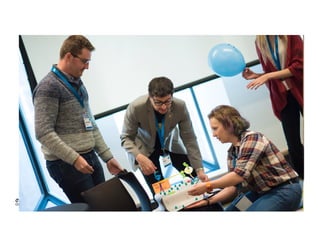
@SXDLab
Prototypes
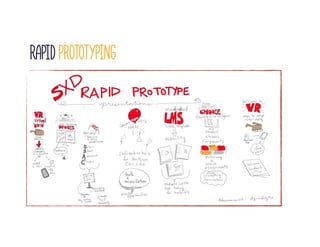
Rapid prototyping
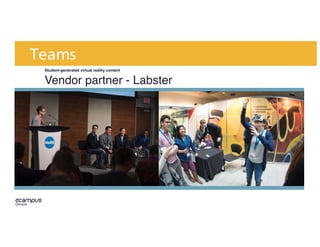
Student-generated virtual reality content
Vendor partner - Labster
Teams
Teams
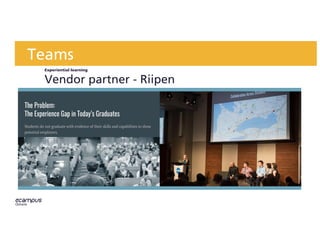
Experiential learning
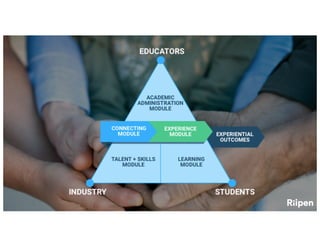
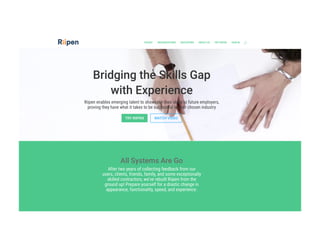
Vendor partner - Riipen
28
29
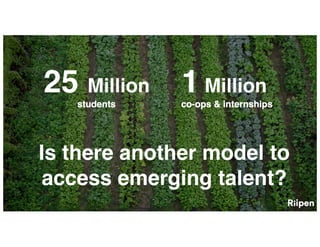
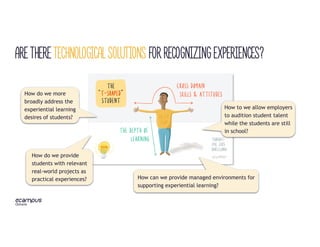
How do we more
broadly address the
experiential learning
desires of students?
Are there technological solutions for recognizing experiences?
How do we provide
students with relevant
real-world projects as
practical experiences?
How to we allow employers
to audition student talent
while the students are still
in school?
How can we provide managed environments for
supporting experiential learning?
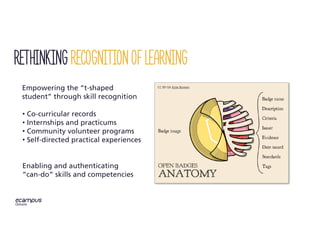
Rethinking Recognition of learning
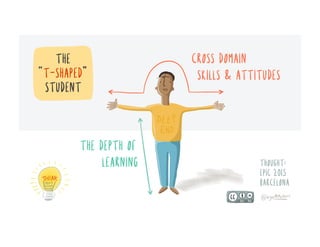
Empowering the “t-shaped
student” through skill recognition
• Co-curricular records
• Internships and practicums
• Community volunteer programs
• Self-directed practical experiences
Enabling and authenticating
“can-do” skills and competencies
32
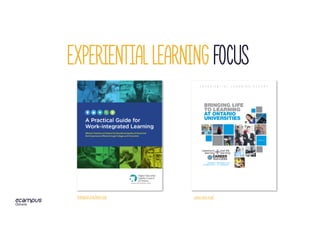
https://files.ontario.ca/highly_skilled_workforce_report_summary_eng.pdf
cou.on.ca/heqco.ca/en-ca
Experiential learning focus
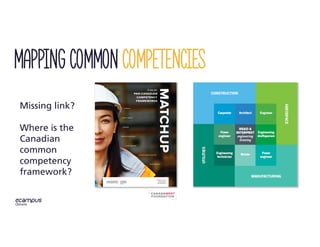
Mapping Common competencies
Missing link?
Where is the
Canadian
common
competency
framework?
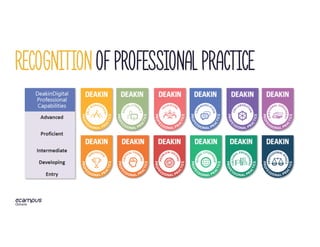
Recognition of Professional Practice
39
ontario
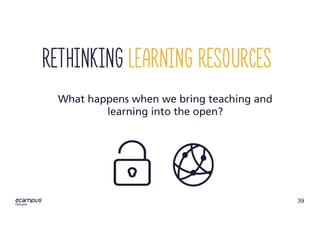
Rethinking Learning Resources
What happens when we bring teaching and
learning into the open?
Why OPEN ?
Image	by	Craig	Garner
PD-US via Wikimedia Commons
“Everyone has the right
to education. Education
shall be free, at least in
the elementary and
fundamental stages…”
Source: United Nations, 1948, Universal Declaration
of Human Rights Article 26, paragraph 1
Universal
Declaration of
Human Rights
It started in 1948
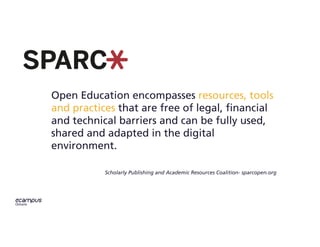
Open Education encompasses resources, tools
and practices that are free of legal, financial
and technical barriers and can be fully used,
shared and adapted in the digital
environment.
Scholarly Publishing and Academic Resources Coalition- sparcopen.org
43
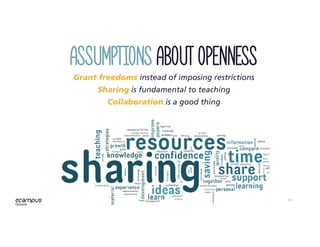
Grant freedoms instead of imposing restrictions
Sharing is fundamental to teaching
Collaboration is a good thing
Assumptions about Openness
44
	
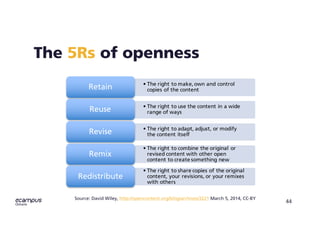
• The right to make,own and control
copies of the contentRetain
• The right to use the content in a wide
range of waysReuse
• The right to adapt, adjust, or modify
the content itselfRevise
• The right to combine the original or
revised content with other open
content to create something new
Remix
• The right to share copies of the original
content, your revisions, or your remixes
with others
Redistribute
Source: David Wiley, http://opencontent.org/blog/archives/3221 March 5, 2014, CC-BY
The 5Rs of openness
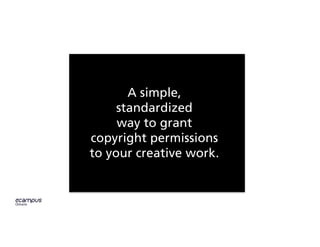
A simple,
standardized
way to grant
copyright permissions
to your creative work.
Some Rights Reserved
Creative Commons logo by Creative Commons used under under a Creative Commons Attribution 3.0 License
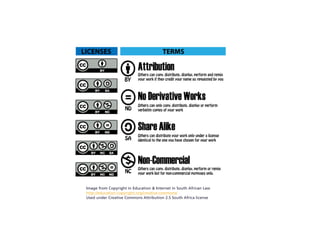
Image from Copyright in Education & Internet in South African Law
http://education-copyright.org/creative-commons/
Used under Creative Commons Attribution 2.5 South Africa license
49
ontario
Rethinking Learning Resources
And, free is more
than just a good deal
51
ontario
The Big Idea of Open
Giving instructional resources expanded power to
enable learning and teaching, beyond being just
free or low cost
5 benefits
to openness
53
ontario
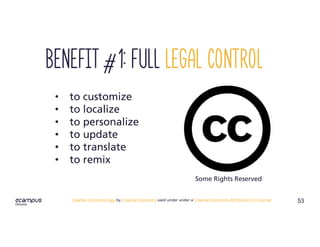
Benefit #1: Full Legal Control
• to customize
• to localize
• to personalize
• to update
• to translate
• to remix
Some Rights Reserved
Creative Commons logo by Creative Commons used under under a Creative Commons Attribution 3.0 License
Open thinking is spreading worldwide
Images from Oxfam.org CC-BY and
http://en.wikipedia.org/wiki/User:Daniel_Mietchen/Talks/World_Open_Educational_Resources_Congress_2012
/How_Open_Access_and_Open_Science_can_mutually_fertilize_with_Open_Educational_Resources CC-BY
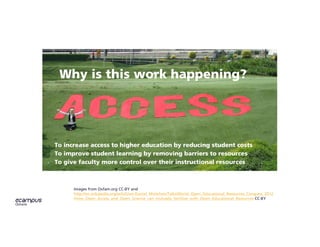
Why is this work happening?
To increase access to higher education by reducing student costs
To improve student learning by removing barriers to resources
To give faculty more control over their instructional resources
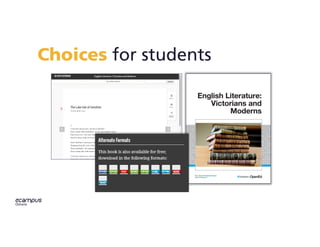
Choices for students
Empowering faculty
Who are the
Open Rangers
on your
campus?
Beyond Free
Benefit #2
Access to customized
resources improves learning
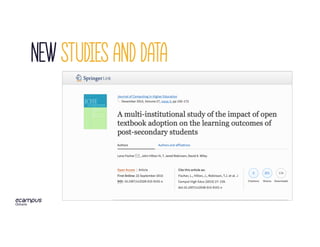
New Studies and Data
Beyond Free
Benefit #3
Open provides opportunities for
authentic learning activities
63
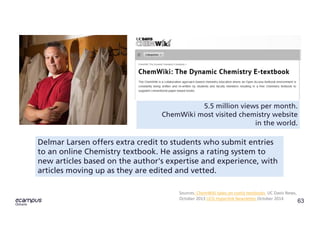
5.5 million views per month.
ChemWiki most visited chemistry website
in the world.
Delmar Larsen offers extra credit to students who submit entries
to an online Chemistry textbook. He assigns a rating system to
new articles based on the author's expertise and experience, with
articles moving up as they are edited and vetted.
Sources:	ChemWiki	takes	on	costly	textbooks	 UC	Davis	News,	
October	2013	UCD	Hyperlink	Newsletter	October	2014
64
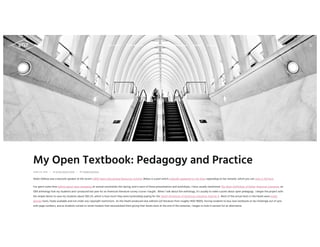
Robin DeRosa
Plymouth State University – New Hampshire
The Open Anthology
of Early American Literature
“I launched the open textbook project over a summer,
and because I teach at a public university where I had
no easy access to graduate assistants or funding, I hired
a bunch of undergrad students and recent alums, and
paid them out of my own pocket to assist me. Turns
out, most of them were willing to work for free (I
didn’t let them, though what I paid was low because it
was all I could spare), and turns out the whole
endeavor of building the work turned out to be
transformative to my own pedagogy and to the course
that followed.”
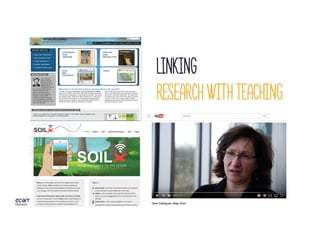
Linking
research with teaching
Beyond Free
Benefit #4
Collegial collaboration
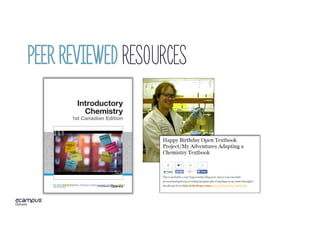
Peer Reviewed Resources
My	Adventures	Adapting	a	Chemistry	Textbook291/365	 by	thebarrowboy used	under	a	CC-BY
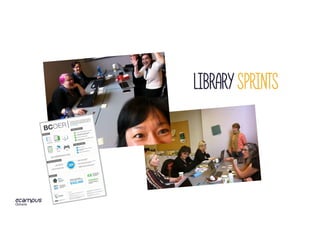
Library sprints
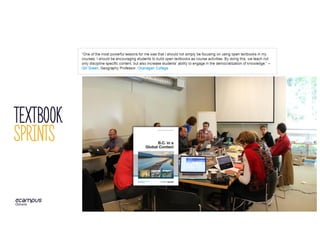
Textbook
sprints
Test bank
sprints
2 Days
17 Psych Faculty
6 Institutions
850 Questions
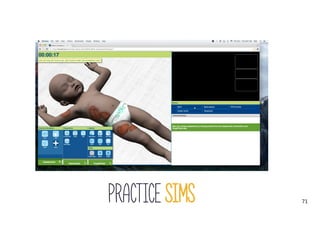
71Practice SIMs
72
Beyond Free
Benefit #5
Demonstration of the service
mission institutions
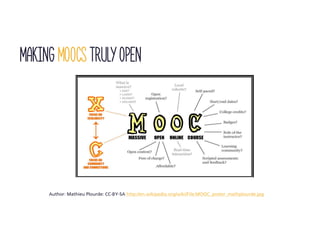
Author: Mathieu Plourde: CC-BY-SA http://en.wikipedia.org/wiki/File:MOOC_poster_mathplourde.jpg
Making MOOCs truly open
76
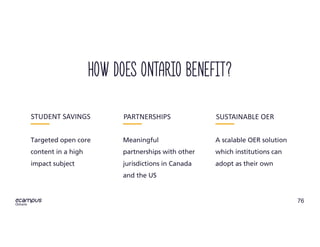
How does ontario benefit?
Targeted open core
content in a high
impact subject
Meaningful
partnerships with other
jurisdictions in Canada
and the US
A scalable OER solution
which institutions can
adopt as their own
STUDENT	SAVINGS PARTNERSHIPS SUSTAINABLE	OER
77
ontario
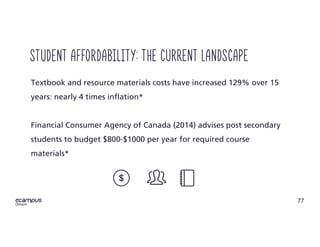
Textbook and resource materials costs have increased 129% over 15
years: nearly 4 times inflation*
Financial Consumer Agency of Canada (2014) advises post secondary
students to budget $800-$1000 per year for required course
materials*
Student Affordability: the current landscape
78
79
81
ontario
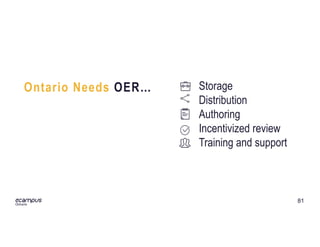
Ontario Needs OER… Storage
Distribution
Authoring
Incentivized review
Training and support
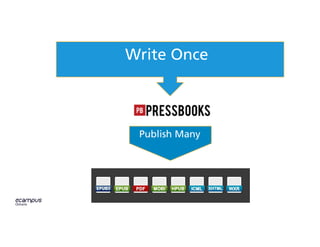
Publish Many
Write Once
83
84
ontario
Beyond textbooks
Teachers also need OPEN resources
• Project files
• Learning activities
• Assessments
• Homework help
• Power point decks
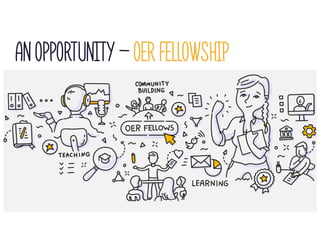
An Opportunity - OER Fellowship
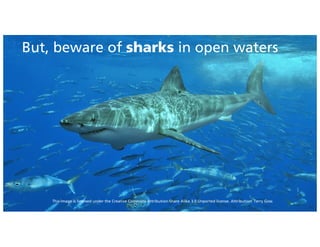
This image is licensed under the Creative Commons Attribution-Share Alike 3.0 Unported license. Attribution: Terry Goss
But, beware of sharks in open waters
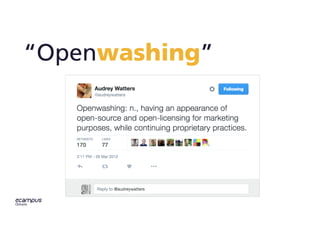
“Openwashing”
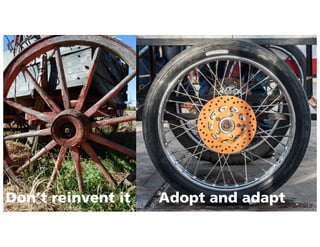
Don’t reinvent it Adopt and adapt
89
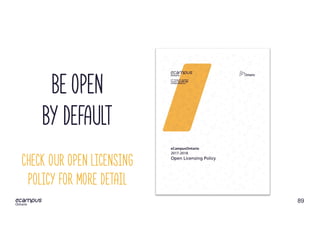
BE open
by default
Check our Open Licensing
policy for more detail
90
Thank you VERY MUCH
Thoughts or Questions?

OCULL 2017

  • 2.
    2 ontario David Porter, Ed.D. CEO,eCampusOntario davidp@ecampusontario.ca Twitter: @dendroglyph Unless otherwise noted, this work is licensed under a Creative Commons Attribution Share Alike License. Feel free to use, modify, reuse or redistribute any or all of this presentation.
  • 3.
  • 4.
  • 5.
    FASTER + FASTER OURWORK IS HAPPENING beforea smoother state now responsiveness to change and emergent opportunities is the new normal
  • 7.
  • 8.
    8 ontario • Nearly allCanadian institutions offer online education. • Double-digit growth in enrollments. Average online education enrollment growth for universities has been about 10% per year and about 15% per year for colleges. • Online courses found in almost every academic subject. More than 50% of the universities reported having courses in Arts and Social Sciences, Business, Education, Science, and Nursing. Some findings from the national Online Learning survey Reported by Russ Poulin, WCET Frontiers, WCET.wiche.edu – October 19, 2017 https://wcetfrontiers.org/2017/10/19/new-survey-tracks-online-and-distance-education-in-canada/
  • 9.
    9 ontario • Online learningis a strategic asset. More than 2/3 rated online learning as important for the institution, long-term. Less than half (14%) have implemented or are implementing (26%) a strategic plan for online learning, while about a third (32%) are developing a plan. • Blended learning is common. Nearly three-fourths (72%) of reporting institutions offer blended/hybrid courses. About 12% of institutions report that more than 30% of their courses are offered in this mode of instruction. • Less use of MOOCs and OER than expected. British Columbia and Ontario have been world-wide leaders in promoting open content. 5% of responding institutions use OER extensively and 35% report moderate OER use. Some findings from the national Online Learning survey
  • 11.
    11 Enhance student experience STUDENTS Supportfaculty development FACULTY Enhance our members’ capacity and participation within a collaborative community of practice INSTITUTIONS Build our organizational capacity to respond to emergent opportunities and to innovate new solutions eCAMPUSONTARIO Four Pillars of OUR Current Strategy
  • 12.
  • 14.
    Simon Bates, University ofBritish Columbia. extend.ecampusontario.ca
  • 15.
    15 An immersive, experientiallearning opportunity where the participants are challenged to teach and learn with different modes and formats, to create and collaborate using digital technology tools, and to discern what approaches may be used to design significant technology-enabled learning experiences. @ontarioextend https://extend.ecampusontario.ca #oextend
  • 16.
  • 17.
  • 18.
    18 Rethinking Needs to beat the core of our practice
  • 19.
    19 Rethinking AS aTheme to guide our program designs Rethinking learning resources Rethinking the learning experience Rethinking recognition of learning
  • 20.
    Rethinking learning experiences •Addressing the engagement factors in online learning • Upping our designs for learning to add authentic, relevant, real-world projects and experiences • Bringing students into the learning design process
  • 21.
  • 23.
  • 25.
    Student-generated virtual realitycontent Vendor partner - Labster Teams
  • 27.
  • 28.
  • 29.
  • 30.
    How do wemore broadly address the experiential learning desires of students? Are there technological solutions for recognizing experiences? How do we provide students with relevant real-world projects as practical experiences? How to we allow employers to audition student talent while the students are still in school? How can we provide managed environments for supporting experiential learning?
  • 31.
    Rethinking Recognition oflearning Empowering the “t-shaped student” through skill recognition • Co-curricular records • Internships and practicums • Community volunteer programs • Self-directed practical experiences Enabling and authenticating “can-do” skills and competencies
  • 32.
  • 35.
  • 36.
    Mapping Common competencies Missinglink? Where is the Canadian common competency framework?
  • 37.
  • 39.
    39 ontario Rethinking Learning Resources Whathappens when we bring teaching and learning into the open?
  • 40.
  • 41.
    PD-US via WikimediaCommons “Everyone has the right to education. Education shall be free, at least in the elementary and fundamental stages…” Source: United Nations, 1948, Universal Declaration of Human Rights Article 26, paragraph 1 Universal Declaration of Human Rights It started in 1948
  • 42.
    Open Education encompassesresources, tools and practices that are free of legal, financial and technical barriers and can be fully used, shared and adapted in the digital environment. Scholarly Publishing and Academic Resources Coalition- sparcopen.org
  • 43.
    43 Grant freedoms insteadof imposing restrictions Sharing is fundamental to teaching Collaboration is a good thing Assumptions about Openness
  • 44.
    44 • The rightto make,own and control copies of the contentRetain • The right to use the content in a wide range of waysReuse • The right to adapt, adjust, or modify the content itselfRevise • The right to combine the original or revised content with other open content to create something new Remix • The right to share copies of the original content, your revisions, or your remixes with others Redistribute Source: David Wiley, http://opencontent.org/blog/archives/3221 March 5, 2014, CC-BY The 5Rs of openness
  • 45.
    A simple, standardized way togrant copyright permissions to your creative work.
  • 46.
    Some Rights Reserved CreativeCommons logo by Creative Commons used under under a Creative Commons Attribution 3.0 License
  • 47.
    Image from Copyrightin Education & Internet in South African Law http://education-copyright.org/creative-commons/ Used under Creative Commons Attribution 2.5 South Africa license
  • 49.
  • 50.
    And, free ismore than just a good deal
  • 51.
    51 ontario The Big Ideaof Open Giving instructional resources expanded power to enable learning and teaching, beyond being just free or low cost
  • 52.
  • 53.
    53 ontario Benefit #1: FullLegal Control • to customize • to localize • to personalize • to update • to translate • to remix Some Rights Reserved Creative Commons logo by Creative Commons used under under a Creative Commons Attribution 3.0 License
  • 55.
    Open thinking isspreading worldwide
  • 57.
    Images from Oxfam.orgCC-BY and http://en.wikipedia.org/wiki/User:Daniel_Mietchen/Talks/World_Open_Educational_Resources_Congress_2012 /How_Open_Access_and_Open_Science_can_mutually_fertilize_with_Open_Educational_Resources CC-BY Why is this work happening? To increase access to higher education by reducing student costs To improve student learning by removing barriers to resources To give faculty more control over their instructional resources
  • 58.
  • 59.
    Empowering faculty Who arethe Open Rangers on your campus?
  • 60.
    Beyond Free Benefit #2 Accessto customized resources improves learning
  • 61.
  • 62.
    Beyond Free Benefit #3 Openprovides opportunities for authentic learning activities
  • 63.
    63 5.5 million viewsper month. ChemWiki most visited chemistry website in the world. Delmar Larsen offers extra credit to students who submit entries to an online Chemistry textbook. He assigns a rating system to new articles based on the author's expertise and experience, with articles moving up as they are edited and vetted. Sources: ChemWiki takes on costly textbooks UC Davis News, October 2013 UCD Hyperlink Newsletter October 2014
  • 64.
    64 Robin DeRosa Plymouth StateUniversity – New Hampshire The Open Anthology of Early American Literature “I launched the open textbook project over a summer, and because I teach at a public university where I had no easy access to graduate assistants or funding, I hired a bunch of undergrad students and recent alums, and paid them out of my own pocket to assist me. Turns out, most of them were willing to work for free (I didn’t let them, though what I paid was low because it was all I could spare), and turns out the whole endeavor of building the work turned out to be transformative to my own pedagogy and to the course that followed.”
  • 65.
  • 66.
  • 67.
  • 68.
  • 69.
  • 70.
    Test bank sprints 2 Days 17Psych Faculty 6 Institutions 850 Questions
  • 71.
  • 72.
  • 73.
    Beyond Free Benefit #5 Demonstrationof the service mission institutions
  • 74.
    Author: Mathieu Plourde:CC-BY-SA http://en.wikipedia.org/wiki/File:MOOC_poster_mathplourde.jpg Making MOOCs truly open
  • 76.
    76 How does ontariobenefit? Targeted open core content in a high impact subject Meaningful partnerships with other jurisdictions in Canada and the US A scalable OER solution which institutions can adopt as their own STUDENT SAVINGS PARTNERSHIPS SUSTAINABLE OER
  • 77.
    77 ontario Textbook and resourcematerials costs have increased 129% over 15 years: nearly 4 times inflation* Financial Consumer Agency of Canada (2014) advises post secondary students to budget $800-$1000 per year for required course materials* Student Affordability: the current landscape
  • 78.
  • 79.
  • 81.
    81 ontario Ontario Needs OER…Storage Distribution Authoring Incentivized review Training and support
  • 82.
  • 83.
  • 84.
    84 ontario Beyond textbooks Teachers alsoneed OPEN resources • Project files • Learning activities • Assessments • Homework help • Power point decks
  • 85.
    An Opportunity -OER Fellowship
  • 86.
    This image islicensed under the Creative Commons Attribution-Share Alike 3.0 Unported license. Attribution: Terry Goss But, beware of sharks in open waters
  • 87.
  • 88.
    Don’t reinvent itAdopt and adapt
  • 89.
    89 BE open by default Checkour Open Licensing policy for more detail
  • 90.
    90 Thank you VERYMUCH Thoughts or Questions?