The Innovative Aspect
of Open Education
Dr. Robert Farrow
Open Education Research Hub
Institute of Educational Technology
The Open University, UK
rob.farrow@open.ac.uk
@philosopher1978
2
SUMMARY
WP7: QUALITY
• What is WP7? Aims, activities and deliverables
• D7.1 Quality Management System
• Proposed Next Steps
Open Educational
Resources (OER) are an
innovation, but what they
respond to (copyright) was
also an innovation.
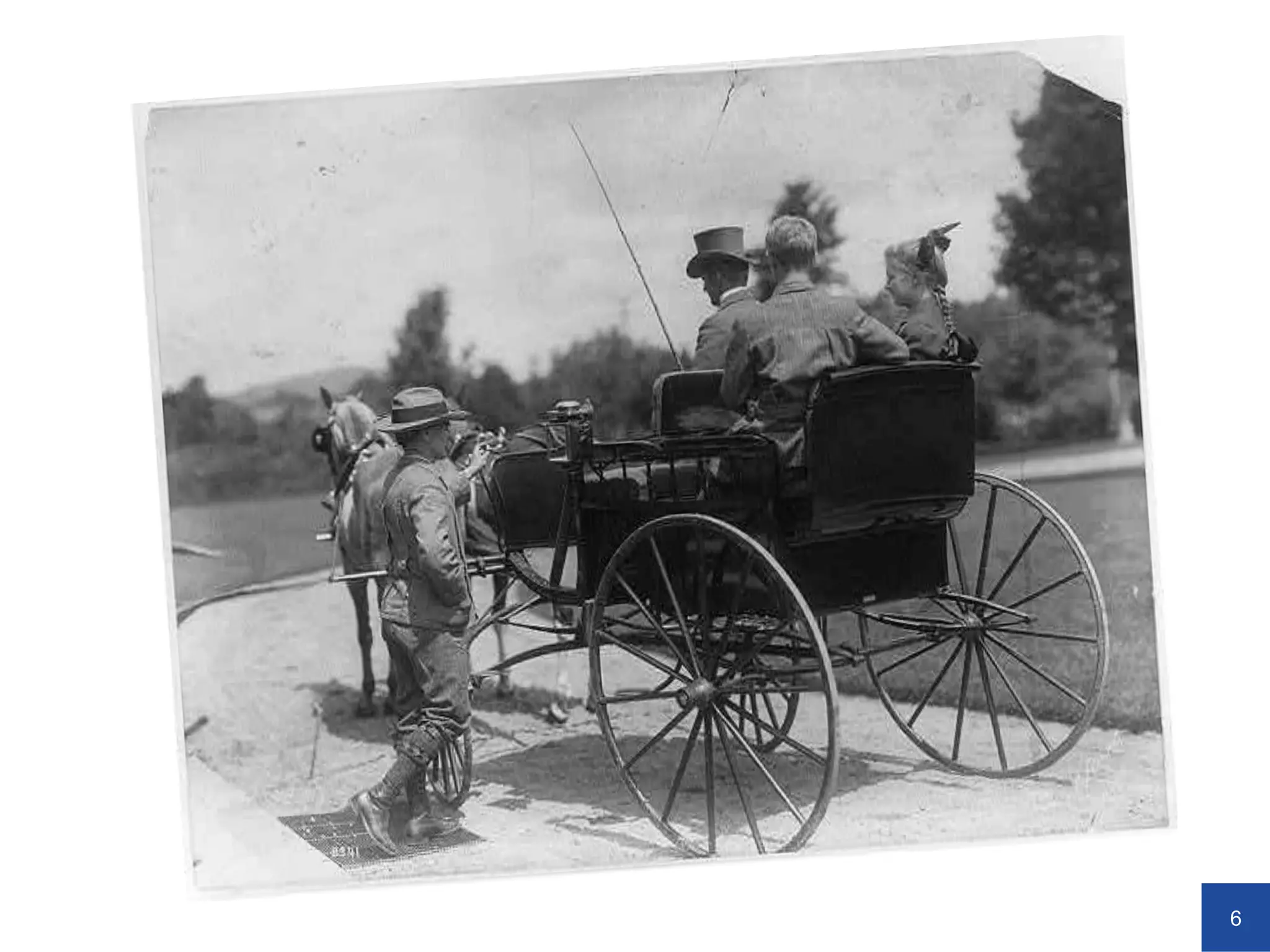
Copyright was introduced
to regulate IP in the age of
mechanical reproduction:
Incentivising creative production
Preserving the integrity of creative
works
Establishing rules for the economic
exploitation of works
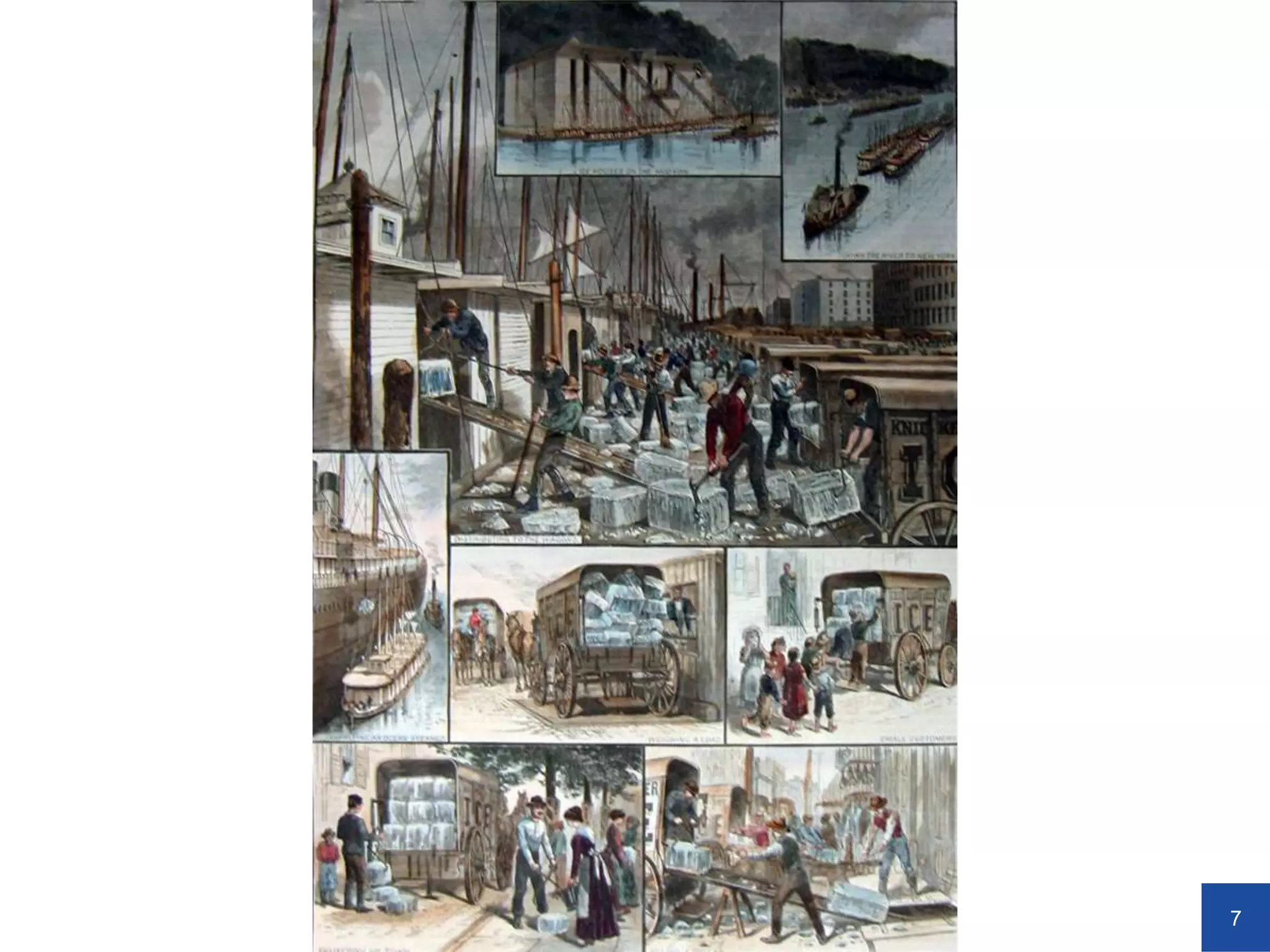
People innovate to
overcome challenges
6
7
People innovate to
overcome challenges
People innovate to
overcome challenges…
giving rise to new
challenges
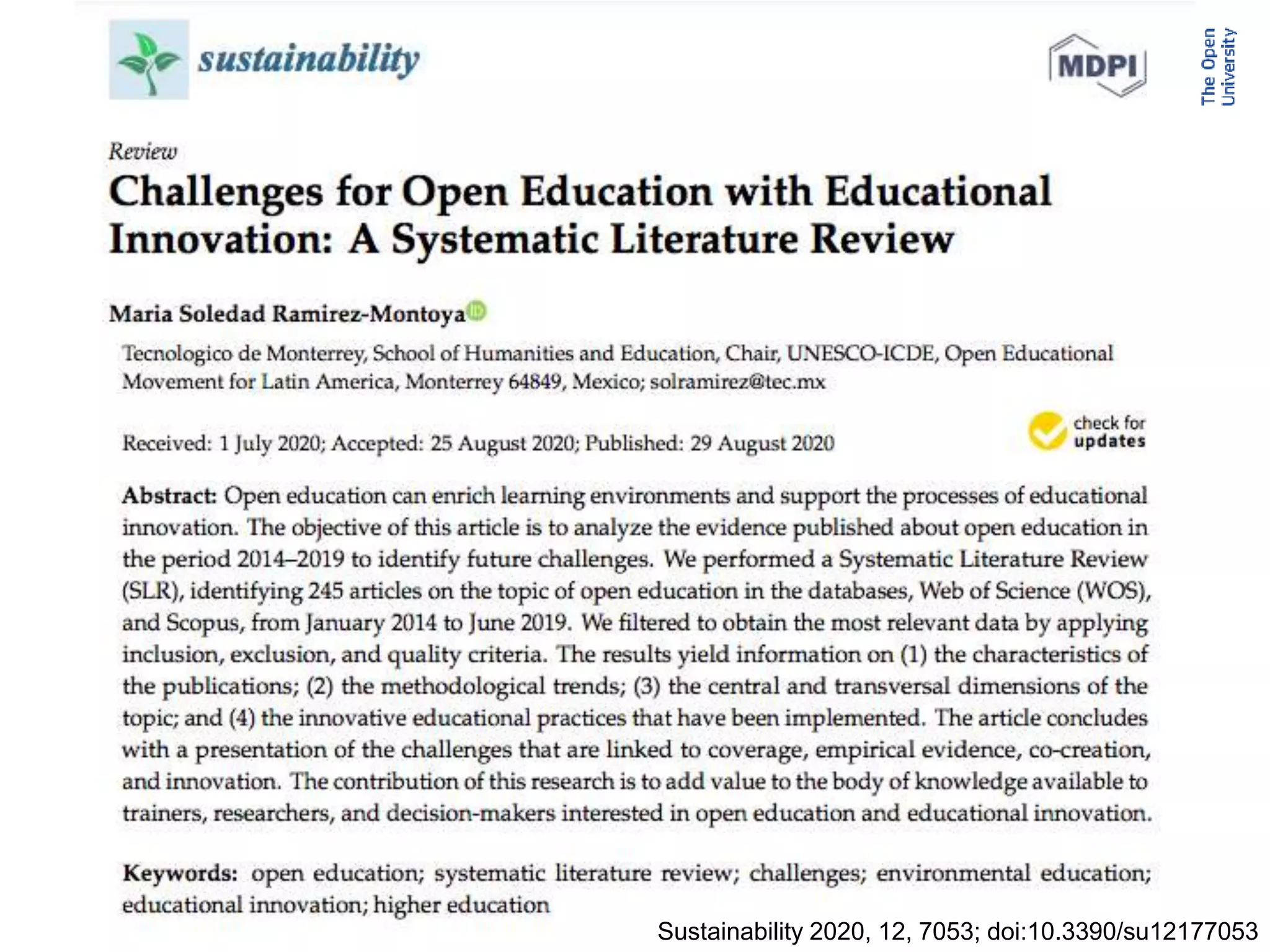
Sustainability 2020, 12, 7053; doi:10.3390/su12177053
[O]ne impediment is traditional thinking that educational innovation
exists within formal educational institutions (e.g., schools, institutes,
universities) and not in other formal or informal environments. Moving
beyond this thinking presents a niche of opportunity to generate lines
of research and publications related to the processes of formal and
informal learning within networks, considering multiple relationships
with educational institutions and other sectors.
Another challenge of great incidence is “openness,” the capacity to
bring together diverse sectors (educational, social, enterprise, cultural)
for collaboration and dissemination. In this landscape, the field of open
education is fertile, both for training in educational innovation and for
promoting innovations within the framework of the open educational
movement with practices of production, use, dissemination, and
mobilization.
Here, the open education movement is visualized as a dynamic
phenomenon, in constant evolution, that starts from the simplest idea
of taking advantage of resources to share a common good, namely,
knowledge. However, open education can also mean something more
complex: developing educational practices that contribute to the
necessary improvements in education, management, and research
required by external changes.
Sustainability 2020, 12, 7053; doi:10.3390/su12177053
http://oerhub.net/
Project Co-PILOT
Keyword Hypothesis
Performance OER improve student performance/satisfaction
Openness People use OER differently from other online materials
Access OER widen participation in education
Retention OER can help at-risk learners to finish their studies
Reflection OER use leads educators to reflect on their practice
Finance OER adoption brings financial benefits for
students/institutions
Indicators Informal learners use a variety of indicators when selecting
OER
Support Informal learners develop their own forms of study support
Transition OER support informal learners in moving to formal study
Policy OER use encourages institutions to change their policies
Assessment Informal assessments motivate learners using OER
http://oerhub.net/reports/
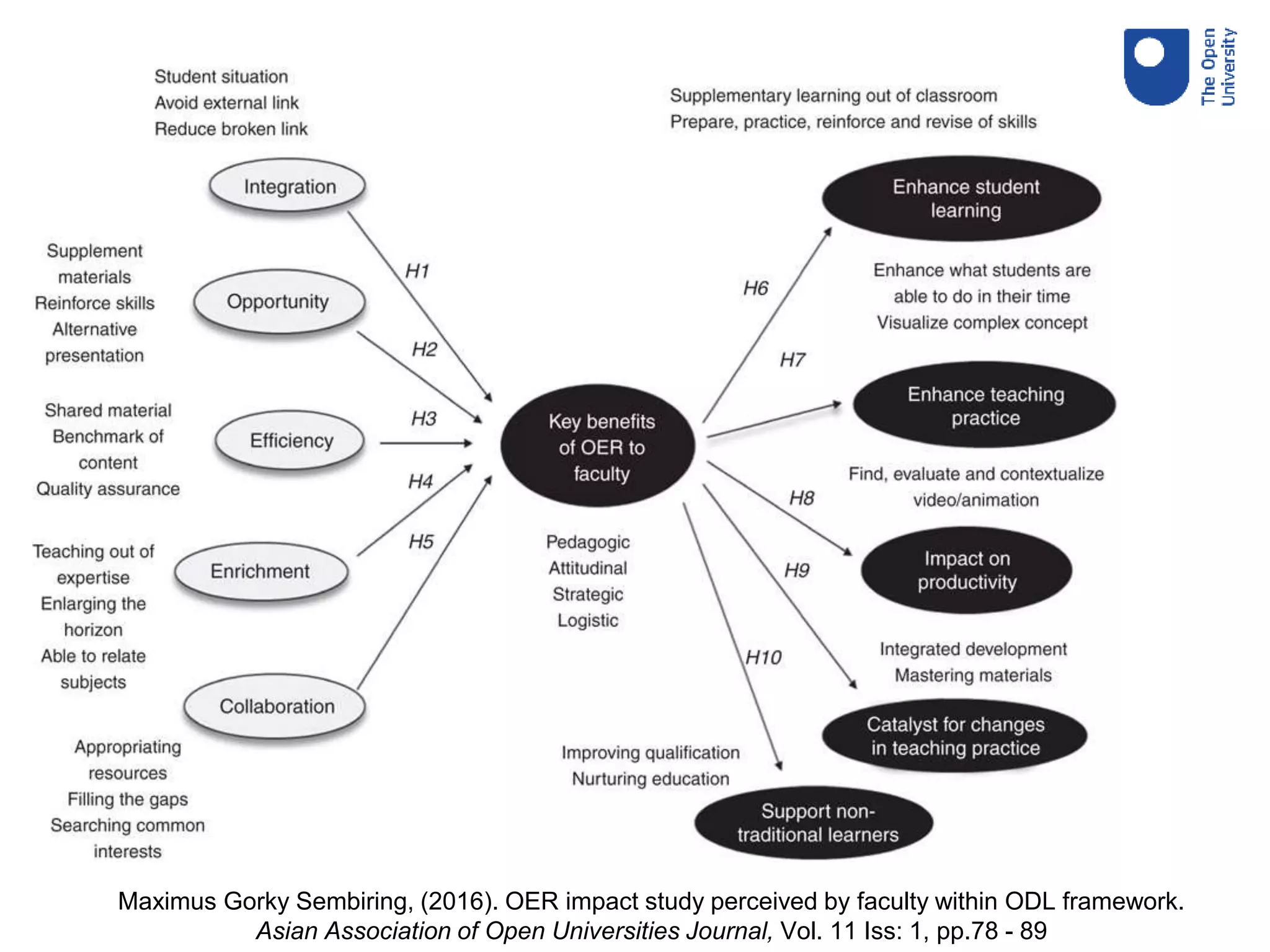
Maximus Gorky Sembiring, (2016). OER impact study perceived by faculty within ODL framework.
Asian Association of Open Universities Journal, Vol. 11 Iss: 1, pp.78 - 89
How can we understand
innovation in open
education?
17
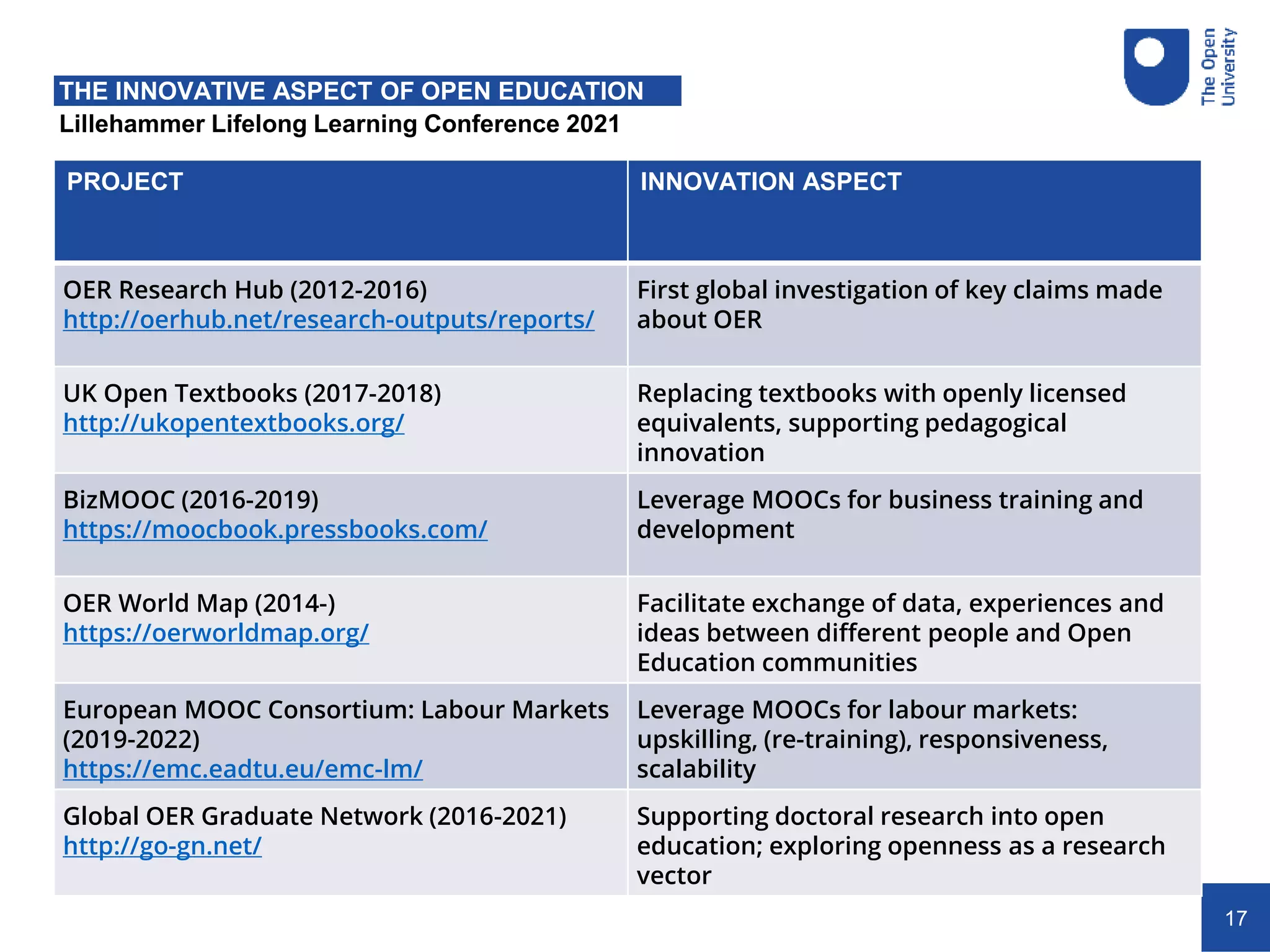
Lillehammer Lifelong Learning Conference 2021
THE INNOVATIVE ASPECT OF OPEN EDUCATION
PROJECT INNOVATION ASPECT
OER Research Hub (2012-2016)
http://oerhub.net/research-outputs/reports/
First global investigation of key claims made
about OER
UK Open Textbooks (2017-2018)
http://ukopentextbooks.org/
Replacing textbooks with openly licensed
equivalents, supporting pedagogical
innovation
BizMOOC (2016-2019)
https://moocbook.pressbooks.com/
Leverage MOOCs for business training and
development
OER World Map (2014-)
https://oerworldmap.org/
Facilitate exchange of data, experiences and
ideas between different people and Open
Education communities
European MOOC Consortium: Labour Markets
(2019-2022)
https://emc.eadtu.eu/emc-lm/
Leverage MOOCs for labour markets:
upskilling, (re-training), responsiveness,
scalability
Global OER Graduate Network (2016-2021)
http://go-gn.net/
Supporting doctoral research into open
education; exploring openness as a research
vector
https://oerworldmap.org/
19
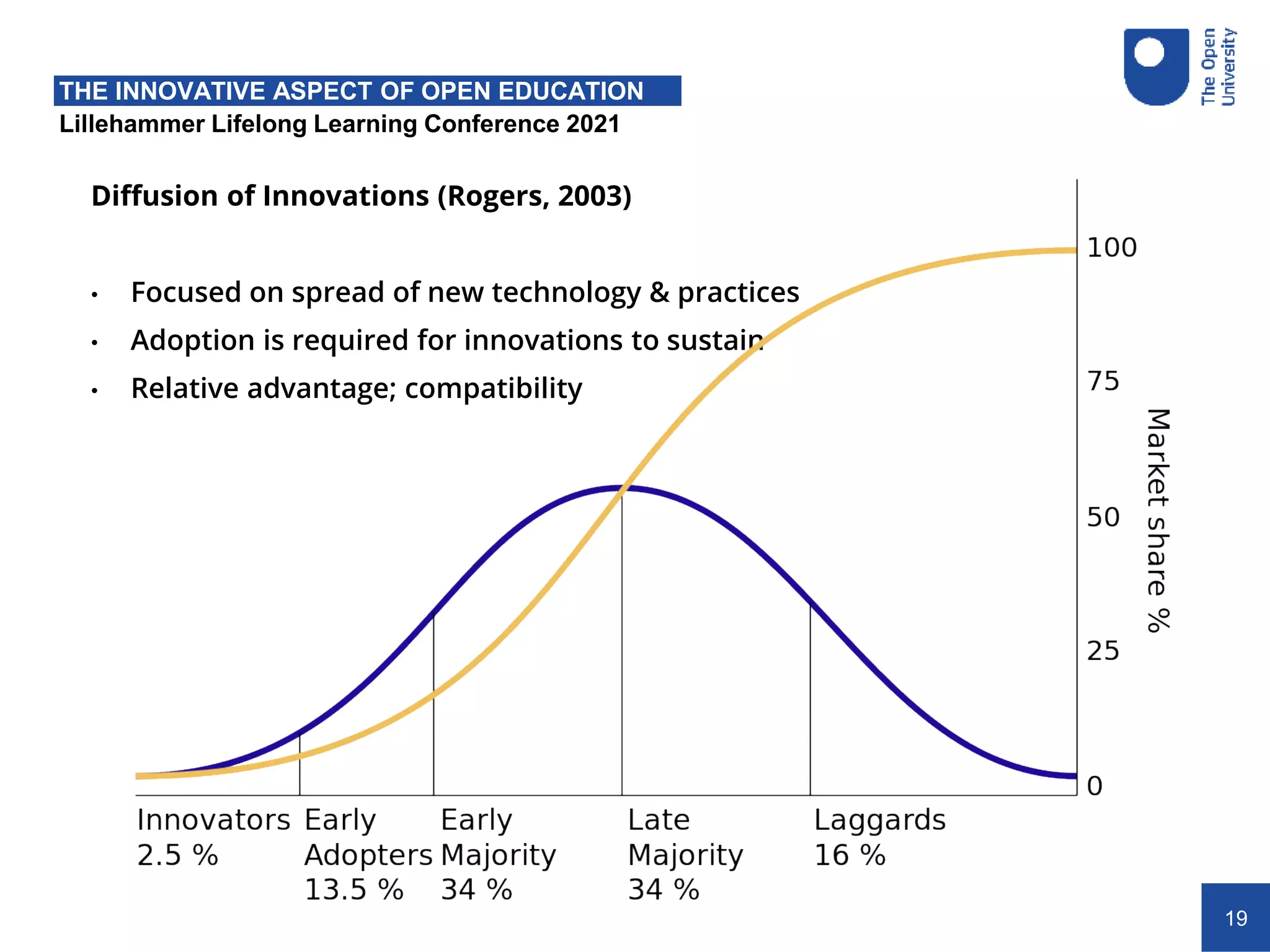
Diffusion of Innovations (Rogers, 2003)
• Focused on spread of new technology & practices
• Adoption is required for innovations to sustain
• Relative advantage; compatibility
Lillehammer Lifelong Learning Conference 2021
THE INNOVATIVE ASPECT OF OPEN EDUCATION
20
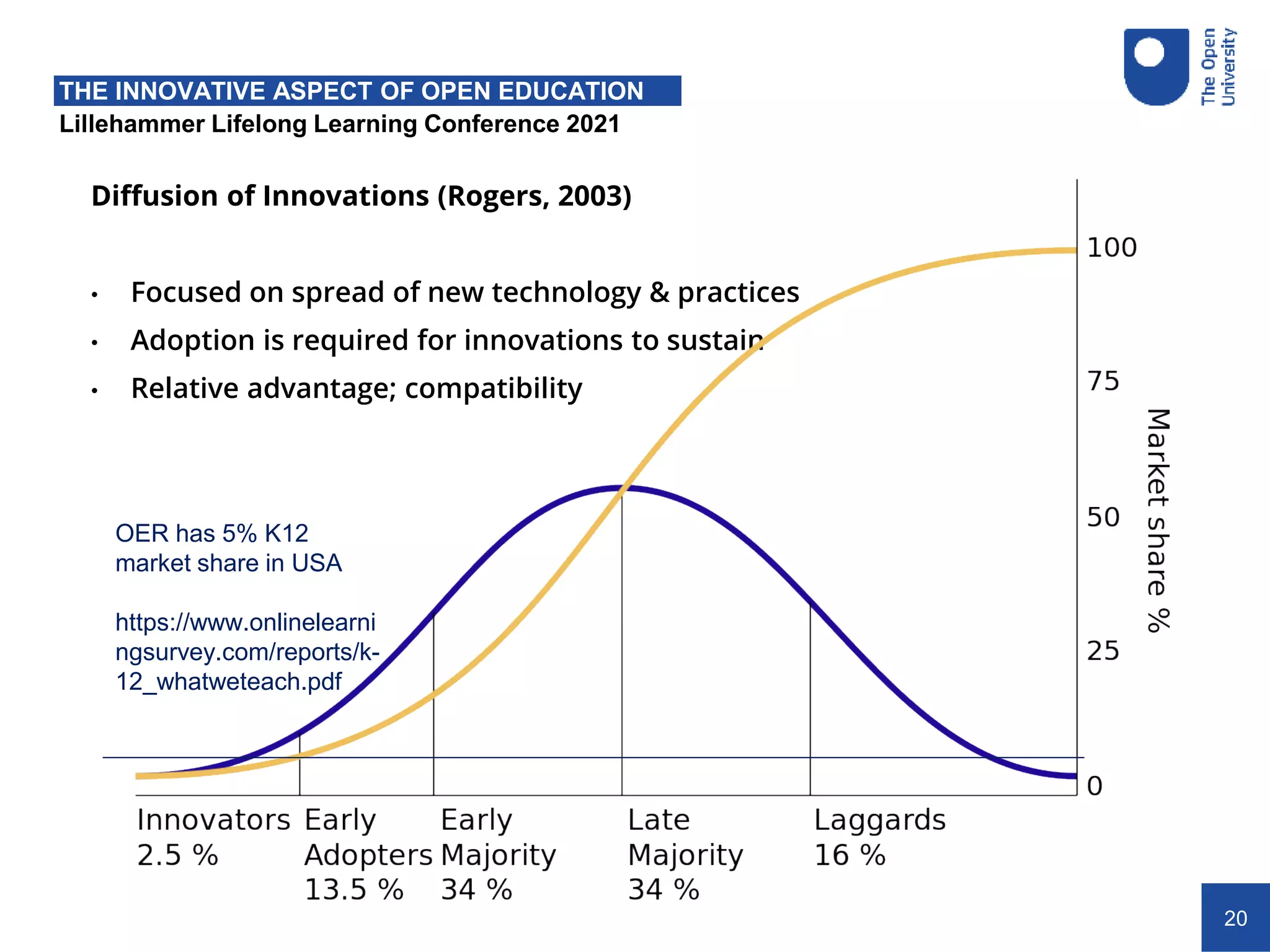
Diffusion of Innovations (Rogers, 2003)
• Focused on spread of new technology & practices
• Adoption is required for innovations to sustain
• Relative advantage; compatibility
Lillehammer Lifelong Learning Conference 2021
THE INNOVATIVE ASPECT OF OPEN EDUCATION
OER has 5% K12
market share in USA
https://www.onlinelearni
ngsurvey.com/reports/k-
12_whatweteach.pdf
22
Lillehammer Lifelong Learning Conference 2021
THE INNOVATIVE ASPECT OF OPEN EDUCATION
SUBSTITUTION AUGMENTATION MODIFICATION REDEFINITION
Open Textbooks Use Open
Textbooks in
place of
proprietary
versions
(More than $1
billion saved in the
USA)
https://sparcopen.
org/news/2018/1-
billion-in-savings-
through-open-
educational-
resources/
Freely shared and
accessible online
Enhances access,
reduced
dependency on
grants and loans
Producing
revised/remixed
versions of
lessons, textbooks
and
supplementary
resources
Collaboration
across institutions
Rethinking the
textbook as the
standard
organisation of
curricula
23
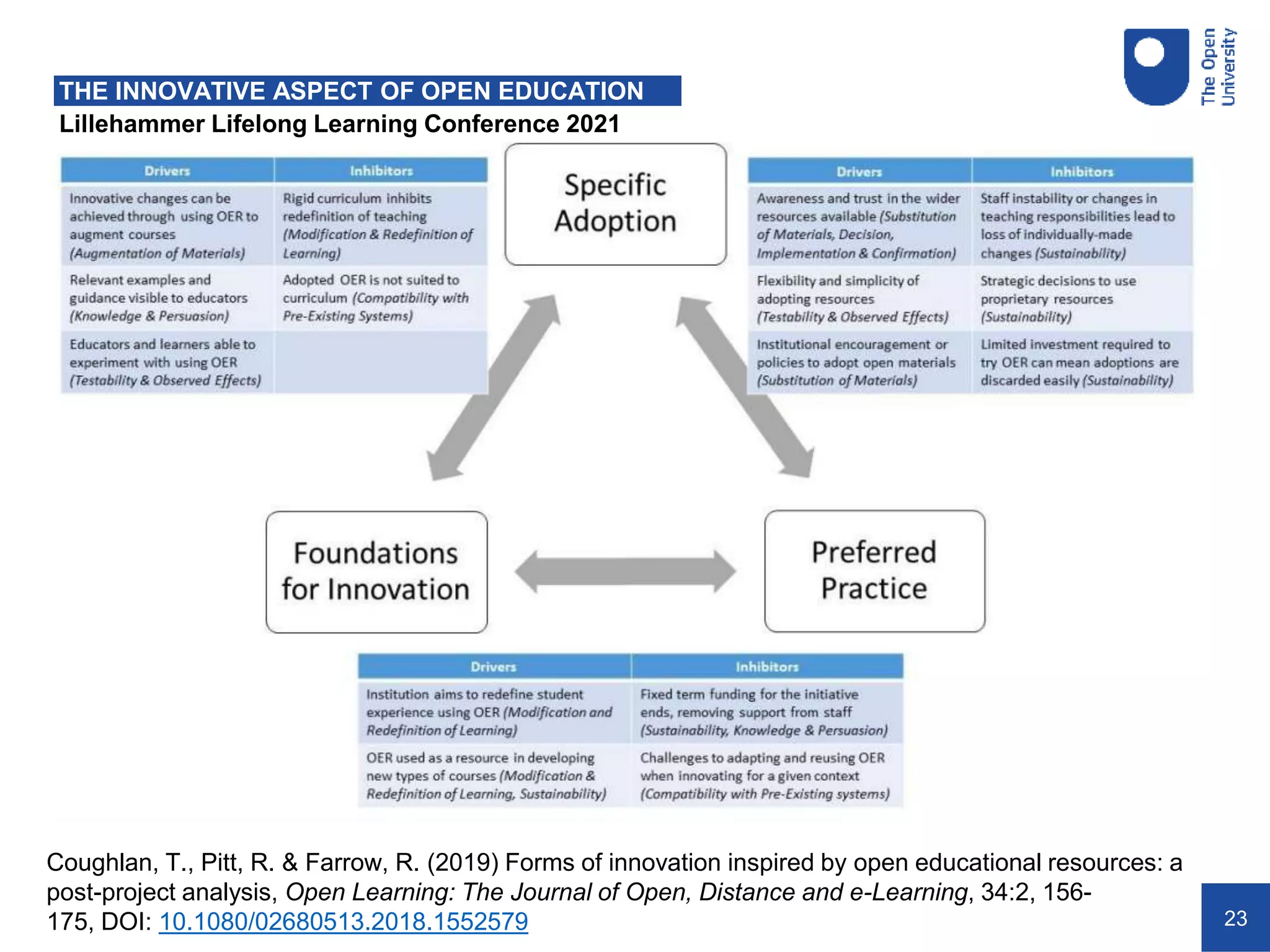
Coughlan, T., Pitt, R. & Farrow, R. (2019) Forms of innovation inspired by open educational resources: a
post-project analysis, Open Learning: The Journal of Open, Distance and e-Learning, 34:2, 156-
175, DOI: 10.1080/02680513.2018.1552579
Lillehammer Lifelong Learning Conference 2021
THE INNOVATIVE ASPECT OF OPEN EDUCATION
24
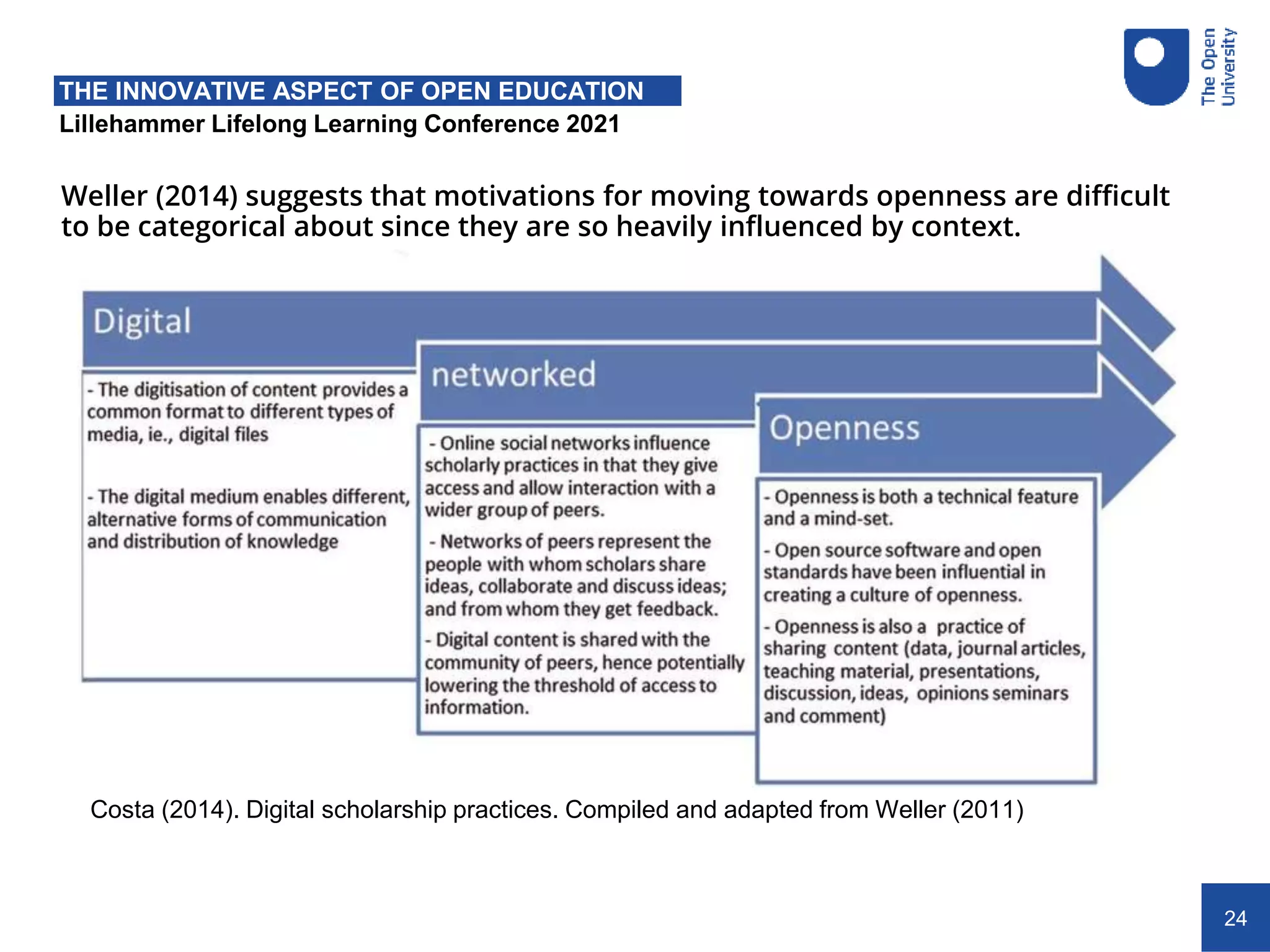
Weller (2014) suggests that motivations for moving towards openness are difficult
to be categorical about since they are so heavily influenced by context.
Lillehammer Lifelong Learning Conference 2021
THE INNOVATIVE ASPECT OF OPEN EDUCATION
Costa (2014). Digital scholarship practices. Compiled and adapted from Weller (2011)
How do we support innovation
with and through OER?
Raise awareness of open alternatives
Empower individuals in ways that enable them to
exercise their autonomy
Encourage experimentation in pedagogy and
practice
Develop constructive, critical learning cultures
Think and act at the level of the ecosystem
Leverage the power of networks
https://www.tandfonline.com/doi/abs/10.1080/17439884.2016.1113991
Deimann, M., & Farrow, R. (2013). Rethinking OER and their use: Open education as
Bildung. The International Review of Research in Open and Distributed Learning, 14(3), 344-360.
https://doi.org/10.19173/irrodl.v14i3.1370
How do we support innovation
with and through OER?
Raise awareness of open alternatives
Empower individuals in ways that enable them to
exercise their autonomy
Encourage experimentation in pedagogy and
practice
Develop constructive, critical learning cultures
Think and act at the level of the ecosystem
Leverage the power of networks
THANK YOU
rob.farrow@open.ac.uk
@philosopher1978
https://iet.open.ac.uk/
oerhub.net

The Innovative Aspect of Open Education

  • 1.
    The Innovative Aspect ofOpen Education Dr. Robert Farrow Open Education Research Hub Institute of Educational Technology The Open University, UK rob.farrow@open.ac.uk @philosopher1978
  • 2.
    2 SUMMARY WP7: QUALITY • Whatis WP7? Aims, activities and deliverables • D7.1 Quality Management System • Proposed Next Steps
  • 3.
    Open Educational Resources (OER)are an innovation, but what they respond to (copyright) was also an innovation.
  • 4.
    Copyright was introduced toregulate IP in the age of mechanical reproduction: Incentivising creative production Preserving the integrity of creative works Establishing rules for the economic exploitation of works
  • 5.
  • 6.
  • 7.
  • 8.
  • 9.
    People innovate to overcomechallenges… giving rise to new challenges
  • 10.
    Sustainability 2020, 12,7053; doi:10.3390/su12177053
  • 11.
    [O]ne impediment istraditional thinking that educational innovation exists within formal educational institutions (e.g., schools, institutes, universities) and not in other formal or informal environments. Moving beyond this thinking presents a niche of opportunity to generate lines of research and publications related to the processes of formal and informal learning within networks, considering multiple relationships with educational institutions and other sectors. Another challenge of great incidence is “openness,” the capacity to bring together diverse sectors (educational, social, enterprise, cultural) for collaboration and dissemination. In this landscape, the field of open education is fertile, both for training in educational innovation and for promoting innovations within the framework of the open educational movement with practices of production, use, dissemination, and mobilization. Here, the open education movement is visualized as a dynamic phenomenon, in constant evolution, that starts from the simplest idea of taking advantage of resources to share a common good, namely, knowledge. However, open education can also mean something more complex: developing educational practices that contribute to the necessary improvements in education, management, and research required by external changes. Sustainability 2020, 12, 7053; doi:10.3390/su12177053
  • 12.
  • 13.
  • 14.
    Keyword Hypothesis Performance OERimprove student performance/satisfaction Openness People use OER differently from other online materials Access OER widen participation in education Retention OER can help at-risk learners to finish their studies Reflection OER use leads educators to reflect on their practice Finance OER adoption brings financial benefits for students/institutions Indicators Informal learners use a variety of indicators when selecting OER Support Informal learners develop their own forms of study support Transition OER support informal learners in moving to formal study Policy OER use encourages institutions to change their policies Assessment Informal assessments motivate learners using OER http://oerhub.net/reports/
  • 15.
    Maximus Gorky Sembiring,(2016). OER impact study perceived by faculty within ODL framework. Asian Association of Open Universities Journal, Vol. 11 Iss: 1, pp.78 - 89
  • 16.
    How can weunderstand innovation in open education?
  • 17.
    17 Lillehammer Lifelong LearningConference 2021 THE INNOVATIVE ASPECT OF OPEN EDUCATION PROJECT INNOVATION ASPECT OER Research Hub (2012-2016) http://oerhub.net/research-outputs/reports/ First global investigation of key claims made about OER UK Open Textbooks (2017-2018) http://ukopentextbooks.org/ Replacing textbooks with openly licensed equivalents, supporting pedagogical innovation BizMOOC (2016-2019) https://moocbook.pressbooks.com/ Leverage MOOCs for business training and development OER World Map (2014-) https://oerworldmap.org/ Facilitate exchange of data, experiences and ideas between different people and Open Education communities European MOOC Consortium: Labour Markets (2019-2022) https://emc.eadtu.eu/emc-lm/ Leverage MOOCs for labour markets: upskilling, (re-training), responsiveness, scalability Global OER Graduate Network (2016-2021) http://go-gn.net/ Supporting doctoral research into open education; exploring openness as a research vector
  • 18.
  • 19.
    19 Diffusion of Innovations(Rogers, 2003) • Focused on spread of new technology & practices • Adoption is required for innovations to sustain • Relative advantage; compatibility Lillehammer Lifelong Learning Conference 2021 THE INNOVATIVE ASPECT OF OPEN EDUCATION
  • 20.
    20 Diffusion of Innovations(Rogers, 2003) • Focused on spread of new technology & practices • Adoption is required for innovations to sustain • Relative advantage; compatibility Lillehammer Lifelong Learning Conference 2021 THE INNOVATIVE ASPECT OF OPEN EDUCATION OER has 5% K12 market share in USA https://www.onlinelearni ngsurvey.com/reports/k- 12_whatweteach.pdf
  • 22.
    22 Lillehammer Lifelong LearningConference 2021 THE INNOVATIVE ASPECT OF OPEN EDUCATION SUBSTITUTION AUGMENTATION MODIFICATION REDEFINITION Open Textbooks Use Open Textbooks in place of proprietary versions (More than $1 billion saved in the USA) https://sparcopen. org/news/2018/1- billion-in-savings- through-open- educational- resources/ Freely shared and accessible online Enhances access, reduced dependency on grants and loans Producing revised/remixed versions of lessons, textbooks and supplementary resources Collaboration across institutions Rethinking the textbook as the standard organisation of curricula
  • 23.
    23 Coughlan, T., Pitt,R. & Farrow, R. (2019) Forms of innovation inspired by open educational resources: a post-project analysis, Open Learning: The Journal of Open, Distance and e-Learning, 34:2, 156- 175, DOI: 10.1080/02680513.2018.1552579 Lillehammer Lifelong Learning Conference 2021 THE INNOVATIVE ASPECT OF OPEN EDUCATION
  • 24.
    24 Weller (2014) suggeststhat motivations for moving towards openness are difficult to be categorical about since they are so heavily influenced by context. Lillehammer Lifelong Learning Conference 2021 THE INNOVATIVE ASPECT OF OPEN EDUCATION Costa (2014). Digital scholarship practices. Compiled and adapted from Weller (2011)
  • 25.
    How do wesupport innovation with and through OER? Raise awareness of open alternatives Empower individuals in ways that enable them to exercise their autonomy Encourage experimentation in pedagogy and practice Develop constructive, critical learning cultures Think and act at the level of the ecosystem Leverage the power of networks
  • 26.
  • 27.
    Deimann, M., &Farrow, R. (2013). Rethinking OER and their use: Open education as Bildung. The International Review of Research in Open and Distributed Learning, 14(3), 344-360. https://doi.org/10.19173/irrodl.v14i3.1370
  • 28.
    How do wesupport innovation with and through OER? Raise awareness of open alternatives Empower individuals in ways that enable them to exercise their autonomy Encourage experimentation in pedagogy and practice Develop constructive, critical learning cultures Think and act at the level of the ecosystem Leverage the power of networks
  • 29.