© 2011 Karthik Ethirajan, all rights reserved
Open Identity Solutions for the
Open Government Initiative
Karthik Ethirajan
November 2011
© 2011 Karthik Ethirajan, all rights reserved
2
Agenda
1. Executive Overview
2. ICAM Trust Framework
3. The Open Government Initiative
4. Government Approved Technology Schemes
5. ICAM Certification Process
6. Recommended Approach for IdM Provider
7. NIH Use Case
© 2011 Karthik Ethirajan, all rights reserved
3
Executive Overview
Government is buying into the vision of IDM
 ICAM Trust Framework was drafted by public-private partnership to help government adopt
commercially available IDM solutions
 ICAM defines the stakeholders and establishes processes for evaluating new technologies. It also
ties together NIST guidelines for e-Authentication and privacy principles from industry Trust Models
The Open Government initiative issues a new mandate
 Federal CIO office stipulates a 3-year period to implement federated identity for federal agency
websites requiring the lowest Assurance Level (LOA 1)
 The initial set of technologies, identity providers and certifications houses have been approved
Government includes industry standard technology options
 ICAM approved technology options are OpenID, SAML and IMI
 A federal profile has been created for each technology to serve the particular requirements of ICAM
The foundations for Open Identity will oversee certification
 Many founding members of Open Identity industry standards are the drivers behind ICAM
ICAM provides IdM provider a clear channel to break into Government space
 Furthers IdM provider’s goal to be a major player in federated identity
 IdM provider and ICAM policies are well aligned
 Does not require major technology upgrades to become ICAM certified
© 2011 Karthik Ethirajan, all rights reserved
4
Agenda
1. Executive Overview
2. ICAM Trust Framework
a) ICAM LOA 1 Trust Framework
b) NIST Levels of Assurance
c) Privacy Principles
d) Government Benefits
3. The Open Government Initiative
4. Government Approved Technology Schemes
5. ICAM Certification Process
6. Recommended Approach for IdM Provider
7. NIH Use Case
© 2011 Karthik Ethirajan, all rights reserved
5
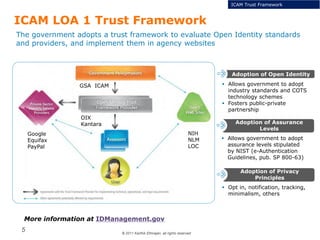
Adoption of Privacy
Principles
 Opt in, notification, tracking,
minimalism, others
Adoption of Assurance
Levels
 Allows government to adopt
assurance levels stipulated
by NIST (e-Authentication
Guidelines, pub. SP 800-63)
Adoption of Open Identity
ICAM LOA 1 Trust Framework
ICAM Trust Framework
The government adopts a trust framework to evaluate Open Identity standards
and providers, and implement them in agency websites
GSA ICAM
OIX
Kantara
Google
Equifax
PayPal
NIH
NLM
LOC
 Allows government to adopt
industry standards and COTS
technology schemes
 Fosters public-private
partnership
More information at IDManagement.gov
© 2011 Karthik Ethirajan, all rights reserved
6
NIST Levels of Assurance
ICAM Trust Framework
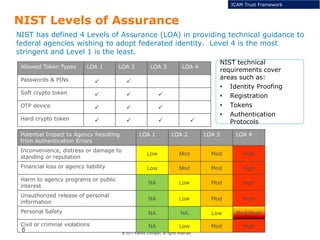
NIST has defined 4 Levels of Assurance (LOA) in providing technical guidance to
federal agencies wishing to adopt federated identity. Level 4 is the most
stringent and Level 1 is the least.
Allowed Token Types LOA 1 LOA 2 LOA 3 LOA 4
Passwords & PINs  
Soft crypto token   
OTP device   
Hard crypto token    
Potential Impact to Agency Resulting
from Authentication Errors
LOA 1 LOA 2 LOA 3 LOA 4
Inconvenience, distress or damage to
standing or reputation
Low Mod Mod High
Financial loss or agency liability Low Mod Mod High
Harm to agency programs or public
interest
NA Low Mod High
Unauthorized release of personal
information
NA Low Mod High
Personal Safety NA NA Low Mod/High
Civil or criminal violations NA Low Mod High
NIST technical
requirements cover
areas such as:
• Identity Proofing
• Registration
• Tokens
• Authentication
Protocols
© 2011 Karthik Ethirajan, all rights reserved
7
Privacy Principles
ICAM Trust Framework
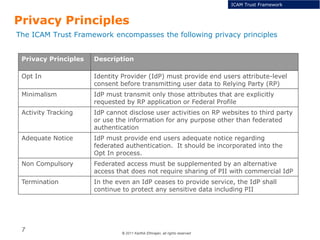
The ICAM Trust Framework encompasses the following privacy principles
Privacy Principles Description
Opt In Identity Provider (IdP) must provide end users attribute-level
consent before transmitting user data to Relying Party (RP)
Minimalism IdP must transmit only those attributes that are explicitly
requested by RP application or Federal Profile
Activity Tracking IdP cannot disclose user activities on RP websites to third party
or use the information for any purpose other than federated
authentication
Adequate Notice IdP must provide end users adequate notice regarding
federated authentication. It should be incorporated into the
Opt In process.
Non Compulsory Federated access must be supplemented by an alternative
access that does not require sharing of PII with commercial IdP
Termination In the even an IdP ceases to provide service, the IdP shall
continue to protect any sensitive data including PII
© 2011 Karthik Ethirajan, all rights reserved
8
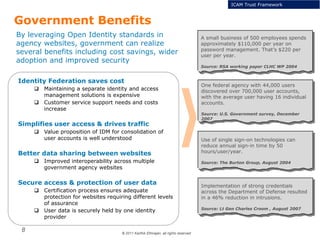
Government Benefits
Identity Federation saves cost
 Maintaining a separate identity and access
management solutions is expensive
 Customer service support needs and costs
increase
Simplifies user access & drives traffic
 Value proposition of IDM for consolidation of
user accounts is well understood
Better data sharing between websites
 Improved interoperability across multiple
government agency websites
Secure access & protection of user data
 Certification process ensures adequate
protection for websites requiring different levels
of assurance
 User data is securely held by one identity
provider
A small business of 500 employees spends
approximately $110,000 per year on
password management. That’s $220 per
user per year.
Source: RSA working paper CLHC WP 2004
One federal agency with 44,000 users
discovered over 700,000 user accounts,
with the average user having 16 individual
accounts.
Source: U.S. Government survey, December
2007
Use of single sign-on technologies can
reduce annual sign-in time by 50
hours/user/year.
Source: The Burton Group, August 2004
Implementation of strong credentials
across the Department of Defense resulted
in a 46% reduction in intrusions.
Source: Lt Gen Charles Croom , August 2007
ICAM Trust Framework
By leveraging Open Identity standards in
agency websites, government can realize
several benefits including cost savings, wider
adoption and improved security
© 2011 Karthik Ethirajan, all rights reserved
9
Agenda
1. Executive Overview
2. ICAM Trust Framework
3. The Open Government Initiative
a) The New Government Mandate
b) Government Agencies Included in the Mandate
c) ICAM Approved Identity Ecosystem
d) Approval Details for Providers & Technologies
e) Timeline for Site Upgrade
4. Government Approved Technology Schemes
5. ICAM Certification Process
6. Recommended Approach for IdM Provider
7. NIH Use Case
© 2011 Karthik Ethirajan, all rights reserved
10
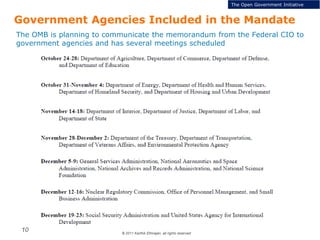
Government Agencies Included in the Mandate
The OMB is planning to communicate the memorandum from the Federal CIO to
government agencies and has several meetings scheduled
The Open Government Initiative
© 2011 Karthik Ethirajan, all rights reserved
11
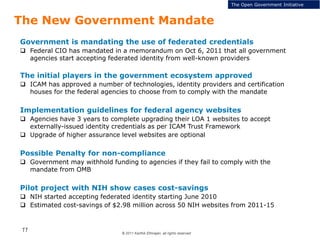
The New Government Mandate
The Open Government Initiative
Government is mandating the use of federated credentials
 Federal CIO has mandated in a memorandum on Oct 6, 2011 that all government
agencies start accepting federated identity from well-known providers
The initial players in the government ecosystem approved
 ICAM has approved a number of technologies, identity providers and certification
houses for the federal agencies to choose from to comply with the mandate
Implementation guidelines for federal agency websites
 Agencies have 3 years to complete upgrading their LOA 1 websites to accept
externally-issued identity credentials as per ICAM Trust Framework
 Upgrade of higher assurance level websites are optional
Possible Penalty for non-compliance
 Government may withhold funding to agencies if they fail to comply with the
mandate from OMB
Pilot project with NIH show cases cost-savings
 NIH started accepting federated identity starting June 2010
 Estimated cost-savings of $2.98 million across 50 NIH websites from 2011-15
© 2011 Karthik Ethirajan, all rights reserved
12
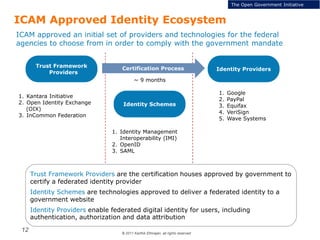
ICAM Approved Identity Ecosystem
Trust Framework
Providers
Identity Providers
Identity Schemes
Certification Process
~ 9 months
1. Kantara Initiative
2. Open Identity Exchange
(OIX)
3. InCommon Federation
1. Identity Management
Interoperability (IMI)
2. OpenID
3. SAML
1. Google
2. PayPal
3. Equifax
4. VeriSign
5. Wave Systems
Trust Framework Providers are the certification houses approved by government to
certify a federated identity provider
Identity Schemes are technologies approved to deliver a federated identity to a
government website
Identity Providers enable federated digital identity for users, including
authentication, authorization and data attribution
The Open Government Initiative
ICAM approved an initial set of providers and technologies for the federal
agencies to choose from in order to comply with the government mandate
© 2011 Karthik Ethirajan, all rights reserved
13
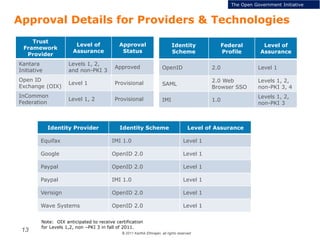
Approval Details for Providers & Technologies
Trust
Framework
Provider
Level of
Assurance
Approval
Status
Kantara
Initiative
Levels 1, 2,
and non-PKI 3
Approved
Open ID
Exchange (OIX)
Level 1 Provisional
InCommon
Federation
Level 1, 2 Provisional
Identity Provider Identity Scheme Level of Assurance
Equifax IMI 1.0 Level 1
Google OpenID 2.0 Level 1
Paypal OpenID 2.0 Level 1
Paypal IMI 1.0 Level 1
Verisign OpenID 2.0 Level 1
Wave Systems OpenID 2.0 Level 1
Note: OIX anticipated to receive certification
for Levels 1,2, non –PKI 3 in fall of 2011.
The Open Government Initiative
Identity
Scheme
Federal
Profile
Level of
Assurance
OpenID 2.0 Level 1
SAML
2.0 Web
Browser SSO
Levels 1, 2,
non-PKI 3, 4
IMI 1.0
Levels 1, 2,
non-PKI 3
© 2011 Karthik Ethirajan, all rights reserved
14
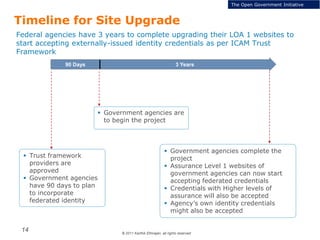
Timeline for Site Upgrade
90 Days 3 Years
 Trust framework
providers are
approved
 Government agencies
have 90 days to plan
to incorporate
federated identity
 Government agencies are
to begin the project
 Government agencies complete the
project
 Assurance Level 1 websites of
government agencies can now start
accepting federated credentials
 Credentials with Higher levels of
assurance will also be accepted
 Agency’s own identity credentials
might also be accepted
Federal agencies have 3 years to complete upgrading their LOA 1 websites to
start accepting externally-issued identity credentials as per ICAM Trust
Framework
The Open Government Initiative
© 2011 Karthik Ethirajan, all rights reserved
15
Agenda
1. Executive Overview
2. ICAM Trust Framework
3. The Open Government Initiative
4. Government Approved Technology Schemes
a) OpenID 2.0 Profile
b) IMI 1.0 Profile
c) SAML 2.0 Web Browser SSO Profile
5. Government Approved Certification Process
6. Recommended Approach for IdM Provider
7. NIH Use Case
© 2011 Karthik Ethirajan, all rights reserved
16
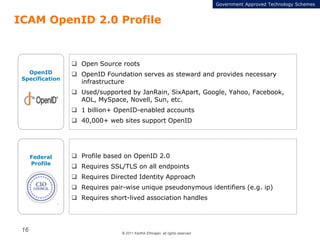
ICAM OpenID 2.0 Profile
 Profile based on OpenID 2.0
 Requires SSL/TLS on all endpoints
 Requires Directed Identity Approach
 Requires pair-wise unique pseudonymous identifiers (e.g. ip)
 Requires short-lived association handles
OpenID
Specification
 Open Source roots
 OpenID Foundation serves as steward and provides necessary
infrastructure
 Used/supported by JanRain, SixApart, Google, Yahoo, Facebook,
AOL, MySpace, Novell, Sun, etc.
 1 billion+ OpenID-enabled accounts
 40,000+ web sites support OpenID
Federal
Profile
Government Approved Technology Schemes
© 2011 Karthik Ethirajan, all rights reserved
17
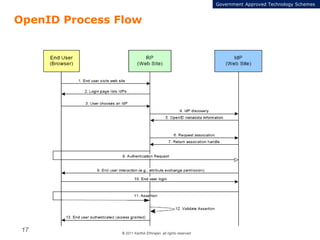
OpenID Process Flow
Government Approved Technology Schemes
© 2011 Karthik Ethirajan, all rights reserved
18
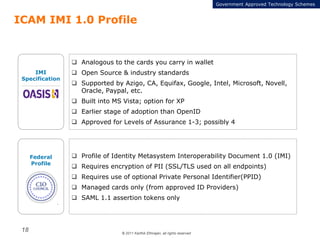
ICAM IMI 1.0 Profile
 Profile of Identity Metasystem Interoperability Document 1.0 (IMI)
 Requires encryption of PII (SSL/TLS used on all endpoints)
 Requires use of optional Private Personal Identifier(PPID)
 Managed cards only (from approved ID Providers)
 SAML 1.1 assertion tokens only
IMI
Specification
 Analogous to the cards you carry in wallet
 Open Source & industry standards
 Supported by Azigo, CA, Equifax, Google, Intel, Microsoft, Novell,
Oracle, Paypal, etc.
 Built into MS Vista; option for XP
 Earlier stage of adoption than OpenID
 Approved for Levels of Assurance 1-3; possibly 4
Federal
Profile
Government Approved Technology Schemes
© 2011 Karthik Ethirajan, all rights reserved
19
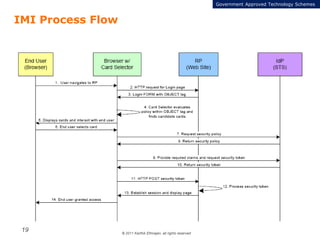
IMI Process Flow
Government Approved Technology Schemes
© 2011 Karthik Ethirajan, all rights reserved
20
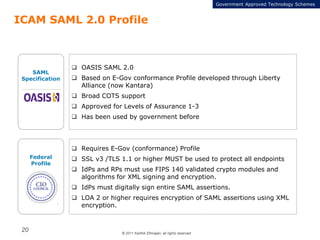
ICAM SAML 2.0 Profile
 Requires E-Gov (conformance) Profile
 SSL v3 /TLS 1.1 or higher MUST be used to protect all endpoints
 IdPs and RPs must use FIPS 140 validated crypto modules and
algorithms for XML signing and encryption.
 IdPs must digitally sign entire SAML assertions.
 LOA 2 or higher requires encryption of SAML assertions using XML
encryption.
SAML
Specification
 OASIS SAML 2.0
 Based on E-Gov conformance Profile developed through Liberty
Alliance (now Kantara)
 Broad COTS support
 Approved for Levels of Assurance 1-3
 Has been used by government before
Federal
Profile
Government Approved Technology Schemes
© 2011 Karthik Ethirajan, all rights reserved
21
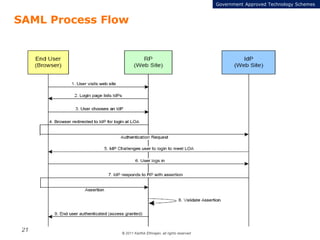
SAML Process Flow
Government Approved Technology Schemes
© 2011 Karthik Ethirajan, all rights reserved
22
Agenda
1. Executive Overview
2. ICAM Trust Framework
3. The Open Government Initiative
4. Government Approved Technology Schemes
5. ICAM Certification Process
a) IdP Certification Process
b) Kantara Service Assessment Criteria
c) OIX Assessment Package
d) Approved Certification Houses
6. Recommended Approach for IdM Provider
7. NIH Use Case
© 2011 Karthik Ethirajan, all rights reserved
23
IdP Certification Process
Membership in Trust
Framework Provider
Network
• Provides legally
binding obligation for
IdP to adhere to TFP
policies and TF
specifications.
• Also requires short
approvals process
including verification of
business information.
House Assessment
and Certification
Process
• Based on criteria
specified in Trust
Framework (TFPAP &
ICAM Profile).
• Provides assurance
that IdP conforms to
basic security and
interoperability
measures established
by IACM.
Publishing of
Metadata in
Certification House
& ICAM Registries
• Federal Websites are
updated regularly with
whitelist of ICAM
approved IdPs.
• Commercial partners
will look to TFP
approved IdP list for
guidance.
http://openidentityexchange.org/sites/default/files/oix-us-icam-loa1-tfp-assessment-package-November%2008%202011%20V2.pdf
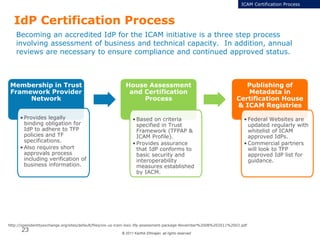
Becoming an accredited IdP for the ICAM initiative is a three step process
involving assessment of business and technical capacity. In addition, annual
reviews are necessary to ensure compliance and continued approved status.
ICAM Certification Process
© 2011 Karthik Ethirajan, all rights reserved
24
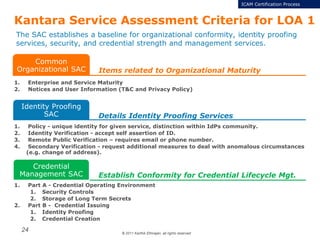
Kantara Service Assessment Criteria for LOA 1
Items related to Organizational Maturity
Common
Organizational SAC
1. Enterprise and Service Maturity
2. Notices and User Information (T&C and Privacy Policy)
Identity Proofing
SAC
1. Policy - unique identity for given service, distinction within IdPs community.
2. Identity Verification - accept self assertion of ID.
3. Remote Public Verification – requires email or phone number.
4. Secondary Verification - request additional measures to deal with anomalous circumstances
(e.g. change of address).
Credential
Management SAC
1. Part A - Credential Operating Environment
1. Security Controls
2. Storage of Long Term Secrets
2. Part B - Credential Issuing
1. Identity Proofing
2. Credential Creation
Details Identity Proofing Services
Establish Conformity for Credential Lifecycle Mgt.
The SAC establishes a baseline for organizational conformity, identity proofing
services, security, and credential strength and management services.
ICAM Certification Process
© 2011 Karthik Ethirajan, all rights reserved
25
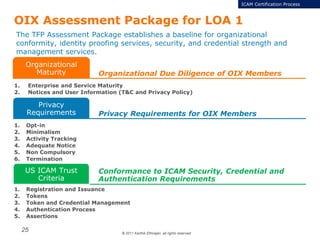
OIX Assessment Package for LOA 1
Organizational Due Diligence of OIX Members
Organizational
Maturity
1. Enterprise and Service Maturity
2. Notices and User Information (T&C and Privacy Policy)
Privacy
Requirements
1. Opt-in
2. Minimalism
3. Activity Tracking
4. Adequate Notice
5. Non Compulsory
6. Termination
US ICAM Trust
Criteria
1. Registration and Issuance
2. Tokens
3. Token and Credential Management
4. Authentication Process
5. Assertions
Privacy Requirements for OIX Members
Conformance to ICAM Security, Credential and
Authentication Requirements
The TFP Assessment Package establishes a baseline for organizational
conformity, identity proofing services, security, and credential strength and
management services.
ICAM Certification Process
© 2011 Karthik Ethirajan, all rights reserved
26
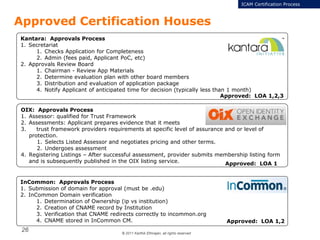
Approved Certification Houses
InCommon: Approvals Process
1. Submission of domain for approval (must be .edu)
2. InCommon Domain verification
1. Determination of Ownership (ip vs institution)
2. Creation of CNAME record by Institution
3. Verification that CNAME redirects correctly to incommon.org
4. CNAME stored in InCommon CM.
Kantara: Approvals Process
1. Secretariat
1. Checks Application for Completeness
2. Admin (fees paid, Applicant PoC, etc)
2. Approvals Review Board
1. Chairman - Review App Materials
2. Determine evaluation plan with other board members
3. Distribution and evaluation of application package
4. Notify Applicant of anticipated time for decision (typically less than 1 month)
OIX: Approvals Process
1. Assessor: qualified for Trust Framework
2. Assessments: Applicant prepares evidence that it meets
3. trust framework providers requirements at specific level of assurance and or level of
protection.
1. Selects Listed Assessor and negotiates pricing and other terms.
2. Undergoes assessment
4. Registering Listings – After successful assessment, provider submits membership listing form
and is subsequently published in the OIX listing service. Approved: LOA 1
Approved: LOA 1,2,3
Approved: LOA 1,2
ICAM Certification Process
© 2011 Karthik Ethirajan, all rights reserved
27
Agenda
1. Executive Overview
2. ICAM Trust Framework
3. The Open Government Initiative
4. Government Approved Technology Schemes
5. ICAM Certification Process
6. Recommended Approach for IdM Provider
a) IdM Benefits
b) IdM Differentiation as an Identity Provider
c) Steps to Becoming an Open Identity Provider for the Government
7. NIH Use Case
© 2011 Karthik Ethirajan, all rights reserved
28
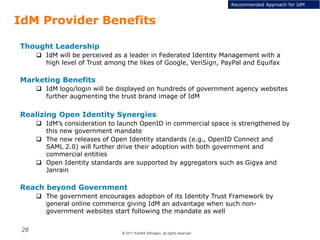
IdM Provider Benefits
Thought Leadership
 IdM will be perceived as a leader in Federated Identity Management with a
high level of Trust among the likes of Google, VeriSign, PayPal and Equifax
Marketing Benefits
 IdM logo/login will be displayed on hundreds of government agency websites
further augmenting the trust brand image of IdM
Realizing Open Identity Synergies
 IdM’s consideration to launch OpenID in commercial space is strengthened by
this new government mandate
 The new releases of Open Identity standards (e.g., OpenID Connect and
SAML 2.0) will further drive their adoption with both government and
commercial entities
 Open Identity standards are supported by aggregators such as Gigya and
Janrain
Reach beyond Government
 The government encourages adoption of its Identity Trust Framework by
general online commerce giving IdM an advantage when such non-
government websites start following the mandate as well
Recommended Approach for IdM
© 2011 Karthik Ethirajan, all rights reserved
29
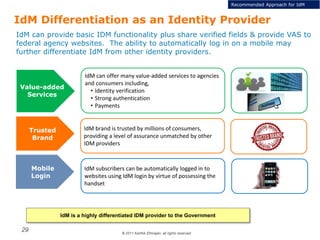
IdM Differentiation as an Identity Provider
IdM can provide basic IDM functionality plus share verified fields & provide VAS to
federal agency websites. The ability to automatically log in on a mobile may
further differentiate IdM from other identity providers.
Mobile
Login
IdM can offer many value-added services to agencies
and consumers including,
• Identity verification
• Strong authentication
• Payments
IdM brand is trusted by millions of consumers,
providing a level of assurance unmatched by other
IDM providers
IdM subscribers can be automatically logged in to
websites using IdM login by virtue of possessing the
handset
IdM is a highly differentiated IDM provider to the Government
Trusted
Brand
Value-added
Services
Recommended Approach for IdM
© 2011 Karthik Ethirajan, all rights reserved
30
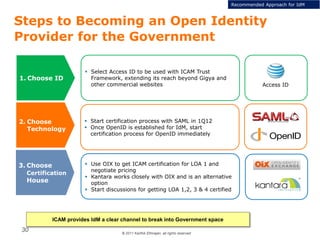
Steps to Becoming an Open Identity
Provider for the Government
1. Choose ID
2. Choose
Technology
3. Choose
Certification
House
 Select Access ID to be used with ICAM Trust
Framework, extending its reach beyond Gigya and
other commercial websites
 Start certification process with SAML in 1Q12
 Once OpenID is established for IdM, start
certification process for OpenID immediately
 Use OIX to get ICAM certification for LOA 1 and
negotiate pricing
 Kantara works closely with OIX and is an alternative
option
 Start discussions for getting LOA 1,2, 3 & 4 certified
ICAM provides IdM a clear channel to break into Government space
Access ID
Recommended Approach for IdM
© 2011 Karthik Ethirajan, all rights reserved
31
Agenda
1. Executive Overview
2. ICAM Trust Framework
3. The Open Government Initiative
4. Government Approved Technology Schemes
5. ICAM Certification Process
6. Recommended Approach for IdM
7. NIH Use Case
a) NCBI Login Screen
b) Identity Provider Login Screen
c) User Data Consent Screen
d) User Name Association Screen
e) User Landing Page
© 2011 Karthik Ethirajan, all rights reserved
32
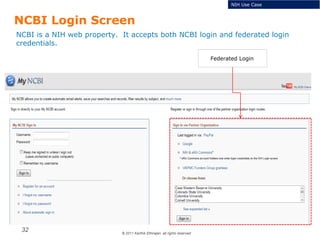
NCBI Login Screen
NCBI is a NIH web property. It accepts both NCBI login and federated login
credentials.
Federated Login
NIH Use Case
© 2011 Karthik Ethirajan, all rights reserved
33
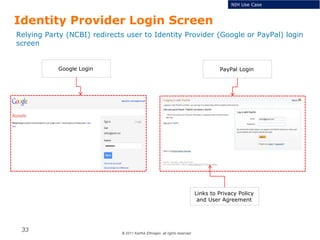
Identity Provider Login Screen
Relying Party (NCBI) redirects user to Identity Provider (Google or PayPal) login
screen
NIH Use Case
PayPal LoginGoogle Login
Links to Privacy Policy
and User Agreement
© 2011 Karthik Ethirajan, all rights reserved
34
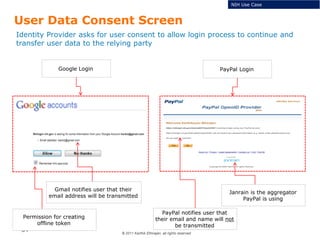
User Data Consent Screen
Identity Provider asks for user consent to allow login process to continue and
transfer user data to the relying party
NIH Use Case
PayPal LoginGoogle Login
PayPal notifies user that
their email and name will not
be transmitted
Gmail notifies user that their
email address will be transmitted
Janrain is the aggregator
PayPal is using
Permission for creating
offline token
© 2011 Karthik Ethirajan, all rights reserved
35
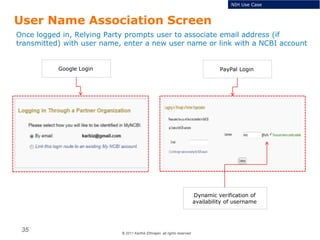
User Name Association Screen
Once logged in, Relying Party prompts user to associate email address (if
transmitted) with user name, enter a new user name or link with a NCBI account
NIH Use Case
PayPal LoginGoogle Login
Dynamic verification of
availability of username
© 2011 Karthik Ethirajan, all rights reserved
36
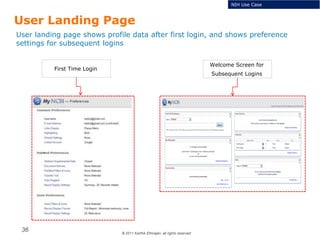
User Landing Page
User landing page shows profile data after first login, and shows preference
settings for subsequent logins
NIH Use Case
Welcome Screen for
Subsequent Logins
First Time Login

Open ID in Government

  • 1.
    © 2011 KarthikEthirajan, all rights reserved Open Identity Solutions for the Open Government Initiative Karthik Ethirajan November 2011
  • 2.
    © 2011 KarthikEthirajan, all rights reserved 2 Agenda 1. Executive Overview 2. ICAM Trust Framework 3. The Open Government Initiative 4. Government Approved Technology Schemes 5. ICAM Certification Process 6. Recommended Approach for IdM Provider 7. NIH Use Case
  • 3.
    © 2011 KarthikEthirajan, all rights reserved 3 Executive Overview Government is buying into the vision of IDM  ICAM Trust Framework was drafted by public-private partnership to help government adopt commercially available IDM solutions  ICAM defines the stakeholders and establishes processes for evaluating new technologies. It also ties together NIST guidelines for e-Authentication and privacy principles from industry Trust Models The Open Government initiative issues a new mandate  Federal CIO office stipulates a 3-year period to implement federated identity for federal agency websites requiring the lowest Assurance Level (LOA 1)  The initial set of technologies, identity providers and certifications houses have been approved Government includes industry standard technology options  ICAM approved technology options are OpenID, SAML and IMI  A federal profile has been created for each technology to serve the particular requirements of ICAM The foundations for Open Identity will oversee certification  Many founding members of Open Identity industry standards are the drivers behind ICAM ICAM provides IdM provider a clear channel to break into Government space  Furthers IdM provider’s goal to be a major player in federated identity  IdM provider and ICAM policies are well aligned  Does not require major technology upgrades to become ICAM certified
  • 4.
    © 2011 KarthikEthirajan, all rights reserved 4 Agenda 1. Executive Overview 2. ICAM Trust Framework a) ICAM LOA 1 Trust Framework b) NIST Levels of Assurance c) Privacy Principles d) Government Benefits 3. The Open Government Initiative 4. Government Approved Technology Schemes 5. ICAM Certification Process 6. Recommended Approach for IdM Provider 7. NIH Use Case
  • 5.
    © 2011 KarthikEthirajan, all rights reserved 5 Adoption of Privacy Principles  Opt in, notification, tracking, minimalism, others Adoption of Assurance Levels  Allows government to adopt assurance levels stipulated by NIST (e-Authentication Guidelines, pub. SP 800-63) Adoption of Open Identity ICAM LOA 1 Trust Framework ICAM Trust Framework The government adopts a trust framework to evaluate Open Identity standards and providers, and implement them in agency websites GSA ICAM OIX Kantara Google Equifax PayPal NIH NLM LOC  Allows government to adopt industry standards and COTS technology schemes  Fosters public-private partnership More information at IDManagement.gov
  • 6.
    © 2011 KarthikEthirajan, all rights reserved 6 NIST Levels of Assurance ICAM Trust Framework NIST has defined 4 Levels of Assurance (LOA) in providing technical guidance to federal agencies wishing to adopt federated identity. Level 4 is the most stringent and Level 1 is the least. Allowed Token Types LOA 1 LOA 2 LOA 3 LOA 4 Passwords & PINs   Soft crypto token    OTP device    Hard crypto token     Potential Impact to Agency Resulting from Authentication Errors LOA 1 LOA 2 LOA 3 LOA 4 Inconvenience, distress or damage to standing or reputation Low Mod Mod High Financial loss or agency liability Low Mod Mod High Harm to agency programs or public interest NA Low Mod High Unauthorized release of personal information NA Low Mod High Personal Safety NA NA Low Mod/High Civil or criminal violations NA Low Mod High NIST technical requirements cover areas such as: • Identity Proofing • Registration • Tokens • Authentication Protocols
  • 7.
    © 2011 KarthikEthirajan, all rights reserved 7 Privacy Principles ICAM Trust Framework The ICAM Trust Framework encompasses the following privacy principles Privacy Principles Description Opt In Identity Provider (IdP) must provide end users attribute-level consent before transmitting user data to Relying Party (RP) Minimalism IdP must transmit only those attributes that are explicitly requested by RP application or Federal Profile Activity Tracking IdP cannot disclose user activities on RP websites to third party or use the information for any purpose other than federated authentication Adequate Notice IdP must provide end users adequate notice regarding federated authentication. It should be incorporated into the Opt In process. Non Compulsory Federated access must be supplemented by an alternative access that does not require sharing of PII with commercial IdP Termination In the even an IdP ceases to provide service, the IdP shall continue to protect any sensitive data including PII
  • 8.
    © 2011 KarthikEthirajan, all rights reserved 8 Government Benefits Identity Federation saves cost  Maintaining a separate identity and access management solutions is expensive  Customer service support needs and costs increase Simplifies user access & drives traffic  Value proposition of IDM for consolidation of user accounts is well understood Better data sharing between websites  Improved interoperability across multiple government agency websites Secure access & protection of user data  Certification process ensures adequate protection for websites requiring different levels of assurance  User data is securely held by one identity provider A small business of 500 employees spends approximately $110,000 per year on password management. That’s $220 per user per year. Source: RSA working paper CLHC WP 2004 One federal agency with 44,000 users discovered over 700,000 user accounts, with the average user having 16 individual accounts. Source: U.S. Government survey, December 2007 Use of single sign-on technologies can reduce annual sign-in time by 50 hours/user/year. Source: The Burton Group, August 2004 Implementation of strong credentials across the Department of Defense resulted in a 46% reduction in intrusions. Source: Lt Gen Charles Croom , August 2007 ICAM Trust Framework By leveraging Open Identity standards in agency websites, government can realize several benefits including cost savings, wider adoption and improved security
  • 9.
    © 2011 KarthikEthirajan, all rights reserved 9 Agenda 1. Executive Overview 2. ICAM Trust Framework 3. The Open Government Initiative a) The New Government Mandate b) Government Agencies Included in the Mandate c) ICAM Approved Identity Ecosystem d) Approval Details for Providers & Technologies e) Timeline for Site Upgrade 4. Government Approved Technology Schemes 5. ICAM Certification Process 6. Recommended Approach for IdM Provider 7. NIH Use Case
  • 10.
    © 2011 KarthikEthirajan, all rights reserved 10 Government Agencies Included in the Mandate The OMB is planning to communicate the memorandum from the Federal CIO to government agencies and has several meetings scheduled The Open Government Initiative
  • 11.
    © 2011 KarthikEthirajan, all rights reserved 11 The New Government Mandate The Open Government Initiative Government is mandating the use of federated credentials  Federal CIO has mandated in a memorandum on Oct 6, 2011 that all government agencies start accepting federated identity from well-known providers The initial players in the government ecosystem approved  ICAM has approved a number of technologies, identity providers and certification houses for the federal agencies to choose from to comply with the mandate Implementation guidelines for federal agency websites  Agencies have 3 years to complete upgrading their LOA 1 websites to accept externally-issued identity credentials as per ICAM Trust Framework  Upgrade of higher assurance level websites are optional Possible Penalty for non-compliance  Government may withhold funding to agencies if they fail to comply with the mandate from OMB Pilot project with NIH show cases cost-savings  NIH started accepting federated identity starting June 2010  Estimated cost-savings of $2.98 million across 50 NIH websites from 2011-15
  • 12.
    © 2011 KarthikEthirajan, all rights reserved 12 ICAM Approved Identity Ecosystem Trust Framework Providers Identity Providers Identity Schemes Certification Process ~ 9 months 1. Kantara Initiative 2. Open Identity Exchange (OIX) 3. InCommon Federation 1. Identity Management Interoperability (IMI) 2. OpenID 3. SAML 1. Google 2. PayPal 3. Equifax 4. VeriSign 5. Wave Systems Trust Framework Providers are the certification houses approved by government to certify a federated identity provider Identity Schemes are technologies approved to deliver a federated identity to a government website Identity Providers enable federated digital identity for users, including authentication, authorization and data attribution The Open Government Initiative ICAM approved an initial set of providers and technologies for the federal agencies to choose from in order to comply with the government mandate
  • 13.
    © 2011 KarthikEthirajan, all rights reserved 13 Approval Details for Providers & Technologies Trust Framework Provider Level of Assurance Approval Status Kantara Initiative Levels 1, 2, and non-PKI 3 Approved Open ID Exchange (OIX) Level 1 Provisional InCommon Federation Level 1, 2 Provisional Identity Provider Identity Scheme Level of Assurance Equifax IMI 1.0 Level 1 Google OpenID 2.0 Level 1 Paypal OpenID 2.0 Level 1 Paypal IMI 1.0 Level 1 Verisign OpenID 2.0 Level 1 Wave Systems OpenID 2.0 Level 1 Note: OIX anticipated to receive certification for Levels 1,2, non –PKI 3 in fall of 2011. The Open Government Initiative Identity Scheme Federal Profile Level of Assurance OpenID 2.0 Level 1 SAML 2.0 Web Browser SSO Levels 1, 2, non-PKI 3, 4 IMI 1.0 Levels 1, 2, non-PKI 3
  • 14.
    © 2011 KarthikEthirajan, all rights reserved 14 Timeline for Site Upgrade 90 Days 3 Years  Trust framework providers are approved  Government agencies have 90 days to plan to incorporate federated identity  Government agencies are to begin the project  Government agencies complete the project  Assurance Level 1 websites of government agencies can now start accepting federated credentials  Credentials with Higher levels of assurance will also be accepted  Agency’s own identity credentials might also be accepted Federal agencies have 3 years to complete upgrading their LOA 1 websites to start accepting externally-issued identity credentials as per ICAM Trust Framework The Open Government Initiative
  • 15.
    © 2011 KarthikEthirajan, all rights reserved 15 Agenda 1. Executive Overview 2. ICAM Trust Framework 3. The Open Government Initiative 4. Government Approved Technology Schemes a) OpenID 2.0 Profile b) IMI 1.0 Profile c) SAML 2.0 Web Browser SSO Profile 5. Government Approved Certification Process 6. Recommended Approach for IdM Provider 7. NIH Use Case
  • 16.
    © 2011 KarthikEthirajan, all rights reserved 16 ICAM OpenID 2.0 Profile  Profile based on OpenID 2.0  Requires SSL/TLS on all endpoints  Requires Directed Identity Approach  Requires pair-wise unique pseudonymous identifiers (e.g. ip)  Requires short-lived association handles OpenID Specification  Open Source roots  OpenID Foundation serves as steward and provides necessary infrastructure  Used/supported by JanRain, SixApart, Google, Yahoo, Facebook, AOL, MySpace, Novell, Sun, etc.  1 billion+ OpenID-enabled accounts  40,000+ web sites support OpenID Federal Profile Government Approved Technology Schemes
  • 17.
    © 2011 KarthikEthirajan, all rights reserved 17 OpenID Process Flow Government Approved Technology Schemes
  • 18.
    © 2011 KarthikEthirajan, all rights reserved 18 ICAM IMI 1.0 Profile  Profile of Identity Metasystem Interoperability Document 1.0 (IMI)  Requires encryption of PII (SSL/TLS used on all endpoints)  Requires use of optional Private Personal Identifier(PPID)  Managed cards only (from approved ID Providers)  SAML 1.1 assertion tokens only IMI Specification  Analogous to the cards you carry in wallet  Open Source & industry standards  Supported by Azigo, CA, Equifax, Google, Intel, Microsoft, Novell, Oracle, Paypal, etc.  Built into MS Vista; option for XP  Earlier stage of adoption than OpenID  Approved for Levels of Assurance 1-3; possibly 4 Federal Profile Government Approved Technology Schemes
  • 19.
    © 2011 KarthikEthirajan, all rights reserved 19 IMI Process Flow Government Approved Technology Schemes
  • 20.
    © 2011 KarthikEthirajan, all rights reserved 20 ICAM SAML 2.0 Profile  Requires E-Gov (conformance) Profile  SSL v3 /TLS 1.1 or higher MUST be used to protect all endpoints  IdPs and RPs must use FIPS 140 validated crypto modules and algorithms for XML signing and encryption.  IdPs must digitally sign entire SAML assertions.  LOA 2 or higher requires encryption of SAML assertions using XML encryption. SAML Specification  OASIS SAML 2.0  Based on E-Gov conformance Profile developed through Liberty Alliance (now Kantara)  Broad COTS support  Approved for Levels of Assurance 1-3  Has been used by government before Federal Profile Government Approved Technology Schemes
  • 21.
    © 2011 KarthikEthirajan, all rights reserved 21 SAML Process Flow Government Approved Technology Schemes
  • 22.
    © 2011 KarthikEthirajan, all rights reserved 22 Agenda 1. Executive Overview 2. ICAM Trust Framework 3. The Open Government Initiative 4. Government Approved Technology Schemes 5. ICAM Certification Process a) IdP Certification Process b) Kantara Service Assessment Criteria c) OIX Assessment Package d) Approved Certification Houses 6. Recommended Approach for IdM Provider 7. NIH Use Case
  • 23.
    © 2011 KarthikEthirajan, all rights reserved 23 IdP Certification Process Membership in Trust Framework Provider Network • Provides legally binding obligation for IdP to adhere to TFP policies and TF specifications. • Also requires short approvals process including verification of business information. House Assessment and Certification Process • Based on criteria specified in Trust Framework (TFPAP & ICAM Profile). • Provides assurance that IdP conforms to basic security and interoperability measures established by IACM. Publishing of Metadata in Certification House & ICAM Registries • Federal Websites are updated regularly with whitelist of ICAM approved IdPs. • Commercial partners will look to TFP approved IdP list for guidance. http://openidentityexchange.org/sites/default/files/oix-us-icam-loa1-tfp-assessment-package-November%2008%202011%20V2.pdf Becoming an accredited IdP for the ICAM initiative is a three step process involving assessment of business and technical capacity. In addition, annual reviews are necessary to ensure compliance and continued approved status. ICAM Certification Process
  • 24.
    © 2011 KarthikEthirajan, all rights reserved 24 Kantara Service Assessment Criteria for LOA 1 Items related to Organizational Maturity Common Organizational SAC 1. Enterprise and Service Maturity 2. Notices and User Information (T&C and Privacy Policy) Identity Proofing SAC 1. Policy - unique identity for given service, distinction within IdPs community. 2. Identity Verification - accept self assertion of ID. 3. Remote Public Verification – requires email or phone number. 4. Secondary Verification - request additional measures to deal with anomalous circumstances (e.g. change of address). Credential Management SAC 1. Part A - Credential Operating Environment 1. Security Controls 2. Storage of Long Term Secrets 2. Part B - Credential Issuing 1. Identity Proofing 2. Credential Creation Details Identity Proofing Services Establish Conformity for Credential Lifecycle Mgt. The SAC establishes a baseline for organizational conformity, identity proofing services, security, and credential strength and management services. ICAM Certification Process
  • 25.
    © 2011 KarthikEthirajan, all rights reserved 25 OIX Assessment Package for LOA 1 Organizational Due Diligence of OIX Members Organizational Maturity 1. Enterprise and Service Maturity 2. Notices and User Information (T&C and Privacy Policy) Privacy Requirements 1. Opt-in 2. Minimalism 3. Activity Tracking 4. Adequate Notice 5. Non Compulsory 6. Termination US ICAM Trust Criteria 1. Registration and Issuance 2. Tokens 3. Token and Credential Management 4. Authentication Process 5. Assertions Privacy Requirements for OIX Members Conformance to ICAM Security, Credential and Authentication Requirements The TFP Assessment Package establishes a baseline for organizational conformity, identity proofing services, security, and credential strength and management services. ICAM Certification Process
  • 26.
    © 2011 KarthikEthirajan, all rights reserved 26 Approved Certification Houses InCommon: Approvals Process 1. Submission of domain for approval (must be .edu) 2. InCommon Domain verification 1. Determination of Ownership (ip vs institution) 2. Creation of CNAME record by Institution 3. Verification that CNAME redirects correctly to incommon.org 4. CNAME stored in InCommon CM. Kantara: Approvals Process 1. Secretariat 1. Checks Application for Completeness 2. Admin (fees paid, Applicant PoC, etc) 2. Approvals Review Board 1. Chairman - Review App Materials 2. Determine evaluation plan with other board members 3. Distribution and evaluation of application package 4. Notify Applicant of anticipated time for decision (typically less than 1 month) OIX: Approvals Process 1. Assessor: qualified for Trust Framework 2. Assessments: Applicant prepares evidence that it meets 3. trust framework providers requirements at specific level of assurance and or level of protection. 1. Selects Listed Assessor and negotiates pricing and other terms. 2. Undergoes assessment 4. Registering Listings – After successful assessment, provider submits membership listing form and is subsequently published in the OIX listing service. Approved: LOA 1 Approved: LOA 1,2,3 Approved: LOA 1,2 ICAM Certification Process
  • 27.
    © 2011 KarthikEthirajan, all rights reserved 27 Agenda 1. Executive Overview 2. ICAM Trust Framework 3. The Open Government Initiative 4. Government Approved Technology Schemes 5. ICAM Certification Process 6. Recommended Approach for IdM Provider a) IdM Benefits b) IdM Differentiation as an Identity Provider c) Steps to Becoming an Open Identity Provider for the Government 7. NIH Use Case
  • 28.
    © 2011 KarthikEthirajan, all rights reserved 28 IdM Provider Benefits Thought Leadership  IdM will be perceived as a leader in Federated Identity Management with a high level of Trust among the likes of Google, VeriSign, PayPal and Equifax Marketing Benefits  IdM logo/login will be displayed on hundreds of government agency websites further augmenting the trust brand image of IdM Realizing Open Identity Synergies  IdM’s consideration to launch OpenID in commercial space is strengthened by this new government mandate  The new releases of Open Identity standards (e.g., OpenID Connect and SAML 2.0) will further drive their adoption with both government and commercial entities  Open Identity standards are supported by aggregators such as Gigya and Janrain Reach beyond Government  The government encourages adoption of its Identity Trust Framework by general online commerce giving IdM an advantage when such non- government websites start following the mandate as well Recommended Approach for IdM
  • 29.
    © 2011 KarthikEthirajan, all rights reserved 29 IdM Differentiation as an Identity Provider IdM can provide basic IDM functionality plus share verified fields & provide VAS to federal agency websites. The ability to automatically log in on a mobile may further differentiate IdM from other identity providers. Mobile Login IdM can offer many value-added services to agencies and consumers including, • Identity verification • Strong authentication • Payments IdM brand is trusted by millions of consumers, providing a level of assurance unmatched by other IDM providers IdM subscribers can be automatically logged in to websites using IdM login by virtue of possessing the handset IdM is a highly differentiated IDM provider to the Government Trusted Brand Value-added Services Recommended Approach for IdM
  • 30.
    © 2011 KarthikEthirajan, all rights reserved 30 Steps to Becoming an Open Identity Provider for the Government 1. Choose ID 2. Choose Technology 3. Choose Certification House  Select Access ID to be used with ICAM Trust Framework, extending its reach beyond Gigya and other commercial websites  Start certification process with SAML in 1Q12  Once OpenID is established for IdM, start certification process for OpenID immediately  Use OIX to get ICAM certification for LOA 1 and negotiate pricing  Kantara works closely with OIX and is an alternative option  Start discussions for getting LOA 1,2, 3 & 4 certified ICAM provides IdM a clear channel to break into Government space Access ID Recommended Approach for IdM
  • 31.
    © 2011 KarthikEthirajan, all rights reserved 31 Agenda 1. Executive Overview 2. ICAM Trust Framework 3. The Open Government Initiative 4. Government Approved Technology Schemes 5. ICAM Certification Process 6. Recommended Approach for IdM 7. NIH Use Case a) NCBI Login Screen b) Identity Provider Login Screen c) User Data Consent Screen d) User Name Association Screen e) User Landing Page
  • 32.
    © 2011 KarthikEthirajan, all rights reserved 32 NCBI Login Screen NCBI is a NIH web property. It accepts both NCBI login and federated login credentials. Federated Login NIH Use Case
  • 33.
    © 2011 KarthikEthirajan, all rights reserved 33 Identity Provider Login Screen Relying Party (NCBI) redirects user to Identity Provider (Google or PayPal) login screen NIH Use Case PayPal LoginGoogle Login Links to Privacy Policy and User Agreement
  • 34.
    © 2011 KarthikEthirajan, all rights reserved 34 User Data Consent Screen Identity Provider asks for user consent to allow login process to continue and transfer user data to the relying party NIH Use Case PayPal LoginGoogle Login PayPal notifies user that their email and name will not be transmitted Gmail notifies user that their email address will be transmitted Janrain is the aggregator PayPal is using Permission for creating offline token
  • 35.
    © 2011 KarthikEthirajan, all rights reserved 35 User Name Association Screen Once logged in, Relying Party prompts user to associate email address (if transmitted) with user name, enter a new user name or link with a NCBI account NIH Use Case PayPal LoginGoogle Login Dynamic verification of availability of username
  • 36.
    © 2011 KarthikEthirajan, all rights reserved 36 User Landing Page User landing page shows profile data after first login, and shows preference settings for subsequent logins NIH Use Case Welcome Screen for Subsequent Logins First Time Login