National Center for Supercomputing Applications
University of Illinois at Urbana–Champaign
Trusting External Identity
Providers for Global
Research Collaborations
Jim Basney
jbasney@ncsa.illinois.edu
IGTF at CERN (Sep 19 2016)
slideshare.net/jbasney
MIND THE GAP
About Jim
• Doing IAM at NCSA since 2001
• Operating IGTF CAs since 2007
• Operating CILogon since 2010
• Operating NCSA SAML IdP since 2016
• Contributing to IAM in LIGO, LSST, XSEDE
• Working to improve the security of e-infrastructure
• Cybersecurity Center of Excellence (trustedci.org)
• Software Assurance Marketplace (continuousassurance.org)
Topics
• Who do we trust to provide identity and access
management services for our research collaborations?
• When do we decide to implement it ourselves versus
relying on others?
• How do we create incentives for establishing trust?
• How do we bridge the gaps in trust, functionality, and
reliability?
Topics
• What new challenges appear when moving from 1 to 10
to 100 to 1000+ identity providers?
• Why does identity information flow more easily in
some federations and not others?
• How do we determine what identity assurance we need
and find providers who can meet those needs?
• How do we mitigate the risks of using external
identities?
• How do we effectively federate services operated by
the research community, higher education institutions,
NRENs, and commercial providers?
Gaps
• Incentives for trust/interoperability
• Needs/Priorities/Approaches:
• e-Research
• Higher Education
• Commercial
• Protocol standards and implementations
• Scaling to 2000+ IdPs
• Operational reliability
MIND THE GAP
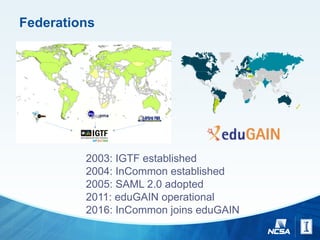
Federations
!"#$%"&'()*+&
&
!"#$%%&'()*'(#$+*,-&).'/#0&-1#23#%-+4*&)'/#$4(#'%-4-1)%#&'5)-4/#
2003: IGTF established
2004: InCommon established
2005: SAML 2.0 adopted
2011: eduGAIN operational
2016: InCommon joins eduGAIN
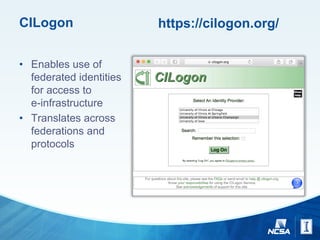
CILogon
• Enables use of
federated identities
for access to
e-infrastructure
• Translates across
federations and
protocols
https://cilogon.org/
What new challenges appear when moving
from 1 to 10 to 100 to 1000 identity providers?
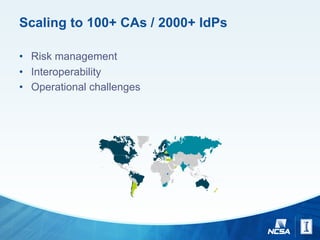
Scaling to 100+ CAs / 2000+ IdPs
• Risk management
• Interoperability
• Operational challenges
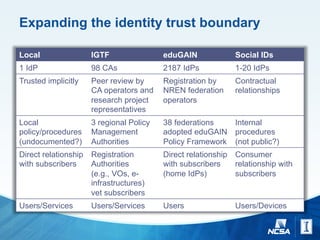
Expanding the identity trust boundary
Local IGTF eduGAIN Social IDs
1 IdP 98 CAs 2187 IdPs 1-20 IdPs
Trusted implicitly Peer review by
CA operators and
research project
representatives
Registration by
NREN federation
operators
Contractual
relationships
Local
policy/procedures
(undocumented?)
3 regional Policy
Management
Authorities
38 federations
adopted eduGAIN
Policy Framework
Internal
procedures
(not public?)
Direct relationship
with subscribers
Registration
Authorities
(e.g., VOs, e-
infrastructures)
vet subscribers
Direct relationship
with subscribers
(home IdPs)
Consumer
relationship with
subscribers
Users/Services Users/Services Users Users/Devices
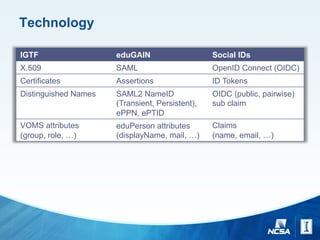
Technology
IGTF eduGAIN Social IDs
X.509 SAML OpenID Connect (OIDC)
Certificates Assertions ID Tokens
Distinguished Names SAML2 NameID
(Transient, Persistent),
ePPN, ePTID
OIDC (public, pairwise)
sub claim
VOMS attributes
(group, role, …)
eduPerson attributes
(displayName, mail, …)
Claims
(name, email, …)
Characteristics of User Identifiers
• https://wiki.shibboleth.net/confluence/x/eYBC
• Persistent: doesn’t change across multiple sessions
(in contrast to transient identifiers)
• Revocable: user-identifier link can be severed
• Reassignable: a revoked identifier can be linked to a
different user (typically after some hiatus period)
• Opaque: identifier does not reveal the user’s identity
(in contrast to transparent identifiers)
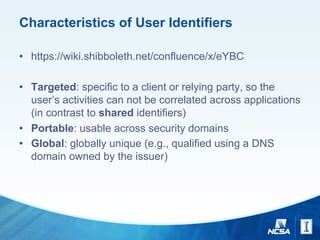
Characteristics of User Identifiers
• https://wiki.shibboleth.net/confluence/x/eYBC
• Targeted: specific to a client or relying party, so the
user’s activities can not be correlated across applications
(in contrast to shared identifiers)
• Portable: usable across security domains
• Global: globally unique (e.g., qualified using a DNS
domain owned by the issuer)
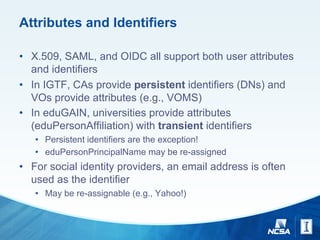
Attributes and Identifiers
• X.509, SAML, and OIDC all support both user attributes
and identifiers
• In IGTF, CAs provide persistent identifiers (DNs) and
VOs provide attributes (e.g., VOMS)
• In eduGAIN, universities provide attributes
(eduPersonAffiliation) with transient identifiers
• Persistent identifiers are the exception!
• eduPersonPrincipalName may be re-assigned
• For social identity providers, an email address is often
used as the identifier
• May be re-assignable (e.g., Yahoo!)
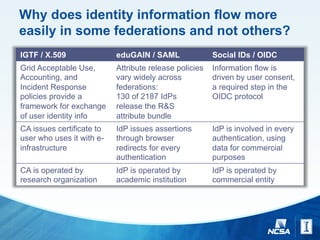
Why does identity information flow more
easily in some federations and not others?
IGTF / X.509 eduGAIN / SAML Social IDs / OIDC
Grid Acceptable Use,
Accounting, and
Incident Response
policies provide a
framework for exchange
of user identity info
Attribute release policies
vary widely across
federations:
130 of 2187 IdPs
release the R&S
attribute bundle
Information flow is
driven by user consent,
a required step in the
OIDC protocol
CA issues certificate to
user who uses it with e-
infrastructure
IdP issues assertions
through browser
redirects for every
authentication
IdP is involved in every
authentication, using
data for commercial
purposes
CA is operated by
research organization
IdP is operated by
academic institution
IdP is operated by
commercial entity
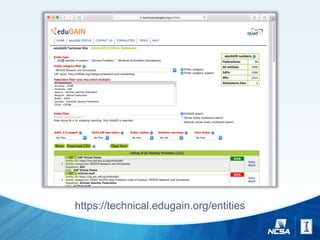
https://technical.edugain.org/entities
When do we decide to implement IAM
ourselves versus relying on others?
Motivations and Driving Use Cases
• IGTF
• Enable access to e-infrastructure
• Per-user accounting, access control, incident response
• eduGAIN
• Access to online academic journals by library patrons
• Strong privacy protections
• Access to contracted cloud services
• Social IdPs
• Facilitate social connections
• Advertising and user activity tracking for commercial purposes
Unique IAM needs for e-Science
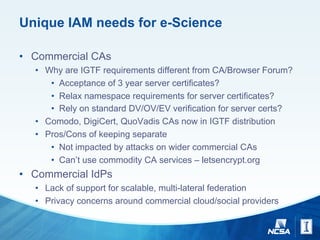
• Commercial CAs
• Why are IGTF requirements different from CA/Browser Forum?
• Acceptance of 3 year server certificates?
• Relax namespace requirements for server certificates?
• Rely on standard DV/OV/EV verification for server certs?
• Comodo, DigiCert, QuoVadis CAs now in IGTF distribution
• Pros/Cons of keeping separate
• Not impacted by attacks on wider commercial CAs
• Can’t use commodity CA services – letsencrypt.org
• Commercial IdPs
• Lack of support for scalable, multi-lateral federation
• Privacy concerns around commercial cloud/social providers
Unique IAM needs for e-Science
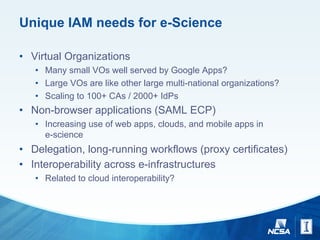
• Virtual Organizations
• Many small VOs well served by Google Apps?
• Large VOs are like other large multi-national organizations?
• Scaling to 100+ CAs / 2000+ IdPs
• Non-browser applications (SAML ECP)
• Increasing use of web apps, clouds, and mobile apps in
e-science
• Delegation, long-running workflows (proxy certificates)
• Interoperability across e-infrastructures
• Related to cloud interoperability?
How do we mitigate the risks of using external
identities?
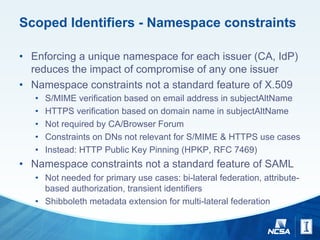
Scoped Identifiers - Namespace constraints
• Enforcing a unique namespace for each issuer (CA, IdP)
reduces the impact of compromise of any one issuer
• Namespace constraints not a standard feature of X.509
• S/MIME verification based on email address in subjectAltName
• HTTPS verification based on domain name in subjectAltName
• Not required by CA/Browser Forum
• Constraints on DNs not relevant for S/MIME & HTTPS use cases
• Instead: HTTP Public Key Pinning (HPKP, RFC 7469)
• Namespace constraints not a standard feature of SAML
• Not needed for primary use cases: bi-lateral federation, attribute-
based authorization, transient identifiers
• Shibboleth metadata extension for multi-lateral federation
Office365 Auth Bypass Vulnerability
• Jointly discovered in Dec 2015 by Klemen Bratec from
Šola prihodnosti Maribor and Ioannis Kakavas from
Greek Research and Technology Network
• Microsoft Office 365 SAML Service Provider
implementation failed to check scope of IDPEmail
attribute used for authorization
• Allowed Office365 tenant to impersonate users from
another Office365 tenant
• Microsoft fixed the vulnerability within 7 hours of report
http://www.economyofmechanism.com/office365-authbypass
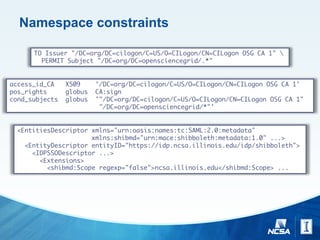
Namespace constraints
TO Issuer "/DC=org/DC=cilogon/C=US/O=CILogon/CN=CILogon OSG CA 1" 
PERMIT Subject "/DC=org/DC=opensciencegrid/.*"
access_id_CA X509 '/DC=org/DC=cilogon/C=US/O=CILogon/CN=CILogon OSG CA 1'
pos_rights globus CA:sign
cond_subjects globus '"/DC=org/DC=cilogon/C=US/O=CILogon/CN=CILogon OSG CA 1"
"/DC=org/DC=opensciencegrid/*"'
<EntitiesDescriptor xmlns="urn:oasis:names:tc:SAML:2.0:metadata"
xmlns:shibmd="urn:mace:shibboleth:metadata:1.0" ...>
<EntityDescriptor entityID="https://idp.ncsa.illinois.edu/idp/shibboleth">
<IDPSSODescriptor ...>
<Extensions>
<shibmd:Scope regexp="false">ncsa.illinois.edu</shibmd:Scope> ...
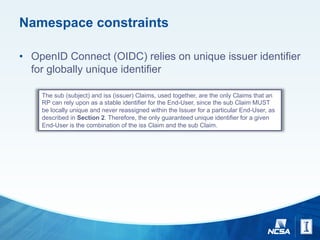
Namespace constraints
• OpenID Connect (OIDC) relies on unique issuer identifier
for globally unique identifier
The sub (subject) and iss (issuer) Claims, used together, are the only Claims that an
RP can rely upon as a stable identifier for the End-User, since the sub Claim MUST
be locally unique and never reassigned within the Issuer for a particular End-User, as
described in Section 2. Therefore, the only guaranteed unique identifier for a given
End-User is the combination of the iss Claim and the sub Claim.
How do we effectively federate services
operated by the research community, higher
education institutions, NRENs, and commercial
providers?
Operational Gaps – Network Challenges
• IPv6
• 29 of 69 IGTF CRL distribution points have AAAA records
• 16 of 38 eduGAIN federation metadata distribution points
have AAAA records
• X.509 CRLs, SAML metadata, and CDNs
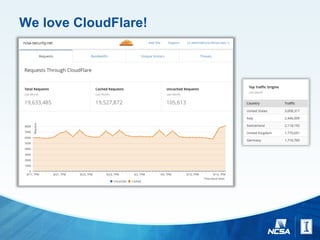
• CILogon and Comodo using CloudFlare CDN for CRLs
• samlbits.org CDN for SAML metadata
• Per-entity metadata
https://spaces.internet2.edu/display/perentity
We love CloudFlare!
Operational Gaps – Algorithm Agility
• SSLv3 ® TLSv1 ® TLSv1.2
• CILogon currently sees 85% TLSv1.2
• Browsers good at updating; CLIs & web apps not so much…
• MD5 ® SHA-1 ® SHA-512 ® SHA-256
• 2013-2015 IGTF transition
https://www.eugridpma.org/documentation/hashrat/sha2-timeline
• 2013-2014 InCommon transition
https://spaces.internet2.edu/x/AYbYAg
• RSA key bits: 512 ® 1024 ® 2048 ® 4096
Operational Gaps – Software Maintenance
• Shibboleth IdPv3 EOL Jul 31, 2016
https://spaces.internet2.edu/x/0IIQBg
Operational Gaps – Software Maintenance
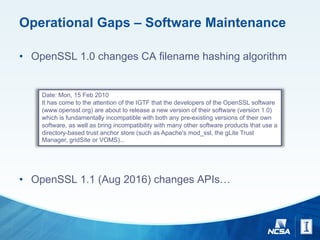
• OpenSSL 1.0 changes CA filename hashing algorithm
• OpenSSL 1.1 (Aug 2016) changes APIs…
Date: Mon, 15 Feb 2010
It has come to the attention of the IGTF that the developers of the OpenSSL software
(www.openssl.org) are about to release a new version of their software (version 1.0)
which is fundamentally incompatible with both any pre-existing versions of their own
software, as well as bring incompatibility with many other software products that use a
directory-based trust anchor store (such as Apache's mod_ssl, the gLite Trust
Manager, gridSite or VOMS)...
Operational Gaps – Reliability
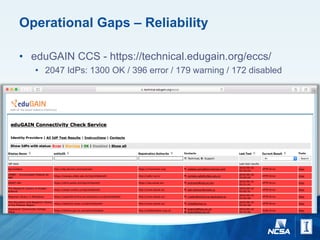
• eduGAIN CCS - https://technical.edugain.org/eccs/
• 2047 IdPs: 1300 OK / 396 error / 179 warning / 172 disabled
How do we determine what identity assurance
we need and find providers who can meet those
needs?
Identity Assurance
• InCommon Assurance program
www.incommon.org/assurance/
• Silver (LOA 2) and Bronze (LOA 1)
• IGTF CILogon Silver CA
• Lacking incentives: apps didn’t show up
• Implementation hurdles: audits and contractual
agreements
• Virginia Tech certified at LOA 2 but didn’t renew
• Too onerous to map from existing certifications
(e.g., DOE Labs)
• FICAM - idmanagement.gov
• Google certified at LOA 1 but didn’t renew
Identity Assurance
• IGTF
• Peer review
• Active engagement from relying parties
• Move to technology-agnostic assurance profiles
https://www.igtf.net/ap/authn-assurance/
• REFEDS Assurance WG - https://wiki.refeds.org/x/MgDI
• Apply IGTF-style assurance to SAML IdPs?
• CILogon-FNAL-LIGO-OSG engaged
• Still a question of incentives:
• Enable university IdPs to simply self-assert what they do
• Enable e-research IdPs to assert a higher assurance
Identity Assurance – Multi-Factor Auth
• e-Science use cases requiring multi-
factor authentication
• Blue Waters supercomputer at NCSA
• TACC resources (XSEDE)
• and others…
• NCSA Two Factor CA (IGTF)
• InCommon MFA Interoperability
Profile Working Group
• https://spaces.internet2.edu/x/CY5HBQ
• InCommon MFA Profile – spec almost fits
on one page!
• http://id.incommon.org/assurance/mfa
How do we bridge the gaps in trust,
functionality, and reliability?
Bridging the gaps: eduGAIN reality
• Some % of IdPs will always be broken
• Automate error handling
• Provide work-arounds
• identity linking, account recovery, catch-all IdPs
• Increase awareness
• Make it easy for participants to declare their practices /
requirements (attributes, assurance, error handling, etc.)
• Monitoring / alerts
• Sharing requirements (e.g., FIM4R)
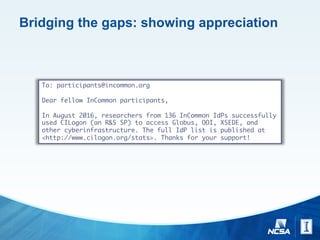
Bridging the gaps: showing appreciation
To: participants@incommon.org
Dear fellow InCommon participants,
In August 2016, researchers from 136 InCommon IdPs successfully
used CILogon (an R&S SP) to access Globus, OOI, XSEDE, and
other cyberinfrastructure. The full IdP list is published at
<http://www.cilogon.org/stats>. Thanks for your support!
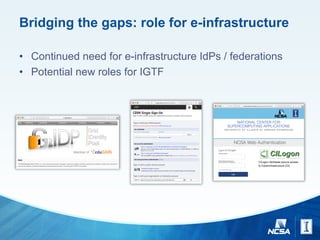
Bridging the gaps: role for e-infrastructure
• Continued need for e-infrastructure IdPs / federations
• Potential new roles for IGTF
Thanks!
jbasney@ncsa.illinois.edu
keybase.io/jbasney
F867 03EA 84ED 456A 7D3E
388E 04DA 0074 775D 6316
@JimBasney
slideshare.net/jbasney

Trusting External Identity Providers for Global Research Collaborations

  • 1.
    National Center forSupercomputing Applications University of Illinois at Urbana–Champaign Trusting External Identity Providers for Global Research Collaborations Jim Basney jbasney@ncsa.illinois.edu IGTF at CERN (Sep 19 2016) slideshare.net/jbasney MIND THE GAP
  • 2.
    About Jim • DoingIAM at NCSA since 2001 • Operating IGTF CAs since 2007 • Operating CILogon since 2010 • Operating NCSA SAML IdP since 2016 • Contributing to IAM in LIGO, LSST, XSEDE • Working to improve the security of e-infrastructure • Cybersecurity Center of Excellence (trustedci.org) • Software Assurance Marketplace (continuousassurance.org)
  • 3.
    Topics • Who dowe trust to provide identity and access management services for our research collaborations? • When do we decide to implement it ourselves versus relying on others? • How do we create incentives for establishing trust? • How do we bridge the gaps in trust, functionality, and reliability?
  • 4.
    Topics • What newchallenges appear when moving from 1 to 10 to 100 to 1000+ identity providers? • Why does identity information flow more easily in some federations and not others? • How do we determine what identity assurance we need and find providers who can meet those needs? • How do we mitigate the risks of using external identities? • How do we effectively federate services operated by the research community, higher education institutions, NRENs, and commercial providers?
  • 5.
    Gaps • Incentives fortrust/interoperability • Needs/Priorities/Approaches: • e-Research • Higher Education • Commercial • Protocol standards and implementations • Scaling to 2000+ IdPs • Operational reliability MIND THE GAP
  • 6.
    Federations !"#$%"&'()*+& & !"#$%%&'()*'(#$+*,-&).'/#0&-1#23#%-+4*&)'/#$4(#'%-4-1)%#&'5)-4/# 2003: IGTF established 2004:InCommon established 2005: SAML 2.0 adopted 2011: eduGAIN operational 2016: InCommon joins eduGAIN
  • 7.
    CILogon • Enables useof federated identities for access to e-infrastructure • Translates across federations and protocols https://cilogon.org/
  • 8.
    What new challengesappear when moving from 1 to 10 to 100 to 1000 identity providers?
  • 9.
    Scaling to 100+CAs / 2000+ IdPs • Risk management • Interoperability • Operational challenges
  • 10.
    Expanding the identitytrust boundary Local IGTF eduGAIN Social IDs 1 IdP 98 CAs 2187 IdPs 1-20 IdPs Trusted implicitly Peer review by CA operators and research project representatives Registration by NREN federation operators Contractual relationships Local policy/procedures (undocumented?) 3 regional Policy Management Authorities 38 federations adopted eduGAIN Policy Framework Internal procedures (not public?) Direct relationship with subscribers Registration Authorities (e.g., VOs, e- infrastructures) vet subscribers Direct relationship with subscribers (home IdPs) Consumer relationship with subscribers Users/Services Users/Services Users Users/Devices
  • 11.
    Technology IGTF eduGAIN SocialIDs X.509 SAML OpenID Connect (OIDC) Certificates Assertions ID Tokens Distinguished Names SAML2 NameID (Transient, Persistent), ePPN, ePTID OIDC (public, pairwise) sub claim VOMS attributes (group, role, …) eduPerson attributes (displayName, mail, …) Claims (name, email, …)
  • 12.
    Characteristics of UserIdentifiers • https://wiki.shibboleth.net/confluence/x/eYBC • Persistent: doesn’t change across multiple sessions (in contrast to transient identifiers) • Revocable: user-identifier link can be severed • Reassignable: a revoked identifier can be linked to a different user (typically after some hiatus period) • Opaque: identifier does not reveal the user’s identity (in contrast to transparent identifiers)
  • 13.
    Characteristics of UserIdentifiers • https://wiki.shibboleth.net/confluence/x/eYBC • Targeted: specific to a client or relying party, so the user’s activities can not be correlated across applications (in contrast to shared identifiers) • Portable: usable across security domains • Global: globally unique (e.g., qualified using a DNS domain owned by the issuer)
  • 14.
    Attributes and Identifiers •X.509, SAML, and OIDC all support both user attributes and identifiers • In IGTF, CAs provide persistent identifiers (DNs) and VOs provide attributes (e.g., VOMS) • In eduGAIN, universities provide attributes (eduPersonAffiliation) with transient identifiers • Persistent identifiers are the exception! • eduPersonPrincipalName may be re-assigned • For social identity providers, an email address is often used as the identifier • May be re-assignable (e.g., Yahoo!)
  • 15.
    Why does identityinformation flow more easily in some federations and not others? IGTF / X.509 eduGAIN / SAML Social IDs / OIDC Grid Acceptable Use, Accounting, and Incident Response policies provide a framework for exchange of user identity info Attribute release policies vary widely across federations: 130 of 2187 IdPs release the R&S attribute bundle Information flow is driven by user consent, a required step in the OIDC protocol CA issues certificate to user who uses it with e- infrastructure IdP issues assertions through browser redirects for every authentication IdP is involved in every authentication, using data for commercial purposes CA is operated by research organization IdP is operated by academic institution IdP is operated by commercial entity
  • 16.
  • 17.
    When do wedecide to implement IAM ourselves versus relying on others?
  • 18.
    Motivations and DrivingUse Cases • IGTF • Enable access to e-infrastructure • Per-user accounting, access control, incident response • eduGAIN • Access to online academic journals by library patrons • Strong privacy protections • Access to contracted cloud services • Social IdPs • Facilitate social connections • Advertising and user activity tracking for commercial purposes
  • 19.
    Unique IAM needsfor e-Science • Commercial CAs • Why are IGTF requirements different from CA/Browser Forum? • Acceptance of 3 year server certificates? • Relax namespace requirements for server certificates? • Rely on standard DV/OV/EV verification for server certs? • Comodo, DigiCert, QuoVadis CAs now in IGTF distribution • Pros/Cons of keeping separate • Not impacted by attacks on wider commercial CAs • Can’t use commodity CA services – letsencrypt.org • Commercial IdPs • Lack of support for scalable, multi-lateral federation • Privacy concerns around commercial cloud/social providers
  • 20.
    Unique IAM needsfor e-Science • Virtual Organizations • Many small VOs well served by Google Apps? • Large VOs are like other large multi-national organizations? • Scaling to 100+ CAs / 2000+ IdPs • Non-browser applications (SAML ECP) • Increasing use of web apps, clouds, and mobile apps in e-science • Delegation, long-running workflows (proxy certificates) • Interoperability across e-infrastructures • Related to cloud interoperability?
  • 21.
    How do wemitigate the risks of using external identities?
  • 22.
    Scoped Identifiers -Namespace constraints • Enforcing a unique namespace for each issuer (CA, IdP) reduces the impact of compromise of any one issuer • Namespace constraints not a standard feature of X.509 • S/MIME verification based on email address in subjectAltName • HTTPS verification based on domain name in subjectAltName • Not required by CA/Browser Forum • Constraints on DNs not relevant for S/MIME & HTTPS use cases • Instead: HTTP Public Key Pinning (HPKP, RFC 7469) • Namespace constraints not a standard feature of SAML • Not needed for primary use cases: bi-lateral federation, attribute- based authorization, transient identifiers • Shibboleth metadata extension for multi-lateral federation
  • 23.
    Office365 Auth BypassVulnerability • Jointly discovered in Dec 2015 by Klemen Bratec from Šola prihodnosti Maribor and Ioannis Kakavas from Greek Research and Technology Network • Microsoft Office 365 SAML Service Provider implementation failed to check scope of IDPEmail attribute used for authorization • Allowed Office365 tenant to impersonate users from another Office365 tenant • Microsoft fixed the vulnerability within 7 hours of report http://www.economyofmechanism.com/office365-authbypass
  • 24.
    Namespace constraints TO Issuer"/DC=org/DC=cilogon/C=US/O=CILogon/CN=CILogon OSG CA 1" PERMIT Subject "/DC=org/DC=opensciencegrid/.*" access_id_CA X509 '/DC=org/DC=cilogon/C=US/O=CILogon/CN=CILogon OSG CA 1' pos_rights globus CA:sign cond_subjects globus '"/DC=org/DC=cilogon/C=US/O=CILogon/CN=CILogon OSG CA 1" "/DC=org/DC=opensciencegrid/*"' <EntitiesDescriptor xmlns="urn:oasis:names:tc:SAML:2.0:metadata" xmlns:shibmd="urn:mace:shibboleth:metadata:1.0" ...> <EntityDescriptor entityID="https://idp.ncsa.illinois.edu/idp/shibboleth"> <IDPSSODescriptor ...> <Extensions> <shibmd:Scope regexp="false">ncsa.illinois.edu</shibmd:Scope> ...
  • 25.
    Namespace constraints • OpenIDConnect (OIDC) relies on unique issuer identifier for globally unique identifier The sub (subject) and iss (issuer) Claims, used together, are the only Claims that an RP can rely upon as a stable identifier for the End-User, since the sub Claim MUST be locally unique and never reassigned within the Issuer for a particular End-User, as described in Section 2. Therefore, the only guaranteed unique identifier for a given End-User is the combination of the iss Claim and the sub Claim.
  • 26.
    How do weeffectively federate services operated by the research community, higher education institutions, NRENs, and commercial providers?
  • 27.
    Operational Gaps –Network Challenges • IPv6 • 29 of 69 IGTF CRL distribution points have AAAA records • 16 of 38 eduGAIN federation metadata distribution points have AAAA records • X.509 CRLs, SAML metadata, and CDNs • CILogon and Comodo using CloudFlare CDN for CRLs • samlbits.org CDN for SAML metadata • Per-entity metadata https://spaces.internet2.edu/display/perentity
  • 28.
  • 29.
    Operational Gaps –Algorithm Agility • SSLv3 ® TLSv1 ® TLSv1.2 • CILogon currently sees 85% TLSv1.2 • Browsers good at updating; CLIs & web apps not so much… • MD5 ® SHA-1 ® SHA-512 ® SHA-256 • 2013-2015 IGTF transition https://www.eugridpma.org/documentation/hashrat/sha2-timeline • 2013-2014 InCommon transition https://spaces.internet2.edu/x/AYbYAg • RSA key bits: 512 ® 1024 ® 2048 ® 4096
  • 30.
    Operational Gaps –Software Maintenance • Shibboleth IdPv3 EOL Jul 31, 2016 https://spaces.internet2.edu/x/0IIQBg
  • 31.
    Operational Gaps –Software Maintenance • OpenSSL 1.0 changes CA filename hashing algorithm • OpenSSL 1.1 (Aug 2016) changes APIs… Date: Mon, 15 Feb 2010 It has come to the attention of the IGTF that the developers of the OpenSSL software (www.openssl.org) are about to release a new version of their software (version 1.0) which is fundamentally incompatible with both any pre-existing versions of their own software, as well as bring incompatibility with many other software products that use a directory-based trust anchor store (such as Apache's mod_ssl, the gLite Trust Manager, gridSite or VOMS)...
  • 32.
    Operational Gaps –Reliability • eduGAIN CCS - https://technical.edugain.org/eccs/ • 2047 IdPs: 1300 OK / 396 error / 179 warning / 172 disabled
  • 33.
    How do wedetermine what identity assurance we need and find providers who can meet those needs?
  • 34.
    Identity Assurance • InCommonAssurance program www.incommon.org/assurance/ • Silver (LOA 2) and Bronze (LOA 1) • IGTF CILogon Silver CA • Lacking incentives: apps didn’t show up • Implementation hurdles: audits and contractual agreements • Virginia Tech certified at LOA 2 but didn’t renew • Too onerous to map from existing certifications (e.g., DOE Labs) • FICAM - idmanagement.gov • Google certified at LOA 1 but didn’t renew
  • 35.
    Identity Assurance • IGTF •Peer review • Active engagement from relying parties • Move to technology-agnostic assurance profiles https://www.igtf.net/ap/authn-assurance/ • REFEDS Assurance WG - https://wiki.refeds.org/x/MgDI • Apply IGTF-style assurance to SAML IdPs? • CILogon-FNAL-LIGO-OSG engaged • Still a question of incentives: • Enable university IdPs to simply self-assert what they do • Enable e-research IdPs to assert a higher assurance
  • 36.
    Identity Assurance –Multi-Factor Auth • e-Science use cases requiring multi- factor authentication • Blue Waters supercomputer at NCSA • TACC resources (XSEDE) • and others… • NCSA Two Factor CA (IGTF) • InCommon MFA Interoperability Profile Working Group • https://spaces.internet2.edu/x/CY5HBQ • InCommon MFA Profile – spec almost fits on one page! • http://id.incommon.org/assurance/mfa
  • 37.
    How do webridge the gaps in trust, functionality, and reliability?
  • 38.
    Bridging the gaps:eduGAIN reality • Some % of IdPs will always be broken • Automate error handling • Provide work-arounds • identity linking, account recovery, catch-all IdPs • Increase awareness • Make it easy for participants to declare their practices / requirements (attributes, assurance, error handling, etc.) • Monitoring / alerts • Sharing requirements (e.g., FIM4R)
  • 39.
    Bridging the gaps:showing appreciation To: participants@incommon.org Dear fellow InCommon participants, In August 2016, researchers from 136 InCommon IdPs successfully used CILogon (an R&S SP) to access Globus, OOI, XSEDE, and other cyberinfrastructure. The full IdP list is published at <http://www.cilogon.org/stats>. Thanks for your support!
  • 40.
    Bridging the gaps:role for e-infrastructure • Continued need for e-infrastructure IdPs / federations • Potential new roles for IGTF
  • 41.
    Thanks! jbasney@ncsa.illinois.edu keybase.io/jbasney F867 03EA 84ED456A 7D3E 388E 04DA 0074 775D 6316 @JimBasney slideshare.net/jbasney