Developments in Open
Educational Practice
Pete Cannell - @petecannell,
petecannell2012@gmail.com
Reflecting on experience
 Open and distance education
 Open Education
 Widening participation
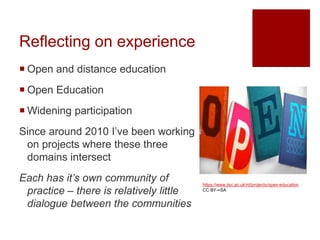
Since around 2010 I’ve been working
on projects where these three
domains intersect
Each has it’s own community of
practice – there is relatively little
dialogue between the communities
https://www.jisc.ac.uk/rd/projects/open-education
CC BY-=SA
Challenges
 Serious challenges face all three domains
 ODL - Relevance and role of Open
Universities in the 21C
 Open Education – limited success in fulfilling
its promise of breaking down barriers
 WP – deep and persistent inequality in the
developed world and huge unmet demand in
the global south
Access vs Participation
 The MOOC phenomenon has
demonstrated the ability of online to
reach very large numbers – it has also
increased the number of staff with skills
and interest in online and distance
learning
 Little evidence of widening participation?
 Innovation in technology but not in
pedagogy?
www.futurelearn.com
www.coursera.org
www.edx.org
Importance of OEP
 Practices that support the (re)use and
production of OER through
institutional policies, promote
innovative pedagogical models, and
respect and empower learners as co-
producers on their lifelong learning
path (OPAL 2011)
 ...collaborative practice in which
resources are shared
by making them openly available, and
pedagogical practices are employed
which rely on social interaction,
knowledge creation, peer-learning,
and shared learning practices (Ehlers
2011)
OEPS Project
 Opening Educational Practices in Scotland
 Focus on partnership, co-creation and
widening participation
 Defining OEP:
 We think of Open Educational Practices as
those educational practices that are
concerned with and promote equity and
openness. Our understanding of ‘open’
builds on the freedoms associated with “the
5 Rs” of OER, promoting a broader sense
of open, emphasising social justice, and
developing practices that open up
opportunities for those distanced from
education.
Findings – (1)
 Barriers to engagement and success in learning
online combine institutional, dispositional and
situational factors well known in WP practice with
specific features of the online environment
 Open Education has often had a technology focus –
there is a strong case for reorienting on practice,
pedagogy and new models of student support
 Reusing content through a process of participatory
design allows for new and effective models of
curriculum development
 Rethinking the boundaries between universities and
other organisations that support (potential) learners
and working across boundaries to coproduce learning
materials has benefits for academic and non-
academic partners and for students
https://pixabay.com/en/jigsaw-puzzle-
game-match-puzzle-1297102/ CC0
Findings – (2)
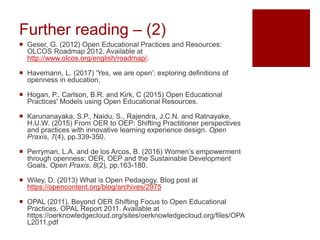
 Good design recognises student context – the
medium may be online but students may be online
and in face to face groups
 In any case designing in opportunities for peer
support has significant impact on retention and
success
 The affordances of open can allow the mass scale of
ODL (or MOOCs) to be combined with student
centred and context specific customisation https://pixabay.com/en/people-girls-women-students-
2557396/ CC0
Further reading – (1)
 Extended notes relating to this presentation can be found on my blog
www.openinguped.wordpress.com
 A full report from the OEPS project and an archive of project activity can
be found at www.oepscotland.org
 Arinto, P. (2018) OER and OEP towards equitable and quality education
for all.
 Arinto, P., Hodgkinson-Williams, C. and Trotter, H. (2017) OER and OEP
in the Global South: Implications and recommendations for social
inclusion.
 Cannell, P., Macintyre, R. and Hewitt, L. (2015) Widening access and
OER: developing new practice. Widening Participation and Lifelong
Learning, 17(1), pp.64-72.
 Cannell, P. (2016) Lifelong learning and partnerships: rethinking the
boundaries of the university in the digital age. Widening Participation
and Lifelong Learning, 18(1), pp.61-73.
 Ehlers, U-D. (2011) Extending the territory: From open educational
resources to open educational practices. Journal of Open, Flexible and
Distance Learning,15(2), 1-10.
Further reading – (2)
 Geser, G. (2012) Open Educational Practices and Resources:
OLCOS Roadmap 2012. Available at
http://www.olcos.org/english/roadmap/.
 Havemann, L. (2017) 'Yes, we are open’: exploring definitions of
openness in education.
 Hogan, P., Carlson, B.R. and Kirk, C (2015) Open Educational
Practices' Models using Open Educational Resources.
 Karunanayaka, S.P., Naidu, S., Rajendra, J.C.N. and Ratnayake,
H.U.W. (2015) From OER to OEP: Shifting Practitioner perspectives
and practices with innovative learning experience design. Open
Praxis, 7(4), pp.339-350.
 Perryman, L.A. and de los Arcos, B. (2016) Women’s empowerment
through openness: OER, OEP and the Sustainable Development
Goals. Open Praxis, 8(2), pp.163-180.
 Wiley, D. (2013) What is Open Pedagogy. Blog post at
https://opencontent.org/blog/archives/2975
 OPAL (2011). Beyond OER Shifting Focus to Open Educational
Practices. OPAL Report 2011. Available at
https://oerknowledgecloud.org/sites/oerknowledgecloud.org/files/OPA
L2011.pdf

New Developments in Open Educational Practice

  • 1.
    Developments in Open EducationalPractice Pete Cannell - @petecannell, petecannell2012@gmail.com
  • 2.
    Reflecting on experience Open and distance education  Open Education  Widening participation Since around 2010 I’ve been working on projects where these three domains intersect Each has it’s own community of practice – there is relatively little dialogue between the communities https://www.jisc.ac.uk/rd/projects/open-education CC BY-=SA
  • 3.
    Challenges  Serious challengesface all three domains  ODL - Relevance and role of Open Universities in the 21C  Open Education – limited success in fulfilling its promise of breaking down barriers  WP – deep and persistent inequality in the developed world and huge unmet demand in the global south
  • 4.
    Access vs Participation The MOOC phenomenon has demonstrated the ability of online to reach very large numbers – it has also increased the number of staff with skills and interest in online and distance learning  Little evidence of widening participation?  Innovation in technology but not in pedagogy? www.futurelearn.com www.coursera.org www.edx.org
  • 5.
    Importance of OEP Practices that support the (re)use and production of OER through institutional policies, promote innovative pedagogical models, and respect and empower learners as co- producers on their lifelong learning path (OPAL 2011)  ...collaborative practice in which resources are shared by making them openly available, and pedagogical practices are employed which rely on social interaction, knowledge creation, peer-learning, and shared learning practices (Ehlers 2011)
  • 6.
    OEPS Project  OpeningEducational Practices in Scotland  Focus on partnership, co-creation and widening participation  Defining OEP:  We think of Open Educational Practices as those educational practices that are concerned with and promote equity and openness. Our understanding of ‘open’ builds on the freedoms associated with “the 5 Rs” of OER, promoting a broader sense of open, emphasising social justice, and developing practices that open up opportunities for those distanced from education.
  • 7.
    Findings – (1) Barriers to engagement and success in learning online combine institutional, dispositional and situational factors well known in WP practice with specific features of the online environment  Open Education has often had a technology focus – there is a strong case for reorienting on practice, pedagogy and new models of student support  Reusing content through a process of participatory design allows for new and effective models of curriculum development  Rethinking the boundaries between universities and other organisations that support (potential) learners and working across boundaries to coproduce learning materials has benefits for academic and non- academic partners and for students https://pixabay.com/en/jigsaw-puzzle- game-match-puzzle-1297102/ CC0
  • 8.
    Findings – (2) Good design recognises student context – the medium may be online but students may be online and in face to face groups  In any case designing in opportunities for peer support has significant impact on retention and success  The affordances of open can allow the mass scale of ODL (or MOOCs) to be combined with student centred and context specific customisation https://pixabay.com/en/people-girls-women-students- 2557396/ CC0
  • 9.
    Further reading –(1)  Extended notes relating to this presentation can be found on my blog www.openinguped.wordpress.com  A full report from the OEPS project and an archive of project activity can be found at www.oepscotland.org  Arinto, P. (2018) OER and OEP towards equitable and quality education for all.  Arinto, P., Hodgkinson-Williams, C. and Trotter, H. (2017) OER and OEP in the Global South: Implications and recommendations for social inclusion.  Cannell, P., Macintyre, R. and Hewitt, L. (2015) Widening access and OER: developing new practice. Widening Participation and Lifelong Learning, 17(1), pp.64-72.  Cannell, P. (2016) Lifelong learning and partnerships: rethinking the boundaries of the university in the digital age. Widening Participation and Lifelong Learning, 18(1), pp.61-73.  Ehlers, U-D. (2011) Extending the territory: From open educational resources to open educational practices. Journal of Open, Flexible and Distance Learning,15(2), 1-10.
  • 10.
    Further reading –(2)  Geser, G. (2012) Open Educational Practices and Resources: OLCOS Roadmap 2012. Available at http://www.olcos.org/english/roadmap/.  Havemann, L. (2017) 'Yes, we are open’: exploring definitions of openness in education.  Hogan, P., Carlson, B.R. and Kirk, C (2015) Open Educational Practices' Models using Open Educational Resources.  Karunanayaka, S.P., Naidu, S., Rajendra, J.C.N. and Ratnayake, H.U.W. (2015) From OER to OEP: Shifting Practitioner perspectives and practices with innovative learning experience design. Open Praxis, 7(4), pp.339-350.  Perryman, L.A. and de los Arcos, B. (2016) Women’s empowerment through openness: OER, OEP and the Sustainable Development Goals. Open Praxis, 8(2), pp.163-180.  Wiley, D. (2013) What is Open Pedagogy. Blog post at https://opencontent.org/blog/archives/2975  OPAL (2011). Beyond OER Shifting Focus to Open Educational Practices. OPAL Report 2011. Available at https://oerknowledgecloud.org/sites/oerknowledgecloud.org/files/OPA L2011.pdf