OPEN APEX
JAMES
IEJ Iranian Endodontic Journal 2017;12 (2): 248-252
INTRODUCTION
• Open apex is usuallyfound in a developing rootof an immature tooth and, in the absence ofpulp or periapical disease,is
normal .
• Apical closure takes place approximately3 years after tooth eruption When the pulp undergoespathologic changes before
root development is completed, dentinformation ceases, and root growth is arrestedthis usually indicates a poor prognosis
and necessitatesan apexification.
• Traditionally, the apexification procedure consists of multipleand long-term applicationsof calcium hydroxide was used to
create an apical barrier before obturationof root canals.
• Because this procedure might alterthe mechanicalproperties of dentinand make these teethmore susceptible to root fracture,
a 1- or 2-step artificialapical barrier by using mineral trioxide aggregate (MTA) has been suggested before obturation ofthe
coronal portion of the root canal with endodontic filling materialsin teeth with necroticpulps and open apexes
• Very high success rates have been reported for this procedure
• However, this procedure might not result in complete root formation and might not completely reduce the chances
for root fracture The ideal outcome for a tooth with an immature root and necrotic pulp would be the regeneration
of pulp tissueinto a canal capable of promoting the continuationof normal root development.
• If the pulpal diagnosisis reversible pulpitis,the treatment of choice is vital pulp therapy, regardless of the degree of
root development.If the diagnosis is irreversible pulpitisor pulpal necrosis,the amount of root development will
determine the proper treatment .If the apex is closed,root canal therapy with high survival rates can be performed
• If the apex is open, other treatment options must be considered. Immature teeth that have open and often divergent
apices are not suitablefor complete cleaningand obturation with traditional techniques and materials.In addition,
because of their thin dentinal walls, these teeth are susceptible to subsequentfracture after treatment.
• In order to treat teeth with open apices effects ,prolonged use of intracanal calcium hydroxide medication,
placement of an apical with freeze-dried bone, tricalcium phosphate, dehydrated dentin matrix calcium
silicate based cements (CSC), such as mineral trioxide aggregate (MTA) and Biodentine, has been
proposed
• MTA has good biological and physicochemical properties, and is one of the most recommended CSCs for
use as apical barrier (apical plug) . However, it presents some disadvantages, mainly low resistance to
solubilization due to their long final setting time ,causing intense local inflammatory reaction if
accidentally pushed into the apical periodontal tissues.
• However, in order to avoid these complications, it has been proposed to use an additional apical matrix
with collagen membrane, prior to placement of the apical barrier with MTA . However, the use of collagen
membrane has some disadvantages, such high cost and the difficulty in handling the material.
• Lyophilized collagen sponge is a practical alternative, efficient and low cost, that is routinely
recommended for promoting hemostasis at a surgical alveolus, besides its good biological properties
CASE REPORT – 1
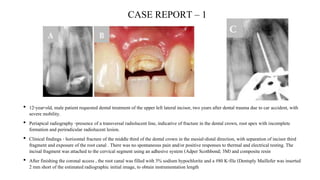
• 12-year-old, male patient requested dental treatment of the upper left lateral incisor, two years after dental trauma due to car accident, with
severe mobility.
• Periapical radiography -presence of a transversal radiolucent line, indicative of fracture in the dental crown, root apex with incomplete
formation and periradicular radiolucent lesion.
• Clinicalfindings - horizontal fracture of the middle third of the dental crown in the mesial-distal direction, with separation of incisor third
fragment and exposure of the root canal . There was no spontaneous pain and/or positive responses to thermal and electrical testing. The
incisal fragment was attached to the cervical segment using an adhesive system (Adper Scothbond; 3M) and composite resin
• After finishing the coronal access , the root canal was filled with 3% sodium hypochlorite and a #80 K-file (Dentsply Maillefer was inserted
2 mm short of the estimated radiographic initial image, to obtain instrumentation length
• Upon completion of the chemo-mechanical preparation,irrigationwas performed with 10 mL of saline, and as a
final irrigation protocol, the root canal was flushed with 5 mL of 17% EDTA for 3 min, and finished with 10 mL of
3% sodium hypochlorite gel and 10 mL of saline,which was later aspiratedand dried with absorbentpaper points.
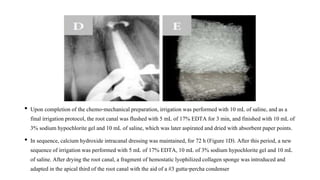
• In sequence,calcium hydroxide intracanaldressing was maintained,for 72 h (Figure 1D). After this period, a new
sequenceof irrigationwas performed with 5 mL of 17% EDTA, 10 mL of 3% sodium hypochloritegel and 10 mL
of saline.After drying the root canal, a fragment of hemostatic lyophilizedcollagen sponge was introduced and
adapted in the apical third of the root canal with the aid of a #3 gutta-percha condenser
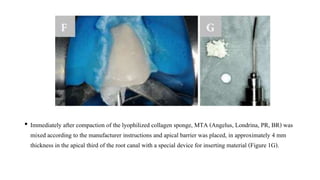
• Immediately after compaction of the lyophilized collagen sponge, MTA (Angelus, Londrina, PR, BR) was
mixed according to the manufacturer instructions and apical barrier was placed, in approximately 4 mm
thickness in the apical third of the root canal with a special device for inserting material (Figure 1G).
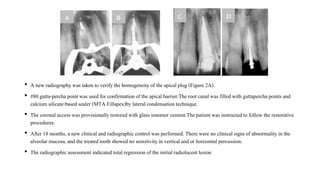
• A new radiographywas taken to verify the homogeneityof the apicalplug (Figure 2A).
• #80 gutta-percha point was used for confirmationof the apical barrier.The rootcanal was filled with guttaperchapoints and
calcium silicate-basedsealer (MTA Fillapex)bylateralcondensationtechnique.
• The coronal accesswas provisionallyrestoredwith glass ionomer cement.The patient was instructedto follow the restorative
procedures.
• After 18 months, a new clinical and radiographic control was performed. There were no clinicalsigns of abnormalityin the
alveolarmucosa, and the treatedtooth showed no sensitivityin vertical and or horizontal percussion.
• The radiographicassessment indicated totalregressionof the initialradiolucent lesion
CASE -2
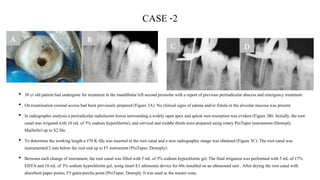
• 30 yr old patient had undergone for treatmentin the mandibular left second premolar with a report of previous periradicularabscess and emergency treatment.
• On examinationcoronal access had been previouslyprepared (Figure 3A). No clinicalsigns of edema and/or fistulain the alveolar mucosa was present.
• In radiographicanalysisa periradicularradiolucent lesionsurrounding a widely open apex and apical root resorptionwas evident (Figure 3B). Initially,the root
canal was irrigatedwith 10 mL of 3% sodium hypochlorite),and cervical and middle thirds wereprepared using rotary ProTaper instruments(Dentsply
Maillefer)up to S2 file.
• To determinethe working length a #70 K-filewas insertedin the root canal and a new radiographic image was obtained (Figure 3C). The root canal was
instrumented2 mm below the root end up to F5 instrument(ProTaper; Dentsply).
• Betweeneach change of instrument,the root canal was filledwith 5 mL of 3% sodium hypochlorite gel. The final irrigationwas performedwith 5 mL of 17%
EDTAand 10 mL of 3% sodium hypochlorite gel, using insert E1 ultrasonicdevice for 60s installedon an ultrasound unit . Afterdrying the root canal with
absorbent paper points, F5 gutta-percha point (ProTaper; Dentsply )) was used as the master cone.
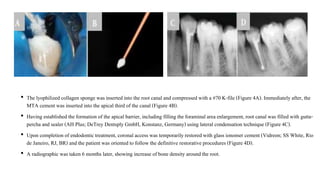
• The lyophilizedcollagen sponge was inserted into the root canal and compressedwith a #70 K-file (Figure 4A). Immediatelyafter, the
MTA cement was insertedinto the apical third of the canal (Figure 4B).
• Having established theformationof the apical barrier,including filling theforaminal area enlargement, root canal was filled with gutta-
percha and sealer (AH Plus; DeTrey Dentsply GmbH, Konstanz, Germany) using lateral condensation technique (Figure4C).
• Upon completionof endodontictreatment, coronal access was temporarilyrestoredwith glass ionomer cement (Vidreon; SS White, Rio
de Janeiro, RJ, BR) and the patient was oriented to follow the definitive restorative procedures (Figure 4D).
• A radiographic was taken 6 months later, showing increase of bone density aroundthe root.
DISCUSSION
• Use of an apicalbarrier with a biocompatible material, before MTA placement is an interestingtreatment strategy for avoiding
extrusionof the material beyond the radicularapex. The collagen membraneis used in periodontal guidedtissue regeneration
due to its excellent biological properties and being resorbable .
• Moreover, the lyophilizedcollagenhemostaticsponge is easy to handle and its tissue tolerability is satisfactory,since its
insertion in the apical radicular thirdcan be performed with the aid of a specificgutta-percha condenser orendodontic file .
• The lyophilizedcollagen sponge used in presented cases,is absorbable, with better biocompatibility, Within 24 days allows
promotes complete alveolar bonehealingwith presence oftrabecular bone and large amount of blood vessels and fibroblasts.
• Healing process also occurs after placement of the lyophilizedcollagensponge.
• After apical condensationof lyophilizedcollagen, clinicallyit is possible to confirm the presence of apicalbarrier by using an
endodontic file.This allowed the safe placement ofthe MTA apical barrier, with approximately4 mm thickness.
• Acute inflammatory reaction in the alveolar bone socket subsides after 5 days of the implantation of
lyophilized collagen sponge . Therefore, there was time for the hydration process and setting of the MTA
cement to occur, preventing its interference on periradicular healing process .
• However, due to its high alkalinity a risk of necrosis exists if there is direct contact with the apical tissues, for
instance after accidental apical overfilling.
• Therefore, the apical barrier with lyophilized collagen sponge and MTA cement allows the root canal filling
in single session, with safety and non-invasive procedures.
Conclusion
• These reports showed that treatment of open-apex teeth with placement of an apical matrix with
lyophilized collagen sponge against which MTA apical plug can be condensed, has favorable prognosis.
JOURNAL OF ENDODONTICS [ VOL 3, NO 11, NOVEMBER 1977
Case Report
• 8-year-old boy comes with trauma A medical history disclosedno systemicabnormalities.
• Clinical examinationshowed multiple lip and gingival lacerations.The maxillary left lateral incisor was intruded and not
visible clinically.The maxillary incisorssustainedEllis Class II coronal fractures.Radiographsshowed a horizontal midroot
fracture of the maxillary left central incisor with displacement of the coronal segment.
• The central incisor was stabilizedwith direct bond orthodontic bracketsin conjunction with round wire (Fig 1). A radiograph
was taken at this time to assure close approximation of the root fragments. The patient was examined weekly for the first
three weeks after the accident.The splint was removed at four weeks and all teeth were asymptomatic.
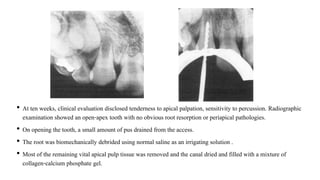
• At ten weeks, clinical evaluation disclosed tenderness to apical palpation, sensitivity to percussion. Radiographic
examination showed an open-apex tooth with no obvious root resorption or periapical pathologies.
• On opening the tooth, a small amount of pus drained from the access.
• The root was biomechanically debrided using normal saline as an irrigating solution .
• Most of the remaining vital apical pulp tissue was removed and the canal dried and filled with a mixture of
collagen-calcium phosphate gel.
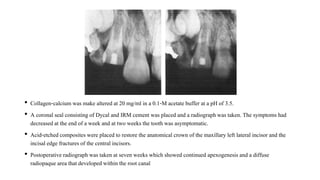
• Collagen-calcium was make altered at 20 mg/ml in a 0.1-M acetatebuffer at a pH of 3.5.
• A coronal seal consistingof Dycal and IRM cement was placed and a radiograph was taken. The symptoms had
decreased at the end of a week and at two weeks the tooth was asymptomatic.
• Acid-etched composites were placed to restore the anatomicalcrown of the maxillary left lateral incisor and the
incisal edge fracturesof the central incisors.
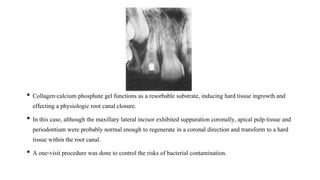
• Postoperative radiograph was taken at seven weeks which showed continued apexogenesisand a diffuse
radiopaque area that developed within the root canal
• Collagen-calcium phosphate gel functions as a resorbable substrate, inducing hard tissue ingrowth and
effecting a physiologic root canal closure.
• In this case, although the maxillary lateral incisor exhibited suppuration coronally, apical pulp tissue and
periodontium were probably normal enough to regenerate in a coronal direction and transform to a hard
tissue within the root canal.
• A one-visit procedure was done to control the risks of bacterial contamination.
• Andreasen and Hansen (1972)~ have observed that pulp may form a hard tissue callus and may aid in the healing
of root fractures.
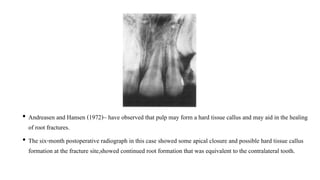
• The six-month postoperative radiograph in this case showed some apical closure and possible hard tissue callus
formation at the fracture site,showed continued root formation that was equivalent to the contralateral tooth.
JOE — Volume 37, Number 2, February 2011 Revitalization of Tooth with Necrotic Pulp and Open Apex by Using PRP
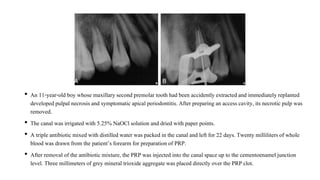
• An 11-year-old boy whose maxillary second premolar tooth had been accidently extractedand immediately replanted
developed pulpal necrosisand symptomatic apical periodontitis.After preparing an access cavity, its necrotic pulp was
removed.
• The canal was irrigated with 5.25% NaOCl solution and dried with paper points.
• A triple antibioticmixed with distilledwater was packed in the canal and left for 22 days. Twenty millilitersof whole
blood was drawn from the patient’sforearm for preparation of PRP.
• After removal of the antibiotic mixture, the PRP was injected into the canal space up to the cementoenamel junction
level. Three millimetersof grey mineral trioxide aggregate was placed directly over the PRP clot.
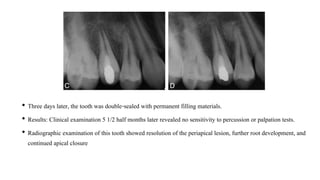
• Three days later, the tooth was double-sealed with permanent filling materials.
• Results: Clinical examination 5 1/2 half months later revealed no sensitivity to percussion or palpation tests.
• Radiographic examination of this tooth showed resolution of the periapical lesion, further root development, and
continued apical closure
Discussion
• If the filling materials are placed close to the cementoenamel level, it is more likely to elicit a positive
response to cold or EPT. Presence of a thick layer of restorative material(s) can prevent stimulation of vital
tissues within the root canal of these teeth and absence of a response to stimuli such as EPT and cold.
• Components needed for successful regenerative endodontics include absence of intracanal infection,
coronal seal to prevent reinfection, a physical scaffold to promote cell growth and differentiation, as well
as signaling molecules for the growth of stem cells .
• In the present case, we obtained disinfection of the root canals with the use of 5.25% NaOCl and triple
antibiotics .The PRP clot provided an excellent matrix for placement of MTA and subsequent permanent
restorations to prevent coronal leakage.
• Placement of a collagen matrix or other barriers might prevent the conductiveand inductive properties of MTA
• The relativelyhard matrix produced by PRP allowed us to place MTA 2–3 mm below the CEJ. The same can be
achieved if intracanalblood is allowed to clot adequately.Further discoloration of the clinical crown during
checkup visit might have been a result of applicationof triple antibioticscontaining minocycline and/or use of grey
MTA.
• Sealing the dentinal tubules in the chamber and use of the dentin bonding agent have been suggestedto prevent or
reduce the intensityof the discolorationcaused by applicationof triple antibiotics. The use of white MTA might
have also reduced the intensityof crown discoloration.Internal bleaching is also an option at this time.
• An ideal scaffold selectively binds and localizescells,contains growth factors, and undergoes biodegradationover
time . Regenerativeendodonticshas been accomplishedwith and without the presence of a physicalscaffold .
• The blood clot as a scaffold and a source of stem cells has been used in many recent cases.The absence of a blood
clot has been implicated in unsuccessfulcases of regenerativeendodonticsin a human clinicalinvestigationand an
animal study
• Conclusions: On the basis of short-term results of the present case, it appears that regeneration of vital
tissues in a tooth with necrotic pulp and a periapical lesion is possible
• Hargreaves et al have identified 3 components contributing to the success of this procedure.
• They include stem cells that are capable of hard tissue formation, signaling molecules for cellular
stimulation, proliferation, and differentiation, and finally, a 3-dimensional physical scaffold that can
support cell growth and differentiation.
JOE — Volume 37, Number 2, February 2011 Revitalizationof Tooth with Necrotic Pulp and Open Apex by Using PRP
REFERENCES
• Graziele Magro M, Carlos Kuga M, Adad Ricci W, Cristina Keine K, Rodrigues Tonetto M, Linares Lima
S, Henrique Borges A, Garcia Belizário L, Coêlho Bandeca M. Endodontic Management of Open Apex
Teeth Using Lyophilized Collagen Sponge and MTA Cement: Report of Two Cases. Iran Endod J.
2017;12(2):248-52. Doi: 10.22037/iej.2017.48
• M.Torabinejad, et al Revitalization of Tooth with Necrotic Pulp and Open Apex by Using PRP JOE —
Volume 37, Number 2, February 2011
• Nevins.A et al , hard tissue induction into pulpless open-apex teeth using collagen-calcium phosphate gel
journal of endodontics ] vol 0, no 11, november 1977

OPEN APEX

  • 1.
  • 2.
    IEJ Iranian EndodonticJournal 2017;12 (2): 248-252
  • 3.
    INTRODUCTION • Open apexis usuallyfound in a developing rootof an immature tooth and, in the absence ofpulp or periapical disease,is normal . • Apical closure takes place approximately3 years after tooth eruption When the pulp undergoespathologic changes before root development is completed, dentinformation ceases, and root growth is arrestedthis usually indicates a poor prognosis and necessitatesan apexification. • Traditionally, the apexification procedure consists of multipleand long-term applicationsof calcium hydroxide was used to create an apical barrier before obturationof root canals. • Because this procedure might alterthe mechanicalproperties of dentinand make these teethmore susceptible to root fracture, a 1- or 2-step artificialapical barrier by using mineral trioxide aggregate (MTA) has been suggested before obturation ofthe coronal portion of the root canal with endodontic filling materialsin teeth with necroticpulps and open apexes • Very high success rates have been reported for this procedure
  • 4.
    • However, thisprocedure might not result in complete root formation and might not completely reduce the chances for root fracture The ideal outcome for a tooth with an immature root and necrotic pulp would be the regeneration of pulp tissueinto a canal capable of promoting the continuationof normal root development. • If the pulpal diagnosisis reversible pulpitis,the treatment of choice is vital pulp therapy, regardless of the degree of root development.If the diagnosis is irreversible pulpitisor pulpal necrosis,the amount of root development will determine the proper treatment .If the apex is closed,root canal therapy with high survival rates can be performed • If the apex is open, other treatment options must be considered. Immature teeth that have open and often divergent apices are not suitablefor complete cleaningand obturation with traditional techniques and materials.In addition, because of their thin dentinal walls, these teeth are susceptible to subsequentfracture after treatment.
  • 5.
    • In orderto treat teeth with open apices effects ,prolonged use of intracanal calcium hydroxide medication, placement of an apical with freeze-dried bone, tricalcium phosphate, dehydrated dentin matrix calcium silicate based cements (CSC), such as mineral trioxide aggregate (MTA) and Biodentine, has been proposed • MTA has good biological and physicochemical properties, and is one of the most recommended CSCs for use as apical barrier (apical plug) . However, it presents some disadvantages, mainly low resistance to solubilization due to their long final setting time ,causing intense local inflammatory reaction if accidentally pushed into the apical periodontal tissues.
  • 6.
    • However, inorder to avoid these complications, it has been proposed to use an additional apical matrix with collagen membrane, prior to placement of the apical barrier with MTA . However, the use of collagen membrane has some disadvantages, such high cost and the difficulty in handling the material. • Lyophilized collagen sponge is a practical alternative, efficient and low cost, that is routinely recommended for promoting hemostasis at a surgical alveolus, besides its good biological properties
  • 7.
    CASE REPORT –1 • 12-year-old, male patient requested dental treatment of the upper left lateral incisor, two years after dental trauma due to car accident, with severe mobility. • Periapical radiography -presence of a transversal radiolucent line, indicative of fracture in the dental crown, root apex with incomplete formation and periradicular radiolucent lesion. • Clinicalfindings - horizontal fracture of the middle third of the dental crown in the mesial-distal direction, with separation of incisor third fragment and exposure of the root canal . There was no spontaneous pain and/or positive responses to thermal and electrical testing. The incisal fragment was attached to the cervical segment using an adhesive system (Adper Scothbond; 3M) and composite resin • After finishing the coronal access , the root canal was filled with 3% sodium hypochlorite and a #80 K-file (Dentsply Maillefer was inserted 2 mm short of the estimated radiographic initial image, to obtain instrumentation length
  • 8.
    • Upon completionof the chemo-mechanical preparation,irrigationwas performed with 10 mL of saline, and as a final irrigation protocol, the root canal was flushed with 5 mL of 17% EDTA for 3 min, and finished with 10 mL of 3% sodium hypochlorite gel and 10 mL of saline,which was later aspiratedand dried with absorbentpaper points. • In sequence,calcium hydroxide intracanaldressing was maintained,for 72 h (Figure 1D). After this period, a new sequenceof irrigationwas performed with 5 mL of 17% EDTA, 10 mL of 3% sodium hypochloritegel and 10 mL of saline.After drying the root canal, a fragment of hemostatic lyophilizedcollagen sponge was introduced and adapted in the apical third of the root canal with the aid of a #3 gutta-percha condenser
  • 9.
    • Immediately aftercompaction of the lyophilized collagen sponge, MTA (Angelus, Londrina, PR, BR) was mixed according to the manufacturer instructions and apical barrier was placed, in approximately 4 mm thickness in the apical third of the root canal with a special device for inserting material (Figure 1G).
  • 10.
    • A newradiographywas taken to verify the homogeneityof the apicalplug (Figure 2A). • #80 gutta-percha point was used for confirmationof the apical barrier.The rootcanal was filled with guttaperchapoints and calcium silicate-basedsealer (MTA Fillapex)bylateralcondensationtechnique. • The coronal accesswas provisionallyrestoredwith glass ionomer cement.The patient was instructedto follow the restorative procedures. • After 18 months, a new clinical and radiographic control was performed. There were no clinicalsigns of abnormalityin the alveolarmucosa, and the treatedtooth showed no sensitivityin vertical and or horizontal percussion. • The radiographicassessment indicated totalregressionof the initialradiolucent lesion
  • 11.
    CASE -2 • 30yr old patient had undergone for treatmentin the mandibular left second premolar with a report of previous periradicularabscess and emergency treatment. • On examinationcoronal access had been previouslyprepared (Figure 3A). No clinicalsigns of edema and/or fistulain the alveolar mucosa was present. • In radiographicanalysisa periradicularradiolucent lesionsurrounding a widely open apex and apical root resorptionwas evident (Figure 3B). Initially,the root canal was irrigatedwith 10 mL of 3% sodium hypochlorite),and cervical and middle thirds wereprepared using rotary ProTaper instruments(Dentsply Maillefer)up to S2 file. • To determinethe working length a #70 K-filewas insertedin the root canal and a new radiographic image was obtained (Figure 3C). The root canal was instrumented2 mm below the root end up to F5 instrument(ProTaper; Dentsply). • Betweeneach change of instrument,the root canal was filledwith 5 mL of 3% sodium hypochlorite gel. The final irrigationwas performedwith 5 mL of 17% EDTAand 10 mL of 3% sodium hypochlorite gel, using insert E1 ultrasonicdevice for 60s installedon an ultrasound unit . Afterdrying the root canal with absorbent paper points, F5 gutta-percha point (ProTaper; Dentsply )) was used as the master cone.
  • 12.
    • The lyophilizedcollagensponge was inserted into the root canal and compressedwith a #70 K-file (Figure 4A). Immediatelyafter, the MTA cement was insertedinto the apical third of the canal (Figure 4B). • Having established theformationof the apical barrier,including filling theforaminal area enlargement, root canal was filled with gutta- percha and sealer (AH Plus; DeTrey Dentsply GmbH, Konstanz, Germany) using lateral condensation technique (Figure4C). • Upon completionof endodontictreatment, coronal access was temporarilyrestoredwith glass ionomer cement (Vidreon; SS White, Rio de Janeiro, RJ, BR) and the patient was oriented to follow the definitive restorative procedures (Figure 4D). • A radiographic was taken 6 months later, showing increase of bone density aroundthe root.
  • 13.
    DISCUSSION • Use ofan apicalbarrier with a biocompatible material, before MTA placement is an interestingtreatment strategy for avoiding extrusionof the material beyond the radicularapex. The collagen membraneis used in periodontal guidedtissue regeneration due to its excellent biological properties and being resorbable . • Moreover, the lyophilizedcollagenhemostaticsponge is easy to handle and its tissue tolerability is satisfactory,since its insertion in the apical radicular thirdcan be performed with the aid of a specificgutta-percha condenser orendodontic file . • The lyophilizedcollagen sponge used in presented cases,is absorbable, with better biocompatibility, Within 24 days allows promotes complete alveolar bonehealingwith presence oftrabecular bone and large amount of blood vessels and fibroblasts. • Healing process also occurs after placement of the lyophilizedcollagensponge. • After apical condensationof lyophilizedcollagen, clinicallyit is possible to confirm the presence of apicalbarrier by using an endodontic file.This allowed the safe placement ofthe MTA apical barrier, with approximately4 mm thickness.
  • 14.
    • Acute inflammatoryreaction in the alveolar bone socket subsides after 5 days of the implantation of lyophilized collagen sponge . Therefore, there was time for the hydration process and setting of the MTA cement to occur, preventing its interference on periradicular healing process . • However, due to its high alkalinity a risk of necrosis exists if there is direct contact with the apical tissues, for instance after accidental apical overfilling. • Therefore, the apical barrier with lyophilized collagen sponge and MTA cement allows the root canal filling in single session, with safety and non-invasive procedures.
  • 15.
    Conclusion • These reportsshowed that treatment of open-apex teeth with placement of an apical matrix with lyophilized collagen sponge against which MTA apical plug can be condensed, has favorable prognosis.
  • 16.
    JOURNAL OF ENDODONTICS[ VOL 3, NO 11, NOVEMBER 1977
  • 17.
    Case Report • 8-year-oldboy comes with trauma A medical history disclosedno systemicabnormalities. • Clinical examinationshowed multiple lip and gingival lacerations.The maxillary left lateral incisor was intruded and not visible clinically.The maxillary incisorssustainedEllis Class II coronal fractures.Radiographsshowed a horizontal midroot fracture of the maxillary left central incisor with displacement of the coronal segment. • The central incisor was stabilizedwith direct bond orthodontic bracketsin conjunction with round wire (Fig 1). A radiograph was taken at this time to assure close approximation of the root fragments. The patient was examined weekly for the first three weeks after the accident.The splint was removed at four weeks and all teeth were asymptomatic.
  • 18.
    • At tenweeks, clinical evaluation disclosed tenderness to apical palpation, sensitivity to percussion. Radiographic examination showed an open-apex tooth with no obvious root resorption or periapical pathologies. • On opening the tooth, a small amount of pus drained from the access. • The root was biomechanically debrided using normal saline as an irrigating solution . • Most of the remaining vital apical pulp tissue was removed and the canal dried and filled with a mixture of collagen-calcium phosphate gel.
  • 19.
    • Collagen-calcium wasmake altered at 20 mg/ml in a 0.1-M acetatebuffer at a pH of 3.5. • A coronal seal consistingof Dycal and IRM cement was placed and a radiograph was taken. The symptoms had decreased at the end of a week and at two weeks the tooth was asymptomatic. • Acid-etched composites were placed to restore the anatomicalcrown of the maxillary left lateral incisor and the incisal edge fracturesof the central incisors. • Postoperative radiograph was taken at seven weeks which showed continued apexogenesisand a diffuse radiopaque area that developed within the root canal
  • 20.
    • Collagen-calcium phosphategel functions as a resorbable substrate, inducing hard tissue ingrowth and effecting a physiologic root canal closure. • In this case, although the maxillary lateral incisor exhibited suppuration coronally, apical pulp tissue and periodontium were probably normal enough to regenerate in a coronal direction and transform to a hard tissue within the root canal. • A one-visit procedure was done to control the risks of bacterial contamination.
  • 21.
    • Andreasen andHansen (1972)~ have observed that pulp may form a hard tissue callus and may aid in the healing of root fractures. • The six-month postoperative radiograph in this case showed some apical closure and possible hard tissue callus formation at the fracture site,showed continued root formation that was equivalent to the contralateral tooth.
  • 22.
    JOE — Volume37, Number 2, February 2011 Revitalization of Tooth with Necrotic Pulp and Open Apex by Using PRP
  • 23.
    • An 11-year-oldboy whose maxillary second premolar tooth had been accidently extractedand immediately replanted developed pulpal necrosisand symptomatic apical periodontitis.After preparing an access cavity, its necrotic pulp was removed. • The canal was irrigated with 5.25% NaOCl solution and dried with paper points. • A triple antibioticmixed with distilledwater was packed in the canal and left for 22 days. Twenty millilitersof whole blood was drawn from the patient’sforearm for preparation of PRP. • After removal of the antibiotic mixture, the PRP was injected into the canal space up to the cementoenamel junction level. Three millimetersof grey mineral trioxide aggregate was placed directly over the PRP clot.
  • 24.
    • Three dayslater, the tooth was double-sealed with permanent filling materials. • Results: Clinical examination 5 1/2 half months later revealed no sensitivity to percussion or palpation tests. • Radiographic examination of this tooth showed resolution of the periapical lesion, further root development, and continued apical closure
  • 25.
    Discussion • If thefilling materials are placed close to the cementoenamel level, it is more likely to elicit a positive response to cold or EPT. Presence of a thick layer of restorative material(s) can prevent stimulation of vital tissues within the root canal of these teeth and absence of a response to stimuli such as EPT and cold. • Components needed for successful regenerative endodontics include absence of intracanal infection, coronal seal to prevent reinfection, a physical scaffold to promote cell growth and differentiation, as well as signaling molecules for the growth of stem cells . • In the present case, we obtained disinfection of the root canals with the use of 5.25% NaOCl and triple antibiotics .The PRP clot provided an excellent matrix for placement of MTA and subsequent permanent restorations to prevent coronal leakage.
  • 26.
    • Placement ofa collagen matrix or other barriers might prevent the conductiveand inductive properties of MTA • The relativelyhard matrix produced by PRP allowed us to place MTA 2–3 mm below the CEJ. The same can be achieved if intracanalblood is allowed to clot adequately.Further discoloration of the clinical crown during checkup visit might have been a result of applicationof triple antibioticscontaining minocycline and/or use of grey MTA. • Sealing the dentinal tubules in the chamber and use of the dentin bonding agent have been suggestedto prevent or reduce the intensityof the discolorationcaused by applicationof triple antibiotics. The use of white MTA might have also reduced the intensityof crown discoloration.Internal bleaching is also an option at this time. • An ideal scaffold selectively binds and localizescells,contains growth factors, and undergoes biodegradationover time . Regenerativeendodonticshas been accomplishedwith and without the presence of a physicalscaffold . • The blood clot as a scaffold and a source of stem cells has been used in many recent cases.The absence of a blood clot has been implicated in unsuccessfulcases of regenerativeendodonticsin a human clinicalinvestigationand an animal study
  • 27.
    • Conclusions: Onthe basis of short-term results of the present case, it appears that regeneration of vital tissues in a tooth with necrotic pulp and a periapical lesion is possible • Hargreaves et al have identified 3 components contributing to the success of this procedure. • They include stem cells that are capable of hard tissue formation, signaling molecules for cellular stimulation, proliferation, and differentiation, and finally, a 3-dimensional physical scaffold that can support cell growth and differentiation. JOE — Volume 37, Number 2, February 2011 Revitalizationof Tooth with Necrotic Pulp and Open Apex by Using PRP
  • 28.
    REFERENCES • Graziele MagroM, Carlos Kuga M, Adad Ricci W, Cristina Keine K, Rodrigues Tonetto M, Linares Lima S, Henrique Borges A, Garcia Belizário L, Coêlho Bandeca M. Endodontic Management of Open Apex Teeth Using Lyophilized Collagen Sponge and MTA Cement: Report of Two Cases. Iran Endod J. 2017;12(2):248-52. Doi: 10.22037/iej.2017.48 • M.Torabinejad, et al Revitalization of Tooth with Necrotic Pulp and Open Apex by Using PRP JOE — Volume 37, Number 2, February 2011 • Nevins.A et al , hard tissue induction into pulpless open-apex teeth using collagen-calcium phosphate gel journal of endodontics ] vol 0, no 11, november 1977

Editor's Notes

  • #12 However, apical adaptation of the gutta-percha point was not possible and the procedure of MTA apical barrier placement after lyophilized collagen sponge was chosen (Figure 3D).
  • #13 There were no reports of clinical signs and symptoms and the tooth was properly restored and maintained in normal function in the oral cavity
  • #27 PRP was first introduced Whitman et al in 1997 It contains growth factors, stimulates collagen production, recruits other cells to the site of injury, produces anti-inflammatory agents, initiates vascular ingrowth, induces cell differentiation, controls the local inflammatory response, and improves soft and hard tissue wound healing . PRP has been widely used in the field of dentistry. It has been used after oral maxillofacial and endodontic surgery to promote wound healing. PRP has been suggested as a scaffold for regenerative endodontic procedures Preparation of PRP -taking a blood sample from the patient, centrifuging the blood in the presence of an anticoagulant, removal of erythrocytes from the blood, and adding thrombin and calcium for coagulation of prepared PRP. Because we did not create bleeding before placing PRP in the root canal of the present case, we believe whatever tissue has been produced in the canal is a result of the presence of PRP. It has increased concentrations of growth factors that can attract stem cells present in the apical tissues (vital pulp cells, periodontal ligament, apical dental papilla, bone marrow) and even from periapical lesions. The advantages of using PRP include its relative ease of application and shorter time to induce vital tissues within the root canal system.