STAINLESS STEEL
CROWNS
PRESENTED BY RANDA YOUSSEF
STAINLESS STEEL CROWNS
 First used in the late 1940s and
became commonly used in the
1960s
 Gained popularity and
acceptance along with the idea of
“pediatric dentistry”
Introduction
• It was introduced as chrome-
steel crowns
• Now it is commonly called as
stainless steel crown.
• The stainless steel crown is
used more frequently in
deciduous dentition .
Advantages of Stainless Steel
Crowns
 Can be used for badly broken
down crowns
 Can be placed with poor isolation
 Fast
 Economical
 Full coverage-prevents recurrent
decay
 Durable
TYPES
Types
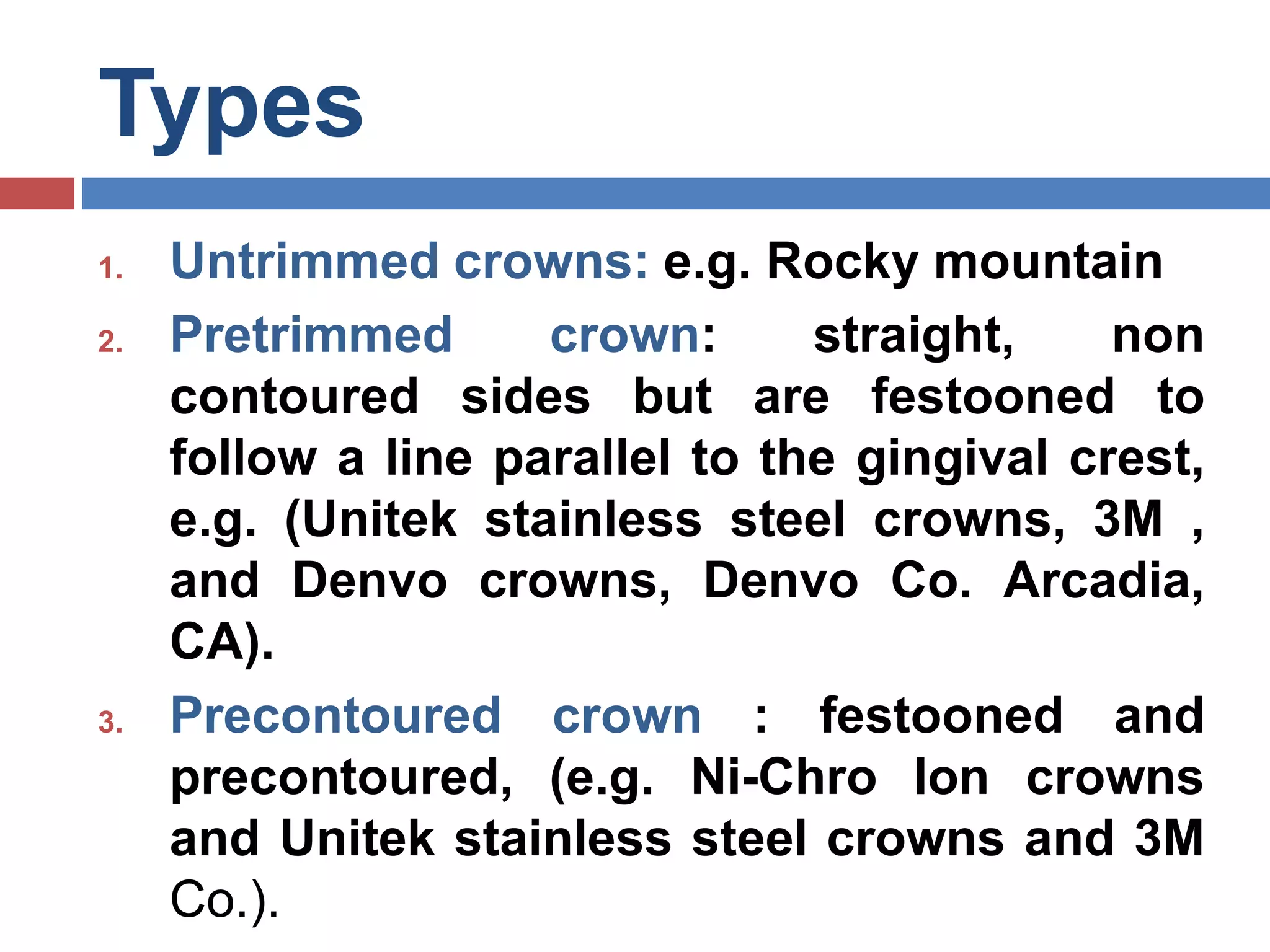
1. Untrimmed crowns: e.g. Rocky mountain
2. Pretrimmed crown: straight, non
contoured sides but are festooned to
follow a line parallel to the gingival crest,
e.g. (Unitek stainless steel crowns, 3M ,
and Denvo crowns, Denvo Co. Arcadia,
CA).
3. Precontoured crown : festooned and
precontoured, (e.g. Ni-Chro Ion crowns
and Unitek stainless steel crowns and 3M
Co.).
COMPOSITION
Composition
17-19% chromium
10-13% nickel
67% iron
4% minor element
 Nickel – base Crowns
72% nickel
14%chromium
6-10% Iron
0.04% carbon
0.35% manganese
0.2% silicon
Stainless Steel
Crowns
Nickel – base Crowns
 Nickel – base Crowns
• The alloys have good formability
and ductility necessary for clinical
adaptation of crowns and wear
resistance to resist opposing
occlusal forces.
Success of SSC Vs. Amalgam in
Primary Molars
 The success rate of SSCs vs.
multi-surface amalgams goes up
dramatically for restorations place
in children under the age of 4
years.
Reasons Given for Not Placing
Stainless Steel Crowns
 Time Consuming to Fit
 Difficult to Manipulate
 Expensive
 Ugly!!!!!!
DISADVANTAGES
Disadvantage of SSC
 Time Consuming
 Difficult to Manipulate
 Expensive
 Ugly
Stainless Steel Crowns are
Fast!!!
Most pediatric dentists
can place one in 10
minutes or less-you can
too!
Stainless Steel Crowns
are just as easy to
manipulate as a matrix
band!
What About Metal Allergy?
 SSCs contain nickel and chromium. It
is the nickel which may elicit an
allergic response in some patients.
 Although more prevalent in females,
intraoral allergic responses seem to be
more minimal than extraoral responses
and also ‘scarce.’
What About Gingival Health?
 “Plaque accumulation and frequency of
gingival problems associated with
SSCs in primary teeth seem to be
unexceptional”
 Some increased inflammation is seen
in permanent dentitions after puberty.
INDICATIONS
Indications:
1. After pulpal therapy
2. Multi-surface carious lesions
3. Proximal box extended beyond ideal
4. Restoration of caries in high risk caries
patients
5. Teeth with extensive attrition
6. Behavior changes
7. For teeth deformed by developmental defects
or anomalies.
8. For teeth with hypoplastic defects.
9. As an abutment.
10. Temporary restoration of a fractured tooth.
11. Single tooth crossbite.
SSC Indications
Large, Deep Caries Caries on 3 or more surfaces
SSC Indications
Following Pulp Therapy
SSC Indications
Large, Deep Caries Enamel Hypoplasia
1st Permanent Molars
PREPARATION
Anatomical Differences
Primary vs. Permanent
A. Enamel Thickness
B. Dentin Thickness
C. Pulpal Size
D. Gingival Bulge
View of Buccal Cervical Bulge:
This is what retains an SSC
“Sweetspot” Remains
SSC Technique
Proper Crown Fit: There are no crown
margins
The SSC fits over the remaining crown and
adapts with a crimped contour.
SSC Technique
Clinical Procedure
 Evaluate the preoperative occlusion
 Selection of crown
The correct size crown is selected by the
M-D dimensions of the tooth to be restored
using Boley gauge.
THE “SLOPPY BOX”
TECHNIQUE
Stainless Steel Crown Preparation
Cut an MOD Prep #330 Bur
Reduce Occlusal 45 Degrees
Lingual Cusp Reduction-Use
Base of MOD Prep as Guide
1-1.5 mm Buccal Counterbevel
Lingual Counterbevel
Round Proximal Box From Line
Angle to Line Angle
Mesial Prep Complete/Distal Not
Complete
No Gingival Seat Ledge Remains
on Mesial!
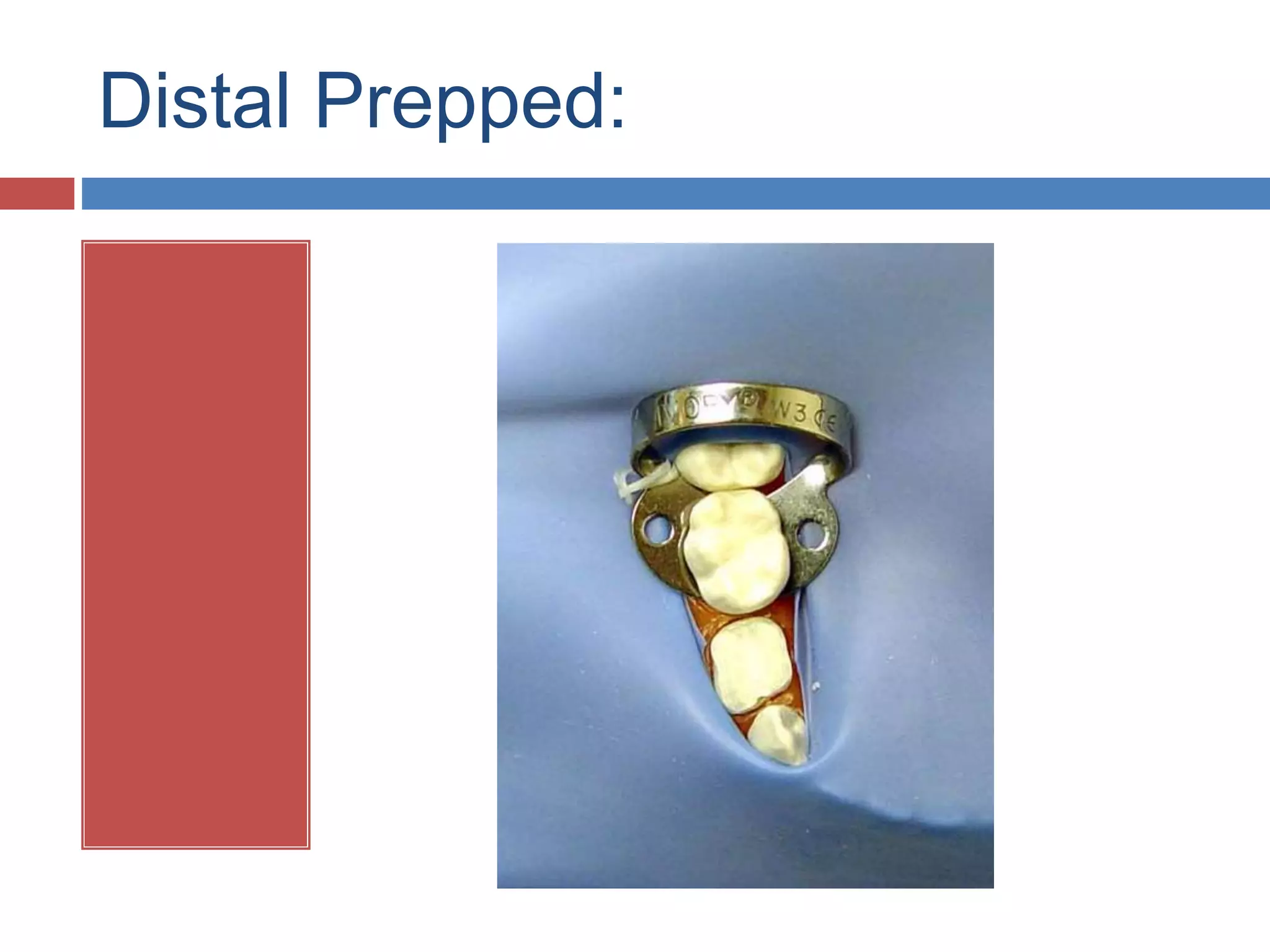
Distal Prepped:
Note: Rounded Line Angles
Occlusal Reduction: Adequate for
Height of SSC ~1-1.5 mm
Select SSC for Mesial-Distal Space:
Usually Rocks on From Lingual to
Buccal
Should “Snap” into Place Over Cervical
Bulge
Check for Open Margins
Remove With Sturdy Instrument
Crimping To Adapt Margins
Band Contouring Plier
Note: Adapted Margins
Uncrimped vs. Crimped
Patient Bites Into Occlusion
Confirm Occlsion
“Depth Groove” Technique
Cut Occlusal Guides #330 Bur
Occlusal Depth Grooves
Connect Depth Grooves
Connecting Depth Grooves
Placing Counterbevel
Counterbevels Complete
Slicing Proximals
Prep Complete
Initial adaptation of crown
 Two principles related to SSC length and margin shape that
are based on an understanding of the tooth morphology and
gingival tissue contours.
 The crown should be of a correct length and its margins
should be adapted closely to the tooth.
 For shaping the crown margins mark 3 light points on the
metal at the (mesiolingual, lingual and distolingual)and at
(mesiobuccal, buccal, distobuccal) surfaces at the crest of
respective marginal gingiva without compressing the
marginal gingiva.
 Final finished margins are placed approximately 1mm below
these marks.
Seating the crown
 Now the crown is tried on the
preparation by seating the lingual first
and applying pressure in a buccal
direction so that the crown slides over
the buccal surface into the gingival
sulcus.
 Resistance should be felt as the crown
slips over the buccal bulge.
Crown contouring
 Initial crown contouring is performed with a
114 plier in the middle 1/3rd of the crown to
produce a belling effect.
 This will give the crown a more even
curvature.
Crown crimping
 The tight marginal fit aids in:
1. Mechanical retention of the crown.
2. Maintenance of gingival health.
3. Protect of cement from exposure to oral
fluids.
CROWN CONTOURING
Crown crimping
Checking the final adaptation of the
crown
 The crown should be replaced on the
preparation after the contouring procedure
to see that it snaps securely into place.
 The occlusion should be checked at this
stage to make sure that the crown is not
opening the bite or causing a shifting of
mandible into an undesirable relationship
with opposing teeth.
Finishing and polishing
 Accumulation of plaque and inflammation of
gingiva is commonly seen in practice of
restorative dentistry due to rough and
unpolished restoration.
 To avoid these complications crown should
be polished prior t o cementation with
rubber wheel to remove all scratches.
Radiographic confirmation of the
gingival fit
 Before cementation a bitewing is taken
to verify proximal marginal integrity
Cementation
 SSC should be cemented
only on clean dry mouth, isolation of teeth
with cotton roll is recommended.
 Rinse and dry the crown inside & out side
and prepare to cement it.
 A zinc phosphate, polycarboxylate or GIC
is preferred.
 Before the cements set ask the patient to close
into centric occlusion by applying pressure
through a cotton roll and confirm that the
occlusion has not been altered.
 Remove the excess cement by an explorer or
scaler & for interproximal area can be cleaned by
passing dental floss through them.
Result
SPECIAL
CONSIDERATION
special consideration for ssc
 Quadrant dentistry
-Prepare the occlusal reduction of one tooth
completely before beginning the other ………
-Reduce the adjacent proximal surface of the
teeth being restored more than when only one
tooth is restored……..
-Both crown should be trimmed, contoured and
prepared before cementation simultaneously to
allow for adjustment in inter proximal space
and establish proper contact area.
Crown in area of space loss
……………………………………….
Preparing a SSC adjacent to a
class II amalgam
……………………………………………
…..
Undersize tooth or the oversize
crown.
……………………………………………
Undersize tooth or the
oversize crown.
…………………………………….
Oversize tooth or undersize
crown
…………………..
Deep subgingival caries.
…………………………
Open contact.
…………………
Crown tilt.
………………………..
Poor margins
Complications
 Inhalation or ingestion of crown.
 QUESTIONS ARE WELCOMED

Stainless steel crowns for primary teeth